The Didache — Old Enough for the Canon, and Still Left Out

On This Page
Part of the series: The New Testament Canon—How 27 Books Survived the Ancient Gauntlet
Every near-miss in this series so far has failed a test we can name. The Shepherd of Hermas, on the Muratorian Fragment’s own account, could not be read publicly in church “either among the Prophets, whose number is complete, or among the Apostles, for it is after [their] time.”1 The Epistle of Barnabas bore an apostle’s name but could not carry a date early enough to make the name plausible. 1 Clement was read aloud in church at Corinth for generations and still lost, because Clement was a disciple of the apostles rather than one of them.
The Didache breaks the pattern. It may well be older than the last books that made it in.
That is the problem worth a post. If the criterion for the New Testament were antiquity, or even proximity to the apostolic generation, the Teaching of the Twelve Apostles would have a stronger claim than 2 Peter has on the dating most critical scholars give it. It has no such claim, and it never did. It sits in no ancient Bible, does not appear in the stichometric inventory bound inside a New Testament manuscript, and passed out of circulation so completely that for something like thirteen centuries no one in the Latin West, and almost no one in the Greek East, is known to have read it.
So the Didache isolates the question the whole series is really about. Strip away the date, and what is left? What did the Church think a canonical book was, such that a document plausibly written while apostles were still alive could fail to be one?
The answer, I will argue, has to do with what kind of book it is. But that argument is mine, and it runs into a real objection that I will meet head-on rather than hide.
What the Didache actually is
The manuscript gives the book two titles, one after the other. The heading reads Διδαχὴ τῶν δώδεκα ἀποστόλων, “Teaching of the Twelve Apostles.” The first line of text then expands it: Διδαχὴ κυρίου διὰ τῶν δώδεκα ἀποστόλων τοῖς ἔθνεσιν, “Teaching of the Lord through the Twelve Apostles to the Nations.”2
Notice what neither title claims. Neither says an apostle wrote this. Both say the teaching came through the apostles, which is a claim about the pedigree of the content, not the identity of the author. No apostle speaks in the first person anywhere in the sixteen chapters. No apostle is named. The only voices in the book are an impersonal instructor addressing “my child” and a liturgical “we.”
This matters more than it may seem, and I will return to it.
The book is short—sixteen brief chapters, readable in a sitting—and it falls into four movements. Chapters 1 through 6 are a moral catechism built on the image of two ways, one of life and one of death. Chapters 7 through 10 give liturgical directions: how to baptize, when to fast, how to pray, what to say over the cup and the bread. Chapters 11 through 15 handle church governance, and especially the awkward practical problem of wandering prophets who may or may not be frauds. Chapter 16 is a short apocalypse, and it stops mid-thought.
Taken together, this is the earliest surviving Christian church order—a manual of communal practice rather than a gospel, a letter, or a vision.3 The genre it inaugurated ran for centuries: the Apostolic Tradition, the Didascalia Apostolorum, the Apostolic Church Order, the Apostolic Constitutions.
The label is not universally loved. Thomas O’Loughlin has argued that reading the Didache as a manual for clergy reflects nineteenth-century assumptions rather than the text, and that the book is better understood as an introduction for people newly joining the community.4 He has a point, and it converges with Aaron Milavec’s reading of the book as a training program for converts. I use “church order” below because it is the standard term and because the dispute is about emphasis rather than substance. Either way, the Didache tells a community how to run itself.
The date question, honestly
Here is where the Didache earns its place in this series, and here is also where writers about it routinely overreach.
The case for a very early book
Jean-Paul Audet, in the 1958 study that reopened the whole question, placed the Didache between roughly 50 and 70, probably at Antioch.5 Aaron Milavec argued the same window on different grounds, treating the book as a unified oral composition created independently of any written gospel.6 Willy Rordorf and André Tuilier, whose critical edition remains standard, put it in the second half of the first century; their volume is presented by its publisher as a manual “almost contemporary with the gospels.”7
The arguments are cumulative and, taken alone, impressive. The ministry the Didache describes is itinerant: apostles, prophets, and teachers wander from community to community, and the local officers are two, not three—bishops and deacons, with no presbyters and no single presiding bishop. The eucharistic prayers of chapters 9 and 10 contain no institution narrative, no words over the body and blood, no reference at all to the death of Jesus. The cup is blessed before the bread, reversing the order in Paul and the Synoptics. Jesus is called God’s pais, “servant” or “child,” an archaic title that drops out of Christian usage early. And chapter 6 treats the question of food offered to idols as live and unsettled, which is difficult to imagine long after the first century.
The case against
Robert Kraft supplied the standard answer, and any argument from primitiveness has to get past it:
All that can emerge is the twofold impression: the Didache contains a great deal of material which derives from very early (i.e., first-century and early second-century) forms of (Jewish-)Christianity; but it would be difficult to argue convincingly that the preserved form (that is, in H) of the Didache is earlier than mid-second century. The very conservative nature of the church manual tradition … is sufficient explanation for the “primitive” factors in the Didache.8
That is the objection in one paragraph. Church orders are a conservative genre. They preserve archaic-looking practice long after the practice has changed, because their whole purpose is to transmit what was received. An old-looking church order may simply be a well-behaved church order.
Kurt Niederwimmer, whose commentary is the standard scholarly treatment, placed the final redaction around 110 to 120 while granting that the sources behind it are first-century.9 Huub van de Sandt and David Flusser, who did more than anyone to reconstruct the Jewish material underneath, were blunt about the limits: “In making a statement about the date and place of origin of the Didache, no answer can pretend to be better than a reasonable guess. The many differing opinions show how meagre and puzzling are the clues given by the Didache.”10
Where this leaves us
The center of gravity is around the year 100. Bart Ehrman states it plainly: “As to the date of the Didachist himself, opinions again vary, but most would put the time of his composition sometime around the year 100, possibly a decade or so later.”11 Jonathan Draper reached the same place from the other direction—“a date for the Didache in its present form later than the second century must be considered unlikely, and a date before the end of the first century probable”—and noted that a consensus was forming around 100.12
This is not a recent development. John Chapman wrote in 1908 that “the commoner view is that which puts the Didache before 100.”13 The pre-100 majority is over a century old.
One further complication has to be stated rather than smoothed over. Most scholars regard the Didache as composite—assembled from earlier sources by a redactor, in layers.14 Niederwimmer identified four: a Jewish Two Ways tract, archaic liturgical material on baptism and the Eucharist, a tradition about receiving itinerant charismatics, and an apocalypse whose ending is lost.15 If that is right, then “the date of the Didache” is a window across strata rather than a point on a line, and every claim about what it predates has to specify which layer is meant.
What the Didache would, and would not, predate
Now the discipline. On the mainstream date of roughly 100, and even on the early date of 50 to 70, the honest comparisons are narrower than enthusiasts suggest.
The Didache’s best comparison is 2 Peter, very often identified as the latest book in the New Testament and placed by Raymond Brown most likely around 130, give or take a decade. That comparison is real but not free. Richard Bauckham’s influential dating of about 80 to 90 would put 2 Peter earlier than the mainstream date for the Didache, and defenders of Petrine authorship put it in the 60s. So the honest statement is that on the critical dating of 2 Peter the Didache is plausibly earlier, and on the traditional dating it is not. Against the Johannine epistles, usually dated 90 to 110, the ranges overlap the Didache’s too closely for a priority claim. On the early dating the Didache may be earlier than the Pastoral Epistles and possibly than the Gospel of John, though both of those collide with its own ceiling and the word is may.
Against Mark, Matthew, Luke and Acts, Hebrews, James, and Jude, no priority claim is possible. Their ranges overlap the Didache’s, and the overlap cannot be resolved by dating alone.
So the defensible sentence—the one that requires no contested premise and that I will rest the argument on—is this. The Didache is one of the earliest Christian writings outside the New Testament, it is plausibly contemporary with much of the New Testament, and on the dating most critical scholars give 2 Peter it is older than the last book to make it in.
That is enough. The lateness objection that disposed of Hermas and Barnabas does not dispose of the Didache. Something else did.
A book assembled, not written
Before the exclusion, one more feature of the book matters, because it bears directly on why the Didache could not be what a canonical book is.
The Two Ways material in chapters 1 through 6 did not originate with the Didache. Nearly the same material appears in the Epistle of Barnabas, chapters 18 through 20, and again in a Latin tract called the Doctrina apostolorum, which preserves the Two Ways without the Christian additions and stops where the Didache’s sixth chapter stops.16
For a long time scholars argued about which of the two copied the other. That debate is essentially over. The dominant view—and Kraft’s own, stated as “the present tendency” as long ago as 1965—is that Barnabas and the Didache drew independently on a common Two Ways source that neither of them used directly.17 Harnack’s early view that the Didache used Barnabas has been generally abandoned; Harnack himself changed his mind.18
The underlying source appears to be Jewish. The two-ways image is thoroughly at home in the Hebrew Scriptures—Deuteronomy sets life and death before Israel, Jeremiah sets the way of life against the way of death, the first Psalm contrasts two paths—and a heavily dualistic development of it turns up at Qumran in the Treatise on the Two Spirits.19
The Qumran connection is regularly overstated, so let me mark the limit. The Didache’s version has life and death, not light and darkness. It has no angels, no cosmic determinism, no sectarian wall between the sons of light and everyone else. Barnabas has the two angels; the Doctrina has the two angels; the Didache does not. Draper, who wrote his dissertation on the question, concluded flatly that “the Didache is not an Essene document, as some had claimed, but … in every place where a comparison is possible, the Didache is closer to Pharisaism/proto-Rabbinism than to the Dead Sea Scrolls.”20 Say that the Didache draws on a common Jewish tradition and you are on solid ground. Say that it draws on Qumran and you are wrong.
What matters for this post is simpler than the source criticism. The Didache is a compilation. Its moral core is inherited Jewish catechesis lightly Christianized; its liturgical core is community practice written down; its church-order core is administrative instruction. A redactor gathered these and gave them a shape. The book is a deposit of what a community already did.
Hold that thought.
What the earliest Christians were doing
The reason the Didache is worth reading has little to do with the canon and everything to do with its contents. It is a photograph of a working Christian community taken while the paint was still wet.
Baptism
And concerning baptism, baptize this way: Having first said all these things, baptize into the name of the Father, and of the Son, and of the Holy Spirit, in living water. But if you have not living water, baptize into other water; and if you can not in cold, in warm. But if you have not either, pour out water thrice upon the head into the name of Father and Son and Holy Spirit. But before the baptism let the baptizer fast, and the baptized, and whatever others can; but you shall order the baptized to fast one or two days before.21
Four things sit in that paragraph, and the fourth is the one people fight about.
First, catechesis precedes the sacrament. “Having first said all these things” refers back to chapters 1 through 6—the Two Ways is baptismal preparation. This is the structural key to the whole book: the moral catechism exists to be recited over a candidate. The Didache is a catechumenate manual.
Second, the formula is Trinitarian, matching Matthew 28:19, in one of the document’s archaic liturgical strata. That is worth noting against reconstructions positing a universal original practice of baptism in the name of Jesus alone. The Didache itself, however, is not tidy here: chapter 9 speaks of those “baptized into the name of the Lord,” so the book uses both formulas and honesty requires saying so.
Third, both the minister and the candidate fast beforehand, along with anyone else who can manage it. The seed of the catechumenate, and arguably of Lent, is visible.
Fourth, and famously, the Didache authorizes baptism by pouring. When there is no running water, no still water, and no choice between cold and warm, the instruction is to pour water three times on the head. The Didachist does not say to wait for better conditions, or to travel to a river, or that the result is something less than baptism. He gives the formula for doing it.
That is a genuinely strong datum, and it is nearly impossible for a strict immersion-only position to absorb. But it should be stated precisely. The Didache does not present pouring as the normal or preferred mode—it sits at the bottom of a graded hierarchy, introduced by “if you have not either.” The text is silent about infant baptism and cannot be pressed either way. It names no minister at all. What it demonstrates is narrower and harder than the popular version: that within living memory of the apostles, a Christian community treated pouring as producing a real baptism, and wrote down how to do it.
Fasting and the Our Father
But let not your fasts be with the hypocrites; for they fast on the second and fifth day of the week; but fast on the fourth day and the Preparation (Friday). Neither pray as the hypocrites; but as the Lord commanded in His Gospel, thus pray: Our Father who art in heaven … for Yours is the power and the glory forever. Thrice in the day thus pray.22
Two practices are fixed here that outlasted the document by nineteen centuries. Christian fast days are deliberately offset from the Jewish ones—Wednesday and Friday against Monday and Thursday—and that Wednesday-and-Friday pattern survives as the Friday abstinence of the Latin Church and the Wednesday-and-Friday fast of the Byzantine churches. And the Lord’s Prayer is prayed three times daily, taking the place of the thrice-daily Jewish office. The Catechism makes precisely this point and cites precisely this verse.23
The doxology deserves care, because it is a favorite of overreach. The Didache’s version reads “for yours is the power and the glory forever”—two members, power and glory. It has no “the kingdom,” and no “amen.” The best manuscripts of Matthew have no doxology at all at Matthew 6:13, and Bruce Metzger, discussing that variant, names the Didache by name and groups it with the Sahidic and Fayyumic Coptic as witnesses that lack “the kingdom and.”24 Tertullian, Origen, and Cyprian all walk through the petitions of the Lord’s Prayer and end at deliverance from evil, with no doxology to expound.25
The safe conclusion is that the Didache shows the doxology already attached to the Lord’s Prayer in liturgical use, in a shorter form than the one that later entered the Matthean manuscript tradition—exactly what one expects if the doxology grew. The unsafe conclusion, which should be avoided, is that the Didache preserves the original ending of Matthew. It does not, and neither Metzger nor the manuscripts support it. The same two-membered cadence is the Didachist’s own house style, appearing again at Didache 10:5.
The Eucharist
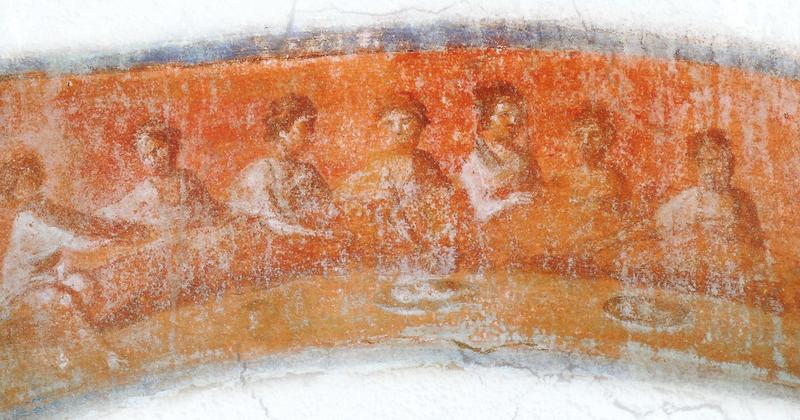
Chapters 9 and 10 give thanksgiving prayers over a cup and broken bread, including the image that made the Didache famous:
Even as this broken bread was scattered over the hills, and was gathered together and became one, so let Your Church be gathered together from the ends of the earth into Your kingdom.26
And then a fence:
But let no one eat or drink of your Thanksgiving (Eucharist), but they who have been baptized into the name of the Lord; for concerning this also the Lord has said, Give not that which is holy to the dogs.27
Chapter 14 is different in vocabulary and frame:
But every Lord’s day gather yourselves together, and break bread, and give thanksgiving after having confessed your transgressions, that your sacrifice may be pure. But let no one that is at variance with his fellow come together with you, until they be reconciled, that your sacrifice may not be profaned. For this is that which was spoken by the Lord: In every place and time offer to me a pure sacrifice; for I am a great King, says the Lord, and my name is wonderful among the nations.28
The word rendered “sacrifice” is θυσία, and it occurs three times in that short chapter.29 The quotation conflates two verses of Malachi rather than one—the pure offering of Malachi 1:11 joined to the great King and the wonderful name of 1:14.30
For a Catholic reader the passage is remarkable. The Sunday assembly’s breaking of bread is called a sacrifice, three times, unprompted; sins are confessed beforehand so that the sacrifice may be pure; reconciliation with one’s neighbor is a condition of participation; and Malachi’s prophecy of a pure offering among the nations is read as fulfilled in it. That is a sacrificial understanding of the Eucharist, in place, in a document plausibly of the apostolic generation.
Yet the scholarly picture is genuinely contested, and pretending otherwise would be a disservice. What chapters 9 and 10 describe has been argued over for a century. They contain no institution narrative and no reference to the Lord’s death; the cup precedes the bread; chapter 10 opens “after you are filled,” implying a real meal. Some have read the chapters as an agape rather than a Eucharist. Hans Lietzmann read them as eucharistic throughout and held that the Eucharist of chapter 14 is none other than that of chapters 9 and 10.31 Audet took chapter 10’s “if anyone is holy, let him come” as the hinge into a eucharistie majeure celebrated on Sunday—the rite of chapter 14.32 Niederwimmer likewise read that line as an invitation to approach the eucharistic celebration.33
And the sacrificial reading of chapter 14 has a serious critic. Alistair Stewart argues that the θυσία language is generated by a chain of catchwords running from the firstfruits material of chapter 13 through a dominical command to Malachi, rather than by an inherited sacrificial doctrine of the Eucharist; that “break bread and give thanks” were neutral terms for beginning any meal; and that the chapter’s concern is the reconciled state of the participants rather than any grace received. He concedes the limit of his own case honestly: “we cannot say that this meal has no eucharistic character, but the text does not speak of any.”34
The fair summary is this. The question of what Didache 9 and 10 describe is open and has been for a hundred years. But the scholars most skeptical that those chapters are eucharistic generally grant that chapter 14 is—and Stewart, who denies that chapter 14 is eucharistic, locates the eucharistic material in chapters 9 and 10 instead. Nearly every position on the board locates a Eucharist somewhere in this document. What is contested is where.
Ministry
The Didache’s church order is the passage most often deployed against Catholic claims, and the deployment is not frivolous.
Therefore, appoint for yourselves bishops and deacons worthy of the Lord, men meek, and not lovers of money, and truthful and proven; for they also render to you the service of prophets and teachers.35
The word for “appoint” is χειροτονήσατε—elect by a show of hands—and it is addressed to the community in the second person plural, with the reflexive “for yourselves.” Πρεσβύτερος, presbyter, does not occur anywhere in the Didache. Ἐπίσκοπος and διάκονος each occur exactly once, in that one clause, both plural.36 There is no monarchical bishop, no ordainer standing above the community, and no language of apostolic succession anywhere in the book. Worse for the tidy account: chapter 15 comes after the chapters on apostles, prophets, and teachers, and it justifies the local officers by saying they “also” perform the service of the prophets and teachers and are to be honored “along with” them. The charismatics legitimate the officers, not the reverse.
The Catholic response is not new and not weak. Chapman made every move of it in 1908: the bishops here “are clearly presbyter-bishops, as in Acts 20, and in the Pastoral Epistles of St. Paul,” which is to say the Didache is not missing an order but using earlier vocabulary, exactly as Acts 20 uses presbyteros and episkopos of the same men.37 The connective at the head of chapter 15 is real and load-bearing: chapter 14 concerns the Sunday sacrifice, and chapter 15 begins “therefore.” As Chapman put it, it is for the sacrifice that bishops and deacons are to be ordained. And a sacerdotal category is already present in the document—chapter 13 calls the prophets “your high priests” and assigns them the firstfruits.38
One redactional detail is telling. When the Apostolic Constitutions reworked this very passage in the fourth century, the compiler wrote: “Do you first ordain bishops worthy of the Lord, and presbyters and deacons.”39 He silently inserted the missing middle order. That is what one expects if the Didache’s two-order language felt archaic rather than heretical.
Still, the honest Catholic position concedes more than apologetics usually does. Francis Sullivan, whose study of the development of the episcopate is the standard Catholic treatment, grants that no single bishop presided over any Christian community until the early second century and that the claim of an unbroken line of episcopal ordination from Christ through the apostles is unsustainable as history. His argument is that the development is nonetheless divinely willed—which relocates the question from history to theology.40 That is the right place for it. The Didache does not show the monepiscopate, and a Catholic does not need it to.
And one line that has never needed defending
You shall not murder a child by abortion nor kill that which is begotten.41
Barnabas has effectively the same sentence, which means that on the majority reconstruction the prohibition comes from the Two Ways source and is older than either document.42 The Catechism quotes it, and its footnote cites Barnabas alongside it—preserving the pairing that source criticism uncovered.43
The book that no Bible ever carried
Now the exclusion, which is stranger than the standard account allows.
Eusebius mentions the Didache in his survey of disputed writings, and the sentence is worth quoting in full because the categories are finer than the textbooks suggest:
Among the rejected writings must be reckoned also the Acts of Paul, and the so-called Shepherd, and the Apocalypse of Peter, and in addition to these the extant epistle of Barnabas, and the so-called Teachings of the Apostles; and besides, as I said, the Apocalypse of John, if it seem proper, which some, as I said, reject, but which others class with the accepted books.44
The word rendered “rejected” is νόθα, literally “bastard” or “spurious.” It is commonly presented as one of four coordinate categories in a tidy Eusebian scheme. It is not. In the very next section he writes that “all these may be reckoned among the disputed books”—folding the νόθα back into the ἀντιλεγόμενα as a subdivision rather than a rival class. And he then defines a further group negatively: the Gospels of Peter, Thomas, and Matthias and the like are “not to be placed even among the rejected writings, but are all of them to be cast aside as absurd and impious.”45
So Eusebius does not condemn the Didache. He classes it with Barnabas, Hermas, the Apocalypse of Peter, and the Acts of Paul in a bin of contested-but-not-heretical books, and then says explicitly that a further class of writings is unfit even for that bin. Note also the plural: αἱ λεγόμεναι διδαχαί, “the so-called Teachings.”
Athanasius is more generous, and more revealing. His thirty-ninth Festal Letter of 367 contains the earliest surviving list of exactly the twenty-seven books of our New Testament. Immediately after it he adds:
But for greater exactness I add this also, writing of necessity; that there are other books besides these not indeed included in the Canon, but appointed by the Fathers to be read by those who newly join us, and who wish for instruction in the word of godliness. The Wisdom of Solomon, and the Wisdom of Sirach, and Esther, and Judith, and Tobit, and that which is called the Teaching of the Apostles, and the Shepherd. But the former, my brethren, are included in the Canon, the latter being [merely] read; nor is there in any place a mention of apocryphal writings. But they are an invention of heretics.46
This passage is quoted constantly as a compliment to the Didache, and it is nothing of the kind. Read the paragraph as a whole and the shape becomes clear: Athanasius is building a fence. The list of readable books exists to specify what may be read to catechumens, precisely so that nothing else may be—and the very next clause is an attack on apocrypha. The Didache is named on the safe side of a wall going up.
The company is instructive too. In 367 the Didache stands alongside the Shepherd of Hermas and, remarkably, Esther, the one book of the Hebrew canon Athanasius demoted.47 Being read to catechumens is a real endorsement of usefulness. It is also, and explicitly, a denial of canonicity.
The other ancient book lists yield less than is often claimed, and each has to be checked individually rather than taken on a summary’s word.
The Stichometry of Nicephorus does list a Doctrina apostolorum at two hundred lines—but under New Testament apocrypha, one category below the four disputed books, not among them.48 The pseudo-Athanasian Synopsis of Sacred Scripture lists a Διδαχὴ ἀποστόλων among New Testament antilegomena, and then immediately says of that whole group that they “are wholly interpolated, spurious, and to be rejected.”49 The List of Sixty Books has an entry reading “Circuits and Teachings of the Apostles,” a single composite title that may or may not denote our text.50 Rufinus names a Duae viae vel Iudicium Petri—“Two Ways, or the Judgment of Peter”—among the books he calls ecclesiastical, read in churches but not appealed to for the confirmation of doctrine; whether that is the Didache, the Latin Doctrina, or some other Two Ways document is disputed.51
Two negatives are worth stating carefully. The Muratorian Fragment does not mention the Didache—though the Fragment is mutilated at both ends, so this is an argument from damaged silence and should not be pressed.52 And Jerome, who catalogued Christian literature exhaustively in De viris illustribus and repeatedly enumerated the disputed and ecclesiastical books, never names the Didache in any of those lists.53 That last silence is loud. Jerome had opinions about the Shepherd of Hermas and recorded them. About the Didache he says nothing at all.
One more claim needs deflating, because it appears in nearly every popular treatment. Clement of Alexandria is regularly said to have cited the Didache as Scripture. What Clement actually writes is that a plagiarist “is by Scripture called a ‘thief.’ It is therefore said, ‘Son, be not a liar; for falsehood leads to theft.’”54 The maxim is close to Didache 3:5 but not identical—Clement has “Son,” the Didache has “My child”—and, decisively, Otto Stählin’s critical apparatus splits the two clauses, keying the word “Scripture” to John 10:8 and only the following sentence to the Two Ways material.55 Clement demonstrably quotes a Two Ways sentence. That the Two Ways reached him as our Didache, and that “Scripture” governs the quotation, are inferences—and the standard critical edition takes the word the other way. Didymus the Blind does name the Didache, but files it as “the book of the catechesis,” the same label he gives the Shepherd.56
The evidence that settles it
All of that is a matter of degree—named here, demoted there, ignored by Jerome. The decisive fact is physical.
The Shepherd of Hermas and the Epistle of Barnabas are bound into Codex Sinaiticus, following Revelation.57 1 Clement and 2 Clement are bound into Codex Alexandrinus.58 Those books came near the canon in the most literal way available: a scribe made a Bible and copied them into it.
No surviving biblical manuscript contains the Didache. Not one.
Its principal Greek witness is an eleventh-century collection of patristic texts. Its only other Greek witness is a pair of fourth-century parchment scraps about two inches square, from a small Didache-only codex.59 Its Coptic witness is a single sheet that was subsequently reused for scribal exercises.60 The Ethiopic material is an excerpt embedded inside another church order.61 Every surviving physical object that carries the Didache is a church order, a patristic miscellany, a standalone booklet, or a writing exercise. Never a Bible.
And there is a sharper piece of evidence still. Bound into Codex Claromontanus—a sixth-century Greek and Latin manuscript of Paul’s letters—there sits a stichometric catalogue, a list of books with their line counts of the sort a scribe would use to price a copying job. It runs through the Old and New Testaments, slipping Barnabas in at 850 lines between Jude and Revelation, and then closes with three more titles: the Shepherd at 4,000 lines, the Acts of Paul at 3,560, the Apocalypse of Peter at 270.62
Every book Eusebius names in that one sentence appears on this list except the Didache. The exact company the Didache keeps in Eusebius—Barnabas, Hermas, the Acts of Paul, the Apocalypse of Peter—stands in a working inventory bound physically inside a New Testament manuscript, priced out by the line. The Didache does not.
It was not merely left out of the canon. It seems not to have been in the working inventory of the people who made Bibles.
Why the Didache was left out
So we have a book that is old enough, orthodox enough to be read to catechumens by the bishop who fixed the twenty-seven, and useful enough that its contents shaped Christian practice for two thousand years—and that never came close.
The traditional criteria named in the literature are apostolicity, orthodoxy, and catholicity of use. The Didache passes the second easily. Its claim on the third is weaker than it looks. On the first it fails, but not in the way the other near-misses failed.
Hermas and Barnabas failed apostolicity because they were too late to be apostolic. The Didache does not fail on the calendar. It fails on something else, and the titles say what it is.
Neither title claims apostolic authorship. Both claim apostolic transmission: teaching of the Lord, through the twelve, to the nations. That is a claim about where the content came from, not about whose testimony it is. And a New Testament book is testimony—testimony in the strict sense of first-hand apostolic report, not merely the faithful transmission of what was received. The Gospels testify to what Jesus did and said; Acts testifies to what the apostles did; the epistles are apostolic voices addressing churches; Revelation is a vision received and reported. In every case a named or implied witness stands behind the text and says, in effect, this is what I saw, this is what I received, this is what I now hand on to you.
The Didache does none of that. No one speaks. It is the community’s own housekeeping written down—how to baptize when the river is dry, which days to fast, how long to feed a traveling prophet before concluding that he is a fraud. It is the Church talking to herself about her own practice.
That is a genuinely different kind of document, and I think it is the reason. The canon is the collection of apostolic witness, and a manual of practice is not a witness, however old it is and however apostolic its practice. The Didache is a monument of Tradition, and the Church has always distinguished Tradition from Scripture rather than collapsing them. The Didache is on the Tradition side of a line the Church drew, and it is on that side by nature and not by date.
The objection
I said I would meet the obvious objection rather than avoid it, and here it is.
If genre were really disqualifying, no church order would ever have been canonized by anybody. But one was. Apostolic Canon 85, the closing canon of the eighth book of the Apostolic Constitutions, enumerates the sacred books of the New Testament and includes “the Constitutions of me Clemens, addressed to you Bishops, in eight books”—that is, the very church order in which the canon itself stands. It also includes both epistles of Clement, and it omits Revelation.63
That is a real counterexample and I will not pretend otherwise. Someone in the fourth-century Syrian church did put a church order in the canon.
Three things blunt it without dissolving it. The first is that Apostolic Canon 85 is a self-referential document canonizing itself, and even the canon’s own text hedges—the Constitutions are “not to be published to all on account of the mystical things in them,” which is a strange thing to say about Scripture. The second is that the list carries the fingerprints of its region: it drops Revelation, as the fourth-century Greek lists of Cyril of Jerusalem, Gregory of Nazianzus, and the Council of Laodicea also do, and as no Latin list does. That is an Eastern regional canon rather than the Church’s. The third, and most telling, is that the compiler of the Apostolic Constitutions had swallowed the Didache whole into his seventh book and did not name the Didache in his canon—he named his own expansion of it. The source was invisible even to the man using it.
There is also a point of method worth conceding plainly. I have not found a scholar who argues that genre as such constrained the canon. The criteria named in the scholarly literature are apostolicity, orthodoxy, and usage, not genre. What I am offering is a reading of what “apostolicity” meant in practice—that it meant apostolic testimony rather than apostolic pedigree—and the Didache is the test case that makes the distinction visible, because it has the pedigree and lacks the testimony. Take it as an argument, not as a report of consensus.
Lost, and not lost
The Didache then did something none of the other near-misses did. It disappeared.
Hermas, Barnabas, and 1 Clement were copied, bound, read, and preserved. The Didache was known by title from the canon lists—Eusebius, Athanasius, Nicephorus, the Synopsis—while the text itself passed out of circulation. For something on the order of thirteen centuries, no one who wrote about the Didache had read it.
Then, in 1873, a Greek scholar named Philotheos Bryennios was working through the library of the Monastery of the Holy Sepulchre in Constantinople and found a parchment codex of a hundred and twenty leaves. He was not yet a bishop; he was head of the Patriarchal Great School in the Phanar.64 The manuscript was signed and dated by its scribe: “Finished in the month of June, upon the 11th (of the month), day 3d (of the week, i.e., Tuesday), Indiction 9, of the year 6564. By the hand of Leon, notary and sinner.”65 The year 6564 of the Byzantine era is 1056.
Bryennios published the two epistles of Clement from the codex in 1875. He published the Didache in 1883.66
The contents of that codex are themselves an argument. It opens with a synopsis of the Old and New Testaments in the order given by Chrysostom, and then runs: Barnabas, 1 Clement, 2 Clement, the Teaching of the Twelve Apostles, the spurious letter of Mary of Cassoboli, and twelve pseudo-Ignatian epistles.67
Read that list again. The scribe knew perfectly well what a canon looked like—he wrote one out at the front of his book—and then copied the Didache into the section that follows it, among the sub-apostolic writings. The Didache sits on the far side of a canon list drawn inside its own principal manuscript.
It is worth pausing on how thin this is. The New Testament’s most sparsely attested book, Revelation, survives in hundreds of Greek manuscripts. Hermas survives in a couple of dozen Greek witnesses from before the seventh century, including Sinaiticus. Barnabas survives in Sinaiticus and roughly a dozen further Greek manuscripts. The Didache has one complete Greek copy, made in 1056, plus two scraps, a Coptic sheet, some scrambled Ethiopic canons, and a Georgian collation of a manuscript that no longer exists.68
And yet the contents never disappeared at all, because they had been absorbed. Around 380 a Syrian compiler took the Didache into the seventh book of the Apostolic Constitutions, rewriting and expanding it chapter by chapter across the whole sixteen.69 His editorial fingerprints are visible: “as this broken bread was scattered upon the mountains” becomes “as this grain was once scattered, and is now become one loaf,” and the mountains vanish; the Didache’s stark “Let grace come and let this world pass away” becomes the gentler “Let this Your kingdom come.”70 Domesticated, and thereby preserved. The Didache went on being read for a millennium and a half by people who did not know they were reading it.
That is a fitting end for a book of this kind. Scripture is preserved as a text, word by word, because the words are the testimony. A church order is preserved as a practice. The Didache survived the way a rule survives—by being obeyed, revised, and passed on until the document that first recorded it no longer mattered.
What the Church did with it anyway
Which brings the argument to its last turn, and to the reason this book still repays attention.
The Didache is not Scripture. The Catholic Church nonetheless cites it in her Catechism six times.
The Catechism quotes Didache 1:1 verbatim as its own statement of the two ways.71 It cites Didache 9:5 and 10:6 for the Church’s name for the Eucharist as ta hagia, the holy things.72 It cites Didache 10:6 for the petition “May your grace come and this world pass away.”73 It cites Didache 2:2 in the paragraph affirming that since the first century the Church has held the moral evil of every procured abortion.74 And it cites Didache 8:2 and 8:3 for the doxology of the Our Father and for the practice of praying it three times a day.75
The conciliar and papal record runs further. Lumen Gentium reads Malachi’s prophecy of a clean oblation among the nations as fulfilled in the Church’s offering, and its footnote cites the Didache alongside Justin, Irenaeus, and the twenty-second session of the Council of Trent—the session on the sacrifice of the Mass.76 The same constitution cites Didache 15:1 on deacons, in the passage restoring the permanent diaconate.77 Ad Gentes cites Didache 10:5 for the gathering of the Church from the four winds.78 Paul VI quoted it by name in Mysterium Fidei, and Pius XII used its image of the many grains in Mystici Corporis.79 John Paul II cited it twice in Evangelium Vitae, calling it “the most ancient non-biblical Christian writing,” and twice again in Dies Domini on the Lord’s Day.80 The Congregation for the Doctrine of the Faith quoted it in the 1974 declaration on procured abortion.81 Pope Francis referred to it in a general audience in December 2024 as “a text from apostolic times.”82
That is a substantial body of magisterial use for a book no Bible ever carried.
And it is precisely the point. If the only thing the Church possessed from the first century were the New Testament, then the Didache’s exclusion would have cost her the Wednesday and Friday fast, the thrice-daily Our Father, the fencing of the eucharistic table, the graded preference of running water over poured water, the sacrificial reading of Malachi, and one of the two earliest surviving Christian condemnations of abortion. She lost none of them. They were never in the Bible, and she has them anyway—because she had them before she had the Bible, and kept them by doing them.
A Catholic reading the Didache is not reading a lost book of Scripture. He is reading his own parish’s rubrics, from before there was a parish.
The Church did not decide that the Didache was false. She decided it was not testimony—and then went on teaching almost everything in it. Which is, in the end, the most exact demonstration available of what she thinks the canon is for, and what she thinks Tradition is for. The Didache did not need to be in the Bible. It only needed to be true, and to be kept.
Frequently Asked Questions
What is the Didache?
The Didache, or Teaching of the Twelve Apostles, is a short anonymous Christian manual of about two thousand words, most often dated to around the year 100 and by some scholars considerably earlier. It covers moral instruction, baptism, fasting, prayer, the Eucharist, church officers, and the last things. It is the earliest surviving Christian church order.
Why is the Didache not in the Bible?
Not because it was judged late or heretical. Athanasius, in the same letter that gives the first list of the twenty-seven New Testament books, approved the Didache for reading to new converts. On the reading I argue for in this post, the book fails the criterion of apostolicity in a specific sense: it claims that its teaching came through the apostles, not that an apostle wrote it, and it contains no apostolic testimony to Christ. It is a manual of practice rather than a witness.
How old is the Didache?
The scholarly center of gravity is around the year 100, with a mainstream range from the later first century into the earlier second. Some scholars, notably Jean-Paul Audet and Aaron Milavec, argue for 50 to 70. Most scholars also regard the book as composite, so its “date” is better understood as a window across several layers of material than as a single year.
Is the Didache older than the New Testament?
Possibly older than parts of it. The strongest case is against 2 Peter, widely regarded as the latest New Testament book: on Raymond Brown’s dating of about 130 the Didache is earlier, though on Richard Bauckham’s 80 to 90 it is not, and on the traditional mid-60s dating it certainly is not. Against the letters of John the ranges overlap too closely to decide. On the early dating it may be earlier than the Pastoral Epistles and the Gospel of John. No priority claim is possible against Mark, Matthew, Luke, Acts, Hebrews, James, or Jude, whose dates overlap it.
Does the Didache support Catholic teaching?
On several points it fits Catholic practice strikingly well: it calls the Sunday breaking of bread a sacrifice and applies Malachi’s pure offering to it—though Alistair Stewart argues that language is generated by a chain of catchwords rather than by a eucharistic doctrine—and it fences the Eucharist against the unbaptized, requires confession of sins beforehand, and permits baptism by pouring. On other points it is harder for every side, including Catholics: it has no presbyters, no single presiding bishop, and no language of apostolic succession, and the congregation elects its own officers. Both facts belong in an honest account.
Where was the Didache found?
Philotheos Bryennios identified it in 1873 in a manuscript in the library of the Monastery of the Holy Sepulchre in Constantinople, in a codex copied in 1056 by a scribe named Leon. He published the text in 1883. The manuscript is now in the Patriarchal Library in Jerusalem.
Did the Church ever lose the Didache?
The book itself disappeared from circulation for roughly thirteen centuries, known only by title from ancient book lists. Its contents did not disappear: around 380 a compiler absorbed the whole of it into the seventh book of the Apostolic Constitutions, where it continued to be copied and read in an expanded form.
Footnotes
1. Muratorian Fragment, lines 73–80 (the quoted words at 77–80): the Shepherd "ought indeed to be read; but it cannot be read publicly to the people in church either among the Prophets, whose number is complete, or among the Apostles, for it is after [their] time." Latin text and English translation at bible-researcher.com. On the Fragment's date, the traditional late-second-century Roman placement is contested by Albert C. Sundberg, "Canon Muratori: A Fourth-Century List," Harvard Theological Review 66 (1973): 1–41, and Geoffrey Mark Hahneman, The Muratorian Fragment and the Development of the Canon (Oxford: Clarendon, 1992).
2. Both titles as printed from Bryennios's editio princeps in Roswell D. Hitchcock and Francis Brown, Teaching of the Twelve Apostles (New York: Scribner's, 1884), available at Project Gutenberg. Capitalization of κυρίου and ἀποστόλων varies by editor and is editorial convention rather than manuscript fact. The Ante-Nicene Fathers renders the long title "The Lord's Teaching Through the Twelve Apostles to the Nations."
3. Bart D. Ehrman, The Apostolic Fathers, Loeb Classical Library (Cambridge, MA: Harvard University Press, 2003), 1:411, describes the book as "a 'church manual' or a 'church order,' the first of its kind to survive." Compare Encyclopaedia Britannica, s.v. "Didache": "the oldest surviving Christian church order."
4. Thomas O'Loughlin, The Didache: A Window on the Earliest Christians (Grand Rapids: Baker Academic, 2010). See the review by Vincent Hunink, Bryn Mawr Classical Review 2011.06.43: the church-order reading "reflects late nineteenth century thinking," and on O'Loughlin's counter-thesis, "the text was not intended for Christian leaders, but was, on the contrary, some sort of introductory guide for those who were new to the Christian community."
5. Jean-Paul Audet, La Didachè: Instructions des apôtres, Études bibliques (Paris: Gabalda, 1958). Audet's conclusion of a date between 50 and 70 and an Antiochene provenance is reported consistently in the secondary literature; his French text was not consulted directly for this post.
6. Aaron Milavec, The Didache: Faith, Hope, and Life of the Earliest Christian Communities, 50–70 C.E. (New York: Newman Press, 2003). The date range is stated in his subtitle. In the companion volume, The Didache: Text, Translation, Analysis, and Commentary (Collegeville, MN: Liturgical Press, 2003), Milavec states "my conclusion that the Didache was composed independently of any known gospel."
7. Willy Rordorf and André Tuilier, La Doctrine des douze apôtres (Didachè), Sources chrétiennes 248 (Paris: Cerf, 1978; 2nd expanded ed. 1998). The publisher's description: "La Doctrine des Douze Apôtres est le plus ancien texte chrétien en dehors du Nouveau Testament… où elle a été vraisemblablement écrite dans la seconde moitié du Ier siècle," and the volume is presented as "un manuel ecclésial quasi contemporain des évangiles."
8. Robert A. Kraft, Barnabas and the Didache, The Apostolic Fathers 3 (New York: Thomas Nelson, 1965), §10.6, quoted from the author's authorized electronic edition at ccat.sas.upenn.edu. "H" denotes Codex Hierosolymitanus.
9. Kurt Niederwimmer, The Didache: A Commentary, Hermeneia, trans. Linda M. Maloney, ed. Harold W. Attridge (Minneapolis: Fortress, 1998); German original Die Didache, Kommentar zu den Apostolischen Vätern 1 (Göttingen: Vandenhoeck & Ruprecht, 2nd ed. 1993).
10. Huub van de Sandt and David Flusser, The Didache: Its Jewish Sources and Its Place in Early Judaism and Christianity, Compendia Rerum Iudaicarum ad Novum Testamentum (Assen: Van Gorcum; Minneapolis: Fortress, 2002).
11. Ehrman, Apostolic Fathers, 1:411.
12. Jonathan A. Draper, "The Jesus Tradition in the Didache," in Gospel Perspectives, vol. 5, ed. David Wenham (Sheffield: JSOT Press, 1985), with the accompanying note that "a new consensus is emerging for a date c. 100 AD."
13. John Chapman, "Didache," in The Catholic Encyclopedia (New York: Robert Appleton, 1908), newadvent.org/cathen/04779a.htm.
14. Shawn J. Wilhite, The Didache: A Commentary (Cambridge: James Clarke, 2019), states the majority position: "Along with the majority of Didache scholarship, I affirm that the Didache is generally a composite text." Aaron Milavec is the principal dissenter, arguing for the oral unity of the document.
15. Niederwimmer, The Didache, identifies four: an originally Jewish Two Ways text; an archaic liturgical tradition concerning baptism and the Eucharist; a tradition concerning the reception of itinerant charismatics; and an apocalyptic description of the end time whose ending is lost.
16. Joseph Schlecht, Doctrina XII apostolorum (Freiburg, 1900/1901). The Latin tract lacks the evangelical section at Didache 1:3b–2:1 and ends where Didache 6 ends; it also has the two angels, siding with Barnabas 18 against the Didache. Its principal witness is Munich, Bayerische Staatsbibliothek, Clm 6264.
17. Kraft, Barnabas and the Didache, introduction to the Two Ways material, ccat.sas.upenn.edu: "It has long been debated whether, for this material, (1) Barnabas has used the Didache, (2) the Didache used Barnabas, or (3) both independently used a common source. The present tendency, which is shared by this writer, is to prefer the last alternative." Kraft adds the refinement that the common source "probably was not directly used by either Pseudo-Barnabas or the Didachist," but "seems to lie at some distance in the shadowy background."
18. Kraft lists Harnack among advocates of the common-source hypothesis in his "later view." Reports of Harnack's 1884 position conflict in the secondary literature and are not reproduced here.
19. Deut 30:15–19; Jer 21:8; Ps 1; Prov 2:13; 4:18–19. On the Qumran Treatise on the Two Spirits, 1QS III.13–IV.26, see Charlotte Hempel, "The Treatise on the Two Spirits and the Literary History of the Rule of the Community," in Dualism in Qumran, ed. Géza G. Xeravits, Library of Second Temple Studies 76 (London: T&T Clark, 2010), 102–20, who argues that the Treatise "was incorporated into S at a late stage."
20. Jonathan A. Draper, from the abstract of his 1983 Cambridge dissertation on the Didache. Compare Kraft's own qualification: "there is no reason to think that the form of the Two Ways tradition shared by Barnabas and the Didache had direct and immediate ties with Semitic Judaism."
21. Didache 7, trans. M. B. Riddle, in Ante-Nicene Fathers, vol. 7, ed. Alexander Roberts, James Donaldson, and A. Cleveland Coxe (Buffalo: Christian Literature Publishing Co., 1886), newadvent.org/fathers/0714.htm. All quotations of the Didache in this post follow Riddle's translation unless otherwise noted. Note that Lightfoot's versification of chapter 7 differs; the pouring clause is Didache 7:3 in the standard critical numbering.
22. Didache 8, ANF 7 (Riddle).
23. Catechism of the Catholic Church 2767, citing Didache 8:3: "the first communities prayed the Lord's Prayer three times a day, in place of the 'Eighteen Benedictions' customary in Jewish piety." vatican.va.
24. Bruce M. Metzger, A Textual Commentary on the Greek New Testament (London and New York: United Bible Societies, 1971), on Matt 6:13. Metzger notes that "the Sahidic and Fayyumic (like the form quoted in the Didache) lack ἡ βασιλεία καί," and concludes that an ascription "was composed (perhaps on the basis of 1 Chr 29.11–13) in order to adapt the Prayer for liturgical use in the early church."
25. Tertullian, De oratione 8–9; Origen, On Prayer 14–19; Cyprian, De dominica oratione 27: "in the conclusion of the prayer comes a brief clause… For we conclude by saying, But deliver us from evil… And when we say, Deliver us from evil, there remains nothing further which ought to be asked." None of the three has a doxology to expound.
26. Didache 9:4, ANF 7 (Riddle).
27. Didache 9:5, ANF 7 (Riddle), quoting Matt 7:6.
28. Didache 14, ANF 7 (Riddle).
29. θυσία at Did. 14:1 and 14:2 (nominative singular) and 14:3 (θυσίαν καθαράν, within the quotation).
30. The Didache conflates Mal 1:11 with Mal 1:14b and adds "and time" to Malachi's "in every place." Draper describes the chapter's method as haggadic and notes that its divergence from the Septuagint is shared with Targum Pseudo-Jonathan: "Pure Sacrifice in Didache 14 as Jewish Christian Exegesis," Neotestamentica 42 (2008).
31. Hans Lietzmann, Messe und Herrenmahl. Lietzmann held that the Eucharist of chapter 14 "is none other than that of chapters 9 and 10," describing the shape of the rite as an agape introduced by a eucharistic celebration.
32. Audet, La Didachè, reading Did. 10:6 as a rituel de passage to the eucharistie majeure of chapter 14.
33. Niederwimmer, The Didache, holds that εὐχαριστία in 9:1 does not yet denote the sacramental Eucharist and that the rubric of 9:5 points forward to a Lord's Supper following 10:6. The Catechism reads the passage the same way; see note 72 below.
34. Alistair C. Stewart, "Didache 14: Eucharistic?", Questions Liturgiques 93 (2012): 3–16. For the opposing case from shared vocabulary, see Huub van de Sandt, "Why Does the Didache Conceive of the Eucharist as a Holy Meal?", Vigiliae Christianae 65 (2011): 1–20.
35. Didache 15:1, ANF 7 (Riddle).
36. Counts run against the Greek text of Kirsopp Lake's Loeb edition and the Greek Wikisource text, which agree: πρεσβυτερ- occurs zero times; ἐπισκοπ- and διακον- once each, both at 15:1; ἀρχιερ- once, at 13:3.
37. Chapman, "Didache": "Presbyters are not mentioned, and the bishops are clearly presbyter-bishops, as in Acts 20, and in the Pastoral Epistles of St. Paul." Compare Acts 20:17 with 20:28; Titus 1:5–7; 1 Clement 44.
38. Didache 13:3, ANF 7 (Riddle): "for they are your high priests." Lightfoot renders "chief-priests."
39. Apostolic Constitutions 7.31, in ANF 7, newadvent.org/fathers/07157.htm.
40. Francis A. Sullivan, S.J., From Apostles to Bishops: The Development of the Episcopacy in the Early Church (New York: Newman Press, 2001). From the preface: "The question that divides Catholics and Protestants is not whether, or how rapidly, the development from the local leadership of a college of presbyters to that of a single bishop took place, but whether the result of that development is rightly judged an element of the divinely willed structure of the church." See the review by David Rankin, Catholic Historical Review 93, no. 1 (2007): 117–19.
41. Didache 2:2, ANF 7 (Riddle). Codex Hierosolymitanus reads γεννηθέντα; the standard critical editions print γεννηθέν, conforming to Barnabas 19:5 and the Apostolic Constitutions.
42. Barnabas 19:5, trans. J. B. Lightfoot: "Thou shalt not murder a child by abortion, nor again shalt thou kill it when it is born."
43. Catechism 2271, note 74: "Didache 2, 2: SCh 248, 148; cf. Ep. Barnabae 19, 5: PG 2, 777; Ad Diognetum 5, 6: PG 2, 1173; Tertullian, Apol. 9: PL 1, 319-320." vatican.va. The footnote apparatus of the Catechism appears on the archive pages; the content-path pages carry the body text only.
44. Eusebius, Historia ecclesiastica 3.25.4, trans. Arthur Cushman McGiffert, in Nicene and Post-Nicene Fathers, 2nd ser., vol. 1 (New York: Christian Literature Company, 1890), newadvent.org/fathers/250103.htm. The Greek phrase is καὶ τῶν ἀποστόλων αἱ λεγόμεναι Διδαχαί.
45. Eusebius, Hist. eccl. 3.25.5 (ταῦτα δὲ πάντα τῶν ἀντιλεγομένων ἂν εἴη, "And all these may be reckoned among the disputed books") and 3.25.6–7 (NPNF, McGiffert). The familiar fourfold scheme of Eusebian categories is a modern tidying of a looser text.
46. Athanasius, Festal Letter 39.7, trans. R. Payne Smith, in Nicene and Post-Nicene Fathers, 2nd ser., vol. 4 (New York: Christian Literature Company, 1892), newadvent.org/fathers/2806039.htm. The bracketed "[merely]" is the translator's supplement. The Greek names the book Διδαχὴ καλουμένη τῶν ἀποστόλων and describes the category as οὐ κανονιζόμενα μέν, τετυπωμένα δὲ παρὰ τῶν πατέρων ἀναγινώσκεσθαι. Note that the fuller Coptic text of the letter, which preserves much that the Greek lacks, garbles the title and adds a gloss distinguishing the book from the Didascalia Apostolorum; see David Brakke, "Canon Formation and Social Conflict in Fourth-Century Egypt," Harvard Theological Review 87 (1994): 395–419, and "A New Fragment of Athanasius's Thirty-Ninth Festal Letter," HTR 103 (2010): 47–66. The section numbering differs between the Greek excerpt tradition (§7) and the paragraph numbering of the fuller text (¶20); they are the same list.
47. Theodor Zahn, Athanasius und der Bibelkanon (Leipzig: Deichert, 1901): "Vom masorethischen Kanon liess er nur Esther fallen."
48. Stichometry of Nicephorus, in Migne, Patrologia Graeca 100, col. 1060: "Doctrina apostolorum vers. 200," listed under Quae apocrypha Novi Testamenti, not under the four books of Quae Novi Testamenti dubitantur at col. 1059. See also Carl de Boor, Nicephori archiepiscopi Constantinopolitani opuscula historica (Leipzig: Teubner, 1880). The catalogue's date is disputed, ranging from the sixth to the ninth century, and it is appended to rather than composed with the Chronographia brevis. Harnack computed the received Didache at roughly 305 lines against Nicephorus's 200, which is a real difficulty for the identification.
49. Pseudo-Athanasius, Synopsis scripturae sacrae, in Migne, PG 28, col. 432. The list is followed immediately by Ταῦτα πάντα ἐξετέθησαν μὲν ὅσον πρὸς εἴδησιν, παραγεγραμμένα δέ εἰσι πάντως καὶ νόθα, καὶ ἀπόβλητα. Most scholars now assign the Synopsis to an anonymous Greek churchman of about the sixth century.
50. List of Sixty Books, in Erwin Preuschen, Analecta (Freiburg, 1893), 158–60; the entry reads Περίοδοι καὶ διδαχαὶ τῶν ἀποστόλων and stands in the catalogue's third section, an appendix of apocrypha, rather than among the sixty or the nine "outside the sixty."
51. Rufinus, Commentarius in symbolum apostolorum 38, trans. William Henry Fremantle, in Nicene and Post-Nicene Fathers, 2nd ser., vol. 3, newadvent.org/fathers/2711.htm. The Latin reads Duae viae vel Iudicium Petri—"or," two titles for one work, not two works.
52. The Latin of the Fragment contains no doctrina and no duae viae; its only apostolorum is in the reference to Acts.
53. Searched across the Prologus Galeatus, the whole of De viris illustribus, and Epistles 53, 107, 120, and 129. This is a bounded negative and not a claim about Jerome's entire corpus. Contrast his notice on the Shepherd at De vir. ill. 10: "It is in fact a useful book and many of the ancient writers quote from it as authority, but among the Latins it is almost unknown."
54. Clement of Alexandria, Stromateis 1.20, trans. William Wilson, in Ante-Nicene Fathers, vol. 2, newadvent.org/fathers/02101.htm. The Ante-Nicene Fathers prints no footnote identifying a source.
55. Otto Stählin, ed., Clemens Alexandrinus, Die griechischen christlichen Schriftsteller (Leipzig: Hinrichs), apparatus fontium, which keys οὗτος κλέπτης ὑπὸ τῆς γραφῆς εἴρηται to John 10:8 and only the following sentence to the Two Ways material. Clement's vocative is υἱέ; Didache 3:5 has τέκνον μου.
56. Didymus the Blind, Commentary on the Psalms (Tura papyrus), on Ps 34:20 LXX: διὰ τοῦτο καὶ ἐν τῇ Διδαχῇ τῇ βίβλῳ τῆς κατηχήσεως λέγεται· "εἰρηνεύσεις μαχομένους" (= Did. 4:3). The introductory formula is λέγεται, not γέγραπται or ἡ γραφή, and Didymus applies the same category label, "book of the catechesis," to the Shepherd of Hermas.
57. See the contents listing of the Codex Sinaiticus Project, codexsinaiticus.org: after Revelation the codex carries Barnabas and the Shepherd. The Didache is not present.
58. Codex Alexandrinus carries 1 Clement (lacking 57:7–63) and 2 Clement (to 12:5a). Patrick Young published the Clementine text from this codex in 1633. The Didache is not present.
59. P.Oxy. XV 1782, containing Did. 1:3c–4a and 2:7b–3:2a. Oxford's own catalogue record gives the material as parchment, not papyrus, and the date as late fourth century; older literature calling it a papyrus is in error. Editio princeps: A. S. Hunt, The Oxyrhynchus Papyri XV (London, 1922), 12–15.
60. British Library, Oriental MS 9271, containing Did. 10:3b–12:2a, acquired 1923 and published by G. W. Horner, Journal of Theological Studies 25 (1924): 225–31. F. Stanley Jones and Paul A. Mirecki concluded that the sheet was subsequently used as a space for scribal exercises.
61. George W. Horner, ed., The Statutes of the Apostles; or, Canones Ecclesiastici (London: Williams & Norgate, 1904). The Ethiopic material is an excerpt inserted secondarily into a church order, in an order scrambled relative to the Greek, and omits the Lord's Prayer itself. It is not a continuous version of the Didache, and the Didache does not stand in the Ethiopian broader canon.
62. The catalogue inserted between Philemon and Hebrews in Codex Claromontanus, printed in Brooke Foss Westcott, A General Survey of the History of the Canon of the New Testament (London, 1870), appendix D: "Iudae Epistula ver. LX. Barnabae Epist. ver. DCCCL. Iohannis Revelatio ĪCC. Actus Apostolorum ĪĪDC. Pastoris versi ĪĪĪĪ. Actus Pauli ver. ĪĪĪDLX. Revelatio Petri CCLXX." Barnabas stands between Jude and Revelation rather than at the end of the list. Text at bible-researcher.com.
63. Apostolic Canon 85, trans. Henry R. Percival, in Nicene and Post-Nicene Fathers, 2nd ser., vol. 14, newadvent.org/fathers/3820.htm. The canon names "the Constitutions of me Clemens, addressed to you Bishops, in eight books, which are not to be published to all on account of the mystical things in them," along with two epistles of Clement, and omits Revelation. It does not name the Didache.
64. The New Schaff-Herzog Encyclopedia of Religious Knowledge, s.v. "Bryennios, Philotheos." Bryennios was head of the Great School of the Nation in the Phanar at the time of the discovery; he became Metropolitan of Serrae in 1875 and of Nicomedia in 1877.
65. Colophon at folio 120a, English rendering from Philip Schaff, The Oldest Church Manual Called the Teaching of the Twelve Apostles (New York: Funk & Wagnalls, 1885). The Didache occupies folios 76a–80b. The manuscript is now Jerusalem, Greek Orthodox Patriarchate, Panaghiou Taphou 54; its Pinakes identifier is Diktyon 35291, and the Library of Congress catalogues it as "Panagios Taphos 54. John Chrysostom: Synopsis of the Testaments; Apostolic Fathers. 1056 A.D. 120 f."
66. The sequence—identification of the codex in 1873, publication of the Clementine epistles in 1875, publication of the Didache in 1883—is attested in the New Schaff-Herzog encyclopedia and in Schaff's 1885 book. Chapman's Catholic Encyclopedia article likewise dates the rediscovery of the codex to 1873 and the publication of the Didache to 1883.
67. Contents per The New Schaff-Herzog Encyclopedia, s.v. "Bryennios, Philotheos": "(1) a synopsis of the Old and New Testaments in the order given by St. Chrysostom; (2) The Epistle of Barnabas; (3) The First Epistle of Clement of Rome to the Corinthians; (4) The Second Epistle of Clement to the Corinthians; (5) The Teaching of the Twelve Apostles; (6) The spurious letter of Mary of Cassoboli; and (7) Twelve pseudo-Ignatian Epistles." The opening synopsis is the source of the so-called Bryennios List of Hebrew Bible books.
68. The comparative manuscript counts here are approximate and are offered to convey an order of magnitude rather than a precise tally. The Georgian version, collated by Grigol Peradse in 1932 from a manuscript since lost and probably itself of the early nineteenth century, is of disputed value as a witness.
69. Apostolic Constitutions 7, ANF 7. The correspondence runs across the whole of the Didache: 7.1 = Did. 1:1; 7.22 ≈ Did. 7; 7.23–24 ≈ Did. 8; 7.25–26 ≈ Did. 9–10; 7.28 ≈ Did. 11–12; 7.29 ≈ Did. 13; 7.30 ≈ Did. 14; 7.31–32 ≈ Did. 15–16. Note that the printed ANF text misnumbers the eucharistic chapter "XXXV" between XXIV and XXVI; the correct reference is 7.25.
70. Compare Did. 9:4 with Apost. Const. 7.25, and Did. 10:6 with Apost. Const. 7.26.
71. Catechism 1696, note 21: "Didache 1, 1: SCh 248, 140." vatican.va.
72. Catechism 1331, note 150: "Apostolic Constitutions 8, 13,12 PG 1,1108; Didache 9, 5; 10:6: SCh: 248,176- 178" (typography as printed). vatican.va.
73. Catechism 1403, note 242: "Didache 10, 6: SCh 248,180." vatican.va.
74. Catechism 2271; see note 43 above.
75. Catechism 2760, note 4: "Didache 8, 2: SCh 248, 174," vatican.va; and 2767, note 18, cited above. These six paragraphs—1331, 1403, 1696, 2271, 2760, and 2767—are, on a full-text search of the Catechism, the whole of its use of the Didache.
76. Lumen Gentium 17, note 22: "Cfr. Didache, 14: ed. Funk I, p. 32. S. Iustinus, Dial. 41: PG 6, 564. S. Irenaeus, Adv. Haer. IV 17, 5; PG 7, 1023; Harvey, 2, p. 199 s. Conc. Trid., Sess. 22, cap. 1; Denz. 939 (1742)." vatican.va.
77. Lumen Gentium 29, note 75, citing "Didache, 15, 1" alongside Polycarp, Ignatius, and the Apostolic Constitutions.
78. Ad Gentes 9, note 23: "Cf. Matt. 24:31, Didache, 10, 5 (Funk I, p. 32)."
79. Paul VI, Mysterium Fidei (3 September 1965), 41, which names "the unknown author of the work called the 'Didache or Teaching of the Twelve Apostles'"; Pius XII, Mystici Corporis Christi (29 June 1943), 83, note 164, citing Did. 9:4.
80. John Paul II, Evangelium Vitae (25 March 1995), 54 and 61; the phrase quoted is from n. 54. And Dies Domini (31 May 1998), 1 and 55, both citing Did. 14:1.
81. Congregation for the Doctrine of the Faith, Declaration on Procured Abortion (18 November 1974), 6.
82. Francis, General Audience of 11 December 2024. Note that Benedict XVI, despite his well-known catecheses on the Apostolic Fathers, never treated or cited the Didache in his general audiences, encyclicals, or apostolic exhortations. This is a bounded negative, established by searching those three bodies of material, and is not a claim about his entire corpus.

Garrett Ham
Garrett Ham is an attorney, military veteran, and holds a Master of Divinity from Yale Divinity School. He writes from Northwest Arkansas on theology, law, and service.
Related Posts
The Apologist Who Believed Too Much
A sophomore apologetics assignment on Justin Martyr's First Apology cost me the church I was raised in. What chapter 66 says about the Eucharist.

1 Clement — The Letter from Rome That Almost Entered the New Testament
1 Clement was read as Scripture at Corinth and bound into Codex Alexandrinus. How the letter came so close to the New Testament, and why the Church left it out.

The Epistle of Barnabas — The Near-Miss That Bore an Apostle's Name
Quoted as Scripture in Alexandria and bound into Codex Sinaiticus, the Epistle of Barnabas bore an apostle's name—yet the New Testament closed without it. Why.
Stay Informed
Get new writing on faith, law, and service delivered to your inbox.
No spam. Unsubscribe anytime.