Apostolic Succession: The Unbroken Chain from Christ’s Twelve
On This Page
Ask a room of Christians whether bishops today stand in an unbroken line of ordination stretching back to the Twelve Apostles, and you will split the room along the oldest fault line in Christendom. Catholics, Eastern Orthodox, Oriental Orthodox, and Assyrians will say yes—and stake the validity of their sacraments on the answer. Most Protestants will say the question itself is wrongly framed: what matters is fidelity to apostolic teaching, not a genealogical chain of hands. This disagreement is not a medieval curiosity. It decides who may consecrate the Eucharist, whose ordinations the ancient churches recognize, whether the communities that emerged from the sixteenth-century Reformation are churches in the full theological sense, and why papal and Orthodox ecumenists can narrow the gap on language but not on consequence.
What makes the debate historically interesting—and, for many converts, personally decisive—is how early the succession claim appears. The structural argument that Christ’s authority passes through identifiable episcopal lineages was already explicit by roughly AD 96 and fully developed by AD 180, within living memory of the apostles themselves. The doctrine did not emerge as a defensive reaction centuries after the fact. It was the operating assumption of the earliest post-biblical Christian communities we can document—writing from Rome to Corinth, from Antioch to Smyrna, from Lyon to Carthage, in Greek and in Latin, polemically and liturgically, and usually without argument because the framework was shared.
This post traces the evidence from the New Testament through the Fathers, examines the Greek vocabulary that drives the debate, explains Tertullian’s legal framework that the modern Catechism still uses, surveys the denominational landscape after a century of ecumenical convergence, and asks why any of this should matter to a twenty-first-century reader.
The Stakes: What This Doctrine Actually Decides
Before the history, the consequences. Apostolic succession is simultaneously the most powerful argument for the visible unity of the Church and the most enduring obstacle to it. Roman Catholics and Eastern Orthodox hold it to be of divine institution and sacramentally necessary; classical Protestants reject the tactile reading in favor of succession in apostolic doctrine; Anglicans and some Lutherans preserve the historic episcopate while disagreeing among themselves about what it guarantees.1
The stakes are not antiquarian. They decide whether a Eucharist is Christ’s body or a devout memorial, whether bishops rule iure divino (by divine right) or iure humano (by human right), whether a communion can call itself a church in the full sense or only in an analogous one, and which ordinations do not need to be repeated when a cleric is received from elsewhere. Apostolicae Curae (1896), which declared Anglican orders “absolutely null and utterly void,” has not been lifted; Orthodox altars remain closed to non-Orthodox clergy; Reformed churches still regard the claim to sacramental succession as a category error. The last sixty years of ecumenical dialogue have narrowed the gap on language but left the core metaphysical claim—that grace is transmitted by tactile succession—essentially where Irenaeus, Calvin, and Leo XIII left it.2
This is why reading the Fathers on apostolic succession is not a matter of archaeological curiosity. It is the doorway into the oldest question that separates the churches: when teachers disagree, whose authority is legitimate—and how can we tell? (For the practical dialogue side of that question—how a Catholic can raise it productively with a Protestant interlocutor—see How to Talk to Protestants about Authority.)
The New Testament Seeds
The New Testament does not use the phrase “apostolic succession,” but it plants the seeds from which the doctrine grows. The scriptural proof-text is Acts 1:15–26, where Peter cites Psalm 109:8 (MT; LXX 108:8)—“Let another take his episkopēn”—to justify replacing Judas with Matthias.3 The Septuagint’s use of episkopē (“office of oversight,” the abstract noun behind episkopos, “overseer/bishop”) is what makes the argument work: the apostolic office is a transferable charge, not a personal charism that dies with its holder.
Paul reinforces this pattern.4 He commissions Timothy by the laying on of hands (cheirothesia) and instructs him to “entrust to faithful men who will be able to teach others also” what he has heard from Paul (2 Tim 2:2).5 He tells Titus to “appoint presbyters in every town” (Titus 1:5), and two verses later gives qualifications for “the episkopos” (1:7). The USCCB footnote on Titus 1 states the point directly: “In Titus 1:5, 7 and Acts 20:17, 28, the terms episkopos and presbyteros (‘bishop’ and ‘presbyter’) refer to the same persons.”6
The same interchange appears in Acts 20. Paul summons the presbyteroi of Ephesus (20:17), then eleven verses later tells them that the Holy Spirit has made them episkopoi to shepherd the church (20:28). 1 Peter 5:1–2 does the same move in reverse, addressing presbyters who “oversee” (episkopountes) the flock. The Catholic biblical scholar Raymond E. Brown summarized the scholarly consensus in blunt terms: the interchangeability of presbyteros and episkopos “is seen not only in the Pastorals but also in Acts 20:28… and 1 Pet 5:2–3.”7
This interchangeability is the single most contested linguistic fact in the history of church polity. If “bishop” and “elder” named the same office in the apostolic period, then the later threefold hierarchy—one bishop presiding over many presbyters and deacons—must have developed after the New Testament was written. When and why that happened is the historical pivot of the entire doctrine.
The Greek Vocabulary That Drives the Debate
Five Greek terms carry the weight of the argument. Their semantic overlap in the New Testament, and their divergence thereafter, are the linguistic data every serious treatment of succession has to address.
| Term | Literal meaning | NT usage | Later usage |
|---|---|---|---|
| apostolos (ἀπόστολος) | “one sent out” | The Twelve, Paul, a wider missionary circle | Reserved for the original apostles |
| episkopos (ἐπίσκοπος) | “overseer, superintendent” | Acts 20:28; Phil 1:1; 1 Tim 3:2; Titus 1:7; 1 Pet 2:25 | ”Bishop” in the modern sense |
| presbyteros (πρεσβύτερος) | “elder” | Acts 11:30; 14:23; 15:22; 1 Tim 5:17; Titus 1:5 | ”Priest” (the English word derives from this one) |
| diakonos (διάκονος) | “servant, minister” | Phil 1:1; 1 Tim 3:8 | ”Deacon” |
| episkopē (ἐπισκοπή) | “office of oversight” | Acts 1:20; 1 Tim 3:1 | ”Episcopate, bishopric” |
Two verbs carry the ritual: cheirotonia (“stretching out of the hand,” the gesture of public election or appointment) and cheirothesia (“laying on of hands,” the gesture of sacramental commissioning). Acts 6:6, Acts 13:3, 1 Tim 4:14, 1 Tim 5:22, and 2 Tim 1:6 together describe the laying on of hands as the physical rite by which ministry is transmitted. By the second century these become the technical terms for ordination, and later Greek theology will distinguish them: cheirothesia for lesser commissions (acolytes, readers, deaconesses), cheirotonia for the major orders (deacon, presbyter, bishop).
The apologetic payoff runs both ways. Catholics and Orthodox point to 2 Timothy 1:6—“the gift of God that is in you through the laying on of my hands”—as the clearest New Testament evidence that ordination transmits a real charism. Protestants point to the episkopos/presbyteros interchange as evidence that no universal threefold order was legislated by Christ or the apostles. The New Testament data sustain both readings simultaneously. Which reading controls the interpretation of the later tradition is the question the rest of the doctrine has to answer.
Clement of Rome: The Earliest Witness (c. AD 96)
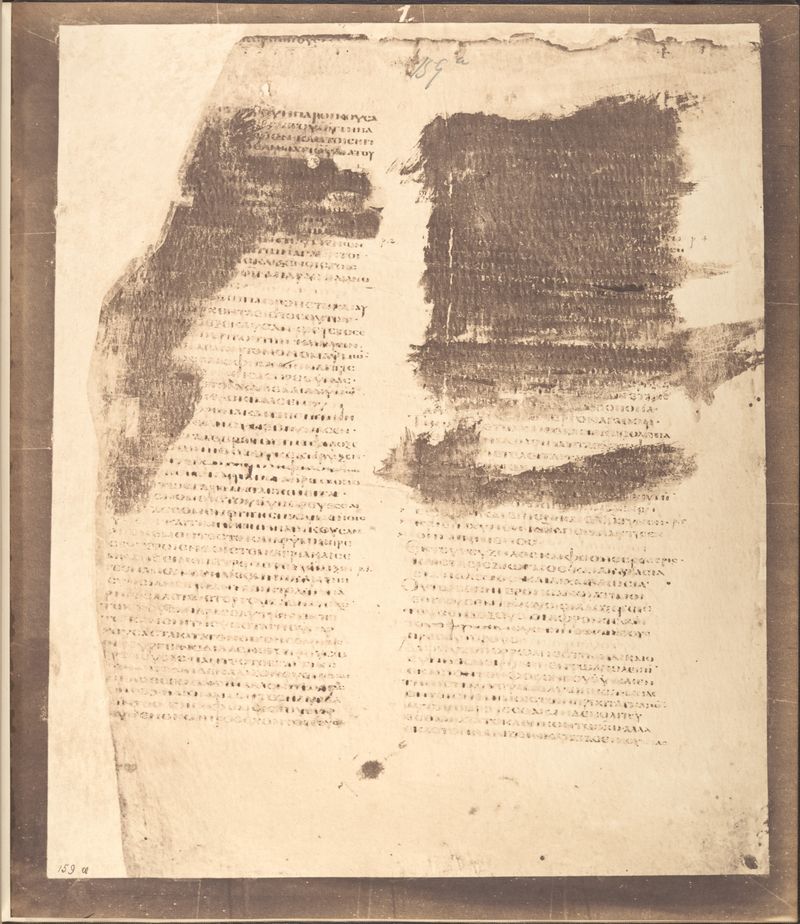
The First Epistle of Clement, sent from the Roman church to Corinth near the end of Domitian’s reign, is the oldest non-canonical Christian document explicitly grounding church order in apostolic transmission.8 Corinthian factions had deposed presbyters installed by the apostles or their immediate successors, and Clement writes to rebuke them.
His argument is structural, not sentimental. The apostles, “having received perfect foreknowledge” that “there would be strife over the name of the bishop’s office,” appointed “bishops and deacons” and “provided a continuance, that if these should fall asleep, other approved men should succeed to their ministration.”9 This is the passage the modern Catechism cites at paragraph 861 when establishing that bishops succeed the apostles by apostolic design.10
Clement’s letter is remarkable for what it assumes rather than what it proves. The Roman church writes with confidence that a second generation of leaders has already passed, that removing men “blamelessly and holily” appointed by apostolic authority constitutes “no small sin,” and that both churches recognize the succession model as normative.11 The letter presupposes that Rome and Corinth share this framework—suggesting the model was not controversial even then, but a common inheritance.
Yet Clement still uses “bishop” and “presbyter” interchangeably and describes only a two-tiered ministry of bishops-presbyters and deacons.12 Protestant scholars read this as evidence that monepiscopacy—the rule of a single bishop over a local church—had not yet arrived in Rome or Corinth in the 90s. The letter also addresses a specific crisis in Corinth rather than laying down a universal theory of orders. Any Catholic reading of 1 Clement has to take both facts seriously: the succession framework is present, the threefold hierarchy is not.
Ignatius of Antioch: The Threefold Ministry (c. AD 107–140)
A decade or so after Clement, Ignatius of Antioch sharpened the picture. Writing seven letters on his way to martyrdom in Rome (traditionally dated c. AD 107, though possibly as late as the 140s), Ignatius is the first unambiguous witness to a single bishop ruling over a college of presbyters and deacons.13
His Letter to the Smyrnaeans contains the earliest recorded use of the phrase “catholic church” and insists that “wherever the bishop appears, there let the people be, just as wherever Jesus Christ is, there is the catholic church.”14 To the Magnesians he writes: “Let the bishop preside in God’s place, and the presbyters take the place of the apostolic council, and let the deacons be entrusted with the ministry of Jesus Christ.”15 Against docetists who denied the true flesh of Christ, Ignatius ties eucharistic validity to the bishop: “Let that be considered a valid Eucharist which is celebrated by the bishop, or by one whom he appoints.”16
This is the link that becomes structurally decisive for later sacramental theology. If only bishops (or those they authorize) can validly celebrate the Eucharist, then the question of who is a bishop—and whether one’s ordination traces back to the apostles—is not a bureaucratic detail but a question about access to Christ’s body and blood. The Catholic argument for succession as sacramentally necessary has its earliest concrete warrant here.
Historians debate whether Ignatius describes an established norm or advocates for a new one. The New Catholic Encyclopedia concedes that the monarchical episcopate “did not rest with any one man during the first post-apostolic generations” in some regions, and scholars like Kenneth Strand have argued that 1 Clement and the Shepherd of Hermas suggest Rome was still governed by a college of presbyters at roughly the same moment Ignatius was presupposing a single bishop in Asia Minor.17 Allen Brent’s Ignatius of Antioch: A Martyr Bishop and the Origin of Episcopacy (2007) presses a further point worth noticing: Ignatius treats the bishop less as the terminus of a tactile chain than as a typos of the Father, a visible icon of unity whose theological function does not depend on traceable ordination from an apostle.18 On Brent’s reading, the later Catholic doctrine of sacramental transmission has to be read into Ignatius; it is not explicit in the letters themselves.
Other historians push back against this narrower reading. J.N.D. Kelly and John Behr, among others, argue that Ignatius’s insistence on the bishop as the sole guarantor of valid Eucharist already carries sacramental succession in seed form: a bishop whose unity-function is untethered from any real capacity to convey apostolic ministry is precisely the abstraction Ignatius refuses. On this reading, what Irenaeus later makes explicit as a tactile chain is organic development from what Ignatius already presupposes—not an alien imposition.19
The cautious conclusion is that Ignatius shows the threefold ministry already fully articulated in early-second-century Syria and Asia Minor, with the bishop as the visible center of eucharistic and ecclesial unity, but without the explicit sacramental-chain argument that later tradition will foreground. The chain argument requires Irenaeus.
The Didache and the Messiness of the Early Period
Any honest account of succession has to reckon with the Didache, the short church order whose dating runs anywhere from roughly AD 50 to 100.20 In chapters 11–15 the Didache shows a church still governed partly by itinerant apostles and prophets moving between communities, alongside locally elected bishops and deacons who handle the eucharistic liturgy when no prophet is present.
Two features matter for the succession debate. First, the Didache uses “bishops and deacons” (15.1) without naming a distinct order of presbyters—matching Clement’s two-tiered vocabulary rather than Ignatius’s three-tiered one. Second, it instructs the community to “elect” (cheirotonēsate) its own bishops and deacons rather than receiving them from an external apostolic source. The bishops of the Didache are charismatically recognized local leaders, not links in a tactile chain from Jerusalem.
None of this is fatal to the Catholic reading; the Didache is one document from one corner of the early Christian world, and its two-tier vocabulary can be read as still-fluid nomenclature rather than a denial of monepiscopacy. But it complicates the picture in two ways. It shows that the monarchical episcopate was not yet universal in the period the Didache describes, and it reminds us that the second-century “succession lists” we will meet in Irenaeus represent a retrospective ordering of a messier first-century reality. The framework as later systematized crystallized gradually between roughly AD 60 and 180, reaching mature expression precisely when Gnostic challenges made a clear principle of authority urgent.
Irenaeus of Lyon: Succession Against the Gnostics (c. AD 180)
The decisive theological elaboration came from Irenaeus of Lyon around AD 180 in Against Heresies. Gnostic teachers claimed access to hidden oral traditions allegedly transmitted from the apostles through secret channels. Irenaeus demolished this by pointing to what anyone could verify: the public, documentable lists of bishops in apostolic sees.
In Book III, Chapter 3, he declares it possible “to reckon up those who were by the apostles instituted bishops in the Churches, and the succession of these men to our own times.”21 He then offers the famous list of Roman bishops from Peter and Paul—Linus, Anacletus, Clement, Evaristus, Alexander, Sixtus, Telesphorus, Hyginus, Pius, Anicetus, Soter, and Eleutherius, who “now, in the twelfth place from the apostles, holds the inheritance of the episcopate.”22 He had not invented the technique; Hegesippus had compiled a similar list of Roman bishops around AD 160, which Eusebius would later use.23
Irenaeus’s logic is epistemological: if the apostles had secret doctrines, they would have entrusted them to the men they personally appointed to lead churches. Those successors taught publicly and have successors who still teach. Therefore any doctrine absent from the episcopal chain is not apostolic. Book III opens by declaring that the apostles, after Pentecost, “handed down to us in the Scriptures” the gospel “to be the ground and pillar of our faith”—scripture and episcopal succession function as mutually confirming witnesses, not rivals.24
Irenaeus’s move is shrewd and consequential. Confronted with teachers claiming private revelations, he refuses to argue esoterically and instead points to public, traceable, falsifiable lineages. The claim is historically testable: any community can be asked to demonstrate an unbroken chain of ordinations back to an apostolic origin. Gnostics could not, because—Irenaeus’s observation—their founders were named, recent, and documented latecomers. The argument works because bishops’ lists are checkable and secret traditions are not.
Book III, Chapter 3, paragraph 2 contains the single most consequential sentence in the ancient Church on Roman primacy. Irenaeus writes that “it is a matter of necessity that every Church should agree with this Church [Rome], on account of its preeminent authority” (propter potentiorem principalitatem; Adv. Haer. III.3.2, trans. ANF 1). The precise reference of the comparative has been disputed since at least the nineteenth century—whether Irenaeus means Rome’s apostolic foundation by Peter and Paul, its position as the imperial capital, or a jurisdictional primacy over other sees. What the text unambiguously asserts is that Rome occupies a normative place among the apostolic churches, such that fidelity to the faith of Rome is the touchstone by which other communities are judged. The sentence is one of the earliest securely datable attestations of the Roman primacy that Pastor Aeternus would formally define seventeen centuries later.
Three Early Lists, Three Slightly Different Romes
The earliest succession lists converge on the same core of names but disagree about their order—a fact that is evidence against coordinated forgery and in favor of independent traditions:
| Position | Irenaeus (c. 180) | Eusebius (c. 324) | Liberian Catalogue (354) |
|---|---|---|---|
| 1 | Linus | Linus | Linus |
| 2 | Anacletus | Anencletus | Clement |
| 3 | Clement | Clement | Cletus |
| 4 | Evaristus | Evaristus | Anacletus |
On the Cletus–Anacletus doubling, scholarly consensus from Louis Duchesne through J. B. Lightfoot treats “Cletus” as a shortened form of the Greek Anencletus (“blameless”), with the Liberian compiler mistakenly entering the same bishop twice. The Catholic Encyclopedia’s article on the Liber Pontificalis concedes the duplication as “an error, owing evidently to the existence of two forms of the same name.”25 The Clement-after-Peter tradition in Tertullian is harder to dismiss. Jerome, in De Viris Illustribus 15, reports that “most of the Latins think that Clement was second after the apostle” even while preserving the Irenaean order himself, and the parallel tradition appears to derive from the pseudo-Clementine Epistola Clementis ad Jacobum, which dramatizes Clement receiving the see from Peter directly.26
Kelly and Walsh’s Dictionary of Popes treats the pre-Victor bishops as historical persons while warning that the early chronology is “schematic” and that no contemporary evidence establishes monarchical episcopacy at Rome before the late second century.27 Eamon Duffy states the problem more pointedly: “Nor can we assume, as Irenaeus did, that the Apostles established there a succession of bishops … for all the indications are that there was no single bishop at Rome for almost a century after the deaths of the Apostles.”28
The more pointed challenge comes from Peter Lampe’s From Paul to Valentinus (1987; English 2003), which argues from archaeological, prosopographical, and literary evidence that Rome was governed by a “fractionated” network of presbyter-led house churches until Victor (c. 189–199), the first genuinely monarchical bishop.29 On this reading, the twelve-name succession list is an Irenaean retrojection of a later structure—not a fabrication, because individual names like Clement are well attested, but a schematic ordering imposed on a less linear reality. J. B. Lightfoot, himself the Anglican Bishop of Durham and no polemicist against Rome, had already conceded in 1868 that “as late therefore as the year 70 no distinct signs of episcopal government have hitherto appeared in Gentile Christendom” and that Clement “still uses the word ‘bishop’ in the older sense … as a synonym for presbyter.”30
For a Catholic reader this does not dissolve the doctrine; it refines it. What Irenaeus defended—the public, traceable continuity of the apostolic depositum through the presiding ministers of the church at Rome—survives even if the first-century Roman episkopē was exercised collegially before one name settled on top of the list. The discrepancies among Irenaeus, Tertullian, Eusebius, and the Liberian compiler are themselves evidence against coordinated forgery and in favor of independent traditions converging on the same short core of names.
Tertullian: Succession as a Legal Principle (c. AD 200)
Writing from Carthage around AD 200, Tertullian extended Irenaeus’s argument in The Prescription Against Heretics with a lawyer’s precision. His praescriptio is a Roman legal term, and the technical background matters if the rhetorical force is to be felt.
Under the classical formulary system, every civil action proceeded on a written formula settled before the praetor in iure. A praescriptio was a clause written—literally prae-scribere—at the head of that formula, defining or narrowing what the iudex could hear. Gaius, in Institutes IV.130–137, distinguishes it sharply from an exceptio, which was embedded between the intentio and the condemnatio within the formula itself.31
A praescriptio pro reo functioned as a threshold plea: the iudex was instructed to examine the preliminary objection first and, if sustained, to suspend the action without reaching the merits. The modern analogues are the demurrer, the plea in bar, the Rule 12(b)(6) motion to dismiss, and—in its substantive form—the statute of limitations. Roman law itself developed a substantive variant, praescriptio longi temporis, by which continuous possession of property for the statutory term (ten or twenty years under Justinian) defeated the true owner’s rei vindicatio. Title by time, unanswerable by argument on the merits.
Tertullian’s legal competence is sometimes overstated. Jerome and Eusebius identified him with the jurist “Tertullianus” cited in Justinian’s Digest, but T. D. Barnes’s Tertullian: A Historical and Literary Study demolished the identification, and David Rankin’s 1997 essay “Was Tertullian a Jurist?” concluded he was a trained advocate and rhetorician, not a iurisconsultus.32 He handled Roman legal vocabulary with precision not because he drafted formulae for a living but because he was forensically educated in Carthage, a Roman colony whose educated class would have been trained in the standard juristic manuals of the day—Gaius’s Institutes chief among them.
The genius of De Praescriptione is that Tertullian fuses both senses of the word. In chapters 15–19 he stages a procedural praescriptio: heretics must not be permitted to argue from Scripture at all, because the prior question of title to the Scriptures must be resolved first. “It ought to be clearly seen to whom belongs the possession of the Scriptures, that none may be admitted to the use thereof who has no title at all to the privilege.”33 He repeatedly deploys forensic diction—possessio, titulus, praeiudicare. In chapters 20–21 he identifies the Church, founded by the apostles and continuous with them, as the rightful possessor of the depositum fidei. Finally, in chapter 32, he specifies the documentary proof of title:
Let them produce the original records of their churches; let them unfold the roll of their bishops, running down in due succession from the beginning in such a manner that your first bishop shall be able to show for his ordainer and predecessor some one of the apostles or of apostolic men.34
He cites two concrete registers: Smyrna recording that Polycarp was placed there by John, and Rome recording Clement’s ordination by Peter.35
But Tertullian does not stop at genealogy. He immediately adds a doctrinal criterion: even if heretics fabricated such lists, their teaching, “after comparison with that of the apostles, will declare, by its own diversity and contrariety, that it had for its author neither an apostle nor an apostolic man.”36 The two tests—succession of bishops from the apostles and identity of doctrine with what apostles taught—function together. Newly founded churches lacking apostolic founders still count as apostolic “because they agree in the same faith” and are “akin in doctrine” (pro consanguinitate doctrinae).37
The ecclesiological payoff is thus structural, not merely evidential. Apostolic succession is the Church’s chain of title, exactly analogous to the deeds and continuous possession that establish ownership under praescriptio longi temporis. Because the heretic cannot produce the deed, he is non-suited in limine; the court never reaches his exegesis. Tertullian does not deny that Scripture, rightly read, refutes heresy. He denies that the heretic has standing to litigate over it. For any reader trained in common-law pleading this is a stunning piece of ecclesiological jurisprudence—and it is why succession and Scripture are, in the patristic imagination, inseparable rather than competing authorities.
Succession and Scripture are, in the patristic imagination, inseparable rather than competing authorities.
Eusebius and Jerome: Preserving the Documentary Record
By the fourth century, the framework Irenaeus had fashioned against the Gnostics became the documentary skeleton of Christian historiography itself. Eusebius of Caesarea’s Ecclesiastical History, composed in stages between roughly 313 and 324, organizes the first three centuries of Christianity around the succession of bishops in the major sees. Book III in particular preserves the apostolic deployments later generations would inherit: Thomas to Parthia, Andrew to Scythia, John to Asia, Peter martyred at Rome under Nero, Paul carrying the gospel “from Jerusalem, and round about to Illyricum.”38 Eusebius reports Linus as the first bishop of Rome after the martyrdoms of Peter and Paul, and follows Irenaeus’s sequence with chronological refinements of his own: Linus reigns twelve years before handing off to “Anencletus” (3.13); Clement succeeds after another twelve (3.15); and Clement is “the third that held the episcopate there after Paul and Peter” (3.21).39
Jerome’s De Viris Illustribus (AD 392/393) catalogued 135 ecclesiastical writers from Peter down to Jerome himself, a bibliographic spine for the patristic tradition. Neither father invented the succession framework; both documented what had by then been the Church’s operating assumption for three centuries. Eusebius’s chronology was schematic, and his numbers do not always match Irenaeus’s, but the order of names held across Greek East and Latin West. That the two standard catalogues of Christian authors from late antiquity—one in Greek, one in Latin—both organize themselves by episcopal succession tells you how thoroughly the framework had become the Church’s self-understanding before a single ecumenical council had formally treated it.
How the Modern Catechism Codifies the Inheritance
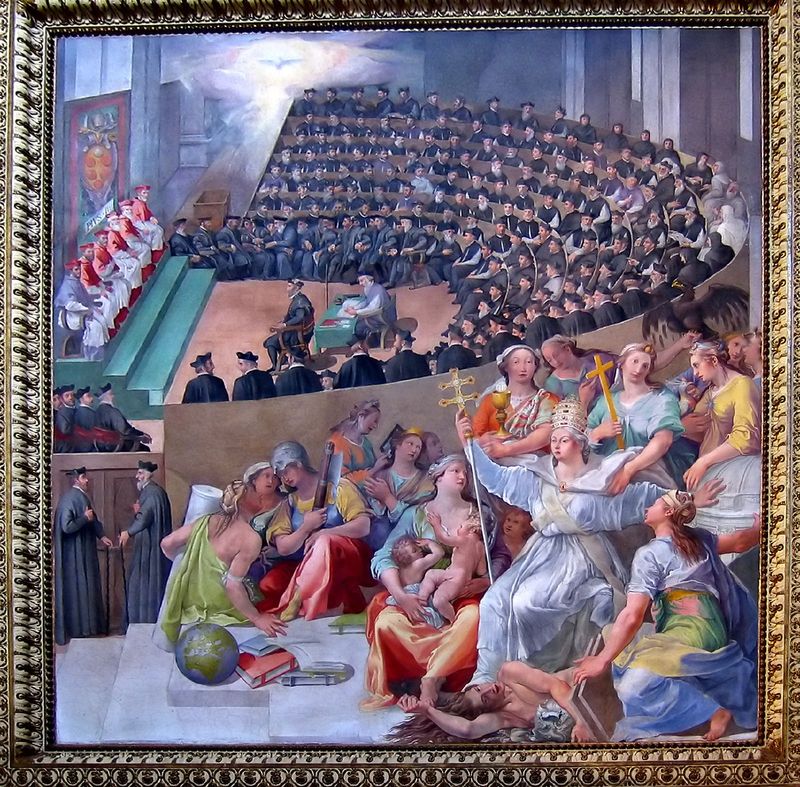
The Catechism of the Catholic Church (1992) consolidates this patristic material in paragraphs 77, 857–862, and 1087, drawing explicitly on Vatican II’s Dei Verbum and Lumen Gentium and citing 1 Clement and Irenaeus by name. The key claims form a tight logical chain.
| CCC § | Claim | Primary source cited |
|---|---|---|
| 77 | The apostles left bishops as their successors, giving them “their own position of teaching authority” | Irenaeus, Adv. Haer. 3.3.1 |
| 857 | The Church is apostolic as founded on, preserving the teaching of, and guided by the successors of the Twelve | Eph 2:20; Acts 2:42 |
| 861 | The apostles designated successors and mandated ongoing succession | 1 Clement 42; 44 |
| 862 | The episcopal office endures “without interruption” | Lumen Gentium 20 |
| 1087 | Christ entrusted his sanctifying power to the apostles, who entrusted it to their successors by the Holy Spirit | Sacramental Theology of Holy Orders |
CCC 77 (quoting Dei Verbum) says the apostles “left bishops as their successors,” giving them “their own position of teaching authority” so that “the apostolic preaching … was to be preserved in a continuous line of succession until the end of time.”40
CCC 857 defines the Church as apostolic “in three ways”—built on the foundation of the apostles, keeping and handing on their teaching, and continuing to be taught, sanctified, and guided “by the apostles … through their successors in pastoral office: the college of bishops.”41 This three-mode formulation is especially precise: apostolicity operates in historical foundation, doctrinal preservation, and living pastoral succession simultaneously. Breaking any of the three breaks the whole.
CCC 861 then quotes Lumen Gentium 20 in language strikingly reminiscent of Tertullian: the apostles “consigned, by will and testament, as it were, to their immediate collaborators the duty of completing and consolidating the work they had begun … They accordingly designated such men and then made the ruling that likewise on their death other proven men should take over their ministry.”42 The footnote cites Clement of Rome’s letter to the Corinthians—the same Clement Tertullian named a century later as Peter’s ordinand.
CCC 1087 adds the sacramental dimension Tertullian had not yet articulated: “The risen Christ, by giving the Holy Spirit to the apostles, entrusted to them his power of sanctifying … By the power of the same Holy Spirit they entrusted this power to their successors.”43 Succession becomes not merely a historical paper trail of fasti (official year-by-year registers of magistrates) and origines (formal foundation narratives of a city or institution) but a sacramental reality “handed on by the sacrament of Holy Orders.”
Tertullian treated the bishop-lists as forensic evidence; the Catechism treats episcopal ordination as the ongoing mechanism by which Christ’s own authority is transmitted. The pastoral corollary, made explicit at CCC 1400, is that Protestant ecclesial communities derived from the Reformation “have not preserved the proper reality of the Eucharistic mystery in its fullness, especially because of the absence of the sacrament of Holy Orders”—which is why, in the magisterial judgment, eucharistic intercommunion with these communities is not possible.
Where Vatican II Sharpened What Tertullian Left Implicit
Tertullian’s test was polemical and negative—a way to exclude heretics from the right to argue. The Catechism recasts the same continuity in positive, sacramental terms that the earlier text only hinted at. Three differences matter for interpretation.
First, Tertullian’s Clement-from-Peter ordination sits in tension with the standard Roman succession lists that name Linus and Cletus before Clement. The ANF editors flagged the problem in a footnote suggesting the earlier bishops “must have died or been martyred… almost as soon as appointed.”44 The Catechism does not resolve the tension; it relies on Clement’s own letter rather than on any specific ordination claim.
Second, Tertullian writes before the idea of a single “successor of Peter” carrying unique universal jurisdiction had been dogmatically defined. His argument treats Rome as parallel to Smyrna, each with its own apostolic register. CCC 862, together with 881–882, articulates a Petrine primacy that Tertullian’s text does not assert.
The International Theological Commission’s 1973 document Catholic Teaching on Apostolic Succession made the transmission mechanism explicit in language the second-century Christian could not have used: the “imposition of hands with the invocation of the Holy Spirit … is the indispensable form for the transmission of the apostolic succession, which alone enables the Church to remain constant in its doctrine and communion.”45 The International Theological Commission and CCC 1087 frame this transmission as iure divino—by divine institution, not ecclesiastical convention—consonant with Vatican I’s Pastor Aeternus (1870), which attributes the primacy of jurisdiction over the whole Church to the Roman Pontiff “by the divine right of the apostolic primacy” (chs. 1–3), and with Lumen Gentium 20–27, which develops the bishop’s triple office of teaching, sanctifying, and governing (tria munera) as the integral continuation of the apostolic commission.
Third, Tertullian treats “apostolic men”—non-apostles who worked alongside apostles—as legitimate ordainers of first bishops.46 The Catechism’s language of “successors” is tighter and channels everything through the episcopal college. The wider apostolic-men category survives in the doctrine of sacramental ordination, which requires an already-consecrated bishop as minister, but the Catechism does not replicate Tertullian’s looser formulation.
The durability of the underlying framework is the point. Tertullian’s test was verifiable, falsifiable, and cheap to administer: anyone could ask a church to produce its list and compare its teaching to the canonical apostolic writings. The Catechism inherits that practicality. The doctrinal prong (continuity of teaching) makes the historical prong (continuity of office) more than mere institutional pedigree—it becomes evidence that the teaching itself has not mutated. Conversely, the historical prong grounds the doctrinal claim in something checkable rather than in private inspiration. Each prong protects against a different failure mode: lineage without orthodoxy yields a valid but erring church; orthodoxy without lineage yields a sect claiming direct revelation.
The Protestant Critique: Calvin’s Attack on Tactile Succession
John Calvin’s attack in Institutes IV.2 remains the most penetrating Protestant refutation of tactile succession. Calvin granted that the fathers—Irenaeus, Tertullian, Cyprian—had valued succession, but insisted their point was doctrinal continuity, not a mechanical transmission of grace. “In the government of the Church especially, nothing is more absurd than to disregard doctrines and place succession in persons,” he wrote, citing Caiaphas as a lawful successor of Aaron who crucified the Messiah, and asking rhetorically whether Caligula and Nero became legitimate rulers merely by succeeding Brutus and Scipio.47
The argument is devastating on its own terms. If the Roman pontiffs had taught Arianism, would their tactile succession have saved the church? If not, then succession is conditional on fidelity, and fidelity—judged against Scripture—becomes the actual criterion. Luther, Zwingli, and the Augsburg Confession took the same line. Augsburg Confession VII (1530) defines the Church as “the assembly of all believers among whom the gospel is purely preached and the holy sacraments are administered according to the gospel”—with no mention of episcopal succession as a note of the true Church.48 The ordination of Matthias Flacius, and of Calvin himself, was defended by the Reformers as extraordinary succession in apostolic doctrine when the ordinary channels had failed.
The Catholic reply accepts the moral force of Calvin’s challenge while rejecting its conclusion. The sacramental character conferred by episcopal ordination, the tradition holds, is not vitiated by the moral or doctrinal failings of the man who bears it—Christ acts through the ordained minister “and the unworthiness of the latter does not prevent Christ from acting” (CCC 1584). A heretical bishop forfeits the licit exercise of his office and, if formally heretical, severs himself from the communion of the Church, but the character of the orders he received remains ontologically real, as Trent reaffirmed against the Reformation in its Session XXIII canons on Holy Orders. Calvin’s Caiaphas analogy assumes what the Catholic tradition denies—that valid succession entails doctrinal inerrancy in the successor. (The same confusion underlies the charge that the clerical abuse crisis disproves the Church’s teaching authority.)
The Orthodox position adds a further requirement: a bishop must remain in communion with the wider Orthodox episcopate, so a bishop in formal schism loses the right to exercise his office even though the underlying sacramental character of his ordination remains. Rome and the East locate that forfeiture slightly differently—Rome focuses on communion with the successor of Peter, the East on communion with the local synod and the wider conciliar fellowship of bishops—but both traditions share the same basic grammar: the validity of a man’s orders (whether his ordination sacramentally “took”) is one question, and the fidelity with which he exercises them is another.
The Reformation thus produced two Protestant families. Confessional Reformed, Presbyterian, Baptist, and most Methodist bodies treat succession as succession in the gospel, with ministerial orders conferred by presbyteries or congregations that stand in the succession of faith, not of hands. They can and do cite Jerome’s letter to Evangelus (Ep. 146), which argues that presbyter and bishop were originally one office, and the scholarly consensus that episcopal superiority developed historically.49 Anglicans and Swedish-Finnish Lutherans took a different road, preserving the historic episcopate while disagreeing internally about whether it is esse (essential), bene esse (beneficial), or plene esse (for the fullness) of the Church. The Chicago–Lambeth Quadrilateral (1886/1888) named “the Historic Episcopate, locally adapted” as one of four non-negotiables for Christian unity, without specifying its theology.50
The Denominational Landscape Today
The doctrine fractures Christianity along a predictable fault line, but the nuances are where the ecumenical work actually happens. The contours of the landscape can be summarized in a single table before we look at the hard cases.
| Tradition | Succession is… | Required for valid Eucharist? | Recognizes whose orders? |
|---|---|---|---|
| Roman Catholic | Sacramental transmission by episcopal ordination; iure divino | Yes | Orthodox, Old Catholic, some Polish National; not Anglican, not Protestant |
| Eastern Orthodox | Ordination + right doctrine + communion | Yes | Only Orthodox bishops in communion; Catholic orders historical but not currently actualized |
| Anglican | Historic episcopate, theological significance debated | Usually yes | Old Catholic, Porvoo Lutherans, Orthodox (disputed), sometimes Catholic |
| Lutheran (Porvoo/Swedish) | “Sign, not guarantee”; rope with many strands | No (but valued) | Most Trinitarian ministries |
| Reformed / Presbyterian | Succession in apostolic doctrine and gospel | No | All who preach the gospel and rightly administer the sacraments |
Catholic and Eastern Orthodox Churches
Catholic and Eastern Orthodox churches both require sacramental succession by episcopal laying on of hands. Orthodoxy adds a stricter condition: the bishop must also maintain right doctrine and full communion with other Orthodox bishops.
John Zizioulas’s Being as Communion (1985) argues that apostolic succession is not a juridical pipeline but a eucharistic-ecclesial reality that holds together two dimensions the modern debate tends to split—the historical (tactile continuity of ordination) and the eschatological (the gathered eucharistic community, presided over by the bishop, as icon of the coming kingdom)—and must be realized in the local eucharistic assembly, not in a paper trail alone.51
A heretical bishop validly ordained is no successor of the apostles; an uncanonical bishop in schism forfeits apostolicity whatever his lineage. This is why the Orthodox have historically not universally recognized Roman Catholic orders as valid even while Rome reciprocally recognizes theirs.
Anglican Orders
Anglican orders are the most contested case. Pope Leo XIII’s 1896 bull Apostolicae Curae declared them “absolutely null and utterly void” on grounds of defect of form and intention in the 1550/1552 Edwardine Ordinal.52 The Archbishops of Canterbury and York replied the following year with Saepius Officio, but Rome has never retracted the judgment; the 2009 apostolic constitution Anglicanorum Coetibus reaffirmed it by re-ordaining absolutely (rather than conditionally) any former Anglican cleric received into full communion.
Anglicans themselves maintain they possess valid succession, and through the Porvoo Communion (est. 1996) and the 1931 Bonn Agreement with Old Catholics, many Anglican bishops can now trace their lineage through Swedish Lutheran and Old Catholic lines whose orders Rome does recognize—creating the curious situation that particular Anglican bishops may be valid by Catholic standards via a back-door route even though the Anglican succession as such is not.
Cardinal Willebrands’s 1985 letter acknowledged that the participation of Old Catholic bishops in Anglican consecrations since 1931 had created “a new context” for evaluating orders—a diplomatic way of saying that many contemporary Anglican bishops likely have valid orders by Rome’s own criteria, even if the 1559 ordinal did not. When the former Anglican Bishop of London Graham Leonard was received into the Catholic Church in 1994, he was ordained conditionally rather than absolutely—a tacit Roman acknowledgment that the Old Catholic co-consecration argument had force, even as Apostolicae Curae remained on the books.53
Willebrands and Leonard notwithstanding, the 2009 Anglicanorum Coetibus and its Complementary Norms codified absolute (not conditional) re-ordination as the Roman discipline for former Anglican clergy received into full communion, with conditional ordination permitted only in cases of “prudent doubt”—a settled position that is incompatible with any general Catholic acceptance of the Old Catholic co-consecration argument, however suggestive the back-door cases may be in particular.
Protestants: Apostolic Fidelity Without Tactile Succession
Most Protestants reject the tactile doctrine entirely. The classical Reformed, Presbyterian, Baptist, and evangelical position is that apostolicity means fidelity to apostolic teaching, not transmission through hands. The British Methodist Conference locates “true continuity” in “the continuity of Christian experience … the continued proclamation of the message.” The Wesleyan/Methodist tradition tends toward a “faithful succession” view, while some Anglicans hold episcopacy is necessary to the “well-being” but not the “being” of the church—allowing intercommunion with non-episcopal Protestants. In the magisterial vocabulary employed since the CDF’s Dominus Iesus (2000, §17) and the Responses of 29 June 2007, these Protestant bodies are denominated “ecclesial communities” rather than “Churches in the proper sense” precisely because they lack the valid episcopate and integral eucharistic substance that, for Rome, mark a particular Church.
Convergence Without Consensus: The Ecumenical Texts
The last sixty years have produced three documents that effectively constitute the current state of the question, and no account of succession is complete without them.
BEM: The Lima Text (1982)
The World Council of Churches’ 1982 Baptism, Eucharist and Ministry—the “Lima text,” or BEM—distinguished “apostolic tradition” from “succession of the apostolic ministry,” defining the former as continuity in the permanent characteristics of the apostolic church (faith, gospel, sacraments, ministerial transmission, communion, service) and treating episcopal succession as “a sign, though not a guarantee, of the continuity and unity of the Church.”54 The text’s most decisive sentence was that Christ did not institute a specific pattern of church government and that all three orders are discernible in the New Testament.
Orthodox respondents, including the Bulgarian Orthodox Church, objected sharply that BEM had severed what the fathers had joined: the apostolic tradition and the apostolic ministry are inextricable, and a distinction that treats episcopal succession as mere “sign” evacuates its sacramental substance. The Vatican’s own 1987 response to BEM, jointly issued by the Pontifical Council for Promoting Christian Unity and the CDF, likewise registered that the text did not adequately reflect the Catholic understanding of the eucharistic sacrifice, of ordained priesthood as sacramentally configured to Christ the Head, or of the normative role of apostolic succession in the historic episcopate.
ARCIC: The Canterbury Statement (1973)
The Anglican–Roman Catholic International Commission’s Canterbury Statement on Ministry and Ordination (1973) claimed “substantial agreement” that only an episcopally ordained priest presides at the Eucharist, and that orders are sacramental and not mere ecclesiastical convention. The Vatican’s 1991 Response to the Final Report of ARCIC I, noting that the 1973 statement had not addressed apostolic succession directly, supplied its own formulation based on Lumen Gentium 20: “the unbroken lines of episcopal succession and apostolic teaching stand in causal relationship to each other.”55
ARCIC-II’s 1993 Clarifications accepted the formulation and re-quoted it at §IV.4. The 1991 Response also registered formal reservations on the agreed statements’ treatment of eucharistic sacrifice, the ministerial priesthood, and—pre-eminently—papal primacy and infallibility. Apostolicae Curae has not been lifted, but the Willebrands letter of 1985 and the cumulative work of ARCIC have changed the texture of the question without changing the legal answer.
Porvoo: The Rope of Many Strands (1993)
The Porvoo Common Statement (1993) produced the most consequential structural change, establishing full communion among the British and Irish Anglican churches and the Nordic and Baltic Lutheran churches. Porvoo’s paragraph 52 advanced the principle that “faithfulness to the apostolic calling of the whole Church is carried by more than one means of continuity”—personal tactile succession, continuity of historic sees, fidelity to apostolic teaching, apostolic mission. (The popular “rope of many strands” image often credited to Porvoo is developed in the Communion’s commentary on §52 rather than in the paragraph itself.) If one strand breaks—as in the Church of Denmark, whose bishops were not in historic tactile succession before 1992—others can carry the weight, and the rope can be rewoven through shared consecrations.56
The rope metaphor cut across the valid/invalid binary that had dominated since 1896. Porvoo’s paragraph 53 added the structural principle that “the mutual acknowledgement of our churches and ministries is theologically prior to the use of the sign of the laying on of hands in the historic succession”—allowing the Danish, Norwegian, and Icelandic Lutheran churches, whose Reformation-era consecrations had passed through the 1537 Bugenhagen presbyteral line, to embrace the sign of historic episcopal succession going forward without conceding that their prior ministries had been defective.
It allowed churches to acknowledge that apostolicity is overdetermined—transmitted by ordination, by teaching, by mission, by communion, by the Spirit—without forcing any one strand to bear the entire weight alone. Whether the Catholic and Orthodox traditions can ultimately receive the metaphor is the question that will shape the next century of ecumenical dialogue. The striking limit of the ecumenical century is that when the question shifts from language to consequence—who may preside at the Eucharist, whose ordinations need not be repeated, whether a communion without bishops is a church—the old fault lines reappear intact.
The Demographic Weight
This may seem like an antiquarian debate, but the numbers tell a different story. Roughly three-quarters of the world’s 2.3 billion Christians belong to communions that formally affirm apostolic succession.57
Pew Research Center’s most recent global census, How the Global Religious Landscape Changed From 2010 to 2020 (June 2025), counted 2.3 billion Christians, or 28.8% of the world population, at the 2020 benchmark. Pew’s last detailed denominational split remains its 2011 Global Christianity report, which apportioned Christians as roughly 50% Catholic, 37% Protestant, 12% Orthodox, and 1% other; that breakdown has not been refreshed in the 2025 update, so any calculation combines Pew’s global total with confessional returns from each communion’s own statistical offices.
The Vatican’s Annuario Pontificio 2026, issued in March 2026, reports 1.422 billion Catholics at the end of 2024—17.8% of humanity, and by itself well over half of all Christians.58 Pew’s 2017 study Orthodox Christianity in the 21st Century placed worldwide Orthodox believers at roughly 260 million combined—about 220 million Eastern Orthodox (the Chalcedonian sees: Constantinople, Moscow, and the other autocephalous churches) and approximately 60 million Oriental Orthodox (Coptic, Ethiopian Tewahedo, Eritrean, Armenian Apostolic, Syriac, and Malankara), though the Gordon-Conwell World Christian Database pushes the Oriental figure closer to 72 million.59 The Assyrian Church of the East, still governed by a Catholicos-Patriarch and claiming uninterrupted descent from the Parthian mission, numbers roughly 400,000.60
Adding the four uncontested successionist families yields about 1.7 billion Christians, or 74% of the global Christian population. Include the 85-million-member Anglican Communion, which affirms succession in the Chicago–Lambeth Quadrilateral (1886/1888), and the share rises to approximately 78%.
Two caveats matter. First, Rome does not recognize Anglican orders; Apostolicae Curae has never been retracted, and the Catholic Church still ordains absolutely any former Anglican cleric who is received. Second, these figures reflect baptismal registers, not pews—Catholic numbers are drawn from parish rolls, Anglican totals are self-reported, and Orthodox estimates vary by as much as 75 million across methodologies. Even so, the direction of the finding is robust: the overwhelming majority of baptized Christians alive today belong to churches that treat apostolic succession as a note of the true Church.
Three Converts the Evidence Moved
The patristic argument does not only sustain existing believers; it has drawn some of the most formidable Protestant minds across the Tiber or into Orthodoxy. Three twentieth- and nineteenth-century converts illustrate how this patristic architecture still moves educated Protestants.
John Henry Newman (1801–1890) made apostolic succession the explicit rallying cry of the Oxford Movement. In the anonymous Tract 1 of 1833, Thoughts on the Ministerial Commission, he wrote: “I fear we have neglected the real ground on which our authority is built—our APOSTOLICAL DESCENT. … The Lord Jesus Christ gave His Spirit to His Apostles; they in turn laid their hands on those who should succeed them; and these again on others; and so the sacred gift has been handed down to our present Bishops.”61
His Apologia Pro Vita Sua (1864) recalls the origin of that conviction: “It is with pleasure that I pay here a tribute to the memory of the Rev. William James, then Fellow of Oriel; who, about the year 1823, taught me the doctrine of Apostolical Succession, in the course of a walk, I think, round Christ Church meadow; I recollect being somewhat impatient of the subject at the time.”62 The impatience gave way. Twelve years of patristic reading displaced the branch theory. In the Introduction to his 1845 Essay on the Development of Christian Doctrine, completed as he was being received at Littlemore, Newman laid down the line that has become a commonplace of the Catholic convert tradition: “To be deep in history is to cease to be a Protestant.”63 The succession he had defended as an Anglican became, by study, the succession from which he concluded the Anglican communion was detached.
To be deep in history is to cease to be a Protestant.
Scott Hahn (b. 1957), a Presbyterian minister with a Gordon-Conwell M.Div., was received into the Catholic Church at the Easter Vigil of 1986 and narrated the journey in Rome Sweet Home (Ignatius, 1993).64 His conversion pivoted on the collapse of sola scriptura as a coherent rule of faith and on covenantal ecclesiology, but apostolic authority—the Magisterium as the living extension of the Twelve—was the structural consequence he could not avoid. In his published conversion narrative he recalls a theological interlocutor conceding that sola scriptura “isn’t something the Bible demonstrates. It is our assumption.”65 That admission, he says, forced him toward a Church able to identify its own ordained teachers with apostolic warrant. Hahn’s own teaching site, the St. Paul Center for Biblical Theology, treats “authority, hierarchy, papal infallibility, apostolic succession” as a unified theme the Reformation had severed.
Jaroslav Pelikan (1923–2006), Sterling Professor of History at Yale and author of the five-volume The Christian Tradition: A History of the Development of Doctrine (1971–1989), was received with his wife Sylvia into the Orthodox Church in America on 25 March 1998—the Feast of the Annunciation—at the Three Hierarchs Chapel of St. Vladimir’s Orthodox Theological Seminary, at the age of 74.66 He described the reception as “the logical culmination of a development in my mind and spirit that has been going on for decades.” His friend Robert Louis Wilken summarized the theological substance in a 2010 retrospective in Concordia Theological Quarterly, “Jaroslav Pelikan and the Road to Orthodoxy”: five decades of historical study had convinced Pelikan that the Orthodox Church was the most faithful custodian of the apostolic faith.67
Two sayings widely attributed to Pelikan—“If you believe what the first Christians believed, you must be Orthodox,” and a quip that when his Lutheran synod “became Baptist,” he became Orthodox—circulate on apologetic sites but cannot be traced to a primary published source and should be handled with care. The substantive evidence is the open letter, the Concordia appreciation, and his own scholarly corpus, which quietly shifts over five decades toward a theology of tradition that his Lutheran students found increasingly hard to distinguish from Orthodoxy.
Three different centuries, three different starting points, one pattern: deep, sustained reading of the first four centuries pulls Protestants in the direction of episcopal-sacramental ecclesiology. Newman and Hahn went to Rome; Pelikan went to Constantinople—and the distinction matters, because Orthodoxy and Rome divide on exactly the questions (papal jurisdiction, the Filioque, the Immaculate Conception) that Pelikan, pressed, would not have answered as a Catholic. What the three share is not a single communion but a shared incapacity to sustain, on the Protestant side of the ledger, the argument the Fathers made—that doctrinal fidelity and episcopal succession are not alternatives but conjoined conditions of the one Church.
What the Argument Is Really About
Stripped of polemic, the disagreement reduces to a prior question about how God promised to keep the Church in truth. If Christ’s promise in Matthew 16:18—“on this rock I will build my church, and the gates of hell shall not prevail against it”—and in Matthew 28:20—“I am with you always, to the end of the age”—is secured through a visible institutional structure (bishops who hand on what they received, teaching in union with Peter’s successor), then apostolic succession is not optional scaffolding but the spine of the Church, and its absence makes a body something less than the Church in the full sense.
If Christ’s promise is secured through his word and Spirit acting wherever the gospel is purely preached and the sacraments rightly administered—Augsburg Confession VII’s definition of the Church—then episcopal succession is at best a useful historical marker and at worst a clerical usurpation. The sola scriptura question, the Petrine primacy question, and the succession question are not three separate arguments; they are three angles on the same prior question about how Christ’s authority travels through time.
The biblical data are genuinely underdetermined. The Pastoral Epistles envisage Timothy and Titus appointing elders, but nowhere legislate a universal threefold order; Acts and Paul use episkopos and presbyteros interchangeably; the threefold ministry as Ignatius describes it is visible nowhere in the canonical New Testament. The honest conclusion is that apostolic succession as a maximal metaphysical doctrine cannot be securely grounded in the New Testament alone, but apostolic succession as a historical fact of the post-apostolic church is undeniable by roughly AD 180.
Apostolic succession as a historical fact of the post-apostolic church is undeniable by roughly AD 180.
Whether that fact is the Holy Spirit’s chosen vehicle for transmitting the Church’s identity, or a sociologically explicable adaptation that the Reformation was right to relativize, is the question that has divided Christendom for five hundred years and that no amount of ecumenical convergence has yet resolved.
A separate honesty is owed about the chain itself. Catholic apologetics often present the line of bishops as a mathematically airtight pedigree, but the documentary record has gaps. By the ongoing genealogical work of Charles Bransom—popularized in English by Jimmy Akin—more than 95% of all currently living Catholic bishops trace their episcopal lineage to a single sixteenth-century figure, Cardinal Scipione Rebiba (1504–1577), whose own consecrator is not recorded—a “Rebiba bottleneck” produced by Pope Benedict XIII’s preference for personally consecrating bishops during his 1724–1730 pontificate and the subsequent dispersion of his line to rapidly expanding mission fields.68
The doctrine of apostolic succession does not depend on every link being archivally documented—the Catholic claim has always been that valid sacramental ordination by a bishop in the line, not the historian’s ability to reconstruct that line, is what matters—but the bottleneck is a useful corrective to triumphalist rhetoric. The chain is real; the documentation thins out long before AD 180.
The striking achievement of the ecumenical century is that Catholics, Orthodox, Anglicans, and Lutherans can now say together that apostolic tradition is broader than tactile succession alone and that succession serves the gospel rather than standing above it. What this convergence does not say—and what Catholic teaching continues to insist upon—is that apostolicity is evenly distributed across the divided communions.
Lumen Gentium 8 holds that the one Church of Christ “subsists in” the Catholic Church, and the CDF’s Dominus Iesus (2000) reaffirmed that ecclesial communities lacking valid episcopal succession and the integral eucharistic substance are “not Churches in the proper sense.” The ecumenical texts acknowledge genuine “elements of sanctification and truth” outside Catholic boundaries without conceding parity.
The striking limit of the ecumenical century is that when the question shifts from language to consequence, the old fault lines reappear. The rope metaphor of Porvoo is probably the most productive recent move, because it allows churches to acknowledge that apostolicity is overdetermined without forcing any one strand to bear the entire weight alone. Whether the Catholic and Orthodox traditions can ultimately receive that metaphor—without ceding the “subsists in” doctrine that locates the Church’s apostolic fullness concretely rather than diffusely—will determine whether the next century of dialogue produces visible unity or only better-mannered disagreement.
Why Any of This Should Matter to You
The doctrine is not antiquarian. It decides who has valid sacraments, who can consecrate the Eucharist, and which ordinations the ancient churches will recognize. It underwrites papal primacy in Catholicism and conciliar episcopacy in Orthodoxy. It is the reason Catholic–Anglican reunion talks have been stuck for 130 years, and the reason ecumenical dialogues with Lutherans and Reformed churches keep circling the question of ministry.
The deeper insight buried in the history is that the doctrine hardened in response to crisis—Gnosticism for Irenaeus, schism at Corinth for Clement, factionalism at Antioch for Ignatius, the Reformation for Trent, the Oxford Movement for nineteenth-century Anglicans. Apostolic succession is, in each era, the Church’s answer to the question: when teachers disagree, whose authority is legitimate?
The answer the ancient churches give—that legitimacy runs through an unbroken physical chain—is both the doctrine’s greatest strength (concrete, verifiable, historical) and, to its critics, its greatest vulnerability (a chain is only as valid as its weakest link, and the New Testament itself seems to use “bishop” and “elder” interchangeably). The patristic witnesses surveyed here—Clement, Ignatius, Irenaeus, Tertullian—treat doctrinal fidelity and episcopal succession not as alternatives but as necessarily conjoined. Separating them is itself a post-Reformation move the fathers would not have recognized. And the striking feature is how early and how confidently the succession claim appears—not as a defensive innovation, but as the taken-for-granted architecture of Christian community within a generation of the apostles’ deaths.
For my part, studying the fathers settled it. The weight of evidence is overwhelming and the internal coherence of the argument considerable. Any account of Christian origins that ignores this evidence is working against, not with, the documentary record. That three of the most serious Protestant minds of the last two centuries—Newman, Hahn, Pelikan—found themselves unable to answer the argument on the Protestant side of the ledger is not a coincidence, and it is not an accident that each, in his own century, moved home.
Frequently Asked Questions
What is apostolic succession?
Apostolic succession is the doctrine that the authority Christ gave the apostles has been transmitted in an unbroken line through the laying on of hands from one generation of bishops to the next. For Catholics and Orthodox, this tactile chain is what makes ordinations and sacraments valid. The Catechism of the Catholic Church teaches that bishops “have by divine institution taken the place of the apostles as pastors of the Church” (CCC 862), and Vatican II’s Lumen Gentium §20 calls the episcopate the continuation of the apostolic office itself.
Where is apostolic succession in the Bible?
There is no verse that uses the phrase, but the concept is traced to several passages. Christ commissions the Twelve in Matthew 28:18–20 and John 20:21–23; Acts 1:15–26 records the apostles replacing Judas with Matthias through prayer and the casting of lots; and 2 Timothy 2:2 instructs Timothy to entrust what he has heard to “faithful men who will be able to teach others also.” Paul describes laying hands on Timothy in 2 Timothy 1:6, and the church at Antioch lays hands on Barnabas and Saul in Acts 13:3. Critics note that none of these texts use the word episkopos for the apostles and that Acts, Paul, and 1 Peter often use episkopos and presbyteros interchangeably—which is why the Scriptural argument is contested rather than self-evident.
Do Catholics and Orthodox agree on apostolic succession?
They agree on the substance and disagree on its ultimate locus. Both require tactile succession for valid sacraments, and Rome formally recognizes Orthodox orders and sacraments as valid. The Orthodox side is less uniform: because Orthodoxy ties valid sacraments to communion with the Orthodox episcopate, most Orthodox jurisdictions do not currently treat Catholic ordinations as actualized for sacramental life outside that communion, even while acknowledging the historic lineage. The disagreement is also structural: Catholics hold that succession reaches its fullness in communion with the Bishop of Rome, while Orthodox hold that the episcopate is collegial and that the Bishop of Rome is first among equals rather than the source of jurisdictional unity. That difference is precisely what the Catholic–Orthodox dialogues have been negotiating for decades.
Are Anglican orders valid?
Rome said no in 1896 and has not reversed the decision. In Apostolicae Curae, Leo XIII declared Anglican ordinations “absolutely null and utterly void,” citing defects in the Edwardine Ordinal’s form and intention. Anglicans disputed that ruling in Saepius Officio (1897) and have since received Old Catholic and occasionally Orthodox episcopal participation in consecrations—which is why some argue the historic succession has been restored in fact even if Rome has not yet recognized it. The Porvoo Common Statement (1993; communion established 1996) extended that recognition among most Anglican and Nordic Lutheran churches. Rome’s position remains unchanged, though the 2009 Apostolic Constitution Anglicanorum Coetibus, together with its Complementary Norms, treats former Anglican clergy who come into full communion as candidates for absolute (not conditional) ordination rather than as already-valid priests.
What is the difference between apostolic succession and apostolic tradition?
Succession refers to the chain of persons—the unbroken line of bishops traceable to the apostles. Tradition (or the depositum fidei) refers to the content—the teaching handed down from the apostles through that chain. Irenaeus in Adversus Haereses 3.3 treats them as inseparable: the succession guarantees the tradition, and the tradition is what the succession is for. Tertullian in De Praescriptione 32 makes the same move when he challenges heretics to produce bishops “whose originator and predecessor” is an apostle. Separating succession from tradition is a post-Reformation analytical move the fathers themselves do not make.
Do Protestants reject apostolic succession?
Most do, but not all, and not in the same way. Lutherans, Anglicans, and Methodists retain the historic episcopate in varying forms; the Porvoo Common Statement affirms it explicitly. Presbyterians and Reformed churches reject tactile succession but affirm a succession of doctrine and office through presbyteries. Baptists and most nondenominational evangelicals reject the category altogether, holding that Scripture alone establishes ministerial authority. The dividing line is not whether to honor the apostles but whether their authority requires a physical chain of ordination to be transmitted.
Who was the first bishop of Rome?
The Catholic Church confesses Peter as the first Bishop of Rome, martyred there c. AD 64–68 and succeeded by Linus (c. AD 67–76), Anacletus (c. AD 76–88), and Clement (c. AD 88–99); Irenaeus gives that sequence in Adversus Haereses 3.3.3. Modern historical-critical scholarship notes that the monarchical episcopate at Rome did not clearly crystallize until the mid-second century and that the earliest Roman church appears to have been governed by a college of presbyter-bishops—a historical observation that refines, but does not overturn, the Church’s received account. See Saint Peter, the First Pope for the longer discussion.
Footnotes
1. For the standard summary of the Catholic and Orthodox positions see New World Encyclopedia, s.v. “Apostolic Succession,” and Encyclopaedia Britannica, s.v. “Apostolic Succession.” On the Lutheran and Anglican internal diversity, see the Porvoo Common Statement (1993), §§ 32–57.
2. Leo XIII, Apostolicae Curae (13 September 1896), §36. On the ecumenical narrowing without lifting of the judgment, see the Pontifical Council for Promoting Christian Unity, Information Service issues tracking ARCIC-I and ARCIC-II from 1973 through the 1990s.
3. Acts 1:20, citing Ps 109:8 (MT; LXX 108:8). The Greek text reads την ἐπισκοπὴν αὐτοῦ λαβέτω ἕτερος. See Bible Hub, Acts 1:20 interlinear.
4. The authorship of the Pastoral Epistles (1 & 2 Timothy and Titus) is contested in modern critical scholarship; a significant stream of New Testament scholars since the nineteenth century has argued that the Pastorals were composed by a Pauline disciple rather than by Paul himself, on the basis of distinctive vocabulary, developed ecclesiology, and the presumed historical setting. See, e.g., I. Howard Marshall, A Critical and Exegetical Commentary on the Pastoral Epistles, ICC (Edinburgh: T&T Clark, 1999), 57–92 (surveying the debate and defending “allonymity”); and, for a defense of direct Pauline authorship, Luke Timothy Johnson, The First and Second Letters to Timothy, Anchor Bible 35A (New York: Doubleday, 2001), 55–99. The debate is real and worth engaging elsewhere, but it is tangential to the argument of this article: whether the letters are directly Pauline or Pauline-school, the canonical text was received by the early Church as apostolic and was read as such by the very figures (Clement, Ignatius, Irenaeus, Tertullian) whose testimony this post examines. The succession argument rests on how the Pastorals were received and applied in the first three centuries, not on the resolution of modern critical questions about their composition.
5. 2 Tim 2:2, ESV. On the laying on of hands, see also 1 Tim 4:14, 5:22; 2 Tim 1:6; Acts 6:6, 13:3.
6. USCCB footnote on Titus 1:5–9. Available at USCCB, Titus 1.
7. Raymond E. Brown, Priest and Bishop: Biblical Reflections (New York: Paulist Press, 1970), 41; and cf. his later An Introduction to the New Testament (New York: Doubleday, 1997), 647–48.
8. On the dating and occasion of 1 Clement, see Bart D. Ehrman, ed. and trans., The Apostolic Fathers, Loeb Classical Library 24 (Cambridge, MA: Harvard University Press, 2003), 1:17–23.
9. 1 Clement 42 and 44, trans. J. B. Lightfoot and J. R. Harmer, ed. Michael W. Holmes, The Apostolic Fathers: Greek Texts and English Translations, 3d ed. (Grand Rapids: Baker Academic, 2007). Accessible at Early Christian Writings.
10. Catechism of the Catholic Church, 2d ed. (Vatican City: Libreria Editrice Vaticana, 1997), §861.
11. 1 Clement 44.3–4 (Holmes). The phrase “no small sin” (οὐ μικρὰν ἁμαρτίαν) underscores the gravity Clement attaches to the Corinthian depositions.
12. See 1 Clement 42.4–5 and 44.1–3. Clement names “bishops and deacons” as the offices the apostles established, never distinguishing a separate order of presbyters above or below bishops.
13. On the dating of the Ignatian letters, see Holmes, Apostolic Fathers, 166–171. The traditional date of c. 107 (under Trajan) is defended by Lightfoot and widely accepted; a minority of scholars (e.g., Timothy D. Barnes) have proposed dates as late as the 140s.
14. Ignatius, Letter to the Smyrnaeans 8.2, trans. Holmes. This is the earliest surviving use of καθολικὴ ἐκκλησία (“catholic church”).
15. Ignatius, Letter to the Magnesians 6.1, trans. Holmes.
16. Ignatius, Letter to the Smyrnaeans 8.1, trans. Holmes.
17. New Catholic Encyclopedia, 2d ed., s.v. “Bishop (in the Church)”; Kenneth A. Strand, “The Rise of the Monarchical Episcopate,” Andrews University Seminary Studies 4 (1966): 65–88.
18. Allen Brent, Ignatius of Antioch: A Martyr Bishop and the Origin of Episcopacy (London: T&T Clark, 2007), esp. chs. 1 and 4.
19. J.N.D. Kelly, Early Christian Doctrines, 5th rev. ed. (San Francisco: HarperOne, 1978); John Behr, The Way to Nicaea, Formation of Christian Theology, vol. 1 (Crestwood, NY: St. Vladimir’s Seminary Press, 2001); Henry Chadwick, The Early Church, rev. ed. (London: Penguin, 1993).
20. On dating, see Holmes, Apostolic Fathers, 334–343; Kurt Niederwimmer, The Didache: A Commentary, trans. Linda M. Maloney, Hermeneia (Minneapolis: Fortress, 1998), 52–54. Most scholars today place the Didache in the late first or early second century.
21. Irenaeus, Against Heresies III.3.1, trans. Alexander Roberts and William Rambaut, in Ante-Nicene Fathers, vol. 1 (Buffalo: Christian Literature Company, 1885). Accessible at New Advent.
22. Irenaeus, Adv. Haer. III.3.3 (ANF 1). The full Roman list is Peter and Paul → Linus → Anacletus → Clement → Evaristus → Alexander → Sixtus → Telesphorus → Hyginus → Pius → Anicetus → Soter → Eleutherius.
23. Eusebius, Historia Ecclesiastica IV.22, records Hegesippus’s list; compare Irenaeus, Adv. Haer. III.3.3. On the relationship see J. B. Lightfoot, The Apostolic Fathers, Part I: S. Clement of Rome (London: Macmillan, 1890), 1:325–333.
24. Irenaeus, Adv. Haer. III.1.1 (ANF 1).
25. J. P. Kirsch, “Pope St. Cletus,” in The Catholic Encyclopedia, vol. 4 (New York: Robert Appleton, 1908), available at New Advent.
26. Jerome, De Viris Illustribus 15; pseudo-Clementine Epistola Clementis ad Jacobum, preserved in the Clementine Recognitions prologue.
27. J. N. D. Kelly, A Dictionary of Popes, 2d ed., rev. Michael J. Walsh (Oxford: Oxford University Press, 2010), entries for Linus, Anacletus, and Clement.
28. Eamon Duffy, Saints and Sinners: A History of the Popes, 4th ed. (New Haven: Yale University Press, 2014), 2.
29. Peter Lampe, From Paul to Valentinus: Christians at Rome in the First Two Centuries, trans. Michael Steinhauser, ed. Marshall D. Johnson (Minneapolis: Fortress, 2003), esp. 397–408. The English is a translation of the 2d rev. and enlarged German edition, Die stadtrömischen Christen in den ersten beiden Jahrhunderten, WUNT 2/18 (Tübingen: Mohr Siebeck, 1989; orig. 1987).
30. J. B. Lightfoot, “The Christian Ministry,” in St. Paul’s Epistle to the Philippians (London: Macmillan, 1868), 181–269. The first quotation is at p. 201; the second, on Clement’s use of “bishop” as a synonym for presbyter, at p. 218.
31. Gaius, Institutes IV.130–137. See Francis de Zulueta, trans. and ed., The Institutes of Gaius, 2 vols. (Oxford: Clarendon, 1946–1953), 2:265–72.
32. T. D. Barnes, Tertullian: A Historical and Literary Study, rev. ed. (Oxford: Clarendon, 1985), 22–29 (rejecting the identification with the jurist); David Rankin, “Was Tertullian a Jurist?” Studia Patristica 31 (1997): 335–342.
33. Tertullian, De Praescriptione Haereticorum 15, trans. Peter Holmes, in Ante-Nicene Fathers, vol. 3 (Buffalo: Christian Literature Company, 1885).
34. Tertullian, De Praescriptione Haereticorum 32, trans. Peter Holmes (ANF 3). Accessible at New Advent.
35. Tertullian, Praesc. 32 (ANF 3). The Latin of 32.2 reads: “sicut Smyrnaeorum ecclesia Polycarpum ab Iohanne collocatum refert, sicut Romanorum Clementem a Petro ordinatum.” Irenaeus, Adv. Haer. III.3.4 corroborates Polycarp at Smyrna but generically credits “apostles” (plural) rather than John specifically.
36. Tertullian, Praesc. 32 (ANF 3).
37. Tertullian, Praesc. 32 (ANF 3).
38. Eusebius, Historia Ecclesiastica III.1 (ANF/NPNF). The mission deployments are drawn from Eusebius quoting Origen.
39. Eusebius, Historia Ecclesiastica III.2; III.13; III.15; III.21 (NPNF² 1).
40. CCC §77, quoting Vatican II, Dei Verbum 7–8.
41. CCC §857.
42. CCC §861, quoting Vatican II, Lumen Gentium 20.
43. CCC §1087.
44. Editorial footnote to Tertullian, De Praescriptione 32, in Ante-Nicene Fathers, vol. 3 (Buffalo: Christian Literature Company, 1885).
45. International Theological Commission, Catholic Teaching on Apostolic Succession (1973), §VI.1. See vatican.va.
46. Tertullian, Praesc. 32 (ANF 3): “apostoli vel apostolici viri.”
47. John Calvin, Institutes of the Christian Religion, trans. Ford Lewis Battles, ed. John T. McNeill, Library of Christian Classics 20–21 (Philadelphia: Westminster, 1960), IV.2.2–3.
48. The Augsburg Confession (1530), art. VII, in Robert Kolb and Timothy J. Wengert, eds., The Book of Concord: The Confessions of the Evangelical Lutheran Church (Minneapolis: Fortress, 2000), 42.
49. Jerome, Epistle 146 (to Evangelus), NPNF² 6.
50. “The Chicago–Lambeth Quadrilateral (1886/1888),” in The Book of Common Prayer (1979), 876–78.
51. John D. Zizioulas, Being as Communion: Studies in Personhood and the Church (Crestwood, NY: St. Vladimir’s Seminary Press, 1985), esp. ch. 5, “Apostolic Continuity and Succession,” pp. 171–208, which develops the historical/eschatological synthesis summarized here against what Zizioulas calls the reduction of succession to a merely “historicist” pipeline.
52. Leo XIII, Apostolicae Curae (13 September 1896), §36. Available at New Advent.
53. The conditional ordination of Graham Leonard is discussed in Timothy Dufort, “The Vatican moves over Anglican Orders,” The Tablet, 29 May 1982, 536–538, and in John Jay Hughes, Absolutely Null and Utterly Void: An Account of the Papal Condemnation of Anglican Orders, 1896 (Washington, DC: Corpus, 1968), with the Leonard case extensively reported in the Catholic press of April 1994.
54. World Council of Churches, Baptism, Eucharist and Ministry, Faith and Order Paper 111 (Geneva: WCC, 1982), “Ministry,” §§ 34–38.
55. Catholic Church, Response to the Final Report of ARCIC I (Congregation for the Doctrine of the Faith and Pontifical Council for Promoting Christian Unity, 5 December 1991), Explanatory Note on Apostolic Succession, citing Lumen Gentium 20. The 1991 Response observes that “the question of Apostolic Succession is not dealt with directly in the Final Report of ARCIC I, but it is referred to in Ministry and Ordination 16, and in Ministry and Ordination: Elucidation 4.” ARCIC-II, Clarifications of Certain Aspects of the Agreed Statements on Eucharist and Ministry (1993), § IV.4, re-quotes the 1991 formulation.
56. Together in Mission and Ministry: The Porvoo Common Statement, ed. C. J. Podmore (London: Council for Christian Unity / Church House Publishing, 1993), §§ 52–53. The text was agreed at Järvenpää, Finland, on 13 October 1992 and published in 1993; full communion among signatory churches was established in 1996.
57. Pew Research Center, How the Global Religious Landscape Changed From 2010 to 2020 (9 June 2025), counts 2.3 billion Christians worldwide at the 2020 benchmark. The denominational split below draws on Pew’s 2011 Global Christianity report (50% Catholic, 37% Protestant, 12% Orthodox, 1% other) combined with each communion’s own statistical offices; Pew has not refreshed that breakdown.
58. Annuario Pontificio 2026 (Vatican City: Libreria Editrice Vaticana, 2026), reporting figures for end of 2024.
59. Pew Research Center, Orthodox Christianity in the 21st Century (8 November 2017); Todd M. Johnson and Gina A. Zurlo, eds., World Christian Database (Leiden: Brill, updated 2024).
60. Estimates for the Assyrian Church of the East vary widely; 400,000 is a commonly cited figure from the World Council of Churches and independent scholars. See Christoph Baumer, The Church of the East: An Illustrated History of Assyrian Christianity, rev. ed. (London: I. B. Tauris, 2016).
61. [John Henry Newman], Tracts for the Times, No. 1: Thoughts on the Ministerial Commission, Respectfully Addressed to the Clergy (London: J. G. & F. Rivington, 1833). The bracketed attribution follows the Chicago convention for works published anonymously whose authorship is known on other grounds; Newman issued Tract 1 unsigned in 1833, and his authorship is now universally accepted. Text available at Project Canterbury.
62. John Henry Newman, Apologia Pro Vita Sua (London: Longman, Green, Longman, Roberts, and Green, 1864); chapter numbering follows the revised 1865 edition, ch. 1.
63. John Henry Newman, An Essay on the Development of Christian Doctrine (London: James Toovey, 1845), Introduction, §5.
64. Scott Hahn and Kimberly Hahn, Rome Sweet Home: Our Journey to Catholicism (San Francisco: Ignatius Press, 1993). After earning an M.Div. summa cum laude at Gordon–Conwell (1982), Hahn was ordained in 1982 and served as assistant pastor at Trinity Presbyterian Church, Fairfax, Virginia (1982–83), and then as pastoral associate with College and Youth Ministry at Calvary Orthodox Presbyterian Church, Grove City, Pennsylvania (1983–85). He resigned his Presbyterian ministry in 1985 to pursue doctoral studies at Marquette University, where he was received into the Catholic Church at the Easter Vigil of 1986.
65. Hahn recounts the exchange in Rome Sweet Home, chs. 3–5 (at pp. 51–53), and has retold it in lectures archived at the St. Paul Center for Biblical Theology, which he founded. The “it is our assumption” admission occurred during his post-seminary wrestling with the coherence of sola scriptura and became the structural wedge that opened the question of ecclesial authority.
66. Pelikan’s reception is documented in the Orthodox Church in America’s archival records and in Valerie R. Hotchkiss and Patrick Henry, eds., Orthodoxy and Western Culture: A Collection of Essays Honoring Jaroslav Pelikan on His Eightieth Birthday (Crestwood, NY: St. Vladimir’s Seminary Press, 2005), ix–xiv.
67. Robert Louis Wilken, “Jaroslav Pelikan and the Road to Orthodoxy,” Concordia Theological Quarterly 74, no. 1 (January 2010): 93–103.
68. The primary source is Charles Bransom Jr., Apostolic Succession & Episcopal Lineages in the Roman Catholic Church (ongoing research, partially collected at apostolicsuccession-episcopallineages.blogspot.com), which places the Rebiba line at more than ninety-five percent of the approximately 5,525 living Roman Catholic bishops (per Annuario Pontificio 2026, reporting figures for end of 2024). Bransom’s research was popularized in English by Jimmy Akin; Akin’s earlier public estimate of ~91% has been updated upward as his ongoing count progressed (see, e.g., Akin, “Unbroken Chain of Apostolic Succession,” JimmyAkin.com podcast episode 37, 14 June 2012). Cardinal Rebiba’s own consecrator is undocumented; the most likely candidate, according to Bransom, is a bishop ordained in the early sixteenth century whose consecration record is lost.
Garrett Ham
Garrett Ham is an attorney, military veteran, and holds a Master of Divinity from Yale Divinity School. He writes from Northwest Arkansas on theology, law, and service.
Related Posts
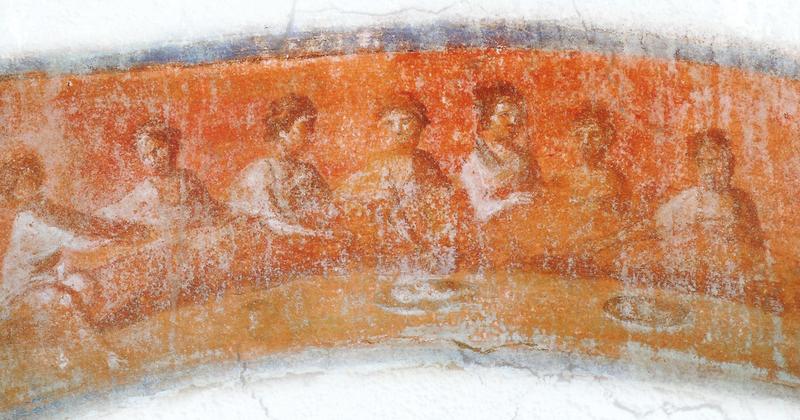
The Apologist Who Believed Too Much
A sophomore apologetics assignment on Justin Martyr's First Apology cost me the church I was raised in. What chapter 66 says about the Eucharist.

1 Clement — The Letter from Rome That Almost Entered the New Testament
1 Clement was read as Scripture at Corinth and bound into Codex Alexandrinus. How the letter came so close to the New Testament, and why the Church left it out.

Pope Saint Felix I: The Twenty-Sixth Pope, the Martyrdom He Never Suffered, and the Letter He Never Wrote
Felix I is the twenty-sixth pope (269–274): a martyr's crown he never earned and a famous letter on Christ he never wrote—both forgeries over one solid fact.
Stay Informed
Get new writing on faith, law, and service delivered to your inbox.
No spam. Unsubscribe anytime.