Real Presence and Transubstantiation: What Catholics Actually Believe About the Eucharist
On This Page
“They abstain from the Eucharist and from prayer, because they refuse to acknowledge that the Eucharist is the flesh of our Savior Jesus Christ, flesh which suffered for our sins and which the Father, in his goodness, raised.” — Ignatius of Antioch, Letter to the Smyrnaeans 6.2, trans. Michael Holmes (c. 110 AD)
What Do Catholics Actually Believe About the Eucharist?
Let me begin with a number that should make every Catholic uncomfortable and every honest Protestant curious.
In August 2019, the Pew Research Center reported that 69% of self-identified U.S. Catholics believe the bread and wine of the Mass are “symbols of the body and blood of Jesus Christ” rather than the actual body and blood. Only 31% affirmed what their own Church has taught since the apostolic age and defined as dogma at the Fourth Lateran Council in 1215. Worse, 43% of all self-identified Catholics said both that the elements are symbolic and that this symbolic view is what the Church teaches—meaning a plurality of American Catholics have not merely dissented from the doctrine but have come to think that the doctrine says something it has never said.1
The survey did its methodological work with the usual caveats. Later studies—CARA’s 2023 survey of Mass-attending Catholics and the 2022 Vinea Research assessment—produced much higher belief rates when the question was worded differently or when the population was limited to weekly attendees.2 The Pew 69% is widely cited and methodologically contested at the same time. Both things are true. What is not in dispute is that the Pew finding, valid or not, triggered one of the most significant Catholic initiatives of the decade: the United States Conference of Catholic Bishops launched a three-year National Eucharistic Revival in June 2022, culminating in the 10th National Eucharistic Congress in Indianapolis in July 2024.3
The stakes the bishops saw in that number are the stakes of this essay. If the Catholic Church is right about what happens at the altar, then a majority of her own children are in a state of grave practical ignorance about the center of their faith. If she is wrong, then over a billion people worldwide are engaged in the most systematic idolatry in human history. There is no safe middle. The question of what happens to the bread and wine is not a doctrinal curio. It is the question on which the shape of Christian worship, the meaning of Scripture, and the identity of the Church all hinge.
I write as someone who was raised an evangelical Protestant and began training for Southern Baptist ministry in college. The Church Fathers—Justin Martyr in particular—led me to the Anglican Church, and eventually to the Catholic Church while earning a Master of Divinity at Yale. The patristic witness on the Eucharist was, in my judgment, unanswerable. I want to make the best possible Catholic case to Protestant readers who have already heard the weak versions of it—the ones that quote John 6 without quoting the disciples walking away, or that cite Ignatius without engaging Zwingli. I also want to do something I rarely see done in apologetic writing: I want to steelman the Protestant objections, in their strongest form, with direct quotation from their best proponents. And then I want to answer them.
Before we get anywhere, we need to clear up what the words actually mean.
Defining Real Presence, Transubstantiation, and What They Don’t Mean
Three terms do most of the work in this debate, and they are not interchangeable.
Real Presence is the broader claim that Christ is truly, objectively present in the Eucharist—not merely symbolically or in the memory of the worshiper. It is a commitment that Christ is really there in a way he is not really in a photograph or a memento. Real Presence is the common property of Catholics, Eastern Orthodox, Oriental Orthodox, Assyrian Christians, Lutherans, and (in a qualified sense) many Anglicans and traditional Reformed Christians. The boundaries of “real presence” are therefore wider than most evangelicals assume, and much Protestant rhetoric about “symbolic” vs. “real” obscures the fact that only one stream of the Reformation—the Zwinglian stream—actually denied Real Presence outright.
Transubstantiation is a much more specific claim: the Catholic metaphysical account of how the Real Presence comes about. The Fourth Lateran Council (1215) used the term in its profession of faith, and the Council of Trent (Session 13, October 1551) defined it as dogma. The Catechism puts it as compactly as anyone:
“By the consecration the transubstantiation of the bread and wine into the Body and Blood of Christ is brought about. Under the consecrated species of bread and wine Christ himself, living and glorious, is present in a true, real, and substantial manner: his Body and his Blood, with his soul and his divinity.”4
Note what the doctrine claims and what it doesn’t. It claims that at the moment of consecration, the substance of bread and wine—their underlying reality, what the elements most deeply are—becomes the substance of Christ’s body and blood. It does not claim that the accidents—the taste, color, weight, chemical composition, what physicists can measure—change in any way. The bread still looks like bread, weighs like bread, digests like bread. A chemist running a mass spectrometer on a consecrated Host will find glucose and gluten, not hemoglobin. This is not an embarrassment to the doctrine; it is the doctrine.
The Thomistic substance/accidents distinction is often misunderstood as a philosophical escape hatch. It is in fact the precise tool Aquinas used to answer the worry the disciples voiced in John 6:52: “How can this man give us his flesh to eat?” The answer: we do not receive Christ’s body in the natural manner of flesh—raw, bloody, sinewy—but under the appearances of bread and wine, which are the mode proper to sacramental communion. Thomas is explicit that Christ’s body is present “after the manner of substance, and not after the manner of quantity” (per modum substantiae, et non per modum quantitatis, ST III, q. 76, a. 1, ad 3), and denies that Christ is present localiter—“in the manner of being in a place”—in the sacrament (ST III, q. 76, a. 5). Christ is not contained spatially in the Host the way a body occupies a chair; the presence is real but not local, which is why the Eucharist cannot be subjected to the ordinary physical tests one would apply to a body in space.5
Several positions are sometimes confused with transubstantiation and should be distinguished clearly. Consubstantiation is the term popularly attributed to Luther—the claim that the substance of bread and the substance of Christ’s body coexist in the host, like two layers of a cake. But Luther repudiated this framing; the confessional Lutheran position is sacramental union, a unique mode of presence in which Christ’s body is present “in, with, and under” the elements without being identified with them metaphysically or diluted into them. The Formula of Concord (1577) does not use the term “consubstantiation”; confessional Lutherans have consistently rejected the label as a Reformed-polemical caricature of their actual view.6
Receptionism holds that Christ is truly received by the believer in the act of faithful communion, but is not objectively present in the elements apart from that reception; this was the position of much of the Elizabethan English Church and is often associated with Thomas Cranmer’s mature theology. Memorialism is the pure Zwinglian view: the bread and wine are symbols only, and the Supper is a remembrance. (Its most confident modern exponent was John MacArthur, whose linguistic argument for it I have examined at length.) Spiritual presence (sometimes called real spiritual presence) is Calvin’s refinement: Christ is truly and really received by faith, not by the mouth, through the power of the Holy Spirit lifting the believer to the ascended Christ’s heavenly presence (sursum corda—“lift up your hearts”). Calvin insists this is a real communion with Christ’s actual flesh and blood, not the mere reception of Christ’s benefits or “virtue”—a distinction that matters, since the label “virtualism” is more accurately applied to certain later Anglican positions and is routinely rejected by Reformed interpreters who read Calvin carefully.
These are not pedantic distinctions. An argument that works against Zwingli (“the Fathers plainly believed the Eucharist is the body of Christ”) does not touch Luther or Calvin. An argument that works against transubstantiation (“the Aristotelian scaffolding is obsolete”) does not touch the Orthodox, who affirm Real Presence using different metaphysical vocabulary. Any serious engagement requires knowing which view one is actually opposing.
With the terms defined, we can ask the prior question. How did I come to think any of this mattered in the first place?
How I Went from Grape Juice to the Blessed Sacrament
I grew up Southern Baptist. My earliest memories of communion involve a metal tray passing down the pew with thimble-sized plastic cups of Welch’s grape juice and oyster-cracker-shaped wafers. The bread was not bread; the wine was not wine. We did this four times a year, on Sundays the pastor flagged in advance. The ordinance was solemn and sincere, but nobody I knew thought it involved any change in the elements themselves. The language of our tradition was the language of remembrance, memorial, and proclamation—“do this in remembrance of me.”
That was the whole framework I had for thinking about the Lord’s Supper when the Church Fathers first broke into my world. In college, while training for Southern Baptist ministry, I picked up Justin Martyr’s First Apology—and the way Justin talked about the Eucharist stopped me cold. It did not sound like anything I had been taught. That encounter, more than any other single factor, led me to the Anglican Church, where I found a tradition that at least took the Fathers seriously. By the time I arrived at Yale Divinity School twelve years later, I was an evangelical Anglican shaped by the Oxford Movement’s branch theory, and I had already considered the Orthodox Church before I began to consider Rome. I was not looking for the Catholic Church. I was looking for the early Church.
I had been reading the Church Fathers for years by this point, but it was at Yale—where I could study early Christianity systematically alongside the primary texts—that the cumulative weight became unavoidable. One edition I returned to often was Michael Holmes’s critical edition of the Apostolic Fathers, a serious Protestant work with an excellent apparatus.7
Ignatius of Antioch was martyred in Rome under Trajan, probably around AD 110. Seven of his letters survive in their authentic recension. He wrote them on the way to his own death, in chains, and the voice is unmistakable—urgent, pastoral, shot through with the certainty of a man who expects to see Christ within the week. He was bishop of Antioch, where the disciples were first called Christians (Acts 11:26). He was plausibly discipled by the Apostle John. If anyone knew what the first-century Church believed about the sacraments, it was Ignatius.
Here is what I read in Smyrnaeans 6.2:
“They abstain from the Eucharist and from prayer, because they refuse to acknowledge that the Eucharist is the flesh of our Savior Jesus Christ, flesh which suffered for our sins and which the Father, in his goodness, raised.”8
The Docetists Ignatius was fighting denied that Jesus had come in real human flesh. Ignatius’s counter-argument is that they won’t come to the Eucharist, because they don’t believe the Eucharist is the flesh of Jesus. The logic only works if the Eucharist really is flesh. If the Eucharist were a symbol of flesh, a memorial of flesh, a spiritual communion with a heavenly Christ whose flesh is not involved, Ignatius’s argument would fall apart. The Docetists could symbolize whatever they pleased. The fact that they stayed away from the Eucharist specifically—and that Ignatius treats this as damning evidence of their error—tells you what the Eucharist meant to Ignatius’s churches.
No Protestant pastor I had ever sat under would use Ignatius’s sentence as a test of orthodoxy. Many of them would, I suspected, find the sentence alarming. The early-second-century bishop of Antioch was talking about the Eucharist the way no evangelical church I had ever attended talked about the Eucharist.
That would have been manageable if Ignatius were a one-off. But he was not a one-off. Justin Martyr (Rome, c. 150)—the Father who had first unsettled me in college—tells the emperor that “not as common bread and common drink do we receive these … the food which is blessed by the prayer of His word, and from which our blood and flesh by transmutation are nourished, is the flesh and blood of that Jesus who was made flesh” (First Apology 66, trans. ANF).9 Irenaeus of Lyons (c. 180) argues against the Gnostics by appealing to the Eucharist, which he insists is the real body and blood of Christ—an argument that only works if Irenaeus believed that.10
Cyril of Jerusalem’s mystagogical catecheses (c. 350) tell the newly baptized: “Having learned these things, and been fully assured that the seeming bread is not bread, though sensible to taste, but the Body of Christ…” (Myst. Cat. 4.9, trans. NPNF).11 John Chrysostom’s eighty-second Homily on Matthew (c. 390) tells his people, in sermon after sermon, that they hold the incarnate Christ in their hands at the altar.12
At some point it became intellectually impossible for me to maintain that the first four centuries of the Church held a low view of the Eucharist and that the medieval Church invented the doctrine of the Real Presence somewhere between Paschasius Radbertus and the Fourth Lateran Council. The evidence simply did not permit that reading. The only honest move was to conclude either that the Church had been wrong about the Eucharist from the apostolic age forward—a conclusion that seemed to gut the Protestant claim to restore apostolic Christianity—or that the Catholic claim was, at the very least, the inheritor of the actual first-millennium position.
That did not make me Catholic on its own. I spent years as an Anglican reading Reformed theology seriously and considering Eastern Orthodoxy along the way. But the patristic question—which pressed toward Orthodoxy and toward Rome alike—never went away. The longer I studied, the more clearly it seemed to me that the Fathers could not be read as early Baptists, or as early Calvinists, or as inchoate Lutherans. They were something closer to what became the Catholic and Orthodox settlements, and any honest Protestant engagement had to start from that premise rather than avoiding it. I simply found it hard to believe that everyone within living memory of the Apostles had simply made up the nature of the Eucharist in a way the Apostles never taught. I began the process of entering the Catholic Church at the end of my first semester at Yale and was received in June 2020, after finishing my first year.
The rest of this essay is the best argument I can assemble for why I ended up where I did. I will make the biblical case, walk through the patristic witness, explain why Luther and Calvin both retained Real Presence when their radical flank did not, steelman the strongest Protestant counter-arguments in their strongest form, and answer them. If you are a Protestant who has never read Ignatius, I am asking you to read him. If you are a Catholic who has never read Zwingli or Carson, I am asking you to read them. The question is serious enough to repay the work.
The Biblical Case for the Real Presence
Four passages do most of the scriptural work: the institution narratives in Matthew, Mark, Luke, and 1 Corinthians; the Bread of Life discourse in John 6; Paul’s warning in 1 Corinthians 11; and Malachi’s prophecy of a pure offering among the nations. Each one admits of multiple readings. Taken together, and read within the Passover liturgy of Second Temple Judaism, they point—in my judgment—unmistakably toward the Real Presence. Here is why.
“This Is My Body”—What the Words of Institution Claim
The four institution narratives show a remarkable stability of language across independent traditions. Matthew 26:26–28, Mark 14:22–24, Luke 22:19–20, and 1 Corinthians 11:23–26 share the core formula: Jesus takes bread, blesses it, breaks it, gives it to the disciples, and says: Touto estin to sōma mou—“This is my body.” Over the cup, he says: Touto estin to haima mou tēs diathēkēs—“This is my blood of the covenant, poured out for many” (Mark 14:24). Luke and Paul add the command, Touto poieite eis tēn emēn anamnēsin—“Do this in remembrance of me” (Luke 22:19; 1 Cor 11:24).13
The Greek copula estin is usually translated “is.” Everything else in the verse is unambiguous. Jesus holds a physical object. He predicates his body of it. He does so on the night of his arrest, at the climax of his public ministry, in the intentional performance of a Passover liturgy. No qualifier softens the claim. He does not say “this represents my body” or “let this remind you of my body.” The qualifying language is absent because, I think, Jesus did not intend it to be there.
Zwingli, as we will see below in the objections section, argued that estin often functions as “signifies” in Christological predications—“I am the vine,” “I am the door,” “the rock was Christ.” That observation is correct and important; it must be addressed directly rather than waved away, and I will address it. For the moment, notice what distinguishes the institution narrative from those metaphors. When Jesus says “I am the vine,” the surrounding discourse in John 15 makes the metaphor unmistakable: the passage is an extended allegory of vineyard cultivation, and Jesus is obviously not a plant. When he says “I am the door,” the preceding discourse has been about shepherds and sheepfolds. The grammatical structure is also distinctive: “I am X” is a predication about the speaker’s role or function. “This is my body” is structurally different—Jesus points to a distinct object and predicates his body of it.
The Passover context matters profoundly. Brant Pitre’s Jesus and the Jewish Roots of the Eucharist (2011) assembled the case from Second Temple sources in a way that reframes the whole exegetical question.14 Pitre notes that the Passover Haggadah already involved identifying the physical elements with the realities they re-presented—that is, made present again. The Mishnah preserves a formula from the Passover seder: “In every generation a person must regard himself as though he personally had come out of Egypt” (m. Pesahim 10:5). The unleavened bread is called lachmah anya—“the bread of affliction which our fathers ate in the land of Egypt” (Deut 16:3, picked up in the Haggadah). First-century Jews did not regard that identification as a metaphor. Obviously the bread on the seder plate was not the same physical bread their ancestors ate in the desert—everyone at the table knew that. The point is that the Passover ritual operated in a category that is neither bare metaphor nor crude literalism: a liturgical identification in which the act of eating the bread genuinely made present the deliverance from Egypt for each new generation. The category will matter when we get to John 6.
When Jesus redeploys the identificatory formula at the Last Supper—“This is my body”—he is not inventing a new literary trope. He is performing a new Passover identification within a ritual that already used identificatory language in a non-metaphorical sense. To read the institution narratives through the filter of later Enlightenment semantics (“symbol = merely symbolic”) is to import a category that the first-century ritual did not contain.
John 6 and the Bread of Life
The Bread of Life discourse in John 6 is the battleground text. Jesus has just fed the five thousand. The crowd follows him across the lake. He tells them they seek him not for signs but for bread, and launches into a sustained teaching that begins as a reflection on the manna (vv. 31–34), develops as an extended invitation to believe in him (vv. 35–51a), and then intensifies—explosively—into the language that should make us stop and pay attention (vv. 51c–58).
“I am the living bread that came down from heaven. If anyone eats of this bread, he will live forever. And the bread that I will give for the life of the world is my flesh… Truly, truly, I say to you, unless you eat the flesh of the Son of Man and drink his blood, you have no life in you. Whoever feeds on my flesh and drinks my blood has eternal life, and I will raise him up on the last day. For my flesh is true food, and my blood is true drink.” (John 6:51, 53–55)
Three things about the Greek demand attention.15
First, at verse 54 the verb shifts. Up through verse 53, the word for “eat” is phagein—the ordinary, unmarked Greek verb for eating. From verse 54 to the end of the discourse, John substitutes trōgein, a much more vivid and physical verb meaning “gnaw, munch, crunch.” Trōgein is the word Greek speakers used for animals eating fodder. Raymond Brown, in his Anchor Bible commentary (not a Catholic apologetic volume), argues that this shift “is part of John’s attempt to emphasize the realism of the eucharistic flesh and blood.”16 The shift is hard to explain if the entire discourse is meant as a figure for believing.
Second, Jesus uses sarx (“flesh”) rather than sōma (“body”). Some interpreters, including D. A. Carson, take this as evidence that the discourse points to the Incarnation rather than the Eucharist—sarx being the word of John 1:14, “the Word became sarx.”17 That is a fair exegetical observation, and Carson is a scholar worth reading carefully. But sarx and sōma are not mutually exclusive; the Incarnation is precisely what the Eucharist makes present, and Ignatius uses exactly the phrase John 6:51 uses (“the flesh of our Savior Jesus Christ, flesh which suffered”) to describe the Eucharist a few decades after John.
Third, and most importantly, the narrative response of the disciples. The audience does not read verses 53–58 as metaphor. They respond: “This is a hard saying; who can listen to it?” (6:60). And then something happens that happens nowhere else in the Gospels: many of his disciples turned back and no longer walked with him (6:66). A mass defection. Jesus has made hard sayings all through his ministry—“I and the Father are one,” “before Abraham was, I am,” “if you do not eat my flesh and drink my blood, you have no life in you.” People have objected before. But only at the end of John 6 do the disciples walk out en masse. Jesus does not soften the claim. He does not explain it away. He turns to the Twelve and says, “Do you also wish to go away?”
Reading the discourse as purely metaphorical makes the walkout hard to account for. If Jesus has said nothing more offensive than “believe in me,” why do his disciples abandon him here, and nowhere else? If the flesh-and-blood language is a figure for faith, why does Jesus not clarify when his disciples evidently misunderstand and are scandalized? Pitre presses this argument sharply: Jesus had spent the better part of a chapter insisting on the language that offended, had shifted to the more graphic trōgein at the very point the audience was ready to walk, and then watched them leave without pulling them back.18
Carson’s best counter-argument is verse 63: “It is the Spirit who gives life; the flesh is of no help at all. The words I have spoken to you are spirit and they are life.” On Carson’s reading, this is Jesus’s own correction—do not hear the flesh-and-blood language carnally; it is spiritual teaching. This is an exegetical move worth taking seriously; if the Catholic reading is correct, 6:63 must be accounted for.
I think the Catholic reading accounts for it in two moves. First, sarx in 6:63 is used in the Pauline sense: “the flesh” as opposed to “the Spirit,” the mode of carnal reasoning that cannot grasp the things of God. Jesus is not contradicting 6:54 (“my flesh is true food”); he is saying that mere unaided human sarx—the carnal mind—is incapable of receiving what he has just taught. Second, the discourse is unfolding on two levels simultaneously. Faith is the indispensable first level: without faith, nothing here is received. The eucharistic feeding is the second level: the bread that will be given is, specifically, the flesh of Jesus for the life of the world. The two levels interlock. Believing and eating are not alternatives; they are the two modes of participation in the same Christ. The patristic tradition reads the passage exactly this way, and nothing in verse 63 forces a purely metaphorical reading.
I want to grant what needs to be granted. The Catholic does not have to claim that John 6 is only about the Eucharist to make the case. Brown’s careful position—that the discourse has multiple layers, that vv. 35–50 emphasize faith in the Incarnate Christ, and that vv. 51c–58 layer eucharistic meaning on top of that—is the honest scholarly position and the one I hold. Carson’s arguments about verse 63 and sarx vs. sōma have genuine force. What cannot be rationalized away are the trōgein shift and the walkout. Those two data points are where the Catholic case on John 6 rests, and they are sturdy enough to carry the weight.
Paul’s Warning and What It Assumes
The third biblical datum is often the most persuasive to Protestant readers, because Paul is the Protestant apostle par excellence and his own description of Communion is uncomfortably direct.
“The cup of blessing that we bless, is it not a participation (koinōnia) in the blood of Christ? The bread that we break, is it not a participation in the body of Christ? Because there is one bread, we who are many are one body, for we all partake of the one bread.” (1 Cor 10:16–17)
The Greek koinōnia is stronger than our “participation”; it denotes an actual sharing-in, a communion with. Paul is arguing from Christian eucharistic practice to Christian moral life. The logic only works if the Eucharist really is a communion with Christ’s body and blood.
The passage that made me, as a careful Reformed reader, stop and think hardest is 1 Corinthians 11:27–30:
“Whoever, therefore, eats the bread or drinks the cup of the Lord in an unworthy manner will be guilty concerning (enochos) the body and blood of the Lord. Let a person examine himself, then, and so eat of the bread and drink of the cup. For anyone who eats and drinks without discerning the body eats and drinks judgment on himself. That is why many of you are weak and ill, and some have died.” (1 Cor 11:27–30)
The word enochos with the genitive means “guilty of” in the sense of culpable for a crime committed against the named object. Paul writes that unworthy reception makes one enochos tou sōmatos kai tou haimatos tou Kyriou—guilty of the body and blood of the Lord. This construction is the legal language of the Septuagint and of Paul’s own epistolary rhetoric (cf. Mark 3:29; Heb 10:29). If the bread and cup are mere symbols, it is not clear in what sense abusing them makes one culpable for a crime against the body and blood themselves.19
The reference to “discerning the body” and to actual physical consequences—illness and death—among those who misreceive reinforces the strength of the language. Paul is not articulating a metaphor. He is describing a sacramental realism in which the body of Christ is truly received at Corinth’s table, and in which that reception bears real consequences for human bodies on the other side of it. Calvin read the passage seriously, and his answer was to insist that the communion is real but spiritual, mediated by the Spirit’s uplifting of the believer to Christ in heaven. That is a coherent answer. It is not the Catholic answer, and we will weigh it in the objections section below.
Malachi, Melchizedek, and the Eucharist as Sacrifice
One more passage, less familiar to Protestant readers. Malachi, writing in the post-exilic fifth century BC, prophesies of the Messianic age:
“From the rising of the sun to its setting my name will be great among the nations, and in every place incense will be offered to my name, and a pure offering (minchah tehorah). For my name will be great among the nations, says the Lord of hosts.” (Mal 1:11)
The unbloody grain offering (minchah) was always, in Levitical thought, the non-animal counterpart to blood sacrifice. Malachi prophesies of a future cultic age in which the pure offering will be made “in every place”—not confined to the Jerusalem temple—and among the Gentiles. The Didache (dated variously between the late first and early second centuries) and Justin Martyr (c. 150 AD) both cite Malachi 1:11 as fulfilled in the Christian Eucharist.20
The Epistle to the Hebrews picks up the other half of the cultic imagery. It identifies Christ as priest “according to the order of Melchizedek” (Heb 5:6, 10, citing Ps 110:4). Melchizedek is the enigmatic king-priest of Genesis 14 who brings out bread and wine and blesses Abraham. Both the bread-and-wine offering of the Old Covenant and the pure-offering prophecy of Malachi are satisfied in a Christian eucharistic reading in a way they are not satisfied elsewhere.
Nothing in Malachi or Hebrews, taken in isolation, proves Real Presence. But read alongside the institution narratives, the participation language of 1 Corinthians 10, and the Bread of Life discourse, the cumulative weight is impressive. The New Testament is not trying to describe a memorial meal. It is describing a cultic act in which a particular, real, bodily Jesus is given for the life of the world, and in which Christians participate by eating and drinking. The Fathers read it that way from the first decades of the second century onward. That is the evidence we will turn to now.
What the Earliest Christians Believed: The Patristic Witness
The single most persuasive historical argument for eucharistic realism is not the testimony of any one Father. It is the convergence of many Fathers, across centuries and languages, from separate geographical centers, speaking of the Eucharist in a realist idiom that a fair-minded reader cannot square with memorialism and struggles to square with receptionism.
Let me take the witnesses in order. Each quotation is from a standard modern critical edition; I have kept the passages short and precise.
From Ignatius to Chrysostom: A Century-by-Century Survey
The Didache (c. 50–100 AD), the earliest Christian church order, treats the eucharistic elements as a holy thing: “Let no one eat or drink of your Eucharist, except those who have been baptized in the name of the Lord; for about this the Lord has said, ‘Do not give what is holy to the dogs’” (Did. 9.5).21 The text also quotes Malachi 1:11, presenting the Eucharist as the fulfillment of Malachi’s prophesied pure offering (Did. 14.1–3).
Ignatius of Antioch (c. 110 AD) is the text I have already quoted. Ignatius, writing on his way to martyrdom, makes two further statements worth noticing. To the Ephesians, he calls the Eucharist “the medicine of immortality (pharmakon athanasias), the antidote against death” (Eph. 20.2). To the Philadelphians, he commands unity around the altar: “Be careful, therefore, to use one Eucharist; for there is one flesh of our Lord Jesus Christ, and one cup for union with his blood, one altar, just as there is one bishop” (Phld. 4.1).22 The metaphors in Ignatius are rich, but the underlying realism is clear.
Justin Martyr (c. 150 AD), defending the faith to the pagan emperor Antoninus Pius in his First Apology, gives perhaps the earliest full description of Christian worship. Justin describes how the bread and wine are brought forward, the Amen is spoken, and the elements are distributed. Then:
“This food is called among us Eucharist, of which no one is allowed to partake but the man who believes that the things which we teach are true, and who has been washed with the washing that is for the remission of sins, and unto regeneration, and who is so living as Christ has enjoined. For not as common bread and common drink do we receive these; but in like manner as Jesus Christ our Savior, having been made flesh by the Word of God, had both flesh and blood for our salvation, so likewise have we been taught that the food which is blessed by the prayer of His word, and from which our blood and flesh by transmutation are nourished, is the flesh and blood of that Jesus who was made flesh.” (1 Apol. 66.1–2)23
The Incarnational analogy is crucial. As Christ had real flesh and real blood at the Incarnation, so the eucharistic food really is his flesh and blood. Justin is making this claim in an apologetic document to a hostile pagan audience, which is exactly the context in which he would have reason to soften the claim if the claim had been softer.
Irenaeus of Lyons (c. 180 AD) argues against the Gnostics in Against Heresies. One of his major arguments is from the Eucharist. The Gnostics, who denied the goodness of matter and the reality of Christ’s flesh, refused to credit Christ as Creator of the material world. Irenaeus’s retort: if the Creator were not the same God as the Redeemer, how could ordinary bread and wine be made into the body and blood of Christ, which then nourishes our own fleshly bodies to incorruption?
“When, therefore, the mixed cup and the baked bread receives the Word of God and becomes the Eucharist, the Body of Christ, and from these the substance of our flesh is increased and supported, how can they affirm that the flesh is incapable of receiving the gift of God, which is eternal life—flesh which is nourished by the body and blood of the Lord?” (Adv. Haer. 5.2.3)24
The whole argument is a reductio against the Gnostics. It only works if Irenaeus’s own churches—and the Gnostics he is addressing—already agreed that the bread and wine become the Body of Christ. Irenaeus is not establishing a new doctrine here; he is using the doctrine the churches of Gaul and Asia Minor already confess against the Gnostics who want to deny it.
Cyril of Jerusalem (c. 350 AD), in the Mystagogical Catecheses he delivered to the newly baptized in the Holy Sepulchre, is utterly explicit:
“He once in Cana of Galilee, turned the water into wine, akin to blood, and is it incredible that he should have turned wine into blood? … Wherefore with all confidence, let us partake as of the Body and Blood of Christ: for in the figure (typos) of Bread is given to thee his Body, and in the figure of Wine his Blood; that thou by partaking of the Body and Blood of Christ mayest be made of the same body and the same blood with him. For thus we come to bear Christ in us, because his Body and Blood are distributed through our members; thus it is that, according to the blessed Peter, we become partakers of the divine nature.” (Myst. Cat. 4.2–3)25
Cyril’s language of typos (“type, figure”) has sometimes been pressed by Protestant readers in the direction of mere symbolism. But Cyril’s context rules that reading out. The whole point of the passage is that “what seems to be bread is not bread, though it be so by taste, but the Body of Christ” (4.9). Typos in Cyril functions as the visible sign of an invisible reality genuinely present—a realist use of the term, not a memorialist one.
Ambrose of Milan (c. 390 AD), in De Sacramentis and De Mysteriis, is the Latin Father who presses hardest on the question of change. He writes: “You perhaps say: ‘My bread is ordinary.’ But that bread is bread before the words of the Sacraments; where the consecration has entered in, the bread becomes the flesh of Christ” (De Sacr. 4.14). And again: “Before the words of Christ the chalice is full of wine and water; when the words of Christ have operated, there is made the blood which redeemed the people” (De Sacr. 4.19).26 Ambrose is not yet speaking the philosophical language of Aquinas, but he is already clearly articulating the change-of-substance claim that transubstantiation will later formalize.
John Chrysostom (c. 390 AD), preaching to the people of Antioch and later Constantinople, hammers on the realism relentlessly:
“For when thou seest the Lord sacrificed, and laid upon the altar, and the priest standing and praying over the victim, and all the worshippers imbued with that precious blood, canst thou then think that thou art still among men, and standing upon the earth? Art thou not, on the contrary, straightway translated to heaven, and casting out every carnal thought from the soul, dost thou not with disembodied spirit and pure reason contemplate the things which are in heaven?” (De Sacerdotio 3.4)27
And in his 24th Homily on 1 Corinthians (on 1 Cor 10), Chrysostom tells his people: “That which He suffered not on the cross, this He suffers in the oblation for your sake, and submits to be broken, that He may fill all men.” The language of sacrifice, of the priest’s offering, of the worshiper receiving “that precious blood,” saturates his preaching.28
Cyril of Alexandria (c. 430), defending the unity of Christ’s person against Nestorius, argues that the Eucharist guarantees real participation in the deified flesh of the Logos (Commentary on John 4.2). Theodoret of Cyrus (c. 450), in his Eranistes dialogues, uses the Eucharist to argue against Monophysitism. His point is that the elements retain their natural properties after consecration while truly becoming the body and blood—just as Christ retains two natures in one person. Some Reformed readers have claimed Theodoret as evidence against transubstantiation; Catholic theologians respond that his emphasis on preserved sensible properties (nature, form, figure) is precisely what the later substance/accidents distinction formalizes. Theodoret is genuinely disputed territory, and honest readers can land differently on what he meant.29
Leo the Great (c. 450) closes the survey with a characteristically blunt formulation: “For the participation of the Body and Blood of Christ effects nothing else than that we pass over into that which we receive” (Sermo 63.7).30
The Protestant patristics scholar J. N. D. Kelly—an Anglican, not a Catholic—summarized the weight of this evidence in his classic Early Christian Doctrines:
“Eucharistic teaching, it should be understood at the outset, was in general unquestioningly realist, i.e. the consecrated bread and wine were taken to be, and were treated and designated as, the Saviour’s body and blood.”31
Kelly’s sentence carries exceptional weight because Kelly is a Protestant scholar with no apologetic stake in the Catholic position. When a Protestant patristics scholar with no motive to favor Rome describes the first-millennium consensus as “unquestioningly realist,” the burden of proof shifts. The question is no longer whether the early Church believed in Real Presence. The question is how any Reformation tradition that denies Real Presence can claim continuity with the faith of the Fathers.
What About Augustine?
Of course, someone always raises Augustine. Keith Mathison’s Given For You (2002) assembled the Reformed case that Augustine’s eucharistic vocabulary maps more naturally onto Calvin than onto Trent.32 Mathison is a careful scholar, and his argument deserves an honest hearing.
Mathison’s case rests on four claims. First, Augustine consistently speaks of “eating” Christ spiritually through faith—famously in Tractates on John 27, where he instructs his congregation: “Why do you make ready teeth and stomach? Believe and you have eaten” (Crede et manducasti). Second, Augustine deploys the distinction between signum (sign) and res (reality) to describe the relationship between the eucharistic elements and the grace they confer. Third, Augustine never teaches in so many words that the substance of bread ceases to exist while the accidents remain; the transubstantiation framework is a later medieval development. Fourth, Augustine interprets John 6:63 as a warning against carnal misunderstanding of eucharistic eating.
All four claims are textually grounded. Augustine genuinely does speak this way, and an honest Catholic response should begin by conceding it. But the conclusion Mathison draws—that Augustine is a sixteenth-century Calvinist born too early—does not follow, for three reasons.
First, reading Augustine’s “sign” language through post-Enlightenment semantics—where “sign” means “merely symbolic, pointing to something absent”—is a profound anachronism. Henri de Lubac’s Corpus Mysticum (1944) demonstrated that Augustine’s signum operates within a participatory framework inherited from Platonism, in which a sacramental sign does not merely point to an absent reality the way a road sign points to a distant city. The sign participates in the reality it signifies.33 De Lubac’s larger argument is that the phrase corpus mysticum originally referred to the eucharistic body of Christ and only later—in the polemical context of Berengar’s eleventh-century controversy—came to mean the Church. The modern Protestant reading of Augustine’s sign-language projects a modern semantics onto an ancient sacramental ontology.
Second, Augustine elsewhere speaks in the direct identification language that every realist Father uses. Sermon 227, preached to the newly baptized on Easter Sunday around 411:
“That Bread which you see on the altar, consecrated by the word of God, is the Body of Christ. That chalice, or rather, what the chalice holds, consecrated by the word of God, is the Blood of Christ. Through those accidents the Lord wished to entrust to us his Body and the Blood which he shed for the remission of our sins.” (Sermo 227)34
The copula is direct and unqualified. The newly baptized are being told, in the catechetical register in which Augustine would have had every reason to avoid misleading them, that the bread on the altar is the Body of Christ.
Third—and this is the point where Mathison’s reading strains hardest—Augustine insists on eucharistic adoration. In his exposition of Psalm 98, commenting on the phrase “worship at his footstool,” Augustine argues that Christ’s flesh is precisely the “footstool” of the divine glory, and then draws the conclusion:
“He took earth from earth, for flesh is from earth, and he took flesh from the flesh of Mary. And because he walked here in that very flesh, he gave that same flesh to us to eat for salvation. But no one eats that flesh without first adoring it … we should sin were we not to adore it.” (Enarr. in Ps. 98.9)35
“Nemo autem illam carnem manducat, nisi prius adoraverit… peccemus non adorando.” No one eats that flesh without first adoring it; we would sin not to adore it. That is not the language of memorialism. It is not the language of receptionism. It is the language of a man who believes that the flesh on the altar is the same flesh born of Mary, crucified under Pilate, and risen from the tomb—and that failure to adore it is sin.
My honest view is that Augustine resists easy categorization. Both sides can quote him; both sides do. The best Catholic case is de Lubac’s: Augustine’s participatory ontology of signs is not medieval transubstantiation and not modern symbolism. It is something that both traditions partially inherit. But if one side has to choose whether Augustine would be more at home at a Reformed Presbyterian communion service or at a Traditional Latin Mass—genuflecting before the elevated Host—the weight of Sermo 227 and Enarr. in Ps. 98.9 points unmistakably to the latter.
The Eucharist Is Not Just Catholic vs. Protestant: A Four-Way Conversation
One of the most important things American evangelicals often do not realize is that the Eucharist is not a Catholic-vs.-Protestant binary. The sixteenth-century Reformers were split on the Lord’s Supper more bitterly than on almost any other question, and the split runs along lines that do not map onto the later Catholic-Protestant divide in the way most readers assume.
Broadly, the Reformers divided into three camps. Luther affirmed a real, bodily presence of Christ “in, with, and under” the bread and wine, though not by way of transubstantiation. Calvin affirmed a real presence mediated by the Holy Spirit, received by faith—real, but not bodily and not in the elements themselves. Zwingli affirmed a memorial presence only: the Eucharist is a remembrance, an act of the believing community recalling what Christ has done. All three call themselves “evangelical,” all three anathematize transubstantiation, and all three anathematize each other. The Marburg Colloquy of 1529, convened to reconcile the Wittenberg and Zurich reformations, famously failed over this question. Luther and Zwingli could not shake hands at the end.36
Understanding this three-way Protestant split—and adding the Eastern Orthodox to make a four-way conversation—is the single best inoculation against false simplifications on both sides of the debate.
Luther and Calvin Both Believed in Real Presence (Just Not the Same Kind)
Luther stood at Marburg and wrote on the table in chalk the words hoc est corpus meum. For Luther, the bare grammar of the institution narrative was decisive. To deny real bodily presence was, for Luther, to abandon the plain sense of Scripture. His defense rested on three pillars: the exegetical argument (“is” means “is”); a christological argument from the communicatio idiomatum—the communication of attributes between Christ’s divine and human natures, such that the ascended body of Christ can be “at the right hand of the Father” in a way that permits ubiquity; and a pastoral-evangelical argument that the Supper is the gospel’s physical seal, given by Christ to comfort anxious consciences.37
The confessional Lutheran formulation is sacramental union (unio sacramentalis). Christ’s body is present “in, with, and under” the bread; the bread is not transubstantiated, and the two substances do not merge. The Formula of Concord does not use the term consubstantiation; confessional Lutheranism after the Formula has consistently rejected the label as a Reformed-polemical caricature, since it implies a local, physical mixing of two substances the Formula’s language of sacramental union deliberately excludes. The body is received orally by every communicant—the manducatio oralis—including unworthy communicants, who receive it to their judgment (manducatio indignorum). “The cause or ground,” the Formula insists, “that these words are so to be understood and that this is to be held, is not our faith but His almighty power.”38
This is a strong doctrine of presence. A confessional Lutheran attending Mass sees substantially the same thing Catholics see: Christ’s body, really there, really received. The differences are metaphysical and sacrificial, not at the level of presence itself.
Calvin’s position is more subtle and is often caricatured. Calvin rejected both transubstantiation and Lutheran bodily presence. He rejected Zwinglian memorialism even more emphatically. His own view, laid out at length in Book IV, Chapter 17 of the Institutes, is that in the Supper Christ is truly given to the believer—not in the bread by way of local presence, but by the Holy Spirit lifting the believer up to heaven, where Christ in his glorified body now sits. The communion is real but pneumatic; spiritual yet not merely metaphorical.
“What, then, our mind does not comprehend, let faith conceive: that the Spirit truly unites things separated by space. Now, that sacred communion of flesh and blood by which Christ transfuses his life into us, just as if it penetrated our bones and marrow, he testifies and seals in the Supper. And he does so not by presenting a vain or empty sign, but manifesting there the efficacy of his Spirit to fulfill what he promises.” (Institutes IV.17.10)39
And crucially: “The thing therefore signified he exhibits and offers to all who sit down at the spiritual banquet, although it is received with benefit by believers alone, who embrace such great goodness with true faith and gratitude.” (IV.17.10)
Calvin’s liturgical formulation was the sursum corda—“lift up your hearts.” The communion does not come down into the elements; the believer is lifted up to Christ. This is not a memorialist position. Calvin is explicit throughout the Institutes that he affirms the real presence of Christ and the real communion of the believer with Christ’s flesh and blood. He is equally explicit that he denies local, bodily presence in the elements themselves. Whether Calvin’s position coheres internally—whether “real but spiritual” says something different from “not really there in the elements”—is a classic question, and one that later Reformed theology has split over (Keith Mathison argues for a recovery of Calvin against a “Zwinglian drift” in contemporary Reformed churches).40
The point for our purposes: the Heidelberg Catechism (1563), the standard-bearing Reformed confession, explicitly teaches real presence received by faith. Question 76 asks what it means to eat the crucified body of Christ, and answers:
“It means to be so united more and more to his sacred body by the Holy Spirit dwelling both in Christ and in us, that, though Christ is in heaven, and we on earth, we are nevertheless flesh of his flesh and bone of his bone, and that we live and are governed forever by one Spirit, as members of the same body are by one soul.” (Heidelberg Catechism, Q/A 76)41
When Protestant apologists quote Calvin or the Heidelberg Catechism against the Catholic Mass, they are very often quoting authors who affirmed a much higher view of the Supper than those apologists themselves hold. A Zwinglian Baptist who invokes Calvin has allied with a stronger position than his own.
The ecumenical fruit of this recognition has been substantial. The Anglican-Roman Catholic International Commission (ARCIC) reached a remarkable convergence on the Eucharist in its 1971 Windsor Statement, declaring: “Christ’s redeeming death and resurrection took place once and for all in history. Christ’s action in the eucharist makes this present to us through sacrament… The body and blood of Christ become really present and are really given. But they are really present and given in order that, receiving them, believers may be united in communion with Christ the Lord.”42 The Catholic Church’s Congregation for the Doctrine of the Faith (then under Cardinal Ratzinger) offered a measured initial response in its 1982 “Observations” on the ARCIC Final Report, and the Holy See’s Official Response (1991, from the PCPCU together with the CDF) concluded that the Windsor text’s teaching on the Eucharist was “substantially agreed.”
ARCIC-II’s 1993 Clarifications responded to Rome’s reservations. The Joint Declaration on the Doctrine of Justification (1999) did comparable ecumenical work between Catholics and Lutherans on a different question, modeling the methodology of “differentiated consensus”; From Conflict to Communion (2013) set out a shared Lutheran–Catholic reading of the Reformation itself.43
None of this means the differences have vanished. What it means is that the serious Reformed, Lutheran, and Catholic traditions are closer on the Eucharist than the popular polemic suggests—and that the real outlier in the conversation is Zwinglian memorialism, which neither Luther nor Calvin held and which most contemporary Reformed and Lutheran theologians reject.
Why the Orthodox Matter for This Debate
Add one more voice. The Eastern Orthodox Church has always affirmed a realist doctrine of Eucharistic presence, often using the Greek term metousiosis (“change of being”) as the functional equivalent of Latin transubstantiatio. The Confession of Dositheus (Synod of Jerusalem, 1672), one of the authoritative Orthodox dogmatic texts of the post-Byzantine era, employs transubstantiation-equivalent language explicitly. Contemporary Orthodox theologians Kallistos Ware, John Meyendorff, and Alexander Schmemann all affirm that the change in the elements is objective and ontological, not merely subjective or spiritual.44
Schmemann’s classic formulation in his essay “Theology and Eucharist”:
“Our earthly food becomes the Body and Blood of Christ because it has been assumed, accepted, lifted up into the ‘age to come,’ where Christ is indeed the very life, the very food of all life.”45
This matters enormously for one particular Protestant objection. The most serious philosophical attack on transubstantiation—that it depends on an Aristotelian metaphysics of substance and accidents that modern philosophy has abandoned—is substantially weakened by the Orthodox case. The East has always affirmed real, objective, ontological change in the Eucharist without any scholastic-Aristotelian scaffolding. Orthodox theologians typically work within a Platonic-patristic frame, not a Thomistic one, and they reach the same realist conclusion. (Many modern Orthodox theologians, it is worth adding, have explicit reservations about formalizing metousiosis in Aristotelian-substantialist terms; their point is that Orthodox affirmation of real change does not require the scholastic vocabulary, not that the scholastic vocabulary is wrong.)
If the Aristotelian-philosophy objection were decisive, the Orthodox position would be inexplicable. It is not inexplicable; it is widely held by intelligent Christians who have thought about the question for sixteen hundred years. The objection, we will see below, is real and deserves a careful response. But it is not the killing blow it is sometimes presented as, and the Orthodox parallel is the strongest single piece of evidence against it.
We now have to take the strongest objections seriously.
The Strongest Protestant Objections—and Why I Take Them Seriously
This is the section on which the credibility of this essay stands or falls. If I dismiss the Protestant objections with a wave or a sneer, I have not earned the right to the Catholic conclusion. What follows is my best attempt to state each objection in its strongest form, with direct quotation from its best proponents, and then to answer it.
1. “Is” Just Means “Signifies” (Zwingli’s Case)
The objection. Zwingli, drawing on the Dutch jurist and humanist Cornelis Hoen, argued in On the Lord’s Supper (1526) that the copula “is” in the institution narrative functions as “signifies.” Scripture uses this construction all the time: “I am the vine” (John 15:5), “I am the door” (John 10:9), “the rock was Christ” (1 Cor 10:4). In none of these cases does anyone take the “is” literally. Why should we take the “is” in “This is my body” literally, when Scripture gives us so many parallels in which Jesus is plainly using metaphorical predication?
Zwingli reinforced the point with a christological argument: Christ’s body is at the right hand of the Father. A human body cannot be in two places at once. Therefore the bread cannot be Christ’s body; the “is” must be figurative. And he cited John 6:63 as Jesus’s own interpretive key: “the flesh profits nothing; it is the Spirit who gives life.”46
My answer. Zwingli is genuinely correct that is often functions metaphorically in Jesus’s self-predications. The Catholic cannot pretend otherwise. The question is whether “This is my body” belongs to that class of metaphors.
I think it does not, for three reasons. First, the grammatical structure is different. “I am the vine” is a predication about the speaker’s role or function, with contextual cues that signal metaphor—the whole surrounding discourse is about vines or doors or rocks. “This is my body” is structurally different: Jesus points to a distinct object (the bread in his hand) and predicates his body of it. There is no vineyard or sheepfold nearby to cue the metaphorical reading.
Second, the Passover ritual context. As we saw in the biblical case above, the Passover Haggadah already used identificatory language for the physical elements in a non-metaphorical sense: “This is the bread of affliction which our fathers ate in Egypt.” The Jewish ritual participant did not receive such language as metaphor. It was not mere symbolism—pointing at something absent—but liturgical making-present: the ritual genuinely drew the participants into the original event, collapsing the distance between past and present in a way that a symbol or metaphor does not claim to do. When Jesus performs a new Passover identification, the natural reading in that ritual grammar is not metaphor.
Third, Paul’s enochos language in 1 Corinthians 11:27 does not work if the bread and cup are mere symbols. You can abuse a symbol; you cannot be legally guilty of a crime against the body and blood themselves by mistreating a symbol. Paul’s language presupposes exactly the identification Zwingli wants to deny.
The deeper disagreement is hermeneutical: what counts as “context” for reading the institution narrative? If you read it primarily within the canon of Johannine metaphors, Zwingli’s reading will feel plausible. If you read it primarily within the Passover liturgy and the wider Pauline witness, the Catholic reading will feel unavoidable. I am not going to pretend Zwingli has no case. However, I do think the Catholic reading is the stronger one, and that the patristic unanimity described in the Fathers section above powerfully reinforces it.
2. Isn’t This Idolatry? (The Heidelberg Catechism’s Charge)
The objection. The Heidelberg Catechism, Q/A 80, states the charge in its sharpest possible form:
“The Mass teaches that the living and the dead do not have forgiveness of sins through the sufferings of Christ, unless Christ is still daily offered for them by the priests; and that Christ is bodily present under the form of bread and wine, and is therefore to be worshipped in them. Therefore, the Mass is basically nothing but a denial of the one sacrifice and passion of Jesus Christ, and an accursed idolatry.”47
This is not a peripheral Protestant concern. If transubstantiation is false, then eucharistic adoration—Benediction, Corpus Christi processions, perpetual adoration chapels, the genuflection of hundreds of millions of Catholics before the tabernacle—is the most widespread idolatry in the history of the world. The stakes could scarcely be higher.
My answer. I want to take the weight of this objection with complete seriousness. It is emotionally and theologically enormous. If I am wrong about the Eucharist, I have violated the first commandment in the most systematic way possible, along with every Catholic saint of the last fifteen hundred years.
That said, the objection is a consequence of one side being wrong, not an independent proof of which side is wrong. The argument is logically symmetrical. If transubstantiation is true, then refusing adoration to the consecrated elements is the greater offense—refusing worship to Christ truly present. The question therefore reduces to the prior question: is transubstantiation true? If it is, adoration is required. If it is not, adoration is idolatrous. The objection does not itself settle which of those we are in.
I will note one historical datum of interest. In 2004 and 2006, the Christian Reformed Church in North America acknowledged that Q/A 80—the very paragraph quoted above—“can no longer be held in its current form as part of our confession,” and the final paragraphs were placed in brackets with a note that they “do not accurately reflect the official teaching and practice of today’s Roman Catholic Church.”48 The CRC did not abandon Reformed soteriology; they acknowledged that the sixteenth-century polemic had misrepresented Rome’s actual sacrificial theology. That is the kind of honest reckoning the ecumenical moment allows.
I understand why the idolatry charge frightens Protestants. It would frighten me if I were not convinced the Catholic case was right. I am not asking the Protestant to abandon the charge; I am asking the Protestant to see that it is a deduction from a prior premise that itself must be argued.
3. Doesn’t This Depend on Medieval Philosophy Nobody Believes Anymore?
The objection. This is the objection Catholic apologetics most often handles worst. The claim is that transubstantiation requires the Aristotelian distinction between substance and accidents, and that this metaphysical framework has been abandoned by modern philosophy and science. Accidents cannot exist without a substance in which to inhere. A bread-accident without bread-substance violates the Aristotelian metaphysics transubstantiation claims to use. Meanwhile, modern science speaks of molecules and energy states; it has no place for Thomistic substances.49
Francis Turretin’s classical Reformed formulation: “It is the property of substance to subsist by itself, so the formal reason of an accident is to be in another thing or to inhere in it.” If bread-accidents persist with no bread-substance, Aquinas has contradicted his own metaphysics. George Berkeley pressed the point further: material “substance” was, for him, a “meaningless term”—if we cannot detect substance directly, we have no reason to think it is there.
Even serious Catholic theologians have felt the force of the challenge. Edward Schillebeeckx in The Eucharist (1968) argued that the Aristotelian vocabulary was no longer philosophically credible for modern persons; he and others in the 1960s—including Piet Schoonenberg, J. de Baciocchi (whom Schillebeeckx credited with coining transfinalisation in 1959), and Karl Rahner—explored transignification (a change in the meaning of the elements within the community of faith) and transfinalization (a change in the elements’ purpose) as alternative conceptual frameworks.
My answer. This is the objection I want to handle most carefully, because I think popular Catholic treatments of it are often embarrassingly thin. Let me offer three responses.
First, Thomistic “substance” is not the same thing as what modern physics measures. In the Thomistic idiom, “substance” names what a thing is at the deepest ontological level—its identity, its essence, the kind of being it is—not its molecular composition. The “accidents” in Aquinas include not only sensible properties (color, taste, weight) but also the measurable chemical and physical properties science detects. The whole category of “what science measures” falls, in Thomistic taxonomy, on the side of accidents. Modern science cannot in principle confirm or deny a change of substance, because substance in the technical sense is not a physical parameter.
This is not a dodge. Aquinas in the Summa Theologiae treats the eucharistic change precisely as a change of substance that leaves the accidents intact (cf. ST III, q. 75, a. 2; q. 77, aa. 1–2). The Council of Trent, significantly, used the word species (appearances) rather than accidentia when it issued the dogmatic definition—a deliberate gesture that avoided committing the Church to one specific philosophical terminology.50
Second, the Orthodox parallel, which I raised in the ecumenical section above, is devastating for the strong form of this objection. The Eastern churches reach the same realist conclusion using a Platonic-patristic vocabulary, not an Aristotelian one. Alexander Schmemann, a Russian Orthodox theologian formed in the nouvelle théologie and the liturgical movement, has no Aristotelian scaffolding in his eucharistic theology at all. If the Aristotelian framework were doing the essential metaphysical work, the Orthodox position would be unintelligible. It is not unintelligible. It is held by careful theologians who have thought about the question for centuries.
Third, and most importantly, Paul VI’s encyclical Mysterium Fidei (1965)—which in §11 explicitly names and rejects the “transignification” and “transfinalization” proposals circulating in the 1960s as substitutes for substantial change—states that the Church’s dogmatic formulas “express concepts that are not tied to a certain specific form of human culture, or to a certain level of scientific progress, or to one or another theological school” (§24). The encyclical affirms that the eucharistic change is a new “reality which we can rightly call ontological” (§46), but rejects any suggestion that transignification or transfinalization alone, without affirming ontological change, suffices.51 Rome has said, in effect: the dogmatic commitment is to an ontological change, and the Thomistic vocabulary is the Church’s preferred framework for articulating that change, but the dogma is not reducible to the vocabulary. The doctrine could, in principle, be restated in other metaphysical idioms, so long as ontological realism is preserved.
The honest concession I think a Catholic writer has to make: the relationship between the dogma and its Thomistic articulation remains a live theological question. Schillebeeckx and Rahner raised real issues; Mysterium Fidei answered them authoritatively but briefly. A sophisticated Catholic account of transubstantiation for modern readers will argue that Aquinas’s articulation is the Church’s preferred framework, not the only possible framework, and that the core dogmatic commitment—real ontological change in the elements, preservation of sensible appearances—can be expressed in multiple metaphysical idioms without loss. The Catholic writer who answers the Aristotelian objection with “well, substance just means what something really is” has not yet done the work. I hope this section has.
4. Wasn’t Augustine Actually Reformed?
The objection. Mathison’s case, surveyed in the patristic section above, is that Augustine’s sign/reality distinction, his spiritual-eating language (“believe and you have eaten”), and his absence of a substance/accidents framework map him more naturally onto Calvin than onto Trent. If the greatest of the Latin Fathers is more Reformed than Roman, the patristic argument for Real Presence collapses into a misreading of the medieval period.52
My answer. I handled this at length in the patristic section above, so I will be brief here. Mathison identifies real data. Augustine does speak of spiritual eating, does deploy the sign/reality distinction, and does not use the later Thomistic vocabulary. But the conclusion does not follow, because (a) de Lubac demonstrated that Augustine’s “sign” operates within a participatory ontology that is neither medieval transubstantiation nor modern symbolism, (b) Sermo 227 flatly identifies the consecrated bread as the Body of Christ, and (c) Enarr. in Ps. 98.9 insists that no one eats that flesh without first adoring it. The weight of the adoration text is particularly hard to reconcile with a Reformed-avant-la-lettre reading of Augustine. You do not adore a symbol; Augustine insists you must adore the eucharistic flesh. The honest assessment is that Augustine is neither a Tridentine Catholic avant la lettre nor a sixteenth-century Calvinist; he is the common ancestor both traditions partially inherit, and the weight of his explicit identification texts is stronger than the weight of his spiritual-eating texts.
5. Didn’t Jesus Say “The Flesh Profits Nothing”? (Carson on John 6)
The objection. D. A. Carson’s PNTC commentary on John (1991) makes the most intellectually serious Protestant case that John 6 is about believing, not eating sacramentally. Five main arguments. (1) The structural parallelism: the promise of 6:54 (“whoever eats my flesh and drinks my blood has eternal life”) is identical in structure to the promise of 6:40 (“everyone who looks on the Son and believes in him should have eternal life”). Carson infers that the former is a metaphor for the latter. (2) Verse 63 as the interpretive key: “the flesh profits nothing” is Jesus’s own correction against carnal readings. (3) The absence of the institution narrative in John 13: a glaring omission if John intended chapter 6 as eucharistic catechesis. (4) The sarx vs. sōma distinction: the institution narratives use sōma, John 6 uses sarx. (5) The structure of the whole discourse moves from manna to believing to flesh/blood, and Carson reads the whole arc as a unified teaching on faith, with eating and drinking as metaphors.53
My answer. Carson is a serious scholar and his arguments are not to be waved away. I think three of his five points have genuine force and two are vulnerable.
I have already addressed verse 63 and sarx vs. sōma in the biblical case above and will not repeat myself. Let me focus on the two points I think Carson overreaches on.
The structural parallelism between 6:40 and 6:54 does not prove the latter is a metaphor for the former. It may prove that they are two descriptions of the same saving participation—believing-and-eating as the two sides of a single reality, not eating-as-metaphor-for-believing. The parallelism is compatible with both readings. Brown’s multi-layered reading (faith in 6:35–50, eucharistic feeding in 6:51c–58) accounts for the parallel while preserving the eucharistic level. Carson’s reading forces the parallel into a single register by suppressing one of the two.
The absence of an institution narrative in John 13 is actually consistent with multiple readings. John, writing late and deliberately supplementing the Synoptics, routinely omits material his readers already know—he omits the temptation, the transfiguration, the Gethsemane agony. John’s practice is to fill in what the Synoptics lack rather than to repeat what they have. If John 6 is a deliberate Johannine meditation on the eucharistic mystery already assumed from the Synoptics, the absence of an institution narrative in chapter 13 is explained rather than problematic.
Where Carson is strongest is in the observation that 6:63 must be accounted for, and that the Johannine vocabulary is Incarnational. I accept both. What I do not accept is that these observations overturn the trōgein shift, the walkout, and the multi-layered reading Brown and the Fathers alike discerned in the discourse. Carson’s honest reading is not the only honest reading. The patristic reading is also honest, and it has fifteen hundred years of exegetical tradition behind it.
6. Doesn’t Hebrews Say “Once for All”? (The Sacrifice Objection)
The objection. The Epistle to the Hebrews is emphatic. Christ “has appeared once for all (hapax) at the end of the ages to put away sin by the sacrifice of himself” (Heb 9:26). “When Christ had offered for all time a single sacrifice for sins, he sat down at the right hand of God” (10:12). “For by a single offering he has perfected for all time those who are being sanctified” (10:14). The seated posture is deliberately contrasted with the Levitical priests who “stand daily” offering “repeatedly the same sacrifices, which can never take away sins” (10:11). Christ sits because the sacrifice is finished.
The Westminster Confession 29.2 draws the polemical conclusion:
“In this sacrament Christ is not offered up to his Father, nor any real sacrifice made at all for remission of sins of the quick or dead, but only a commemoration of that one offering up of himself, by himself, upon the cross, once for all… so that the popish sacrifice of the mass (as they call it) is most abominably injurious to Christ’s one, only sacrifice, the alone propitiation for all the sins of the elect.”54
If Hebrews means what it plainly says, the Mass is a repeated sacrifice; if the Mass is a repeated sacrifice, it denies the sufficiency of Calvary; if it denies the sufficiency of Calvary, it denies the gospel. This is not a minor doctrinal scruple for confessional Protestants. It is the gospel itself at stake.
My answer. The Council of Trent, Session 22 (September 1562), addresses the objection directly:
“The victim is one and the same, the same now offering by the ministry of priests who then offered Himself on the cross, the manner alone of offering being different. The fruits of that bloody sacrifice, it is well understood, are received most abundantly through this unbloody one, so far is the latter from derogating in any way from the former.” (Trent, Sess. 22, ch. 2)55
Trent’s Canon 4 anathematizes anyone who says “that by the sacrifice of the Mass a blasphemy is cast upon the most holy sacrifice of Christ consummated on the cross; or that the former derogates from the latter.” The Catholic teaching is emphatic and unambiguous: the Mass is not a new sacrifice. It is not a repetition of Calvary. It adds nothing to Calvary. It is the same sacrifice, made sacramentally present across time, in an unbloody mode.
The key concept here is anamnesis. The Greek word the New Testament uses for the eucharistic command (“do this in remembrance of me,” Luke 22:19 / 1 Cor 11:24) is anamnēsis, which in Septuagint and Jewish ritual usage does not mean mere recollection but liturgical making-present. The Passover Haggadah’s demand that every Jew regard himself “as though he personally had come out of Egypt” is anamnesis: the past act is made present to the worshiping community. The Catholic claim about the Mass is that anamnesis at this altar does something comparable: Calvary, the once-for-all sacrifice, is made sacramentally present. Not repeated. Not duplicated. Made present.
Scott Hahn’s The Fourth Cup (2018) makes the case from the Gospel narratives themselves: Jesus deliberately withheld the fourth Passover cup at the Last Supper (“I shall not drink again of the fruit of the vine…”), refused wine on the way to the cross, and received sour wine on a hyssop branch at the very end before declaring “it is finished” (John 19:28–30). The Last Supper and Calvary are one continuous Passover liturgy, not two separable events. The sacrifice begins in the Upper Room and is consummated at Golgotha. The Mass, on Hahn’s reading, re-presents this single unified act, not a second sacrifice.56
Whether this account satisfies the Protestant objector depends on whether one accepts that sacramental anamnesis can achieve this kind of temporal transcendence. I want to be honest: the Catholic answer requires accepting premises about sacramental ontology that the Protestant objection denies. If one does not accept that anamnesis can make-present a past act rather than merely commemorating it, the Catholic case will sound like sophisticated double-talk. The honest thing to say is that the Catholic answer is coherent—Trent’s “one victim, one offering, different manner” formula does not internally contradict Hebrews—but it is coherent only within a sacramental framework that is itself contested. The debate on the Mass-as-sacrifice ultimately comes down to the prior debate on anamnesis and sacramental presence, which is why I have not tried to resolve it in two paragraphs.
What I can say is that Hebrews is entirely compatible with the Catholic reading. The text’s emphasis that Christ’s sacrifice is once for all and perfectly finished is affirmed by Catholic dogma; the Catholic claim is that this one finished sacrifice is made sacramentally present on the altar, not repeated. The Protestant objector who insists that any ritual language of sacrifice must mean a new sacrifice has smuggled in a premise that Hebrews itself does not require.
Why This Matters—the Eucharist and the Shape of Christian Life
It would be easy, after nine thousand words of exegesis and patristics, to forget why any of this matters. It matters because the Eucharist is not a doctrine filed under “sacraments, section five.” It is, if the Catholic claim is true, the risen Christ offering himself to his people at every Mass on every continent of the world. The question is not academic. It is the question of what Christianity is.
What’s at stake for Catholics who don’t believe their own Church’s teaching
The 2019 Pew Research Center study that launched the United States Conference of Catholic Bishops’ three-year National Eucharistic Revival (2022–2025) reported that only 31 percent of U.S. Catholics affirmed that the bread and wine become the body and blood of Christ; 69 percent said the elements are “symbols.” The number has been contested. A December 2019 EWTN/RealClear poll using different question wording found closer to 49 percent affirming Real Presence; a June 2022 EWTN/RealClear follow-up found roughly 50 percent; a 2022 McGrath Institute / Vinea Research study and a 2023 CARA study, both designed to avoid the false “symbol vs. reality” binary that the researchers judged theologically imprecise for Catholic sacramental language, found majorities of weekly Mass-attenders affirming the doctrine. The methodological critiques are real, and any single number overstates certainty.57
But the directional alarm is not the question. Whatever the precise percentage, what is clear is that a substantial share of baptized Catholics—perhaps a majority, perhaps a large minority, but certainly more than a handful—either do not know or do not accept what the Church teaches about the sacrament she calls the “source and summit of the Christian life” (the Catechism’s rendering of Lumen Gentium 11’s fontem et culmen; the Vatican’s official English text of LG 11 gives “fount and apex”). Lumen Gentium 11 and the Catechism 1324 are emphatic on that phrase; it is not a rhetorical flourish but a conciliar judgment about the structure of Christian existence.58
If the Church’s teaching is true, the pastoral situation is catastrophic. Millions of people are receiving the sacrament Aquinas called res et sacramentum—the sign that is also the reality—without believing what they are receiving. Paul in 1 Corinthians 11 warned that unworthy reception brings krima, judgment. Aquinas distinguished the unbeliever who receives sacramentally but not spiritually from the believer who receives in faith; only the latter truly eats what the Church means by “eats.”59 Pastorally, this means catechesis is not a polite extra. It is triage. Bishop Andrew Cozzens, who chaired the Revival’s organizing committee, framed the three-year program as a response to what organizers described as a decline in eucharistic belief—not primarily an intellectual decline, on his account, but a crisis of encounter.60
The National Eucharistic Congress in Indianapolis in July 2024 drew an estimated fifty to sixty thousand pilgrims and multiple cardinals for five days of preaching, adoration, and procession. Its success suggests that the loss of eucharistic faith is not irreversible. People respond to the doctrine when it is actually taught. The structural problem is that it has not, in many parishes and for many decades, actually been taught. The recovery is beginning. Whether it succeeds will determine what the American Catholic Church looks like in a generation.
For Catholics reading this post: the most important thing you can do for the Eucharist is to believe it. Believe what the Church teaches about what is happening on the altar. Receive in faith. Make a Holy Hour this month if you have not in years. Go to confession before receiving if you have unconfessed mortal sin. The doctrine is not a burden to be defended against Protestant objections; it is a gift to be received with the kind of faith the Smyrnaeans had when Ignatius wrote to them in AD 110.
An invitation, not an argument
For Protestant readers who have followed me this far—thank you. This post is long, and I know I have tested your patience on several occasions. I want to end with an invitation rather than an argument.
I do not expect this essay to convince you. I did not expect any single essay to convince me, either. Books I read as an undergraduate training for Baptist ministry did not flip my view of the Eucharist; they simply made it impossible to keep reading the Fathers in the way I had been reading them. The patristic cascade takes time to work on a person. Part of why I wrote this post at this length is that I wanted to make it possible for a Reformed or evangelical reader to sit with the evidence the way I had to sit with it—without a cartoon version of the Catholic position on one side or a cartoon version of the Reformed position on the other.
Take seriously the points I conceded. Verse 63 is real. The Aristotelian-metaphysics worry is real. Mathison’s Augustine is worth reading. Carson’s PNTC commentary is a serious scholarly work and I recommend it. The Westminster divines are not malicious; they were trying, in the aftermath of the Thirty Years’ War, to protect the gospel against what they saw as a dangerous Catholic distortion. Hold on to whatever in your own tradition you cannot honestly surrender.
But read the Fathers. Read Ignatius’s Letter to the Smyrnaeans in Michael Holmes’s Apostolic Fathers translation. Read Justin’s First Apology 65–67. Read Irenaeus’s Against Heresies 4.18 and 5.2. Read Cyril of Jerusalem’s Mystagogical Catechesis 4 and 5. Read Chrysostom’s Homily on Matthew 82. Read them consecutively, in their own voices, and ask yourself whether any Reformation tradition preserves their eucharistic vocabulary intact. What you will find is not that one or two Fathers used sacrificial and realist language—which could be dismissed as idiosyncrasy—but that the language is universal, from Syria to Gaul to Alexandria to Milan, from AD 110 to AD 400, in settings as different as catechetical lectures for new Christians and pastoral sermons for the laity. J.N.D. Kelly, writing as a Protestant patristics scholar, conceded that by the third century the eucharistic realism of the Fathers was “unquestioningly realist.”61 That is not a Catholic judgment. That is an Anglican judgment, made on the evidence.
If after reading the Fathers you still conclude that the Reformation’s eucharistic theology is a recovery of apostolic Christianity and not a departure from it, then at least you will hold that position having seen the best case for the other side. And if you find yourself—as I found myself at Yale Divinity School in 2019—unable to read Ignatius and remain a memorialist, you will be in good company. You will be in the company of the Apostolic Fathers.
Cyril of Jerusalem told his catechumens in the fourth century:
“Consider therefore the Bread and the Wine not as bare elements, for they are, according to the Lord’s declaration, the Body and Blood of Christ. For even though sense suggests this to thee, yet let faith establish thee. Judge not the matter from the taste, but from faith be fully assured without misgiving, that the Body and Blood of Christ have been vouchsafed to thee.” (Mystagogical Catechesis 4.6)62
That is the invitation. Not an argument. Not a demand. A fourth-century bishop, catechizing his newly baptized, asking them to believe what their senses cannot confirm and what their Lord promised is true. Crede et manducasti. Believe and you have eaten.
Frequently Asked Questions
What is the difference between Real Presence and transubstantiation?
Real Presence is the broader claim that Christ is truly, substantially present in the Eucharist—a claim shared in various forms by Catholics, Eastern Orthodox, Lutherans, and (in Calvin’s “spiritual presence” mode) Reformed Christians. Transubstantiation is the specific metaphysical account the Catholic Church adopted at the Fourth Lateran Council (1215) and defined at Trent (1551): the substance of bread and wine is changed into the substance of Christ’s body and blood, while the accidents (appearance, taste, extension) remain. Every Catholic affirms Real Presence; transubstantiation is the Western Church’s preferred theological explanation of how that presence obtains.
Didn’t Jesus speak in metaphors all the time? Why can’t “this is my body” be one?
Jesus did use metaphors, and nobody denies that. The Catholic case does not rest on a naive refusal to recognize figurative speech. It rests on three things: (1) the ritual setting of the institution, where Jesus deliberately invokes the Passover typology of sacrificial meal; (2) the reaction of the disciples in John 6, where the Fourth Gospel records a mass walkout that makes sense only if Jesus was claiming something shocking rather than merely metaphorical; and (3) the witness of the Fathers who were either eyewitnesses to the apostolic generation or separated from it by one or two links, who unanimously read the language realistically. Zwingli’s reading is grammatically possible; it is not exegetically or historically probable.
What about John 6:63—“the flesh profits nothing”?
The verse is real and must be accounted for. The Catholic reading is that Jesus is contrasting unspiritual flesh (sarx, in the Johannine sense of fallen human nature apart from the Spirit) with the Spirit-given reality of the Eucharist, not denying what he has just said about eating his flesh (sōma). Paul uses the same sarx/sōma distinction in 1 Corinthians; the Greek does the work the English cannot. Verse 63 is what Carson thinks it is only if Jesus contradicts himself seven verses later. Verse 63 is what Augustine and Cyril and Chrysostom thought it was—a clarification, not a retraction—if one reads the Johannine vocabulary in its Johannine sense.
Doesn’t Hebrews say Christ’s sacrifice was “once for all”? How can the Mass not contradict that?
Catholic teaching affirms Hebrews emphatically. The Council of Trent (Session 22) defines the Mass as the same sacrifice as Calvary, offered sacramentally rather than repeated. The key is the biblical concept of anamnesis (Luke 22:19; 1 Cor 11:24), which in Septuagintal and Jewish ritual usage does not mean mere recollection but liturgical making-present. The Passover itself is anamnesis. Catholics claim the Eucharist is anamnesis of Calvary—the one finished sacrifice made present across time. Whether that account persuades depends on whether one accepts sacramental ontology as a category. It is, however, not a simple contradiction of Hebrews.
Isn’t eucharistic adoration idolatry?
The charge that it is—most famously Heidelberg Catechism Question 80—presupposes what it sets out to prove. If the consecrated host is Christ, the latria (adoration) offered to it is adoration of Christ, which is not idolatry but the most fitting possible response. If the consecrated host is bread, Heidelberg 80 is correct. The charge of idolatry does not function as an independent argument against transubstantiation; it is a consequence that follows from the prior question. The Christian Reformed Church of North America removed Heidelberg 80’s accusation of idolatry from confessional status in 2006, a move I think does credit to its honesty.
Why should I trust a philosophical concept (Aristotelian substance) the Bible never uses?
This is a good and honest question. The Council of Trent used Aristotelian metaphysics because it was the lingua franca of thirteenth- to sixteenth-century academic theology, not because Scripture requires it. Paul VI’s Mysterium Fidei (1965) explicitly allows alternative philosophical frameworks so long as what they articulate is the real, ontological change the Church affirms. The Eastern Orthodox use a different vocabulary (metousiosis, though they are cautious about formalizing it) and arrive at substantially the same conclusion. The doctrine of transubstantiation is not wedded to one metaphysics; it is an attempt, using the tools available, to name something Scripture asserts and the Fathers taught.
Did the early Church really believe all this? Isn’t this a later medieval development?
The specific term “transubstantiation” is indeed medieval (first attested in Hildebert of Lavardin, c. 1079; formalized at the Fourth Lateran Council in 1215). But what the term names—a real, substantial change in the elements—is patristic. Ignatius (c. 110) calls the Eucharist “the flesh of our Savior Jesus Christ.” Justin (c. 155) teaches that the eucharistic elements are “the flesh and blood of that Jesus who was made flesh.” Irenaeus (c. 180) grounds the resurrection of the body on the assumption that Christians “receive the eucharist” as his body. By the third century, J.N.D. Kelly concluded, the Fathers were “unquestioningly realist.” The philosophical vocabulary developed; the underlying claim did not.
If the 2019 Pew number (69% saying “symbol”) is contested, why do Catholics still care?
The precise number is contested, but the directional alarm is not. Whether 69% or 51% or 36% of American Catholics reject what the Church teaches about the Eucharist, what is uncontested is that a substantial share do. The bishops’ decision to launch a three-year National Eucharistic Revival (2022–2025) responds to a catechetical failure several decades in the making. If Lumen Gentium 11 is right that the Eucharist is “the source and summit of the Christian life,” then loss of eucharistic faith is not a secondary issue; it is the center collapsing.
Footnotes
1. Gregory A. Smith, “Just One-Third of U.S. Catholics Agree with Their Church That Eucharist Is Body, Blood of Christ,” Pew Research Center, August 5, 2019, https://www.pewresearch.org/short-reads/2019/08/05/transubstantiation-eucharist-u-s-catholics/. The 43% figure for those who held a symbolic view while also believing it represented Church teaching is reported in the same study.
2. Mark M. Gray, “Measuring Eucharistic Beliefs,” Center for Applied Research in the Apostolate (CARA), Georgetown University, 2023, https://nineteensixty-four.blogspot.com/. See also Vinea Research, “Catholic Beliefs about the Eucharist,” commissioned by McGrath Institute for Church Life, University of Notre Dame, 2022. The methodological debate concerns how question wording affects response rates among respondents with varying catechetical formation.
3. United States Conference of Catholic Bishops, “National Eucharistic Revival,” launched June 19, 2022, Solemnity of Corpus Christi; culminating in the 10th National Eucharistic Congress, Indianapolis, July 17–21, 2024. See https://www.eucharisticrevival.org/.
4. Catechism of the Catholic Church, 2nd ed. (United States Catholic Conference, 2000), §1413. See also §§1373–1381 for the fuller doctrinal exposition of the Real Presence and transubstantiation.
5. Thomas Aquinas, Summa Theologiae III, q. 75, aa. 1–8; q. 76, aa. 1–8. For the Latin and English, see Thomas Aquinas, Summa Theologiae, trans. Fathers of the English Dominican Province (Benziger Bros., 1947; repr. Christian Classics, 1981). For the per modum substantiae formulation, see ST III, q. 76, a. 1, ad 3; on the denial of local presence (non localiter), see ST III, q. 76, a. 5.
6. Formula of Concord (1577), Solid Declaration, art. VII, §§35–42. English text in The Book of Concord: The Confessions of the Evangelical Lutheran Church, ed. Robert Kolb and Timothy J. Wengert (Fortress Press, 2000), 599–605.
7. Michael W. Holmes, ed. and trans., The Apostolic Fathers: Greek Texts and English Translations, 3rd ed. (Baker Academic, 2007). The Greek edition is widely used in North American seminary patristics courses, including mainline Protestant and evangelical programs.
8. Ignatius of Antioch, Letter to the Smyrnaeans 6.2, trans. Michael W. Holmes, in Holmes, The Apostolic Fathers: Greek Texts and English Translations, 3rd ed. (Baker Academic, 2007), 253. The Eucharistic line is Smyrn. 6.2; the passage continues through 7.1 with the condemnation of those who “gainsay the good gift of God.” Dating of Ignatius’s martyrdom c. 107–110 AD, in the reign of Trajan (98–117). On Ignatius’s eucharistic realism, see also Eph. 20.2; Phld. 4.1; Rom. 7.3.
9. Justin Martyr, First Apology 66.1–2, in Holmes, Apostolic Fathers (for textual history) and in Leslie W. Barnard, trans., St. Justin Martyr: The First and Second Apologies, Ancient Christian Writers 56 (Paulist Press, 1997), 70–71. Written c. 155 AD and addressed to Emperor Antoninus Pius.
10. Irenaeus of Lyons, Against Heresies 4.18.4–5, 5.2.2–3, in Dominic J. Unger and John J. Dillon, trans., St. Irenaeus of Lyons: Against the Heresies, Ancient Christian Writers 55, 64, 65 (Paulist Press, 1992–). Written c. 180 AD. The anti-Gnostic polemic depends on the reality of the eucharistic body.
11. Cyril of Jerusalem, Mystagogical Catechesis 4.9, trans. Edward Yarnold, SJ, in The Awe-Inspiring Rites of Initiation: The Origins of the R.C.I.A., 2nd ed. (T&T Clark, 1994), 89–90. The Mystagogical Catecheses are delivered in Jerusalem c. 350 AD to the newly baptized.
12. John Chrysostom, Homilies on the Gospel of Matthew 82, in Philip Schaff, ed., Nicene and Post-Nicene Fathers, ser. 1, vol. 10 (repr. Hendrickson, 1994), 493–497. See also Chrysostom, De Sacerdotio 3.4, discussed at fn. 27 below.
13. For the institution narratives in their critical and redactional context, see Joachim Jeremias, The Eucharistic Words of Jesus, trans. Norman Perrin, 3rd ed. (SCM Press, 1966). Jeremias (himself Lutheran) argues for the authenticity of the Aramaic substratum and the Passover setting.
14. Brant Pitre, Jesus and the Jewish Roots of the Eucharist: Unlocking the Secrets of the Last Supper (Image/Doubleday, 2011). Pitre’s assembly of Second Temple and rabbinic sources, including the “bread of the Presence,” the showbread tradition, and manna typology, is the most accessible scholarly presentation of the Jewish context.
15. The Greek analysis in this section follows the observations in Raymond E. Brown, The Gospel According to John I–XII, Anchor Bible 29 (Doubleday, 1966), 281–304; and in Pitre, Jewish Roots, 93–118.
16. Brown, John I–XII, 283. Brown was a Catholic priest but his Anchor Bible commentary is not an apologetic volume; it is a critical commentary of the highest scholarly order. On trōgein specifically: the verb appears in classical Greek for the eating of animals and of fruits/vegetables that must be physically masticated; John’s shift to it from the standard esthiein/phagein is unusual enough to demand explanation.
17. D. A. Carson, The Gospel According to John, Pillar New Testament Commentary (Eerdmans / Apollos, 1991), 295–297. Carson’s argument is marshaled more fully at fn. 53 below.
18. Pitre, Jewish Roots, 107–115. The walkout scene is John 6:60–66. Verse 66 is the narrative climax: “After this many of his disciples turned back and no longer walked with him.”
19. On the legal force of enochos with the genitive in Hellenistic Greek, see Gordon D. Fee, The First Epistle to the Corinthians, New International Commentary on the New Testament, rev. ed. (Eerdmans, 2014), 623–626. Fee is Pentecostal, not Catholic, and his exegesis of 1 Cor 11:27 is nonetheless difficult to reconcile with a pure memorialist reading.
20. Didache 14.1–3, in Holmes, Apostolic Fathers, 367; Justin Martyr, Dialogue with Trypho 41, in Thomas B. Falls, trans., St. Justin Martyr: Dialogue with Trypho, rev. Thomas P. Halton, ed. Michael Slusser (Catholic University of America Press, 2003), 62–63. Both cite Malachi 1:11 as fulfilled in the Christian Eucharist.
21. Didache 9.5, in Holmes, Apostolic Fathers, 359. On the dating of the Didache, see the introduction in Holmes, 334–343, and Jonathan A. Draper, ed., The Didache in Modern Research (Brill, 1996).
22. Ignatius of Antioch, To the Ephesians 20.2 and To the Philadelphians 4.1, in Holmes, Apostolic Fathers, 199, 239. The phrase pharmakon athanasias (“medicine of immortality”) is one of the most cited patristic eucharistic formulations.
23. Justin Martyr, 1 Apology 66.1–2, in Barnard, Justin Martyr: Apologies, 70–71. Justin’s context: explaining Christian practice to a pagan emperor, who would have had no reason to credit the claim if it were merely figurative.
24. Irenaeus, Against Heresies 5.2.3, in Unger and Dillon, Irenaeus: Against the Heresies. The anti-Gnostic polemical structure of the argument is decisive: Irenaeus is defending the goodness of the material body, and the Eucharist functions as the premise, not the conclusion, of his argument.
25. Cyril of Jerusalem, Mystagogical Catechesis 4.2–3, in Yarnold, Awe-Inspiring Rites, 87–88. The reference to 2 Peter 1:4 (“partakers of the divine nature”) connects the eucharistic realism to the broader patristic doctrine of theosis.
26. Ambrose of Milan, De Sacramentis 4.14–19; De Mysteriis 52–54. English in Ambrose, Theological and Dogmatic Works, trans. Roy J. Deferrari, Fathers of the Church 44 (Catholic University of America Press, 1963). Ambrose’s Milanese catechetical texts (late 380s) are among the earliest explicit Latin statements of eucharistic change.
27. John Chrysostom, De Sacerdotio 3.4, trans. W. R. W. Stephens, in Nicene and Post-Nicene Fathers, ser. 1, vol. 9 (repr. Hendrickson, 1994), 46–47. Chrysostom is writing (c. 390) about the priesthood and the awe proper to the celebrant at the altar.
28. John Chrysostom, Homilies on 1 Corinthians 24.5 (on 1 Cor 10:13), trans. Talbot W. Chambers, in Nicene and Post-Nicene Fathers, ser. 1, vol. 12 (repr. Hendrickson, 1994), 141–144. The quotation here follows the NPNF rendering at 24.5.
29. Cyril of Alexandria, Commentary on John 4.2, trans. David R. Maxwell, 2 vols. (InterVarsity Press, 2013–2015); Theodoret of Cyrus, Eranistes (Dialogues) 2, trans. Gerard H. Ettlinger (Catholic University of America Press, 2003), 134–138. Theodoret’s sensible-properties-remain argument is often cited in isolation; read in context against his Monophysite opponent, it functions as a defense of the substance-change view under another vocabulary.
30. Leo the Great, Sermo 63.7, trans. Charles Lett Feltoe, in Nicene and Post-Nicene Fathers, ser. 2, vol. 12 (repr. Hendrickson, 1994), 175–176.
31. J. N. D. Kelly, Early Christian Doctrines, 5th ed. (Harper & Row, 1978; repr. Continuum, 2000), 440. Kelly was an Anglican priest and Principal of St. Edmund Hall, Oxford; his Early Christian Doctrines is a standard reference in both Catholic and Protestant patristics programs.
32. Keith A. Mathison, Given For You: Reclaiming Calvin’s Doctrine of the Lord’s Supper (P&R Publishing, 2002), 17–62. Mathison’s argument is that Augustine’s sacramental ontology is closer to Calvin’s than to Aquinas’s; his reading is engaged on its merits below.
33. Henri de Lubac, SJ, Corpus Mysticum: The Eucharist and the Church in the Middle Ages, trans. Gemma Simmonds, CJ, with Richard Price and Christopher Stephens, ed. Laurence Paul Hemming and Susan Frank Parsons (University of Notre Dame Press, 2006; translation of the 2nd French edition, Aubier, 1949; 1st French edition 1944). De Lubac’s thesis on the shift in the reference of corpus mysticum remains the standard scholarly treatment.
34. Augustine of Hippo, Sermo 227, trans. Edmund Hill, OP, in Sermons, ed. John E. Rotelle, OSA, Works of Saint Augustine III/6 (New City Press, 1993), 254–256. Preached to the newly baptized at Easter, c. 410–420.
35. Augustine, Enarrationes in Psalmos 98.9, trans. Maria Boulding, OSB, in Expositions of the Psalms 73–98, ed. Boniface Ramsey, Works of Saint Augustine III/18 (New City Press, 2002). The “no one eats that flesh without first adoring it” line is decisive for the patristic basis of eucharistic adoration. On the Crede et manducasti formula, see Augustine, Tractates on the Gospel of John 25.12 and 26.1–3.
36. On Marburg 1529, see Hermann Sasse, This Is My Body: Luther’s Contention for the Real Presence in the Sacrament of the Altar, rev. ed. (Openbook Publishers, 1977); and Diarmaid MacCulloch, The Reformation: A History (Viking, 2003), 173–178.
37. Martin Luther, The Babylonian Captivity of the Church (1520), in Luther’s Works, vol. 36, ed. Abdel Ross Wentz, trans. A. T. W. Steinhäuser (Muhlenberg Press, 1959), 11–126; Luther, Confession Concerning Christ’s Supper (1528), in Luther’s Works, vol. 37, ed. Robert H. Fischer (Muhlenberg Press, 1961), 161–372. On the communicatio idiomatum, see also the Formula of Concord, Solid Declaration, art. VIII.
38. Formula of Concord, Solid Declaration, art. VII, §42, in Kolb and Wengert, Book of Concord, 600. On the manducatio oralis and manducatio indignorum, see SD VII §§60–66.
39. John Calvin, Institutes of the Christian Religion IV.17.10, trans. Ford Lewis Battles, ed. John T. McNeill, 2 vols. (Westminster, 1960), 2:1370–1371.
40. Mathison, Given For You, 157–282. Mathison’s polemic is directed against what he regards as the Zwinglian drift in much contemporary Reformed eucharistic practice. His internal critique of his own tradition is among the most thoughtful in recent Reformed theology.
41. Heidelberg Catechism (1563), Q/A 76, trans. in The Three Forms of Unity (Reformed Church in the United States / CRC Publications, various editions). The Heidelberg Catechism is a confessional standard in the Reformed Church in America, the Christian Reformed Church, and many continental Reformed bodies.
42. Anglican–Roman Catholic International Commission, Agreed Statement on Eucharistic Doctrine (Windsor, 1971), §§5–8. Text in The Final Report (CTS/SPCK, 1982).
43. Congregation for the Doctrine of the Faith, “Observations on the ARCIC Final Report” (27 March 1982); Pontifical Council for Promoting Christian Unity (together with the CDF), “Catholic Response to the Final Report of ARCIC I” (5 December 1991); ARCIC-II, Clarifications of Certain Aspects of the Agreed Statements on Eucharist and Ministry (6 September 1993). Joint Declaration on the Doctrine of Justification, Lutheran World Federation and Roman Catholic Church (31 October 1999), especially §40 on the methodology of “differentiated consensus.” From Conflict to Communion: Lutheran–Catholic Common Commemoration of the Reformation in 2017, Lutheran World Federation / Pontifical Council for Promoting Christian Unity (2013). The JDDJ addresses justification, not the Eucharist directly; it is cited here as a methodological model for differentiated consensus.
44. Confession of Dositheus (Synod of Jerusalem, 1672), decree 17. English text in J. N. W. B. Robertson, The Acts and Decrees of the Synod of Jerusalem (Thomas Baker, 1899). Contemporary Orthodox theology: Kallistos Ware, The Orthodox Church, new ed. (Penguin, 1993), 283–289; John Meyendorff, Byzantine Theology: Historical Trends and Doctrinal Themes, 2nd ed. (Fordham University Press, 1983), 201–211; Alexander Schmemann, For the Life of the World: Sacraments and Orthodoxy, 2nd ed. (St. Vladimir’s Seminary Press, 1973).
45. Alexander Schmemann, “Theology and Eucharist,” reprinted in Liturgy and Tradition: Theological Reflections of Alexander Schmemann, ed. Thomas Fisch (St. Vladimir’s Seminary Press, 1990). The ascent-and-age-to-come motif is also developed in For the Life of the World, 2nd ed. (St. Vladimir’s Seminary Press, 1973), 42–43.
46. Huldrych Zwingli, On the Lord’s Supper (1526), in Zwingli and Bullinger, ed. and trans. G. W. Bromiley, Library of Christian Classics 24 (Westminster Press, 1953), 176–238. On Cornelis Hoen’s letter (c. 1521) and its influence on Zwingli, see W. P. Stephens, The Theology of Huldrych Zwingli (Clarendon Press, 1986), 220–250.
47. Heidelberg Catechism (1563), Q/A 80. Textual history: Q/A 80 was absent from the first edition of 1563 (which had 128 questions), was added in a shorter form in the second edition of 1563, and received its expanded “accursed idolatry” language in the third edition of 1563—the form translated here. Text in The Three Forms of Unity (Reformed Church in the United States / CRC Publications, various editions); see also the Christian Reformed Church’s online edition at https://www.crcna.org/welcome/beliefs/confessions/heidelberg-catechism.
48. Christian Reformed Church in North America, Acts of Synod 2004, 594–597, and Acts of Synod 2006, 729–733, formally bracketing the final three paragraphs of Heidelberg Catechism Q/A 80 on grounds that they “can no longer be held in their current form” as binding confessional teaching. Available at https://www.crcna.org/synodresources.
49. Francis Turretin, Institutes of Elenctic Theology, vol. 3, trans. George Musgrave Giger, ed. James T. Dennison Jr. (P&R Publishing, 1997), Topic XIX, Question 27, presents the classic Reformed objection that transubstantiation violates Aristotelian metaphysics itself. On modern Catholic responses in the transignification debates, see Edward Schillebeeckx, OP, The Eucharist, trans. N. D. Smith (Sheed & Ward, 1968); and Karl Rahner, SJ, “The Presence of Christ in the Sacrament of the Lord’s Supper,” in Theological Investigations, vol. 4, trans. Kevin Smyth (Helicon Press, 1966), 287–311.
50. Council of Trent, Session 13 (October 11, 1551), Decretum de SS. Eucharistia, chap. 4 and canon 2. English text and analysis in Norman P. Tanner, SJ, ed., Decrees of the Ecumenical Councils, 2 vols. (Sheed & Ward / Georgetown University Press, 1990), 2:693–698. The choice of species over accidentia is noted in most modern commentaries; see e.g. John F. McHugh, The Doctrine of the Real Presence (Herder, 1962).
51. Pope Paul VI, Mysterium Fidei (Encyclical Letter, September 3, 1965), §§11, 24, 46. Latin and English at https://www.vatican.va/content/paul-vi/en/encyclicals/documents/hf_p-vi_enc_03091965_mysterium.html. §11 names and rejects “transignification” and “transfinalization” as substitutes for substantial change; §24 discusses dogmatic formulas; §46 affirms that the eucharistic change produces a new “ontological” reality with a new signification and finality. The encyclical was written explicitly to address proposals advanced in the 1960s by some Dutch and Belgian theologians.
52. Mathison, Given For You, 17–62, especially his treatment of Augustine, Tractates on the Gospel of John 25–27 and Sermons 227, 272. My answer above in the patristic section follows de Lubac, Corpus Mysticum.
53. Carson, The Gospel According to John, 288–304. Carson’s five arguments are summarized in the body above; the commentary as a whole is among the most rigorous conservative evangelical treatments of the Fourth Gospel.
54. Westminster Confession of Faith (1646), chap. 29, §2. Text in Philip Schaff, ed., The Creeds of Christendom, vol. 3 (1877; repr. Baker Book House, 1983), 664–665.
55. Council of Trent, Session 22 (September 17, 1562), Doctrina de SS. Missae Sacrificio, chap. 2; Canons 1–9. English text in Tanner, Decrees of the Ecumenical Councils, 2:732–737. The “one victim, one offering, different manner” formula is the key dogmatic claim.
56. Scott Hahn, The Fourth Cup: Unveiling the Mystery of the Last Supper and the Cross (Image, 2018). Hahn’s Passover-liturgical reading draws on earlier exegetical work by Louis Bouyer and Joachim Jeremias and develops it into a distinctive narrative of Last-Supper-to-Calvary as a single liturgical act.
57. Pew, “Just One-Third of U.S. Catholics Agree,” 2019 (see fn. 1); EWTN News / RealClear Opinion Research, “National Survey of American Catholics,” December 2019 (49% affirming Real Presence) and June 2022 (approximately 50%); Vinea Research for the McGrath Institute for Church Life, University of Notre Dame, “Catholic Beliefs about the Eucharist,” 2022; CARA, “Measuring Eucharistic Beliefs,” 2023 (see fn. 2). The McGrath and CARA teams have argued that Pew’s 2019 wording was theologically imprecise because it forced a binary between “symbol” and “reality” that Catholic sacramental theology itself refuses: a sacramental sign is precisely the reality it signifies.
58. Second Vatican Council, Lumen Gentium (Dogmatic Constitution on the Church, November 21, 1964), §11; Catechism of the Catholic Church, §1324, citing Sacrosanctum Concilium §10 and Presbyterorum Ordinis §5 for the formula “source and summit.”
59. On res et sacramentum, see Aquinas, ST III, q. 73, a. 6; q. 80, aa. 3–4. On sacramental versus spiritual eating, see ST III, q. 80, a. 3, and the surrounding articles on the effects of the Eucharist on worthy and unworthy communicants.
60. Bishop Andrew H. Cozzens, “A Eucharistic Revival Worthy of the Name,” address at the USCCB Plenary Assembly, June 2022. See also his interviews with the National Catholic Register and the America magazine coverage of the Indianapolis Congress, July 2024.
61. Kelly, Early Christian Doctrines, 440 (see fn. 31).
62. Cyril of Jerusalem, Mystagogical Catechesis 4.6, in Yarnold, Awe-Inspiring Rites, 88–89. The exhortation “judge not the matter from the taste, but from faith” is the fourth-century pastoral complement to the Crede et manducasti formula in Augustine.
Garrett Ham
Garrett Ham is an attorney, military veteran, and holds a Master of Divinity from Yale Divinity School. He writes from Northwest Arkansas on theology, law, and service.
Related Posts
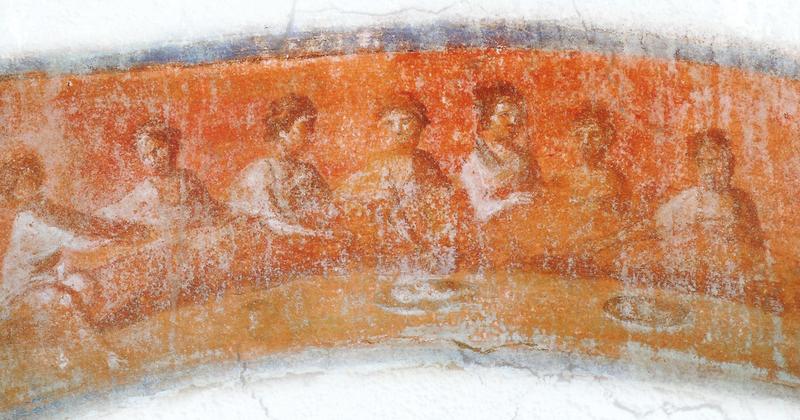
The Apologist Who Believed Too Much
A sophomore apologetics assignment on Justin Martyr's First Apology cost me the church I was raised in. What chapter 66 says about the Eucharist.
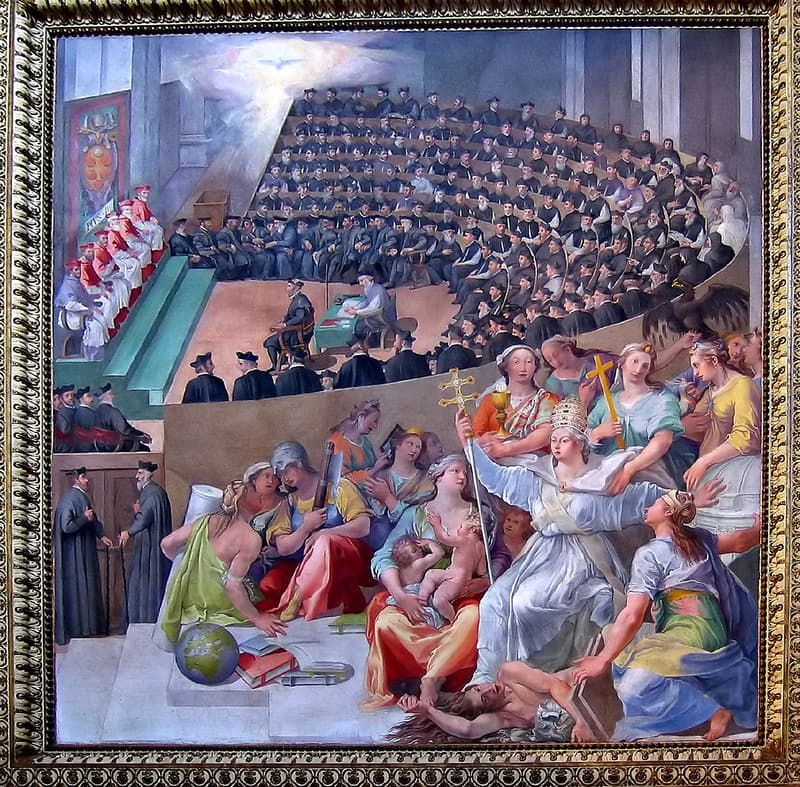
What the Council of Trent Actually Said About Justification
A Catholic convert reads the Council of Trent's 1547 Decree on Justification verbatim—and finds that what Protestants are taught it says is not what it says.
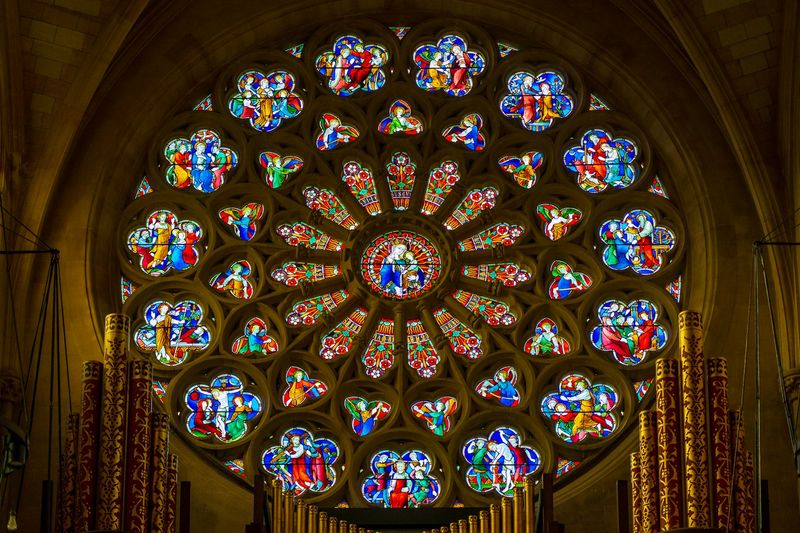
Calvinism vs. Catholicism
Calvinism vs. Catholicism explained side-by-side: authority, salvation, sacraments, predestination, the Church, and Mary. A scholarly 2026 comparison of the two great Augustinian traditions.
Stay Informed
Get new writing on faith, law, and service delivered to your inbox.
No spam. Unsubscribe anytime.