The Council of Trent (1545–1563): Catholic Doctrine, Reform, and the Reformation's Long Answer
On This Page
Eighteen years, three popes, twenty-five sessions, and a single small town in the Dolomites produced the Roman Catholicism every Catholic after 1563 inherited — and every Protestant after 1563 defined himself against. The Council of Trent did not reunify the Church. It closed the door on reunion by answering the Reformation with the very ecclesiastical machinery the Reformers had rejected: papal authority, conciliar decree, and anathema.
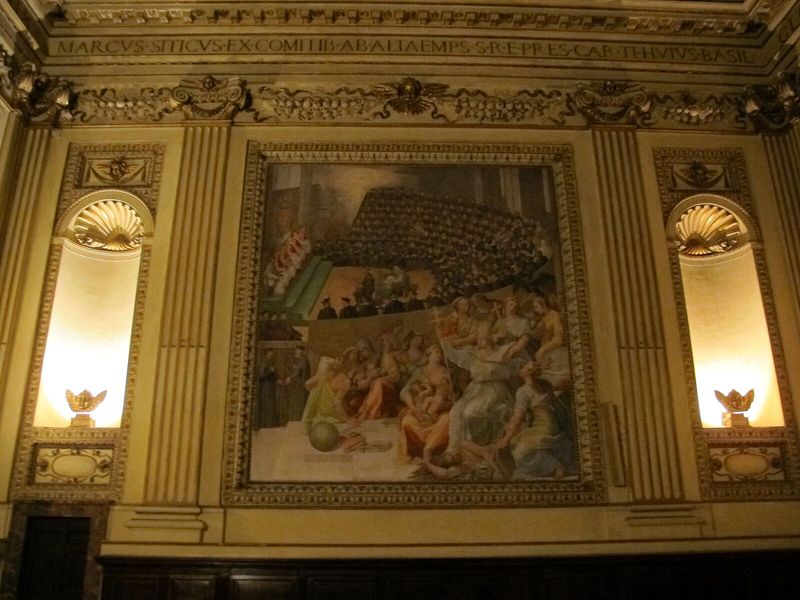
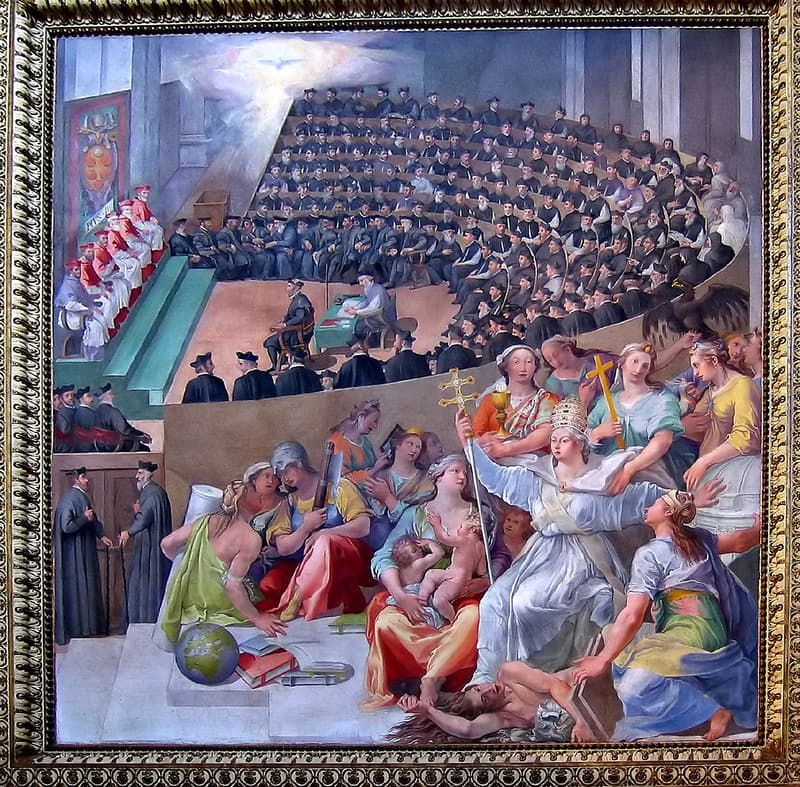
Between 1545 and 1563, at a prince-bishop’s town on the imperial side of the Alps, the Catholic Church held what was simultaneously its longest council and its most interrupted one. Suspended by typhus in 1547 and by Protestant arms in 1552, dormant through the pontificate of an anti-Trent pope (Paul IV, 1555–1559), Trent reopened for its final session only under Pius IV and ran from January 1562 through December 1563. The council produced sweeping doctrinal definitions on Scripture and tradition, original sin, justification, the seven sacraments, transubstantiation, the Mass as sacrifice, purgatory, saints, relics, and indulgences — paired with disciplinary decrees on episcopal residence, seminaries, marriage, clerical reform, and the Index. What emerged was a church that had lost northern Europe but won back its southern heartland, armed with a standardized liturgy, a trained clergy, and a hardened doctrinal identity that would not substantially shift until the Second Vatican Council four hundred years later.
What the Council of Trent Was
Trent was the nineteenth ecumenical council of the Catholic Church, convoked by Pope Paul III for the city of Trento (German: Trient) in the prince-bishopric on the imperial side of the Brenner Pass, and chosen precisely so that the emperor could get to it and the pope could deny that it was on Italian soil. It opened on 13 December 1545, closed on 4 December 1563, and met in twenty-five numbered “sessions” under three popes — Paul III (to 1549), Julius III (1550–1555), and Pius IV (1559–1565). The Council of Mantua (1537) and the Council of Vicenza (1538) had been called and abandoned before it. No ecumenical council would meet for another three centuries until Vatican I in 1869–1870.1
The council was not large. It opened with roughly thirty bishops and closed with about 255 signatories, the clear majority of them Italian — a fact that Protestant and later Gallican critics noted and that Catholic reform-minded participants (Reginald Pole, Girolamo Seripando, Charles Borromeo) worked around rather than denied. Protestants were formally invited under imperial safe-conduct during the council’s second period. Philip Melanchthon set out for Trent in 1552 and got only as far as Nuremberg before the military crisis of that year ended Protestant cooperation for good. France boycotted until a last-minute delegation arrived on the eve of the final session in November 1562.
The council’s eighteen-year span is misleading. The actual working time was closer to four and a half years, broken by two long suspensions. What Trent did during those four and a half years is the subject of the rest of this post.
Why the Council Took Twenty-Eight Years to Convene
Luther posted his Ninety-Five Theses in October 1517. Rome did not answer with a general council until December 1545. The twenty-eight-year delay was not theological. It was political.
Pope Clement VII (1523–1534), scarred by the 1527 Sack of Rome at the hands of Charles V’s partially Lutheran imperial troops, feared that a general council would revive conciliarism — the medieval view, condemned by Martin V at Constance and again by Pius II in Execrabilis (1460), that a council outranks a pope. A council convoked under imperial pressure on imperial soil could easily slide in that direction.
Emperor Charles V pushed hard for a council to reunify his religiously fractured empire — at first in hopes of winning the Protestant princes back, and later because he needed a theological settlement to stabilize the peace of his reign. His great rival, King Francis I of France, obstructed the council for decades precisely because Charles wanted it: a religiously unified empire was a militarily unconstrained empire, and Francis preferred Charles entangled. Paul III tried twice to open the council — at Mantua in 1537 and at Vicenza in 1538 — before war, plague, and non-attendance forced postponement. Only the September 1544 Treaty of Crépy between Charles and Francis freed the political log-jam. The council opened fourteen months later.2
By the time the bishops finally assembled, the last serious hope of negotiated reunion had collapsed. The 1541 Diet of Regensburg had briefly produced an agreed article on justification — the so-called duplex iustitia (double justice) formula drafted by Gasparo Contarini, Johann Gropper, and others — that satisfied neither Luther, who rejected it in principle, nor Rome, which never ratified it. Trent opened with no illusions that it was a reunion council. It was a consolidation council.
Three Working Periods, Three Popes
Trent’s sessions cluster into three working periods, each with distinctive theological focus and each shaped by the pope who convoked it.
The first period (1545–1547), under Paul III, settled the most fundamental doctrinal questions. Session 4 (8 April 1546) fixed the canon of Scripture and the authority of the Latin Vulgate. Session 5 (17 June 1546) defined original sin. Session 6 (13 January 1547) issued the Decree on Justification — the most carefully worked doctrinal decree the council produced, and the one that most directly answered Luther. The period ended when typhus swept the Dolomites; Paul III transferred the council to Bologna, Charles V refused to accept a council on Italian soil, and a schism between the imperial and papal parties dragged the council into a suspension that lasted until 1551. Reginald Pole, the only English cardinal in significant attendance and Seripando’s ally on the double-justice question, withdrew from Trent during Session 6 for health reasons that contemporaries and historians have read variously.
The second period (1551–1552), under Julius III, took up the sacramental core. Session 13 (11 October 1551) defined the real presence and transubstantiation. Session 14 (25 November 1551) treated the sacrament of penance and extreme unction. The period collapsed when Elector Maurice of Saxony — having switched sides after the Schmalkaldic War — marched south against Charles V in early 1552 and advanced into Tyrol, close enough to Trent to scatter the bishops. The fiercely anti-Protestant Paul IV (Gian Pietro Carafa, 1555–1559) refused to reconvene the council during his entire pontificate, preferring the Roman Inquisition and the 1557 and 1559 Indexes of Forbidden Books as instruments of his own.3
The third and decisive period (1562–1563), under Pius IV (Giovanni Angelo de’ Medici) and guided operationally by his nephew Charles Borromeo, picked up sacramental theology (communion under both kinds and infant communion at Session 21; the Mass as sacrifice at Session 22) and then completed the program. Session 23 (15 July 1563) defined holy orders and ordered every diocese to establish a seminary (Cum adolescentium aetas). Session 24 (11 November 1563) defined marriage and issued the Tametsi decree requiring canonical form. Session 25 (3–4 December 1563) handled purgatory, saints, relics, images, indulgences, Regulars and Nuns, and the remaining reform legislation. Pius IV confirmed the council’s decrees in the bull Benedictus Deus on 26 January 1564, two years before his death.4
Scripture and Tradition: The Single Word That Changed Everything
Session 4 is where Trent first answered Luther, and where a single word still reverberates through Catholic theology four hundred years later.
The council decreed that the gospel of Christ is preserved in “the written books” (the canonical Scriptures) and “in the unwritten traditions” that had come down from the apostles — and that both are to be received “with an equal affection of piety and reverence.”5 The Latin Vulgate was declared the authoritative edition for public reading, teaching, and disputation — not a claim about textual-critical superiority, but a disciplinary directive fixing one stable Latin text against the proliferation of divergent humanist Bibles. The canon of Scripture was fixed to include the deuterocanonical books (the so-called Apocrypha) that the Reformers had excluded, in direct continuity with the canon already received by the local councils of Hippo (393), Carthage (397 and 419), and the Council of Florence’s Decree for the Jacobites (1442). The Church alone retained the authority to interpret Scripture.
The single word that changed everything is the conjunction between “written books” and “unwritten traditions.” An early draft of the decree used the Latin “partim… partim” — “partly in Scripture, partly in tradition” — which would have made Scripture by itself materially insufficient, requiring tradition to fill in what Scripture lacks. Before the vote, the drafting commission substituted “et” — “and.” The change looks cosmetic. It is not.
The partim/partim reading would have canonized a two-source theory: Scripture says some things, tradition says others, and neither is complete without the other. The et reading leaves the question open. It permits a reading on which Scripture contains, at least in substance, everything necessary for salvation, while tradition transmits, preserves, and authoritatively interprets it. Twentieth-century Catholic exegetes — especially the German Josef Rupert Geiselmann, followed by Yves Congar and then Joseph Ratzinger — reopened this question against the neo-scholastic reading that had hardened into a partim/partim assumption. The Second Vatican Council’s Dei Verbum §9 picked up the thread: Scripture and tradition “flow from the same divine wellspring, come together in some fashion to form one thing, and move towards the same goal,” without canonizing either the partim/partim or a strict Protestant sola scriptura.6
Trent did not canonize a two-source theory. It canonized a both/and. That distinction is the hinge for every later Catholic argument about Scripture, tradition, and the question of whether Trent “banned” vernacular Scripture — a question Session 4’s Vulgate decree, properly read with the 1564 Index’s Rule IV, does not in fact answer in the way popular retellings suggest.
Justification: Trent’s Most Carefully Worked Decree
Session 6’s Decree on Justification is the most technically demanding text the council produced, and the one it labored over most. It ran to sixteen chapters of positive teaching and thirty-three canons with anathemas, and it answered Luther’s sola fide with a theology of justification that is simultaneously gratuitous, transformative, and cooperative.
The decree’s structural move is to set justification inside the Aristotelian scheme of causes. The final cause is the glory of God and eternal life. The efficient cause is the mercy of God. The meritorious cause is Christ’s passion. The instrumental cause is the sacrament of baptism (the “instrumental cause of initial justification”). The formal cause is “the justice of God — not by which he himself is just, but by which he makes us just” — that is, an actual inward righteousness imparted to the believer, not merely imputed.7
That formal-cause claim is the hinge. Against Luther, Trent taught that justification is a real interior transformation initiated by grace, requiring cooperation with grace, capable of being lost by mortal sin, and capable of being increased through good works performed in grace. Against the Reformers’ claim that no one can know with certainty that he is justified unless by special revelation, Trent taught a doctrine of ordinary humble hope that nonetheless denied the Lutheran claim of infallible present assurance. Against the claim that good works done by the justified do not merit eternal life, Trent taught that they do — not by any autonomous merit, but by condign merit rooted entirely in the grace of Christ.
The six canons with the most obvious teeth deserve naming. Canon 9 condemns anyone who says that the impious person is justified by faith alone, “in the sense that nothing else is required to cooperate with the grace of justification.” Canon 12 rejects the claim that justifying faith is nothing other than trust in God’s mercy remitting sins for Christ’s sake. Canon 14 condemns the claim that anyone is absolved and justified by the bare fact of believing himself absolved and justified. Canon 24 condemns the claim that the justice received is not preserved or even increased before God by good works. Canon 30 condemns the claim that every baptized person leaves baptism with no temporal punishment owing. Canon 32 condemns the claim that the good works of the justified are not truly meritorious of eternal life.8
Inside the conciliar drafting committee, the Augustinian general Girolamo Seripando pressed for a duplex iustitia account — a “double righteousness” in which the inherent justice of the baptized is insufficient by itself and must be supplemented by the imputed justice of Christ. Seripando’s position was intellectually respectable and represented a Catholic reception of some of Luther’s concerns. The council rejected it. The final decree teaches a single formal cause of justification: the inherent justice given in baptism, not a composite of inherent plus imputed. Seripando accepted the verdict, signed the decree, and remained a Catholic reformer and later a cardinal. His surviving speeches on the floor are now recognized as one of the clearest statements of the alternative Trent did not take.9
The Joint Declaration of 1999, to which I will return below, concluded that the Tridentine canons do not fall on a properly stated Lutheran doctrine of justification — not by revising the canons, but by demonstrating that the positions each side actually holds today are not the ones condemned in 1547.
The Sacramental Core: Eucharist, Penance, and the Mass
Session 13 (11 October 1551) issued the Decree on the Most Holy Eucharist. Its structural move is the tricolon of Chapter 1: after consecration, Christ is present “vere, realiter, ac substantialiter” — “truly, really, and substantially” — in the Eucharist. Each adjective targets a distinct Reformer. Vere (“truly”) answers Zwingli’s reduction of the Supper to a bare sign. Realiter (“really”) answers Calvin’s spiritualized presence by the power of the Spirit. Substantialiter (“substantially”) answers Luther’s consubstantiation and every theology of cohabitation of Christ’s body with the substance of the bread.10
Transubstantiation is named — chapter 4 declares the term “most fitting” (aptissime) for the change that takes place. The word is canonized. Aristotle’s substance-accident metaphysics is not. Scholastic Thomists and later Catholic sacramental theologians would insist that transubstantiation is the term for the fact of the change, not a commitment to Aristotelian philosophy as its necessary explanation. A Catholic who cannot work through the Aristotelian metaphysics of accidents inhering without their substance is still confessing the dogma. This distinction matters in Catholic conversation with Orthodox and with certain Protestants who accept the real presence while rejecting the Aristotelian apparatus: Trent did not require the apparatus.
Session 14 (25 November 1551) took up the sacrament of penance in nine chapters and fifteen canons, followed by a briefer decree on extreme unction in three chapters and four canons. Against Luther’s early claim that penance is merely a return to the grace of baptism, Trent defined penance as a true and proper sacrament instituted by Christ (John 20:22–23 in the exegetical background) with three integral acts on the part of the penitent: contrition, confession, and satisfaction. Integral confession — the enumeration of all mortal sins by number and kind — is required by divine law for anyone aware of mortal sin; the sacramental form is the priest’s absolution, which does not merely declare God’s forgiveness but effects it. Satisfaction for sin through prayer, fasting, almsgiving, or other works does not add to Christ’s satisfaction but shares in it, and is a part of the ordinary medicinal operation of the sacrament rather than a competing merit.
Session 21 (16 July 1562) addressed communion under both kinds and the communion of infants. The council affirmed — by the doctrine of concomitance — that Christ is received whole and entire under either species, and that communion under both kinds is not required by divine law. Canon 2 added that the Church has the authority to determine the manner of administration. The concession of the chalice to the laity was left to papal discretion; Pius IV granted it for several German dioceses and Bohemia in 1564, but the concession was withdrawn within a few years, and subsequent popes through 1572 ended the Bohemian and German experiments as failing to produce the hoped-for unity. Canon 4 rejected the claim that infant communion is necessary for salvation — the Western practice at this time had generally not administered communion to infants, and the canon stabilized that against critics who argued the Eastern practice was universally binding.11
Session 22 (17 September 1562) issued the Decree on the Sacrifice of the Mass — the most Reformer-targeted of the eucharistic decrees. Nine chapters of positive teaching and nine canons define the Mass as a true and proper propitiatory sacrifice offered by Christ to the Father through the hands of priests, ordained at the Last Supper when he commanded his apostles to “do this in my memory” (Luke 22:19). The sacrifice is not a repetition of Calvary but a sacramental re-presentation (repraesentaretur) of the one sacrifice of the cross, whose fruits are applied to the living and the dead.
Three points of precision on Session 22 are worth surfacing, because they are widely misread. First, Canon 9 of the session — which condemns anyone who says the Mass “must be celebrated only in the vernacular” (lingua tantum vulgari) — does not anathematize the use of the vernacular. It anathematizes the claim that Latin Mass is illegitimate. The canon permits Latin; it does not require Latin. That distinction matters enormously for how Vatican II’s Sacrosanctum Concilium §36 and the post-1969 vernacular Missal stand in relation to Trent: the vernacular Missal does not violate Canon 9, because Canon 9 never forbade the vernacular.12 Second, repraesentaretur means “re-presented,” not “repeated” — a point the decree itself states, against Reformed polemics that accused the Catholic Mass of a continuing series of sacrifices in addition to Calvary. Third, the decree explicitly locates the propitiatory character of the Mass in its identity with the one sacrifice of Christ. The Mass is propitiatory because Christ’s own sacrifice is propitiatory, not alongside it as an independent source of merit.
Marriage and the Reform of Catholic Life
Session 24 (11 November 1563) defined the sacrament of matrimony. The doctrinal canons are short. The disciplinary decree attached to them — known from its opening word as Tametsi — is long, and it quietly rebuilt European marriage law.
Canon 7 of Session 24 condemned anyone claiming that the Church errs when she holds that the bond of marriage cannot be dissolved on grounds of adultery, and that neither party (not even the innocent) may remarry during the lifetime of the other spouse. The canon was carefully worded — the Venetians had pressed for a version that would have permitted remarriage after adultery in continuity with Eastern Orthodox practice — and the final form rejected that accommodation.
The Tametsi decree on clandestine marriage is the disciplinary counterpart. Before Tametsi, medieval canon law recognized any valid exchange of present-tense consent between baptized man and woman as sacramental marriage, even without witnesses or priest. Clandestine marriages were valid, uprovable, and the source of endless litigation. Tametsi introduced canonical form: from publication forward, a marriage was valid only if contracted before the couple’s proper parish priest and at least two witnesses. The decree included a thirty-day posting clause — Tametsi was binding only in parishes where it had been canonically promulgated after the proper reading and notice.
That thirty-day clause is the single most underappreciated disciplinary detail in Trent’s reception. Tametsi never became universal Catholic law in 1563. Large parts of Catholic Europe — most of France, parts of the German lands, colonial America, and Ireland — received it only partially, not at all, or only after centuries of delay. A Catholic marriage contracted clandestinely in nineteenth-century Ireland could still be valid under the pre-Tametsi rule. Only Pius X’s 1907 decree Ne Temere (effective Easter 1908) made canonical form universally required for Catholics, and the 1917 Code of Canon Law codified the result. The popular telling of Tametsi — that Trent “ended” clandestine marriage in 1563 — is off by 345 years.13
The reform of clerical life is where Trent reshaped Catholicism most. Session 23’s decree Cum adolescentium aetas ordered every diocese with sufficient resources to establish a seminary for the training of candidates for holy orders — a decree whose long-run effects are difficult to overstate. Within a century, the educational level of Catholic parish clergy across much of Europe had been transformed. The pre-Tridentine parson who could not parse the Latin of the Mass he recited became, over the seventeenth century, a minority figure; the seminary-trained priest who could preach, hear confessions competently, and catechize became the norm.
Episcopal residence was enforced. Bishops were required to reside in their dioceses, absent no more than three months and never during Advent or Lent, and to preach regularly and conduct annual parish visitations. Holding multiple sees — pluralism — was progressively restricted, though the council stopped short of a simple abolition and retained dispensation pathways that later popes would sometimes widen. The paradigmatic implementer was Charles Borromeo, archbishop of Milan from 1564 to 1584, whose pastoral visitation of a vast Alpine diocese, his Acta Ecclesiae Mediolanensis, and his six provincial councils became the template for Tridentine episcopal reform across Catholic Europe.
The sale of indulgences — the immediate provocation of Luther’s 1517 protest — was handled more decisively than popular histories usually convey. Session 21’s reform decree on indulgence preaching abolished the office of quaestor (the licensed indulgence preacher whose percentage of the take had corrupted the 1515 indulgence that sparked the Reformation). Session 25’s Decree on Indulgences, passed on the council’s final day, affirmed the Church’s power to grant indulgences but expressly forbade all abuses, all evil gains, and all superstition. Pius V’s 1567 reform moving the grant of indulgences out of commercial channels finished the institutional reform.14
Session 25 also addressed purgatory, the invocation of saints, the veneration of relics, and sacred images. The council confirmed the doctrine of purgatory against Reformers who rejected it as unbiblical, affirmed the ancient practice of invoking the saints’ intercession, and authorized the veneration — not the adoration — of images, explicitly citing the Second Council of Nicaea (787) as the governing settlement. That citation is not a footnote. It is the point: in the middle of the Reformation’s attack on images, Session 25 reached back to the Eastern patristic image settlement and reattached Latin Catholicism to it.
After the Council: Missal, Catechism, Index
The council closed on 4 December 1563. Pius IV confirmed the decrees on 26 January 1564 with the bull Benedictus Deus. In the process he also did something conciliar fathers had explicitly asked him to do: he reserved to the Holy See the authority to interpret the decrees, to grant dispensations from them, and to produce the implementing works the council had delegated to him rather than completed itself.
Four of those delegated works defined post-Tridentine Catholicism for the next four centuries. The Roman Catechism (the Catechismus ex decreto Concilii Tridentini ad parochos, 1566) was issued by Pius V and aimed at parish clergy rather than the laity — a reference work for the preachers who would now be trained in the new seminaries. The Roman Breviary (1568, also Pius V) standardized the Divine Office across the Latin Church while permitting long-established local uses to continue. The Roman Missal (Missale Romanum, 1570, Pius V, promulgated by the bull Quo Primum of 14 July 1570) standardized the Mass. The Index of Forbidden Books (1564, Pius IV) and its ten general rules governing the reading of books extended the Inquisitorial Indexes of 1557 and 1559 into a universal Latin-Church framework.15
Rule IV of the 1564 Index is worth reading in its own terms before the popular telling takes over. Far from a simple ban on vernacular Bibles, Rule IV set up a permission system: vernacular Bibles translated by Catholic authors, read by those permitted by their bishop or confessor, were allowed. The restrictiveness is real — lay Bible reading without permission was limited — but the categorical “Trent banned the Bible” reading is simply wrong. That reading survived for centuries in Protestant polemics because the effect of Rule IV’s permission system in many Catholic countries was functionally restrictive, not because Trent or the 1564 Index actually prohibited vernacular Scripture as such.
The 1564 Tridentine Profession of Faith — often called the Creed of Pope Pius IV after the bull Iniunctum nobis of 13 November 1564 that promulgated it — became the required oath for bishops, cardinals, canons, and university teachers. It summarizes the council’s dogmatic decisions in concise affirmations and stands as the clearest short statement of Tridentine Catholic identity.
The reception of Trent by Catholic states was uneven and politically consequential. Spain accepted the decrees by royal cédula of Philip II on 12 July 1564, making them binding in Spanish territories. Portugal, Venice, Poland-Lithuania, and the Catholic Swiss cantons followed within two years. France never formally received the disciplinary decrees — the Estates-General of 1614–1615 refused to register them, and the 1682 Four Articles of the Gallican Liberties cemented French clerical independence on several points Trent would have closed. French bishops nonetheless implemented most Tridentine provisions on their own authority, producing the anomaly of a church that was Tridentine in practice and non-receptive in law.
What Vatican II Did and Did Not Do to Trent
No question about Trent is more contested than its relation to the Second Vatican Council (1962–1965). The contest has two sides. Traditionalists (including some Catholics in full communion and the Society of Saint Pius X separately) argue that Vatican II broke with Trent on liturgy, religious liberty, ecumenism, and the Church’s self-understanding. Progressive readings sometimes agree that a rupture occurred — and celebrate it. Benedict XVI, in his Christmas 2005 address to the Roman Curia, named and rejected both positions, proposing instead a “hermeneutic of reform, of renewal in the continuity of the one subject-Church” as the correct reading of how Vatican II stands to its predecessors.16
The hermeneutic of continuity rests on a distinction Trent itself makes operative: dogma is irreformable; discipline is not. Vatican II did not revise a single Tridentine anathema. Every canon of Session 6 on justification, Session 13 on the Eucharist, Session 22 on the Mass, Session 24 on marriage, and Session 25 on purgatory, saints, relics, images, and indulgences is as binding in 2026 as in 1563. What Vatican II did was three things.
First, it developed doctrine on points Trent had left the Catholic theological tradition still working out — most importantly the relation of Scripture and tradition (Dei Verbum), episcopal collegiality (Lumen Gentium), the nature of the liturgy (Sacrosanctum Concilium), religious liberty (Dignitatis Humanae), and the Church’s engagement with the world (Gaudium et Spes). The partim/et edit of 1546 opened Dei Verbum §9’s “one wellspring, flowing together” formulation four centuries later; the reform of the liturgy on the terms of Session 22 and its Canon 9 (which never forbade the vernacular) proceeded without violating the session’s anathemas.
Second, it reformed discipline — the liturgical books, the Breviary, the canon law, the seminary curriculum — without touching the dogmatic substructure. The Missal of Paul VI (1969, revised 1975 and 2002) is a reform of the Missal of Pius V (1570). It is not a replacement for it, and it is not a repudiation of the Tridentine canons it implements. Whether the specific shape of that reform was prudent is a separate and ongoing question. Whether it was dogmatically permissible is settled.
Third — and most surprisingly for readers reared on the Reformation polemic — it opened the door to ecumenical rapprochement on the one doctrine that had most directly provoked Trent’s anathemas: justification.
The Joint Declaration on the Doctrine of Justification was signed by representatives of the Lutheran World Federation and the Catholic Church in Augsburg on 31 October 1999. Its central claim — stated in §15 — is a “common understanding of our justification by God’s grace through faith in Christ,” worked out in paragraphs 19–39 against both sides’ historically critiqued positions. Paragraphs 40–42 conclude that the Declaration “shows that a consensus in basic truths of the doctrine of justification exists between Lutherans and Catholics,” that “the teaching of the Lutheran churches presented in this Declaration does not fall under the condemnations from the Council of Trent,” and that “the condemnations of the Council of Trent do not apply to the teaching of the Lutheran churches presented in this Declaration.”17
The Declaration did not revise Trent. It argued, after thirty years of bilateral dialogue, that the positions Trent’s anathemas fall on are not the positions Lutherans today actually hold, and that the positions Lutherans today actually hold are not the positions Trent’s anathemas fall on. The distinction is delicate but not empty. Every Tridentine canon still stands exactly as written in 1547. None of them, on the 1999 reading, reaches Lutheran Christians in the Lutheran churches the Declaration represents. It is worth noting that Rome signed only after insisting on the Official Common Statement and its Annex of June 1999, which specify that not every question has yet been satisfactorily resolved and that Trent’s canons “remain fully valid” — the Declaration is a consensus on what both sides can now affirm together, not a claim that further work is unnecessary.
The reception widened. The World Methodist Council affirmed the Declaration in 2006, the Anglican Communion in 2016 and 2017, and the World Communion of Reformed Churches in 2017. Four communions representing the majority of Reformation Protestantism now affirm the Joint Declaration in some form — the single most consequential post-Trent ecumenical shift since the council closed.
Trent and the Traditional Latin Mass: Quo Primum to Traditionis Custodes
The popular shorthand in contemporary Catholic conversation treats Quo Primum (Pius V, 14 July 1570) as an immutable dogmatic act promulgating a universal and timeless Tridentine Latin Mass. Neither half of that description matches the bull’s actual text.
Quo Primum promulgated the 1570 Missal as binding on the Roman Rite — but not on every Latin-rite liturgy, and not on rites of longer custom. The bull expressly exempted liturgical rites whose custom was of more than two hundred years’ standing, leaving the Ambrosian Rite of Milan, the Mozarabic Rite of Toledo, the Dominican Rite, the Carthusian Rite, the Carmelite Rite, and the Premonstratensian Rite untouched. “The Traditional Latin Mass” was never a single universal Latin-Church liturgy. It was one family of rites within a larger Latin-rite family whose diversity Trent and Pius V were careful to preserve.
The post-1969 arc from John Paul II’s 1988 Ecclesia Dei through Benedict XVI’s 2007 Summorum Pontificum through Francis’s 2021 Traditionis Custodes and 2022 apostolic letter Desiderio Desideravi is, on the Tridentine reading, a question of discipline rather than dogma. Quo Primum, whatever its scope in 1570, is a disciplinary act; popes can and do modify the disciplinary acts of their predecessors, and have done so repeatedly with respect to the Missal of 1570 in every liturgical reform from Clement VIII (1604) to Pius X’s Psalter reform (1911) to Pius XII’s Holy Week (1955) to Paul VI’s Missal (1969). The question whether Francis’s specific restrictions on the 1962 Missal are prudent is legitimate. The question whether a pope can in principle regulate the liturgy on his own authority is not, under the Tridentine understanding of dogma and discipline, open.18
Why Trent Still Matters
For four hundred years, the Council of Trent was the reason Catholicism looked the way it did. The seminary-trained priest, the Roman Missal celebrated from Boston to Manila, the Baltimore Catechism transmitted through the mid-twentieth century Catholic parochial school, the dogmatic precision with which American Catholic convert literature from G. K. Chesterton through Thomas Merton distinguished Catholic from Protestant accounts of justification and the sacraments — all of it traces to Trent, in one way or another.
That world ended in the 1960s. Vatican II reformed much of what Trent had built, and the reformers differed bitterly over whether the reform was continuous with Trent or departed from it. Sixty years later, the dust is still settling.
The deepest irony of Trent is that it answered the Reformation — and answered it effectively — by using the very ecclesiastical machinery the Reformers had rejected. Papal authority convoked it. Conciliar decree defined its doctrine. Anathema protected its settlements. Pius IV’s confirmation in Benedictus Deus sealed it. The result was a Catholic Church that had lost northern Europe but won back its southern heartland, armed with a standardized liturgy, a trained clergy, a fixed catechism, and a doctrinal identity that could not be dissolved. In doing so, Trent ensured that the two Christian worlds it had walled apart would develop separately for the next four centuries — and that when, four centuries later, representatives of those worlds sat down in Augsburg on 31 October 1999 to say that Trent’s anathemas do not fall on what either side actually teaches now, they could do so only because Trent had been clear enough in the first place to make the question answerable.
Frequently Asked Questions
When and where did the Council of Trent take place?
The Council of Trent opened on 13 December 1545 and closed on 4 December 1563, meeting in the city of Trento (German: Trient), the seat of a prince-bishopric on the imperial side of the Alps in what is today northern Italy. It met in twenty-five numbered “sessions” spread across eighteen calendar years under three popes — Paul III, Julius III, and Pius IV — with two long suspensions. Actual working time was closer to four and a half years.
Who called the Council of Trent?
Pope Paul III (Alessandro Farnese) convoked the Council of Trent by the bull Laetare Ierusalem on 19 November 1544, fixing Laetare Sunday (15 March 1545) as the opening date. The council actually opened several months later on 13 December 1545. Paul III presided over it in its first period; his successors Julius III and Pius IV reopened and closed it.
What did the Council of Trent actually decide?
The Council of Trent (1545–1563) defined Catholic doctrine on Scripture and tradition, original sin, justification, the seven sacraments (including transubstantiation and the Mass as a true propitiatory sacrifice), purgatory, the veneration of saints and relics, and indulgences. It also issued sweeping disciplinary decrees — the seminary decree (Cum adolescentium aetas), the residence requirement for bishops, the Tametsi decree requiring canonical form for marriage, the abolition of the quaestor system of indulgence preaching, and the mandates that produced the Roman Missal (1570), the Roman Catechism (1566), the Roman Breviary (1568), and the 1564 Index of Forbidden Books.
Was the Council of Trent a reunion council?
No. By the time Trent opened on 13 December 1545, the last serious negotiated-justification formula — the 1541 Diet of Regensburg’s duplex iustitia — had already collapsed. Protestants were formally invited under imperial safe-conduct during the council’s second period (1551–1552), but were denied voting rights; the only Protestant delegation to reach the council, led by Melanchthon, got as far as Nuremberg before the Schmalkaldic crisis ended the effort. Trent was a consolidation council, not a reunion council.
Did Trent condemn Lutheranism?
Trent condemned certain positions it attributed to Luther and to other Reformers — especially on justification by faith alone, the number of sacraments, transubstantiation, the Mass as sacrifice, the necessity of auricular confession, and the legitimacy of purgatory and indulgences. Whether those condemnations fall on what Lutherans today actually teach is the question the 1999 Joint Declaration on the Doctrine of Justification took up. The Declaration’s §41 concluded that Trent’s anathemas on justification do not fall on the Lutheran teaching articulated in the Declaration itself — not by revising Trent, but by arguing that the positions each side now holds are not the positions the other’s condemnations were aimed at.
Did Trent ban the Bible?
No, though the popular telling persists. Rule IV of the 1564 Index set up a permission system: vernacular Bibles translated by Catholic authors were permitted to readers authorized by their bishop or confessor. The restrictiveness was real in practice, but the categorical claim that Trent banned the Bible is wrong. I treat the question at more length in this post.
Is the Tridentine Mass the “real” Catholic Mass?
The Tridentine Mass — promulgated in Quo Primum on 14 July 1570 — is one valid form of the Roman Rite. It is not the only one the Latin Church has ever celebrated. Quo Primum itself exempted the Ambrosian, Mozarabic, Dominican, Carthusian, Carmelite, and Premonstratensian rites, which remained in use then and remain in use now. The Missal of Paul VI (1969) reformed the 1570 Missal on the authority Trent itself reserved to the pope. Traditionis Custodes (2021) further regulated the 1962 Missal. Whether that regulation is prudent is debated; whether a pope has the authority to make it is not, on the Tridentine distinction between dogma and discipline.
Did Vatican II change Trent?
Vatican II did not revise a single Tridentine anathema. It developed doctrine on points Trent left unresolved (the Scripture-tradition relation, episcopal collegiality, religious liberty, the nature of the liturgy), and it reformed discipline — the Missal, Breviary, canon law, seminary curriculum — without touching the dogmatic substructure. Benedict XVI’s 22 December 2005 address to the Roman Curia named this reading the “hermeneutic of reform, of renewal in the continuity of the one subject-Church” and rejected both rupture narratives (progressive and traditionalist).
Footnotes
- 1. The standard modern English-language narrative history is John W. O'Malley, SJ, Trent: What Happened at the Council (Cambridge, MA: Belknap Press of Harvard University Press, 2013). The classic earlier study is Hubert Jedin, A History of the Council of Trent, 2 vols. (vol. 1, The Struggle for the Council; vol. 2, The First Sessions at Trent 1545–1547), trans. Ernest Graf (London: Thomas Nelson, 1957–61) — Jedin's four-volume German original Geschichte des Konzils von Trient (Freiburg: Herder, 1949–75) runs through the council's end. Critical text of the decrees: Norman P. Tanner, SJ, ed., Decrees of the Ecumenical Councils, 2 vols. (London: Sheed & Ward; Washington, DC: Georgetown University Press, 1990), 2:657–799. Public-domain English translation of the decrees: J. Waterworth, trans., The Canons and Decrees of the Sacred and Oecumenical Council of Trent (London: Dolman, 1848), available online at papalencyclicals.net and at history.hanover.edu.
- 2. For the political prehistory — conciliarism under Clement VII, the 1527 Sack of Rome, the Mantua (1537) and Vicenza (1538) false starts, and the September 1544 Treaty of Crépy that unlocked Paul III's third and successful convocation — see O'Malley, Trent, 1–91, and Jedin, History, vol. 1. On the 1541 Diet of Regensburg, the Contarini-Gropper duplex iustitia formula, and its failure to win ratification from either Rome or Luther, see Alister E. McGrath, Iustitia Dei: A History of the Christian Doctrine of Justification, 4th ed. (Cambridge: Cambridge University Press, 2020), chs. on the Reformation-era debates.
- 3. On Paul IV's refusal to reconvene the council — and his alternative program of the Roman Inquisition and the Indexes of 1557 and 1559 — see O'Malley, Trent, 155–58, and Paolo Prodi, The Papal Prince: One Body and Two Souls: The Papal Monarchy in Early Modern Europe, trans. Susan Haskins (Cambridge: Cambridge University Press, 1988), chs. 3–5.
- 4. Benedictus Deus was promulgated 26 January 1564 (dated 30 June 1564 in some editions for the bull of publication); the text is in the Bullarium Romanum and summarized in Henricus Denzinger and Peter Hünermann, eds., Enchiridion symbolorum definitionum et declarationum de rebus fidei et morum (43rd ed.; Freiburg: Herder, 2010), DH 1847–1850 (cf. the session-by-session decrees at DH 1500–1870). Charles Borromeo's implementation of the council's reform program in Milan is treated in Simon Ditchfield, Liturgy, Sanctity and History in Tridentine Italy: Pietro Maria Campi and the Preservation of the Particular (Cambridge: Cambridge University Press, 1995), and in Wietse de Boer, The Conquest of the Soul: Confession, Discipline, and Public Order in Counter-Reformation Milan (Leiden: Brill, 2001).
- 5. Council of Trent, Session 4 (8 April 1546), Decree on the Canonical Scriptures and Decree on the Edition and Use of the Sacred Books, in Tanner, Decrees, 2:663–65; Waterworth, Canons and Decrees, online at papalencyclicals.net. Denzinger-Hünermann DH 1501–1508. For the deuterocanonical canon's continuity with the earlier African councils (Hippo 393, Carthage 397 and 419) and the Council of Florence's Decretum pro Jacobitis (4 February 1442), see Tanner, Decrees, 1:572–83.
- 6. Josef Rupert Geiselmann, "Das Konzil von Trient über das Verhältnis der Heiligen Schrift und der nicht geschriebenen Traditionen," in Michael Schmaus, ed., Die mündliche Überlieferung (Munich: Hueber, 1957), and Geiselmann, Die Heilige Schrift und die Tradition, Quaestiones Disputatae 18 (Freiburg: Herder, 1962). Geiselmann's reading was taken up in Yves Congar, Tradition and Traditions, trans. Michael Naseby and Thomas Rainborough (New York: Macmillan, 1966 [French orig. 1960–63]), and reflected in Joseph Ratzinger's commentary on Dei Verbum §9 in Herbert Vorgrimler, ed., Commentary on the Documents of Vatican II, vol. 3 (New York: Herder and Herder, 1969), 181–98. Dei Verbum text: vatican.va.
- 7. Council of Trent, Session 6 (13 January 1547), Decree on Justification, chs. 1–16, in Tanner, Decrees, 2:671–81; Waterworth, online at papalencyclicals.net; DH 1520–1550. The Aristotelian causal scheme is in ch. 7: "Finally, the single formal cause is the justice of God, not that by which he himself is just, but by which he makes us just" (DH 1529).
- 8. Session 6, Canons on Justification, in Tanner, Decrees, 2:679–81; DH 1551–1583. The English quoted formulations are paraphrased from Waterworth, cross-checked against Tanner and DH. On the reception history, see McGrath, Iustitia Dei, chs. on the Tridentine formulation; Joseph F. Wawrykow, God's Grace and Human Action: "Merit" in the Theology of Thomas Aquinas (Notre Dame, IN: University of Notre Dame Press, 1995); and, for a lucid short Catholic introduction, Christopher Malloy, Engrafted into Christ: A Critique of the Joint Declaration (New York: Peter Lang, 2005), which, while polemical on the Joint Declaration question, is reliable on Trent's own text.
- 9. On Seripando's duplex iustitia proposal and the council's rejection of it, see Hubert Jedin, Papal Legate at the Council of Trent: Cardinal Seripando, trans. Frederic C. Eckhoff (St. Louis: B. Herder, 1947); and the summary in McGrath, Iustitia Dei, at the Tridentine chapters. On Reginald Pole's withdrawal during Session 6, see O'Malley, Trent, 104–6.
- 10. Council of Trent, Session 13 (11 October 1551), Decree on the Most Holy Eucharist, ch. 1 and Canons 1–2, in Tanner, Decrees, 2:693–98; Waterworth, online at papalencyclicals.net; DH 1635–1661. The aptissime is from ch. 4. On the theological precision of the decree and its non-identification with any single philosophical framework, see Joseph Ratzinger, "The Problem of Transubstantiation and the Question about the Meaning of the Eucharist," in The Feast of Faith: Approaches to a Theology of the Liturgy, trans. Graham Harrison (San Francisco: Ignatius, 1986), 79–112. See also my longer treatment at Real Presence and Transubstantiation in the Eucharist.
- 11. Council of Trent, Session 21 (16 July 1562), Doctrine on Communion under Both Kinds and of Little Children, in Tanner, Decrees, 2:726–28; Waterworth, online at papalencyclicals.net; DH 1725–1734. On Pius IV's 1564 concession of the chalice to several German dioceses and Bohemia and its subsequent withdrawal by later popes through 1572, see O'Malley, Trent, 223–25, and the Denzinger apparatus at DH 1760 and the surrounding notes.
- 12. Council of Trent, Session 22 (17 September 1562), Doctrine and Canons on the Sacrifice of the Mass, in Tanner, Decrees, 2:732–37; Waterworth, online at papalencyclicals.net; DH 1738–1759. On the parsing of Canon 9 (lingua tantum vulgari) as an anathema on those who demand vernacular celebration rather than on vernacular celebration as such, see Robert F. Taft, SJ, "Mass without Consecration? The Historic Agreement on the Eucharist between the Catholic Church and the Assyrian Church of the East Promulgated 26 October 2001," Worship 77, no. 6 (November 2003): 482–509, at the note on vernacular and silent canon; and the Second Vatican Council's Sacrosanctum Concilium §36 at vatican.va.
- 13. Council of Trent, Session 24 (11 November 1563), Doctrine and Canons on the Sacrament of Matrimony and the Decree Tametsi, in Tanner, Decrees, 2:753–59; Waterworth, online at papalencyclicals.net; DH 1797–1816. On the thirty-day posting clause and the patchwork reception of Tametsi across Catholic Europe, the colonial Americas, and Ireland, see the summary in John T. Noonan, Power to Dissolve: Lawyers and Marriages in the Courts of the Roman Curia (Cambridge, MA: Belknap Press of Harvard University Press, 1972). On Pius X's Ne Temere (10 August 1907, effective Easter 1908) and the 1917 Code, see Canons 1094 and 1099 of the 1917 Codex Iuris Canonici, and the historical apparatus in John M. Huels, The Pastoral Companion: A Canon Law Handbook for Catholic Ministry, 4th ed. (Quincy, IL: Franciscan Press, 2009).
- 14. Council of Trent, Session 21 (16 July 1562), Decree on Reform, ch. 9 (on indulgence preachers and the abolition of the quaestor office); Session 25 (3–4 December 1563), Decree on Indulgences; and Decree on Purgatory, on the Invocation, Veneration, and Relics of Saints, and on Sacred Images — all in Tanner, Decrees, 2:774–96; Waterworth, online at papalencyclicals.net; DH 1820–1835 and 1867–1870. On the Session 25 image decree's explicit citation of Nicaea II (787), see Tanner, Decrees, 2:774–75. For the fuller treatment of the Second Council of Nicaea on images, see Percival, The Seven Ecumenical Councils, NPNF II.14, at CCEL.
- 15. The Roman Catechism (Catechismus ex decreto Concilii Tridentini ad parochos) was promulgated by Pius V in 1566. The Roman Breviary followed in 1568 and the Roman Missal in 1570 by the bull Quo Primum of 14 July 1570. The Tridentine Profession of Faith was promulgated by Pius IV in the bull Iniunctum nobis of 13 November 1564 (DH 1862–1870). The 1564 Index of Forbidden Books, with its ten general rules governing the reading of books, is described in Gigliola Fragnito, ed., Church, Censorship and Culture in Early Modern Italy (Cambridge: Cambridge University Press, 2001), and in Paul F. Grendler, The Roman Inquisition and the Venetian Press, 1540–1605 (Princeton: Princeton University Press, 1977). On Rule IV's permission system for vernacular Bibles, see Fragnito's volume and the related essays.
- 16. Benedict XVI, "Address of His Holiness Benedict XVI to the Roman Curia Offering Them His Christmas Greetings," 22 December 2005, Vatican City, at vatican.va. The phrase rendered here as "hermeneutic of reform, of renewal in the continuity of the one subject-Church" appears in the published English translation in the passage contrasting a "hermeneutic of discontinuity and rupture" with the continuity reading.
- 17. Joint Declaration on the Doctrine of Justification by the Lutheran World Federation and the Catholic Church, signed Augsburg, 31 October 1999, §§15, 40, 41, 42, at vatican.va. On the subsequent reception: the World Methodist Council's official statement of association was made 23 July 2006 in Seoul; the Anglican Consultative Council's statement came in 2016, with the Methodist/Anglican/Lutheran/Catholic five-way statement in October 2017; the World Communion of Reformed Churches formally associated itself with the Declaration at Wittenberg on 5 July 2017. For a balanced Catholic evaluation, see Avery Cardinal Dulles, SJ, "Two Languages of Salvation: The Lutheran-Catholic Joint Declaration," First Things (December 1999), and the fuller account in Susan K. Wood and Timothy J. Wengert, A Shared Spiritual Journey: Lutherans and Catholics Traveling toward Unity (New York: Paulist, 2016).
- 18. Quo Primum (Pius V, 14 July 1570), text at papalencyclicals.net. John Paul II, Ecclesia Dei (motu proprio, 2 July 1988), at vatican.va. Benedict XVI, Summorum Pontificum (motu proprio, 7 July 2007), at vatican.va. Francis, Traditionis Custodes (motu proprio, 16 July 2021), at vatican.va. Francis, Desiderio Desideravi (apostolic letter, 29 June 2022), at vatican.va. On the disciplinary vs. dogmatic distinction in the reception of papal liturgical acts, see the sympathetic discussion in Alcuin Reid, OSB, The Organic Development of the Liturgy, 2nd ed. (San Francisco: Ignatius, 2005), and the contrary but substantive counter-discussion in Andrea Grillo, Beyond Pius V: Conflicting Interpretations of the Liturgical Reform, trans. Barry Hudock (Collegeville, MN: Liturgical Press, 2013).
Garrett Ham
Garrett Ham is an attorney, military veteran, and holds a Master of Divinity from Yale Divinity School. He writes from Northwest Arkansas on theology, law, and service.
Related Posts
Why Catholics Confess to a Priest: A History of the Sacrament of Reconciliation
A scholarly Catholic history of the sacrament of reconciliation: its biblical, patristic, medieval, and Reformation roots, for curious Protestant readers.
What the Council of Trent Actually Said About Justification
A Catholic convert reads the Council of Trent's 1547 Decree on Justification verbatim—and finds that what Protestants are taught it says is not what it says.
The First Council of Nicaea: What It Decided and Why It Matters
What happened at the First Council of Nicaea in 325 AD? A Catholic examination of the Arian crisis, the meaning of homoousios, and why the Nicene Creed still defines Christian orthodoxy.
Stay Informed
Get new writing on faith, law, and service delivered to your inbox.
No spam. Unsubscribe anytime.