The Apologist Who Believed Too Much

On This Page
Part of the series: Evangelical to Catholic
In the spring of my sophomore year, a professor handed me a second-century document and told me to spend a semester becoming an expert on it. I did not know that this one assignment would cost me the church in which I was raised.
I never set out to become Catholic. I attended college at Ouachita Baptist University in Arkadelphia, Arkansas, where I majored in Christian Studies, intending to become a Southern Baptist pastor—an ambition that only hardened once I began my studies. If you had told me when I left for college that I would eventually join the Catholic Church, I would have been both incredulous and mortified. I was a Southern Baptist through and through, and I loved every minute of my time at Ouachita: the academic study of Scripture, theology, and church history through an evangelical lens.
That spring the Christian Studies department offered a course in Christian apologetics with Dr. Preben Vang, the professor who would have the biggest impact on my life.1 (He was and is a devout Baptist, however, so I doubt he’s too pleased that I became a Catholic.) For many earnest, ministry-minded undergraduate students in the evangelical tradition, apologetics is irresistible. Many believe that if they could learn the right arguments, they could prove Christianity true to anyone. I was one of them.
As part of the course, each student was assigned a famous ancient Christian apologist to study. The papers we turned in would be centered on our apologist’s writings, and by the end of the course, we were supposed to be experts on him. Dr. Vang assigned me Justin Martyr. I had heard the name before—though where I don’t remember—but I didn’t know anything about him (except that he was a martyr).
The Philosopher in the Cloak
Justin was born around the year 100 in Flavia Neapolis, a Roman city in Samaria not far from Jacob’s Well.2 He was a philosopher by temperament and training. In his Dialogue with Trypho, he describes working through the philosophical schools of his day—Stoic, Peripatetic, Pythagorean, and at last Platonist—without finding what he sought, until he met an old man in a field near the sea who spoke to him of the Hebrew prophets.3 He became a Christian without ceasing to be a philosopher: he kept the cloak, taught in Rome, and wrote arguments addressed to the educated pagan.4
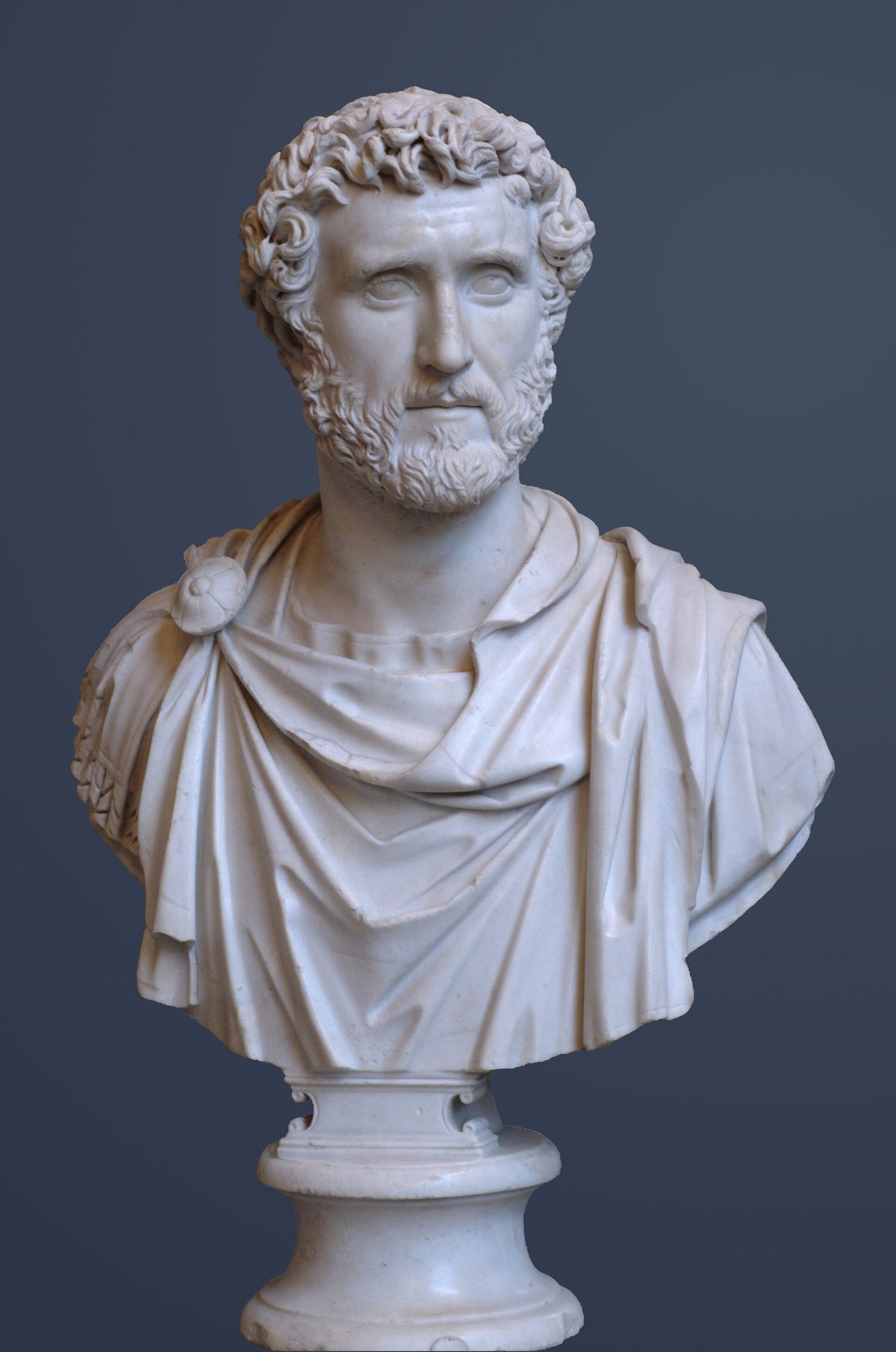
The work Dr. Vang assigned me to study was Justin’s First Apology—an apology in the old sense, a defense rather than a regret—written around 155 and addressed to Emperor Antoninus Pius.5 I came to it with a certain expectation. I had been told in the churches of my upbringing that the goal of evangelicalism was to recover the faith and practices of the early Church. Over the centuries, I was taught, accretions had accumulated and the Reformation had begun the work of stripping them away. The early Church was the standard to which we were trying to return, and here was my chance to see the early Church for myself.
I should say at the outset that not every Protestant makes that promise. Confessional Reformed readers will point out, correctly, that their confessions never claimed the second-century church was a proto-Baptist one—only that Scripture is the rule and the fathers are useful, fallible witnesses beneath it. If that is your position, my presuppositions were not yours. The evidence, though, is the same for both of us. The tradition that raised me made the promise plainly and often, and I believed it. So I started reading, expecting Justin to confirm it.
He didn’t.
Chapter 66
The first thing in Justin’s writings that changed my perspective was his description of the Eucharist—the Lord’s Supper, communion; the Greek word simply means thanksgiving.6 I had grown up hearing a story you may not have: that the Romans of the first and second centuries accused Christians of cannibalism, and that the accusation was a tragic misunderstanding. They had misconstrued “This is my body … This is my blood” (Matt 26:26–28 and parallels) to mean that Christians were actually eating flesh and drinking blood. Christians, however, knew that the bread and wine were only symbols, and the Romans were merely confused.7
So when I came to Justin’s account of the Eucharist in chapter 66, I expected him to clarify the issue. He was writing to a pagan audience—to the Roman emperor, in fact—which is to say precisely to the people who had levied the charge. I assumed he would say, “No, you misunderstand. The bread and wine are merely symbols of Christ’s body and blood, not actual flesh and blood.”
But he doesn’t say that. He says the opposite, and he says it at length:
And this food is called among us Εὐχαριστία [the Eucharist], of which no one is allowed to partake but the man who believes that the things which we teach are true, and who has been washed with the washing that is for the remission of sins, and unto regeneration, and who is so living as Christ has enjoined. For not as common bread and common drink do we receive these; but in like manner as Jesus Christ our Saviour, having been made flesh by the Word of God, had both flesh and blood for our salvation, so likewise have we been taught that the food which is blessed by the prayer of His word, and from which our blood and flesh by transmutation are nourished, is the flesh and blood of that Jesus who was made flesh.8
In a document meant to defend Christians against precisely that kind of misunderstanding, he doesn’t deny the accusation. He embraces it.
In a document meant to defend Christians against precisely that kind of misunderstanding, he doesn’t deny the accusation. He embraces it.
Justin was not a memorialist, not a proto-Zwinglian.9 He is not advancing a private theory. He is explaining to outsiders what is done every Sunday by all the Christians he knows. He gives us, in the surrounding chapters, what amounts to the fullest description of a Christian Sunday service to survive from the first two centuries: the gathering, the readings from the prophets and memoirs of the apostles, the homily from the man Justin calls the “president,” the prayers with the people answering “Amen,” the bread and the cup mixed with water, the distribution by deacons, the portion carried away to the absent.10 It is recognizably a Mass.
Between Zwingli and Trent
A Reformed reader will object here that I have shown only that Justin was not Zwingli—and he is right; few readers of Justin, Catholic or Reformed, think otherwise. But between Zwingli and Trent stands Calvin, who held that in the Supper the believer truly feeds on the body and blood of Christ—really, and not as a bare memorial—by the power of the Holy Spirit, who raises the communicant up to the ascended Christ rather than bringing Christ down into the bread.11 That is not a symbolic view, and Reformed writers have long claimed Justin for it.12 They can point to real features of the text: Justin calls the rite a thanksgiving, and he says the bread is made the Eucharist “by the prayer of His word”—which sounds to a Reformed ear more like a blessing than a change of substance.13
However, I don’t think that position accounts for the passage. Justin’s analogy is not to a benefit conveyed to a believer. It is to the Incarnation. As Christ was made flesh by the word of God and had flesh and blood, so, Justin says, the food is the flesh and blood of that same Jesus. That is a statement about the food rather than about what happens in the communicant. Calvin, in fairness, does not make the reality depend on the recipient’s faith either; he holds that Christ is genuinely offered to everyone who comes. But he locates the reality in the Spirit’s work of joining the believer to the ascended Christ, and it is the food that Justin’s sentence is about.14 It does not get me to Trent—nothing in the second century does—but it does rule out the position in which I was raised.
Why the Letters Do Not Settle It
It is worth asking why the New Testament doesn’t simply settle a question like this. I think it was never built for that. Its letters were written to Christians who already believed, and they addressed specific situations: a problem in Corinth, a dispute in Galatia, a question in Colossae. Paul does give the Corinthians corrective instruction on the Supper, and a Protestant reader is right to press it—but he is correcting an abuse in a congregation that already knew the rite, not explaining it to someone who had never seen one.15 Letters were for believers. The Gospels look more outward—though whether they were written to win outsiders or to instruct those who already believed is itself an old question—but either way they narrate what Jesus did and said; none of them stops to explain to a stranger what a Christian assembly looks like from the door. Preaching was to win converts, and preaching leaves few manuscripts.
Justin is different. He is writing precisely for people who had no context, so he explains everything: how Christians gather, what they read, how they pray, what they believe about Christ and why. He did, for an emperor who knew nothing of the faith, what I had spent much of my life trying to force the Bible to do.
Ignatius of Antioch
I would later discover that Justin is not even the earliest witness to the belief that the elements in the Lord’s Supper actually become the body and blood of Christ. Ignatius of Antioch—writing on the traditional dating around 107 or 110, some four or five decades before Justin—warned his churches about heretics who held themselves apart from the Eucharist precisely because, he said, they would not confess that the Eucharist was the flesh of Jesus Christ.16 The two earliest witnesses who take up the question directly agree, and no second-century writer contradicts them.17
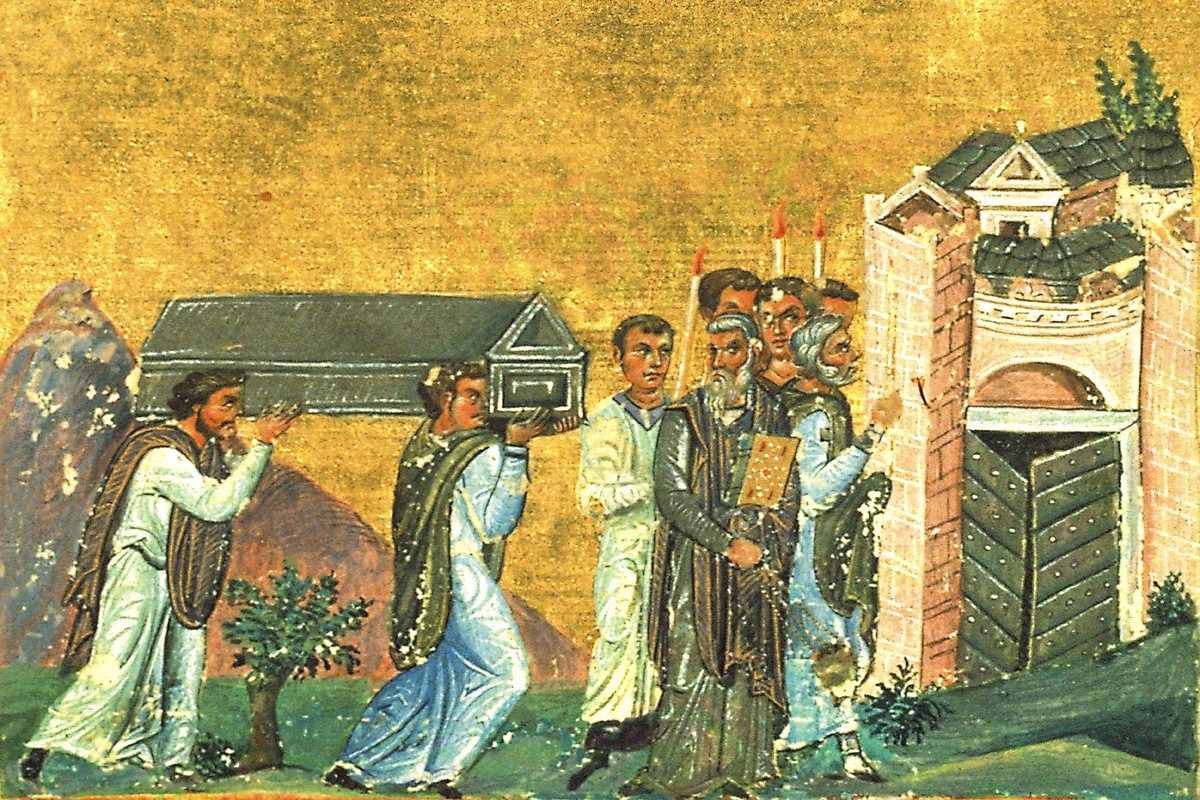
Neither of them is using the medieval vocabulary, and it would be dishonest to pretend otherwise. Transubstantiation is a later word that explains how the elements become the body and blood of Christ, not an argument that they do.18 Justin and Ignatius are not offering that explanation. What they are doing is asserting the very thing that transubstantiation was later formulated to explain—and on that question they are far closer to Trent than to Zwinglian memorialism.
This changed everything for me. It is one thing for someone in the fifth century, or the twelfth, or the sixteenth, to develop an elaborate doctrine of Christ’s presence in the Eucharist. It is something else entirely for second-century witnesses—men writing within living memory of the apostolic generation—to describe it the way they did, and particularly for Justin, who wrote for outsiders, where every motive for self-protection pulled the other way.19
The dating merits a moment’s attention. Justin was writing in the middle of the second century, when living memory of the apostles still existed. Polycarp of Smyrna, who had known John in his youth, was Justin’s older contemporary; on the conventional dating he was burned at Smyrna in 155 or 156, within a year or two of the First Apology, and roughly a decade before Justin’s own beheading at Rome.20 Whatever Justin describes as the faith of the Church is something handed down through a chain at most two or three links long. He is not describing the Church centuries later. He is describing the Church the apostles left behind.
The Assumption I Was Making
I should be honest about the assumption I was making, because everything that follows turns on it. I was assuming that if the generation closest to the apostles believed something, that belief most likely came from the apostles. Put that way it sounds almost too obvious to say out loud. But it is worth saying because it is, in fact, not obvious, and it is precisely the assumption a thoughtful Protestant will want to challenge.
This assumption has real limits. Proximity is not infallibility. The Corinthians were closer to Paul than Justin was, and they managed the Lord’s Supper so badly that Paul told them their meetings did more harm than good. The Galatians had only just received the gospel, and Paul was astonished at how quickly they were deserting it.21 Nearness to the apostles guarantees nothing about faithfulness to them, and an argument that treats it as a guarantee is proving far too much.
The Best Argument Against Me
The Protestant case I would eventually encounter makes exactly that point. Scripture itself, the argument runs, teaches us to expect early corruption: Paul warned the Ephesian elders that after his departure savage wolves would come in, and that from their own number men would arise speaking perverse things; he told the Thessalonians the mystery of lawlessness was already at work.22 If the New Testament predicts error inside the church, and soon, then finding it in the second century is no scandal but a fulfillment. On that reading Justin is not a witness to the apostolic faith. He is early evidence of the drift away from it.
I take that objection seriously, and I would take it more seriously still if what I found in Justin looked anything like drift. Drift is gradual and contested, and it leaves tracks—someone objects, someone defends, and the argument survives in the record. What I found instead was a settled practice, explained from the ground up to strangers who had never heard of it, without the slightest hint of disagreement inside the churches Justin knew. The only dissent anywhere in the second-century record is the abstention Ignatius reports, and he treats it as evidence that those men had left the faith rather than as a live question within it. Writers in other cities describe the rite the same way, and nothing in the record suggests anyone thought it novel. That is not how an error begins. That is how an inheritance is received.
That is not how an error begins. That is how an inheritance is received.
That silence is worth more than silence usually is, because Justin is demonstrably willing to break it. In the Dialogue with Trypho he sets out his own conviction that the righteous will be raised to reign a thousand years in a rebuilt Jerusalem—and then says, without embarrassment, that many who belong to the pure and pious faith think otherwise.23 He recognized disagreement among Christians when he saw it, and he was prepared to name it. In the same work, however, he describes the eucharistic bread and cup, and he names nothing. A witness who marks the disputed questions is more credible on the ones he leaves unmarked.
That cuts against me as well. The Church I eventually joined did not follow Justin on the thousand years, and it did not follow Cyprian of Carthage—a bishop and a martyr—when he insisted that baptism administered by heretics was no baptism at all.24 Proximity to the apostles made nobody infallible, and I have never claimed it did. What it does give you is a powerful witness who must be weighed, not a man who must be obeyed.
Men Who Died for the Faith
There is a second problem that I have never gotten past. These men died for the faith in which this was an ordinary, unremarkable part. Polycarp learned the faith from John and was burned alive rather than renounce it.25 Justin was beheaded. Ignatius of Antioch was carried across the empire to be killed by animals.26 The claim I was being asked to accept is that this generation received the faith from the apostles, altered it on this point, and died rather than deny the faith as they had revised it—with no one who had heard the apostles preach appearing to notice. The point is not that any of them died for this one doctrine alone. The point is that men do not die for what they had felt free to revise: a faith subject to one’s own revisions is not one worth dying for. Men do sometimes die for what is false. They rarely die for what they have only just invented.
I do not offer that as a proof. It isn’t one. But it gnawed at me then, and it gnaws at me still.
Chapter 61
And once I started reading the First Apology as a description rather than as an argument, the Eucharist stopped being an isolated problem.
Five chapters earlier, in chapter 61, Justin explains baptism to the same emperor, in the same register, with the same assumption that he is reporting ordinary practice rather than defending a contested theory:
As many as are persuaded and believe that what we teach and say is true, and undertake to be able to live accordingly, are instructed to pray and to entreat God with fasting, for the remission of their sins that are past, we praying and fasting with them. Then they are brought by us where there is water, and are regenerated in the same manner in which we were ourselves regenerated … And this washing is called illumination, because they who learn these things are illuminated in their understandings.27
He quotes Christ—“Except ye be born again, ye shall not enter into the kingdom of heaven”—and applies the words, with no apparent awareness that anyone might read them otherwise, to the rite he has just described.28 Baptism, in his account, is not a public sign of a decision already made. It is the means by which a person is made new.
I want to tread carefully here, because this one landed closer to home than the Eucharist did. I was raised in a tradition that had thought hard about baptism and staked a great deal on the conviction that it follows faith as a symbol rather than conveys anything—a conviction held by serious people for serious reasons. Chapter 61, however, does not hand everything to the Catholics. The people Justin describes being baptized are adults who have been persuaded, who have undertaken to live accordingly, and who fasted with the congregation first—believer’s baptism upon profession of faith. That was in keeping with the faith of my upbringing. What I would not have expected is what he says the water does.29
Hermeneutics Against Presupposition
And this is where my hermeneutics—the way in which I approached and interpreted Scripture—clashed with my theological presuppositions. If I wanted to know what the New Testament writers meant, their own disciples were better placed to know than I was. The natural reading of “this is my body” can sound symbolic to a modern reader, and coming to those words without any historical context, that is how I took them. But it is not how the people closest to the source took them, and it is not how the Church that later recognized which books would go into the New Testament took them.
The obvious reply is that recognizing a book is not the same as conferring anything on it: the Church discovered the canon rather than creating it—which is, as it happens, how the Catechism itself puts it: the Church “discerned” which writings belonged (CCC 120)—and a man may identify an inspired text correctly while holding a mistaken view of the Supper or baptism. That is a fair answer, and it deserves more than I can give it here. To me, it did not feel like two questions. It felt like being told that the men whose judgment I trusted on which books would bind my conscience had been simultaneously and unanimously wrong about what they did every Sunday.
That posed a problem I could not push past. I had assumed the early Church understood Scripture the same way I did, but on this point in particular, they didn’t. And it seemed strange, if not arrogant, to claim that twenty centuries later, reading the same texts, we could understand what John meant better than his disciples could. And then, of course, there was the matter of what believing and professing his faith cost Justin.
The Trial
Justin was beheaded in Rome around 165 along with six companions under the urban prefect Junius Rusticus, the Stoic who had been the most important of Marcus Aurelius’s philosophical teachers—the man who put Epictetus into the future emperor’s hands.30 A record of the trial survives.31 Rusticus opened by asking whether Justin really supposed that, if he were scourged and beheaded, he would ascend into heaven. Justin answered that he hoped, if he endured these things, to have God’s gifts. Rusticus then ordered him and his companions to sacrifice to the gods, and Justin refused: no right-thinking person, he said, falls away from piety to impiety. Rusticus warned him that unless he obeyed he would be punished without mercy. Justin answered that through prayer they could be saved even after being punished, and that this would become for them salvation and confidence at the judgment seat of Christ. Rusticus ordered them scourged and beheaded.32
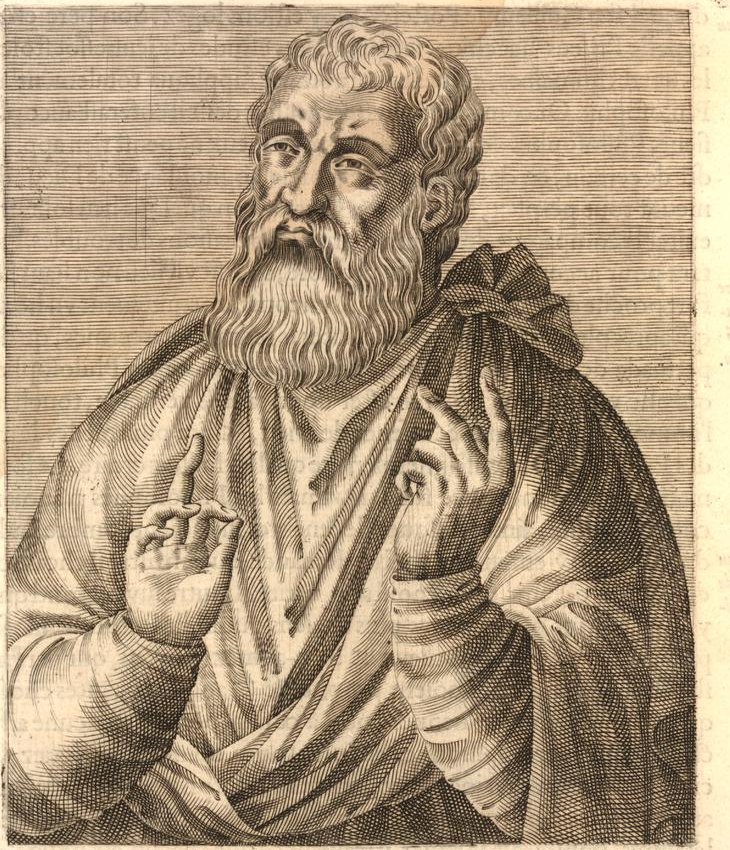
He had every opportunity to soften his teaching first. He was a philosopher addressing philosophers; he knew how to speak to that audience in a way that would let him off the hook. He could have burned incense to the Roman gods. He could have walked back the strangest parts of his explanation of the faith—the parts that had drawn the charge of cannibalism, the parts that made Christianity look like a mystery cult rather than a respectable philosophy fit for the empire. He didn’t.
By the standard of every reasonable man in that courtroom, he was an apologist who believed too much. He believed more than his own defense required and more than his audience could accept, and he would not trade the excess for his life. There was no worldly upside. There was only the conviction that what he had received was true, and that softening it for a kinder reception was not an option. I have thought about that a great deal in the years since. The parts of the faith I would most like to file down have turned out, with some regularity, to be the parts holding up the roof.
The parts of the faith I would most like to file down have turned out, with some regularity, to be the parts holding up the roof.
After the Assignment
After that the Church Fathers stopped being an assignment. Ignatius was already in my hands, and Clement of Rome and the Didache followed soon after. The letters Ignatius wrote on the road to his execution are short and urgent, and what he spends his last weeks on is telling his churches to stay with their bishop: do nothing without him; where the bishop appears, there let the people be, just as where Jesus Christ is, there is the Catholic Church.33 I had assumed that kind of language was the residue of Constantine, but on the traditional dating of Ignatius it appears within a generation—or maybe even just a few years—of the last apostle’s death.
Irenaeus is the one to whom I kept returning. He had been taught by Polycarp, who had been taught by John, and when the Gnostics claimed a secret apostolic tradition of their own, his answer was not to appeal to Scripture alone. It was to name the bishops of Rome in order from the apostles to his own day, and to say: this is where the teaching has been kept in the open, where anyone can go and check it.34 I had expected the early Church’s defense against heresy to look like mine. It didn’t.
What I Found Instead
This conclusion was not the one I expected to reach. I had been told, implicitly and explicitly, that the early Church was a sort of pre-Constantinian evangelicalism: scriptural, simple, free of hierarchy, gathered around the preached word. What I found instead was a church organized around bishops, treating apostolic succession as the test of authentic teaching and the Eucharist as the actual body and blood of Christ. That church may have been right or may have been wrong, but it was not the church I had been told the Reformation was trying to restore. I did not find a fully developed Catholicism—I want to be clear about that—but I did find something more compatible with Rome than with the tradition that raised me.
None of this made me Catholic, of course. The distance from where I stood to Rome was enormous, and the prejudices I had absorbed about Catholicism were considerable. I had been baptized in a Missionary Baptist church, a tradition with one of the more pronounced anti-Catholic streaks in American Protestantism. Walking into a Catholic church on a Sunday morning had been unthinkable when I started college. But as I kept reading, that distance began to shrink a little at a time.
Before long I was driving an hour to Little Rock on Sunday mornings to attend an Anglican parish where the music was warm and evangelical and the Eucharist stood at the center of every week in a way I had begun, through Justin, to recognize. I was confirmed into that church at twenty-one. The path from there to Rome took thirteen more years and several false starts.
But it started here. It started with a sophomore apologetics assignment and a document eighteen centuries older than I was, written by a man who was reporting what his church actually did, and who had every reason to describe it more flatteringly than he did. He laid it out plainly when the easier course would have been to soften the strange parts. He held the line and lost his head for it.
Justin’s First Apology runs to sixty-eight short chapters—an hour’s reading, and free online at newadvent.org and ccel.org in the Ante-Nicene Fathers translation quoted above. Chapters 61 through 67 are the ones this essay concerns.
Frequently Asked Questions
What did Justin Martyr say about the Eucharist?
In chapter 66 of the First Apology, written around 155 and addressed to the emperor Antoninus Pius, Justin says that Christians do not receive the consecrated elements “as common bread and common drink,” but that the food “is the flesh and blood of that Jesus who was made flesh”—drawing his analogy from the Incarnation itself. He presents this not as a private theory but as what all the Christians he knows do every Sunday, explained to outsiders who had never seen the rite.
Did Justin Martyr believe in transubstantiation?
He never used the word, and it would be an anachronism to put it in his mouth. Transsubstantiatio is a coinage of the twelfth-century schools, used in participial form by the Fourth Lateran Council in 1215 and defined at Trent in 1551. What Justin asserts is the thing the later word was coined to explain: that the eucharistic food is the flesh and blood of the incarnate Jesus. On that question he stands far closer to Trent than to symbolic memorialism, while offering no theory of how the change takes place.
When was the First Apology written, and to whom?
Scholars place it between roughly 150 and 157, most often around 153–155; the firmest anchor is Justin’s reference to Felix, prefect of Egypt around 150–154. It is formally addressed to the emperor Antoninus Pius, to his sons—“Verissimus,” the future Marcus Aurelius, and Lucius—and to the Senate and the people of Rome.
How did Justin Martyr die?
He was scourged and beheaded in Rome around 165, together with six companions, after refusing to sacrifice to the Roman gods. The trial was conducted by the urban prefect Junius Rusticus—the Stoic philosopher who had been Marcus Aurelius’s most important philosophical teacher—and a martyr narrative drawn from the court minutes survives as the Acts of Justin.
Was Justin Martyr Catholic?
Not in the sense of holding a developed medieval theology—nothing in the second century does, and this essay does not claim otherwise. The editors of the Protestant translation quoted above remark that the passage “is claimed alike by Calvinists, Lutherans, and Romanists; and, indeed, the language is so inexact, that each party may plausibly maintain that their own opinion is advocated by it”—a caution that cuts against every side, and one editor dissents even from that. The essay’s argument is narrower: on the Eucharist, what Justin describes rules out the memorialism of my own upbringing; what he says the water of baptism does was not what I expected either; and the second-century church taken whole—Justin alongside Ignatius and Irenaeus—looks more compatible with Rome than with the church I had been told the Reformation was restoring.
Footnotes
1. Preben Vang served ten years as professor and chair of the department of theology at Ouachita Baptist University before moving to Palm Beach Atlantic University and, in 2014, to Baylor University’s George W. Truett Theological Seminary, where he is Professor of Christian Scriptures and Executive Director of the Doctor of Ministry program. See his faculty page at Truett Seminary. Ouachita’s unit is the Pruet School of Christian Studies.
2. Justin identifies himself in the opening line of the First Apology as “the son of Priscus and grandson of Bacchius, natives of Flavia Neapolis in Palestine” (1 Apol. 1). No ancient source gives his birth year; “around 100” is a scholarly convention back-calculated from his maturity in the 130s and his death in the 160s. Flavia Neapolis—modern Nablus—was founded by Vespasian in AD 72/73 and did not receive the rank of colonia until the reign of Philip the Arab (r. 244–249), nearly a century and a half after Justin’s birth. Jacob’s Well lies roughly two and a half kilometers east-southeast of the Roman city center; the proximity is a fact of geography, not something the ancient sources make anything of.
3. Dialogue with Trypho 2–8. The schools appear in that order in Justin’s narrative at Dial. 2. The setting is often loosely reported as a beach; the text says otherwise: “I used to go into a certain field not far from the sea. And when I was near that spot one day … a certain old man, by no means contemptible in appearance, exhibiting meek and venerable manners, followed me at a little distance” (Dial. 3, ANF). Whether the old man is a real encounter or a literary device is disputed.
4. That Justin went on wearing the philosopher’s dress is an inference, but a well-founded one: in Dial. 1 Trypho accosts him in the street precisely because of what he is wearing, and Eusebius says Justin preached “in the guise of a philosopher” (Hist. eccl. 4.11.8). “Taught in Rome” is deliberately modest. No ancient source describes a school in any institutional sense; the only evidence of a location is Justin’s own answer at his trial, that he lived “above one Martinus, at the Timiotinian Bath” and knew of no other meeting place, and that “if any one wished to come to me, I communicated to him the doctrines of truth” (Acts of Justin 2, ANF). The address is textually corrupt and has never been securely identified.
5. Scholars place the First Apology between roughly 150 and 157, most often c. 153–155; the firmest anchor is Justin’s reference at 1 Apol. 29 to “Felix the governor in Alexandria,” identified from the papyri as L. Munatius Felix, prefect of Egypt c. 150–154, attested in office in September 151. The formal address is wider than the emperor alone. Justin addresses the petition to Antoninus Pius, “and to his son Verissimus the Philosopher, and to Lucius the Philosopher … and to the sacred Senate, with the whole People of the Romans” (1 Apol. 1). “Verissimus” is the future Marcus Aurelius—so the defense was addressed, among others, to the emperor whose own teacher would preside over Justin’s execution. On Rusticus, see note 30.
6. Greek εὐχαριστία, “thanksgiving”; the ANF translators gloss it exactly so at this passage. Unless otherwise noted, all quotations from Justin follow the Ante-Nicene Fathers translations—the Apologies by Marcus Dods, the Dialogue by George Reith—in Ante-Nicene Fathers, vol. 1, ed. Alexander Roberts, James Donaldson, and A. Cleveland Coxe (Buffalo, NY: Christian Literature Publishing Co., 1885). Roberts and Donaldson are the edition’s editors rather than, as is often assumed, the translators of these particular works.
7. The accusation itself is well attested: Athenagoras, Legatio 3 (“atheism, Thyestean feasts, Œdipodean intercourse”); Minucius Felix, Octavius 9, with the accuser named at 31 and the rebuttal at 30; Tertullian, Apology 7–8; and the letter of the churches of Lyons and Vienne in Eusebius, Hist. eccl. 5.1.14. The tidy explanation I was taught—that pagans had simply misheard the words of institution—is, however, no longer the scholarly consensus. See Andrew McGowan, “Eating People: Accusations of Cannibalism Against Christians in the Second Century,” Journal of Early Christian Studies 2, no. 4 (1994): 413–42, which reads the charges as instances of “labelling,” a symbolic stereotype applied to many marginal groups in antiquity, “rather than relying on the traditional explanation of a misunderstanding of eucharistic ‘body and blood’ imagery.” Robert Louis Wilken adds a point worth sitting with: “the accusations of promiscuity and ritual murder appear only in Christian authors. They are not present in the writings of pagan critics of Christianity” (The Christians as the Romans Saw Them, 2nd ed. [New Haven: Yale University Press, 2003], 21).
8. Justin Martyr, First Apology 66 (ANF 1:185), ccel.org. The Catechism itself quotes this chapter (CCC 1355) and quotes chapters 65–67 at length (CCC 1345).
9. “Proto-Zwinglian” is shorthand, and Zwingli scholars would want it qualified. Bruce Gordon, author of Zwingli: God’s Armed Prophet (New Haven: Yale University Press, 2021), calls the assumption that Zwingli “simply stands for some form of bare memorialist position on the Lord’s Supper” the most obvious mistake made about him (interview, Zwinglius Redivivus, 4 November 2021), and W. P. Stephens’s The Theology of Huldrych Zwingli (Oxford: Clarendon, 1986), 218–259, is the fullest statement of that revisionist case; B. A. Gerrish’s typology (below, note 11) nonetheless keeps “symbolic memorialism” as the label for Zwingli. More to the point for my own tradition: the memorialism I was raised in is a nineteenth-century Baptist development rather than a sixteenth-century Zurich inheritance. The Second London Confession of 1689 (30.7) follows the Westminster Confession (29.7) almost verbatim in saying that worthy receivers “really and indeed, yet not carnally and corporally, but spiritually, receive, and feed upon Christ crucified.” Something was lost between 1689 and the church I grew up in.
10. 1 Apol. 65 and 67. Chapter 65 describes the kiss of peace, then “bread and a cup of wine mixed with water” brought to “the president of the brethren” (τῷ προεστῶτι τῶν ἀδελφῶν), the people’s “Amen,” and the deacons who “give to each of those present to partake” and carry a portion “to those who are absent.” Chapter 67 adds the Sunday gathering of “all who live in cities or in the country,” the reading of “the memoirs of the apostles or the writings of the prophets … as long as time permits,” and the president’s instruction and exhortation. Strictly, the two chapters describe two occasions—chapter 65 the eucharist that follows a baptism, chapter 67 the ordinary Sunday assembly—and the kiss of peace is attested only for the former.
11. Calvin, Institutes IV.17, esp. §§10, 19, 31–32. The formulation matters, and I have tried to state it as a Reformed reader would: the antithesis in Reformed theology is not between a real partaking and a figurative one—Calvin freely grants that “the breaking of bread is a symbol, not the reality” (IV.17.10)—but between a real partaking and an empty sign. Westminster Confession 29.5 has the elements called body and blood “truly, yet sacramentally only,” while 29.7 has worthy receivers feed on Christ “really and indeed, yet not carnally and corporally, but spiritually.” The directionality is Calvin’s own and is the part that bears on my argument: “Christ does not seem to them to be present unless he descends to us, as if we did not equally gain his presence when he raises us to himself … while we deem it unlawful to draw him down from heaven” (IV.17.31, Beveridge); and, more bluntly, “the real flesh of Christ does not enter us” (IV.17.32). The Reformed confessions are not univocal here; on the range from Calvin’s “symbolic instrumentalism” to a weaker parallelism, see B. A. Gerrish, “The Lord’s Supper in the Reformed Confessions,” Theology Today 23, no. 2 (1966): 224–43.
12. The editors of the very translation I am quoting say so in a note on this passage: “This passage is claimed alike by Calvinists, Lutherans, and Romanists; and, indeed, the language is so inexact, that each party may plausibly maintain that their own opinion is advocated by it” (ANF 1:185 n.); Coxe appends his own dissent from the charge of inexactness. The clearest Reformed claim on Justin is John Williamson Nevin, The Mystical Presence: A Vindication of the Reformed or Calvinistic Doctrine of the Holy Eucharist (Philadelphia: Lippincott, 1846), 131–32. It is only fair to note that the claim has never been unanimous among the Reformed: William Cunningham thought the passage “obscure and ambiguous” and not worth the time (The Reformers and the Theology of the Reformation [Edinburgh: T. & T. Clark, 1862], 232), while Robert Letham reads Justin as already “talking in terms of a realistic corporal presence of Christ in the eucharist” (The Lord’s Supper: Eternal Word in Broken Bread [Phillipsburg, NJ: P&R, 2001], 19). Calvin does not, so far as I can find, adduce Justin on the Supper anywhere in the Institutes—his patristic authority there is overwhelmingly Augustine—but when Lutheran opponents pressed the passage on him he did not flinch: “Justin says, that the bread and wine, by the word of prayer and thanksgiving, become the flesh and blood of Christ. We, too, say the same thing, provided the mode of communion, which was then known to the Church, be added” (Last Admonition to Joachim Westphal [1557], in Tracts, trans. Beveridge, 2:435).
13. The concession is better founded than I appreciated at the time. The Greek is δι᾽ εὐχῆς λόγου τοῦ παρ᾽ αὐτοῦ, and it is genuinely contested: G. J. Cuming took it for a fixed dominical formula, i.e., the words of institution (“ΔΙ᾽ ΕΥΧΗΣ ΛΟΓΟΥ,” Journal of Theological Studies 31 [1980]: 80–82); Anthony Gelston, for a prayer of thanksgiving offered on Jesus’ pattern rather than a set form (“ΔΙ᾽ ΕΥΧΗΣ ΛΟΓΟΥ (Justin, Apology i. 66. 2),” JTS 33 [1982]: 172–75); Michael Heintz, for “the prayer of the Word”—the Logos himself as the agent of consecration, and the seed of the later Logos-invocation (“δι᾽ εὐχῆς λόγου τοῦ παρ᾽ αὐτοῦ (Justin, Apology 1.66.2): Cuming and Gelston Revisited,” Studia Liturgica 33 [2003]: 33–36). Paul Bradshaw adjudicates the three and comes down nearest to Heintz (Eucharistic Origins, rev. ed. [Eugene, OR: Wipf and Stock, 2023], 95–96). Everett Ferguson’s verdict on the whole clause is worth quoting: “Almost every word in the Greek is ambiguous and even a literal English translation does not adequately suggest the options” (Early Christians Speak: Faith and Life in the First Three Centuries, 3rd ed. [Abilene, TX: ACU Press, 1999], in the chapter on the Lord’s Supper). The Catholic reply is that the ambiguity changes little: whichever reading prevails, Justin’s sentence continues past the phrase to say what the food thereby is—and the reading Bradshaw finds most persuasive, Heintz’s, makes the consecrating agent the Logos himself: the seed of the later eucharistic epiclesis, not an alternative to it.
14. On the incarnational parallel, Bradshaw concludes that Heintz “was undoubtedly correct in recognizing that an intentional parallel was being drawn by Justin between the process of incarnation and of eucharistic consecration here” (Eucharistic Origins, rev. ed., 96), and Andrew McGowan—one of my professors at Yale—makes the broader point against a recipient-centered reading: second-century writings treat the eucharistic food with a realism he finds startling, nothing in them suggesting that the elements were mere signs or that what they were depended on the disposition of the recipient (Ancient Christian Worship: Early Church Practices in Social, Historical, and Theological Perspective [Grand Rapids: Baker Academic, 2014], ch. 2). See also J. N. D. Kelly, Early Christian Doctrines, 4th ed. (London: A. & C. Black, 1968), 198. In fairness, Calvin anticipated and rejected exactly the reading I am giving: replying to Heshusius, who had pressed the incarnation analogy, Calvin wrote that it was “as if Justin were making out that the one was as miraculous as the other, while all he meant was, that the flesh which Christ once assumed from us is daily given us for food” (Clear Explanation, in Tracts, 2:537). I do not think that is what Justin means, but a reader should know that the objection is Calvin’s own and not a modern afterthought. Calvin also pressed the chapter’s opening restriction—no one may partake but the believing and baptized—writing in the same reply that Justin “contends for no more than that this benefit is imparted to the disciples of Christ alone who have been initiated into true piety” (Clear Explanation, in Tracts, 2:537). But that restriction governs who may approach, not what the food is; it is disciplinary and baptismal, and the incarnational analogy in the second half of Justin’s sentence concerns the food regardless of who receives it. One further caution against overreading: Justin’s phrase κατὰ μεταβολήν (“by transmutation”) is, since F. H. Colson’s 1922 article, generally taken to describe ordinary digestion in the recipient rather than a change in the elements (“Notes on Justin Martyr, Apology I,” Journal of Theological Studies os-23, no. 90 [1922]: 161–71, at 166–68). Colson himself, however, read the digestive sense as strengthening the analogy rather than deflating it—if food becomes our flesh every day, the higher change is not incredible—a further thought he noted that Bethune-Baker and Gore, who shared the digestive reading, did not take up.
15. 1 Cor 11:17–34.
16. Ignatius of Antioch, Smyrnaeans 6.2: “They abstain from the Eucharist and from prayer, because they confess not the Eucharist to be the flesh of our Saviour Jesus Christ, which suffered for our sins, and which the Father, of His goodness, raised up again” (ANF 1:89, short recension), newadvent.org. A citation trap worth naming: in the versification of Lightfoot and Holmes the sentence falls at the end of 6.2, and 7.1 begins “They therefore that gainsay the good gift of God”; but the Ante-Nicene Fathers, which numbers chapters and not verses, breaks its chapters at a different point and prints this sentence as the opening of its chapter 7. Both “Smyrn. 6.2” and “ANF chapter 7” are correct for their own editions. The Didache (c. 100) may be earlier still, but its eucharistic prayers (9–10) and its sacrificial language (14) never take up the identification question one way or the other; it is silent on the point rather than contrary to it. Compare Ephesians 20.2, where the eucharistic bread is “the medicine of immortality, and the antidote to prevent us from dying.” The traditional date of c. 107–110 comes from Eusebius’s Chronicle, not from the Church History, which places Ignatius under Trajan only by context and reports the martyrdom itself as hearsay. A significant modern minority dates the letters considerably later—T. D. Barnes to the 140s (“The Date of Ignatius,” Expository Times 120, no. 3 [2008]: 119–30), and a smaller group treats them as later pseudepigrapha. On the later datings the interval between Ignatius and Justin narrows or disappears; the Trajanic date remains the majority position, and I follow it, but the reader should know the case is not closed.
17. The narrowing is deliberate. Early in the third century Tertullian could gloss the words of institution as “the figure of my body” (Adv. Marc. 4.40, ANF), and Origen could describe the consecrated bread in the language of type and symbol (Comm. Matt. 11.14). What those passages mean—and whether either writer thought he was correcting anything—is a longer argument than this essay needs; it is enough that they exist, and that within the second century itself the record stands as described.
18. The noun transsubstantiatio is a coinage of the twelfth-century schools. The Fourth Lateran Council in 1215 used the participle without defining the term—transsubstantiatis pane in corpus, et vino in sanguinem potestate divina (Constitution 1, Firmiter credimus; DH 802)—and the definition came only at Trent, which taught the conversion of the whole substance of the bread and wine and said that this conversion “is by the holy Catholic Church suitably and properly called transubstantiation” (Session XIII [1551], ch. 4; DH 1642; the anathema is at can. 2, DH 1652, which uses aptissime rather than the chapter’s convenienter et proprie). Jaroslav Pelikan’s formulation of the underlying methodological point is the one I would stand behind: the effort to cross-examine second- and third-century fathers about ninth- or sixteenth-century controversies “is both silly and futile” (The Christian Tradition, vol. 1 [Chicago: University of Chicago Press, 1971], 166–67)—a stricture that tells just as heavily against the Reformed claim on Justin in note 12 as against any Catholic one.
19. I have deliberately not claimed that Ignatius himself heard the apostles. The tradition that he was a disciple of John appears first in the Martyrium Ignatii, a document unknown to Eusebius and generally dated no earlier than the fifth century; neither Ignatius, nor Polycarp, nor Irenaeus, nor Eusebius says any such thing, and Ignatius’s own letter to Polycarp—who is generally accepted as a disciple of John (see note 20)—suggests the two had not met before his journey. The still later story that Ignatius was the child Jesus took in his arms is a Byzantine growth from a pun on his epithet Θεοφόρος.
20. The date is contested and the contest matters, so it is worth being exact. The Martyrdom of Polycarp 21 dates the death to “the second day of the month Xanthicus … Statius Quadratus being proconsul,” which Waddington’s chronology fixed to 23 February 155; Turner and others prefer 156, and T. D. Barnes argues for 157. A minority following Eusebius’s Chronicle puts it as late as 166/167, and Otto Zwierlein’s critical edition (Die Urfassungen der Martyria Polycarpi et Pionii und das Corpus Polycarpianum, 2 vols. [Berlin: De Gruyter, 2014]) argues for a range of 161–168—on the later of those datings Polycarp would have outlived Justin rather than predeceased him. I follow the conventional 155/156, which remains the majority view, but nothing in my argument requires it: on any dating the two were contemporaries. That Polycarp had heard John is best supported not by Adv. Haer. III.3.4, which says only that he was “instructed by apostles,” but by Irenaeus’s letter to Victor, where Polycarp is said to have observed Easter “with John the disciple of our Lord, and the other apostles with whom he had associated” (Eusebius, Hist. eccl. 5.24.16), and by Tertullian, who says flatly that “Polycarp was placed therein by John” (De praescriptione haereticorum 32). Whether that John is the apostle or the “elder John” whom Papias appears to distinguish from him is an old and unresolved question.
21. 1 Cor 11:17 (“your meetings are doing more harm than good” [NABRE]); Gal 1:6.
22. Acts 20:29–30; 2 Thess 2:7.
23. Dial. 80: “I admitted to you formerly … that I and many others are of this opinion … but, on the other hand, I signified to you that many who belong to the pure and pious faith, and are true Christians, think otherwise” (ANF 1:239). The ANF chapter heading is itself candid: “The opinion of Justin with regard to the reign of a thousand years. Several Catholics reject it.”
24. Cyprian, Ep. 72 in the ANF (Wallis) numbering = Ep. 73 in Hartel’s CSEL text, to Jubaianus: baptism among heretics “we cannot consider as valid or legitimate.” The numbering of Cyprian’s letters diverges between the two editions and should always be specified. A council of eighty-seven African bishops at Carthage on 1 September 256 backed him unanimously, against Pope Stephen I, whose rescript survives only where Cyprian quotes it: “let nothing be innovated (or done) which has not been handed down” (Ep. 73.1 ANF = 74.1 Hartel). The dispute was not resolved in either man’s lifetime—Stephen died in 257 and Cyprian was beheaded in 258—and the Western practice was settled at the Council of Arles in 314, not at Nicaea. Trent would later reject Cyprian’s position in substance (Session VII [1547], Canons on Baptism, can. 4; DH 1617). Augustine’s later verdict on Cyprian is the generous one the Church kept: his error “was cleared away by the pruning-hook of martyrdom” (On Baptism, Against the Donatists I.18.28).
25. “Burned alive” is the usual shorthand and is how the death is remembered, though the Martyrdom of Polycarp itself reports that the flames arched around him without consuming him and that he was finally dispatched with a dagger (Mart. Pol. 15–16). On the strength of the tradition that Polycarp learned from John—and the unresolved question of which John—see note 20.
26. Ignatius’s own letters make plain that he expected to die in the arena and did not wish to be spared (Romans 4–5). Eusebius, characteristically careful, introduces the martyrdom itself with “Report says that he was sent from Syria to Rome, and became food for wild beasts” (Hist. eccl. 3.36).
27. Justin Martyr, First Apology 61 (ANF 1:183), ccel.org. The Catechism cites this very sentence of Justin at CCC 1216. The ellipsis omits, among other material, the trinitarian baptismal formula, the reason Justin says the apostles handed down for the rite, the quotation of Christ discussed just below, and a citation of Isaiah 1:16–20.
28. 1 Apol. 61. Justin’s wording does not match either Johannine verse exactly: “born again” is the language of John 3:3 and “enter into the kingdom” that of John 3:5, and the ANF editors footnote the citation to John 3:5. The phrasing itself leans Matthean—“kingdom of heaven” is Matthew’s idiom, not John’s (cf. Matt 18:3)—which only sharpens the point. Whether Justin is quoting loosely from memory, using a harmonized text, or drawing on a catechetical source is disputed—the conflation is itself evidence that he is reporting the way the passage was used in the rite rather than exegeting a text in front of him.
29. The point cuts both ways, and I do not want to overstate it. That Justin describes the baptism of persuaded adults tells us what he had occasion to describe in a defense addressed to outsiders, not what the Church did or did not do with the children of believers; he is silent on the question. Justin does, however, refer elsewhere to “many, both men and women, who have been Christ’s disciples from childhood” (1 Apol. 15).
30. Q. Junius Rusticus, suffect consul 133 and consul ordinarius 162, held the urban prefecture between 162 and 168, which is the only real basis for dating Justin’s death; “c. 165” is a conventional midpoint rather than an attested year. The Historia Augusta says Marcus “received most instruction from Junius Rusticus, whom he ever revered and whose disciple he became” (Marcus Aurelius 3.3), and Marcus thanks Rusticus in the opening book of the Meditations for, among much else, “being acquainted with the discourses of Epictetus, which he communicated to me out of his own collection” (Meditations 1.7). He was Marcus’s philosophical mentor and lifelong counselor rather than a childhood tutor in the schoolroom sense.
31. The Acts of Justin and Companions survive in three divergent Greek recensions, conventionally labeled A (shorter), B (the middle or vulgate version), and C (a later, expanded literary reworking); the ANF text translated by Marcus Dods is recension B. Most scholars hold that the Acts depend on official court records (commentarii), and the text is notably restrained by comparison with later martyr literature, though a recent minority dates the surviving recensions considerably later and cautions against treating the protocol form as a guarantee of authenticity. It is a martyr narrative drawn from court minutes, not a transcript sitting in an archive. The six companions are named at Acts of Justin 3: Chariton, Charito, Euelpistus, Hierax, Pæon, and Liberianus—the ANF title names only four of them.
32. Acts of Justin 4–5 (ANF 1:305–6), newadvent.org. The exchange in full: “Hearken, you who are called learned, and think that you know true doctrines; if you are scourged and beheaded, do you believe you will ascend into heaven?” — “I hope that, if I endure these things, I shall have His gifts.” … “Having come together, offer sacrifice with one accord to the gods.” — “No right-thinking person falls away from piety to impiety.” — “Unless you obey, you shall be mercilessly punished.” — “Through prayer we can be saved on account of our Lord Jesus Christ, even when we have been punished, because this shall become to us salvation and confidence at the more fearful and universal judgment-seat of our Lord and Saviour.” The sentence follows: “Let those who have refused to sacrifice to the gods and to yield to the command of the emperor be scourged, and led away to suffer the punishment of decapitation, according to the laws.”
33. Ignatius, Smyrnaeans 8: “Let no man do anything connected with the Church without the bishop … Wherever the bishop shall appear, there let the multitude [of the people] also be; even as, wherever Jesus Christ is, there is the Catholic Church” (ANF 1:89–90). This is the earliest surviving occurrence of the phrase “the Catholic Church.” Lightfoot argued that the sense here is simply “universal” rather than the later confessional one, which I find to be a distinction without a difference.
34. Irenaeus, Against Heresies III.3.3, which runs the Roman succession from Linus to Eleutherius, “in the twelfth place from the apostles”; the argument that “it is a matter of necessity that every Church should agree with this Church, on account of its pre-eminent authority” is at III.3.2, and the passage on Polycarp at III.3.4, newadvent.org. The Latin of III.3.2—potiorem principalitatem—is one of the most fought-over phrases in patristics, and I do not lean on it here.

Garrett Ham
Garrett Ham is an attorney, military veteran, and holds a Master of Divinity from Yale Divinity School. He writes from Northwest Arkansas on theology, law, and service.
Related Posts

Learning to Read
Four years of Greek and Hebrew at a Baptist college taught me the opposite of what I expected. Not precision—the places where the English hides a decision.

The Faith of My Fathers
A Catholic convert's gratitude for the Southern Baptist faith that raised him—the Bible under his arm, the casseroles, the cost, the hymn verse he never sang.
Real Presence and Transubstantiation: What Catholics Actually Believe About the Eucharist
A Yale MDiv convert's case for the Real Presence and transubstantiation—steelmanning Zwingli, Calvin, Luther, Carson, and Mathison, then answering each.
Stay Informed
Get new writing on faith, law, and service delivered to your inbox.
No spam. Unsubscribe anytime.