Learning to Read
On This Page
Part of the series: Evangelical to Catholic
Nobody in that room was going to be a scholar. We were destined to be youth pastors and small-town preachers, most of us in Arkansas, and a Baptist college had decided we could not do that without a dead language.
I was eighteen, away from home for the first time, and elementary Greek was the course I had most wanted to take. The first semester was core requirements and introductory Christian Studies courses, the touchy-feely part of the curriculum I came to despise. Greek was the one class on my schedule that felt like real Bible study rather than a preparation for it. I had been looking forward to this for years.
The course was taught by Dr. Marvin Pate, who also served as my academic advisor my whole time at Ouachita. He had the sort of idiosyncrasies people expect of a brilliant professor, and he was a prolific writer. He seemed to put out a new book every year, which is not much of an exaggeration.1 Along with the quirks came a kindness that bordered on naiveté. He was interested in his students beyond whether they had done the work, which some students unfortunately couldn’t help taking advantage of. I would have him for this course alone, which I regret, but I remember him fondly.
I had bought my books a few days earlier, and Mounce’s grammar was among them. If you have ever taken a course in Koine Greek, particularly in an evangelical setting, you are probably familiar with the book.2 I leafed through it before classes started. Twenty-three years later, that book is still on my shelf, and I open it when I need a refresher on the basics.
The first day was little more than the syllabus and the expectations for the course. I’d been a procrastinator my whole life. Years later, one of my commanders in the Air Force told me, “If you wait until the last minute, it only takes a minute,” and that was a fair account of how I had gotten through high school. That night I sat in my dorm room and wrote out the Greek alphabet over and over until I had it. It would be some time before I was tested on it, but I couldn’t stand to put it off.
My love of Scripture defined me growing up, and it defines me still. From a young age, I paged through the Bible for spiritual instruction and out of plain curiosity. I found God fascinating and the stories about Him captivating. I was fourteen before I finally read it all the way through, having spent years skipping from Exodus to Joshua and ignoring most of the prophets and the psalms. I wanted the stories of the Old Testament and the teachings of the New. To me, Scripture was living and active, and though I could not have said so at the time, that is why the stories held me.
My desire to learn Greek—and later Hebrew—was about getting closer to the text. The four years I would spend formally studying Greek, three in college and one more in graduate school, were fruitful in ways I had not anticipated. I read Greek still. My Hebrew is rusty, but I dust it off from time to time. I continue to do this now as a Catholic, and that is the part worth explaining, because it runs against the expectation. I did not become Catholic in spite of the way I was taught to read Scripture. I became Catholic because of it. Whatever the stereotype of the biblically ignorant Catholic, I love Scripture more now than I ever did. What was handed down to me at eighteen in that classroom I still use, and I have never wanted to give it back.
Why a Baptist College Taught Dead Languages
That inheritance did not come from nowhere. Anyone training for ministry should know Greek. That was simply assumed in the academic world I was entering, and assumed as well in the church I had attended since I was ten, including by people who had never studied the language themselves. If you loved Scripture, you got as close to it as you could, and the closest you could get was the language in which it was written. Sermons reached for it constantly, expounding some insight said to be visible only in the Greek. The effect on a boy in the pew was that Greek was a kind of key. Somewhere behind the English, and behind the abundance of translations, was a text that said what it said, and a man who knew Greek could go and see it for himself.
If you loved Scripture, you got as close to it as you could, and the closest you could get was the language in which it was written.
It was not, however, that simple. There was a tension running through the Baptist world of which I was a part. On one side was a real regard for study, for effort, for getting the interpretation right and being faithful to what the authors meant. On the other was a suspicion of learning itself. The churches of my childhood held—and still hold—a large contingent of fundamentalists who had been taught to look sideways at formal education. They carried a cultural memory of the early decades of the twentieth century, when, as they saw it, biblical teaching was phased out in favor of the hard sciences and modern historical study. Education came to be associated with dismissing the truth of Scripture and chasing cultural fads instead of submitting to it. The Scopes trial summed it up for them, though it was fought out on many less prominent battlefields in the century since.3
Both strands ran through the same denominations and often the same congregations, and the result sometimes tipped over into incoherence. I had classmates in Greek who doubted that a man needed an education to preach at all, citing the disciples, though ignoring that they had spent three years with Jesus.
Ouachita did not abide that. It had scholars who took the work seriously, and they rejected the idea that studying Scripture by every available means was something to approach with skepticism. Some of the laity hold that the Holy Spirit will guide anyone who relies on Him to provide the correct interpretation, notwithstanding that the people who claim this disagree with one another constantly. My professors took the position that the Holy Spirit equips those willing to be equipped, and that being willing meant doing the work. The Holy Spirit was not in the business of accommodating the sluggard.
Looking back, I believe the department I walked into was better than it had any business being at a small Arkansas Baptist college. The faculty seemed larger then than it is now, and the department seemed to have more money. The mix of people in those offices at that particular moment—with some exceptions—was extraordinary, and it could not last. I was lucky to be there when I was.
In that light, it is easy to see why Ouachita taught dead languages. It valued Scripture, and valuing Scripture meant treating it as an authority rather than a mascot to be trotted out in support of whatever a man already believed. We were to be servants of the text, to find out what it said and submit to it, not to go to it for proof texts to carry an argument we had brought with us. That was the environment in which I got my first formal training in reading Scripture.
What I Expected Greek to Do
What I expected from Greek was precision. I thought knowing the language would make the meaning of a word more exact and the sense of a passage clear. A little reflection shows the problem with that, though it took me years to see it. There is no hidden precision in the Greek waiting to be extracted. If the Greek gave a precise meaning, the translators would translate that precise meaning. The value of knowing Greek shows up not when the text is clear, but when it is not.
More often, the Greek made things less certain rather than more. There are places where a phrase or a verse can be rendered several mutually exclusive ways, and English cannot hold the ambiguity open, forcing the translator to decide. What you are reading in those places is not what the text says. It is what the translator concluded the text says. Two translations on the same shelf will hand you two different sentences. It is not a reason to distrust your Bible. It is a reason to know that in many places an interpretive decision was made that you did not make—which is a different problem from whether Scripture contains errors.
The Man Born Blind
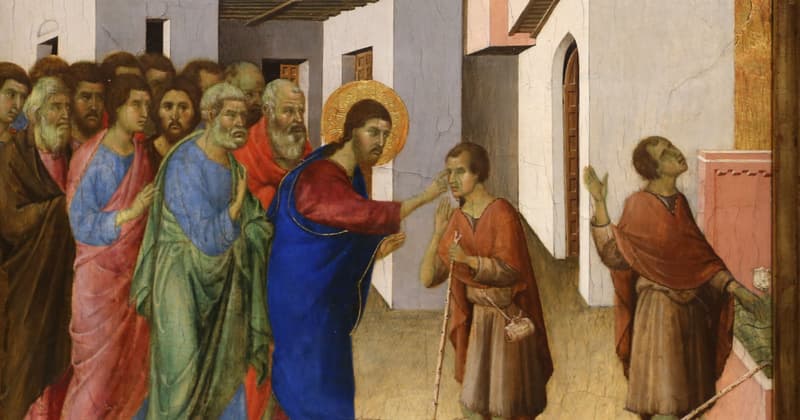
Consider the man born blind in the ninth chapter of John. The disciples ask whose sin caused it, his or his parents’. In most English translations, Jesus answers that neither sinned, but that this happened so that the works of God might be displayed in him. The suggestion, then, is that God made this man blind to show His glory later in the man’s life.
Read that again with the theology switched on. A man spends decades in darkness, begging, cut off from the temple and from ordinary life, and the explanation offered is that God arranged it as a setup. Most readers slide past the verse without noticing what they have just agreed to.
Here is the thing worth knowing. The Greek does not say “this happened.” Look at any interlinear and you will find that the words rendered “it was so that” or “this happened so that” are not in the sentence. They are supplied by the translators to make the English work. What the Greek has is a negation, then a conjunction, then a purpose particle and a verb: neither this one sinned nor his parents, but in order that the works of God might be manifested in him. The main clause that the purpose particle depends on is missing, and a translator who wants a smooth English sentence has to invent one. The KJV declines to, and so do the ASV, NKJV and ESV, leaving the gap showing.4
That is an interpretive decision, and it may well be the right one. The standard commentaries are essentially unanimous that a clause has dropped out and should be supplied—he was born blind in order that the works of God might be manifested.5 But there is at least one other way to take the Greek, in which the purpose particle carries the force of a command: “neither this one sinned nor his parents—but let the works of God be made manifest in him.” A third proposal, argued in a peer-reviewed journal article and contested in the same journal, puts the sentence break in a different place, so that the clause about the works of God belongs to what follows and the healing completes the thought.6
The difference is not small. The first reading, taken flat-footedly, has God ordaining the blindness for a purpose He would disclose later—though the commentators who read it that way have always distinguished between what God causes and what He permits and turns to good. The other two decline to explain the blindness at all and turn instead to what is about to happen.
Both of the other two readings are minority positions, and the grammar behind each is disputed. The first of them turns a purpose clause into a command, which sounds like special pleading until you see that the category is standard and that translators use it without hesitation elsewhere. In the fifth chapter of Ephesians, Paul writes a clause with no verb of commanding in it at all—just that same particle and a subjunctive—and virtually every English Bible renders it “let the wife see that she respects her husband,” or “the wife must respect her husband.” Almost nobody translates it as a purpose clause, because in that spot the purpose reading produces nonsense—Young’s Literal Translation is the only common one that does, and it shows how odd the result sounds.7
The second proposal depends on where the sentence is allowed to break, which the manuscripts cannot settle, because the earliest of them are written without word spacing and with punctuation that is sporadic at best.8 Whether either reading is available in the ninth chapter of John is a live question, and capable scholars say it is not.
For our purposes here, it doesn’t matter. The debate is the point. Two competent scholars can look at one clause and hand you two different sentences, and the English in front of you will not tell you that you are holding only one of them.
The Comma, the Capital Letter, the Quotation Mark
The same thing happens in smaller ways all through Scripture. Everything that tells you how to read a sentence—the comma, the capital letter, the quotation mark—was put there afterward by somebody other than the author.

In Luke’s account of the repentant thief, there is a great deal of difference between Jesus telling him, “Truly I tell you, today you will be with me in paradise,” and “Truly I tell you today, you will be with me in paradise.” The Greek is identical. Where the comma goes is an editorial decision, and nothing on the English page tells you one was made. It is worth saying plainly that the second reading is the minority one and that the groups who press it—Jehovah’s Witnesses above all—have a doctrinal reason to prefer it, since it removes a text that says the thief arrived in paradise that day. That does not make the punctuation question go away. It just means you should know who is arguing what, and why.9
Capital letters do the same work. Every time you see a bare “Spirit” capitalized in your Bible—with no “Holy” beside it in the Greek—a translator has judged that the word there means the Holy Spirit rather than one of its other possible meanings: a human spirit, or breath, or wind. There is no capital in the manuscripts to give it away, because the oldest of them are written entirely in capitals. In the third chapter of John it happens twice in one verse: the wind blows where it wishes, and so it is with everyone born of the Spirit. Wind and Spirit are the same word there, and the translator has rendered it two ways in a single verse to make the English work.10 Whether a word comes out as wind or as Holy Spirit can carry a good deal of a passage’s meaning with it.
No punctuation also means no quotation marks. Paul writes, in his first letter to the Corinthians, that it is good for a man not to touch a woman. Without quotation marks, that is either Paul’s own position or Paul quoting a Corinthian slogan he is about to qualify. Many modern translations print it as a quotation. Others, old and recent alike, do not. The Greek has not changed, scholars still argue about it, and what you see on the page is which side your translator came down on. The Catholic edition I read now puts the line in quotation marks and adds a footnote saying it may have been the slogan of an ascetic party at Corinth—which is honest, and which is also a translator telling you what he decided.11
This is not to say the language settles nothing. Greek is good for disposing of an interpretive scheme built by someone who does not understand it. But that work is usually reserved for readings that are technically available in the English but torture the passage to get there. A careful, educated reading of a good translation will land you in the neighborhood in the vast majority of cases. The language does not move you from wrong to right so much as it moves you closer to the man who wrote the sentence.
A Little Greek Is a Dangerous Thing
Learning that took years, and it showed me why a man who knows a little Greek is dangerous. He invests words with a significance they do not carry, because he has the vocabulary and not the culture, and he expounds insights from the Greek that are not there. I have put together a glossary of the Greek terms in John’s prologue that tries to do the honest version of this, which is mostly a matter of saying what a word does not settle.
Anyone who has sat in an evangelical pew has heard the sermon on the end of John’s gospel, where Jesus asks Peter three times whether he loves Him. The first two times, we are told, Jesus uses the lofty word for divine love and Peter answers with the humbler word for the affection between friends, and the third time Jesus comes down to where Peter is. It is a moving sermon. It is also not in the text.
The tell is what else John varies in the same three verses. He uses two different verbs for the command to feed or tend, and not in a progression—the first and third are the same word, with the odd one in the middle. He shifts the word for the flock from lambs to sheep, the first of those a diminutive, and the manuscripts cannot agree on whether he shifts to a second diminutive at the end. And in Peter’s final answer he stacks two different verbs for knowing side by side in a single breath: you know all things, you know that I love you. The lambs and the sheep get a sermon occasionally. The feeding verbs and the knowing verbs never do—and it is the knowing verbs that ought to embarrass the theory, since they sit in one clause, about one thing.12
It is a moving sermon. It is also not in the text.
John also uses the two words for love interchangeably elsewhere in the gospel, including of the same disciple and of the Father’s love for the Son. D. A. Carson, who is not a man with any Catholic axe to grind, put the objection about as well as it can be put: it is “rather strange to insist on a semantic distinction between the two words for ‘to love’ in this context, and not on small distinctions between other pairs of words in the same context.”13
A similar disease produces the sermon in which the Greek word for power is said to equate to dynamite given that dynamite comes from the same Greek word. So, the gospel is the dynamite of God unto salvation. Dynamite was patented in 1867. The derivation runs from the Greek to Nobel, not from Paul to Nobel, and Carson notes the further problem that dynamite blows things up, which is not what the power of God is doing in the passage where it appears.14 Or the one about the camel and the eye of the needle, where the needle’s eye turns out to be a low gate in the Jerusalem wall that a camel could squeeze through on its knees. There is no evidence any such gate ever existed. The earliest trace of the story is eleventh-century, and it exists to soften a hard saying about wealth.15
Think of how people today use the word “literally.” If you were fluent in English but a stranger to the culture, you might read, “I was so scared I literally jumped out of my skin,” and conclude that the speaker had separated himself from his skin and somehow survived to tell the story. That would be the correct understanding going just on the dictionary definition of the words. But, to my chagrin, people do not always use a word to mean what the dictionary says it means. Sometimes they use it to mean something near enough. Sometimes they use it to mean the opposite of what it says, as with the previous example and the way people say they could care less when they mean they could not.
I should be fair here, because the opposite error exists too. Not every disputed word is a pulpit invention. There is a long, serious argument about whether the word Paul uses in the third chapter of Romans means that Christ’s death turned away God’s wrath or that it wiped away sin—propitiation or expiation—and it has been carried on by scholars of the first rank for the better part of a century, with real arguments on both sides.16 That is not a myth. That is a hard question. Part of what an education in the languages gives you is the ability to tell the two apart.
The World Behind the Words
Knowing the language is where this begins, not where it ends. What Greek gave me over time was less the language itself than the world that produced it.
Think how much of our own speech assumes the listener knows what we know. Whisper “Redrum” to a friend after a child says something unintentionally creepy, and he knows you are referencing The Shining. A fluent English speaker in Beijing probably will not, and neither will anyone two thousand years from now working through what is left of our books. Say “you’ve got to know when to hold ’em” after a gamble fails to pay off and the line does little for someone who has never heard Kenny Rogers. Refer in passing to Skynet in an article about artificial intelligence and the reference is either everything or nothing, depending on whether the reader knows the Terminator films. Language does not live in a vacuum. It lives in a culture, and it is full of innuendo and shibboleths and allusions and inside jokes, and a man can be fluent in the words and still miss most of what they were sent to carry.
Scripture is full of that, and it takes reading outside the New Testament to hear it. Take the eleventh chapter of Hebrews, where the author runs through the heroes of the faith and arrives at people who “were tortured, refusing to accept release, so that they might rise again to a better life.” An evangelical reader hits that line and has nowhere to put it. There is no such episode in his Old Testament. The scene is in Second Maccabees—an old man named Eleazar who goes to the rack of his own accord rather than accept a staged reprieve, and seven brothers tortured to death in front of their mother, one of whom tells the king that God will raise them up to an everlasting renewal of life. The resurrection hope is precisely why they refuse the release. That is what “a better life” is pointing at, and the commentators have long agreed on it. I have written separately about how those books ended up in some Bibles and not others.17
I want to be careful here, because there is a cheap version of this observation and I am not making it. The presence of an allusion is not by itself an argument about the canon; the New Testament alludes to more than it canonizes. But something did happen to me over four years of being taught to chase down every allusion, which is that the books I had been given to work with kept turning out to be smaller than the world in which the authors were living.
The forgiveness clause of the Lord’s Prayer is a case of the same kind. “Forgive us our debts, as we also have forgiven our debtors” reads as a striking and slightly frightening piece of arithmetic until you find nearly the same thought in Sirach: forgive your neighbor the wrong he has done, and then your sins will be pardoned when you pray. The scholar who has worked that parallel hardest calls it the only very close one in early Jewish tradition.18 I was not being taught apologetics for the deuterocanon. I was being taught to read. The reading did the rest, and it took years.
It works the same way outside the Jewish material. You cannot get far with James without some familiarity with the language a moralist trained in the Greek schools would have used—the vocabulary, the stock images of the bridle and the rudder and the mirror, the idiom of the wise man who counts his trials as joy. That is a claim about language and furniture, not about James secretly being a Stoic; he is arguing from the Torah and against a good deal of what that world assumed.19 And you cannot grasp what Paul is doing with slavery and freedom without knowing something about how slavery actually worked in that world—that a slave’s identity was a matter of whose he was, so that the question was never whether a man had a master but which master he had. That is why the sixth chapter of Romans is not about being set loose. It is about a transfer.20
Knowing Greek is not winning at exegesis. It is the ticket that lets you play.
The Luther-Shaped Paul
And having the ticket forces a reevaluation of familiar readings. The Paul most of us were handed was a devout Jew worn down by a law he could not keep and terrified of a divine wrath he could not satisfy, who heard the gospel and felt the weight come off. That Paul is recognizable. He is also a closer likeness of Martin Luther than of a first-century Jew.

The observation is not mine. Krister Stendahl made it in a lecture to the American Psychological Association in 1961—he had published it in Swedish the year before—and in English two years after that, and the thing that makes his article hard to shake is that it is mostly just reading. Paul, he pointed out, does not talk like a man with a tormented conscience. He describes himself as blameless under the law and says so without embarrassment. Stendahl’s conclusion was that the Reformation read Paul through the anxieties of late medieval piety and found in him a question he had not asked.21
He is also a closer likeness of Martin Luther than of a first-century Jew.
That argument opened out into a much larger fight about justification that is still going, and I am not pretending it is settled. What is widely granted, including by Stendahl’s sharpest critics, is the narrow historical point—that the introspective conscience is a later development, and that the man in the letters does not have one. If you have the Greek but not the world behind it, that is an easy mistake to make. You can carry the words across accurately and still land them in the wrong century.
There is a smaller version of the same lesson in the text itself. The men who wrote the New Testament come through in the Greek in a way they cannot in English. They make grammatical mistakes. They misspell words. One writes plainly and another with great skill. Translation smooths out all of that, and it is worth having back, because it is the evidence that these were people writing, each in his own hand, with whatever ability and whatever quirks of personality he happened to bring to the work. You cannot fully appreciate the divine authorship of Scripture without attending to the human authorship God used.
The Text Outranks You
Through all of it, my professors left me with a rule that was simple and hard. The text outranks you. You go where the exegesis goes. A conclusion you dislike is not wrong on that account, and a conclusion you like is not right on that account either.
You find out whether you actually hold the rule when you come to a passage that says something you would rather it did not. Do you sit with it and let it work on what you brought to the text, or do you explain it away and move on? That is the difference between submitting to Scripture and making Scripture subservient to you.
The Paper I Was Uncomfortable Writing
My own test came in a paper for my Old Testament theology class. The question I chose was whether God changes His mind, which was a live debate at the time and a hot one in Southern Baptist circles in particular.22 I decided to answer it from Scripture alone, with—to the extent possible—no philosophers and no systematic theologians, ancient or modern, to push me to one position or another. That is what I had been taught to do, and what I understood the purpose of the exercise to be. I concluded that He does.
A lot of uncomfortable implications come from that answer. But it is undeniable that Scripture is full of examples of God’s changing His mind, expressing surprise, speaking of a future as though it were not settled, and regretting what He has done. And the fifteenth chapter of 1 Samuel, often cited against this view, is the sharpest case in the Bible. The Lord says He regrets making Saul king. Eighteen verses later Samuel tells Saul that the Glory of Israel does not lie or change His mind (“regret”), for He is not a man that He should change His mind (“regret”). Then, at the end of the chapter, the narrator says the Lord regretted that He had made Saul king. The same Hebrew verb, in the same stem, four times in one chapter—twice inside the single verse that denies it, and flanked by two that affirm it.23

Of course, setting 1 Samuel aside as being at best ambiguous, other passages seem to cut the other way. One of them is in the mouth of Balaam, a diviner in the business of selling curses, who lacked credibility. However, Numbers states that the words Balaam spoke were put there by God. Psalm 110 can be read to state that God does not change His mind, but it could just as easily be read that He will not change His mind in this situation. The totality of the evidence, though, appeared to point in the direction of God’s ability to change His mind.24
What unsettled me at the time, however, was not the conclusion, or even that other people had reached a different one. It was how they got there. I went looking for a classical theologian to grapple with those passages about God’s changing His mind and found mostly hand-waving. Calvin and his spiritual progeny called them accommodations—God stooping to His people the way a nurse stoops to a child—but never explained why Moses needed the accommodation but they did not.25
To be fair to Calvin, he does not leave the metaphor empty. When Scripture says God repents, what changes on his reading is the way God deals with people—the course of action itself—and not the eternal decree standing behind it. What I could not find was the limiting principle. Call a passage a metaphor and you owe the reader an account of what the metaphor points to, and then an account of why it stops where you have stopped it. If I say I am so hungry I could eat a horse, the exaggeration is pointing at something real: that I am hungry. It cannot mean I am full.
So which passages get the treatment, and on what grounds, and why did Moses need the accommodation when the men explaining it to me did not? Nobody said. They had decided in advance what God must be like and then handled the text accordingly, and they had done it while telling me the text was the final authority.
So I went where the reading led, and I wrote my senior thesis on open theism. I rejected it later, on other grounds, but the people arguing against it were no help to me at the time.
They had decided in advance what God must be like and then handled the text accordingly, and they had done it while telling me the text was the final authority.
What helped was the Fathers, and a distinction I did not have at twenty: between who God is in Himself and how He meets us. Basil put it in a sentence—that we know God from His operations, and do not undertake to approach His essence.26 The changing is real, and it is real in the history—in the dealings, the covenant, the long argument God carries on with His people. What changes is us, and what happens between us. Not God.
Years later I found that the tradition I had joined had been holding both halves the whole time, and with more precision than I had managed. Aquinas asks flatly whether the will of God is changeable, quotes Genesis on God repenting as his first objection, and answers that God wills that things should change without His will changing. The repentance language describes what God does, not an alteration in Him.27 That is not a dodge, and it is not the hand-waving I ran into at twenty, because it says what the metaphor is a metaphor for.
And the Church had done more than hold the distinction. The First Vatican Council taught it: God is one, simple and unchangeable, and all things are open and laid bare to His eyes, “even those which will be brought about by the free activity of creatures.”27 That last clause names the exact class of events open theism says God does not know. Of course, Protestants had said much the same thing long before 1870, so nobody in a Baptist college in Arkansas was going to need Vatican I for it. But if nobody there would hand me the answer, nobody there forbade me the question either.
I wrote that paper for a Baptist college’s Christian Studies department, and then the thesis, and not one of my professors told me the conclusion was off limits.
They meant it.
They taught me the languages because they believed the text would bear out their positions. They told me to follow it because they believed it led home. Both were convictions, and they acted on them at their own expense.
The wrestling did not lower my regard for Scripture. It raised it. Even when I thought people were reading it badly, bringing to it what they wanted to find, I came away holding more firmly that its authority is not up for negotiation, and that the work of getting our prejudices out of the way is worth what it costs.
What I Miss on Sunday Morning
However imperfectly it was practiced, life among the people who raised me revolved around Scripture. That was true in the churches of my childhood, true at Ouachita, and true in the evangelical settings I was part of afterward. There is an ordinary lay familiarity with the Bible in those places that I have not found in Catholic ones.
I would rather not rest that on impression, so here is the number. In the most recent Religious Landscape Study, Pew asked more than thirty-six thousand Americans how often they read Scripture outside of religious services. Fifty-one percent of evangelical Protestants said at least once a week. Among Catholics the figure was fourteen percent—one in seven. Run it the other way and it is worse: sixty-seven percent of Catholics said they seldom or never open the Bible outside of Mass, against twenty-eight percent of evangelicals.28
Two things have to be said against my own number. It measures reading outside of services, which is exactly where Catholic practice is weakest and exactly where it is not the main event: a Catholic at Mass hears an Old Testament reading, a psalm, an epistle, and a gospel, on a three-year Sunday cycle with a two-year cycle of weekday readings running alongside it—a good deal more Scripture read aloud than I heard on most Sunday mornings growing up. And these are self-reported figures, which are generous to everyone in the table. The Catholic number is also not lonely in it. Mainline Protestants come in at eighteen percent and Orthodox Christians at fifteen. The line does not fall between Catholic and Protestant. It falls between traditions that hand you the book and expect you to go home and open it, and traditions that read it to you.
Still, it’s hard to overlook the fact that few Catholics read Scripture on their own even after more than a century of the Church telling Catholics to do so. Leo XIII in 1893, Pius XII in 1943, and the Second Vatican Council in 1965, which urged all the faithful to learn the excellent knowledge of Jesus Christ by frequent reading of the Scriptures and quoted Jerome’s line that ignorance of the Scriptures is ignorance of Christ. The Church even attaches a plenary indulgence to reading Scripture devoutly for half an hour. It is difficult to imagine a stronger institutional hint.29
In six years, in more than one parish, I have not once sat in a room where people had their Bibles open and were arguing about a passage. There are good things on the parish calendar, but that is not one of them. Where I came from, I was never more than a week away from that room.
That is a real loss, and I want to be plain about it. Reading the Bible alone, apart from the community and the tradition of the Church, produces all manner of strange teaching. I watched it happen. But those people were reading their Bibles. Run-of-the-mill Catholics, in my experience, more often believe the right things without having gone to the text themselves. What the parish offers instead is formation in the faith, and that formation is steeped in Scripture. What my parishes have not offered is six weeks with one book of it. Scripture is meant to be read, turned over, applied, argued with, taken personally—and a great many Catholics never do this.
The Church gives guardrails. They keep an interpretation from running off, while leaving a great deal of room, because the Church has not defined the meaning of every verse and does not pretend to or even want to. But a fence around a field is not a reason to stay out of the field. If anything, the fence is what makes it safe to walk in.
But a fence around a field is not a reason to stay out of the field.
So this is what I miss, and I miss it on Sunday mornings. I miss the love evangelicalism has for Scripture and the plain fact that its people read the book. If more Catholics did that, inside the framework the Church provides rather than instead of it, we would be in far better shape than we are.
A Lighter Way to the Pulpit
One thing at Ouachita that did trouble me, and it troubles me still. Ouachita had a single Christian Studies major, and you chose an emphasis within it. In those years the choices were biblical studies, Christian theology, Christian missions, Christian ministry, and philosophy. I took two of them, biblical studies and Christian theology.30 Over four years I watched a split open that was not only about which courses you took but ran through the study groups and the friendships as well. The biblical studies and theology students were understood to be the academic ones, serious about the text and about history. The Christian ministry students carried the lighter load, and their courses were built around the practical, around how to preach rather than how to understand the thing being preached.
The languages were where it showed. Greek was not required by name. A language requirement was, and most of us satisfied it with Greek. The ministry students took the first year and stopped. The rest of us kept going.
One of the tracks built for men headed to pulpits was a lighter one, thereby producing, almost intentionally, two tiers of intellectual seriousness among future pastors. That is what the arrangement said, whether anyone meant it to or not. I spent some time working in churches afterward and saw what came of it. In a system whose whole foundation is that Scripture is the final authority, the work of understanding Scripture had been quietly filed as a box to be checked.
What I Was Given
None of that takes anything away from what I was given there.
The professors in biblical studies and theology at the Pruet School of Christian Studies were serious people, and they pushed me. They showed me what it is to submit to the text and to test everything against it, including what you brought to it, which is the part that costs. I have met a great many people since who say everything should be tested against Scripture and have never done the work of finding out what Scripture really says. That department was not like that. The students matched the faculty, and I came out with two emphases, a double minor in Greek and Hebrew, and a grounding in theology and biblical studies I have never stopped drawing on.
I did my graduate work later at a divinity school with a much older name and a great deal more money, and I think my time at Ouachita rivals it. What I got in Arkadelphia was not only the knowledge but the shape of a life to put it in.
I still love that place. I go back for homecoming most years. I sponsor a scholarship for students writing a thesis in the Pruet School. Most of the professors I studied under have moved on or retired, and I think about them more often than they would guess. Dr. Pate. Dr. Hays. Dr. Nykolaishen. Dr. Vang. Dr. Richards. Dr. Pemberton. And others whose names would mean nothing to you but a great deal to me.
I ended up somewhere not one of them would have chosen for me. I’ve never once wished they had taught me less. They gave me something I use every day of my life, and I have never stopped being grateful for it.
Frequently Asked Questions
Do you need to know Greek to understand the Bible?
No, and anyone who tells you otherwise is selling something. A careful, educated reading of a good translation will land you in the right neighborhood almost every time. What the language gives you is not a better answer but a truer picture of the question: it shows you the places where the English had to choose, and it lets you see how much of what you are reading is a decision somebody made on your behalf.
Does the Greek make the meaning of a passage more precise?
Usually the opposite. If the Greek said something precisely, the translators would render that precise thing. The language earns its keep exactly where it is unclear—where a clause can be construed two or three mutually exclusive ways and English, which cannot hold an ambiguity open, has to pick one.
Did God make the man in John 9 blind so that He could heal him later?
Most English translations read that way, and it may be right. But the words “this happened” are not in the Greek; translators supply a missing clause to make the sentence work in English. At least two other constructions have been proposed—one reading the purpose particle as a command, one moving the sentence break—and on either of them the sentence declines to explain the blindness at all. Both are minority positions and both are contested. The useful thing is knowing that a decision was made.
Does John 21 teach that Jesus and Peter used two different words for love?
The two verbs are there, but the sermon built on them does not hold up. John varies other things in the same three verses—two verbs for feeding the flock in an ABA pattern, a shift from lambs to sheep, and two different verbs for knowing stacked side by side in Peter’s last answer—and the last of those never gets a sermon at all. John also uses the two love-verbs interchangeably elsewhere in the gospel. D. A. Carson, among others, has made this case at length.
Do Catholics read the Bible less than evangelicals?
By the most recent Pew data, yes, and by a wide margin: 51% of evangelical Protestants read Scripture outside of religious services at least weekly, against 14% of Catholics, while 67% of Catholics say they seldom or never do. I could not verify the common claim that the Catholic share is falling—Pew changed survey methods and says this question is not comparable across waves. The gap in the current data is large enough without a trend line.
Why did a Baptist college make ministry students learn a dead language?
Because it took the doctrine seriously. If Scripture is the final authority, then knowing what Scripture says is not a specialist’s hobby, and the closest you can get to what it says is the language in which it was written. The irony I write about here is that a student headed for the pulpit could take the lighter emphasis, and many did: they took the first year of Greek and stopped.
Footnotes
1. C. Marvin Pate holds a PhD from Marquette and taught previously at Moody Bible Institute; at Ouachita he held the Elma Cobb Professorship—styled “Elma Cobb Professor of Biblical Studies” in 2009 and “Elma Cobb Professor of Christian Theology” by 2016—and chaired the Department of Theology. When Ouachita announced 40 Questions about the Historical Jesus (Kregel) in May 2015, it described the book as his twenty-fifth. See “Ouachita professor Marvin Pate releases new book” (Ouachita Baptist University, 9 May 2015).
2. William D. Mounce, Basics of Biblical Greek: Grammar (Grand Rapids: Zondervan, 1993), the colon dropped from the title in the later editions of 2003, 2009, and 2019. The publisher reports that more than 250,000 students have used it. It has been the default first-year text in evangelical colleges and seminaries for a generation.
3. The State of Tennessee v. John Thomas Scopes was tried in Dayton, Tennessee, July 10–21, 1925, under the Butler Act; Scopes was convicted and fined $100, and the Tennessee Supreme Court later set the conviction aside on a technicality. The standard account of the movement is George M. Marsden, Fundamentalism and American Culture (New York: Oxford University Press, 1980). Worth flagging, since I am describing a memory rather than endorsing it: the popular story in which Scopes humiliated fundamentalism into retreat is itself largely a later construction, assembled by Frederick Lewis Allen in 1931, hardened by Richard Hofstadter, and fixed in the public mind by the 1960 film of Inherit the Wind. Edward J. Larson, Summer for the Gods (New York: Basic Books, 1997), which won the Pulitzer Prize for History, takes the legend apart; at the time, most fundamentalists thought they had won. What I am describing is what the trial came to mean in the churches I grew up in, which is a different thing from what it did.
4. John 9:3 reads: Οὔτε οὗτος ἥμαρτεν οὔτε οἱ γονεῖς αὐτοῦ, ἀλλ’ ἵνα φανερωθῇ τὰ ἔργα τοῦ Θεοῦ ἐν αὐτῷ. There is no verb between the negation and the ἵνα clause. The KJV supplies nothing and reads “but that the works of God should be made manifest in him”; the NASB supplies “it was so that,” and the NIV supplies “this happened so that.” The supplied material is where the causal theology enters the English.
5. Vincent’s Word Studies: “There is an ellipsis: but (he was born blind) that.” The Cambridge Bible for Schools and Colleges notes that the elliptical use “is common in S. John, and illustrates his fondness for the construction expressing a purpose.” Meyer and the Pulpit Commentary argue the purpose reading directly; Bengel and the Expositor’s Greek Testament proceed on it rather than defend it. See the collected commentaries on John 9:3.
6. John C. Poirier, “‘Day and Night’ and the Punctuation of John 9.3,” New Testament Studies 42, no. 2 (April 1996): 288–94, arguing that repositioning the punctuation attaches the clause about the works of God to what follows. Hugo Mendez reached the opposite conclusion in the same journal—“‘Night’ and ‘Day’ in John 9.4–5: A Reassessment,” New Testament Studies 61, no. 4 (2015): 468–81—though not as a reply: Mendez argues independently that John 9.4–5 parallels 12.35–6, and disposes of the repunctuation in a single footnote, on the ground that it would leave v. 5 stranded.
7. Ephesians 5:33b: ἡ δὲ γυνὴ ἵνα φοβῆται τὸν ἄνδρα. The ESV renders it “let the wife see that she respects her husband”; the NASB, “the wife must see to it that she respects her husband”; the NIV and NET, “the wife must respect her husband.” 2 Corinthians 8:7 works the same way. James L. Boyer treats both as the standard examples of the construction and suggests they may be ellipses of an easily supplied imperative; A. T. Robertson and Nigel Turner discuss it as well. I should not overstate the unanimity: Young’s Literal Translation renders Ephesians 5:33 as a purpose clause, and Margaret Sim has argued for a deontic rather than imperatival analysis, so even sympathetic linguists do not simply sign off on the category. One parallel often offered here is weaker than it looks. In Mark 5:23 Jairus begs Jesus to come and lay hands on his daughter, and translators render that ἵνα clause as a request rather than a purpose. It is suggestive, and Robertson does class it as imperatival. But the verse has a governing verb of entreaty, so a critic can fairly say the imperatival force comes from “he begged him” and the clause is simply the content of the request. Ephesians 5:33 has no such verb, which is why it is the better parallel to John 9:3.
8. The earliest New Testament papyri are written in scriptio continua, without word spacing. Punctuation is not absent altogether—P46, P66, and P75 all show scattered dots—but its use is sporadic and unsystematic, and Vaticanus and Sinaiticus remain largely unpunctuated by modern standards. In P46 the structure signals are “not as plentiful and systematically deployed as in later manuscripts”: a few high dots at clause-level sense breaks, and two dicola in the entire codex. Even in P75 the punctuation “takes the form of high, medial and low points, but if any rationale governs the different heights it is difficult to discern.” Sinaiticus carries only the occasional medial point or dicolon, Vaticanus “very occasionally a high point.” Edgar Battad Ebojo, “A Scribe and His Manuscript: An Investigation into the Scribal Habits of Papyrus 46 (P. Chester Beatty II – P. Mich. Inv. 6238)” (PhD diss., University of Birmingham, 2014), 169–71; S. D. Charlesworth, “Public and Private—Second- and Third-Century Gospel Manuscripts,” Buried History 42 (2006): 25–36, at 28 and 36 n. 138. The practical upshot is unchanged: the punctuation in your Bible is an editorial tradition, not part of the text.
9. Luke 23:43. The disputed word is σήμερον, which sits between “I say to you” and “you will be with me.” P75, the earliest surviving manuscript to preserve this part of Luke, has no punctuation around it. The New World Translation of Jehovah’s Witnesses punctuates it “I tell you today,” and the reading has also been defended in Seventh-day Adventist publications; in both cases a doctrine of the intermediate state is doing some of the work. Against it stands the weight of the Fathers, who read the thief as entering paradise that day. Jerome’s Latin runs amen dico tibi hodie mecum eris in paradiso, as unpunctuated as the Greek and carrying the identical ambiguity—but the printed Latin tradition made the same choice the English did. The Clementine Vulgate prints “Amen dico tibi : Hodie mecum eris in paradiso,” putting the break before hodie; the Stuttgart edition, following the manuscripts, sets the text per cola et commata and supplies no punctuation at all. I have seen it argued that the formula “truly I say to you” never takes an adverb of time elsewhere in the Gospels. I have now counted, and it does not hold as an absolute: Mark 14:30 puts “today” inside the very clause the formula introduces. The older and better argument is not distributional but rhetorical—the formula introduces what follows rather than closing what precedes, so attaching hodie to “I say” drains it, in Plummer’s phrase, of “almost all its force.” Luke’s own usage at 22:34 sets the pattern. Alfred Plummer, A Critical and Exegetical Commentary on the Gospel According to S. Luke, ICC (Edinburgh: T. & T. Clark, 1896), 535.
10. John 3:8: τὸ πνεῦμα ὅπου θέλει πνεῖ … οὕτως ἐστὶν πᾶς ὁ γεγεννημένος ἐκ τοῦ Πνεύματος. Same noun twice, rendered “wind” and then “Spirit”; the verb translated “blows” is cognate with it. Two editorial judgments are stacked here, not one, since the capital is also supplied—the oldest manuscripts are written entirely in majuscule.
11. First Corinthians 7:1. The NIV, ESV, CSB, NET, and NRSVue print the clause as a quotation; the KJV, NKJV, ASV, NASB, and NLT do not. The NABRE reads: “Now in regard to the matters about which you wrote: ‘It is a good thing for a man not to touch a woman,’” and its footnote says the phrase “may have been the slogan of the ascetic party at Corinth.” Whether Paul is quoting the Corinthians here is genuinely disputed, and the broader practice of identifying slogans in this letter has itself been challenged in the journal literature.
12. John 21:15–17. The commands are βόσκε (v. 15), ποίμαινε (v. 16), and βόσκε again (v. 17)—so the pattern is ABA, and no escalation story can be told about it at all. The word for the flock shifts too: ἀρνία (“lambs”) at v. 15, πρόβατα (“sheep”) at vv. 16–17 in the modern critical text and in the Byzantine text alike, though Westcott–Hort and Nestle 1904 print προβάτια at both verses—which is what a reader checking BibleHub will see. ἀρνία is itself a diminutive, and a body of witnesses reads the further diminutive προβάτια—Tischendorf prints it at both vv. 16 and 17, Tregelles at v. 17. And in v. 17 Peter says πάντα σὺ οἶδας, σὺ γινώσκεις—two verbs for knowing in one clause, about one thing. Carson counts the variation the same way, printing “sheep” at both vv. 16 and 17. Note also that the narrator attributes Peter’s grief to Jesus asking a third time, not to a change of verb.
13. D. A. Carson, “Word-Study Fallacies,” in Exegetical Fallacies. Carson is careful to frame his argument as refuting a bad case rather than closing the question, and I follow him in that. C. K. Barrett rejects the distinction as well, arguing from the parallel usage at John 14:23 and 16:27. For the interchangeable use elsewhere in the gospel, compare John 13:23 with 20:2 (the beloved disciple, both verbs) and John 3:35 with 5:20 (the Father’s love for the Son, both verbs).
14. Carson, Exegetical Fallacies, on Romans 1:16: “I do not know how many times I have heard preachers offer some such rendering of Romans 1:16 as this: ‘I am not ashamed of the gospel, for it is the dynamite of God unto salvation for everyone who believes.’” He calls it “a kind of reverse etymology, the root fallacy compounded by anachronism,” and adds that dynamite “blows things up, tears things down, rips out rock, gouges holes, destroys things,” which is not the work Paul has in view. Alfred Nobel patented dynamite in 1867.
15. The “needle’s eye gate” has no ancient attestation. The earliest trace is an eleventh-century comment quoted later in Aquinas; there is no archaeological or documentary evidence of such a gate in Jerusalem. On the provenance see Agnieszka Ziemińska, “The Origin of the ‘Needle’s Eye Gate’ Myth: Theophylact or Anselm?” New Testament Studies 68 (2022): 358–61, which traces it to a gloss attributed to Anselm of Canterbury and preserved in Aquinas’s Catena aurea, and disposes along the way of the common claim that it comes from Theophylact. The companion softening—that the word for camel should be read as a similar word meaning “rope”—is no better, the supposed word being a late invention. Both exist to take the edge off a hard saying about wealth.
16. The word is ἱλαστήριον at Romans 3:25. C. H. Dodd argued in 1931 that the biblical sense is expiation rather than propitiation; Leon Morris and Roger Nicole challenged him from the 1950s onward. Nico S. L. Fryer’s survey concludes that Dodd “overstated his case” and that “the case for finding the idea of propitiation in the context of Rom. 3:25 is indeed a strong one,” while himself favoring a typological reading pointing to the mercy seat. See Fryer, “The Meaning and Translation of Hilasterion in Romans 3:25,” The Evangelical Quarterly 59, no. 2 (1987): 99–116. The point for my purposes is that this is a real dispute among serious people, which is exactly what the dynamite sermon is not.
17. Hebrews 11:35. Meyer, the Cambridge Bible, Ellicott, Jamieson-Fausset-Brown, and the Pulpit Commentary all identify the allusion as 2 Maccabees 6–7: Eleazar, who “welcoming death with honor rather than life with pollution, went up to the rack of his own accord” (2 Macc 6:19 NRSV), and the seven brothers, one of whom tells the king that “the King of the universe will raise us up to an everlasting renewal of life” (7:9 NRSV). The resurrection hope is the stated reason for refusing release, which is what makes it the natural referent for the “better life” of Hebrews 11:35b.
18. Sirach 28:2 (NRSV): “Forgive your neighbor the wrong he has done, and then your sins will be pardoned when you pray.” Compare Matthew 6:12 and 6:14–15. Sirach 28:1–7 as a unit is the better comparison than the single verse. Isaac Kahwa Mbabazi calls Sirach 28:1–4 “the only very close early Jewish parallel” to the reciprocity Matthew sets up, and the only explicit Septuagint text stating interpersonal forgiveness as a condition—though he is careful to add that conditionality itself, “although very rare in the Hebrew Bible,” is “not absent from Jewish thought.” Isaac Kahwa Mbabazi, The Significance of Interpersonal Forgiveness in the Gospel of Matthew (Eugene, OR: Pickwick, 2013), 35, 141–42. The underlying proposal is David J. Reimer’s: “The Apocrypha and Biblical Theology: The Case of Interpersonal Forgiveness,” in After the Exile: Essays in Honour of Rex Mason, ed. John Barton and David J. Reimer (Macon, GA: Mercer University Press, 1996), 259–82, at 277–79.
19. Matt A. Jackson-McCabe, Logos and Law in the Letter of James: The Law of Nature, the Law of Moses, and the Law of Freedom (Supplements to Novum Testamentum 100; Leiden: Brill, 2001), makes the book-length case for reading James’s “implanted word” and “law of freedom” against Stoic natural-law categories. Dale Allison notes markers of a classical education in the letter’s vocabulary and idiom, and Luke Timothy Johnson catalogues the thematic parallels—joy in testing, true wealth and freedom as virtue, friendship with God, the mirror, the bridle and the rudder. Johnson also insists on James’s deeper disagreement with Greco-Roman ethics and concludes that the letter is at home in a world shaped by Torah. Whether the parallels amount to influence or only to shared Hellenistic idiom is genuinely disputed; I am claiming the weaker and better-supported thing.
20. I have deliberately not leaned on the older explanation here. Adolf Deissmann proposed in Licht vom Osten (Tübingen, 1908; English as Light from the Ancient East, 1910) that Paul’s redemption language draws on the sacral manumission recorded in the manumission inscriptions at Delphi, in which a slave’s price was deposited at the temple and the slave notionally sold to the god. Deissmann himself gives no count, saying only that the French archaeologists had published “a vast number” of them; the roughly 1,300 usually quoted is a modern estimate, not his. It is a marvelous theory and it has not held up especially well: S. Scott Bartchy questioned the manumission background itself (First-Century Slavery and 1 Corinthians 7:21, SBLDS 11 [Atlanta: Society of Biblical Literature, 1973], 121–24), and John Byron (Slavery Metaphors in Early Judaism and Pauline Christianity, WUNT 2/162 [Tübingen: Mohr Siebeck, 2003], 203–5, 211–20) and James Dunn (The Theology of Paul the Apostle [Grand Rapids: Eerdmans, 1998], 226–27) read Romans 6 as a contrast not between slavery and freedom but between service to two masters, which points to the exodus rather than to Delphi. Dunn is the more cautious of the two: he allows the Delphic parallel as a relevant consideration and calls the exodus the stronger influence rather than the only one. That reading is the one I find persuasive, and it makes the underlying point better anyway. One boundary on that, because the theory travels better elsewhere than it does here: what I am declining to lean on is the Delphic background for Romans 6. I take it to be the right background for 1 Corinthians 6:12–20, where Paul uses the manumission inscriptions’ own word for the slave eight times in nine verses—in a passage about sexual sin, where the fleshier word would be the natural one—reproduces their “with a price” formula at 6:20, and leans on the Greek prohibition against re-enslaving a freed slave when he says he will not be mastered by anyone. The standard objection, that in a sacred manumission the slave supplied his own purchase money and the god’s ownership was a legal fiction, is the thing Paul inverts rather than a defeater: the Corinthians did not pay, and the God who bought them is no idol standing in as a fictional third party, so their manumission is not a fiction and they are not free to sell themselves back. I argued the case at length in “Greek Sacred Manumissions and the Writings of Paul” (seminar paper, Yale University, 2020).
21. Krister Stendahl, “The Apostle Paul and the Introspective Conscience of the West,” Harvard Theological Review 56, no. 3 (1963): 199–215, a revised version of “Paulus och Samvetet,” Svensk Exegetisk Årsbok 25 (1960): 62–77; the lecture was the invited address to the American Psychological Association on 3 September 1961. Stendahl finds Paul “equipped with what in our eyes must be called a rather ‘robust’ conscience,” and writes that “it is exactly at that point that we can discern the most drastic difference between Luther and Paul, between the 16th and the 1st century…” The article opened out into the New Perspective on Paul—E. P. Sanders (1977), James Dunn, N. T. Wright—and drew heavy return fire, notably from D. A. Carson, Peter O’Brien, and Mark Seifrid, eds., Justification and Variegated Nomism (2001, 2004), and Stephen Westerholm, Perspectives Old and New on Paul (2004). The theological argument about justification remains very much live. The narrower historical observation about Paul’s conscience is widely granted, including by critics of the rest.
22. The open theism controversy ran roughly from Clark Pinnock and others, The Openness of God (1994), through John Sanders, The God Who Risks (1998), and Gregory Boyd, God of the Possible (2000), to Bruce Ware’s God’s Lesser Glory (2000) and Beyond the Bounds (2003)—edited by John Piper, Justin Taylor and Paul K. Helseth, with Ware among the contributors—on the other side. The Southern Baptist Convention’s Baptist Faith and Message 2000 added language specifying that God’s perfect knowledge extends to “the future decisions of His free creatures.” In November 2003 the Evangelical Theological Society voted on expelling Pinnock and Sanders; both were retained, the motion against Sanders drawing 388 votes to 231—62.7 per cent, short of the required two-thirds. Baptist Press reported the margin as twenty-seven votes, which does not reconcile with that tally unless abstentions are counted in the denominator. One detail that gets garbled in the retelling: the charges were formally about inerrancy, not foreknowledge, and the society’s own reporting noted that open theism as such was not what the vote was on.
23. The verb is נחם (nāḥam), and it appears four times in 1 Samuel 15, all in the Niphal: v. 11 (“I regret that I have made Saul king”), twice in v. 29 (NASB: “will not lie or change His mind; for He is not a man that He should change His mind”), and v. 35 (“the LORD regretted that he had made Saul king”). Same root, same stem, no lexical escape hatch. The classical solution is to read vv. 11 and 35 as anthropopathic and v. 29 as the literal theology; the Cambridge Bible puts it as the historian speaking after the manner of men while the prophet speaks as befits the nature of God. Worth noticing about the voices: vv. 11 and 35 are the narrator’s, while v. 29 is Samuel speaking to Saul in the middle of refusing him.
24. Numbers 23:19, spoken in Balaam’s second oracle. Scripture is hard on Balaam—Numbers 31:16, Joshua 13:22 (“the one who practiced divination”), 2 Peter 2:15–16, Jude 11, Revelation 2:14—but Numbers is equally clear that the oracles were not his: “The word that God puts in my mouth, that must I speak” (22:38); “the LORD put a word in Balaam’s mouth” (23:5); “the Spirit of God came upon him” (24:2). Nor are these the only denials. Psalm 110:4 uses the identical Niphal form found in 1 Samuel 15:29 and is quoted at Hebrews 7:21 for the permanence of Christ’s priesthood; Jeremiah 4:28 and Ezekiel 24:14 belong in the same set. And Aquinas cites Numbers 23:19 as the sed contra in ST I, q. 19, a. 7. One further caution I owe the reader: the verb in Numbers 23:19 is Hithpael, not the Niphal of 1 Samuel 15, so “the same Hebrew word” is exactly right within 1 Samuel 15 and needs the qualifier across books.
25. John Calvin, Institutes of the Christian Religion I.13.1 (Beveridge): “For who is so devoid of intellect as not to understand that God, in so speaking, lisps with us as nurses are wont to do with little children? Such modes of expression, therefore, do not so much express what kind of a being God is, as accommodate the knowledge of him to our feebleness.” That passage is aimed at those who read Scripture’s language about God’s hands and eyes literally; Calvin applies the same principle to divine repentance at Institutes I.17.12–13, where he names both Genesis 6:6 and 1 Samuel 15:11 and resolves them by 1 Samuel 15:29, and in his commentary on Genesis 6:6: “The repentance which is here ascribed to God does not properly belong to him, but has reference to our understanding of him.” The image is older than Calvin, running back through Chrysostom’s synkatabasis. The seminal modern study is Ford Lewis Battles, “God Was Accommodating Himself to Human Capacity,” Interpretation 31, no. 1 (January 1977): 19–38.
26. Basil, Letter 234.1, in the NPNF translation: “The operations are various, and the essence simple, but we say that we know our God from His operations, but do not undertake to approach near to His essence.” NPNF renders ἐνέργειαι as “operations”; readers who go looking for the word “energies” will not find it there. I am using Basil for the modest and uncontroversial point—that God is known in His dealings with us and not comprehended in His essence—and not for the later and much-argued Palamite distinction between the divine essence and the divine energies, which Catholics and Orthodox have contested since the fourteenth century and which the Catholic Church has neither defined nor condemned. Nothing in my argument requires taking a side in that quarrel, and it is worth adding that no one on either side of it holds that God is ignorant of anything: for Palamas the energies are uncreated and eternal and involve no change in God whatever.
27. Thomas Aquinas, Summa Theologiae I, q. 19, a. 7 (“Whether the will of God is changeable?”). There are four objections; the first two are Genesis 6:7 and Jeremiah 18:7–8. The answer is that “the will of God is entirely unchangeable,” on the distinction that willing that things should change is not the same as the will itself changing. The reply to the first objection is that the repentance language is metaphorical and describes God’s actions rather than an alteration in His will. See also ST I, q. 9, on divine immutability. The conciliar text is Vatican I, Dei Filius (Session 3, 24 April 1870), ch. 1, quoted here in Tanner’s translation: God is “one, singular, completely simple and unchangeable spiritual substance,” and “all things are open and laid bare to his eyes, even those which will be brought about by the free activity of creatures”—the sentence that closes the chapter, echoing Hebrews 4:13. Worth stating precisely: this is the constitution’s own doctrinal text, not a canon. The five canons attached to chapter 1 condemn atheism, materialism, pantheism, emanationism and the denial of creation ex nihilo; none attaches an anathema to the denial of God’s knowledge of future free acts. Nor does the passage adjudicate how God knows them, which is the Bañez–Molina quarrel and remains open. The point is not peculiarly Catholic, and I should not imply it was. The Lutheran Formula of Concord (1577) separates foreknowledge from election outright—“the foreknowledge of God is nothing else than that God knows all things before they happen,” extending “alike over the godly and the wicked, but it is not the cause of evil”—and the Westminster Confession (1646) says that in God’s sight “all things are open and manifest…so as nothing is to him contingent, or uncertain,” citing the same Hebrews 4:13 that Dei Filius cites. The Second London Baptist Confession of 1689, the one nearest to hand where I was sitting, carries the Westminster language almost verbatim. Formula of Concord, Epitome XI.2–3; Westminster Confession 2.2 (American text); Second London Baptist Confession 2.2. One caution: Westminster 3.2 is the section usually quoted here, and it is about the decree rather than foreknowledge—the foreknowledge clause in it is concessive.
28. Pew Research Center, Religious Landscape Study, conducted 17 July 2023 to 4 March 2024 among 36,908 U.S. adults (field dates and sample size per the study’s methodology statement). Respondents were asked how often they “read scripture outside of religious services.” Reading at least weekly: all U.S. adults 22%, Protestants 41%, evangelical Protestants 51%, historically Black Protestant tradition 46%, mainline Protestants 18%, Catholics 14%, Orthodox Christians 15%, Latter-day Saints 59%. Answering “seldom or never”: evangelical Protestants 28%, Catholics 67%. A reader following the link should know that the chapter page states the national figure (22% weekly, 61% seldom or never) and the three highest-reading traditions in prose; the full breakdown by tradition is in the accompanying chart and the study’s interactive database.
29. On whether these numbers are falling: Pew states that it does not have valid trend data for most of the practice questions in the 2023–24 study, because some were asked for the first time and others “cannot be compared with previous surveys because of changes in methodology or question wording”—the study moved from telephone interviewing to online and paper. The scripture-reading item is among those flagged as not comparable. Daily prayer, which is comparable, has fallen fourteen points nationally since 2007, with statistically significant declines among Catholics; that is a different measure and I am not substituting it for the one I wanted. On the documentary trail: Leo XIII, Providentissimus Deus (1893); Benedict XV, Spiritus Paraclitus (1920); Pius XII, Divino Afflante Spiritu (1943); and Vatican II, Dei Verbum (1965), §25, which “earnestly and especially urges all the Christian faithful, especially Religious, to learn by frequent reading of the divine Scriptures the ‘excellent knowledge of Jesus Christ’” and quotes Jerome: “For ignorance of the Scriptures is ignorance of Christ.” The indulgence is Grant 30 of the Manual of Indulgences (Washington, DC: USCCB, 2006), translating the Enchiridion Indulgentiarum, 4th ed. (1999): a plenary indulgence for reading Sacred Scripture devoutly for at least half an hour, partial for less.
30. Formally the Chesley and Elizabeth Pruet School of Christian Studies. The single-major-with-emphases structure has been continuous, but the emphases have been consolidated since I was there; Ouachita now lists four, with biblical studies and theology merged into one department. Marvin Pate was chairing a distinct Department of Theology as late as 2015, and Preben Vang chaired it before him through roughly the end of my time in Arkadelphia.

Garrett Ham
Garrett Ham is an attorney, military veteran, and holds a Master of Divinity from Yale Divinity School. He writes from Northwest Arkansas on theology, law, and service.
Related Posts

The Faith of My Fathers
A Catholic convert's gratitude for the Southern Baptist faith that raised him—the Bible under his arm, the casseroles, the cost, the hymn verse he never sang.
Errors in Scripture and Biblical Authority
Do contradictions undermine biblical authority? A Catholic look at inerrancy, Dei Verbum § 11, and reading Scripture for the truth it teaches for our salvation.
The Apologist Who Believed Too Much
A sophomore apologetics assignment on Justin Martyr's First Apology cost me the church I was raised in. What chapter 66 says about the Eucharist.
Stay Informed
Get new writing on faith, law, and service delivered to your inbox.
No spam. Unsubscribe anytime.