The Deuterocanonical Books: What They Are, Where They Came From, and Why Christians Disagree About Them
On This Page
Wisdom 2 is a chapter most Protestants have never read. The New American Bible, Revised Edition footnote at Wisdom 2:12–20 is candid: “The description of the ‘righteous one’ in 2:12–20 seems to undergird the New Testament passion narrative.”1 Wisdom 2:12–20: “Let us lie in wait for the righteous one, because he is annoying to us… He professes to have knowledge of God and styles himself a child of the Lord… For if the righteous one is the son of God, God will help him and deliver him from the hand of his foes.”2 Compare Matthew 27. The Sanhedrin’s mockery at the cross: “He trusted in God; let him deliver him now, if he wants him. For he said, ‘I am the Son of God.’”3
Read together, one passage is reading the other. Read separately, the verbal density of the cross-mockery becomes inexplicable.
What is clear is that the writers of the New Testament knew and referenced the deuterocanonical books often. This essay will explore what the deuterocanonical books are, where they came from, why Catholics and Orthodox accept them, and why Protestants do not. It is written from inside the Catholic tradition, but it is written for the Protestant reader who is willing to hear the case stated carefully. The Protestant objection is not silly, and any Catholic apologetic that treats it as such is unworthy of either side.
I will argue four things.
First, that there was no fixed, settled “Jewish canon” in the first century for the apostolic Church to inherit—a scholarly consensus that has hardened decisively since 1964 and that most Protestant readers have not encountered.
Second, that the deuterocanonical books were received, quoted, preached, and prayed by the Church from the sub-apostolic period onward—not added by Trent in 1546—and that the dogmatic boundary the Council of Florence drew in 1442 alone refutes the “Trent invented this” narrative.
Third, that the case for the historic Catholic and Orthodox canon is best made not by minimizing the Protestant objection but by stating it at its strongest—Jerome’s Prologus Galeatus, Athanasius’ middle tier, Cardinal Cajetan’s pre-Trent dissent—and then showing why the historic Church’s reception still wins on the merits.
Fourth, that the modern anglophone Protestant Bible-with-exactly-sixty-six-books is not a Reformation settlement at all. It is a creation of 1826, the year the British and Foreign Bible Society resolved to stop subsidizing Apocrypha-bearing editions. The 1611 King James Version contained the deuterocanonical books between the Testaments, and Archbishop George Abbot threatened a year’s imprisonment in 1615 for any printer who issued a Bible without them. Most contemporary Protestants do not know this. It changes the conversation.
This is a long essay, because the question deserves length. If you are short on time, the Key Takeaways below are the shape of the argument. If you have an hour, the body of the essay walks through the historical record carefully. Either way, my hope is that you finish this with a clearer picture of what the disagreement is actually about—and a more accurate sense of what the historical record actually says.
A note on method. I have tried to follow the principle of steel-manning throughout. Where Protestants object, I cite Westminster, the 39 Articles, Luther’s Leipzig debate of 1519, Calvin’s Antidote to the Council of Trent (1547), and the modern scholarship of Roger Beckwith and John Meade—not weak internet apologists. Where Catholics teach, I cite primary conciliar texts (Hippo, Carthage, Innocent I, Florence, Trent) and the magisterial documents themselves rather than popular polemic. Where the historical record is contested, I say so. Where the Protestant has the better immediate argument, I say so. The goal is not to win. The goal is to put the strongest case alongside the strongest objections and let the reader weigh them.
What the deuterocanonical books are
The word deuterocanonical means “second canon”—but this is one of the most misunderstood pieces of vocabulary in the whole debate, and it deserves a moment of patience. The Italian theologian Sixtus of Siena (1520–1569) coined the term in his Bibliotheca Sancta (Venice, 1566) to distinguish books whose canonical status had been undisputed from the apostolic age (the protocanonical books—Genesis, Isaiah, the Psalms, the Gospels) from books whose canonical status had been contested in some quarters before being formally received (the deuterocanonical books—Tobit, Judith, Wisdom, Sirach, Baruch, 1–2 Maccabees, and the Greek additions to Daniel and Esther).4
The “second” is chronological-historical, not theological. A deuterocanonical book is not a “lesser” or “second-class” book. The Catholic Church teaches that Sirach is just as inspired as Isaiah and that 2 Maccabees is just as canonical as 2 Kings. The “deutero-” prefix records the historical fact that Christian reception of these books took longer to be everywhere uncontested—not that they sit on a lower theological tier than the rest of Scripture.
The seven books, with the briefest of introductions:
Tobit is a diaspora-era novella of Jewish piety set in eighth-century BC Nineveh. It tells the story of the blind Tobit, his son Tobiah, the demon Asmodeus, the angel Raphael, and the woman Sarah. It contains the proto–Golden Rule (“Do to no one what you yourself hate,” Tobit 4:15) and one of the most beautiful nuptial prayers in all of Scripture (Tobit 8:5–8). Aramaic and Hebrew fragments of Tobit (4Q196, 4Q197, 4Q198, 4Q199 in Aramaic; 4Q200 in Hebrew) were recovered at Qumran, demonstrating that the book was used in a Jewish sectarian community in the second-temple period.5
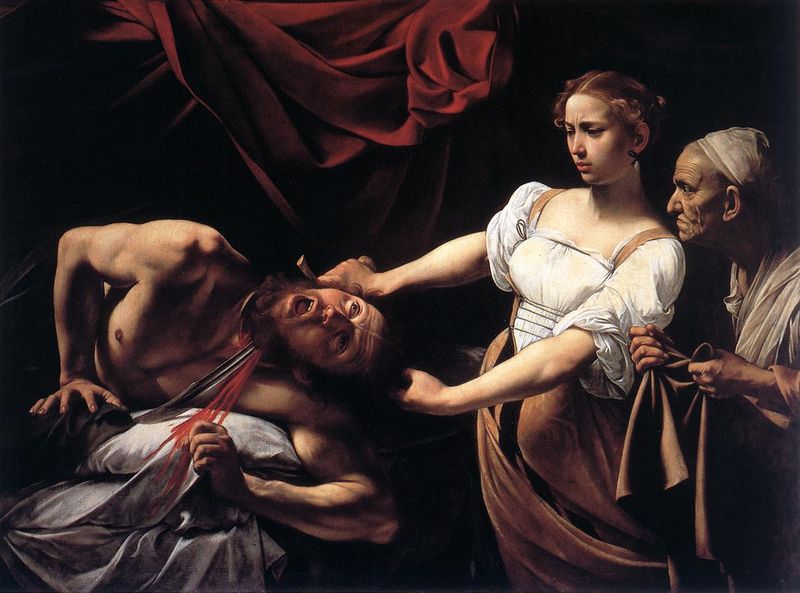
Judith is a hagiographic novel of Israelite resistance under a fictional siege. The opening line—“Nebuchadnezzar, who ruled over the Assyrians in the great city of Nineveh”—is, as the New American Bible footnote candidly puts it, “an invention of the author.”6 Judith operates in the genre of Esther and Daniel: theological narrative, not historical reportage. The widow Judith’s beheading of the Assyrian general Holofernes is one of the great set-pieces of biblical iconography (Caravaggio, Artemisia Gentileschi, Donatello, Klimt).
Wisdom of Solomon is a Greek-language wisdom treatise composed in Alexandria, probably in the first century BC. Its theology is the most explicitly developed in the Old Testament: the suffering righteous one whom God will vindicate (chapters 2–5), the personification of Wisdom as the breath of God’s might and the spotless mirror of his power (chapter 7), the philosophical critique of idolatry (chapters 13–15). The Greek word apaugasma—“radiance, refulgence”—appears in Wisdom 7:26 and reappears once and only once in the New Testament, at Hebrews 1:3.7
Sirach (Ecclesiasticus) is a Jewish wisdom book composed in Hebrew by Jesus ben Sira around 180 BC and translated into Greek by his grandson around 132 BC. It is the longest of the deuterocanonicals—fifty-one chapters of moral counsel, prayer, hymnic praise, and reflection on the saints of Israel. Sirach 24’s portrait of personified Wisdom tabernacling in Jacob (“In Jacob make your dwelling, in Israel your inheritance”) is reflected in the Johannine Logos and in John 1:14’s verb eskēnōsen (“dwelt,” literally “tabernacled”) among us.8
Baruch, with the Letter of Jeremiah appended in Catholic Bibles as chapter 6, is a short pseudepigraphic work attributed to Jeremiah’s secretary. Baruch 3:36–38 (“Such is our God; no other is to be compared to him… she has appeared on earth, is at home with mortals”) was read Christologically in the Latin tradition, where the Vulgate’s post haec in terris visus est, et cum hominibus conversatus est—“afterwards he was seen on earth, and conversed with men”—invited the reading directly.
1 Maccabees is a sober, almost military-historical account of the Maccabean revolt against Antiochus IV Epiphanes (167–134 BC). It is the only sustained narrative of the period before Jewish independence. 2 Maccabees is a different work—a theologized, miracle-rich abridgement of an earlier five-volume work by Jason of Cyrene. It is 2 Maccabees that contains the martyrdom of the seven brothers and their mother (chapter 7), Judas Maccabeus’ prayer and sin offering for the fallen dead (12:38–46), and the vision of Onias and Jeremiah interceding for the people (15:11–16).
The Greek additions to Daniel are three: the Prayer of Azariah and the Song of the Three Young Men (Daniel 3:24–90), Susanna (Daniel 13), and Bel and the Dragon (Daniel 14). The Song of the Three Young Men—the Benedicite, omnia opera Domini, “Bless the Lord, all you works of the Lord”—is one of the great canticles of Christian worship, sung at Sunday Lauds in the Roman Liturgy of the Hours and printed as Canticles 1 and 12 in the 1979 Book of Common Prayer.9
The Greek additions to Esther include six expansions and additions that fill in the prayers and providential reasoning that the Hebrew Esther leaves implicit. They include Mordecai’s prayer, Esther’s prayer, the king’s edicts, and the dream of Mordecai.
Together these seven works (counting Baruch + the Letter of Jeremiah as one and counting both sets of Greek additions as parts of the books they belong to) form the Catholic deuterocanon. The Eastern Orthodox canon adds 1 Esdras, 3 Maccabees, the Prayer of Manasseh, and Psalm 151; the Ethiopian Tewahedo canon adds Enoch, Jubilees, and the Meqabyan; the Slavonic adds 4 Ezra (sometimes called 2 Esdras). The peripheral variations between the apostolic communions are real, and we will get to them. But the seven Catholic deuterocanonicals are the core that Catholic, Eastern Orthodox, and Oriental Orthodox communions hold in common.
The Protestant objection at its strongest
A Catholic post on the deuterocanonicals that does not begin by stating the Protestant case fairly is not worth reading. Here is the case at its strongest, made the way the most thoughtful Protestants make it.
First, the New Testament never cites the deuterocanonicals with a scriptural-introduction formula. The New Testament’s standard formulae for introducing inspired Scripture—gegraptai (“it is written”), legei hē graphē (“the Scripture says”), kathōs eirēken (“as he has said”)—are attached to passages from Genesis, Isaiah, the Psalms, the Twelve (the Minor Prophets, treated as a single book in Hebrew tradition), and the rest of the Hebrew protocanon. They are never formally attached to Tobit, Judith, Wisdom, Sirach, Baruch, or Maccabees. If the apostolic community had regarded these books as Scripture on par with Isaiah, the Protestant argument runs, we should expect at least one unambiguous gegraptai. We do not get one. The argument from absence has its limits, but it carries weight when the comparison class is books regularly cited with scriptural-introduction formulae.
Second, the rabbinic Jewish canon does not include them. Paul writes in Romans 3:2 that “the Jews were entrusted with the utterances of God.” If the Jews—the original trustees of the Old Testament—did not canonize Tobit and Judith and Maccabees, on what authority does the Gentile Church do so? This is the argument from covenantal continuity, and it is more substantive than Catholic apologists usually grant.
Third, the Fathers were divided. Melito of Sardis, the earliest Christian to enumerate the Old Testament (c. 170, preserved in Eusebius), gives a Hebrew-aligned twenty-two-book list and pointedly omits Tobit, Judith, Wisdom, Sirach, Baruch, and Maccabees.10 Origen, the greatest biblical scholar of the third century, supplied a twenty-two-book Hebrew-aligned list in his Commentary on Psalm 1 (preserved in Eusebius, Historia Ecclesiastica 6.25.1–2) and explicitly placed Maccabees outside the count: exō de toutōn estin ta Makkabaika, “and besides these there are the Maccabees” (though Origen’s Jeremiah entry quietly absorbs the deuterocanonical Letter of Jeremiah inside Jeremiah).11 Athanasius, in his Festal Letter 39 of AD 367, classified Wisdom, Sirach, Esther, Judith, and Tobit (alongside the Didache and the Shepherd of Hermas) as books “to be read” (anaginōskomena) by catechumens but not canonical—though even his canonical Old Testament tier omits Esther and includes Baruch with the Letter of Jeremiah, so his middle tier ends up containing a protocanonical book alongside the deuterocanonicals.12
Cyril of Jerusalem in his Catechetical Lectures gave a twenty-two-book list (though, like Origen’s, his Jeremiah entry includes Baruch and the Letter of Jeremiah inside it—the “Hebrew” count is structurally Hebrew-aligned but materially contains deuterocanonical material). And Jerome—the greatest Western biblical scholar of the patristic age, the translator of the Vulgate—wrote in his Prologus Galeatus that “whatever is outside of these is set aside among the apocrypha. Therefore, Wisdom, which is commonly ascribed to Solomon, and the book of Jesus son of Sirach, and Judith and Tobias, and the Shepherd are not in the canon.”13 If the most rigorous patristic voices excluded these books, the Protestant argument runs, the burden of proof is on the side that includes them.
Fourth, the Council of Trent looks reactionary. Trent dogmatically defined the canon under anathema in April 1546—twelve years after Luther’s 1534 German Bible relegated the deuterocanonicals to an inter-testamental section, and twenty-seven years after Luther’s 1519 Leipzig debate with Johann Eck rejected 2 Maccabees as a basis for purgatory. Even sympathetic Catholics had been hesitant. Cardinal Thomas Cajetan, the most formidable Catholic theologian of the early sixteenth century and Luther’s interlocutor at Augsburg in 1518, wrote in his 1532 Commentary on the Historical Books of the Old Testament (In omnes authenticos Veteris Testamenti historiales libros Commentarii) that the deuterocanonicals are “not canonical, that is, not in the nature of a rule for confirming matters of faith” while remaining “canonical… in the nature of a rule for the edification of the faithful.”14
Cardinal Francisco Jiménez de Cisneros, in the Complutensian Polyglot (printed 1514–17, papal sanction 1520), treated the deuterocanonicals with manifest care but acknowledged Jerome’s reservations. Erasmus—whose 1516 Greek New Testament made the Reformation philologically possible—registered the same reservations. If the universal Latin Church had truly held a settled view, why was pre-Trent Catholic opinion itself divided?
Fifth, the deuterocanonicals contain historical and theological errors. Tobit’s genealogy of Assyrian kings is wrong: Sennacherib was not Shalmaneser’s son.15 Judith opens with “Nebuchadnezzar, who ruled over the Assyrians”—Nebuchadnezzar was a Babylonian.16 2 Maccabees 2 has Jeremiah hiding the Ark in a cave. The doctrine of prayer for the dead and atoning sacrifice for the fallen at 2 Maccabees 12:43–46 is, the Protestant argues, exactly the kind of theological position that should not be smuggled in via books the Jews themselves did not canonize.
I will respond to each of these, in order, in a later section. Some of them I will concede in part. None of them, taken in their full scope, defeats the Catholic position. But they all have to be felt at their full weight first. A Catholic apologetic that does not feel them at their full weight is not seriously engaging with the Protestant tradition.
Second Temple Judaism didn’t hand the Church a closed canon
The argument from “the Jews were the trustees” only works if there was a settled Jewish canon for the apostolic Church to inherit. The argument has been losing ground in scholarship for sixty years.
The classical Protestant picture, formed in the nineteenth century and crystallized in Roger Beckwith’s The Old Testament Canon of the New Testament Church (Eerdmans, 1985), runs roughly as follows: the Jewish canon was closed by the late second century BC; the rabbis gathered at Jamnia (Jabneh) around AD 90 ratified the closed Hebrew canon of twenty-two or twenty-four books; this rabbinic canon was the canon Jesus and the apostles inherited; the wider Greek “Alexandrian canon” was a Diaspora deviation that Christians—to their detriment—followed instead of the Palestinian standard.
This picture is no longer tenable. The dismantling began in 1964 with two independent works.
Albert Sundberg’s Harvard dissertation, published as The Old Testament of the Early Church (Harvard University Press, 1964), demolished the “Alexandrian canon” hypothesis. Sundberg showed that there is no pre-Christian evidence for a distinct, closed “Alexandrian canon” different from a “Palestinian canon”; the alleged Alexandrian list is a modern reconstruction projected backward from later Christian Septuagint codices. There was no closed Jewish canon—Alexandrian or Palestinian—for the early Church to “follow.” There was a wider, more fluid collection of Hellenistic Jewish scriptures, and the early Church received them.17
The same year, Jack P. Lewis published “What Do We Mean by Jabneh?” in the Journal of Bible and Religion 32.2 (1964): 125–132. Lewis showed that the modern “Council of Jamnia” thesis—first proposed by Heinrich Graetz in 1871—was a scholarly construct without rabbinic-source basis. There was no “Council of Jamnia” in any meaningful sense. There were rabbinic discussions at Yavneh in the late first and early second century AD about whether certain books “defile the hands” (a technical term for sacred status), but these were not a canon-closing council. The rabbis did not “decide” the Hebrew canon at Jamnia. The Hebrew canon took its definitive shape gradually over a longer period, and the term “Council of Jamnia” should be retired.18
The Dead Sea Scroll discoveries from 1947 onward sealed the picture. Qumran preserved Hebrew, Aramaic, and Greek manuscripts of what later became canonical, deuterocanonical, and non-canonical literature side by side in a single Jewish sectarian library. The Qumran community used Tobit (in Aramaic and Hebrew, as 4Q196–200), Sirach (in Hebrew, as 2Q18 and 11QPsa), Jubilees, Enoch, the Aramaic Levi document, and many other works alongside Genesis and Isaiah. There was no neat closed canon to be Jewish about.
The current scholarly consensus is articulated by Timothy Lim in The Formation of the Jewish Canon (Yale University Press, 2013): “throughout the post-exilic period up to around 100 CE there was not one official ‘canon’ accepted by all Jews; rather, there existed a plurality of collections of scriptures.”19 Edmon Gallagher and John Meade—and Meade is a Protestant evangelical scholar of impeccable credentials—published The Biblical Canon Lists from Early Christianity (Oxford University Press, 2017), a ~360-page sourcebook collecting and analyzing the major Jewish and Christian canon lists of the first four centuries, demonstrating definitively that the early-Christian canon was a process, not an event.20
This matters. The Protestant argument that “the Church inherited the Jewish canon” assumes a settled Jewish canon that the historical record will not supply. The apostolic Church inherited a wider, more fluid collection of Greek scriptures that included most of what Catholics now call the deuterocanon—and the rabbinic standardization of the Hebrew Bible on a narrower list took definitive shape after the Christian Church was already in possession of its own.
The Catholic and Orthodox position is not that the Church “added” books to a settled Jewish canon. The Catholic and Orthodox position is that the Church received a Hellenistic Jewish heritage that was wider than the later rabbinic standard, and discerned over the first four centuries which of those books bore the Spirit’s witness. The Reformers’ decision to align Christian Old Testaments with the later Masoretic Hebrew canon was a sixteenth-century change—not a return to a primitive standard.
The Reformers’ decision to align Christian Old Testaments with the later Masoretic Hebrew canon was a sixteenth-century change—not a return to a primitive standard.
The Septuagint was plural, not singular
The corollary to the dissolution of the “fixed Jewish canon” thesis is the dissolution of the “fixed Septuagint” thesis. There was no single Septuagint codex floating around the Roman Empire that the apostolic Church could simply inherit.
The “Septuagint”—the Greek translation of the Hebrew Scriptures—was produced over centuries (the Pentateuch in the third century BC, the Prophets later, the Writings later still) by different translators of different competence with different aims. By the first century AD, what we call “the Septuagint” was a family of related Greek texts circulating in Hellenistic Jewish communities and increasingly in Christian ones. The great Christian-era codices that preserve our earliest complete Greek Old Testaments—Vaticanus (fourth century), Sinaiticus (fourth century), Alexandrinus (fifth century)—do not contain the same secondary books. Sinaiticus has 4 Maccabees; Vaticanus does not. Alexandrinus has 3 and 4 Maccabees; Sinaiticus has 4 only. The Psalms of Solomon appear in Alexandrinus’ table of contents but not in Sinaiticus or Vaticanus. The plurality of the manuscript tradition is not a footnote. It is the texture of the actual evidence.
What this means for the Catholic-vs-Protestant question: when the New Testament writers cite “Scripture,” they cite a wider, more fluid Greek collection—not a fixed canonical list. Of the approximately 300 Old Testament quotations in the New Testament, at least two-thirds follow the Septuagint rather than what would later become the Masoretic Hebrew text—and on some specialist accountings the proportion runs substantially higher.21 Hebrews 1:6 quotes Deuteronomy 32:43 in a form preserved in the Septuagint and Qumran but not in the Masoretic—a worship-line tradition the Hebrew text lacks. Acts 7:14 quotes the Septuagint number for those who went down with Jacob to Egypt (seventy-five) rather than the Hebrew (seventy). Romans 3:10–18 is a catena Paul composed (or inherited) drawing on Ps 14:1–3, Ps 5:9, Ps 140:3, Ps 10:7, Isa 59:7–8, and Ps 36:1; the long form of LXX Psalm 13(14):3 that agrees verbatim with Romans 3:13–18 is a secondary Christian gloss copied into LXX Psalter manuscripts from Romans, which is why Rahlfs brackets it as non-original.21
The apostolic Church was already living inside the Greek Old Testament when it began to write the New Testament. To insist now that Christians must align their Old Testament with the later rabbinic Hebrew is to insist on a standard the apostles did not use.
The deuterocanon inside the New Testament
Here the Protestant objection—that the deuterocanonicals are never quoted with a gegraptai formula—has to be taken seriously and then taken further than it usually is.
The objection is correct. The New Testament does not introduce Tobit or Wisdom or 2 Maccabees with “it is written.” But the standard does not self-apply. The New Testament also does not introduce Esther, Ecclesiastes, Song of Songs, Ezra, Nehemiah, Obadiah, or Nahum with “it is written.” If formal citation formula were the canonicity test, half the Hebrew protocanon would fail it. No Protestant draws that conclusion. The reason is that the New Testament’s relationship to the Old is a matter of saturation, allusion, and atmosphere—not just direct citation.
When you read the New Testament with the deuterocanonicals open beside it, the saturation is unmistakable. A partial inventory:
Hebrews 11:35
“Others were tortured and would not accept deliverance, in order to obtain a better resurrection.” There is no plausible Old Testament source for this except 2 Maccabees 6–7 (and the parallel retelling in 4 Maccabees 5–18)—the martyrdom of Eleazar, the mother, and seven sons, who refuse to renounce the Law under torture and explicitly look forward to a “better resurrection.” Hebrews 11:35b is a clear allusion to that Maccabean cycle: it shares the anast- root of resurrection-from-martyrdom (Hebrews’ noun ἀνάστασις paired with 2 Maccabees 7:9’s verb ἀναστήσει), the τυμπανίζω torture vocabulary that 2 Maccabees 6:19, 28 also uses, and the explicit refusal of offered release for fidelity (2 Maccabees 6:21–22; 7:24). The author of Hebrews is preaching a sermon on the heroes of faith and includes the Maccabean martyrs in the catalogue. He treats them as heroes of biblical faith, not as a borderline case.
Hebrews 1:3
“Who is the refulgence of his glory, the very imprint of his being.” The Greek noun apaugasma—“radiance, refulgence”—is a New Testament hapax legomenon. It appears once in the New Testament, here. It appears once in the Septuagint Old Testament, at Wisdom 7:26: “For she is the reflection of eternal light, the spotless mirror of the power of God.” A word that occurs nowhere else in the Greek New Testament and only at Wisdom 7:26 in the Greek Old Testament makes Hebrews’ lexical dependence on Wisdom of Solomon virtually certain. The author of Hebrews is, at the very opening of his sermon on Christ’s superiority, reaching into Wisdom of Solomon for the language to describe the Son.
Matthew 27:41–43
The Sanhedrin’s mockery at the cross: “He trusted in God; let him deliver him now, if he wants him. For he said, ‘I am the Son of God.’” The verbal echo of Wisdom 2:17–20—“Let us see if his words be true… For if the righteous one is the son of God, God will help him and deliver him from the hand of his foes”—is so close that the NABRE footnote at Wisdom 2 simply concedes it: “The description of the ‘righteous one’ in 2:12–20 seems to undergird the New Testament passion narrative.”
Romans 1:19–32
Paul’s famous diatribe against pagan idolatry—“what can be known about God is evident to them, because God made it evident to them”—runs extensive verbal and conceptual parallels to Wisdom 11–15. Paul is not just sharing a tradition with Wisdom; he is thinking through Wisdom’s argument as he writes Romans. Romans 1:23’s “exchanged the glory of the immortal God for the likeness of an image of mortal man, and of birds, and of four-legged animals, and of reptiles” echoes Psalm 106:20 (“they exchanged their glory for the image of an ox that eats grass”) and pulls its animal taxonomy from Genesis 1; the broader anti-idolatry argument of Romans 1:18–32 thinks through the same logic developed at length in Wisdom 11–15—especially Wisdom 13:1–9 (idolatry from creation gone wrong) and Wisdom 14:12–27 (idolatry leading to moral collapse).
James 1:13
“No one experiencing temptation should say, ‘I am being tempted by God’; for God is not subject to temptation to evil.” Compare Sirach 15:11–14: “Do not say, ‘It was God’s doing that I fell away’… It was he who created humankind in the beginning, and he left them in the power of their own free choice.”
The Nestle–Aland 28th edition of the Greek New Testament—the standard scholarly text—prints, in its Loci Citati vel Allegati apparatus at the back of every volume, a dedicated subsection of Old Testament citations and allusions to the deuterocanonical books. The list runs to several hundred entries. This is not Catholic apologetic; it is the consensus instrument of New Testament textual scholarship, edited by an international committee of mostly Protestant scholars, recording what every careful reader of the New Testament eventually notices: the apostolic community was saturated in the deuterocanonical literature.
The absence of a gegraptai formula does not mean the apostles ignored these books. It means they used them differently than they used Isaiah and the Psalms. They alluded, echoed, and breathed the air of Wisdom and 2 Maccabees and Sirach. The Protestant reader who has read Hebrews without noticing the deuterocanonicals has not read Hebrews carefully enough.
The Protestant reader who has read Hebrews without noticing the deuterocanonicals has not read Hebrews carefully enough.
The Fathers, taken seriously
The Protestant argument that “the Fathers were divided” deserves the same fair statement the modern scholarship deserves. The patristic record really is plural. The most rigorous voices really did exclude the deuterocanonicals. Athanasius’ middle tier really exists. Jerome really did write the Prologus Galeatus.
What the Protestant argument tends to omit is that this same patristic plurality includes a much larger body of voices that received the deuterocanonicals as Scripture, plus the structural fact that the rigorous voices themselves did not act on their own classifications.
The earliest Christian writers cite the deuterocanonicals as Scripture. The First Epistle of Clement of Rome (c. AD 96), one of the earliest sub-apostolic writings, cites Wisdom and Judith with the same gravity it cites Psalms and Genesis. Clement appeals to Judith and Esther in tandem at 1 Clement 55, holding both up as exemplars of faithful Israelite women. Cyprian of Carthage’s Ad Quirinum (Testimonies, third century) cites Wisdom 2:12 ff. as Christological prophecy.22 Hippolytus of Rome’s Commentary on Daniel (c. 202–211)—the earliest complete extant Christian biblical commentary—comments on Susanna alongside the rest of Daniel without distinction, treating Susanna typologically as the Church persecuted by false elders.23
Origen, who in his Commentary on Psalm 1 listed twenty-two Hebrew-aligned books, defended Susanna and Tobit and Judith at length in his Letter to Africanus (c. 240): “the History of Susanna, which is found in every Church of Christ in that Greek copy which the Greeks use, but is not in the Hebrew… Tobias (as also Judith), we ought to notice, the Jews do not use… However, since the Churches use Tobias…”24
Origen is the perfect test case. The same Origen who, when listing the canon Hebrews-style, places Maccabees outside the twenty-two, is the Origen who when faced with Africanus’ argument that Susanna should be excluded responds with a detailed defense of ecclesial reception—and who quotes Wisdom, Sirach, Tobit, Judith, Baruch, and the additions to Daniel as graphē throughout his homilies and commentaries.
This is the pattern Edmon Gallagher calls the “list-vs.-practice tension” in the patristic record. Many of the Fathers operated a dual standard: when arguing with Jews, who appealed to the Hebrew, they listed the Hebrew canon for polemical purposes; when preaching, praying, and writing for Christians, they used the wider Greek collection.25 Athanasius, who in Festal Letter 39 (367) classified Wisdom and Sirach in the anaginōskomena tier “to be read” by catechumens, quotes Wisdom and Sirach as Scripture freely in his other works. Athanasius’ middle tier is a pedagogical category, not a rejection.
Athanasius’ middle tier is a pedagogical category, not a rejection.
The Western Latin Fathers were less ambivalent. Augustine in De Doctrina Christiana 2.8.13 (AD 397) lays out a positive rule for canonicity—prefer books “received by all the catholic churches”—and enumerates a canon that includes Tobit, Judith, both books of Maccabees, Wisdom, and Sirach among the prophetical books “since they have attained recognition as being authoritative.”26 The contrast between Jerome’s polemical Prologus Galeatus and Augustine’s pastoral De Doctrina is the contrast that defined the Latin West’s settlement of the question—and Augustine, not Jerome, won institutionally.
Jerome’s complicated witness
Because Jerome is the patron saint of the Protestant case on the deuterocanon, he deserves a section of his own. The honest reading of Jerome is more complicated than either side typically allows.
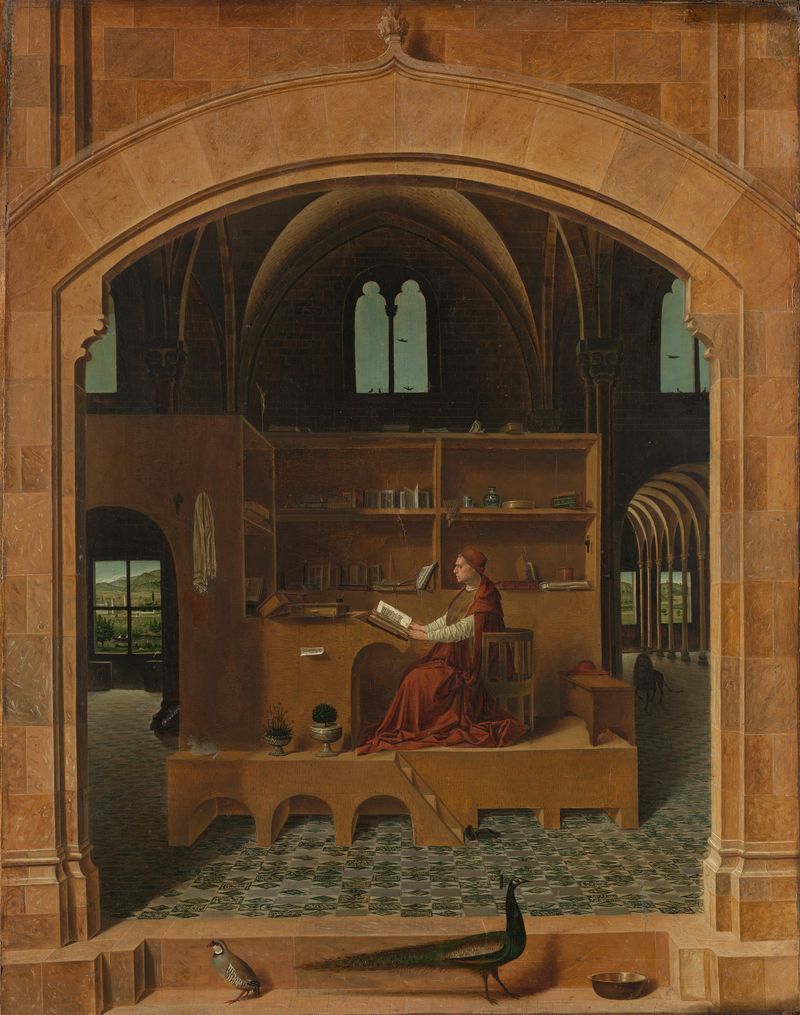
Jerome’s Prologus Galeatus—the “Helmeted Prologue” prefacing his Vulgate translation of Samuel and Kings, c. 391–392—is the single most-quoted patristic text on the Protestant side of the canon debate. In it Jerome enumerates a twenty-two-book Hebrew Old Testament corresponding to the twenty-two letters of the Hebrew alphabet and writes: “whatever is outside of these is set aside among the apocrypha. Therefore, Wisdom, which is commonly ascribed to Solomon, and the book of Jesus son of Sirach, and Judith and Tobias, and the Shepherd are not in the canon.”27
The preface to the books of Solomon (c. 398) draws the libri canonici / libri ecclesiastici distinction explicitly: Jerome groups Judith, Tobit, and Maccabees as books “the Church reads but does not receive among the canonical Scriptures,” then applies the same logic to Wisdom and Sirach (the immediate subject of the Solomon preface): they are read “for the strengthening of the people, not for confirming the authority of ecclesiastical dogmas.”28 The Daniel preface (c. 393) consigns Susanna, the Song of the Three Youths, and Bel and the Dragon to the category of “apocryphal fables.”
If that were the whole of Jerome’s witness, the Protestant case would be straightforward, but it is not the whole of Jerome’s witness.
The same Jerome who consigned Tobit and Judith to the apocrypha translated both books anew into Latin from Aramaic at the request of his episcopal patrons—and in his preface to Judith, he appealed to the alleged reception of Judith by the First Council of Nicaea: “the Council of Nicaea is read to have computed this book among the number of sacred Scriptures.”29 The claim cannot be corroborated from the surviving Nicene acts; whether Jerome had access to a now-lost source or whether he was over-reaching is debated, but his pastoral move is unmistakable. He translated the book because the Church received it, even though his own Prologus Galeatus would have him exclude it.
The same Jerome quotes Sirach, Baruch, and Wisdom as Scripture across his letters and commentaries. In Against Rufinus 2.33 he defends his use of Theodotion’s expanded Greek Daniel—the version with Susanna, Bel, and the Song of the Three—by appealing to “the judgment of the churches”: “What sin have I committed in following the judgment of the churches?”30
The leading modern Jerome scholar, Edmon Gallagher, summarizes the verdict in Hebrew Scripture in Patristic Biblical Theory (Brill, 2012): “Jerome’s scriptural citations are not a reliable guide for determining the books he would list as belonging to the canon.”31 Megan Hale Williams’ The Monk and the Book (Chicago, 2006) traces Jerome’s Hebraica veritas as a polemical scholarly posture constructed across decades against detractors—not a settled doctrinal position.32 Jerome’s prologues are the polemic of a working scholar defending his Hebrew translation project against a Septuagint-loving Latin Church. They are not the dispassionate canon judgment a Protestant reader needs them to be.
And the institutional point is decisive. Jerome did not “remove” the deuterocanonicals from the Vulgate. He translated Tobit and Judith anew from Aramaic. Sirach, Wisdom, Baruch, and 1–2 Maccabees passed through into the Vulgate untouched in their Old Latin form. Every medieval Vulgate manuscript transmits these books integrated into the Old Testament with Jerome’s prefaces attached. The Gutenberg Bible—the first printed Bible, 1455—includes them. The Latin Church for a thousand years read the deuterocanonicals as Scripture inside Vulgate codices that also carried Jerome’s reservations as paratext. Cardinal Cajetan’s 1532 harmonization—“not canonical, that is, not in the nature of a rule for confirming matters of faith” yet “canonical… in the nature of a rule for the edification of the faithful”—is the medieval Latin settlement: read them, preach from them, pray them, but do not establish dogma from them alone.
The Protestant reading of Jerome is not wrong about Jerome’s prologues. It is wrong about what Jerome did with the books in practice and what the Latin Church did with Jerome’s prologues.
The Protestant reading of Jerome is not wrong about Jerome’s prologues. It is wrong about what Jerome did with the books in practice.
The Western consensus settles
While the Greek East continued reading the wider Septuagint without major debate, the Latin West settled the canon question between 393 and 405 in a sequence of regional councils ratified by Rome.
The Council of Hippo, 8 October 393, was the first regional African synod to enumerate the canon. Its acts do not survive intact, but its canon list is preserved in the Breviarium Hipponense drawn up at Carthage in 397 and edited in modern critical form by Charles Munier in Corpus Christianorum Series Latina 149.33 The Council of Carthage of 397, Canon 36, gave the explicit list: “Genesis, Exodus, Leviticus, Numbers, Deuteronomy, Joshua, Judges, Ruth, four books of Kings, two books of Chronicles, Job, the Davidic Psalter, the five books of Solomon [Proverbs, Ecclesiastes, Song of Songs, Wisdom, Sirach], the twelve books of the Prophets, Isaiah, Jeremiah, Ezekiel, Daniel, Tobit, Judith, Esther, two books of Esdras, two books of Maccabees.”34 Carthage 419, Canon 24, re-promulgated this list and asked that the transmarine Church (Rome) be consulted for confirmation.
Pope Innocent I provided the Roman confirmation. His letter to Exsuperius of Toulouse, Consulenti tibi, dated February 405, gives the first securely datable papal canon list. Innocent enumerates “Moses, that is, the five books… and the four books of Kings, with Ruth; sixteen books of Prophets; five of Solomon; the Psalms; likewise of histories, the book of Job, of Tobit, of Esther, of Judith, of the Maccabees two, of Esdras two, the Chronicles two.”35 Tobit, Judith, the Maccabees, and the five Solomonic books—the deuterocanon—are inside the list. Innocent’s letter is the single earliest papal canon listing whose authenticity and date are not in dispute.
A note on what this list is not. The so-called Decretum Gelasianum, sometimes invoked in Catholic apologetic literature as a “canon list of Pope Damasus from the Council of Rome 382,” should be retired from this conversation. Ernst von Dobschütz demonstrated definitively in his 1912 critical edition (Das Decretum Gelasianum de libris recipiendis et non recipiendis) that the document is pseudonymous, composed in the early sixth century—not a Damasine decree of 382. Catholic apologists who appeal to it embarrass their case. The genuine evidence is strong enough on its own.
What the Latin West had by 405 was a canon list that included the deuterocanonicals, agreed by African regional synods and ratified by Roman papal letter. That canon list was the Bible of the Latin medieval Church for the next thousand years—the Bible Aquinas read, the Bible Bonaventure read, the Bible from which Aquinas’ Summa Theologiae I, q. 41, a. 3, obj. 4 cites Sirach 24:5 (= Sir 24:3 NRSV/NABRE) in the Vulgate’s voice of “begotten Wisdom,” and from which the posthumous Supplementum’s appendix on purgatory cites 2 Maccabees 12:46 in its Vulgate/Douay-Rheims wording—“It is a holy and wholesome thought to pray for the dead, that they may be loosed from sins”—as Scripture.36
A minority Jeromist current ran alongside this consensus throughout the medieval period. Hugh of St. Victor’s Didascalicon IV.2 (c. 1130) preserved Jerome’s reservations in the schools: sunt praeterea alii quidam libri, ut Sapientia Salomonis, liber Iesu filii Sirach, et liber Iudith, et Tobias, et libri Machabaeorum, qui leguntur quidem, sed non scribuntur in canone—“there are besides certain other books, like the Wisdom of Solomon, the book of Jesus son of Sirach, and the book of Judith, and Tobit, and the books of the Maccabees, which are indeed read, but are not written in the canon.”37
Nicholas of Lyra’s Postilla litteralis, the dominant late-medieval commentary on Scripture and an instrument heavily used by Luther, prefaced his treatment of Tobit, Judith, and Wisdom with the formula “here begins the book of… which is not in the canon” and declined to draw demonstrative arguments from them. The Glossa Ordinaria—the standard medieval marginal commentary on the Vulgate—transmitted Jerome’s prefatory classifications as paratext on glossed Vulgate codices that otherwise treated the deuterocanonicals as Scripture.
The medieval Latin position, then, was a nuanced one: the books are received as Scripture, read in the liturgy, preached from in homilies, used to ground doctrine—but the Jeromist scruple is preserved as a learned minority position in the schools. This is the inheritance Cajetan codified in 1532 with his libri canonici / libri ecclesiastici distinction. It is the inheritance Trent will dogmatically resolve in 1546.
Theological goldmines
Before Florence and Trent, a section on what is actually in these books—because the case for their canonicity is not just historical. It is also that they are theologically rich in ways the Protestant Bible is poorer for missing.
Wisdom 2 and the passion
Wisdom 2:12–20 is the most sustained pre-Christian portrait of the suffering righteous one as a son of God: “He professes to have knowledge of God and styles himself a child of the Lord… For if the righteous one is the son of God, God will help him and deliver him from the hand of his foes. With violence and torture let us put him to the test that we may have proof of his gentleness and try his patience.” This is the script the Sanhedrin reads at the cross in Matthew 27. Without Wisdom 2, the verbal density of the passion narrative’s mockery becomes inexplicable.
Wisdom 7 and the Logos
Wisdom 7:25–26 personifies Wisdom as “a breath of the might of God… the reflection of eternal light, the spotless mirror of the power of God, the image of his goodness.” Hebrews 1:3 reaches into this language to describe the Son: “who is the refulgence (apaugasma) of his glory, the very imprint (charaktēr) of his being.” Apaugasma—a New Testament hapax legomenon—appears in the entire Greek Old Testament only at Wisdom 7:26. Charaktēr (also a New Testament hapax) draws on the broader Hellenistic-Philonic theological lexicon, where Philo applies it to the divine Logos (Det. Pot. Ins. 83; Plant. 18). The combined effect of pairing two rare lexemes from Wisdom-tradition Christology in one verse makes Hebrews’ literary dependence on Hellenistic Jewish wisdom literature—Wisdom of Solomon foremost—virtually certain.
Sirach 24 and John’s Logos
Sirach 24’s description of personified Wisdom dwelling in Jacob—“From the mouth of the Most High I came forth… Then the Creator of all gave me his command, and my Creator chose the spot for my tent. He said, ‘In Jacob make your dwelling, in Israel your inheritance’“—is a direct background to the Johannine Logos hymn, where the Word “made his dwelling among us” (eskēnōsen, “tabernacled,” John 1:14). The patristic exegesis that read Sirach 24 alongside Proverbs 8 and John 1 was not eccentric Catholic flight of fancy. It was the obvious reading.
2 Maccabees 12 and prayer for the dead
Judas Maccabeus collects a sin offering after his soldiers have fallen in battle wearing pagan amulets. He sends the offering to Jerusalem to atone for the dead. The author concludes: “In doing this he acted in a very excellent and noble way, inasmuch as he had the resurrection in mind; for if he were not expecting the fallen to rise again, it would have been superfluous and foolish to pray for the dead… Thus he made atonement for the dead that they might be absolved from their sin” (2 Maccabees 12:43–46).38
This is the only sustained Old Testament locus for the doctrine of prayer for the dead—a doctrine attested in the early Christian liturgical record, in Tertullian’s De Corona (c. 211), and in Augustine’s City of God 21.13. To remove 2 Maccabees from the canon is, in effect, to remove the explicit Old Testament warrant for a practice the Church has never not done.
Baruch 3:36–38 and the Incarnation
Baruch’s hymn opens by praising God (“Such is our God; no other is to be compared to him”), then names Wisdom as the divine gift bestowed on Israel and continues: “Thus [Wisdom] has appeared on earth, is at home with mortals.” The NABRE makes the subject of v. 38 feminine because Hebrew ḥokmah and Greek sophia are grammatically feminine. The Vulgate reads post haec in terris visus est, et cum hominibus conversatus est—“afterwards he was seen on earth, and conversed with men”—which Latin Christian readers from Augustine forward heard as a prophecy of the Incarnation. Augustine cites Baruch 3:36–38 among the Old Testament prophecies of Christ’s coming in City of God 18.33—and like other Latin Fathers whose Bibles bound Baruch with Jeremiah, Augustine attributes the passage to Jeremiah, not Baruch.39
The Benedicite
Daniel 3:57–88—the Song of the Three Young Men in the fiery furnace, “Bless the Lord, all you works of the Lord”—is among the most-prayed Christian canticles. It is sung at Sunday Lauds Weeks I and III in the Roman Liturgy of the Hours, with the related Daniel 3:52–57 (the Benedictus es) at Sunday Lauds Weeks II and IV. The Benedicite is printed as Canticle 1 (Rite I Morning Prayer) and Canticle 12 (Rite II) in the 1979 Book of Common Prayer.40 Pope John Paul II’s General Audience of 2 May 2001 was a sustained reflection on the Benedictus es (Daniel 3:52–57) and its place in Christian worship.41 Anglican Christians who pray Morning Prayer using the BCP are praying a deuterocanonical text—usually without realizing it.
Susanna
Daniel 13—the story of the falsely-accused Susanna and the young Daniel’s discernment of the elders’ contradictory testimony—is the First Reading at Mass on Monday of the Fifth Week of Lent in the Roman Lectionary.42 Hippolytus of Rome treated Susanna typologically as the Church persecuted by false witnesses. The story has shaped Christian art and conscience for two millennia.
Sirach 3 and the Holy Family
Sirach 3:2–6, 12–14—“Whoever honors his father atones for sins, and whoever reveres his mother is like one who lays up treasure”—is the First Reading on the Feast of the Holy Family of Jesus, Mary, and Joseph in the Roman Lectionary, Year A.43
These are not random texts the Church happens to read. They are theologically load-bearing passages around which Catholic and Orthodox piety, Christology, and liturgy have been constructed. To excise them is not to “purify” the Bible. It is to amputate large parts of how the historic Church has read Scripture together.
Florence 1442—four decades before Luther, a century before Trent
The single fact that does the most damage to the Protestant “Trent invented this in 1546” narrative is Florence 1442. A century before the Council of Trent met, the Council of Florence—the seventeenth ecumenical council of the Catholic Church on the standard counting—issued the Bull of Union with the Copts, Cantate Domino, on 4 February 1442 under Pope Eugene IV.
The bull was not primarily about the canon. It was about reunion with the Coptic Church and the resolution of Christological and ecclesiological differences inherited from the fifth-century rupture. But in setting out the faith the reunited communion would profess, the bull enumerated the canonical Scriptures the Church holds. The Old Testament list runs: “the five books of Moses, namely Genesis, Exodus, Leviticus, Numbers, Deuteronomy; Joshua, Judges, Ruth, four books of Kings, two of Paralipomenon, Esdras, Nehemiah, Tobit, Judith, Esther, Job, Psalms of David, Proverbs, Ecclesiastes, Song of Songs, Wisdom, Ecclesiasticus, Isaiah, Jeremiah, Baruch, Ezekiel, Daniel, the twelve minor prophets—Hosea, Joel, Amos, Obadiah, Jonah, Micah, Nahum, Habakkuk, Zephaniah, Haggai, Zechariah, Malachi—two books of the Maccabees.”44
The grammar of the bull’s reception is suscipit et veneratur—“receives and venerates.” The bull does not invent or define a new canon. It enumerates the canon the Church holds, in a public ecumenical context, with the binding authority of an act of reunion. Tobit, Judith, Wisdom, Sirach, Baruch, and 1–2 Maccabees are all inside the list. The verb is the same one Trent will use a century later: Florence 1442 suscipit, Trent 1546 suscipit ac veneratur—the same receptive grammar, 104 years apart.
This is the fact that, by itself, refutes the claim that the Council of Trent “added the deuterocanonicals to the Bible in 1546 in reaction to Luther.” Four decades before Luther was born—and a full century before Trent—the universal Catholic Church through the Council of Florence had already enumerated those books as canonical, in a binding ecumenical instrument issued for the express purpose of reunion with another apostolic communion. Trent’s 1546 decree did not “add” books. It dogmatically defined under anathema what Florence had already received and what Hippo, Carthage, and Innocent I had already enumerated more than a thousand years earlier.
Reformation rejections—and pre-Trent Catholic dissent
With Florence 1442 in view, the Reformers’ decision to contract the Old Testament has to be understood as exactly that: a contraction, not a return to a primitive standard.
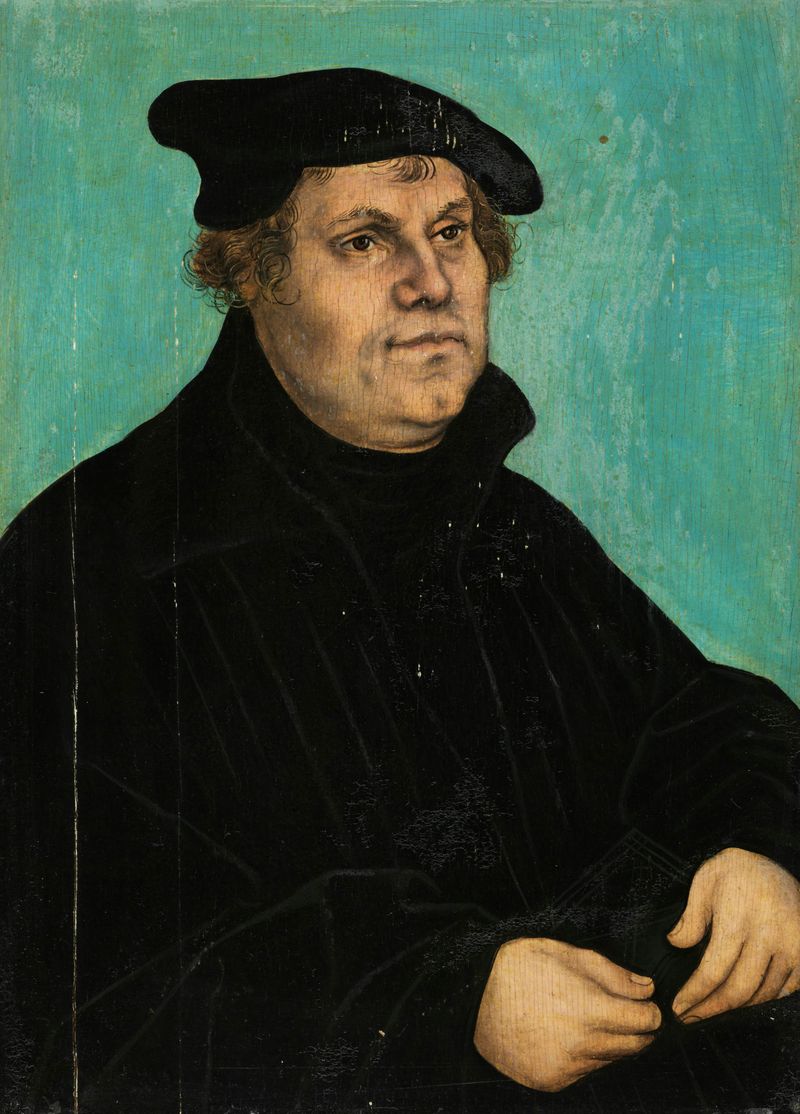
The decisive Protestant action on the canon was not a theological declaration but a typesetter’s decision. Luther’s complete German Bible (Wittenberg: Hans Lufft, 1534) segregated the deuterocanonicals into their own inter-testamental section under the rubric “Apokryphen”: Das sind Bücher, so nicht der heiligen Schrift gleichgehalten, und doch nützlich und gut zu lesen sind—“Apocrypha: these are books not held equal to Holy Scripture, yet useful and good to read.”45 Luther kept the books inside the Bible but in a subordinate paratextual position. He did not denounce them; he demoted them. His own preface to the apocrypha tells the reader the books are profitable for reading but not for establishing doctrine.
The decisive Protestant action on the canon was not a theological declaration but a typesetter’s decision.
Luther’s reasoning was overdetermined. The humanist ad fontes instinct supplied the scholarly cover: if Jerome had reservations, those reservations could be reactivated. The acute theological pressure was 2 Maccabees 12:41–46—the proof-text for prayer for the dead and, by 1517, for the indulgence economy the Ninety-Five Theses had challenged. At the Leipzig Disputation of June–July 1519, Johann Eck cited 2 Maccabees 12 in defense of purgatory. Luther’s reply, worked out in his Resolutio Lutheriana super propositione XIII de potestate papae (Weimar Ausgabe 2:324–330), was that 2 Maccabees “cannot stand in debate, nor convince, since it is not in the canon.”46 The 1520 Assertio omnium articulorum (WA 7:94–151) and the 1534 segregated-section Bible were the working-out of that 1519 polemical move.
The other Reformers ran the same direction at different speeds. Zwingli’s Zurich (Froschauer) Bible of 1530, with a folio edition in 1531, included a section labeled “Apocryphi”—but Leo Jud’s preface said the books were included so readers “will not complain about their absence” and noted that they “contain much which in no way contradicts the biblical writings.”47 Zurich included more apocrypha than Wittenberg—adding 3 Esdras, 4 Esdras, and 3 Maccabees. Calvin in Institutes 1.7.5 grounded scriptural authority in the internal testimony of the Spirit (autopistos) and in his Antidote to the Council of Trent (Geneva, 1547) attacked Trent’s canon decree by appealing to the patristic distinction (Jerome, Rufinus) between libri canonici and libri ecclesiastici—arguing that the Fathers themselves had received Ecclesiasticus, Wisdom, Tobit, Judith, and Maccabees as ecclesiastical, not canonical. In a separate attack on the companion De editione decree, Calvin argued that the Vulgate could not displace the Hebrew and Greek originals; his broader prefatory case challenged the Council’s ecumenicity altogether.48
English Protestantism stabilized at the mildest position. The Thirty-Nine Articles of 1571, Article VI, after defining the canonical books as those “of whose authority was never any doubt in the Church,” continues: “And the other Books (as Hierome saith) the Church doth read for example of life and instruction of manners; but yet doth it not apply them to establish any doctrine.” Article VI then names fourteen “other Books”: 3 and 4 Esdras, Tobias, Judith, the rest of Esther, Wisdom, Jesus the Son of Sirach, Baruch the Prophet, the Song of the Three Children, the Story of Susanna, Bel and the Dragon, the Prayer of Manasses, and 1 and 2 Maccabees.49 Article VI’s formula is almost verbatim Jerome’s libri ecclesiastici category. The 1611 King James Version printed the same fourteen books as a separate section between the Testaments.
The hardest Protestant position is the Westminster Confession of Faith 1.3 (1647): “The books commonly called Apocrypha, not being of divine inspiration, are no part of the Canon of the Scripture; and therefore are of no authority in the Church of God, nor to be any otherwise approved, or made use of, than other human writings.”50 Westminster—the Reformed standard for English-speaking Presbyterianism—went further than Luther, further than Zurich, further than the 39 Articles. The Apocrypha were not just demoted; they were declared to be of no authority in the Church of God, not to be otherwise approved or made use of than other human writings. This is the position that hardened into modern American evangelical practice—but it is not the position of the Magisterial Reformation as a whole.
It is also worth saying that pre-Trent Catholic opinion was not unanimous. Cardinal Cajetan’s 1532 distinction between libri canonici and libri ecclesiastici was a serious Catholic theologian’s recovery of Jerome’s reservations. Cardinal Cisneros’ Complutensian Polyglot (printed 1514–17) treated the deuterocanonicals with care but registered Jerome’s reservations. Erasmus, whose 1516 Greek New Testament made Luther’s translation philologically possible, voiced similar hesitations. The Council of Trent was not silencing universal Catholic agreement; it was settling a question on which there had been authentic Catholic disagreement.
Trent’s Session IV, read carefully
The Council of Trent, Session IV, Decretum de canonicis Scripturis, was promulgated on 8 April 1546 under Pope Paul III. The decree’s grammar matters as much as its content.
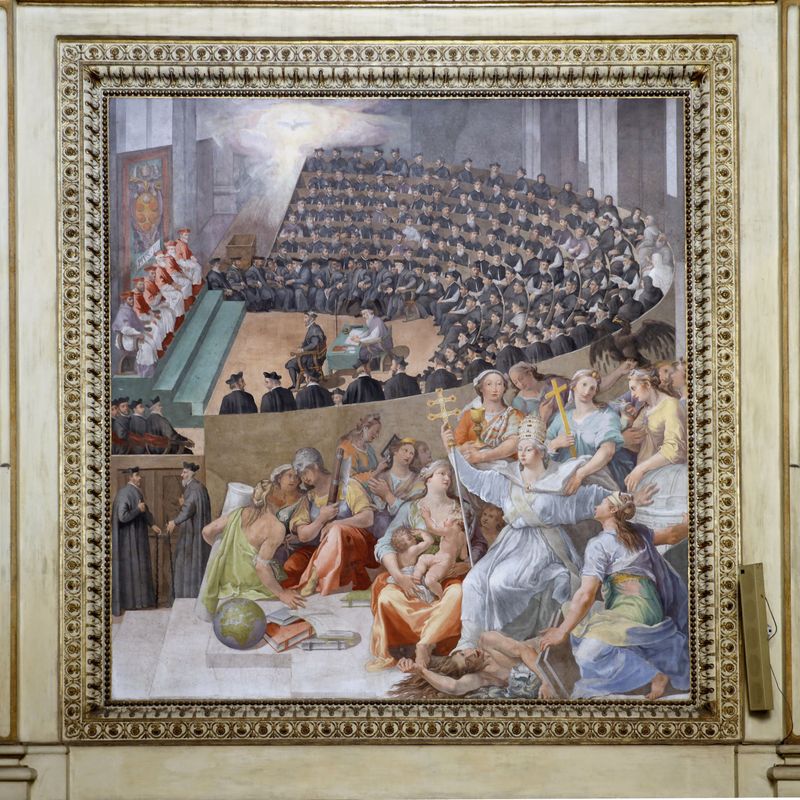
The decree opens: omnes libros tam Veteris quam Novi Testamenti, cum utriusque unus Deus sit auctor… pari pietatis affectu ac reverentia suscipit ac veneratur—“[the Synod] receives and venerates with equal piety and reverence all the books of both the Old and New Testaments, since the one God is the author of both.” It then enumerates the canon—Old Testament protocanonical and deuterocanonical, New Testament—without distinguishing between the two. Tobit, Judith, Wisdom, Sirach, Baruch, and the two books of Maccabees stand in the same list as Genesis, Isaiah, and the Gospels. The decree concludes with the anathema: “If anyone, however, does not receive (non susceperit) these entire books with all their parts, as they have been customarily read in the Catholic Church and are contained in the old Latin Vulgate edition, as sacred and canonical… let him be anathema.”51
The Latin verb suscipere—“to receive, to take up”—appears three times in the decree: the synod suscipit ac veneratur the canonical books; the list is supplied so that no one can be uncertain quinam sint, qui ab ipsa Synodo suscipiuntur (which books are received by the Synod itself); and the anathema falls on anyone who does not susceperit these books. The grammar is receptive, not constitutive. Trent receives a canon already held in the Catholic Church, already promulgated at Florence, already voted at Hippo and Carthage, already listed by Innocent I—and now defines its reception under anathema in response to the Reformation challenge.
Trent’s anathema is narrow. It does not anathematize anyone who reads the deuterocanonicals with reservations or who notices that Tobit and Judith are theological narratives rather than historical chronicles. It anathematizes those who refuse to receive the books “as sacred and canonical”—that is, who reject their inspired and canonical status. The post-Tridentine Catholic theological tradition has been able to acknowledge genre questions, historical inaccuracies, and pseudepigraphic authorship in Tobit and Judith without violating the decree, because the decree concerns canonicity, not modern historical-critical questions about composition.
A companion decree of the same day, De editione et usu sacrorum librorum, declared the Vulgate “authentic” for “public readings, disputations, sermons, and expositions.” This is a juridical, not a textual-critical, claim—it sets the Vulgate as the official Latin text for ecclesiastical use, not as the only legitimate translation or as a claim about the originals. Calvin’s Antidote attacked this decree, but he attacked it on the wrong grounds: the decree did not claim the Vulgate was textually superior to the Greek and Hebrew, only that it was the authoritative Latin for Catholic public use.
What Trent did, and what it did not do: Trent dogmatized the canon under anathema. Trent did not invent the canon, did not “add” the deuterocanonicals to the medieval Latin Bible (which had always contained them), and did not break ecumenical continuity with the prior tradition. Trent settled, with the binding authority of an ecumenical council, what had been the working consensus of the Latin Church since Innocent I in 405 and the dogmatic definition of Florence in 1442.
The Eastern canon and the Synod of Jerusalem
A Catholic post on the deuterocanonicals that does not engage the Eastern Orthodox witness is missing the strongest historical argument. The Greek East has received the wider Septuagint canon continuously, without major debate, from the patristic age forward. Catholic and Orthodox agree on the seven deuterocanonical books; they differ only at the periphery.
The Byzantine practice was simply to use the Septuagint. The Greek liturgy reads from the LXX. The Greek manuscript tradition transmits the wider canon with variations: Tobit, Judith, 1–3 Maccabees (and at the periphery 4), Wisdom, Sirach, Baruch, the Letter of Jeremiah, Psalm 151, the Prayer of Manasseh, and the Greek expansions to Esther and Daniel. John of Damascus’ De Fide Orthodoxa IV.17 (c. 730) places Wisdom and Sirach in a subordinate but honored category. The medieval Byzantine canonists—Zonaras, Balsamon, Aristenus—transmitted the wider canon. The Greek Bible never went through anything like the Reformation contraction.
The crisis came in the seventeenth century from a Calvinizing direction. Cyril Lucaris, Patriarch of Constantinople (intermittently 1620–1638), issued his Eastern Confession of the Christian Faith in Latin (Geneva, 1629) and Greek (1631/1633). The eighteen-chapter confession taught Calvinistic doctrines—sola scriptura, unconditional predestination, justification by faith alone, rejection of transubstantiation, denial of purgatory. The Greek edition’s appendix of four questions excluded the Apocrypha from canonical status. This was a Calvinizing incursion at the highest level of the Greek Church.52
The Orthodox response was emphatic. Cyril Lucaris was murdered by Ottoman order on 27 June 1638, and the Synod of Constantinople convoked that same year condemned the Confessio as heretical. Peter Mogila’s Orthodox Confession of the Catholic and Apostolic Eastern Church, composed in Kiev around 1638–1640 and revised at the Synod of Iași in 1642, was signed by the four Eastern Patriarchs in 1643 as the official Orthodox response. The decisive document was the Synod of Jerusalem (also called the Synod of Bethlehem) of 16 March 1672, under Patriarch Dositheus Notaras. Dositheus’ confession contains six chapters, eighteen horoi (Decrees), and four catechetical Questions. The canon list is in Question 3—not, as is sometimes mistakenly claimed in Catholic apologetic literature, in Decree 3 (which treats predestination).53
Dositheus’ Question 3 is worth quoting directly: “Following the rule of the Catholic Church, we call Sacred Scripture all those which Cyril collected from the Synod of Laodicea, and enumerated, adding to Scripture those which he foolishly and ignorantly, or rather maliciously, called Apocrypha; specifically, ‘The Wisdom of Solomon,’ ‘Judith,’ ‘Tobit,’ ‘The History of the Dragon,’ ‘The History of Susanna,’ ‘The Maccabees,’ and ‘The Wisdom of Sirach.’”54 The Synod of Jerusalem reaffirmed against Lucaris’ Calvinizing incursion the books the Greek Church had always received.
The Greek Orthodox canon is slightly wider than the Catholic. It includes Psalm 151, the Prayer of Manasseh, 1 Esdras (= 3 Esdras in Vulgate numbering), and 3 Maccabees. The Slavonic adds 4 Ezra (= 2 Esdras in Protestant Apocrypha numbering). The Ethiopian Tewahedo canon, the most expansive of all, includes 1 Enoch, Jubilees, and the Meqabyan books. These peripheral variations are real, and they are sometimes urged as an argument against the Catholic position: “if tradition really preserved an apostolic canon, Catholic and Orthodox should agree.”
The reply is twofold. First, the differences are at the periphery, not at the core. The Catholic, Eastern Orthodox, and Oriental Orthodox communions all receive the seven Catholic deuterocanonical books with full canonical standing. The peripheral variations reflect the actual plurality of the ancient Septuagint manuscript tradition itself, not a failure of tradition. Second, the variations follow a clear pattern: the historic apostolic communions all received more than the rabbinic Hebrew, never less. The argument from variation cuts against the Reformation contraction, not in favor of it. If anything, the Orthodox witness shows that the deuterocanonicals are not a Latin Catholic peculiarity but the patrimony of the historic Christian East and West together.
The KJV had them; the BFBS removed them
Most modern Protestant readers do not know how recently their sixty-six-book Bible became standard. The history is short and decisive.
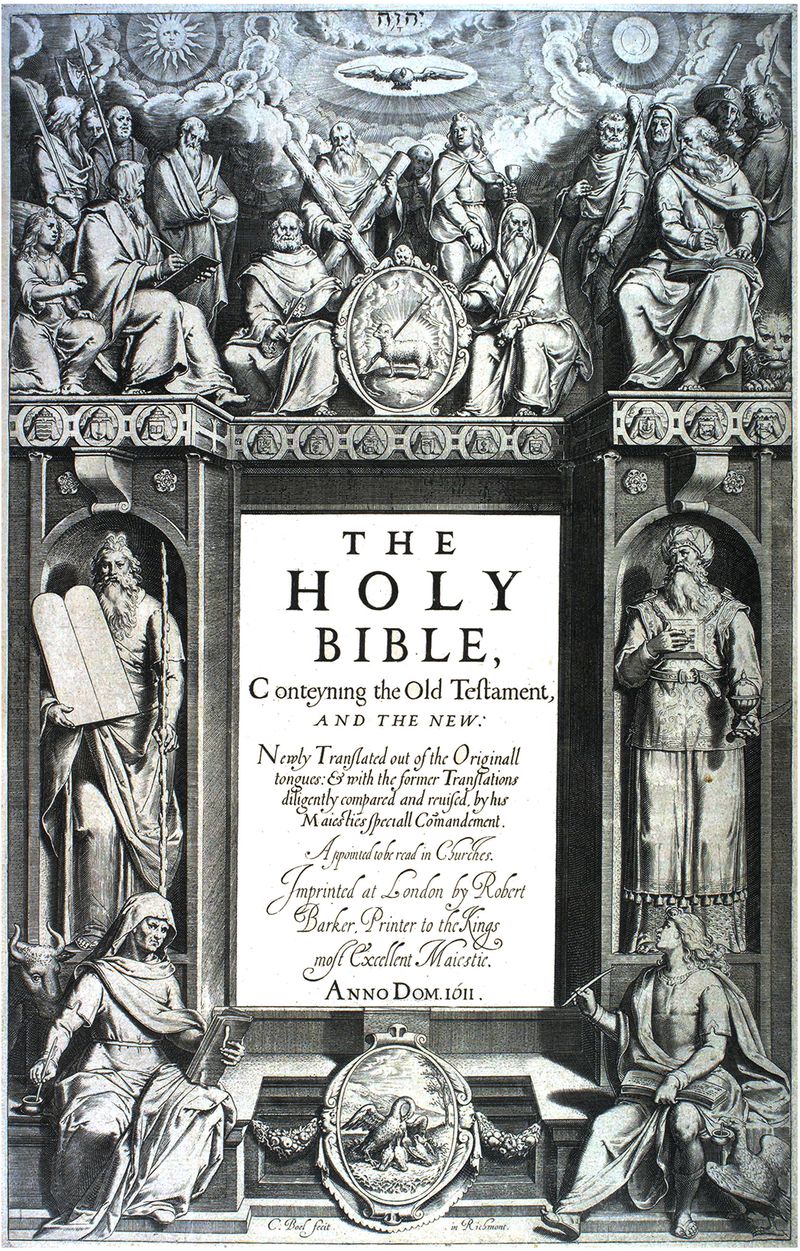
The 1611 King James Version included the Apocrypha—the same fourteen books named in Article VI of the Thirty-Nine Articles—printed as a separate section between the Old and New Testaments. The translators worked from the Septuagint and Vulgate for these books, just as they worked from Hebrew and Greek for the protocanon. The KJV’s Apocrypha was a regular part of public reading in the Church of England for centuries.
In 1615, Archbishop George Abbot of Canterbury—one of the original 1611 KJV translators—issued a directive forbidding any printer to issue a Bible without the Apocrypha, reportedly on pain of a year’s imprisonment.55 The Anglican establishment understood the KJV’s Apocrypha not as optional ballast but as part of the publicly authorized Bible. Compliance was uneven; some editions from 1630 onward omitted it, but the standard remained Apocrypha-bearing into the early nineteenth century.
The contraction came not from the Reformation but from the Evangelical Awakening. The British and Foreign Bible Society, founded in 1804 to distribute Bibles inexpensively, initially included the Apocrypha in editions for Lutheran and Catholic markets where the books were expected. Beginning around 1821, the Scottish ministers Robert Haldane and William Thorp led a campaign to forbid the Society from funding Apocrypha-bearing editions on the ground that the books were not divinely inspired; Andrew Mitchell Thomson—minister of St George’s, Edinburgh, and editor of The Christian Instructor—led the 1825–26 ecclesiastical escalation that produced the secession of the Edinburgh and Glasgow Bible Societies. After several years of controversy, the BFBS resolved in 1826 to confine its funding “to the printing and circulation of the canonical books of Scripture to the exclusion of those books which are termed apocryphal.”56
This was the decisive action. From 1826 forward, the BFBS distributed only sixty-six-book Bibles. The American Bible Society, founded in 1816, followed the same path, with its parallel resolution holding until 1964. The BFBS ban held until 1966. For a century and a half, the world’s largest English-language Bible distributor refused to print the Apocrypha. The “Bible-with-exactly-sixty-six-books” became the de facto Protestant Bible in the anglophone world—but not because the Reformers had concluded the Apocrypha was uninspired (the Reformers’ position was more nuanced), and not because the historic Anglican tradition had abandoned them (Article VI explicitly preserved them for liturgical reading). The sixty-six-book Bible became standard because nineteenth-century evangelical Bible societies refused to subsidize the alternative.
The KJV-only and dispensationalist American evangelical traditions inherited the post-1826 sixty-six-book object without inheriting the historical context that produced it. The result is a curious historical irony: the contemporary evangelical who insists that “the Bible has always had sixty-six books” is appealing to a publishing decision of 1826, not to apostolic teaching, Reformation conviction, or even the original printings of the King James Version his own tradition reveres.
The contemporary evangelical who insists “the Bible has always had sixty-six books” is appealing to a publishing decision of 1826.
This is not a knockdown argument that the deuterocanonicals are inspired. It is an argument that the contraction is more recent and more contingent than its inheritors realize. A Protestant who wants to defend the sixty-six-book canon has every right to defend it—but he should know what he is defending and when it became standard.
Answering the strongest objections
Now to the responses to the five objections I laid out at the beginning of the essay.
1. “Christ and the apostles never cite the deuterocanonicals with a Scripture formula.”
I conceded this is correct as a matter of formal citation. But the formal-citation standard does not apply consistently. Esther, Ecclesiastes, Song of Songs, Ezra, Nehemiah, Obadiah, and Nahum are also never introduced with gegraptai in the New Testament. No Protestant rejects them. The standard is therefore not the operative test of canonicity. The operative test must be something else—at minimum, allusion, atmosphere, and reception, and at maximum, ecclesial reception in liturgy and dogma.
By the allusion-and-atmosphere test, the deuterocanonicals pass. Hebrews 11:35’s “better resurrection” requires 2 Maccabees 7. Hebrews 1:3’s apaugasma requires Wisdom 7:26. Matthew 27’s mockery saturates Wisdom 2:17–20. Romans 1’s polemic against idolatry tracks Wisdom 13–14 paragraph for paragraph. The apostolic community was breathing the deuterocanonical literature when it wrote the New Testament. The absence of formal citation formula means these books are used differently than Isaiah, not that they are excluded.
This test is not by itself decisive. Jude 14–15 cites 1 Enoch 1:9 with prophetic-introduction language (“Enoch, the seventh from Adam, prophesied”), and 1 Enoch is not received as canonical by any of the major Christian traditions outside the Ethiopian Tewahedo. Allusion and atmosphere are necessary but not sufficient. They establish that a book was woven into the apostolic Church’s scriptural imagination; they do not by themselves establish canonicity. The final discernment is ecclesial—the reception of a book over time, in liturgy and dogma, by the Church the apostles founded. That is the test the deuterocanonicals pass, and that is the test the rest of this essay traces.
2. “The rabbinic Jewish canon does not include them.”
This was true after approximately AD 100 and was definitive only later. In the first century when the apostolic Church was forming, no settled rabbinic canon existed. The Council of Jamnia thesis is dead. The Qumran evidence demonstrates pre-Christian Jewish use of Tobit and Sirach. The argument from “the Jews were the trustees” cannot be made on first-century evidence; it can only be made by importing later rabbinic standards backward—which is precisely what the apostolic Church declined to do.
The deeper point: the Christian Church did not inherit the canon from rabbinic Judaism. The Christian Church received its Scriptures from a Hellenistic Jewish tradition that overlapped with but was not identical to the rabbinic line. The apostles were Greek-speaking Jews of the Diaspora as well as Aramaic-speaking Jews of Palestine. The Christian Old Testament’s relationship to the rabbinic canon is one of historical descent from a common Jewish heritage that subsequently took different forms in Judaism and Christianity. To insist that Christians must align with the rabbinic standard is to insist that the apostles got their Old Testament wrong.
3. “The Fathers were divided. Follow the rigorous voices.”
The Fathers were divided. Melito, Origen, Athanasius, Cyril of Jerusalem, Jerome—these are real witnesses, and their reservations should be acknowledged. But the rigorous voices are not the most representative voices. Athanasius’ middle tier is a pedagogical category, not a rejection. Origen defended Susanna and Tobit and Judith against Africanus and quoted the deuterocanonicals as Scripture in his homilies. Jerome translated Tobit and Judith and quoted Sirach and Wisdom as Scripture in his correspondence. The patristic plurality on canon is normal in Christian doctrinal history—Trinitarian terminology, Christological formulae, and the New Testament canon itself had similar pluralism before settling. The settlement, when it came, was for the wider canon: in the Latin West at Hippo, Carthage, and Innocent I; in the Greek East by continuous reception; in both communions ratified at Florence 1442 and Trent 1546 and Jerusalem 1672.
Diversity before consensus does not mean the consensus is illegitimate. It means the consensus is a real settlement of a real prior question. The Protestant who argues “the Fathers were divided, so we should pick the rigorous voices” is not following the patristic process; he is freezing it at the most polemic moment and refusing to follow it through to its institutional resolution.
4. “Trent added these books in reaction to Luther.”
Florence 1442 alone refutes this claim. The ecumenical Council of Florence enumerated the same canon a century before Luther was born, in a binding ecumenical instrument issued for reunion with the Coptic Church. Trent’s 1546 decree did not “add” books. Trent dogmatized—defined under anathema—what Florence had already received and what Hippo, Carthage, and Innocent I had already enumerated more than a millennium earlier. The pre-Trent Catholic minority view—Cajetan, Cisneros, Erasmus—was a real position within the Latin Church, and Trent settled the question against it. But settling a question against a minority view inside the Church is not the same as inventing the answer in response to outside pressure.
5. “The deuterocanonicals contain historical and theological errors.”
This is the most interesting objection because it has to be answered fairly. The errors are real. Tobit’s genealogy of Assyrian kings is wrong. Judith’s “Nebuchadnezzar, who ruled over the Assyrians” is, as the NABRE note candidly states, “an invention of the author.” 2 Maccabees has Jeremiah hiding the Ark in a cave that no archaeology has located.
But the standard, applied consistently, deletes more than the deuterocanonicals. Daniel 6:1 has “Darius the Mede” reigning between Belshazzar and Cyrus—a figure unattested outside Daniel and historically problematic. Chronicles contains synchronisms with Kings that defy historical reconciliation without literary-theological harmonization. The Genesis flood chronologies vary substantially across Masoretic, Septuagint, and Samaritan witnesses. If Tobit’s genealogy is disqualifying, Daniel’s Darius is disqualifying. If Judith’s Nebuchadnezzar is disqualifying, Daniel’s chronological frame is disqualifying.
The real question is not whether these books are modern historical reportage. The whole Old Testament is ancient theological literature, not modern history-writing, and reading Tobit as if its genre were a Wikipedia infobox is reading it badly. The real question is whether these books are inspired Scripture—and the answer to that has to come from somewhere besides anachronistic genre tests. It has to come from ecclesial reception, the witness of the Spirit in the Church, and the discernment of the apostolic communions over centuries.
On that test the deuterocanonicals pass. The Church received them. The Church reads them. The Church prays them. The Church has dogmatized them in the East and West. That is what canonicity has always meant.
The Church received them. The Church reads them. The Church prays them. That is what canonicity has always meant.
What this means for the reader
If you are a Protestant reader who has come this far, my hope is not that you will rush to buy a Catholic Bible tomorrow. My hope is more modest: that the deuterocanonicals will stop being for you what they often are—texts you assume you do not need to take seriously, on the strength of an argument you have not actually examined. The historical record is more interesting than either side’s polemic.
If you want to begin reading the deuterocanonicals in the most serious modern English translation, three are worth your attention. The New American Bible, Revised Edition (NABRE) is the official Catholic translation for the United States, with rigorous footnotes that mark genre, historical-critical issues, and intertextual connections. The Revised Standard Version, 2nd Catholic Edition (RSV-2CE) is widely loved for its literary register and its conservative engagement with Catholic tradition. The New Revised Standard Version, Catholic Edition (NRSV-CE), or its updated form NRSVue, is the standard ecumenical and academic translation.
For supporting scholarship, the New Oxford Annotated Bible with Apocrypha (5th ed., NRSV) is the standard ecumenical study Bible with full annotations on the Apocrypha; the SBL Study Bible (NRSVue, 2023) is a current scholarly alternative; and the Baylor Annotated Study Bible (Baylor University Press, 2019), edited by W. H. Bellinger Jr. and Todd D. Still, is a high-quality Protestant-led NRSV study Bible whose annotations cover only the 66-book Protestant canon (the volume includes the NRSV Apocrypha at the back as text but does not annotate it). David A. deSilva’s Introducing the Apocrypha (Baker Academic, 2nd ed. 2018) is the standard evangelical introduction—and deSilva is an ordained United Methodist (now Global Methodist) New Testament scholar at Ashland Theological Seminary—and it argues from inside the Protestant tradition for the books’ theological and historical importance.
If you are Catholic, my hope is that you will pray with these books more—and pray them as Scripture, not as second-class material. Sirach 3 is read at the Feast of the Holy Family. Wisdom is read at funerals. The Maccabean martyrs are commemorated on August 1 in the Eastern churches and in the Roman Martyrology (and were on the General Roman Calendar before its 1969 revision). A Daniel canticle (Dan 3:57–88 in Weeks I and III, the related Dan 3:52–57 in Weeks II and IV) is sung at every Sunday Lauds in the Liturgy of the Hours. Tobit’s nuptial prayer at 8:4b–8 is one of the marriage rite’s options. The deuterocanonicals are not the Catholic Bible’s appendix; they are part of the body the Spirit has given the Church.
And in particular: pray for your dead. The doctrine of intercessory prayer for the dead is rooted in 2 Maccabees 12:43–46, attested in the earliest Christian liturgical record, and confessed by Catholic, Orthodox, and (in muted but real form) Anglican Christianity. Most Protestants who lose a parent or a friend instinctively want to keep loving them, keep praying for them, keep being on the side of God’s mercy with them. The deuterocanonical witness gives explicit Scripture to that instinct. It is one of the gifts the historic Church has tried to give us.
The deuterocanonical witness gives explicit Scripture to that instinct. It is one of the gifts the historic Church has tried to give us.
The seven extra books in the Catholic Bible are not the leftovers of an apologetic argument. They are part of how the Church has read God’s word for two thousand years. The Reformers took them out for reasons that, on close inspection, do not hold. The historic Church received them for reasons that, on close inspection, do.
Frequently Asked Questions
What are the deuterocanonical books?
The seven books accepted as Scripture by Catholic, Eastern Orthodox, and Oriental Orthodox communions but not by most Protestant communions: Tobit, Judith, Wisdom of Solomon, Sirach (Ecclesiasticus), Baruch (with the Letter of Jeremiah), 1 Maccabees, and 2 Maccabees—plus the Greek additions to Daniel (the Prayer of Azariah, the Song of the Three Young Men, Susanna, Bel and the Dragon) and the Greek additions to Esther.
Is “deuterocanonical” the same as “apocrypha”?
The terms overlap but carry different connotations. Deuterocanonical (“second canon”) is the Catholic term, coined by Sixtus of Siena in 1566, and indicates books whose canonicity was historically contested in some quarters but is fully received by the Catholic Church. Apocrypha (Greek for “hidden, secret”) is the Protestant term, used in a more reserved sense to mean books read for instruction but not as Scripture. In a strictly pejorative sense—books regarded as forgeries—the term applies to a different category of works (the pseudepigrapha) that no major Christian communion accepts.
Did the Council of Trent add books to the Bible?
No. The Council of Florence’s Bull of Union with the Copts, Cantate Domino, of 4 February 1442, enumerated the deuterocanonical books as canonical a full century before the Council of Trent met. Hippo (393), Carthage (397, 419), and Pope Innocent I’s letter to Exsuperius of Toulouse (405) had enumerated the same list more than eleven hundred years before Trent. Trent dogmatically defined under anathema what the Catholic Church had long received.
Did the King James Version include the Apocrypha?
Yes. The 1611 King James Version included the fourteen books named in Article VI of the Thirty-Nine Articles as a separate section between the Old and New Testaments. Archbishop George Abbot’s 1615 directive forbade printers to issue Bibles without the Apocrypha on pain of imprisonment. The British and Foreign Bible Society’s 1826 resolution against subsidizing Apocrypha-bearing editions is what produced the modern truncated Protestant Bible in the anglophone world—not the Reformation.
What is the difference between Catholic and Orthodox canons?
Catholic and Eastern Orthodox communions agree on the seven Catholic deuterocanonical books. The Eastern Orthodox canon adds Psalm 151, the Prayer of Manasseh, 1 Esdras (= 3 Esdras in Vulgate numbering), and 3 Maccabees. The Slavonic Orthodox tradition adds 4 Ezra (= 2 Esdras in Protestant Apocrypha numbering). The Oriental Orthodox Ethiopian Tewahedo canon, the most expansive, adds Enoch, Jubilees, and the Meqabyan. The peripheral variations are real but do not affect the seven core deuterocanonicals all apostolic communions share.
Does Hebrews really quote Wisdom of Solomon?
Hebrews 1:3 uses the Greek word apaugasma (“radiance, refulgence”), which is a New Testament hapax legomenon—it appears only once in the NT. It also appears once in the Septuagint Old Testament: Wisdom of Solomon 7:26, “she is the reflection (apaugasma) of eternal light, the spotless mirror of the power of God.” The lexical match is verbatim. The Nestle–Aland Greek New Testament’s apparatus of biblical citations and allusions records this and many other deuterocanonical parallels in the New Testament.
What about 2 Maccabees and prayer for the dead?
2 Maccabees 12:43–46 narrates Judas Maccabeus collecting a sin-offering for fallen soldiers and concludes: “Thus he made atonement for the dead that they might be absolved from their sin.” This is the only sustained Old Testament locus for the doctrine of prayer for the dead. The doctrine is also attested in the earliest Christian liturgical record and in Tertullian’s De Corona (c. 211). Luther’s rejection of 2 Maccabees at the Leipzig Disputation of 1519 was directly tied to his rejection of the indulgence economy and of the doctrine of purgatory; the canon question and the doctrinal question were always linked.
Should I read the deuterocanonicals if I’m Protestant?
Yes. Whatever you conclude about their canonical status, they are essential to understanding the Old Testament background of the New Testament, the theological imagination of the apostolic Church, and the worship of two thousand years of historic Christianity. For an annotated NRSV-with-Apocrypha treatment, the New Oxford Annotated Bible with Apocrypha (5th ed.) is the standard ecumenical option, with the SBL Study Bible (NRSVue, 2023) as a current scholarly alternative. David A. deSilva’s Introducing the Apocrypha (Baker Academic, 2nd ed. 2018) is the standard evangelical introduction.
Footnotes
1. New American Bible, Revised Edition, footnote at Wisdom 2:12–20. https://bible.usccb.org/bible/wisdom/2.
2. Wisdom 2:12–20 (NABRE). https://bible.usccb.org/bible/wisdom/2.
3. Matthew 27:43 (NABRE). https://bible.usccb.org/bible/matthew/27.
4. Sixtus of Siena, Bibliotheca Sancta ex praecipuis catholicae ecclesiae auctoribus collecta (Venice, 1566), book I. Sixtus, a Jewish convert who began his career as a Franciscan and transferred to the Dominican Order in 1551, coined “deuterocanonical” in this work as a defense and explanation of Trent’s canonical decree.
5. The Aramaic fragments are 4Q196, 4Q197, 4Q198, and 4Q199; the Hebrew fragment is 4Q200. See the Israel Antiquities Authority’s Leon Levy Dead Sea Scrolls Digital Library, https://www.deadseascrolls.org.il/explore-the-archive/manuscript/4Q196-1. Dating ranges roughly 100 BC to AD 25.
6. NABRE footnote at Judith 1:1. https://bible.usccb.org/bible/judith/1.
7. Wisdom 7:26 (NABRE): “For she is the reflection of eternal light, the spotless mirror of the power of God, the image of his goodness.” Hebrews 1:3 (NABRE): “who is the refulgence of his glory, the very imprint of his being.” The Greek word ἀπαύγασμα (apaugasma) is a New Testament hapax legomenon. https://bible.usccb.org/bible/wisdom/7 and https://bible.usccb.org/bible/hebrews/1.
8. Sirach 24:8 (NABRE): “Then the Creator of all gave me his command… ‘Make your dwelling in Jacob, and in Israel receive your inheritance.’” John 1:14 uses the verb ἐσκήνωσεν (eskēnōsen), “tabernacled.” https://bible.usccb.org/bible/sirach/24.
9. Roman Liturgy of the Hours, Sunday Lauds, Weeks I and III; Book of Common Prayer (1979), Canticle 1 (Rite I Morning Prayer) and Canticle 12 (Rite II), https://www.bcponline.org/.
10. Eusebius, Historia Ecclesiastica 4.26.13–14, A. C. McGiffert trans., NPNF 2.1, https://www.newadvent.org/fathers/250104.htm. McGiffert’s footnote 1312 specifies that “Wisdom also” (ἣ καὶ Σοφία) in Melito’s list refers to the Book of Proverbs (called hē Sophia or Panaretos Sophia in second-century Christian usage), not the deuterocanonical Wisdom of Solomon.
11. Eusebius, Historia Ecclesiastica 6.25.1–2, McGiffert trans., NPNF 2.1, https://www.newadvent.org/fathers/250106.htm. McGiffert’s footnote 1975 to this passage states explicitly: “the Maccabees, as is clear from the words ἔξω δὲ τούτων ἐστὶ τὰ Μακκαβαϊκά, are not reckoned by Origen among the twenty-two books as a part of the Hebrew canon.” Note that Origen’s Jeremiah entry includes “the epistle”—that is, the Epistle of Jeremiah, a deuterocanonical work—quietly inside his Hebrew-aligned listing.
12. Athanasius, Festal Letter 39 (AD 367), NPNF 2.4, https://www.newadvent.org/fathers/2806039.htm. The critical modern edition is David Brakke, “A New Fragment of Athanasius’ Thirty-Ninth Festal Letter,” Harvard Theological Review 103.1 (2010).
13. Jerome, Prologus Galeatus (preface to the books of Samuel and Kings), c. 391–392, Kevin P. Edgecomb trans., https://www.tertullian.org/fathers/jerome_preface_kings.htm.
14. Cardinal Cajetan (Tommaso de Vio), In omnes authenticos Veteris Testamenti historiales libros Commentarii (Rome: 19 July 1532; first printed Rome 1533), discussing Esther 10:9–10. The work covers the historical books from Joshua through Esther, which Cajetan treats as the de facto end of the Hebrew protocanonical Old Testament. Cajetan’s distinction between libri canonici (canonical for confirming dogma) and libri ecclesiastici (canonical for edification) preserved Jerome’s reservations within mainstream Latin Catholic theology.
15. NABRE footnote at Tobit 1:15. https://bible.usccb.org/bible/tobit/1.
16. NABRE footnote at Judith 1:1. https://bible.usccb.org/bible/judith/1.
17. Albert C. Sundberg Jr., The Old Testament of the Early Church, Harvard Theological Studies 20 (Cambridge: Harvard University Press, 1964). Sundberg’s dissertation dismantled the older “Alexandrian canon” hypothesis and remains a foundational work in canon studies.
18. Jack P. Lewis, “What Do We Mean by Jabneh?” Journal of Bible and Religion 32.2 (1964): 125–132, https://academic.oup.com/jaar/article-abstract/XXXII/2/125/700440. (The journal was renamed Journal of the American Academy of Religion in 1966–67.)
19. Timothy H. Lim, The Formation of the Jewish Canon, Anchor Yale Bible Reference Library (New Haven: Yale University Press, 2013), https://yalebooks.yale.edu/book/9780300164343/the-formation-of-the-jewish-canon/.
20. Edmon L. Gallagher and John D. Meade, The Biblical Canon Lists from Early Christianity: Texts and Analysis (Oxford: Oxford University Press, 2017), https://global.oup.com/academic/product/the-biblical-canon-lists-from-early-christianity-9780198792499. Meade is a Protestant Old Testament scholar at Phoenix Seminary.
21. The “approximately 300 / approximately two-thirds” framing is standard across modern reference works on the New Testament’s use of the Old; estimates among scholars range from roughly 50 percent to two-thirds, with precision difficult because many quotations are loose paraphrases. See for instance the discussion in Karen H. Jobes and Moisés Silva, Invitation to the Septuagint, 2nd ed. (Grand Rapids: Baker Academic, 2015), ch. 9. On the secondary Christian insertion of vv. 13–18 into LXX Psalm 13(14):3, see Alfred Rahlfs, ed., Septuaginta, vol. 10: Psalmi cum Odis, 2nd ed. (Göttingen: Vandenhoeck & Ruprecht, 1967), apparatus and Prolegomena §4.4 (the additional stichs are bracketed as non-original); Douglas J. Moo, The Epistle to the Romans, NICNT (Grand Rapids: Eerdmans, 1996), 203 n. 28; Joseph A. Fitzmyer, Romans, Anchor Bible 33 (New York: Doubleday, 1993), 333.
22. Cyprian of Carthage, Ad Quirinum (Testimonies) Book II.14, ANF 5, https://www.newadvent.org/fathers/050712b.htm. The chapter collects Wisdom 2:12–22 as Christological prophecy under the heading “That He should be called a sheep, and be led to the slaughter for our sake.”
23. Hippolytus of Rome, Commentary on Daniel, ANF 5, https://www.ccel.org/ccel/schaff/anf05. A modern English translation is T. C. Schmidt, Hippolytus of Rome: Commentary on Daniel (2010).
24. Origen, Letter to Africanus §§2, 13, ANF 4, https://www.newadvent.org/fathers/0414.htm.
25. Edmon L. Gallagher, Hebrew Scripture in Patristic Biblical Theory: Canon, Language, Text, Supplements to Vigiliae Christianae 114 (Leiden: Brill, 2012), ISBN 978-90-04-22633-3. The “list-vs.-practice” pattern is the central thesis of Gallagher’s monograph. Gallagher writes from a Protestant institutional setting (Heritage Christian University), and his argument takes the Fathers’ theoretical Hebrew-canon commitments seriously even as it documents their LXX-inclusive practice.
26. Augustine, De Doctrina Christiana 2.8.13, English text at https://www.bible-researcher.com/augustine.html.
27. Jerome, Prologus Galeatus, Edgecomb trans., https://www.tertullian.org/fathers/jerome_preface_kings.htm.
28. Jerome, Preface to the Books of Solomon (c. 398), Edgecomb trans., https://www.tertullian.org/fathers/jerome_preface_solomon.htm. Jerome distinguishes books received among canonical Scriptures from those read for edification (Solomon preface, c. 398); the paired technical terminology libri canonici vs. libri ecclesiastici as a clean classification was later codification—Rufinus (Comm. in Symb. Apost. §36, c. 400) calls them ecclesiastici, Cajetan (1532) systematized the contrast at the end of his Esther commentary, and Seripando refined it for the Trent debate.
29. Jerome, Preface to Judith, c. 393. Jerome’s claim to Nicene reception of Judith cannot be verified from the surviving Nicene acts.
30. Jerome, Against Rufinus 2.33, NPNF 2.3, https://www.newadvent.org/fathers/27122.htm.
31. Edmon L. Gallagher, Hebrew Scripture in Patristic Biblical Theory: Canon, Language, Text, Supplements to Vigiliae Christianae 114 (Leiden: Brill, 2012), ch. 3 (“Jerome and the Hebrew Canon”), esp. pp. 56–82.
32. Megan Hale Williams, The Monk and the Book: Jerome and the Making of Christian Scholarship (Chicago: University of Chicago Press, 2006).
33. Charles Munier, ed., Concilia Africae A. 345 – A. 525, Corpus Christianorum Series Latina 149 (Turnhout: Brepols, 1974). For the Breviarium Hipponense canon list, see Roger Pearse’s English translation, https://www.roger-pearse.com/weblog/2021/06/03/canons-29-36-of-the-breviarium-of-the-council-of-hippo-393/.
34. Council of Carthage 397, Canon 36, English text at https://www.bible-researcher.com/carthage.html.
35. Pope Innocent I, Consulenti tibi (Letter to Exsuperius of Toulouse), §7, 20 February 405, English text at https://www.bible-researcher.com/innocent.html.
36. Aquinas, Summa Theologiae I, q. 41, a. 3, obj. 4 (citing Sirach 24:5 and 24:14 in the voice of “begotten Wisdom”), https://www.newadvent.org/summa/1041.htm. Aquinas, Summa Theologiae Supplement, Appendix on Purgatory, q. 1 a. 1, sed contra (citing 2 Maccabees 12:46), https://www.newadvent.org/summa/.
37. Hugh of St. Victor, Didascalicon IV.2, Latin text at https://www.thelatinlibrary.com/hugo/hugo4.html. English translation in Jerome Taylor, The Didascalicon of Hugh of Saint Victor (New York: Columbia University Press, 1961).
38. 2 Maccabees 12:43–46 (NABRE), https://bible.usccb.org/bible/2maccabees/12.
39. Augustine, De Civitate Dei 18.33, NPNF 1.2, https://www.newadvent.org/fathers/120118.htm. On the doctrine of prayer for the dead more broadly, see Augustine, De Civitate Dei 21.13, https://www.newadvent.org/fathers/120121.htm, and De cura pro mortuis gerenda (On the Care to Be Had for the Dead).
40. Book of Common Prayer (1979), Canticles 1 and 12, https://www.bcponline.org/.
41. John Paul II, General Audience of 2 May 2001 on the canticle Benedictus es (Daniel 3:52–57), https://www.vatican.va/content/john-paul-ii/en/audiences/2001/documents/hf_jp-ii_aud_20010502.html.
42. Roman Lectionary, First Reading for Monday of the Fifth Week of Lent, https://bible.usccb.org/bible/readings/032326.cfm.
43. Roman Lectionary, Year A, First Reading for the Feast of the Holy Family of Jesus, Mary, and Joseph, https://bible.usccb.org/bible/readings/122825.cfm.
44. Council of Florence, Bull Cantate Domino (Bull of Union with the Copts), Session 11, 4 February 1442, English text at https://www.papalencyclicals.net/councils/ecum17.htm. The standard critical edition is in Conciliorum Oecumenicorum Decreta, ed. Giuseppe Alberigo et al., 3rd ed. (Bologna: Istituto per le Scienze Religiose, 1973).
45. Martin Luther, Biblia, das ist, die gantze Heilige Schrifft Deudsch (Wittenberg: Hans Lufft, 1534). The Apocrypha rubric appears in Weimarer Ausgabe, Deutsche Bibel vol. 12.
46. Luther, Resolutio Lutheriana super propositione XIII de potestate papae, in D. Martin Luthers Werke: Kritische Gesamtausgabe (Weimar: Hermann Böhlau, 1883–) [hereafter “WA”], 2:324–330. Otto Seitz, ed., Der authentische Text der Leipziger Disputation 1519 (Berlin: C. A. Schwetschke, 1903), preserves the disputation acta in critical form.
47. Leo Jud, preface to the Apocrypha section of the Zurich (Froschauer) Bible (Zurich: Christoph Froschauer, 1530–1531).
48. Calvin, Institutes of the Christian Religion 1.7.5, Beveridge trans., https://www.ccel.org/ccel/calvin/institutes.html; Calvin, Acta Synodi Tridentinae cum Antidoto (Geneva, 1547).
49. Articles of Religion (1571), Article VI, text at https://anglicansonline.org/basics/thirty-nine_articles.html.
50. Westminster Confession of Faith (1647), 1.3, text at https://www.ccel.org/ccel/anonymous/westminster3/westminster3.i.i.html.
51. Council of Trent, Session IV, Decretum de canonicis Scripturis (Decree concerning the canonical Scriptures), 8 April 1546. English and Latin parallel at https://www.bible-researcher.com/trent1.html; full text at https://www.papalencyclicals.net/councils/trent/fourth-session.htm. Standard critical edition: Conciliorum Oecumenicorum Decreta, ed. Alberigo et al.
52. Cyril Lucaris, Eastern Confession of the Christian Faith, Latin (Geneva: 1629), Greek (1631/1633). English text at https://www.crivoice.org/creedcyril.html.
53. Confession of Dositheus / Synod of Jerusalem (Bethlehem), 16 March 1672. The canon list is in Question 3, not Decree 3 (Decree 3 treats predestination). English text at https://www.crivoice.org/creeddositheus.html; Schaff, Creeds of Christendom II at https://ccel.org/ccel/schaff/creeds2/creeds2.vi.ii.html.
54. Confession of Dositheus, Question 3, Bratcher trans., https://www.crivoice.org/creeddositheus.html.
55. Archbishop George Abbot’s 1615 directive forbidding the issuing of Bibles without the Apocrypha is widely attested in the secondary literature on early modern Bible publishing; the directive is associated with Abbot’s tenure as Archbishop of Canterbury (1611–1633). See Encyclopædia Britannica, “George Abbot”, and the discussion of early printings of the King James Apocrypha. The specific penalty of “a year’s imprisonment” appears in popular literature without a primary citation locatable in Pollard (Records of the English Bible, 1911) or Norton (A Textual History of the King James Bible, CUP 2005); the directive itself is real, though its enforcement was uneven, with some editions from 1630 onward omitting the Apocrypha despite Abbot’s mandate.
56. The “Apocrypha Controversy” of 1821–1826 within the British and Foreign Bible Society. The standard scholarly accounts are George Browne, The History of the British and Foreign Bible Society (London: Bagster & Sons, 1859), vol. 1, ch. 7, and Leslie Howsam, Cheap Bibles: Nineteenth-Century Publishing and the British and Foreign Bible Society (Cambridge: Cambridge University Press, 1991). The Scottish ecclesiastical leadership of the 1825–26 escalation was Andrew Mitchell Thomson (1779–1831), credited by the Dictionary of National Biography as “mainly responsible for the famous Apocrypha controversy.” The BFBS resolution of 1826 confining Society funds to canonical books to the exclusion of the Apocrypha held until 1966; the parallel American Bible Society resolution held until 1964.

Garrett Ham
Garrett Ham is an attorney, military veteran, and holds a Master of Divinity from Yale Divinity School. He writes from Northwest Arkansas on theology, law, and service.
Related Posts

The First Letter to the Corinthians — The Oldest Words in the New Testament and Its Road Into the Canon
A Catholic on 1 Corinthians — the quarrelsome church whose letter preserves the oldest creed and the earliest Eucharist in the New Testament, and its road into the canon.

3 John — The Elder, Gaius, and the Man Who Loved to Be First
The Third Letter of John is the shortest book in the Bible, never names Jesus, and records a real first-century church quarrel over hospitality. A Catholic reads Gaius, Diotrephes, and its long road into the canon.

The Acts of Paul — Thecla, the Baptized Lion, and the Forger Who Loved Paul
A presbyter in Asia forged the Acts of Paul 'out of love for Paul'—and was deposed for it. How the book gave the Church Thecla, the baptized lion, and 3 Corinthians, and why it was still left out of the canon.
Stay Informed
Get new writing on faith, law, and service delivered to your inbox.
No spam. Unsubscribe anytime.