What the Council of Trent Actually Said About Justification
On This Page
“Trent anathematized the gospel.”
I heard that sentence—or some version of it—almost every week of my Protestant childhood. Sometimes it was more polite (“Trent fundamentally misunderstood Paul”). Sometimes it was less (“Rome cursed the doctrine of justification by faith and made works the cause of salvation”). The wording varied. The substance was constant: the Council of Trent, meeting in 1547, had pronounced an anathema on the doctrine the Reformers had recovered from Romans, and that anathema still stood.
It was the structural assumption underneath every Catholic-Protestant conversation I had heard from infancy through college. When I started reading the actual Tridentine decree in seminary at Yale Divinity School—slowly, in the Latin and in the Waterworth English—I expected to find it confirmed. I had grown up Southern Baptist, gone to a Southern Baptist university to train for the ministry, and arrived at Yale to begin an M.Div. with the standard Reformed-evangelical summary of Trent firmly in hand. Trent rejected sola fide. Trent rejected imputation. Trent made the believer’s works the cause of his own justification.
What I actually found in the decree was different—different enough that the difference is, in part, why I am now Catholic.1
This is the long answer to “what does Trent actually say about justification.” I will defend the decree on its own primary-source ground. I will engage the Lutheran and Reformed counter-statements on theirs—Augsburg Confession Article 4, the Apology, Luther’s Smalcald Articles, Calvin’s Institutes III.11, the Westminster Confession Chapter 11—as fairly as I can. Where the popular Protestant summary actually maps onto Trent, I will say so. Where it does not, I will show the Tridentine text that contradicts it.
And I will close with the document that, more than any other, has changed the shape of this conversation in living memory: the 1999 Joint Declaration on the Doctrine of Justification, signed at Augsburg by the Lutheran World Federation and the Catholic Church on the 482nd anniversary of the 95 Theses, and now formally affirmed by Methodists (2006), Anglicans (2016), and the World Communion of Reformed Churches (2017).2
The table summarizes how Trent, the Lutheran and Reformed confessions, and the 1999 Joint Declaration answer the contested questions examined in detail in the sections that follow.
| Question | Council of Trent (Session VI, 1547) | Lutheran & Reformed confessions | 1999 Joint Declaration |
|---|---|---|---|
| Formal cause of justification | ”The justice of God… whereby He maketh us just”: inhering grace and charity poured into the soul by the Holy Spirit; the believer is not merely reputed but is just (Chapter 7) | Christ’s perfect obedience reckoned to the believer through faith; righteousness extra nos, the believer simul iustus et peccator | Not resolved at its surface; critics such as Malloy argue the Declaration is silent on the formal cause |
| Imputed vs. infused righteousness | Righteousness is infused and inhering; Canon 11 condemns sole imputation to the exclusion of inhering grace and charity, not imputation as such | Imputed: “not by infusing righteousness into them, but by pardoning their sins” (Westminster 11.1); for Calvin, forgiveness of sins and the imputation of Christ’s righteousness (Institutes III.11.2) | Treats imputed righteousness and inhering grace as naming the same reality under different aspects |
| Role of faith | Justified “by faith,” because faith is “the beginning of human salvation, the foundation, and the root of all Justification,” and “freely,” because nothing preceding it, faith or works, merits the grace (Chapter 8); Canon 9 condemns only a “faith alone” that excludes the will’s cooperation under grace | Faith alone is the instrument: “This faith God imputes for righteousness” (Augsburg 4); faith is “the alone instrument of justification,” yet “not alone in the person justified” (Westminster 11.2) | “By grace alone, in faith in Christ’s saving work and not because of any merit on our part, we are accepted by God and receive the Holy Spirit” (§15) |
| Good works and merit | The justified “truly merit” the increase of grace and eternal life through the grace of God and the merit of Christ; God “will have the things which are His own gifts be their merits” (Chapter 16; Canon 32) | Works are necessary fruits of faith, but we “should not rely on those works to merit justification” (Augsburg 6); “the fruits and evidences of a true and lively Faith” (Westminster 16.2); merit rejected as a theological category | Catholic “merit” language means a reward in heaven is promised, not a denial “that justification always remains the unmerited gift of grace” (§38) |
| Increase in justification | The justified “increase in that justice which they have received… and are still further justified” (Chapter 10); Canon 24 condemns calling works merely fruits and signs | Denied: justification is once-for-all and complete in its initial verdict, so there is nothing in the believer to be increased | — |
| Assurance | Forbids certainty of divine faith, “which cannot be subject to error,” that one’s sins are forgiven (Chapter 9; Canon 13); affirms “a most firm hope in God’s help” (Chapter 13) and a moral certainty of being in a state of grace | Reject the kind of assurance Trent leaves room for; with the formal cause extra nos, assurance does not rest on examining one’s own state of grace | — |
| What the condemnations strike | Pelagianism (Canon 1); a “faith alone” excluding cooperation (Canon 9); sole imputation (Canon 11); faith as mere confidence (Canon 12); works as mere fruits (Canon 24); denial of merit (Canon 32) | Luther, Calvin, Augsburg, and Westminster all affirm Canon 1, and also reject a faith unaccompanied by love and works (Augsburg 6, Westminster 11.2); but Canon 12 strikes the narrow Lutheran fiducia construction, and Canon 24 the Reformed view of works as “fruits and evidences” (Westminster 16.2) | The 16th-century condemnations “do not apply” to the teaching each communion now presents in the Declaration (§41) |
What I Was Taught Trent Said
Before showing what Trent actually says, it is worth stating clearly what I—and most American evangelicals my age—were taught it says. The standard summary runs roughly like this:
-
Trent rejected sola fide. Canon 9 placed the anathema of the Church on the doctrine that we are justified by faith alone. Therefore, on the Tridentine view, faith is not enough; some additional human contribution—works, sacraments, satisfactions—must complete what faith starts.
-
Trent invented (or codified) works-righteousness. The Reformers taught that justification is unmerited grace received by faith; Trent replied that the Christian must merit eternal life by good works performed in cooperation with grace. The believer’s own works, on Trent’s account, become the cause of his final justification.
-
Trent denied imputation. Where Paul teaches in Romans 4 that righteousness is reckoned (Greek logizomai) to the believer through faith—and where the Reformers grounded justification on the imputed righteousness of Christ apprehended apart from any inhering quality—Trent moved the locus of righteousness inside the soul of the justified, infused by the Holy Spirit, and so subordinated the whole event to the believer’s own transformation.
-
Trent forbade assurance of salvation. Chapter 9 of the decree, “Against the Vain Confidence of Heretics,” and the canons that followed, made it impossible for any Catholic to know with the certainty of faith that he was in a state of grace. The believer was condemned to a perpetual anxiety the gospel was meant to relieve.
-
Trent “added” works to grace. The Reformation slogan sola gratia (by grace alone) was rejected. Catholic salvation is grace-plus-something—grace plus works, grace plus sacraments, grace plus merits—and the plus is what made the Reformation necessary.
This is the summary I was taught. It is also, broadly speaking, the summary you will find in popular Protestant apologetics, in evangelical seminary survey courses, and—when you ask Google to summarize Trent on justification—in the AI-generated answer at the top of the page. Each of the five claims has at least some grain of truth in it; one of them (the formal-cause point about inhering vs. imputed righteousness) corresponds to a real Catholic-Protestant disagreement that has not gone away. But each of them also obscures something the Tridentine text actually says—and in two cases the opposite of what the text actually says.
The way to discover this is to read the decree.
The Decree Itself: Trent Session VI in Five Moves
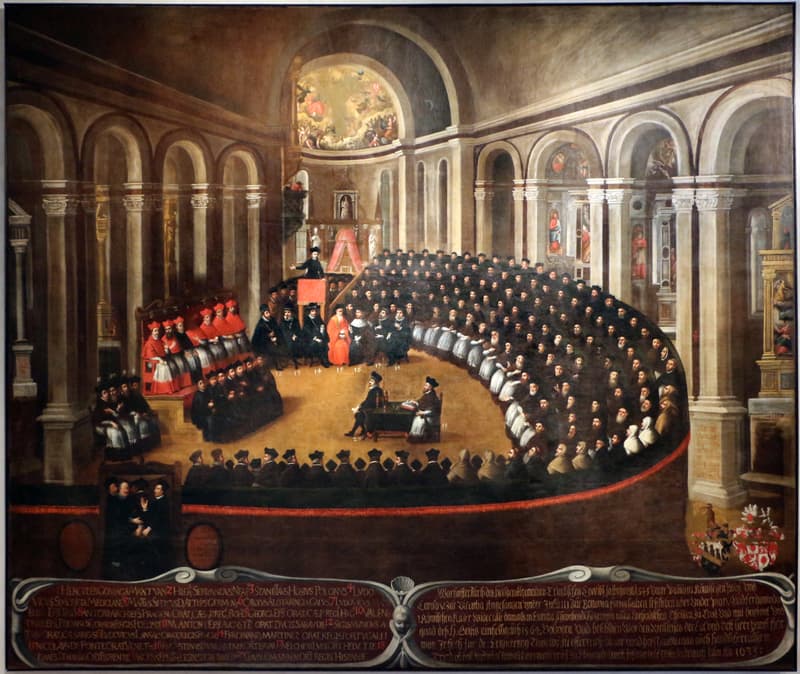
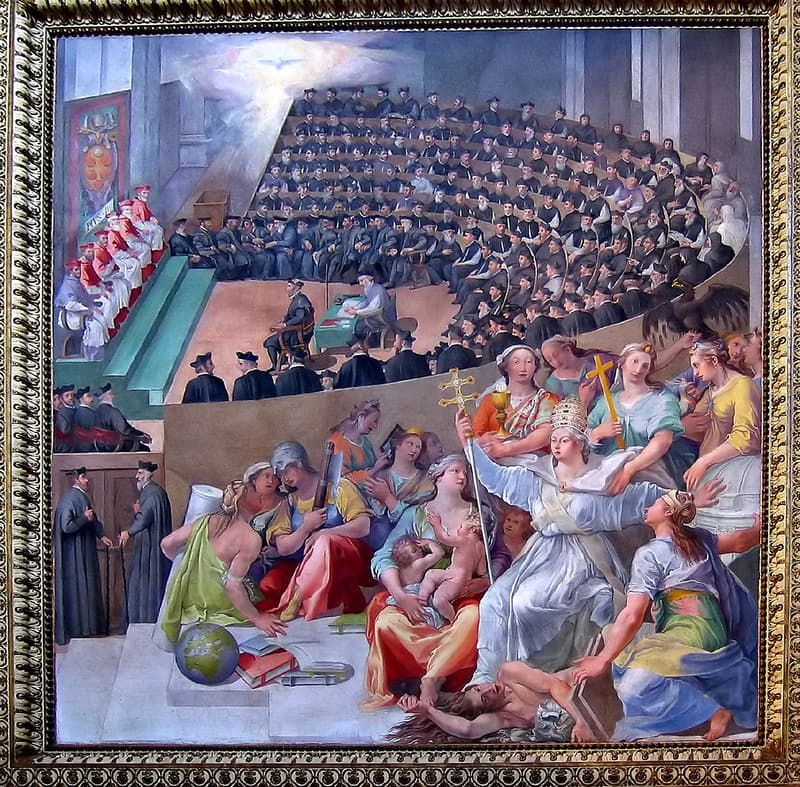
The Decree on Justification was promulgated on January 13, 1547, in the closing weeks of the Council’s first period under Paul III, before the brief 1547 translation to Bologna.3 It is the longest doctrinal decree in the Tridentine corpus—a proem, sixteen chapters of positive teaching, and thirty-three canons of explicit anathema—and it took the better part of seven months and multiple redactions to produce.4
The five moves below are not the only thing the decree does, but they are the load-bearing five. If you understand them, you understand what the council actually settled.
Move 1: Justification is a “translation”—Chapter 4
Chapter 4 of the decree opens by defining justification. It is, in the Latin, a translatio—a “translation” or “transfer”—“from that state wherein man is born a child of the first Adam, to the state of grace, and of the adoption of the sons of God, through the second Adam, Jesus Christ, our Saviour.”5
The vocabulary matters. Trent does not say justification is a legal verdict (the Reformation framing) or a renewal of the inner man (the rival schoolmen’s framing). It says justification is a translation. The believer is moved from one state to another. The state-change is real—there is a before and an after—and the agent who moves him is God. Whatever else is true about the act, it is an act in which God transfers a person from the realm of fallen Adam into the realm of redeemed Christ.
This is the framework inside which everything else in the decree happens. When Chapter 7 later talks about “the alone formal cause” being “the justice of God… whereby He maketh us just,” it is because the act is being described as a real translation of the believer into a real new state—and the form of that new state is something the decree wants to specify. When Chapter 10 talks about increase in justification, it is because the new state, once entered, can grow. When Chapter 14 talks about restoration through penance, it is because the new state, once entered, can also be lost.
Move 2: Prevenient grace is the cause—Chapters 5 and 6
The next two chapters address something the standard Protestant summary often forgets: Trent’s account of how an adult comes to justification. Chapter 5 declares that “in adults, the beginning of the said Justification is to be derived from the prevenient grace of God, through Jesus Christ, that is to say, from His vocation, whereby, without any merits existing on their parts, they are called.”6
The phrase prevenient grace—gratia praeveniens, the grace that goes before—is Augustine’s, and Trent uses it in the precise Augustinian sense. The will of fallen man cannot move itself toward justification by its own resources. God moves it first. The will’s role is only to consent—and even the consent is itself sustained by what Trent calls God’s “quickening and assisting grace.”
Chapter 6, on “the manner of preparation,” develops this further. The adult preparing for justification is “excited and assisted by divine grace”—not merely permitted, by some neutral grace, to choose for or against, but actually moved toward God by the Spirit’s interior working. The acts that follow—believing, fearing, hoping, loving God as the source of righteousness, hating sin, resolving on baptism—are all framed as the work of grace acting on a will that has been freed by grace to act.
This matters because the popular summary that “Trent makes salvation a matter of human cooperation with grace” is true only on a reading of “cooperation” that Trent itself rejects in Canon 4. The cooperation Trent affirms is the cooperation of a will that has first been moved by God. It is the cooperation Augustine described against Pelagius: God working in us to will and to work, without which we could neither will nor work. To call this Pelagian or semi-Pelagian—as the popular summary does—is to read Trent against the very anti-Pelagian tradition Trent self-consciously appropriates.
Move 3: The four causes—Chapter 7 (the watershed)
Chapter 7 is the structural center of the entire decree. It does two things. First, it defines what justification is: “not remission of sins merely, but also the sanctification and renewal of the inward man, through the voluntary reception of the grace, and of the gifts, whereby man of unjust becomes just, and of an enemy a friend, that so he may be an heir according to hope of life everlasting.”7
Notice the and. Justification is both remission of sins and the sanctification of the inner man. Trent refuses the Reformation cut between the two—but it does not collapse the second into the first. Both are present, in the same act, by the same gift.
Second, Chapter 7 walks through the causes of justification on a scholastic Aristotelian schema:
- The final cause is “the glory of God and of Jesus Christ, and life everlasting.”
- The efficient cause is “a merciful God who washes and sanctifies gratuitously.”
- The meritorious cause is “His most beloved only-begotten, our Lord Jesus Christ, who, when we were enemies, for the exceeding charity wherewith he loved us, merited Justification for us by His most holy Passion on the wood of the cross, and made satisfaction for us unto God the Father.”
- The instrumental cause is “the sacrament of baptism, which is the sacrament of faith, without which (faith) no man was ever justified.”
- And the alone formal cause—unica formalis causa—is “the justice of God, not that whereby He Himself is just, but that whereby He maketh us just, that, to wit, with which we being endowed by Him, are renewed in the spirit of our mind, and we are not only reputed, but are truly called, and are, just.”8
That last sentence is the watershed of the entire Reformation debate.
For Trent, the form of the believer’s righteousness—the principle in him by virtue of which he is righteous before God—is something inhering in him. It is given by God, never autonomous, never owed, always Christ-derived. But it is in him. He is not merely reckoned righteous; he is truly called and is just, because the Holy Spirit has poured the love of God into his heart and the righteousness so given is really there.
For Luther and Calvin and the Westminster divines, the form of the believer’s righteousness is something outside him. Christ’s perfect obedience is reckoned to the believer’s account in the moment of justifying faith; the believer remains, in himself, a sinner under grace. The Latin tag iustus extra nos—“righteous outside ourselves”—captures it. Calvin’s Institutes III.11.2 (1559) treats justification under exactly this metaphor: the sinner is reckoned righteous as an innocent man is reckoned righteous by an upright judge—by an act of pronouncement, on the basis of an alien righteousness, not by any quality that has come to inhere in him.9
This is the genuine and remaining Catholic-Protestant disagreement on justification. Everything else in the popular summary either misses the actual divergence or mislocates it. The formal-cause question is the real one.
Move 4: By faith and gratuitously—Chapter 8 (the under-cited passage)
Then Chapter 8 says something the popular Protestant summary almost never quotes: “we are therefore said to be justified by faith, because faith is the beginning of human salvation, the foundation, and the root of all Justification; without which it is impossible to please God, and to come unto the fellowship of His sons: but we are therefore said to be justified freely, because that none of those things which precede justification—whether faith or works—merit the grace itself of justification. For, if it be a grace, it is not now by works, otherwise, as the same Apostle says, grace is no more grace.”10
Read that paragraph slowly.
Trent says justification is by faith, and gives reasons: faith is the “beginning of human salvation, the foundation, and the root of all Justification.” Trent says justification is gratuitous, and gives reasons: nothing—not even faith, much less works—merits the grace of justification. The decree explicitly invokes Paul’s argument from Romans 11:6 that grace and works are mutually exclusive at the point of being a cause of grace.
This chapter exists. It was promulgated by the same council and on the same day as Canon 9. It is not a stray sentence; it is one of the most carefully redacted paragraphs in the whole decree, drafted with Augustine’s anti-Pelagian language consciously in view.
I will not pretend the chapter eliminates the Reformation debate. It does not. The formal-cause question is still on the table. But notice how much of the popular Protestant summary the chapter pre-empts. “Trent rejected sola fide”—Trent itself says justification is “by faith.” “Trent rejected sola gratia”—Trent itself says justification is gratuitous because nothing in the believer merits grace. “Trent added works to grace as the basis of salvation”—Trent itself, citing Paul, insists that grace and works as causes of grace are mutually exclusive.
When the standard summary asserts these things without quoting Chapter 8, what is being summarized is not the Tridentine decree but a polemical paraphrase of it.
When the standard summary asserts these things without quoting Chapter 8, what is being summarized is not the Tridentine decree but a polemical paraphrase of it.
Move 5: Increase, perseverance, and merit—Chapters 10 and 16
The final move of the decree’s positive teaching addresses something the Reformation tradition did genuinely deny: the increase of justification through good works performed in grace.
Chapter 10 says the justified, “advancing from virtue to virtue,” through “the observance of the commandments of God and of the Church, faith co-operating with good works, increase in that justice which they have received through the grace of Christ, and are still further justified.”11
Chapter 16, on the merit of good works, is more careful still. It grounds the merit of the justified Christologically: Christ Jesus “as the head into the members and the vine into the branches, continually infuses his virtue into the said justified, and this virtue always precedes and accompanies and follows their good works, which without it could not in any wise be pleasing and meritorious before God.” And then comes the line that, more than any other, captures Trent’s positive doctrine of merit:
“Thus, neither is our own justice established as our own as from ourselves; nor is the justice of God ignored or repudiated: for that justice which is called ours, because that we are justified from its being inherent in us, that same is (the justice) of God, because that it is infused into us of God, through the merit of Christ. Neither is this to be omitted,—that although, in the sacred writings, so much is attributed to good works, that Christ promises, that even he that shall give a drink of cold water to one of his least ones, shall not lose his reward… nevertheless God forbid that a Christian should either trust or glory in himself, and not in the Lord, whose bounty towards all men is so great, that He will have the things which are His own gifts be their merits.”12
That last clause—suam ipsius dona velit esse merita illorum, “He will have the things which are His own gifts be their merits”—is a direct echo of Augustine’s famous formula at Epistle 194: “When God crowns our merits, He crowns nothing other than His own gifts.”13
This is what Trent affirms. The justified Christian, performing works in the grace of the indwelling Spirit, truly merits the increase of grace and the attainment of eternal life—because Christ is supplying the meritorious power, and the merit is, structurally, the gift. Joseph Wawrykow’s careful reading of Aquinas has shown that the same logic governs the Thomist account of merit on which Trent draws: condign merit presupposes the grace and the Holy Spirit; reward is God’s gracious fidelity to His own ordination, not a wage owed to autonomous human achievement.14
The Reformers rejected this language because they suspected it would, in pastoral practice, drift into the Pelagianism it formally disowned. That was not an unreasonable suspicion in 1547, given the corruption of the indulgence trade and the late-medieval popular preaching Luther had grown up under. But the suspicion is about the pastoral effects of a system, not about whether the system as Trent articulates it is in fact Pelagian. Read on its own primary-source ground, Trent on merit is Augustine on merit.
What the Canons Actually Say
The decree closes with thirty-three canons of explicit anathema. The popular Protestant summary tends to focus on three or four of them, read in isolation. A careful reading puts those three or four back in the context of the surrounding canons and the chapters they implement.
Canon 1—anti-Pelagian, not anti-Reformation
Canon 1 is the first move and sets the controlling frame: “If any one saith, that man may be justified before God by his own works, whether done through the teaching of human nature, or that of the law, without the grace of God through Jesus Christ; let him be anathema.”15
This anathematizes Pelagianism. It does not anathematize anything any Reformer ever taught. Luther affirmed it, Calvin affirmed it, the Augsburg Confession affirms it, the Westminster Confession affirms it. The fact that Trent leads with this canon is a clue to the council’s self-understanding: it is not, primarily, condemning the Reformation; it is condemning the heresies the Catholic and Protestant traditions both reject.
Canon 9—read in full
Canon 9 is the canon most often cited as Trent’s anathema on sola fide. The full text reads: “If any one saith, that by faith alone the impious is justified; in such wise as to mean, that nothing else is required to co-operate in order to the obtaining the grace of Justification, and that it is not in any way necessary, that he be prepared and disposed by the movement of his own will; let him be anathema.”16
The qualifying clauses do all the work. The canon does not say “if anyone saith that justification is by faith alone, let him be anathema.” It says “if anyone saith that justification is by faith alone in such wise as to mean that nothing else is required to cooperate, and that it is not necessary that he be prepared and disposed by the movement of his own will.”
The construction Canon 9 condemns is a specific construction of sola fide—one in which the will plays no cooperative role under grace. The construction it does not condemn is one in which the will is moved by grace to cooperate, and faith is the foundational instrument of justification. That construction is Trent’s own teaching in Chapters 5, 6, and 8.
The phrase “by faith alone” therefore admits of two readings inside the Tridentine system. On one reading—the one Canon 9 anathematizes—it means a passively received forensic verdict that bypasses the will. On the other reading, it means that faith is the foundation and root of justification, the initium, by which the believer first stands in the new state of grace. The second reading is what Cajetan affirmed before Trent and what Catholic theologians from Bellarmine through Newman through Bouyer have reaffirmed since.17
R.C. Sproul, the late dean of late-twentieth-century American Reformed apologetics, read Canon 9 as condemning the Reformation gospel itself and concluded that Trent had excommunicated Paul.18 That conclusion follows only if you read Canon 9 without its qualifying clauses and without Chapter 8. With both in view, the canon strikes a narrower target, and Sproul’s reading misfires.
Canons 10, 11, and 12—the imputation question
Canon 10 anathematizes those who say “men are just without the justice of Christ, whereby He merited for us to be justified; or that it is by that justice itself that they are formally just.”19
Canon 11 anathematizes those who say “men are justified, either by the sole imputation of the justice of Christ, or by the sole remission of sins, to the exclusion of the grace and the charity which is poured forth in their hearts by the Holy Spirit, and is inherent in them; or even that the grace, whereby we are justified, is only the favour of God.”20
Canon 12 anathematizes those who say “justifying faith is nothing else but confidence in the divine mercy which remits sins for Christ’s sake; or, that this confidence alone is that whereby we are justified.”21
Read together, these three canons do not condemn imputation as such. They condemn three specific positions: (a) that the believer is formally just by Christ’s righteousness itself construed as outside him (Canon 10); (b) that justification consists in the sole imputation of Christ’s righteousness to the exclusion of inhering grace and charity (Canon 11); and (c) that justifying faith is nothing more than confidence in divine mercy—i.e., the narrow Lutheran fiducia construction (Canon 12).
What Trent leaves room for—and what several Tridentine fathers actively pressed—is an additional imputative dimension alongside the inhering renewal. The Augustinian Cardinal Girolamo Seripando, Prior General of the Augustinians and a leading theological voice on the floor of Session 6, argued at length for an explicit duplex iustitia formula, in which the believer possesses both the inhering righteousness of grace and an imputed righteousness of Christ that compensates for the inhering righteousness’ residual deficiencies.22 Seripando’s formula was the substance of the agreement that had nearly succeeded at the Regensburg Colloquy in 1541, when Catholic and Protestant theologians under Imperial pressure produced a joint Article 5 on justification that both Contarini and Bucer signed before Rome and Wittenberg both rejected it.23
Seripando lost the floor at Trent. Domingo de Soto’s more strictly Thomist construction prevailed. But Seripando’s defeat was not the defeat of imputation as such; it was the defeat of sole imputation construed against inhering charity. The decree the council promulgated condemns sole imputation; it does not condemn the broader category.
Canon 24—the increase claim
Canon 24 anathematizes those who say “the justice received is not preserved and also increased before God through good works; but that the said works are merely the fruits and signs of Justification obtained, but not a cause of the increase thereof.”24
This canon directly opposes the Reformed position that good works are fruits and evidences of justification but not its cause in any sense. Westminster Confession 16.2 codifies the Reformed alternative: good works are “the fruits and evidences of a true and lively Faith.”25
This is a real disagreement. It cannot be papered over. But notice what is—and is not—being claimed on the Tridentine side. Trent does not say that the initial justification is by works; that is anathematized in Canon 1. Trent says that the increase of an already-received justification, in a justified believer cooperating with the indwelling Spirit, is by good works performed in grace. The Reformed position denies that any “increase” makes sense at all because justification is once-for-all and complete in its initial verdict. The Tridentine position holds that the new state, once entered, is dynamic: it can grow, and it grows through the works of charity which the Spirit produces in the justified.
Canon 32—the merit claim
Canon 32 anathematizes those who say “the good works of one that is justified are in such manner the gifts of God, as that they are not also the good merits of him that is justified; or, that the said justified, by the good works which he performs through the grace of God and the merit of Jesus Christ (whose living member he is), does not truly merit increase of grace, eternal life, and the attainment of that eternal life,—if so be, however, that he depart in grace,—and also an increase of glory.”26
This is the canon Sproul and Horton and most of the contemporary Reformed critique cite as proof that Trent makes the believer’s works the cause of his salvation.27 Read in isolation it can sound that way. Read in the context of Chapter 16—the chapter Canon 32 implements—it is qualified throughout. The merit is the merit of someone “through the grace of God and the merit of Jesus Christ, whose living member he is.” The merit is preceded, accompanied, and followed by the indwelling Spirit’s infused virtue. The merit, for Trent, is the gift. As Augustine’s Epistle 194 had said and as Trent self-consciously echoes: God crowns His own gifts.
Canon 32 is the formal language of a doctrine of merit that, read against Augustine and Aquinas, is the doctrine of merit Augustine and Aquinas held—a doctrine in which the merit is not a wage owed to autonomous human achievement but a divine fidelity to the Spirit’s own work in the soul of the justified. Whether the Reformation’s wholesale rejection of merit-language was right to read this as covertly Pelagian is a fair theological question. It is not the same question as whether Trent itself was teaching Pelagianism.
What the Reformers Actually Said

Trent did not articulate itself in a vacuum. Session VI was promulgated in January 1547—seventeen years after the Augsburg Confession, ten years after the Smalcald Articles, and against the backdrop of Calvin’s first Institutio (1536) and the gathering Reformed confessions on the Continent. The Reformation positions Trent was responding to are themselves primary sources, with their own carefully drafted definitive statements. Reading them on their own ground is part of reading Trent fairly.
The Augsburg Confession Article 4
The Augsburg Confession was presented at the Diet of Augsburg on June 25, 1530, as the German Lutheran territories’ confessional statement to the Emperor. Article 4, “Of Justification,” is short—three sentences in Latin and German—but it is the foundational Lutheran symbol on the doctrine. In the public-domain Triglotta translation:
“Also they teach that men cannot be justified before God by their own strength, merits, or works, but are freely justified for Christ’s sake, through faith, when they believe that they are received into favor, and that their sins are forgiven for Christ’s sake, who, by His death, has made satisfaction for our sins. This faith God imputes for righteousness in His sight. Rom. 3 and 4.”28
This is the position Trent’s Canon 9 has in view. Two things in it deserve attention. First, Article 4 grounds justification in Christ’s satisfaction—the meritorious cause is Christ’s death, exactly as Trent Chapter 7 will affirm seventeen years later. Second, the instrument by which the believer receives the satisfaction is faith—not faith plus works, not faith plus love, not faith plus sacraments, but faith alone, which God imputes for righteousness.
Article 6, “Of New Obedience,” answers the inevitable charge of antinomianism. Faith, the Lutherans insist, “is bound to bring forth good fruits, and… it is necessary to do good works commanded by God, because of God’s will, but that we should not rely on those works to merit justification before God.”29 Justifying faith is never alone in the believer; it is always accompanied by the works that flow from it. But the works do not justify; faith does, by laying hold of Christ.
The Apology of the Augsburg Confession Article 4
When the Catholic Confutatio rejected Article 4 in August 1530, Melanchthon responded with the Apology of the Augsburg Confession, whose own Article 4 is the longest article in the entire Lutheran symbolic corpus. The Apology’s most under-cited move is its account of what justification is. The Reformers are popularly read as treating justification as a purely forensic verdict that leaves the sinner in himself unchanged. The Apology will not let the reader stop there. Justifying faith, Melanchthon writes, is not a bare cognitive assent or a bare law-court reckoning: “Therefore by faith alone we are justified, understanding justification as the making of a righteous man out of an unrighteous, or that he be regenerated.”30
The summary is restated: “by faith alone we are justified, i.e., of unrighteous men made righteous, or regenerated.”31
The point is not that Melanchthon is conceding the Tridentine doctrine. He is not. He is insisting that Lutheran justification is not a bare extrinsic verdict that leaves the sinner unchanged—it is the act by which God makes the unrighteous righteous through union with Christ by faith. The forensic and the regenerative are simultaneous and inseparable, even if they remain formally distinct. This is closer to Trent than the standard popular Lutheran summary, and it is one of the texts the 1999 Joint Declaration would later draw on to argue that the historic Lutheran position and the historic Tridentine position name the same reality under different aspects.
Luther’s Smalcald Articles, Part II Article 1
Luther himself drafted the Smalcald Articles in 1537 at Elector John Frederick’s request, as the Lutheran position to be taken to the council Pope Paul III had announced (and which would not actually convene until 1545). Part II Article 1, “Of Christ and Faith,” contains the famous line that fixes Luther’s whole project on this article alone. In the Triglotta:
“All have sinned and are justified without merit [freely, and without their own works or merits] by His grace, through the redemption that is in Christ Jesus, in His blood… Now, since it is necessary to believe this, and it cannot be otherwise acquired or apprehended by any work, law, or merit, it is clear and certain that this faith alone justifies us… Of this article nothing can be yielded or surrendered, even though heaven and earth, and whatever will not abide, should sink to ruin… And upon this article all things depend which we teach and practice in opposition to the Pope, the devil, and the [whole] world.”32
This is the tone in which Luther wrote when he wanted to be unmistakable. Articulus stantis et cadentis ecclesiae—“the article on which the church stands and falls”—is the later shorthand for the Lutheran self-understanding the Smalcald Articles articulate.
Calvin’s Institutes III.11
Calvin’s mature treatment of justification appears in Book III, Chapters 11 through 18 of the 1559 Institutio Christianae Religionis. The defining definition is at III.11.2. In Beveridge’s 1845 English: “A man is said to be justified in the sight of God when in the judgment of God he is deemed righteous, and is accepted on account of his righteousness… As an innocent man, when charged before an impartial judge, who decides according to his innocence, is said to be justified by the judge, as a man is said to be justified by God when, removed from the catalogue of sinners, he has God as the witness and assertor of his righteousness.” Justification, on Calvin’s account, consists in the forgiveness of sins and the imputation of the righteousness of Christ.33
Two things are worth noting in Calvin’s framing. First, the metaphor is forensic: a judge, an acquittal, a courtroom verdict. The sinner is reckoned righteous as an innocent man is reckoned righteous—by pronouncement, on the basis of an alien righteousness, not by any quality that has come to inhere in him. Second, Calvin places this discussion after eight chapters on the Christian life (III.6 through III.10) and immediately under the rubric of the duplex gratia he introduces at III.11.1: Christ, received by faith, bestows on the believer a twofold grace—reconciliation with God through Christ’s blamelessness (justification), and sanctification by Christ’s Spirit (the renewal of the inner life). The two graces are distinct (against Rome’s collapsing of them) but inseparable (against the antinomian charge).
The architectural point matters. Calvin will not let the reader reach his account of justification before traversing eight chapters on the necessity of self-denial, bearing the cross, and the imitation of Christ. The popular caricature of Calvin’s position as a license for indifference about sanctification cuts directly against this architecture.
The Westminster Confession Chapter 11
A century later, the English Puritan divines convened at Westminster Abbey and produced what remains the most precise codification of Reformed orthodoxy on justification in the English-speaking world. Westminster Confession Chapter 11 was completed in December 1646 and ratified by the Long Parliament in 1648. Article 1 reads:
“Those whom God effectually calleth, he also freely justifieth: not by infusing righteousness into them, but by pardoning their sins, and by accounting and accepting their persons as righteous; not for anything wrought in them, or done by them, but for Christ’s sake alone; nor by imputing faith itself, the act of believing, or any other evangelical obedience to them, as their righteousness; but by imputing the obedience and satisfaction of Christ unto them, they receiving and resting on him and his righteousness, by faith; which faith they have not of themselves, it is the gift of God.”34
The first clause—“not by infusing righteousness into them, but by pardoning their sins”—is the deliberate counter-statement to Trent Chapter 7. The Westminster divines knew exactly what Trent had said, and they specified what the Reformed position would and would not affirm. Justification is not by infused righteousness. It is by imputed righteousness—and not even by imputing the believer’s own act of faith, but by imputing Christ’s obedience and satisfaction.
Article 2 then addresses the antinomian charge as the Augsburg Confession Article 6 had: “Faith, thus receiving and resting on Christ and his righteousness, is the alone instrument of justification: yet is it not alone in the person justified, but is ever accompanied with all other saving graces, and is no dead faith, but worketh by love.”35
Where the Real Disagreement Was
The popular summary of the Catholic-Protestant divide on justification is constructed around the wrong center. It treats sola fide as the disputed phrase. But “by faith alone” is admitted by Trent in a particular sense (Chapter 8), and is denied by the Reformers in the senses Trent’s Canon 9 condemns (the Reformers also reject a faith that is unaccompanied by love and works—Augsburg Article 6, Westminster 11.2). The actual divergence is not at the level of the slogan.
It is at the level of the formal cause.
For Trent, the righteousness by which the believer is righteous before God is the inhering grace and charity poured into his soul by the Holy Spirit through union with Christ. The believer is not merely reputed just; he is just, “receiving justice within us, each one according to his own measure” (Chapter 7).
For the Reformers, the righteousness by which the believer is righteous before God is Christ’s perfect obedience reckoned to him through faith. The believer remains, considered in himself, a sinner—simul iustus et peccator, in Luther’s phrase—but he is reckoned righteous on Christ’s account.
This is a real disagreement. It is not a verbal misunderstanding. It cannot be papered over with ambiguity. Both sides have always known it was the watershed; they have not always been clear that it was the only watershed.
What the Reformers added beyond the formal-cause point—the rejection of merit as a useful theological category, the rejection of the increase of justification through good works, the rejection of any sacramental instrumentality in initial justification, the rejection of the kind of assurance Trent leaves room for—was real and consequential. But each of those rejections is a downstream consequence of the formal-cause cut. Make the formal cause extra nos, and the rest follows: there is nothing in the believer to be increased, no inhering quality the sacraments could instrumentally confer or augment, no ground for an assurance based on examination of one’s own state of grace.
Make the formal cause inhering, and the Tridentine architecture also follows: the new state really is in the believer; it really can grow through the indwelling Spirit’s works; the sacraments really are instruments by which God confers and increases it; assurance has to be moral and pastoral rather than infallible because the inhering quality, while real, is not directly accessible to introspection with the certainty of faith.
The whole sixteenth-century debate, on this reading, comes down to a single structural choice. Most of what looks like multiple disagreements is one disagreement in different applications.
Most of what looks like multiple disagreements is one disagreement in different applications.
What Newman Saw in 1838
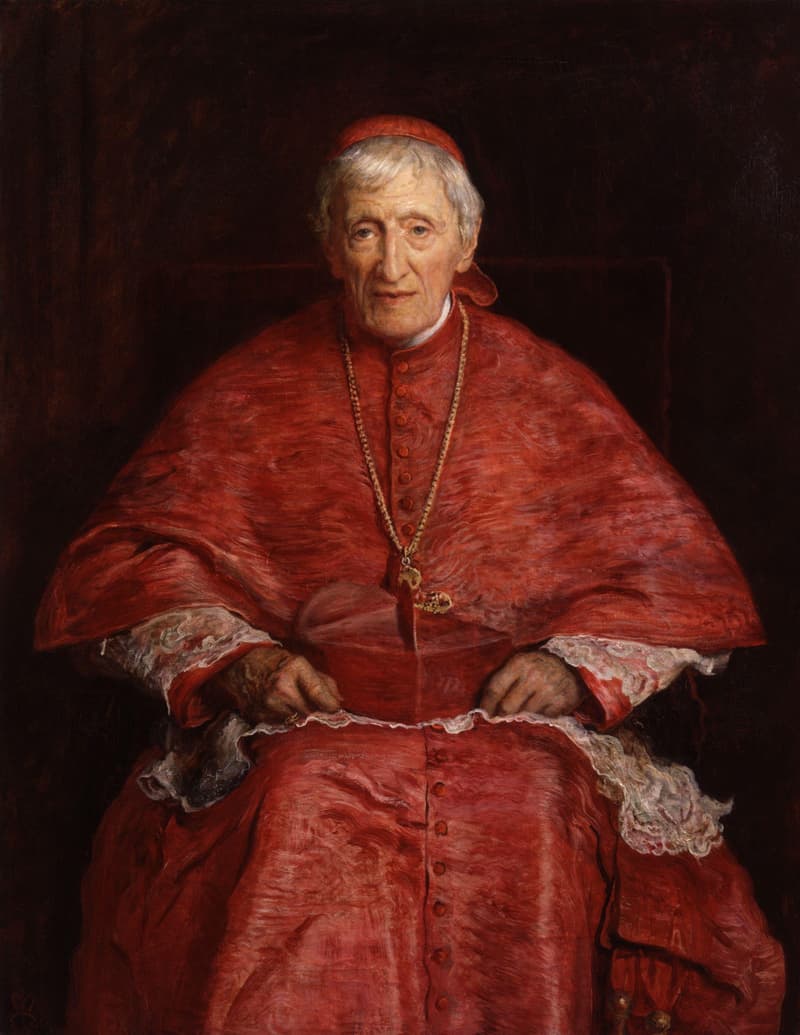
The clearest mid-nineteenth-century anglophone treatment of this question came from a man who at the time was neither Catholic nor classically Protestant. John Henry Newman published his Lectures on the Doctrine of Justification in London in 1838. He was thirty-seven years old, a Fellow of Oriel College Oxford, vicar of the University Church of St. Mary the Virgin, and seven years from his reception into the Catholic Church.
The opening of Lecture 1 frames the project: “TWO main views concerning the mode of our justification… on the one hand, that this great gift of our Lord’s passion is vouchsafed to those who are moved by God’s grace to claim it,—on the other, to those who by the same grace are moved to do their duty… the one to be the symbol of what goes by the name of Romanism, the other of what is commonly called Protestantism.”36
Newman’s verdict on the two views, also in Lecture 1: “Justification by faith only, thus treated, is an erroneous, and justification by obedience is a defective, view of Christian doctrine. The former is beside, the latter short of the truth.”37
His thesis emerges in Lecture 6, “The Gift of Righteousness.” Justification, Newman argues, is not only the imputation of Christ’s righteousness (the Lutheran reading) and not only the infusion of an inhering charity (the dominant Roman schoolmen’s reading). It is the indwelling of Christ in the soul of the justified by the Holy Spirit—a gift which is at once forensic and transformative because it is a Person, not a state or a quality. “Justifying righteousness, then, consists in the coming and presence of the Holy Ghost within us.”38
This is the via media Newman thought the Anglican settlement could occupy. He was wrong about the Anglican settlement, as he later judged. He was not wrong about the underlying theological move. The structural insight—that the imputed righteousness of Christ and the inhering grace of the Spirit are not two competing answers but partial views of one indwelling reality—is the move the 1999 Joint Declaration on the Doctrine of Justification would make a hundred and sixty-one years later.
When Newman reissued the Lectures in 1874—twenty-nine years after his Catholic conversion—his Advertisement to the third edition is striking. He prefaces the unaltered text with the explanation that “Unless the Author held in substance in 1874 what he published in 1838, he would not at this time be reprinting what he wrote as an Anglican; certainly not with so little added by way of safeguard.”39
He does qualify one element of his 1838 argument. The Tridentine fathers, Newman acknowledges, “pronounced that there was but one formal cause of justification as a state of the soul, and that, in opposition to the Protestant view, that form was an inward gift… And so far as the author of these Lectures contradicts this categorical statement, he now simply withdraws what he has said in them.”40
This is honest and important. Newman does withdraw the precise formulation of “more than one formal cause”—Trent’s unica formalis causa settles that question. What he preserves is the substantive insight: what the unique form of the justified state is—whether considered as the indwelling Christ, or as a created sanctifying grace, or as the theological virtues—remained a live question among approved Catholic theologians (Bellarmine, Pallavicino, Vasquez, Petavius), and Newman thought his own indwelling-Christ formulation could be defended within that internal Catholic latitude.
I bring up Newman not to make him out as a vindication of either side. I bring him up because his 1874 self-assessment is a model for how this whole debate should be conducted: hold the substantive insight; correct the precise formulation where the magisterial text requires it; refuse to make the dispute louder than the text itself makes it.
The 1999 Joint Declaration
What the Declaration confesses
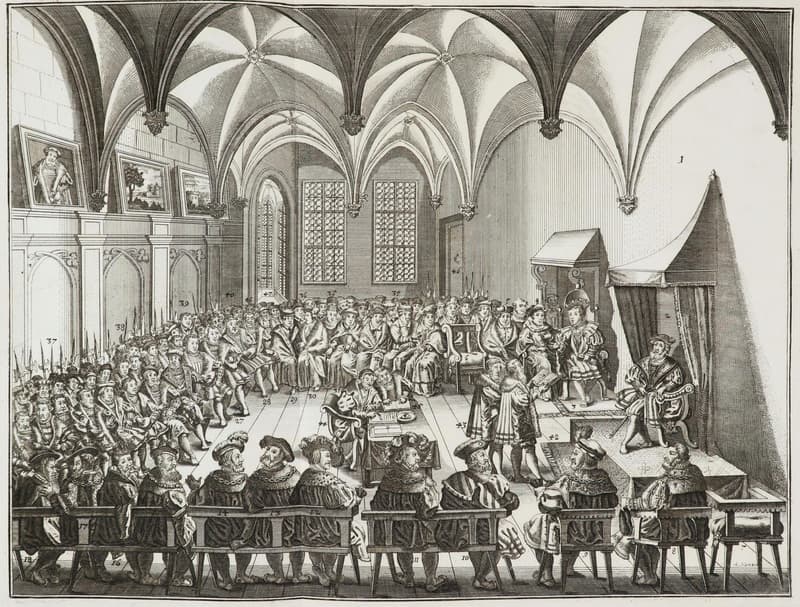
On October 31, 1999—the 482nd anniversary of Luther’s posting of the 95 Theses—the Lutheran World Federation and the Catholic Church signed the Joint Declaration on the Doctrine of Justification at Augsburg. The signatories, four in all, were Bishop Christian Krause and Dr. Ishmael Noko for the LWF, and Edward Idris Cardinal Cassidy and Bishop Walter Kasper for the Pontifical Council for Promoting Christian Unity.41
The Declaration is short—forty-four numbered paragraphs plus an Annex of three clarifications. Its central methodological move is what the document calls “differentiated consensus.” The two communions are not pretending to identical theological language. They are claiming that on the basic truths of the doctrine of justification, they hold the same content under their differing articulations, and that the historic mutual condemnations therefore “do not apply” to the teaching of either communion as articulated in this Declaration.
The load-bearing common confession is at paragraph 15: “Together we confess: By grace alone, in faith in Christ’s saving work and not because of any merit on our part, we are accepted by God and receive the Holy Spirit, who renews our hearts while equipping and calling us to good works.”42
The structural verdict on the historic condemnations is at paragraph 41: “Thus the doctrinal condemnations of the 16th century, in so far as they relate to the doctrine of justification, appear in a new light: The teaching of the Lutheran churches presented in this Declaration does not fall under the condemnations from the Council of Trent. The condemnations in the Lutheran Confessions do not apply to the teaching of the Roman Catholic Church presented in this Declaration.”43
On the specific question of merit—the locus of Trent’s Canon 32 and the Reformed objection—paragraph 38 articulates the Catholic position in language that explicitly disowns the popular caricature: “When Catholics affirm the ‘meritorious’ character of good works, they wish to say that, according to the biblical witness, a reward in heaven is promised to these works. Their intention is to emphasize the responsibility of persons for their actions, not to contest the character of those works as gifts, or far less to deny that justification always remains the unmerited gift of grace.”44
Reception across the communions
The Declaration’s reception history is itself part of the argument. The World Methodist Council formally associated with the JDDJ at the World Methodist Conference in Seoul on July 23, 2006, in a Statement of Association signed by Bishop Sunday Mbang and Rev. Dr. George Freeman alongside Bishop Mark Hanson of the LWF and Walter Cardinal Kasper.45 The Anglican Consultative Council, meeting at ACC-16 in Lusaka in April 2016, “welcomed and affirmed the substance” of the Declaration in Resolution 16.17—a weaker form of association than the Methodist or Reformed instruments, but a formal affirmation by one of the four Instruments of Communion in the Anglican world.46 The World Communion of Reformed Churches signed its own “Association with the Joint Declaration on the Doctrine of Justification” at Wittenberg on July 5, 2017, during the WCRC General Council meeting—and signed the same week, but as a separate parallel bilateral, the “Wittenberg Witness” between the LWF and the WCRC.47
Five communions, encompassing the great bulk of confessional Lutheran, Reformed, Methodist, and Catholic Christianity worldwide, now formally affirm a common confession on justification.
Critics of the Declaration
This achievement has serious critics. The leading Catholic-traditionalist critique is Christopher Malloy’s Engrafted into Christ: A Critique of the Joint Declaration (Peter Lang, 2005), which argues that the JDDJ is silent on the precise question Trent answered—the formal cause of justification—and that several portions of the Declaration are, on their face, irreconcilable with the defined Catholic dogma at Trent.48 From the Reformed side, Michael Horton’s two-volume Justification (Zondervan Academic, 2018) defends the classical Reformed forensic-imputational view at length and is sharply critical of attempts—whether the Finnish Luther school or the JDDJ—to collapse justification into participation or transformation.49 Carl Trueman’s broader methodological case is that ecumenical convergence purchased by ambiguity is, before it is bad theology, bad history: the Reformers and Trent understood each other and disagreed, and pretending otherwise is anachronistic.50
These critiques deserve to be taken seriously. The Declaration is not the end of the conversation; the formal-cause question is genuinely not resolved at its surface, and the ambiguities Malloy and Horton object to are real ambiguities, not invented ones. Walter Kasper, who as PCPCU president was a Catholic architect and signatory of the Declaration, has been candid that “differentiated consensus” names a real ecumenical category but does not pretend to dissolve all disagreement: agreement on basic truths, room for legitimate diversity, an obligation to keep working on what remains.51
What the Declaration does accomplish—and what its critics on either side cannot honestly deny—is a public, signed, and widely received finding that the historic mutual condemnations, as drafted, do not strike the actual present teaching of the other communion as either side now articulates it. That is not nothing. It is, in fact, the most consequential ecumenical result on justification in the five hundred years since Augsburg.
A note on the New Perspective on Paul
A third axis worth naming briefly: the so-called “New Perspective on Paul” associated with E.P. Sanders’ Paul and Palestinian Judaism (1977), James D.G. Dunn’s 1982 Manson Memorial Lecture, and especially N.T. Wright’s Justification: God’s Plan and Paul’s Vision (2009) and Paul and the Faithfulness of God (2013).52 Wright’s specific reframing—justification as God’s verdict that a person is incorporated into the covenant family, grounded in the death and resurrection of Christ, with future justification “according to” the whole life lived in the Spirit—is not Tridentine; Wright is an Anglican, not a Catholic, and he resists infused-righteousness language. But the structural move he makes—locating justification inside incorporation into Christ, rather than as a forensic verdict opposed to participation—lands closer to Trent’s transformative dimension than to traditional Reformed forensic-individualism. John Piper’s The Future of Justification: A Response to N.T. Wright (2007) saw the danger and pushed back hard.53 Piper was right to see the structural similarity. He was not, in my judgment, right to think Wright’s reframing requires the abandonment of the gospel he defends.
What Trent Did Not Settle
One last point. Trent settled the Catholic-Protestant boundary on justification. It did not settle the Catholic intra-tradition question on grace and free will. The boundaries within which licit Catholic theology of grace can move were drawn by a sequence of post-Tridentine condemnations—Pius V’s 1567 condemnation of the propositions of Michael Baius, Innocent X’s 1653 Cum Occasione against five Jansenist propositions, Innocent XI’s 1679 condemnation of laxist propositions on the opposite flank, and Clement XI’s 1713 Unigenitus against 101 propositions of Quesnel.54
The Jansenist propositions condemned in 1653 are worth attending to, because they show what Trent’s settlement leaves outside the bounds of permissible Catholic theology even on the Augustinian side:
“Aliqua Dei praecepta hominibus iustis volentibus et conantibus, secundum praesentes quas habent vires, sunt impossibilia; deest quoque illis gratia, qua possibilia fiant.”
“Interiori gratiae in statu naturae lapsae numquam resistitur.”
“Ad merendum et demerendum in statu naturae lapsae non requiritur in homine libertas a necessitate, sed sufficit libertas a coactione.”
“Semipelagiani admittebant praevenientis gratiae interioris necessitatem ad singulos actus, etiam ad initium fidei; et in hoc erant haeretici, quod vellent eam gratiam talem esse, cui posset humana voluntas resistere vel obtemperare.”
*“Semipelagianum est dicere, Christum pro omnibus omnino hominibus mortuum esse aut sanguinem fudisse.”*55
The first four were condemned as heretical absolutely; the fifth was condemned in the restrictive sense—i.e., that Christ died only for the predestined.56
Why this matters for the present argument: the post-Tridentine magisterium ruled out a hard-Augustinian reading that denies the universal salvific will, denies any genuine resistibility of interior grace in fallen nature, and denies freedom from intrinsic necessity as a condition of merit. Catholic theology of grace, by the time Cum Occasione and Unigenitus finished their work, was solidly anti-Pelagian (Trent), solidly anti-Lutheran on imputation alone (Trent again), but also not as Augustinian as Jansen wanted. The two licit schools that remained—the Bañezian/Thomist and the Molinist—have been arguing inside that space ever since.
The Reformation tradition watches all this and concludes that Catholic theology of grace is incoherent: it wants to be Augustinian without being Augustinian enough. The Catholic tradition watches all this and concludes that the Reformation tradition has solved the wrong problem: it has so successfully protected sola gratia that it has lost the ability to talk about the believer’s real inner transformation as anything other than an awkward appendix. Which side reads which side fairly is, of course, the standing question.
A Convert’s Read
I am writing this essay as a Catholic, and the framing is unmistakably Catholic. But I want to close with what I would say to my younger Reformed self, the one who walked into Yale Divinity School with the standard summary of Trent in hand.
What I did not understand then was that the standard summary was reading Trent backward. I had been taught Trent through Reformation and post-Reformation polemic—Calvin’s Institutes IV, the Westminster Confession’s deliberate counter-statement, the Reformed handbooks of the seventeenth century, the popular Protestant apologetics of the twentieth. Each of those sources is responding to Trent from a particular standpoint, and each is selecting the canons and chapters that bear most directly on the standpoint. None of them is wrong to do so. But all of them, taken together, gave me an inheritance in which the Tridentine text functioned mostly as a foil—a body of error against which the Reformation gospel could be displayed.
When I read Trent on its own ground, the foil function broke down. Chapter 8 said justification was by faith. Chapter 5 said the entire process was prevenient grace. Canon 1 anathematized Pelagianism in language any Reformer could have signed. Canon 9 carried the qualifying clauses. Chapter 16 grounded merit in Christ as the head and the vine. The decree was not a Pelagian work I had been told to reject; it was an Augustinian work I had been told was the rejection of Augustine.
I did not become Catholic because I was suddenly persuaded that Trent had been right and the Reformers had been wrong on every contested point. I became Catholic for a tangle of reasons—sacramental, ecclesiological, historical—most of which are off-topic here. But on this topic, the change was that I stopped being able to use the popular summary of Trent as I had been using it. Once I had read the decree, the summary did not match the text. And once the summary did not match the text, the polemical case I had been taught to make against Catholicism on justification stopped feeling like an argument and started feeling like an inheritance I had not examined.
The 1999 Joint Declaration suggests that I am not the only Christian, on either side of the divide, who has worked through this and come out somewhere unexpected. That document is not a triumphalist Catholic text. It is also not a Lutheran capitulation. It is what its drafters say it is—a differentiated consensus on basic truths, with the historic condemnations no longer applying to the present articulations of the other side. It does not erase the formal-cause question. It locates that question, alongside several others, inside a wider agreement that the historic enmity neither captured nor anathematized the actual gospel either side was professing.
For most of Christian history that would have been an unthinkable result. It was not a result anyone expected on either side in 1547 or 1646 or 1817. It is the result we have. And it is—among other things—what comes of reading the actual texts against the actual texts, instead of the popular summaries against each other.
Frequently Asked Questions
Did the Council of Trent anathematize justification by faith?
No—not in the form Lutherans and Reformed Christians actually held it. Trent’s Canon 9 anathematizes a specific construction of “by faith alone”—one in which nothing else is required to cooperate with grace, and the will plays no role under grace. Read alongside Chapter 8 of the Decree on Justification, which explicitly says that justification is by faith and is gratuitous, the canon strikes a narrower target than the popular summary suggests. The actual remaining disagreement is over the formal cause of justification—whether the righteousness by which the believer is righteous is inhering (Trent) or imputed (the Reformers)—not over the bare phrase “by faith alone.”
Does Trent deny imputation?
Not as such. Canon 11 condemns the position that justification consists in sole imputation to the exclusion of the inhering grace and charity poured forth in the heart by the Holy Spirit. Trent leaves room for an additional imputative dimension. At the council itself, the Augustinian Cardinal Girolamo Seripando pressed unsuccessfully for an explicit duplex iustitia formula combining inhering and imputed righteousness; he lost the floor to Domingo de Soto’s stricter Thomist construction. The decree the council promulgated condemned sole imputation but not the broader category.
What is “the formal cause of justification” and why does it matter?
The “formal cause” is the Aristotelian term Trent’s Chapter 7 uses for the principle in the believer by virtue of which he is righteous before God. For Trent, the formal cause is the inhering grace and charity infused by the Holy Spirit through union with Christ. For the magisterial Reformers, the formal cause is the alien righteousness of Christ reckoned to the believer through faith. This is the genuine, durable, and still-contested center of the Catholic-Protestant disagreement on justification—and almost all the other disagreements (on merit, on increase, on assurance, on sacramental instrumentality) are downstream applications of this single divergence.
What did the 1999 Joint Declaration on Justification actually do?
The Joint Declaration on the Doctrine of Justification, signed at Augsburg by the Lutheran World Federation and the Catholic Church on October 31, 1999, articulated a “differentiated consensus” on justification: a common confession that “by grace alone, in faith in Christ’s saving work and not because of any merit on our part, we are accepted by God and receive the Holy Spirit, who renews our hearts” (§15), with explicit recognition that the historic 16th-century mutual condemnations “do not apply” to the teaching now held in common (§41). The World Methodist Council associated with the Declaration in 2006, the Anglican Consultative Council affirmed its substance in 2016, and the World Communion of Reformed Churches signed its own statement of association in 2017.
Does Trent forbid the Christian from having assurance of salvation?
Trent forbids one specific kind of assurance and permits others. Chapter 9 and Canon 13 anathematize the position that one knows with the certainty of divine faith—which cannot be subject to error—that one’s sins are forgiven. Chapter 13 affirms that all should “place and repose a most firm hope in God’s help” and that God will perfect the work He has begun. The position Trent rejects is presumption (“vain confidence”); the position Trent affirms is firm hope coupled with a moral certainty of being in a state of grace based on a clear conscience. The Tridentine teaching is anti-presumption, not anti-hope.
Did the Reformers accuse Trent of teaching Pelagianism?
Some did—but the careful Reformation theologians knew that Trent’s Canon 1 anathematizes Pelagianism explicitly, and that Trent’s Chapter 5 grounds the whole process of justification in prevenient grace. The more careful Reformation critique was not that Trent was formally Pelagian but that the Tridentine system of preparation, infused grace, sacramental instrumentality, and meritorious good works would in pastoral practice drift toward Pelagianism whatever its formal statements said. That is a narrower critique than the popular charge, and a more interesting one.
What is the New Perspective on Paul, and does it change the debate?
The “New Perspective on Paul” associated with E.P. Sanders, James D.G. Dunn, and especially N.T. Wright reframes Paul’s polemic against “works of the law” as a polemic against ethnic boundary markers (circumcision, Sabbath, food laws) rather than against meritorious works in general, and reframes justification as God’s verdict that a person is incorporated into the covenant family in Christ. Wright’s reframe is not Tridentine—he resists infused-righteousness language—but it locates justification inside incorporation into Christ rather than as a forensic verdict opposed to participation, which lands structurally closer to Trent’s transformative dimension than to traditional Reformed forensic-individualism. John Piper’s The Future of Justification (2007) saw and resisted exactly this convergence. Whether Wright’s reading of Paul is exegetically sound is a live debate; that it has narrowed the Pauline ground available for the historic Catholic-Protestant divide is harder to dispute.
What’s the difference between Trent’s “merit” and Pelagianism?
Pelagianism teaches that fallen man can, by his own unaided will, perform works that genuinely earn divine favor and salvation. Trent—on Chapter 16 and Canon 32—teaches that the justified believer, performing works in the grace of the indwelling Spirit, truly merits the increase of grace and the attainment of eternal life, if he perseveres in grace. The merit Trent affirms is the merit of someone “through the grace of God and the merit of Jesus Christ, whose living member he is.” The merit is preceded, accompanied, and followed by the indwelling Spirit’s infused virtue. As Augustine had said and as Trent self-consciously echoes: God crowns His own gifts.
Footnotes
1. The longer story of my conversion is the subject of a separate essay defending the Catholic answer to the Reformation's most foundational claim. This essay is a sequel: it works through the central Reformation dividing line itself, primary sources in hand.
2. Joint Declaration on the Doctrine of Justification, signed at Augsburg by the Lutheran World Federation and the Catholic Church, October 31, 1999. Official English text at the Pontifical Council for Promoting Christian Unity, vatican.va. The Methodist, Anglican, and Reformed receptions are detailed in fns. 45–47 below.
3. The Council met in three discontinuous periods: 1545–1547 (under Paul III), 1551–1552 (under Julius III, with Lutheran observers), and 1562–1563 (under Pius IV, closing December 4, 1563). Session 6 falls in the closing weeks of the first period.
4. Hubert Jedin, A History of the Council of Trent, vol. 2: The First Sessions at Trent, 1545–1547, trans. Ernest Graf (London: Thomas Nelson, 1961), is the standard scholarly history of the drafting of Session 6. For the floor debates and the Seripando vote, see Jedin’s detailed reconstruction at vol. 2, chs. 6–8.
5. Council of Trent, Session 6, Chapter 4, in J. Waterworth, trans., The Canons and Decrees of the Sacred and Oecumenical Council of Trent (London: Dolman, 1848), 31. Public domain. Hosted at Hanover Historical Texts Project. All subsequent Trent Session 6 quotations are from this edition unless otherwise noted.
6. Trent Session 6, Ch. 5, Waterworth 32–33.
7. Trent Session 6, Ch. 7, Waterworth 34.
8. Trent Session 6, Ch. 7, Waterworth 34–35. The Latin unica formalis causa at this point is decisive: there is one formal cause of justification, and that one form is the inhering righteousness given by God. The phrase “not that whereby He Himself is just, but that whereby He maketh us just” is drawn directly from Augustine’s De Spiritu et Littera 9.15, on which Trent is consciously building.
9. John Calvin, Institutes of the Christian Religion III.11.2, trans. Henry Beveridge (Edinburgh: Calvin Translation Society, 1845). Public domain. Hosted at CCEL.
10. Trent Session 6, Ch. 8, Waterworth 36.
11. Trent Session 6, Ch. 10, Waterworth 37–38.
12. Trent Session 6, Ch. 16, Waterworth 43–44.
13. Augustine, Epistle 194 (to Sixtus), 5.19: “Cum Deus coronat merita nostra, nihil aliud coronat quam munera sua.” The formula appears across Augustine’s anti-Pelagian corpus and is taken up by Aquinas at ST I-II q. 114 a. 3, on which Trent Ch. 16 builds.
14. Joseph P. Wawrykow, God’s Grace and Human Action: “Merit” in the Theology of Thomas Aquinas (Notre Dame: University of Notre Dame Press, 1995), ISBN 978-0268010317. Wawrykow’s central argument is that Aquinas grounds merit in the prior, sovereign, predestining grace of God; reward is God’s gracious fidelity to His own ordination, not a wage owed to autonomous human achievement. Trent’s doctrine of merit is best read through this Thomist account.
15. Trent Session 6, Canon 1, Waterworth 44.
16. Trent Session 6, Canon 9, Waterworth 45.
17. See, e.g., Robert Bellarmine, Disputationes de controversiis Christianae fidei adversus huius temporis haereticos, 4 vols. (Ingolstadt, 1586–1593), vol. 4, controversy IX, De justificatione; and Louis Bouyer, The Spirit and Forms of Protestantism, trans. A. V. Littledale (Westminster, MD: Newman Press, 1956), chs. 1–3.
18. R.C. Sproul, Faith Alone: The Evangelical Doctrine of Justification (Grand Rapids: Baker Books, 1995), ISBN 978-0801010903; reissue paperback (Baker Books, 2017), ISBN 978-0801019494. Sproul’s argument throughout, and especially in chs. 6–7, is that Trent’s Canon 9 anathematizes the Reformation gospel itself.
19. Trent Session 6, Canon 10, Waterworth 45.
20. Trent Session 6, Canon 11, Waterworth 46.
21. Trent Session 6, Canon 12, Waterworth 46.
22. On Seripando’s position, see Hubert Jedin, Papal Legate at the Council of Trent: Cardinal Seripando, trans. Frederic C. Eckhoff (St. Louis: B. Herder, 1947), chs. 9–11; and Anthony N. S. Lane, Justification by Faith in Catholic-Protestant Dialogue: An Evangelical Assessment (London: T&T Clark, 2002), 45–73.
23. The Regensburg Article 5 of May 2, 1541, was negotiated by Eck, Pflug, and Gropper for the Catholic side and Melanchthon, Bucer, and Pistorius for the Protestant side, with the papal legate Cardinal Gasparo Contarini approving from above. The article articulated a duplex iustitia formula. Luther denounced it as “a wide-mouthed and patchwork thing” and Rome’s consistory under Paul III rejected it later that month. See Lane, Justification by Faith, ch. 3, for the text and critical reception.
24. Trent Session 6, Canon 24, Waterworth 47.
25. Westminster Confession of Faith 16.2.
26. Trent Session 6, Canon 32, Waterworth 48–49.
27. Sproul, Faith Alone, ch. 7; Michael Horton, Justification, vol. 2 (Grand Rapids: Zondervan Academic, 2018), ISBN 978-0-310-57838-3.
28. Augsburg Confession (1530), Article IV, in Triglot Concordia: The Symbolical Books of the Ev. Lutheran Church, trans. F. Bente and W. H. T. Dau (St. Louis: Concordia, 1921). Public domain. Hosted at Project Wittenberg.
29. Augsburg Confession (1530), Article VI, Triglotta 1921. Hosted at Project Wittenberg.
30. Apology of the Augsburg Confession (Melanchthon, 1531), Article IV, in Triglotta 1921. Hosted at Project Wittenberg. Emphasis added.
31. Apology, Article IV, Triglotta 1921 (Part 5, “That We Obtain Remission of Sins by Faith Alone in Christ”), restatement following the load-bearing definitional sentence.
32. Smalcald Articles (1537), Part II, Article 1, “Of Christ and Faith,” Triglotta 1921. Hosted at Project Wittenberg. The Triglotta wording (“Of this article nothing can be yielded or surrendered”) differs slightly from the Tappert (“Nothing in this article can be given up or compromised”) and Kolb-Wengert renderings; the underlying German is unchanged.
33. Calvin, Institutes III.11.1–2, Beveridge trans. The duplex gratia framework is at III.11.1; the definition is at III.11.2.
34. Westminster Confession of Faith (1646), Chapter 11, Article 1. Public domain. Hosted at OPC American Standard Edition, materially identical to the 1646 original at this chapter.
35. Westminster Confession 11.2.
36. John Henry Newman, Lectures on the Doctrine of Justification (London: J. G. F. & J. Rivington, 1838), Lecture 1, opening. Public domain. Hosted at the Newman Reader (Birmingham Oratory / National Institute for Newman Studies), set from the 1908 Longmans 9th impression of the 1874 third edition.
37. Newman, Lectures on Justification, Lecture 1, §1.
38. Newman, Lectures on Justification, Lecture 6, “The Gift of Righteousness.”
39. Newman, “Advertisement to the Third Edition,” Lectures on the Doctrine of Justification, 3rd ed. (London: Rivingtons, 1874), signed “THE ORATORY, January 6, 1874.” Hosted at the Newman Reader.
40. Newman, “Advertisement to the Third Edition,” 1874. Newman cites Bellarmine, Pallavicino, Vasquez, Sporer, and Petavius as Catholic theologians of approved standing who had treated what the unique formal cause is as a question admitting of more than one answer within the Tridentine bounds.
41. The four signatories at Augsburg, October 31, 1999, were Bishop Christian Krause (President, LWF) and Dr. Ishmael Noko (General Secretary, LWF); Edward Idris Cardinal Cassidy (President, PCPCU) and Bishop Walter Kasper (Secretary, PCPCU). The signing was photographed; both Noko and Kasper appear as the actual hand-signers in the contemporary photographs, with Krause and Cassidy signing as principals of their respective bodies.
42. Joint Declaration on the Doctrine of Justification, §15, official Vatican English text at vatican.va.
43. JDDJ §41, vatican.va.
44. JDDJ §38, vatican.va.
45. “Statement of Association of the World Methodist Council and its Member Churches with the Joint Declaration on the Doctrine of Justification,” signed July 23, 2006, at the World Methodist Conference in Seoul. Signatories: Bishop Sunday Mbang (WMC Chair), Rev. Dr. George Freeman (WMC GS); Bishop Mark Hanson (LWF); Walter Cardinal Kasper (PCPCU). See worldmethodistcouncil.org.
46. Anglican Consultative Council Resolution 16.17, “Joint Declaration on the Doctrine of Justification,” adopted at ACC-16, Lusaka, Zambia, April 8–19, 2016. Publicly received and presented at Westminster Abbey, London, October 31, 2017. Hosted at anglicancommunion.org. The ACC affirmation is weaker than the Methodist or Reformed instruments—it “welcomes and affirms the substance” rather than constituting a formal accession.
47. “Association of the World Communion of Reformed Churches with the Joint Declaration on the Doctrine of Justification,” signed July 5, 2017, at the Town Church (Stadtkirche), Wittenberg, Germany. Signatories: Rev. Dr. Jerry Pillay (WCRC President), Rev. Dr. Chris Ferguson (WCRC GS); Bishop Munib Younan (LWF); Rev. Dr. Martin Junge (LWF GS); Kurt Cardinal Koch (PCPCU); Bishop Ivan Abrahams (WMC). The same week and location also saw the signing of the “Wittenberg Witness”—a separate, parallel LWF-WCRC bilateral document, often confused with the JDDJ accession but distinct from it.
48. Christopher J. Malloy, Engrafted into Christ: A Critique of the Joint Declaration, American University Studies, Series VII: Theology and Religion 233 (New York: Peter Lang, 2005), ISBN 978-0820474083. Malloy’s three central charges: the Declaration overstates resolution by claiming no remaining church-dividing differences; it is conspicuously silent on the formal cause of justification; and it cannot consistently be claimed to harmonize with both Trent and the Lutheran Confessions, since those documents contradict one another on the disputed points.
49. Michael Horton, Justification, 2 vols., New Studies in Dogmatics (Grand Rapids: Zondervan Academic, 2018), ISBN 978-0-310-49160-6 (vol. 1) and 978-0-310-57838-3 (vol. 2). Volume 2 is the principal engagement with contemporary biblical scholarship and ecumenical convergence.
50. Carl R. Trueman, Histories and Fallacies: Problems Faced in the Writing of History (Wheaton: Crossway, 2010), ISBN 978-1-58134-923-8; and Trueman, Luther on the Christian Life: Cross and Freedom (Wheaton: Crossway, 2015), ISBN 978-1-4335-2502-5.
51. Walter Kasper, Harvesting the Fruits: Basic Aspects of Christian Faith in Ecumenical Dialogue (London/New York: Continuum, 2009), ISBN 978-1441162724, especially ch. 2, “Salvation, Justification, Sanctification.” Bruce D. Marshall’s “Justification as Declaration and Deification,” International Journal of Systematic Theology 4, no. 1 (March 2002): 3–28, DOI: 10.1111/1463-1652.00070, supplies the systematic backbone for treating the JDDJ as a genuine convergence rather than a verbal compromise.
52. E. P. Sanders, Paul and Palestinian Judaism: A Comparison of Patterns of Religion (Philadelphia: Fortress, 1977), ISBN 978-0800618995; James D. G. Dunn, “The New Perspective on Paul,” Bulletin of the John Rylands Library 65, no. 2 (1983): 95–122, available at Manchester Hive; N. T. Wright, Justification: God’s Plan and Paul’s Vision (Downers Grove: IVP Academic, 2009), ISBN 978-0830838639; and Wright, Paul and the Faithfulness of God, Christian Origins and the Question of God 4 (Minneapolis: Fortress, 2013), ISBN 978-0800626839.
53. John Piper, The Future of Justification: A Response to N. T. Wright (Wheaton: Crossway, 2007), ISBN 978-1-58134-964-1. The Carson-O’Brien-Seifrid project, Justification and Variegated Nomism, vol. 2: The Paradoxes of Paul (Mohr Siebeck/Baker, 2004), ISBN 978-3-16-148400-1, mounts the parallel scholarly case against the New Perspective.
54. Pius V, Ex omnibus afflictionibus (1567), Denzinger-Hünermann §§1901–1980, condemning 79 propositions of Michael Baius; Innocent X, Cum Occasione (May 31, 1653), DH §§2001–2007 (older Bannwart numbering DH 1092–1096), condemning five Jansenist propositions; Innocent XI’s 1679 condemnation of 65 laxist propositions, DH §§2101–2167; Clement XI, Unigenitus Dei Filius (September 8, 1713), DH §§2400–2502, condemning 101 propositions of Pasquier Quesnel.
55. Innocent X, Cum Occasione, propositions 1–5, in Heinrich Denzinger and Adolf Schönmetzer, eds., Enchiridion Symbolorum, 36th ed. (1976), DS 2001–2005. The Latin text is hosted at Documenta Catholica Omnia; the standard 19th-century English translation by T.A. Buckley is at Wikisource.
56. Censures from Cum Occasione, DS 2006: propositions 1, 2, and 3 condemned simply as heretical; proposition 4 as “false and heretical”; proposition 5 as “false, rash, scandalous, and—understood in the sense that Christ died for the salvation only of the predestined—impious, blasphemous, contumelious, derogating from divine goodness, and heretical.”

Garrett Ham
Garrett Ham is an attorney, military veteran, and holds a Master of Divinity from Yale Divinity School. He writes from Northwest Arkansas on theology, law, and service.
Related Posts

The Second Letter to the Corinthians — The Letter No One Doubted and No One Can Agree Is One Letter
A Catholic on 2 Corinthians — Paul's most personal letter, its power-in-weakness gospel, and the integrity debate behind a book the Church never doubted.

The First Letter to the Corinthians — The Oldest Words in the New Testament and Its Road Into the Canon
A Catholic on 1 Corinthians — the quarrelsome church whose letter preserves the oldest creed and the earliest Eucharist in the New Testament, and its road into the canon.

The Book of Romans — Paul's Masterwork and Its Road Into the Canon
A Catholic on the Book of Romans — the one letter no critic could deny, the most tangled text in the New Testament, and why it stands first among Paul's letters.
Stay Informed
Get new writing on faith, law, and service delivered to your inbox.
No spam. Unsubscribe anytime.