Pope Saint Pius I: The Tenth Pope, the Brother of Hermas, and the Roman Church That Fought Marcion

On This Page
The tenth in a series on the popes.
With Hyginus, the ninth pope, the record gave us a vivid crisis and a dim man: Gnosticism arriving in force at Rome while the bishop himself remained a name and an ordinal. Pius I, his successor, is the inverse of that inversion. Here the man finally comes into something like focus—not through the legends the later chronicles heaped on him, but through a single, almost offhand sentence in the oldest list of New Testament books we possess, which happens to tell us who his brother was and what that brother wrote. And the crisis sharpens too: it was under Pius that the Roman church confronted Marcion, the most dangerous heretic of the century, and excluded him from communion. The tenth pope is the first since the apostolic generation about whom we can say something genuinely personal, and the something we can say is strange and human and well-attested all at once.
This is the tenth entry in my series on the popes, following Peter, Linus, Anacletus, Clement, Evaristus, Alexander I, Sixtus I, Telesphorus, and Hyginus. If Hyginus was the test case for a martyr-title with no early evidence behind it, Pius is the test case for the opposite problem: a pope with almost too much attached to his name—a brother who wrote a near-scriptural book, a heretic he expelled, a clutch of decrees and church attributions the Liber Pontificalis hung on him centuries later. The work of reading him honestly is the work of sorting the one solid datum from the accretions, and the solid datum turns out to be the strangest of them all.
A Name in the List, Counted Two Ways
The earliest witness to Pius is, as for every pope in this stretch, Irenaeus of Lyons. In Book III of his Adversus Haereses (Against Heresies), written around AD 180 to refute the Gnostic claim to a secret apostolic tradition, Irenaeus sets out the public, traceable succession of Roman bishops as his counter-argument: the true teaching is the one preserved openly in the named line at Rome. Pius appears in that list in the plainest possible terms, slotted between his predecessor and his successor:
then, sixth from the apostles, Sixtus was appointed; after him, Telephorus, who was gloriously martyred; then Hyginus; after him, Pius; then after him, Anicetus. Soter having succeeded Anicetus, Eleutherius does now, in the twelfth place from the apostles, hold the inheritance of the episcopate.1
“Then Hyginus; after him, Pius; then after him, Anicetus.” The placement is unambiguous, and one detail in it matters for a later section: Irenaeus pauses to call Telesphorus, two popes back, the one “who was gloriously martyred,” and gives Pius no such epithet. The silence is the same one that hangs over Hyginus, and it will matter when we come to the martyr question.
As with Hyginus, the number attached to Pius depends on how one counts, though here the discrepancy is milder. Counting Peter himself as the first pope—the modern Catholic convention this series follows—the line runs Peter, Linus, Anacletus, Clement, Evaristus, Alexander, Sixtus, Telesphorus, Hyginus, Pius: Pius is the tenth. Counting only Peter’s successors, so that Linus is the first and Peter stands at the head of the list rather than within it, Pius is the ninth—and that is exactly how the Catholic Encyclopedia phrases it. After the bare opening line, “Date of birth unknown; pope from about 140 to about 154,” the article’s very next sentence states flatly that, on Irenaeus’s list, “Pius was the ninth successor of St. Peter.”2 The two numbers are not a disagreement about where Pius stands; they are two conventions for counting the same fixed position in the same undisputed line. This series takes Peter as the first pope, which makes Pius the tenth.
The Dates We Can Almost Fix
For most of the early popes, the chronology is a fog—a regnal length borrowed from Eusebius laid over a start-date borrowed from Eusebius, with no external check on either. Pius is the welcome exception. His dates are the most securely anchored of anyone in this part of the list, and the anchor is a death in another city entirely.
The Catholic Encyclopedist Johann Peter Kirsch lays out the reasoning. The conventional range is c. 140 to c. 154, and Kirsch explains precisely why the back end can be trusted:
The only chronological datum we possess is supplied by the year of St. Polycarp of Smyrna’s death, which may be referred with great certainty to 155-6. On his visit to Rome in the year before his death Polycarp found Anicetus, the successor of Pius, bishop there; consequently, the death of Pius must have occurred about 154.3
This is a real argument from real evidence, and it is worth savoring after so many pages of guesswork. Polycarp of Smyrna, the disciple of the Apostle John, made a famous journey to Rome late in his life to confer with the Roman bishop about the date of Easter. We can date Polycarp’s martyrdom to 155 or 156 with unusual confidence. When he arrived in Rome the bishop he met was Anicetus—Pius’s successor, not Pius. Therefore Pius was already dead by the time of the visit, which puts his death around 154. The front end of the range, c. 140, follows from working backward across the reign.
The length of that reign comes from Eusebius, who in his Church History records both the accession and the term. Pius takes office when Hyginus dies—“But Hyginus having died at the close of the fourth year of his episcopate, Pius succeeded him in the government of the church of Rome”—and reigns fifteen years: “And in Rome Pius died in the fifteenth year of his episcopate, and Anicetus assumed the leadership of the Christians there.”4 A fifteen-year pontificate ending around 154 lands the accession near 139 or 140, and the two figures—Eusebius’s regnal length and the Polycarp anchor—agree with each other. For the early papacy, that is as good as the evidence ever gets.
The later sources, predictably, make a hash of it. The Liber Pontificalis, the sixth-century papal chronicle, assigns Pius a reign of “nineteen years, four months, and three days” (ann. XVIIII m. IIII d. III), dates his accession to the consulship of Clarus and Severus (AD 146), and places him “in the time of Antoninus Pius.”5 The nineteen-year figure contradicts Eusebius’s fifteen; the 146 accession contradicts the c. 140 that the Polycarp anchor requires; and a reign of nineteen years from 146 would run to 165, well past the point where Anicetus is known to have been bishop. The Liberian Catalogue, the fourth-century list the Liber Pontificalis drew on, gives the dates 146 to 161—and Kirsch dismisses these too, noting that they “rest on a false calculation of earlier chroniclers, and cannot be accepted.”6 The lesson is the familiar one: where the later chronicles offer precision, the precision is manufactured, and the honest range is the looser c. 140–154 that the Polycarp synchronism actually supports.
The Brother of Hermas
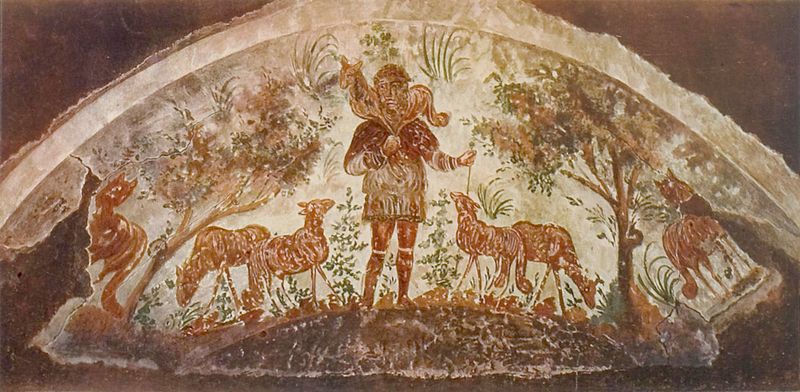
Here is what sets Pius apart from every pope before him in this series: we know something about his family, and we know it from a source older and stranger than any papal chronicle. The tenth pope was the brother of the man who wrote The Shepherd of Hermas.
The witness is the Muratorian Fragment—the oldest surviving list of the books the Church received as Scripture, an inventory most scholars date to around AD 170, within living memory of Pius himself. The fragment is a battered, barbarously copied Latin text, but at one point it pauses over The Shepherd, a wildly popular Christian book of visions and moral exhortation, to explain why it should be read privately but not treated as Scripture. In doing so it drops the datum that concerns us:
But Hermas wrote the Shepherd very recently, in our times, in the city of Rome, while bishop Pius, his brother, was occupying the [episcopal] chair of the church of the city of Rome. And therefore it ought indeed to be read; but it cannot be read publicly to the people in church either among the Prophets, whose number is complete, or among the Apostles, for it is after [their] time.7
The Latin is explicit on the relationship—pio episcopo fratre eius, “bishop Pius, his brother”—and on the timing: nuperrime temporibus nostris, “very recently, in our times.” This single sentence does a remarkable amount of work. It tells us that Pius had a brother named Hermas; that Hermas wrote The Shepherd; that the writing happened during Pius’s pontificate, which the fragment’s author regarded as recent; and, by implication, that the fragment itself was composed not long after Pius’s death. The whole conventional dating of The Shepherd to the mid-second century rests on this notice, against the book’s own internal fiction, which pretends to a setting two generations earlier.8
And the brother datum is not a lonely one. The same fact is recorded independently in the Liberian Catalogue, the fourth-century Roman list, which is why Kirsch treats it as the one piece of the Liber Pontificalis’s Pius material that can actually be trusted: “From a notice in the ‘Liberian Catalogue’… which is confirmed by the Muratorian Fragment… we learn that a brother of this pope, Hermas by name, published ‘The Shepherd.’”9 Two independent witnesses, one of them nearly contemporary, agreeing on a homely biographical fact: by the standards of second-century papal history, this is bedrock.
What kind of book did the pope’s brother write? The Shepherd of Hermas was, for a stretch of the second and third centuries, very nearly Scripture. It is a long allegory—Bruce Metzger compares it to Pilgrim’s Progress, “but more impressive in that it purports to convey a series of divine revelations”—in which a series of visions, mandates, and parables are delivered to the narrator Hermas, partly by an aged woman who personifies the Church and partly by an angel who appears in the dress of a shepherd.10 It was read aloud in churches, cited as authoritative by Irenaeus and Clement of Alexandria, and bound right into the great fourth-century biblical manuscript Codex Sinaiticus, after the New Testament. The Muratorian Fragment’s careful ruling—read it, yes, but not publicly alongside the Prophets and Apostles, because it is too recent—captures exactly the borderline status of a book everyone valued and no one could quite canonize.
There is a tantalizing, and frequently misread, further wrinkle. The Shepherd itself contains an internal notice that seems to point to a different and earlier date. In the second Vision, Hermas is told to write out his revelation and distribute it:
Thou shalt therefore write two little books, and shalt send one to Clement, and one to Grapte. So Clement shall send to the foreign cities, for this is his duty… But thou shalt read (the book) to this city along with the elders that preside over the Church.11
The “Clement” here has long been read as Clement of Rome, who died around the turn of the first century—which would put Hermas a full two generations before Pius. The two data points are not actually in conflict once the genre is understood: the Clement reference belongs to the book’s literary fiction, a pseudo-archaic frame, while the Muratorian notice records the real circumstances of composition. Scholars reconcile them by treating the work as written under Pius “under the fiction of his predecessor’s age,” or by positing composite authorship over time. The point to hold onto is that the external, datable witness—the Muratorian Fragment—places the actual writing in Pius’s own pontificate. The two notices must be kept distinct; merging them is a standard error.
One more inference is worth flagging with appropriate caution. Hermas describes himself in The Shepherd as a former slave, later freed, who took up trade and lost his fortune. If that self-portrait is historical rather than literary, it would make Pius the brother of a freedman and so a man of humble, possibly servile, origin himself. Kirsch states the caveat exactly: “If the information which the author gives concerning his personal conditions and station… were historical, we should know more about the origin of the pope, his brother. It is very possible that the story which Hermas relates of himself is a fiction.”12 So the servile-origin reading is an inference from a possibly fictional self-description—suggestive, not certain. What is certain is the brotherhood, and through it a thread that ties the tenth pope to one of the most beloved books of the early Church.
Marcion, Valentinus, and the Roman Front Line
If Hyginus’s Rome was where Gnosticism arrived, Pius’s Rome was where the Church fought back—and the adversary who gives the reign its drama is Marcion of Sinope. Marcion was the shipowner from Pontus who built the most coherent and most dangerous heresy the second-century Church faced: a system that opposed the just but inferior creator-God of the Old Testament to the good, previously unknown Father of Jesus, and that followed this dualism to the point of rejecting the Hebrew Scriptures wholesale and cutting the New Testament down to a censored Gospel of Luke and ten edited letters of Paul.13
Marcion’s break with the Roman church is conventionally dated to around AD 144, squarely within Pius’s pontificate, and the date comes from Tertullian, who in his Against Marcion works out the interval between Christ and Marcion:
In the fifteenth year of Tiberius, Christ Jesus vouchsafed to come down from heaven… Now, from Tiberius to Antoninus Pius, there are about 115 years and 6-1/2 months. Just such an interval do they place between Christ and Marcion.14
The fifteenth year of Tiberius falls around AD 29; add the 115-odd years and the result lands near 144, under the emperor Antoninus Pius—on whose name Tertullian cannot resist a pun, calling Marcion “a heretic of the Antonine period, impious under the pious.” (The emperor Antoninus Pius is not to be confused with our Pope Pius, who happened to reign during his rule.) Tertullian gives the interval; the precise “144” is a scholarly reconstruction built on it. What matters is that Marcion’s emergence and rupture belong to the years Pius held the Roman chair—and the Catholic Encyclopedia draws the consequence directly: Marcion, it says, was “excluded from communion by Pius.”15
A note of precision is owed here, because the sources do not all line up neatly. Irenaeus, our earliest witness, dates the flourishing of these heretics by Roman bishop, and his scheme is careful: Valentinus, the great Gnostic teacher, “came to Rome in the time of Hyginus, flourished under Pius, and remained until Anicetus,” while Marcion himself, succeeding his teacher Cerdo, “flourished under Anicetus.”16 On Irenaeus’s own reckoning, then, Marcion’s peak activity falls under Pius’s successor. The two pictures are reconciled the same way historians always reconcile them: Marcion arrived at Rome and broke with the Church under Pius, around 144, and went on building his rival church—which spread with alarming speed across the empire—into the reign of Anicetus. The excommunication belongs to Pius; the floruit spilled past him. It is worth getting this right, because it is easy to find the claim that “Irenaeus says Marcion was condemned under Pius,” and Irenaeus says no such thing: he assigns Marcion’s flowering to Anicetus and only Valentinus’s to Pius.
The larger truth is the conjunction. Under Pius, the Roman church was simultaneously home to Valentinus’s sophisticated Gnostic school, confronting and expelling Marcion’s dualist counter-church, and host to Justin Martyr, the most important Christian philosopher of the age, who—in the Catholic Encyclopedia’s words—“expounded the Christian teachings during the pontificate of Pius and that of his successor.”17 Justin’s First Apology, addressed to the emperor around 155, comes out of exactly this Roman milieu. Pius’s city was the intellectual battleground of mid-second-century Christianity, and the careful, public succession list that Irenaeus would later wield against the Gnostics was being forged in the very years the heretics were thickest on the ground.
What the Liber Pontificalis Made of Him
Where the early sources give us a brother and a heretic, the Liber Pontificalis gives us decrees—and, as with every early pope, the decrees turn out to be later constructions rather than memories. For Pius the chronicle supplies three substantive claims, and all three dissolve under inspection.
The first is a ruling on Easter. The Liber Pontificalis says that during Pius’s episcopate his brother Hermas wrote The Shepherd, in which an angel “commanded him that Easter be celebrated only on the Lord’s day” (ut Paschae die dominico celebraretur).18 This is a tidy attempt to give Pius a stake in the great second-century controversy over the date of Easter—but it collapses on a single fact, which Louise Ropes Loomis flagged in a one-line footnote to her 1916 translation: “There is no mention of Easter in the book of Hermas.”19 The angelic Easter-command simply is not in The Shepherd. And the genuine flashpoint of the Easter question fell not under Pius but under his successor: it was Anicetus whom Polycarp came to Rome to confer with about the Quartodeciman practice. The Liber Pontificalis has retrojected a later concern onto Pius and tied it, falsely, to his brother’s book.
The second claim is disciplinary: that Pius “decreed that a heretic coming out of the heresy of the Jews should be received and baptized.”20 The phrasing itself betrays its lateness—it treats Judaism as a “heresy,” a categorization that belongs to a much later period—and Kirsch applies the standard verdict the Liber Pontificalis earns again and again: “What this means we do not know; doubtless the author of the ‘Liber Pontificalis,’ here as frequently, refers to the pope a decree valid in the Church of his own time.”21 A sixth-century compiler, wanting to fill the silence, has dressed a rule of his own era in second-century clothes.
The third and most colorful claim is architectural: that Pius, at the request of Saint Praxedis, dedicated a church at the baths of Novatus in the Vicus Patricius in honor of her sister Saint Pudentiana, and built a baptismal font there. This passage is a still later accretion; in the manuscript tradition it is an eleventh-century interpolation drawn from the legendary Acts of Pudentiana and Praxedis. The developed legend extended the story to both of the Roman churches associated with the Pudens family—the titulus Pudentis (Santa Pudenziana) and the titulus Praxedis—and Kirsch is blunt that “the story… can lay no claim to historical credibility. These two churches came into existence in the fourth century.”22 What is fascinating is how Pius got pulled into the legend, and the mechanism is one we have seen before in this series: a confusion over a word. The “shepherd” of Hermas’s title, Pastor in Latin, was misread by later writers as a personal name—a Roman priest “Pastor”—and since a priest named Pastor already figured in the Pudens-family legend, and since the tradition already linked Pius to the Pastor, the compiler wove the pope into the church-foundation story. Kirsch lays the chain bare: the Pastor “is erroneously accepted as the name of the author, and, since a Roman priest Pastor is assigned an important role in the foundation of these churches, it is quite possible that the writer of the legend was similarly misled, and consequently interwove Pope Pius into his legendary narrative.”23 A mistranslation became a biography.
The chronicle adds the usual furniture—a father named Rufinus, an origin in Aquileia—but Kirsch judges these “probably a conjecture of the author, who had heard of Rufinus of Aquileia,” the famous fourth-century churchman, and retrojected the name.24 And it supplies the standard burial notice, placing Pius’s grave “near the body of the blessed Peter, in the Vatican,” exactly the formula Loomis showed the chronicle applied wholesale to early popes whose tombs it did not actually know.25 Strip the accretions away and the Liber Pontificalis adds nothing reliable to the brother-of-Hermas core that the older sources already gave us.
The Martyrdom That Isn’t There
Like Hyginus before him, Pius is honored as a martyr in the old Roman calendar—and like Hyginus, he almost certainly was not one, at least not on any evidence the Church can produce. The pre-conciliar Roman Martyrology, in the recension associated with Cardinal Baronius, carries the notice under 11 July: “At Rome, the blessed Pius, Pope and martyr, who was crowned with martyrdom in the persecution of Marcus Aurelius Antoninus.”26
The sentence has the same two defects the Hyginus notice had. First, it is silent in the earliest sources: Irenaeus, who reaches for “gloriously martyred” to mark the death of Telesphorus two popes earlier, gives Pius only his name and his place in the line; Eusebius records the fifteen-year reign and the succession of Anicetus, with no word of martyrdom; and the Liber Pontificalis, which states outright that Evaristus and Telesphorus “were crowned with martyrdom,” supplies no such clause for Pius. Second, and more damningly, the specific historical claim is incoherent. The martyrology has Pius dying “in the persecution of Marcus Aurelius”—but Marcus Aurelius did not become emperor until 161, and Pius died around 154. The pope was dead before the emperor in whose persecution he supposedly perished ever took the throne. The notice is a textbook instance of the tendency the Bollandist Hippolyte Delehaye documented at length: the Roman tradition awarded the martyr’s crown to nearly every early bishop, with little regard for whether any source supported it. The Protestant Eusebius translator Arthur Cushman McGiffert made the point bluntly about exactly these popes: the martyrologies call them martyrs, “but this means nothing, as the early bishops of Rome almost without exception are called martyrs by these documents.”27
Notably, Kirsch—who flatly denied the martyr evidence for Hyginus—simply declines to repeat the martyr claim for Pius at all. His Catholic Encyclopedia article discusses the date of death and the feast and says nothing whatever about a martyrdom, a quiet refusal to endorse the martyrology’s assertion. And the post-conciliar Church made the refusal official. The study that produced the 1969 revision of the General Roman Calendar concluded that there were “no grounds” for treating Pius as a martyr, and the 2004 Martyrologium Romanum drops the title entirely. Where the Tridentine martyrology had papa et martyr, the revised text reads:
At Rome, the commemoration of Saint Pius the First, pope, who, brother of Hermas, the author of the work entitled The Shepherd, himself also a good shepherd, kept watch over the Church for fifteen years.28
The revised notice is worth reading twice. It removes the unsupported martyrdom; it preserves the one solid biographical fact, the brotherhood with Hermas; it even turns that fact into a gentle play on words—the brother of the man who wrote about the Shepherd was “himself also a good shepherd” of the flock; and it gives the fifteen-year reign that Eusebius, not the Liber Pontificalis, supports. This is the tradition correcting itself in real time, and doing it not by skepticism but by fidelity to its own earliest witnesses. The Church did not declare that Pius was not a martyr—a second-century bishop of Rome certainly faced danger, and the question is simply unanswerable. What it declined to do was keep asserting a martyrdom for which there is no early warrant and a stated occasion that the calendar itself rules out.
Did Rome Have a Pope Yet?
Behind this whole entry sits the question that has shadowed the entire early stretch of the series, and Pius’s pontificate is where it comes to its sharpest point—because the single best piece of evidence in the whole debate was written at Rome, in Pius’s own household, during his own reign. The question is blunt: in the 140s and 150s, did Rome have a monarchical bishop—one man governing the city’s church—or was it led by a council of presbyters presiding over a scattered set of house-churches, with the tidy single-file succession list constructed and projected backward only later?
The most influential modern statement of the second view belongs to the German scholar Peter Lampe, whose From Paul to Valentinus is the standard study of the social structure of the early Roman church. Lampe argues that Roman Christianity in this period was “fractionated”—dispersed among many small, independent house congregations across the city, each with its own presbyter-leader, lacking central coordination—and that a genuinely monarchical bishop emerged at Rome only later in the century, decisively with Victor in the 190s.29 And the linchpin of Lampe’s case sits precisely in Pius’s reign. The Shepherd of Hermas—written, on the Muratorian dating, at Rome during Pius’s pontificate—speaks repeatedly of plural leadership: it has Hermas read his book “along with the elders that preside over the Church,” and elsewhere addresses the city’s leadership in the plural—“you that are rulers of the Church, and that occupy the chief seats.” A text composed in Pius’s own city, in Pius’s own generation, by Pius’s own brother, describes a board of presiding elders rather than a single monarch-bishop. For Lampe this is close to decisive: the contemporary Roman evidence does not look like a monarchical episcopate. The popular survey that put the view before a general readership, Eamon Duffy’s Saints and Sinners, states it just as directly—“all the indications are that there was no single bishop at Rome for almost a century after the deaths of the Apostles.”30 On this reading Pius was most likely a leading presbyter—perhaps the most prominent—within a college that governed the Roman churches collectively, enrolled as “the tenth bishop” only when Irenaeus’s generation drew up the single-line succession.
The case is serious and deserves to be put at its strongest. But it is not the only reading, and the traditional Catholic position has real arguments on its side. The first is that the succession lists are early and were compiled by people with every reason to get them right: Irenaeus published his list around 180, drawing on the earlier work of Hegesippus, and he wielded it as a polemical weapon against the Gnostics because it was checkable—a fabricated line would have been worse than useless in an argument whose whole force depended on the names being public and verifiable. The second is logical: one cannot move from “the office was less developed” to “there was no real continuity of leadership.” A church led by a college that recognized a single presiding figure—a primus inter pares who would, over a few generations, grow into a monarchical bishop in the full sense—fits both Lampe’s social data and a genuine, unbroken succession of named leaders. The third is that the argument from silence cuts less than it seems: the absence of the developed language of monarchical episcopacy is not the absence of the thing in some real if inchoate form.
This is where mainstream Catholic scholarship has largely landed, and it is the position I find most defensible. Francis Sullivan, in his careful study From Apostles to Bishops, grants that the monarchical episcopate at Rome developed gradually and reached its full form only around the middle of the second century—while arguing that this developmental picture is entirely consistent with the legitimate doctrinal development of the papal office.31 The honest framing separates two claims that the polemics on both sides tend to fuse. The names in the early Roman succession—Linus, Clement, Hyginus, Pius, and the rest—are most probably genuine: real leaders of the Roman church, remembered in a real line, attested within living memory by Irenaeus. What is anachronistic is reading the fully articulated papal office of the fourth or fifth century back onto the Rome of the 140s, as though Pius governed the way Leo the Great would. Hold the two apart, and the developmental account and apostolic succession are not rivals at all. Pius was a real link in a real chain; the chain had simply not yet taken on the shape it would later wear—and his brother’s book is, ironically, both the best evidence for how undeveloped the office still was and a vivid reminder of how alive and self-aware that Roman church already was.
What We Can Actually Say
Strip Pius back to the load-bearing evidence and, for the first time in this series, a genuinely personal figure emerges. There was a man who held the Roman see for about fifteen years, dying around 154—a date we can fix with rare confidence because Polycarp found his successor Anicetus already in office shortly before 155. He was the tenth in the line from Peter, named by Irenaeus within two generations of his death. He had a brother, Hermas, who wrote The Shepherd, one of the most beloved Christian books of the age—a fact attested independently by the Muratorian Fragment and the Liberian Catalogue, and the surest single biographical datum about any pope of the early second century. And he presided at Rome during the Church’s confrontation with Marcion, whom the tradition remembers him excluding from communion, while Valentinus taught and Justin Martyr argued in the same city. That much the evidence supports, and it is more than we can say of most of his predecessors.
What it does not support is the rest. The martyrdom has no early witness and a stated occasion—the persecution of Marcus Aurelius—that postdates Pius’s death, and the post-conciliar Church has rightly stopped asserting it. The Easter decree rests on a command that is not in The Shepherd. The ruling on Jewish converts is a later rule retrojected. The foundation of the Pudentiana and Praxedis churches is a later legend built on a mistranslation of Pastor, attached to fourth-century buildings. The Aquileia birthplace and the father Rufinus are guesses, and the tomb beside Peter is the chronicle’s standard formula. And the man himself was very likely not a monarchical bishop in the later sense, but a leading presbyter in a Roman church his own brother’s book describes as governed by a college of elders.
Apostolic succession has never required that every pope arrive with a martyr’s crown, a sheaf of decrees, and a list of churches founded. It requires that the line be real and the names remembered. For Pius, uniquely in this stretch, it gives us more: not just a name in a list but a brother, a book, a heretic expelled, and a death we can almost date to the year. The tenth pope is the point where the fog over the early papacy thins just enough to show a human being—a man with a family and a fight on his hands—standing in a real chain whose later shape he would not have recognized but whose continuity he genuinely held. Reading him honestly means keeping all of that: the brother and the Muratorian sentence, the place in the line and the confrontation with Marcion, the fifteen years and the death around 154—while releasing the martyrdom, the Easter decree, the convert ruling, the churches, and the tomb that the evidence will not bear. It is less than the Liber Pontificalis wanted to hand down. It is also, for once, a good deal more than a name.
Next in the series: Pope Saint Anicetus, the eleventh pope.
How Pius Became a Saint
Of all the rewrites the modern Martyrology performed on the early popes, the entry it composed for Pius may be the most quietly affectionate: the false crown removed, and in its place a true image—the brother of the man who wrote The Shepherd, “himself also a good shepherd,” keeping watch over the Church for fifteen years. It is worth pausing over how a man acquires such an entry at all, nineteen centuries after anyone could examine his life.
The answer is that nobody ever did examine it. Pius was never canonized; no canonization existed to receive him. His sainthood was made the old way—by cultus, the Roman church’s standing veneration of its earliest bishops, kept up in the lists and liturgical books until it was older than any authority that might have questioned it. When Urban VIII’s decrees of the 1630s finally forbade public veneration without papal approval, cults of a century’s standing were exempted wholesale, and Pius’s was then some fifteen hundred years old.32 He is a pre-congregational saint, in the language of how the Catholic Church makes saints—though with one distinction his neighbors lack: the Muratorian Fragment’s aside about “very recently, in our own times, Pius” gives his cult what almost no early pope’s possesses, a biographical anchor set down within living memory of the man.
The trajectory of his feast has already been traced above: eleven July in the Tridentine books as “pope and martyr,” crowned in a persecution that began seven years after he died; the 1969 reform’s finding that no grounds existed for the martyr title, and the feast’s removal from the universal calendar with those of the other second-century popes; the 2004 Martyrology’s corrected entry under the same date.33 None of it was decanonization—no such act exists for a saint of immemorial cult. The Church repaired his biography and left his sainthood exactly where sixteen centuries of veneration had put it.
A Catholic may accordingly still seek his intercession on every level the Church’s books provide short of the universal calendar: his Martyrology entry keeps public veneration lawful on local calendars and in votive Masses, and private prayer to him needs no provision at all.34 The good shepherd of the revised entry remains available to his flock; the Church simply stopped telling an untrue story about how he left it.
Further Reading
- J. N. D. Kelly and Michael J. Walsh, A Dictionary of Popes, 2nd ed., Oxford Quick Reference (Oxford University Press, 2010), ISBN 978-0-19-929581-4—the most reliable quick reference for the early popes
- Eamon Duffy, Saints and Sinners: A History of the Popes, 4th ed. (Yale University Press, 2014)—the most readable honest survey, and the popular source for the “no single bishop yet” thesis
- Peter Lampe, From Paul to Valentinus: Christians at Rome in the First Two Centuries, trans. Michael Steinhauser (Minneapolis: Fortress Press, 2003), ISBN 978-0-8006-2702-7—the standard scholarly study of the social structure of the Roman church in Pius’s century, and the fullest statement of the case from The Shepherd
- Bruce M. Metzger, The Canon of the New Testament: Its Origin, Development, and Significance (Oxford: Clarendon Press, 1987), ISBN 978-0-19-826180-3—for the Muratorian Fragment, with text, translation, and commentary
- Francis A. Sullivan, From Apostles to Bishops: The Development of the Episcopacy in the Early Church (New York: The Newman Press, 2001), ISBN 978-0-8091-0534-2—the irenic Catholic treatment of how the monarchical episcopate developed
- Bart D. Ehrman, ed. and trans., The Apostolic Fathers, vol. 2, Loeb Classical Library 25 (Cambridge, MA: Harvard University Press, 2003), ISBN 978-0-674-99608-3—for the Greek text and a modern English translation of The Shepherd of Hermas
This post is part of an ongoing series on the popes. You can read about Saint Peter, the first pope, Saint Linus, the second pope, Saint Anacletus, the third pope, Saint Clement, the fourth pope, Saint Evaristus, the fifth pope, Saint Alexander I, the sixth pope, Saint Sixtus I, the seventh pope, Saint Telesphorus, the eighth pope, and Saint Hyginus, the ninth pope.
Frequently Asked Questions
Who was Pope Saint Pius I?
Pius I was the tenth Bishop of Rome counting Peter as first, conventionally dated c. 140–154. The earliest source, Irenaeus of Lyons writing around AD 180, names him in the Roman succession list between Hyginus and Anicetus. His most distinctive feature is family: the Muratorian Fragment, the oldest list of New Testament books, identifies him as the brother of Hermas, the author of The Shepherd—one of the most popular Christian books of the second century. His pontificate is also remembered as the period when the Roman church confronted and excommunicated the heretic Marcion, while Valentinus taught Gnosticism in the city and Justin Martyr defended the faith there.
Why is Pius I called the brother of Hermas?
Because the Muratorian Fragment says so. This Latin document, the oldest surviving list of the books the Church received as Scripture (usually dated about AD 170), states that The Shepherd of Hermas was written “very recently, in our times, in the city of Rome, while bishop Pius, his brother, was occupying the chair” at Rome. The same fact is recorded independently in the fourth-century Liberian Catalogue. Because two independent sources—one nearly contemporary—agree on it, scholars treat the brotherhood as the single most reliable biographical fact about any early-second-century pope. It also fixes the date of The Shepherd to the mid-second century, during Pius’s reign.
When did Pius I reign as pope?
Roughly c. 140 to c. 154, and these are the best-anchored dates of any pope in this part of the list. The anchor is the death of Polycarp of Smyrna, which can be dated with confidence to 155–156. Shortly before his death Polycarp visited Rome and found Anicetus—Pius’s successor—already bishop, which means Pius had died by about 154. Eusebius assigns Pius a fifteen-year reign, which, counting back from 154, places his accession around 139–140. The Liber Pontificalis gives a longer, internally contradictory figure of nineteen years that conflicts with both Eusebius and the Polycarp evidence.
Did Pius I excommunicate Marcion?
According to the Catholic tradition, yes. The Catholic Encyclopedia states that Marcion was “excluded from communion by Pius.” Marcion of Sinope built a dualist heresy that rejected the Old Testament and reduced the New Testament to an edited Luke and ten Pauline letters; Tertullian’s chronology places his emergence around AD 144, within Pius’s pontificate. One nuance: Irenaeus, the earliest source, dates Marcion’s flourishing to the reign of Anicetus, Pius’s successor, while assigning only Valentinus’s flourishing to Pius. The standard reconciliation is that Marcion arrived and broke with the Roman church under Pius, then built up his rival church into the reign of Anicetus.
Was Pius I a martyr?
Almost certainly not. The tradition cannot support the claim. The old Roman Martyrology calls him a martyr “in the persecution of Marcus Aurelius Antoninus,” but this is historically impossible: Marcus Aurelius became emperor only in 161, and Pius died around 154. No early source—not Irenaeus, not Eusebius, not even the Liber Pontificalis, which readily supplies martyrdom clauses for Evaristus and Telesphorus—says Pius died for the faith. The study behind the 1969 calendar reform found “no grounds” for considering him a martyr, and the 2004 Martyrologium Romanum dropped the title, listing him simply as “pope.” The Church has not declared that he was not a martyr; it has stopped asserting a martyrdom for which there is no early evidence.
What is The Shepherd of Hermas, and why does it matter for Pius?
The Shepherd is a long second-century Christian allegory of visions, commandments, and parables, delivered to the narrator Hermas partly by an angel dressed as a shepherd. It was enormously popular—read aloud in churches, cited as authoritative by Irenaeus and Clement of Alexandria, and bound into the fourth-century Codex Sinaiticus after the New Testament. The Muratorian Fragment treats it as a borderline case: worth reading privately, but too recent to be read publicly alongside the Prophets and Apostles. It matters for Pius because its author was his brother, which both dates the book to Pius’s reign and—through its language of plural “elders that preside over the Church”—provides key evidence in the debate over whether Rome yet had a single monarchical bishop.
Did Rome have a single bishop in Pius’s time?
This is genuinely debated, and Pius’s reign is the focal point. Influential modern scholars—Peter Lampe and, in a popular vein, Eamon Duffy—argue that mid-second-century Roman Christianity was led by a college of presbyters governing scattered house-churches, with a fully monarchical bishop emerging only later, around the time of Anicetus and Victor. Their strongest single piece of evidence is The Shepherd of Hermas, written at Rome in Pius’s own generation, which speaks of plural presiding elders. The traditional Catholic response, well represented by Francis Sullivan, accepts that the office developed gradually while insisting that the names in the early succession are genuine apostolic memory and that this development is fully compatible with a real, unbroken Petrine succession. The honest position holds both together: the line is real and early-attested, even if the fully articulated papal office crystallized over the course of the century.
Can Catholics pray to Pope Saint Pius I?
Yes. Pius is a canonized saint by immemorial cult—recognized through the ancient veneration of the early popes rather than any formal process, which would not exist for another eight centuries. His entry in the current Roman Martyrology (11 July, now without the historically impossible martyr title) keeps public veneration lawful on local calendars and in votive Masses, and private prayer for his intercession is open to every Catholic.
Footnotes
1. Irenaeus of Lyons, Against Heresies III.3.3 (c. AD 180), translated in Ante-Nicene Fathers, vol. 1, eds. Alexander Roberts and James Donaldson, rev. A. Cleveland Coxe (Buffalo: Christian Literature Publishing Co., 1885). Available at NewAdvent.org. Irenaeus names Pius bare ("after him, Pius"), with no martyr epithet, in pointed contrast to Telesphorus ("who was gloriously martyred") in the same sentence.
2. Johann Peter Kirsch, "Pope St. Pius I," in The Catholic Encyclopedia, vol. 12 (New York: Robert Appleton Company, 1911). Nihil Obstat, 1 June 1911 (Remy Lafort, S.T.D., Censor); Imprimatur, John Cardinal Farley, Archbishop of New York. Available at NewAdvent.org. Kirsch counts only the successors of Peter (Linus first), making Pius the ninth; this series counts Peter as the first pope, making Pius the tenth. The two reckonings agree on his position in the line.
3. Kirsch, "Pope St. Pius I," Catholic Encyclopedia vol. 12. On the dating of Polycarp's martyrdom to 155–156 and his visit to Rome under Anicetus, see Eusebius, Historia Ecclesiastica IV.14, and the Martyrdom of Polycarp.
4. Eusebius, Historia Ecclesiastica IV.11.6–7, translated by A. C. McGiffert in Nicene and Post-Nicene Fathers, 2nd series, vol. 1 (Buffalo: Christian Literature Publishing Co., 1890). Available at NewAdvent.org. Eusebius gives no martyrdom for Pius, in contrast to his explicit notice of Telesphorus's martyrdom at HE IV.10.
5. Liber Pontificalis, entry "Pius," in Louis Duchesne, ed., Le Liber Pontificalis: Texte, introduction et commentaire, vol. 1 (Paris: Ernest Thorin, 1886), 132; Latin text also at The Latin Library: "Pius, natione Italus, ex patre Rufino, frater Pastoris, de ciuitate Aquilegia, sedit ann. XVIIII m. IIII d. III. Fuit autem temporibus Antonini Pii, a consolatu Clari et Seueri."
6. Kirsch, "Pope St. Pius I," Catholic Encyclopedia vol. 12: "The dates given in the Liberian Catalogue for his pontificate (146-61) rest on a false calculation of earlier chroniclers, and cannot be accepted."
7. The Muratorian Fragment, lines 73–80, in Bruce M. Metzger, The Canon of the New Testament: Its Origin, Development, and Significance (Oxford: Clarendon Press, 1987), Appendix IV, 305–307 (translation following Hans Lietzmann's amended text). The Latin (lines 73–76): "pastorem vero nuperrime temporibus nostris in urbe roma herma conscripsit sedente cathedra urbis romae aecclesiae pio episcopo fratre eius." Metzger's note: "This would be Pius I, bishop of Rome from about 142 to 157." Text and translation at bible-researcher.com.
8. The Muratorian notice is the principal external anchor for dating The Shepherd to the mid-second century, against the work's own internal fiction, which appears to presuppose an earlier (Clement-era) setting. See note 11 below on the "Clement" reference.
9. Kirsch, "Pope St. Pius I," Catholic Encyclopedia vol. 12, citing the Liberian Catalogue (in Duchesne, Liber Pontificalis, vol. 1, 5) as confirmed by the Muratorian Fragment. The convergence of the two independent witnesses is why the brother-of-Hermas datum is treated as historical while the rest of the Liber Pontificalis material on Pius is not.
10. Bruce M. Metzger, The Canon of the New Testament, 305 n. 7c. On The Shepherd's near-canonical status, its citation by Irenaeus (Against Heresies IV.20.2) and Clement of Alexandria, and its inclusion in Codex Sinaiticus, see the introduction in Bart D. Ehrman, ed. and trans., The Apostolic Fathers, vol. 2, Loeb Classical Library 25 (Cambridge, MA: Harvard University Press, 2003).
11. The Shepherd of Hermas, Vision 2.4.3, trans. J. B. Lightfoot. The "Clement" mentioned has traditionally been identified with Clement of Rome (d. c. 99), which is the source of the work's apparent chronological tension with the Muratorian dating; the standard resolution treats the reference as a literary device while taking the Muratorian notice as the record of actual composition under Pius. The Ante-Nicene Fathers translation (vol. 2) renders the closing clause "the presbyters who preside over the Church"; available at NewAdvent.org.
12. Kirsch, "Pope St. Pius I," Catholic Encyclopedia vol. 12. Hermas's self-description as a former slave and freedman engaged in trade appears in The Shepherd, Vision 1.1.1.
13. On Marcion's system and his mutilation of Luke and the Pauline corpus, see Irenaeus, Against Heresies I.27.2, ANF vol. 1; NewAdvent.org. The fullest ancient refutation is Tertullian's five-book Adversus Marcionem.
14. Tertullian, Against Marcion I.19, trans. Peter Holmes, Ante-Nicene Fathers, vol. 3 (Buffalo: Christian Literature Publishing Co., 1885). Available at NewAdvent.org. The fifteenth year of Tiberius corresponds to c. AD 29; the interval of "115 years and 6½ months" yields a date near AD 144 for Marcion's emergence, which falls within Pius's pontificate. The precise "144" is a modern reconstruction from this passage, not an explicit statement by Tertullian.
15. Kirsch, "Pope St. Pius I," Catholic Encyclopedia vol. 12: "Excluded from communion by Pius, the latter [Marcion] founded his heretical body."
16. Irenaeus, Against Heresies III.4.3, ANF vol. 1; NewAdvent.org: "For Valentinus came to Rome in the time of Hyginus, flourished under Pius, and remained until Anicetus. Cerdon, too, Marcion's predecessor… Marcion, then, succeeding him, flourished under Anicetus, who held the tenth place of the episcopate." Irenaeus thus assigns Valentinus's flourishing—but not Marcion's—to Pius's reign.
17. Kirsch, "Pope St. Pius I," Catholic Encyclopedia vol. 12: "But Catholic teachers also visited the Roman Church, the most important being St. Justin, who expounded the Christian teachings during the pontificate of Pius and that of his successor." Justin's First Apology, addressed to the emperor Antoninus Pius, dates to c. 155.
18. Liber Pontificalis, "Pius" (Duchesne ed., vol. 1, 132): "Sub huius episcopatum Hermis librum scripsit, in quo mandatum continet quod ei praecepit angelus Domini, cum uenit ad eum in habitu pastoris; et praecepit ei ut Paschae die dominico celebraretur." Latin at The Latin Library; English in Louise Ropes Loomis, The Book of the Popes (Liber Pontificalis) (New York: Columbia University Press, 1916), 14–15.
19. Loomis, The Book of the Popes, 15 n. 1: "There is no mention of Easter in the book of Hermas." The genuine Roman flashpoint of the Easter (Quartodeciman) controversy fell under Pius's successor Anicetus, whom Polycarp visited to discuss the question; see Eusebius, Historia Ecclesiastica V.24.
20. Liber Pontificalis, "Pius" (Duchesne ed., vol. 1, 132): "Hic constituit hereticum uenientem ex Iudaeorum herese suscipi et baptizari." Loomis, The Book of the Popes, 15, renders it: "He ordained that a heretic coming out from the heresy of the Jews should be received and baptised." Loomis notes (15 n. 2, following Duchesne) that the classing of Jews with heretics reflects a later perspective.
21. Kirsch, "Pope St. Pius I," Catholic Encyclopedia vol. 12.
22. Kirsch, "Pope St. Pius I," Catholic Encyclopedia vol. 12. The church-foundation passage (the dedication of the titulus at the baths of Novatus at the request of Praxedis) is a later addition to the Liber Pontificalis, marked as interpolated in Duchesne's edition and drawn from the legendary Acts of Pudentiana and Praxedis; Loomis, The Book of the Popes, 15 n. 3, dates the added sentences to eleventh-century manuscripts.
23. Kirsch, "Pope St. Pius I," Catholic Encyclopedia vol. 12. The misreading of Pastor ("Shepherd") as the personal name of a Roman priest is the same onomastic mechanism that generated legendary biography elsewhere in the early papal record—compare the "philosopher of Athens" attached to Hyginus by confusion with two Latin authors named Hyginus.
24. Kirsch, "Pope St. Pius I," Catholic Encyclopedia vol. 12: the Liber Pontificalis "says the father of Pius was Rufinus, and makes him a native of Aquileia; this is, however, probably a conjecture of the author, who had heard of Rufinus of Aquileia (end of fourth century)."
25. Liber Pontificalis, "Pius" (Duchesne ed., vol. 1, 132): "Qui etiam sepultus est iuxta corpus beati Petri, in Vaticanum, V id. iul." (Duchesne prints the accusative in Vaticanum; The Latin Library's text normalizes to the ablative in Vaticano. V id. Iul. = 11 July, the feast date.) On the chronicle's formulaic supply of a Vatican burial for early popes whose tombs it did not know, see Louise Ropes Loomis, The Book of the Popes (Liber Pontificalis) (New York: Columbia University Press, 1916), Introduction: "our author arbitrarily supplied him with date and place of sepulture. The natural spot for interring the first pontiffs was the Vatican; afterward the catacomb of Callistus."
26. The Roman Martyrology (the Tridentine recension associated with Cardinal Cesare Baronius), 11 July: "At Rome, the blessed Pius, Pope and martyr, who was crowned with martyrdom in the persecution of Marcus Aurelius Antoninus." The notice is historically untenable: Marcus Aurelius became emperor only in 161, whereas Pius died about 154.
27. A. C. McGiffert, apparatus note to Eusebius, Historia Ecclesiastica IV.10, in Nicene and Post-Nicene Fathers, 2nd series, vol. 1 (Buffalo: Christian Literature Publishing Co., 1890): "The Roman martyrologies make him a martyr, but this means nothing, as the early bishops of Rome almost without exception are called martyrs by these documents." On the broad late awarding of the martyr's crown to early Roman bishops, see Hippolyte Delehaye, Les origines du culte des martyrs, Subsidia Hagiographica 20, 2nd ed. (Brussels: Société des Bollandistes, 1933).
28. Martyrologium Romanum, editio typica altera (Vatican City: Typis Vaticanis, 2004), 11 July. On the finding that there were no grounds for treating Pius as a martyr, see Calendarium Romanum (Vatican City: Typis Polyglottis Vaticanis, 1969), 129. The revised notice retains the brother-of-Hermas datum and the fifteen-year reign while dropping the martyr title the Tridentine martyrology had carried.
29. Peter Lampe, From Paul to Valentinus: Christians at Rome in the First Two Centuries, trans. Michael Steinhauser (Minneapolis: Fortress Press, 2003), ISBN 978-0-8006-2702-7. Lampe argues that the fractionated, house-church structure of Roman Christianity "favored a collegial presbyterial system of governance and prevented for a long time, until the second half of the second century, the development of a monarchical episcopacy in the city," with a genuinely monarchical bishop emerging decisively only with Victor (c. 189–199). The Shepherd of Hermas, written at Rome in Pius's generation, is among Lampe's key witnesses to this plural-leadership structure. That language appears at Vision 2.4.3 ("the elders that preside over the Church") and Vision 3.9.7 ("you that are rulers of the Church, and that occupy the chief seats"), trans. J. B. Lightfoot. The often-cited rivalry "about first places" (Similitudes 8.7.4–6) is addressed not to presbyters but to believers generally, and is plural in Lightfoot's text.
30. Eamon Duffy, Saints and Sinners: A History of the Popes (New Haven: Yale University Press, 1997), ch. 1: "all the indications are that there was no single bishop at Rome for almost a century after the deaths of the Apostles."
31. Francis A. Sullivan, S.J., From Apostles to Bishops: The Development of the Episcopacy in the Early Church (New York: The Newman Press, 2001), ISBN 978-0-8091-0534-2. Sullivan accepts a gradual emergence of the monarchical episcopate at Rome around the mid-second century while defending the legitimacy of the developed papal office as authentic doctrinal development.
32. On the first solemn papal canonization (Ulrich of Augsburg, by John XV in 993) and the exemption of immemorial cults—those with at least a hundred years’ public veneration—under Urban VIII’s decrees of 1625 and apostolic constitution Caelestis Hierusalem cives (5 July 1634), see Camillo Beccari, “Beatification and Canonization,” The Catholic Encyclopedia, vol. 2 (New York: Robert Appleton Company, 1907), available at NewAdvent.org.
33. Calendarium Romanum (Vatican City: Typis Polyglottis Vaticanis, 1969), promulgated by Paul VI’s motu proprio Mysterii Paschalis (14 February 1969), available at vatican.va; Martyrologium Romanum, editio typica altera (Vatican City: Typis Vaticanis, 2004), 11 July.
34. Martyrologium Romanum (2004), Praenotanda, nn. 15, 26–33, on the levels of lawful veneration: universal calendar, Martyrology enrollment with celebration according to the liturgical norms, and private devotion, which remains free toward any canonized saint.

Garrett Ham
Garrett Ham is an attorney, military veteran, and holds a Master of Divinity from Yale Divinity School. He writes from Northwest Arkansas on theology, law, and service.
Related Posts

Pope Saint Anicetus: The Eleventh Pope, Polycarp's Host, and the Easter Dispute Rome Let Stand
Anicetus is the eleventh pope (c. 155–166), who received Polycarp of Smyrna and let the Easter-date dispute stand in peace. The martyr title has no early source.
The Shepherd of Hermas: The Book That Almost Made It Into the Bible
The most popular Christian text you've never heard of — and how the Church discerned that the Shepherd of Hermas belonged to Tradition, not Scripture.

Pope Saint Hyginus: The Ninth Pope, the Gnostic Crisis, and a Martyrdom the Sources Do Not Record
Hyginus, the ninth pope (c. 138–142), reigned as Valentinus and Cerdo brought Gnosticism to Rome. The martyr title attached to his name has no early source.
Stay Informed
Get new writing on faith, law, and service delivered to your inbox.
No spam. Unsubscribe anytime.