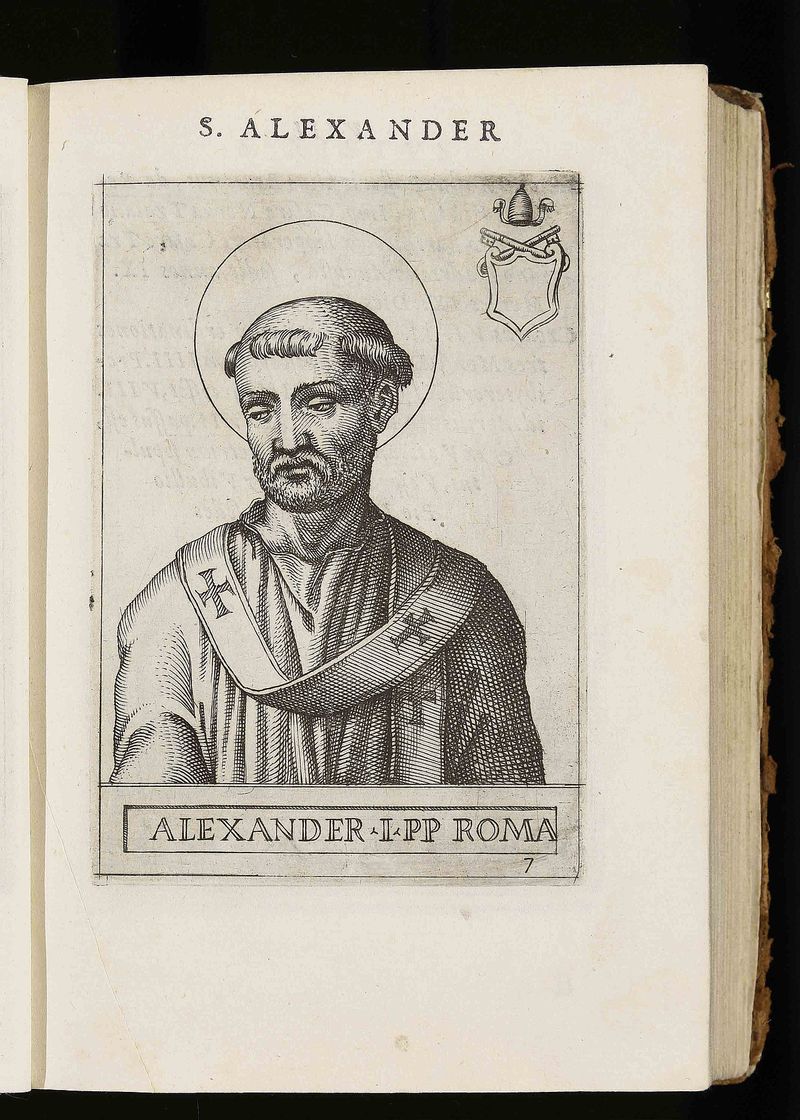
Pope Saint Alexander I: The Sixth Pope and a Case of Mistaken Identity
On This Page
The sixth in a series on the popes.
With Evaristus, the fifth pope, the problem was silence: the record gave us almost nothing. With Alexander I, the sixth Bishop of Rome, the problem runs the other way. Later tradition gave him a great deal—an institution still in use at every Sunday Mass, a hand in the words of consecration, and a martyr’s death on a named Roman road—and almost none of it survives scrutiny. Alexander is the pope to whom history attached famous things that very probably belong to someone, or something, else.
This is the sixth entry in my series on the popes, following Peter, Linus, Anacletus, Clement, and Evaristus. If Evaristus is the test case for how honest Catholic history treats a blank, Alexander is the test case for how it treats an accretion: a bare name in the earliest source onto which three later centuries each hung something of their own.
A Name in the List
Everything reliably known about Alexander fits in a sentence. In Against Heresies III.3.3, written around AD 180 to rebut Gnostic claims of secret apostolic tradition, Irenaeus of Lyons gives the earliest surviving list of the bishops of Rome. Alexander occupies a single clause:
To this Clement there succeeded Evaristus. Alexander followed Evaristus; then, sixth from the apostles, Sixtus was appointed.
That is the whole of the second-century witness.1 A name, a position, a successor. Irenaeus, who elsewhere is happy to note Telesphorus’s glorious martyrdom a few names later, says nothing of Alexander beyond his place in the chain.
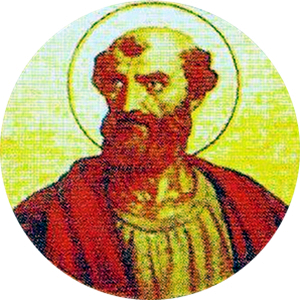
Eusebius of Caesarea, writing two centuries later, adds chronology. At Historia Ecclesiastica IV.1 he reports that Alexander “received the episcopate at Rome, after Evarestus had held the office eight years,” and reckons him “the fifth in the line of succession from Peter and Paul”—fifth, that is, not counting Peter as a numbered bishop, which is the sixth place on the reckoning this series follows.2 At IV.4 he closes the account: “Alexander, bishop of Rome, died after holding office ten years. His successor was Xystus.”3 Eusebius places that death in the third year of Hadrian—already a quiet problem, since the later tradition would insist Alexander reigned and died under Trajan. He also appears on the Roman bishop-list that Hegesippus compiled before the death of Pope Eleutherius around 189.4
The reign is therefore dated only by approximation. Louis Duchesne placed it at 106–115, J. B. Lightfoot at 109–116, and modern reference works settle near c. 107 to c. 115.5 That is the secure core: a man named Alexander, sixth in the Roman succession, who held the see for roughly a decade in the early second century. Everything else is later tradition, and the question for honest history is how much weight each piece can bear.
The Pope Who “Invented” Holy Water
Ask which pope instituted holy water and the usual answer is Alexander I. The claim comes from the Liber Pontificalis, the serial biography of the popes first compiled in Rome around AD 514–535—four centuries after Alexander’s death. Its entry credits him with establishing the blessing of water mixed with salt for the cleansing of Christian homes: constituit aquam sparsionis cum sale benedici in habitaculis hominum.6
The custom is real and old. Duchesne pointed to a blessing in the Gelasian Sacramentary that closely echoes the Asperges, the rite of sprinkling holy water that survives today as an optional replacement for the penitential act at the start of Sunday Mass. But a genuine Roman practice is one thing; its institution by a particular pope around AD 110 is another. The Liber Pontificalis routinely projects later liturgical and administrative structures back onto early names, and the holy-water attribution is a textbook instance: a custom that took shape over generations, assigned retroactively to a convenient figure near the start of the list.
The same entry credits Alexander with inserting the Qui pridie—the narrative of the Last Supper—into the Canon of the Mass. Here the Catholic Encyclopedia is bluntly skeptical of its own tradition. It attributes the words to him “but scarcely with accuracy,” because the commemoration of the institution of the Eucharist was “certainly primitive and original in the Mass.”7 You cannot insert what was there from the beginning. The single “fact” most people associate with Alexander I and the liturgical achievement tradition prizes most are, on inspection, the two claims least able to stand.
A Martyr by Mistaken Identity
The gravest claim is the martyrdom, and it is here that the case of mistaken identity comes into focus. The Liber Pontificalis has Alexander suffer death by decapitation on the Via Nomentana on 3 May, under Trajan. Yet Irenaeus, our earliest source, “says nothing of his martyrdom,” as the Catholic Encyclopedia concedes, and neither does Eusebius.8
Then comes the archaeology. In 1855 a cemetery was rediscovered on the Via Nomentana dedicated to the martyrs Alexander, Eventius, and Theodulus—at precisely the spot where tradition placed the pope’s death. Some took this as confirmation. Duchesne took it as the explanation. In the introduction to his critical edition of the Liber Pontificalis he denied the identity of the martyr and the pope, “while admitting that the confusion of both personages is of ancient date, probably anterior to the beginning of the sixth century”—that is, already baked in by the time the Liber Pontificalis was compiled.9 A local Roman martyr named Alexander, venerated on the Via Nomentana, was absorbed into the biography of the pope who shared his name. The tomb is genuine; the identification is not.
A local Roman martyr named Alexander, venerated on the Via Nomentana, was absorbed into the biography of the pope who shared his name.
The Church has since acted on the doubt. When the General Roman Calendar was revised under John XXIII in 1960, the pope was no longer honored as a martyr: the 3 May commemoration was kept for the Via Nomentana martyrs Alexander, Eventius, and Theodulus, but the identification of the pope with that martyr Alexander—the very confusion Duchesne had diagnosed—was quietly let go.10 As with Evaristus, the modern Roman church has stepped back from a claim its older books made confidently.
The Letters He Never Wrote
A final layer arrived later still. In the ninth century, the forgers behind the Pseudo-Isidorian Decretals composed letters in Alexander’s name to lend his ancient authority to a much later campaign for ecclesiastical privilege; his so-called Acts are likewise late and inauthentic.11 The pattern holds across seven centuries: a name that originally carried only a position in a list kept acquiring a biography, one era at a time—an institution here, a martyrdom there, a forged correspondence later still.
What We Can Actually Say
Strip the accretions away and a real figure remains. There was a man named Alexander, sixth in the Roman succession, who held the see for about ten years in the early second century, and whom Irenaeus could still name within a few generations of the event. That much the earliest evidence supports.
What it does not support is the rest: that he invented holy water, edited the words of consecration, or died a martyr on the Via Nomentana. Apostolic succession needs the names remembered and the line real; it never needed every saint to come with a complete file. Reading Alexander honestly—keeping the name, releasing the legend—is not a concession to skeptics. It is what a tradition does when it actually believes its own claims and has no need to prop them up with borrowed biography.
Next in the series: Pope Saint Sixtus I: The Seventh Pope, the Sanctus, and a Name That Means Sixth.
How Alexander Became a Saint
Alexander’s sainthood is real. Much of the veneration it attracted belonged to another man. Holding those two sentences together is the whole story of his cult, and it is worth telling precisely because the Church has now told it against itself.
Like every pope of the first millennium, Alexander was never canonized; no juridical process existed, and the first solemn papal canonization came only in 993. The earliest popes were saints by immemorial cultus—veneration that simply accumulated at Rome around the names in the succession—and when Urban VIII’s seventeenth-century legislation at last required papal approval for public cults, it ratified every veneration already a century old exactly as it stood.12 The trouble, as this essay has shown, is that cultus attaches to graves and dates, and Alexander’s were borrowed. The tomb on the Via Nomentana and the martyr’s crown belonged to a different Alexander; the Tridentine books fused the two men into a single 3 May feast of “Alexander, pope and martyr” with his companions Eventius and Theodulus, and for four centuries the universal Church venerated the sixth pope largely through a martyr who was not him.13 I have written elsewhere about how the Catholic Church makes saints; Alexander is the standing proof that the old way, canonization by memory, could misfile a man for a millennium without anyone noticing.
The unwinding came in stages already noted above: the 1960 calendar quietly stopped honoring the pope as a martyr, and the 1969 reform removed the feast from the General Roman Calendar altogether. The current Martyrologium Romanum completes the separation. Its 3 May entry commemorates the Via Nomentana martyrs on their own terms, no longer identifying their Alexander with the pope—which leaves the sixth pope himself, almost uniquely in this series, without a clearly distinct day of his own in the modern universal books.14
What remains to him is the tier of veneration no calendar can touch. Alexander was never decanonized—no such act exists for a saint of ancient cult, and the Church has never repudiated his sanctity, only the biography that was pinned to it. Private prayer for his intercession therefore remains fully open to any Catholic, and public celebration wherever a local calendar keeps his memory follows the ordinary liturgical norms.15 The confusion that inflated his cult never created his sainthood; the correction that deflated it never removed it.
Further Reading
- J. N. D. Kelly and Michael J. Walsh, A Dictionary of Popes, 2nd ed. (Oxford University Press, 2010)—the most reliable quick reference for the early popes
- Eamon Duffy, Saints and Sinners: A History of the Popes, 4th ed. (Yale University Press, 2014)—the most readable honest survey
- Raymond Davis, trans., The Book of Pontiffs (Liber Pontificalis), 2nd rev. ed. (Liverpool University Press, 2000)—the standard English translation, with an essential introduction on the early entries’ reliability
This post is part of an ongoing series on the popes. You can read about Saint Peter, the first pope, Saint Linus, the second pope, Saint Anacletus, the third pope, Saint Clement, the fourth pope, and Saint Evaristus, the fifth pope.
Frequently Asked Questions
Who was Pope Saint Alexander I?
Alexander I was the sixth Bishop of Rome (counting Peter as first), conventionally dated c. 107–115. The earliest source, Irenaeus of Lyons (c. AD 180), gives only his name and place in the Roman succession list; Eusebius later credits him with about a ten-year reign. The fuller biography in the sixth-century Liber Pontificalis—holy water, a hand in the Canon, a martyr’s death—is regarded by modern scholarship as later accretion rather than fact.
When did Alexander I reign as pope?
Roughly c. 107 to c. 115. Eusebius gives him about ten years and places his death in the third year of Hadrian; Duchesne dated the reign 106–115 and Lightfoot 109–116. None of these figures rests on a document from Alexander’s own century, and the Liber Pontificalis adds tension by placing his reign under Trajan.
Did Alexander I invent holy water?
This is the most famous claim about him, and it is not historically secure. The Liber Pontificalis credits him with instituting the blessing of water mixed with salt—a genuine ancient Roman custom, but assigning its institution to a pope around AD 110 reflects that work’s habit of projecting later practices onto early names. The same entry credits him with inserting the words of consecration into the Mass, which the Catholic Encyclopedia rejects because those words were “certainly primitive and original in the Mass.”
Was Alexander I a martyr?
Probably not, and the tradition likely confused him with someone else. His martyrdom appears only in the Liber Pontificalis, not in Irenaeus or Eusebius. In 1855 a cemetery of the martyrs Alexander, Eventius, and Theodulus was found on the Via Nomentana, where tradition placed the pope’s death; Duchesne denied that this martyr was the pope. In 1960 the Roman calendar removed Alexander’s martyr title for lack of historical evidence.
When is Alexander I’s feast day?
3 May, long shared with the martyrs Eventius and Theodulus on the Via Nomentana. Since 1960 he has been commemorated without the title Martyr, reflecting the judgment that his traditional martyrdom cannot be verified.
Can Catholics pray to Pope Saint Alexander I?
Yes. Alexander is a canonized saint by immemorial cult, recognized through the ancient veneration of the early Roman bishops rather than any formal process, and he has never been decanonized—the modern reforms corrected his borrowed biography, not his sanctity. Because the current Martyrology’s 3 May entry now belongs to the Via Nomentana martyrs rather than the pope, his standing today rests chiefly on private devotion, which is open to every Catholic, and on whatever local calendars keep his memory.
Footnotes
1. Irenaeus of Lyons, Against Heresies III.3.3 (c. AD 180), translated in Ante-Nicene Fathers, vol. 1, eds. Alexander Roberts and James Donaldson, rev. A. Cleveland Coxe (Buffalo: Christian Literature Publishing Co., 1885). Available at NewAdvent.org.
2. Eusebius, Historia Ecclesiastica IV.1, translated by A. C. McGiffert in Nicene and Post-Nicene Fathers, 2nd series, vol. 1 (1890). Available at NewAdvent.org. Eusebius numbers the bishops from Peter and Paul without counting Peter himself, so his “fifth” is the sixth place on the reckoning that counts Peter as the first pope.
3. Eusebius, Historia Ecclesiastica IV.4. The notice places Alexander’s death in the third year of Hadrian (c. AD 119–120), in tension with the later tradition that has him reign and die under Trajan (98–117).
4. The Roman bishop-list of Hegesippus, compiled before the death of Pope Eleutherius (c. 189) and preserved in Eusebius, Historia Ecclesiastica IV.22.3; see Thomas J. Shahan, “Pope St. Alexander I,” in The Catholic Encyclopedia, vol. 1 (New York: Robert Appleton Company, 1907). Available at NewAdvent.org.
5. Shahan, “Pope St. Alexander I,” citing Duchesne (106–115) and Lightfoot (109–116); cf. J. N. D. Kelly and Michael J. Walsh, A Dictionary of Popes, 2nd ed. (Oxford: Oxford University Press, 2010), s.v. “Alexander I.”
6. Liber Pontificalis, entry VII (Alexander): constituit aquam sparsionis cum sale benedici in habitaculis hominum; Latin text in Louis Duchesne, ed., Le Liber Pontificalis, vol. 1 (Paris, 1886), 127. On the parallel Gelasian Sacramentary blessing and the Asperges, see Duchesne as cited in Shahan, “Pope St. Alexander I.” The sprinkling rite survives in the Ordinary Form as an option that may replace the Penitential Act on Sundays, especially in Easter Time; see General Instruction of the Roman Missal, no. 51.
7. Shahan, “Pope St. Alexander I”: the Liber Pontificalis attributes the Qui pridie to Alexander “but scarcely with accuracy,” the words being “certainly primitive and original in the Mass.”
8. Shahan, “Pope St. Alexander I”: Irenaeus “says nothing of his martyrdom”; the tradition of decapitation on the Via Nomentana on 3 May is recorded only in the Liber Pontificalis.
9. Shahan, “Pope St. Alexander I,” reporting the 1855 discovery of the cemetery of Sts. Alexander, Eventius, and Theodulus on the Via Nomentana; Duchesne (Le Liber Pontificalis, vol. 1, xci–xcii) “denies the identity of the martyr and the pope, while admitting that the confusion of both personages is of ancient date, probably anterior to the beginning of the sixth century.” Cf. Albert Dufourcq, Gesta Martyrum Romains (Paris, 1900), 210–211.
10. General Roman Calendar of 1960 (under John XXIII’s motu proprio Rubricarum instructum): from 1960 the pope is no longer honored as a martyr. The 3 May commemoration was retained for the Via Nomentana martyrs Alexander, Eventius, and Theodulus; modern scholarship holds that the pope had probably been confused with that martyr Alexander.
11. Shahan, “Pope St. Alexander I”: the letters ascribed to Alexander by Pseudo-Isidore are printed in Patrologia Graeca V, 1057ff, and in Paul Hinschius, Decretales Pseudo-Isidorianae (Leipzig, 1863), 94–105; his “Acts” are not genuine (Tillemont, Mémoires II, 590ff; Dufourcq, op. cit., 210–211).
12. On the first solemn papal canonization (Ulrich of Augsburg, by John XV in 993) and the exemption of immemorial cults—those with at least a hundred years’ public veneration—under Urban VIII’s decrees of 1625 and apostolic constitution Caelestis Hierusalem cives (5 July 1634), see Camillo Beccari, “Beatification and Canonization,” The Catholic Encyclopedia, vol. 2 (New York: Robert Appleton Company, 1907). Available at NewAdvent.org.
13. The Roman Martyrology, trans. under Cardinal Gibbons (Baltimore: John Murphy Company, 1916), 3 May: “At Rome, on the Via Nomentana, the birthday of the holy martyrs Alexander, pope, Eventius, and Theodulus”—the Tridentine text that fused the pope with the Nomentana martyr of the same name.
14. Martyrologium Romanum, editio typica altera (Vatican City: Typis Vaticanis, 2004), 3 May (p. 268), where Eventius, Alexander, and Theodulus are commemorated as martyrs without identification of Alexander as the Roman pontiff.
15. Martyrologium Romanum (2004), Praenotanda, nn. 15, 26–33, on the levels of lawful veneration; removal of a feast from the General Roman Calendar, or the revision of a Martyrology entry, is a liturgical judgment about the calendar, not a revocation of sanctity.
Garrett Ham
Garrett Ham is an attorney, military veteran, and holds a Master of Divinity from Yale Divinity School. He writes from Northwest Arkansas on theology, law, and service.
Related Posts

Pope Saint Pius I: The Tenth Pope, the Brother of Hermas, and the Roman Church That Fought Marcion
Pius I was the tenth pope (c. 140–154), brother to Hermas of The Shepherd and the bishop under whom Rome expelled Marcion. No early source calls him a martyr.

Pope Saint Hyginus: The Ninth Pope, the Gnostic Crisis, and a Martyrdom the Sources Do Not Record
Hyginus, the ninth pope (c. 138–142), reigned as Valentinus and Cerdo brought Gnosticism to Rome. The martyr title attached to his name has no early source.

Pope Saint Telesphorus: The Eighth Pope, the First Martyred Successor, and the Long Backdrop to the Easter Quarrel
Telesphorus is the eighth pope and the first after Peter whose martyrdom rests on a primary source. The Christmas Mass and seven-week Lent later credited to him are another matter.
Stay Informed
Get new writing on faith, law, and service delivered to your inbox.
No spam. Unsubscribe anytime.