Pope Saint Evaristus: The Fifth Pope and the Silence of the Record
On This Page
The fifth in a series on the popes.
Evaristus is the first Bishop of Rome about whom virtually nothing is known. That is not a rhetorical flourish. The earliest surviving source—Irenaeus of Lyons, writing around AD 180—gives us his name and his place in a list. Nothing else survives from within a century of his life. No writing of his, no letter from him, no decree under his authority, no contemporary mention. A Christian walking the streets of Rome in AD 150 would not have been able to tell us much more about Evaristus than we can say today.
This is the fifth entry in my series on the popes, following earlier posts on Saint Peter, Saint Linus, Saint Anacletus, and Saint Clement. Those posts develop the historical and theological background—particularly the question of whether the monarchical episcopate existed in first-century Rome—that this post will build upon. What Clement illuminates by his own surviving letter, Evaristus illuminates by his silence: he is the test case for how honest Catholic history should treat a saint about whom the record is almost entirely blank.
The Fifth Name on Irenaeus’s List
Everything reliably known about Evaristus fits in a single sentence of Irenaeus. In Against Heresies III.3.3, composed around AD 180 to refute Gnostic claims to secret apostolic tradition, Irenaeus supplies the earliest surviving list of the bishops of Rome. His purpose is polemical: to show that the true apostolic teaching has been preserved by a public, traceable succession of public figures. The list runs from Linus, whom the apostles ordained, through Irenaeus’s own contemporary Eleutherius, “in the twelfth place from the apostles.”1
Evaristus occupies a single clause. In the standard English of the Ante-Nicene Fathers translation:
To this Clement there succeeded Evaristus. Alexander followed Evaristus; then, sixth from the apostles, Sixtus was appointed.
That is the entirety of Irenaeus’s witness. No origin. No duration of office. No biographical note. No martyrdom. No institutional achievement. The Latin (the continuous Greek of Against Heresies III is largely lost, though Eusebius preserves the Greek of the succession list itself at Historia Ecclesiastica V.6) is equally terse: Huic autem Clementi succedit Euarestus, et Euaresto Alexander, ac deinceps sextus ab apostolis constitutus est Xystus.2 A name, a position, a successor. That is all.
What is striking is what Irenaeus could have said and did not. Of Telesphorus, three positions later, he notes the martyrdom: qui etiam gloriosissime martyrium fecit—“who indeed most gloriously underwent martyrdom.”3 Of Linus he mentions Paul’s reference in the Pastorals. Of Clement he adds the detail that Clement had seen and conversed with the apostles. Of Evaristus, nothing. Whatever institutional memory Irenaeus’s source possessed about Evaristus—if it possessed anything beyond the name—did not rise to the level of being worth recording.
This is the rock on which everything else sits. Every claim about Evaristus that is not in Irenaeus is, by definition, later tradition. The question for honest history is how much weight any given piece of later tradition can bear.
Eusebius’s Arithmetic: Eight Years, Nine Years, or None
The second-earliest source is Eusebius of Caesarea, writing more than two centuries after Evaristus’s death in his Historia Ecclesiastica (c. AD 325). Eusebius is working from Hegesippus, Irenaeus, and Julius Africanus to fix chronological relationships between Roman bishops and Roman emperors. His two notices of Evaristus are not obviously consistent with each other.
At Historia Ecclesiastica III.34, Eusebius reports the transition from Clement:
In the third year of the reign of the emperor mentioned above, Clement committed the episcopal government of the church of Rome to Evarestus, and departed this life after he had superintended the teaching of the divine word nine years in all.
At IV.1, he records the transition to Alexander:
At that time also Alexander, the fifth in the line of succession from Peter and Paul, received the episcopate at Rome, after Evarestus had held the office eight years.
Both notices survive verbatim in the Nicene and Post-Nicene Fathers translation.4 Read together, they bracket Evaristus’s pontificate between the third year of Trajan (AD 100 or 101) and roughly the twelfth year of Trajan (AD 108 or 109). The numbers do not quite line up, even within Eusebius’s own corpus. At III.34 the “nine years in all” most naturally attaches to Clement’s ministry rather than to Evaristus’s tenure—so the real tension is not between III.34 and IV.1 but between Historia Ecclesiastica IV.1, where Evaristus holds the office “eight years” before Alexander, and Jerome’s Latin translation of Eusebius’s Chronicon, which allots Evaristus only seven. Neither figure is anchored in an independent document, and that disagreement—within the same author, between his two works on the same question—warns us that even by the 320s the chronology of the pre-Eusebian Roman succession had become uncertain.
The Liberian Catalogue, preserved in the Chronograph of AD 354, disagrees with Eusebius both about the duration and the name. It gives Evaristus—whom it calls Aristus—thirteen years, seven months, and two days, under the emperors Domitian and Trajan.5 The dating straddles back into Clement’s conventional reign and forward past Alexander’s conventional accession. Whatever is going on in these numbers, they are not independent confirmation of anything.
Modern reference works have responded by listing conventional dates with scholarly caution. J. N. D. Kelly in A Dictionary of Popes gives c. 100 – c. 109; the 1909 Catholic Encyclopedia gave “about 98 or 99 to about 106 or 107”;6 the Annuario Pontificio follows a similar range. All are approximations of Eusebius’s arithmetic, not data points from Evaristus’s own century.
The Silences: Jerome, Hegesippus, and the Liturgical Calendar
What makes Evaristus distinctive within the early Roman succession is not just that he left nothing of his own, but that the subsequent Christian tradition through the fourth century left almost nothing about him either.

Jerome’s De Viris Illustribus, completed in AD 392, is the great Latin reference work on the most eminent Christian writers from the apostles to his own day. He devotes a chapter to Clement, and he notes the apostolic Fathers who followed the apostles. Evaristus does not appear anywhere in the book. The chapter on Clement (chapter 15) concludes without naming his successor.7 For a figure who allegedly administered the Roman church for nine or thirteen years, this silence is remarkable. Jerome knew he existed—the name had been in Eusebius, whom Jerome had translated—but Jerome had nothing to say about him.
Hegesippus, writing around AD 160, is the earliest patristic author known to have compiled a list of Roman bishops. His work survives only in fragments preserved by Eusebius. The crucial fragment runs:
And when I had come to Rome I remained there until Anicetus, whose deacon was Eleutherus. And Anicetus was succeeded by Soter, and he by Eleutherus.
That is all of the Roman succession that Hegesippus’s surviving text mentions.8 Evaristus is not named. Whether the lost portions of Hegesippus’s work contained a fuller list running back to Peter we cannot now recover. Eusebius’s abbreviation leaves us with a silence that might once have been speech.
The most striking silence of all is liturgical. The Chronograph of 354—a calendar of the city of Rome compiled by the scribe Furius Dionysius Filocalus for a well-off Roman Christian—preserves two early martyr-and-bishop lists: the Depositio Episcoporum (burials of Roman bishops commemorated with a feast) and the Depositio Martyrum (Roman martyrs commemorated liturgically). Neither list commemorates Evaristus. The earliest bishop in the Depositio Episcoporum is Lucius I (d. 254); the Depositio Martyrum lists no pre-third-century pope as a martyr, apart from Peter.9 As late as 354, the Roman church was not liturgically celebrating Evaristus—not as confessor, not as martyr, not at all.
The same silence holds in the most venerable prayer of the Roman rite. The Communicantes of Eucharistic Prayer I—the ancient Roman Canon—names a handful of early popes by name: Linus, Cletus, Clement, Sixtus, Cornelius, alongside Cyprian of Carthage. Evaristus is not among them. Nor are Alexander, Telesphorus, Hyginus, Pius, Anicetus, Soter, or Eleutherius—none of the popes from the Irenaean list between Clement and the great third-century martyrs.10 The very liturgy of the city over which Evaristus allegedly presided preserves no memory of him.

The Ignatius Problem
The most revealing silence, however, comes from Ignatius of Antioch—and it is a silence that points not merely to our ignorance of Evaristus but to a structural feature of the Roman church in his time.
Ignatius, Bishop of Antioch, was condemned to the beasts and taken under military guard to Rome for execution around AD 107–110. Along the way, he wrote seven letters—to the Ephesians, Magnesians, Trallians, Romans, Philadelphians, Smyrnaeans, and a personal letter to Polycarp of Smyrna. His traditional dating falls squarely within Evaristus’s conventional pontificate.
Ignatius is the first Christian writer to articulate a fully developed monarchical ecclesiology. In To the Smyrnaeans 8, he writes:
See that you all follow the bishop, even as Jesus Christ does the Father, and the presbytery as you would the apostles… Let no man do anything connected with the Church without the bishop.
He makes the same point, in varying terms, in every letter.11 The bishop, for Ignatius, is the sine qua non of the Christian community. “Apart from these [bishop, presbyters, deacons] there is nothing that can be called a church” (To the Trallians 3.1). He names the local bishop at four of the six churches he writes to—Onesimus at Ephesus, Damas at Magnesia, Polybius at Tralles, Polycarp at Smyrna—and refers directly to the bishop, even without naming him, in his letter to the Philadelphians.
Then he writes to the Romans. The prescript greets “the Church which has obtained mercy, through the majesty of the Most High Father, and Jesus Christ, His only-begotten Son…”12 No bishop is named. The body of the letter speaks of Ignatius’s own episcopal office—“God has deemed me, the bishop of Syria, worthy to be sent for from the east unto the west”—and laments that his Antiochene community “now has God for its shepherd, instead of me.”13 He knows exactly what a bishop is; he insists on episcopal authority at every opportunity elsewhere. But to Rome he addresses no bishop, names no presbyterate in the singular, and commends himself to no single Roman leader.
Why? The possibilities are four: (a) Ignatius forgot; (b) it was a stylistic quirk; (c) he knew but declined to greet Evaristus for reasons unknown; (d) there was no single bishop of Rome for him to greet. When the Ignatian silence is read alongside the other evidence for the Roman church at this date—the plural-voiced 1 Clement, the plural presbyters in the Shepherd of Hermas, the plural “presbyters” Irenaeus himself uses when referring to Anicetus, Pius, Hyginus, Telesphorus, and Sixtus in retrospect14—explanation (d) becomes difficult to avoid.
This is not a radical or anti-Catholic reading of the data. It is the reading offered by mainstream Catholic historians. It does, however, bear directly on what we should mean when we call Evaristus the fifth pope.
Rome c. 100 Without a Monarch
Peter Lampe’s From Paul to Valentinus, originally published in German in 1987 and translated into English in 2003, is the foundational modern study of Christianity in first- and second-century Rome. Lampe reconstructs a city in which Christian communities were “fractionated”—scattered across Trastevere, the Aventine, the Appian region, the Via Latina, attached in part to the pre-existing Jewish residential quarters—and governed locally by presbyter-bishops who corresponded with one another and with communities elsewhere as occasion required.

On Lampe’s account:
The fractionation in Rome favored a collegial presbyterial system of governance and prevented for a long time, until the second half of the second century, the development of a monarchical episcopacy in the city.
Lampe identifies Pope Victor (c. 189–199) as the first Roman bishop who plausibly functioned in a monarchical sense, preceded only by “faint-hearted attempts” under Anicetus, Soter, and Eleutherius.15 Allen Brent goes even further in Hippolytus and the Roman Church in the Third Century, placing the emergence of a Roman mono-episcopate in the third century rather than the second.16
This is not merely a Protestant or secular reading. Francis A. Sullivan, S.J., in From Apostles to Bishops, concludes that the evidence “makes it highly probable” that the Roman church was governed by a college of presbyters rather than by a single bishop through at least several decades of the second century.17 Klaus Schatz, S.J., in Papal Primacy: From Its Origins to the Present, is blunter still: “If one had asked a Christian in the year 100, 200, or even 300 whether the bishop of Rome was the head of all Christians… he or she would certainly have said no.”18 Eamon Duffy, in the opening pages of Saints and Sinners, reports the same picture without polemic: the Roman church in the first century and most of the second did not know a single bishop in the sense Irenaeus’s 180s succession list presupposes.19
There is a counter-current. Alistair Stewart’s The Original Bishops (2014) argues for an earlier and denser episcopate, on the grounds that every individual house-congregation already had its own episkopos; what develops later is the mono-episcopate, in which a single bishop presides over many congregations in one city.20 Stewart’s reading preserves the presence of bishops in the apostolic age while accepting the late emergence of the single city-wide bishop. Even on his account, Evaristus could not have been “the bishop of Rome” in the later sense; he would have been one presbyter-bishop among many.
If any of this is correct—and the convergence of Catholic, Orthodox, and Protestant scholarship on a version of it is striking—Evaristus was still a pope, but not a monarchical one in the modern sense. The succession is real; what the Liber Pontificalis retrojects onto him is not the office itself but the single-occupant structure the office would later take.
The Liber Pontificalis as Historical Artefact
If Irenaeus and Eusebius give us nearly nothing about Evaristus, the Liber Pontificalis gives us almost everything. It is also our single largest problem.

The Liber Pontificalis—literally “Book of the Pontiffs”—is a serial biography of the popes compiled in Rome. Its first recension was produced around AD 514–535 and re-edited before 546. The standard critical edition remains Louis Duchesne’s Le Liber Pontificalis (2 vols., Paris, 1886–1892), and the standard modern English translation is Raymond Davis’s Book of Pontiffs, second revised edition (Liverpool, 2000).21
The work is indispensable for the late-antique and early-medieval papacy. For the popes of its own sixth century, the Liber Pontificalis is essentially contemporary reportage—occasionally partisan, sometimes slanted, but close to the events. For the popes of the fourth and fifth centuries, its reliability decreases but remains usable. For the popes of the first three centuries, its reliability collapses. As Davis writes in the introduction to his translation, for the earliest entries the work is compiled from “scraps of formulaic material” applied by template to names drawn from earlier succession lists.22 Rosamond McKitterick’s more recent Rome and the Invention of the Papacy (Cambridge, 2020) frames the book’s early entries as a Roman memory project: they tell us how the sixth-century Roman clergy imagined their second- and third-century predecessors, not what those predecessors actually did.23
The entry on Evaristus is a near-perfect specimen of the genre. In Louise Ropes Loomis’s 1916 English translation of the Liber Pontificalis (working from a first-recension variant that reads “a Greek of Antioch” and gives the duration as thirteen years, seven months, two days):
Euuaristus, by nationality a Greek of Antioch, son of a Jew named Judah, from the city of Bethlehem, occupied the see 13 years, 7 months and 2 days… He divided the parish churches in the city of Rome among the priests, and ordained 7 deacons to keep watch over the bishop when he spoke, for the sake of the word of truth. He held 3 ordinations in the month of December, 17 priests, 2 deacons, 15 bishops in divers places. He also was buried near the body of the blessed Peter in the Vatican, October 27. And the bishopric was empty 19 days.24
Read slowly, every clause of this entry is either unverifiable or retrojective. Nationality? No earlier source. Father’s name and Bethlehem origin? Typologically freighted—Bethlehem is the birthplace of the Incarnate Word—and without corroboration. Duration? Contradicts Eusebius. Consular synchronisms? Give dates that overlap Clement’s traditional reign. Martyrdom? Absent from Irenaeus, Eusebius, and the Depositio Martyrum. Division of the tituli? An anachronism of three centuries (see the next section). Seven deacons? A template the Liber Pontificalis applies to several early popes. Three December ordinations with seventeen priests, two deacons, fifteen bishops? Davis identifies such numbers as “formulaic”; the round-number topos of “fifteen bishops ordained in various places” tracks no external evidence. Burial near Peter in the Vatican? Not confirmed by the twentieth-century Vatican necropolis excavations. Vacancy of nineteen days? A cessavit-episcopatus formula filling out the chronological arithmetic.
Taken clause by clause, the entry tells us a great deal about the Roman clergy in the 520s and almost nothing about Evaristus in the 100s. It is a window into how the sixth-century Roman church imagined its own first-century origins—with a bishop who looked recognizably like a sixth-century pope, complete with titular parishes, deacons, and an administrative rhythm. That is a valuable document in its own right, but it is not biography.
Tituli, Seven Deacons, and the Retrojection Engine
The single most dubious claim in the Evaristus entry—because it is the most easily falsified by external evidence—is that he “divided the titles in the city of Rome among the presbyters.”
The tituli—Rome’s titular churches, properties deeded to a named patron or saint and served by assigned presbyters—are genuinely important. They are the ancestors of the Roman parish system and the basis on which cardinals, to this day, are given a titular church in the city. But their historical emergence is not in the first century. The earliest documentary attestation is the Liber Pontificalis’s entry on Pope Marcellus I (d. 309), which records that Marcellus “established twenty-five tituli in the city of Rome, as it were dioceses.” The Liber Pontificalis thus attributes the twenty-five-titulus system to Marcellus in the early fourth century—an attribution in self-evident tension with its own attribution of the same system to Evaristus two centuries earlier. The earliest epigraphic attestation is a 377 epitaph of a lector tituli Fasciolae. The earliest signed prosopographic list comes from the acta of the Roman Synod of 1 March 499 under Pope Symmachus, at which roughly twenty-nine tituli are represented by the presbyters who subscribed the decrees—with multiple presbyters signing on behalf of several tituli—alongside seventy-two bishops.25
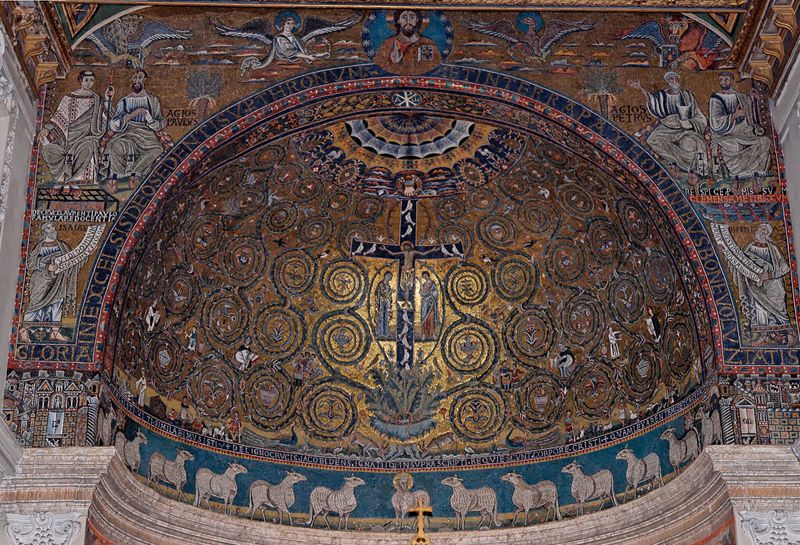
The archaeology tells the same story. The five titular churches most often invoked as first- or second-century “house churches”—San Clemente, Santa Pudenziana, San Martino ai Monti, Santi Giovanni e Paolo, Santa Sabina—all show the same pattern under modern excavation: a first- or second-century Roman structure (domus, horrea, insula, mint, or baths) with no demonstrable Christian cult use; a fourth-century conversion to Christian worship during or after Constantine; a fifth-century basilical rebuilding. Richard Krautheimer’s monumental Corpus Basilicarum Christianarum Romae (1937–1977) and his later Rome: Profile of a City (1980) put the point starkly: nothing clearly Christian inside the walls predates Constantine.26 Federico Guidobaldi’s more recent work on Roman Christian topography argues that the very idea of founding tituli emerged only in the sixth century—making the Liber Pontificalis’s retrojection onto Evaristus a retrojection of something that did not exist in anyone’s mind before the compiler’s own generation.27
Johann Peter Kirsch, writing for the Catholic Encyclopedia in 1909, had already seen this clearly. Of the Liber Pontificalis’s titular claim he writes: “in this statement, however, the Liber Pontificalis arbitrarily refers to the time of Evaristus a later institution of the Roman Church.”28 The scholarly consensus has only hardened since.
The parallel Liber Pontificalis claim that Evaristus ordained seven deacons “to keep watch over the bishop when he spoke, for the sake of the word of truth” is subject to the same critique. Seven-deacon structures are attributed by the Liber Pontificalis to Peter himself, to Cletus, to Evaristus, and to Fabian depending on the entry. Of these, only the Fabian attribution (c. 236–250) is historically defensible: a college of seven Roman deacons is independently attested in the Cyprianic correspondence of the 250s. Its projection onto Evaristus is a classic Liber Pontificalis doublet, made theologically plausible by the seven-deacon pattern of Acts 6 and institutionally plausible by the Cyprianic-era Roman structure that the sixth-century compiler knew from his own day.
Martyr by Default
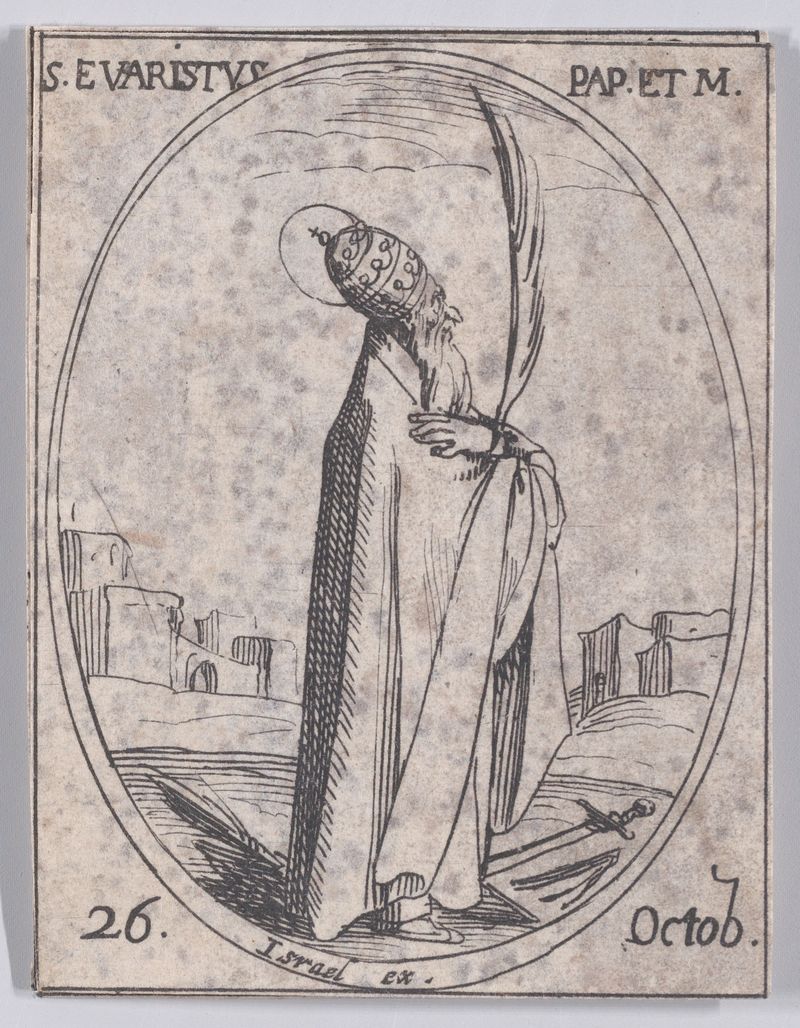
The traditional Roman Martyrology commemorates Evaristus on 26 October as a martyr under the Emperor Hadrian. The date is consistent; the imperial attribution is not—Eusebius has Evaristus dying under Trajan, not Hadrian. But the substantive question is not when he was martyred but whether he was martyred at all.
The evidence is thin to the point of absence. Irenaeus, who is happy to note Telesphorus’s glorious martyrdom five names later, says nothing about Evaristus. Eusebius, writing more than 200 years after the event, assigns Evaristus no martyr-title. The Depositio Martyrum of 354, the earliest surviving Roman martyr-list, does not commemorate him. Hegesippus’s surviving fragment does not name him. The martyr tradition enters the record only with the Liber Pontificalis’s terse martyrio coronatur—“he is crowned with martyrdom”—and is then amplified by the early-medieval Latin martyrologies of Ado and Usuard and finally the Tridentine Roman Martyrology of Cardinal Baronius.
Kirsch, in 1909, judged plainly: “The martyrdom of Evaristus, though traditional, is not historically proven.”29 Kelly in A Dictionary of Popes concurs. The structural argument is nearly decisive: Evaristus’s traditional dates fall squarely within the reigns of Nerva and Trajan—emperors under whose administration no systematic persecution of Christians is attested in Rome. The Pliny-Trajan correspondence (Epistulae 10.96–97), which first gives us documentary evidence of Roman legal procedure against Christians, dates to Pliny’s governorship of Bithynia-Pontus around AD 111–112—later than Evaristus’s alleged death and from a different province.30 Individual martyrdoms in Rome did occur (Ignatius, for one, on arrival), but these were ad hoc. A “crowned with martyrdom” template applied to nearly every pope before Sylvester I cannot bear individual evidentiary weight.
The post-conciliar Roman Martyrology, revised under Paul VI and John Paul II and issued in the editio typica altera in 2004, retained Evaristus’s 26 October commemoration but removed the honorific Martyr in line with the revisers’ policy of dropping titles for which no historical evidence exists. The change is quiet but telling: the Roman church itself, in its official liturgical book, has stepped back from the claim.
What Counts as a Pope?
All of this leaves us with the question the series has been circling from the beginning: in what sense was Evaristus the fifth pope?
If the consensus of Lampe, Brent, Sullivan, Schatz, and Duffy is right—and the convergence of Catholic, Orthodox, and Protestant scholarship is striking—then Rome in AD 100 did not yet have a single monarchical bishop. What it had was a fractionated network of house communities served by a college of presbyter-bishops, one of whom may have taken chief responsibility for external correspondence (as Clement seems to have done a decade earlier, in 1 Clement). Evaristus was perhaps such a presbyter-bishop—perhaps the one whose name was most vividly remembered, perhaps the one whose tenure most directly connected Clement’s generation to Alexander’s, perhaps the one whose chief responsibility for external correspondence made him the de facto head of the Roman college. That he was a pope in the sense the Church confesses—a successor of Peter holding the Roman see—is what apostolic succession requires. That the office had not yet taken on its later monarchical form is what the first- and early second-century evidence shows.
This is not an argument against apostolic succession. The succession—the unbroken continuity of teaching authority handed from the apostles through their successors—is real. What is retrojected is the single-occupant structure that the succession would later take. The apostolic deposit was handed on; it happens to have been handed on, for several generations, through a college of presbyter-bishops rather than through a single bishop. The Liber Pontificalis, composed in the 520s when the monarchical structure had long since crystallized, could only imagine that structure having existed always. So it rewrote the first-century Roman church in the image of the sixth.
The apostolic deposit was handed on; it happens to have been handed on, for several generations, through a college of presbyter-bishops rather than through a single bishop.
Catholic historians have handled this in different ways. Duffy simply reports the data and lets the reader draw inferences. Sullivan argues for organic development: the subsequent crystallization of a single presiding bishop, under the Spirit’s guidance, is consistent with and seminal in the apostolic deposit, even if it was not yet visible as such in the first or early second century. Schatz distinguishes a historical layer (no supreme bishop in 100, 200, or 300) from a theological one (papal primacy as legitimate Spirit-led unfolding).31 Each of these responses is available. What is not available is a reading of the first-century evidence that makes Evaristus a monarchical pope in the later sense. The sources do not support it, and the honest response to that is not to force them but to understand what they do support.
Reading the Silence with Catholic Confidence
There is a specifically Catholic temptation, when reading about a saint of whom almost nothing is known, to fill the silence with legend—to repeat the Liber Pontificalis’s confident biography as if repetition could promote it to fact. There is an equally Catholic temptation, in response, to over-correct by implying that if the legend is wrong, the faith must be wrong too. Both are failures of nerve.
The Catholic tradition does not depend on the historicity of every clause in the Liber Pontificalis. It depends on the apostolic deposit—the faith delivered once for all to the saints—being faithfully handed on by a continuing succession of teachers who stand in living continuity with the apostles. That succession, for several generations in Rome, ran through a college of presbyter-bishops rather than a single monarch. Evaristus was part of that succession. His name was remembered, his place in the list was preserved, and Irenaeus—who had in his own youth heard Polycarp, who had in his youth heard John—was close enough to the Roman church in the 170s to know who had held the office, in the generation before Anicetus, in the generation before Clement.
That is what we can say. It is not nothing. It is, in fact, precisely the kind of thing the apostolic deposit requires—that the names be remembered, that the line be preserved, that the continuity be real. What we cannot say is the rest of it: the birthplace, the father’s name, the tituli, the seven deacons, the fifteen consecrations, the martyrdom. Those are the work of later pens, and they belong to the later pens who wrote them.
I find, increasingly, that this kind of honesty deepens rather than damages my confidence in the tradition. A church that needs to pretend it knows things it does not know is a church that does not believe its own claims. A church that can admit what it does not know, and still confess what it does know, is a church that has learned something about how the Spirit actually works in history—which is always more reticent than our hagiography, and always more patient. Evaristus is a good teacher for that lesson. He gave us nothing but his name. That his name has survived at all, across nineteen centuries, in the memory of a church he would not have recognized, is already more than most of us will leave behind.
Next in the series: Pope Saint Alexander I, the sixth pope.
How Evaristus Became a Saint
Evaristus was made a saint by a list. Every other kind of evidence a cult ordinarily leaves behind—a venerated tomb, an early feast, an epitaph, a church carrying the name—is missing from his file. He appears in neither of the commemorative calendars the fourth-century Roman church kept, the Depositio Martyrum and the Depositio Episcoporum; no ancient source records where his grave was honored, or whether it was. His veneration is documented only from the early-medieval martyrologies onward, and it attached to him for one reason: he stood in the succession.32 The Roman church of the first millennium venerated its earliest bishops as a class, on the strength of the office and the age in which they had held it, and Evaristus—the fifth name—was carried along with his brothers. No process ever tested the assumption, because none existed: the first solemn papal canonization in history came only in 993, and when Urban VIII’s seventeenth-century legislation finally required papal approval for any public cult, it expressly ratified every veneration already a century old just as it stood—Evaristus’s included, by then roughly a millennium deep.33 He is a pre-congregational saint in the purest form the category allows; the system that eventually grew up around such cults is traced in how the Catholic Church makes saints.
From the Tridentine books until living memory his entry read “pope and martyr,” and both halves of that liturgical identity have since been audited. The martyr half, as the section above recounted, dissolved on inspection, and the 2004 Martyrologium Romanum keeps his 26 October commemoration without the title. The feast went first: the 1969 reform of the General Roman Calendar removed Evaristus along with nearly all the second-century popes, leaving saints known only by name to particular calendars.34 Neither change was a demotion in rank of sanctity. Removal from the calendar is not decanonization—no such act exists for a saint of immemorial cult—and no authority has ever unsainted Evaristus.
Where that leaves the Catholic faithful is on the middle tier of the Church’s three levels of veneration. Because Evaristus stands in the current Martyrology, his public cult remains lawful: a local church may keep 26 October, and a votive Mass may be offered in his honor. Private prayer for his intercession is permitted to anyone, as it is toward any canonized saint, listed or not.35 There is something fitting in the arrangement. The Church has never known what Evaristus did; it has never once doubted where he stands.
Further Reading
For readers who want to dig deeper:
- J. N. D. Kelly and Michael J. Walsh, A Dictionary of Popes, 2nd ed. (Oxford University Press, 2010)—the single most reliable quick reference for the early papacy; the Evaristus entry is on page 8
- Eamon Duffy, Saints and Sinners: A History of the Popes, 4th ed. (Yale University Press, 2014)—the most readable and honest popular survey
- Peter Lampe, From Paul to Valentinus: Christians at Rome in the First Two Centuries, trans. Michael Steinhauser (Fortress Press, 2003)—the foundational modern study of first- and second-century Roman Christianity
- Raymond Davis, The Book of Pontiffs (Liber Pontificalis), 2nd revised ed. (Liverpool University Press, 2000)—the standard modern English translation, with an invaluable introduction
- Rosamond McKitterick, Rome and the Invention of the Papacy: The Liber Pontificalis (Cambridge University Press, 2020)—the most recent major study of the Liber Pontificalis as a constructed document
- Francis A. Sullivan, S.J., From Apostles to Bishops: The Development of the Episcopacy in the Early Church (Newman Press, 2001)—the most rigorous Catholic engagement with the development of the episcopate
- Klaus Schatz, S.J., Papal Primacy: From Its Origins to the Present (Liturgical Press, 1996)—the best Catholic treatment of how the papacy developed, historically and theologically
- Allen Brent, Hippolytus and the Roman Church in the Third Century (Brill, 1995)—the most thorough case for a late emergence of Roman mono-episcopacy
- Alistair C. Stewart, The Original Bishops: Office and Order in the First Christian Communities (Baker Academic, 2014)—the most serious scholarly alternative to the Lampe consensus
- Richard Krautheimer, Rome: Profile of a City, 312–1308 (Princeton University Press, 1980)—the standard archaeological history of Christian Rome
- Michael W. Holmes, The Apostolic Fathers, 3rd ed. (Baker Academic, 2007)—the most up-to-date English translation of Ignatius with facing Greek text
This post is part of an ongoing series on the popes. You can read about Saint Peter, the first pope, Saint Linus, the second pope, Saint Anacletus, the third pope, and Saint Clement, the fourth pope.
Frequently Asked Questions
Who was Pope Saint Evaristus?
Evaristus was the fifth Bishop of Rome (counting Peter as first), traditionally dated c. AD 100 – c. 109. He is the first pope of whom virtually nothing is known. The earliest source, Irenaeus of Lyons (c. AD 180), supplies only his name and position in a succession list. Nothing he wrote survives, no contemporary names him, and the detailed biography found in the sixth-century Liber Pontificalis is considered by modern scholarship to be a retrojection of later Roman institutional memory rather than a record of fact.
When did Evaristus reign as pope?
The conventional dating places his pontificate between the death of Clement (c. 99 or 100) and the accession of Alexander I (c. 107–109), under the Roman emperors Nerva (96–98) and Trajan (98–117). Eusebius’s Historia Ecclesiastica gives him eight or nine years (the two Eusebian notices disagree with each other); the Liberian Catalogue of 354 gives thirteen years, seven months, two days. Modern reference works such as Kelly’s A Dictionary of Popes list him conventionally at c. 100 – c. 109.
Was Evaristus really the fifth pope?
He is the fifth name in the earliest surviving Roman succession list, compiled by Irenaeus around AD 180 to rebut Gnostic claims to secret apostolic tradition. Whether he was “pope” in the monarchical sense assumed by later tradition is a different question. The dominant scholarly consensus—articulated by Peter Lampe and shared by Catholic historians such as Sullivan, Schatz, and Duffy—holds that Rome did not have a single monarchical bishop until the mid-to-later second century. On the Catholic reading, Evaristus was a pope—a successor of Peter holding the Roman see—but he exercised that office as a prominent member of a college of presbyter-bishops rather than as a single monarch. The monarchical form the papacy would later take emerged only in the later second century.
Was Evaristus a martyr?
The traditional Roman Martyrology commemorates him as a martyr on 26 October, but his martyrdom is absent from every early source: Irenaeus, Eusebius, the Depositio Martyrum of 354, and Hegesippus all fail to note it. The claim first appears in the sixth-century Liber Pontificalis, which applies the formula martyrio coronatur to nearly every early pope. No systematic persecution of Christians in Rome is attested under Nerva or Trajan during his traditional pontificate. The 1909 Catholic Encyclopedia judged the martyrdom “traditional, but not historically proven,” and the post-conciliar Martyrologium Romanum (editio typica altera, 2004) commemorates him without the title Martyr.
Did Evaristus divide Rome into tituli or parish churches?
Almost certainly not. The Liber Pontificalis attributes to him the division of Rome into titular churches (tituli), but its own entry on Pope Marcellus I (d. 309) assigns the same twenty-five-titulus system to Marcellus in the early fourth century—an internal inconsistency that tells against the Evaristus attribution. The earliest signed prosopographic list of Roman titular presbyters comes from the Roman Synod of 499. Archaeological investigation of the titular churches has found no demonstrable first- or second-century Christian use at any of them. Johann Peter Kirsch recognized in 1909 that the Liber Pontificalis “arbitrarily refers to the time of Evaristus a later institution of the Roman Church,” and the modern consensus (Krautheimer, Guidobaldi, Brandenburg) dates the titular system firmly to the fourth through sixth centuries.
When is Evaristus’s feast day?
26 October. He is commemorated on that date in the Martyrologium Romanum; his feast was removed from the General Roman Calendar in the 1969 reform, which left saints of his kind to particular calendars. He is not named in the Roman Canon (Eucharistic Prayer I), unlike Linus, Cletus, Clement, Sixtus, and Cornelius—a telling liturgical silence about a bishop who supposedly governed the Roman church for nearly a decade.
Can Catholics pray to Pope Saint Evaristus?
Yes. Evaristus is a canonized saint by immemorial cult—recognized through the ancient veneration of the early popes as a class, never through any formal process, since none existed for another nine centuries. His entry in the current Roman Martyrology (26 October) keeps public veneration lawful on local calendars and in votive Masses, and private prayer for his intercession is open to any Catholic, even though his feast left the universal calendar in 1969.
Footnotes
1. Irenaeus of Lyons, Against Heresies III.3.3 (c. AD 180), translated in Ante-Nicene Fathers, vol. 1, eds. Alexander Roberts and James Donaldson, rev. A. Cleveland Coxe (Buffalo: Christian Literature Publishing Co., 1885). Available at NewAdvent.org.
2. Latin text following the standard critical reading; see Adelin Rousseau and Louis Doutreleau, eds., Irénée de Lyon: Contre les hérésies, Livre III, Sources Chrétiennes 211 (Paris: Cerf, 1974). The continuous Greek of Against Heresies III survives only indirectly; Eusebius preserves the Greek of the succession list itself at Historia Ecclesiastica V.6.
3. Irenaeus, Against Heresies III.3.3.
4. Eusebius, Historia Ecclesiastica III.34 and IV.1, translated by A. C. McGiffert in Nicene and Post-Nicene Fathers, 2nd series, vol. 1 (1890). Available at NewAdvent.org. Critical Greek text: Eduard Schwartz, Eusebius Werke 2.1, Die griechischen christlichen Schriftsteller 9.1 (Leipzig: Hinrichs, 1903).
5. Liberian Catalogue, in the Chronograph of 354; critical edition in Theodor Mommsen, Chronica Minora I, Monumenta Germaniae Historica, Auctores Antiquissimi 9 (Berlin, 1892).
6. J. N. D. Kelly and Michael J. Walsh, A Dictionary of Popes, 2nd ed. (Oxford: Oxford University Press, 2010), p. 8, s.v. “Evaristus”; Johann Peter Kirsch, “Pope St. Evaristus,” in The Catholic Encyclopedia, vol. 5 (New York: Robert Appleton Company, 1909). Available at NewAdvent.org.
7. Jerome, De Viris Illustribus 15 (c. AD 392), translated by E. C. Richardson in Nicene and Post-Nicene Fathers, 2nd series, vol. 3 (1892). Available at NewAdvent.org. Chapter 15 treats Clement; Evaristus is not named anywhere in the book.
8. Hegesippus (c. AD 160s), fragment preserved in Eusebius, Historia Ecclesiastica IV.22; translation per McGiffert, NPNF II.1.
9. Chronograph of 354, including the Depositio Episcoporum and Depositio Martyrum. The earliest bishop in the Depositio Episcoporum is Lucius I (d. 254). See Mommsen, Chronica Minora I, MGH AA 9.
10. Missale Romanum, editio typica tertia (Vatican City: Typis Vaticanis, 2002), Prex Eucharistica I, Communicantes. The named popes are Linus, Cletus, Clement I, Sixtus II (d. 258), and Cornelius (d. 253).
11. Ignatius of Antioch, To the Smyrnaeans 8 (c. AD 107–110); translation per Ante-Nicene Fathers, vol. 1. For the other six letters, see especially To the Ephesians 6, To the Magnesians 2, To the Trallians 2–3, and To the Philadelphians prescript. Critical Greek and English: Bart D. Ehrman, The Apostolic Fathers, 2 vols., Loeb Classical Library 24–25 (Cambridge, MA: Harvard University Press, 2003).
12. Ignatius, To the Romans, prescript; translation per Ante-Nicene Fathers, vol. 1. Available at NewAdvent.org.
13. Ignatius, To the Romans 2.2 and 9.1.
14. Irenaeus’s letter to Victor, preserved in Eusebius, Historia Ecclesiastica V.24, refers to “the presbyters before Soter”—Anicetus, Pius, Hyginus, Telesphorus, Sixtus—using a plural, elder-centric vocabulary. See Eric G. Jay, “From Presbyter-Bishops to Bishops and Presbyters,” The Second Century 1 (1981): 125–162.
15. Peter Lampe, From Paul to Valentinus: Christians at Rome in the First Two Centuries, trans. Michael Steinhauser, ed. Marshall D. Johnson (Minneapolis: Fortress Press, 2003), p. 397. German original: Die stadtrömischen Christen in den ersten beiden Jahrhunderten, WUNT 2/18 (Tübingen: J. C. B. Mohr [Paul Siebeck], 1987; 2nd ed. 1989).
16. Allen Brent, Hippolytus and the Roman Church in the Third Century: Communities in Tension before the Emergence of a Monarch-Bishop, Supplements to Vigiliae Christianae 31 (Leiden: Brill, 1995); and more recently Ignatius of Antioch: A Martyr Bishop and the Origin of Episcopacy (London: T&T Clark, 2007).
17. Francis A. Sullivan, S.J., From Apostles to Bishops: The Development of the Episcopacy in the Early Church (New York: Newman Press, 2001), especially chapters on 1 Clement, the Ignatian letters, and the transition to the mono-episcopate.
18. Klaus Schatz, S.J., Papal Primacy: From Its Origins to the Present, trans. John A. Otto and Linda M. Maloney (Collegeville, MN: Liturgical Press, 1996), p. 3.
19. Eamon Duffy, Saints and Sinners: A History of the Popes, 4th ed. (New Haven: Yale University Press, 2014), ch. 1.
20. Alistair C. Stewart, The Original Bishops: Office and Order in the First Christian Communities (Grand Rapids: Baker Academic, 2014).
21. Louis Duchesne, ed., Le Liber Pontificalis: Texte, introduction et commentaire, 2 vols. (Paris: E. Thorin, 1886; E. de Boccard, 1892; reprinted with Cyrille Vogel’s additions, 3 vols., 1955–1957); Raymond Davis, trans., The Book of Pontiffs (Liber Pontificalis): The Ancient Biographies of the First Ninety Roman Bishops to AD 715, 2nd rev. ed., Translated Texts for Historians 6 (Liverpool: Liverpool University Press, 2000).
22. Davis, Book of Pontiffs, introduction, xi–xxxii.
23. Rosamond McKitterick, Rome and the Invention of the Papacy: The Liber Pontificalis (Cambridge: Cambridge University Press, 2020).
24. Liber Pontificalis, entry VI (Evaristus); Latin text from Duchesne, Le Liber Pontificalis, vol. 1; English translation by Louise Ropes Loomis, The Book of the Popes (Liber Pontificalis), vol. 1 (New York: Columbia University Press, 1916), pp. 9–10, reflecting the first-recension reading “a Greek of Antioch.”
25. Liber Pontificalis, entry XXXI (Marcellus): “XXV titulos in urbe Roma constituit, quasi diocesis”; see Duchesne, Le Liber Pontificalis, vol. 1, and Davis, Book of Pontiffs, 2nd rev. ed., s.v. Marcellus. On the 377 epitaph and the 499 acta, see Charles Pietri, Roma Christiana, 2 vols. (Rome: École française de Rome, 1976), and the prosopographic subscriptions in Andreas Thiel, Epistolae Romanorum Pontificum Genuinae (Brunsberg, 1867), 642–654.
26. Richard Krautheimer et al., Corpus Basilicarum Christianarum Romae, 5 vols. (Vatican City: Pontificio Istituto di Archeologia Cristiana, 1937–1977); Krautheimer, Rome: Profile of a City, 312–1308 (Princeton: Princeton University Press, 1980).
27. Federico Guidobaldi, “L’organizzazione dei tituli nello spazio urbano” (2000), and contributions to E. M. Steinby, ed., Lexicon Topographicum Urbis Romae (Rome: Quasar, 1993–2000). See also Hugo Brandenburg, Ancient Churches of Rome from the Fourth to the Seventh Century, Bibliothèque de l’Antiquité tardive 8 (Turnhout: Brepols, 2005).
28. Kirsch, “Pope St. Evaristus.”
29. Kirsch, “Pope St. Evaristus.”
30. Pliny the Younger, Epistulae 10.96–97; critical text and English translation: Betty Radice, trans., Pliny: Letters, Volume II: Books 8–10. Panegyricus, Loeb Classical Library 59 (Cambridge, MA: Harvard University Press, 1969).
31. Sullivan, From Apostles to Bishops, “Afterword,” pp. 217–233; Schatz, Papal Primacy, pp. 50–51; Duffy, Saints and Sinners, 4th ed., ch. 1.
32. For the Depositio Martyrum and Depositio Episcoporum in the Chronograph of 354, neither of which includes Evaristus, see Theodor Mommsen, ed., Chronica Minora, vol. 1, MGH Auctores Antiquissimi 9 (Berlin, 1892), 70–72; transcriptions at Tertullian.org. His commemoration enters the record through the historical martyrologies of the eighth and ninth centuries (Ado, Usuard) and thence the Tridentine Martyrologium Romanum of 1584.
33. On the first solemn papal canonization (Ulrich of Augsburg, by John XV in 993) and the exemption of cults with a hundred years’ public veneration (the casus excepti) under Urban VIII’s decrees of 1625 and apostolic constitution Caelestis Hierusalem cives (5 July 1634), see Camillo Beccari, “Beatification and Canonization,” The Catholic Encyclopedia, vol. 2 (New York: Robert Appleton Company, 1907), available at NewAdvent.org.
34. Calendarium Romanum (Vatican City: Typis Polyglottis Vaticanis, 1969), promulgated by Paul VI’s motu proprio Mysterii Paschalis (14 February 1969), available at vatican.va. The reform’s governing principle—that saints of less than universal significance be left to particular calendars—derives from Sacrosanctum Concilium §111.
35. Martyrologium Romanum, editio typica altera (Vatican City: Typis Vaticanis, 2004), 26 October; on the levels of lawful veneration, Praenotanda, nn. 15, 26–33.

Garrett Ham
Garrett Ham is an attorney, military veteran, and holds a Master of Divinity from Yale Divinity School. He writes from Northwest Arkansas on theology, law, and service.
Related Posts

Pope Saint Pius I: The Tenth Pope, the Brother of Hermas, and the Roman Church That Fought Marcion
Pius I was the tenth pope (c. 140–154), brother to Hermas of The Shepherd and the bishop under whom Rome expelled Marcion. No early source calls him a martyr.

Pope Saint Hyginus: The Ninth Pope, the Gnostic Crisis, and a Martyrdom the Sources Do Not Record
Hyginus, the ninth pope (c. 138–142), reigned as Valentinus and Cerdo brought Gnosticism to Rome. The martyr title attached to his name has no early source.

Pope Saint Telesphorus: The Eighth Pope, the First Martyred Successor, and the Long Backdrop to the Easter Quarrel
Telesphorus is the eighth pope and the first after Peter whose martyrdom rests on a primary source. The Christmas Mass and seven-week Lent later credited to him are another matter.
Stay Informed
Get new writing on faith, law, and service delivered to your inbox.
No spam. Unsubscribe anytime.