The Case Against John MacArthur: A Critical Assessment
On This Page
When John MacArthur died on July 14, 2025, at the age of eighty-six, the tributes began within hours.1 Albert Mohler called him “the most significant exponent of expository preaching in his generation.”2 The obituaries recited the numbers that his admirers have recited for decades: fifty-six years in a single pulpit, forty-two years preaching verse by verse through the entire New Testament, a commentary series of more than thirty volumes, a study Bible in the hands of millions.3 In the year since his death, those numbers have hardened into an argument. How could a man who devoted four decades to the line-by-line exposition of Scripture be anything other than a scholar, a serious theologian, a teacher whose work commands deference?
This essay is my answer to that question. It is a long answer, because the argument from MacArthur’s productivity deserves more than a dismissive sentence, and because the case I intend to make—that John MacArthur was an articulate and disciplined preacher who was not a scholar, who repeatedly pronounced with total confidence on questions he got demonstrably wrong, and whose certainty consistently outran his knowledge—is the kind of case that must be documented or not made at all.
So let me state the ground rules. Every quotation of MacArthur in this essay comes from Grace to You’s own published transcripts, from his published books, or from reporting that I cite in full, so that any reader can check my work against his words.4 Where his defenders have answers, I give them. Where he was right, or where the attacks on him were unfair, I say so. And where my own commitments are relevant—I was raised evangelical, I remain grateful for that upbringing, I hold a Master of Divinity from Yale, and I am now a Catholic—I put them on the table rather than pretending to a neutrality no one writing on this subject possesses. The reader may discount accordingly. But the reader should notice, as we proceed, how much of the case against MacArthur rests on Catholic authorities and how much rests on his fellow Protestants: on D. A. Carson and R. T. France, on Kim Riddlebarger and R. Scott Clark, on Daniel Wallace and John Piper, on the faculty journal of MacArthur’s own seminary, and on the accreditors, courts, and journalists who examined his institutions. This is not a Catholic grievance dressed up as an assessment. It is an assessment, and it would stand if I had never converted.
One more thing must be said at the outset. MacArthur spent his career pronouncing public judgment on the teaching of others—on Catholics, on charismatics, on psychologists, on fellow evangelicals—and he was right about the principle, if not always the application: public teaching invites public scrutiny. “To rescue people out of a damning and false religion is the only loving thing to do,” he said of his campaign against my Church.5 He did not believe that criticizing a man’s doctrine was an act of hatred against the man. Neither do I. What follows is not a verdict on John MacArthur’s soul, which belongs to God alone. It is a weighing of his public teaching, by the standard he himself applied to everyone else.
The Achievement, Stated Honestly
Any assessment that begins by denying the scale of what MacArthur built will forfeit the reader’s trust, and should. So let the record be stated fairly.
John Fullerton MacArthur Jr. was born in Los Angeles on June 19, 1939, the son, grandson, and great-grandson of preachers.6 He came to Grace Community Church in Sun Valley, California, in February 1969, and he never left. He preached his final sermon there in November 2024 and died the following July, having served that one congregation for fifty-six years.7 On June 5, 2011, he completed something almost no preacher in the history of the church has attempted: a verse-by-verse pulpit exposition of the entire New Testament, begun in 1969 and finished forty-two years later.8 Those sermons became The MacArthur New Testament Commentary, completed in 2015 and sold by Moody as a set of thirty-four volumes.9 The MacArthur Study Bible, published in 1997 with roughly twenty thousand notes, won the Evangelical Christian Publishers Association’s Gold Medallion in the Bibles category and has sold over two million copies.10 Grace to You, his broadcast ministry, has distributed his preaching around the world for decades; The Master’s University and The Master’s Seminary trained thousands under his leadership.
Nor was the man himself a hypocrite of the familiar televangelist type. He was married to one woman for sixty-one years. He was, by the testimony of friend and critic alike, personally disciplined, prodigiously hardworking, and—as Mohler put it in his tribute—“He never crashed in moral scandal.”11 He opposed the prosperity gospel loudly and correctly. Men who fought him for decades, John Piper among them, professed real love for him and real profit from his preaching.12
The most perceptive assessment of MacArthur’s appeal that I know of comes from Hughes Oliphant Old, the historian of preaching, in a passage MacArthur’s own admirers like to quote. “Why do so many people listen to MacArthur, this product of all the wrong schools?” Old asked. His answer was that MacArthur’s power lay not in learning, oratory, or charm, but in something else: “What he seems to have is a witness to true authority. He recognizes in Scripture the Word of God… It is not that the words of John MacArthur are so interesting as it is that the Word of God is of surpassing interest.”13 Notice what Old is actually saying. The compliment—and it is a real compliment—is that people experienced the authority of Scripture through MacArthur’s confidence in it. The phrase his admirers skip past is the one doing the work: this product of all the wrong schools. Old’s praise is praise of a witness, not of a scholar. That distinction is where the honest assessment begins.
Articulate Is Not the Same as Learned
Here is a fact that surprises people who know MacArthur only through the honorific that constantly attends his name: “Dr. MacArthur” held no earned doctorate. His formal education consisted of two years at Bob Jones University, a bachelor’s degree from Los Angeles Pacific College, and a Master of Divinity from Talbot Theological Seminary in 1964.14 The doctorates were honorary—one from Grace Graduate School in 1976, and a Doctor of Divinity from Talbot in 1977. An honorary doctorate, by settled academic convention, does not confer the title: the standard protocol guides state flatly that recipients are not correctly addressed as “Dr.,” and adopting the style anyway is widely regarded as misleading and in poor taste—a claim, in effect, to a degree one does not hold. Yet The Master’s University referred to its chancellor as “Dr. John MacArthur” in nearly every sentence of its official biography.15
Let me be precise about what this does and does not prove. A man can be a formidable scholar without a doctorate; the degree is a credential, not a mind. The point is not that MacArthur lacked a piece of paper. The point is that he lacked the thing the paper certifies: sustained training in the biblical languages, in textual criticism, in the history of interpretation, conducted under experts entitled to tell you when you are wrong—and he lacked, across sixty years, any submission of his work to the ordinary disciplines of scholarly correction. He published no research in independent peer-reviewed venues; his occasional journal pieces appeared in his own seminary’s journal. His commentaries were not, and were not treated as, contributions to the academic study of the New Testament. I am aware of no standard scholarly bibliography that depends on them.
This is not my private verdict. It is the classification rendered by the standard evangelical commentary survey—the guide of the very scholarly world MacArthur’s admirers imagine embracing him. D. A. Carson—the most influential evangelical New Testament scholar of his generation, and no Catholic—assessed the MacArthur commentaries in his New Testament Commentary Survey with a candor that ought to end the “great exegete” claim by itself. The volumes, Carson wrote, are “a hybrid difficult to classify—part commentary, part expository sermon,” and they are “wordy and often betray too little time and care taken with the text, so that they cannot be read as reliable commentary; but the amount of information goes beyond that of most expositions. Doubtless they will well serve the well-read layperson and the poorly trained preacher.”16 Sit with that sentence. The standard evangelical guide to New Testament commentaries tells its readers that the MacArthur commentaries cannot be read as reliable commentary, and commends them to the poorly trained.
Nor were the commentaries written the way readers assume. They are MacArthur’s sermons, transcribed and reworked into book form—The MacArthur Center at his own seminary describes his books as “based on his sermons”—and the reworking was substantially the labor of others.17 Phil Johnson, the executive director of Grace to You, has said plainly for years that he “edits most of MacArthur’s major books.”18 There is nothing scandalous in this; it is how celebrity-pastor publishing works. But a thirty-four-volume set produced by transcribing four decades of sermons and having a gifted editor turn them into prose is a monument to diligence in preaching. It is not a body of scholarship, and the sheer count of its volumes—the forty-two years, the thirty-plus volumes, the thousands of pages—measures endurance, not expertise. Quantity is the wrong axis. A man who repeats a method for forty-two years has practiced the method for forty-two years; whether the method was sound is precisely the question the numbers cannot answer.
And MacArthur, to his credit, knew what he was and said so, in public, to an audience of pastors, in 2012: “Preaching is something I have to do; studying is something I love to do. And I’m not a scholar, you know that, I’m not a scholastic, I’m not an egghead, but I just love discovering the Word of God.”19 I take him at his word, and I wish his admirers would. The claim under examination in this essay—MacArthur the scholar, MacArthur the serious theologian whose decades of exposition demand deference—is a claim his followers make for him. He did not make it for himself. What he did do, relentlessly, was speak as though the scholarly questions were settled and simple, in a tone of finality that his training could not underwrite. An honest man may disclaim scholarship. What he may not then do is pronounce, with the authority of scholarship, on the meaning of Greek words, the history of doctrine, and the teaching of a two-thousand-year-old Church—and call dissent from his pronouncements a war on the truth. The rest of this essay documents what happened when he did.
The Exegetical Record
The demand I have heard more than once, from MacArthur’s defenders, runs like this: name a specific exegetical error—an actual, documentable case where the man misread the text or misrepresented the evidence—or concede that the criticism is mere assertion. It is a fair demand. Sweeping judgments about a preacher’s competence are cheap; specifics are not. So here are specifics. I have chosen five passages and two habits of method, not because they exhaust the record but because each one is documented from MacArthur’s own transcripts and books and each one can be checked against sources that are not Catholic. In several of these cases the reader will notice a pattern worth naming now: the error is not merely that MacArthur adopted a disputed position—every interpreter does that—but that he asserted, as settled linguistic or historical fact, things that the linguistic and historical evidence contradicts, and that the scholars of his own tradition had already corrected in print, sometimes decades before he spoke.
Matthew 16:18: The Small Stone That Refutes Itself
Begin with the most famous disputed verse in the Catholic–Protestant debate: “You are Peter, and on this rock I will build my church.” MacArthur’s printed commentary note reads: “The word for ‘Peter,’ Petros, means a small stone (John 1:42). Jesus uses a play on words here with petra, which means a foundation boulder… Jesus’ words here are best interpreted as a simple play on words in that a boulder-like truth came from the mouth of one who was called a small stone.”20 He preached the same thing to his congregation as late as 2020: “you are stone, a small stone; but on this rock bed of your confession I will build My church.”21
The small-stone/big-rock distinction is a genuine feature of some classical Greek poetry. It is not a feature of first-century Koine Greek, and the modern Protestant commentators—not Catholic apologists, Protestant commentators—have said so for two generations. D. A. Carson, in the Expositor’s Bible Commentary: “Although it is true that petros and petra can mean ‘stone’ and ‘rock’ respectively in earlier Greek, the distinction is largely confined to poetry,” and, more pointedly, “if it were not for Protestant reactions against extremes of Roman Catholic interpretation, it is doubtful whether many would have taken ‘rock’ to be anything or anyone other than Peter.”22 R. T. France: “It is only Protestant overreaction to the Roman Catholic claim… that has led some to claim that the ‘rock’ here is not Peter at all but the faith which he has just confessed.”23 Craig Blomberg: “The expression ‘this rock’ almost certainly refers to Peter”; Donald Hagner: the attempts to deny it “seem to be largely motivated by Protestant prejudice.”24 This was not even a twentieth-century discovery. John Broadus—a Baptist, writing in 1886—had already explained that the distinction “is almost entirely confined to poetry,” and that the decisive point is the language Jesus actually spoke: “our Lord undoubtedly spoke Aramaic, which has no known means of making such a distinction.” The Peshitta accordingly renders both halves of the sentence with the same word, kipho—the observation Broadus pressed against the small-stone theory more than a century before MacArthur printed it.25 Oscar Cullmann’s standard reference article concluded that the “obvious pun… suggests a material identity between petra and Petros.”26
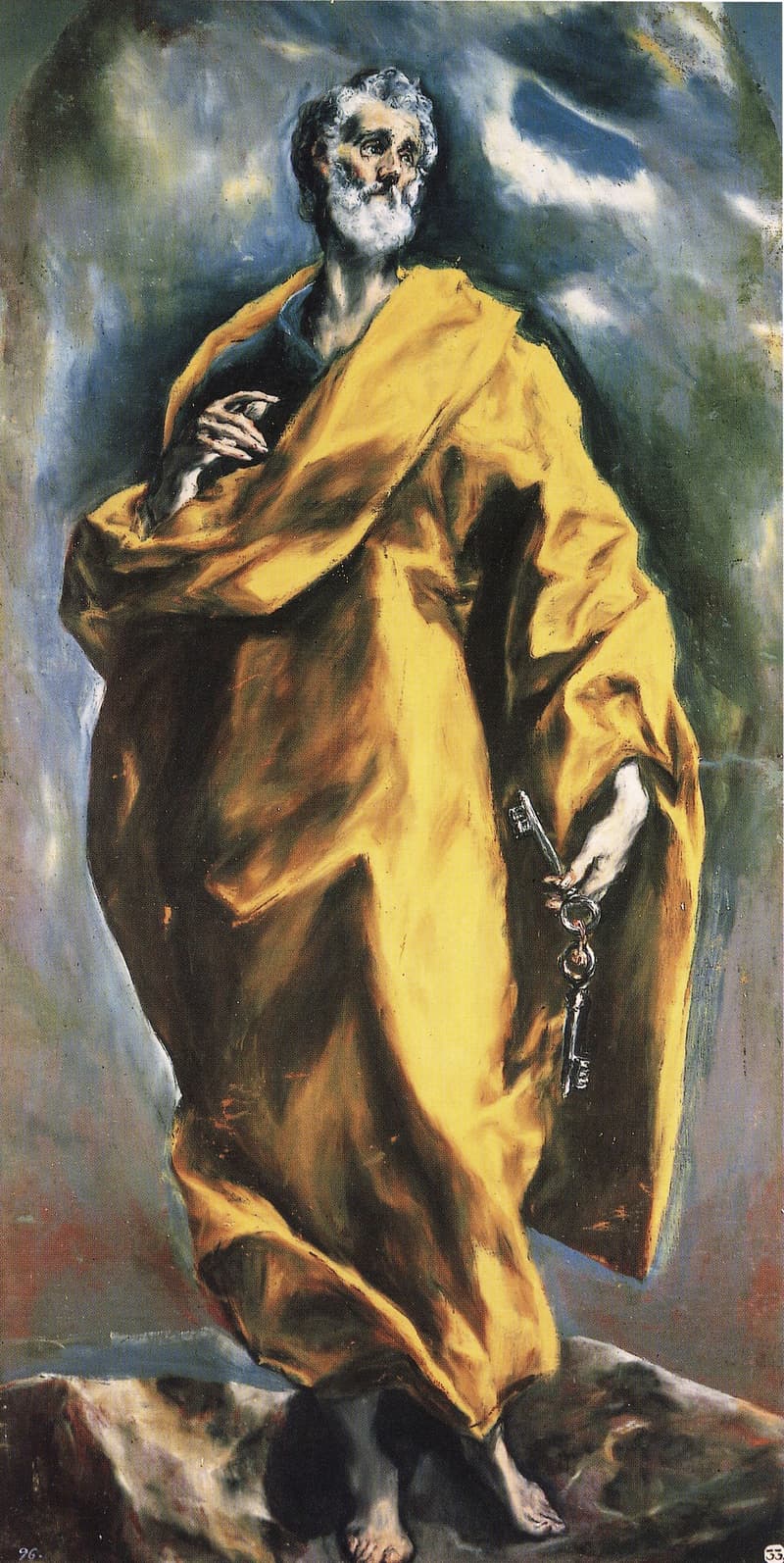
Now notice something telling about MacArthur’s own note. To establish that Πέτρος (Petros) means “a small stone,” it cites John 1:42. Yet, John 1:42 is the verse in which Jesus names Simon Κηφᾶς (Kephas)—the Aramaic word for rock—of which John tells us “Peter” is the translation. The one verse MacArthur’s note offers in support of the small-stone theory is the verse that records the Aramaic name that destroys the small-stone theory. That is not a disputed interpretation. That is a reference that refutes the sentence containing it, printed in a study Bible that has sold two million copies.
There is a stranger fact still. In 1993, at his own Shepherds’ Conference, MacArthur told the assembled pastors that the Protestant confession-not-Peter reading “may be” right, “but let me take you to another understanding that I think may be more accurate. It does refer to Peter… He is talking about Peter and what He is saying is, ‘Peter, I’m going to build My church on you in this sense, the fact that you are articulating the truth.’”27 In 1993, then, MacArthur conceded to a room of pastors what Carson and France had written—Peter is the rock—before reverting, in his printed notes and his 2020 pulpit, to the small-stone argument the scholarship had buried. A man may change his mind. What he may not honorably do is teach a congregation, as settled Greek grammar, an argument he had himself abandoned as probably inaccurate, without telling them the evidence runs the other way. Whether Peter’s rock-foundation role implies everything the Catholic Church says it implies—succession, primacy, the whole edifice—is a further argument. The lexical claim MacArthur actually made, however, is not. It is just wrong, and the leading commentators of his own tradition had said so, in print, in the standard commentaries of that tradition.
John 6: The Argument the Second Century Answers
When MacArthur reached the Bread of Life discourse—“unless you eat the flesh of the Son of Man and drink his blood, you have no life in you”—he told his congregation: “This is, of course, a chapter that has been mutilated by the Roman Catholic Church, and they have used this to develop the Mass where Christ is re-sacrificed again and again and again. And you eat His flesh and drink His blood, just exactly what He’s not talking about.”28 His commentary supplies the linguistic argument: “It is a false foundation for a false doctrine, however, to suggest that Jesus was referring to the Eucharist (Communion or the Lord’s Table) here, since He used the word sarx (flesh). A different word, sōma (‘body’), appears in the passages referring to Communion.”29
Let me be careful about what I am and am not claiming. A non-eucharistic reading of John 6 is a respectable position with a Protestant pedigree—Zwingli held it, and so do fine evangelical exegetes today. If MacArthur had said “I read the eating as a metaphor for faith, as many in my tradition do,” there would be nothing to document here. He said two other things instead, and both are false as matters of historical fact.
The first is the σάρξ/σῶμα (sarx/sōma) argument. Note what the substitution actually involves. Σῶμα is the broader, milder term—“body,” physical or corporate, the word Paul can stretch to cover the church itself. Σάρξ is the coarser one: meat, muscle, mortal stuff—the word John had already chosen for the scandal of the incarnation: “the Word became flesh” (John 1:14). A writer wishing to spiritualize the eating of John 6 had the milder word ready to hand; John reached past it for the cruder one. Against the institution narratives’ “body,” the discourse’s “flesh” is a doubling down, not a softening.
If John’s word “flesh” excludes the Eucharist because the institution narratives say “body,” then the earliest Christians on record should reflect that distinction. They reflect its opposite. Ignatius of Antioch—a bishop who died around the year 107, within living memory of the apostle John, writing to a church John himself had known—described the docetic heretics this way: “They abstain from the Eucharist and from prayer, because they confess not the Eucharist to be the flesh of our Saviour Jesus Christ, which suffered for our sins, and which the Father, of His goodness, raised up again.”30 The Eucharist is the flesh—σάρξ—of Christ: Johannine vocabulary, applied to the sacrament, by a bishop of the apostolic age, a generation after the Gospel was written. Justin Martyr, around 155, said the same: the consecrated food “is the flesh and blood of that Jesus who was made flesh.”31 Irenaeus followed later in the same century: the bread over which thanksgiving has been offered “is no longer common bread, but the Eucharist.”32 The earliest eucharistic vocabulary outside the New Testament is not σῶμα but σάρξ—which is to say, MacArthur’s lexical argument does not merely fail; it points in precisely the wrong direction. Even within Protestant scholarship the eucharistic resonance of John 6 is widely conceded: the Baptist commentator George Beasley-Murray wrote of verse 53 that “neither the Evangelist nor the Christian readers could have written or read the saying without conscious reference to the Eucharist.”33
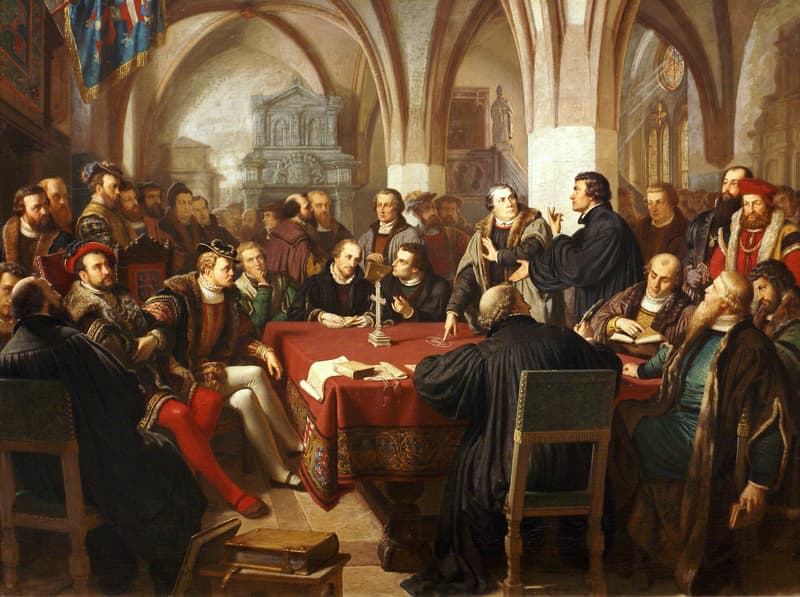
The second false claim is the word “mutilated”—the assertion that the eucharistic reading of John 6 is a Roman corruption imposed on a text that originally meant something else. The history runs the other way. The eucharistic reading is the earliest attested reading; the faithful John Chrysostom preached to in the fourth century heard him insist, on this very chapter, that Christ spoke as he did “that they might not suppose the words to be a mere enigma or parable, but might know that it is by all means needful to eat the Body.”34 Cyril of Jerusalem catechized his converts: “Since then He Himself declared and said of the Bread, This is My Body, who shall dare to doubt any longer?”35 One may believe the ancient church broadly misread the chapter. That is a coherent position. But then the honest statement is “the earliest attested reading is wrong,” not “Rome mutilated the chapter”—and a man who tells his congregation the second thing, when the documentary record shows the first, has replaced history with polemic. It is worth adding that MacArthur’s memorialism—the Supper as “the cup which remembers”36—would have been rejected not only by the fathers but by Luther, who at Marburg in 1529 chalked Hoc est corpus meum on the table and refused to yield the literal words of institution to Zwingli.37 On the Lord’s Supper, MacArthur did not stand with Luther—nor with Calvin, whose doctrine of spiritual presence the Reformed confessions enshrine. He stood at Zwingli’s barest, and taught the position as though no other had ever been Christian.
John 3:5: An Argument Refuted by the Next Paragraph
To Nicodemus, Jesus says that no one enters the kingdom of God “without being born of water and Spirit.” The Christian tradition read “water” baptismally with striking near-unanimity—Justin Martyr cites the verse in his description of baptism around 155, and Tertullian, around 200, rests “the prescript… that without baptism, salvation is attainable by none” chiefly on “that declaration of the Lord, who says, Unless one be born of water, he has not life.”38 MacArthur ruled the baptismal reading out, and here is one of his arguments, from his late-career series on the essentials: Nicodemus “wouldn’t know anything about Christian baptism either, because it hadn’t been implemented yet.”39
Read the rest of John 3. Seventeen verses after the Nicodemus conversation, the evangelist reports: “After this, Jesus and his disciples went into the region of Judea, where he spent some time with them baptizing. John was also baptizing in Aenon near Salim” (John 3:22–23). The chapter in which Jesus tells Nicodemus about water and the Spirit is a chapter saturated in baptism—John’s baptism drawing crowds in the immediate narrative frame, Jesus’ own disciples baptizing in the very next scene, the evangelist returning to the theme at the start of chapter 4. Whatever “born of water” means, the argument that it cannot involve baptism because baptism was not yet on the scene collapses on a plain reading of the surrounding text. Nor does the qualifier “Christian” rescue the argument: specifically Christian baptism lay in the future, but so did the Eucharist at the Last Supper, and the cross in every prediction our Lord made of it—speaking of realities not yet instituted is much of what the Gospel shows Jesus doing. An expositor whose method was, by his own account, the patient verse-by-verse treatment of whole books somehow preached an argument that the passage’s own context refutes—and note, again, the shape of the failure: not a defensible alternative reading (his positive case, that the image echoes Ezekiel 36, is a respectable evangelical position), but a confident supporting assertion that cannot survive contact with the adjacent paragraph.
Acts 2:38: The Grammar That Is “Clearly” Otherwise
At Pentecost, Peter tells the crowd: “Repent and be baptized every one of you in the name of Jesus Christ for the forgiveness of your sins” (Acts 2:38). The Greek preposition is εἰς (eis)—“for,” “unto,” “with a view to.” Baptism is for the forgiveness of sins: so the text, and so the creed recited by hundreds of millions every Sunday, whose clause speaks this same vocabulary: “one baptism for the remission of sins.”40 MacArthur, whose theology required baptism to follow forgiveness rather than convey it, taught his people that εἰς here means “because of”: “While it is often translated ‘for the purpose of,’ it can also mean ‘because of’—that’s clearly the sense it conveys in Matthew 12:41… That’s the sense we ought to see in Acts 2:38.”41
“Clearly” is the word to watch. The causal reading of εἰς was a live proposal in mid-century scholarship—advanced by J. R. Mantey, precisely to protect believer’s-baptism theology—and it was examined and dismantled in the Journal of Biblical Literature by Ralph Marcus in an exchange that has been settled for seventy years. Daniel Wallace—a Dallas Seminary grammarian, a dispensationalist, a man with every theological incentive to accept the causal reading—renders the verdict in the standard evangelical Greek grammar: Marcus “ably demonstrated that the linguistic evidence for a causal eis fell short of proof,” and Wallace declines to build anything on it.42 The standard lexicon glosses the phrase in Acts 2:38 as purpose: “so that sins might be forgiven.”43 Once more, the point is not that MacArthur took a side in a live debate. The point is that he told his congregation a linguistically abandoned proposal was “clearly” the sense of the text. The men who actually do Greek grammar for a living—his fellow conservative evangelicals—say the opposite.
Slave: The Cover-Up That Wasn’t
In 2010 MacArthur published Slave: The Hidden Truth About Your Identity in Christ, whose thesis—that δοῦλος (doulos) means “slave,” and that English translations soften it to “servant”—is true, unoriginal, and useful. The scholarly monograph on the subject, Murray Harris’s Slave of Christ, had made the point a decade earlier with appropriate sobriety. What MacArthur added was a conspiracy. The book’s back cover announced that translators had “perpetrated a fraud,” a “cover-up of biblical proportions.”44 From his pulpit he had already supplied the details: “the word ‘slave’ appears in the New Testament 130 times in the original text. You will find it once in the King James, once the Greek word ‘slave’ is translated slave”; only one English translation, Goodspeed’s, renders δοῦλος consistently as slave; and the translators’ motive “might well be a lack of courage, conviction.”45 At Liberty University he traced the crime to its origin: “This started in 1560 with the Geneva Bible when translators said there’s too much stigma on the word slave [δοῦλος], ‘We can’t call Christians slaves, so let’s call them servants.’”46
Nearly every factual component of that account is wrong. The King James Version’s one New Testament occurrence of “slaves”—Revelation 18:13, in the cargo list of Babylon—translates not δοῦλος but σωμάτων (sōmatōn), “bodies.”47 The KJV never renders δοῦλος “slave” at all—its renderings are “servant” and, in a handful of places, “bond” or “bondman”—so the “once” statistic, offered as evidence of the cover-up, is a misreading of the one verse it rests on. The Geneva-Bible origin story is worse. William Tyndale’s New Testament—1534, twenty-six years before the Geneva Bible existed—opens Romans with “Paul the seruaut of Iesus Christ,” and Wycliffe’s translators had opened it with “Poul, the seruaunt of Jhesu Crist” in the 1380s, following the Latin servus.48 The rendering MacArthur attributed to a 1560 committee’s loss of nerve was, by 1560, already the standing convention of every English Bible ever made. And the “cover-up” framing collapsed under the gentlest scrutiny from within his own camp: Trevin Wax, reviewing the book for The Gospel Coalition, observed that MacArthur himself concedes in the book that the translators’ choice was unintentional—“an admission that quickly throws water on the suggestion that there is a massive ‘cover up.’ Cover-ups are always intentional, aren’t they?”49 Here is the MacArthur method in miniature: a sound scholarly observation, borrowed; inflated into a dramatic accusation, unsupported; garnished with statistics that do not survive a check of the concordance; and delivered with the cadence of a man revealing hidden truth.
The Small Habits: Dynamite and “Called-Out Ones”
Two smaller items, briefly, because they are the tells of a preacher working beyond his linguistic means. MacArthur on Romans 1:16: “The word is dunamis. We get our word ‘dynamite’ from it. And Paul has in mind the fact that the gospel of Christ carries with it the omnipotence of God.”50 We do get “dynamite” from dunamis—Alfred Nobel coined it in the 1860s—which is precisely why Paul cannot have had anything of the sort “in mind,” and why D. A. Carson uses this exact move, the gospel-as-dynamite trope, as his textbook example of the fallacy of semantic anachronism: reading a later derivative back into an ancient word.51 Likewise MacArthur on the church: “just change the word ‘church’ to ‘assembly’ because that’s what the word means, called-out ones.”52 The first half is right; the second is the stock example of the root fallacy—deriving a word’s meaning from its etymological components. By New Testament times ekklesia simply meant an assembly (Acts 19 uses it for a pagan mob); “called-out ones” is a preacher’s etymology, the Greek-class equivalent of explaining “goodbye” by “God be with ye” in a modern conversation. These are small errors. They matter because they are method errors, the kind a single semester of graduate exegesis is designed to beat out of a student, appearing in the sermons of a man his followers call the greatest Bible expositor of the age.
The Misquotations: Justin Martyr and Philip Schaff
The last item in the exegetical record is the gravest, because it does not concern a disputed interpretation at all. It concerns the handling of sources—the thing scholars are trained, above everything else, not to do.
In 2007, making his case that premillennialism was the faith of the early church, MacArthur told his congregation: “Even Justin Martyr, who lived from 100 to 165, said, ‘But I and others who are right-minded Christians on all points are assured that there will be a resurrection of the dead and a thousand years in Jerusalem, which then will be built, adorned and enlarged, as the prophets Ezekiel and Isaiah and others declare.’”53 The quotation is genuine. It comes from chapter 80 of the Dialogue with Trypho. And earlier in that same chapter, Justin says this: “I admitted to you formerly, that I and many others are of this opinion, and [believe] that such will take place, as you assuredly are aware; but, on the other hand, I signified to you that many who belong to the pure and pious faith, and are true Christians, think otherwise.”54 Justin’s own chapter concedes that many true and pious Christians rejected the millennial view. MacArthur quoted the confident sentence and omitted the concession—the one datum in the passage that directly falsifies the early-church-consensus argument he was using the passage to make.
In the same sermon he reached for the historians: “Philip Schaff… writes, ‘The most striking point in the eschatology of the Ante-Nicene Age is the prominent millenarianism; that is the belief of a visible reign of Christ in glory on earth with the risen saints for a thousand years before the general resurrection and the judgment. It is the widely-held opinion of distinguished teachers such as Barnabas, Papias, Justin, Irenaeus, Tertullian, Methodius, Lactantius,’ and on and on and on.”55 Here is what Schaff’s History of the Christian Church actually says, in the sentence MacArthur was rendering: “It was indeed not the doctrine of the church embodied in any creed or form of devotion, but a widely current opinion of distinguished teachers, such as Barnabas, Papias, Justin Martyr, Irenaeus, Tertullian, Methodius, and Lactantius; while Caius, Origen, Dionysius the Great, Eusebius (as afterwards Jerome and Augustin) opposed it.”56 The sentence as delivered from MacArthur’s pulpit drops Schaff’s governing qualification—that chiliasm was never the church’s doctrine—converts “a widely current opinion” into “the widely-held opinion,” and deletes the list of church fathers who opposed the view. The qualification appears nowhere in the transcript of MacArthur’s sermon, and Schaff’s roll of opponents is never reported—Origen surfaces in the sermon only as the father of allegorizing, never as Schaff’s counter-witness against a premillennial consensus.
I do not know, and do not claim to know, whether MacArthur altered these texts himself or inherited them, pre-trimmed, from some secondary compilation. In a sense it does not matter. A scholar is a man who checks. The whole meaning of the word—the entire difference between scholarship and confident repetition—is the discipline of verifying that your source says what you are about to claim it says, most especially when it is about to prove your point. Whatever else these two quotations demonstrate, they demonstrate that the man delivering them was not checking. And they were not delivered in a casual aside. They were the documentary evidence in his signature historical argument, preached to thousands and distributed worldwide under a ministry whose motto is “Unleashing God’s Truth, One Verse at a Time.”
A Hermeneutic Asserted, Never Established
Everything MacArthur preached about the Bible’s storyline ran through a system: dispensational premillennialism, with its pretribulational rapture, its seven-year tribulation, its restored national Israel, its thousand-year earthly kingdom. He did not hold the system tentatively. In 2007 he opened his own pastors’ conference with an address whose title he relished repeating: “Why every self-respecting Calvinist has to be a premillennialist.” “It’s too late for John Calvin to fix his work,” he told his congregation in the follow-up series, “although he is now a premillennialist in heaven”; amillennialism he waved off—“I say leave amillennialism to the process theologians”—a quip worth pausing over: process theology, whose evolving, non-omnipotent God no orthodox communion accepts, is heresy by any classical measure, so the line consigns amillennialism—the reading of Augustine, of the Reformers, of the greater part of Christian history—to the company of heretics; and the exegetical foundation was announced as a statistic: “There are over two thousand references to Israel in Scripture; not one of them means anything but Israel.”57
The Manifesto and Its Reception
The Reformed world he was lecturing did not receive this as scholarship. Kim Riddlebarger, who had written an actual book on amillennialism, replied that “with a rather striking measure of audacity, Dr. MacArthur went on to argue that unless you are a dispensationalist, you cannot be a ‘consistent Calvinist,’” called the Arminian jab “simply a cheap shot,” and concluded: “Dr. MacArthur set up and repeatedly attacked a straw man. His was a pyrrhic victory over a phantom foe.” He added a detail that deserves more attention than it got: “As Richard Muller pointed out back in 1993, there is every likelihood that John MacArthur’s ‘Calvinism’ would probably not be recognized by Calvin himself.”58 Sam Waldron found the address remarkable enough to answer with an entire book.59 The spectacle, savored at the time by Reformed bloggers, was of a man informing a tradition of its own logical requirements—a tradition whose confessions had spent four centuries saying otherwise—on the strength of a word count.
Darby, the Rapture, and the Early Church
Two facts frame the whole eschatological edifice, and neither is Catholic special pleading. The first is chronological: the pretribulational rapture—the distinctive doctrine, the one that generates the Left Behind sequence MacArthur preached as the plain sense of Scripture—cannot be securely documented as anyone’s teaching before the nineteenth century. Even the survey of the rapture’s history published in The Master’s Seminary Journal—the academic organ of MacArthur’s own seminary—in an article written to defend pretribulationism’s pedigree, concedes that the early fathers held “a sort of imminent intra- or post-tribulationism”—that is, they expected the church to meet Antichrist, not to be evacuated before him—and dates the distinctive doctrine to Darby: “the pretribulational rapture view which Darby had discovered while in Bible study between 1826–27, was later supported by Edward Irving.”60 The standard academic histories of the movement say the same: the secret rapture and the prophetic “parenthesis” entered Christian teaching through John Nelson Darby and the Powerscourt circle in the early 1830s, found its mass American audience through the Scofield Reference Bible, and conquered the fundamentalist pulpit from there.61
Honesty requires the footnote that partisans advance two alleged precedents—a sermon of disputed date and authorship attributed to Ephraem, and a passage of the eighteenth-century Baptist Morgan Edwards—and that the survey in MacArthur’s journal embraces them. Honesty equally requires reporting that the Ephraem sermon has been read by careful interpreters as placing the church squarely inside the tribulation it supposedly escapes, and that the standard academic histories continue to date the doctrine’s actual career from Darby.
When MacArthur preached the rapture sequence—“Those of us who have already been with Him, having been raptured before the tribulation, we come back with Him to earth”—he added, in passing, a concession his hearers might have weighed more heavily: “Though it doesn’t describe the rapture—it’s described in other places—it’s clear that that is what has happened.”62 The book of Revelation, expounded verse by verse as the blueprint of the end, does not contain the event on which his entire chronology hangs. He said so himself, in a subordinate clause, and kept going.
The second fact is what the early church actually held. The honest version is the one Philip Schaff wrote, not the one MacArthur preached: premillennialism of a sort was indeed widespread among prominent ante-Nicene teachers, it was never the church’s doctrine, it was opposed by others, and Justin himself admitted that devout Christians rejected it. Augustine, who had once held a version of the millennial hope—“for I myself, too, once held this opinion,” he writes in the City of God—abandoned it for the reading that would carry the church for the next thousand years and the Reformers after that.63 The Augsburg Confession condemned the millenarian schemes of its day as “Jewish opinions”; Cranmer’s Forty-Two Articles dismissed the restored millennium as a “fable” of those who “cast themselves headlong into a Jewish dotage.”64 A man is entitled to argue that Darby found in 1827 what the whole church had missed for eighteen centuries. What he is not entitled to do—what MacArthur did—is present the novelty as the ancient faith, deliver his patristic and historical witnesses pre-edited into agreement, and inform the heirs of Calvin that self-respect requires them to follow.
The Reversals
If the exegetical record shows a man asserting more than he knew, the doctrinal record shows something that should trouble his admirers more. On the most solemn subject in theology—the eternal relations of the Trinity—MacArthur taught for decades a doctrine he would at last abandon: sixteen years in print, and, his critics documented, longer in the pulpit.
Incarnational Sonship: The Retracted Doctrine
From the early 1970s—his critics preserved it on tape as early as 1972—until 1999, MacArthur taught that Christ’s Sonship began in time: that “Son” names a role the second Person assumed at the incarnation, not an eternal relation. The position appeared in his 1983 Hebrews commentary—“He was always God, but He became Son. Eternally He is God, but only from His incarnation has He been Son,” as the commentary put it—was defended before his fundamentalist denomination’s convention in 1989, and was reissued in a 1991 booklet.65 In 1999 he retracted it, in a public statement whose candor I want to acknowledge even as I insist on its implications: “I want to state publicly that I have abandoned the doctrine of ‘incarnational sonship.’ Careful study and reflection have brought me to understand that Scripture does indeed present the relationship between God the Father and Christ the Son as an eternal Father-Son relationship. I no longer regard Christ’s sonship as a role He assumed in His incarnation.”66
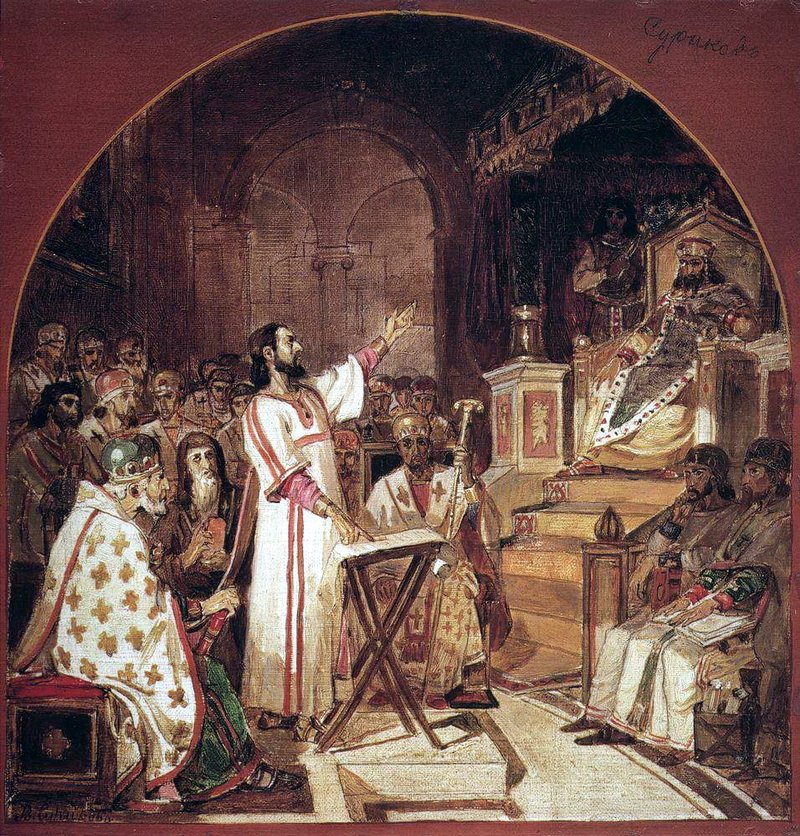
Credit where due: public retractions are rare, and this one was real. He maintained, plausibly, that the abandoned view had been “a minority opinion” and “by no means rank heresy.” But consider what it concedes. The eternal Sonship of Christ is not an obscure point. It is the grammar of the Nicene Creed—begotten of the Father before all ages—the settled confession of the entire Christian tradition, East and West, Catholic and Protestant. A man whose method reliably produced sound doctrine should not have needed decades and a wave of critics to arrive at the Trinitarian consensus of the fourth century. That is the methodological lesson of the sonship affair: MacArthur’s confidence operated at full strength on both sides of the reversal. The tone in which he taught the error was the tone in which he retracted it. The certainty was a constant; only the content changed. And the affair had casualties his admirers rarely mention—the controversy roiled the Independent Fundamental Churches of America for years, and, as one of his persistent fundamentalist critics documented, contributed to departures from that fellowship.67
The Blood Controversy: Where He Was Right
Fairness requires me to add the controversy where MacArthur was substantially right: the “blood of Christ” affair. In remarks first published in 1976, he denied that the literal liquid shed at Calvary had magical properties—“There was nothing supernatural in Jesus’ blood that sanctified those it touched,” he later wrote; the blood saves as the biblical idiom for Christ’s atoning death.68 For this, Bob Jones Jr. pronounced in 1986 that “MacArthur’s position is heresy,” and the fundamentalist world convulsed for five years until the Joneses stood down.69 On the substance, MacArthur’s position was defensible and arguably obvious. I include the episode for two reasons. First, because fairness demands it. Second, because of what it reveals: MacArthur spent a decade on the receiving end of exactly the polemical machinery he operated for everyone else—the confident heresy verdict, delivered without careful reading, by men certain beyond their competence—and the experience taught him nothing about the machinery.
Lordship Salvation: Corrected in Silence
The third episode sits between the other two. The Gospel According to Jesus (1988), his signature book, ignited the “lordship salvation” war with the Free Grace dispensationalists—Zane Hodges answered that MacArthur’s gospel “differs only insignificantly from official Roman Catholic dogma,” which as a Catholic I note with some amusement70—but the more telling response came from the Reformed theologians whose tradition MacArthur claimed to champion. The 1992 volume Christ the Lord, edited by Michael Horton, sided with MacArthur against Hodges and then, patiently, documented that MacArthur did not command the Reformation categories he was wielding: that his account “risks confusion on some fundamental evangelical convictions, particularly between justification and sanctification”; that his redefinition of faith’s element of trust to include obedience was, in Riddlebarger’s words, “outside the classical Protestant understanding of that model”—the first edition had even misquoted Louis Berkhof in a way that made the Reformed dogmatician appear to agree; and that his formulations left a standing dilemma, as Paul Schaefer put it, whether obedience is for MacArthur the fruit of faith or “actually a constituent part of the definition of faith.”71 MacArthur, hearing the criticisms, revised the book—later editions added, among other things, a chapter on justification—without acknowledging, anywhere in its footnotes, Christ the Lord itself.72 The pattern, by now, should be familiar. The man his followers regard as a theological fixed point spent the 1990s being corrected—on the Trinity by his critics, on justification by the confessional Reformed—and absorbed the corrections silently, the pulpit voice’s certainty undimmed.
The Polemicist
Every public teacher makes enemies. MacArthur manufactured them at industrial scale, and the manner of it belongs in any honest assessment, because his defenders present the combativeness as courage—the lion of the pulpit, fearless before the age. Examine the actual engagements and a different picture emerges: a man whose harshest verdicts consistently outran his evidence, aimed at targets who deserved arguments and received anathemas.
Strange Fire and the Charismatics
Take the charismatics. There are five hundred million people in the charismatic and Pentecostal movements, and MacArthur’s Strange Fire conference in 2013 addressed them like this: “This is paganism. This is the work of Satan. This is the work of the kingdom of darkness, and it is not to be attributed to the Holy Spirit.” The movement’s worship “blasphemes” the Spirit’s name; its practices “are the same as those who are engaged with demons”; evangelicalism had “welcomed the Trojan Horse of the charismatic movement into the city of God”; and of the half billion, “the charismatic movement is loaded with non-Christians… the vast majority, I fear, are in the dark.”73 Whatever one thinks of continuationism—and serious criticisms of charismatic excess exist; some were made at that very conference—this is not criticism. It is the wholesale consignment of the largest movement in world Christianity to the kingdom of darkness. The response from within MacArthur’s own Reformed-evangelical world was instructive: John Piper answered, gently, that he prays for the gift of prophecy “almost as often as I pray for anything,” and advocates obedience to the texts MacArthur’s position must explain away—“Earnestly desire the spiritual gifts”; “do not forbid speaking in tongues.”74 The New Testament scholar Craig Keener—author of the standard academic study of miracle claims—observed that MacArthur “suppresses some biblical truth on the basis of a postbiblical doctrine, the very offense with which he charges others.”75 That sentence, from a scrupulously irenic scholar, is as close as the guild comes to a charge of hypocrisy.
Beth Moore: Go Home
Or take October 2019, when a word-association game at his ministry’s conference offered him the name “Beth Moore,” and MacArthur answered, to laughter and applause: “Go home.” He continued: “There is no case that can be made biblically for a woman preacher – period, paragraph, end of discussion,” and then, of a woman who had spent decades teaching the Bible to evangelical women: “Just because you have the skill to sell jewelry on the TV sales channel doesn’t mean you should be preaching. There are people who have certain hawking skills, natural abilities to sell. They have energy, personality and all of that. That doesn’t qualify you to preach.”76 One may hold the complementarian position—most of the Christian tradition has—without the sneer. The sneer was the point; the laughter was the reward. “Period, paragraph, end of discussion” is, once again, the voice of a man for whom the absence of counterargument is a rhetorical style rather than an achieved result.
Denying PTSD, OCD, and ADHD
Or take April 2024, fifteen months before his death, when MacArthur informed a conference Q&A: “There’s no such thing as PTSD. There’s no such thing as OCD. There’s no such thing as ADHD. Those are noble lies to basically give the excuse, in the end of the day, to medicate people. And Big Pharma is in charge of a lot of that.” PTSD, he explained, is really grief, and grief “is part of life”; and parents who accept a diagnosis for their child are “literally… turning your child into a potential” drug addict, “but maybe a potential criminal.”77 I served in the military as a JAG officer. I have known men and women whose post-traumatic injuries were as real as shrapnel. I myself still suffer nightmares and other effects from the sex crimes and child pornography cases I had to prosecute. A pastor is entitled to warn against overmedication and diagnostic fads; he is not entitled to inform the traumatized, on no medical training whatsoever, that their condition does not exist. Christian psychologists and even longtime allies said as much within days.78 It was the last major controversy of his life, and it was perfectly in character: total confidence, no expertise, maximal stakes for the people who believed him.
The Slavery Interview
And there is the 2012 interview, resurfaced a decade later by the evangelical New Testament scholar Michael Bird, in which MacArthur—promoting Slave—mused: “It is a little strange that we have such an aversion to slavery because historically there have been abuses. There have been abuses, there have been abuses in marriage, we don’t have an aversion to marriage particularly,” and suggested that for some slaves, “working for a gentle, caring, loving master was the best of all possible worlds.” Bird’s judgment: what MacArthur “shockingly does is rehearse the 19th-century pro-slavery arguments made in the antebellum south.”79 In context MacArthur was commending the slave-of-Christ metaphor, and fairness requires saying so. Fairness also permits observing that a careful teacher, handling the subject of human bondage, does not reach for “the best of all possible worlds”—and that MacArthur’s separately documented civil-rights recollections, including his account of standing at the Lorraine Motel within hours of Dr. King’s assassination, have been publicly disputed by men he named as witnesses.80 When he dismissed the evangelical racial-justice conversation in 2018 as “the most subtle and dangerous threat” to the gospel he had ever fought, he did so, characteristically, in the same breath as “I deplore racism”—the concession and the dismissal, as always, arriving together.81
What He Told His People About the Catholic Church
I have saved the Catholic material for late in this essay deliberately, so that no one can mistake the order of the argument. The case that MacArthur was not a careful handler of texts and evidence has now been made almost entirely from Scripture, lexicons, church fathers, Protestant scholars, and his own transcripts. Bring that established pattern, now, to the subject he attacked more relentlessly than any other, and ask a single question—not whether he was right that Catholicism is false, which is the great argument of Western Christianity and will not be settled here, but whether what he told his people about the Catholic Church was accurate. It was not, and the inaccuracy is documentable at the level of quotation.
The Tone of the Campaign
First, the tone, so the reader unfamiliar with this corner of MacArthur’s ministry understands what we are discussing. In the weeks after John Paul II’s death, MacArthur preached that Catholicism is “an apostate, corrupt, heretical, false Christianity; it is a front for the kingdom of Satan”; that “Romanism is a gigantic system of church worship, sacrament worship, Mary worship, saint worship, image worship, relic worship, priest worship, and pope worship”; that the papacy is “the biggest hoax ever foisted on the world”; and, of the dead pope himself, that “we should grieve for that man because he gained the whole world and lost his soul.”82 The billion Catholics of the world he pronounced “a mission field,” and the question of whether to evangelize or cooperate with them, he said, “changes everything. Everything.” In print, he was tidier but no softer: Rome is “a false and deceptive form of Christianity,” and “it is the spiritual duty of all true Christians to oppose Roman Catholic doctrine with biblical truth and to call all Catholics to true salvation.”83
Trent, Justification, and a Doctrine Misstated
Strong words impose strong duties. A man who declares a communion of a billion souls satanic owes it, at minimum, an accurate description. Here is MacArthur’s summary of Catholic soteriology, from the same printed treatment: “In the teaching of the Roman Catholic Church, then, works are necessary both to begin and to continue the process of justification.”84
And here is the Council of Trent, the very council MacArthur cited as the proof of Rome’s apostasy, in its Decree on Justification: “we are therefore said to be justified by faith, because faith is the beginning of human salvation, the foundation, and the root of all Justification… we are therefore said to be justified freely, because that none of those things which precede justification—whether faith or works—merit the grace itself of justification. For, if it be a grace, it is not now by works, otherwise, as the same Apostle says, grace is no more grace.” The same decree’s first canon anathematizes anyone who says “that man may be justified before God by his own works… without the grace of God through Jesus Christ.” Its sixteenth chapter grounds even merit in gift: “God forbid that a Christian should either trust or glory in himself, and not in the Lord, whose bounty towards all men is so great, that He will have the things which are His own gifts be their merits.”85 The Catechism repeats the doctrine in a single sentence: “no one can merit the initial grace of forgiveness and justification, at the beginning of conversion.”86
Works do not “begin” justification in Catholic teaching; the denial that they do is conciliar doctrine, guarded by the decree’s opening canon, quoting the same Pauline texts MacArthur deployed against us. One may still object to Trent’s account of what follows justification’s beginning—the Reformation debate is real, and Trent does teach that adults are prepared for justification by grace-prompted dispositions—but a disposition wrought by prevenient grace is not a work that earns, the infant at the font is justified with no works at all, and the sentence MacArthur gave his readers describes a religion that Trent condemned.
Did he know? Here the record turns strange, because in his own polemic against Evangelicals and Catholics Together, MacArthur wrote this: “the Council of Trent explicitly denied that anyone can be justified by good works apart from grace,” and added—of Trent’s own polemics—a sentence that reads today like an unintended self-portrait: “Trent often attacked straw men of its own making… Sometimes the view they condemn is merely a caricature of Reformation teaching.”87 He could describe the doctrine accurately when scoring a debating point about anathemas; he described it inaccurately when telling his people what Catholics believe. Whether that is carelessness or something worse I leave to the reader.
Doctoring the Catechism on the Mass
But the decisive exhibit—the one I would hand to anyone who asked for a single documented case of MacArthur misrepresenting a source—comes from his 2006 sermon “Explaining the Heresy of the Catholic Mass.” His thesis was that the Mass repeats the sacrifice of Christ, re-immolating the Lord day after day in defiance of Hebrews’ “once for all.” The Catholic texts say the opposite, and say it as plainly as language allows: “The sacrifice of Christ and the sacrifice of the Eucharist are one single sacrifice,” in the Catechism’s words, which quotes Trent: “the victim is one and the same… only the manner of offering is different”—the Mass re-presents the one sacrifice of Calvary; it does not repeat it.88 MacArthur read that very paragraph to his congregation, and here, verbatim from his ministry’s own transcript, is what he did with it: “Here’s one paragraph from the Catechism: ‘The sacrifice of Christ and the sacrifice of the Eucharist are one single sacrifice… the same Christ who offered Himself once on the altar of the cross is offered in an unbloody manner,’ repeatedly. I added the word ‘repeatedly’ for clarification.”89 He quoted the document that refutes his characterization and inserted—announcing the insertion—the one word that reverses its meaning. “Clarification” is not the name for that operation. If a seminarian did it to a source in a term paper, he would fail the course; MacArthur did it to the defining catechetical text of a billion Christians, from a pulpit, while calling their worship “demonic,” “idolatrous,” and “hocus-pocus”—and telling his people that “the Mass cancels the cross” and that Catholics devote their lives to “worshiping a piece of bread in a box.”90
Mary, Purgatory, and the Phantom Church
The rest of the indictment runs the same way, item by item. Catholics “worship Mary,” he said. The Church’s actual teaching, in the conciliar text and the Catechism, is that Marian devotion “differs essentially from the adoration which is given to the incarnate Word and equally to the Father and the Holy Spirit”—the distinction between veneration and worship is not a Catholic evasion but a Catholic dogma, and the veneration of images “is not contrary to the first commandment.”91 (Note that Western Catholics and most Protestants divide the ten commandments differently, so that what is traditionally the second commandment in Protestant and Eastern Catholic circles is included in the first commandment in the Catholic Latin Rite.)
Purgatory, he said, was “invented” because it was “motivated by money,” a “safety net” that keeps the system running.92 The Catechism’s actual doctrine is a purification of “all who die in God’s grace and friendship, but still imperfectly purified”—the saved, not the damned, and not a second chance; whatever one makes of it, the doctrine long predates the medieval abuses MacArthur mistook for its essence. The Church “kept the Bible from the people,” he taught, in a potted history running from Marian England to poor Tyndale—a story I have examined elsewhere and will not relitigate here, except to note that the man telling it also told his people that the eucharistic reading of John 6 was a Roman mutilation, and his reliability on historical claims about Catholicism has been sampled above.
And when he wished to make the case concrete, he reached for Mother Teresa: recounting a visit to Calcutta, he told his congregation of her inscription in a Bible—“May you enter into the heart of Jesus through the Virgin Mary”—and concluded, “So she believed that salvation is by virtue of Mary. And that’s very true of the Catholic faith.”93 It is not. No magisterial text teaches salvation “by virtue of Mary”; the Church confesses one mediator between God and men, the man Christ Jesus, and understands Marian intercession within that mediation, as the Christian East does as well—a distinction MacArthur had every resource to know and no interest in reporting.
This, then, was the man’s treatment of the communion he opposed above all others—the subject on which his admirers assure me he was a fearless truth-teller. He fought the 1994 Evangelicals and Catholics Together accord, by his own account, through a marathon meeting with its evangelical signers, and his written verdict complained that the document nowhere mentioned sola fide.94 That was a coherent Protestant objection, coherently stated. Had he confined himself to such objections—the real disputes, argued from accurate descriptions—he would have been a controversialist worth engaging. Instead, he taught a generation of evangelicals a Catholicism that does not exist: a works-ladder Rome that Trent anathematized, a repeated-sacrifice Mass that the Catechism excludes in the very sentence he doctored, a Mary-goddess the Church formally forbids. I spent years as an evangelical absorbing exactly this picture, and I can report from experience what it produces: not Protestants equipped to debate the Catholic Church, but Protestants equipped to debate a phantom—and primed for the disorientation that follows on discovering, as I eventually did, that the phantom was the polemicist’s creation. If the Catholic Church is wrong, she can be shown wrong from what she actually teaches. That MacArthur so seldom took that route is itself evidence of how strong he judged the actual case to be.
The Shepherd’s Record
Doctrine was not the whole of MacArthur’s public trust. He was a pastor, a university chancellor, a steward of institutions, and in his last years the record of that stewardship became public in ways that belong in any honest accounting—not as gossip, but because his authority rested on the claim that his ministry embodied the truth he preached.
Defying Caesar, Denying the Pandemic
Begin with the pandemic, the episode his admirers count a triumph. When California barred indoor worship in 2020, Grace Community Church defied the order, and the elders’ statement, “Christ, Not Caesar, Is Head of the Church,” declared that “we cannot and will not acquiesce to a government-imposed moratorium on our weekly congregational worship…”95 On the constitutional question, MacArthur’s side substantially won: after the Supreme Court’s 2021 ruling against California’s worship bans, the county and state together paid the church $800,000 in legal fees. Let me be plain about where my sympathies lie: the state’s treatment of Grace Community Church was, in my judgment, indefensible, and the official handling of the pandemic at large did much to earn the distrust it reaped. On the constitutional question MacArthur was right, and I am glad he won.96
But MacArthur did not stop at the constitutional argument, where his ground was firm. On August 30, 2020, he stood before his congregation and announced, on the strength of a misread CDC statistic, that “there is no pandemic.”97 By the following August he was telling the same congregation that he and his wife had “enjoyed our own bout with COVID,” and that the virus “probably went through our church in maybe December or January.”98 A pandemic that does not exist does not go through your church. The failure was never the defiance; a church may stand its ground against an overreaching Caesar, and be honored for it. The failure is the pattern that runs through everything above: a man pronouncing with total certainty, to people who trusted him completely, on a question he had neither the training nor the evidence to settle—and being overtaken by events within the year.
And in January 2021, back in the pulpit, he delivered the sentence that ought to be more famous than it is: “I don’t even support religious freedom. Religious freedom is what sends people to hell. To say I support religious freedom is to say I support idolatry… No Christian with half a brain would say, ‘We support religious freedom.’”99 This from the plaintiff in a religious-freedom lawsuit, months before accepting $800,000 of the public’s money in vindication of his free-exercise rights. As a lawyer I can only admire the nerve. As an assessment of the man’s consistency, the episode speaks for itself: the constitutional principle was a tool to be wielded in court and mocked from the pulpit, and the empirical claim—no pandemic—was falsified inside his own sanctuary without correction or retraction.
The Eileen Gray Excommunication
Then there is the case I would rather not write about, but must. In 2002, from the pulpit of Grace Community Church, MacArthur announced the excommunication of a mother named Eileen Gray, for the offense of refusing to take back her husband: “This is what the Lord wants. He wants discipline… to be put out of the church, to be publicly shamed, to be put away from fellowship. In this case it applies to Eileen Gray.” Her sin, as he framed it, was deciding “to leave her husband, to grant no grace at all, to take the children, to go away.” He directed the congregation to treat her as an unbeliever, and to pray for the husband: “Pray for David, for the sympathy and compassion and the lovingkindness of God to be his portion.”100
David Gray—who had taught music and Bible to children at that church—was subsequently tried and convicted of aggravated child molestation, corporal injury to a child, and child abuse, and sentenced to twenty-one years to life in prison.101 When the story surfaced in 2022, an elder and board officer of the church, the attorney Hohn Cho, reviewed the file and concluded, with a group of Christian lawyers, that Eileen Gray’s conduct had been—as Christianity Today summarized the finding—“objectively reasonable and fully vindicated”; and, by his account, he was told by MacArthur to “forget it,” then pressured to walk back his findings; he resigned instead. “They sided with a child abuser, who turned out to be a child molester, over a mother desperately trying to protect her three innocent young children,” Cho told Christianity Today. “And that was and is flatly wrong, and needs to be made right.”102
The church’s position, stated after the reporting, was that it does not discuss counseling and discipline matters and stands by its process; a defense circulated privately urged that confidential counseling contained exculpatory context the public record lacks.103 Let the reader weigh that defense. What cannot be weighed away is the public act: a pastor who publicly shamed a protecting mother, by name, from the pulpit, and whose church never—in the twenty years between the discipline and the reporting, or in the three years between the reporting and his death—publicly acknowledged error, even after the criminal courts had spoken.
Probation, Payroll, and Opacity
The institutional record points the same direction. In 2018, the accreditor of The Master’s University and Seminary placed the school on probation—citing, among other findings, a board that failed basic independence requirements, financial conflicts of interest involving the president’s family, and, in the visiting team’s words, “a disturbing climate of fear, intimidation and bullying at the institution.”104 The school reformed its governance; MacArthur moved from president to chancellor; probation was lifted in 2020.
And the financial reporting deserves mention with the attribution it requires: according to the investigation published by The Roys Report from ministry tax filings, MacArthur’s combined compensation from Grace to You and the university ran to roughly $3.4 million over the decade 2005–2015, with more than $12.8 million flowing to MacArthur and his family and their related companies over a longer period—reporting his ministry disputed; the same investigation documented that Grace to You had stopped filing public IRS disclosure forms in 2015.105
None of this is prosperity-gospel excess, and I do not claim otherwise. It is, however, the ordinary machinery of a religious empire—family on the payroll, opacity where transparency once was, an accreditor compelled to intervene—presided over by a man whose brand was the fearless denunciation of everyone else’s compromises. The man who told Beth Moore to go home, who consigned the half-billion-member charismatic movement to the kingdom of darkness, who pronounced a dead pope in hell, ran institutions that his own accreditor described in the language of fear, and a church that publicly shamed an abused man’s protecting wife. Judgment, our Lord observed, is a measure that returns.
Weighing the Forty-Two Years
Return, at the end, to the argument I set out to answer: forty-two years, verse by verse, thirty-four volumes. Does not the sheer sustained mass of the work refute everything above?
It does not, and the reason is worth stating carefully, because it applies far beyond MacArthur. Volume measures devotion; it cannot measure soundness. Sheer output, if it were the test, would credential the most prolific religious writers in American history—prophetesses, presses, and publishing empires no evangelical would dream of following. The forty-two years attest that MacArthur was diligent, disciplined, and utterly convinced. Diligence, discipline, and conviction are the machinery of a teaching ministry. They say nothing about whether the machine was calibrated—and calibration is exactly what the record above examines. A man who repeats an uncalibrated method for four decades does not refine his conclusions; he entrenches them. The commentaries did not become scholarship by accumulating; the small-stone argument did not become Greek by repetition; Schaff’s sentence did not become accurate by being preached to larger audiences.
What would the alternative have looked like? We are not left to imagine it; MacArthur’s own tradition supplies the counterexamples. Carson and France revised their judgments in public and showed their work. Wallace prints the arguments against his own positions in his grammar and tells the reader where the evidence is thin. These men are Protestants, most of them Calvinists, several of them MacArthur’s admirers in other respects. The difference between them and MacArthur is not conviction; it is the habit of checking—the willingness to let the sources, the languages, and the critics discipline the conclusions before the conclusions reach the pulpit. That habit is what “scholar” names. It is the habit MacArthur’s forty-two years never exhibited, and the habit his admirers now cite the forty-two years to excuse.
I anticipate the reply, because I have heard it: you are a Catholic; of course you would say this. Count the witnesses. The verdict that his commentaries “cannot be read as reliable commentary” is D. A. Carson’s. The verdict that his signature conference address was “a pyrrhic victory over a phantom foe” is Kim Riddlebarger’s. The observation that he “suppresses some biblical truth… the very offense with which he charges others” is Craig Keener’s. The demonstration that causal εἰς “fell short of proof” is Daniel Wallace’s. The finding that his faith-definition sits “outside the classical Protestant understanding” is Christ the Lord, the confessional Reformed volume that defended him against Hodges. The documentation of the sonship error is his own retraction. The “climate of fear” is the accreditor’s phrase. The rebuke over the charismatics came from John Piper, who loved him. The correction over Slave came from The Gospel Coalition. The 1826–27 dating of Darby’s “discovery” of the pretribulational rapture is printed in his own seminary’s journal. And every quotation of MacArthur in this essay comes from his own ministry’s transcripts, his own books, or reporting cited in full. If this is a Catholic vendetta, it has recruited a remarkable roster of Protestants.
Conclusion: A Fair Verdict
So what was John MacArthur? He was a gifted preacher of extraordinary discipline and durability, personally free of the scandals that consumed so many of his peers, genuinely convinced of everything he said, and beloved by millions who met the authority of Scripture through the confidence of his voice. That is all true, and I have no wish to shrink it.
He was also—on the documented record of his own transcripts—a man who taught error on the Trinity for decades and error about Greek for longer; who pronounced settled what specialists had unsettled and called clear what his own concessions admitted was not; who preached a trimmed Justin and a rewritten Schaff, and doctored the Catechism in the act of quoting it; who described for his people a Catholic Church that does not exist and a translation conspiracy that never happened; who consigned the largest movement in world Christianity to Satan, post-traumatic stress to fiction, and a protecting mother to public shame; and who did all of it in the same voice of total certainty, leaving behind, from fifty-six years of pulpit ministry, a single printed retraction on a matter of doctrinal substance—that of 1999, to his credit—while describing his quieter practice, in that same statement, as “taking measures to delete erroneous or confusing statements from my own tapes.” The tragedy of John MacArthur is not that he was ignorant; many teachers are. It is that his gifts, his platform, and his temperament combined to make his ignorance authoritative—to convert the limitations of one autodidact into the settled convictions of a movement. He was, in the end, precisely what Hughes Old saw: a witness to authority. The witness was sincere. The authority he actually wielded, over the people who trusted him, was his own—and he wielded it, too often, against the truth of texts, the findings of his own tradition’s scholars, and the reputations of people who deserved better.
He now knows more theology than all of us. His theology had no room for asking prayers for the dead, and so he never asked; mine obliges me to offer them anyway. I intend to. May God have mercy on John MacArthur, grant him the purification he preached against, and bring him to the vision of the Christ he served as best he understood—and may God grant the rest of us the humility to check our sources.
Frequently Asked Questions
Was John MacArthur a scholar?
No. He held no earned doctorate—his degrees beyond the M.Div. were honorary—published no scholarship in independent peer-reviewed venues, and described himself plainly in 2012: “I’m not a scholar.” D. A. Carson’s standard evangelical commentary survey classifies the MacArthur commentaries as sermon-based volumes that “cannot be read as reliable commentary.” He was a preacher of unusual discipline and output, which is a different achievement.
What specific exegetical errors did John MacArthur make?
Documented examples include his claim that Πέτρος (Petros) in Matthew 16:18 means “a small stone” contrasted with Peter (rejected by Carson, France, Blomberg, Hagner, and Cullmann, and undercut by the Aramaic kepha recorded in the very verse his note cites); his argument that John 6 cannot be eucharistic because it uses σάρξ (sarx) rather than σῶμα (sōma) (the earliest eucharistic texts, Ignatius and Justin, use σάρξ); his claim that “born of water” in John 3:5 cannot involve baptism because Christian baptism “hadn’t been implemented yet” (John 3:22–23 describes Jesus’ disciples baptizing in the next scene); his assertion that εἰς (eis) in Acts 2:38 “clearly” means “because of” (a proposal the standard evangelical grammar finds linguistically unproven); and the false statistics underlying his book Slave, including a King James “slave” count that rests on a word that is not δοῦλος (doulos).
Did John MacArthur ever admit he was wrong?
Once, notably: in 1999 he publicly abandoned his long-taught doctrine of “incarnational sonship”—the claim that Christ’s Sonship began at the incarnation—writing, “I want to state publicly that I have abandoned the doctrine of ‘incarnational sonship.’” He also quietly revised The Gospel According to Jesus after Reformed critics documented problems with its treatment of faith and justification, without acknowledging Christ the Lord, the book that had corrected him.
Did John MacArthur misrepresent Catholic teaching?
In documented instances, yes. He told readers that in Catholic teaching “works are necessary both to begin… justification,” which the Council of Trent explicitly denies (“none of those things which precede justification—whether faith or works—merit the grace itself of justification”). Most strikingly, while reading the Catechism’s statement that Christ’s sacrifice and the Eucharist are “one single sacrifice,” he appended the word “repeatedly”—announcing, “I added the word ‘repeatedly’ for clarification”—thereby reversing the sentence’s meaning in the act of quoting it.
Was John MacArthur personally corrupt?
There is no evidence of the sexual or criminal scandal that destroyed other celebrity pastors; even many critics concede his personal discipline and marital fidelity. The documented institutional concerns are of a different kind: an accreditation probation citing governance failures and a “climate of fear” at his university, reporting on family compensation and ministry opacity that his ministry disputed, and his church’s handling of the Eileen Gray discipline case, which a former elder publicly called “flatly wrong.”
Why was John MacArthur so popular if his teaching had these problems?
The historian of preaching Hughes Oliphant Old supplied the honest answer: people experienced “a witness to true authority” in his absolute confidence that Scripture is God’s Word. Certainty is a powerful pastoral product, and MacArthur supplied it for fifty-six years. The argument of this essay is that certainty and correctness are different things, and that his record shows the difference.
Further Reading
For the scholarly assessments cited throughout, begin with D. A. Carson’s New Testament Commentary Survey (Baker Academic), which situates the MacArthur commentaries within the field, and his Exegetical Fallacies (Baker), which catalogs the word-study errors sampled above. On Matthew 16:18, the commentaries of R. T. France (Tyndale series, Eerdmans) and Craig Blomberg (New American Commentary, Broadman) state the modern Protestant consensus; Oscar Cullmann’s article in the Theological Dictionary of the New Testament remains the standard lexical treatment. On the Lordship controversy, Michael Horton’s edited volume Christ the Lord: The Reformation and Lordship Salvation (Baker) is the essential Reformed assessment of MacArthur’s soteriology. Samuel Waldron’s MacArthur’s Millennial Manifesto: A Friendly Response answers the 2007 premillennialism address at book length, and Kim Riddlebarger’s A Case for Amillennialism (Baker) presents the alternative MacArthur caricatured. Ernest Sandeen’s The Roots of Fundamentalism (University of Chicago Press) and George Marsden’s Fundamentalism and American Culture (Oxford University Press) document the nineteenth-century origins of the dispensational system. Murray Harris’s Slave of Christ (InterVarsity) shows what the δοῦλος (doulos) argument looks like in scholarly hands. For the Catholic teaching MacArthur described, the primary texts are short and public: the Council of Trent’s Decree on Justification, and the Catechism of the Catholic Church §§1030–1031, 1366–1367, 1987–2011.
Footnotes
1. Bob Smietana, “John MacArthur, Megachurch Pastor and Voice of ‘Grace to You’ Radio Ministry, Has Died,” Religion News Service, July 14, 2025, religionnews.com; Daniel Silliman, “Died: John MacArthur, Who Explained the Bible to Millions,” Christianity Today, July 14, 2025, christianitytoday.com.
2. R. Albert Mohler Jr., in “Tributes for John MacArthur,” 9Marks, July 15, 2025, 9marks.org.
3. “John MacArthur,” official biography, Grace Community Church, gracechurch.org; “In Memoriam: John MacArthur,” Grace to You, gty.org/memorial.
4. Grace to You hosts full transcripts of MacArthur’s sermons and articles at gty.org; all sermon citations below are to those official transcripts by title and catalog number.
5. John MacArthur, “The Pope and the Papacy” (sermon 90-291, Grace Community Church, May 1, 2005), transcript at gty.org.
6. Smietana, “John MacArthur”; Silliman, “Died: John MacArthur.”
7. Grace Community Church, “John MacArthur” (official biography): “John MacArthur was the pastor-teacher of Grace Community Church from 1969 to 2025.” His final sermon, “The Unfailing Promises of God,” was preached November 24, 2024 (Grace Community Church sermon archive).
8. Justin Taylor, “Preaching the Entire New Testament: Verse by Verse,” The Gospel Coalition, June 14, 2011, thegospelcoalition.org.
9. The MacArthur New Testament Commentary Set of 34 Volumes (Chicago: Moody Publishers), moodypublishers.com; Grace to You, “In Memoriam”: “In 2015, John completed The MacArthur New Testament Commentary series—thirty-four volumes covering every verse of the New Testament.”
10. Evangelical Christian Publishers Association, 1998 Gold Medallion Book Awards, “Bibles” category, christianbookexpo.com; Silliman, “Died: John MacArthur” (twenty thousand notes; two million copies in twenty-two years). Grace to You’s memorial claims “nearly 25,000 study notes”; the count evidently varies by edition.
11. Mohler, in “Tributes for John MacArthur.”
12. John Piper, “John MacArthur and Strange Fire,” Ask Pastor John, episode 214, Desiring God, November 12, 2013, desiringgod.org: “I love John. I love that ministry.”
13. Hughes Oliphant Old, The Reading and Preaching of the Scriptures in the Worship of the Christian Church, vol. 7, Our Own Time (Grand Rapids: Eerdmans, 2010), in the section on MacArthur; quoted approvingly by The MacArthur Center at The Master’s Seminary, “About John MacArthur,” macarthurcenter.org.
14. Smietana, “John MacArthur” (two years at Bob Jones University; Los Angeles Pacific College; Talbot). Iain Murray’s authorized biography records his graduation from Talbot in 1964.
15. No biography published by his own institutions—Grace Community Church, Grace to You, or The Master’s University—claims an earned doctorate; standard references record honorary degrees from Grace Graduate School (1976) and Talbot Theological Seminary (D.D., 1977). For the styling, see “Chancellor Dr. John MacArthur,” The Master’s University, masters.edu. On the convention, see Robert Hickey, “How to Use My Honorary Degree,” Honor & Respect: The Official Guide to Names, Titles, and Forms of Address (online guide), formsofaddress.info: honorary-degree recipients are “not correctly addressed as ‘Dr. (Name)’ in their professional/personal life.”
16. D. A. Carson, New Testament Commentary Survey, 6th ed. (Grand Rapids: Baker Academic, 2007), on the Matthew volumes; quoted in Tim Challies, “Review – N.T. Commentary Survey,” challies.com. Challies notes that for MacArthur’s later volumes Carson simply refers the reader back to this assessment of the series.
17. The MacArthur Center, “About John MacArthur”: “John’s 3,500 sermons are the foundation of his best-selling and highly acclaimed MacArthur New Testament Commentary series,” and his books are “nearly all... based on his sermons.”
18. Phillip R. Johnson, biographical note, romans45.org: Johnson “has been closely associated with John MacArthur since 1981 and edits most of MacArthur’s major books.”
19. John MacArthur, “Questions and Answers with John MacArthur” (Shepherds’ Conference 2012, session SC12-3), transcript at gty.org.
20. John MacArthur, The MacArthur Bible Commentary (Nashville: Thomas Nelson, 2005), on Matt 16:18; the same annotation appears in The MacArthur Study Bible.
21. John MacArthur, “The Hallmarks of God’s True Church” (sermon 81-95, 2020), transcript at gty.org.
22. D. A. Carson, “Matthew,” in The Expositor’s Bible Commentary, ed. Frank E. Gaebelein, vol. 8 (Grand Rapids: Zondervan, 1984), 368.
23. R. T. France, The Gospel according to Matthew, TNTC (Grand Rapids: Eerdmans, 1985), 254.
24. Craig L. Blomberg, Matthew, NAC 22 (Nashville: Broadman, 1992), 251–52; Donald A. Hagner, Matthew 14–28, WBC 33B (Dallas: Word, 1995), 470.
25. John A. Broadus, Commentary on the Gospel of Matthew (Philadelphia, 1886), 355–56.
26. Oscar Cullmann, “πέτρα, Πέτρος, Κηφᾶς,” in Theological Dictionary of the New Testament, ed. Gerhard Kittel and Gerhard Friedrich, trans. Geoffrey W. Bromiley, vol. 6 (Grand Rapids: Eerdmans, 1968), 98–99, 108. The ICC volume of W. D. Davies and Dale Allison and William Hendriksen’s commentary reach the same conclusion: the rock is Peter.
27. John MacArthur, “I Will Build My Church” (sermon 80-113, Shepherds’ Conference, March 1993), transcript at gty.org; emphasis added.
28. John MacArthur, “I Am the Bread of Life” (sermon 43-36), transcript at gty.org.
29. John MacArthur, The MacArthur New Testament Commentary: John 1–11 (Chicago: Moody, 2006), on John 6:53–58, quoted in “Are We Called to Literally Eat Christ’s Flesh and Drink His Blood?,” Grace to You blog, February 12, 2016, gty.org.
30. Ignatius of Antioch, Letter to the Smyrnaeans 7.1, trans. in Ante-Nicene Fathers 1, newadvent.org.
31. Justin Martyr, First Apology 66, trans. in Ante-Nicene Fathers 1, newadvent.org.
32. Irenaeus, Against Heresies 4.18.4–5, trans. in Ante-Nicene Fathers 1, newadvent.org; cf. 5.2.2–3.
33. George R. Beasley-Murray, John, WBC 36 (Waco, TX: Word, 1987), 95.
34. John Chrysostom, Homilies on the Gospel of John 47.1 (on John 6:53–71), trans. in Nicene and Post-Nicene Fathers, 1st ser., 14, newadvent.org.
35. Cyril of Jerusalem, Catechetical Lectures 22.1 (Mystagogical Catechesis 4), trans. in Nicene and Post-Nicene Fathers, 2nd ser., 7, newadvent.org.
36. John MacArthur, “The Last Passover—the First Communion” (sermon 80-77), transcript at gty.org: “He transformed the cup of blessing out of the Passover into the cup of the Lord, the cup which remembers the Lord.”
37. Philip Schaff, History of the Christian Church, vol. 7, Modern Christianity: The German Reformation, on the Marburg Colloquy, ccel.org.
38. Justin Martyr, First Apology 61; Tertullian, On Baptism 12–13, trans. in Ante-Nicene Fathers 3, newadvent.org: “the prescript is laid down that without baptism, salvation is attainable by none (chiefly on the ground of that declaration of the Lord, who says, Unless one be born of water, he has not life).”
39. John MacArthur, “You Must Be Born Again” (sermon 81-97), transcript at gty.org.
40. Niceno-Constantinopolitan Creed (381): “We acknowledge one Baptism for the remission of sins,” trans. in Nicene and Post-Nicene Fathers, 2nd ser., 14, newadvent.org.
41. John MacArthur, “Baptism: Thoughts from Acts 2:38,” Thomas Nelson Bibles blog, adapted from his Study Bible commentary on Acts 2:38, thomasnelsonbibles.com; the same wording appears in “Does Baptism Save You?,” Grace to You blog, August 15, 2016, gty.org; cf. John MacArthur, “Believers’ Baptism” (sermon 80-370), transcript at gty.org.
42. Daniel B. Wallace, Greek Grammar beyond the Basics (Grand Rapids: Zondervan, 1996), 369–71, engaging Ralph Marcus, “On Causal Eis,” Journal of Biblical Literature 70 (1951): 129–30, and “The Elusive Causal Eis,” Journal of Biblical Literature 71 (1952): 43–44.
43. BDAG, s.v. “εἰς,” §4, glossing Acts 2:38: “for forgiveness of sins, so that sins might be forgiven.”
44. John MacArthur, Slave: The Hidden Truth about Your Identity in Christ (Nashville: Thomas Nelson, 2010), back cover. The sober scholarly treatment is Murray J. Harris, Slave of Christ: A New Testament Metaphor for Total Devotion to Christ, New Studies in Biblical Theology (Downers Grove, IL: InterVarsity, 1999).
45. John MacArthur, “Slaves for Christ” (sermon 80-321), transcript at gty.org.
46. “John MacArthur Reveals Hidden Truth in Bible Translation,” Liberty University News Service, February 11, 2011, liberty.edu.
47. Rev 18:13: καὶ σωμάτων, καὶ ψυχὰς ἀνθρώπων (“and slaves [lit., bodies], and souls of men,” KJV “and slaves, and souls of men”); see the interlinear text at biblehub.com.
48. Tyndale New Testament (1534), Rom 1:1, textusreceptusbibles.com; Wycliffe Bible, Rom 1:1 (“Poul, the seruaunt of Jhesu Crist”), textusreceptusbibles.com.
49. Trevin Wax, “A Review of John MacArthur’s New Book – ‘Slave,’” The Gospel Coalition, December 22, 2010, thegospelcoalition.org.
50. John MacArthur, “The Gospel of Christ” (sermon 45-08, on Rom 1:16), transcript at gty.org.
51. D. A. Carson, Exegetical Fallacies, 2nd ed. (Grand Rapids: Baker, 1996), 33–34.
52. John MacArthur, “The Church That Christ Builds, Part 1” (sermon 2318, 1982), transcript at gty.org.
53. John MacArthur, “Why Every Calvinist Should Be a Premillennialist, Part 6” (sermon 90-339, 2007), transcript at gty.org.
54. Justin Martyr, Dialogue with Trypho 80, trans. in Ante-Nicene Fathers 1, newadvent.org.
55. MacArthur, “Why Every Calvinist Should Be a Premillennialist, Part 6”; emphasis added.
56. Philip Schaff, History of the Christian Church, vol. 2, Ante-Nicene Christianity, §158, “Chiliasm,” ccel.org; emphasis added.
57. John MacArthur, “Why Every Calvinist Should Be a Premillennialist, Part 1” (sermon 90-334, March 25, 2007), transcript at gty.org. The conference address was delivered at the Shepherds’ Conference on March 7, 2007.
58. Kim Riddlebarger, “A Reply to John MacArthur,” kimriddlebarger.com, citing Richard A. Muller, “How Many Points?,” Calvin Theological Journal 28 (1993): 425–33.
59. Samuel E. Waldron, MacArthur’s Millennial Manifesto: A Friendly Response (2008).
60. James F. Stitzinger, “The Rapture in Twenty Centuries of Biblical Interpretation,” The Master’s Seminary Journal 13, no. 2 (2002): 149–71, tms.edu.
61. Ernest R. Sandeen, The Roots of Fundamentalism: British and American Millenarianism, 1800–1930 (Chicago: University of Chicago Press, 1970); George M. Marsden, Fundamentalism and American Culture (New York: Oxford University Press, 1980). For the contested reading of the Pseudo-Ephraem sermon—on which the church confronts Antichrist rather than escaping him—see Robert H. Gundry, First the Antichrist (Grand Rapids: Baker, 1997).
62. John MacArthur, “Why Every Calvinist Should Be a Premillennialist, Part 2” (sermon 90-335, 2007), transcript at gty.org.
63. Augustine, City of God 20.7, trans. in Nicene and Post-Nicene Fathers, 1st ser., 2, newadvent.org; the argument runs through 20.7–9.
64. Augsburg Confession, art. XVII, in Philip Schaff, ed., The Creeds of Christendom, vol. 3, The Evangelical Protestant Creeds, 17–18, ccel.org; the Forty-Two Articles (1553), art. 41: “They that go about to renew the fable of heretics called Millenarii are repugnant to Holy Scripture, and cast themselves headlong into a Jewish dotage” (spelling modernized). The article was omitted when the Articles were reduced to thirty-nine in 1563.
65. The publication history is MacArthur’s own account in the retraction (see the following note): the view was first published in his 1983 Hebrews commentary, defended at a plenary session of the Independent Fundamental Churches of America convention in 1989, and issued as the booklet The Sonship of Christ in 1991. The commentary’s wording is documented in George Zeller, “John MacArthur’s Position on the Sonship of Christ,” Middletown Bible Church, middletownbiblechurch.org, quoting John MacArthur, Hebrews, MacArthur New Testament Commentary (Chicago: Moody, 1983), 27–28.
66. John MacArthur, “Reexamining the Eternal Sonship of Christ” (1999), Grace to You, gty.org; reprinted in Journal for Biblical Manhood and Womanhood 6, no. 1 (2001): 21–23.
67. Zeller, “John MacArthur’s Position on the Sonship of Christ.” Zeller, a persistent critic on this point, reports that the controversy contributed to men and churches leaving the IFCA; the claim is his.
68. John MacArthur, “I Believe in the Precious Blood” (1988), reproduced in Phillip R. Johnson, “What’s All the Controversy About John MacArthur and the Blood of Christ?,” romans45.org.
69. Bob Jones Jr., in Faith for the Family (April 1986), as documented in Johnson, “What’s All the Controversy”: “MacArthur’s position is heresy.” Johnson reproduces the correspondence through Bob Jones III’s July 3, 1991 letter declaring the issue resolved.
70. Zane C. Hodges, Absolutely Free! A Biblical Reply to Lordship Salvation (Grand Rapids: Zondervan, 1989), excerpted at sharperiron.org. Charles Ryrie’s So Great Salvation (1989) made the Free Grace case in more measured form.
71. Michael Horton, ed., Christ the Lord: The Reformation and Lordship Salvation (Grand Rapids: Baker, 1992): Horton, preface, 12; Kim Riddlebarger, “What Is Faith?,” 94; Paul Schaefer, “A Battle Royal,” 183–84; as quoted in R. Scott Clark, “The Gospel According to John (MacArthur)—Part 1,” Heidelblog, April 2023, heidelblog.net.
72. Clark, “The Gospel According to John (MacArthur)—Part 1”: “in none of the footnotes to GAJ is there any acknowledgement of the influence of Christ the Lord nor any interaction with it.”
73. John MacArthur, “Strange Fire” (conference address TM13-1, October 16, 2013), transcript at gty.org.
74. Piper, “John MacArthur and Strange Fire,” quoting 1 Cor 12:31; 14:1, 39.
75. Craig S. Keener, “MacArthur’s Strange Fire,” November 15, 2013, craigkeener.com.
76. Bob Smietana, “Accusing SBC of ‘Caving,’ John MacArthur Says of Beth Moore: ‘Go Home,’” Religion News Service, October 19, 2019, religionnews.com; full transcription in “‘Go Home’: John MacArthur’s Sharp Rebuke of Beth Moore, Decry of Feminism Sending Shock Waves,” Christian News Network, October 22, 2019, christiannews.net.
77. Josh Shepherd and Julie Roys, “John MacArthur Denies Mental Illness: Says ‘There Is No Such Thing’ as PTSD, OCD & ADHD,” The Roys Report, May 2, 2024, julieroys.com. The remarks came in a Q&A on April 20, 2024, at a conference at Grace Church of the Valley, Kingsburg, California.
78. Shepherd and Roys, “John MacArthur Denies Mental Illness,” quoting psychologist Philip Monroe (“It’s nearly criminal...”) and longtime supporter Steve Camp (“stunningly unwise, misinformed and lacking biblical footing”), among others.
79. Michael F. Bird, “John MacArthur on Slavery,” Word from the Bird (Substack), July 6, 2022, michaelfbird.substack.com, transcribing a 2012 video interview.
80. MacArthur’s own account is in “Social Injustice and the Gospel,” Grace to You blog, August 13, 2018, gty.org. For the disputes, see Smietana, “John MacArthur” (RNS obituary): “a claim some of those pastors have said was untrue.”
81. MacArthur, “Social Injustice and the Gospel”: “This recent (and surprisingly sudden) detour in quest of ‘social justice’ is, I believe, the most subtle and dangerous threat so far”; “I deplore racism and all the cruelty and strife it breeds.”
82. MacArthur, “The Pope and the Papacy.” The sermon’s list ends with a favorable quotation of J. C. Ryle; the sentences quoted here are MacArthur’s own.
83. John MacArthur, “Is Roman Catholicism Biblical?,” Grace to You (article A190, adapted from Reckless Faith [Wheaton: Crossway, 1994]), gty.org; “mission field”: MacArthur, “The Pope and the Papacy.”
84. MacArthur, “Is Roman Catholicism Biblical?”
85. Council of Trent, Session 6, Decree on Justification (January 13, 1547), chap. 8, canon 1, and chap. 16, trans. J. Waterworth (1848), history.hanover.edu; cf. canon 32 (good works are “the gifts of God” and the merits of the justified through “the grace of God and the merit of Jesus Christ”).
86. Catechism of the Catholic Church §2010; cf. §§2007–2009, vatican.va; and §1996, vatican.va.
87. John MacArthur, “Evangelicals and Catholics Together,” Grace to You (article A149, adapted from The Master’s Seminary Journal 6, no. 1 [1995]), gty.org.
88. CCC §§1366–1367, vatican.va, quoting Council of Trent, Session 22, Doctrine on the Sacrifice of the Mass (September 17, 1562), chaps. 1–2, trans. Waterworth, history.hanover.edu: the sacrifice of the cross, “once to be accomplished on the cross, might be represented, and the memory thereof remain even unto the end of the world.”
89. John MacArthur, “Explaining the Heresy of the Catholic Mass, Part 1” (sermon 90-318, 2006), transcript at gty.org; emphasis added.
90. John MacArthur, “Explaining the Heresy of the Catholic Mass, Part 2” (sermon 90-319, 2006), transcript at gty.org (“It is demonic. It is idolatrous... The Mass cancels the cross”; “hocus-pocus”); “piece of bread in a box”: MacArthur, “Explaining the Heresy of the Catholic Mass, Part 1.”
91. CCC §971 (quoting Lumen Gentium 66), vatican.va; CCC §2132, vatican.va.
92. MacArthur, “The Pope and the Papacy”: “Motivated by money, it has invented purgatory. And by the way, purgatory is what makes the whole system work.” For the actual doctrine: CCC §§1030–1031, vatican.va.
93. John MacArthur, “The Exclusiveness of the Gospel, Part 1” (sermon 80-233), transcript at gty.org. For the Church’s teaching on Christ’s unique mediation, see CCC §970: Mary’s role “in no way obscures or diminishes this unique mediation of Christ, but rather shows its power... [it] flows forth from the superabundance of the merits of Christ, rests on his mediation, depends entirely on it.”
94. MacArthur, “Evangelicals and Catholics Together”: “In the entire twenty-five-page document, not one reference to sola fide appears anywhere!” The account of the meeting with the accord’s evangelical signers—J. I. Packer, Charles Colson, and Bill Bright, with R. C. Sproul and Michael Horton alongside MacArthur—is MacArthur’s own, in “The Pope and the Papacy.”
95. Grace Community Church elders, “Christ, Not Caesar, Is Head of the Church,” Grace to You blog, July 2020, gty.org.
96. Alejandra Molina, “California, LA County Both to Pay $400,000 Settlement to John MacArthur’s Church,” Religion News Service, August 31, 2021, religionnews.com.
97. Megan Briggs, “John MacArthur Tells Congregation ‘There Is No Pandemic,’” ChurchLeaders, September 4, 2020, churchleaders.com, which also documents the CDC’s explanation of the statistic MacArthur misread.
98. Molina, “California, LA County Both to Pay $400,000 Settlement,” quoting MacArthur’s remarks of August 29, 2021.
99. John MacArthur, “2020 Clarity: Reflecting on God’s Goodness in the Last Year” (sermon GTY178, January 17, 2021), transcript at gty.org.
100. Julie Roys, “John MacArthur Shamed, Excommunicated Mother for Refusing to Take Back Child Abuser,” The Roys Report, March 8, 2022, julieroys.com, reproducing the August 18, 2002 service.
101. Roys, “John MacArthur Shamed, Excommunicated Mother,” documenting from court records David Gray’s 2005 convictions and sentence of twenty-one years to life, and his service teaching music and Bible to children at the church from 1994 to 2001.
102. “Grace Community Church Rejected Elder’s Calls to ‘Do Justice’ in Abuse Case,” Christianity Today, February 9, 2023, christianitytoday.com.
103. The church’s February 2023 statement is quoted in the Christianity Today report’s update; on the earlier decision to issue no official response, and the privately circulated defense invoking counseling confidentiality, see “Grace Community Church Releases Response to Recent Child Abuse Excommunication Scandal,” Protestia, March 26, 2022, protestia.com.
104. “‘Climate of Fear,’ Admin Issues Lead to Probation for The Master’s University,” SCVNews, August 17, 2018, scvnews.com, quoting the WSCUC action letter and team report. The commission’s institution page records the June 2018 probation action and the November 2020 action restoring ordinary accreditation: wscuc.org.
105. Julie Roys, “The Prosperous Lifestyle of America’s Anti-Prosperity Gospel Preacher,” The Roys Report, February 3, 2021, roysreport.com. Grace to You executive director Phil Johnson’s defense of MacArthur’s compensation is quoted and disputed in the same report.
Garrett Ham
Garrett Ham is an attorney, military veteran, and holds a Master of Divinity from Yale Divinity School. He writes from Northwest Arkansas on theology, law, and service.
Related Posts

Anti-Catholic Evangelicals
During this time of quarantine, I have had the opportunity to dialogue with some old-school anti-Catholic evangelicals, and it has left me wondering how...
Evangelical to Catholic: The Intellectual Journey
The story of my conversion from Southern Baptist evangelicalism to the Catholic Church, told as a series of essays — the road in order, one installment at a time.
How to Talk to Protestants about Authority
Catholic-Protestant dialogue about religious authority: start from shared Scripture, then move to the Church Fathers and Catholic Tradition.
Stay Informed
Get new writing on faith, law, and service delivered to your inbox.
No spam. Unsubscribe anytime.