Catholic Just War Theory: From Augustine to the Iran War

On This Page
On April 14, 2026, the Vice President of the United States stood onstage at a Turning Point USA memorial in Athens, Georgia, and invoked a doctrine that has belonged, for most of its existence, to clerics and canon lawyers. Citing what he called “more than a 1,000-year tradition of just war theory,” JD Vance described American soldiers liberating France from the Nazis and opening the gates of the Holocaust camps, arguing that the war his administration was prosecuting against the Islamic Republic of Iran fit within that inheritance.1 The next day, Auxiliary Bishop James Massa of Brooklyn, chair of the United States Conference of Catholic Bishops’ Committee on Doctrine, issued a statement clarifying that Vance had summarized the tradition incorrectly and that Pope Leo XIV—whose public statements against the war Vance had appeared to rebuke—was not freelancing when he warned, at a St. Peter’s Basilica vigil on April 11, against “that delusion of omnipotence… becoming increasingly unpredictable and aggressive.”2
That sequence—a senior elected official invoking a sixteen-hundred-year-old moral tradition to defend an ongoing war, a bishop correcting him in public, a pope speaking from a candlelit basilica—is not a gimmick. It is how the Catholic doctrine of just war has functioned, in one form or another, since Augustine of Hippo tried to work out what Christians serving in the armies of a collapsing Rome were actually permitted to do. This essay walks through the tradition from the fifth century to the present, sets it next to the secular law of armed conflict that governs American JAG lawyers and their clients, and then uses the two frameworks as a joint rule to measure a live war. The goal is jurisprudential rather than partisan. The reader is asked to hold both arguments in mind and decide.
The Vance–Leo Clash: What Happened
On February 28, 2026, the United States and Israel launched simultaneous strikes against the Islamic Republic of Iran. The opening wave killed Supreme Leader Ali Khamenei and several senior figures in Tehran’s military command. The Trump administration did not seek a declaration of war from Congress, and the 2001 Authorization for Use of Military Force remained the operative domestic legal basis; the 2002 Iraq AUMF had been repealed in the FY2026 National Defense Authorization Act signed ten weeks earlier.3
By early April, the Iranian human-rights monitor HRANA had documented 3,636 war deaths—1,701 of them civilians, 1,221 military, and 714 unclassified.4 On February 28, the same day the opening wave killed Khamenei, a strike on the Iranian port city of Minab hit the Shajareh Tayyebeh Primary School, which stood adjacent to an Islamic Revolutionary Guard Corps naval base. At least 175 people were killed, including more than one hundred children. A preliminary Department of Defense investigation, first reported by the New York Times, attributed the strike to U.S. munitions and traced the targeting error to outdated Defense Intelligence Agency data used in Central Command’s civilian-presence overlay.5
On April 7, responding to the Trump administration’s threat against the Iranian people, Pope Leo XIV called the strikes “truly unacceptable.” Four days later, on April 11, as direct U.S.–Iran talks opened in Islamabad, Leo presided at an evening vigil inside St. Peter’s Basilica and said: “It is here that we find a bulwark against that delusion of omnipotence that surrounds us and is becoming increasingly unpredictable and aggressive,” adding, “Even the holy Name of God, the God of life, is being dragged into discourses of death.”6 He named no government.
On April 14, Vance appeared at the Akins Ford Arena in Athens, Georgia, at a Turning Point USA memorial (Erika Kirk had withdrawn from the event hours before, citing threats). Asked about Leo’s remarks, Vance invoked what he called “more than a 1,000-year tradition of just war theory” and described American soldiers in the Second World War as having acted within it—liberating France, opening the gates of the Holocaust camps. He added that he respected the Holy Father as a moral authority but distinguished his own role from the pope’s: his job, he said, was to apply moral truth to public policy, while the pope’s job was to preach the Gospel.7 Senate Majority Leader John Thune told reporters outside the Capitol the next morning, asked whether Leo should have stayed quieter: “Isn’t that his job?” Speaker Mike Johnson, for his part, said the conflict raised “issues that people of good faith and good sense can debate,” while defending the nation’s right to self-defense.8
On April 15, the USCCB statement followed. Bishop Massa, writing as chair of the doctrine committee, reminded readers that “for over a thousand years, the Catholic Church has taught just war theory”—language meant to forestall the claim that Leo was inventing something new—and then turned to the Catechism itself. CCC 2308, Massa noted, permits “lawful self-defense, once all peace efforts have failed.” The operative adjective is lawful; the operative predicate is once all peace efforts have failed. Massa concluded with a sentence that carried more weight than most readers noticed: “When Pope Leo speaks as supreme pastor of the universal Church, he is not merely offering opinions on theology, he is preaching the Gospel and exercising his ministry as the Vicar of Christ.”9
Within the week, Richard Cassleman’s First Things essay “The USCCB’s Just War Error”—republished the same week at The Catholic Thing—argued that Massa had conflated a prudential judgment about Iran (on which Catholics may disagree) with the doctrinal core (on which they may not), and that the classical tradition, properly read, gives more latitude to elected officials than the modern presumption-against-war reading allows.10 Both lines of argument—Massa’s and Cassleman’s—trace to real positions in the tradition. Neither is inventing. The rest of this essay is an attempt to show why.
The Classical Tradition: Augustine, Aquinas, Salamanca
Augustine’s pastoral answer
The doctrine was not born from enthusiasm for combat. It was born from a pastoral problem. By the fourth century, Christians—who for three hundred years had been understood, with varying degrees of strictness, to be barred from shedding blood—were serving in increasing numbers in the army of a now-Christian Rome that was facing barbarian invasion on every frontier. Augustine of Hippo, writing roughly between 410 and his death in 430, took up the question of whether they were sinning by doing so. His answer was no, with conditions. He cited the Baptist’s instruction to soldiers in Luke 3:14—“do violence to no man, and be content with your pay”—as evidence that soldiering as such was not forbidden, and argued that war waged by lawful authority for the sake of restoring peace and punishing wrongdoing could be compatible with charity. The relevant texts are scattered: Contra Faustum 22, the letters to Boniface and to Marcellinus, and the Questions on the Heptateuch. Augustine never wrote a treatise on war. He left a temperament: war is a tragic instrument of justice, never a good in itself, and the Christian who fights does so under the sober obligation to love even the enemy he kills.11
Aquinas’s three conditions
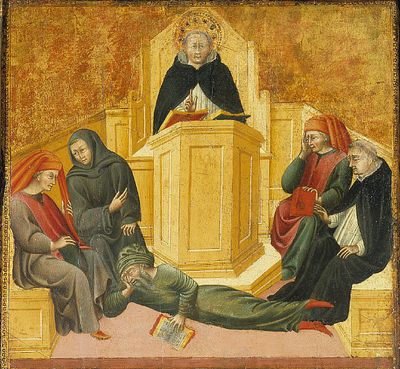
Eight centuries later, Thomas Aquinas organized Augustine’s intuitions into the structure that still anchors the tradition. Summa Theologiae II-II, Question 40, Article 1, asks “whether it is always sinful to wage war.” Aquinas’s answer requires three conditions, present simultaneously, for a war to be just. First, auctoritas principis—the authority of the sovereign, since “it is not the business of a private individual to declare war.” Second, causa iusta—a just cause, “those who are attacked should be attacked because they deserve it on account of some fault.” Third, intentio recta—right intention, that combatants intend “the advancement of good, or the avoidance of evil,” not “aggrandizement, or cruelty.”12
Aquinas worked out several refinements that have been quietly load-bearing ever since. Clerics may not personally take up arms because warlike pursuits are “altogether incompatible” with the ministry of the altar. Ambushes and concealment of tactics are licit; lying and breaking promises to the enemy are not, “for there are certain rights of war and covenants which ought to be observed even among enemies.” Fighting on holy days is permissible when the common good demands it, since the observance of holy days “is no hindrance to those things which are ordained to man’s safety.”13
The School of Salamanca: Vitoria and Suárez
In the sixteenth century the Spanish Dominican Francisco de Vitoria, lecturing at Salamanca on what to do about the Spanish conquest of the New World, took Aquinas’s three conditions and ran them against the actual conduct of his own state. The result was the modern law of nations in embryonic form. In De Indis and De Jure Belli, Vitoria argued that “difference of religion is not a cause of just war,” that mere “extension of empire” was not a just cause, that wars waged for “the personal glory or convenience of the prince” were not just, and that the only just cause was a wrong received—and even then proportionately answered. Vitoria insisted that even barbarian peoples held genuine rights of dominion that could not be overridden by Christian conquest. His student Francisco Suárez, writing fifty years later, distinguished defensive war (which any community may wage without any superior authorization) from offensive war (which requires both grave injury and proper authority), and held that even an offensive just war “must be waged with the greatest moderation.”14
The Salamancan distinction matters for the modern controversy. Defenders of the classical tradition who think Vance has a point usually argue that defensive force—against an actual ongoing or imminent armed attack—has always required a lower threshold of justification than offensive force, and that a sovereign acting in genuine self-defense need not satisfy the same elaborate criteria as one launching a preventive war. Critics respond that the question begs itself: was the Iran action defensive against an imminent attack, or preventive against a feared one? Vitoria’s framework lets the question be asked sharply. It does not answer it.
The Twentieth-Century Tightening: From Hiroshima to Vatican II
For most of its history the just-war tradition treated the conditions as a checklist: if a sovereign in good faith concluded the criteria were met, the war was just, and the moral burden fell on the soldier to follow lawful orders. Two events changed this. The first was the saturation bombing of European and Japanese cities in 1943–1945—Hamburg, Dresden, Tokyo, Hiroshima, Nagasaki—which made it impossible to pretend that distinction between combatant and noncombatant was a side constraint that could be relaxed in extreme cases. The second was the Cold War standoff between two arsenals capable of ending civilization in ninety minutes. The Catholic moral theologian John C. Ford, S.J., writing in Theological Studies in September 1944, called the obliteration bombing of Germany murder; his argument was widely read in seminaries by the time the Council opened.15
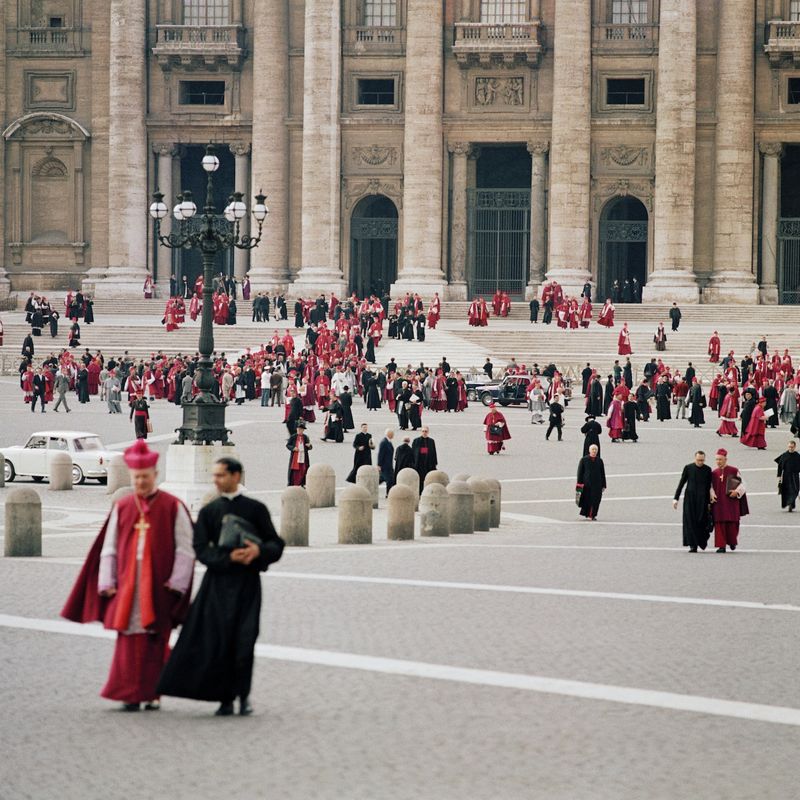
The Second Vatican Council picked the question up in its 1965 pastoral constitution Gaudium et Spes. Promulgated by Paul VI on December 7, 1965 by a vote of 2,307 to 75, the document devoted articles 77–82 to peace and war and called for war to be evaluated “with an entirely new attitude” (art. 80). Article 80 condemned “any act of war aimed indiscriminately at the destruction of entire cities [or] extensive areas along with their population” as “a crime against God and man himself”—language transplanted directly into CCC 2314 a generation later. Article 81 called the arms race “one of the greatest curses on the human race” and a robbery of the poor. Article 82 set the Council’s hope on a future “when all war is outlawed by international consent.”16
Two months earlier, on October 4, 1965, Paul VI had stood at the United Nations and pleaded, “Jamais plus la guerre”—“No more war, war never again.” John XXIII’s 1963 encyclical Pacem in Terris, written in the wake of the Cuban Missile Crisis, had already declared that, “in this age which boasts of its atomic power, it no longer makes sense to maintain that war is a fit instrument with which to repair the violation of justice.” John Paul II opposed both Gulf Wars and the 2003 invasion of Iraq. In his 2000 World Day of Peace message, he had warned that wars “generally do not resolve the problems for which they are fought”; in his January 13, 2003 address to the diplomatic corps, he called war “a defeat for humanity.” His apostolic nuncio, Cardinal Pio Laghi, met with President George W. Bush at the White House on March 5, 2003 to deliver a personal letter from the pope; at the National Press Club afterward, Laghi told reporters that an Iraq war would be “immoral, illegal, unjust.”17
This pattern—popes opposing specific wars, theologians arguing that the tradition’s criteria are increasingly difficult to satisfy in practice—is what Catholic moral theology calls the presumption against war. The phrase is not a doctrinal definition. It is a way of describing the slope of the conditions: the modern tradition treats the moral burden as falling on those who would wage war, not on those who would refuse it.
The Catechism’s Four Conditions
The 1992 Catechism of the Catholic Church, with revisions promulgated by John Paul II in 1997, codifies the result. Part III, Section 2, Chapter 2, Article 5 is titled “Safeguarding Peace.” Its tone is set by paragraph 2307, which opens not with permission for war but with an imperative to avoid it: invoking the Fifth Commandment’s prohibition on the intentional destruction of human life, the Catechism urges “prayer and to action so that the divine Goodness may free us from the ancient bondage of war.” Paragraph 2308 then concedes the necessity of defense: “as long as the danger of war persists and there is no international authority with the necessary competence and power, governments cannot be denied the right of lawful self-defense, once all peace efforts have failed.”18
Paragraph 2309 sets out the conditions. They are cumulative. All four must be present at once.
“The strict conditions for legitimate defense by military force require rigorous consideration. The gravity of such a decision makes it subject to rigorous conditions of moral legitimacy. At one and the same time: the damage inflicted by the aggressor on the nation or community of nations must be lasting, grave, and certain; all other means of putting an end to it must have been shown to be impractical or ineffective; there must be serious prospects of success; the use of arms must not produce evils and disorders graver than the evil to be eliminated.”
The Catechism then names these “the traditional elements enumerated in what is called the ‘just war’ doctrine,” and assigns the evaluation to “the prudential judgment of those who have responsibility for the common good”—a clause defenders of the Vance position underline and critics quietly concede.19 The text closes paragraph 2309 with an observation appended to the proportionality bullet that does most of the modern work: “The power of modern means of destruction weighs very heavily in evaluating this condition.” The condition as codified is proportionality, but the observation’s interpretive reach extends across the others. A drone strike’s payload, the cascading effects of cyberattacks on civilian infrastructure, and above all the destructive radius of nuclear or quasi-nuclear weapons make the cure-versus-disease arithmetic harder, not easier, than it was for Aquinas.
The jus in bello teaching is equally strict. Paragraph 2312 asserts that “the mere fact that war has regrettably broken out does not mean that everything becomes licit between the warring parties.” Paragraph 2313 requires humane treatment of noncombatants, the wounded, and prisoners, and adds that “one is morally bound to resist orders that command genocide.” Paragraph 2314 condemns “every act of war directed to the indiscriminate destruction of whole cities or vast areas with their inhabitants” as “a crime against God and man,” singling out atomic, biological, and chemical weapons. Paragraphs 2315–2316 extend moral scrutiny to arms races and the international arms trade. Paragraph 2311 defends the conscientious objector and requires states to provide alternative service.20
| Jus ad bellum condition (CCC 2309) | What it requires |
|---|---|
| Just cause | The aggressor’s damage must be lasting, grave, and certain. |
| Last resort | Every non-military alternative must have failed or been shown ineffective. |
| Probability of success | A serious prospect of achieving the defensive aim. |
| Proportionality | The evils caused must not exceed the evil being removed. |
A reader could be forgiven for thinking the framework is austere to the point of being unusable. That is, in part, the point. The Catechism’s drafters were not trying to bless any particular war. They were trying to write a doctrine that would make war hard to justify and, when undertaken, hard to wage carelessly.
Francis and the Rupture Debate
Pope Francis pushed the trajectory to its sharpest point in centuries. His 2020 encyclical Fratelli Tutti, in paragraphs 255–262 of a section titled “The injustice of war,” argued that war is “the negation of all rights and a dramatic assault on the environment,” that “every war leaves our world worse than it was before,” and that war represents “a failure of politics and of humanity.” Paragraph 258 is the decisive passage:
“We can no longer think of war as a solution, because its risks will probably always be greater than its supposed benefits. In view of this, it is very difficult nowadays to invoke the rational criteria elaborated in earlier centuries to speak of the possibility of a ‘just war.’ Never again war!”
A footnote to paragraph 258—note 242 in the English text—goes further still, stating that Augustine himself “forged a concept of ‘just war’ that we no longer uphold in our own day,” even as the same footnote cites Augustine approvingly as a witness to peacemaking.21 Francis observed that “in recent decades, every single war has been ostensibly ‘justified,’” citing humanitarian, defensive, and preventive pretexts, and warned that such reasoning produced “an overly broad interpretation of this potential right,” wrongly justifying “preventive” attacks—an evident reference to the 2003 Iraq war.
Catholic moral theologians split immediately on what Fratelli Tutti actually did. On one reading, associated with the blog Catholic Moral Theology and Redemptorist commentators, Francis formally abandoned just-war reasoning in favor of a “just peace” framework emphasizing nonviolence. On a second reading, associated with Jesuit and Dominican commentators writing in Where Peter Is, First Things, and the National Catholic Register, Francis did not repudiate CCC 2309; he issued a strong prudential judgment that the criteria are so rarely satisfiable today as to be practically inoperative. On a third reading, associated with philosopher Edward Feser and theologian Daniel Philpott of Notre Dame, no development of magisterial teaching has taken place: Francis was preaching, not legislating, and the classical criteria remain the authoritative doctrine.22 The distinction matters because a pope’s magisterial statements develop doctrine gradually and—on the Catholic theory of authority—non-dogmatic teaching requires religious assent of intellect and will but is not infallible. Fratelli Tutti does not explicitly rescind CCC 2309, and no pope has yet promulgated a revised version.
What is clear is that any Catholic invocation of “just war” after 2020 carries a heavier burden of proof than it would have in 1920. The damage must be lasting, grave, and certain. Every peaceful alternative must be exhausted. Success must be seriously probable. The cure must not be worse than the disease. In an age of drones, cyberattacks, and nuclear arsenals, meeting that burden is harder than it has ever been, which is precisely what the modern Church intends.
Pope Leo XIV’s Posture on Iran
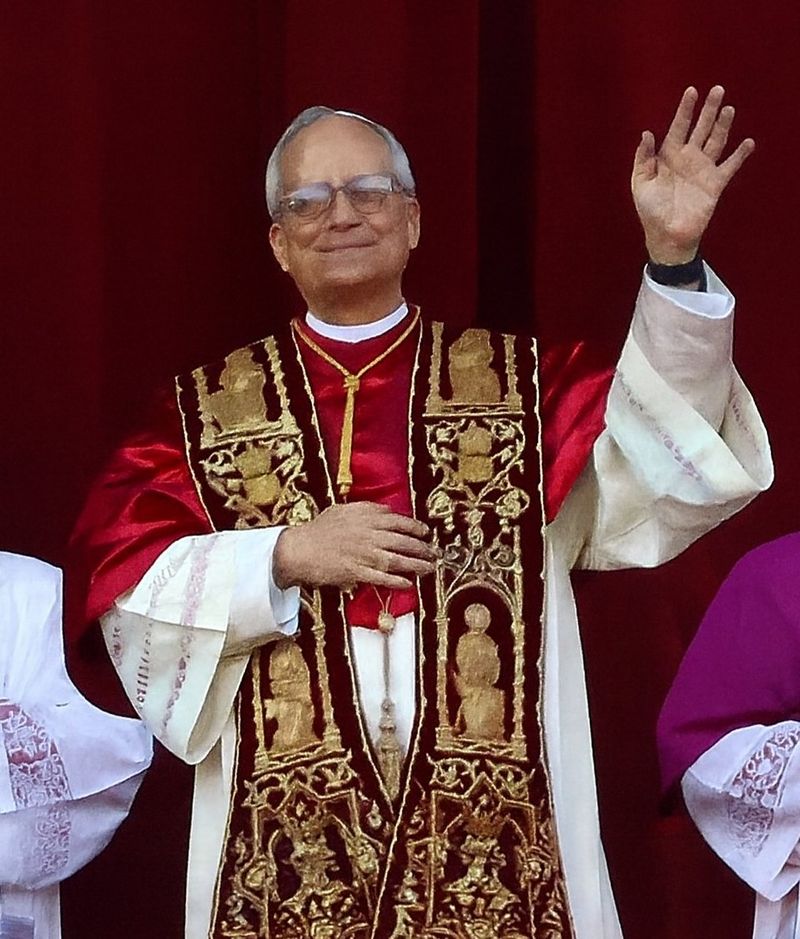
Pope Leo XIV—the first American pope, elected in May 2025 after the death of Francis—has not issued an encyclical on war. His public statements on the 2026 conflict have come, so far, in homilies, Angelus addresses, and unscripted remarks. On April 7, 2026, responding to threats against the Iranian people, he called the U.S.–Israeli strikes against Iran “truly unacceptable.” At the St. Peter’s Basilica vigil of April 11—held on the evening direct U.S.–Iran talks opened in Islamabad—he warned against “that delusion of omnipotence that surrounds us and is becoming increasingly unpredictable and aggressive” and added that “even the holy Name of God, the God of life, is being dragged into discourses of death.” He named no government. He cited no specific event. He spoke in the register of the prophets.23
Three interpretive questions have followed. First: was Leo preaching universal moral principles applicable to every belligerent, or was he addressing a particular war? His defenders argue both are true; critics argue the second is the operative reading whatever the first may be. Second: does his silence on Iran’s own conduct—its proxy attacks, its funding of militias, its rhetoric toward Israel—render the pope’s pronouncements morally unbalanced? His defenders argue a pope speaks to the conscience of the specific audience in front of him, which in this case was the United States government and its Catholic voters; critics read the silence as a judgment about whose conduct merits rebuke. Third: is a pope’s criticism of a specific war a matter of prudential judgment on which Catholics may disagree, or is it a teaching to which they owe religious assent? Massa’s USCCB statement is an exercise in this third question. It does not say Catholics must oppose the Iran war. It does say that Leo, when he speaks pastorally, is not merely offering opinions.
The careful reader will note that both positions in this exchange invoke the Catechism’s framework, even as the USCCB’s clarification treats one application as deficient. A Catholic may believe, in good conscience, that the Iran war satisfies CCC 2309 and that Leo’s remarks are a prudential call to end the conflict rather than a binding judgment on its initiation. A Catholic may also believe, in good conscience, that the war fails CCC 2309 and that Leo’s remarks reflect the tradition rather than invent against it. The tradition does not foreclose the debate—it frames it. What a Catholic may not do, consistent with the tradition’s own logic, is pretend that the classical criteria are loose enough to wave through any war a sovereign chooses to wage.
The Secular Law of Force
While the Catholic tradition was tightening, another body of law—secular, positive, enforced through tribunals and manuals rather than confessionals—was emerging in parallel. A Vice President who cites just-war theory on a public stage is drawing on one vocabulary; the lieutenant-colonel JAG officer sitting behind the targeteer at Central Command headquarters is drawing on another. They overlap more than they differ, but the vocabularies are not interchangeable.
International law: the U.N. Charter and the Geneva Conventions
The international law of force begins with the United Nations Charter of 1945. Article 2(4) forbids the “threat or use of force against the territorial integrity or political independence of any state.” Two exceptions: Article 51 preserves “the inherent right of individual or collective self-defence if an armed attack occurs,” until the Security Council takes measures necessary to maintain international peace and security; and Chapter VII authorizes the Council itself to take, or to delegate, coercive action. Every lawful use of force by a state must fit one of those two openings. The term of art for unauthorized preventive war is illegal; the term of art for unauthorized humanitarian intervention is, in Justice Goldstone’s formulation about Kosovo in 1999, “illegal but legitimate.”24
The law governing conduct within war is older. The 1949 Geneva Conventions, with Common Article 3 binding all parties in non-international armed conflict, and Additional Protocols I and II of 1977, set the rules on treatment of wounded, prisoners, and civilians. The Department of Defense Law of War Manual, first published in 2015 and most recently substantially revised in July 2023, is the U.S. military’s operational bible. Its five foundational principles—military necessity, humanity, distinction, proportionality, and honor—map closely onto the jus in bello teaching of CCC 2313–2314. Distinction forbids targeting civilians; proportionality forbids attacks whose expected civilian harm is excessive in relation to anticipated military advantage. Civilian Harm Mitigation and Response, institutionalized in the 2022 DoD Civilian Harm Mitigation and Response Action Plan and codified in DoDI 3000.17 of December 2023, puts specific procedural weight behind those principles.25
Domestic authority: the Constitution and the AUMFs
At the domestic level, the Constitution gives Congress the power to declare war. The last formal declaration came on June 5, 1942, against Romania. Every conflict since Korea has been fought under a mix of statutory authorizations and claimed Article II executive power. The War Powers Resolution of 1973 requires the President to withdraw forces from hostilities within sixty days absent congressional authorization. The 2001 AUMF, passed by votes of 98–0 in the Senate and 420–1 in the House (Representative Barbara Lee the sole dissenter), remains the operative authority for most counter-terrorism operations. The 2002 Iraq AUMF was repealed on December 18, 2025 in the FY2026 NDAA. No new authorization has been enacted for operations against Iran.26
Enforcement: the ICC, the UCMJ, and the JAG corps
Enforcement is asymmetric. The International Criminal Court’s Rome Statute binds its 125 states parties but not the United States, which withdrew its signature in 2002 and does not recognize the Court’s jurisdiction over its personnel. The Uniform Code of Military Justice does prosecute U.S. service members who commit war crimes, but prosecutions are rare and acquittal rates are substantial. Military JAG lawyers—Judge Advocate Generals—sit at every operational echelon and sign off on rules of engagement, targeting decisions, and use-of-force authorities. Their role is not ornamental. Through 2025, senior JAGs at the combatant command overseeing lethal strikes on small vessels claimed to be trafficking narcotics off the Venezuelan coast raised internal objections to the legal basis for those operations; several were sidelined or reassigned, and a bipartisan group of senators demanded answers about the pattern of dismissals. The episode became a public marker of the tension between legal review and executive direction.27
The secular framework, in short, is not the Catechism. But it runs parallel to it in most respects, and it does the same thing the Catechism does: it sets out conditions designed to make war hard to launch and, when launched, hard to wage without discipline. Both frameworks concede the right of defense. Both require authority. Both require proportion. Both insist on distinction between combatant and noncombatant. Both are applied by humans under pressure, which is to say, imperfectly. The Catholic reader who wants to know what her tradition says about a given war can consult her Catechism. The citizen who wants to know what her government is legally permitted to do can consult the Charter and the Manual. The two will usually—not always, but usually—answer the same way.
A Jurisprudential Test: Running the 2026 Iran Strikes Through Both Frameworks
This section is the one this essay exists to write. The four conditions of CCC 2309 are designed to be applied to particular wars, not contemplated in the abstract. The right way to read the doctrine is to put a war in front of it. So: take the 2026 U.S. and Israeli action against Iran, and walk the conditions one by one, with the strongest defender’s argument and the strongest critic’s argument set side by side. The Catechism itself assigns the prudential judgment to “those who have responsibility for the common good,” not to a writer or a reader. The reader is asked to do the doctrinal arithmetic herself.
First, just cause
Was the damage inflicted by the aggressor lasting, grave, and certain? The defender’s argument is that Iran’s program of nuclear enrichment, sustained funding of Hezbollah and Hamas, repeated armed attacks against Israel and U.S. forces in the region across two decades, and stated goal of the Israeli state’s destruction constitute a course of aggression that satisfies all three adjectives. Lasting, because it has continued for more than thirty years; grave, because it culminates in nuclear capability; certain, because it is documented in IAEA reports, IDF intelligence, and the Iranian regime’s own public statements. The critic’s argument is that CCC 2308 specifies “lawful self-defense” against an aggressor’s actual harm, that Iran had not launched a kinetic strike on either the United States or Israeli territory in the period immediately preceding February 28, 2026, and that “preventive” defense against a feared future capability is exactly the category Francis warned against in Fratelli Tutti—an “overly broad interpretation” of the right of self-defense. Both arguments operate on the doctrine. The disagreement is on the facts: at what point does a chronic threat become an aggressor’s damage that is grave and certain enough to ground a present right of force?
Second, last resort
Had every non-military means been shown impractical or ineffective? The defender’s argument is that the United States had spent two presidential administrations attempting nuclear diplomacy with Iran, that the 2015 Joint Comprehensive Plan of Action had collapsed, that subsequent talks had repeatedly broken down, that European sanctions had failed to halt enrichment, and that the window for non-military prevention of nuclear breakout had closed. The critic’s argument is that direct U.S.–Iran talks were in fact opening in Islamabad on April 11, six weeks after the strikes began, which suggests by definition that diplomatic options were not exhausted on February 28; that U.N. Security Council options had not been pursued to conclusion; and that “impractical” is not synonymous with “we doubt it would have worked.” Again, both arguments operate on the doctrine.
Third, probability of success
Were there serious prospects of success? The defender’s argument is that Israeli and U.S. strikes against Iran’s command and control, including the elimination of senior leadership in the opening hours, demonstrate that the operational objectives—decapitation of nuclear command, destruction of enrichment infrastructure, suppression of regional proxy networks—were achievable. The critic’s argument is that “success” in just-war reasoning is not a synonym for tactical effectiveness. The Catholic tradition asks whether the war can produce the political end that justifies it: a more durable peace, a more secure region, a more legitimate Iranian government. By that standard, regime decapitation absent any plan for what comes after—an Iranian state without Khamenei but also without an alternative center of authority—has historically not produced success in the relevant sense. Iraq 2003 is the cautionary case.
Fourth, proportionality
Would the use of arms not produce evils and disorders graver than the evil to be eliminated? The defender’s argument is that a nuclear-armed Iran would have menaced the region for decades and made future war more, not less, likely; that the alternative to action in 2026 was action under worse conditions in 2030; and that the civilian harm sustained, while tragic, must be weighed against that counterfactual. The critic’s argument is that proportionality is the Catechism’s hardest condition for any modern war and that the Iran action specifically has produced documented harms—HRANA’s 1,701 civilian deaths through April 7; the Minab school strike that killed at least 175 people, more than one hundred of them children, traced to a preliminary DoD investigation finding U.S. munitions and a targeting error in Central Command’s civilian-presence overlay—that strain the cure-versus-disease arithmetic at its center. The defender will respond that civilian harm in war is not the same as targeting civilians, that Common Article 3 and DoD targeting doctrine prohibit the latter while not eliminating the former, and that the moral analysis must distinguish them. The critic will respond that the Catechism’s own gloss—“the power of modern means of destruction weighs very heavily in evaluating this condition”—was written precisely to prevent that distinction from doing too much exculpatory work.
The reader who walks each condition will notice three things. First, there is genuine disagreement on the application even among Catholics in good faith. Second, the disagreement is rarely about what the Catechism says; it is about how to characterize the war. Third, the Catechism itself anticipated this. It assigned the judgment to the prudential authority of those responsible for the common good. It did not say that judgment was incontestable. Bishop Massa’s USCCB statement is one such judgment from one such authority. Vice President Vance’s invocation of just war theory is another from another. The classical tradition has always allowed both kinds of judgment to be made and contested. What it has never allowed is the conclusion that the conditions are merely advisory, or that a sovereign’s good-faith assertion of just cause exhausts the moral question. The conditions are conditions. They bind whoever invokes them.
What the Tradition Still Holds in Common
The two strands of Catholic thinking on war—the classical-restatement school that descends through Vitoria and Suárez to Weigel and Biggar (with figures like Edward Feser sharing the methodology while dissenting from its administration-aligned application to the 2026 Iran war); and the modern presumption-against-war school that descends through Pacem in Terris and Gaudium et Spes to Francis, Massa, and the bulk of contemporary Catholic moral theology—agree on more than they disagree on. Both affirm that defensive war is permitted in principle. Both reject the position that any war is just because the sovereign declares it so. Both bind soldiers in the field by the rules of distinction and proportionality, and both treat indiscriminate attacks on civilian populations as crimes against God and humanity. Both honor the conscientious objector. Both treat the obligation to seek peace as continuous, not exhausted by the outbreak of hostilities. Both insist that a Catholic statesman’s authority to wage war is not a license to wage it carelessly.
The disagreement, in the end, is about how strict to make a doctrine that both sides agree must be strict. Aquinas, Vitoria, and Suárez wrote when wars were waged with pikes and cavalry; the Catechism’s drafters wrote with hydrogen bombs and cluster munitions in mind. Francis writes with drones, cyberattacks, and seventy-five years of failed regime-change wars in front of him. The conditions have not changed. The world to which they apply has changed. Whether that change requires a tighter reading of the conditions, or whether the conditions remain stable across all eras, is the question that divides the schools.
What both schools refuse, and what no Catholic invocation of “just war theory” can sustain, is the use of the doctrine to baptize a war already underway. The phrase is not a credential. It is a rule. The rule is that the use of force must be lasting-grave-and-certain in the cause it answers, exhausting in the alternatives it has tried, serious in the success it can predict, and proportionate in the cure it offers. A statesman who can show all four, and a JAG officer who can sign off on the rules of engagement that flow from them, has the warrant of the tradition. A statesman who cannot does not. The voters who sent him do well to remember that the question Aquinas and the Catechism both ask is not does the sovereign claim this war is just but does the war satisfy the conditions. The conditions belong to the moral order, not to the sovereign.
Frequently Asked Questions
Is just war theory still binding on Catholics?
Yes. CCC 2307–2317 remains the operative magisterial teaching, codifying the four conditions for legitimate defense and the rules of conduct in war. Pope Francis’s Fratelli Tutti and Pope Leo XIV’s homilies on the 2026 Iran war are interpreted by mainstream Catholic theologians as strong prudential teaching that the criteria are increasingly difficult to satisfy in modern warfare, but neither has formally rescinded the Catechism’s framework.
Did Pope Francis abolish just war theory?
No. Fratelli Tutti §258 said it is “very difficult nowadays to invoke” the classical criteria, and footnote 242 said Augustine’s concept is one “we no longer uphold in our own day.” Catholic theologians read these statements as ranging from a strong prudential judgment (the dominant view) to a development of doctrine toward a “just peace” framework (a minority view). The Catechism has not been amended.
What are the four conditions of the Catechism?
CCC 2309 requires all of the following, simultaneously: (1) the aggressor’s damage must be lasting, grave, and certain; (2) all other means of putting an end to it must have been shown impractical or ineffective; (3) there must be serious prospects of success; and (4) the use of arms must not produce evils and disorders graver than the evil to be eliminated.
How does Catholic just war doctrine differ from the laws of war?
The frameworks are parallel but not identical. The U.N. Charter and the Geneva Conventions are positive international law; the Catechism is moral theology. Both restrict war to defensive purposes, require proportionality, and insist on distinction between combatant and noncombatant. The Catechism additionally requires evaluation of the war in conscience by those exercising authority, and treats the obligation to seek peace as continuous. The Department of Defense Law of War Manual maps closely onto the jus in bello teaching of CCC 2313–2314.
Can a Catholic soldier refuse to fight?
Yes. CCC 2311 protects the conscientious objector and requires civil authorities to provide alternative service. CCC 2313 holds that “one is morally bound to resist orders that command genocide.” The Catholic soldier remains obligated to follow lawful orders but is morally bound to refuse orders that violate the rules of war.
Footnotes
1. JD Vance, remarks at the Turning Point USA memorial event, Akins Ford Arena, Athens, Georgia, April 14, 2026. Video at C-SPAN event ID 442147. See also Kate Scanlon, “US bishops’ doctrine chair defends Church’s just war tradition after Vance comments,” OSV News, April 15, 2026.
2. Auxiliary Bishop James Massa, “U.S. Bishops’ Chairman on Doctrine Issues Clarification on Just War Theory,” United States Conference of Catholic Bishops, April 15, 2026, usccb.org.
3. FY2026 National Defense Authorization Act, Pub. L. 119-60 (Dec. 18, 2025) (repealing the 2002 Authorization for Use of Military Force Against Iraq, Pub. L. 107-243, and the 1991 Authorization for Use of Military Force Against Iraq, Pub. L. 102-1). The 2001 AUMF, Pub. L. 107-40, remains in force.
4. Human Rights Activists News Agency (HRANA), “War Casualty Update,” April 7, 2026, en-hrana.org. Figures: 3,636 documented deaths (1,701 civilian, 1,221 military, 714 unclassified).
5. Reporting on the ongoing U.S. military investigation first surfaced in The New York Times on March 11, 2026, tracing the strike to outdated DIA data. See Human Rights Watch, “US/Israel: Investigate Iran School Attack as a War Crime,” March 7, 2026, hrw.org; Amnesty International, “USA/Iran: Those responsible for deadly and unlawful US strike on school that killed over 100 children must be held accountable,” March 2026.
6. Pope Leo XIV, homily at the Vigil for Peace, St. Peter’s Basilica, April 11, 2026; see “Pope Leo says ‘delusion of omnipotence’ is fueling U.S.-Israeli war in Iran,” NPR, April 11, 2026, npr.org; additional coverage in PBS NewsHour and the Associated Press.
7. Vance, supra note 1.
8. Sen. John Thune, remarks to reporters at the U.S. Capitol, April 15, 2026, reported by Andrew Desiderio, Punchbowl News; Speaker Mike Johnson, press availability at the U.S. Capitol, April 15, 2026, reported in “Johnson invokes ‘just war’ theory to defend Iran conflict,” Courthouse News, April 15, 2026.
9. Massa, supra note 2 (emphasis original).
10. Richard Cassleman, “The USCCB’s Just War Error,” First Things, April 16, 2026, republished the same week at The Catholic Thing. The essay draws heavily on Vitoria and Suárez for the proposition that defensive war and offensive war are governed by distinct standards in the classical tradition.
11. Augustine, Contra Faustum Manichaeum 22.74–75; Epistula 138 (to Marcellinus); Epistula 189 (to Boniface); Quaestiones in Heptateuchum 6.10. Standard treatment in R. A. Markus, “Saint Augustine’s Views on the ‘Just War,’” in The Church and War, ed. W. J. Sheils, Studies in Church History 20 (Oxford: Blackwell, 1983), 1–13.
12. Thomas Aquinas, Summa Theologiae II-II, q. 40, a. 1, in the Fathers of the English Dominican Province translation (Benziger Bros., 1920), available at newadvent.org/summa/3040.htm.
13. Aquinas, ST II-II, q. 40, aa. 2–4.
14. Francisco de Vitoria, De Indis and De Jure Belli (Salamanca lectures, 1539), trans. Anthony Pagden and Jeremy Lawrance, in Vitoria: Political Writings (Cambridge: Cambridge University Press, 1991), 231–327; Francisco Suárez, De Bello, in Selections from Three Works, trans. Gwladys L. Williams et al. (Carnegie Endowment, 1944), 800–865. The classical-vs.-modern distinction is developed in Gregory M. Reichberg, Thomas Aquinas on War and Peace (Cambridge: Cambridge University Press, 2017).
15. John C. Ford, S.J., “The Morality of Obliteration Bombing,” Theological Studies 5, no. 3 (September 1944): 261–309. The locus classicus on the morality of strategic bombing in mid-war Catholic theology.
16. Second Vatican Council, Gaudium et Spes (December 7, 1965), §§ 77–82, available at vatican.va. Vote: 2,307 to 75.
17. Paul VI, address to the United Nations General Assembly, October 4, 1965; John XXIII, Pacem in Terris (April 11, 1963), § 127; John Paul II, “Peace on Earth to Those Whom God Loves!” Message for the XXXIII World Day of Peace (December 8, 1999), § 2 (“wars generally do not resolve the problems for which they are fought”); John Paul II, address to the diplomatic corps, January 13, 2003 (“defeat for humanity”); Cardinal Pio Laghi, remarks to reporters at the National Press Club, Washington, D.C., March 5, 2003 (“immoral, illegal, unjust”), reported in The New York Times, March 6, 2003.
18. Catechism of the Catholic Church, 2nd ed. (Vatican City: Libreria Editrice Vaticana, 1997), §§ 2307–2308, available at vatican.va/archive/ENG0015/__P81.HTM.
19. CCC § 2309.
20. CCC §§ 2311–2316.
21. Pope Francis, Fratelli Tutti (October 3, 2020), §§ 255–262 and footnote 242, available at vatican.va.
22. For the “just peace” reading, see Tobias Winright, “Fratelli Tutti and the Demise of the Just War Tradition,” Catholic Moral Theology (blog), October 8, 2020. For the prudential reading, see Pedro Gabriel, “Did Pope Francis Abolish the Just War Doctrine?” Where Peter Is, October 12, 2020. For the conservative-classical reading, see Edward Feser, “Pope Francis and Just War,” Edward Feser (blog), October 6, 2020; Daniel Philpott, “Did Pope Francis Just Reject Just War?” Public Discourse, November 2, 2020.
23. Leo XIV, supra note 6; see also AP, “Pope Calls Iran Strikes ‘Truly Unacceptable,’” April 7, 2026.
24. U.N. Charter, arts. 2(4), 51, and Chapter VII; Independent International Commission on Kosovo, The Kosovo Report (Oxford: Oxford University Press, 2000), 4 (Goldstone formulation: “illegal but legitimate”).
25. Geneva Conventions of 1949, Common Article 3; Additional Protocol I (1977), arts. 48, 51, 57; Department of Defense, Law of War Manual, rev. July 2023, §§ 2.1–2.6 (necessity, humanity, distinction, proportionality, honor) and § 5.4.3.2 (civilian-presumption rule); DoDI 3000.17, “Civilian Harm Mitigation and Response,” December 21, 2023; Department of Defense, Civilian Harm Mitigation and Response Action Plan, August 25, 2022.
26. U.S. Const. art. I, § 8, cl. 11; War Powers Resolution, 50 U.S.C. § 1544(b) (1973); Authorization for Use of Military Force, Pub. L. 107-40 (Sept. 18, 2001); FY2026 NDAA, supra note 3. The last formal congressional declaration of war was against Romania, June 5, 1942.
27. On the ICC: Rome Statute of the International Criminal Court, July 17, 1998 (125 states parties as of April 2026); United States signed Dec. 31, 2000 and “unsigned” May 6, 2002. On the Venezuela boat strikes and JAG reassignments: Courtney Kube and Carol Lee, “Top military lawyer raised legal concerns about boat strikes,” NBC News, October 2025; Natasha Bertrand and Haley Britzky, “How the Pentagon sidelined lawyers while testing the legal limits of military action,” CNN, October 15, 2025; “United States strikes on alleged drug traffickers during Operation Southern Spear,” Wikipedia, accessed April 2026.
Garrett Ham
Garrett Ham is an attorney, military veteran, and holds a Master of Divinity from Yale Divinity School. He writes from Northwest Arkansas on theology, law, and service.
Related Posts
Augustine on the Atonement
How Augustine's Trinitarian theology shaped atonement doctrine—victory, sacrifice, grace, and love united in Catholic soteriology.
Apostolic Succession: The Unbroken Chain from Christ’s Twelve
Apostolic succession traced from AD 96 to the 1992 Catechism: the patristic evidence, Tertullian’s legal logic, the Protestant critique, and why three in four Christians still require it.
Catholic Indulgences: What They Actually Are (and Aren't)
An indulgence isn't a Get-Out-of-Hell card, and the Church never taught it was. What indulgences actually are—plus the history Luther was right to protest.
Stay Informed
Get new writing on faith, law, and service delivered to your inbox.
No spam. Unsubscribe anytime.