Saint Andrew the Apostle: The First-Called and the Brother of Peter
On This Page
The second installment in a series on the Twelve Apostles.
Every year on 30 November, a small delegation from the Holy See flies to Istanbul and walks into the modest Greek-Orthodox compound the world calls the Phanar. Every year on 29 June, a small delegation from the Ecumenical Patriarchate flies the other way and walks into the bronze doors of St Peter’s. The exchange has happened, without interruption, since the late 1960s. It has no founding decree; it has the texture of custom; and it operates on the conviction that two brothers from a fishing village on the Sea of Galilee, having spent the better part of two thousand years apart, ought to greet each other on each other’s feasts.
When Pope Paul VI handed a small relic of Andrew to Cardinal Gordon Joseph Gray of Edinburgh in 1969, he did so with five words—“Peter greets his brother Andrew.”1 The gesture compressed a great deal: the historical Andrew of the New Testament, the patristic Andrew of the missions, the legendary Andrew of the apocryphal Acts, the relic-bearing Andrew of Constantinople and Amalfi and Patras, the heraldic Andrew of Burgundy and Scotland, the ecumenical Andrew of post-conciliar Catholic-Orthodox rapprochement. To take Andrew seriously is to ask which of these Andrews are historical, which are legendary, which are theological, and which are some carefully calibrated mixture of all three. What follows is an attempt to read the sources honestly on each of those questions.
The apostle in the New Testament
Andrew is named twelve times in the Greek New Testament: four times in Mark (1:16, 1:29, 3:18, 13:3), twice in Matthew (4:18, 10:2), once in Luke (6:14), four times in John (1:40, 1:44, 6:8, 12:22), and once in Acts (1:13). Every formal list of the Twelve places him in the first four. He never speaks in the Synoptics—the question on the Mount of Olives at Mark 13:3–4 is grammatically singular but governed by all four named questioners—and he speaks only twice in John. The total quantity of Andrew material in the canon is small. The quality, however, is striking.
Bethsaida, the Greek name, the bilingual home
Andrew was born in Bethsaida, the “House of Fishing” on the north shore of the Sea of Galilee, just east of where the Jordan enters the lake. John 1:44 calls Bethsaida “the town of Andrew and Peter.”2 By the time he is grown, the Synoptic tradition has him at Capernaum, a few kilometres west, where Mark 1:29 places “the house of Simon and Andrew” jointly. The most economical reconciliation is that the brothers were born in Bethsaida and moved to Capernaum, perhaps on Peter’s marriage, where their fishing operation had partnered with the Zebedees (cf. Luke 5:10).3
Andrew’s name is unambiguously Greek. Ἀνδρέας is built on the root ἀνήρ / ἀνδρός (“man,” “husband”) and the abstract ἀνδρεία (“manliness,” “courage”). No Hebrew or Aramaic doublet is attested for the bearer. Of the Twelve, only Andrew and Philip—Andrew’s fellow Bethsaidan, also Greek-named—bear unambiguously Hellenic names with no Semitic alternative. Tal Ilan’s Lexicon of Jewish Names in Late Antiquity catalogues some 3,000 named Palestinian Jews from 330 BCE to 200 CE; Greek names constitute roughly 12 percent of male Palestinian Jewish names in this corpus, and Andreas is attested but uncommon.4 Markus Bockmuehl reads the datum as historically meaningful: Bethsaida sat on the cultural boundary between Jewish Galilee and the Decapolis, and Peter’s “childhood in Bethsaida, a village with little Jewish presence, in which his brother Andrew and close friend Philip were known exclusively by their Greek names, would have ensured his ability to speak tolerable Greek from a young age.”5 Whatever else Andrew was, he was a bilingual Galilean Jew at home on a cultural frontier.
The location of Bethsaida itself remains contested. Two sites have been excavated as candidates: et-Tell, two kilometres inland, by Rami Arav since 1987; and el-Araj (Beit Habek), directly on the lakeshore, by Mordechai Aviam and R. Steven Notley since 2016. As of the most recent seasons, the scholarly weight has shifted slightly toward el-Araj, whose Roman-period stratum, Byzantine basilica, and lakeshore position better fit the Gospel description.6 The debate is unresolved, but neither candidate disturbs the core picture: Andrew grew up working a small lake from a small village, with stone vessels for ritual purity in his kitchen, lead net-weights in his boat, and Greek and Aramaic on his tongue.
First to follow
The Synoptics call Andrew with his brother. Mark 1:16–18 and Matthew 4:18–20 describe Jesus walking by the Sea of Galilee, seeing the two brothers casting nets, calling them together, and watching them leave the nets “at once.” The verb in Mark is ἀμφιβάλλοντας—a New Testament hapax denoting the circular cast-net—and the call is parallel: “Come after me, and I will make you fishers of men.”7
The Fourth Gospel tells a different story, and it is the source of every later tradition that calls Andrew Πρωτόκλητος, the “First-Called.” In John 1:35–42, Andrew first appears as one of two unnamed disciples of John the Baptist standing with their teacher when Jesus walks by. The Baptist says, “Behold, the Lamb of God,” and the two follow Jesus. Jesus turns and asks them what they are looking for. They ask where he is staying; he tells them to come and see; and they spend that day with him—“It was about four in the afternoon,” the Evangelist notes precisely.8 Then comes the verse that grounds an entire eight centuries of Byzantine ecclesiology:
Andrew, the brother of Simon Peter, was one of the two who heard John and followed Jesus. He first found his own brother Simon and told him, “We have found the Messiah” (which is translated Anointed). Then he brought him to Jesus.9
The Greek behind “he first found” is εὑρίσκει οὗτος πρῶτον, with πρῶτον in NA28 as an adverb (“first he found”); some witnesses read πρῶτος (“he was the first to find,” implying the unnamed second disciple, traditionally John, found his own brother James only later). Either reading yields the same conclusion: in the Fourth Gospel, Andrew is the first follower of Jesus, and he becomes the first follower by acting on the Baptist’s testimony to the Lamb. He does so before Peter does, and he is the means by which Peter is brought to the Christ who will rename him Cephas.
It is worth pausing on what this entails biographically. The Synoptic call by the lake describes a public encounter; the Johannine call by the Jordan describes a religious history. Andrew was already a disciple—already in the wilderness, already in a baptismal-renewal sect, already in a movement self-consciously eschatological and self-consciously critical of Jerusalem’s temple authorities—before he had ever heard of Jesus of Nazareth. John P. Meier sketches the Baptist’s circle in just these terms in A Marginal Jew: water-rite, wilderness withdrawal, apocalyptic dualism, demand for repentance, indifference to the Herodian regime.10 Whether the Baptist’s movement was Essene-adjacent in any technical sense is debated; the structural family resemblance is real, the direct historical link is not demonstrable. But Andrew came to Jesus from a community that was already preparing for a kingdom.
The disciple who brings
The Fourth Gospel does something with Andrew the Synoptics never do. Three times—and only three times—Andrew is given a narrative function. Each time, that function is the same: he brings someone to Jesus.
In John 1:42, Andrew brings his own brother. He has spent that one afternoon with Jesus from the tenth hour; he comes out and finds Peter and tells him, “We have found the Messiah,” and the Greek that follows—ἤγαγεν αὐτὸν πρὸς τὸν Ἰησοῦν, “he led him to Jesus”—is the inaugural act of the apostolic vocation. Peter’s name itself is downstream of Andrew’s mediation: Jesus “looked at him” only after Andrew had brought him, and only after that does the renaming happen.
In John 6:8–9, on a hillside above the lake with five thousand hungry people, Andrew speaks the second of his two recorded sentences in the canon: “There is a boy here who has five barley loaves and two fish; but what good are these for so many?” The line ends in a doubt the miracle will overturn, but Andrew has done what only Andrew does in this Gospel—he has produced the resource Jesus uses. Barley loaves were the food of the poor; the allusion is to Elisha and the hundred men of 2 Kings 4:42–44; and the boy with the loaves is, again, brought.
In John 12:20–22, on Jesus’ last visit to Jerusalem, “some Greeks among those who had come up to worship at the feast” approach Philip—another Bethsaidan with a Greek name—and ask, “Sir, we would like to see Jesus.” Philip does not act alone; he goes first to Andrew, and the two of them together carry the request to Jesus.11 The Evangelist’s response in Jesus’ mouth is treated as eschatological trigger: “The hour has come for the Son of Man to be glorified.” The Greeks have appeared. The world is asking. And again, it is Andrew through whom the asking arrives.
Three concentric circles, three mediations. He brings his own brother (kin); then a Galilean boy (an anonymous Israelite); then Gentile pilgrims (the world).
Three concentric circles, three mediations. He brings his own brother (kin); then a Galilean boy (an anonymous Israelite); then Gentile pilgrims (the world). Raymond E. Brown in his Anchor Bible commentary on John reads this as a deliberate evangelistic typology, with Andrew as the bringer-disciple modelling the Johannine community’s theology of how discipleship works: a chain reaction of “come and see” in which each disciple’s first act is to bring another.12 Francis Moloney in the Sacra Pagina volume reads the three Andrew-mediations as a structural triad culminating at 12:20–22, when the Gentile request triggers the Passion sequence. The Andrew of the Fourth Gospel is the apostle through whom others are introduced.
Andrew and the eschatological four
Mark’s ordering of the Twelve places Peter, James, and John as an inner trio, with Andrew dropped to fourth. This is consistent with the inner circle’s privileged access at the raising of Jairus’ daughter (Mark 5:37), the Transfiguration (9:2), and Gethsemane (14:33), where Peter, James, and John alone accompany Jesus. But Mark 13:3 makes one striking exception. As Jesus sits on the Mount of Olives opposite the Temple, “Peter, James, John, and Andrew asked him privately”—κατ᾽ ἰδίαν, “privately,” the technical Markan marker for moments of inner-circle revelation. Andrew is uniquely admitted into the eschatological discourse that follows. Mark’s Olivet Discourse, the longest single block of Jesus’ teaching in the Second Gospel, is delivered to four men, not three. The fishermen’s brothers ask the question; Mark’s apocalypse answers it.
Matthew (10:2) and Luke (6:14) reorder the lists by fraternal pairs and restore Andrew to second place, immediately after Peter. Acts 1:13, the post-Resurrection ordering, demotes him again to fourth, after Peter, John, and James. The variation is meaningful precisely because the roster is fixed: four New Testament books, four orderings, all twelve names identical, with Andrew always in the first four and never in the inner three—except on the Mount of Olives. Richard Bauckham reads the apostolic lists in his Jesus and the Eyewitnesses as stable, formally transmitted rosters of the foundational eyewitness body, ordered for different theological purposes by different evangelists.13 Andrew’s consistent position in the first four, and his unique elevation at Mark 13:3, are not contradictions; they are the signature of a memory deliberately preserved.
After the upper room at Acts 1:13, Andrew vanishes from the canonical record. He says no word; he takes no recorded action; he is named in no later book. Whatever happens to him next is a question the New Testament leaves open.
Patristic memory
The Church remembered Andrew with care, but the gap between his presumed death and the earliest extant patristic notice of his missionary territory is roughly two hundred years. What we have at this layer is reception history, not archive. The traditions are interesting precisely because they show how a missing apostle was filled in.
Scythia in Origen and what it could mean
The earliest surviving notice comes from Origen, preserved by Eusebius of Caesarea in the third book of the Historia Ecclesiastica, written around 311–325. Eusebius opens chapter 1 with a panoramic survey of the apostolic dispersion:
Such was the condition of the Jews. Meanwhile the holy apostles and disciples of our Saviour were dispersed throughout the world. Parthia, according to tradition, was allotted to Thomas as his field of labor, Scythia to Andrew, and Asia to John, who, after he had lived some time there, died at Ephesus. Peter appears to have preached in Pontus, Galatia, Bithynia, Cappadocia, and Asia to the Jews of the dispersion. And at last, having come to Rome, he was crucified head-downwards. … These facts are related by Origen in the third volume of his Commentary on Genesis.14
The Greek phrase is Ἀνδρέας δὲ τὴν Σκυθίαν εἴληχεν—literally, “Andrew received Scythia by lot.” The verb (εἴληχεν, perfect of λαγχάνω) is the technical term for a kleros, an allotted portion. Origen wrote in Alexandria and Caesarea around 230–250; the Eusebian quotation is our only access to his lost Commentary on Genesis. By the time Origen wrote, Andrew had been dead for roughly two hundred years.
What “Scythia” meant to a third-century Greek-speaking Christian is a question with a clean answer. McGiffert’s NPNF footnote is exact: “The name Scythia was commonly used by the ancients, in a very loose sense, to denote all the region lying north of the Caspian and Black Seas. But two Scythias were distinguished in more accurate usage: a European Scythia, lying north of the Black Sea, between the Danube and the Tanais [the Don], and an Asiatic Scythia, extending eastward from the Ural. The former is here meant.”15 In the geographical imagination inherited from Herodotus and Strabo, “Scythia” was the Pontic steppe—Sarmatian and earlier Scythian nomads from the lower Danube to the Don, north of the Black Sea. It was not Russia in any modern sense; Slavic settlement of this region is a phenomenon of the sixth through ninth centuries, half a millennium after Origen.
What Origen transmits, then, is an Alexandrian tradition that distributed the apostles by lot among regions of the inhabited world. Whether the tradition reflects a memory of where Andrew actually went or a third-century theological geography is impossible to determine from the source alone. Francis Dvornik, in his magisterial study of the Andrew legend, treats Origen’s Scythia notice as the oldest and probably most credible of the missionary traditions, and notes that the later Achaean strand develops only as the apocryphal Acts of Andrew propagate in the second and third centuries.16
The geography that hardens into a list
By the time the so-called Pseudo-Hippolytan treatise On the Twelve Apostles and the Seventy Disciples circulates—a short Greek text once printed under the name of Hippolytus of Rome but now dated, on the consensus of modern scholarship, to the late fourth or fifth century—the geography has hardened. Andrew now “preached to the Scythians and Thracians, and was crucified, suspended on an olive tree, at Patrae, a town of Achaia; and there too he was buried.”17 The conjunction of elements—Scythia, Thrace, Patras, the olive-tree, the crucifixion—does not appear in any second- or genuinely-third-century source. It is a fourth- or fifth-century synthesis of Origen’s Scythia tradition with the Patras-martyrdom narrative of the apocryphal Acts. The X-shaped cross is not yet present; the cross specified is, if anything, an olive tree.
Eusebius himself—writing perhaps a century before Pseudo-Hippolytus—is sharply careful to distinguish the bare Scythia tradition (which he records without embarrassment) from the apocryphal Acts of Andrew (which he assigns to his lowest scriptural category). At HE 3.25.6–7 he treats the apocryphal Acts of Andrew, John, and the other apostles as “the fictions of heretics,” works that “no one belonging to the succession of ecclesiastical writers has deemed worthy of mention,” whose “style is at variance with apostolic usage” and whose contents are “so completely out of accord with true orthodoxy that they clearly show themselves to be the fictions of heretics. Wherefore they are not to be placed even among the rejected writings, but are all of them to be cast aside as absurd and impious.”18 Eusebius will preserve the Scythia datum; he refuses to traffic in the Patras martyrology.
The apostle in the homiletic tradition
Where the chronicling tradition becomes thin, the homiletic tradition runs deep. John Chrysostom delivered his eighty-eight Homilies on John at Antioch around 390. Homily 19 treats John 1:41–42—Andrew finding his brother. The pastoral move Chrysostom makes is to read Andrew’s προθυμία, his ready zeal, as the model for any Christian who has heard the gospel and not yet brought a brother:
Yet let no one blame his easy temper if he received the word without much questioning. … It is not said absolutely that he believed, but that he brought him to Jesus, to give him up for the future to Him, so that from Him he might learn all. … Much more would Andrew have done this, not deeming himself sufficient to declare the whole, but drawing him to the very fount of light with so much zeal and joy, that the other neither deferred nor delayed at all.19
This is the foundational patristic text behind every later Western and Eastern devotional treatment of Andrew as the model evangelist who first witnesses to his own kin. The Roman Office of Readings on 30 November draws its second reading from this very homily.20 Chrysostom’s Homily 20 on John opens by referring to Bethsaida as “the city of Andrew and Peter,” and contrasts the catechetical chains: “Andrew was persuaded when he had heard from John, and Peter the same from Andrew.”
By the early fifth century the Latin West also has Andrew in Achaea. Paulinus of Nola, in Carmen 19 (Natalicium 11, delivered January 405), describes how Constantine, founding his new capital, secured for it apostolic bodies: tunc Andream devexit Achivis / Timotheumque Asia—“then he carried Andrew off from the Achaeans and Timothy from Asia.”21 Paulinus ascribes the translation to Constantine; the actual translation, as we will see, belongs to Constantius II in 357. But by 405 the Latin West unambiguously assumes Andrew belongs to Achaea—not Scythia, not Bithynia—and the assumption presupposes the apocryphal Acts of Andrew as its source.
A century and a half later, in Rome around 591–592, Pope Gregory the Great preached his Forty Gospel Homilies. Homily 17 in the older Maurist–Migne numbering (= Homily 19 in Hurst’s 1990 translation, following Étaix’s CCSL 141 reordering), on the sending of the Seventy at Luke 10:1–9, contains the line that fixes Andrew’s Achaean apostolate as Latin commonplace:
There Peter shall appear bringing with him his converts of Judea. There Paul shall appear, bringing with him, so to speak, the whole world which he converted. There Andrew shall present to his King his converts of Achaia; John, those of Asia; and Thomas, those of India.22
Gregory’s own monastic foundation on the Caelian was dedicated to S. Andrea. By the late sixth century, the Achaean Andrew is the assumed pastoral commonplace in Latin Rome—independently of any Constantinopolitan controversy.
The Protocletus title
The epithet “the First-Called,” Πρωτόκλητος in Greek, has roots that are genuinely Johannine and a technical history that is not. John 1:35–42 makes Andrew first; that is exegesis, not invention. But Πρωτόκλητος as a stable Byzantine epithet appears only in the eighth-tenth-century hagiographic literature, as part of the broader codification of the Andrew-as-founder-of-Constantinople tradition. Pope Benedict XVI’s 14 June 2006 catechesis on Andrew states the consensus directly: “the liturgy of the Byzantine Church honours him with the nickname ‘Protokletos,’” and grounds the epithet explicitly in John 1:35–40.23 The Latin tradition has always preferred Peter’s primacy and so never canonized Protocletus in liturgical Latin usage; the East fixed the title in proportion as it needed Andrew to anchor an apostolic-succession claim against Rome. That story belongs to a later section of this post.
The Acts of Andrew and the Patras martyrdom
Almost everything later said about Andrew’s death depends, by one route or another, on a single apocryphal text—the Acts of Andrew—that the Church condemned every time she noticed it. The story of how the kernel of a Patras martyrdom survived the rejection of its container is one of the more revealing episodes in the early Church’s reception of pseudepigraphal literature.
Composition, condemnation, survival
The Acts of Andrew was a Greek prose narrative, almost certainly composed between 150 and 200 CE, possibly closer to 150. The leading critical edition is Jean-Marc Prieur’s Acta Andreae in the Corpus Christianorum Series Apocryphorum (Brepols, 1989); Dennis MacDonald’s parallel-column reconstruction (Scholars Press, 1990) is the principal English alternative; Lautaro Roig Lanzillotta’s 2007 monograph from his Groningen dissertation argues that the only secure primitive witness is Codex Vaticanus gr. 808 and that the rest of the textual tradition has been heavily redacted.24 The original may have been roughly twice the length of the canonical Acts of the Apostles; what survives is a fraction—perhaps a third to a half—reconstructed from a Vatican Greek fragment, two later Greek martyrium recensions, a Latin Passio, an “Encyclical Letter” spuriously ascribed to the presbyters and deacons of Achaia, a sixth-century Latin epitome by Gregory of Tours, a Coptic Utrecht papyrus, and Armenian, Georgian, and Ethiopic versions.
The text is the most thoroughly encratite of the major apocryphal Acts. Epiphanius of Salamis names it precisely as the scripture of the Encratite sect: “For scriptures they use principally the so-called Acts of Andrew, and of John, and of Thomas, and certain apocrypha.”25 The Manichaean Psalm-Book of the mid-third century alludes to scenes scholars now identify as from the Acts. In the late fourth century the Western anti-Manichaean campaign opens, and every major condemnation of the Acts of Andrew for the next century and a half belongs to it.
In 405 Pope Innocent I, writing to Bishop Exsuperius of Toulouse, listed the apocryphal Acts that should be repudiated by name. The Latin survives in the canonical collections:
But the rest of the books, which appear under the name of Matthias or of James the Less, or under the name of Peter and John (which were written by a certain Leucius), or under the name of Andrew (which were written by the philosophers Xenocharides and Leonidas), or under the name of Thomas, and whatever others there may be, you should know they are not only to be rejected but also condemned.26
The names “Xenocharides and Leonidas” appear in many manuscript witnesses as Nexocharide et Leonida and elsewhere as Charide et Leucio. Theodor Zahn judged the bracketed clause a probable interpolation; Fabricius conjectured corruptions of Charinus et Leucius. The names should not be treated as historically real. The judgment, however—the work is to be condemned, not merely rejected—is settled Western policy by the early fifth century.
The Decretum Gelasianum, an early-sixth-century apocrypha-list pseudonymously attributed to Damasus or Gelasius, places “Actus nomine Andreae apostoli” in its catalogue of forbidden books, followed shortly by “Libri omnes quos fecit Leucius discipulus diabuli”—all the books which Leucius the disciple of the devil made.27 Augustine, around 420, dispatches the Acts of Andrew together with the apocryphal Acts of John in his Contra adversarium legis et prophetarum: “If these were really their works, they would have been received by the Church.”28 Augustine knows them principally as Manichaean ammunition (cf. Contra Faustum 22.79). Filastrius of Brescia notes Manichaean possession of the Acts directly: “The Manichaeans have the apocrypha of the blessed apostle Andrew, that is, the Acts which he did when he came from Pontus into Greece.”29 In the mid-fifth century, Bishop Turibius of Astorga writes to Idacius and Ceponius about Priscillianist use of the apocryphal Acts; Pope Leo I confirms in his Letter 15.
The patristic verdict comes to its ninth-century fulfillment in Photius of Constantinople. In codex 114 of his Bibliotheca, Photius reports having read the Periodoi tōn Apostolōn—the “Travels of the Apostles,” the bound corpus of the five major apocryphal Acts including Andrew’s—and delivers a judgment whose phrasing has stuck: the corpus is, in his Greek, ἁπάσης αἱρέσεως πηγὴ καὶ μήτηρ, “the source and mother of all heresy.”30 Photius lists his particulars: a dualist theology of two gods (one evil, the God of the Jews with Simon Magus as minister; one good, the source of Christ); a docetic Christology in which Christ “was not crucified, but another in his place, while he himself laughed at the mistake of the executioners”; a prohibition of marriage and condemnation of all sexual relations.
Yet the Patras-martyrdom kernel survived. Around the 590s Gregory of Tours read a long version of the Acts of Andrew in Latin. Gregory’s own self-description tells us what he did with it. He composed a slim Latin epitome—the Liber de miraculis beati Andreae apostoli—which he prefaces with this account:
I came upon a book about the powerful deeds of Saint Andrew the Apostle which, on account of its excessive verbosity, was called by some “apocryphal”; concerning which it pleased me that—having only the powerful deeds drawn forth and brought to light, with those things that breed weariness omitted—the wondrous miracles might be enclosed in only one small volume, which would both bestow grace upon readers and remove the malice of detractors, because unblemished faith demands not a multitude of verbosity but integrity of reasoning and purity of mind.31
Gregory’s word for the longer book is apocrifus; he faults it for verbositas and fastidium, not haereticus. Modern scholars (Prieur, MacDonald, van Kampen) read his redactional intervention as de-encratizing and de-Platonizing—dropping the sexual-renunciation plot to the periphery, eliding the long philosophical speeches, retaining the miracles and the martyrdom. Gregory’s epitome and the Greek martyrium recensions are the channels through which the Patras tradition passes from the heretical text into orthodox memory.
The cross at Patras: what the source actually says
The narrative arc of Andrew’s martyrdom, preserved across the Vatican Greek fragment, the two Greek martyriums, the Latin Passio, the Encyclical Letter, and Gregory’s epitome, runs as follows. Andrew arrives at Patras in Achaea. He converts Maximilla, wife of the proconsul Aegeates. Maximilla repudiates the marriage bed and substitutes a slave girl in her place. When the deception is discovered, Aegeates mutilates the slave, crucifies the informants, and turns his wrath on Andrew. Andrew is imprisoned, scourged, and crucified—bound, not nailed, to a cross by the seashore. He preaches from the cross for three days, and dies. Maximilla buries his body. The story is, recognizably, an apocryphal-acts romance in the technical sense: a Greco-Roman novel rewritten as Christian missionary narrative, with a sexual-renunciation plot at its core.
What deserves the most careful attention is what the surviving narrative does not say about the cross. The Greek vocabulary is uniformly σταυρός—the generic “cross” or “stake”—with forms of δέω (“bind”). The Latin is crux with forms of ligare or alligare (“tie”). Where the technical verb προσηλόω (“nail to”) appears in the Andrew narrative, it is in Aegeates’ mocking reference to Christ’s crucifixion, never to Andrew’s. In M. R. James’ 1924 English of the Vatican Greek fragment: “And they came and bound his hands and his feet and nailed them not (καὶ … ἔδησαν αὐτοῦ τὰς χεῖρας καὶ τοὺς πόδας καὶ οὐ προσήλωσαν); for such a charge had they from Aegeates; for he wished to afflict him by hanging him up.”32 The Walker translation of the Encyclical Letter is identical in substance: “they only bound his feet, but did not sever his joints”—ligaverunt, not affixerunt clavis.33
The cross’ shape, where the sources speak to it at all, is described not as an X but as a four-armed upright. In Andrew’s “speech to the cross”—the great Christological hymn that opens Χαῖρε σταυρέ (“Hail, O cross”) and that survives in expanded form across all five recensions—the geometry the apostle himself describes is heavenward, right and left, and earthward:
I know thy mystery, for the which thou art set up: for thou art planted in the world to establish the things that are unstable: and the one part of thee stretcheth up toward heaven that thou mayest signify the heavenly word; and another part of thee is spread out to the right hand and the left that it may put to flight the envious and adverse power of the evil one. … And another part of thee is planted in the earth, and securely set in the depth, that thou mayest join the things that are in the earth and that are under the earth unto the heavenly things.34
Heavenward, right and left, earthward. Not diagonal. Andrew, in the apocryphal text his entire later cult depends on, is bound to a four-armed upright cross.
Heavenward, right and left, earthward. Not diagonal. Andrew, in the apocryphal text his entire later cult depends on, is bound to a four-armed upright cross. The X-cross, when it arrives, will arrive from somewhere else.
The Letter of the Presbyters and Deacons: a forgery’s tells
The most-cited textual witness to Andrew’s Patras martyrdom is the so-called Epistula Presbyterorum et Diaconorum Achaiae, a Latin letter purporting to be a first-century encyclical from the presbyters and deacons of Achaea reporting Andrew’s death “to all the churches established in the name of Christ Jesus, both in the east and west, north and south.” The letter opens with a salutation that gives the game away:
Peace to you, and to all who believe in one God, perfect Trinity, true Father unbegotten, true Son only-begotten, true Holy Spirit proceeding from the Father, and abiding in the Son. …35
This is post-Nicene Trinitarian language, with the formula “Father unbegotten, Son only-begotten, Spirit proceeding” that crystallizes only after the Councils of Nicaea (325) and Constantinople (381). No first-century Christian document could have been composed in this idiom. M. R. James, in his 1924 introduction to the document, was characteristically dry: “The first editors of this Letter thought it might be a genuine document. But it is really an artificial thing.” Lipsius, Schäferdiek, Prieur, and Elliott all place the original Latin in late antiquity, Prieur most precisely in the sixth century. The letter is a useful source for what the post-Nicene Latin West thought Andrew’s martyrdom looked like; it is not what the presbyters of Achaia wrote in the 60s.
How Andrew came to wear an X
The X-shaped cross we associate with Andrew is one of the most successful pieces of late-medieval Western iconographic engineering in Christian art. It is also—in the most exact sense—a retrojection: a fourteenth- and fifteenth-century convention attached to a man whose actual mode of death is, on strict historical grounds, recoverable only as a late-second-century literary tradition.
The textual and iconographic case
The negative case is straightforward and converges from three directions. Textually, no Greek or Latin source earlier than the high medieval period describes Andrew on an X-shaped cross. The Acts of Andrew, the Martyrium prius and Martyrium alterum, the Latin Passio, the Encyclical Letter, Gregory of Tours’ epitome, Pseudo-Hippolytus, Pseudo-Dorotheus, and every patristic notice in Eusebius, Jerome, Chrysostom, Paulinus, and Gregory the Great use the generic σταυρός / crux with the verbs of binding. Where the geometry is described, it is described as four-armed and upright.
Iconographically, Andrew’s earliest type is not crucified at all. He is an apostle with a book or a scroll—the standard sixth-century Ravenna mosaic type, preserved at Sant’Apollinare Nuovo and San Vitale, and on the Sinai panels. The decisive modern study is Charlotte Denoël’s 2001 École des Chartes thesis on the cult and iconography of Andrew in France from the fifth to the fifteenth century. Denoël identifies the twelfth-century baptismal font at Cottam, in the East Riding of Yorkshire, as the earliest scholarly-secure Western image of Andrew on an X-cross.36 Earlier candidates—a miniature in the Tropaire d’Autun, a sculpture from Saint-André de Bâgé, a Légende dorée miniature around 1300—Denoël regards as contested or insecure. The convention multiplies in the thirteenth century, becomes recognizable in fourteenth-century Burgundian art, and only standardizes in the fifteenth.
Burgundian heraldry and the Order of the Golden Fleece
Heraldically, the convention’s diffusion is northern. The dukes of Valois Burgundy adopted Andrew as patron under Philippe le Hardi; the saltire emerged as a Burgundian field sign under Jean sans Peur, attested from 1411 in Parisian archaeological finds and chronicle reports during the Armagnac-Burgundian civil war. The pivotal institutional moment is the foundation of the Order of the Golden Fleece by Philip the Good at Bruges on 10 January 1430, on his marriage to Isabella of Portugal. The Order placed itself under the dual patronage of the Virgin Mary and Saint Andrew; St Andrew’s Day became the Order’s feast; the saltire became the Order’s heraldic attribute. With the marriage of Mary of Burgundy to Maximilian of Habsburg in 1477 and Philip the Handsome’s accession to the Spanish crown in 1506, the Cross of Burgundy entered Iberia; from 1506 to 1843 it served as the standard battle ensign of the Spanish tercios.37
The Baroque shift, against the philological grain
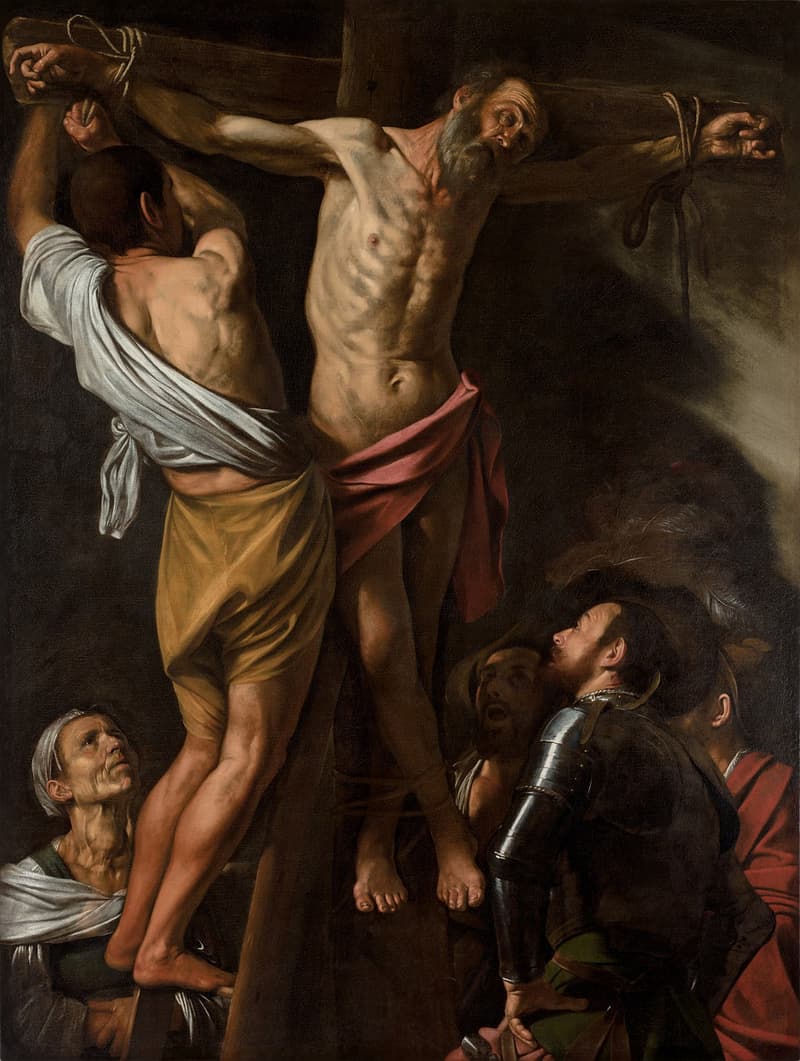
The most informative test case for the convention’s strength is the Baroque shift. Caravaggio’s Crucifixion of Saint Andrew, painted in Naples in 1606–1607 for the Conde de Benavente, Spanish viceroy of Naples, places Andrew not on a saltire but on a standard vertical cross. The Cleveland Museum of Art’s own description is explicit: “Although Saint Andrew is typically associated with an X-shaped cross, here he is depicted on a standard vertical cross.”38 Caravaggio’s choice followed the recommendation of two sixteenth-century Catholic philologists: Joannes Molanus (Jan Vermeulen) in De Picturis et Imaginibus Sacris (Louvain, 1570; expanded 1594), and Justus Lipsius in De Cruce Libri Tres (Antwerp, 1594). As the curators at the Cleveland Museum of Art summarize it: “two important sixteenth-century writers, Joannes Molanus and Justus Lipsius, explicitly asserted that the saint had, according to all the evidence, in fact been executed on a Latin cross like Christ himself. It was only during the seventeenth century that the crux decussata became widely accepted as the type of ‘St. Andrew’s Cross.’”39
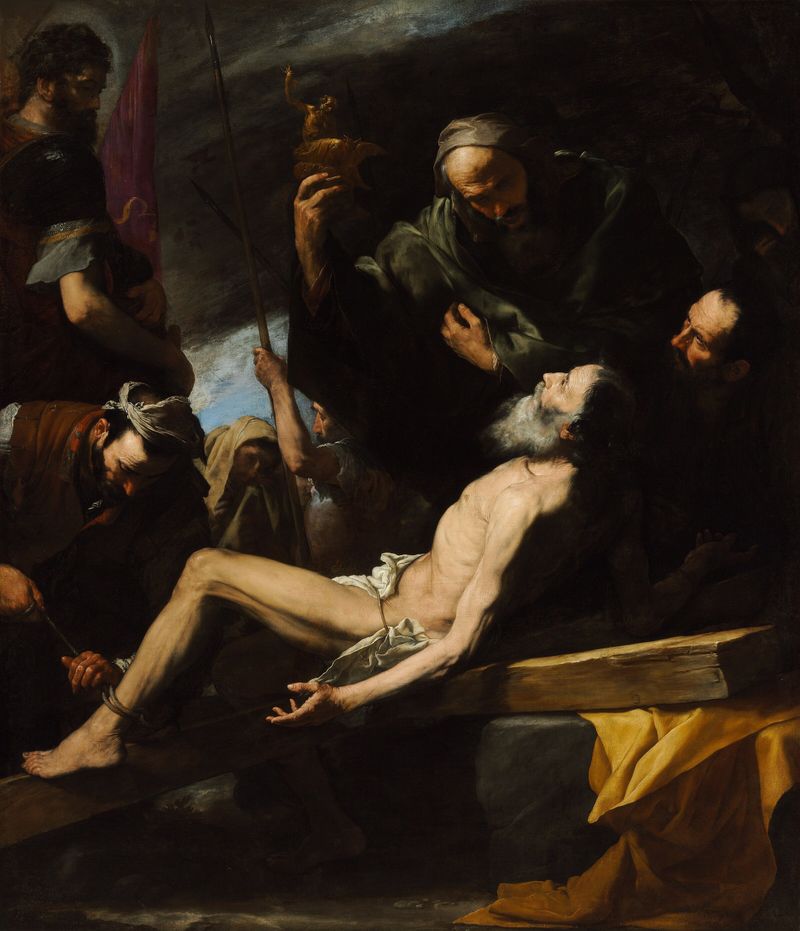
The shift to the X-cross as the universal Western convention happens in roughly the 1620s through the 1640s, in Spanish-Italian Catholic painting, against the philological grain. Jusepe de Ribera’s Martyrdom of Saint Andrew (1628, Museum of Fine Arts Budapest) shows Andrew on an X. Charles Le Brun’s Crucifiement de saint André (1647, Notre-Dame de Paris) uses the X to identify the apostle. Murillo’s Martyrdom of Saint Andrew in the Prado, painted around 1675–1682, shows Andrew “tied to the X-shaped cross on which he will die,” with a Rubens Martyrdom of Saint Andrew (1638–1639, painted for the Real Hospital de San Andrés de los Flamencos in Madrid and today in the collection of the Fundación Carlos de Amberes) cited by the Prado as the iconographic source.40 By the second half of the seventeenth century, the X-cross is standard. The pious explanation that Andrew “deemed himself unworthy” to be crucified on the same cross as Jesus is itself a late hagiographic gloss, supplied retrospectively to motivate a convention whose actual origins lie in fourteenth-century Burgundian heraldry and fifteenth-century devotional art.
The Scottish Saltire
The Scottish Saltire—argent saltire on azure, the oldest national flag in continuous use in Europe—sits inside this same convention but with its own distinct history. The 1286 Seal of the Guardians of Scotland depicts Andrew on his X-shaped cross with the inscription Andrea Scotis dux esto compatriotis (“Andrew, be leader of your fellow-Scots”). The saltire as a national-military badge is first documented in the 1385 Act of the Scottish Parliament, which decreed that “every man French and Scots shall have a sign before and behind, namely a white St Andrew’s Cross.”41
The famous Athelstaneford legend—King Óengus II of the Picts seeing a cloud-saltire before battle in 832 CE—is a 13th- to 16th-century literary back-formation, not contemporary history; Britannica calls it “clearly apocryphal.” John of Fordun in the 1380s records a battle and a dream-vision but no cloud-saltire. Walter Bower in the 1440s elaborates an angel with a standard. Only in John Leslie’s Historie of Scotland in the late sixteenth century does the full sky-saltire appear: “the Croce quhairvpon S. Andro deit … suddanlie apperit, in vuie and bricht colouris, in a manner, sett in the Aire.” The Athelstaneford form post-dates the use of the saltire as a Scottish military badge by at least a century. The flag came first; the legend caught up.
The four translations
If the historical Andrew is recoverable only at the level of late-second-century memory, the geographic Andrew—the relics of the apostle considered as physical objects—has been one of the most travelled bodies in Christian history. Four major translations span sixteen hundred years and trace the geography of every major rupture and rapprochement in the Christian East and West.
357: Constantius II and the apostolic mausoleum
The first translation moved Andrew from Patras to Constantinople in 357 CE, the twentieth regnal year of the Emperor Constantius II. Three converging Latin notices establish the date. Jerome’s De viris illustribus, in chapter 7 (the entry on Luke), reads: “Sepultus est Constantinopolim, ad quam urbem, vicesimo Constantii anno, ossa eius, cum reliquiis Andreae apostoli, translata sunt”—“He is buried at Constantinople, to which city, in the twentieth year of Constantius, his bones together with the remains of the apostle Andrew were transferred.”42 Jerome’s Chronicon, composed at Constantinople around 380–381, records the translation under the same year. Isidore of Seville reflects the entry verbatim in his Chronica 342: “Ossa Andreae et Lucae apostolorum Constantinopoli transferuntur.” In Contra Vigilantium Jerome defends the practice rhetorically: “Was the Emperor Constantius guilty of sacrilege when he transferred the sacred relics of Andrew, Luke, and Timothy to Constantinople?”
The mid-sixth century supplies an independent witness. Procopius, in De aedificiis 1.4.18–23, describing Justinian’s reconstruction of the Holy Apostles, reports that workmen demolishing the older basilica “saw three wooden coffins lying there neglected, which revealed by inscriptions upon them that they contained the bodies of the apostles Andrew and Luke and Timothy. And the Emperor himself and all the Christians saw these with the greatest joy.”43 The relics survived the Iconoclast period in situ; they were rediscovered around 550 during the Justinianic rebuilding and reinterred under the new altar.
The decisive modern study is Cyril Mango’s 1990 article in Byzantinische Zeitschrift. Mango argues that Constantine’s original heroon—a circular mausoleum attached to but architecturally distinct from the Holy Apostles—was the resting place of Constantine alone; only after Constantius II completed or refounded the cruciform basilica was Andrew (joined later by Luke and Timothy) deposited there.44 On Mango’s reading, Andrew is the first apostolic body placed beside Constantine’s tomb, and the translation is a deliberate dynastic act giving Constantinople apostolic credentials in answer to Rome’s Peter and Paul. The Apostoleion itself was demolished by Mehmed II after 1461 to make way for the Fatih Mosque; the great church under whose floor Andrew lay for nearly nine hundred years has not survived.
1208: Pietro Capuano and the Amalfi crypt
The second translation took Andrew’s body—minus the head—from Constantinople to Amalfi on 8 May 1208, in the aftermath of the Fourth Crusade’s sack of the Byzantine capital in 1204. Cardinal Pietro Capuano, an Amalfitan-born papal legate to the Crusade, brought the relics via Syria and Gaeta and deposited them in the crypt of the Duomo di Sant’Andrea. Capuano funded the construction of the transept and crypt of the Cathedral before the deposition. The principal documentary witness is the Translatio S. Andreae (BHL 433) in the Acta Sanctorum Novembris II.1; the major modern academic treatment is the eight-centenary symposium volume Amalfi and Byzantium, edited by Edward Farrugia for the Pontifical Oriental Institute in 2009.45
The local cult of the “manna of St Andrew”—a liquid exudate (manna sancti Andreae) periodically collected at the saint’s tomb—is documented at Amalfi from 29 November 1304, when, according to cathedral tradition, the substance reportedly healed a blind man from Tramonti. A separate manna tradition tied to Andrew’s original Patras tomb is already attested in Gregory of Tours’ sixth-century epitome, but the Amalfi cult is most cleanly read as an autonomous late-medieval phenomenon onto which the older Patran tradition was retrojected. Capuano’s original Romanesque crypt was rebuilt in Baroque style across the seventeenth century, with the central marble altar and silver urn traditionally attributed to Domenico Fontana c. 1602–1603, when the relics were rediscovered and reburied under the present altar. In 2008, marking the eighth centenary of the 1208 translation, the Vatican gave Amalfi a small portion of the cranium—partially reuniting head and body for the first time in nearly fifteen hundred years.
1462: Thomas Palaiologos, Pius II, and the Tempietto
The head took a different route. It appears to have been at Patras when the Despotate of the Morea fell to the Ottomans in 1460–1461. Thomas Palaiologos, Despot of the Morea and brother of the last Byzantine emperor Constantine XI, fled the Morea via Corfu in 1460 and reached Italy through Ancona, where the relic was handed to a papal envoy. The head was kept at Narni in Umbria for more than a year before being brought down the Tiber to the Milvian Bridge in April 1462. Pope Pius II Piccolomini received the head with his own hands at the Milvian Bridge outside Rome on 12 April 1462—the Monday of Holy Week, pridie Idus Aprilis. The contemporary inscription on Pius’ commemorative Tempietto, the small Sant’Andrea a Ponte Milvio, reads:
Pius II Pont. Max., sacrum beati apostoli Andree caput ex Peloponneso advectum, his in pratis excepit et suis manibus portavit in Urbem anno salutis MCCCCLXII, pridie Idus Aprilis que tunc fuit secunda feria majoris hebdomadae.46
The whole adventus and orations are described at length in Pius’ Commentarii rerum memorabilium, Book VIII; the standard modern edition is the I Tatti Renaissance Library translation by Margaret Meserve and Marcello Simonetta. Torch and DeSilva’s 2022 article in Renaissance Studies shows that the adventus narrative now embedded in the Commentarii originally circulated as a free-standing Andreis compilation, deployed by Pius for crusade promotion.47
The head was deposited in St Peter’s Basilica. After Bernini’s reconstruction of the crossing in the mid-seventeenth century, the Andrew reliquary was placed in one of the four piers supporting the bronze baldacchino—the south-west pier, marked by François Duquesnoy’s monumental statue of St Andrew, sculpted between 1629 and 1640. Pius II’s tomb, with a relief depicting the head’s reception at the Milvian Bridge, was originally in St Peter’s; it was transferred to Sant’Andrea della Valle in 1614, where it remains.
1964: Augustin Bea, Patras, and ecumenical reciprocity
The fourth translation reversed the second. On 26 September 1964, Pope Paul VI returned Andrew’s head to Patras as an ecumenical gesture. Cardinal Augustin Bea, S.J., president of the Vatican Secretariat for Promoting Christian Unity, headed the eight-man delegation. The reliquary flew from Rome to the Araxos military airfield and was solemnly handed to Metropolitan Constantine of Patras in a public ceremony before the older Church of Saint Andrew (the present Byzantine-style cathedral was not inaugurated until 1974). The handover was recorded by British Pathé and reported in the New York Times the following day. Cardinal Bea’s words at the handover are part of the official Vatican record:
For centuries we have lived like strangers, where as a common baptism made us all the children of God. May this day mark the beginning of a road, which with God’s help may lead us to the day when our churches can be reunited.48
The trajectory the 1964 return helped to make possible was already in motion. On 5–6 January 1964 Paul VI had embraced Ecumenical Patriarch Athenagoras I in Jerusalem—the first papal-patriarchal meeting since the Council of Florence (1438–1439), more than five centuries earlier. On 7 December 1965, on the eve of Vatican II’s closure, the Joint Catholic-Orthodox Declaration was read simultaneously in Rome and the Phanar; it “regret[ted] and remove[d] both from memory and from the midst of the Church the sentences of excommunication” of 1054.49 Andrew’s head returning to Patras was a concrete instalment in a longer drama. Five years later, in 1969, Paul VI gave another small Andrean relic to Cardinal Gordon Joseph Gray of Edinburgh on the occasion of Gray’s elevation to the cardinalate—the first resident Scottish cardinal since the Reformation. He handed it to Gray with five words: “Peter greets his brother Andrew.”
The annual reciprocal exchange that followed—papal delegation to the Phanar on 30 November, patriarchal delegation to Rome on 29 June—has no founding decree; both sides describe it as a “custom” or “tradition” inaugurated by Athenagoras and Paul VI. It has continued without interruption. Patriarchs personally attended in Rome in 1995, 2004, and 2008; popes have personally attended at the Phanar in 1979 (John Paul II), 2006 (Benedict XVI), and 2014 (Francis). The Peter-Andrew brotherhood has been moving from the New Testament page through the relic-translations of late antiquity and the Middle Ages into the institutional liturgical calendar of the late twentieth and early twenty-first centuries. It is, in a perfectly literal sense, the most enduring application of John 1:42.
Cult, feast, and Scotland
The 30 November feast, East and West
The 30 November feast is one of the oldest fixed liturgical commemorations shared between East and West. It is liturgical, not historical: no pre-medieval source attaches Andrew’s death to a specific calendar day. The Martyrologium Hieronymianum—the earliest universal Latin martyrology, compiled in stages from the fifth through the eighth centuries and pseudonymously attributed to Jerome—fixes Andrew on II Kal. Dec. (30 November) in the standard editio princeps by Giovanni Battista de Rossi and Louis Duchesne in Acta Sanctorum Novembris II.1.50 The Constantinopolitan Synaxarium of the tenth century, edited by Hippolyte Delehaye in 1902, contains the proper synaxis of Andrew the Protokletos. By the fifth and sixth centuries the date is conventional in both East and West; thereafter it is universal.
Patras, Russia, Romania
The Patras cathedral remains the principal Greek shrine. Patras itself, the Achaean city the apocryphal Acts made into Andrew’s death-place and burial-place, is patron of the city and patron of Greece nationally. The cathedral preserves the head returned in 1964 along with a fragment of the cross. The Russian Order of St Andrew the First-Called, founded by Peter the Great on 30 November 1698, makes Andrew the principal patron of Russia and the chief order of Russian chivalry; St Andrew’s saltire became the Russian naval ensign by Peter’s decree in 1699 and remains so to this day. The Romanian Holy Synod declared Andrew protector of Romania in 1997, and in 2012 the Romanian Parliament declared 30 November a national public holiday. The legend of Andrew’s mission to Dobruja is recognized by historians as a twentieth-century devotional construction with patristic roots in Hippolytus and Origen, but no pre-modern Romanian local cult.
Scotland: from Hexham to Arbroath
The Scottish story is the most institutionally consequential of the western patronages, and its history has often been mistold. The Saint Regulus or Rule legend—that a Greek monk warned by an angel took relics of Andrew from Patras “to the ends of the earth” and was shipwrecked at Mucros (later Cennrígmonaid, the Pictish “King’s mount,” later still St Andrews) in Fife—is a twelfth-century Augustinian foundation narrative. Walter Bower’s fifteenth-century Scotichronicon gives it its most developed Latin form. The legend’s setting under the Pictish king Hungus filius Forgus (Onuist son of Uurguist) is internally inconsistent with the supposed fourth-century Regulus, since Onuist reigned in the early ninth century.
Ursula Hall’s St Andrew and Scotland (1994) and James Fraser’s 2009 essay on the movements of Andrew in Britain make a stronger historical case: the cult more credibly migrated from Wilfridian Northumbria—where Wilfrid had dedicated Hexham to Andrew in deliberate imitation of his Roman patron-church Sant’Andrea ad Catabarbara—to Pictland in the early eighth century, with Bishop Acca of Hexham (deposed in 732) as the most plausible carrier of relics northward.51 The Regulus legend, on this reading, was constructed retrospectively in the twelfth century, when the Augustinian canons installed at St Andrews under King Alexander I and Bishop Robert needed a foundation narrative competitive with Iona-Columba.
The cult was securely Scottish-royal by the late twelfth century. The 1286 Seal of the Guardians of Scotland deployed Andrew nationally for the first time. The most famous formal articulation of the patronage is the Declaration of Arbroath, drafted in Latin and sent to Pope John XXII on 6 April 1320, almost certainly by Bernard of Linton, Abbot of Arbroath and Chancellor of Scotland:
The high qualities and deserts of these people, were they not otherwise manifest, gain glory enough from this: that the King of kings and Lord of lords, our Lord Jesus Christ, after His Passion and Resurrection, called them, even though settled in the uttermost parts of the earth, almost the first to His most holy faith. Nor would He have them confirmed in that faith by merely anyone but by the first of His Apostles by calling—though second or third in rank—the most gentle Saint Andrew, the Blessed Peter’s brother, and desired him to keep them under his protection as their patron forever.52
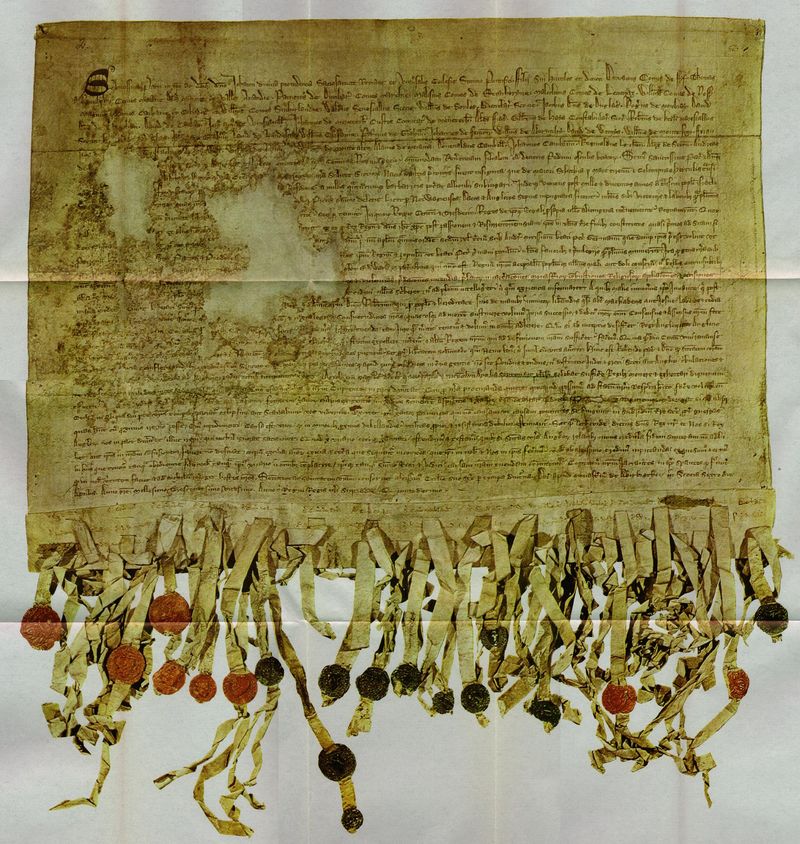
The Latin names Andrew sanctum Andream mitissimum beati Petri Germanum—“the most gentle Saint Andrew, brother of blessed Peter”—and identifies him as the special patron and protector (quem semper ipsis preesse voluit vt Patronum). The medieval Andrean relics in Scotland themselves did not survive: in June 1559, in the wake of John Knox’s preaching at Holy Trinity, St Andrews, the cathedral interior was destroyed by reformers and the shrine despoiled. The contemporary Andrean relics in Scotland are post-Reformation gifts: a “large portion of the shoulder” given by Archbishop Maiorsini of Amalfi to Archbishop John Strain of Edinburgh in 1879, and Paul VI’s 1969 gift to Cardinal Gray. Both rest in the National Shrine of Saint Andrew at St Mary’s Cathedral, Edinburgh.
The Saltire is a piece of medieval Catholic devotion that the Reformation destroyed in fact and preserved in symbol. Andrew’s shrine at St Andrews is gone; the X-cross is on every public building from Edinburgh Castle to the Forth Bridge.
The Saltire, then, is a piece of medieval Catholic devotion that the Reformation destroyed in fact and preserved in symbol. Andrew’s shrine at St Andrews is gone; the X-cross is on every public building from Edinburgh Castle to the Forth Bridge.
Constantinople, Russia, and the apostolic claims
The Stachys legend
The same apostle whose Achaean martyrdom gave Patras its claim, and whose missionary Scythia gave Russia and Romania theirs, also gave the see of Constantinople its case for apostolic foundation. The case is, in its developed form, a ninth-century Byzantine codification of older materials.
The Constantinopolitan claim, in summary form, runs: Andrew, after preaching in Pontus and Bithynia, came to Byzantium, passed through Argyropolis on the European shore of the Bosphorus, founded the church there, and consecrated Stachys—identified with the Stachys of Romans 16:9—as first bishop of Byzantium. The chain Andrew → Stachys → eventually → Metrophanes (under Constantine) → modern Ecumenical Patriarchs is the basis of the Patriarchate’s apostolic-succession claim against Rome’s exclusive Petrine appeal.
The earliest formal codification of the legend is the Pseudo-Dorothean apostolic list (the Index apostolorum/discipulorum attributed to Dorotheus of Tyre). Cyril Mango and Tony Burke have established that the work is not a fourth-century work of any historical Dorotheus but a ninth-century Byzantine production, certainly before 810/811. The Andrew-Stachys legend is unattested in any pre-seventh-century source. It crystallizes after the rise of iconodule defenses of Constantinople’s apostolicity and is propagated through the Laudatio Andreae of Nicetas the Paphlagonian, the Passio Artemii, and the Narratio of around 825.
Francis Dvornik’s The Idea of Apostolicity in Byzantium and the Legend of the Apostle Andrew remains the standard treatment. The thesis Dvornik defends across more than three hundred pages is that the see of Constantinople was already called “apostolic” from the seventh century forward without reference to Andrew; the Andrew-Stachys legend supplied a positive Andrew-genealogy when polemics with the Latin West intensified.53 The legend surfaces especially in the Photian Schism of the 860s and 880s, is invoked in the Filioque controversy and the canonical aftermath of 1054, becomes commonplace in tenth- through twelfth-century Byzantine ecclesiology, and is debated at the Councils of Lyons (1274) and Florence (1438–1439). Catholic apologetics has historically used Dvornik’s findings to reject Orthodox parity claims rooted in Andrean apostolicity; modern Orthodox scholarship has often shifted the argument toward the imperial-administrative principle Dvornik himself identified as the East’s actual operating logic.
Russia, Kyiv, and the Primary Chronicle
The Russian and Ukrainian developments belong to the same family. The Povest’ vremennykh let—the “Tale of Bygone Years”—was compiled at the Kyivan Caves Monastery between approximately 1110 and 1118, traditionally attributed to the monk Nestor, with three early redactions surviving. The standard English is Samuel Hazzard Cross and Olgerd Sherbowitz-Wetzor’s 1953 translation for the Mediaeval Academy of America. The Andrew passage stands in the introductory geographical section that precedes the year-entries:
But the Dnieper flows through various mouths into the Pontus. This sea, beside which taught St. Andrew, Peter’s brother, is called the Russian Sea. When Andrew was teaching in Sinope and came to Kherson (as has been recounted elsewhere), he observed that the mouth of the Dnieper was near by. Conceiving a desire to go to Rome, he thus journeyed to the mouth of the Dnieper. Thence he ascended the river, and by chance he halted beneath the hills upon the shore. Upon arising in the morning, he observed to the disciples who were with him, “See ye these hills? So shall the favor of God shine upon them that on this spot a great city shall arise, and God shall erect many churches therein.” He drew near the hills, and having blessed them, he set up a cross.54
The text continues with Andrew climbing further north, past Novgorod, where he is amazed by the Slavic banya: “I saw the land of the Slavs, and while I was among them, I noticed their wooden bathhouses. They warm them to extreme heat, then undress, and after anointing themselves with an acid liquid, they take young branches and lash their bodies. They actually lash themselves so violently that they barely escape alive. Then they drench themselves with cold water, and thus are revived.” The chronicler is having a small joke at northern expense, but the apologetic-political work the passage performs is deadly serious.
Almost universally, modern scholars treat the passage as a twelfth-century interpolation. The chronicle itself states sub anno 6491/983 that “the apostles were not by body here … and the prophets did not prophesy here”—a statement that directly contradicts the Andrew episode. Andrzej Poppe has argued that two competing theological-political concepts, Vladimir-as-apostle and Andrew-as-apostle, coexist in early Rus’ writings, and that the Andrew layer was added precisely to give Kyiv apostolic dignity vis-à-vis Constantinople in the post-988 environment when the see of Kyiv was angling for autocephaly.55 The Andriyivska Tserkva on Kyiv’s Andriyivskyi Uzviz, built by Bartolomeo Rastrelli in 1747–1754 to mark the legendary site, is a late-Baroque monument to a twelfth-century literary construction.
The brothers, still distinct
The annual Rome-Phanar exchange—the institution that bookends this section and this post—is the redemption of these centuries of competing apostolic narratives. Apostolicity, in the fixed Catholic-Orthodox theological dialogue of the Ravenna Document (2007) and the Joint International Commission, is no longer weaponized as a polemic. Andrew’s protokletos status relativizes but does not deny Petrine primacy. The fraternal exchange embodies the relativization. The brothers, still distinct, still embrace.
Honest reckoning: what we know, what we don’t
The cumulative weight of the sources allows a careful summary judgment on each of the major claims. None of them is identical to the popular treatment, and most of the popular treatment is overconfident.
The Patras martyrdom is probable but not historically verifiable. No first- or early-second-century witness places Andrew at Patras. The earliest source is the apocryphal Acts of Andrew, c. 150–200, a text replete with legendary motifs and condemned by every major Western ecclesiastical authority between Eusebius and Photius. Pseudo-Hippolytus may preserve a partly independent witness. Sean McDowell, applying a 0–10 probability scale across the apostolic martyrdom traditions in The Fate of the Apostles, rates Andrew 6/10—“slightly more plausible than not” connected to a reliable tradition.56 Dvornik states the consensus from the other side: “The tradition concerning the missionary activity of the Apostle Andrew in Achaea and his death at Patras is regarded as legendary by the majority of modern scholars.”57 The Catholic Encyclopedia of 1907—“It is generally agreed that he was crucified by order of the Roman Governor, Aegeas or Aegeates, at Patrae in Achaia, and that he was bound, not nailed, to the cross”—overstates the consensus McDowell’s 6/10 captures more honestly.
The mission to Scythia is ancient but geographically vague. Origen, via Eusebius, transmits the oldest extant tradition. Dvornik treats this as the earliest and probably original Andrew-mission. The modern Romanian Orthodox claim of mission to Dobruja is a twentieth-century devotional construction with patristic roots in Origen but no pre-modern Romanian local cult; the Russian Primary Chronicle’s Kyiv-route is a twelfth-century Byzantine-influenced literary construction.
The X-cross is a late-medieval Western invention. The earliest scholarly-secure exemplar is the twelfth-century Cottam baptismal font; standardization belongs to the Burgundian fourteenth-fifteenth-century Order of the Golden Fleece; universal use to the seventeenth century. Caravaggio still painted Andrew on a Latin cross in 1607.
Birth and death dates are speculative. No ancient source gives Andrew’s birth year. Britannica’s “between 60 and 70 CE” for his death is a defensible window; more specific dates (60, 62, 69, 70, 80) circulate in late hagiography without primary support. The 30 November feast preserves a calendar day, not a year.
The Constantinople-foundation legend is ninth century, not first. Dvornik’s case is settled. The Andrew-Stachys-Byzantium chain, whatever ecumenical good it has done in the post-conciliar period, is not history.
Scottish patronage by formal status dates from 1320; the cult is older. The Declaration of Arbroath fixes the formal patron-charter; the cult goes back, on the strongest evidence, to the early eighth century via Acca of Hexham, not the legendary fourth-century Regulus.
Andrew’s relationship to the Greeks is literarily secure but biographically uncertain. John 12:20–22 places Andrew, with Philip, as the bilingual mediator between Greek-speaking pilgrims and Jesus on the eve of the Passion. Whether this is historical recollection or Johannine theological projection is genuinely undecidable. The two readings are not strictly incompatible.
The Acts of Andrew is legendary but probably preserves a kernel. Gregory of Tours’ sixth-century epitome and the Greek martyrium recensions are channels through which the Patras memory passes from a heretical text into orthodox circulation. Whether the kernel goes back to the apostolic generation, or to a second-century Achaean Christian community remembering its founder, or to a third-century literary construction full stop—the sources do not tell us.
What remains, after the legends are sorted from the evidence, is something both more and less than the popular Andrew. He is less, because the X-cross, the Patras inscription on the cross, the four-day preaching, the Mission to Russia, the founding of Constantinople, and the fourth-century Scottish shipwreck all dissolve. He is more, because the surviving New Testament Andrew—the bilingual Galilean fisherman, the disciple of John the Baptist, the first to follow Jesus, the disciple whose vocation in the Fourth Gospel is to bring kin and strangers and Greeks to Christ—is recoverable as a historical figure to the extent any of the Twelve are. He really did exist. He really did go from John the Baptist to Jesus. He really did bring his brother. The rest is what the Church remembered him for, in the centuries when she was still figuring out how to remember at all.
The apostle of bringing
Three times in John, Andrew brings someone to Jesus: his brother Peter, a boy with five barley loaves, a delegation of Greeks at Passover. Once in the Synoptics, on the Mount of Olives, he asks the question that triggers the apocalypse. Then Acts puts him in the upper room and the New Testament has nothing further to say.
Whatever Andrew did between the upper room and his death—Scythia, Achaea, Patras, the bound cross, the four days’ preaching—the patristic and apocryphal sources cannot tell us with certainty. What they can tell us, and what every relic-translation and feast-day and patronage and ecumenical exchange in this post is in some way an echo of, is that the Church understood Andrew’s vocation correctly. He was the apostle of bringing. He brings his brother to the Christ who renames him; he brings the boy with the loaves to the miracle that becomes the Eucharist; he brings the Gentiles to the “hour” of glorification. His own bones travel afterward—Patras to Constantinople to Amalfi, Patras to Rome and back to Patras—as if even after death the apostle whose work was bringing could not stop bringing. The annual greeting of Peter to his brother Andrew at the Phanar on 30 November, and of Andrew to his brother Peter at St Peter’s on 29 June, is the same vocation continuing: the brothers, still introducing each other, still introducing the Church.
The first thing Andrew said in the New Testament, in Greek, was “We have found the Messiah.” The next thing he did was lead his brother to him. Twenty centuries on, the Church has not finished imitating the gesture.
The first thing Andrew said in the New Testament, in Greek, was εὑρήκαμεν τὸν Μεσσίαν—“We have found the Messiah.” The next thing he did was lead his brother to him. Twenty centuries on, the Church has not finished imitating the gesture.
Frequently Asked Questions
Why is Saint Andrew called the “First-Called”?
The epithet comes from the Fourth Gospel. John 1:35–42 describes Andrew as one of two disciples of John the Baptist who, on hearing the Baptist call Jesus “the Lamb of God,” left to follow him. He then brought his own brother Simon—Peter—to Jesus. The Greek title Πρωτόκλητος (Protokletos, “First-Called”) is a stable Byzantine epithet attested in eighth- through tenth-century Greek hagiographic literature; the underlying exegesis of John 1 is much older. The Latin tradition has always preferred Petrine primacy and never canonized Protocletus in liturgical Latin usage.
How did Saint Andrew die?
According to the apocryphal Acts of Andrew (c. 150–200 CE) and its later derivatives, Andrew was crucified at Patras in Achaea on the orders of the Roman proconsul Aegeates. The earliest sources—Greek martyrium recensions, the Latin Passio, Gregory of Tours’ sixth-century epitome—uniformly say he was bound, not nailed, to the cross, and preached for several days before dying. No first- or early-second-century witness places Andrew at Patras. Sean McDowell, applying a 0–10 probability scale, rates Andrew’s Patras martyrdom 6/10—more probable than not but not historically verifiable.
Was Saint Andrew really crucified on an X-shaped cross?
Almost certainly not. The X-shaped cross (the saltire or crux decussata) is a late-medieval Western iconographic invention. The earliest surviving texts uniformly describe Andrew on a generic four-armed upright cross with no shape specified. The earliest scholarly-secure Western image of Andrew on a saltire is the twelfth-century baptismal font at Cottam, Yorkshire. The convention spread through fourteenth-fifteenth-century Burgundian heraldry (especially Philip the Good’s 1430 Order of the Golden Fleece) and only became universal in the seventeenth century. Caravaggio in 1607 still painted Andrew on a standard vertical cross.
Why is Saint Andrew the patron saint of Scotland?
The cult most plausibly migrated from Wilfridian Northumbria—where Wilfrid had dedicated Hexham to Andrew in deliberate imitation of his Roman patron-church Sant’Andrea ad Catabarbara—to Pictland in the early eighth century, with Bishop Acca of Hexham (deposed 732) as the most plausible carrier of relics. The legendary fourth-century Saint Regulus or Rule narrative is a twelfth-century Augustinian foundation tale constructed when the canons at St Andrews needed a foundation narrative competitive with Iona-Columba. The formal national patronage was articulated in the Declaration of Arbroath (6 April 1320), which named Andrew the Scots’ perpetual patron.
Where are Saint Andrew’s relics today?
Andrew’s body has made four major translations across sixteen hundred years. The body (minus the head) was moved from Patras to Constantinople in 357 by Constantius II, then to Amalfi after the Fourth Crusade in 1208, where the bulk of it remains in the crypt of the Duomo di Sant’Andrea. The head was carried west by Thomas Palaiologos to Pope Pius II in 1462 and kept at St Peter’s in Rome until Pope Paul VI returned it to Patras as an ecumenical gesture on 26 September 1964. Smaller portions are at the National Shrine of Saint Andrew, St Mary’s Cathedral, Edinburgh, and at Amalfi (a 2008 Vatican gift partially reuniting head and body).
What is the annual exchange between the Pope and the Ecumenical Patriarch?
Since the late 1960s, on Andrew’s feast (30 November) a delegation from the Holy See travels to the Phanar in Istanbul to greet the Ecumenical Patriarch; on Peter and Paul’s feast (29 June) a delegation from the Ecumenical Patriarchate travels to St Peter’s in Rome. The custom has no founding decree but was inaugurated by Pope Paul VI and Patriarch Athenagoras I after their 1964 Jerusalem embrace and the 1965 Joint Catholic-Orthodox Declaration that lifted the mutual anathemas of 1054. Popes have personally attended at the Phanar in 1979, 2006, and 2014; patriarchs in Rome in 1995, 2004, and 2008.
Are the Acts of Andrew canonical?
No. The Acts of Andrew is a second-century apocryphal Greek prose narrative condemned by every major Western ecclesiastical authority that noticed it—Eusebius (early fourth century), Pope Innocent I (405), Augustine (c. 420), the Decretum Gelasianum (sixth century), Pope Leo I, and finally Photius (ninth century), who called the corpus of apocryphal Acts “the source and mother of all heresy.” The text is encratite (radically anti-marriage), and Photius identifies dualist and docetic theology in it. What survives of the Patras martyrdom tradition reaches orthodox circulation principally through Gregory of Tours’ sixth-century Latin epitome, which deliberately stripped out the heretical material.
Footnotes
1. Recorded at the National Shrine of Saint Andrew, St Mary’s Cathedral, Edinburgh. The relic was given to Cardinal Gordon Joseph Gray in St Peter’s Basilica in 1969 (not 1964, as some popular sources confuse), on the occasion of Gray’s elevation to the cardinalate at the consistory of 28 April 1969—the first resident Scottish cardinal since the Reformation. (The Scottish Catholic hierarchy itself had been re-established earlier, in 1878, by Leo XIII.) See the National Shrine’s public account.
2. John 1:44 (NABRE): “Now Philip was from Bethsaida, the town of Andrew and Peter.” Greek (NA28): ἦν δὲ ὁ Φίλιππος ἀπὸ Βηθσαϊδά, ἐκ τῆς πόλεως Ἀνδρέου καὶ Πέτρου.
3. Mark 1:29 (NABRE): “On leaving the synagogue he entered the house of Simon and Andrew with James and John.” The Zebedee partnership is attested at Luke 5:10, where James and John are explicitly Simon’s κοινωνοί (“partners”).
4. Tal Ilan, Lexicon of Jewish Names in Late Antiquity, Part I: Palestine 330 BCE–200 CE, Texts and Studies in Ancient Judaism 91 (Tübingen: Mohr Siebeck, 2002).
5. Markus Bockmuehl, Simon Peter in Scripture and Memory: The New Testament Apostle in the Early Church (Grand Rapids: Baker Academic, 2012), ch. 6. Bockmuehl extends his earlier The Remembered Peter, WUNT 262 (Tübingen: Mohr Siebeck, 2010).
6. Mordechai Aviam and R. Steven Notley have published preliminary reports on the el-Araj excavations. Rami Arav’s work at et-Tell remains the alternative case. See Megan Sauter, “Excavating El-Araj: A Candidate for Biblical Bethsaida,” Bible History Daily, Biblical Archaeology Society.
7. Mark 1:16–18 (NABRE); Greek (NA28): δεῦτε ὀπίσω μου, καὶ ποιήσω ὑμᾶς γενέσθαι ἁλιεῖς ἀνθρώπων. Matt 4:18–20 follows Mark with minor redactional tightening.
8. John 1:39 (NABRE): “It was about four in the afternoon.” The Greek is ὥρα ἦν ὡς δεκάτη—“the tenth hour,” counted from sunrise.
9. John 1:40–42 (NABRE). Greek (NA28): Ἦν Ἀνδρέας ὁ ἀδελφὸς Σίμωνος Πέτρου εἷς ἐκ τῶν δύο τῶν ἀκουσάντων παρὰ Ἰωάννου καὶ ἀκολουθησάντων αὐτῷ· εὑρίσκει οὗτος πρῶτον τὸν ἀδελφὸν τὸν ἴδιον Σίμωνα καὶ λέγει αὐτῷ· εὑρήκαμεν τὸν Μεσσίαν, ὅ ἐστιν μεθερμηνευόμενον χριστός. ἤγαγεν αὐτὸν πρὸς τὸν Ἰησοῦν.
10. John P. Meier, A Marginal Jew: Rethinking the Historical Jesus, Volume Two: Mentor, Message, and Miracles, AYBRL (New York: Doubleday, 1994), chs. 12–13 on the Baptist.
11. John 12:20–22 (NABRE). The USCCB note observes that “the approach is made through disciples who have distinctly Greek names.”
12. Raymond E. Brown, The Gospel According to John I–XII, Anchor Bible 29 (Garden City, NY: Doubleday, 1966); cf. Brown, An Introduction to the Gospel of John, ed. Francis J. Moloney, ABRL (New York: Doubleday, 2003); reissued by Yale University Press in 2010 (AYBRL). Francis J. Moloney, The Gospel of John, Sacra Pagina 4 (Collegeville: Liturgical Press, 1998), ad loc.
13. Richard Bauckham, Jesus and the Eyewitnesses: The Gospels as Eyewitness Testimony, 2nd ed. (Grand Rapids: Eerdmans, 2017), 99.
14. Eusebius, Historia Ecclesiastica 3.1.1–2, in Arthur Cushman McGiffert, trans., Eusebius: Church History, NPNF, 2nd Series, Vol. 1 (Edinburgh, 1890), available at the Christian Classics Ethereal Library, https://www.ccel.org/ccel/schaff/npnf201.iii.viii.i.html. Greek text in Eduard Schwartz, ed., Eusebius Werke II: Die Kirchengeschichte, GCS 9.1–3 (Leipzig: Hinrichs, 1903–09).
15. McGiffert, NPNF 2.1, n. 565 ad HE 3.1.1.
16. Francis Dvornik, The Idea of Apostolicity in Byzantium and the Legend of the Apostle Andrew, Dumbarton Oaks Studies IV (Cambridge, MA: Harvard UP, 1958), ch. V; full scan at https://archive.org/details/DvornikByzApostolicity.
17. Pseudo-Hippolytus, On the Twelve Apostles and the Seventy Disciples, trans. J. H. MacMahon, in Ante-Nicene Fathers, Vol. 5 (Edinburgh, 1886), https://www.ccel.org/ccel/schaff/anf05.iii.v.ii.html. On the dating, see Tony Burke, “List of the Apostles and Disciples, by Pseudo-Hippolytus of Thebes,” NASSCAL e-Clavis Christian Apocrypha, https://www.nasscal.com/.
18. Eusebius, HE 3.25.6–7 (McGiffert), https://www.newadvent.org/fathers/250103.htm.
19. John Chrysostom, Homilies on John 19, on John 1:41–42, trans. Charles Marriott, rev. Philip Schaff, NPNF, 1st Series, Vol. 14 (New York, 1889), https://www.newadvent.org/fathers/240119.htm.
20. Liturgia Horarum, Office of Readings, 30 November (Feast of Saint Andrew, Apostle), Second Reading.
21. Paulinus of Nola, Carmen 19.335–342, ed. W. von Hartel, CSEL 30 (Vienna, 1894); critical edition Franz Dolveck, CCSL 21 (Turnhout: Brepols, 2015). English in P. G. Walsh, trans., The Poems of St. Paulinus of Nola, Ancient Christian Writers 40 (New York: Newman Press, 1975). Cult of Saints in Late Antiquity database, Oxford, record E05132.
22. Gregory the Great, Homiliae in Evangelia 17 (= Hurst, Hom. 19), on Luke 10:1–9; English in David Hurst, trans., Forty Gospel Homilies, Cistercian Studies 123 (Kalamazoo: Cistercian Publications, 1990), Hom. 19, pp. 134–150; older English at https://archive.org/stream/homilystgregory00greguoft. Latin in CCSL 141, ed. Raymond Étaix (1999), and PL 76, cols. 1138–1149.
23. Benedict XVI, General Audience of 14 June 2006, “Andrew, the Protoclete,” https://www.vatican.va/content/benedict-xvi/en/audiences/2006/documents/hf_ben-xvi_aud_20060614.html.
24. Jean-Marc Prieur, Acta Andreae, 2 vols., Corpus Christianorum, Series Apocryphorum 5–6 (Turnhout: Brepols, 1989); Dennis R. MacDonald, The Acts of Andrew and the Acts of Andrew and Matthias in the City of the Cannibals, SBL Texts and Translations 33 (Atlanta: Scholars Press, 1990); Lautaro Roig Lanzillotta, Acta Andreae Apocrypha: A New Perspective (Geneva: Cramer, 2007).
25. Epiphanius, Panarion 47.1.5 (against the Encratites), ed. Karl Holl, GCS 31 (Leipzig: Hinrichs, 1922).
26. Pope Innocent I, Epistula 6 ad Exsuperium Tolosanum (February 405), PL 20.501–502; Latin and English at https://www.bible-researcher.com/innocent.html.
27. Decretum Gelasianum, ed. Ernst von Dobschütz, Das Decretum Gelasianum de libris recipiendis et non recipiendis, Texte und Untersuchungen 38.4 (Leipzig: Hinrichs, 1912); English at https://tertullian.org/decretum_eng.htm.
28. Augustine, Contra adversarium legis et prophetarum 1.20.39, ed. K.-D. Daur, CCSL 49 (Turnhout: Brepols, 1985); PL 42.624.
29. Filastrius of Brescia, Diversarum hereseon liber 88, ed. F. Marx, CSEL 38 (Vienna, 1898), https://archive.org/details/CorpusScriptorumEcclesiasticorumLatinorum38.
30. Photius, Bibliotheca codex 114, ed. René Henry, Photius: Bibliothèque, Tome II (Paris: Les Belles Lettres, 1960), 84–86; PG 103, cols. 388C–392B. English in J. H. Freese, trans., The Library of Photius, Vol. I (London: SPCK, 1920), 232. Note that codex 114 is not included in N. G. Wilson’s 1994 abridged Duckworth selection.
31. Gregory of Tours, Liber de miraculis beati Andreae apostoli, prologue, ed. Maximilien Bonnet, MGH SRM 1.2 (Hannover: Hahn, 1885), 826. English in Andrew Koperski’s translation at Ad Fontes, https://adfontesjournal.com/. The first complete published English translation of the Liber is Randy R. Richardson, trans., with an introduction by Burnam W. Reynolds and a foreword by Raymond Van Dam, Gregory of Tours: The Book of the Miracles of the Blessed Andrew the Apostle, Dallas Medieval Texts and Translations 29 (Leuven: Peeters, 2022).
32. M. R. James, trans., The Apocryphal New Testament (Oxford: Clarendon, 1924), 359, rendering Vat. gr. 808; full text at http://www.earlychristianwritings.com/text/actsandrew.html.
33. Epistle of the Presbyters and Deacons of Achaia, in Alexander Walker, trans., Apocryphal Gospels, Acts and Revelations, ANF 8 (Edinburgh, 1873), https://www.tertullian.org/fathers2/ANF-08/anf08-95.htm.
34. M. R. James, Apocryphal New Testament, 359–60. The Greek opening (Tischendorf, basis of Bonnet 1898): Χαῖρε σταυρέ· χαῖρε γάρ, ἀληθῶς. Synoptic comparison across all five recensions in Prieur, Acta Andreae, CCSA 6, 738–45.
35. Walker, ANF 8, https://www.tertullian.org/fathers2/ANF-08/anf08-95.htm. The dating consensus is sketched in Prieur, Acta Andreae, CCSA 5, 13–14, and Tony Burke for NASSCAL, https://www.nasscal.com/.
36. Charlotte Denoël, Saint André: Culte et iconographie en France (Ve–XVe siècles), École nationale des chartes thesis 2001; published as Mémoires et documents de l’École des chartes 77 (Paris: École des chartes, 2004), reviewed at https://www.persee.fr/doc/bec_0373-6237_2005_num_163_2_463766_t1_0529_0000_2.
37. See Order of the Golden Fleece foundation documents, summarized at https://en.wikipedia.org/wiki/Order_of_the_Golden_Fleece, and the Cross of Burgundy / Cruz de Borgoña documentation at Flags of the World, https://www.crwflags.com/fotw/flags/es_brgdy.html.
38. Cleveland Museum of Art, “The Crucifixion of Saint Andrew,” accession no. 1976.2, https://www.clevelandart.org/art/1976.2.
39. Cleveland Museum of Art curators, summarized at https://www.caravaggio.org/crucifixion-of-saint-andrew.jsp, drawing on the museum’s catalogue. Joannes Molanus, De Picturis et Imaginibus Sacris (Louvain, 1570; expanded ed. 1594); Justus Lipsius, De Cruce Libri Tres (Antwerp, 1594).
40. Bartolomé Esteban Murillo, The Martyrdom of Saint Andrew, c. 1675–1682, Museo del Prado P00982, https://www.museodelprado.es/en/the-collection/art-work/the-martyrdom-of-saint-andrew/4e16dcf0-f952-45f6-ae7d-b9cab4748cdd.
41. 1385 Act of the Scottish Parliament, RPS 1385/4/2 (Liber Niger, NAS PA5/4); edited and discussed in Anne Curry, “Disciplinary ordinances for English and Franco-Scottish armies in 1385: An international code?” Journal of Medieval History 37, no. 3 (2011): 269–294, https://www.tandfonline.com/doi/abs/10.1016/j.jmedhist.2011.05.004.
42. Jerome, De viris illustribus 7 (entry on Luke); Latin and English at the Cult of Saints in Late Antiquity database, Oxford, record E07903, https://portal.sds.ox.ac.uk/. Critical edition: E. C. Richardson, De viris inlustribus, Texte und Untersuchungen 14/1a (Leipzig: Hinrichs, 1896). Jerome’s Chronicon, ed. R. Helm, Eusebius Werke 7, GCS 47 (Berlin, 1956).
43. Procopius, De aedificiis 1.4.18–23, trans. H. B. Dewing and Glanville Downey, Loeb Classical Library 343 (Cambridge, MA: Harvard UP, 1940), https://penelope.uchicago.edu/Thayer/E/Roman/Texts/Procopius/Buildings/.
44. Cyril Mango, “Constantine’s Mausoleum and the Translation of Relics,” Byzantinische Zeitschrift 83 (1990): 51–62, https://doi.org/10.1515/byzs.1990.83.1.51; reprinted as study V in his Studies on Constantinople (Aldershot: Variorum, 1993).
45. Edward G. Farrugia, S.J., ed., Amalfi and Byzantium: Acts of the International Symposium on the Eighth Centenary of the Translation of the Relics of St Andrew the Apostle from Constantinople to Amalfi (1208–2008), Orientalia Christiana Analecta 287 (Rome: Pontificio Istituto Orientale, 2009). On the documentary tradition, see Pierre, comte Riant, Exuviae sacrae Constantinopolitanae, 2 vols. (Geneva: Société de l’Orient Latin, 1877–78), https://archive.org/details/exuvisacrconsta00parigoog, and Matteo Camera, Memorie storico-diplomatiche dell’antica città e ducato di Amalfi, 2 vols. (Salerno, 1876–81). The Translatio S. Andreae deposition account is BHL 433, in Acta Sanctorum Novembris II.1.
46. Tempietto / Sant’Andrea a Ponte Milvio inscription, Rome (1462). The narrative of the head’s adventus is given at length in Pius II, Commentarii rerum memorabilium, Book VIII.
47. Pius II, Commentaries, ed. and trans. Margaret Meserve and Marcello Simonetta, I Tatti Renaissance Library (Cambridge, MA: Harvard UP, 2003– ); older annotated English in F. A. Gragg and L. C. Gabel, Memoirs of a Renaissance Pope (New York: Putnam, 1959). Barry Torch and Jennifer Mara DeSilva, “Pius II and the Andreis (1462): Textual Circulation, Crusade Promotion and Papal Power,” Renaissance Studies 36, no. 4 (2022): 590–609, https://doi.org/10.1111/rest.12781.
48. Cardinal Augustin Bea, S.J., handover address at Patras, 26 September 1964; reproduced in L’Osservatore Romano, 27 September 1964, and in the Acta Apostolicae Sedis 1964 fascicle. Pope Paul VI’s own address is indexed at https://www.vatican.va/content/paul-vi/en/speeches/1964.index.3.html. The handover was filmed by British Pathé and reported in The New York Times, 27 September 1964.
49. Joint Catholic-Orthodox Declaration of Pope Paul VI and Patriarch Athenagoras I, 7 December 1965, https://www.vatican.va/content/paul-vi/en/speeches/1965/documents/hf_p-vi_spe_19651207_common-declaration.html.
50. Martyrologium Hieronymianum, ed. Giovanni Battista de Rossi and Louis Duchesne, in Acta Sanctorum Novembris II.1 (Brussels: Société des Bollandistes, 1894); critical commentary by H. Quentin and H. Delehaye in AS Nov. II.2 (1931). Synaxarium Ecclesiae Constantinopolitanae, ed. Hippolyte Delehaye, Propylaeum ad Acta Sanctorum Novembris (Brussels, 1902), cols. 265–268, https://archive.org/details/DelehayeSynaxariumConstantinopolitanum.
51. Ursula Hall, St Andrew and Scotland (St Andrews: St Andrews University Library, 1994); James E. Fraser, “Rochester, Hexham and Cennrígmonaid: the movements of St Andrew in Britain, 604–747,” in Saints’ Cults in the Celtic World, ed. Steve Boardman, John Reuben Davies, and Eila Williamson (Woodbridge: Boydell, 2009), 1–17. See also Simon Taylor and Gilbert Márkus, The Place-Names of Fife, 5 vols. (Donington: Shaun Tyas, 2006–12), esp. vol. 3.
52. Declaration of Arbroath (Letter of the Barons of Scotland to Pope John XXII), 6 April 1320, NRS SP13/7. Translation by Sir James Fergusson with revisions by Alan Borthwick, https://www.nrscotland.gov.uk/learning-and-events/the-declaration-of-arbroath/transcription-of-the-declaration-of-arbroath/.
53. Dvornik, Idea of Apostolicity, chs. IV–VI. On Pseudo-Dorotheus see Cyril Mango, “Constantinople’s Mount of Olives and Pseudo-Dorotheus of Tyre,” Nea Rhome 6 (2009): 157–170, http://nea-rhome-2017.uniroma2.it/wp-content/uploads/2009/06/nr06_mango.pdf.
54. Samuel Hazzard Cross and Olgerd P. Sherbowitz-Wetzor, trans., The Russian Primary Chronicle: Laurentian Text, Mediaeval Academy Publication 60 (Cambridge, MA: Mediaeval Academy of America, 1953), 53–54, https://mgh-bibliothek.de/dokumente/a/a011458.pdf.
55. Andrzej Poppe, “Two Concepts of the Conversion of Rus’ in Kievan Writings,” Harvard Ukrainian Studies 12/13 (1988–89): 488–504. The broader context is treated in Simon Franklin and Jonathan Shepard, The Emergence of Rus 750–1200 (London: Longman, 1996), and in Simon Franklin, “Kievan Rus’ (1015–1125),” ch. 4 of The Cambridge History of Russia, vol. I, ed. Maureen Perrie (Cambridge: CUP, 2006).
56. Sean McDowell, The Fate of the Apostles: Examining the Martyrdom Accounts of the Closest Followers of Jesus (Farnham: Ashgate, 2015; 2nd ed. London: Routledge, 2024), ch. 10, p. 259.
57. Dvornik, Idea of Apostolicity, Foreword, p. v.
Garrett Ham
Garrett Ham is an attorney, military veteran, and holds a Master of Divinity from Yale Divinity School. He writes from Northwest Arkansas on theology, law, and service.
Related Posts

Saint Jude Thaddaeus: The Apostle of Hopeless Causes
A scholarly Catholic account of Saint Jude Thaddaeus—the apostle of three names, the Epistle of Jude, the mission legends, and the patron of hopeless causes.

Saint Matthew the Apostle: The Tax Collector at the Customs Post
A scholarly Catholic account of Saint Matthew the Apostle: the call at the Capernaum customs post, the Matthew/Levi question, and his contested death.

Saint Bartholomew the Apostle: Nathanael, Pantaenus's India, and the Armenian Tradition
A scholarly Catholic account of Saint Bartholomew the Apostle — the Nathanael identification, the Eusebius–Pantaenus trace to India, the Armenian Apostolic tradition, and the witness of Catholic liturgy.
Stay Informed
Get new writing on faith, law, and service delivered to your inbox.
No spam. Unsubscribe anytime.