Per Stirpes

On This Page
What Does Per Stirpes Mean?
If you’ve ever read through a will, you have likely encountered the phrase per stirpes. Most wills that I have seen and drafted include this phrase. Clients commonly ask me what it means.
Per stirpes (pronounced per STIR-peez) is a Latin term meaning “by branch” or “by roots.” It is a method of property distribution used in estate planning. These two words explain who should inherit if a testator’s heirs predecease them. In most cases, the words never become operative. If, for example, you leave your property to your children, your children will likely inherit it. However, per stirpes addresses those situations where your children predecease you.
Per stirpes is not the only option in such scenarios. Per capita and per capita at each generation are other conventional methods. Per stirpes, however, is generally the preferred choice.
But, why? Why do testators generally prefer per stirpes over per capita, for example?
In this post, I will explain the per stirpes method of property distribution. I will address how it works and why it is generally preferred. I will also explain the difference between its classical and modern forms, how per stirpes applies beyond wills to trusts and beneficiary designations, and what language you might use if you want to include it in your own estate plan.
Classic Per Stirpes
Classic per stirpes provides that the shares of heirs who predecease a testator will pass to the heirs’ children.
So, for example, say you leave your estate to your two children in equal shares per stirpes. If one of your children predeceases you, at your death, your surviving child will inherit half of your estate. The children of your predeceased child will divide the other half of your estate. So, if the child who died before you had three children, each of your surviving grandchildren would receive one-sixth of your estate. (Any grandchildren you might have through your surviving child, however, would not inherit anything directly from you.)
Under classic per stirpes, the division of your estate always occurs at the second generation. That is, the division always happens at your children’s generation. This is true even if all of your children predecease you. This is the difference between classic per stirpes and modern per stirpes (explained below).
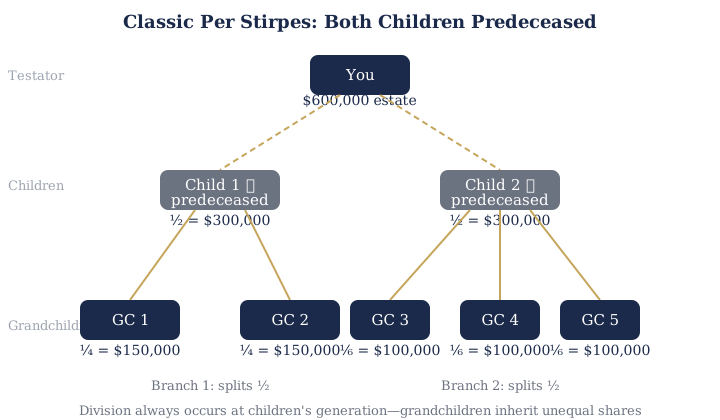
So, let’s change the example above a bit. Say you leave your estate to your two children in equal shares per stirpes. In this scenario, however, both of your children predecease you. Your first child left two surviving children. Your second child left three.
Under classic per stirpes, your first child’s two children would divide half your estate. Your second child’s three children would also share half your estate. So, your first child’s children would each receive one-quarter of your estate. Your second child’s children, however, would each receive one-sixth.
The inheritance passes down by the branch—thus the name. Children, therefore, can never inherit more than what their parent’s share would have been.
Modern Per Stirpes
Modern per stirpes attempts to remedy this apparent inequity. Some people feel it is unfair for grandchildren to receive unequal shares if all the testator’s children have already died. This is particularly true where there are many predeceased children with a varying number of surviving children.
In the example above, the disparity between surviving grandchildren is not that great. What if, however, you have three predeceased children? What if the first had one child, the second had two, and the third had five? At your death, some of your grandchildren would inherit as much as one-third—the first child’s child. Others, however, would inherit as little as one-fifteenth—the third child’s five children.
To some, this seems unfair.
Under the modern approach, however, the first division occurs at the first generation with surviving members. So, under the scenario above, each grandchild would inherit an equal share.
This is, however, only because there is no surviving member of the previous generation. Were just one of your children living, the division would occur the same as it would under the classic approach.
So, say in the example above your first child survived but the other two predeceased you. Your first child would inherit one-third. The children of your second child would each inherit one-sixth. Finally, the children of your third child would each inherit one-fifteenth.
There is only a difference between classic and modern per stirpes when all the testator’s children are predeceased.
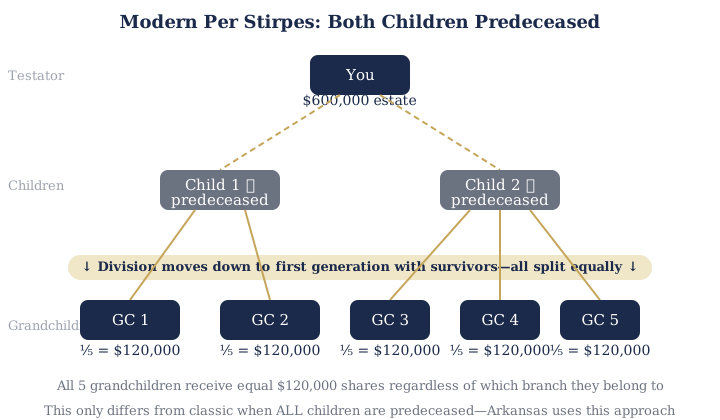
Arkansas note: Arkansas follows the modern approach to per stirpes. So, if you state you want your children to inherit per stirpes in Arkansas, the probate court will follow the modern approach. If you’d prefer the classical approach, you should state so explicitly in your will.
Classic vs. Modern Per Stirpes: A Comparison
| Feature | Classic Per Stirpes | Modern Per Stirpes |
|---|---|---|
| Division starts at | Children’s generation (always) | First generation with survivors |
| Equal grandchild shares? | No—shares track parent’s branch | Yes—when all children are predeceased |
| When they differ | Never, if any child survives | Only when all children are predeceased |
| Arkansas default? | No | Yes |
Per Stirpes vs. Per Capita
Per stirpes and per capita represent fundamentally different philosophies of inheritance. The choice between them determines whether your estate plan prioritizes family branches or living individuals.
Under per stirpes, each branch of the family receives an equal share, and the descendants of a deceased beneficiary step into their parent’s place. Under per capita, the estate is divided equally among surviving beneficiaries at a given generation—if a beneficiary has died, their share is not passed down to their children but is instead redistributed among the remaining living beneficiaries.
Consider a testator with three children: Alice, Bob, and Carol. Alice has two children; Bob has one child; Carol has no children. If Bob predeceases the testator:
Under per stirpes, Alice receives one-third, Carol receives one-third, and Bob’s one child receives one-third (stepping into Bob’s share). Under per capita, Alice and Carol each receive one-half, and Bob’s child receives nothing.
A third method—per capita at each generation—offers a middle ground. It divides equally among living members at the first generation with survivors, then pools and redistributes any remaining shares equally at the next generation. The Uniform Probate Code (UPC) adopted this approach as its default.
For most families, per stirpes remains the preferred choice because it preserves the testator’s original intent—ensuring each family line receives its intended share.
Per Stirpes vs. By Representation
You may also encounter the phrase “by representation” in estate planning documents. In many states, “by representation” is a synonym for modern per stirpes—it means the estate is divided at the first generation that has living members, and the shares of any deceased members at that level pass equally to their descendants.
However, the precise meaning of “by representation” varies by jurisdiction. In some states, it follows the per capita at each generation method from the UPC, while in others it mirrors modern per stirpes exactly. Because of this ambiguity, many attorneys—myself included—prefer to use the term per stirpes explicitly and to specify whether the classical or modern form is intended.
If your will or trust uses the phrase “by representation” without further definition, consult an attorney in your state to confirm how the courts will interpret it.
Per Stirpes in Trusts
Per stirpes is not limited to wills. It appears frequently in revocable living trusts and irrevocable trusts as well.
In a trust context, per stirpes operates the same way it does in a will: if a named beneficiary predeceases the trust’s grantor (or dies before their distribution date in an ongoing trust), that beneficiary’s share passes to their lineal descendants rather than being redistributed to the other beneficiaries.
This is particularly important in irrevocable life insurance trusts (ILITs), where the trust terms govern how insurance proceeds are distributed. If the trust names your three children as beneficiaries per stirpes and one child predeceases you, that child’s share of the insurance proceeds will pass to their children—your grandchildren—rather than being split between your two surviving children.
Because trust distributions can be more complex than outright bequests in a will—involving staggered distributions, trustee discretion, and multiple distribution events—it is especially important to define clearly whether you intend classic or modern per stirpes in your trust instrument.
Per Stirpes for Beneficiary Designations
Beyond wills and trusts, per stirpes can also apply to assets that pass by beneficiary designation rather than through probate. These include retirement accounts (401(k)s and IRAs), life insurance policies, and annuities.
When you name a beneficiary on a retirement account or life insurance policy, you can typically add a “per stirpes” designation to each beneficiary’s name. For example, you might list your primary beneficiary as “Jane Doe, per stirpes.” If Jane dies before you, her share would pass to her children rather than to your contingent beneficiary or your estate.
This is a critical but often overlooked detail. Without a per stirpes designation, a deceased beneficiary’s share on a 401(k) or IRA typically passes to the remaining named beneficiaries or, if none survive, to the account holder’s estate—potentially triggering probate and accelerated tax consequences.
A few practical notes on beneficiary designations: first, the financial institution’s form must support per stirpes language—most major custodians do, but check your plan documents. Second, beneficiary designations override your will, so even a well-drafted will cannot redirect an IRA or life insurance payout if the beneficiary form says otherwise. Third, you should review your beneficiary designations whenever your family circumstances change—after a birth, death, marriage, or divorce.
How to Write Per Stirpes in a Will
If you want to include a per stirpes provision in your will, the language is typically straightforward. A common formulation reads:
“I give, devise, and bequeath my residuary estate to my children, in equal shares, per stirpes.”
This sentence accomplishes several things. It identifies the primary beneficiaries (your children), specifies the allocation method (equal shares), and directs what happens if a beneficiary predeceases you (per stirpes—their share passes to their descendants).
If you prefer classic per stirpes in a state that defaults to the modern approach—as Arkansas does—you should specify your intent:
“I give, devise, and bequeath my residuary estate to my children, in equal shares, per stirpes (classic), with the initial division occurring at the generation of my children regardless of whether any child survives me.”
Of course, the precise language should be tailored to your estate plan and reviewed by an attorney. Every family’s situation is different, and even small variations in wording can affect how a probate court interprets your wishes. If you’re unsure whether you need a lawyer for this, the answer is almost certainly yes—especially if your estate involves trusts, multiple beneficiaries, or assets in more than one state.
Per Stirpes by State
While the per stirpes concept is universal in American estate law, states differ in which form they apply as a default. If your will simply says per stirpes without specifying “classic” or “modern,” the result depends on your state’s statute:
| State | Default Approach | Statutory Basis |
|---|---|---|
| Arkansas | Modern per stirpes | Ark. Code § 28-9-205 |
| California | Modern per stirpes | Cal. Prob. Code § 240 |
| Florida | Per stirpes (classic) | Fla. Stat. § 732.104 |
| Illinois | Per stirpes | 755 ILCS 5/2-1 |
| New York | Per capita at each generation | N.Y. EPTL § 1-2.16; § 4-1.1 |
| Ohio | Modern per stirpes | Ohio Rev. Code § 2105.06 |
| Texas | Per capita with representation | Tex. Est. Code § 201.101 |
The variation across states is striking. Some—like Florida—follow classic per stirpes, dividing at the children’s generation regardless of who survives. Others—like Arkansas, California, Illinois, Ohio, and Texas—use modern per stirpes (sometimes called “per capita with representation”), where division begins at the first generation with living members. New York is among the states that adopted the UPC’s per capita at each generation system, which pools shares across branches at each generational level. This makes explicit language in your will all the more important if you want a specific distribution method. If your estate touches assets in multiple states, an attorney can help ensure your will’s language is interpreted consistently across jurisdictions.
The Preferred Method?
People generally prefer the per stirpes approach because it preserves the original distribution plan. That is, it prescribes what likely would have happened to the inheritance had all your children survived.
You would expect that your children would leave the inheritance you leave to them to their own children. So, per stirpes effectuates that desired result.
Under other approaches, such as per capita, a great-grandchild could potentially inherit as much as a child. Most people do not want this. Some do, however, so these options are available.
Every family’s situation is different, and other distribution methods—such as per capita—may better fit your goals. Per stirpes, however, remains the most common choice. To understand the alternatives, see my companion post on per capita and per capita at each generation.
Frequently Asked Questions
What does per stirpes mean in a will?
Per stirpes is a Latin term meaning “by branch.” In a will, it directs that if a named beneficiary dies before the testator, that beneficiary’s share of the estate passes to their descendants rather than being redistributed among the surviving beneficiaries.
How do you pronounce per stirpes?
Per stirpes is pronounced per STIR-peez. The phrase is Latin, and the second word rhymes with “stir peas.” You may occasionally hear per STUR-peez, which is also acceptable.
What is the difference between per stirpes and per capita?
Under per stirpes, a deceased beneficiary’s share passes to their children, preserving each family branch’s portion. Under per capita, the estate is divided equally among surviving beneficiaries only—descendants of a predeceased beneficiary receive nothing.
What is the difference between classic and modern per stirpes?
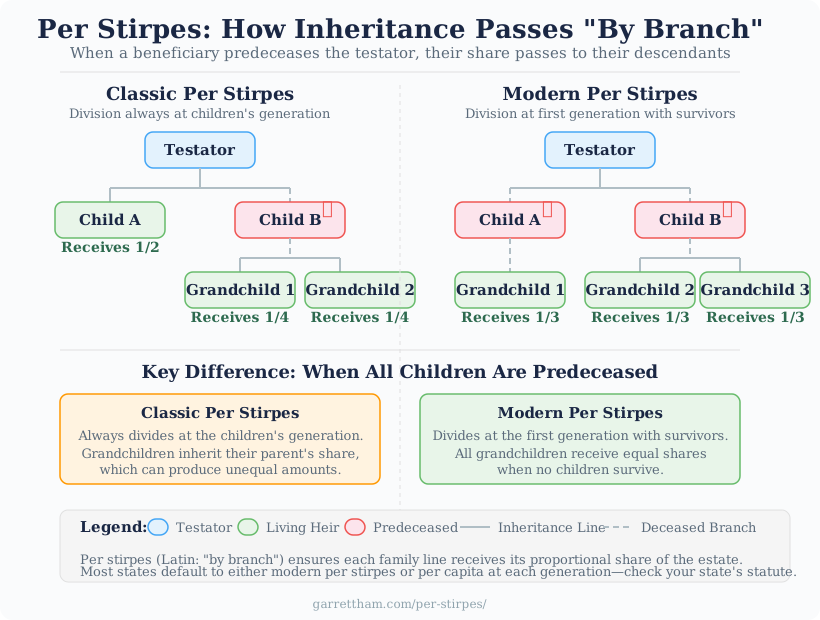
The two forms produce different results only when all of the testator’s children have predeceased them. Classic per stirpes always divides at the children’s generation, which can produce unequal shares among grandchildren. Modern per stirpes divides at the first generation with living members, giving all grandchildren equal shares when no children survive.
Can you use per stirpes on a 401(k) or IRA?
Yes. Most retirement account custodians allow you to add a per stirpes designation next to each named beneficiary. If that beneficiary predeceases you, their share passes to their descendants rather than to your remaining beneficiaries or your estate. Check your plan documents to confirm the custodian’s form supports this language.
Does per stirpes apply to trusts?
Yes. Per stirpes appears in revocable living trusts, irrevocable trusts, and other trust instruments. It operates the same way as in a will: a predeceased beneficiary’s share passes to their lineal descendants.
What happens per stirpes if there are no descendants?
If a beneficiary predeceases the testator and leaves no surviving descendants, that beneficiary’s share typically reverts to the residuary estate or is redistributed among the remaining beneficiaries according to the terms of the will. The specific result depends on the language of the document and applicable state law.
What does “lineal descendants per stirpes” mean?
“Lineal descendants per stirpes” means that the inheritance flows downward through direct bloodline—children, grandchildren, great-grandchildren, and so on—with each branch receiving its proportional share. The phrase “lineal descendants” is often added for clarity, though per stirpes by definition already limits inheritance to direct descendants rather than collateral relatives like siblings, nieces, and nephews.
Is per stirpes or per capita better?
Neither is inherently better—it depends on your family situation and goals. Per stirpes is better if you want each family branch to receive its share regardless of who survives. Per capita at each generation is better if you want all surviving members of a generation to receive equal shares. Traditional per capita simply divides among surviving beneficiaries, cutting out the descendants of anyone who has died. Most estate planners recommend per stirpes because it preserves the testator’s original intent.
What is the difference between per stirpes and by representation?
“By representation” often means the same thing as modern per stirpes, but its precise legal definition varies by state. Some states interpret it as per capita at each generation under the Uniform Probate Code. Because of this ambiguity, using per stirpes explicitly—and specifying classic or modern—is the safer drafting choice.
No information contained on this site is intended to be, nor does it constitute, legal advice. Legal information provided is for general educational purposes only and may not accurately reflect the law’s application to your individual situation or circumstances. Nothing herein establishes an attorney-client relationship. See Terms and Conditions of Use for more information.
Related Posts
- Per Capita and Per Capita at Each Generation—The alternative distribution methods and how they compare to per stirpes.
- When an Heir Predeceases the Testator—What happens when a beneficiary dies before the person who made the will.
- The Living Trust Explained—How revocable living trusts work and when you might need one.
- Do I Need a Will?—An Arkansas estate planning guide to help you decide.
- Issues of Inheritance Planning—Broader considerations when planning how your estate will be distributed.

Garrett Ham
Garrett Ham is an attorney, military veteran, and holds a Master of Divinity from Yale Divinity School. He writes from Northwest Arkansas on theology, law, and service.
More about Garrett →Related Posts

Per Capita and Per Capita at Each Generation
Per capita divides an estate equally among surviving heirs. Per capita at each generation splits it equally at each level. Learn how both methods work and compare to per stirpes.

When an Heir Predeceases the Testator
What happens when a will beneficiary dies before the testator? Learn how anti-lapse statutes, class gifts, and contingent beneficiaries work.

The Living Trust Explained
What is a living trust and do you need one? An Arkansas attorney explains how living trusts work, their benefits, and when they make sense.
Stay Informed
Get new writing on faith, law, and service delivered to your inbox.
No spam. Unsubscribe anytime.