The First Council of Constantinople (381): How the Church Finished the Creed
On This Page
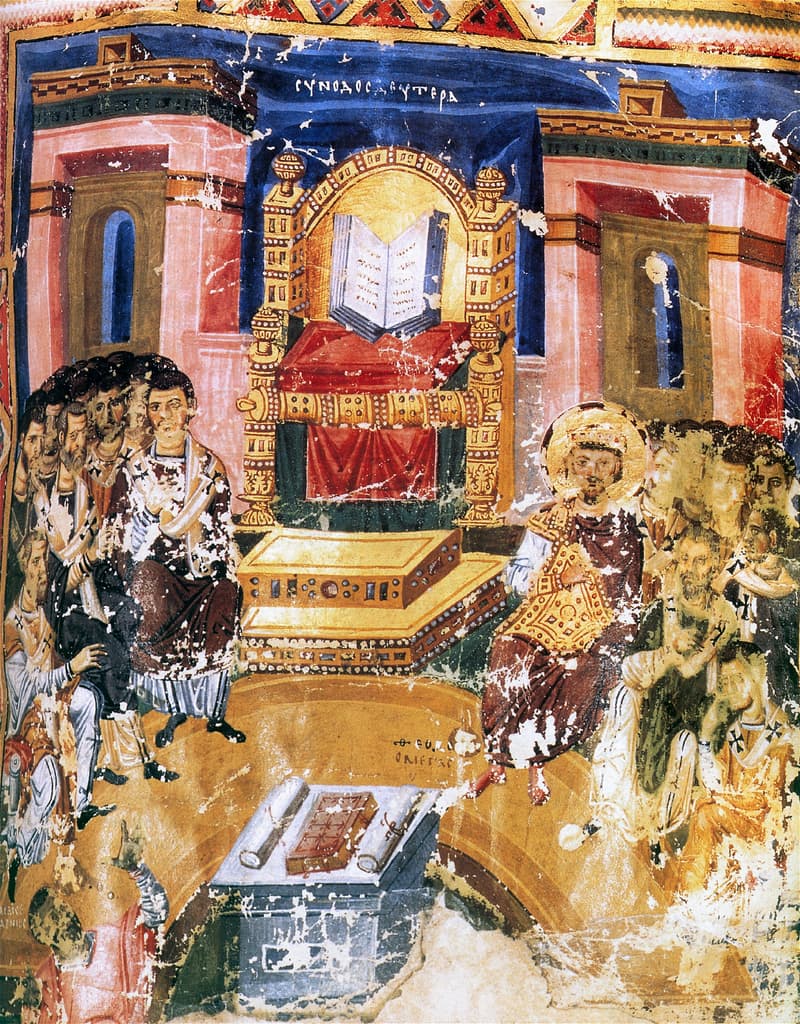
Every Sunday, Catholics stand and recite a creed that most of them assume came from the Council of Nicaea. It did not—at least, not all of it. The clauses we say about the Holy Spirit, “the Lord, the giver of life,” and about the Church, baptism, and the resurrection of the dead, were not in the creed the 318 fathers issued in 325. They belong to a second council, held fifty-six years later in the new imperial capital on the Bosphorus. That council confessed the full divinity of the Holy Spirit, finished the Trinitarian grammar Nicaea had left half-spoken, and, unlike Nicaea, did so without a single Western bishop in the room and without the pope’s legates present.1
This is the puzzle worth taking seriously. The First Council of Constantinople is the council we lean on most and think about least. We profess its creed, we inherit its doctrine of the Spirit, and we treat it as the Second Ecumenical Council—yet it began as a regional synod of eastern bishops, its acts are lost, its presidency was a fiasco, and Rome accepted its faith while pointedly refusing one of its canons. Reading it honestly means holding two things together: that the council’s doctrinal authority is now universal, and that its road to that authority was anything but smooth.
What the First Council of Constantinople actually was
The short version found in most encyclopedias is that the council “completed the Nicene Creed and condemned the Macedonians.” That is true as far as it goes, but it flattens the more interesting reality. The council was convened by the emperor Theodosius I and met in Constantinople from May through July of 381. Tradition places its sessions in the Church of Hagia Irene.2 Roughly 150 bishops took part, all of them from the eastern half of the empire. It did three things that lasted: it reaffirmed the faith of Nicaea against a cluster of named heresies, it confessed the divinity of the Holy Spirit in language that became the third article of the Creed, and it issued a handful of disciplinary canons—one of which, by promoting the see of Constantinople, planted a seed that would help split Christendom six centuries later.
What it did not have was the one thing we now assume an ecumenical council requires: the visible participation of the universal Church. There were no Latin bishops, no papal legates, no representatives of Rome. Theodosius summoned the East. The West would receive the council’s faith only gradually, and its canons not at all. The gap between what the council was in 381 and what it became by 451 is the real story.
The world that made the council necessary
To see why 381 mattered, you have to abandon the tidy assumption that Nicaea settled the Arian question in 325. It did not. For most of the fifty years that followed, the imperial machinery worked against the Nicene faith, not for it. Under Constantius II, sole ruler of the whole empire from 353, the court favored Arian and “Homoian” formulas and exiled Nicene bishops by the dozen. Julian the Apostate (361–363) cheerfully granted toleration to every faction precisely because a divided Church served his pagan revival. Valens, who ruled the East until his death at the catastrophe of Adrianople in 378, was himself an Arian—more precisely, a Homoian—who pressed the Nicenes hard. Jerome’s famous line about this period—that “the whole world groaned and was astonished to find itself Arian”—is rhetorical, but it captures something real.3
The theological center of gravity had also shifted. The fight at Nicaea had been over the Son: was he homoousios, of one substance with the Father, or merely the highest of creatures? By the 370s the front line had moved to the Holy Spirit. A party the Greeks called the Pneumatomachoi—the “Spirit-fighters”—conceded much of the Nicene case about the Son but refused to grant the Spirit equal divine status, treating him instead as a creature or a “ministering spirit” on the strength of Hebrews 1:14 (“Are not all angels spirits in the divine service, sent to serve for the sake of those who are to inherit salvation?” [NRSV]).4 Nicaea’s creed had said only, baldly, “And we believe in the Holy Spirit,” and stopped there. That sentence had become a battleground.
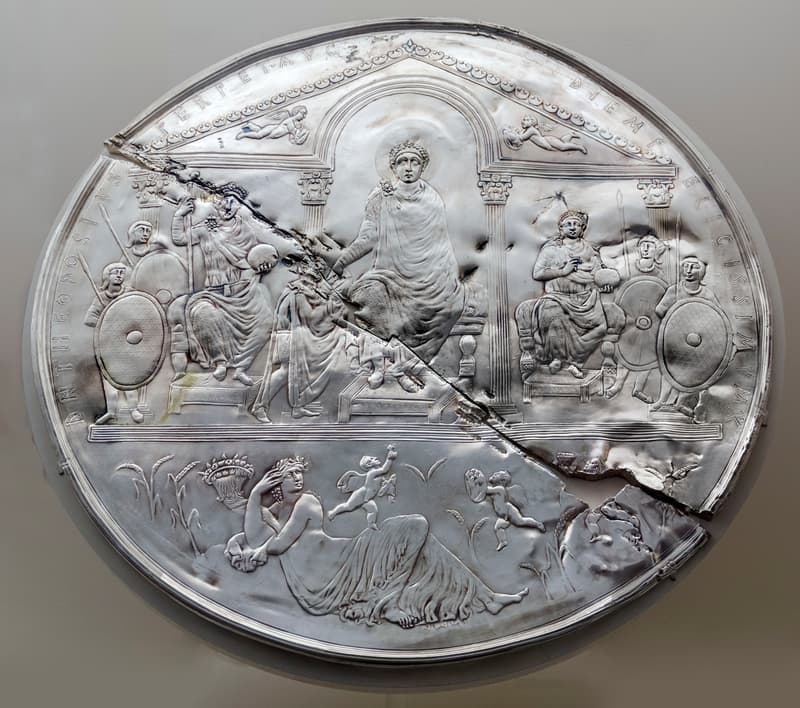
Everything changed when Theodosius came to the eastern throne in 379. A convinced Nicene from the Latin West, he moved quickly. In February 380 he issued the edict Cunctos populos—the famous Edict of Thessalonica—commanding all his subjects to hold “the faith which the divine Apostle Peter delivered to the Romans,” the faith now professed by Pope Damasus of Rome and Peter, bishop of Alexandria: one deity of Father, Son, and Holy Spirit in equal majesty.5 The edict made Nicene Christianity the law of the empire. It is worth pausing on its logic, because it matters for a Catholic reading of what followed: Theodosius located orthodoxy not by his own imperial preference but by communion with Rome and Alexandria. The council he summoned the next year gave conciliar form to a faith the emperor had already defined by reference to the apostolic sees.
The men in the room
If you imagine an ecumenical council as a serene assembly of saints, Constantinople will disabuse you. Its proceedings were chaotic, and its presidency changed hands twice through death and resignation.
The council opened under the presidency of Meletius of Antioch, a much-exiled Nicene bishop who had only recently returned from banishment. He promptly died during the sessions; Theodosius attended his funeral, and his body was carried back to Antioch.6 His death reopened the old wound of the Antiochene schism, in which two rival Nicene bishops—Meletius and Paulinus—each claimed the city, with Rome and Alexandria backing Paulinus and the eastern bishops backing Meletius. The council’s decision to continue Meletius’ line rather than recognize Paulinus put it crosswise with the West from the start.7
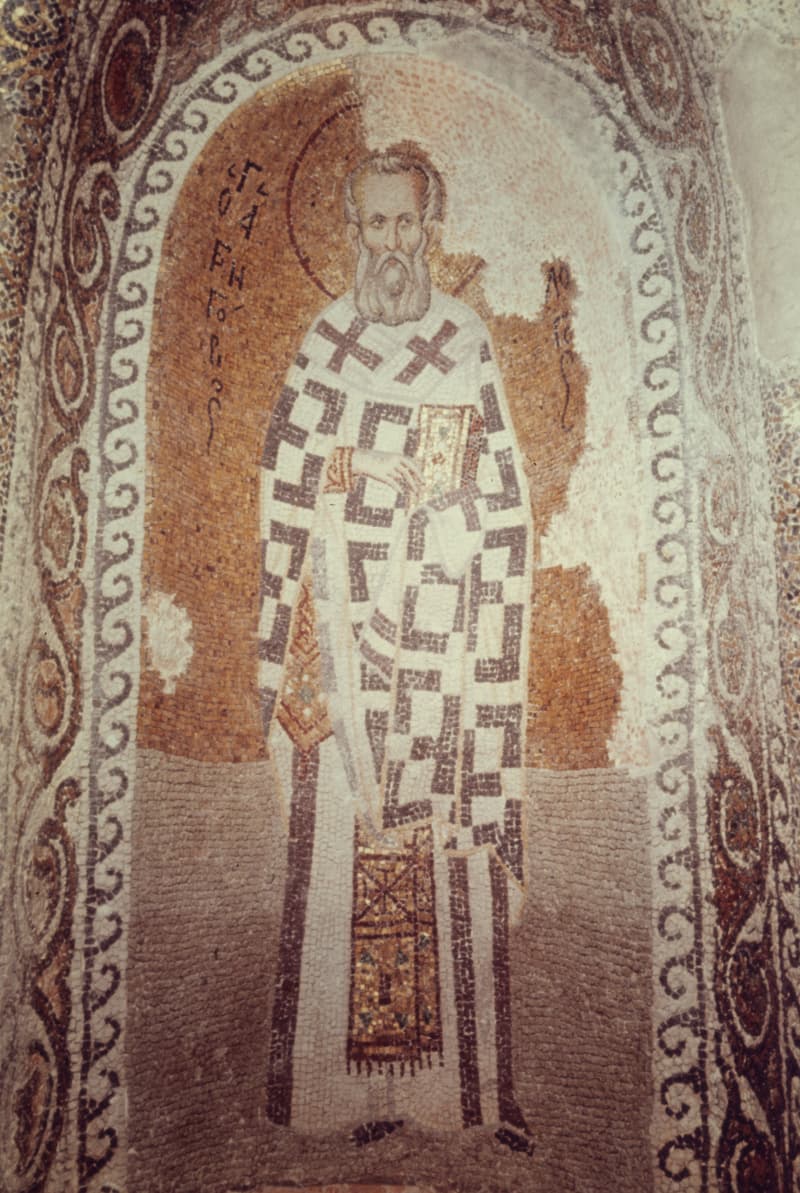
Meletius was succeeded as president by Gregory of Nazianzus, one of the three Cappadocian Fathers and arguably the finest theologian of the age. Gregory had been leading the small, embattled Nicene congregation in Constantinople, and it was there, around 380, that he delivered the five sermons—Orations 27 through 31—that earned him the rare title “the Theologian.”8
The council confirmed him as bishop of the capital. Then it unraveled on him. Late-arriving Egyptian bishops challenged his appointment on the canonical ground that he had already been ordained for another see, and translation between sees was forbidden by a Nicene canon. Worn down by the infighting, Gregory resigned both the council’s presidency and the see of Constantinople, leaving behind a bitter retrospective on the squabbling of bishops that is one of the most quoted passages in patristic literature.
Declining a summons to yet another synod the following year, he wrote: “For my part, if I am to write the truth, my inclination is to avoid all assemblies of bishops, because I have never seen any Council come to a good end, nor turn out to be a solution of evils. On the contrary, it usually increases them.”9
His replacement was the strangest choice of all: Nectarius, an elderly civil official of Constantinople who was not even baptized. He had to be baptized in order to be consecrated, and he presided over the rest of the council straight out of the font.10 The council also formally annulled the irregular consecration of one Maximus the Cynic, a philosopher who had been smuggled into the see of Constantinople in a night-time intrusion backed by Alexandria.11 These were not the deliberations of a body conscious of speaking for the universal Church. They were the often-graceless workings of an eastern episcopate sorting out its own house.
The heresy the council was called to kill
Behind the personalities was the doctrinal task: to finish what Nicaea had started by confessing the divinity of the Holy Spirit against the Pneumatomachians.
The “Spirit-fighters” are conventionally called Macedonians, after Macedonius, a deposed Arian-installed bishop of Constantinople. That label deserves a caution that popular accounts usually skip. No writings of Macedonius survive, and the sources connect the doctrine to him only loosely; serious scholars have long doubted whether the heresy can be pinned on Macedonius personally at all.12 What is certain is that a real movement existed which denied the Spirit’s full deity, and that thirty-six of its bishops attended the council, according to the fifth-century historians Socrates and Sozomen, only to withdraw when they would not accept the Nicene confession of the Spirit.13
The answer the council confessed had been worked out a few years earlier by the Cappadocians. Basil of Caesarea, who died on the first day of 379 and so never lived to attend, had written his treatise On the Holy Spirit around 375. Its occasion was almost comically small: Basil had been attacked for using a doxology that glorified God “with the Son together with the Holy Spirit,” and he wrote the book to defend the phrase.14 His argument ran from worship and from baptism. If the Lord himself commanded that we be baptized “in the name of the Father and of the Son and of the Holy Spirit,” ranking the Spirit alongside the Father and the Son, then to refuse the Spirit equal honor is to defy the command of God.
Strikingly, Basil never flatly calls the Spirit “God” in that treatise, nor does he apply the word homoousios to him. His near-contemporary Gregory of Nazianzus explained the reticence as deliberate pastoral economy—a way of leading the half-convinced forward by stages rather than provoking them with a word that was not yet in the creed. (Some modern scholars think this caution has been overstated, and that Basil’s substance is fully divine even where his vocabulary is reserved.)15 Gregory himself felt no such restraint. In the last of his Theological Orations he put the question and answered it without flinching: “What then? Is the Spirit God? Most certainly. Well then, is He Consubstantial? Yes, if He is God.”16
“What is not assumed is not healed”
Canon 1 of the council anathematized a whole roster of errors, and alongside the Pneumatomachians it named the Apollinarians.17 Their founder, Apollinaris of Laodicea, had been a staunch ally of the Nicene cause against Arianism—which makes his condemnation a useful reminder that orthodoxy on one front does not guarantee it on another. In his zeal to defend the unity of Christ, Apollinaris taught that in the Incarnation the divine Word took the place of Christ’s human rational soul or mind. Christ had a human body and an animal soul, but the Logos supplied what would otherwise have been his human intellect. The result was a Christ who was not fully one of us.
Gregory of Nazianzus answered with the principle that has anchored Catholic Christology ever since. Writing against Apollinaris, he laid down the soteriological rule: “For that which He has not assumed He has not healed; but that which is united to His Godhead is also saved.”18 In the Greek it is a four-word epigram—τὸ γὰρ ἀπρόσληπτον, ἀθεράπευτον—“the unassumed is the unhealed.”19 If Christ did not take a human mind, then the human mind—the very seat of the sin he came to heal—goes unredeemed. Salvation requires that the Son assume a complete humanity, mind and all. That principle, forged against Apollinaris and ratified at Constantinople, would do decades of work later at Ephesus and Chalcedon.
Completing the Creed
The council’s most enduring act is also its most historically delicate, and honesty requires laying the difficulty out plainly rather than smoothing it over.
The creed we recite today—the one scholars call the Niceno-Constantinopolitan Creed—greatly expands Nicaea’s bare clause on the Spirit. Where 325 had said only “And we believe in the Holy Spirit,” the new text confesses him as “the Lord and Giver-of-Life, who proceeds from the Father, who with the Father and the Son together is worshipped and glorified, who spoke by the prophets,” and goes on to add the articles on the one holy catholic and apostolic Church, the one baptism for the remission of sins, and the resurrection of the dead and the life of the world to come.20
It says the divine thing in doxological language.
Notice the careful strategy: the creed asserts the Spirit’s full divinity by giving him the worship due to God—he is “worshipped and glorified” together with the Father and the Son—without inserting the contested philosophical word homoousios. It says the divine thing in doxological language.
The Catechism, drawing the conclusion the council’s worship-language implies, states it directly: the Spirit is “consubstantial with the Father and the Son.”21
Set side by side, article by article, the two texts show what 381 confessed that 325 had not:
| Article | Nicaea (325) | Constantinople (381) |
|---|---|---|
| The Father | We believe in one God, the Father Almighty, Maker of all things visible and invisible. | We believe in one God, the Father Almighty, maker of heaven and earth and of all things visible and invisible. |
| The Son | And in one Lord Jesus Christ, the Son of God, begotten of the Father, only-begotten, that is, from the substance of the Father, God from God, Light from Light, true God from true God, begotten, not made, consubstantial with the Father; through whom all things were made, things in heaven and things on earth; who for us men and for our salvation came down and was incarnate and became man, suffered, and rose again on the third day, ascended into the heavens, and is coming to judge the living and the dead. | And in one Lord Jesus Christ, the only begotten Son of God, begotten of his Father before all worlds, Light of Light, very God of very God, begotten not made, being of one substance with the Father, by whom all things were made. Who for us men and for our salvation came down from heaven and was incarnate by the Holy Ghost and the Virgin Mary, and was made man, and was crucified also for us under Pontius Pilate. He suffered and was buried, and the third day he rose again according to the Scriptures, and ascended into heaven, and sits at the Right Hand of the Father. And he shall come again with glory to judge both the quick and the dead. Whose kingdom shall have no end. |
| The Holy Spirit | And in the Holy Spirit. | And we believe in the Holy Ghost, the Lord and Giver-of-Life, who proceeds from the Father, who with the Father and the Son together is worshipped and glorified, who spoke by the prophets. |
| The Church and the life to come | — | And we believe in one, holy, Catholic and Apostolic Church. We acknowledge one Baptism for the remission of sins, and we look for the resurrection of the dead and the life of the world to come. Amen. |
| Anathemas | And those who say “there was when he was not,” and “before being begotten he was not,” and that he came into existence from what is not, or who allege that the Son of God is of another substance or essence, or is subject to alteration or change—these the Catholic and Apostolic Church anathematizes. | — |
The 325 text follows the translation used in the Council of Nicaea post; the 381 text follows Percival, NPNF II.14 (see note 20).
Here is the delicate part. The text of this creed does not survive in the council’s acts, which are lost. It first appears, attributed to “the 150 fathers” of Constantinople, in the records of the Council of Chalcedon seventy years later, in 451.22 That gap has generated a genuine scholarly debate.
The dominant modern reconstruction, associated with Joseph Lebon, J. N. D. Kelly, and Adolf Martin Ritter, holds that the council did not compose a brand-new creed from scratch; rather, it endorsed one of the several baptismal creeds then circulating under the umbrella name “the Nicene faith,” developing its article on the Holy Spirit, and that Chalcedon later singled this form out and named it for the 150 fathers.23 An older, more skeptical view, associated with Adolf von Harnack, treated the attribution to 381 as essentially a later, Chalcedonian retrojection.24 The careful claim is this: the creed of the Mass is substantially the faith Constantinople confessed in 381, transmitted to us through Chalcedon, even if the council did not sit down and draft it word for word as a committee. And the seventy-year gap in attestation may mean nothing more sinister than lost paperwork: the council’s acts do not survive, and a creed endorsed in 381 could simply have left no trace in the surviving record until Chalcedon read it back into the minutes.
There is a beautiful theological logic underneath the council’s expansion of the Spirit-clause, and Gregory of Nazianzus gave it its classic statement. Why had the full divinity of the Spirit taken so long to confess? Because, Gregory argued, God reveals himself by stages, accommodating his self-disclosure to what his people can bear. The Catechism quotes him at length, calling this “the pedagogy of divine condescension”: “The Old Testament proclaimed the Father clearly, but the Son more obscurely. The New Testament revealed the Son and gave us a glimpse of the divinity of the Spirit. Now the Spirit dwells among us and grants us a clearer vision of himself.”25 On this reading, 381 was not the Church inventing a new doctrine but arriving, at the proper time, at the open confession of what had always been true.
“From the Father”—the seed of a thousand-year quarrel
One phrase in that third article deserves to be set apart, because it became the most contested clause in the history of the Creed. The council confessed the Spirit as the one “who proceeds from the Father.” From the Father—and the original Greek says nothing more. There is no “and the Son.” There is no filioque (the single Latin word that says it).26
The Latin West would later add that word. The addition spread regionally in the early medieval West and was eventually adopted at Rome, so that Western Christians came to recite that the Spirit proceeds “from the Father and the Son.”27 To the Christian East, this was a double scandal: a substantive theological claim it regarded as mistaken, and a unilateral alteration of an ecumenical creed that no single part of the Church had the authority to amend. The filioque became one of the principal doctrinal grievances behind the schism of 1054, and it remains a live point of contention—a dispute examined in detail in whether Eastern Orthodoxy can coherently exist in the West. For now it is enough to mark the irony: the very article that united the Church in 381 by confessing the Spirit’s divinity carried within it the wording that would later divide it.
Canon 3 and the problem of New Rome
If the procession clause concealed a theological time bomb that others would arm centuries later, Canon 3 was a jurisdictional one of the council’s own making. In the standard text, the council decreed: “The Bishop of Constantinople, however, shall have the prerogative of honour after the Bishop of Rome; because Constantinople is New Rome.”28
Read it closely, because the rationale is the whole story. Constantinople was to rank second in the Church—above the ancient apostolic sees of Alexandria and Antioch—on the explicit ground that it was the new imperial capital. The logic is civic: ecclesiastical rank follows the political importance of the city. That principle was congenial to the East, where the organization of the Church tended to track the organization of the empire.
It was deeply uncongenial to Rome, and for a reason that goes to the heart of the Catholic understanding of the papacy. Rome’s primacy, on the Catholic account, rests not on its status as the old imperial capital but on its being the see of Peter. A canon that grounds rank in imperial geography implicitly subordinates primacy to politics—and if rank follows the capital, then the capital’s relocation could in principle relocate the primacy itself. Rome could not accept the premise.29
So Rome did not accept the canon. The canons were never submitted to the apostolic see, and Rome never extended its approval to them. The canon itself was no secret in the West—the oldest Latin collections, including that of Dionysius Exiguus, contained the council’s first four canons, New Rome among them—but knowing a canon and receiving it are different things. What Rome withheld was not knowledge but sanction.30 Seventy years later, when the Council of Chalcedon tried to renew and strengthen this canon as its own Canon 28, the papal legates lodged a formal protest, and Pope Leo the Great declared that the measure had never been brought to Rome’s knowledge and violated the order established at Nicaea.31 The conflict that erupted at Chalcedon in 451 was the direct descendant of the quiet canon Constantinople had passed in 381.
This is where the two great traditions read the same facts differently, and it is worth stating each fairly. For the Catholic, Rome’s refusal of Canon 3 is principled: the Church received Constantinople’s faith as binding precisely while rejecting the imperial-city logic of its claim about rank, because Roman primacy is Petrine, not political. For the Eastern Orthodox, the canon expresses a legitimate conciliar ordering of the historic patriarchates, in which Constantinople holds a real second place and Rome a primacy of honor among equals. Both traditions agree on what happened—Rome took the creed and balked at the canon. They disagree about what primacy is. That disagreement, already visible in 381, has never been resolved.
What else the council legislated
Canon 3 was not the council’s only piece of housekeeping. Canon 1 reaffirmed Nicaea and anathematized the roster of heresies already discussed. Canon 2 imposed order on a quarrelsome episcopate by forbidding bishops to interfere in churches beyond their own civil diocese—Alexandria was to administer Egypt alone, Antioch the East, and the bishops of Asia, Pontus, and Thrace their own regions—a rule aimed squarely at the kind of meddling that had produced the Maximus affair. Canon 4 dealt with Maximus himself, declaring that he “never was and is not now a bishop” and that every ordination he had performed was void.32
The remaining canons in the Greek collections are almost certainly later additions. Canon 5, receiving “the tome of the Westerns,” and Canon 6, a detailed procedure restricting who could bring accusations against a bishop, are generally assigned by the editors—Hefele in his excursus on the number of the canons, and Tanner in his introduction—to the synod that met in Constantinople the following year, in 382. Canon 7, prescribing how converts from the various heresies were to be received—some by anointing with chrism, others, including Eunomians and Montanists, by baptism—is later still. The oldest Latin collections, as noted above, transmit only the first four.
How an eastern council became ecumenical
Which returns us to the opening puzzle. How did a council of 150 eastern bishops, with no Western representation and no papal legates, become the Second Ecumenical Council whose creed the whole Church recites?
Not quickly. In the years right after 381 the council was barely mentioned; even Gregory of Nazianzus, who had presided over part of it, was scathing about the whole exercise. The Council of Ephesus in 431 passed over it in near-silence. The decisive turn came at Chalcedon in 451, which solemnly read out the Constantinopolitan creed alongside the Nicene and treated it as authoritative; from that point the Greek Church honored Constantinople as ecumenical.33 Western recognition came later still and was always carefully bounded. Pope Gregory the Great gave the classic formula, professing that he venerated the four councils—Nicaea, Constantinople, Ephesus, and Chalcedon—“in the same way as I do the four books of the holy Gospel.”34 But that veneration extended to the council’s faith, not to its disputed canon. As Rome consistently maintained, it received Constantinople’s doctrine while never receiving the canon that elevated the Constantinopolitan see.35
The authority of the creed does not rest on the tidiness of the assembly that produced it.
That distinction—between the doctrine a council defines and the discipline it legislates—is the key to the whole affair. The faith of Constantinople is universal because it is true, and the Church recognized its truth even though the council that confessed it was regional, messy, and politically entangled. The authority of the creed does not rest on the tidiness of the assembly that produced it.
Why it still matters
Constantinople is clarifying precisely because it is not clean. We like our doctrines to descend from serene, plenary councils, and when we discover that the creed of the Mass comes from a fractious eastern synod whose presidents kept dying or resigning, whose canons Rome partly refused, and whose own text we receive secondhand through Chalcedon, the instinct is to feel the ground move. It should do the opposite. The council shows that the Holy Spirit works through exactly the kind of contingent, conflicted, human process that the Spirit-clause it produced describes—God condescending to act through means we would not have chosen.
And the substance endures. Every time we stand and confess the Spirit as “the Lord, the giver of life,” we are speaking the language of 381 against the Spirit-fighters. Every time we insist that Christ assumed a complete human nature, we are leaning on the principle Gregory wielded against Apollinaris. Every time East and West argue over one Latin word about procession, we are working out a tension the council left in the creed. The First Council of Constantinople finished the sentence Nicaea began. We have been living inside that sentence ever since.
Frequently Asked Questions
What did the First Council of Constantinople accomplish?
It accomplished three lasting things. It reaffirmed the faith of Nicaea and anathematized a list of heresies, chiefly the Pneumatomachians (who denied the divinity of the Holy Spirit) and the Apollinarians (who denied Christ’s complete human nature). It confessed the divinity of the Holy Spirit in the language that became the third article of the Niceno-Constantinopolitan Creed—the creed still recited at Mass. And it issued disciplinary canons, including the controversial Canon 3 elevating the see of Constantinople. It is recognized as the Second Ecumenical Council.
Did the Council of Constantinople write the Nicene Creed we say at Mass?
Substantially, yes—but with a scholarly caveat. The expanded creed we recite is traditionally and rightly associated with this council, but its text does not survive in the council’s own (lost) acts; it first appears, ascribed to the 150 fathers of 381, in the records of the Council of Chalcedon in 451. Most scholars hold that the council endorsed and developed an existing baptismal creed, especially its article on the Spirit, rather than composing a wholly new text from scratch. The faith is Constantinople’s; the precise drafting history is debated.
Why is the filioque not in the original creed?
Because the council confessed only that the Holy Spirit “proceeds from the Father.” The phrase “and the Son” (filioque in Latin) was a later Western addition that spread in the early medieval West and was eventually adopted at Rome. The East regarded it as both theologically mistaken and an illegitimate unilateral change to an ecumenical creed, and it became a central grievance in the East-West schism.
Why did Rome reject Canon 3 if it accepted the council?
Rome distinguished between the council’s doctrine and its discipline. It received the creed and the condemnation of the Pneumatomachians as binding, but it never accepted Canon 3, which ranked Constantinople second “because it is New Rome.” That rationale grounds ecclesiastical rank in imperial-city status, whereas the Catholic understanding grounds Roman primacy in the Petrine succession. The canon was never submitted to Rome, and the conflict resurfaced sharply at Chalcedon in 451 over its successor, Canon 28.
Was the First Council of Constantinople really ecumenical if no Western bishops attended?
It was originally a council of eastern bishops, summoned by the emperor Theodosius, with no papal legates present. Its standing as ecumenical was recognized only later—decisively at the Council of Chalcedon in 451, which received its creed—and the West’s acceptance extended to the council’s faith, not to its canons. This is why the council is a useful case study in how the Church recognizes a council’s authority: not by the completeness of the assembly, but by the truth of what it confessed.
Footnotes
1. For the council’s standing and the absence of Western participants, see Norman P. Tanner, ed. and trans., Decrees of the Ecumenical Councils, vol. 1 (London: Sheed & Ward; Washington, DC: Georgetown University Press, 1990), and the introduction to the council reproduced online at Papal Encyclicals Online. One qualifier: Ascholius of Thessalonica—papal vicar in Illyricum—attended and conveyed Damasus’ wishes on Maximus and on episcopal translations (Tanner, council introduction). Since Thessalonica lay within the eastern empire, the council is still reckoned a wholly eastern assembly; no Latin bishops and no formally commissioned papal legates were present.
2. The council met in Constantinople in 381 at the summons of Theodosius I; the heading to the canons dates them to July 381. See Henry R. Percival, trans., The Seven Ecumenical Councils, Nicene and Post-Nicene Fathers, Series II, Vol. 14 (1900); the canons and creed are online at the Tertullian Project mirror of NPNF2-14 and at New Advent.
3. Jerome, Dialogue Against the Luciferians 19 (“ingemuit totus orbis et Arianum se esse miratus est”). On the imperial politics of the post-Nicene period under Constantius II, Julian, and Valens, see Lewis Ayres, Nicaea and Its Legacy: An Approach to Fourth-Century Trinitarian Theology (Oxford: Oxford University Press, 2004).
4. On the Pneumatomachi and their appeal to Hebrews 1:14, see the Catholic Encyclopedia, “Pneumatomachi,” newadvent.org; the “ministering spirit” charge is answered directly by Basil, On the Holy Spirit (see note 14).
5. Edict of Thessalonica (Cunctos populos), Codex Theodosianus 16.1.2, issued 27 February 380 in the names of the emperors Gratian, Valentinian II, and Theodosius. The Latin text with English translation (after Ehler and Morrall) is conveniently reproduced, with the consular dating clause, at the standard online edition of the Theodosian Code; for the underlying source see the Codex Theodosianus. Scholars debate how settled Theodosius’ Nicene program was at his accession in 379; his formal public commitment crystallized with his baptism and this edict in 380. See Neil McLynn, Ambrose of Milan (Berkeley: University of California Press, 1994), 107–8.
6. Catholic Encyclopedia, “Meletius of Antioch,” newadvent.org; Tanner, Decrees, council introduction.
7. On the Meletian (Antiochene) schism and its bearing on the council, see the Catholic Encyclopedia, “Meletius of Antioch,” and Ayres, Nicaea and Its Legacy. Rome and Alexandria backed Paulinus; the eastern bishops continued Meletius’ line by ordaining Flavian, a point of friction recorded in the synodical correspondence of 382.
8. The standard modern biography is John A. McGuckin, St. Gregory of Nazianzus: An Intellectual Biography (Crestwood, NY: St Vladimir’s Seminary Press, 2001). The Five Theological Orations are Orations 27–31, delivered at the Anastasia chapel in Constantinople around 380; they are translated in NPNF Second Series, Vol. 7. The title “the Theologian” was formally accorded him at the Council of Chalcedon (451).
9. On Gregory’s contested confirmation, the canonical objection to translation between sees, and his resignation, see McGuckin, St. Gregory of Nazianzus; his own jaundiced account appears in the autobiographical poem De Vita Sua and in the farewell Oration 42; the quoted lines on assemblies of bishops are from his letter declining an invitation to the synod of 382, Ep. 130 to Procopius, trans. NPNF Second Series, Vol. 7.
10. On Nectarius, an unbaptized civil official baptized and consecrated to succeed Gregory, see Tanner, Decrees, council introduction, and Ayres, Nicaea and Its Legacy. The synodical letter of 382 records the ordination of Nectarius as bishop of Constantinople.
11. Maximus the Cynic; his irregular consecration was annulled by the council (Canon 4 in Percival’s numbering). See Percival, NPNF II.14, on the canons, Tertullian Project.
12. No writings of Macedonius survive, and the attribution of the doctrine to him personally is historically uncertain; see the Catholic Encyclopedia, “Pneumatomachi,” newadvent.org, which itself notes that some scholars reject the identification, and R. P. C. Hanson, The Search for the Christian Doctrine of God: The Arian Controversy 318–381 (Edinburgh: T&T Clark, 1988), on the heresiological character of the label.
13. The figure of thirty-six Macedonian bishops who attended and withdrew derives from the fifth-century church historians Socrates Scholasticus (Hist. eccl. V.8) and Sozomen (Hist. eccl. VII.7); both report that the Macedonians, urged to accept the Nicene confession, refused and departed.
14. Basil of Caesarea, On the Holy Spirit (De Spiritu Sancto, c. 375), trans. Blomfield Jackson, NPNF Second Series, Vol. 8; the occasion (the disputed doxology) is described in chapter 1, the baptismal argument in chapter 10. Online at New Advent. Basil died on 1 January 379.
15. Basil nowhere in the treatise applies the bare word “God” or homoousios to the Spirit; Gregory of Nazianzus defends this reserve as deliberate economy in his funeral oration for Basil (Oration 43). Some recent scholarship regards the reticence as overstated and reads Basil as affirming full divinity in substance; the responsible summary is that Basil argued the Spirit’s divinity through worship, honor, and shared operation rather than through the contested term itself.
16. Gregory of Nazianzus, Oration 31 (Fifth Theological Oration), On the Holy Spirit, §10, NPNF Second Series, Vol. 7, newadvent.org.
17. Canon 1 of Constantinople names, among the anathematized heresies, “the Eunomians or Anomoeans, the Arians or Eudoxians, the Semi-Arians or Pneumatomachi, the Sabellians, the Marcellians, the Photinians, and the Apollinarians.” Percival, NPNF II.14; cross-checked against Tanner, Decrees. On Apollinarianism more fully, see the fuller treatment in Apollinarius and his heresy; on Arianism, the Arian heresy explained; on Sabellianism, the Modalist heresy; on the remaining four, see the dedicated treatments of Eunomianism, Pneumatomachianism, Marcellianism, and Photinianism.
18. Gregory of Nazianzus, Letter 101, To Cledonius the Priest Against Apollinarius, NPNF Second Series, Vol. 7, newadvent.org.
19. Greek: τὸ γὰρ ἀπρόσληπτον, ἀθεράπευτον, Gregory of Nazianzus, Ep. 101 (PG 37.181). The pointed Greek and its precise punctuation vary across editions (see Sources Chrétiennes 208).
20. The third article and additional clauses of the creed, as translated by Percival, NPNF II.14, newadvent.org. The Nicene Creed of 325, by contrast, concluded its profession of the Spirit with the bare clause “And we believe in the Holy Spirit”; see the clause-by-clause explanation of the Nicene Creed.
21. Catechism of the Catholic Church 685, vatican.va.
22. The Greek text of the Constantinopolitan creed is preserved in the acts of the Council of Chalcedon (451), where it is ascribed to the 150 fathers; no ancient witness quotes it as a product of 381 in the intervening years. See Tanner, Decrees, council introduction, Papal Encyclicals Online.
23. J. N. D. Kelly, Early Christian Creeds, 3rd ed. (London: Longman, 1972), in the chapter on the Creed of Constantinople; Adolf Martin Ritter, Das Konzil von Konstantinopel und sein Symbol (Göttingen: Vandenhoeck & Ruprecht, 1965); the reconstruction originates with Joseph Lebon. Tanner summarizes this consensus in his introduction to the council.
24. Adolf von Harnack argued that the creed was a Jerusalem baptismal formula with Nicene additions attributed to the 381 fathers only after Chalcedon; the position is reported (and rejected as resting on “apparently inconclusive grounds”) in the Catholic Encyclopedia, “The First Council of Constantinople,” newadvent.org.
25. Catechism of the Catholic Church 684, quoting Gregory of Nazianzus, Oration 31 (theol. 5), 26 (PG 36, 161–163), vatican.va. On the theme of divine accommodation, see the essay on divine condescension and divine love.
26. The conciliar text reads “who proceeds from the Father” (Greek ek tou Patros ekporeuomenon), with no “and the Son.” Percival, NPNF II.14, newadvent.org.
27. The filioque spread in the Latin West from the early medieval period (it appears in Spanish conciliar texts and was promoted under Charlemagne) and was eventually received at Rome. The Catechism treats the procession of the Spirit and the filioque question at CCC 246–248. The precise chronology of its Western adoption is a separate study; what matters here is that it was no part of the creed of 381.
28. Canon 3 (Percival’s numbering), NPNF II.14, Tertullian Project; Tanner renders it, “Because it is new Rome, the bishop of Constantinople is to enjoy the privileges of honour after the bishop of Rome.” Note that New Advent’s edition arranges the canons differently and omits this one; the standard Percival and Tanner texts are followed here.
29. On the imperial-city rationale versus the Petrine basis of Roman primacy, see the Catholic Encyclopedia, “The First Council of Constantinople,” newadvent.org: “The purely human reason of Rome’s ancient authority, suggested by this canon, was never admitted by the Apostolic See, which always based its claim to supremacy on the succession of St. Peter.”
30. Tanner notes that Rome’s approval “was not extended to the canons, because they were never brought ‘to the knowledge of the apostolic see’,” and that Dionysius Exiguus “knew only of the first four”—that is, the Latin collections contained canons 1–4 (the New Rome canon among them) and lacked the later canons 5–7. Hefele records that the old Latin translations (the Prisca, Dionysius Exiguus, Isidore) “only recognize the first four canons of the Greek text.” The first three canons were in fact read out at Chalcedon in 451; what Rome withheld was approval, not awareness. Tanner, Decrees, council introduction; Hefele in Percival, NPNF II.14.
31. On the legates’ protest at Chalcedon and Leo the Great’s rejection of Canon 28 (the renewal of Constantinople’s Canon 3), see Hefele’s discussion in Percival, NPNF II.14, and the Catholic Encyclopedia, “The First Council of Constantinople.” The Chalcedonian conflict is treated fully in Canon 28 of Chalcedon.
32. Canons 2 and 4 in Percival’s numbering, NPNF II.14, Tertullian Project; Tanner’s arrangement agrees. On the assignment of canons 5–6 to the synod of 382 and canon 7 to a later compilation, see Tanner, Decrees, council introduction, and Hefele’s excursus on the number of the canons in Percival.
33. The council was titled “ecumenical” in the synodical letter of 382, but its decisive recognition came at Chalcedon (451), which recited its creed at the second session; thereafter the Greek Church honored it as ecumenical. Tanner, Decrees, council introduction; Catholic Encyclopedia, “The First Council of Constantinople.” On Chalcedon itself, see the full account of the Council of Chalcedon.
34. Gregory the Great, as quoted in Tanner, Decrees, council introduction: “I confess that I accept and venerate the four councils (Nicaea, Constantinople, Ephesus and Chalcedon) in the same way as I do the four books of the holy Gospel.”
35. Pope Gregory the Great recognized the council “only in its dogmatic utterances”; the Latin formula preserved by Hefele states that the Roman Church “does not have or accept” the council’s canons, “but accepts it in what was defined through it against Macedonius.” See Percival, NPNF II.14, and the Catholic Encyclopedia, “The First Council of Constantinople.”
Garrett Ham
Garrett Ham is an attorney, military veteran, and holds a Master of Divinity from Yale Divinity School. He writes from Northwest Arkansas on theology, law, and service.
Related Posts

The Filioque: How One Word Split the Church—and Whether It Still Has To
The filioque—'and the Son'—is the word that helped divide Christendom. Its biblical roots, the long schism, and why Rome and Orthodoxy are closer than most think.
The First Council of Nicaea: What It Decided and Why It Matters
What happened at the First Council of Nicaea in 325 AD? A Catholic examination of the Arian crisis, the meaning of homoousios, and why the Nicene Creed still defines Christian orthodoxy.
The Nicene Creed Explained: A Phrase-by-Phrase Guide to the Church’s Central Confession
What does the Nicene Creed mean? A Catholic phrase-by-phrase guide to the full text of the Niceno-Constantinopolitan Creed — its history, theology, and why it still matters.
Stay Informed
Get new writing on faith, law, and service delivered to your inbox.
No spam. Unsubscribe anytime.