Photinus of Sirmium and the Photinian Heresy: When Christ Becomes a Mere Man
On This Page
Every great heresy has a teacher who takes it one step further. Marcellus of Ancyra had taught that the Word of God was not an eternally distinct Person but God’s own outgoing power, which became Son only in the incarnation. His deacon Photinus drew the conclusion his master had left hanging: if the Word is not a distinct divine Person, then Jesus of Nazareth is not a divine Person either. He is a man—conceived of the Virgin, uniquely inspired, morally supreme, exalted by God—but a man.
The ancient Church found this teaching so distilled an error that “Photinian” became a common noun. For Augustine and the later tradition, a Photinian is anyone, of whatever century, who holds Christ to be a mere man. This is the story of the bishop behind the byword.
From Ancyra to Sirmium
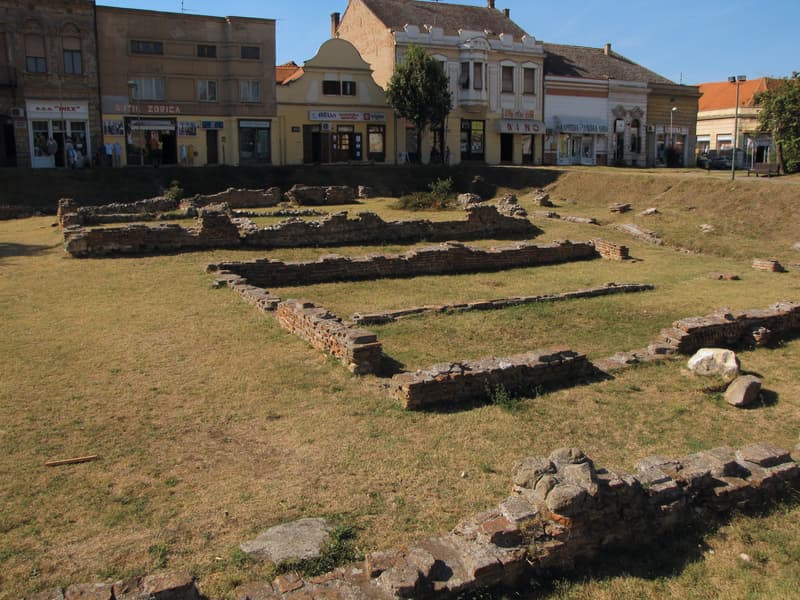
Photinus was a Galatian, deacon to Marcellus, metropolitan of Ancyra—the anti-Arian zealot whose collapsing Trinity had already alarmed the East. Able in both Greek and Latin, Photinus became bishop of Sirmium in Pannonia (modern Sremska Mitrovica, Serbia), a city whose importance the emperors guaranteed: Constantius II resided there frequently, which made its bishop unusually visible and his errors unusually intolerable.1
Teacher and pupil were initially condemned together. The Eusebian synod of Antioch (344), which produced the long “macrostich” creed, anathematized both; the next year a synod at Milan condemned Photinus—though, tellingly, not Marcellus, whom the West still considered orthodox on the strength of his written professions.2 Photinus enjoyed no such benefit of the doubt. His teaching was, as the Catholic Encyclopedia puts it with unusual bluntness, “obviously heretical”—so much so that parties who agreed on almost nothing else agreed on him. Arians, Semi-Arians, and Nicenes all condemned Photinus, a distinction almost no other fourth-century figure achieved.
What Photinus taught
Reconstructing Photinus exactly is delicate—his works are lost, and his doctrine survives mainly in the twenty-seven anathemas of the synod that deposed him and in hostile summaries by Hilary of Poitiers, Epiphanius, and others.3 But the core is consistent across the sources. Photinus radicalized the Marcellian framework: the Word is not a distinct divine Person but God’s reason or utterance; therefore the Word did not personally descend, assume flesh, and live among us. Jesus is instead the man in whom God’s Word-power worked supremely—conceived virginally, anointed beyond measure, advanced and exalted by his obedience, and granted a kind of derived dignity. What he is not, and never was, is the preexistent Son who “was in the beginning with God” as a divine someone.
The ancient writers reached for older labels to place him: a new Paul of Samosata, a refined Ebionite. The technical term the tradition settled on is psilanthropism—from the Greek psilos anthrōpos, “mere man.”
For Augustine and the later tradition, a Photinian is anyone who holds Christ to be a mere man.
Sirmium, 351: the disputation and the deposition
Photinus proved remarkably hard to remove. The people of Sirmium liked their bishop, and an attempt to depose him around 347 failed against popular resistance. The decisive blow came in 351, when a great synod assembled at Sirmium with imperial backing. In a formal disputation—judges appointed, proceedings recorded—Photinus was confronted by Basil of Ancyra, the man who had succeeded his master Marcellus and the future leader of the Semi-Arian party. Photinus lost, was deposed, and the synod issued twenty-seven anathemas mapping the boundaries his teaching had crossed.4
He returned from exile briefly under Julian the Apostate—who tolerated every Christian faction impartially, the better to watch them quarrel—and Jerome records that Valentinian banished him again. He died in Galatia in 376. Epiphanius, writing around the time of his death, judged the heresy already dead in the West, though pockets of Photinians persisted in Pannonia as late as 381, and a Photinian named Marcus was still finding adherents decades later.5
Constantinople’s anathema and the long shadow
When the First Council of Constantinople drew up Canon 1 in 381, “that of the Photinians” took its place on the list of anathematized heresies, immediately after the Marcellians—the council condemning the school and its radicalized offshoot in consecutive breaths.6 There is a quiet justice in the placement. The same council that vindicated the full divinity of the Holy Spirit against the Pneumatomachians also closed the opposite escape route: a Christianity whose Christ is only a man.
The shadow proved longer than the sect. “Photinian” survived in Latin theology as the standing name for psilanthropism wherever it reappeared—which it has done, century after century, from medieval adoptionisms to Enlightenment “Jesus of history” reconstructions to the casual modern assumption that Jesus was a great moral teacher and nothing more. The label has outlived every memory of the man.
Why it still matters
Photinianism is the heresy most natural to the modern mind. It requires no exotic metaphysics—only the conviction that Jesus was the best of us, and that “Son of God” is an honorific. Which is why the Church’s response repays attention. Against Photinus the fathers did not merely assert Christ’s divinity; they insisted that the whole point of the gospel collapses without it. A merely human Christ can model salvation but cannot give it; he can show us God but cannot be God-with-us. The question Jesus put at Caesarea Philippi—is Jesus God?—admits no honorific middle answer.
The Creed’s second article, recited every Sunday, is the standing refutation: “God from God, Light from Light, true God from true God, begotten, not made, consubstantial with the Father… he came down from heaven.” Every clause of that descent is something Photinus denied. The Church kept the clauses.
Frequently Asked Questions
What is the Photinian heresy in simple terms?
Photinus of Sirmium (d. 376) taught that Jesus Christ was not the preexistent, divine Word made flesh but a mere man—virginally conceived, uniquely empowered by God, and exalted, but a man. The teaching is also called psilanthropism, from the Greek for “mere man.”
How was Photinus related to Marcellus of Ancyra?
Photinus was Marcellus’ deacon at Ancyra. Marcellus taught that the Word was not an eternally distinct Person but God’s outgoing power; Photinus drew the radical conclusion that Jesus, therefore, was not a divine Person at all. The Church condemned them in the same breath—Canon 1 of Constantinople lists the Marcellians and the Photinians consecutively.
When and where was Photinus condemned?
Repeatedly: at Antioch (344), Milan (345), and decisively at the Synod of Sirmium (351), which deposed him after a formal disputation with Basil of Ancyra and issued twenty-seven anathemas. The First Council of Constantinople (381) anathematized the Photinians among the heresies of Canon 1.
Why did “Photinian” become a generic label?
Because the error is generic. In Augustine and later writers, “Photinian” names anyone who holds Christ to be a mere man, whatever their connection to Photinus—making him one of the few heretics whose name became a permanent category rather than a historical footnote.
Is Photinianism the same as Arianism?
No—in a sense they are opposite errors. Arianism made Christ a superhuman creature, a demigod neither fully God nor merely man. Photinianism made him fully and only man. Both deny the Catholic confession that Jesus is true God from true God, consubstantial with the Father, made man.
Footnotes
1. Catholic Encyclopedia, “Photinus,” newadvent.org: “a Galatian and deacon to Marcellus, Metropolitan of Ancyra,” who “became the Bishop of Sirmium in Pannonia, an important position on account of the frequent residence of the Emperor Constantius there. The city was more Latin than Greek, and Photinus knew both languages.”
2. Catholic Encyclopedia, “Photinus,” on the condemnations at Antioch (344, the “macrostich” creed) and Milan (345), where “Photinus was condemned, but not Marcellus.”
3. The twenty-seven anathemas of Sirmium (351) are partially preserved by Hilary of Poitiers; see the Catholic Encyclopedia, “Photinus.” For modern treatments of Photinus’ doctrine and its Marcellian roots, see R. P. C. Hanson, The Search for the Christian Doctrine of God: The Arian Controversy 318–381 (Edinburgh: T&T Clark, 1988), and J. N. D. Kelly, Early Christian Doctrines, 5th ed. (London: A&C Black, 1977).
4. Catholic Encyclopedia, “Photinus”: the failed deposition c. 347 (“impossible owing to an outbreak of the populace in his favour”), the great synod at Sirmium (351), the disputation with Basil of Ancyra, the deposition, and the twenty-seven anathematisms.
5. Catholic Encyclopedia, “Photinus,” citing Jerome on the banishment under Valentinian; Epiphanius on the heresy’s decline; Photinians in Pannonia in 381; and the later Photinian Marcus.
6. Canon 1 of Constantinople (381), in Henry R. Percival, trans., The Seven Ecumenical Councils, NPNF Second Series, Vol. 14, newadvent.org; cross-checked against Norman P. Tanner, ed., Decrees of the Ecumenical Councils, vol. 1 (1990). On Augustine’s use of “Photinian” for any mere-man Christology, see the Catholic Encyclopedia, “Photinus.”

Garrett Ham
Garrett Ham is an attorney, military veteran, and holds a Master of Divinity from Yale Divinity School. He writes from Northwest Arkansas on theology, law, and service.
Related Posts
Marcellus of Ancyra and the Marcellian Heresy: Why the Creed Says His Kingdom Will Have No End
Marcellus of Ancyra fought Arianism so hard he fell into the opposite error—a Trinity that expands and contracts. The Creed's 'no end' clause answers him.
The First Council of Constantinople (381): How the Church Finished the Creed
The First Council of Constantinople (381) confessed the Holy Spirit’s divinity, completed the Creed we recite at Mass, and became the Second Ecumenical Council.
Is Jesus God? The Biblical and Catholic Case for the Deity of Christ
Is Jesus God? A biblical and theological examination of the deity of Christ, from New Testament texts through the Councils, addressing common objections and theological implications.
Stay Informed
Get new writing on faith, law, and service delivered to your inbox.
No spam. Unsubscribe anytime.