The Nicene Creed Explained: A Phrase-by-Phrase Guide to the Church’s Central Confession
On This Page
Introduction
Every Sunday at Mass, Catholics profess the Nicene Creed—or more precisely, the Niceno-Constantinopolitan Creed. We stand, place our hands over our hearts, and declare our faith in one God, one Lord, one holy Church. Yet for many Catholics, the words have become rote. We recite without reflecting. We confess without comprehending.
This creed is no mere liturgical formality. It is the heartbeat of Christian orthodoxy, a confession hammered out by the bishops of the ancient Church through councils and controversy, refined across centuries, and now binding on all who claim the name Christian. To understand the Nicene Creed is to understand what Christians actually believe about God, Christ, and salvation.
In this comprehensive guide, we will journey through the creed phrase by phrase, unpacking its theology, examining its history, and discovering why a document written in 325 and revised in 381 remains the Church’s most important doctrinal standard today.
Historical Background
The story of the Nicene Creed begins not with creeds, but with a crisis. In the fourth century, a priest named Arius in Alexandria taught that the Son of God, though divine, was created by the Father and therefore subordinate to him. The Son, Arius claimed, had a beginning. This view, called Arianism, spread rapidly through the Church, dividing bishops and laity alike.
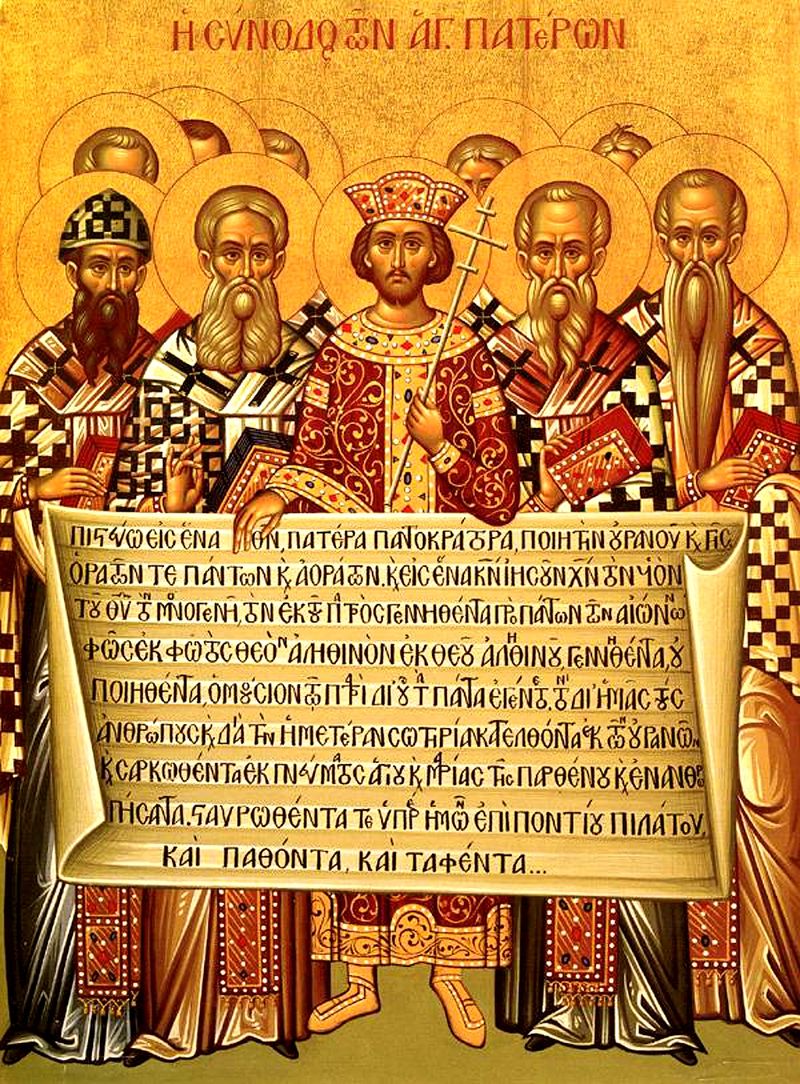
Emperor Constantine, concerned that religious division threatened the unity of his empire, convened the First Ecumenical Council at Nicaea (in modern-day Turkey) in 325 AD. Around 300 bishops gathered. Their task was to define, once and for all, who Jesus Christ is.
The result was the original Nicene Creed of 325, which condemned Arianism and declared that the Son is “of one substance” (homoousios) with the Father. But this creed was not the final word. The Council of Constantinople in 381 AD adopted the creed we recite today. Scholars since J.N.D. Kelly have shown that the 381 creed was likely based on an independent baptismal creed from the Syro-Palestinian tradition (related to creeds associated with Cyril of Jerusalem and Epiphanius of Salamis), which was then modified to incorporate Nicaea’s key theological terms and expanded with pneumatological clauses. This Niceno-Constantinopolitan Creed is consonant with the theology of the 325 creed but is not a simple line-by-line revision of it. It added substantial clarifications about the Holy Spirit, the Church, and resurrection.
For the full historical context of these councils and the theological battles that shaped the creed, see our detailed article on the Council of Nicaea.
The Full Text of the Niceno-Constantinopolitan Creed (381 AD)
Below is the full text of the creed as professed in the Roman Rite (minor variations exist in Eastern liturgies, but the substance is identical):
I believe in one God, the Father almighty, maker of heaven and earth, of all things visible and invisible.
I believe in one Lord Jesus Christ, the only Son of God, eternally begotten of the Father, God from God, Light from Light, true God from true God, begotten, not made, of one substance with the Father; through him all things were made. For us men and for our salvation he came down from heaven, and by the Holy Spirit was incarnate of the Virgin Mary, and became man. For our sake he was crucified under Pontius Pilate; he suffered death and was buried. On the third day he rose again in accordance with the Scriptures; he ascended into heaven and is seated at the right hand of the Father. He will come again with glory to judge both the living and the dead. His kingdom will have no end.
I believe in the Holy Spirit, the Lord, the giver of life, who proceeds from the Father and the Son, who with the Father and the Son is worshipped and glorified, who has spoken through the prophets.
I believe in one, holy, catholic and apostolic Church. I confess one baptism for the forgiveness of sins. I look for the resurrection of the dead and the life of the world to come. Amen.
Phrase-by-Phrase Analysis
Part One: The Father and Creation
“I believe in one God, the Father almighty”
The creed opens not with a definition but with an act of faith. “I believe” establishes the personal nature of credal affirmation. To recite the creed is to stake one’s soul on the truth it proclaims.
The emphasis on one God is crucial. This monotheistic declaration cuts against any polytheistic misunderstanding of the Trinity. We do not believe in three gods. The Trinity is not tritheism. God is radically, absolutely one. Yet, as the creed will explain, this one God eternally exists as Father, Son, and Holy Spirit in a unity of substance.
“The Father” is the first person of the Trinity. In creedal language, the Father is the principle or source of the Godhead—not in the sense that the Father created the Son (as Arius taught), but in the eternal procession of love and generation within the divine nature. The Father generates the Son eternally; the Father and Son breathe forth the Spirit.
“Almighty” (pantocrator in Greek) affirms divine omnipotence. God possesses all power. Nothing limits God. This prepares us for the theological implications later: if God is almighty, then God’s creative power and God’s sustaining power are absolute. All that exists exists through and in God.
“Maker of heaven and earth, of all things visible and invisible”
This phrase grounds Christian theology in a doctrine of creation ex nihilo—creation from nothing. God did not shape pre-existing matter (as Greek philosophers believed). Rather, God brought all reality into existence by divine will alone.
“Heaven and earth” encompasses the entire cosmos—the spiritual and the material realms. “All things visible and invisible” reinforces this totality. This phrasing is deliberate: it asserts that both the physical world (which we see) and the spiritual realm (which we do not see but apprehend by faith) owe their existence to God.
This phrase also contains an implicit rejection of certain heresies. Gnosticism taught that the material world was evil, created by an inferior deity. Orthodox Christianity, by contrast, affirms that God created matter and declared it good. The Incarnation itself—God becoming flesh—would be impossible if matter were inherently evil. God did not scorn the body; God assumed one.
Part Two: The Son
“I believe in one Lord Jesus Christ, the only Son of God”
The creed shifts from the Father to the Son—a movement that dominates the second half of the creedal statement. Here we find the creed’s polemical heart.
“One Lord” echoes the Shema, the Jewish confession “Hear, O Israel: the Lord our God is one Lord” (Deuteronomy 6:4). Early Christians dared to apply this title to Jesus. Jesus is “Lord”—not in a secondary sense, but in the full sense reserved for God.
“The only-begotten Son of God” (Greek: ton huion tou theou ton monogenē) is equally significant. The term monogenēs carries the sense of “only-begotten” or “unique,” and the traditional rendering “only-begotten” best serves the creed’s internal logic, which depends on the distinction between begetting and making. Jesus is not one divine being among many. He is the unique, unrepeatable Son. This phrase directly contradicts Arianism, which saw Jesus as merely the highest creature.
“Eternally begotten of the Father”
This phrase is among the most carefully chosen in the creed, and it warrants extended reflection.
“Eternally begotten” encodes a paradox that the Fathers of the Church grappled with extensively. To be “begotten” typically means to have a beginning. A human father begets a human son at a particular moment in time. The son is generated and becomes. But Christian theology insists that the Son’s generation is eternal. The Son is forever being begotten. There is no moment when the Son did not exist, because there is no moment when the Father was not generating the Son.
How can this be? It points to a truth about God that transcends time. God exists in an eternal “now.” The Father’s generation of the Son is not a temporal event but an eternal relationship. The Son is eternally dependent upon the Father for his being, and the Father is eternally expressing himself in the Son. This is how the great theologians of the tradition—the Church Fathers Gregory of Nyssa and Augustine, and the medieval Scholastic Thomas Aquinas—reconciled the apparent contradiction.
The creed employs “begotten” rather than “created” for a precise reason. To be begotten is to share the same nature. When a human father begets a human son, the son is human. When the Father (who is God) begets the Son, the Son is God. This stands against Arianism.
“God from God, Light from Light, true God from true God”
These three parallel statements hammer home a single truth: the Son is fully and truly divine. They build in ascending order of emphasis.
“God from God” asserts that the Son derives from the Father yet is fully God. The language of “from” expresses the Son’s eternal procession from the Father while maintaining the Son’s full divinity.
“Light from Light” employs imagery from Scripture. God is described as light throughout Scripture. In John 1, Christ is called the “light of the world.” The image of light from light is particularly apt: light begets light. When the sun shines, light emanates. The light that emanates is not a lesser thing than the light of the sun; it is the same light. This was the bishops’ way of saying: the Son is not a diluted or secondary form of divinity. The divinity of the Son is identical to the divinity of the Father.
“True God from true God” places the emphatic adjective “true” before each instance of “God.” The Father is true God. The Son is true God. Not partially God. Not God-like. True God. This final formulation levels any remaining doubt.
“Begotten, not made”
One phrase from the original 325 creed survives here with intense doctrinal weight. The Greek distinction is gennēthenta (begotten, aorist passive participle) versus poiēthenta (made)—gennēthenta ou poiēthenta in the creed’s actual text. This line was the sword with which the Council of Nicaea slew Arianism.
Arius taught that the Son was “made”—created out of nothing, placed first in order but still fundamentally a creature. The creed responds: No. The Son is begotten, which means the Son shares the Father’s nature. A creature is made. The Son is begotten.
“Of one substance with the Father”
Here we arrive at the creed’s most famous theological innovation: homoousios, translated “of one substance” (or sometimes “consubstantial”).
This word did not come easily to the bishops. Some initially preferred homoiousios (“of similar substance”), which would have left room for Arian compromise. But the majority of bishops insisted on homoousios. The Father and Son share one substance—one being, one divine nature.
This is not to say that the Father and Son are identical persons. The creed carefully maintains the distinction of persons while asserting the unity of substance. The doctrine of the Trinity teaches that there is one God (one substance, one divine nature) eternally subsisting in three distinct persons: Father, Son, and Holy Spirit.
“Through him all things were made”
The creed returns to cosmology, but now with Christological emphasis. The Son is not merely one agent among the Father’s servants. Rather, all creation comes into being through the Son. This echoes John 1:3: “All things were made through him.”
In medieval and modern Catholic theology, especially in Thomas Aquinas and the Thomistic tradition, creation through the Son is understood within the framework of divine ideas. God the Father creates, but the ideas according to which creation takes shape exist eternally in the Divine Word (the Son). The Son is the instrument and exemplar of creation.
This phrase also implicitly affirms the Son’s pre-existence and divinity. Only God can be the principle through which all things are made.
“For us men and for our salvation he came down from heaven”
The creed now pivots from the eternal divine processions (the inner life of God) to the economy of salvation (God’s action toward us). The Son came down. This phrase evokes the Incarnation, though the creed will be more explicit in what follows.
“For us men and for our salvation” grounds Christology in soteriology. We believe in Christ not as an abstract theological principle but as the one through whom we are saved. This soteriological focus has been central to Catholic theology since Augustine. Christ became man that man might become deified, in the words of the Fathers.
“Came down from heaven” uses spatial imagery to describe something that transcends space. The Son does not vacate heaven by becoming incarnate. Rather, the pre-existent Son assumes human nature while remaining in heaven. This is a profound mystery: divine and human natures united in one person, without confusion, without separation. This doctrine would be refined further at the Council of Chalcedon.
“And by the Holy Spirit was incarnate of the Virgin Mary, and became man”
The creed here affirms the Virgin Mary’s essential role in the Incarnation. Jesus was not an adult who suddenly appeared; he was born of a woman. The phrase “incarnate of the Virgin Mary” (Greek: kai sarkōthenta ek Pneumatos Hagiou kai Marias tēs parthenou) asserts the reality of Christ’s humanity and Mary’s virginity at the conception. The full doctrine of perpetual virginity—that Mary remained a virgin before, during, and after the birth of Christ—is affirmed by the broader Tradition and magisterial teaching (see the Lateran Council of 649 and CCC §§499–510), though the creedal phrase itself directly attests only to the virginal conception (virginitas ante partum).
The mention of the Holy Spirit is also crucial. The Incarnation is not the work of the Father alone, nor of the Son alone. The Holy Spirit overshadows Mary. The Trinity acts conjointly in the Incarnation. Mary’s consent (“Let it be done to me according to your word”) cooperates with grace, modeling the synergy of divine and human action.
“Became man” (Greek: enanthrōpēsanta, the aorist active participle of enanthrōpeō) means “became human,” drawing on the root anthrōpos (human being). The active voice is significant: the Son actively assumed human nature. The creed asserts the reality of Christ’s humanity without ambiguity. Jesus was not a phantom. He possessed a complete human nature: body, soul, rational mind, and will—a truth that would be definitively settled at Chalcedon.
“For our sake he was crucified under Pontius Pilate”
The creed moves to the Passion. Christ’s crucifixion is historical and redemptive. “Under Pontius Pilate” anchors the Incarnation and Redemption in datable history. This is not myth. It happened when Pilate governed Judea. The eternal Word of God entered time and space and died.
“For our sake” emphasizes the sacrificial dimension. Christ did not die for himself, but for us. This echoes 1 Corinthians 15:3: “Christ died for our sins in accordance with the Scriptures.” The Cross is an act of redemptive love.
“He suffered death and was buried”
The creed emphasizes that Christ truly died. Some early heresies denied the reality of Christ’s death. Docetism taught that Christ only appeared to suffer. The creed responds: He suffered. He died. He was buried. His death was as real as any human death.
This is theologically significant because it affirms the reality of the Incarnation. If Christ did not truly die, then the Word did not truly assume all the conditions of human existence (sin excepted). The Redemption depends upon the authenticity of both the Incarnation and the Passion.
“On the third day he rose again in accordance with the Scriptures”
The Resurrection is the pivot-point of Christian faith. Without it, the Crucifixion would be the end of Christ’s story and the defeat of Christianity. But Christ rose.
“In accordance with the Scriptures” points to the fulfillment of Old Testament prophecy. Psalm 16 and Isaiah 53, read in the light of Resurrection faith, predicted these events. The Resurrection was not a surprise innovation but the fulfillment of God’s plan.
“On the third day” specifies the timing. This is historically significant because it grounds the Resurrection account, and it carries symbolic weight. Three days mirrors the Jonah narrative (Matthew 12:39-40). The number three suggests completeness and divine action.
“He ascended into heaven and is seated at the right hand of the Father”
The Ascension completes the mystery of salvation. After the Resurrection, Christ ascends. He enters heaven and sits at the Father’s right hand.
“Seated at the right hand of the Father” is a gesture of honor and power. In the biblical tradition, the right hand is the place of authority. Psalm 110, the most frequently cited psalm in the New Testament, declares: “The Lord said to my Lord, sit at my right hand” (Psalm 110:1). Christ’s ascension and heavenly session affirm his lordship over all creation.
“He will come again with glory to judge both the living and the dead. His kingdom will have no end.”
The creed projects forward to the Parousia—the Second Coming. Christ will return, not in humility but with glory. He will judge. The divine judgment is not arbitrary but is Christ’s function. In John 5:22, Christ says: “The Father judges no one, but has committed all judgment to the Son.”
“Both the living and the dead” indicates that Christ’s judgment is universal. No one escapes it. This connects to the final section of the creed, which speaks of resurrection and the life to come.
“His kingdom will have no end” was added at Constantinople in 381 primarily to refute the teaching of Marcellus of Ancyra (d. c. 374), who—ironically an anti-Arian ally at the original Council of Nicaea—taught that the Son’s distinct existence as a person was temporary and that Christ would surrender his kingdom at the eschaton (drawing on 1 Corinthians 15:28), at which point the Logos would be reabsorbed into the Father. The creed’s affirmation that Christ’s kingdom has no end directly counters this Marcellan position. The phrase also broadly reinforces anti-Arian theology: if the Son’s kingdom is everlasting, then the Son himself is eternal, and eternal dominion is an attribute of God alone.
Part Three: The Holy Spirit
“I believe in the Holy Spirit, the Lord, the giver of life”
The third article of the creed treats the Holy Spirit with far less elaboration than the Son. This reflects the Church’s historical development. The doctrine of the Holy Spirit crystallized later than the doctrine of the Son. Nevertheless, the creed accords the Spirit full theological weight.
“I believe in the Holy Spirit” parallels the openings of the first two articles, signaling that the Spirit is an object of faith, not merely a force or influence.
“The Lord” applies to the Spirit the same title given to Christ. This is a significant Christological honor applied pneumatologically. The Spirit is Lord.
“The giver of life” (to zoopoion) establishes the Spirit as the principle of vitality. In Genesis, the Spirit of God hovers over the waters. Throughout Scripture, the Spirit gives life to the dead, resurrects the fallen, and animates the Church. This phrase points to the Spirit’s role in creation (Genesis 1:2) and in the Resurrection of Christ (Romans 8:11). It also prefigures the Spirit’s role in giving supernatural life to believers through grace.
“Who proceeds from the Father and the Son”
This phrase is the creed’s most historically contentious addition, known as the Filioque (“and the Son” in Latin). We will examine this controversy in detail below, but the phrase itself requires explanation here.
The Spirit “proceeds” from the Father and the Son. In Trinitarian theology, “procession” describes the emanation of the other persons from the first. The Father does not proceed; the Father is the source. The Son proceeds eternally from the Father (as “begotten”). The Spirit proceeds from the Father and the Son.
This procession is eternal and constitutive of the Trinity. The Spirit’s procession from the Father and Son is not a temporal event but an eternal relationship within the Godhead. It establishes why there is a Trinity and not, say, a Quaternity: God eternally subsists as Father (source), Son (begotten), and Spirit (proceeding).
“Who with the Father and the Son is worshipped and glorified, who has spoken through the prophets”
The Spirit receives the same worship as the Father and Son. This statement is an implicit claim to divinity. In Jewish monotheism, only God receives worship. By declaring that the Spirit is worshipped and glorified with the Father and Son, the creed affirms the Spirit’s divinity.
“Has spoken through the prophets” emphasizes the Spirit’s role in revelation. The Spirit inspired the Hebrew prophets. In 2 Peter 1:20-21: “No prophecy of Scripture comes from someone’s own interpretation. For no prophecy was ever produced by the will of man, but men spoke from God as they were carried along by the Holy Spirit.” The Spirit is thus the guarantor of revelation.
Part Four: The Church and Sacraments
“I believe in one, holy, catholic and apostolic Church”
The creed now turns to ecclesiology. The Church is one, holy, catholic, and apostolic. These four marks define the Church and echo Catholic teaching.
“One” Church. Despite the sad reality of Christian division, the creed asserts that there is a single Church. This oneness derives from Christ’s Headship and the unity of the Spirit. The Catechism of the Catholic Church teaches that Christ’s Church “subsists in” the Catholic Church (CCC §816), a careful formulation acknowledging both the Church’s unity in Christ and the tragic divisions within Christendom.
“Holy” Church. The Church is sanctified by Christ and the Spirit. Its holiness is both constitutive (it is the Bride of Christ, without stain) and progressive (it is constantly being sanctified through the sacraments and the Christian life).
“Catholic” Church. “Catholic” (Greek: katholike) means universal or whole. The Church is not confined to one nation, culture, or moment in history. It is universal in scope and fullness in doctrine.
“Apostolic” Church. The Church traces its authority and teaching back to the Apostles. This apostolic succession ensures continuity. When a bishop is ordained, he enters a line of succession stretching back to the Apostles and to Christ himself. The Church’s apostolicity guarantees the integrity of her doctrine.
“I confess one baptism for the forgiveness of sins”
Baptism is the sacrament of entrance into the Church and the font of salvation. “One baptism” reflects the ecumenical reality. There is one baptism recognized by all Christians, though churches may disagree about the theology of baptism or the proper form of its administration.
“For the forgiveness of sins” articulates baptism’s efficacy. In the baptismal waters, original sin and personal sins are forgiven. Baptism grafts us into Christ’s death and resurrection (Romans 6:3-4). It is the gateway to grace.
“I look for the resurrection of the dead and the life of the world to come. Amen.”
The creed concludes with eschatology. We believe in the Resurrection of the dead. This is not merely a spiritual immortality of the soul; Christian faith affirms the resurrection of the body. Our bodies, joined to our souls, shall rise again. This was the hope of Martha at Jesus’ raising of Lazarus: “I know that he will rise again in the resurrection at the last day” (John 11:24).
“The life of the world to come” points to the eschaton, the end of time when God makes all things new. Heaven and earth are renewed. God’s kingdom comes to its fullness. We live as pilgrims and exiles in this world, but our hope is in the world to come.
“Amen” (Hebrew: “so be it”) seals the profession. To say Amen to the creed is to commit oneself to its truth.
How the 325 and 381 Creeds Differ
The original Nicene Creed of 325 AD was shorter. Its positive confession concluded with “And in the Holy Spirit,” without further elaboration of the Spirit’s nature. However, the 325 document also appended a series of anathemas condemning specific Arian propositions—such as “there was a time when he was not” and that the Son came from nothing—which are integral to the original text even if structurally distinct from the credal confession itself. (The 381 creed notably dropped these anathemas.) The bishops at Nicaea focused on the Son’s divinity against Arianism.
The Council of Constantinople in 381 AD expanded the creed to address additional heresies and clarify further doctrines. The expanded version (which we use today) includes:
- Extended treatment of the Holy Spirit and the Spirit’s procession
- The doctrine that the Spirit is “the Lord, the giver of life”
- Worship of the Spirit alongside the Father and Son
- The four marks of the Church (one, holy, catholic, apostolic)
- Baptism for the forgiveness of sins
- The resurrection of the dead and the life to come
The 381 creed is thus more comprehensive. It addresses not only Christology (the doctrine of Christ) but pneumatology (the doctrine of the Holy Spirit) and ecclesiology (the doctrine of the Church).
For a detailed examination of the councils and the theological controversies they addressed, please see The Council of Nicaea.
The Filioque Controversy
The phrase “and the Son” (Latin: Filioque) in the sentence “who proceeds from the Father and the Son” has been historically controversial, particularly between Catholic and Orthodox Christianity.
The original Greek creed stated that the Spirit proceeds from the Father. Over time, the Western (Latin) Church added “and the Son,” teaching that the Spirit proceeds from both the Father and the Son. This addition was made gradually, likely beginning in Spain at the Third Council of Toledo in 589, and spread through Frankish liturgical use in the late eighth century. It was formally added to the Roman liturgy by Pope Benedict VIII in 1014 at the request of Emperor Henry II—notably, Pope Leo III (795–816) had earlier refused to insert it into the creed despite affirming the doctrine itself.
The Orthodox East objected to this addition, viewing it as:
- Unilateral innovation: The East had not consented to the change. A new doctrine affecting the Creed of the entire Church should have required ecumenical consensus.
- Theological shift: Some Orthodox theologians argued that the Filioque compromised the Father’s unique role as source of the Trinity.
- Subordination concerns: Others worried that affirming the Spirit’s procession from the Son somehow implied the Son’s superiority or the Spirit’s inferiority.
The Catholic perspective, articulated by theologians from Augustine to Thomas Aquinas to the modern Catechism, is:
- The Filioque is a legitimate development of doctrine. It clarifies the Spirit’s relationship to the Son and protects against subordinationism.
- The Spirit’s procession from the Father is primary. The Spirit proceeds from the Father through the Son (to use a more precise formulation). This maintains the Father’s primacy while affirming the Son’s role in the divine life.
- The Filioque protects Trinitarian orthodoxy by preventing any notion that the Son is unrelated to the Spirit’s being.
The Second Vatican Council and subsequent Catholic teaching have acknowledged the painful history of the Filioque and extended ecumenical gestures toward the Orthodox, but the Catholic Church continues to affirm the Filioque as doctrinally sound and necessary.
Why the Nicene Creed Matters Today
In a postmodern age that prizes personal experience over doctrinal precision, the Nicene Creed might seem quaint—a relic of ancient metaphysics. Yet the creed remains indispensable for three reasons:
First, it safeguards the Gospel itself. Without precise doctrine about Christ’s divinity, the Incarnation dissolves into sentiment. The stakes are real. If Christ is merely a creation (as Arianism taught), then the Incarnation is impossible. If Christ is not fully God, then the Redemption is incomplete. The creed protects the Gospel’s core claim: Christ is God become human for our salvation.
Second, it provides a standard of orthodoxy for a fractured Christian world. Catholics, Orthodox, and most Protestant denominations recite the Nicene Creed. It is the broadest basis of Christian unity. In a world of thousands of Christian denominations with differing beliefs, the Nicene Creed stands as a touchstone. To confess the creed is to stand in apostolic tradition. For more context on how these three traditions differ while sharing this confession, see our comprehensive comparison of Orthodox, Catholic, and Protestant theology.
Third, it challenges us to deeper faith. To recite the creed is not merely to mouth words. Each phrase invites contemplation. What does it mean that God is almighty? What does it mean that the Son is eternally begotten? What does it mean that we look for the resurrection of the dead? The creed demands intellectual engagement. It refuses to let us settle for vague religiosity.
FAQ: Common Questions About the Nicene Creed
1. Why do Catholics recite the Nicene Creed at Mass?
The creed is recited at every Sunday Mass and on solemnities as a corporate profession of faith. It serves several purposes: it teaches doctrine, it unites the congregation in a common confession, and it connects contemporary believers to nearly 1,700 years of Christian tradition. The creed is not merely historical artifact but a living statement of what we believe and why.
2. What is the difference between the Nicene Creed and the Apostles’ Creed?
The Apostles’ Creed is shorter and more ancient in its basic form (though it took its final shape around the eighth century). It does not contain the detailed Christological affirmations of the Nicene Creed, particularly concerning the Son’s divinity and the Filioque. The Apostles’ Creed is used in the Rosary and in Baptismal theology. The Nicene Creed (or Niceno-Constantinopolitan Creed) is more theologically precise and is used in the Mass. Both are orthodox and valuable, but they serve different purposes in the life of the Church.
3. Is it sinful to have doubts about the creed?
No. Doubt is not sin; it is an invitation to faith that seeks understanding. Thomas Aquinas teaches that faith is a virtue that involves the will’s assent even amid intellectual difficulty. If you struggle to understand what “eternally begotten” means, or how God can be three in one, you are in good company. The saints and theologians have wrestled with these mysteries for centuries. The appropriate response is not to abandon belief but to seek deeper understanding through prayer, study, and engagement with the theological tradition.
4. Did the Council of Nicaea write the entire creed that we recite today?
No. The Council of Nicaea (325 AD) wrote the original Nicene Creed, which was shorter. The creed we recite today is the Niceno-Constantinopolitan Creed, adopted at the Council of Constantinople in 381 AD. Scholars believe the 381 creed was based on an existing baptismal creed modified to incorporate Nicene theology, rather than a direct revision of the 325 text. This version addressed further heresies and provided more comprehensive treatment of the Holy Spirit and the Church.
5. What heresies did the Nicene Creed condemn?
The original creed was written primarily to condemn Arianism, which taught that the Son was a created being subordinate to the Father. The expanded 381 creed also addressed:
- Macedonianism (or Pneumatomachianism): The denial of the Holy Spirit’s divinity.
- Docetism: The claim that Christ only appeared to have a human body.
- Apollinarianism: The denial of Christ’s complete human nature (particularly a rational human soul).
The creed’s precise language was designed to exclude these false teachings while affirming orthodox doctrine. See our article on the Council of Chalcedon for further clarity on Christological orthodoxy.
Conclusion
To recite the Nicene Creed is to stand within a tradition that stretches back to the fourth century, to confess alongside billions of Christians across history and across the globe today. It is to anchor oneself in doctrine. It is to say: This is what Christians believe. This is who Jesus Christ is. This is what we stake our souls upon.
The creed does not answer every theological question. It does not explain the mechanism of the Incarnation or exhaust the mystery of the Trinity. But it draws boundaries. It says: Here lies orthodoxy. Beyond this lies error.
As Catholics, we live in an age of doctrinal confusion. Our culture prizes emotion and experience over truth claims. Our secular society dismisses doctrine as outdated metaphysics. Even within the Church, some Catholics have grown embarrassed by the creed’s precise claims about divinity and divinity’s implications for our salvation.
The cure is not to abandon the creed but to rediscover it. Study it. Pray it. Let its phrases lodge in your memory and shape your imagination. When you stand at Mass next Sunday and profess, “I believe in one God, the Father almighty,” know that you are joining your voice to the voices of martyrs and saints, councils and doctors, the great cloud of witnesses who have confessed this faith unto death.
The creed is not dead dogma. It is the beating heart of Christian orthodoxy. It is reason to believe.
Further Reading
- J.N.D. Kelly, Early Christian Creeds (London: Longman, 1972)
- Lewis Ayres, Nicaea and Its Legacy: An Approach to Fourth-Century Trinitarian Theology (Oxford: Oxford University Press, 2004)
- Catechism of the Catholic Church, §§185-197 and §§242-256
- John H. Leith, ed., Creeds of the Churches, rev. ed. (Richmond: John Knox Press, 1973)
- The Council of Nicaea
- Understanding the Trinity: A Catholic Explanation
- Is Jesus God? What the Church Teaches
- The Council of Chalcedon and the Two Natures of Christ
- Divine Simplicity and God’s Nature
- Modalism: A Heresy Against the Trinity
- The term homoousios (“of one substance”) was not part of the biblical vocabulary. Some bishops initially resisted it as foreign to Scripture. But the Council determined that the creed’s primary purpose was to exclude false doctrine. Arius was defending himself by claiming to affirm biblical language. The bishops realized they needed technical precision to exclude his heresy definitively. Thus homoousios entered the Church’s confession. This illustrates a principle of doctrinal development: the Church’s doctrine grows not by adding new content but by clarifying and defending apostolic faith against error. ↩
- The phrase “life of the world to come” is more accurately translated “life of the age to come.” In biblical cosmology, the present age (this aeon) is distinguished from the age to come (the eschaton). The creed affirms our hope in the age to come, when God will remake creation and death will be no more. This is not an escape from the physical world but its transformation and renewal. ↩
- The Council of Constantinople in 381 expanded the creed but did not do so unilaterally. The First Council at Nicaea in 325 left unresolved questions about the Holy Spirit. By the time of Constantinople (381), the Church had encountered new heresies (particularly Macedonianism) and needed to articulate the Spirit’s divinity more clearly. The bishops at Constantinople understood themselves not as creating new doctrine but as defending apostolic faith against contemporary error. ↩
- Augustine and the medieval Scholastics developed sophisticated accounts of the Trinity and the Filioque. Augustine famously described the Trinity using the analogy of lover, beloved, and love. Thomas Aquinas taught that the Spirit’s procession from the Father and Son (as amor or love) maintains the Father’s primacy while affirming the Son’s role in the divine life. The Filioque, properly understood, does not compromise the Trinity but protects it from subordinationism. ↩
Garrett Ham
Garrett Ham is an attorney, military veteran, and holds a Master of Divinity from Yale Divinity School. He writes from Northwest Arkansas on theology, law, and service.
Related Posts

The Filioque: How One Word Split the Church—and Whether It Still Has To
The filioque—'and the Son'—is the word that helped divide Christendom. Its biblical roots, the long schism, and why Rome and Orthodoxy are closer than most think.
The First Council of Constantinople (381): How the Church Finished the Creed
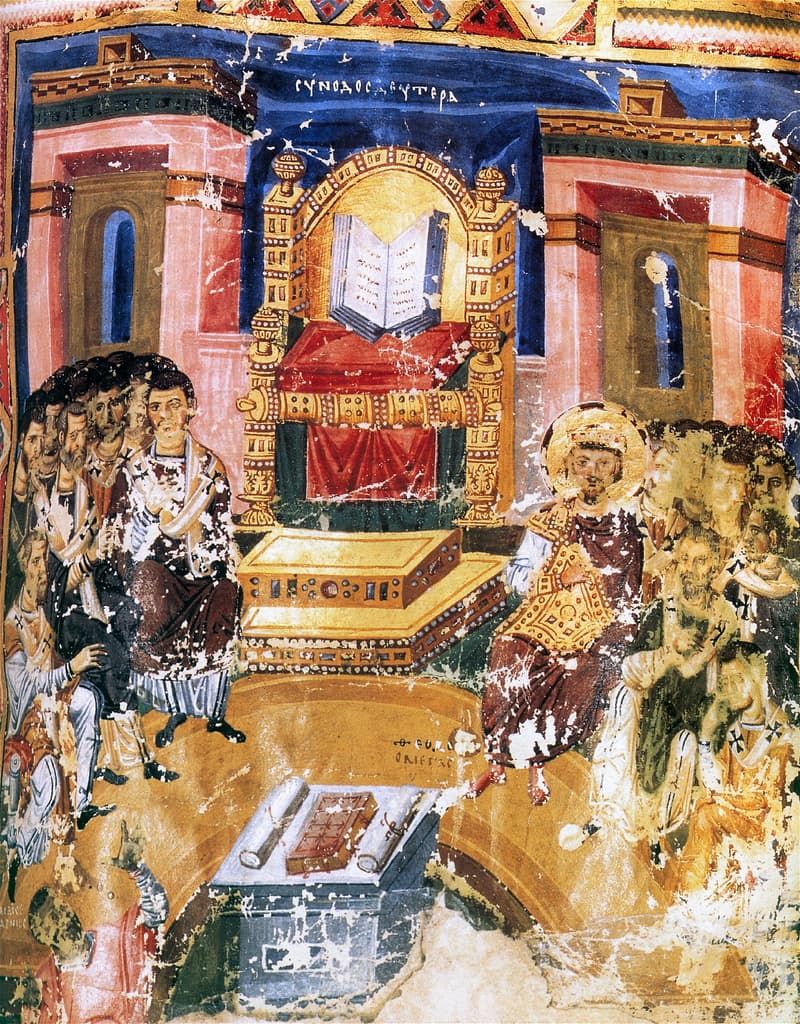
The First Council of Constantinople (381) confessed the Holy Spirit’s divinity, completed the Creed we recite at Mass, and became the Second Ecumenical Council.
The First Council of Nicaea: What It Decided and Why It Matters
What happened at the First Council of Nicaea in 325 AD? A Catholic examination of the Arian crisis, the meaning of homoousios, and why the Nicene Creed still defines Christian orthodoxy.
Stay Informed
Get new writing on faith, law, and service delivered to your inbox.
No spam. Unsubscribe anytime.