Marcellus of Ancyra and the Marcellian Heresy: Why the Creed Says His Kingdom Will Have No End
On This Page
There is a clause in the Creed that most Catholics recite without ever wondering why it is there: “and his kingdom will have no end.” It seems an odd thing to need saying. Who ever claimed Christ’s kingdom would end?
A bishop did—one of the most zealous defenders of Nicaea, a man who sat in the council of 325 and fought Arius without flinching. His name was Marcellus of Ancyra, and his story is the fourth century’s great cautionary tale about fighting one error so hard that you back into its opposite. The clause about the unending kingdom entered the Creed as the Church’s answer to him.
The anti-Arian champion
Marcellus was bishop of Ancyra (modern Ankara) and a conciliar veteran: present at the Council of Ancyra (314) and then at Nicaea itself, where he stood with the strictest opponents of Arius. The Catholic Encyclopedia introduces him as “a strong opponent of Arianism, but in his zeal to combat Arius adopting the opposite extreme of modified Sabellianism.”1 That one sentence is his whole biography in miniature.
A few years after Nicaea, Marcellus wrote a long book against Asterius, a prominent Arian apologist. It survives only in the fragments his enemies quoted in order to refute him—above all Eusebius of Caesarea, who answered with two full treatises, Against Marcellus and On the Theology of the Church.2 What those fragments reveal is a theologian so determined to protect the unity of God against Arian subordinationism that he dismantled the eternal Trinity to do it.
What Marcellus taught
In Marcellus’ system, God is originally and ultimately a single divine Person—a Monad. The Word (Logos) existed eternally in God the way a man’s reason exists in the man: not as a distinct Person, but as God’s own immanent rationality. At creation, the Word “went forth” from the Father as his active power; in the incarnation, this outgoing Word became embodied in Jesus and was then constituted Son of God. The Holy Spirit, in turn, went forth as a third expansion. The Monad had become, for the time of the economy, a Triad.3
But what expands, contracts. Marcellus read Paul’s words in 1 Corinthians 15:24–28—“then comes the end, when he hands over the kingdom to his God and Father… so that God may be all in all” (NABRE)—with disastrous literalness. At the consummation, the Word and the Spirit return into the Father; the incarnate Son’s kingdom has a terminus; and the Godhead is once again an undifferentiated Unity. The Trinity, on this account, is not who God eternally is. It is a phase God passes through.
The Trinity, on this account, is not who God eternally is. It is a phase God passes through.
This is why the fathers classed Marcellus with Sabellius, the third-century modalist, even though the two systems differ in machinery. Modalism makes Father, Son, and Spirit three masks of one Person; Marcellus made Son and Spirit two temporary extrusions of one Person. Either way, the three are not eternally distinct, and either way the eternal generation of the Son—the heart of Nicaea’s homoousios, rightly understood—is denied.
Condemnations, vindications, and the slow turn
Marcellus’ afterlife was a forty-year tug-of-war between East and West. A council at Constantinople in 336, presided over by the Arian Eusebius of Nicomedia, deposed him and installed Basil of Ancyra in his see. He appealed to Rome, and Pope Julius I, after examining his profession of faith, declared him innocent in 340; the Synod of Sardica (343) likewise sustained him.4 The Westerners were not being naive: the creed Marcellus submitted to Julius was unobjectionable on its face, and his enemies were, after all, Arians. But the Easterners had read the book against Asterius, and they never relented. Marcellus regained his see briefly, was driven out again around 353, and died, deprived of it, around 374.
The most telling judgment came from his own side. Athanasius, his old ally in the Nicene cause, gradually distanced himself; the Catholic Encyclopedia records that he “at last recognized Marcellus’ heterodoxy,” as did Pope Damasus in 380.5 The man whose disciple Photinus carried the system into open adoptionism had become indefensible. When the First Council of Constantinople drew up its list of anathematized heresies in 381, “that of the Marcellians” stood on it, between the Sabellians and the Photinians.6
The clause in the Creed
The Church’s most durable answer to Marcellus is not a treatise but seven words of the Creed. Where the Nicene Creed of 325 ended its second article with Christ coming “to judge the living and the dead,” the creed associated with Constantinople adds: “Whose kingdom shall have no end”—the angel Gabriel’s words at the Annunciation, “and of his kingdom there will be no end” (Luke 1:33).7 Scholars such as J. N. D. Kelly have read the addition as aimed precisely at Marcellus’ doctrine of the terminating kingdom.8
The clause also fixed the Catholic reading of 1 Corinthians 15. The Son’s “handing over” of the kingdom to the Father is not the Son’s dissolution into the Father; it is the completed presentation of a redeemed creation to its God, by a Son who reigns forever in the humanity he will never discard. Christ’s kingship is not a costume worn for the duration of the economy.
Why it still matters
Marcellus matters because his error is the perennial temptation of everyone who takes divine unity seriously—which is to say, of every monotheist. If Arianism is what happens when the distinction of Persons swallows the unity of God, Marcellianism is what happens when the unity swallows the distinction. The Catholic faith holds the line at both edges: one God, three Persons, eternally—not a Monad that unfolds and refolds, and not three graded deities. The Trinity is not God’s strategy. It is God’s life.
And every Sunday, when the congregation reaches “and his kingdom will have no end,” it pronounces—mostly without knowing it—the Church’s final word over a bishop who fought heroically at Nicaea and lost his way on the road home.
Frequently Asked Questions
What is the Marcellian heresy in simple terms?
Marcellus of Ancyra (d. c. 374) taught that God is fundamentally one Person, from whom the Word and the Spirit “go forth” for creation and redemption and into whom they will return at the end—so that the Trinity is temporary and Christ’s kingdom will end. The Church condemned this as a refined form of Sabellianism.
Wasn’t Marcellus a defender of Nicaea?
Yes—he was one of Arius’ fiercest opponents at the Council of Nicaea in 325. His heresy grew out of overcorrection: in guarding the oneness of God against Arian subordinationism, he denied the eternal, personal distinction of the Son and the Spirit.
Why does the Creed say “his kingdom will have no end”?
The clause, drawn from Luke 1:33, entered the Niceno-Constantinopolitan Creed as a rejection of Marcellus’ claim—based on his reading of 1 Corinthians 15:24–28—that the Son’s kingdom terminates when he hands all things back to the Father.
How is Marcellianism different from Modalism?
Classical Modalism (Sabellianism) says Father, Son, and Spirit are three modes or roles of one Person. Marcellus’ version is dynamic: one divine Person who temporarily extends himself as Word and Spirit and then retracts. The mechanisms differ, but both deny that the three Persons are eternally distinct, and the fathers condemned them together.
Was Marcellus ever formally condemned?
Repeatedly in the East (notably at Constantinople in 336), though Rome under Julius I and the Synod of Sardica (343) initially sustained him on the basis of his written profession. Athanasius and Pope Damasus eventually recognized his heterodoxy, and the First Council of Constantinople (381) anathematized “the Marcellians” in Canon 1.
Footnotes
1. Catholic Encyclopedia, “Marcellus of Ancyra,” newadvent.org.
2. Eusebius of Caesarea, Contra Marcellum and De ecclesiastica theologia; see the Catholic Encyclopedia, “Marcellus of Ancyra.” The fragments of Marcellus are collected in the critical literature; for a modern assessment, see Lewis Ayres, Nicaea and Its Legacy: An Approach to Fourth-Century Trinitarian Theology (Oxford: Oxford University Press, 2004).
3. Catholic Encyclopedia, “Marcellus of Ancyra”: in his work against Asterius “he maintained that the trinity of persons in the Godhead was but a transitory dispensation”; the Logos “went out from the Father” at creation, “became incarnate in Christ and was thus constituted Son of God,” and at the consummation Christ and the Spirit “will return to the Father and the Godhead be again an absolute Unity.” See also J. N. D. Kelly, Early Christian Doctrines, 5th ed. (London: A&C Black, 1977), on Marcellus.
4. Catholic Encyclopedia, “Marcellus of Ancyra,” on the deposition of 336 under Eusebius of Nicomedia, the appeal to Julius I (vindicated 340), and the restoration allowed under Constantius; on Sardica’s support, see also the Catholic Encyclopedia, “Photinus,” newadvent.org.
5. Catholic Encyclopedia, “Marcellus of Ancyra”: “St. Athanasius himself at last recognized Marcellus’ heterodoxy; Pope Damasus likewise, in 380, and the Second General Council pronounced against him.”
6. Canon 1 of Constantinople (381), in Henry R. Percival, trans., The Seven Ecumenical Councils, NPNF Second Series, Vol. 14, newadvent.org; cross-checked against Norman P. Tanner, ed., Decrees of the Ecumenical Councils, vol. 1 (1990).
7. “Whose kingdom shall have no end,” Percival’s translation of the Constantinopolitan creed, NPNF II.14, newadvent.org; cf. Luke 1:33. On the creed’s history, see the full account of the First Council of Constantinople.
8. J. N. D. Kelly, Early Christian Creeds, 3rd ed. (London: Longman, 1972), in the chapter on the Creed of Constantinople, treats the clause as directed against Marcellan doctrine.
Garrett Ham
Garrett Ham is an attorney, military veteran, and holds a Master of Divinity from Yale Divinity School. He writes from Northwest Arkansas on theology, law, and service.
Related Posts
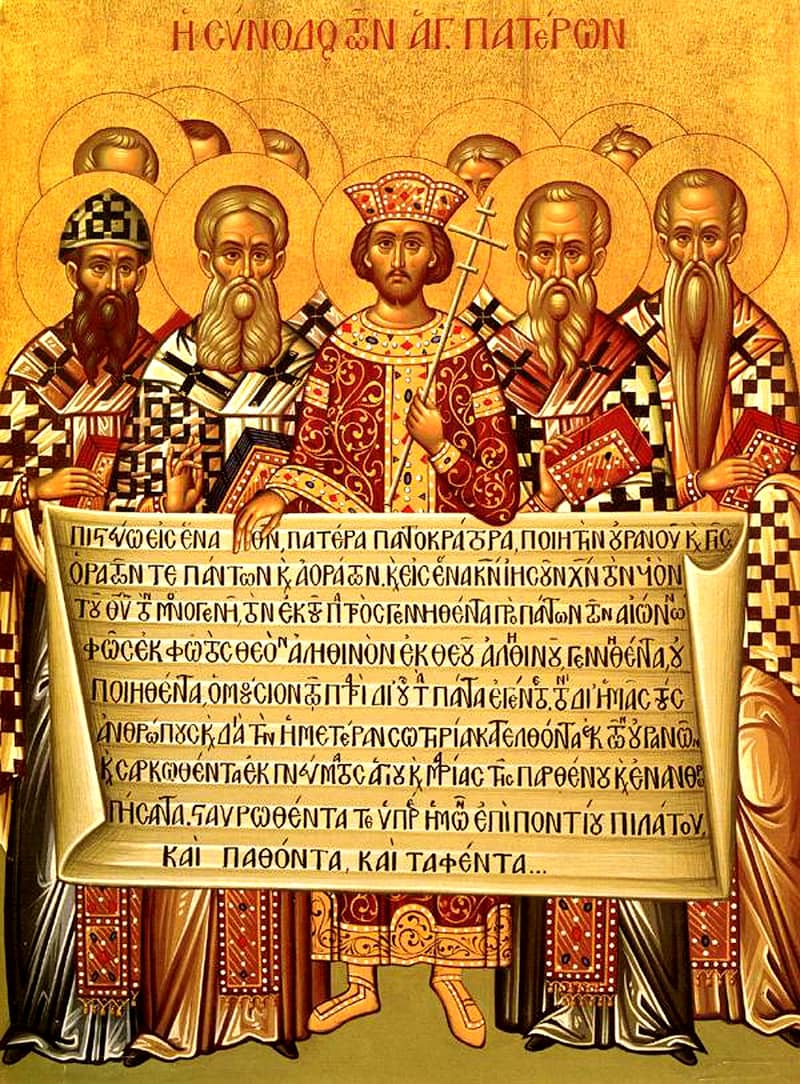
Modalism: The Trinitarian Heresy That Collapsed the Persons of God
What is Modalism? A Catholic examination of the heresy that denied the real distinction of Father, Son, and Spirit — its origins, key proponents, and why the Church condemned it.
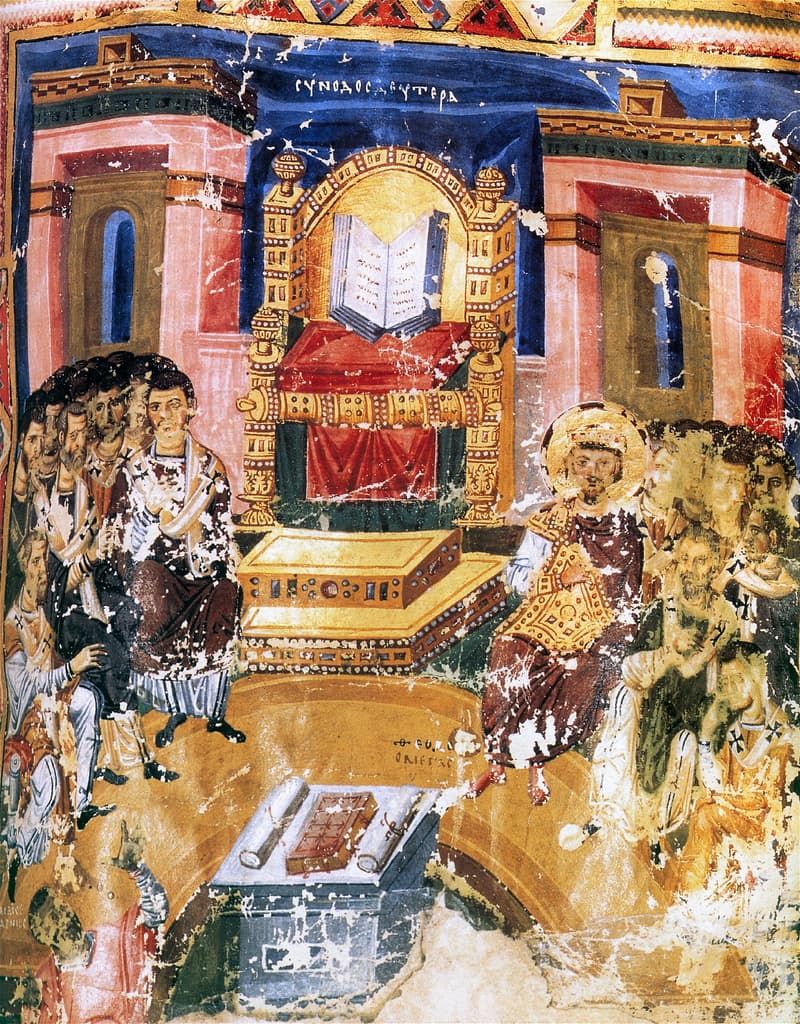
The First Council of Constantinople (381): How the Church Finished the Creed
The First Council of Constantinople (381) confessed the Holy Spirit’s divinity, completed the Creed we recite at Mass, and became the Second Ecumenical Council.
The First Council of Nicaea: What It Decided and Why It Matters
What happened at the First Council of Nicaea in 325 AD? A Catholic examination of the Arian crisis, the meaning of homoousios, and why the Nicene Creed still defines Christian orthodoxy.
Stay Informed
Get new writing on faith, law, and service delivered to your inbox.
No spam. Unsubscribe anytime.