Is Yale Divinity School Worth It?
On This Page
Is Yale Divinity School Worth It?
After completing my M.Div. at Yale Divinity School, I’ve had time to reflect on whether the significant investment of time, money, and intellectual energy was worthwhile. The answer, like most important questions, is complicated—and it depends on what you’re trying to accomplish. This assessment draws from my own experience navigating YDS alongside hundreds of peers, observing both those who thrived and those who struggled with the decision to enroll.
The Academics
Yale Divinity School maintains one of the most rigorous theological curricula in North America, with faculty who are actively shaping scholarship in biblical studies, church history, systematic theology, and practical ministry. The core curriculum ensures that regardless of your specialization, you’ll engage seriously with Scripture, historical theology, and the traditions of Christian thought. Beginning with the fall 2025 entering class, the M.Div. moved to a cohort-based model that prescribes eight core courses across the first four semesters—Hebrew Bible Interpretation, New Testament Interpretation, History of Christianity, Introduction to Theology, Foundations of Christian Worship, Introduction to Pastoral Theology and Care, Introduction to Ethics, and Engaging Society—woven together by a three-semester Integrative Seminar. This means your first two years follow a structured path, while your third year opens up for electives, internship, and thesis work.
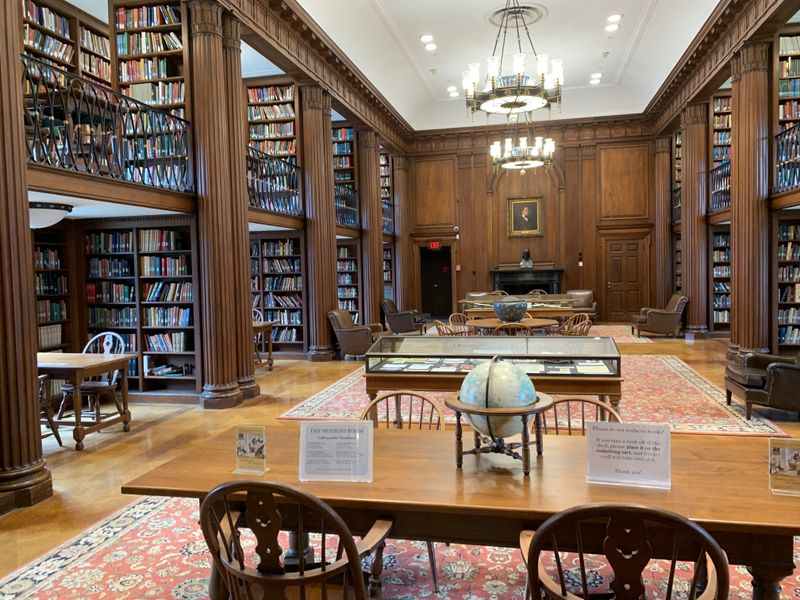
The academic breadth at YDS is difficult to match. Beyond the prescribed sequence, nine distribution categories ensure exposure to preaching, world Christianity, non-Christian faiths, religion and the arts, and leadership. The curriculum draws not only on YDS’s own faculty but on the resources of the broader university. I took a Roman Law course at Yale Law School that counted toward my degree requirements, and classmates pursued courses in the School of Management, the History Department, and the Political Science Department. That kind of cross-pollination is rare in theological education and is one of the most compelling arguments for choosing a divinity school embedded in a major research university. Yale’s libraries—including the Beinecke Rare Book and Manuscript Library and the vast holdings of Sterling Memorial Library—are world-class research resources that few seminaries can approach.
The intellectual environment pushes you to think carefully about inherited assumptions. Whether you come to YDS to deepen your faith or to interrogate it, the academic structures support sustained engagement with complex theological questions. Seminars at Yale are genuinely interactive. In my History of Early Christianity sections, our teaching fellow—a Ph.D. student in history—led discussions that required preparation and participation, not passive attendance. Attendance and participation constituted a significant portion of the grade in most courses. Papers, not exams, drive the bulk of assessment: you’re expected to produce sustained, original arguments, not regurgitate material. For students preparing for doctoral work, the thesis option allows you to produce a thirty-to-one-hundred-page research project under the supervision of two faculty readers, which serves as genuine preparation for the kind of scholarship expected in a Ph.D. program. For those headed into ministry, the emphasis on writing and argumentation equips you to think, preach, and teach with intellectual rigor that will serve your congregation well.
Faculty and Mentorship
The faculty at Yale include some of the most accomplished theologians, biblical scholars, and historians in their fields. Miroslav Volf, the Henry B. Wright Professor of Systematic Theology, is one of the most influential living theologians and served as my academic advisor. Dean Gregory Sterling is an accomplished New Testament scholar who also serves as Lillian Claus Professor of New Testament. Teresa Jean Morgan, the McDonald Agape Professor of New Testament and Early Christianity, brought Oxford-trained rigor to her scholarship. Willie James Jennings, the Andrew W. Mellon Professor of Systematic Theology and Africana Studies, is a major voice in contemporary theology. The list goes on across every discipline.
What surprised me most about the faculty was how much many of them seemed to care about students. My Greek professor invited every student in her class to a one-on-one lunch, offering tailored advice about preparing for Ph.D. work and navigating the academic job market. The Associate Dean for Student Affairs met individually with first-year students at the start of each semester to check in on goals and wellbeing. Faculty advisors were accessible and genuinely engaged in shaping students’ academic trajectories.
Mentorship relationships can be transformative—but they’re not automatic. The quality of your education depends significantly on whether you pursue these relationships intentionally. YDS does not assign a faculty mentor who meets with you weekly; you have an academic advisor who approves your course schedule and offers guidance when sought. The Integrative Seminar under the new curriculum provides a more structured faculty relationship through its cohort model, but the deeper mentorship—the kind that opens doors to Ph.D. programs, research collaborations, and professional networks—requires initiative on your part. Show up to office hours. Engage with a professor’s published work. Ask for feedback on your writing beyond what the syllabus requires. The faculty who invested the most in me were the ones I pursued, not the ones who were assigned to me.
The one caveat is that faculty availability varies. Some departments are more thinly staffed than others. During my time, the New Testament faculty included only three full-time professors, with one on sabbatical—which limited course offerings in a given semester. When faculty are on leave, the impact on course availability and mentorship can be real. It’s worth checking which professors are teaching in a given year before committing to a particular academic focus.
Community and Culture
Yale Divinity School brings together a remarkably diverse student body: seasoned pastors returning for academic study, career-changers in their second or third profession, international students from a dozen countries, people of various faith traditions, and everything in between. The entering class in fall 2025 ranged in age from twenty to seventy-eight, with an average age of thirty. Many held advanced degrees—Ph.D.s, D.Min.s, J.D.s—before arriving. One incoming student was a former Department of Defense senior adviser; at least five were former university department chairs. This is not a community of twenty-two-year-olds fresh out of college. The life experience in the room is extraordinary, and it shapes every classroom discussion, every chapel service, and every late-night conversation.
This diversity is one of YDS’s greatest strengths, creating an environment where you encounter genuinely different approaches to ministry, theology, and faith. Student organizations, chapel life, and programs like the Annand Program for Spiritual Formation provide structured opportunities for connection. The Annand Program offers intake interviews, first-year formation groups, and individual spiritual mentorship, and it’s available to all YDS students (required for Berkeley students). The Berkeley Divinity School community, with its weekly Eucharist, morning and evening prayer, and shared meals, provides an additional layer of communal life for students in the Anglican tradition.
The residential nature of divinity school distinguishes it from many graduate programs. Living and studying alongside your cohort creates sustained engagement that shapes your development as a minister or scholar in ways classroom learning cannot. The new Carol B. Bauer Hall, a regenerative residence that opened for the fall 2025 class, represents a significant institutional investment in residential community. Total enrollment at YDS is roughly three hundred students, small enough that you will recognize faces and build genuine relationships, but large enough that you won’t feel claustrophobic.
That said, building meaningful community at YDS requires intentional effort. The school is not a monastery. People have families, jobs, and lives outside Sterling Quadrangle. The academic workload is heavy—I read roughly three hundred pages per weekend during my first semester—and the time pressure can make community feel like one more obligation rather than a natural outgrowth of shared life. Students who arrived with families, as I did, faced the additional challenge of dividing time between school and home. I found that the relationships I built were the ones I deliberately pursued: study groups, shared meals, conversations after class. The institution provides the raw materials for community, but you have to build it yourself.
Theological Diversity and Ideological Climate
One of Yale Divinity School’s defining characteristics is its embrace of theological pluralism. You will study alongside evangelicals, liberals, Catholics, Orthodox Christians, Pentecostals, mainline Protestants, and scholars approaching Christianity from critical perspectives. In the 2024–25 academic year, the student body identified with thirty-four different faith traditions. This exposure is invaluable if you’re seeking to understand the full landscape of Christian thought and practice. I came from a Southern Baptist background through Anglicanism, and studying alongside people from traditions I had never encountered deepened my understanding of the faith in ways I could not have anticipated.
In the classroom, this diversity means that no single theological framework is assumed. Professors approach Scripture and theology from different angles—historical-critical, literary, theological, pastoral—and you’re expected to engage with all of them. My History of Early Christianity course was taught by a scholar who presented the material with academic rigor regardless of confessional commitments. My Systematic Theology course with Miroslav Volf explored how great theologians from various traditions—including Joseph Ratzinger—understood the purpose and practice of theology. The result is an education that forces you to articulate why you believe what you believe, not simply that you believe it.
However, this pluralism can also feel unsettling. If you come to YDS seeking institutional reinforcement of your particular theological tradition, you may experience the environment as destabilizing rather than enriching. I wrote extensively about this during my time at Yale. As a conservative student, I found the constant challenge to my assumptions both rewarding and exhausting. The institution assumes a general ideological homogeneity—politically liberal, theologically progressive—that does not reflect the full range of Christian thought. Students and faculty speak of political conservatives as an “other” group, an exotic species lurking somewhere beyond the walls of the Ivory Tower. Theological conservatives attract similar skepticism, though perhaps not to the same extent.
This is not to say that conservative students cannot thrive at Yale—I believe they can, and I believe they get a better education precisely because they’re constantly challenged. Strength comes in challenging interactions. But you should come with your eyes open. If your sole purpose in pursuing an M.Div. is to prepare for ministry in a conservative or traditional church, and you want an institution that reinforces the theological framework of that tradition, Yale is probably not the right fit. If, however, you’re looking for academic rigor at the highest level and you’re willing to be stretched, this is a great place to be. The faith that survives the crucible is stronger for having endured it.
Financial Considerations
The cost of attendance at Yale Divinity School for the 2025–2026 academic year totals $55,884—comprising $30,576 in tuition, $3,422 for Yale Health insurance, and roughly $21,886 in estimated living expenses (housing, food, books, transportation, and personal expenses). For students with dependents, the housing estimate rises to $16,515, pushing the total cost higher still. Yale publishes updated figures each spring; expect modest annual increases in the range of two to four percent.
The critical variable in determining whether YDS is “worth it” financially is your financial aid package. Since the fall 2022 entering class, all admitted M.Div. and MAR students with demonstrated financial need receive scholarships covering one hundred percent of tuition. M.Div. and MAR students enrolled at least three-quarter time also receive a living stipend. This policy—funded in part by the affiliation with Andover Newton Theological School and the sale of the Andover Newton campus—represented a transformative shift in the financial landscape of theological education. Other elite seminaries have moved in the same direction. Princeton Theological Seminary, with an endowment exceeding $1.3 billion, offers generous scholarship packages that cover full tuition for the majority of its master’s students. Yale’s decision to guarantee full tuition for all students with demonstrated need accelerated a broader trend among well-endowed divinity schools, making top-tier theological education more financially accessible than at any point in modern history.
For those receiving substantial grant aid, the equation shifts considerably. A fully funded education at Yale is an extraordinary value. You’re receiving instruction from world-class scholars at one of the world’s most prestigious universities, with access to research libraries, cross-disciplinary courses, and an alumni network that spans the globe—at no tuition cost. The living stipend, while modest, helps offset the opportunity cost of three years out of the workforce. According to ATS data, about half of seminary graduates nationally carry educational debt, typically in the range of $30,000 to $40,000. Full-tuition Yale graduates who live modestly can exit with significantly less—or no—debt at all.
For those who do not qualify for full aid, or who are financing living expenses through loans, the financial calculus demands careful attention to expected income in your vocational path. Parish ministry salaries vary widely but typically range from $40,000 to $70,000 for full-time positions, with significant variation by denomination, geography, and church size. Academic positions in theology or biblical studies are extraordinarily competitive and pay modestly—assistant professors at seminaries and divinity schools often start in the $50,000 to $90,000 range depending on institutional size and endowment. Chaplaincy positions in hospitals, universities, and the military offer somewhat more predictable compensation, often in the $50,000 to $80,000 range. Nonprofit leadership is similarly variable. Carrying $100,000 or more in debt into any of these fields would be financially precarious. If your aid package leaves you borrowing heavily, that is a red flag worth taking seriously—not because the education isn’t excellent, but because the economics of ministry and theological work do not support large debt loads.
Veterans should know that the GI Bill works well at Yale. Yale participates in the Yellow Ribbon Program, and the combination of GI Bill benefits and Yale’s contribution covered my full cost of attendance. I received minimal financial aid from Yale precisely because the GI Bill filled the gap, but the net result was the same: I graduated without debt. If you’re a veteran considering seminary, this path is worth serious exploration.
Career Outcomes
The M.Div. opens different doors depending on your vocational goals. Yale Divinity School graduates enter pulpit ministries across denominations, chaplaincy programs in hospitals and the military, nonprofit leadership, social service, academia, and—because this is Yale—occasionally law, business, and public policy. The YDS alumni network is broad, and the Yale name carries weight in ways that are difficult to quantify but real. When I pursued opportunities outside traditional ministry, the institutional credibility of a Yale degree opened conversations that a degree from a lesser-known seminary would not have.
For those pursuing academic careers, Yale’s placement record into Ph.D. programs is strong. The Divinity School’s connection to Yale’s own graduate programs in Religious Studies, History, and other departments creates natural pathways. Faculty members actively mentor students toward doctoral work, and the teaching fellow positions held by Yale Ph.D. students give you a window into what that world looks like. My Greek professor’s advice about language preparation, research positioning, and faculty mentorship was shaped by the ecosystem of Yale’s graduate programs. If a Ph.D. is your goal, Yale Divinity is among the best places in the country to prepare for one.
For denominational ministry, career outcomes depend heavily on your denomination and your network. Students preparing for ministry in mainline denominations—United Methodist, Episcopal, ELCA Lutheran, Presbyterian (PCUSA), United Church of Christ—will find strong pipelines from YDS into those ecclesial structures. The Berkeley Divinity School provides specific formation for those pursuing ordination in the Episcopal Church. For those from more conservative denominations, the pathway is less direct. A Yale M.Div. may not carry the same weight with a Southern Baptist search committee as a degree from a Southern Baptist seminary, and the formation you receive at Yale will not track the specific expectations of conservative ordination processes.
However, the degree alone doesn’t guarantee placement, and the job market has shifted significantly even in the past decade. ATS data show declining M.Div. enrollment across the sector, and the supply of seminary graduates in some denominational traditions exceeds demand for pastoral positions. Your network, field experience during seminary, and ability to articulate your value matter as much as the diploma. The six-credit, four-hundred-hour internship embedded in the Yale M.Div. provides practical experience, and students can pursue placements in ministry settings, hospitals (through Clinical Pastoral Education), and nonprofit organizations. Career services at YDS exist but are modest; this is not a professional school with a dedicated corporate recruiting pipeline. The onus is on you to build relationships, pursue placements, and network your way into the positions you want.
Who Should (and Shouldn’t) Attend Yale Divinity School
Yale Divinity School is an excellent fit for those seeking:
- Deep theological education that takes seriously multiple traditions and critical perspectives
- A residential community of faith for sustained spiritual formation
- Preparation for pastoral ministry in mainline or progressive-evangelical contexts
- Academic training for doctoral study or theological scholarship
- Leadership development for Christian organizations and institutions
YDS may be less suited for those who:
- Need clarity and doctrinal reinforcement rather than theological complexity
- Are prioritizing minimum cost and rapid entry into ministry
- Require a homogeneous theological environment that matches their tradition
- Are not prepared for the intellectual and sometimes spiritual disorientation that rigorous theological study brings
- Are seeking guaranteed employment outcomes in specific denominations or geographic contexts
Frequently Asked Questions
What denomination is Yale Divinity School?
Yale Divinity School is not affiliated with a single denomination. Founded in 1822 as a school for training ministers in the Congregational tradition, YDS has evolved into an explicitly multi-denominational institution that welcomes students from all Christian traditions and faith backgrounds. In the 2024–25 academic year, students identified with thirty-four different faith traditions. The school’s approach is fundamentally ecumenical—it exists to serve the entire church rather than any particular denomination. The curriculum reflects this commitment, requiring all students to engage seriously with Scripture, church history, and contemporary theology across denominational lines. The affiliated Berkeley Divinity School provides specific Anglican and Episcopal formation for students in those traditions, but the M.Div. degree itself is from Yale.
What is the Yale Divinity School acceptance rate?
Yale Divinity School has become increasingly selective in recent years. The acceptance rate dropped to twenty-three percent for the Class of 2025, and the school welcomed what it called the “most select class in school history” for fall 2025. This increasing selectivity reflects both a surge in applications—driven in part by the full-tuition scholarship model announced in 2022—and a declining applicant pool sector-wide, which has allowed elite schools with strong financial aid to attract a larger share of top candidates. The admissions process considers academic preparation, ministry experience or calling, intellectual curiosity, and fit with the YDS community. A strong personal statement, evidence of engagement with the faith, and solid academic credentials provide a competitive profile.
When was Yale Divinity School founded?
Yale Divinity School was established in 1822, growing out of the Yale College movement that sought to prepare ministers for Christian service. The school predates many other major divinity schools and reflects the long history of theological education in American higher education. Its founding in the early nineteenth century places it among the oldest continuously operating seminaries in the United States. The affiliated Andover Newton Theological School traces its lineage to Andover Theological Seminary, founded in 1807—America’s first graduate school—which further enriches the historical depth of the YDS community.
Is Yale Divinity School accredited?
Yes, Yale Divinity School is fully accredited by the Association of Theological Schools (ATS), which ensures that the curriculum, faculty, and institutional practices meet rigorous standards for theological education. ATS accreditation is important if you plan to pursue further academic study or seek positions in denominations that prioritize seminary credentials. YDS maintains its accreditation through regular review and assessment, reflecting its commitment to educational excellence.
How much does Yale Divinity School cost?
The total cost of attendance for the 2025–2026 academic year is $55,884. Tuition is $30,576, Yale Health insurance is $3,422, and estimated living expenses account for the remainder. Yale publishes updated figures each spring. However, all admitted M.Div. and MAR students with demonstrated financial need receive scholarships covering one hundred percent of tuition, and those enrolled at least three-quarter time also receive a living stipend. Veterans may be eligible for additional support through the GI Bill and Yellow Ribbon Program.
Is Yale Divinity School worth it for conservative students?
It depends on what you mean by “worth it.” If you’re seeking an institution that will reinforce the theological commitments of a conservative denomination and prepare you specifically for ministry within that tradition, Yale is probably not the right fit. But if you’re seeking the highest level of academic rigor, willing to have your assumptions challenged, and confident enough in your faith to withstand sustained intellectual pressure, Yale can be extraordinarily valuable for conservative students. I believe conservative students get a better education at Yale than progressive students precisely because they’re constantly forced to articulate and defend their beliefs. The faith that survives the crucible is stronger for having endured it.
My Honest Assessment
Is Yale Divinity School worth it? The answer depends on what you’re measuring value against. If you’re asking whether it’s worth the cost, it depends on your financial package. If you’re asking whether the education is rigorous and enriching, the answer is yes. If you’re asking whether it’s the only path to meaningful ministry, the answer is emphatically no.
What I can say with confidence is this: Yale Divinity School provided me with an intellectually serious, spiritually formative, and genuinely transformative community. The education challenged my assumptions, deepened my faith, expanded my understanding of the global church, and equipped me for the work I’m doing. Whether that same experience is worth it for you requires honest reflection on your goals, your financial situation, and what you hope to become through the process.

Garrett Ham
Garrett Ham is an attorney, military veteran, and holds a Master of Divinity from Yale Divinity School. He writes from Northwest Arkansas on theology, law, and service.
More about Garrett →Related Posts
God and Man at Yale Divinity
Complete Yale Divinity School guide: how to apply, personal statement, GI Bill benefits, financial aid, acceptance, and thriving in the M.Div. program.
Week 1 of the M.Div. at Yale Divinity School
What the first week of Yale Divinity School is really like — classes, community, and culture shock. A veteran's firsthand account of the M.Div. program.
Week 5: Conservatives at Yale Divinity
Is Yale Divinity liberal? Yes. But conservative students thrive. A candid account of being a conservative at Yale Divinity School and finding your place there.
Stay Informed
Get new writing on faith, law, and service delivered to your inbox.
No spam. Unsubscribe anytime.