The Historical David: Archaeology, the Hebrew Bible, and Catholic Doctrine in 2026

On This Page
The internet’s short answer to whether King David existed—“yes, the Tel Dan stele proves it, settled question, next”—is wrong in two directions at once. It overclaims what the stele actually establishes, and it understates how much honest scholarly work has shifted under our feet in the last thirty years. AI Overview is currently confident about David in a way that a serious historian of the southern Levant in 2026 is not.
I am writing this post because the question deserves more than a confident summary. I came into the Catholic Church through the Church Fathers; I trained at Yale Divinity School (M.Div., 2022); I served as a JAG officer in the Army National Guard and on active duty in the Air Force before separating in 2019. I read the Hebrew Bible in seminary alongside the Septuagint and 4QSamuela; I read the patristic and magisterial reception of the David narratives alongside William Dever and Israel Finkelstein. The picture that emerges from that reading is not what apologetic shorthand tells you, and it is not what skeptical shorthand tells you either.
This essay is the long version of what I conclude. It is written from inside the Catholic tradition for a reader who wants the actual evidence, the actual sources in their actual languages, the actual scholarly debate, and the actual magisterial framework that integrates them. By the end you will have, I hope, three things you cannot get from an AI Overview: the Aramaic of the Tel Dan stele in transliteration; the Hebrew of 2 Samuel 21:19 with the puzzle that Hebrew creates; and a clearly labeled Catholic reader’s conclusion about what doctrine actually requires concerning the man behind the bytdwd inscription.
Did King David actually exist? The short answer.
Yes—almost certainly. By 2026 the centrist consensus is that a 10th-century-BC Judahite ruler named David founded a dynasty that bore his name; the question that remains genuinely live is what kind of polity he ruled. The single most important piece of evidence is a basalt fragment recovered at Tel Dan in northern Israel in 1993 and 1994.
But the way that evidence is usually summarized—“the Tel Dan stele proves David existed, end of story”—collapses three distinct questions into one. It is worth keeping them separate before we go further.
The first question is whether the literary character in 1–2 Samuel—the shepherd who slew Goliath, played the harp for Saul, danced before the ark, slept with Bathsheba, mourned Absalom—corresponds to a real Iron Age person. The second is whether a 10th-century BC historical figure of that name lived, founded a dynasty, and is the eponymous source of the line that ruled Judah from Jerusalem until 587 BC. The third is whether the Davidic dynasty as a political entity was recognized by Israel’s neighbors in the 9th century BC. The Tel Dan stele speaks most directly to the third question; it makes the second question historically probable, in the minimal sense that an attested dynasty by c. 840 BC implies an eponymous founder some generations earlier; and it says almost nothing about the first.
Apologetic shorthand routinely conflates the three layers. So does skeptical shorthand. The 2026 careful answer keeps them apart.
The Tel Dan stele establishes a Davidic dynasty by c. 840 BC. It does not establish the biographical David of Samuel. A Catholic post that claims more is overclaiming, and one that claims less has not read the inscription.
What the Tel Dan stele actually says
On 21 July 1993 a surveyor named Gila Cook, working with Avraham Biran’s excavation team at Tel Dan in upper Galilee, recognized that a basalt fragment built into a wall of the Iron Age city’s outer gate complex carried alphabetic letters. Biran’s team recovered two more fragments—designated B1 and B2—in June 1994. All three pieces had been broken up and reused as masonry in antiquity, which is why the stele survived at all: the Assyrian destruction of Tel Dan in 733/732 BC supplies a terminus ante quem. The fragments were published by Biran and Joseph Naveh in Israel Exploration Journal 43 (1993) and 45 (1995); the assembled text is now catalogued as KAI 310 and exhibited at the Israel Museum in Jerusalem.1
Thirteen partially preserved lines survive. The script is mid-to-late 9th-century BC Aramaic. Internal evidence—an invocation of Hadad as the god who “made me king” (line 4), the named victims reconstructable as Joram of Israel and Ahaziah of Judah—converges on the inscription’s author as Hazael of Aram-Damascus (c. 843/842–c. 800 BC), the Aramean ruler whose name is also engraved into the Hebrew Bible’s account of 2 Kings 8–13.2
Lines 8–9 contain the words that ended an entire era of scholarship. In the Biran–Naveh reconstruction, square brackets enclose letters restored from damaged or missing portions of the stone, dots are the scribe’s word dividers, and the closing “k” of the word mlk (“king”) wraps from the end of line 8 to the start of line 9:
…mlk.yśrʾl.wqtl[t.ʾyt.ʾḥz]yhw.br[.yhwrm.ml]k.bytdwd.wʾśm.[ʾyt.qryt.hm.ḥrbt.wʾhpk.ʾ-]…
English (Biran and Naveh, abridged): “…king of Israel, and [I] killed [Ahaz]iahu son of [Jehoram, kin]g of the House of David. And I set [their towns into ruins and turned…]”3
The philological crux is in line 9. The dot between two words—the small raised point that separates byt (“house”) from dwd (the proper name David)—is missing. Throughout the rest of the inscription the scribe is careful to use word dividers; here the two components are written as a single graphic unit. That single missing dot is the entire fight.
Three responses to that absence have been worked through by competent scholars. The first—the standard reading defended by Biran, Naveh, Anson Rainey, William Schniedewind, Lawrence Mykytiuk, and the working consensus by 2026—is that bytdwd is the Aramean exonym for the southern Hebrew kingdom, structurally parallel to the Akkadian Bīt-Ḫumrî (“House of Omri”) for Israel, Bīt-Agūsi for Arpad, Bīt-Ḫazaʾili for Aram-Damascus.4 The construction byt + dynastic eponym is well attested in 9th–8th-century Neo-Assyrian usage.
Hazael’s stele is doing exactly what an Aramean inscription would do: he names his Israelite victim by the dynastic patronymic the Assyrians used (Bit-Humri = Israel = “House of Omri”) and his Judahite victim by the parallel patronymic for Judah (bytdwd = “House of David”). The missing word divider is unsurprising in a fixed proper name, and Rainey produced the parallel example of brbʿr (“son of Beor”) in the Deir ʻAlla plaster inscription, written without an internal divider for the same reason.5
A second reading was proposed in 1994 by E. A. Knauf, A. de Pury, and Thomas Römer, who suggested vocalizing D-W-D as Dōd—a putative Northwest Semitic divine epithet meaning something like “the Beloved One.” On this reading bytdwd would be a temple, not a dynasty. The proposal has not gained traction; no other Northwest Semitic inscription clearly attests Dōd as a divine name, and the Akkadian dynastic-house parallels are too clean to ignore.6
A third reading was developed by George Athas in his 2003 monograph The Tel Dan Inscription: A Reappraisal and a New Interpretation. Athas does not deny the historicity of David, but he argues that bytdwd is a toponym—a place-name for Jerusalem itself, the “City of David”—rather than a dynastic exonym. He concludes that the stele “neither confirms nor denies the biblical assertion that a certain David lent his name to a fortress in Jerusalem… we cannot say that we have pinned David down outside the pages of the Bible. We may well, so to speak, have found a footprint, even a fresh one, but he himself still eludes us.”7 Athas’ reading is the most thoughtful minority position in the literature; it concedes everything I want this post to claim and merely relocates the bytdwd from dynasty to capital.
By 2026 the dust has settled. Lester Grabbe, who is no Catholic apologist, summarized the state of the field as early as 2007: “The Tel Dan inscription generated a good deal of debate and a flurry of articles when it first appeared, but it is now widely regarded (a) as genuine and (b) as referring to the Davidic dynasty and the Aramaic kingdom of Damascus.”8 Even Israel Finkelstein—the most influential figure in what used to be called minimalist scholarship—concedes: “The mention of the ‘House of David’ in the Tel Dan inscription from the ninth century B.C.E. leaves no doubt that David and Solomon were historical figures.”9
That is the careful conclusion. It is also the limited conclusion. The Tel Dan stele establishes that by c. 840 BC an Aramean ruler treated the southern Hebrew kingdom by the dynastic name “House of David”—which means a Davidic dynasty was a recognized political entity to neighbors in the mid-9th century BC, and a Davidic eponymous founder lived at some earlier point broadly consistent with the biblical placement in the early 10th century BC. It does not, by itself, prove anything about the size of David’s kingdom, the historicity of Solomon, the existence of the Temple, the geographic reach implied by 1 Kings 4–10, or any specific biographical detail in 1–2 Samuel.
A 2024 reexamination by Michael Langlois at Strasbourg, using Reflectance Transformation Imaging, has argued that Fragments A and B of the stele were inscribed by two different scribes and questions Biran and Naveh’s physical join.10 This does not affect the bytdwd reading—the relevant letters fall wholly within Fragment A—but it complicates the reconstruction of the surrounding context. Scholarship is not finished with this stele yet.
Mesha, Khirbet Qeiyafa, and the rest
If Tel Dan were the only piece of evidence, the case for a historical David would still be strong. It is not the only piece, but the supporting evidence is uneven and one of the most-cited supporting items is, I think, oversold by Catholic apologetics.
The Mesha Stele line 31 dispute
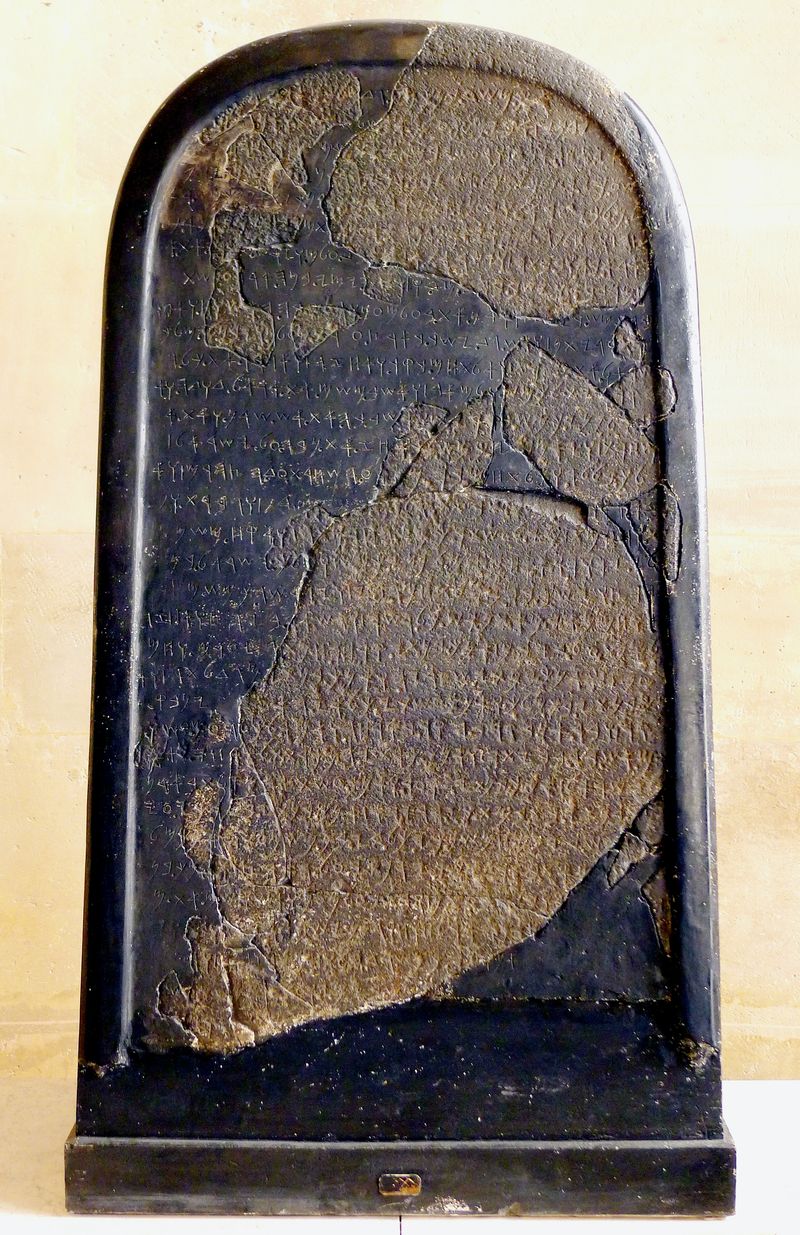
The Mesha Stele was found intact at Dhiban (biblical Dibon, in modern Jordan) in August 1868 by Frederick Augustus Klein. A paper squeeze was made for Charles Clermont-Ganneau in 1869 before Bedouin shattered the original; about two-thirds of the surface survives, the rest reconstructed from the squeeze. The intact stone is now exhibited at the Louvre (AO 5066). The text is Moabite, written in a Phoenician-style alphabet, and dates to c. 840 BC—the same horizon as Tel Dan. KAI 181.11
In 1994 André Lemaire, working with the squeeze and the surviving stone, proposed that line 31 should be reconstructed as bt[d]wd—“House of David.” Lemaire wrote in Biblical Archaeology Review: “My own examination of the stone and the squeeze… confirms that t follows the b. I would now, for the first time, reconstruct the missing letter as a d (d). The result: bt[d]wd, the ‘House of [D]avid!’”12 If correct, line 31 would supply a second 9th-century BC Northwest Semitic reference to the Davidic dynasty.
It is contested. In 2019 Israel Finkelstein, Nadav Na’aman, and Thomas Römer published a re-examination using new high-resolution photographs taken in connection with the 2018 Mésha et la Bible exhibition at the Collège de France. Their conclusion: “After studying new photographs of the Mesha Stele and the squeeze of the stele prepared before the stone was broken, we dismiss Lemaire’s proposal to read bt[d]wd (‘House of David’) on Line 31.”13 They argued that what Lemaire read as taw “does not exist,” that what precedes the waw is in fact a sentence-divider stroke rather than a letter, and that the surviving sequence is best reconstructed as the personal name Balak—the king of Moab named in the Balaam narrative of Numbers 22–24.
In the same year Michael Langlois, working with Reflectance Transformation Imaging conducted at the Louvre, reaffirmed Lemaire’s reading. Langlois argued that Finkelstein, Na’aman, and Römer had mistaken a feature in the reconstructed plaster for a feature on the stone itself: “The vertical stroke that precedes [the waw], and which Finkelstein, Na’aman and Römer understood as sentence divider, is actually not on the stone itself but in the reconstructed part… The letter that follows waw features a triangular head and no descender, which is indicative of daleth. It is followed by a large dot indicating the end of the word.”14 Langlois concluded that “the best reading—though hypothetical—is btdwd ‘Bethdaw[i]d,’ that is, ‘House of David.’”
In 2022 Lemaire and Jean-Philippe Delorme published their own RTI examination, which described the daleth as a matter of “practical certainty” while conceding that the taw “remains uncertain” and “somewhat unclear.” In a 2023 online response to Richelle and Burlingame they upgraded the taw reading to “highly probable.”15 A 2023 BAR survey by Matthieu Richelle and Andrew Burlingame summed up the stalemate: “while the reading btdwd is not impossible, it remains purely hypothetical.”16
That phrase—purely hypothetical—is the responsible default for any post that wants to be honest with its reader. A second-witness reading of “House of David” would be welcome confirmation of Tel Dan; we do not have it. The Mesha Stele is not a load-bearing piece of evidence for the historical David, and Catholic posts that present line 31 as established are leaning on a contested reconstruction.
Khirbet Qeiyafa
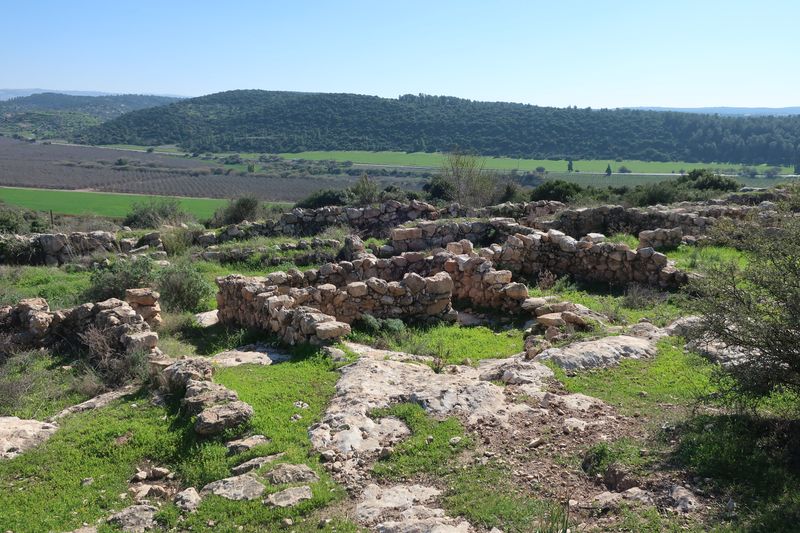
Khirbet Qeiyafa is a 2.3-hectare ridge site in the Elah Valley of the Judean Shephelah, c. 30 km southwest of Jerusalem, excavated by Yosef Garfinkel of Hebrew University and Saar Ganor of the Israel Antiquities Authority over seven seasons (2007–2013). The site has a roughly 700-meter casemate city wall, two gates, a destruction layer that ends abruptly, and a single-stratum Iron IIA occupation. Two radiocarbon programs have produced consistent dates: the 2015 second-generation analysis put the destruction at “~1000 BC,” with the city’s brief occupation falling within roughly 1020–980 BC.17
Garfinkel reads Qeiyafa as a Judahite fortress on the Philistine frontier and identifies it with biblical Sha’arayim (“two gates”), referenced at Joshua 15:36, 1 Samuel 17:52, and 1 Chronicles 4:31–32. He argues that the casemate-with-abutting-houses urban template is a distinctively Judahite signature, that the absence of pig bones and Philistine figurines distinguishes the assemblage from Philistine sites, and that the alphabetic ostracon found in 2008 supports a Hebrew (and therefore Judahite) cultural milieu. His popular synthesis is In the Footsteps of King David (Thames & Hudson, 2018).18
The peer-reviewed pushback has been substantial. Israel Finkelstein and Alexander Fantalkin, in a 2012 Tel Aviv paper, argued that “Khirbet Qeiyafa has no bearing on the Iron Age chronology debate” and that, between the two possibilities for the territorial affiliation of Khirbet Qeiyafa with a highlands polity—Judah or an early north-Israelite entity—“the latter seems to us the more attractive one.”19 Nadav Na’aman published a 2017 Journal of Hebrew Scriptures article titled, with admirable directness, “Was Khirbet Qeiyafa a Judahite City? The Case Against It.” Lily Singer-Avitz has argued from pottery typology that the assemblage belongs to late Iron I rather than early Iron IIA. And Christopher Rollston’s methodological evaluation of the famous Qeiyafa Ostracon—the central piece of inscriptional evidence Garfinkel cites—concluded that “there are no discernible diagnostic features in the ostracon that mandate” a specifically Hebrew identification.20
Where does that leave us? Khirbet Qeiyafa unambiguously establishes that around the time the Bible places King David, organized urban life—monumental fortification, distinctive non-Philistine material culture, alphabetic literacy—already existed in the Judean Shephelah. It does not prove that David personally ruled it, or that Judah was a centralized state radiating from Jerusalem, or that the inhabitants were ethnically and politically Judahite, or that the ostracon is a Hebrew literary text. The site is real, important, and contested. It is not a clinching argument for the biblical David, and the apologetic framing that treats it as such overstates a real but more limited finding.
Khirbet Qeiyafa is real, important, and contested. It is not a clinching argument for the biblical David, and apologetic framing that treats it as such overstates a real but more limited finding.
Eilat Mazar’s “Large Stone Structure”
Eilat Mazar (1956–25 May 2021), granddaughter of Benjamin Mazar, began excavating at the summit of the City of David in February 2005. She identified a complex of monumental walls—the “Large Stone Structure”—with the palace built for David by Hiram of Tyre’s masons in 2 Samuel 5:11. Her 2006 BAR article asked, in the title, “Did I Find King David’s Palace?” Her answer was a confident yes.21
A 2007 critique by Israel Finkelstein, Ze’ev Herzog, Lily Singer-Avitz, and David Ussishkin argued that “the walls unearthed by Mazar do not belong to a single building” and that “the more elaborate walls may be associated with elements uncovered by Macalister and Duncan in the 1920s and should possibly be dated to the Hellenistic period.”22 Their methodological complaint was sharper than the dating dispute: they argued that Mazar treated biblical data as authoritative and read the archaeological record through that lens, rather than the reverse.
The matter is unresolved as of 2026, and the dispute is actually three-cornered, not two: Eilat Mazar dated the Large Stone Structure to early Iron IIA c. 1000 BC and identified it with David’s palace; Avraham Faust and (separately) Amihai Mazar accept that the LSS and Stepped Stone Structure form an integrated complex but argue for an Iron Age I Jebusite construction date that David likely reused; Finkelstein and his coauthors deny the walls form a single building and date the more elaborate elements to the Hellenistic period. The Large Stone Structure is real; what it is, who built it, and when remain contested. The Catholic post that wants to be honest will say: this is genuinely disputed, and our case for a historical David does not depend on it.
Tell es-Safi/Gath: the maximalist constraint
The single piece of archaeological data most underemphasized in apologetic accounts is Tell es-Safi/Gath. Aren Maeir at Bar-Ilan University has directed the excavation since 1996. Iron Age Gath was c. 50 hectares in the 10th–9th centuries BC—one of the largest urban centers in the southern Levant, larger than any Israelite or Judahite city of the same period. Maeir himself accepts a historical David, but he draws the appropriate inference: “Due to Gath’s dominant position, the Judahite monarchy could not expand westward very far.”23
This is a hard constraint on maximalist readings. The biblical United Monarchy of 1 Kings 4–10 spans from the Euphrates to the Brook of Egypt, with David and Solomon ruling an empire whose materiel reach should be visible in the southern Levant’s Iron IIA archaeological record. Tell es-Safi/Gath shows it cannot have been quite that. Either the biblical portrait is theological-literary rather than reportorial geography, or the actual reach of the Davidic-Solomonic polity was smaller than the literary portrait suggests, or both. A Catholic reader can hold these together—and we will, in §7—but only by way of a literary-genre principle that takes the inspired narrative as ancient Near Eastern court historiography rather than as a modern political map.
What the biblical text itself says, in its actual languages
Move from the dirt to the text and the picture gets harder, not easier. The Hebrew Bible’s account of David is not a single homogeneous document. It is at least four literary surfaces in stratigraphic relation: the Court History or Succession Narrative embedded in 2 Samuel 9–20 and 1 Kings 1–2; the prose of the larger Deuteronomistic History in which that source is now embedded; the Chronicler’s substantial reworking in 1 Chronicles; and the Davidic Psalter, with its post-narrative editorial superscriptions linking psalms to specific moments in David’s life. None of these layers is what an AI Overview means when it summarizes “what the Bible says about David.”
The Court History thesis goes back to Leonhard Rost’s Die Überlieferung von der Thronnachfolge Davids (1926), translated as The Succession to the Throne of David in 1982. Rost identified 2 Samuel 9–20 with 1 Kings 1–2 as an originally independent literary work whose unifying question is supplied by 1 Kings 1:20, 27: “Who shall sit on the throne of my lord the king after him?” Gerhard von Rad called the Court History the earliest specimen of historical writing in ancient Israel, characterized by a literary restraint in which the narrator advances theological convictions through events rather than editorial intrusion.24
Subsequent scholarship has refined and contested Rost’s dating—John Van Seters in particular has argued that the Court History is a late post-Deuteronomistic anti-Davidic supplement—but the basic delimitation continues to be the standard starting point, and the centrist reading (Halpern, McKenzie, Schniedewind) treats the Court History as substantially apologetic, written close to the events it narrates, and therefore historically interesting.
This matters because what makes the Court History so unusual in the ancient Near Eastern royal-narrative corpus is its embarrassments. David is portrayed committing adultery (2 Sam 11), arranging Uriah’s murder (2 Sam 11:14–17), failing as a father (2 Sam 13–19), being cursed by Shimei in his flight from Absalom (2 Sam 16), and dying after a contested succession in which his preferred son almost loses the throne to a cabal led by Joab (1 Kgs 1–2). Royal apologetic literature does not invent these stories. Royal apologetic literature works hard to explain them when they cannot be denied.
Steven McKenzie’s methodological key in King David: A Biography (Oxford, 2000) puts the point well: “The fact that the author felt the need to try to explain the motives behind David’s deeds indicates that those deeds were widely believed to have occurred. An author would not invent accusations against David… just to try to explain them away.”25
Baruch Halpern, in David’s Secret Demons (Eerdmans, 2001), pushes the argument further. He reads 2 Samuel as so transparently apologetic—working hard to defend David against specific charges from contemporaries about, among other things, the deaths of Saul, Jonathan, Ish-bosheth, Abner, and several inconvenient people in David’s path—that its very awkwardness vindicates an early date. “To escape the framework of the historical narrative, we need only imagine the events from a political and ideological position opposite that of the text,” Halpern writes. “Our only direct information about David, in the books of Samuel, essentially presents him as a hero. The present book is therefore a glimpse of David as his enemies saw him.” His final verdict: “The real David was not someone whom it would be wise to invite to dinner.”26
This is the centrist consensus. The text in front of us is worked—edited, shaped, theologically framed—but it is not invented out of nothing. The pattern of embarrassed apologetic explanation is recognizable to anyone trained to evaluate witness testimony, and it points toward a real Iron Age figure complicated enough to need defending.
The Elhanan / Goliath puzzle
The clearest single illustration of how worked the text is comes at 2 Samuel 21:19. The Masoretic Text reads:
וַתְּהִי−עוֹד הַמִּלְחָמָה בְּגוֹב עִם−פְּלִשְׁתִּים וַיַּךְ אֶלְחָנָן בֶּן−יַעְרֵי אֹרְגִים בֵּית הַלַּחְמִי אֵת גָּלְיָת הַגִּתִּי וְעֵץ חֲנִיתוֹ כִּמְנוֹר אֹרְגִים׃
English (close rendering, attentive to word order): “And there was again the battle in Gob with the Philistines, and Elhanan son of Jaare-oregim the Bethlehemite struck Goliath the Gittite; and the wood of his spear was like the beam of weavers.”27
Read it again. There is no word for “brother” in the Hebrew. The verse, as written, says that someone other than David—Elhanan, son of Jaare-oregim, of Bethlehem—killed Goliath the Gittite. Same Goliath, same Gath, same idiom for the spear-shaft (“like a weaver’s beam”) that 1 Samuel 17:7 uses for the giant David fights.
Compare 1 Chronicles 20:5:
וַתְּהִי−עוֹד מִלְחָמָה אֶת−פְּלִשְׁתִּים וַיַּךְ אֶלְחָנָן בֶּן−יָעוּר אֶת−לַחְמִי אֲחִי גָּלְיָת הַגִּתִּי׃
English (the Chronicler's version): “And there was again battle with the Philistines, and Elhanan son of Jair struck Lahmi the brother of Goliath the Gittite.”
The bolded word in the Hebrew is אֲחִי (ʾaḥî, “brother of”). The Chronicler has dropped Jaare-oregim, dropped Beit-Hallahmi (the Bethlehemite gentilic), and inserted “Lahmi the brother of.” The result is a verse that no longer creates the puzzle.
Modern English Bibles handle this in three different ways.
The KJV (1611) prints “slew the brother of Goliath the Gittite,” with the words “the brother of” set in distinguishing typography (smaller roman type in the 1611 first printings, italic type in later editions and modern reprints) to flag them as not present in the Hebrew. This is a frequently discussed and well-documented case in English Bible translation of a translator openly importing words from a parallel passage to harmonize an apparent contradiction.
The NRSV, ESV, and JPS Tanakh (1985) translate the MT honestly: “Goliath the Gittite,” with no inserted “brother.” The JPS footnotes Jaare-oregim as probably a duplicate of the Hebrew word ʾoregim (“weavers”) earlier in the verse, an attractive scribal-error explanation.
The NIV and NET import the Chronicler’s harmonization into the running text—NIV with brief footnotes pointing to the Hebrew and to 1 Chronicles 20:5 for both the “Jair” substitution and the “the brother of” insertion; NET with a substantial translator’s note explaining the textual problem and the proposed scribal-error reconstruction. The harmonization is disclosed in the apparatus, but it is in the running text rather than typographically marked there. A reader who skips the footnotes will not know that the Hebrew of 2 Samuel 21:19 says no such thing.
It is worth noting, against the temptation to treat the harmonization as an Old Testament problem unique to Hebrew transmission, that the Septuagint of 2 Samuel 21:19 follows the MT and does not harmonize toward Chronicles. Brenton’s English of the Greek reads “Eleanan son of Ariorgim the Bethlehemite slew Goliath the Gittite.” The Greek tradition preserves the difficult reading. The harmonization is specifically a feature of the Chronicler’s redaction and of certain English translations that follow Chronicles.
The mainstream critical view—P. Kyle McCarter Jr. in his Anchor Bible commentary on 2 Samuel and Emanuel Tov in Textual Criticism of the Hebrew Bible—treats 2 Samuel 21:19 as preserving an older tradition that originally credited the slaying of Goliath to Elhanan, one of David’s mighty men (cf. 2 Sam 23:24). A more recent intervention by Kaspars Ozolins defends a different reconstruction: the original reading was “Elhanan… killed the brother of Goliath,” with אַח (“brother of”) lost by haplography between two adjacent ʾet particles—a position that resolves the apparent contradiction without recourse to the McCarter-Tov “older tradition” hypothesis.28 On either reconstruction, 1 Chronicles 20:5 is most plausibly later than 2 Samuel 21:19. The Chronicler (or a pre-Chronicler tradent) saw the same problem we are seeing now.
Stated cleanly, without apologetic dodge or minimalist overreach: the Hebrew of 2 Samuel 21:19 attributes Goliath’s death to Elhanan, with no word for “brother.” The canonical text leaves the careful reader with a puzzle that cannot be resolved by ignoring it. A naive inerrantism that treats Scripture as a flat surface of factual reportage cannot hold this verse honestly. A Catholic doctrine of inspiration that respects textual history can.
The Hebrew of 2 Samuel 21:19 attributes Goliath’s death to Elhanan, with no word for “brother.” A naive inerrantism that treats Scripture as a flat surface cannot hold this verse honestly. A Catholic doctrine of inspiration that respects textual history can.
We will get to what that Catholic doctrine actually says in a moment. The point for now is that the text is not what an AI Overview imagines it is.
LXX 1 Samuel 17 and the David-and-Goliath puzzle widens
The David-and-Goliath narrative we know comes from the Masoretic Text of 1 Samuel 17. The Septuagint preserves a substantially shorter recension. Codex Vaticanus omits 1 Samuel 17:12–31, 17:41, 17:48b, 17:50, 17:55–58, 18:1–5, 18:10–11, 18:12b, 18:17–19, and 18:29b–30—39 of the 88 verses of MT 1 Samuel 17–18, per Tov’s enumeration.29 The shorter LXX presents a coherent narrative in which David is already in Saul’s service from chapter 16 when he fights Goliath; the MT plus-text reintroduces him as if Saul had never met him—which is what produces the otherwise-mystifying 1 Samuel 17:55, “Whose son is this lad?”
Codex Vaticanus also reads Goliath’s height as four cubits and a span (about 6′9″) rather than the MT’s six cubits and a span (about 9′9″). 4QSamuela from Qumran agrees with the LXX on the smaller number, as does Josephus in Antiquities Book 6. Most text critics now treat the smaller number as original, with the MT’s six cubits as a later expansion.
Emanuel Tov holds that the LXX of 1 Samuel 17 reflects an earlier, shorter Hebrew Vorlage, and that MT 1 Samuel 17–18 is a conflate “Version 2”—an originally separate David tradition spliced onto the proto-MT in the Persian period.30 P. Kyle McCarter follows the same Addition Hypothesis. Dominique Barthélemy and David Gooding defended the priority of MT, arguing that the LXX translator (or his Vorlage) abridged MT to remove perceived contradictions; their defense is the most serious dissent. The dominant current view (Tov, McCarter, the NRSV translators) treats LXX as preserving an earlier literary stratum. A Catholic reader is free to engage either reconstruction; a Catholic reader is not free to pretend that the textual history of 1 Samuel 17 is settled and simple.
4QSamuela: the Dead Sea Scrolls Samuel manuscript
The third layer of complication comes from Qumran. 4QSamuela, a manuscript edited by Frank Moore Cross, Donald Parry, Richard Saley, and Eugene Ulrich and published in Discoveries in the Judaean Desert XVII (Oxford, 2005), preserves a Hebrew text of Samuel that frequently aligns with the LXX against the MT.31
Three places where this matters for any reading of David:
At 1 Samuel 1:23, the MT reads “only may the LORD establish his word”; 4QSamuela reads “that which goes out of your mouth,” agreeing with LXX tò exelthòn ek toû stómatós sou. Cross and Ulrich, with most modern text critics, judge the 4QSamuela/LXX reading as original.
Between 1 Samuel 10:27 and 11:1, 4QSamuela preserves a substantial paragraph absent from MT and from most LXX manuscripts: Nahash king of the Ammonites had been gouging out the right eye of every Gadite and Reubenite east of the Jordan, and seven thousand had escaped to Jabesh-gilead. The paragraph is partially attested in Josephus’ Antiquities (6.5.1), confirming its currency in the Second Temple period. The NRSV (1989) prints it as part of the canonical text. Frank Moore Cross argued in 1983 that the verses had been lost from MT through scribal error.32
At 2 Samuel 5:4–5, 4QSamuela omits the regnal formula (“David was thirty years old when he became king, and he reigned forty years”); LXX-B agrees. The verses are most plausibly a secondary harmonizing insertion drawn from 1 Kings 2:11.
The implication, for our purposes, is that Samuel circulated in multiple Hebrew text-forms in the late Second Temple period, and that the MT we have is one branch among several. Eugene Ulrich’s 1978 monograph The Qumran Text of Samuel and Josephus established that Josephus’ Hebrew Vorlage stood close to 4QSamuela, which means this textual tradition was current in first-century Palestine, not idiosyncratic to a single Qumran scribe.33
A Catholic doctrine of inspiration must reckon with this. CCC §107 will tell us how. But none of the variants undermines the substance of the David narrative. The text has a transmission history; the truth God willed to be confided to Sacred Scripture for our salvation is preserved in that text and through that history; the Holy Spirit does not work by Xerox.
The Davidic superscriptions and what they actually claim
The Hebrew Psalter ascribes roughly 73 psalms to David by way of the lə-dāwid superscription (e.g., Pss 3, 18, 51, 60, 142). Thirteen of those superscriptions go further and link a specific psalm to a specific moment in David’s life—most famously Psalm 51, “When Nathan the prophet came to him, after he had gone in to Bathsheba.” The LXX expands this layer further, attaching tôi Dauid to additional psalms in Books IV–V of the Psalter that have no Hebrew lə-dāwid.
Brevard Childs’ 1971 Journal of Semitic Studies article “Psalm Titles and Midrashic Exegesis” established the consensus reading: the historical superscriptions are post-exilic, midrashic editorial additions. Scribes observed thematic or lexical correspondences between a psalm and a Davidic episode in 1–2 Samuel and supplied a narrative anchor. The link between Psalm 51 and 2 Samuel 12 rests on shared vocabulary—חטא (sin), חסד (loyal love)—rather than independent biographical memory. Childs argued that these titles are the earliest stratum of Jewish scriptural interpretation, not biographical data.34
That reading collides, on the surface, with what Christ does at Mark 12:35–37, Matthew 22:41–46, and Luke 20:41–44, where he treats David as the personal speaker of an inspired psalm. We will engage that collision in §6 below. The point here is narrower: the Psalter’s Davidic attributions are evidence about David’s reception in Second Temple Judaism, not about him directly. They tell us that by the post-exilic period the Davidic figure had become the lyrical voice of Israel’s prayer; they do not tell us what the historical David said or wrote.
Josephus and Augustine: ancient receptions
Two ancient receptions matter for any responsible Catholic post on the historical David, and they sit at opposite ends of a useful spectrum.
Josephus, Antiquities Book 7, is the earliest extended retelling of the Davidic narrative outside the canonical text. Writing at the end of the 1st century AD for a Greco-Roman audience, Josephus follows the LXX Vorlage (close to 4QSamuela) and reshapes the David material as classical historiography. He renders David’s capture of Jerusalem at Antiquities 7.61 with the famous “blind, lame, maimed” detail; he handles Bathsheba at Antiquities 7.130 with no Chronicler-style softening, calling David’s act “a very grievous sin.” Josephus’ witness is important precisely because he is not a Christian apologist; he is a Hellenistic Jewish historian writing inside the textual stream that produced 4QSamuela, treating David as a real Iron Age king whose failures are part of the historical record.35
Augustine, De Civitate Dei Book XVII, is the earliest sustained Christian theological reading of the historical David that does not collapse history into allegory. Augustine’s threefold rule in De Civitate Dei 17.3—that prophetic utterances “are of three kinds…some relating to the earthly Jerusalem, some to the heavenly, and some to both”—is the principle by which he reads David as simultaneously a historical king of the earthly Jerusalem and a typological figure pointing to Christ.
In De Civitate Dei 17.8 Augustine reads the Nathan oracle of 2 Samuel 7 against the supposition that it was fulfilled in Solomon: “He who thinks this grand promise was fulfilled in Solomon greatly errs… Let him therefore attend and behold the house of Solomon full of strange women worshipping false gods, and the king himself, aforetime wise, seduced by them, and cast down into the same idolatry.” The fulfillment, Augustine argues, “save in Christ our Lord, who was made of the seed of David according to the flesh,” is impossible.36
In De Civitate Dei 17.20 Augustine offers what is, I think, the most theologically careful single sentence ever written about the historical David:
Regnauit ergo Dauid in terrena Hierusalem, filius caelestis Hierusalem, diuino multum testimonio praedicatus, quia et delicta eius tanta pietate superata sunt per saluberrimam paenitendi humilitatem, ut prorsus inter eos sit, de quibus ipse ait: Beati quorum remissae sunt iniquitates et quorum tecta sunt peccata.
English (Marcus Dods): “David therefore reigned in the earthly Jerusalem, a son of the heavenly Jerusalem, much praised by the divine testimony; for even his faults were overcome by such great piety, through the most salutary humility of his repentance, that he is altogether one of those of whom he himself says, ‘Blessed are they whose iniquities are forgiven, and whose sins are covered.’”37
What Augustine does in that one sentence is precisely the integration we will need below. David is both real and figural; both historical king and citizen of the heavenly city; both repentant sinner and inspired psalmist of his own forgiveness. None of those is an allegorical replacement for the others. They are simultaneous. This is the Catholic theological inheritance.
What Catholic doctrine actually requires
It is worth stating crisply, because Catholic apologetics and Catholic skepticism both tend to overreach here. Catholic doctrine does not require any specific archaeological reconstruction of David’s kingdom. The magisterium has not defined the political reach of the Davidic polity, the population of 10th-century Jerusalem, the chronology of the United Monarchy, or the geographic extent of David’s reign. None of these is a defined dogma in the technical sense.
Catholic doctrine does not require any specific archaeological reconstruction of David’s kingdom. What it requires is more important and less often stated cleanly.
What Catholic doctrine does require is more important and less often stated cleanly. There are four loci.
Dei Verbum §11 and CCC §107: the salvific-truth clause
The Dogmatic Constitution on Divine Revelation, Dei Verbum, was solemnly promulgated by Pope Paul VI on 18 November 1965. It is the highest-ranking conciliar text on biblical inspiration and inerrancy, and its §11 is the operative passage for any Catholic engagement with biblical historicity:
Therefore, since everything asserted by the inspired authors or sacred writers must be held to be asserted by the Holy Spirit, it follows that the books of Scripture must be acknowledged as teaching solidly, faithfully and without error that truth which God wanted put into sacred writings for the sake of salvation.38
The Latin phrase that does the work is nostrae salutis causa—“for the sake of our salvation”—which sits between Deus (God) and Litteris Sacris consignari voluit (willed to be confided to Sacred Scripture). The grammar permits two construals. On the restrictive reading, the clause narrows the domain of inerrancy: Scripture teaches without error the truth that pertains to salvation; whether it teaches without error in matters that do not pertain to salvation is left undefined.
On the purposive reading, the clause modifies the act of confiding: God willed, for the sake of our salvation, that the truth be confided to Scripture; the inerrancy is unrestricted, but the purpose of the confiding is salvific. The Flannery English translation, reproduced in CCC §107, leans toward the purposive reading: “that truth which God, for the sake of our salvation, wished to see confided to the Sacred Scriptures.” The Vatican.va translation leans toward the restrictive reading. A faithful Catholic blog post should not pretend that a centuries-old conciliar drafting question is settled by either rendering.
What is not in dispute is the consequence: what the inspired authors affirm is what the Holy Spirit affirms; that affirmation is firm, faithful, and without error; the domain of that affirmation is the salvific truth God willed to be confided to Scripture, calibrated by literary genre per Divino Afflante Spiritu and read in the Spirit per Dei Verbum §12.
CCC §107 is the operational rule:
The inspired books teach the truth. “Since therefore all that the inspired authors or sacred writers affirm should be regarded as affirmed by the Holy Spirit, we must acknowledge that the books of Scripture firmly, faithfully, and without error teach that truth which God, for the sake of our salvation, wished to see confided to the Sacred Scriptures.”39
This is the Catholic statement of inerrancy, and it is broader and more hospitable to the textual-history phenomena we have just walked through (the Elhanan/Goliath puzzle, the LXX/MT/4QSamuela divergences, the editorial Davidic superscriptions) than naive inerrantist alternatives.
Dei Verbum §12 and the Spirit-led reading
Dei Verbum §12 supplies the interpretive principle that integrates historical-critical and theological reading: “Sacred Scripture must be read and interpreted in the sacred spirit in which it was written.” It names three criteria for that integration: the content and unity of the whole of Scripture; the living tradition of the whole Church; and the analogy of faith. It also affirms attention to literary forms—“truth is set forth and expressed differently in texts which are variously historical, prophetic, poetic, or of other forms of discourse”40—and instructs the interpreter to attend to “the customary and characteristic styles of feeling, speaking and narrating which prevailed at the time of the sacred writer.”
This is the conciliar warrant for historical-critical method, properly used. It is also the conciliar warrant for refusing to absolutize that method.
Divino Afflante Spiritu and the literary-genre principle
Pius XII’s encyclical of 30 September 1943 is the document that set Catholic biblical scholarship free to ask the questions modern criticism asks while keeping inerrancy intact. The literary-genre material runs from §33 through §39, with the duty-of-the-exegete sentence at §38.
§33 grounds the principle that the inspired writer is the “living and reasonable instrument of the Holy Spirit” who “impelled by the divine motion, he so uses his faculties and powers” that his book reveals “the special character of each one and, as it were, his personal traits.” §35 instructs the interpreter that he “must, as it were, go back wholly in spirit to those remote centuries of the East” to determine “what modes of writing… the authors of that ancient period would be likely to use, and in fact did use.” §36 supplies the decisive premise: “For the ancient peoples of the East, in order to express their ideas, did not always employ those forms or kinds of speech which we use today; but rather those used by the men of their times and countries.”
§38 issues the duty: the Catholic commentator must “determine, that is, to what extent the manner of expression or the literary mode adopted by the sacred writer may lead to a correct and genuine interpretation”—a part of his office that “cannot be neglected without serious detriment to Catholic exegesis.”41
For David, this is the hinge. The genre of 1–2 Samuel is not modern Western history-writing; it is also not a-historical legend. It is ancient Near Eastern court historiography composed under inspiration, embedding source documents (the Court History; lists; psalms), shaped by prophetic-theological purpose, deploying conventions a Catholic reader is required to recognize before pronouncing on what the inspired text “claims” historically. Schematized regnal lengths, theologically framed military narrative, reconstructed speeches—these are the features of the genre, not evidence of fabrication, and a Catholic reader who treats them as the latter has not done the work Divino Afflante Spiritu requires.
Sancta Mater Ecclesia and the three stages, applied by analogy
The Pontifical Biblical Commission’s 1964 instruction Sancta Mater Ecclesia directed the exegete to attend to “the three stages of the tradition through which the life and teaching of Jesus have come down to us”—the events themselves; the period of apostolic and ecclesial transmission, in which “the Apostles… adapt[ed] the format of their preaching to the condition of their audience”; and the final inspired literary composition, in which “the sacred authors recorded this primitive teaching in the four Gospels,” reporting some elements, summarizing others, and developing still others “in accordance with the needs of the various churches.”42
Strictly, the instruction concerns Gospel formation. But its method is straightforwardly applicable by analogy to the David narratives in 1–2 Samuel. The David traditions plausibly arose in three roughly parallel layers: actual events in late 11th- and early 10th-century Judah (the historical core); a long phase of court memory, prophetic interpretation, psalmic and oral transmission; and the final inspired literary composition, with its embedded sources—the Court History, the Succession Narrative—assembled, schematized, and theologically framed by inspired authors.
The three-stage method is not a license to reduce; it is a license to distinguish. It permits a Catholic reader to affirm both that the sacred text faithfully transmits the salvific truth God willed and that it does so through ancient literary conventions different from modern reportage. It is the methodological grammar that makes the Elhanan/Goliath puzzle, the LXX/MT divergence, and the editorial Davidic superscriptions integratable rather than threatening.
Verbum Domini §35 and the warning against dualism
Benedict XVI’s post-synodal apostolic exhortation Verbum Domini (30 September 2010) is the most theologically substantial recent magisterial treatment of inspiration, history, and interpretation. The decisive passage is §35, “The danger of dualism and a secularized hermeneutic,” with antecedents at §§32–34.
§32 supplies the principle that has been quoted ever since: “The historical fact is a constitutive dimension of the Christian faith. The history of salvation is not mythology, but a true history, and it should thus be studied with the methods of serious historical research.” §34 declares: “Only where both methodological levels, the historical-critical and the theological, are respected, can one speak of a theological exegesis, an exegesis worthy of this book.”
§35 is the pivot. Benedict warns of “the serious risk nowadays of a dualistic approach to sacred Scripture.” Distinguishing the historical-critical and theological levels of reading, he insists, “does not in any way mean to separate or oppose them, nor simply to juxtapose them. They exist only in reciprocity.” Where exegesis is reduced to history alone, the Bible “ends up being a text belonging only to the past” and “exegesis is no longer truly theological, but becomes pure historiography.” Where a hermeneutic of faith is absent, “there inevitably enters another hermeneutic, a positivistic and secularized hermeneutic ultimately based on the conviction that the Divine does not intervene in human history”—and “this leads to interpretations that deny the historicity of the divine elements.” Such a position, Benedict warns, “can only prove harmful to the life of the Church, casting doubt over fundamental mysteries of Christianity and their historicity—as, for example, the institution of the Eucharist and the resurrection of Christ.”43
For our question, §35 is the antidote to two opposite errors. A fundamentalist reading that flattens the inspired text into modern reportage is a dualism, because it implicitly concedes that the only respectable historicity is positivist. A critical reading that treats the historical core as dispensable so long as the symbolic meaning survives is a dualism, because it relocates “divine elements” into a separate non-historical register. Benedict’s warning is that both reduce inspiration to one of two unsustainable halves of a false split.
What this all means for the historical David
Catholic doctrine on the historical David, gathered together, says four things.
What is doctrinally required: The inspired and inerrant character of 1–2 Samuel as Sacred Scripture (CCC §107; Dei Verbum §11). The salvific-truth clause: what these books affirm is taught firmly, faithfully, and without error within the domain of God’s salvific intent.44 The Davidic descent of Jesus Christ as the Messiah (Romans 1:3; Matthew 1; Luke 3; CCC §437; CCC §439; and, supporting the broader messianic Christology within which Davidic descent is implicit, the Niceno-Constantinopolitan Creed of 381). And the reality of historical reference: the David behind the Davidic promise is not a literary cipher but a person within Israel’s actual past (Verbum Domini §32).
What doctrinal requirement does not include: any specific archaeological position on the political reach, the population of Jerusalem, the chronology of the United Monarchy, or the geographic extent of David’s reign. The magisterium has never defined any of these.
What is theologically appropriate: A presumption in favor of the inspired text’s historical claims, calibrated by literary genre per Divino Afflante Spiritu §§33–39. A reading of 1–2 Samuel that recognizes ancient Near Eastern court historiography as its genre. Acceptance of the methodological distinction between events, transmission, and inspired composition (the Sancta Mater Ecclesia analogy). Integration of the historical-critical findings with the canonical, traditional, and faith-based reading the Church’s hermeneutic requires.
What sits at the edge of the permissible: A maximally minimalist reading that empties the inspired narrative of historical reference—one that treats David as a literary cipher around which post-exilic scribes constructed an ideology. Such a reading sits in tension with Verbum Domini §35 not because the magisterium has condemned it but because it instantiates exactly the dualism Benedict warns against: divine elements relocated into “meaning” while the historical level is conceded to a closed naturalist horizon.
David called the Messiah his Lord
There is a single New Testament datum that any Catholic reading of the historical David must integrate. It appears in all three Synoptic Gospels—Mark 12:35–37, Matthew 22:41–46, Luke 20:41–44—and it presupposes David as the personal, inspired speaker of an Old Testament psalm.
Mark 12:36 reads, in the SBL Greek New Testament:
αὐτὸς Δαυἰδ εἶπεν ἐν τῷ πνεύματι τῷ ἁγίῳ· Εἶπεν κύριος τῷ κυρίῳ μου· Κάθου ἐκ δεξιῶν μου…
English (NABRE): “David himself, inspired by the holy Spirit, said: ‘The Lord said to my lord, Sit at my right hand…’”45
Matthew 22:43 has the shorter Dauìd en pneúmati—“David, inspired by the Spirit.” Luke 20:42 substitutes a different attribution: autòs gàr Dauìd légei en bíblοi psalmôn—“For David himself in the Book of Psalms says.” The psalm in question is Psalm 110, whose superscription in Hebrew (BHS/WLC) reads lə-dāwid mizmôr—“of David, a psalm.”
This is not a knock-down argument from Christology to historiography, and a serious Catholic post should not pretend otherwise. Christ’s citation of an inspired psalm under its Davidic superscription operates in the linguistic conventions of first-century Jewish exegesis, where the Davidic attribution functioned as a canonical-liturgical fact rather than as a modern claim of compositional authorship. To treat Mark 12:36 as a magisterial pronouncement on the late-19th-century question of psalmic redaction is to import a category that does not belong.
But it is a datum any Catholic reading must integrate. The Lord himself treats David as the personal speaker of an inspired psalm, in the Holy Spirit, naming someone greater than himself “Lord.” A reading that concludes that David is a literary cipher must explain this—and the explanations available to it tend either to evacuate Christ’s argument of force or to relocate it into a purely rhetorical register that the Synoptic authors do not signal.
A reading that concludes that David is a real Iron Age king whose words and prayers are remembered, transmitted, and finally composed under inspiration into the Psalter (allowing for the ancient literary conventions Pius XII identifies in Divino Afflante Spiritu §§33–39) does not have to explain anything away. It is the integrating reading.
The same Davidic anchor appears in Acts 2:29–36, where Peter’s Pentecost sermon argues from Psalm 16’s “you will not abandon my soul to Hades” to the resurrection of Christ. Peter’s structure is the same as Augustine’s: “Brethren, I may say to you confidently of the patriarch David that he both died and was buried, and his tomb is with us to this day. Being therefore a prophet… he foresaw and spoke of the resurrection of the Christ.”46 David is real, died, was buried; therefore the unfulfilled promise of an enthroned Davidic descendant must point past David himself to Christ. Without the historical David, the Pentecost argument does not run.
What AI Overview gets wrong
“Did King David exist?” is exactly the kind of question Google’s AI Overview thinks it can answer well, and the brevity of its summary is the problem. AI Overview output is non-deterministic, and the critique that follows is of substantive distortions rather than of compression as such. AI Overview’s typical answer in early 2026, on queries like “did King David really exist,” has tended to run something like: “Most scholars accept that King David was a real historical figure, citing the Tel Dan stele’s reference to the ‘House of David.’ However, some minimalist scholars dispute this, arguing the biblical narrative is largely literary.” That summary is not wrong, but it is so compressed that it misleads in four directions.
It overstates Tel Dan’s reach. The stele establishes a Davidic dynasty by c. 840 BC, not the biographical David of Samuel. The summary treats them as the same thing, which they are not.
It treats the minimalist position as a fringe scholarly remnant, when the working consensus has actually moved centrist—not maximalist—in the last decade. Even Finkelstein concedes a 10th-century historical David. The remaining debate is over scale and reach, and AI Overview elides the entire structure of that debate.
It silently flattens the textual layer. There is no AI Overview answer I have seen that engages the Elhanan/Goliath puzzle, the LXX shorter recension of 1 Samuel 17, or the 4QSamuela evidence. Those phenomena are uncomfortable for both naive inerrantism and lazy minimalism, and AI Overview’s habit is to summarize past them rather than into them.
It misses the doctrinal layer entirely. AI Overview can paraphrase what Wikipedia says about the minimalist/maximalist debate. It cannot, by design, navigate what Verbum Domini §35 says about why the very framing “either history or theology” is a dualism the Church has named and rejected. That framing is exactly what AI Overview’s summary instantiates.
A Catholic reader who walks away from an AI Overview answer with “yes, David was real, here’s the inscription” has the right conclusion for the wrong reasons, and is one step away from being shaken out of it by the first text-critical observation he encounters. A Catholic reader who walks through the dirt, the text, and the doctrine in their actual sequence has done the work the Church’s hermeneutic asks of him.
What most explanations miss
The deeper miss, which is not specific to AI Overview, is the integration §35 demands. Most secular treatments of the historical David stop at archaeology. Most fundamentalist treatments stop at “the Bible says so.” Most mainline-Christian treatments stop at literary analysis with a theological gesture at the end. Each of these is half a reading.
The Catholic theological layer is where the post earns its keep. The dirt and stones (Layer 1: Tel Dan, Khirbet Qeiyafa, the Large Stone Structure, Iron Age chronology) ended the era when “David never existed” was a serious archaeological position. The textual record (Layer 2: Hebrew Samuel, the LXX, 4QSamuela, the Psalter’s Davidic superscriptions, Josephus, Augustine) complicates flat-footed appeals to “what the Bible says.” The magisterial framework (Layer 3: Dei Verbum, Providentissimus Deus, Divino Afflante Spiritu, Sancta Mater Ecclesia, CCC §107, Verbum Domini, the 1993 PBC document) supplies the doctrinal and methodological grammar the Catholic reader uses to integrate the dirt and the text into a faith-coherent reading.
Each layer is necessary and none is sufficient. That is the missing piece in most explanations, and it is the piece that takes the most space to lay out, which is why a 6,000-word post does not give a 600-word AI summary the same answer. Compression is not innocent here.
A positioned Catholic reader’s conclusion
Speaking as a Catholic convert with a Yale Divinity School M.Div. and a JAG-officer’s habit of reasoning about embarrassed-admission witness testimony, the integrated reading commits me to a real David: a 10th-century BC ruler of an early Judahite polity (the hyphenated “chieftain-king” is my own compromise between Dever’s “chiefdom” framing and Mazar’s “state in development”) whose dynasty is independently confirmed by the Tel Dan stele bytdwd line and whose biblical portrait, while shaped by ancient literary conventions and theological purpose, refers to actual events in actual Iron Age Israel.
The David behind the Davidic promise was a real man. The kingdom he ruled was probably smaller than the imperial geography of 1 Kings 4–10 allows, and Tell es-Safi/Gath’s scale is the hard archaeological constraint that pushes the reading in that direction. The texts of 1–2 Samuel as we have them are worked: edited, harmonized in places, divergent across MT, LXX, and 4QSamuela, and shaped by an apologetic purpose that has the recognizable signature of court literature defending a real king against real charges. The Davidic Psalter is editorial Davidization built on top of a kernel of real Davidic memory. The Davidic superscriptions are reception, not autobiography.
None of this collapses into the dualism Verbum Domini §35 warns against. The salvific truth God willed to be confided to Sacred Scripture in 1–2 Samuel is preserved in the inspired text—through, not despite, the textual phenomena and ancient genre conventions we have walked through. The inerrancy of CCC §107 is not the inerrancy a 19th-century fundamentalist needs it to be; it is broader, more capacious, and easier to hold honestly.
This is a positioned reading, not a magisterial pronouncement. Other Catholic readers can land at different places along the centrist spectrum—a more maximalist reading following Faust and Mazar, a more skeptical reading following Finkelstein’s later work—and remain entirely within the bounds of permissible scholarly opinion. What I think the doctrinal framework rules out is the maximally minimalist reading that empties the inspired narrative of historical reference, and the naively maximalist reading that treats Iron Age archaeology as a constraint the inspired text must satisfy on the inspired text’s literal-modern terms.
What this is not
A few things this post is not, because the genre matters as much for an essay as for an inscription.
This is not a magisterial pronouncement. It is one Catholic reader’s positioned conclusion, written from inside the integration Dei Verbum §12 and Verbum Domini §35 require. The Catholic Church has not defined the political reach of David’s kingdom and is unlikely to.
This is not a settled archaeological argument. The Iron IIA chronology dispute remains live. The Mesha Stele line 31 reading is contested. Khirbet Qeiyafa’s political identity is contested. Eilat Mazar’s Large Stone Structure is contested. A reader is welcome—encouraged, even—to walk through the peer-reviewed literature and arrive at different judgments on any of these.
This is not an attempt to make believers out of skeptics. The Tel Dan stele does not prove the existence of God or the inspiration of Scripture or the resurrection of Christ. It establishes a Davidic dynasty by c. 840 BC. What the believing reader does with that fact, and with everything else laid out above, is mediated by faith—not by additional inscriptions.
It is, I hope, a model of how a Catholic reader integrates the dirt, the text, and the doctrine without flattening any of them. That is what my Yale Divinity training gave me as a method, and what coming into the Catholic Church gave me as a frame in which the method is at home.
The historical David existed. He was smaller than legend and stranger than the encyclopedia entry. The inspired text remembers him with theological purpose and ancient literary craft. The Catholic reader is not required to choose among those layers—and that is the freedom Dei Verbum gave us.
Frequently Asked Questions
Did King David really exist?
Almost certainly yes. The Tel Dan stele, an Aramaic inscription from c. 840 BC, refers to the southern Hebrew kingdom as the “House of David” (bytdwd), establishing that a Davidic dynasty was a recognized political entity by the mid-9th century BC—within roughly 130 years of David’s traditional reign dates. By 2026, virtually no working archaeologist denies a 10th-century BC historical David, including the most influential skeptic of the last generation, Israel Finkelstein. The remaining debate is over the scale and geographic reach of the kingdom, not its existence.
Does the Tel Dan stele prove David existed?
It establishes a Davidic dynasty by c. 840 BC—which makes a 10th-century historical David broadly probable—but it does not, by itself, prove the biographical David of 1–2 Samuel or any specific detail of the biblical narrative. Apologetic shorthand that says “Tel Dan proves David” overstates what the inscription delivers. The careful claim is that the inscription confirms a Davidic dynasty’s existence and political identity, which implies an earlier eponymous founder.
What does the Mesha Stele say about David?
This is contested. André Lemaire (1994) and Michael Langlois (2019, 2022) reconstruct line 31 of the Mesha Stele to read “House of David,” supplying a possible second 9th-century BC reference. Israel Finkelstein, Nadav Na’aman, and Thomas Römer (2019) re-read the same letters as the personal name “Balak.” A 2023 BAR survey concluded that the btdwd reading “is not impossible, [but] remains purely hypothetical.” The responsible default is to not lean on the Mesha Stele as evidence for the historical David.
Did Elhanan or David kill Goliath?
The Hebrew of 2 Samuel 21:19 says Elhanan killed Goliath, with no word for “brother” in the Hebrew. 1 Chronicles 20:5 inserts “Lahmi the brother of” into a parallel telling, which is plausibly a scribal harmonization. The KJV (1611) prints “the brother of” in distinguishing typography to flag the inserted words. The NRSV, ESV, and JPS Tanakh translate the MT honestly as “Goliath the Gittite.” The mainstream critical view (McCarter, Tov) treats 2 Samuel 21:19 as preserving an older tradition that originally credited Goliath’s death to Elhanan, one of David’s mighty men; a more recent reconstruction by Ozolins (2022) defends a haplography of אַח instead.
What does Catholic doctrine require about David?
The inspired and inerrant character of 1–2 Samuel as Sacred Scripture (CCC §107; Dei Verbum §11), the salvific-truth clause that what these books affirm is taught firmly, faithfully, and without error in the domain of God’s salvific intent, the Davidic descent of Jesus Christ as Messiah, and the reality of historical reference (Verbum Domini §32: “the history of salvation is not mythology, but a true history”). What is not required is any specific archaeological reconstruction—the Church has not defined the political reach of the Davidic kingdom or the chronology of the United Monarchy.
Is the United Monarchy of David and Solomon historical?
A real but more modest version of it is broadly accepted. The biblical portrait of an empire stretching from the Euphrates to the Brook of Egypt does not match the archaeological record—Tell es-Safi/Gath alone (c. 50 hectares in the 10th–9th centuries BC) is large enough to constrain westward Judahite expansion. A Catholic reader, drawing on Divino Afflante Spiritu’s literary-genre principle, can hold that the inspired narrative remembers a real Davidic-Solomonic polity with the literary conventions of ancient Near Eastern court historiography rather than the conventions of modern political mapping.
What is bytdwd?
Bytdwd (Aramaic bēt dāwid) is the dynastic exonym for the southern Hebrew kingdom on the Tel Dan stele. The construction is byt (“house”) + dwd (the personal name “David”), parallel to the Akkadian Bīt-Ḫumrî (“House of Omri”) for the northern kingdom of Israel and Bīt-Agūsi for Arpad. Aramean and Assyrian rulers regularly named the surrounding kingdoms by their founding dynasty’s eponymous ancestor. Hazael of Aram-Damascus, the likely author of the Tel Dan stele, named his Israelite victim by the Assyrian-style “House of Omri” patronymic and his Judahite victim by the parallel “House of David” patronymic.
Further reading
For the inscription itself: Avraham Biran and Joseph Naveh, “An Aramaic Stele Fragment from Tel Dan,” Israel Exploration Journal 43 (1993): 81–98, and “The Tel Dan Inscription: A New Fragment,” IEJ 45 (1995): 1–18, are the editiones principes; George Athas, The Tel Dan Inscription: A Reappraisal and a New Interpretation (JSOTSup 360; Sheffield, 2003) is the most thoughtful minority reading; Lawrence J. Mykytiuk, Identifying Biblical Persons in Northwest Semitic Inscriptions of 1200–539 B.C.E. (SBL, 2004) is the standard scholarly treatment of the bytdwd reading.
For the Mesha Stele dispute: André Lemaire, “‘House of David’ Restored in Moabite Inscription,” Biblical Archaeology Review 20/3 (1994): 30–37; Israel Finkelstein, Nadav Na’aman, and Thomas Römer, “Restoring Line 31 in the Mesha Stele: The ‘House of David’ or Biblical Balak?” Tel Aviv 46/1 (2019): 3–11; Michael Langlois, “The Kings, the City and the House of David on the Mesha Stele in Light of New Imaging Techniques,” Semitica 61 (2019): 23–47.
For the broader scholarly debate: Baruch Halpern, David’s Secret Demons: Messiah, Murderer, Traitor, King (Eerdmans, 2001); Steven L. McKenzie, King David: A Biography (Oxford, 2000); William G. Dever, Has Archaeology Buried the Bible? (Eerdmans, 2020); William M. Schniedewind, Society and the Promise to David: The Reception History of 2 Samuel 7:1–17 (Oxford, 1999); Yosef Garfinkel, In the Footsteps of King David (Thames & Hudson, 2018); Israel Finkelstein and Amihai Mazar, The Quest for the Historical Israel, ed. Brian B. Schmidt (SBL, 2007).
For the textual layer: P. Kyle McCarter, I Samuel (Anchor Bible 8; Doubleday, 1980) and II Samuel (Anchor Bible 9; Doubleday, 1984); Emanuel Tov, Textual Criticism of the Hebrew Bible, 3rd ed. (Fortress, 2012); Frank Moore Cross, Donald W. Parry, Richard J. Saley, and Eugene Ulrich, Qumran Cave 4.XII: 1–2 Samuel (DJD XVII; Oxford, 2005).
For the Catholic doctrinal layer: Dei Verbum (1965); Providentissimus Deus (1893); Divino Afflante Spiritu (1943); Sancta Mater Ecclesia (PBC, 1964); Verbum Domini (Benedict XVI, 2010); The Interpretation of the Bible in the Church (PBC, 1993). Joseph Ratzinger, Jesus of Nazareth, Vol. 1 (Doubleday, 2007), Foreword pp. xi–xxiv, is the indispensable theological frame.
Footnotes
- 1. Avraham Biran and Joseph Naveh, “An Aramaic Stele Fragment from Tel Dan,” Israel Exploration Journal 43 (1993): 81–98; Biran and Naveh, “The Tel Dan Inscription: A New Fragment,” IEJ 45 (1995): 1–18. The corpus number is KAI 310 (H. Donner and W. Röllig, Kanaanäische und aramäische Inschriften). Israel Antiquities Authority accession 1993-3162 (Fragment A) and 1996-125 (Fragment B), exhibited at the Israel Museum, Jerusalem.
- 2. André Lemaire, “The Tel Dan Stela as a Piece of Royal Historiography,” Journal for the Study of the Old Testament 81 (1998): 3–14; M. J. Suriano, “The Apology of Hazael,” Journal of Near Eastern Studies 66/3 (2007): 163–176.
- 3. Biran and Naveh 1995, 13. The composite text reproduced here follows the 1995 reconstruction; the bytdwd sequence is wholly within Fragment A and is not affected by Michael Langlois’ 2024 reexamination of the physical join (see infra).
- 4. Lawrence J. Mykytiuk, Identifying Biblical Persons in Northwest Semitic Inscriptions of 1200–539 B.C.E. (Atlanta: SBL, 2004), 126: bytdwd “is best translated as ‘the house of David,' meaning the dynasty of David or the territory it ruled.” On the Akkadian dynastic-house parallels, see also William M. Schniedewind, “Tel Dan Stela: New Light on Aramaic and Jehu’s Revolt,” Bulletin of the American Schools of Oriental Research 302 (1996): 75–90.
- 5. Anson F. Rainey, “The ‘House of David’ and the House of the Deconstructionists,” Biblical Archaeology Review 20/6 (Nov/Dec 1994): 47. The Deir ʻAlla parallel is brbʻr (“son of Beor”), Combination I line 4, written without internal divider.
- 6. E. A. Knauf, A. de Pury, and T. Römer, “BaytDawīd ou BaytDōd? Une relecture de la nouvelle inscription de Tel Dan,” Biblische Notizen 72 (1994): 60–69. The proposal has not been adopted by subsequent Northwest Semitic epigraphers.
- 7. George Athas, The Tel Dan Inscription: A Reappraisal and a New Interpretation (JSOTSup 360; Sheffield Academic Press, 2003), 226 (the toponym thesis), 308–309 (the “footprint” passage). Athas’ reading, although a minority view, is internally consistent and does not deny David’s historicity.
- 8. Lester L. Grabbe, Ahab Agonistes: The Rise and Fall of the Omri Dynasty (LHBOTS 421; T&T Clark, 2007), 333.
- 9. Israel Finkelstein, “King Solomon’s Golden Age?: History or Myth?” in I. Finkelstein and A. Mazar, The Quest for the Historical Israel, ed. Brian B. Schmidt (Atlanta: SBL, 2007), 107–116, here at 114–115.
- 10. Michael Langlois, “The Tel Dan Inscription After 30 Years: A Fresh Look,” IEJ 74/2 (2024): 59–79.
- 11. Standard reference edition: H. Donner and W. Röllig, Kanaanäische und aramäische Inschriften (KAI), no. 181. The intact stone is exhibited at the Louvre, AO 5066; the squeeze (taken by Charles Clermont-Ganneau in 1869 before the stone was shattered) is AO 5019.
- 12. André Lemaire, “‘House of David’ Restored in Moabite Inscription,” Biblical Archaeology Review 20/3 (May/June 1994): 30–37, here at 36.
- 13. Israel Finkelstein, Nadav Na'aman, and Thomas Römer, “Restoring Line 31 in the Mesha Stele: The ‘House of David’ or Biblical Balak?” Tel Aviv 46/1 (2019): 3–11, abstract at p. 3.
- 14. Michael Langlois, “The Kings, the City and the House of David on the Mesha Stele in Light of New Imaging Techniques,” Semitica 61 (2019): 23–47, here at 38–39, conclusion at 47.
- 15. André Lemaire and Jean-Philippe Delorme, “Mesha’s Stele and the House of David,” Biblical Archaeology Review (Winter 2022): 28–41, here at 37 (taw “remains uncertain”), 38 (daleth “practical certainty”), 40 (taw “somewhat unclear”). The “highly probable” upgrade for the taw appears in their 2023 online response to Richelle and Burlingame, “Defending the ‘House of David,'” Biblical Archaeology Society’s Bible History Daily.
- 16. Matthieu Richelle and Andrew Burlingame, “Set in Stone? Another Look at the Mesha Stele,” Biblical Archaeology Review (Spring 2023): 50–57, here at 57.
- 17. Yosef Garfinkel, Katherina Streit, Saar Ganor, and Paula J. Reimer, “King David’s City at Khirbet Qeiyafa: Results of the Second Radiocarbon Dating Project,” Radiocarbon 57/5 (2015): 881–890.
- 18. Yosef Garfinkel, Saar Ganor, and Michael G. Hasel, In the Footsteps of King David: Revelations from an Ancient Biblical City (London: Thames & Hudson, 2018). The Sha'arayim identification is developed in Garfinkel and Ganor, “Khirbet Qeiyafa: Sha'arayim,” Journal of Hebrew Scriptures 8 (2008), art. 22.
- 19. Israel Finkelstein and Alexander Fantalkin, “Khirbet Qeiyafa: An Unsensational Archaeological and Historical Interpretation,” Tel Aviv 39/1 (2012): 38–63, here at 41 (chronology) and 57 (territorial affiliation).
- 20. Christopher A. Rollston, “The Khirbet Qeiyafa Ostracon: Methodological Musings and Caveats,” Tel Aviv 38/1 (2011): 67–82. See also Lily Singer-Avitz, “The Relative Chronology of Khirbet Qeiyafa,” Tel Aviv 37/1 (2010): 79–83; and Nadav Na'aman, “Was Khirbet Qeiyafa a Judahite City? The Case Against It,” Journal of Hebrew Scriptures 17 (2017).
- 21. Eilat Mazar, “Did I Find King David’s Palace?” Biblical Archaeology Review 32/1 (Jan/Feb 2006): 16–27, 70.
- 22. Israel Finkelstein, Ze'ev Herzog, Lily Singer-Avitz, and David Ussishkin, “Has King David’s Palace in Jerusalem Been Found?” Tel Aviv 34/2 (2007): 142–164. See also Finkelstein, “The ‘Large Stone Structure’ in Jerusalem: Reality versus Yearning,” Zeitschrift des Deutschen Palästina-Vereins 127 (2011): 1–10. For Faust’s three-cornered defense—LSS+SSS as one architectural complex but Iron Age I Jebusite construction reused by David—see Avraham Faust, “The Large Stone Structure in the City of David: A Reexamination,” ZDPV 126 (2010): 116–130, and “Did Eilat Mazar Find David’s Palace?” Biblical Archaeology Review 38/5 (2012): 47–52, 70.
- 23. Aren M. Maeir, “The Philistines and Their Cities,” Bible Odyssey, Society of Biblical Literature, is the source of the “Due to Gath’s dominant position…” passage. The principal background excavation publications are Maeir, ed., Tell es-Safi/Gath I: The 1996–2005 Seasons (ÄAT 69; Wiesbaden: Harrassowitz, 2012), and Maeir and Joe Uziel, eds., Tell es-Safi/Gath II: Excavations and Studies (ÄAT 105; Münster: Zaphon, 2020).
- 24. Leonhard Rost, Die Überlieferung von der Thronnachfolge Davids (Stuttgart: Kohlhammer, 1926); ET The Succession to the Throne of David, trans. Michael D. Rutter and David M. Gunn (Sheffield: Almond Press, 1982); Gerhard von Rad, “The Beginnings of Historical Writing in Ancient Israel,” in The Problem of the Hexateuch and Other Essays, trans. E. W. Trueman Dicken (Edinburgh: Oliver and Boyd, 1966), 166–204.
- 25. Steven L. McKenzie, King David: A Biography (Oxford: Oxford University Press, 2000), 23–24.
- 26. Baruch Halpern, David’s Secret Demons: Messiah, Murderer, Traitor, King (Grand Rapids, MI: Eerdmans, 2001), xv (preface), 479–480 (final verdict). On the apologetic-source argument and the “Tiglath-Pileser principle” (truth + spin), see also Halpern at 57, 74, and 126.
- 27. 2 Samuel 21:19, Hebrew per Biblia Hebraica Stuttgartensia / Westminster Leningrad Codex, verified at Sefaria, II Samuel 21:19. The KJV (1611) prints “the brother of” in distinguishing typography to flag the inserted words; the NRSV, ESV, and JPS Tanakh (1985) translate the MT honestly as “Goliath the Gittite”; the NIV and NET import the Chronicler’s harmonization into the running text and disclose it in apparatus footnotes (NIV) or a translator’s note (NET).
- 28. P. Kyle McCarter Jr., II Samuel (Anchor Bible 9; Garden City, NY: Doubleday, 1984), 449–451 (the “older Elhanan tradition” view); Emanuel Tov, Textual Criticism of the Hebrew Bible, 3rd ed. (Minneapolis: Fortress, 2012). The contrasting reconstruction—haplography of אַח between two adjacent direct-object markers—is defended in Kaspars Ozolins, “Killing Goliath? Elhanan the Bethlehemite and the Text of 2 Samuel 21:19,” Vetus Testamentum 72.4–5 (2022): 716–733.
- 29. Codex Vaticanus omits 1 Sam 17:12–31, 17:41, 17:50, 17:55–58, and 18:1–5. What appears in those verses in some printed editions of “the LXX” is reconstructed from Codex Alexandrinus or Lucianic manuscripts, not the Old Greek.
- 30. Emanuel Tov, “The Composition of 1 Samuel 16–18 in the Light of the Septuagint Version,” in Empirical Models for Biblical Criticism, ed. Jeffrey H. Tigay (Philadelphia: University of Pennsylvania Press, 1985), 97–130; rev. in Tov, The Greek and Hebrew Bible: Collected Essays on the Septuagint (VTSup 72; Leiden: Brill, 1999), 333–362; Textual Criticism of the Hebrew Bible, 3rd ed., 334–336. The principal dissent is D. Barthélemy, D. W. Gooding, J. Lust, and E. Tov, The Story of David and Goliath: Textual and Literary Criticism (OBO 73; Fribourg: Éditions Universitaires; Göttingen: Vandenhoeck & Ruprecht, 1986).
- 31. Frank Moore Cross, Donald W. Parry, Richard J. Saley, and Eugene Ulrich, Qumran Cave 4.XII: 1–2 Samuel (Discoveries in the Judaean Desert XVII; Oxford: Clarendon Press, 2005).
- 32. Frank Moore Cross, “The Ammonite Oppression of the Tribes of Gad and Reuben: Missing Verses from 1 Samuel 11 Found in 4QSamuela,” in History, Historiography and Interpretation: Studies in Biblical and Cuneiform Literatures, ed. Hayim Tadmor and Moshe Weinfeld (Jerusalem: Magnes; Leiden: Brill, 1983), 148–158.
- 33. Eugene Ulrich, The Qumran Text of Samuel and Josephus (Harvard Semitic Monographs 19; Missoula, MT: Scholars Press, 1978).
- 34. Brevard S. Childs, “Psalm Titles and Midrashic Exegesis,” Journal of Semitic Studies 16/2 (Autumn 1971): 137–150. See also Bruce K. Waltke, “Superscripts, Postscripts, or Both,” Journal of Biblical Literature 110/4 (1991): 583–596, who is more conservative than Childs about authenticity but agrees the historical superscriptions are editorial.
- 35. Josephus, Antiquities of the Jews, Book 7, English from William Whiston’s 1737 translation (public domain) at Project Gutenberg; Greek from the Niese edition.
- 36. Augustine, De Civitate Dei 17.8, English translation by Marcus Dods in Nicene and Post-Nicene Fathers, Series 1, vol. 2 (1887), available at New Advent.
- 37. Augustine, De Civitate Dei 17.20. Latin from Corpus Christianorum, Series Latina 47–48 (Dombart-Kalb edition); English from Marcus Dods in NPNF Series 1, vol. 2, slightly modified to track the Latin perfect-passive superata sunt (“were overcome” rather than the published “are overcome”).
- 38. Second Vatican Council, Dei Verbum §11 (18 November 1965), official English translation at vatican.va. The Latin reads: “inde Scripturae libri veritatem, quam Deus nostrae salutis causa, Litteris Sacris consignari voluit, firmiter, fideliter et sine errore docere profitendi sunt.”
- 39. Catechism of the Catholic Church §107, citing Dei Verbum §11; available at vatican.va. The Flannery English of Dei Verbum §11, reproduced in CCC §107, takes a slightly different construal of the Latin nostrae salutis causa than the Vatican.va English translation; both readings are theologically defensible.
- 40. Dei Verbum §12, vatican.va.
- 41. Pius XII, Divino Afflante Spiritu §§33–39 (30 September 1943), English translation at vatican.va. The duty-of-the-exegete sentence is at §38.
- 42. Pontifical Biblical Commission, Sancta Mater Ecclesia (21 April 1964; AAS 56 [1964] 712–718). The instruction is not officially hosted in English on vatican.va; reliable English translations are available at catholic-resources.org. The three-stage analysis applies, by the method’s logic, to Old Testament historiography by analogy.
- 43. Benedict XVI, Verbum Domini §§32, 34, 35 (30 September 2010, post-synodal apostolic exhortation), English translation at vatican.va.
- 44. The Catholic doctrine of inerrancy is best read on the purposive (not the restrictive) construal of Dei Verbum §11‘s nostrae salutis causa clause: everything Scripture asserts is asserted under inspiration without error, and the salvific purpose qualifies God’s act of confiding the truth to Scripture rather than narrowing the domain of inerrancy. The restrictive reading—that only salvation-content is inerrant—has been clarified against by the magisterium. See Brian W. Harrison, “The Truth and Salvific Purpose of Sacred Scripture according to Dei Verbum, Article 11,” Living Tradition (June 1995); Congregation for the Doctrine of the Faith, Doctrinal Commentary on the Concluding Formula of the Professio Fidei (29 June 1998), §11; Pontifical Biblical Commission, The Inspiration and Truth of Sacred Scripture (2014). The construal I adopt above is consistent with these clarifications.
- 45. Mark 12:36, Greek from the SBL Greek New Testament (Logos Bible Software, 2010); English from the New American Bible, Revised Edition (USCCB), available at bible.usccb.org. The synoptic parallels are Matthew 22:43—Dauìd en pneúmati—and Luke 20:42—autòs gàr Dauìd légei en bíblοi psalmôn.
- 46. Acts 2:29–31, Revised Standard Version, Catholic Edition (Ignatius, 1965/2006).

Garrett Ham
Garrett Ham is an attorney, military veteran, and holds a Master of Divinity from Yale Divinity School. He writes from Northwest Arkansas on theology, law, and service.
Related Posts

Who Actually Killed Goliath? David, Elhanan, and the Textual Transmission of 1–2 Samuel
2 Samuel 21:19 in Hebrew credits Elhanan, not David, with killing Goliath. The Catholic tradition has long-standing tools for the textual problem.
1 Samuel 2:25 Meaning: “The Lord Wanted Them Dead”
An exegetical study of 1 Samuel 2:25—the Hebrew ḥāpēṣ, the hardening tradition, and the Catholic response from Aquinas to Trent to De Auxiliis.
“Speak, for Your Servant Is Listening”: Samuel’s Omission of the Divine Name
Why did Samuel drop the divine name from Eli's instruction in 1 Samuel 3:10? An exegetical study of the gradual Israelite silence around the Tetragrammaton.
Stay Informed
Get new writing on faith, law, and service delivered to your inbox.
No spam. Unsubscribe anytime.