Five Heresies That Misread John 1 — and How the Church Answered Them
On This Page
ἐν ἀρχῇ ἦν ὁ λόγος, καὶ ὁ λόγος ἦν πρὸς τὸν θεόν, καὶ θεὸς ἦν ὁ λόγος.
“In the beginning was the Word, and the Word was with God, and the Word was God.” — John 1:1
Why These Five Matter
These five heresies did not emerge as arbitrary distortions. Each arose from an attempt to preserve something true while missing something else equally true. Arianism wanted to preserve God’s absolute uniqueness. Modalism wanted to preserve monotheism. Adoptionism wanted to preserve Jesus’s genuine humanity. Understanding where each went wrong, and how the Church remained faithful to the text, is essential for understanding Christology.
John 1:1–18, the Prologue to John’s Gospel, is perhaps the densest theological text in the New Testament. It contains at least five claims that seem, at first glance, in tension with one another: the Word was in the beginning; the Word was with God; the Word was God; the Word was distinct from everything that was made; the Word became flesh. Over the centuries, various Christian communities and teachers misread this passage, interpreting it in ways that compromised fundamental doctrine. This post explores five of the most significant heresies, what made each seductive, where John 1 was misread, and how the Church’s response preserved the full biblical witness.
1. Arianism: “There Was When the Son Was Not”
What Arianism Taught
Arianism, named after its chief proponent Arius (c. 250–336 AD), the presbyter of Alexandria, taught that the Son was created. (For a comprehensive examination of why the deity of Christ matters theologically, see Is Jesus God? The Biblical and Catholic Case for the Deity of Christ.) More precisely: the Father alone is eternally unbegotten and immutable. The Son, though divine and though created before all other things, was created out of nothing by an act of the Father’s will. The Son had a beginning; there was a time when the Son did not exist. Hence Arius’s slogan: ἦν ὅτε οὐκ ἦν—“There was when [the Son] was not.”
Arianism was not denying Christ’s divinity in a crude sense. Arius affirmed that the Son was θεός—divine. But the Son’s divinity was a derived divinity, a gift from the Father, not an essential participation in the Father’s unbegotten nature. The Son was, in a real sense, the highest creature—but a creature nonetheless.
Why was this view attractive? Because it seemed to solve a genuine theological problem: How can there be only one unbegotten God if the Son is eternal and unbegotten? Arianism offered a solution: only the Father is unbegotten. The Son is begotten, created, subordinate in nature to the Father. The unity of God is preserved. Monotheism stands.
The Misreading of John 1
Arius grounded his position in Scripture, reading John 1 selectively. He focused on passages suggesting the Son’s subordination: “the Word was with God” (John 1:1b), which suggested relationship and distinction. He interpreted “all things were made through him” (John 1:3) in light of Colossians 1:15, where Christ is called “the firstborn of all creation,” concluding that Christ was the first created being.
Arius also appealed to John 1:18, “the only-begotten Son,” arguing that “begotten” meant the Son had a beginning, just as begetting occurs in time. And he invoked passages from later in John’s Gospel: “the Father is greater than I” (John 14:28) and “my Father is greater than all” (John 10:29), which he read as evidence of essential subordination.
But Arius did not adequately account for the weight of John 1:1’s opening claim: θεὸς ἦν ὁ λόγος, “the Word was God.” Nor did he attend to the temporal force of the imperfect tense: ἦν indicates being in the past that continues into the present. The Word was God—not “became God” (γίνεται) but “was God” (ἦν). The Greek imperfect does not indicate a beginning in time; it indicates continuous existence in past time. John 1:1 points to the Word’s eternal deity, not a creation.
How the Church Responded
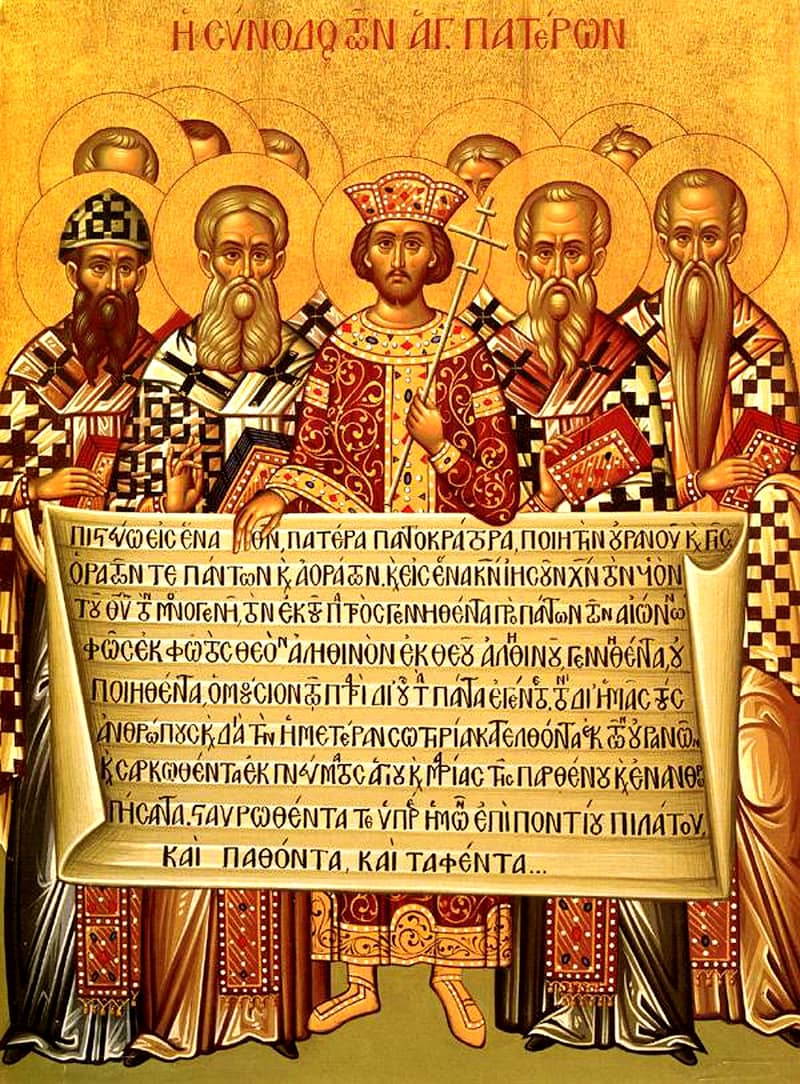
The Church responded at the Council of Nicaea (325 AD) by affirming that the Son is ὁμοούσιος, “consubstantial” with the Father. This term was crucial because it affirmed that the Son shares the same divine nature (οὐσία) as the Father. The Son is not a creature, however exalted. The Son is not derived in nature but truly God of truly God. The Council of Nicaea anchored this affirmation in John 1:1’s very grammar: the imperfect ἦν indicates that the Word’s being is eternal, and the predicate θεὸς affirms that the Word is fully divine.
Ironically, Nicaea’s victory over Arianism set the stage for a new error: Apollinarius of Laodicea, a committed anti-Arian, was so zealous in defending the Son’s full divinity that he denied Christ possessed a complete human nature—provoking the Church to clarify not only what it means for Christ to be God, but what it means for him to be truly human.
The tradition also clarified the meaning of “begotten.” The Son is begotten not in time but eternally. This is not a logical puzzle but a mystery: the Son eternally proceeds from the Father, yet both are eternal and both fully divine. The Father does not exist before the Son; they are coeternal. And the Spirit, too, participates in this eternal communion of the Trinity. There is no subordination of nature, only a real distinction of persons defined by their eternal relationships of origin.
2. Modalism/Sabellianism: “The Modes of One God”
What Modalism Taught
If Arianism addressed the problem by subordinating the Son, Modalism addressed it by collapsing the distinction between the persons. Modalism (also called Sabellianism after the early proponent Sabellius) taught that Father, Son, and Holy Spirit are not three distinct persons but three successive modes or manifestations of one divine person.
The Father is God as the Creator and Lawgiver of the Old Testament. The Son is God as the Redeemer and Revealer of the New Testament. The Spirit is God as the ongoing Sanctifier in the present and future. But there is only one divine person; these are masks God wears or roles God plays in different eras. It’s like an actor playing three different roles: the person is one, but the persona changes.
The appeal of Modalism was different from Arianism’s: it preserved absolute monotheism (literally, one person/one God). If your primary concern is avoiding any suggestion of polytheism, Modalism appears to solve the problem completely. But it does so at the cost of making the relationships within God illusory.
The Misreading of John 1
Modalism misread John 1:1 by conflating the first and second clauses. When John writes that the Word “was with God” (πρὸς τὸν θεόν), Modalism interpreted this as a relational illusion: God was speaking about himself, not relating to another person. The distinction was phenomenal, not ontological—a matter of God’s self-presentation, not of real personal difference.
More generally, Modalism struggled with the structure of John 1:1, which holds two apparently contradictory claims together: the Word was with God (suggesting distinction) and the Word was God (suggesting identity). John 1:2 reinforces this tension by restating the relational clause after the identity clause. A Modalist simply could not make sense of why John would repeat himself unless he was expressing different modes of the same divine person.
How the Church Responded
The Church responded by insisting on the real distinction of persons within the one divine nature. Modalism was condemned not because the Church wanted to import polytheism but because it made genuine relationship within God impossible. If Father, Son, and Spirit are not truly distinct persons, then the Son cannot truly relate to the Father in love and obedience. The incarnation cannot be God genuinely entering into human condition; it can only be a pretense.
The Church clarified that the three persons are really distinct, yet they share one divine essence. This real distinction is not a matter of different roles or modes but of eternal relationships. The Father eternally generates the Son; the Son is eternally generated by the Father; the Spirit proceeds eternally from both. These relationships are real and constitute the persons as genuinely distinct, yet they do not divide the divine unity because they are purely relational: each person is defined not by what is proper to that person alone but by how that person relates to the others.
John 1:1, read correctly, holds this together: the Word is distinct from God (πρὸς τὸν θεόν) and is fully God (θεὸς ἦν). Both realities are true. The Word is personally distinct, yet shares the divine nature. Verse 2 makes the point even more forcefully by saying the same thing twice, ensuring the reader does not collapse one truth into the other.
3. Adoptionism: “Jesus Became Divine at His Baptism”
What Adoptionism Taught
Adoptionism taught that Jesus was a human being—the son of Mary and (allegedly) Joseph—who was adopted into divine sonship at some point in his life, usually his baptism. At the moment of adoption, God declared Jesus to be his Son, empowering him with the Holy Spirit and enabling him to work miracles and eventually to ascend to heaven.
This view took seriously Jesus’s genuine humanity and his Jewish context. It avoided the appearance of imposing pagan myths (gods descending to earth) on the Jewish Jesus. But it did so at a cost: Jesus was not God except by adoption after his conception. He was not eternally divine. He was not the Word who existed “in the beginning” (ἐν ἀρχῇ).
Adoptionism came in several varieties. Some Adoptionists argued that Jesus was completely human until his baptism. Others, more nuanced, argued that Jesus was human but so perfectly aligned with God’s will that he deserved to be “adopted” into the divine family. But all forms shared the conviction that the divinity of Christ was conferred, not essential, and conferred at a point in time.
The Misreading of John 1
Adoptionists struggled with John 1:1–18 because the Prologue so clearly places the Word’s existence before the Incarnation, even before creation. “In the beginning was the Word” means before the beginning of creation, the Word already existed. The Incarnation (“the Word became flesh”) is not the beginning of the Word’s existence but the Word’s assumption of human flesh.
Adoptionists thus often rejected the Prologue as inauthentic or reinterpreted it heavily. Some argued that John 1:1–18 was a later Gnostic addition to the Gospel, not truly from John. But this move cannot be sustained textually or historically. John 1:1–18 is integral to John’s theology and appears in all manuscripts.
Others argued that “the Word” in John 1:1 refers not to the pre-incarnate Jesus but to God’s creative reason or divine power—a principle distinct from the historical Jesus. But this contradicts John’s explicit identification in 1:14: “the Word became flesh”—the very Word of verses 1–3 became the historical Jesus.
How the Church Responded
The Church affirmed what John 1:1–18 teaches: the Word is eternally divine; the Word who was God from the beginning is the one who became flesh in Jesus of Nazareth. Jesus’s humanity is real and complete, but it is the humanity of the Son of God, not a later addition to a merely human person.
The Council of Chalcedon (451 AD) was the culmination of the Church’s response to Adoptionism and related Christological errors. Chalcedon affirmed that Christ is “truly God and truly man, with a rational soul and a body, consubstantial with the Father as regards his divinity, and consubstantial with us as regards his humanity.” The union of divine and human natures in the one person of the Word is permanent, from conception to resurrection. Jesus is not a human who was adopted into divinity; he is the eternally divine Word who became human.
4. Ditheism/Bitheism: “Two Gods in Heaven”
What Ditheism Taught
Ditheism is the belief in two Gods. In the context of early Christian heresy, Ditheism arose from a misreading of texts that distinguished God from the Word or from the Spirit. If the Word is truly divine (θεός) and the Father is truly divine (θεός), and if they are truly distinct persons, does that not give us two Gods?
The question is not inherently foolish. It arises from taking seriously what Scripture says: that the Word is God, that the Spirit is God, and that they are distinct. The Arian heresy, by subordinating the Son, tried to avoid Ditheism by denying true divinity to the Son. But if one rejects Arianism and affirms that both Father and Son are truly God—then how does one avoid Ditheism?
The Misreading of John 1
Ditheists focused on the fact that John 1:1 twice uses the word θεός: once for the Word (“the Word was God”) and once for the Father in the phrase “with God” (πρὸς τὸν θεόν). Both are called God. Both are divine. The distinction clause (“with God”) seemed to indicate that they are two separate beings. Two Gods.
But this misses what John is doing grammatically and theologically. The use of the article ὁ in “the God” (τὸν θεόν) in the phrase πρὸς τὸν θεόν typically refers to the Father, the one God of Israel, the unique God who alone is God in the strict sense. The anarthrous θεός in “the Word was God” (θεὸς ἦν ὁ λόγος) is qualitative, affirming that the Word shares in the divine nature without claiming that the Word is numerically identical with the Father. John is not saying there are two Gods. He is saying the Word is fully divine, yet relationally distinct from the Father.
How the Church Responded
The Church responded by clarifying the concept of the Trinity. The Trinity is not tritheism (three Gods). Rather, there is one God in three persons. This means:
- One divine nature or substance (οὐσία) shared by all three persons.
- Three really distinct persons (ὑποστάσεις) defined by their eternal relationships to one another.
- Each person is wholly God—not one-third of God, but the fullness of divinity. (CCC §253)
The doctrine of the Trinity preserves both the monotheism of Israel and the New Testament witness to the distinction and divinity of Father, Son, and Holy Spirit. It does so by distinguishing between essence (what God is) and person (how the divine essence subsists). God’s essence is one and indivisible. God’s persons are three and really distinct.
This is not a compromise between monotheism and polytheism. It is the affirmation that the one God whom Israel worships exists eternally as three distinct persons in communion. The relational life within God (the κοινωνία of the Trinity) is not a problem to be solved but the deepest reality of God’s nature.
5. Docetism: “The Word Only Appeared to Become Flesh”
What Docetism Taught
Docetism comes from the Greek δοκεῖν, “to seem” or “to appear.” Docetism taught that the Word, being divine and immaterial, could not have genuinely assumed human flesh. Instead, the Word only appeared to be human. The incarnation was illusory—God in the form of a human appearance, not God genuinely becoming a human being.
Why would anyone hold such a view? Often because of philosophical presuppositions: the belief that the divine is immaterial and perfect, that matter is evil or defiling, and that God could never genuinely enter into material reality or human suffering. These presuppositions were central to Gnosticism, and Docetism seemed to preserve God’s transcendence and immutability.
But Docetism strikes at the heart of Christian faith. If the Word did not become flesh, then Jesus’s life, suffering, death, and resurrection are not God’s acts but divine pretense. Redemption becomes a cosmic illusion. The Christian claim that God entered into our condition, suffered for us, and rose from the dead—all of this collapses if Christ’s flesh is illusory.
The Misreading of John 1
Docetists seized on John 1:1–3, which emphasizes the Word’s preexistence and divine nature. The Word was God, eternal, the agent of creation. Then verse 14 says: “the Word became flesh.” Docetists reasoned: How can the eternally divine Word become flesh? Divine nature and material flesh are opposed. The Word cannot truly become what is opposed to its nature. Therefore, the Word must have only appeared to become flesh.
But this reading misses the very point John makes. John 1:14 uses the word σάρξ, “flesh,” not in a diminished sense (mere appearance) but as a biblical term for human existence in its materiality, vulnerability, and mortality. When John says the Word “became flesh,” he is affirming something radical: the eternal, divine Word genuinely entered into human existence, all the way—into the material body, the human limitations, even unto death.
Moreover, John emphasizes the reality of the incarnation: “we have seen his glory, glory as of the only Son from the Father, full of grace and truth” (John 1:14). The disciples saw the Word’s glory, not a phantom or illusion. They touched him (1 John 1:1). He ate and drank. He suffered. The incarnation was real.
How the Church Responded
The Church condemned Docetism as early as the First and Second Epistles of John (1 John 1:1–3, 2 John 7), which emphasize that the Word became genuinely flesh. The tradition insisted that the incarnation is not a divine illusion but God’s genuine assumption of human nature.
Yet the Church also had to clarify what genuine incarnation means. The Council of Ephesus (431 AD) and especially the Council of Chalcedon (451 AD) affirmed that in Christ, there are two complete natures—divine and human—united in one person (the Word). The human nature is real: Jesus had a real body, a real human soul, real human limitations and sufferings. The divine nature is real: Jesus is truly God, with all divine attributes and powers.
The union is neither a confusion (Docetism) nor a separation (Nestorianism, which denied a real personal union). The Word himself is the subject of both divine and human activities. The Word suffered on the cross, not in his divine nature (which is impassible), but in his human nature united to his divine person. This is what the tradition means by the communicatio idiomatum, the “exchange of properties”: the divine and human attributes belong to the one person of the Word, even though they belong to different natures.
A Comparison Table: The Five Heresies at a Glance
| Heresy | Chief Claim | Misreading of John 1 | The Error | Church’s Response |
|---|---|---|---|---|
| Arianism | The Son was created; there was when the Son was not. | Overemphasis on “with God” (distinction); underreading of “was God” (full deity). | Denies the Son’s eternal, essential divinity. | Council of Nicaea (325): The Son is ὁμοούσιος (consubstantial) with the Father. |
| Modalism | Father, Son, Spirit are three modes of one divine person. | Conflates the distinction clause with the identity clause; makes personal relationships illusory. | Collapses real personal distinction within God; undermines genuine relation. | Trinitarian theology: One essence, three really distinct persons. |
| Adoptionism | Jesus was a human adopted into divine sonship at baptism. | Rejects or reinterprets the preincarnate Word; denies that the Word became flesh in Jesus. | Jesus is not eternally the Son of God; divinity is conferred, not essential. | Council of Chalcedon (451): The eternally divine Word became human; his divinity is essential. |
| Ditheism | The Word and the Father are two separate Gods. | Takes the use of θεός for both Word and Father as indication of numerical plurality. | Undermines monotheism; fails to distinguish essence from persons. | Trinity: One divine nature shared by three distinct persons. |
| Docetism | The Word only appeared to become flesh; incarnation is illusory. | Overemphasizes the Word’s divinity and eternity; denies the reality of σάρξ (flesh). | Denies the reality of the incarnation; undermines redemption. | Chalcedon: Two complete natures (divine and human) united in one person. |
Lessons for Reading John 1 Aright
What does John 1:1–18 really teach? And how do we avoid these pitfalls?
1. Hold Distinction and Identity Together
John 1:1 holds together two seemingly contradictory claims: the Word is with God (πρὸς τὸν θεόν), implying distinction, and the Word is God (θεὸς ἦν ὁ λόγος), implying identity. The reader must resist the temptation to collapse one side into the other. The Word is not mere distinction from God (as Ditheism suggests) and not mere identity with God (as Modalism suggests). The Word is truly God and truly distinct from the Father. This is the mystery the Church would later articulate as the Trinity.
2. Pay Attention to Tense and Grammar
The imperfect tense ἦν in John 1:1 (ἦν ὁ λόγος, “the Word was”) indicates continuous existence in past time, not a beginning in time. The Word did not become; the Word was. This grammar supports the tradition’s affirmation of the Word’s eternity against Arianism and Adoptionism. The anarthrous θεός in the predicate position (θεὸς ἦν ὁ λόγος) affirms the Word’s divine nature without claiming numerical identity with the Father—supporting the tradition’s affirmation of real personal distinction against Modalism and supporting the rejection of Ditheism, which would require an articulate θεὸς or some indication of numerical plurality.
3. Read the Incarnation as Real
John 1:14 says the Word “became flesh” (ὁ λόγος σάρξ ἐγένετο). This is not pretense. The eternal Word genuinely assumed human flesh. This supports the tradition’s rejection of both Adoptionism (which denies the Word’s eternal divinity) and Docetism (which denies the reality of the flesh). The Word who was eternally God became genuinely human.
4. Recognize That Mystery Requires Developed Language
John 1:1 presents the reality of the Trinity but not the fully articulated doctrine. The Church did not invent the Trinity; it developed the vocabulary—οὐσία, ὑπόστασις, person, nature—to protect what Scripture already taught. This development was not a departure from Scripture but a faithful unfolding of its implications. Reading John aright means being willing to engage the tradition’s theological language as an aid to deeper scriptural understanding, not as a replacement for Scripture.
Frequently Asked Questions
Were all five of these heresies actually widespread?
Arianism was widespread, especially in the fourth century, and threatened to become the dominant form of Christianity. Modalism was condemned early (around the time of Tertullian, c. 160–220 AD) and again at the Council of Rome (262 AD) but persisted in various forms. Adoptionism was particularly influential in the second and early third centuries (Jewish Christianity often held to it; the Ebionites are a clear example). Ditheism was not as much a distinct heresy as a danger that the Church had to carefully navigate in articulating the Trinity. Docetism was especially prevalent in Gnostic circles and is explicitly condemned in 1 John.
Did Jesus ever claim to be God?
In the Synoptic Gospels (Matthew, Mark, Luke), Jesus does not use the explicit language “I am God.” However, he claims divine prerogatives: forgiveness of sins, authority over the Sabbath, the right to be worshipped. In John’s Gospel, Jesus makes more explicit claims, using the divine name “I am” and saying “I and the Father are one.” These statements were understood by his contemporaries as claims to divinity (see John 10:33, where the Jews charge: “you, being a man, make yourself God”).
How does the Church distinguish between monotheism and Trinitarianism?
Monotheism is the belief that there is one God. Trinitarianism is the belief that the one God exists eternally as three distinct persons: Father, Son, and Holy Spirit. The Trinity does not compromise monotheism; it clarifies it. God’s essence or nature (what God is) is one and indivisible. God’s personhood (how God subsists or exists) is threefold. There is one divine nature shared by three distinct persons, much as (imperfectly) one human nature is shared by billions of human persons.
Can the doctrine of the Trinity be proven from Scripture alone?
The word “Trinity” does not appear in the Bible. But the reality—that God is Father, Son, and Holy Spirit; that all three are divine; that all three are distinct—is woven throughout the New Testament. The Church developed precise philosophical language to articulate this reality, but the doctrine is rooted in Scripture, not imposed on it from outside.
Why does the Church insist on precise theological language?
Because precision guards against error. When we say the Son is ὁμοούσιος with the Father, we are protecting a specific truth: that the Son shares the divine nature with the Father, not in a derived or subordinate way, but truly. When we say there are three persons in one nature, we distinguish the Trinity from both Modalism and tritheism. Theological language is like a fence: it marks out the boundaries of what Scripture teaches and protects against dangerous errors.
For Further Study
John 1:1 and the Grammar of Divine Identity — A detailed exegesis of the foundational verse.
John 1:2: This One Was in the Beginning with God — How John resists both Modalism and Ditheism through structure and grammar.
A Glossary of Greek Terms in John 1:1–18 — Understanding the key words and their theological significance.
The First Council of Nicaea: What It Decided and Why It Matters — The Church’s response to Arianism.
The Council of Chalcedon — The Church’s clarification of the two natures of Christ.
The Holy Trinity Explained: A Catholic Guide — A comprehensive introduction to Trinitarian doctrine.
Modalism: The Heresy That Collapsed the Persons of God — An extended treatment of Modalism and its dangers.
Apollinarius and His Heresy — Another Christological error and how the Church answered it.
Scholarly Sources
- Lewis Ayres, Nicaea and Its Legacy: An Approach to Fourth-Century Trinitarian Theology (Oxford: Oxford University Press, 2004)
- Khaled Anatolios, Retrieving Nicaea: The Development and Meaning of Trinitarian Doctrine (Grand Rapids: Baker Academic, 2011)
- Jaroslav Pelikan, The Christian Tradition: A History of the Development of Doctrine, Volume 1: The Emergence of the Catholic Tradition (100–600) (Chicago: University of Chicago Press, 1971)
- Rowan Williams, Arius: Heresy and Tradition, 2nd ed. (Grand Rapids: Eerdmans, 2001)
- J.N.D. Kelly and J.F. Macdonald, The Oxford Dictionary of Popes (Oxford: Oxford University Press, 2005) [for historical context]
- Alister E. McGrath, Christian Theology: An Introduction, 6th ed. (Chichester: Wiley-Blackwell, 2016), chs. 4–6 on Christology and the Trinity
- Raymond E. Brown, The Gospel According to John I–XII, Anchor Bible 29 (New York: Doubleday, 1966), introduction and commentary on 1:1–18
- Craig S. Keener, The Gospel of John: A Commentary, 2 vols. (Peabody: Hendrickson, 2003), commentary on 1:1–18
- Catechism of the Catholic Church, 2nd ed. (Vatican City: Libreria Editrice Vaticana, 1997), §§465–469 (the Incarnation) and §§252–256 (the Trinity)
Footnotes
1. On Arius and Arianism, see Rowan Williams, Arius: Heresy and Tradition, 2nd ed. (Grand Rapids: Eerdmans, 2001), which argues that Arius was not as irrational or deviant as later tradition often portrayed him, but was attempting to solve a genuine theological problem. However, Williams also shows how Arius’s solution compromised the full biblical witness.

Garrett Ham
Garrett Ham is an attorney, military veteran, and holds a Master of Divinity from Yale Divinity School. He writes from Northwest Arkansas on theology, law, and service.
More about Garrett →Related Posts
John 1:6 Meaning Explained: There Came a Man, Sent from God
What does John 1:6 mean? A Catholic exegesis of the Greek—the ἦν/ἐγένετο contrast, the perfect participle ἀπεσταλμένος, and John the Baptist as witness.
John 1:2 Meaning Explained: This One Was in the Beginning with God
What does John 1:2 mean? A close reading in the original Greek — why the repetition guards against Modalism and polytheism, and what it reveals about God.
The Gospel of John Prologue: A Verse-by-Verse Series
A Catholic verse-by-verse commentary on the Prologue to John's Gospel (John 1:1–18) — exploring the Greek text, Trinitarian theology, and the Church's doctrinal tradition.
Stay Informed
Get new writing on faith, law, and service delivered to your inbox.
No spam. Unsubscribe anytime.