Beyond Anselm: Christus Victor in Romans 5:18
On This Page
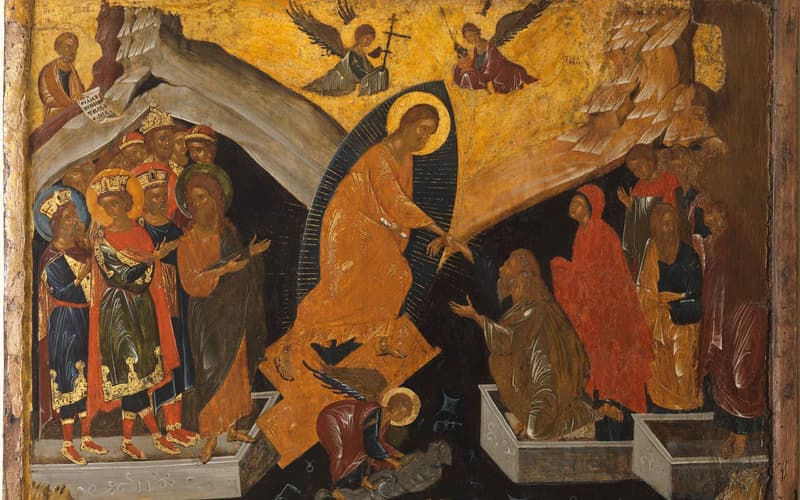
Romans 5:18 sets Adam’s one transgression against Christ’s one righteous act and names the result: “acquittal and life came to all.” Read in context, Paul’s “all” reaches every person, and its point is that Jew and Gentile stand before God on equal footing. The result is legal and cosmic at once: acquittal before God and deliverance from the reign of death. That is why the ancient Christus Victor tradition, joined to the satisfaction theology Anselm gave the West, frames Paul’s argument far better than the penal substitution theory of the Reformation. Scripture and the Church affirm that Christ took our place (CCC 615); they do not teach that the Father punished the Son in our place. True substitution belongs within the larger frame of God’s victory.
Romans 5:18
In conclusion, just as through one transgression condemnation came upon all, so through one righteous act acquittal and life came to all.
In verse 18, Paul completes a sentence he began in verse 12 and left unfinished: “Therefore, just as through one person sin entered the world, and through sin, death, and thus death came to all, inasmuch as all sinned” (5:12). Carefully balancing two parallel clauses, he now argues that just as one person’s transgression brought condemnation, so one person’s righteous act brings acquittal.1
Identity, for Paul, is grounded in faith, not culture or ethnicity.
Notice what Paul does here. He drops all talk of ethnic distinctions—the categories that have so vividly defined his writing up to this point—and gathers everyone under the single banner of “men”2 (“all” in the NABRE).
Paul addresses ethnic distinctions at such length in Romans because the situation in Rome required it. The Roman church had been shaken by the expulsion of Jews from the city under Claudius and by their later return;3 a largely Gentile congregation was now tempted to look down on its Jewish brothers and sisters (11:13–25), even as disputes over food and holy days divided the “weak” from the “strong” (14:1–15:13). (I trace that situation in detail in my study of Romans 9–11.)
Paul does not pretend the distinction between Jew and Gentile is unreal: the gospel is “to the Jew first and also to the Greek” (1:16), and the advantage of the Jew is “much, in every way” (3:2). What he refuses is to let that distinction become a claim of privilege before God. His real aim is to break the hold of such categories on his audience, hoping they will abandon an ethnic self-understanding and see themselves simply as “Messiah-people.”4 Identity, for Paul, is grounded in faith, not culture or ethnicity.5
This is the argument he has been building since chapter one. All people, Jew and Gentile alike, stand in relation to one of two men, aligned either with Adam and the condemnation that sin brings or with Christ and God’s saving work.6 Through Adam’s transgression, condemnation has come to all people, thereby dismantling any claim to ethnic privilege before God and setting the stage for the universal scope of Christ’s work.7
The Scope of Paul’s “All”
Modern theological assumptions can easily obscure what Paul is doing here. He argues that Adam’s sin brought universal condemnation, then writes that “acquittal and life came to all.” Read as an exposition of individual salvation, this verse could support universalism—and some have read it that way.8 If Adam’s disobedience brought universal condemnation, the logic goes, Christ’s righteousness must bring universal justification.
This reading, however, misunderstands Paul’s purpose, projecting modern Western individualism back onto the text.9 Paul is not primarily concerned with the eternal destiny of individual persons, and that debate is out of place here. Even the “we” of 5:1–11 (“since we have been justified by faith, we have peace with God,” 5:1) is the “we” of a community: Jew and Gentile together, the family of Abraham, “the father of all of us” (4:16). That community is made up of persons, of course, and each must receive the gift. The passage itself draws that line: it is “those who receive the abundance of grace” who “come to reign in life” (5:17). The text answers universalism on its own terms, without our importing a later debate into it.
What, then, does Paul mean by “all” (literally, “all men”)? Just as some have cited this verse for universal salvation, others have used it chiefly as a proof text for universal sinfulness. Both miss the point of Paul’s argument. The scope of “all” is universal on both sides: every person stands in Adam, and Christ’s act reaches every person. But Paul’s point in pressing that universality is that no one, Jew or Gentile, stands outside it. All men “without ethnic distinction” were made sinners, an argument that fits squarely within the letter’s larger theme.10 (The Church finds universal sinfulness taught in this very passage. The ethnic question is not an alternative to that universality; it is why Paul insists on it.) On Christ’s side, the gift is universal in its reach, but, as verse 17 makes clear, it must be received.
Verse 19 makes the same point in different words: “For just as through the disobedience of one person the many were made sinners, so through the obedience of one the many will be made righteous.” Paul’s “the many” is not a smaller group than the “all” of verse 18. The Catechism reads the verse as “many (that is, all men)” (CCC 402), and, of the parallel “many” in Jesus’ ransom saying, it notes that the term “is not restrictive, but contrasts the whole of humanity with the unique person of the redeemer” (CCC 605). Paul changes his vocabulary without narrowing his scope.
The Reign of Death
Paul’s emphasis in this passage falls less on how Adam’s sin is passed on than on what it set loose: death, reigning over the whole human race. The distinction matters.
The Western Church, following Augustine, holds that original sin is transmitted by propagation, not by imitation. The Council of Trent defined this as dogma (Session V, 1546), and the Catholic Church continues to teach it (CCC 388–390, 396–409). The Eastern Christian tradition, while affirming the universality of sin and death, has historically understood the transmission differently, emphasizing what it calls “ancestral sin”: the inheritance of mortality and a disordered condition. The difference is often misdescribed as a dispute over personal guilt, but Catholic teaching does not hold Adam’s descendants personally guilty for his act either. Original sin, the Catechism explains, is “contracted” and not “committed,” and it “does not have the character of a personal fault in any of Adam’s descendants” (CCC 404–405).
The point here is not to adjudicate between these traditions. Paul does not describe the mechanism by which Adam’s sin passes from one generation to the next;11 his emphasis falls instead on the fact that sin always ends in death.
The best-known crux in the passage illustrates the difficulty. Paul writes that death came to all, ἐφ’ ᾧ (“inasmuch as”) all sinned (5:12). The Latin Vulgate rendered the phrase in quo, “in whom,” and Augustine read it to mean that all humanity sinned in Adam. Many modern exegetes, Catholic scholars among them, take the Greek instead as a conjunction: “because,” or, in Joseph Fitzmyer’s careful study, “with the result that.”12
None of this unsettles Catholic doctrine. The Council of Trent cited Romans 5:12 in its decree on original sin and taught that the verse must be understood as the Catholic Church has always understood it (Session V, canons 2 and 4), and the Catechism reads the whole passage as the Apostle’s witness that “all men are implicated in Adam’s sin” (CCC 402). The doctrine never rested on a single preposition. What the exegetical debate clarifies is where Paul’s own emphasis falls: on the reign of death that entered with Adam, and on its defeat in Christ.
That language of reign is Paul’s own. The verb he uses, βασιλεύω (“to reign”), runs through the passage. Death “reigned from Adam to Moses” (5:14) and “came to reign through that one” (5:17); sin “reigned in death” (5:21). Against these tyrants Paul sets a rival reign: grace will “reign through justification for eternal life” (5:21), and “those who receive the abundance of grace” will themselves “come to reign in life” (5:17). Here sin (ἁμαρτία) and death appear not as abstractions but as rulers. The next chapter continues the picture: death “no longer has power over” the risen Christ (6:9), “sin must not reign over your mortal bodies” (6:12), and believers have been “freed from sin” (6:18). This is the vocabulary of Christus Victor, and it appears in Romans 5 itself. Verse 18 gathers both sides of the story into a single phrase: Christ’s righteous act brings “acquittal and life”—the verdict before God and deliverance from the reign of death.
All Peoples, Without Distinction
Paul’s “all,” then, reaches every person, and its purpose is to show that Jew and Gentile stand before God on the same terms. It is not a promise that every individual will in fact be saved. The Church is clear that Christ died for all without exception (CCC 605); Paul’s point here is that the gift is offered to Jew and Gentile alike. The passage itself shows why. Death “reigned from Adam to Moses” (5:14), that is, before the Torah was given, and the law itself “entered in so that transgression might increase” (5:20). Adam’s problem is older than Israel’s law, so possessing the law cannot exempt anyone from that problem. Paul has already drawn the conclusion: God “is one and will justify the circumcised on the basis of faith and the uncircumcised through faith” (3:30), and Abraham is both “the father of all the uncircumcised who believe” and “the father of the circumcised” who share his faith (4:11–12). Just as the sin of Adam condemns all, regardless of ethnicity, so also the grace of Christ extends to every people, Jew and Gentile alike.13 Paul’s “universalism is of the sort that holds to Christ as the way for all.”14
Paul subverts the division of the world into Jew and Gentile by dividing it instead between those who put their faith in Jesus Christ and those who do not—a criterion that transcends ethnicity entirely. Jews and Gentiles alike are affected by sin and death; salvation through Jesus Christ is offered to both on the same terms. The universal reach of Paul’s gospel—the dismantling of ethnicity as the measure of belonging to God’s people—is central to his treatment of predestination and election in Romans 9–11, where he addresses Israel’s place in the economy of salvation.
In effect, Paul rejects any claim that ethnicity defines covenant membership. God’s plan of salvation requires neither a particular ethnic identity nor the observance of distinctive cultural customs.15
Christ’s “Righteous Act”
Paul points to Christ’s death—His “righteous act”—as the event that ushers in a new era. The “one act” of verse 18 is the cross; to read it as a reference to the entire life of Christ would blur the verse’s carefully balanced contrast and its echo of 3:24–26.16 But verse 19 names what that act was: “obedience” (ὑπακοή). Christ humbled Himself, “becoming obedient to death, even death on a cross” (Phil 2:8). The cross is the one act, and it is the culmination of a whole life of obedience. It can be singled out, but it cannot be cut off from the life that led to it.
To present only two options—confining Christ’s redemptive work entirely to the cross, or viewing His life as a mere moral example—is to create a false dichotomy. We should be wary of our modern Western tendency to isolate Christ’s death from the rest of His life. Paul does not do so: those “reconciled to God through the death of his Son” will be “saved by his life” (5:10).
The word “transgression” (παράπτωμα) in verse 18 is itself revealing. The same Greek word appears in Romans 11:11—“Hence I ask, did they stumble so as to fall? Of course not! But through their transgression [italics added] salvation has come to the Gentiles, so as to make them jealous”—and Galatians 6:1a—“Brothers, even if a person is caught in some transgression [italics added], you who are spiritual should correct that one in a gentle spirit.”17
In the Septuagint, the word most often denotes conscious, deliberate sin against God,18 though its semantic range also includes unintentional error and negligence. Outside Paul’s writings, it appears in the critical text of the New Testament only in the parallel passages of Matthew 6:14–15 and Mark 11:25, where it emphasizes the nature of the act along with its consequences. (In Romans 5:20 the word describes the transgression multiplied across the human race, an outworking of Adam’s own.) In the context of Romans 5, where Paul is describing Adam’s primal act of rebellion, the connotation of deliberateness is particularly apt—though the word itself does not always carry this force.19
The word is also comparatively rare, appearing only about twenty times in the New Testament—far less than the more generic word for sin, ἁμαρτία.20 Paul’s choice underscores the gravity of mankind’s rebellion against God, a rebellion that necessitated a decisive righteous act by the Messiah. In Romans 5, moreover, Paul keeps the two words apart. He uses παράπτωμα for Adam’s act (5:15, twice; 5:16, 17, 18, 20) and ἁμαρτία for the power that act let loose: the sin that “entered the world” (5:12) and “reigned in death” (5:21). The transgression was a single act of rebellion; sin is what it enthroned. Christ’s one act of obedience answers Adam’s one transgression, and in doing so it breaks the reign that Adam’s transgression began.
Christ’s obedience is also God’s own faithfulness. Paul presents the cross as a great act of covenant fidelity, in which God, through Jesus Christ, addressed the problem of sin and opened salvation to all who would be justified through faith. The result is the renewal of individuals of all ethnicities: not merely a change of status from “condemned” to “saved,” but a transformation into “God’s true humanity,” His new creation.21
The Spiritual Warfare Worldview Behind Paul
Romans itself supplies the vocabulary of this victory. Death and sin reign (5:14, 17, 21). Creation “was made subject to futility” and waits to “be set free from slavery to corruption” (8:20–21). Paul names “angels,” “principalities,” and “powers” among the forces that cannot separate us from God’s love (8:38–39). And he closes the letter with the promise that “the God of peace will quickly crush Satan under your feet” (16:20), an unmistakable echo of Genesis 3:15. Behind these lines stands a worldview wider than modern readers tend to acknowledge, and to see it we must step back from two thousand years of theological development that have shaped our reading of this passage.
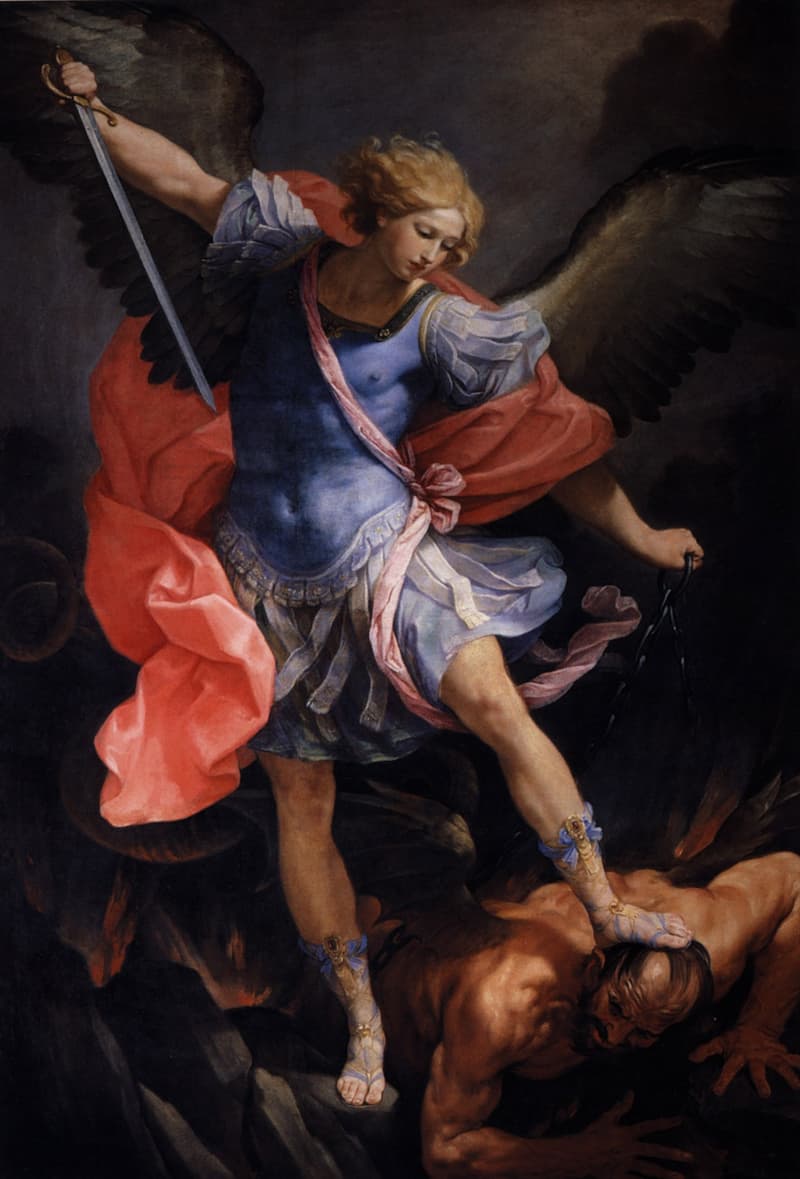
The conviction that the world is contested by hostile spiritual powers, though foreign to post-Enlightenment Western societies, runs throughout the Jewish world in which Paul was formed. The Book of Wisdom, which the Church receives as Scripture, traces death itself to the devil: “by the envy of the devil, death entered the world” (Wis 2:24), a close parallel to Romans 5:12. The Watchers of 1 Enoch, the Mastema of Jubilees, and the Qumran War Scroll’s battle between the “sons of light” and the “sons of darkness” reflect the same conviction.22 Nor is it peculiar to Judaism: some such belief has been a nearly universal feature of human cultures. This perspective underpins Paul’s argument here. Behind his teaching on God’s plan of salvation lies an understanding of the world as a spiritual battlefield.23
To reduce the teaching of Romans to a purely legal scenario—a meritorious act of one overcoming the infraction of another—is to miss the cosmic significance that Paul attaches to Christ’s work.24 What kind of victory, then, does Paul mean? To answer that, we must first examine the lens through which we read him.
Reading Past Our Inherited Lens
Mixing systematic theology with exegesis is always risky. We read Scripture through the lens of our theological systems, approach the text with preconceived conclusions, and can easily miss the author’s intended message.
Sometimes, however, the lens is so familiar that we forget we are wearing it, and we must step back to ask whether we are reading the text or merely confirming what we already believe. As N. T. Wright puts it, “You don’t look at your spectacles until looking through them becomes difficult.”25 I believe this is precisely the case with the modern Western reading of the atonement in Paul. (For a broader overview of the Christus Victor model and its place in the Christian tradition, see my companion essay.)
The First-Millennium Worldview
Belief in the ubiquity of spiritual warfare was common in the first century and remained so within the Church for at least the first millennium.26 Origen’s argument that every particular aspect of the earth is under “the agency and control of certain beings whom we may call invisible husbandmen and guardians”27 reflects this mindset. To read Paul without it is to read him without the theological air he breathed.
Adam’s Fall as Cosmic Rebellion
Underpinning Paul’s understanding of the atonement is the view that Adam, as God’s viceroy of creation, unleashed devastation when he rejected God’s lordship. Man, created to rule, subjected himself to the destructive forces that oppose God’s reign.28
The temptation of the serpent was not an arbitrary act of cruelty but an act of war against God, drawing man into cosmic rebellion. Adam’s transgression was an infraction, but it was more than that. It was a fall in the cosmic sense—an existential threat to all creation.
Adam’s rebellion allowed God’s enemies to take the world hostage, setting up Satan as “the ruler of this world” and “the ruler of the power of the air” (cf. John 12:31; Eph 2:2; 6:12; 1 John 5:19). Into this situation Christ came. God, taking the form of man, fulfilled His own command to subdue the earth. Through His teaching, ministry, death, and resurrection, He vanquished Satan and restored human beings to their place as God’s viceroys on earth.29
How did He vanquish the powers? Paul does not set victory against the forgiveness of sins. In Colossians the two are a single act. God, “having forgiven us all our transgressions”—παραπτώματα, the plural of the word Paul uses for Adam’s transgression—was “obliterating the bond against us, with its legal claims”; He “removed it from our midst, nailing it to the cross,” and, “despoiling the principalities and the powers, he made a public spectacle of them, leading them away in triumph by it” (Col 2:13–15). Hebrews says the same: through death Christ destroyed “the one who has the power of death, that is, the devil,” and set free “those who through fear of death had been subject to slavery all their life” (Heb 2:14–15). The powers held humanity by its guilt. When the bond that stood against us was obliterated, their claim was broken. Victory and forgiveness are not rival accounts of the cross but one event seen from two sides.
Adam’s transgression was an infraction, but it was more than that. It was a fall in the cosmic sense—an existential threat to all creation.
To Paul, sin and death are not mere ideas or abstract concepts. They are objective powers that Christ defeated to set man free.30
Within this framework, the entire life and ministry of Christ demonstrates a profound unity of purpose. His seemingly disconnected activities—exorcisms, healings, and miracles, as well as His death and resurrection—take on new coherence as acts of war.31 If, as Origen suggested, “famine, blasting of the vine and fruit trees, pestilence among men and beasts … are the proper occupations of demons”32 then “[e]very healing, exorcism, or raising of the dead is a loss for Satan and a gain for God.”33
Atonement, in this view, is an all-inclusive cosmic act, extending to all creation.34
Atonement as Cosmic Act
Atonement and Incarnation are therefore inseparable.35 Christ’s atoning work may have culminated at the cross, but it cannot be limited to it.36 Consider an analogy. Passing the bar exam is the final step that makes a person a lawyer, but what makes him a lawyer is not limited to that event. You cannot isolate the exam from the rest of his education, or reduce his education to mere preparation for the exam, without misunderstanding the whole process of becoming an attorney. As Joseph Ratzinger argued, a sound Christology demands that the theology of the cross become one with the theology of the Incarnation.37 Thomas Aquinas makes the same connection from the other direction: “from the beginning of His conception Christ merited our eternal salvation,” and the Passion was needed to remove the obstacles on our side that kept that merit from taking effect.38 To miss this central aspect of Pauline theology is to miss the passage.
This does not mean Paul packs all of this atonement theology into Romans 5. It means we cannot appreciate the cosmic significance he assigns to the work of Christ without understanding the framework that governs his thought. Paul saw the atonement as Christ’s deliverance of humanity from the evil that held it in bondage39—a defeat of “the principalities and the powers” (Col 2:15).40
Christ came as the true Adam, reversing the Adamic curse by succeeding where Adam failed and, as the true Israelite, carrying the message of salvation to the whole world.
Anselm’s Question: Why God Became Man
In reading Paul, we must look behind some of the later theological developments that have shaped—and at times narrowed—our understanding of the atonement.41 Chief among these is the influence of Anselm of Canterbury’s eleventh-century masterwork, Cur Deus Homo. Anselm, whom the Catholic Church rightly honors as a Doctor of the Church, sought to provide a more rationally rigorous account of why the Incarnation was necessary, moving beyond what he considered the cruder ransom imagery that had become associated with the Christus Victor tradition.42 In denying that the devil had any just claim on humanity, he corrected real excesses in that imagery.43 Scholars have long debated the background of his categories. R. W. Southern influentially read them against the feudal world of Anselm’s day,44 while more recent readers, such as David L. Whidden, trace his language of honor, obedience, and order to Benedictine monastic life.45
Anselm’s contribution to atonement theology is substantial. His rigorous logical method advanced the Western theological tradition in important ways, and the Catechism itself incorporates satisfaction language when discussing Christ’s redemptive sacrifice (cf. CCC 615–616). The difficulty is not with Anselm’s theory per se but with its subsequent dominance. Over time, his framework became so central in the West that it effectively displaced the earlier, more cosmic understanding of Christ’s work that, on Gustaf Aulén’s influential account, had prevailed for the first millennium. It is this displacement, not the theory itself, that distorts our reading of Paul. Anselm did not intend that result; his project was more carefully circumscribed than his critics often acknowledge.
Anselm’s argument deserves to be stated in his own terms. Sin, for Anselm, is the failure to render God the honor due to Him. God’s honor cannot be diminished in itself (“nothing can be added to or taken from the honor of God”), but sin violates the right order and beauty of creation, and God cannot simply leave that disorder standing. Hence Anselm’s famous principle: “satisfaction or punishment must needs follow every sin.”46 Satisfaction, in other words, is the alternative to punishment, not a form of it. Humanity owes the debt, but only God can pay it, so the satisfaction must be made by one who is both God and man. The Son makes it freely. The Father “did not compel him to suffer death,” and Christ, being sinless and so not bound to die, “freely offered to the Father what there was no need of his ever losing.”47 Because that gift exceeds anything owed, it merits a reward, which the Son gives to those for whom He became man.
Anselm’s own question was why God became man; the Incarnation stands at the center of his book. But because his argument turned on the necessity of Christ’s death, the tradition that followed him tended to make the cross the nearly exclusive locus of atonement, and the Incarnation receded into the background as the means by which atonement was made possible rather than an integral part of the saving act itself.48
This framework still shapes Western Christianity, though in modified form. As the law of the state replaced the honor of the ruler as the foundational civic authority, Anselm’s satisfaction theory gave rise to what we now call penal substitution—a distinct theory and, in important respects, a departure from Anselm, since it turns the satisfaction that Anselm offered as the alternative to punishment into punishment itself. Substitution itself is far older than either theory. Athanasius wrote that the Word yielded His body “to death in the stead of all,” and Eusebius that the Lamb of God “suffered a penalty He did not owe.”49 What the Reformation era added was the systematization of those themes in penal terms. Penal substitution often finds expression in statements about Christ’s taking our place and bearing the punishment for our sins.50
Beyond Penal Substitution
Paul does discuss themes of satisfaction and substitution, and they are important. God “set forth” Christ “as an expiation, through faith, by his blood” (Rom 3:25). The Greek word behind “expiation” is ἱλαστήριον, the word the Greek Old Testament uses for the mercy seat, where the blood was sprinkled on the Day of Atonement (Lev 16:14–15). In Romans 5 itself, Paul writes that, “since we are now justified by his blood,” we will much more surely “be saved through him from the wrath” (5:9), and that “while we were enemies, we were reconciled to God through the death of his Son” (5:10). God “condemned sin in the flesh” (8:3). The Church reads Romans 5 in exactly this light: the Catechism cites verse 19 to teach that Jesus “atoned for our faults and made satisfaction for our sins to the Father” (CCC 615). None of this can be set aside.
But notice who acts in these texts. It is God who puts Christ forward (3:25). It is God who condemns sin, the ruling power, in the flesh of His Son (8:3). And the wrath from which we are saved is met by God’s own provision, not placated by a payment from outside. Satisfaction and substitution are real, but they are aspects of a much larger narrative: the story of God’s victory over the powers that held His creation captive. Missing this distorts Paul’s teaching and robs his letters of their power.
Here penal substitution parts ways with both Anselm and the Catholic faith. As John Calvin formulated it, Christ on the cross “endured the death which is inflicted on the wicked by an angry God,” and He “bore in his soul the tortures of condemned and ruined man.”51 The Catholic Church cannot accept that account. Jesus “did not experience reprobation as if he himself had sinned”; He suffered in “the redeeming love that always united him to the Father” (CCC 603). The Son did not endure the torments of the damned in our place, and His satisfaction is not a sentence of punishment transferred from the guilty to the innocent. For Anselm, satisfaction is the alternative to punishment, and Aquinas, as we will see, grounds its value first in the love and obedience with which the Son offered His life. Joseph Ratzinger rejected the devotional image of a God whose unrelenting justice demanded the sacrifice of His own Son: “This picture is as false as it is widespread.”52 Where penal substitution departs from Anselm, it departs from Catholic teaching as well.
Many evangelicals would not put the matter as starkly as Calvin did. John Stott rejects the caricature of an angry Father placated by a loving Son as firmly as anyone, and describes the cross instead as “the self-substitution of God.”53 Yet even in this gentler form, penal substitution keeps its defining claim: that on the cross God inflicted on His Son the punishment due to sinners. That is where Catholic teaching parts ways with it. The cross is not primarily a movement from below to above, a sacrifice brought to God to satisfy His wrath. Christ does truly offer His life to the Father, but the Catechism is careful to say that His sacrifice is first of all “a gift from God the Father himself” (CCC 614). The cross is, above all, God’s movement toward us—“the expression of that foolish love of God’s that gives itself away to the point of humiliation in order thus to save man.”54 As Clark Pinnock puts it, “the cross reconciles the world to God, not God to the world” (cf. 2 Cor 5:19).55
Anselm’s framework, for all its brilliance, tends structurally in the opposite direction. By centering Christ’s accomplishment on what He achieves as man in restoring God’s honor, the logic of the satisfaction model can obscure God’s role as both Reconciler and, in Aulén’s terms, the Reconciled. God is not won over by someone else’s offering; He reconciles the world to Himself through His own act. Aulén and others have argued that this structural tendency makes a certain isolation of Christ’s death from the rest of His life and ministry—and, to some extent, from His resurrection—difficult to avoid.56 The Catholic tradition itself shows another way. Thomas Aquinas, who gave satisfaction its classic scholastic form, grounded it in love: Christ atoned “by suffering out of love and obedience.” In the very next question, Thomas asks “whether we were delivered from the devil’s power through Christ’s Passion” and answers that we were.57 For Thomas, satisfaction and victory are two aspects of a single saving act. That is the synthesis this essay commends.
Grace, Not Merely Justice, Governs God’s Movement
Paul’s Christology embraces the entire life of Christ, not just His death.58 For Paul, the atonement is not merely about satisfying the demands of divine justice. In this new order, the relationship between God and man is governed by grace, the grace from which even our merits flow.59 As I explore in my discussion of the Word in John 1:1, the Incarnation itself carries profound theological significance.
Too often, modern accounts of Christ’s atoning work reduce the divine-human relationship to a legal transaction governed by Western notions of justice. But Christ’s conquest of the powers that enslave creation shows that salvation comes through a mercy that exceeds the demands of justice. God is indeed just—but His justice transcends our legalistic categories.60
Cosmic Reconciliation
Because Anselm’s project in Cur Deus Homo was deliberately narrow—answering the specific question of why God became man—it did not address the cosmological dimensions that the Fathers had traditionally associated with the atonement. The result, over time, was a Western theology that treated human sin as if it were the only problem in the cosmos.
Too often, modern accounts of Christ’s atoning work reduce the divine-human relationship to a legal transaction governed by Western notions of justice.
The individual dimension of salvation matters. But the cosmic significance of Christ’s life, death, and resurrection is more ontologically fundamental, because what Christ’s atoning work means for the individual can be appreciated only in light of the cosmic victory it won.
To Paul, sin is not an abstract, impersonal force but a highly personal power associated not just with lawbreaking but with every evil that oppresses and enslaves creation.61 Man’s reconciliation to God belongs within the reconciliation of all creation (cf. Col 1:15–22; CCC 668, 1043–1050).62
The Abrahamic Covenant and Romans 5
This returns us to the passage at hand, and to the chapter that precedes it. Paul places the Adam–Christ contrast directly after his long exposition of Abraham, because the thrust of his argument is that God called Abraham to address the problem of Adam’s sin.63 The promise to Abraham was not a promise of land alone. It was the promise “that he would inherit the world” (4:13), and it made him “the father of all of us” (4:16) and “father of many nations” (4:17). In that one promise, the two threads of this essay meet. Abraham’s family is drawn from every nation, so no ethnicity can claim it; and Abraham’s inheritance is the whole κόσμος (“world”), so nothing less than the undoing of Adam’s fall can fulfill it.
Paul’s argument throughout Romans is that Christ came not merely to save individuals but to fulfill the purpose of the Abrahamic covenant: to set right what Adam set wrong. When we reduce Romans to a systematic gospel of the individual, a roadmap for personal salvation, we miss Paul’s larger message: that God has been true to His promises to Abraham and, consequently, “that the long entail of sin and death has been overcome, so that the way is clear to the rescue of human beings and, through them, the rescue of the whole creation.”64
Conclusion
What emerges from Romans 5 is a vision of atonement far richer than the legal transaction to which Western theology has often reduced it. Paul’s cosmic Christology—in which Christ succeeds where Adam failed, vanquishes the powers that hold creation in bondage, and opens salvation to all peoples without ethnic distinction—demands that we hold together the Incarnation, the cross, and the resurrection as a unified act of divine faithfulness. Christ’s one righteous act brings “acquittal and life” (5:18): the verdict before God and the defeat of death’s reign, joined in a single phrase. To read Paul well, we must be willing to set aside the theological spectacles we have inherited and encounter his message on its own terms: as the story of a Creator who enters His own creation to set it free.
Frequently Asked Questions
What is the Christus Victor theory of atonement?
Christus Victor is one of the earliest and most widespread models of the atonement in Christian history. It understands Christ’s life, death, and resurrection as a cosmic victory over the powers of sin, death, and evil that hold creation in bondage. Rather than focusing primarily on legal satisfaction or penal substitution, Christus Victor presents the atonement as God entering creation to defeat the forces that enslaved it. Gustaf Aulén, who popularized the term, argued that this model dominated Christian theology for the first millennium; it was championed by Church Fathers including Athanasius, Gregory of Nyssa, John Chrysostom, and Augustine.
How does Christus Victor differ from penal substitution?
Penal substitution, a development of the Reformation era, holds that on the cross God inflicted on His Son the punishment due to sinners. It departs from Anselm’s eleventh-century satisfaction theory, for which satisfaction is the alternative to punishment, and from Catholic teaching, which holds that Jesus “did not experience reprobation as if he himself had sinned” (CCC 603). Christus Victor, by contrast, encompasses Christ’s entire life—His teaching, miracles, exorcisms, death, and resurrection—as a unified act of divine warfare against evil. Where penal substitution can easily be heard as a movement “from below” (humanity satisfying an offended God), a distortion Joseph Ratzinger warned against, Christus Victor sees God moving toward humanity to liberate creation. The Catholic Church honors Anselm as a Doctor of the Church for good reason and incorporates satisfaction language in its own teaching (cf. CCC 615–616), and the earlier cosmic framework complements that satisfaction theology with a broader account of Christ’s redemptive work.
What does Romans 5:18 teach about atonement?
Romans 5:18 sets Adam’s one transgression against Christ’s one righteous act: “just as through one transgression condemnation came upon all, so through one righteous act acquittal and life came to all.” The scope is universal, and Paul’s point is that Jew and Gentile stand before God on the same footing. The pairing of acquittal and life also shows the breadth of Christ’s work: acquittal before God and deliverance from the reign of sin and death that entered with Adam (Rom 5:12–21). It is a divine act of covenantal faithfulness, not a legal transaction alone.
Does the Catholic Church teach Christus Victor?
The Catholic Church does not exclusively endorse any single atonement model. The Catechism incorporates satisfaction language (CCC 615–616) while also affirming the cosmic dimensions of Christ’s redemptive work (cf. CCC 635–637 on the descent into hell; CCC 668, 1043–1050 and Col 1:15–22 on cosmic reconciliation). Many Church Fathers whom the Church venerates—including Athanasius, the Cappadocians, and Augustine—articulated Christus Victor themes long before Anselm. Thomas Aquinas taught both that Christ’s Passion made satisfaction for sin and that it delivered us from the devil’s power (ST III, qq. 48–49). The Catholic tradition is broad enough to hold together the legal, cosmic, and personal dimensions of Christ’s saving work, though modern Western catechesis has often emphasized satisfaction to the neglect of the earlier tradition.
Why does Paul say “all” in Romans 5:18 if not everyone is saved?
Christ died for all without exception (CCC 605), and Paul’s “all” is universal in scope: every person stands in Adam, and Christ’s act reaches every person. It is not, however, a promise that every individual will be saved, because the gift must be received (Rom 5:17). Paul’s concern throughout Romans is to dismantle any claim that covenant status belongs to one ethnic group. He wants the Roman Christians to see that sin and salvation transcend ethnicity—Jews and Gentiles alike stand condemned through Adam, and Jews and Gentiles alike can receive justification through Christ. Paul’s universalism, in other words, is the universality of a single way: Christ, offered to all.
Footnotes
1. Unless otherwise noted, Scripture quotations follow the New American Bible, Revised Edition (NABRE). See Everett F. Harrison, “Romans,” in The Expositor’s Bible Commentary, ed. Frank E. Gaebelein, vol. 10 (Grand Rapids: Zondervan, 1976), 64. The NABRE, like several modern translations, treats the Greek word for “one” here adjectivally (“one transgression,” “one righteous act”); a strong case can be made for reading it pronominally (“one man”), referring first to Adam and then to Christ. Douglas J. Moo, The Epistle to the Romans, NICNT (Grand Rapids: Eerdmans, 1996), 341; N. T. Wright, “The Letter to the Romans: Introduction, Commentary, and Reflections,” in The New Interpreter’s Bible, ed. Leander E. Keck, vol. 10 (Nashville: Abingdon, 2002), 529 (hereafter Wright, “Romans”).
2. Moo, Epistle to the Romans, 315.
3. Suetonius, Claudius 25.4; cf. Acts 18:2 and Rom 16:3.
4. N. T. Wright, Paul and the Faithfulness of God, 2 vols., Christian Origins and the Question of God 4 (Minneapolis: Fortress, 2013), 1:397.
5. See Wright, Faithfulness of God, 1:397.
6. Moo, Epistle to the Romans, 315.
7. See Moo, Epistle to the Romans, 341–42.
8. Arland J. Hultgren, for example, argues that some are saved by faith in this life, while others who do not put their faith in God on earth will receive justification at judgment. See Arland J. Hultgren, Christ and His Benefits: Christology and Redemption in the New Testament (Philadelphia: Fortress, 1987), 54–55, cited in Moo, Epistle to the Romans, 342.
9. This is not to say that the debate over universal salvation is illegitimate. Its forms range from the pluralism popularly associated with Unitarian Universalism to Origen’s speculative teaching on a final universal restoration (ἀποκατάστασις), which was condemned by the Emperor Justinian’s edict of 543. The question of Christ’s descent to the dead (1 Pet 3:19–20) also has a long and contested history. See Hilarion Alfeyev, Christ the Conqueror of Hell: The Descent into Hades from an Orthodox Perspective (Crestwood, NY: St. Vladimir’s Seminary Press, 2009), 78, 193. The Catholic Church teaches that death ends the time open to accepting or rejecting the grace manifested in Christ (CCC 1021), and that hell is real, a state of definitive self-exclusion from communion with God (CCC 1033–1037). That discussion, however, lies beyond the scope of this passage.
10. Mark Rapinchuk, “Universal Sin and Salvation in Romans 5:12–21,” JETS 42 (1999): 437.
11. That is, this verse does not adjudicate the longstanding difference between Roman Catholic and Eastern Orthodox formulations of original sin. The Catholic Church’s dogmatic teaching on original sin (Council of Trent, Session V; CCC 396–409) and the Eastern understanding of ancestral sin represent distinct theological developments that both postdate Paul’s letter. Paul’s concern here is the universality of sin’s consequences across ethnic lines, not the mechanism of sin’s transmission.
12. Joseph A. Fitzmyer, “The Consecutive Meaning of ἐφ’ ᾧ in Romans 5.12,” NTS 39 (1993): 321–39.
13. Rapinchuk, “Universal Sin and Salvation,” 428–30.
14. Wright, “Romans,” 529.
15. Rapinchuk, “Universal Sin and Salvation,” 430–34.
16. See James D. G. Dunn, Romans 1–8, WBC 38A (Dallas: Word, 1988), 283. Indeed, a purely exemplarist reading, in which Christ simply reversed Adam’s course by setting the right example, cannot be sustained. (Irenaeus’s doctrine of recapitulation, by contrast, is not a moral-example theory.) Nowhere does Paul argue that Christ brought redemption to humanity through the sum of many different acts. Dunn, Romans 1–8, 283. The unity of that one act with the obedience of Christ’s whole life, as discussed in the text, is a different claim.
17. NABRE translation.
18. There are places where the word stands for unintentional sins (e.g., Ps 19:12) and negligence in regard to duty (e.g., Dan 6:4), but they are isolated and rare. “παράπτωμα,” in New International Dictionary of New Testament Theology: Abridged Edition, ed. Verlyn D. Verbrugge (Grand Rapids: Zondervan, 2003), 438 (hereafter NIDNTT). Paul’s use of the more generic ἁμαρτία elsewhere in this passage highlights the choice.
19. “παράπτωμα,” NIDNTT, 438.
20. See “παράπτωμα,” NIDNTT, 438; “ἁμαρτία,” NIDNTT, 38.
21. Wright, “Romans,” 523.
22. See Wis 2:23–24; 1 En. 6–16; Jub. 10:1–14; and the War Scroll (1QM I). For the powers in Paul’s letters against this background, see Clinton E. Arnold, Powers of Darkness: Principalities & Powers in Paul’s Letters (Downers Grove, IL: InterVarsity Press, 1992).
23. See Gregory A. Boyd, God at War: The Bible and Spiritual Conflict (Downers Grove, IL: InterVarsity Press, 1997), 11, 17. Boyd is a controversial figure, chiefly because of his advocacy of open theism, the view that God does not exhaustively foreknow the future free choices of his creatures because they do not yet exist to be known. As a Catholic, I reject that view; the Church teaches that all things are “open and laid bare” to God’s eyes, “even those which will be brought about by the free activity of creatures” (First Vatican Council, Dei Filius, ch. 1; cf. CCC 600). Boyd’s open theism, however, is irrelevant to the question at hand. He is cited here only for his treatment of the spiritual-warfare background of the New Testament, and the Christus Victor view is far older than he is: it is the view Aulén traced to the Fathers (see infra n. 40). Nothing in it depends on open theism.
24. This is not to say that Paul does not use legal metaphors and courtroom imagery. Indeed, he does so frequently and with great force. Rather, it is to recognize our own overreliance on such metaphors and imagery to the neglect of other aspects of the Pauline message.
25. Wright, Faithfulness of God, 1:163.
26. Robert H. Culpepper, Interpreting the Atonement (Grand Rapids: Eerdmans, 1966), 73.
27. Origen, Against Celsus 8.31 (trans. Frederick Crombie; ANF 4:651).
28. Boyd, God at War, 107, 111.
29. Boyd, God at War, 111–12.
30. Gustaf Aulén, Christus Victor: An Historical Study of the Three Main Types of the Idea of Atonement, trans. A. G. Hebert (London: SPCK, 1931; repr., Eugene, OR: Wipf & Stock, 2003), 20.
31. Boyd, God at War, 180.
32. Origen, Against Celsus 8.31 (ANF 4:651).
33. Susan R. Garrett, The Demise of the Devil: Magic and the Demonic in Luke’s Writings (Minneapolis: Fortress, 1989), 55, as quoted in Boyd, God at War, 186.
34. Stanley J. Grenz, Theology for the Community of God (Grand Rapids: Eerdmans, 2000), 348.
35. Aulén, Christus Victor, 20, 59.
36. Gregory A. Boyd, “Christus Victor View,” in The Nature of the Atonement: Four Views, ed. James Beilby and Paul R. Eddy (Downers Grove, IL: InterVarsity Press, 2006), 36.
37. Joseph Cardinal Ratzinger, Introduction to Christianity, trans. J. R. Foster and Michael J. Miller, 2nd ed. (San Francisco: Ignatius, 2004), 230.
38. Thomas Aquinas, Summa theologiae III, q. 48, a. 1, ad 2 (trans. Fathers of the English Dominican Province).
39. Culpepper, Interpreting the Atonement, 73.
40. Hans Boersma, Violence, Hospitality, and the Cross: Reappropriating the Atonement Tradition (Grand Rapids: Baker Academic, 2004), 181; cf. Aulén, Christus Victor, 37–39. The Church Fathers more fully developed this position into what became known as the Christus Victor view of atonement. Although the Fathers developed this theme in varied ways (see Joel B. Green and Mark D. Baker, Recovering the Scandal of the Cross: Atonement in New Testament and Contemporary Contexts [Downers Grove, IL: InterVarsity Press, 2000], 188), adherents to this basic model of the atonement include Justin Martyr, Origen, Athanasius, Basil the Great, Gregory of Nyssa, Gregory of Nazianzus, Cyril of Alexandria, Cyril of Jerusalem, John Chrysostom, and John of Damascus in the East and Ambrose, Augustine of Hippo, Leo the Great, Caesarius of Arles, Faustus of Rhegium, and Gregory the Great in the West. Boersma, Violence, Hospitality, and the Cross, 182; cf. Aulén, Christus Victor, 37–39.
41. At the same time, we must avoid reading back into Paul a more developed Christus Victor system.
42. Aulén, Christus Victor, 47. Anselm’s actual project is more nuanced than any brief summary can convey. For a separate treatment of the subjective view of the atonement, which I have largely set aside here, see my essay on Abelard and the subjective model.
43. Anselm, Cur Deus Homo 1.7: “in an evil angel there can be no justice at all.” Quotations of Cur Deus Homo follow Anselm, St. Anselm: Proslogium; Monologium; An Appendix in Behalf of the Fool by Gaunilon; and Cur Deus Homo, trans. Sidney Norton Deane (Chicago: Open Court, 1903), cited by book and chapter.
44. See R. W. Southern, Saint Anselm: A Portrait in a Landscape (Cambridge: Cambridge University Press, 1990); for the feudal reading applied to atonement theology, see J. Denny Weaver, The Nonviolent Atonement (Grand Rapids: Eerdmans, 2001), 16.
45. David L. Whidden III, “The Alleged Feudalism of Anselm’s Cur Deus Homo and the Benedictine Concepts of Obedience, Honor, and Order,” Nova et Vetera (English edition) 9 (2011): 1055–87.
46. Anselm, Cur Deus Homo 1.15; see also 1.13: “the honor taken away must be repaid, or punishment must follow.”
47. Anselm, Cur Deus Homo 1.8; 2.18 (in Deane’s translation, the second part of the chapter). On the sinless man’s freedom from any obligation to die, see 2.11; on the reward that flows to humanity, see 2.19.
48. Grenz, Theology for the Community, 343.
49. Athanasius, On the Incarnation 20 (cf. 9); Eusebius of Caesarea, Demonstratio evangelica 10.1 (trans. W. J. Ferrar).
50. The shift from Anselm’s categories to the modern expression of penal substitution resulted from changes in European culture around the time of the Reformation. With the breakdown of feudalism and the rise of nation-states, the focus shifted from God’s honor to God’s wrath, and Christ came to be understood as the substitute recipient of divine punishment. While the two theories share a structural resemblance—both center on the cross as the satisfaction of a divine demand—they differ significantly. Anselm’s satisfaction theory emphasizes the restoration of God’s honor through Christ’s supererogatory merit, whereas penal substitution emphasizes the transfer of punishment. The Catholic Church incorporates satisfaction language in its teaching (cf. CCC 615–616) but has never endorsed penal substitution, and its teaching that Jesus “did not experience reprobation as if he himself had sinned” (CCC 603) excludes that theory’s central claim. Grenz, Theology for the Community, 344–45.
51. John Calvin, Institutes of the Christian Religion 2.16.10, trans. Henry Beveridge (Edinburgh: Calvin Translation Society, 1845).
52. Ratzinger, Introduction to Christianity, 281.
53. John R. W. Stott, The Cross of Christ, 20th anniversary ed. (Downers Grove, IL: InterVarsity Press, 2006), 133–63. For an evangelical account that integrates Christ’s victory with his substitutionary death, see Jeremy R. Treat, The Crucified King: Atonement and Kingdom in Biblical and Systematic Theology (Grand Rapids: Zondervan, 2014).
54. Ratzinger, Introduction to Christianity, 281–82.
55. Clark H. Pinnock, Flame of Love: A Theology of the Holy Spirit (Downers Grove, IL: InterVarsity Press, 1996), quoted in Boyd, “Christus Victor View,” 43.
56. Aulén, Christus Victor, 87–89, 151.
57. Aquinas, Summa theologiae III, q. 48, a. 2; q. 49, a. 2. In the Dominican Fathers’ translation, satisfactio in q. 48, a. 2 is rendered “atonement.”
58. James D. G. Dunn, The Theology of Paul the Apostle (Grand Rapids: Eerdmans, 1998), 202.
59. Council of Trent, Session VI, Decree on Justification, ch. 16 (God “will have the things which are His own gifts be their merits”); see also canon 32.
60. Aulén, Christus Victor, 90–92, 145–46. Aulén raises several concerns about the satisfaction framework, including the question of why God’s acceptance of Christ’s death as recompense should not appear arbitrary, and the potential tension between satisfaction models and Trinitarian theology—since, as Augustine of Hippo observed, the Father was not an angry God appeased by the Son’s death, for the Father’s love for us came first (De Trinitate 13.11.15). These are contested points: scholars such as David Brown have defended Anselm against such readings, and R. W. Southern argued that Anselm’s feudal imagery stood for rational order rather than arbitrariness. The concerns nevertheless illustrate why the broader cosmic framework is valuable. Aulén, Christus Victor, 58, 94.
61. Boersma, Violence, Hospitality, and the Cross, 184.
62. Boyd, “Christus Victor View,” 33, 46.
63. N. T. Wright, Justification: God’s Plan & Paul’s Vision (Downers Grove, IL: IVP Academic, 2009), 226.
64. Wright, Justification, 226.

Garrett Ham
Garrett Ham is an attorney, military veteran, and holds a Master of Divinity from Yale Divinity School. He writes from Northwest Arkansas on theology, law, and service.
Related Posts

Christus Victor
What is Christus Victor? The earliest Christian atonement theory teaches that Christ defeated sin, death, and the devil. Explore the Church Fathers' witness.
Athanasius on the Atonement
How Athanasius understood Christ's work through incarnation, deification, and the triumph over death—resources for a richer Catholic theology of the cross.
Augustine on the Atonement
How Augustine's Trinitarian theology shaped atonement doctrine—victory, sacrifice, grace, and love united in Catholic soteriology.
Stay Informed
Get new writing on faith, law, and service delivered to your inbox.
No spam. Unsubscribe anytime.