Sola Scriptura and the Journey Toward Catholicism
On This Page
In this post, I write about sola scriptura and what started my journey toward the Catholic Church.
I recently joined the Catholic Church thirteen years after taking my first RCIA class. As I reflect upon my journey toward Catholicism, I try to pinpoint what started me down this path.
Even now, I have rejected very few of the evangelical presuppositions with which I grew up. I still believe that salvation comes by grace through faith in Jesus Christ alone. I still believe in the importance of a personal relationship with Jesus Christ and of cultivating an individual faith. I also still believe in the infallibility of Scripture.
Sola Scriptura: The Argument from Canon
The tenet of Protestantism that collapsed under scrutiny, however, was the doctrine of sola scriptura. I found this teaching to be self-defeating.
To say that Scripture can be the only source of authority makes no sense. To accept such a thing, you must first accept some authority outside of Scripture to determine which books should make it up. Would it not require some infallible source of authority to identify infallibly what other sources of authority should be infallible?
Would it not require some infallible source of authority to identify infallibly what other sources of authority should be infallible?
This is not a marginal objection. The canon of Scripture—which books belong, which do not—was settled by the Church’s discernment over several centuries. Athanasius’s 39th Festal Letter (367) named the twenty-seven books of the New Testament. The broader canon, including the deuterocanonical Old Testament books that Athanasius did not list, was articulated at the Roman Synod under Pope Damasus (382) and ratified by the African regional councils at Hippo (393) and Carthage (397), then consolidated in subsequent patristic and conciliar reception. The Catechism of the Catholic Church puts the point plainly: “It was by the apostolic Tradition that the Church discerned which writings are to be included in the list of the sacred books” (CCC 120).1 To accept the canon at all is already to accept an authority that is not itself derived from Scripture.
What 2 Timothy 3:16–17 Does Not Say
The Protestant case for sola scriptura often begins with 2 Timothy 3:16–17: “All scripture is inspired by God and is useful for teaching, for reproof, for correction, and for training in righteousness, so that everyone who belongs to God may be proficient, equipped for every good work” (NRSV).
Two things follow from this passage. The first is a Catholic affirmation: Scripture is divinely inspired and pre-eminently profitable for forming a Christian. The second is what the passage does not say. It does not claim that Scripture is the only source of authority, nor that everything binding on Christians must be found within its pages, nor that the Spirit’s other gifts to the Church—apostolic teaching, sacramental order, the rule of faith—are excluded. Paul wrote these words roughly three centuries before the New Testament canon was conciliarly settled, while the Church was already teaching, baptizing, ordaining, and excommunicating on apostolic authority that Paul himself helped exercise.
In his first letter to the same Timothy, Paul calls the Church—not Scripture—“the pillar and bulwark of the truth” (1 Timothy 3:15, RSV). The pairing matters. The same Pauline corpus that grounds the high doctrine of inspiration in 2 Timothy also identifies, in 1 Timothy, a living institution rather than a book as truth’s structural support. Paul does not see his teaching against this. To use 2 Timothy 3:16–17 to exclude the authority Paul names in 1 Timothy is to read against the grain of his Pastoral Epistles.2
Sola and Solo Scriptura: The Reformed Refinement
A careful Protestant interlocutor might object that I am attacking a caricature. The classic Reformed doctrine of sola scriptura, defenders argue, never meant Scripture in isolation from the Church, the creeds, or the Tradition. Keith Mathison’s The Shape of Sola Scriptura names this distinction sharply: sola scriptura—Scripture as the highest, but not solitary, authority, read within the rule of faith—versus solo scriptura, a radical individualism in which each believer becomes his own pope.3 Mathison’s argument is that the refined doctrine has been deformed in popular evangelical practice but remains coherent in its classical form.
I find Mathison’s distinction valuable. It is fairer to engage the magisterial Reformed position than the cartoon version that many in popular evangelical culture espouse. (I say more elsewhere on the practical question of how Catholics can engage Protestants on their own theological vocabulary without resorting to caricature in the other direction.) But the difficulty does not dissolve. Even on Mathison’s reading, the Church’s role is regulative, not constitutive: the Church interprets a Scripture whose canon and authority are received from somewhere prior. The question is what that prior is, and whether the tradition Mathison hopes to recover can supply the authority his framework requires without becoming the very thing—Tradition with a capital T—that sola scriptura was meant to subordinate.
Ultima Scriptura: The Practical Argument
The more coherent version of sola scriptura, which amounts to ultima scriptura, runs into similar trouble, though it is a more practical argument. This version of sola scriptura affirms that Scripture is the most long-standing and least disputed source of authority. Therefore, we should, as a practical matter, accept it as the ultimate source of authority.
While this makes some sense, it still raises the question: if the Church’s persistent affirmation of the authority of Scripture is what gives us the confidence to accept that authority, why would the Church not have the power to make similar pronouncements about other things? The Church’s testimony cannot be a load-bearing premise for the canon and a negligible factor everywhere else. Either ecclesial discernment is the kind of thing through which God speaks bindingly, or it is not. The ultima position needs the Church’s voice to be binding when it fixes the canon yet not binding for anything that follows from it—and that asymmetry is hard to defend.
Tradition I and Tradition II
Heiko Oberman, the great historian of late medieval theology and the early Reformation, drew a useful distinction between two senses of “Tradition” in late medieval thought.4 Tradition I treats the Church’s tradition as the faithful interpretation of an inscripturated apostolic deposit—Scripture as the substance, Tradition as the mode of its handing on. Tradition II treats Tradition as a parallel, partly unwritten deposit of apostolic teaching transmitted alongside Scripture, with material content of its own. Oberman argued that the magisterial Reformers rejected Tradition II while remaining within Tradition I; the Catholic Counter-Reformation, in his reading, hardened into a Tradition II position at Trent. (That reading of Trent is contested. Joseph Geiselmann argued in the 1950s, and Joseph Ratzinger followed him, that Trent’s deliberate change from partim…partim to et…et in Session IV’s drafting history was meant precisely to leave the two-source question open. The Geiselmann–Ratzinger reading is the dominant post-conciliar Catholic interpretation, but it is not unanimous.)
Whether or not Oberman’s historiography holds in every particular, his framing is useful for naming what Dei Verbum §9 does not do. Vatican II does not canonize a Tradition II “two-source” theory. It teaches instead that Scripture and Tradition, “flowing from the same divine wellspring, in a certain way merge into a unity and tend toward the same end” (Dei Verbum §9), and that the task of authentically interpreting them is “entrusted exclusively to the living teaching office of the Church” (Dei Verbum §10).5 The Catholic position, properly stated, is closer to Oberman’s Tradition I than to the Counter-Reformation caricature—and closer than many Protestant readers expect to the position Reformed theologians like Mathison hold in their better moments. The convergence with Mathison is real but partial: Catholicism and the magisterial Reformed both refuse the two-source caricature, but they continue to disagree about where binding authority finally rests when Scripture’s interpretation is contested.
The Catholic claim, then, is not that there is a secret oral tradition floating alongside Scripture, supplying doctrines the Bible does not contain. It is that Scripture is already the Church’s book—canonized by the Church’s discernment, preserved by the Church’s hand, interpreted within the Church’s living memory—and that to extract Scripture from this matrix is not to liberate it but to cut it from its roots.
Where the Path Led
These thoughts planted the seeds that eventually led me to the Catholic Church. Of course, my journey was much more complicated than that, but if I must point to one thing that started me down that road, it is the logical collapse of sola scriptura. Once that doctrine falls, the path inevitably leads back to one of the ancient churches, where Scripture and Tradition are held in proper theological balance—flowing, as Dei Verbum §9 puts it, “from the same divine wellspring.”
Footnotes
1. Catechism of the Catholic Church, 2nd ed. (Vatican City: Libreria Editrice Vaticana, 1997), §120. The same paragraph appeals to Dei Verbum §8 for the role of apostolic Tradition in transmitting and discerning the canon.
2. The authorship of the Pastoral Epistles (1 Timothy, 2 Timothy, Titus) is contested in modern critical scholarship; many academic New Testament scholars argue for pseudonymous composition in the late first or early second century. The argument here treats Pauline authorship as the working assumption—both because it is the traditional Christian view and because the question of authorship lies outside the scope of this essay. The exegetical point survives either way: the canonical text places these letters together, and the doctrine of inspiration applies to the canonical form.
3. Keith A. Mathison, The Shape of Sola Scriptura (Moscow, ID: Canon Press, 2001). Mathison adapts Heiko Oberman's typology of tradition to distinguish the magisterial Reformation's sola scriptura from later individualist solo scriptura.
4. Heiko A. Oberman, The Harvest of Medieval Theology: Gabriel Biel and Late Medieval Nominalism (Cambridge, MA: Harvard University Press, 1963; repr., Grand Rapids, MI: Eerdmans, 1967; Durham, NC: Labyrinth Press, 1983; Grand Rapids, MI: Baker Academic, 2000), esp. ch. 11, “Holy Writ and Holy Church.” Oberman articulated the Tradition I / Tradition II distinction in this study of late medieval theology and developed it across subsequent work on the pre-Reformation period. For the Geiselmann–Ratzinger reading of Trent's Session IV that disputes Oberman's location of the Counter-Reformation as a Tradition II hardening, see Josef Rupert Geiselmann, Die Heilige Schrift und die Tradition, Quaestiones Disputatae 18 (Freiburg: Herder, 1962), and Joseph Ratzinger's commentary on Dei Verbum in Herbert Vorgrimler, ed., Commentary on the Documents of Vatican II, vol. 3 (New York: Herder & Herder, 1969), 181–98.
5. Second Vatican Council, Dei Verbum §§9–10 (1965).
Garrett Ham
Garrett Ham is an attorney, military veteran, and holds a Master of Divinity from Yale Divinity School. He writes from Northwest Arkansas on theology, law, and service.
Related Posts
Why Catholics Confess to a Priest: A History of the Sacrament of Reconciliation
A scholarly Catholic history of the sacrament of reconciliation: its biblical, patristic, medieval, and Reformation roots, for curious Protestant readers.
What the Council of Trent Actually Said About Justification
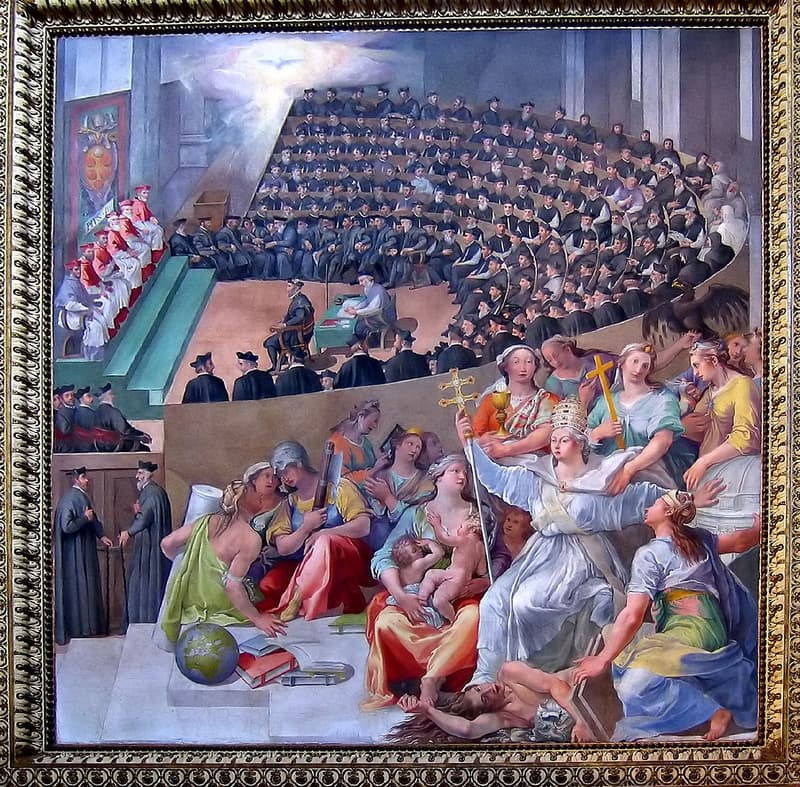
A Catholic convert reads the Council of Trent's 1547 Decree on Justification verbatim—and finds that what Protestants are taught it says is not what it says.
Did Christianity Go Wrong for 1,500 Years? A Catholic Reply
A Catholic convert defends and steelmans the claim that Protestantism's deepest assumption is that Christianity went wrong for 1,500 years before Luther.
Stay Informed
Get new writing on faith, law, and service delivered to your inbox.
No spam. Unsubscribe anytime.