The Obsession with Oppression at Yale Divinity School

On This Page
When I was growing up, there was an old joke in Sunday School that, if you didn’t know the answer to a question the teacher asked, you should guess, “Jesus.” Jesus was always the right answer.
At Yale Divinity School, the right answer is always “oppression.”
There is such an obsession with “power dynamics” and oppression that it has become the North Star to which all other things point, the guiding light in exegesis, historical analysis, and academic study. No matter the text, no matter the period, no matter the question, the analysis inevitably bends toward oppression. Who has power? Who is marginalized? What structures of domination are at work? These questions are not illegitimate—they are, in fact, often important. But when they become the only questions, when they function as the universal interpretive key that unlocks every passage and explains every historical development, something has gone wrong.
The Fetishization of Victimhood
I once read a description of the “fetishization of victimhood” in conservative commentary, and I have come to think the concept captures something real about the intellectual culture at Yale Divinity School. The idea is not that victimhood is fictional or that oppression is imaginary. It is that victimhood has been elevated to a kind of moral currency—the more oppressed one can claim to be, the more authority one’s voice carries, and the less one’s arguments need to withstand scrutiny.1
In the classroom, I have watched this dynamic play out repeatedly. A discussion about a Pauline epistle becomes a discussion about empire and resistance. A lecture on the history of Christian missions becomes an indictment of colonialism. A seminar on liturgical theology becomes an exercise in identifying whose voices have been “centered” and whose have been “erased.” These are not always inappropriate frames, but they are applied with such relentless consistency that other legitimate scholarly approaches—philological, theological, literary, devotional—are crowded out.
The result is an intellectual monoculture. The appearance of diversity (of race, gender, background) coexists with a striking uniformity of analytical framework. There is a seemingly monolithic stream of thought at Yale, visible in its culture and general disposition, that treats oppression analysis as the default mode of serious scholarship and regards other approaches as naive at best.
This is not a complaint about studying oppression. Oppression is real and has existed in many forms throughout human history up to the present day. The problem is the reductive application of oppression as the universal interpretive key—the insistence that every text, every institution, every tradition must be read primarily through the lens of power and marginalization. To find oppression in every action, in every motivation, in every event is not rigorous scholarship. It is ideology.
The Woke Scold
Despite, however, the seemingly authoritarian light in which elite universities are often portrayed in conservative media outlets—silencing of those who disagree, calling all opposing points of view “hate” without ever actually engaging the argument—there is a diversity of thought in the undercurrent. Not everyone accepts these premises.
The aggressive woke scold crowd, the over-the-top group that is so ridiculous in the way it presents itself and distorts reality into a caricature of its darkest self, is a small minority here. But, as any parent will tell you, in a room full of babies, you only notice the ones screaming.
This distinction matters enormously. Most of even the most progressive students here are kind and willing to listen to others. Even obviously and unabashedly liberal students, for example, expressed disappointment over the cancellation of the scheduled talk by the Russian Orthodox bishop and the unwillingness of some students to dialogue with others. They recognized that canceling a speaker because his tradition holds views they find objectionable is not a victory for justice but a failure of intellectual courage.
The reasonable majority at Yale Divinity School is, in my experience, genuinely interested in learning and genuinely open to hearing perspectives different from their own. They may disagree with me on nearly every political and theological question, but they are willing to engage the arguments rather than simply denounce them. The problem is that the screaming minority sets the tone, defines the boundaries of acceptable discourse, and creates an atmosphere in which the reasonable majority often stays quiet rather than risk the social costs of dissent. This observation would become clearer over time as I witnessed how cancel culture operated at Yale, and how it served to enforce the ideological conformity that had already characterized the institution. My experience as a conservative at Yale Divinity School further underscored this dynamic.
When people say that students are our future, we should recognize that there is a very real reason we do not allow them to be our present.
The Irony in the Call
The irony in all of this, of course, is that those who cry “oppression, oppression, oppression” tend to want large, coercive governments that diminish personal freedoms, to want to silence those with whom they disagree, and to want a collectivism that has proven time and time again to produce history’s most oppressive regimes.
Friedrich Hayek made this argument with devastating clarity in The Road to Serfdom: the centralization of economic power in the hands of the state, however well-intentioned, inevitably leads to the centralization of political power, and from there to tyranny.2 The pattern has been repeated so many times in the twentieth century that it should require no further demonstration—and yet the lesson seems perpetually unlearned.
Somehow William Gladstone—the Victorian Prime Minister who served four terms, expanded the franchise to nearly two million new voters through the Third Reform Act of 1884, and championed Irish Home Rule—becomes the personification of oppression. And Fidel Castro—who imprisoned political dissidents, executed opponents, suppressed a free press, and drove more than a million into exile—becomes the paragon of virtue, or at least a figure whose “complexity” demands a more “nuanced” treatment than simple condemnation.
At this point, at least the anarchists make some coherent sense. There is, however, also a movement of “anarchist socialists,” which is kind of like saying “free serf.” A serf is by definition bound to the land he works—a “free serf” is an oxymoron. Anarcho-socialists will object that they envision collective ownership through voluntary communes, worker cooperatives, and mutual aid rather than through a state. Fair enough—that is what figures like Bakunin and Kropotkin proposed. But the objection merely relocates the problem without solving it. Collective ownership still requires enforcement: someone must decide who gets what, compel contributions to the common store, and prevent individuals from opting out or accumulating private property. In a small, self-selected commune of true believers, social pressure may suffice for a time. But scale the arrangement to anything resembling a modern economy—with millions of strangers who hold competing interests and different visions of the good—and you need mechanisms of compulsion that look an awful lot like a state, whatever you choose to call them. Revolutionary Catalonia lasted three years before internal coercion and external force destroyed it. The Zapatistas govern a rural region smaller than Connecticut. These are not coincidences; they are evidence of the constraint. The moment collective ownership must be imposed on anyone who does not volunteer for it, anarchism has been abandoned in all but name. The compound term sounds radical, but it papers over a fatal tension: you can have anarchism or you can have socialism, but the attempt to enforce the latter will always devour the former.
The deeper problem, as Hayek and others have observed, is that the desire to use state power to eliminate oppression tends to create new and more efficient forms of oppression. The Soviet Union, Maoist China, Castro’s Cuba, Pol Pot’s Cambodia—these were not aberrations. They were the predictable consequences of concentrating power in the hands of those who believed they could engineer a just society from the top down.3 The road to serfdom, it turns out, is often paved with the language of liberation.
A Call to Consistency
Some of it is all very bizarre to witness. But being in this environment forces me to evaluate my own points of view and to find their strengths and weaknesses.
And continually being challenged forces me to be consistent. This is not an environment where a conservative can get away with saying ridiculous, contradictory things that lack evidence in the same way a progressive can.
I do not mean this as a complaint. It is a genuine benefit. Conservatives have blind spots, too. We can be too quick to dismiss structural injustice, too comfortable with systems that benefit us, too confident that individual virtue alone is sufficient to address social problems. The progressive critique of conservative complacency is not always wrong—it is often uncomfortably right. And the experience of being a minority voice in a progressive institution is itself instructive: it gives you some small taste of what it is like to hold views that the surrounding culture regards as not merely mistaken but morally suspect.
The challenge of Yale Divinity School, for a conservative student, is that it exposes the inconsistencies in your own thinking with merciless clarity. You cannot simply assert your positions and expect them to go unchallenged. You have to defend them. You have to know why you believe what you believe, and you have to be able to articulate it in terms that someone who disagrees can at least understand, even if they remain unpersuaded.
This is exhausting. There are days when the relentless pressure to justify your existence in a space that was not designed for people like you feels overwhelming. But it is also, ultimately, a good thing. Iron sharpens iron, and the faith or philosophy that cannot withstand rigorous challenge was not worth holding in the first place.
I would rather have my convictions tested and refined than hold them in a comfortable echo chamber where they are never questioned. Yale has given me that, and for all its frustrations, I am grateful.
This essay grew out of observations I originally recorded in my Week 10 at Yale journal entry. I also wrote a companion piece on a related theological pattern: Neo-Gnosticism in Evangelical and Progressive Christianity.
1 Bradley Campbell and Jason Manning, The Rise of Victimhood Culture: Microaggressions, Safe Spaces, and the New Culture Wars (Cham, Switzerland: Palgrave Macmillan, 2018).
2 F. A. Hayek, The Road to Serfdom (London: Routledge, 1944).
3 Robert Conquest, Reflections on a Ravaged Century (New York: W. W. Norton, 2000). See also Greg Lukianoff and Jonathan Haidt, The Coddling of the American Mind: How Good Intentions and Bad Ideas Are Setting Up a Generation for Failure (New York: Penguin Press, 2018) for the broader campus culture context.
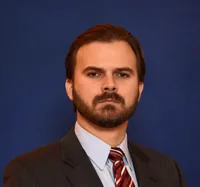
Garrett Ham
Garrett Ham is an attorney, military veteran, and holds a Master of Divinity from Yale Divinity School. He writes from Northwest Arkansas on theology, law, and service.
More about Garrett →Related Posts

Week 1 of the M.Div. at Yale Divinity School
What the first week of Yale Divinity School is really like — classes, community, and culture shock. A veteran's firsthand account of the M.Div. program.

Week 8 at Yale: Cancel Culture Comes to YDS
A firsthand account of cancel culture at Yale Divinity School: how ideological conformity silences diverse perspectives, the consequences for free speech, and why this matters for conservative students.

Week 10 at Yale: Ph.D. Aspirations
A Yale Divinity School student reflects on PhD aspirations, academic grading, and the top doctoral programs in New Testament and religious studies worth pursuing.
Stay Informed
Get new writing on faith, law, and service delivered to your inbox.
No spam. Unsubscribe anytime.