Luther’s 1522 New Testament: The Four Books He Set Apart
On This Page
Part of the series: The New Testament Canon—How 27 Books Survived the Ancient Gauntlet
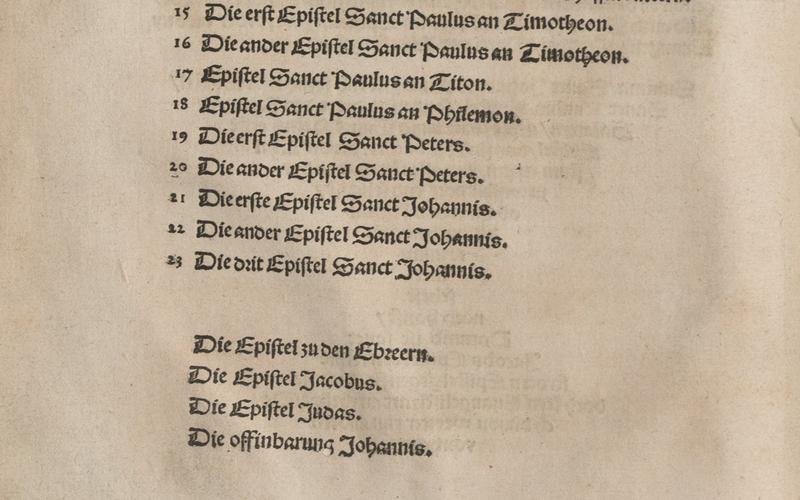
Did Luther remove books from the Bible? From the New Testament, no. When his German New Testament came off a Wittenberg press in September 1522, all twenty-seven books were in it, each translated in full.1 What he did instead was quieter, and I think more consequential. He numbered only twenty-three of them. The last four—Hebrews, James, Jude, and Revelation—stand at the foot of his table of contents without numbers, set off by a blank space, and prefaces explain why they do not belong among the rechten gewissen hewbt bucher, the true and certain chief books.2
That is my position in brief. The familiar charge that Luther cut books out of the New Testament is false, and the familiar defense—that he merely repeated doubts the early Church had already voiced—lets him off too easily. He kept the books. He changed the test. The closing section of his general preface to that first edition shows both moves at once:
wilchs die rechten vnd Edlisten bucher des newen testaments sind.
Avs disem allen kanstu nu recht vrteylen vnter allen buchern, vnd vnterscheyd nehmen, wilchs die besten sind, Denn nemlich ist Johannis Euangelion vnnd Sanct Paulus Epistelln, sonderlich die zu den Romern, vnd sanct Peters erste Epistel der rechte kern vnd marck vnter allen buchern, wilche auch billich die ersten seyn sollten, Vnd eym iglichen Christen zu ratten were, das er die selben am ersten vnd aller meysten lese, vnd yhm durch teglich leßen so gemeyn mechte, als das teglich brott, Denn ynn disen findistu nicht viel werck vnnd wunderthatten Christi beschrieben, Du findist aber gar meysterlich außgestrichen, wie der glawbe an Christum, sund, tod vnd helle vberwindet, vnd das leben, gerechtigkeyt vnnd seligkeyt gibt, wilchs die rechte artt ist des Euangeli, wie du gehoret hast. […]
Summa, Sanct Johannis Euangeli vnd seyne erste Epistel, Sanct Paulus Epistel, sonderlich die zu den Romern, Galatern, Ephesern, vnnd Sanct Peters erste Epistel, das sind die bucher, die dyr Christum zeygen, vnd alles leren, das dyr zu wissen nott vnd selig ist, ob du schon kein ander buch noch lere nummer sehest noch horist, Darumb ist sanct Jacobs Epistel eyn rechte stroern Epistel gegen sie, denn sie doch keyn Euangelisch art an yhr hat, Doch dauon weytter ynn andern vorrheden.3
The heading promises to show which are the true and noblest books of the New Testament. The Anglican scholar B. F. Westcott translated the passage in the nineteenth century, abridging the middle of it:
From all this you can rightly judge between all the books, and distinguish which are the best. For St John’s Gospel, and St Paul’s Epistles, especially that to the Romans, and St Peter’s first Epistle, are the true marrow and kernel of all the books; which properly also might be the first, and each Christian should be counselled to read them first and most, and make them as common by daily reading as his daily bread…briefly St John’s Gospel and his first Epistle, St Paul’s Epistles, especially those to the Romans, Galatians, Ephesians, and St Peter’s first Epistle: these […] are the books which shew thee Christ, and teach all which it is needful and blessed for thee to know, even if you never see or hear any other book, or any other doctrine. Therefore is the Epistle of St James a right strawy Epistle compared with them, for it has no character of the Gospel in it.4
The passage Westcott skipped explains why: John and Paul record few of Christ’s works and miracles, Luther says, but show with a master’s hand how faith in Christ overcomes sin, death, and hell, and given the choice he would rather do without Christ’s works than without his preaching. The last words of the German, which Westcott also omits, promise more on James ynn andern vorrheden, in the other prefaces.
Three things are visible in that paragraph. Luther ranked the books. He ranked them by a criterion of his own: how plainly each one shows Christ and the gospel as he understood it. And he announced the verdict on James before the reader reached James. This essay is about what that edition physically did, what the four prefaces actually argued, how Luther softened them, how later Lutherans and the Council of Trent answered the question he raised, and why the question matters more than the answer most people remember.
Did Luther Remove Books from the Bible?
The short answer depends on which Testament the question means, and the confusion between the two is the source of much of the bad history on this subject.
On the Old Testament side, the books usually meant are the seven that Catholics call deuterocanonical and Protestants call apocryphal: Tobit, Judith, Wisdom, Sirach, Baruch, and First and Second Maccabees. Luther did not delete them either. His complete German Bible of 1534 gathered them into a separate section between the Testaments, under a heading that called them books not held equal to Holy Scripture, yet useful and good to read.5 The modern Protestant Bible that omits them altogether is a later development, and the story of how it happened belongs to my longer essay on the deuterocanonical books, which I will not repeat here.
On the New Testament side, the answer is cleaner still. Every book of the New Testament appears, in full, in Luther’s New Testament from its first edition in 1522 to the Wittenberg Bible of 1546, printed just after his death. Nothing in Luther’s 1522 volume corresponds to the popular image of a reformer with a pair of scissors. What it contains instead is a table of contents with a hierarchy built into it, and a set of prefaces that tell the reader how much weight each book can bear.
That distinction is not pedantry. A man who removes a book from the Bible makes a claim about the canon. A man who prints a book but tells his readers it is not among the chief books makes a different and, in its way, more radical claim: that within the canon there are grades of authority, and that the reader, armed with the right test, can tell which is which.
What the September Testament Actually Did
Luther began translating the New Testament in the winter of 1521–22, during his concealment at the Wartburg, and finished his draft before he left the castle in March 1522. Back in Wittenberg he revised it with Philip Melanchthon, the better Greek scholar of the two. His base text was the Greek New Testament published by Erasmus.6 The book appeared in September 1522, printed by Melchior Lotther the Younger for Christian Döring and the painter Lucas Cranach, whose workshop supplied the woodcuts for Revelation.7 It carried no translator’s name on its title page: Das Newe Testament Deutzsch, and below it, Vuittemberg. Because of its month of publication it has been known ever since as the Septembertestament, the September Testament. A second edition, with many corrections, followed in December.
Open that volume to the leaf after the general preface and you find the table of contents, headed Die Bucher des newen testaments. It lists the four Gospels, Acts, the thirteen letters that bear Paul’s name, the two letters of Peter, and the three of John, numbered one through twenty-three. Then comes a gap. Below the gap, indented and without numbers, stand four more titles: Die Epistel zu den Ebreern, Die Epistel Jacobus, Die Epistel Judas, Die offinbarung Johannis.8 The image at the head of this essay is that page.
Two features of the list deserve notice. The first is the order. In the Greek New Testament of Erasmus from which Luther worked, Hebrews closed the letters of Paul, and James opened the letters traditionally called Catholic. Jude and Revelation already stood last. To build his appendix, then, Luther did not need to move four books; he needed to move two, pulling Hebrews and James down from their customary places to join Jude and Revelation at the end, after Third John.9 The second is how long the arrangement lasted. The editors of the critical Weimar edition note that the deliberate blank space above the last four lines was often dropped in later printings, but that the distinction itself was always kept, by the indentation of the four lines and by the absence of numbers before them.10 The table of contents of the Wittenberg Bible of 1546, printed just after his death, still numbers twenty-three books and leaves the last four unnumbered.11
The prefaces did the rest. Each of the four set-apart books has a preface (Jude’s is the second half of the one it shares with James), and the preface to Hebrews, which heads the group, explains the arrangement in its opening sentence:
Bjs her haben wyr die rechten gewissen hewbt bucher des newen testaments gehabt, Dise vier nach folgende aber, haben vor zeytten eyn ander ansehen gehabt…12
Philip Schaff, the American church historian, rendered it: “Hitherto we have had the right and genuine books of the New Testament. The four that follow have been differently esteemed in olden times.”13 The sentence does two things at once. It appeals to history: these books were disputed long before Luther. And it draws a line inside the New Testament that the reader is meant to carry with him as he reads.
There is one more detail of the September Testament that tells us something about its spirit. Cranach’s full-page woodcuts for Revelation put a papal tiara on the head of the dragon and on the Whore of Babylon. In the December edition, those three cuts were altered and the tiara became a plain crown; in the complete Bibles from 1534 onward, the tiara came back.14 Luther’s New Testament was not a neutral scholarly edition. It was a book of the Reformation, and it argued with Rome in its pictures as well as its prefaces.
“Eyn rechte stroern Epistel”: The Line in Its Context
Probably the most famous sentence Luther ever wrote about the canon is the last sentence of the passage quoted at the head of this essay, and it is usually quoted without the rest of the passage.
Read in place, it is plainly a comparison. Luther has just named the books that, in his judgment, show Christ most clearly: John’s Gospel and first letter, Paul’s letters to the Romans, Galatians, and Ephesians, and First Peter. James is stroern—the adjective from Stroh, straw—gegen sie, against them in the comparative sense of beside them. The reason given is that it has no Euangelisch art, nothing of the gospel’s character or kind. The verdict is withering, but it is a verdict about James’s place among the books, not a declaration that James is not Scripture. The same preface tells the reader that the fuller argument waits in the other prefaces, and it does. The Lutheran historian Henry Eyster Jacobs made the point in 1898: Luther’s language about James, “in the form in which it is generally quoted, omits the contrast which he makes with what he regards as the chief books of the New Testament.”15
The image of straw is not random. In his preface to Hebrews, Luther takes it explicitly from Paul. Hebrews, he says, does not lay the foundation of faith, which is the apostles’ office, but it builds on that foundation golt, sylber, edelsteyne, wie S. Paulus .1. Cori. 3. sagt—gold, silver, precious stones, as Paul says in First Corinthians 3—and the reader should not be put off if some holltz, stro odder hew, wood, straw, or hay, is mixed in.16 Paul’s builders in 1 Corinthians 3:12 lay gold, silver, precious stones, wood, hay, and straw on the one foundation, which is Christ, and the fire of the day of judgment tests each one’s work.17 Straw, in that picture, is still built on Christ. It is simply the cheapest and least durable of the materials. Whether Luther had that verse in mind when he wrote stroern in the general preface, he does not say; but it is the image he used, naming the verse, in another preface to the same volume.
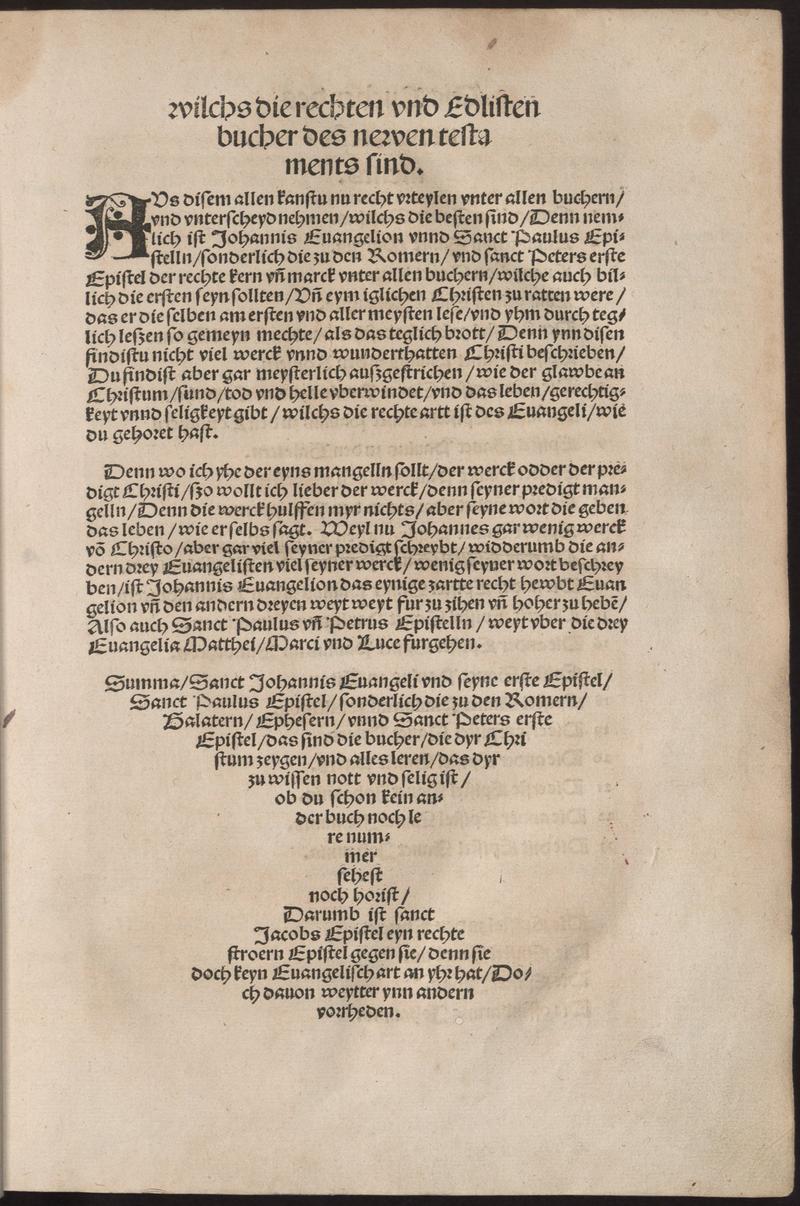
What happened to the sentence afterward is less often told, and it is easy to tell imprecisely. When Luther’s first complete German Bible appeared in 1534, the whole ranking section, from its heading to its last words, was gone, and it did not return in any complete Bible of Luther’s lifetime. The separate New Testaments kept printing it through 1537 and dropped it from 1539 on; the Weimar editors judged that the lag was most likely a printer’s oversight, a sign that Luther paid no attention to those reprints, and they doubted that the cut was a concession to his Catholic critic Hieronymus Emser.18 The opening paragraphs of the general preface were cut at the same time; the rest of it survived, but the ranking of the books, and the straw, did not.
I do not think that disappearance proves Luther changed his mind about James. As we shall see, his preface to James was softened in 1530 but never withdrawn, and the four books stayed at the end of his table of contents, unnumbered, until his death. What the disappearance suggests, though the Weimar editors themselves ask why the passage was cut, is that Luther came to think the sentence said more than it should, or said it in the wrong place.
Four Prefaces, Four Different Verdicts
It is tempting to treat Luther’s four books as a single category, and the table of contents invites it. The prefaces do not. They give four different sets of reasons and arrive at four different degrees of doubt, from a reverent reservation about Hebrews to something near rejection of Revelation. Read side by side, they are less a theory of the canon than four separate judgments made by a single, strong-minded reader.
Hebrews: the excellent letter with a hard knot
Luther’s case against Hebrews has two parts, and neither claims that the letter fails to preach Christ. The first is authorship. Hebrews 2:3 says that the salvation announced by the Lord “was confirmed for us by those who had heard,” and Luther reasoned that the author therefore speaks of the apostles as a disciple to whom their teaching came, perhaps long afterward. Paul, by contrast, insists in Galatians 1 that he received his gospel from no man. So the letter, Luther concludes, is neither Paul’s nor any apostle’s.19
The second part is a theological difficulty he calls eyn harten knotten, a hard knot. In chapters 6 and 10, Hebrews seems flatly to deny repentance to those who sin after baptism, and in chapter 12 it says that Esau sought repentance and did not find it. That, Luther wrote in 1522, is against all the Gospels and the letters of Paul; one may put a gloss on it, but the words are so clear that he doubts whether a gloss is enough. He adds a suspicion that the letter has been put together from many pieces.20
Then he turns, and the turn is generous. Hebrews is eyn außbundige gelerte Epistel, an exceptionally learned letter, which speaks of Christ’s priesthood masterfully and thoroughly from the Scriptures and expounds the Old Testament richly. Its author must have been an excellent scholar, a disciple of the apostles, well practiced in the Scriptures. In Westcott’s translation, the writer “does not lay the foundation of faith, but yet he builds upon it gold, silver, precious stones. Therefore even if we find perhaps wood, straw, or hay, mingled with it, that shall not prevent us from receiving such instruction with all honour; though we do not place it absolutely on the same footing as the Apostolic Epistles.”21 As for who wrote it, Luther says, that is unknown and will remain so for a while, and it does not matter; the reader should be content with the teaching.22
The Hebrews preface is the mildest of the four, and it is worth noticing what it does not say. It never suggests that Hebrews fails to show Christ. A letter whose central subject is Christ’s priesthood could hardly be accused of that. Its demotion rests on authorship and on three passages about repentance, which tells us that Luther’s touchstone, whatever its virtues, was not the only thing deciding where a book belonged.
James: not out of the Bible, but out of the chief books
The preface to James is the one people think they remember, and it is both harsher and more carefully qualified than the memory.
It opens with praise. Though the letter was rejected by the ancients, Luther says, he praises it and holds it to be good, because it sets up no human doctrine and urges God’s law vigorously. Then comes the qualification: to give his own opinion, without prejudice to anyone, he does not regard it as the writing of an apostle.23
His first reason is the one everyone expects. James, he says, flatly contradicts Paul and the rest of Scripture by ascribing justification to works, saying that Abraham was justified by his works when he offered his son, whereas Paul in Romans 4 teaches that Abraham was justified without works, by faith alone, and proves it from Genesis 15, before the sacrifice of Isaac. A gloss might rescue James’s language about the justification of works, Luther allows, but nothing can rescue its use of Genesis 15, which speaks only of Abraham’s faith, as a text about his works.24
His second reason is the one that matters most for the canon. In all its teaching, James never once mentions the Passion, the resurrection, or the Spirit of Christ. It names Christ a few times but teaches nothing about him, only a general faith in God. Yet the office of a true apostle, Luther says, is to preach Christ’s suffering and resurrection and office, and to lay the foundation of faith in him. Here the famous touchstone appears, and I quote it in full in the next section. Luther’s conclusion is that this James does nothing but drive his readers to the law and its works, and throws things together in such disorder that he seems to have been some good, pious man who collected a few sayings of the apostles’ disciples and put them on paper.25
A further argument is historical, and here he slipped. He noted that James quotes sayings found in Peter and Paul, and reasoned that the author must have written long after them, since the apostle James was put to death by Herod in Jerusalem before Peter.26 Acts 12:2 does record that Herod killed James, but that James was the son of Zebedee. The letter has traditionally been ascribed to a different James, the brother of the Lord, who led the church in Jerusalem until his own death in the early 60s. Luther had the wrong James, and the argument built on the error does not stand.27
The preface’s conclusion is where the misquotation lives. The 1522 sentence reads:
Darumb will ich yhn nicht haben ynn meyner Bibel ynn der zal der rechten hewbtbucher, will aber damit niemant weren, das er yhn setz vnd hebe, wie es yhn gelustet, denn es viel guter spruch sonst drynnen sind…28
Luther does not say he will not have James in his Bible. He says he will not have James in his Bible in the number of the true chief books, and in the same breath he declines to stop anyone else from placing and esteeming the letter as he likes, since it contains many good sayings. The line often quoted in English, in which Luther says he will not have James in his Bible, exists only by cutting the sentence in half.
Jude: a copy of 2 Peter, and unnecessary
The preface to Jude is short, because Luther printed it as the second half of the James preface, and its verdict is the briefest of the four. No one can deny, Luther says, that Jude is an extract or copy of Second Peter, since nearly all its words are the same. Its author speaks of the apostles as a disciple who came long after them. It cites sayings and stories found nowhere in Scripture, which had moved the ancient Fathers to throw it out of the chief Scripture. And the apostle Jude, by report, did not go to the Greek-speaking world but to Persia, so he did not write in Greek. Luther’s conclusion: though he praises it, it is an unnecessary epistle to count among the chief books that should lay the foundation of faith.29
Two of those arguments have aged badly. The sayings and stories Luther could not find in Scripture are Jude’s quotation of 1 Enoch and its allusion to Michael’s dispute over the body of Moses, and the ancient doubts about Jude did turn on the first of them, as Jerome reports.30 But the relationship with Second Peter runs the other way in most modern scholarship, which judges that 2 Peter drew on Jude rather than the reverse.31 There is an irony here that Luther could not have seen. He set Jude apart as a copy of 2 Peter, while 2 Peter itself kept its number among the chief books, though Eusebius had listed it among the disputed writings alongside James and Jude, and though its early attestation is, on most scholars’ reckoning, the thinnest in the New Testament.32 For the long story of that letter, see my essay on 2 Peter; for Jude, see the Epistle of Jude.
Revelation: “Meyn geyst kan sich ynn das buch nicht schicken”
The 1522 preface to Revelation is the most severe of the four, and the most personal. Luther begins by leaving everyone free to judge the book as he will and binding no one to his opinion. Then he says what he feels: he misses more than one thing in this book, so that he holds it neither apostolic nor prophetic.33
His reasons come in a rush. The apostles do not deal in visions; they prophesy in clear, plain words, as Peter, Paul, and Christ himself do in the Gospel. No prophet of the Old Testament, let alone the New, deals so entirely in visions and images, so that Luther ranks the book almost with the apocryphal Fourth Book of Esdras and cannot detect that the Holy Spirit produced it. It seems too much to him that the book commends itself so highly, more than any other sacred book does, threatening anyone who takes anything away from it and promising blessing to those who keep what is written in it, when no one knows what that is, let alone how to keep it. Many of the Fathers rejected it, he notes, and though Jerome praises it highly, saying it is beyond all praise and holds as many mysteries as words, he cannot prove it and is too generous in his praise in other places too.34
The preface ends with the line that best sums up Luther’s whole approach to these four books:
Endlich, hallt dauon yderman, was yhm seyn geyst gibt, meyn geyst kan sich ynn das buch nicht schicken, Vnd ist myr die vrsach gnug, das ich seyn nicht hoch achte, das Christus, drynnen widder geleret noch erkandt wirt, wilchs doch zu thun fur allen dingen eyn Apostel schuldig ist…35
Let everyone, he says, hold of this book what his spirit gives him. Westcott’s abridged English gives the drift of the whole preface: “For several reasons I hold it to be neither Apostolic nor Prophetic…My spirit cannot acquiesce in the book…I abide by the books which present Christ clear and pure to me.”36 The reason he gives in the omitted words is that Christ is neither taught nor known in the book, which an apostle is bound above all things to do.
It is hard to read that sentence now without wincing. Revelation opens with “Jesus Christ, the faithful witness, the firstborn of the dead,” shows the Lamb who was slain receiving the worship of heaven in chapter 5, and closes with the prayer “Come, Lord Jesus!”37 Whatever the book’s difficulties, the claim that Christ is neither taught nor known in it is not a description of its contents. It is a description of a reader’s frustration. Luther seems to have felt the same way within a few years, because the 1522 preface did not survive the decade.
Was Christum treibet: Luther’s Touchstone
The heart of the matter is a single passage in the James preface. It is the passage Lutheran theologians still cite when they describe Luther’s approach to Scripture, and it deserves to be read whole:
Vnd daryn stymmen alle rechtschaffene heylige bucher vber eyns, das sie alle sampt Christum predigen vnd treyben, Auch ist das der rechte prufesteyn alle bucher zu taddelln, wenn man sihet, ob sie Christum treyben, odder nit, Syntemal alle schrifft Christum zeyget Ro. 3. vnnd Paulus nichts denn Christum wissen will .1. Cor. 2. Was Christum nicht leret, das ist nicht Apostolisch, wens gleich Petrus odder Paulus leret, Widerumb, was Christum predigt, das ist Apostolisch, wens gleych Judas, Annas, Pilatus vnd Herodes thett.38
All the genuine holy books, Luther says, agree in this: that they all preach and treiben Christ, a verb that means to drive, urge, or press. (Later writers condensed the test into the tag was Christum treibet, whatever drives Christ home; the tag is a summary, not Luther’s own wording.) Philip Schaff’s translation of the rest follows the 1522 wording:
This is the true touchstone (der rechte Prüfstein) of all books, whether they make Christ their sole topic and aim [literally “drive Christ,” Christum treiben], or not; since all Scripture shows Christ (Rom. 3), and St. Paul wishes to know nothing but Christ (1 Cor. 2). That which does not teach Christ is not apostolic, though St. Peter and Paul should teach it; again, that which preaches Christ is apostolic, though Judas, Annas, Pilate and Herod should say it.39
A Prüfstein is the stone on which gold was rubbed to test it.
There is something admirable in this, and a Catholic should say so plainly. Luther is not reaching for a standard outside the faith. He is insisting that the Scriptures are about Christ, which is exactly what Jesus says of them on the road to Emmaus and what the Church has always taught. The Catechism, quoting Augustine, puts it in a sentence Luther could have written: “one and the same Word of God extends throughout Scripture.”40 Luther’s touchstone is a Christological reading of the Bible pressed into service as a test of the Bible, and the Christological reading is true. The Church even agrees that the books are not all equally central: the Catechism calls the Gospels “the heart of all the Scriptures.”41 What she denies is that centrality is a grade of authority.
The trouble lies in the pressing. A touchstone needs a hand to hold it, and in Luther’s prefaces the hand is his. Whether a book urges Christ turns out to mean whether it urges Christ as Luther understood the gospel—justification by faith apart from works, as he read Romans and Galatians. James fails because it seems to contradict that reading. Revelation fails because Luther cannot find Christ in its images, though Christ is on its first page and its last. Hebrews, whose whole subject is Christ, is set apart on grounds of authorship and of a doctrinal knot about repentance, never on the ground that it fails to urge Christ. The test was announced as objective, but it was applied as a personal theological judgment, and the judgment was shaped by the very doctrine that was in dispute. That is not only a Catholic complaint. Schaff, a Protestant historian writing in 1888 with real admiration for Luther, called him “the bold pioneer of a higher criticism, which was indeed subjective and arbitrary, but, after all, a criticism of faith,” and said that Luther “made his central doctrine of justification by faith the criterion of canonicity.”42 Schaff meant it as qualified praise. He thought the Reformers had “a right” to reopen the question of the canon, credited them with “a firm criterion of canonicity, namely, the purity and force of teaching Christ and his gospel of salvation,” and faulted Trent for settling the canon “without any critical inquiry or definite theological principle.” That makes his verdict on Luther the more telling. He also granted the premise this essay presses: the extent of the canon, he wrote, “is not determined by the Bible itself or by inspiration, but by church authority or tradition.”43
The final sentence of the passage exposes the difficulty more sharply than any critic could. If what preaches Christ would be apostolic even in the mouth of Pilate, then apostolicity has stopped meaning what it meant to the early Church, which received books because they were believed to come from the apostles and their circle, were read in the churches, and agreed with the rule of faith those churches had received. Luther kept something of the last test, but he cut it loose from the others and let it overrule them: apostolicity has come to mean agreement with the gospel as the reader grasps it. That is a coherent position, but it relocates the authority of the canon from the Church’s reception of the books to the believer’s perception of their content. It is the same move, applied to the boundaries of Scripture, that sola scriptura applies to its interpretation, and the problem it creates is the same: whose perception?
Luther seems to have heard the overstatement himself. From the revised New Testament of 1530 onward, the passage reads differently. What does not teach Christ is not yet apostolic (das ist noch nicht Apostolisch), even if Peter or Paul teaches it; what preaches Christ would be apostolic (das were Apostolisch), even if Judas, Annas, Pilate, and Herod did it.44 The added “not yet” and the shift to the subjunctive soften the paradox into a hypothesis. They do not withdraw the test.
1530: Luther Softens, but Does Not Recant
The year 1530 is the hinge in this story, and popular accounts often leave it out. In that year Luther published a thoroughly revised New Testament, and the Weimar editors, who collated the editions printed under his supervision, note that the revision touched the prefaces as well as the translation. Occasionally, they observe, Luther softened an expression that had been too harsh at first; more significant is the substantive change to the preface to James, where from 1530 he moderated his originally too harsh wording in several expressions and by cutting.45
The changes are worth listing, because together they show a man pulling his punches without changing his mind:
- The conclusion of the James preface no longer says will ich yhn nicht haben ynn meyner Bibel ynn der zal der rechten hewbtbucher, that Luther will not have James in his Bible among the true chief books. From 1530 it says kan ich yhn nicht vnter die rechten Heubtbücher setzen: he cannot place James among the true chief books.46
- The charge that James zureysset die schrifft, tears Scripture apart and so sets himself against Paul and all Scripture, was cut. So was the closing proverb, Eyn man ist keyn man ynn welltlichen sachen, with its question how one lone writer could count against Paul and the rest of Scripture.47
- The touchstone gained its “not yet” and its subjunctive.48
- In the Hebrews preface, the judgment that the repentance passages were widder alle Euangeli vnd Epistel Sanct Pauli, against all the Gospels and Paul’s letters, became the milder statement that, as the words read, they scheinet—seem—to be against them.49
- The 1522 preface to Revelation was dropped entirely and replaced with a new, much longer one.50
The new Revelation preface is a different kind of document. Rather than dismissing the book, it offers a way to read it: as a prophecy of the history of the Church from the apostles to the end of the world, to be interpreted by matching its images against the Church’s past troubles. The Weimar editors place it within Luther’s sharply antipapal thinking in early 1530, as the Lutheran confession that became the Augsburg Confession was being prepared, and they record his remark of 25 February 1530, Apocalypsin diligenti praefatione et scholiis paene commentati sumus: with a careful preface and glosses, he had all but written a commentary on the Apocalypse.51 The book Luther had found too dark to hold Christ had become, eight years later, a book that could explain the troubles of the Church in his own day. One may doubt that this was an improvement in exegesis. It was certainly a change of heart about the book’s usefulness.
It was not a change of mind about its author. The new preface still noted that some of the ancient Fathers had held the book not to be the apostle John’s, citing the twenty-fifth chapter of Eusebius’s third book, and kept that doubt open:
Jnn welchem zweiuel wirs fur vns auch noch lassen bleiben, Damit doch niemand gewehret sein sol, das ers halte fur S. Johannis des Apostels, odder wie er wil.52
In that doubt, Luther says, we too still leave it for ourselves, without preventing anyone from holding it to be the apostle John’s, or as he will.
And still the table of contents did not change. The four books remained at the end, without numbers, in the Wittenberg editions through the Bible of 1546.53 The ranking passage with the straw line was gone from the complete Bible, and the James preface had been sanded down, but the architecture of the 1522 volume—twenty-three chief books and four others—outlived every softening of its language. The Weimar editors add, in a note, that the milder mood of 1530 did not last, and they refer the reader to later remarks of Luther’s that were harsher again.54
He Was Not Alone
It would be unfair to Luther to present his doubts as an eccentricity, and a Catholic writer has particular reason to resist the temptation, because some of the most prominent doubters of his day were Catholics in good standing.
The doubts themselves were ancient. Eusebius of Caesarea, writing around 325, sorted the Christian writings into those acknowledged by all, those disputed though recognized by many, and those rejected. Among the disputed he placed James, Jude, Second Peter, and Second and Third John; Revelation he placed among the acknowledged books “if it really seem proper,” and again among the rejected, noting that opinions differed.55 Jerome, at the end of the fourth century, reported that the letter of James was said by some to have been published by someone else under James’s name and only gradually to have gained authority; that Jude was rejected by many because it quotes the Book of Enoch; and that Hebrews was not considered Paul’s because of its difference in style and language.56 Luther’s appeal to the ancients was not invented, though for James it went further than the evidence: Eusebius had counted the letter disputed, not rejected.
The doubts were also current among Catholics in Luther’s own lifetime. Erasmus, whose Greek New Testament Luther translated, questioned in the annotations to his first edition of 1516 whether Hebrews was Paul’s and whether James and Revelation were written by the apostles whose names they bore. He was careful to separate authorship from authority. On James he wrote that he would quarrel with no one about it and accepted the letter, Epistolam probo & amplector, and on Revelation he wrote that its style and contents would move him to doubt that John the evangelist wrote it, were it not that the consent of the world, and above all the authority of the Church, called him the other way—provided, he added, that the Church meant to hold it as John’s and of equal weight with the other canonical books.57 The Paris theology faculty censured him for these doubts in the 1520s.58 Cardinal Cajetan—the same Thomas de Vio who had examined Luther at Augsburg in 1518—went further. In commentaries he finished at Gaeta in August 1529, he took Jerome as his rule for telling canonical books from the rest and drew the consequence. Since Jerome thought the author of Hebrews uncertain, Cajetan wrote, the letter itself is rendered doubtful, because unless it is Paul’s it is not clear that it is canonical, so that a doubtful point of faith could not be settled from its authority alone: “See how great mischief an anonymous book creates.” He judged Jude and the second and third letters of John to be of lesser authority than the books that are certainly Scripture, and he declined to expound Revelation, confessing that he did not know how to explain it in its literal sense.59 The Dominican Ambrogio Catarino attacked his commentaries in print.60
Cajetan’s case is the closest Catholic parallel to Luther’s, and the difference between them is instructive. Cajetan graded the books by their attestation: he followed Jerome’s report of what the ancient Church had and had not been sure of. Luther graded them by their content: whether, in his judgment, they urged Christ. The first is an error about what canonicity rests on. The second is a new theory of what makes a book apostolic.
What distinguished Luther from these men was not that he doubted. It was what he did with the doubt. A humanist could question who wrote Hebrews and leave the book where it stood. Luther built the doubt into the architecture of a vernacular Bible that would be reprinted again and again and read by people who had never heard of Eusebius, and he gave them a test by which to rank the books for themselves.
What Later Lutheranism Did with the Four
Luther’s theological heirs kept his order of books and, as a test of canonicity, quietly set his touchstone aside, though the printed Bibles went on reprinting his prefaces, test and all, through the seventeenth century.61 The story of how they did so is one of the more interesting chapters in the history of the canon, and it is not often told outside Lutheran seminaries.
The decisive figure is Martin Chemnitz, the leading Lutheran theologian of the generation after Luther, whose Examination of the Council of Trent began to appear in 1566. Chemnitz did not ask whether a book urged Christ. He asked what the earliest Church had testified about it. Following Eusebius, he sorted the New Testament books into those the ancient Church had received without contradiction and those whose standing had been doubted, and his list of the second kind runs to seven books, not four: James, Jude, Second Peter, Second and Third John, Hebrews, and Revelation.62 His criterion was historical attestation, not Christological content, which is why Second Peter and the two short letters of John, which Luther had left among the numbered books, appear on his list.
Chemnitz’s rule for using those books was firm. He did not want them thrown out: Nunquid igitur simpliciter abjiciendi et damnandi sunt libri illi? Nequaquam hoc quaerimus—are those books then simply to be rejected and condemned? That is not what we are asking. But no doctrine was to be built on them that lacked a sure foundation in the other canonical books:
Nullum igitur dogma ex istis libris exstrui debet, quod non habet certa et manifesta fundamenta et testimonia in aliis Canonicis libris. Nihil quod controversum est, ex istis libris probari potest, si non exstent aliae probationes et confirmationes in libris Canonicis.63
No dogma, that is, may be built from these books that does not have sure and plain foundations in the other canonical books, and nothing in dispute may be proved from them unless there are other proofs in the canonical books. Against Trent, Chemnitz argued that a later Church cannot make doubtful books certain without firm testimony from the early Church, any more than it can make false writings true.64
Chemnitz would not have called his position an irony. In the same work he counted the Church’s handing-on of the books of Scripture, passed down quasi per manus, as it were from hand to hand, among the traditions he accepted: hanc traditionem … reverenter accipimus, this tradition we receive reverently.65 His quarrel with Trent was over what that tradition contained. He read it as preserving the doubts of the earliest witnesses, and he denied that a later Church could turn their doubt into certainty.
After Chemnitz the distinction first hardened and then softened. Around 1600 several Lutheran teachers, Aegidius Hunnius and Matthias Hafenreffer among them, went so far as to call the disputed books the apocrypha of the New Testament, and in 1619 the Wittenberg theology faculty used the same term.66 Johann Gerhard, the great systematician of the next generation, still distinguished canonical books “of the first order” from canonical books “of the second order,” naming the same seven, but he argued that the ancient doubts had concerned the books’ human authors more than their canonical authority, and that it was unsuitable to call them apocryphal.67 Defending Luther against Catholic critics, Gerhard also noted that the straw remark was a comparison and had been dropped from later editions.68 By the early eighteenth century David Hollaz, often counted the last of the great orthodox Lutheran dogmaticians, recorded the division of the New Testament into protocanonical and deuterocanonical books and concluded that, since all evangelical teachers now ascribed divine authority to the deuterocanonical ones, distinctione isthac minime opus esse videtur—the distinction no longer seemed necessary at all.69
The Lutheran confessions themselves never settled the matter. The Book of Concord of 1580 contains no list of canonical books; the Formula of Concord names “the prophetic and apostolic Scriptures of the Old and of the New Testament alone” as the sole rule and standard of doctrine without saying which books those are.70 They do treat James as Scripture. The Apology of the Augsburg Confession answers the Catholic appeal to James 2:24 by reading the verse alongside Paul rather than discounting the letter, and the Formula of Concord, quoting the Apology, says that “St. James teaches correctly when he denies that we are justified by such a faith as is without works.”71 Confessional Lutherans in the nineteenth and twentieth centuries revived Chemnitz’s distinction in principle. Franz Pieper of the Missouri Synod held that the later Church could not abolish by resolution a distinction the early Church had made, while insisting that the disputed books contain neither false doctrine nor any doctrine beyond what the undisputed books teach, and that it is self-contradictory to speak of “deuterocanonical” Scripture; C. F. W. Walther in 1856 defended a pastor who doubted Revelation, though Walther himself did not share the doubt.72
The printed Bible is where Luther’s arrangement lived longest. A German church historian writing in 1908 observed that Luther’s table of contents, with the last four books unnumbered, survived here and there in German Luther Bibles as late as 1689, and that Luther’s order of the books had survived to his own day.73 It survives still. The current revision of the Luther Bible, published in 2017, runs from Third John to Hebrews, James, Jude, and Revelation.74 At least one later Lutheran Bible, a Low German edition printed at Hamburg in 1596, went further than Luther and headed the four “Apocrypha”; I have found no record of a Lutheran church printing a New Testament without them.75
Trent’s Answer: The Canon by Tradition
The Catholic answer came at the Council of Trent, in its fourth session, on 8 April 1546, seven weeks after Luther’s death. It is worth reading the decree with Luther’s table of contents in mind, because, set beside it, the decree reads like an answer.
The Council first said where the truth of the gospel is found: in the written books and in the unwritten traditions received by the apostles from Christ or handed on by the apostles under the Holy Spirit, and it received both, the books and the traditions, “with an equal affection of piety, and reverence.”76 It then inserted a list of the sacred books, “lest a doubt may arise in any one’s mind, which are the books that are received by this Synod.” The New Testament half of that list reads, in the 1848 translation of James Waterworth:
the four Gospels, according to Matthew, Mark, Luke, and John; the Acts of the Apostles written by Luke the Evangelist; fourteen epistles of Paul the apostle, (one) to the Romans, two to the Corinthians, (one) to the Galatians, to the Ephesians, to the Philippians, to the Colossians, two to the Thessalonians, two to Timothy, (one) to Titus, to Philemon, to the Hebrews; two of Peter the apostle, three of John the apostle, one of the apostle James, one of Jude the apostle, and the Apocalypse of John the apostle. But if any one receive not, as sacred and canonical, the said books entire with all their parts, as they have been used to be read in the Catholic Church, and as they are contained in the old Latin vulgate edition; and knowingly and deliberately contemn the traditions aforesaid; let him be anathema.77
The list was, in substance, the one the Council of Florence had issued in 1442 in its decree of union with the Copts, and in Jedin’s account the debate began from a unanimous desire to stay within that decree’s limits. Florence, however, had received and venerated the books without calling them canonical and without attaching an anathema to the list.78
Three features of that text bear directly on Luther. The four books he had set apart are back among the others: Hebrews at the end of Paul’s letters, James and Jude among the Catholic letters, Revelation last. The list carries no numbers, no gaps, and no grades. And the anathema falls on anyone who does not receive the books integros cum omnibus suis partibus, entire with all their parts, a phrase that also covered the disputed passages the Council had discussed, such as the longer ending of Mark and the woman taken in adultery.79
The Council did consider grading the books. In February 1546 the Council’s members debated whether to divide Scripture into two classes, one for edification and one for the proof of doctrine, a proposal pressed by the learned Augustinian general Girolamo Seripando with the Old Testament deuterocanonical books chiefly in view. By the account of the nineteenth-century translator of the decrees, it “found, however, few or no supporters, and was accordingly silently dropped.”80 The Council declined, too, to write any distinction of rank into the decree, though it stopped short of defining in so many words that all the books were of equal authority; according to the leading modern historian of the Council, the majority preferred to leave open questions that had been disputed since Augustine and Jerome.81 The bishops did argue over whether to attach an anathema to the list at all, and a vote on 15 February carried it by a margin of about twenty-four to fifteen; that figure is sometimes misreported as the final vote on 8 April, when the decree in fact passed with only token reservations.82
What Trent did not do matters as much as what it did. The list names the traditional authors—Paul for Hebrews, “the apostle James,” “Jude the apostle,” “John the apostle” for the Apocalypse—but the Council did not open the question of authorship, and Catholic scholars have commonly read the decree as defining which books are canonical rather than who wrote each one. The Catholic Encyclopedia of 1908 put it this way: the decree “affirms the authenticity of the books to which proper names are attached, without however including this in the definition.”83 (The authorship of Hebrews had a later chapter of its own. In 1914 the Pontifical Biblical Commission, appealing above all to the acts of Trent, ruled that Hebrews must be counted with certainty among Paul’s genuine letters, while allowing that Paul need not have given it its final form. Paul VI reorganized the Commission in 1971 as a body of scholars at the service of the Magisterium, and how far the 1914 ruling still binds is debated.)84 The modern Catechism lists “the Letter to the Hebrews” separately from “the Letters of St. Paul.”85
Twenty years after that session, a Dominican scholar, Sixtus of Siena, gave Catholics a vocabulary for what Luther had noticed. In his Bibliotheca Sancta of 1566 he distinguished protocanonical books, never doubted, from deuterocanonical books, whose standing was for a time uncertain among Catholics because they came to the knowledge of the whole Church later. His New Testament deuterocanonicals are Hebrews, James, Second Peter, Second and Third John, Jude, and Revelation, together with three disputed passages in the Gospels. And he insisted that the two orders differ non auctoritate, aut certitudine, aut dignitate, not in authority, certainty, or dignity, sed cognitione, ac tempore, but in when they became known.86 That is the Catholic counterpart to Luther’s appendix. The history of doubt is acknowledged openly. It is simply not allowed to become a ranking of authority.
Why not? Because, on the Catholic view, the Church did not make these books canonical by approving them, and cannot unmake them by ranking them. The First Vatican Council put it in a sentence: the Church holds these books sacred and canonical “not because, having been carefully composed by mere human industry, they were afterwards approved by her authority, nor merely because they contain revelation, with no admixture of error; but because, having been written by the inspiration of the Holy Ghost, they have God for their author, and have been delivered as such to the Church herself.”87 The Church’s part is to receive and hand on what was delivered to her, and to recognize it. “It was by the apostolic Tradition,” says the Catechism, “that the Church discerned which writings are to be included in the list of the sacred books.”88
What Most Explanations Miss
Popular treatments of this subject tend to come in two kinds. One says that Luther tore books out of the Bible, which is false. The other says that Luther merely noted, as an honest scholar, doubts the early Church had already raised, which is true as far as it goes and misses the point.
The point is this. When Luther wanted to know which books had been doubted, he did not consult the touchstone. He consulted history. His prefaces appeal again and again to die allten, the ancients, and to viel der veter, many of the Fathers: the ancients rejected James; the old Fathers threw Jude out of the chief Scripture; many Fathers rejected Revelation; Hebrews and the rest had a different standing from ancient times.89 The raw material of his appendix, the knowledge that these books had been doubted, came from the Church’s memory of its own past, preserved in Eusebius and Jerome. The touchstone told him what to make of it, including which doubted books to set apart: Second Peter and the two short letters of John, as disputed in Eusebius as James and Jude, kept their numbers.
And it told him to make different things of it than the Church had. The same tradition that remembered the doubts also remembered how they were resolved. Jerome, who reported that many rejected Jude, added that by age and use it had gained authority and was reckoned among the Holy Scriptures.90 Eusebius, who listed James and Jude among the disputed books, also recorded that they were read publicly in very many churches.91 The ancient doubts were real, but in the Latin West they were worked through and, by the end of the fourth century, settled in practice: the African councils listed all four books among “the things which we have received from our fathers to be read in church.”92 In the Greek East, doubts about Revelation lasted much longer. Luther reopened a question the Western Church had long since settled in practice, though not yet by solemn definition, using the tradition’s own records, and then declined to accept the tradition’s own answer.
That is the deeper difficulty for sola scriptura, and it is why I think this episode belongs at the center of any honest conversation about the canon. Scripture alone cannot tell us which books are Scripture; there is no inspired table of contents. Luther knew that the four books had been disputed only because the Church remembered disputing them. A principle that must borrow its data from tradition, and then sits in judgment on tradition’s verdict, has not escaped tradition. It has simply chosen which part of tradition to trust. Chemnitz, to his credit, never claimed otherwise; he received the Church’s handing-on of the books as a tradition. The question that divides Lutherans and Catholics is narrower and harder: whether the later Church’s settled reception belongs to that tradition or merely comes after it. In A Fallible Collection of Infallible Books? I take up the best Protestant answers to that difficulty, from Calvin to the present.
None of this makes Luther a villain. He was candid about what he was doing, as candid as almost any writer on the canon has been. He labeled his opinion as opinion, told his readers they were free to disagree, kept every book in his Bible, and in 1530 softened the harshest of what he had written, even if, as his editors note, the milder mood did not last. Most of all, he took seriously a question the late-medieval Church had never been forced to settle with finality: what, exactly, makes a book canonical? He gave the wrong answer. But he asked the question at a moment when the Church needed to be made to answer it, and the Church’s binding answer, defined at Trent and explained at the First Vatican Council, came in large part because Luther made it necessary.
Conclusion: Twenty-Three and Four
The page at the top of this essay is a small thing: a list of titles, a gap, four lines without numbers. It is worth looking at for a while, because it says something the famous phrases do not. Luther did not throw books out of the Bible. He kept every one, translated every word, and set four of them a little apart, with prefaces explaining why.
What he set apart, in the end, was less important than how. A canon received from the Church’s memory had been made to answer to a single reader’s sense of where Christ is preached most clearly. Luther was honest enough to say so, humble enough to soften what he had written, and conservative enough in his instincts to keep the books his own test would have demoted. The Church that answered him at Trent kept them too, for a different reason: not because each book passed a test, but because, on the Catholic view, they were written under the Spirit’s inspiration and handed down as such by apostolic Tradition.
Both answers keep the same twenty-seven books. Only one of them can say why none of them may be set apart.
Further Reading
The 1522 text and its later revisions are edited, with a full apparatus of the editions Luther saw through the press, in volumes 6 and 7 of the Weimar edition’s Die Deutsche Bibel (Weimar: Böhlau, 1929 and 1931); both are freely readable at the Internet Archive, and German Wikisource offers a proofread transcription of the September Testament itself. The standard English translation of the prefaces is in Luther’s Works, volume 35, Word and Sacrament I, edited by E. Theodore Bachmann (Philadelphia: Muhlenberg Press, 1960). For Chemnitz, see Examination of the Council of Trent, Part I, translated by Fred Kramer (St. Louis: Concordia, 1971). B. F. Westcott’s A General Survey of the History of the Canon of the New Testament (London: Macmillan, seventh edition, 1896) remains useful on the sixteenth century, Catholic and Protestant alike, and translates many of the key passages; Johannes Leipoldt’s Geschichte des neutestamentlichen Kanons (Leipzig: Hinrichs, 1908), volume 2, traces what Luther’s arrangement became in later Lutheran Bibles. On Trent, the indispensable account is Hubert Jedin, A History of the Council of Trent, volume 2, translated by Ernest Graf (London: Thomas Nelson, 1961). For the wider story of the canon, Bruce M. Metzger, The Canon of the New Testament: Its Origin, Development, and Significance (Oxford: Clarendon Press, 1987), and F. F. Bruce, The Canon of Scripture (Downers Grove, IL: InterVarsity Press, 1988), are the standard surveys in English.
Frequently Asked Questions
Did Luther remove books from the Bible?
Not from the New Testament. Luther’s 1522 German New Testament printed all twenty-seven books, and so did every Wittenberg edition up to the Bible of 1546. He did set four of them apart—Hebrews, James, Jude, and Revelation—by placing them last, leaving them unnumbered in the table of contents, and explaining his doubts in prefaces. The claim that Luther removed seven books refers to the Old Testament deuterocanonical books, and even those he printed, in a separate section of his 1534 Bible headed as books not equal to Holy Scripture but useful and good to read.
Why did Luther call James an “epistle of straw”?
The phrase comes from the closing section of his general preface to the 1522 New Testament, where he ranked the books by how clearly they show Christ. Beside John’s Gospel and first letter, Paul’s letters to the Romans, Galatians, and Ephesians, and First Peter, he called James eyn rechte stroern Epistel, a straw epistle by comparison, because it had nothing of the gospel’s character in it. His fuller reasons, given in the preface to James, were that it seemed to contradict Paul on justification and never mentioned Christ’s Passion or resurrection. The ranking section, straw line included, appeared only in his separate New Testaments from 1522 to 1537.
Did Luther think Revelation was Scripture?
He printed it in his Bible, but in 1522 he said he held it neither apostolic nor prophetic, that his spirit could not fit itself to the book, and that Christ was neither taught nor known in it, while leaving every reader free to judge for himself. In 1530 he replaced that preface with a much longer one that read Revelation as a prophecy of the Church’s history, and he kept the book in every edition, still unnumbered at the end of the table of contents, while leaving the question of its author open.
What are the antilegomena?
Antilegomena is Greek for “things spoken against,” the term Eusebius of Caesarea used around 325 for writings that were disputed though recognized by many. His disputed list for the New Testament included James, Jude, 2 Peter, and 2 and 3 John; he placed Revelation in both the accepted and the rejected categories, depending on one’s view. Lutheran theologians after Luther, most influentially Martin Chemnitz, revived Eusebius’s distinction, and confessional Lutherans still use the word antilegomena for the seven New Testament books whose standing was doubted in antiquity: Hebrews, James, Jude, 2 Peter, 2 and 3 John, and Revelation. (Hebrews, which Eusebius counted with Paul’s letters, is on the Lutheran list because the Latin West long doubted it.)
What did the Council of Trent decide about these books?
On 8 April 1546, in its fourth session, the Council of Trent listed the books of Scripture, including Hebrews (among the fourteen letters it attributed to Paul), James, Jude, and the Apocalypse, and anathematized anyone who did not receive them as sacred and canonical “entire with all their parts.” The Council wrote no grades of canonicity into its list, though it did not define in so many words that all the books are of equal authority. The Catholic Church today teaches that “it was by the apostolic Tradition that the Church discerned which writings are to be included in the list of the sacred books” (CCC 120).
Do Lutheran Bibles still put Hebrews and James at the end?
In German, yes. The current revision of the Luther Bible, published in 2017, runs from Third John to Hebrews, James, Jude, and Revelation, the order Luther set in 1522. For a long time some German Luther Bibles also kept his table of contents with the last four books unnumbered; a German history of the canon published in 1908 found examples as late as 1689. Lutheran theologians, after a period around 1600 when some called the disputed books the apocrypha of the New Testament, gradually stopped treating them as a lower class of Scripture, though some confessional Lutherans still keep the old distinction between the undisputed and the disputed books.
Footnotes
1. Martin Luther, trans., Das Newe Testament Deutzsch (Wittenberg: Melchior Lotther the Younger, for Christian Döring and Lucas Cranach, September 1522). I quote the 1522 German from the transcription at German Wikisource, Das Newe Testament Deutzsch, made from the copy in the Württembergische Landesbibliothek Stuttgart, proofread twice against its scans, and keyed to the critical edition, D. Martin Luthers Werke: Kritische Gesamtausgabe. Die Deutsche Bibel [hereafter WA DB], vols. 6 (Weimar: Hermann Böhlaus Nachfolger, 1929) and 7 (1931). I have checked the passages quoted here against the page images of WA DB 6 and 7 at the Internet Archive (vol. 6; vol. 7). The spelling is the 1522 spelling. English quotations of the prefaces come from public-domain translations by B. F. Westcott (1896), Philip Schaff (1888), and Henry Eyster Jacobs (1898); where no public-domain English exists, I paraphrase, without quotation marks. The standard modern translation is in Luther’s Works, vol. 35, Word and Sacrament I, ed. E. Theodore Bachmann (Philadelphia: Muhlenberg Press, 1960), which is still in copyright.
2. Luther, “Die Bucher des newen testaments,” in Das Newe Testament Deutzsch (1522); WA DB 6:12. The page is reproduced on Wikimedia Commons, File:Luther Das Newe Testament Deutzsch 014.jpg (public domain; Württembergische Landesbibliothek Stuttgart). The phrase rechten gewissen hewbt bucher is from the first sentence of the preface to Hebrews, WA DB 7:344.
3. Luther, “Vorrhede,” closing section (“wilchs die rechten vnd Edlisten bucher des newen testaments sind”), in Das Newe Testament Deutzsch (1522); WA DB 6:10; Wikisource transcription. The page as printed in 1522 is on Wikimedia Commons, File:Luther Das Newe Testament Deutzsch 013.jpg.
4. B. F. Westcott, A General Survey of the History of the Canon of the New Testament, 7th ed. (London: Macmillan, 1896), 489, archive.org, translating from the Walch edition of Luther’s works. Westcott notes that the words beginning “these” are emphasized in the original and that the passage “is left out in the later editions.” His “right strawy Epistle” renders eyn rechte stroern Epistel.
5. George J. Reid, “Canon of the Old Testament,” The Catholic Encyclopedia, vol. 3 (1908): “In the first edition of Luther’s Bible, 1534, the deuteros were relegated, as apocrypha, to a separate place between the two Testaments,” newadvent.org. For the heading and its sources, see my essay on the deuterocanonical books.
6. Schaff, German Reformation, 346–347, archive.org: Luther “began with the New Testament in November or December, 1521, and completed it in the following March, before he left the Wartburg. He thoroughly revised it on his return to Wittenberg, with the effectual help of Melanchthon, who was a much better Greek scholar.” On Erasmus’s text as the basis of Luther’s translation, see ibid., §6.
7. WA DB 6:XXI, XLVI; the title data of the WLB Stuttgart copy in the Wikisource transcription (“Melchior Lotther d. J. für Christian Döring und Lukas Cranach d. Ä.”). The exact day of publication, often given as 21 September, is not certain (WA DB 6:XLVI). On the December edition and its corrections, see Schaff, German Reformation, 347.
8. WA DB 6:12.
9. Erasmus, Novum Instrumentum omne (Basel: Froben, 1516), whose annotations run from Hebrews directly to James and end with Jude and the Apocalypse, archive.org. Schaff, German Reformation, 347 n., notes that in Luther’s translation “the order of the Epistles is changed, and the change remained in all subsequent editions.”
10. WA DB 6:12, apparatus: “Der bedachtsame Zwischenraum über den letzten vier Zeilen dieses Registers fällt später öfter fort … doch bleibt die Abstufung durch das Einrücken der vier Zeilen und durch das Fehlen der Zahlen vor denselben stets gekennzeichnet.”
11. WA DB 6:13, the table of contents of the 1546 Bible: “1. Euangelium S. Matthes … 23. Die 3. Epistel S. Johannis,” followed by “Die Epistel an die Ebreer. Die Epistel Jacobi. Die Epistel Jude. Die Offenbarung Johannis,” without numbers.
12. Luther, “Vorrhede auff die Epistel zu den Ebreern” (1522), WA DB 7:344; Wikisource transcription.
13. Philip Schaff, History of the Christian Church, vol. 6, Modern Christianity: The German Reformation (New York: Scribner, 1888), 35, archive.org. (In the later eight-volume numbering this is vol. 7.)
14. WA DB 7:407, note on the woodcuts: the earliest three changes to Cranach’s full-page cuts (the eleventh, sixteenth, and seventeenth), made in the December Testament of 1522, concern “die Tiara des Drachens und der babylonischen Hure, die in eine einfache Krone verändert ist. In den Vollbibeln 34–46 aber tritt wieder die päpstliche Tiara an ihre alte Stelle.”
15. Henry Eyster Jacobs, Martin Luther: The Hero of the Reformation (New York: Putnam, 1898), 350, archive.org, who translates the closing sentence as “In comparison with these, therefore, the Epistle of St. James is actually nothing but an epistle of straw, for it has in it nothing whatever of the Gospel.”
16. Luther, “Vorrhede auff die Epistel zu den Ebreern” (1522), WA DB 7:344; Wikisource. Luther names the source of the image himself: “wie S. Paulus .1. Cori. 3. sagt.”
17. 1 Corinthians 3:11–13 (NABRE): “If anyone builds on this foundation with gold, silver, precious stones, wood, hay, or straw, the work of each will come to light”; biblegateway.com.
18. WA DB 6:10, critical apparatus to lines 7–35: “der ganze Abschnitt fehlt 34–46, 39–46.” In the Weimar sigla, 34–46 (set in bold) are the complete Bibles of 1534–1546 and the plain 39–46 the separate New Testaments of 1539–1546 (WA DB 6, introduction); the section is recorded in the separate New Testaments from 1522 through 1537. WA DB 6 at the Internet Archive. The editors’ commentary is at WA DB 6:536: “Schwerlich erfolgten diese Kürzungen infolge des Tadels durch Hieron. Emser … so beruht dies wohl nur auf einer Unachtsamkeit der Druckerei und ist ein Anzeichen dafür, daß Luther selbst um die Sonderdrucke 34–37 sich nicht gekümmert hat.” The same editions cut the opening paragraphs of the preface (WA DB 6:2, apparatus). Of the cut ending the editors ask, warum auch dieser?, why this one too (WA DB 6:536). Some older accounts date the omission differently, among them Johann Gerhard’s, discussed below.
19. Luther, Hebrews preface (1522), WA DB 7:344, citing Heb 2:3 and Gal 1:12. Hebrews 2:3 (NABRE): “Announced originally through the Lord, it was confirmed for us by those who had heard”; biblegateway.com.
20. Luther, Hebrews preface (1522), WA DB 7:344: “Vber das hatt sie eyn harten knotten, das sie am .6. vnnd 10. cap. stracks verneynet vnnd versagt die pus den sundern nach der tauffe, vnd am .12. spricht, Esau hab puß gesucht, vnnd doch nicht funden … Mich dunckt, es sey ein Epistel von vielen stucken zusamen gesetzt …” The passages in view are Heb 6:4–6, 10:26–27, and 12:16–17.
21. B. F. Westcott, A General Survey of the History of the Canon of the New Testament, 7th ed. (London: Macmillan, 1896), 490, archive.org.
22. Luther, Hebrews preface (1522), WA DB 7:344.
23. Luther, “Vorrhede auff die Episteln Sanct Jacobi vnnd Judas” (1522), WA DB 7:384: “Dje Epistel Sanct Jacobi, wie woll sie von den allten verworffen ist, lobe ich vnd halt sie doch fur gutt … acht ich sie fur keyns Apostel schrifft”; Wikisource.
24. Luther, James preface (1522), WA DB 7:384, contrasting Jas 2:21–23 with Rom 4 and Gen 15:6.
25. Luther, James preface (1522), WA DB 7:384–386: “Aber diser Jacobus thutt nicht mehr, denn treybt zu dem gesetz vnd seynen wercken … das mich dunckt, es sey yrgent eyn gut frum man gewesen, der ettlich spruch von der Apostelln Jungern gefasset, vnnd also auffs papyr geworffen hat …”
26. Luther, James preface (1522), WA DB 7:386: “So doch Sanct Jacobus zeytlich von Herodes zu Jerusalem, fur S. Peter todtet war.”
27. Acts 12:1–2. On the death of James the brother of the Lord, stoned at Jerusalem in the interval between the procurators Festus and Albinus, see Josephus, Antiquities 20.9.1, trans. William Whiston, Project Gutenberg. On the authorship question, see my essay on the Epistle of James.
28. Luther, James preface (1522), WA DB 7:386; Wikisource. I have checked the sentence against the page image of WA DB 7:386 at the Internet Archive.
29. Luther, James and Jude preface (1522), WA DB 7:386: “Die Epistel aber Sanct Judas, kan niemant leugnen, das eyn austzog oder abschrifft ist aus Sanct. Peters ander Epistel … Darumb ob ich sie wol preysse, ist doch eyn vnnotige Epistel vnter die hewbt bucher zu rechen, die des glawbens grund legen sollen.” From 1539 the two prefaces were printed separately, each before its own letter (WA DB 7:XXXII).
30. Jerome, De viris illustribus 4, trans. Ernest Cushing Richardson, NPNF2 3: Jude’s letter, “because in it he quotes from the apocryphal Book of Enoch it is rejected by many. Nevertheless by age and use it has gained authority and is reckoned among the Holy Scriptures”; newadvent.org.
31. See Richard J. Bauckham, Jude, 2 Peter, Word Biblical Commentary 50 (Waco: Word Books, 1983), and the discussion in my essay on the Epistle of Jude.
32. Eusebius, Ecclesiastical History 3.25.1–4, trans. Arthur Cushman McGiffert, NPNF2 1: “Among the disputed writings, which are nevertheless recognized by many, are extant the so-called epistle of James and that of Jude, also the second epistle of Peter, and those that are called the second and third of John”; newadvent.org.
33. Luther, “Vorrhede auff die offinbarung Sanct Johannis” (1522), WA DB 7:404: “Myr mangellt an disem buch nit eynerley, das ichs wider Apostolisch noch prophetisch hallte”; Wikisource.
34. Luther, Revelation preface (1522), WA DB 7:404, alluding to Rev 1:3 and 22:18–19. For Jerome’s praise, see Jerome, Letter 53.9 (NPNF numbering; 53.8 in Migne), to Paulinus: “The apocalypse of John has as many mysteries as words”; newadvent.org.
35. Luther, Revelation preface (1522), WA DB 7:404; Wikisource. The preface ends: “Darumb bleyb ich bey den buchern, die myr Christum hell vnd reyn dar geben.”
36. B. F. Westcott, A General Survey of the History of the Canon of the New Testament, 7th ed. (London: Macmillan, 1896), 491 n. 3, archive.org. The German is WA DB 7:404.
37. Revelation 1:5; 5:6–14; 22:20 (NABRE); biblegateway.com.
38. Luther, James preface (1522), WA DB 7:384; Wikisource. Checked against the page image of WA DB 7:384.
39. Schaff, German Reformation, 34 n. 1, archive.org. Schaff’s rendering follows the 1522 wording, before the changes of 1530.
40. CCC 102, quoting Augustine, Enarrationes in Psalmos 103.4.1. On Emmaus, see Luke 24:27.
42. Schaff, German Reformation, 34, archive.org.
43. Schaff, German Reformation, 33–34, archive.org.
44. WA DB 7:385 (the 1546 text) and the apparatus to WA DB 7:384, lines 29 and 31: “nicht (2.) 22¹–27² 40] noch nicht 30¹–39 44–46, 34–46”; “ist 22¹–27²] were 30¹<.” In the 1546 Bible the passage reads: “Was Christum nicht leret, das ist noch nicht Apostolisch, wens gleich S. Petrus oder Paulus leret. Widerumb, was Christum prediget, das were Apostolisch, wens gleich Judas, Hannas, Pilatus, vnd Herodes thet.” One separate New Testament, of 1540, kept the 1522 nicht.
45. WA DB 7:XXXII, the editors’ introduction: “Gelegentlich mildert Luther einen anfänglich zu schroffen Ausdruck”; on James, “wo Luther seine anfangs zu schroffe Fassung seit 30¹ in mehreren Ausdrücken und durch Kürzungen gemildert hat.” WA DB 7 at the Internet Archive.
46. WA DB 7:386, apparatus to lines 14–21: “Darumb will 22¹–27²] Darumb kan 30¹<”; “nicht haben ynn meyner Bibel ynn der zal der rechten hewbtbucher 22¹–27²] nicht vnter die rechten Heubtbücher setzen 30¹<”; “vnd zureysset die schrifft, vnd widerstehet damit Paulo vnd aller schrifft 22¹–27²] fehlt 30¹<”; “Eyn man ist keyn man bis gellten?] fehlt dauernd 30¹<.” The sigil 30¹ is the revised New Testament of 1530.
47. WA DB 7:386, apparatus to lines 14–21.
48. WA DB 7:384–385, apparatus to lines 29 and 31.
49. WA DB 7:344–345, apparatus to lines 15–16, and WA DB 7:XXXII: Luther’s judgment “zuerst: Das ist wider alle Euangelien usw. Später: das scheine, wie es lautet, wider alle Euangelia zu sein.” The 1546 text reads “Welchs, wie es lautet, scheinet, wider alle Euangelia vnd Epistel S. Pauli sein.”
50. WA DB 7:XXXII–XXXIII and 7:406–421. The editors note that the first preface, which ran in the editions from 1522 through 1527, did not satisfy Luther, and that he replaced it in 1530 with an entirely different one belonging to his sharply antipapal thought of that year, when the confession later called the Augsburg Confession was being drafted. Luther’s remark of 25 February 1530 is quoted at WA DB 7:407.
51. WA DB 7:XXXII–XXXIII, 407.
52. Luther, “Vorrede auff die Offenbarung S. Johannis” (1530), WA DB 7:408, lines 15–19, checked against the page image at the Internet Archive. Westcott, General Survey, 491, translates the last clause: “no man ought to be hindered from holding it to be a work of St John or otherwise, as he will,” though he misdates the preface to 1534.
53. WA DB 6:13.
54. WA DB 7:XXXII, referring the reader to the note at WA DB 6:537 (“Daß diese mildere Stimmung nicht von Bestand war …”).
55. Eusebius, Ecclesiastical History 3.25.3.
56. Jerome, De viris illustribus 2 (James), 4 (Jude), and 5 (Paul: “The epistle which is called the Epistle to the Hebrews is not considered his, on account of its difference from the others in style and language”), trans. Richardson, NPNF2 3; newadvent.org.
57. Erasmus, Novum Instrumentum omne (Basel: Froben, February 1516), Annotationes on Hebrews, James (606), and Revelation (printed 675, recte 625); archive.org. On James: “Epistolam probo & amplector.” On Revelation: “nisi me consensus orbis alio uocaret, praecipue uero autoritas ecclesiae, si tamen hoc opus, hoc animo comprobat ecclesia, ut Ioannis euangelistae uelit haberi, & pari esse pondere, cum caeteris canonicis libris.” See also B. F. Westcott, A General Survey of the History of the Canon of the New Testament, 7th ed. (London: Macmillan, 1896), 479–482, archive.org, who translates probo et amplector as “I heartily affirm.”
58. B. F. Westcott, A General Survey of the History of the Canon of the New Testament, 7th ed. (London: Macmillan, 1896), 482, archive.org, quoting the censure: “after that the Church has received them under the name of such authors by its universal usage, and has approved them by its judgment, it is not any longer right for a Christian to doubt of the fact, or to call it in question.”
59. Cajetan (Tommaso de Vio), preface to his commentary on Hebrews, in Opera omnia quotquot in Sacrae Scripturae expositionem reperiuntur, vol. 5 (Lyon: Prost, 1639), archive.org; English trans. Westcott, General Survey, 483–484 (the Hebrews passage on 483), archive.org. On Jude (vol. 5, unnumbered verso after p. 399): “minoris esse authoritatis hanc Epistolam iis quae sunt certae scripturae sacrae.” The colophon after Jude (unnumbered verso after p. 400; Westcott cites it as p. 401) dates the commentaries Gaeta, 17 August 1529, and adds: “Apocalypsim enim fateor me nescire exponere iuxta sensum literalem: exponat cui Deus concesserit.” Cajetan defended Second Peter. The 1908 Catholic Encyclopedia article “Cajetan” wrongly adds Second Peter to his doubts.
60. Ambrosius Catharinus Politus, Annotationes in commentaria Cajetani (Lyon, 1542); see Westcott, General Survey, 484 n. 2.
61. Leipoldt, Geschichte, 2:95: “In der Tat hat man zunächst eine Zeit lang ohne Bedenken auch Luthers Vorreden zu den biblischen Büchern beibehalten, in denen die Begründung der Kritik enthalten war”; Howorth, “Canon of the Bible among the Later Reformers,” 202, on the Weimar Bible of 1644, in which Luther’s “prefaces to the several books were duly set out, and so they were treated in the Lutheran Bibles during the rest of that century.”
62. Martin Chemnitz, Examen Concilii Tridentini, Part I, Locus I, Section VI, §21, ed. Eduard Preuss (Berlin: Schlawitz, 1861), 57–58, archive.org: “Ex libris Novi Testamenti, qui in prima et veteri Ecclesia non habuerunt satis certa, firma et consentientia certitudinis et autoritatis suae testimonia, hi recensentur.” Part I first appeared in 1566; the dedication is dated 29 April 1565. Preuss reprints the Frankfurt edition of 1578, collated with that of 1707. English: Examination of the Council of Trent, Part I, trans. Fred Kramer (St. Louis: Concordia, 1971), 168–195. Chemnitz’s own Greek term for the doubted books in this section is ἀμφίλεκτα rather than ἀντιλεγόμενα (Preuss ed., 61).
63. Chemnitz, Examen, Part I, Locus I, Section VI, §25, ed. Preuss, 59, archive.org. The rule covers the Old Testament apocrypha as well as the seven New Testament books.
64. Chemnitz, Examen, Part I, Locus I, Section VI, §§15, 22, ed. Preuss, 56, 58: “sequens Ecclesia sicut non potest ex falsis facere vera, ita nec ex dubiis potest certa facere sine manifestis et firmis documentis.”
65. Chemnitz, Examen, Part I, Locus II (De traditionibus), Sect. II, ed. Preuss, 71, archive.org: the books of Scripture were “ab Ecclesia custoditi, et fideliter ad posteros transmissi, nobisque quasi per manus traditi … Et hanc traditionem, qua nobis in manum dantur sacrae Scripturae libri, reverenter accipimus.” Chemnitz refers the reader back to his section on the canonical books.
66. Howorth, “Canon of the Bible among the Later Reformers,” 194–195, archive.org, quoting Matthias Hafenreffer, Loci theologici (1603), 140 (“Apocryphi Libri in Nouo Testamento sunt: Posterior Epistola Petri: secunda & tertia Iohannis: Epistola ad Hebraeos: Epistola Iacobi: Epistola Iudae: & Apocalypsis Ioannis Theologi”), Aegidius Hunnius’s disputation on the canonical Scriptures (1601), and the Wittenberg faculty’s reply to the Socinian catechism (1619), 13, on “den Apocriphis Newes Testaments.” Howorth adds that these writers soon modified their ground.
67. Johann Gerhard, Loci theologici, Locus I, ch. 9, §242, ed. Eduard Preuss, vol. 1 (Berlin: Schlawitz, 1863), 104, archive.org: “Canonici libri secundi ordinis sunt, de quorum auctoribus a quibusdam in ecclesia aliquando fuit dubitatum. Tales sunt epistola ad Hebraeos, Jacobi, Judae, posterior Petri, secunda et tertia Johannis, Apocalypsis.” The doubted books “minus commode vocantur apocryphi,” because the doubt concerned “non tam de auctoritate canonica, quam de auctore librorum istorum secundario.”
68. Gerhard, Loci theologici, Locus I, §279, ed. Preuss, 1:120: Luther called James “epistolam stramineam … si cum illis comparetur,” and “in posterioribus bibliorum editionibus verba illa sunt omissa.” Gerhard dates the omission to after 1526 and places the remark in the James preface; the Weimar apparatus shows it stood in the general preface and in the separate New Testaments through 1537 (WA DB 6:10).
69. David Hollaz, Examen theologicum acroamaticum, Prolegomenon III (De Sacra Scriptura), q. 39, obs., ed. Romanus Teller (Stockholm and Leipzig: Kiesewetter, 1750), 131, archive.org: “… cum hodie euangelici doctores omnes deuterocanonicis istis diuinam auctoritatem assignent, distinctione isthac minime opus esse videtur.” The work first appeared in 1707.
70. Formula of Concord, Epitome, “Of the Summary Content, Rule, and Standard,” §1, in Concordia Triglotta (St. Louis: Concordia, 1921), 777; bookofconcord.org.
71. Apology of the Augsburg Confession, art. IV (art. III in the Triglotta), in Concordia Triglotta (St. Louis: Concordia, 1921), 189: “From James they cite 2,24 … But the reply is easy and plain”; Formula of Concord, Solid Declaration III.42, ibid., 931, quoting the Latin Apology: “Iacobus recte negat, nos tali fide iustificari, quae est sine operibus.” archive.org.
72. Franz Pieper, Christliche Dogmatik, vol. 1 (St. Louis: Concordia, 1924), 399–401, 406–407, archive.org: “Den Unterschied zwischen Homologumena und Antilegomena, den die erste Kirche gemacht hat, kann die spätere Kirche nicht durch Beschluß aufheben” (399). Pieper quotes C. F. W. Walther, Lehre und Wehre 2 (1856), on the case of Pastor Röbbelen, who doubted Revelation (400–401). On “deuterokanonischen Schriften,” which Pieper says cannot be spoken of “ohne einen gewissen Selbstwiderspruch,” and on the antilegomena as containing “weder eine falsche Lehre … noch auch eine Lehre, die ihrem Inhalte nach über die Bücher hinausginge,” see 406–407.
73. Johannes Leipoldt, Geschichte des neutestamentlichen Kanons, pt. 2 (Leipzig: Hinrichs, 1908), 95, archive.org: “Das luthersche Inhaltsverzeichnis zum Neuen Testamente, das die vier letzten Bücher unbeziffert läßt, hat sich in deutschen Lutherbibeln vereinzelt bis zum Jahre 1689 erhalten.”
74. Lutherbibel, revised 2017, on the website of the Deutsche Bibelgesellschaft, where Hebrews follows Third John and Jude is followed by Revelation: die-bibel.de.
75. Leipoldt, Geschichte, 2:95–96, on the Low German Bible printed at Hamburg in 1596, which heads the four books “Apocrypha”; H. H. Howorth, “The Canon of the Bible among the Later Reformers,” Journal of Theological Studies 10 (1909): 183–232, at 202, archive.org, who found “an almost rigid adherence to Luther’s view in the Lutheran Bibles of Germany and Scandinavia.” The absence of any omission is a negative finding and is stated as such.
76. Council of Trent, Session IV (8 April 1546), First Decree, trans. J. Waterworth, The Canons and Decrees of the Sacred and Oecumenical Council of Trent (London: Dolman, 1848), 17–19, archive.org; online at Hanover College.
77. Ibid., 18–19. Latin (DH 1501–1504): vatican.va.
78. Council of Florence, bull Cantate Domino (4 February 1442), vatican.va, which “suscipit et veneratur” the books it lists; Jedin, History, 2:55.
79. The Latin reads “Si quis autem libros ipsos integros cum omnibus suis partibus, prout in Ecclesia catholica legi consueverunt, et in veteri vulgata latina editione habentur, pro sacris et canonicis non susceperit … anathema sit.” On the disputed passages raised in the Council’s discussions of 1 April 1546 (the longer ending of Mark, Luke 22:43–44, and John 7:53–8:11), see Hubert Jedin, A History of the Council of Trent, vol. 2, trans. Ernest Graf (London: Thomas Nelson, 1961), 81–82.
80. Waterworth, Canons and Decrees, historical essay, lxxxiv, archive.org; Jedin, History, 2:56–57.
81. Jedin, History, 2:56–57, 81.
82. Jedin, History, 2:55–56 (the vote of 15 February on attaching the anathema, twenty-four against fifteen or sixteen) and 2:92–93 (the session of 8 April, with six conditional votes). Waterworth, Canons and Decrees, lxxxv, reports the same division. The figure “24 to 15, with 16 abstentions,” sometimes attached to the final decree, belongs to the February vote.
83. George J. Reid, “Canon of the New Testament,” The Catholic Encyclopedia, vol. 3 (New York: Robert Appleton, 1908), newadvent.org. The same article overstates the case on the other side, saying that Luther had discarded the four books “as altogether uncanonical,” which his own Bible contradicts.
84. Pontifical Biblical Commission, “De auctore et de modo compositionis epistolae ad Hebraeos,” 24 June 1914, Acta Apostolicae Sedis 6 (1914): 417–418, vatican.va. The decree treats canonicity as “de fide definitum” and Pauline authorship as to be held “certo,” while answering that Paul need not have given the letter its final form; Question I appeals to the acts of the councils, “Tridentini praesertim.” On the Commission’s reorganization under Paul VI’s motu proprio Sedula cura (1971) as a body placed at the service of the Magisterium, see its profile at vatican.va.
86. Sixtus of Siena, Bibliotheca Sancta, bk. 1 (Venice, 1566), in the edition of P. T. Milante (Naples, 1742), 1:2–3, archive.org. See also Westcott, General Survey, 487–488.
87. First Vatican Council, Dei Filius (24 April 1870), ch. 2, trans. Henry Edward Manning, in Philip Schaff, The Creeds of Christendom, vol. 2 (New York: Harper, 1877), 242, archive.org.
88. CCC 120.
89. WA DB 7:344 (Hebrews: “haben vor zeytten eyn ander ansehen gehabt”), 384 (James: “von den allten verworffen”), 386 (Jude: “die alten veter bewegt hat, dise Epistel aus der hewptschrifft zu werffen”), and 404 (Revelation: “Es haben auch viel der veter dis buch vortzeyten verworffen”).
90. Jerome, De viris illustribus 4.
91. Eusebius, Ecclesiastical History 2.23.25, on James and Jude: “Nevertheless we know that these also, with the rest, have been read publicly in very many churches”; newadvent.org.
92. Code of Canons of the African Church, canon 24, NPNF2 14, listing “The Epistles of Paul, xiv.,” “The Epistles of James the Apostle, j.,” “The Epistle of Jude the Apostle, j.,” and “The Revelation of John, j. book,” as “the things which we have received from our fathers to be read in church”; newadvent.org. The canon in this form was re-enacted at Carthage in 419 from the African councils of the 390s.

Garrett Ham
Garrett Ham is an attorney, military veteran, and holds a Master of Divinity from Yale Divinity School. He writes from Northwest Arkansas on theology, law, and service.
Related Posts
A Fallible Collection of Infallible Books? The Canon Problem for Sola Scriptura
R. C. Sproul called the Protestant canon “a fallible collection of infallible books.” A Catholic convert weighs the best Protestant case, Calvin to Ortlund.

The Epistle of James — Faith, Works, and the Letter Luther Called “Straw”
The one New Testament book a Reformer tried to demote. A Catholic on the Epistle of James—its disputed road to the canon, its authorship, and the faith-versus-works fight.

Martin Luther: A Fair Catholic Assessment
A balanced Catholic assessment of Martin Luther: honest acknowledgment of medieval abuses he rightly condemned, examination of his theological claims, and rigorous critique of his solutions and later works.
Stay Informed
Get new writing on faith, law, and service delivered to your inbox.
No spam. Unsubscribe anytime.