John 1:7 Meaning: He Came as a Witness, That All Might Believe
On This Page
οὗτος ἦλθεν εἰς μαρτυρίαν ἵνα μαρτυρήσῃ περὶ τοῦ φωτός, ἵνα πάντες πιστεύσωσιν δι᾽ αὐτοῦ.
“This one came as a witness, in order that he might testify concerning the light, so that all might believe through him.”—John 1:7 (author’s translation)
John 1:7 in Three Translations
NABRE: “He came for testimony, to testify to the light, so that all might believe through him.”
KJV: “The same came for a witness, to bear witness of the Light, that all men through him might believe.”
ESV: “He came as a witness, to bear witness about the light, that all might believe through him.”
Greek (NA28): οὗτος ἦλθεν εἰς μαρτυρίαν ἵνα μαρτυρήσῃ περὶ τοῦ φωτός, ἵνα πάντες πιστεύσωσιν δι᾽ αὐτοῦ.
The Verse Where the Gospel Names Its Method
The Prologue of the Fourth Gospel (John 1:1–18) has already done extraordinary things by the time it reaches verse 7. It has placed the Word in the beginning with God, declared the Word to be God, run all of creation through him, and announced that the light shines in the darkness and the darkness has not overcome it. Then, in verse 6, the hymn breaks for a human name: “A man named John was sent from God.”
Verse 7 tells us what that man was sent to do. “He came for testimony, to testify to the light, so that all might believe through him.” If verse 6 is the hinge that lets history into the hymn, verse 7 is the verse where the Gospel quietly names its own method. The Word is the light; the world is in darkness; and the way the light will be recognized is not by overwhelming display but by a man who stands up and points. The Evangelist is telling you, almost in passing, how he expects you to come to faith: through a witness.
I find myself unable to read this verse without a crowd of questions pressing in—the same questions, I suspect, that pressed on the first readers. Why does the Word need a witness at all? What was it about John’s testimony that some of his own followers apparently refused to follow into Christianity? What does it mean to believe “through” a man? And underneath all of it, the question this Gospel keeps forcing on me: who exactly was John the Baptist, that the evangelist would interrupt the most exalted poem in the New Testament to insist on what he was not? This essay follows verse 7 down into its Greek, its Old Testament roots, and its long reception in the Church—and lets it answer as much of that as it can.
The Greek of Testimony: μαρτυρία and μαρτυρέω
A Word Borrowed from the Courtroom
The governing word of verse 7 is μαρτυρία (martyria, “testimony, witness”) and its cognate verb μαρτυρέω (martyreō, “to bear witness, testify”). In ordinary Koine these were courtroom words. A μάρτυς was a witness who testified to what he had seen; μαρτυρία was the testimony he gave; the whole family belongs first to the world of legal evidence before it belongs to the world of religion.1
That forensic flavor is not incidental to John; it is structural. The Fourth Gospel uses this vocabulary with an intensity found nowhere else in the New Testament. The noun μαρτυρία appears fourteen times and the verb μαρτυρέω thirty-three times across the Gospel—a concentration that, for the verb alone, accounts for a large share of its entire New Testament usage. Hermann Strathmann’s standard study traces how this word-group runs from “witness in court” through “witness to facts and truth” and on toward the later Christian sense of the “witness” who seals his testimony with his blood—the sense that eventually gives us the English word martyr. In the Fourth Gospel the vocabulary sits close to its juridical root: to testify is to give evidence about the truth of who Jesus is.2
This is why it matters that the Fourth Gospel never once gives John the title “the Baptist” (βαπτιστής)—the fixed title the Synoptic Gospels use for him constantly. It calls him simply “John,” describing his activity only with a verb—“John was baptizing” (ἦν…βαπτίζων, a periphrastic imperfect). In John he is the witness. The transformation is deliberate. The man whose Synoptic identity is bound up with a rite is, in the Fourth Gospel, bound up with a testimony.
The Verse, Letter by Letter
Set side by side, the Greek and its transliteration show how compact the verse is:
John 1:7 — text, transliteration, sense
Greek (NA28): οὗτος ἦλθεν εἰς μαρτυρίαν ἵνα μαρτυρήσῃ περὶ τοῦ φωτός, ἵνα πάντες πιστεύσωσιν δι᾽ αὐτοῦ.
Transliteration (SBL): houtos ēlthen eis martyrian hina martyrēsē peri tou phōtos, hina pantes pisteusōsin di’ autou.
Word for word: “this one” (οὗτος) • “came” (ἦλθεν) • “for witness” (εἰς μαρτυρίαν) • “that he might testify” (ἵνα μαρτυρήσῃ) • “about the light” (περὶ τοῦ φωτός) • “that all might believe” (ἵνα πάντες πιστεύσωσιν) • “through him” (δι᾽ αὐτοῦ).
Two features stand out before any interpretation. First, οὗτος (“this one”) is fronted, a demonstrative pointing emphatically back to the John just named in verse 6: this is the one whose role we are about to learn. Second, the verb ἦλθεν (“came,” aorist of ἔρχομαι) places John in the register of one who comes on a mission—the same verb (ἔρχομαι, there in the perfect, ἐλήλυθα) the Gospel will later put on the lips of Jesus, who says, “for this I came into the world, to testify to the truth” (John 18:37). The witness comes to testify; so does the One witnessed to. The vocabulary binds them together even as the next verse holds them apart.
Two Purposes, Stacked
The most easily missed feature of verse 7 is that it contains two purpose clauses, each introduced by ἵνα (hina, “in order that”), and they are not parallel. They are nested. John came “for testimony”—and then the first ἵνα explains the testimony (“in order that he might testify about the light”), while the second ἵνα explains the purpose of the testimony (“in order that all might believe through him”). The structure is a small staircase:
John came → in order to testify to the light → in order that all might believe.
Testimony is never an end in itself. It exists for the sake of belief. The two verbs in these clauses—μαρτυρήσῃ and πιστεύσωσιν—are aorist subjunctives, the ordinary mood and tense for a Greek purpose clause. The aorist here does not mean John’s witness was brief or his hearers’ faith momentary; it simply presents each as a single envisaged goal rather than an ongoing process. The grammar refuses to let the witness become the point. The point is always the believing, and the believing is always in the Light.3
A Trial Across the Whole Gospel
The Witness List
When the Evangelist introduces “testimony” in verse 7, he is not using a stray metaphor; he is opening a theme that will organize the entire book. The official note on this verse in the New American Bible (Revised Edition) puts it plainly: the verse introduces “the testimony theme of John,” which “portrays Jesus as if on trial throughout his ministry,” and it lists the witnesses the Gospel will call—“John the Baptist, the Samaritan woman, scripture, his works, the crowds, the Spirit, and his disciples.”4
Scholars have made the same observation at book length. Andrew Lincoln has shown that the Fourth Gospel is structured as an extended lawsuit—a cosmic trial in which the truth about Jesus is contested and a procession of witnesses is summoned to testify. Jesus himself draws up the roster in John 5:31–40: John the Baptist, the works the Father has given him to do, the Father himself, and the Scriptures. To these the Gospel later adds the Spirit-Paraclete, who “will testify” (15:26–27), and the eyewitness at the cross whose “testimony is true” (19:35; cf. 21:24). John the Baptist stands at the head of this list. He is the first witness called.5
Why a Lawsuit Needs Witnesses
The forensic frame is not arbitrary. It reaches back into Israel’s own law, where no charge could stand and no fact could be established except “on the testimony of two or three witnesses” (Deut 17:6; 19:15). The Greek translation of these texts uses the very μάρτυς vocabulary the Fourth Gospel will deploy. Behind that legal rule lies something deeper still: the great courtroom scenes of Isaiah, where the LORD puts the nations on trial and turns to his own people—“You are my witnesses (μάρτυρες), says the LORD” (Isa 43:10). In Isaiah, God’s people are summoned to testify that the LORD alone is God; in John, a new set of witnesses is summoned to testify that in Jesus, God is fully revealed.
It is striking that Thomas Aquinas, commenting on this very verse, reaches instinctively for that Isaian text. Explaining why God should send a human witness at all, Aquinas writes that God “willed that divine knowledge reach men through certain other men,” and immediately quotes Isaiah: “‘You are my witnesses,’ says the Lord.”6 The witness of John the Baptist is not an innovation; it is the Isaian vocation of Israel, now narrowed to a single voice in the wilderness and aimed at a single Light.
“That All Might Believe Through Him”: The Puzzle of the Pronoun
Believing “Through,” Not Believing “Into”
The second purpose clause contains one of the most quietly important constructions in the Prologue: ἵνα πάντες πιστεύσωσιν δι᾽ αὐτοῦ, “that all might believe through him.” The Fourth Gospel has a favorite way of describing saving faith: it speaks of believing into Christ—πιστεύω εἰς, with the accusative, a vivid grammar of trust that moves toward and rests in its object (so 3:16; 6:29; and dozens of times after). That is not the construction here. Here John writes πιστεύω with διά and the genitive—“believe through” someone. This is the grammar of mediation. The διά marks the channel through whom belief becomes possible, not the object in whom belief comes to rest.7
That distinction is the whole theology of the verse in miniature, and it turns on a single question.
Whose “Him”?
The pronoun αὐτοῦ (“him”) is grammatically ambiguous. It could refer to the nearest preceding noun, “the light” (τοῦ φωτός)—in which case the verse means “that all might believe through the Light,” i.e., through Christ. Or it could refer to John, the subject of the whole sentence—“that all might believe through John’s testimony.” The Greek alone does not settle it.
The interpretive tradition does. From the Fathers onward, the dominant reading takes αὐτοῦ as John. Thomas Aquinas states the case with characteristic precision:
“He says through him, to show that John is different than Christ. For Christ came so that all might believe in him… John, on the other hand, came that all men might believe, not in him, but in Christ through him.”8
The logic that decides the question is the logic of verse 8. Precisely because John “was not the light,” his role can only be that of the medium through whom the Light is recognized. He is not the One believed in; he is the one through whom believing happens. The contrast that the next verse draws—witness, not light—makes the John-as-channel reading almost necessary, and it is the dominant reading among modern critical commentators as well.9
The Doctrine Hidden in a Preposition
This is where a Protestant reader sometimes hesitates, and the hesitation is worth taking seriously. Does “believe through a man” compromise the directness of saving faith—does it put a creature between the soul and Christ? It does not, and the reason is the grammar itself. The διά is instrumental, not terminal. John is the means by which the Light is pointed out; he is never the place where faith stops. As verse 7 itself insists, belief travels through John to the Light. He is a window, not a wall.
That is, in fact, the Catholic doctrine of witness in a single preposition. The Church has always understood her own mission this way: not as the source of the light, but as the lamp that announces a dawn she did not cause. When the Second Vatican Council opens its great constitution on the Church with the words Lumen Gentium—“Christ is the Light of nations”—and teaches that this light is “brightly visible on the countenance of the Church,” it is simply expanding John 1:7 into ecclesiology. An older patristic image catches the same logic: the Church is the moon, shining not with her own light but with the light of Christ the sun. Every Christian believes through the witness of others; and every Christian, in turn, becomes a “him” through whom someone else may believe. The whole apostolic chain is built out of this one genitive.
And the scope is total: ἵνα πάντες πιστεύσωσιν, “that all might believe.” The witness is not aimed at an inner circle. It is aimed at everyone. The missionary universality of the Church is already encoded in the purpose clause of the Baptist’s vocation.
Not the Light: The Honest Apology of the Fourth Gospel
Why Say What He Was Not?
Verse 8 follows immediately and, on the surface, redundantly: “He was not the light, but came to testify to the light.” Why, having just said John came to bear witness to the light, would the Evangelist turn around and stress that John was not the light? Chrysostom asks exactly this and gives the answer that has shaped the tradition. The repetition, he says, is not careless tautology. It exists because “among ourselves, the person witnessing is held to be greater, and generally more trustworthy than the person witnessed of”—and so, “that none might suspect this in the case of John,” the Evangelist “at once from the very beginning removes this evil suspicion,” showing “what an interval there is between the witnessed of, and the bearer of witness.”10
This is the most candid thing the early Church says about the Prologue’s rhetoric: it is apologetic. The Evangelist is heading off a misunderstanding before it can take root. Someone might rank the witness above the One witnessed to. The Gospel will not allow it.
Augustine turns the same point into an image no reader forgets. John, he says, is a mountain—and a mountain is a genuinely great thing, “vast merit, great grace, great loftiness.” But:
“A mountain is in darkness unless it be clothed with light… only admire John that you may hear what follows, ‘He was not that light;’ lest if, when you think the mountain to be the light, you make shipwreck on the mountain.”11
The mountain is real, and high, and the first thing the morning sun strikes. But the dawn is not the mountain’s. Augustine presses further into the distinction between a light and the light: “an enlightened man is also called a light; but the true light is that which enlightens… John was a light, but not the true light; because, if not enlightened, he would have been darkness.”12 Aquinas says the same thing in the vocabulary of metaphysics: John and all the saints are light “by participation,” whereas the Word is light by his very essence—“for fire is better exhibited by something afire than by anything else.”13 The witness glows, but with borrowed fire.
What Were John’s Disciples Holding On To?
Here one of my own long-standing questions becomes unavoidable. If the Evangelist is so insistent that John was not the light, not the Messiah (1:20), not even Elijah or the Prophet (1:21), it is hard not to conclude that someone, somewhere, was claiming otherwise. The history bears this out. The Acts of the Apostles records, at Ephesus—the city where Christian tradition locates the Fourth Gospel—two encounters with people whose religious world had stopped at John. Apollos, an eloquent and learned Alexandrian, “knew only the baptism of John” until Priscilla and Aquila took him aside and “explained to him the Way [of God] more accurately”; and, separately, about twelve men whom Paul found there had received only John’s baptism, and were baptized anew “in the name of the Lord Jesus” (Acts 18:24–19:7). There were, in other words, real people in the late first century whose religious world began and ended with John. (I traced the full evidence for this rivalry—and Raymond Brown’s influential reconstruction of it—in the study of John 1:6.)14
What were they holding on to? The honest answer is that we do not fully know; no scripture of a “Baptist sect” survives for us to read. But the shape of the misunderstanding is visible in the very passage from Acts. They had received John’s baptism—a baptism of repentance, a preparation—and had stopped there, as if the preparation were the arrival. The Catechism marks the precise distinction the early Church drew: “John’s baptism was for repentance; baptism in water and the Spirit will be a new birth.”15 To remain a disciple of John alone, after the One John pointed to had come, was to mistake the finger for the dawn—to make shipwreck on the mountain, in Augustine’s phrase. Verse 7 is the Gospel’s gentle, firm correction: John came so that you might believe—and the believing was never meant to terminate in John.
Was Jesus a Disciple of John?
There is a sharper version of the question, and intellectual honesty requires stating it fairly. Some historical-critical scholars argue that the very fact of Jesus’ baptism by John is so awkward for the early Church—why would the greater submit to the lesser?—that it must be historical (this is the so-called criterion of embarrassment), and a few press further to suggest that Jesus began as a disciple within John’s movement before launching his own. The case is not frivolous: the Fourth Gospel itself reports that Jesus’ first disciples, Andrew among them, came to him out of John’s circle (John 1:35–42), and that the two ministries overlapped.16
Several things can be said in response without special pleading. The proximity of the two movements is not in dispute; the Gospels do not hide it. But proximity is not subordination: that Jesus emerged into public view in the orbit of John says nothing about who ranks above whom, and the question of rank is precisely what the evangelists address head-on rather than suppress. The deeper point is that the early Church did not try to erase the baptism—an embarrassing fact would have been quietly dropped, not narrated by all four Gospels. Instead the tradition interpreted it. In Matthew, Jesus submits “to fulfill all righteousness” (Matt 3:15). In the Eastern Fathers, the sinless One enters the water not to be cleansed but to cleanse it. And the Catechism reads the scene as Jesus’ acceptance of his mission as the suffering Servant, his solidarity with sinners, the sanctification of the waters of baptism. (I took up the “why was Christ baptized” question, with the patristic sources, in the John 1:6 essay.) The historical datum and the theological meaning are not rivals. Verse 7 holds them together: the one Jesus came out toward is the same one who “came for testimony” about him.
The Questions the Verse Leaves Open
Two of my own recurring questions about the Baptist are worth pausing on, because verse 7’s portrait of John-as-pure-witness is exactly what brings them into focus.
Was John “Elijah”?
The Synoptic Jesus says yes: “if you are willing to accept it, he is Elijah, the one who is to come” (Matt 11:14; cf. 17:10–13), fulfilling Malachi’s promise that God would send “Elijah” before the great day (Mal 3:23–24), and echoing Gabriel’s word that John would go before the Lord “in the spirit and power of Elijah” (Luke 1:17). Yet in the Fourth Gospel, when the priests ask John directly, “Are you Elijah?” he answers flatly, “I am not” (John 1:21). The tension is real, and it is old.
The resolution that satisfies me, and that the Catholic tradition adopts, distinguishes two senses of “Elijah.” The official note on John 1:21 observes that “the Baptist did not claim to be Elijah returned to earth.” John denies being Elijah-come-back—the literal, bodily return of the prophet that popular expectation awaited. What Jesus affirms is something else: that John fulfills the Elijah role typologically, “in the spirit and power” of the prophet, as the forerunner who turns hearts before the Lord. The Catechism states the affirmation without flinching: “John is ‘Elijah who must come.’ The fire of the Spirit dwells in him and makes him the forerunner of the coming Lord.” The man can truthfully deny being one thing while truthfully being called another.17
Why Does the Fourth Gospel Skip the Family Story?
Luke tells us that John and Jesus were kin—that Elizabeth was related to Mary, that the unborn John leapt at Mary’s greeting, that the whole drama of Zechariah and the Visitation preceded the Baptist’s birth (Luke 1). The Fourth Gospel includes none of it. Worse, on the surface it seems to exclude it: John says twice, “I did not know him” (John 1:31, 33). Why would the Evangelist drop the family connection—and seem to contradict it?
The answer lies in what this Gospel wants John to be. The official note on John 1:31 is candid: “this gospel shows no knowledge of the tradition (Lk 1) about the kinship of Jesus and John the Baptist,” and John’s baptizing “is not connected with forgiveness of sins; its purpose is revelatory, that Jesus may be made known to Israel.”18 In other words, the Fourth Gospel has reduced John to a single function: testimony. A cousinly intimacy would only diffuse it. John’s “I did not know him” is not a denial of any prior acquaintance so much as an insistence that his recognition of Jesus was given from above, not inherited from family ties—“the one who sent me to baptize… told me” (1:33). The Evangelist is not interested in John the relative. He is interested in John the witness. That is the whole portrait: a voice, a finger, a testimony—and nothing about the man allowed to compete with the One he points to.
Witness as the Shape of the Christian Life
Step back from the grammar and the controversies and the verse turns out to be about something every Christian is. John came “for testimony… that all might believe through him.” Strip away what is unique to the Baptist—the wilderness, the camel’s hair, the Jordan—and what remains is the bare structure of the Christian vocation: a creature, sent by God, who points beyond himself to the Light so that others may believe.
The Catechism makes the connection explicit, and it does so by quoting this verse. Describing John as the one in whom “the Holy Spirit concludes his speaking through the prophets,” it adds: “As the Spirit of truth will also do, John ‘came to bear witness to the light.’”19 The line is remarkable. The Catechism sets John’s witness alongside the witness of the Holy Spirit—the same Spirit who, the Gospel says, “will testify” to Jesus and lead the disciples to do the same (15:26–27). To bear witness to the light is not merely something John did; it is what the Spirit does, and therefore what the Spirit-filled Church does. John is the first instance of a vocation the whole Church inherits.
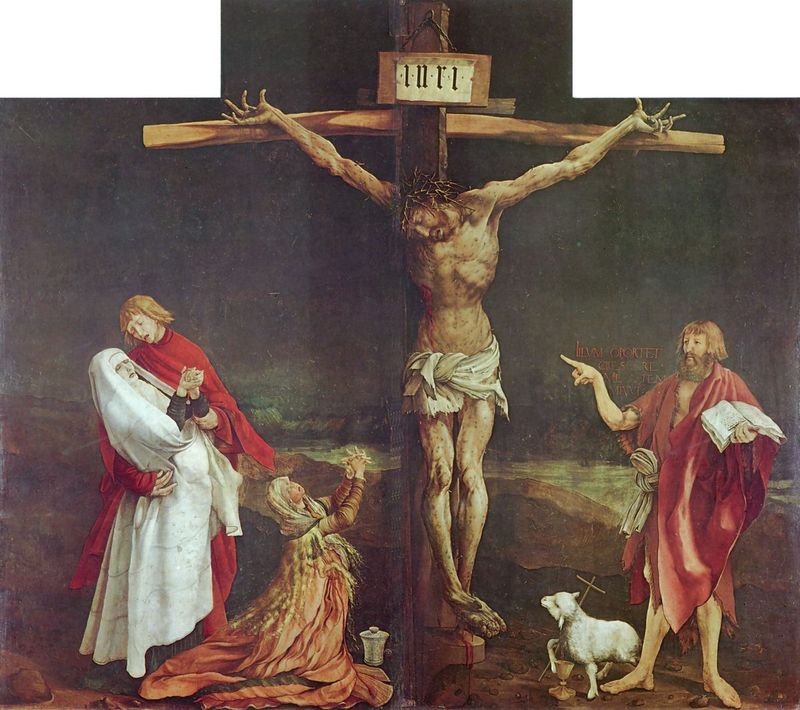
This is why John’s own summary of his ministry—“He must increase, but I must decrease” (John 3:30)—is inscribed beside his pointing finger in Grünewald’s great altarpiece. The witness who grasps his task wants to become smaller, not larger, as the Light grows. The temptation of every witness is to be mistaken for the dawn; the holiness of every witness is to keep pointing past himself. Verse 7 is the antidote to the oldest religious vanity there is.
So I return to where I began, with my questions—and find that the verse has answered the most important one. I wanted to know who John the Baptist was. The Fourth Gospel’s answer is almost austere: he was the one who came so that you might believe. Not the light. Not the Christ. Not even, in this Gospel, the cousin. A witness—sent from God, testifying to the Light, so that all might believe through him. And the verse turns the description into an invitation, because the same sentence can be written over any baptized life: sent, testifying, that others might believe. The Baptist’s vocation is not a museum piece. It is a job description, and it is ours.
If you are following this series through John’s Prologue, the previous posts explore John 1:1 and the grammar of divine identity, John 1:5 on the light that shines in the darkness, and John 1:6 on the man sent from God and the historical rivalry with the Baptist’s disciples. You may also find it helpful to read Five Heresies That Misread John 1 and the Glossary of Greek Terms in John 1.
Study & Reflection Questions
These questions are designed for personal study, small group discussion, or Bible study preparation.
-
The Fourth Gospel never calls John “the Baptizer”; it calls him the witness. What does it change about how you picture John the Baptist to think of him primarily as someone giving testimony?
-
Verse 7 stacks two purposes: John testifies in order that all might believe. Where in your own life are you tempted to treat witness—teaching, sharing, serving—as an end in itself rather than as something aimed at someone else’s faith?
-
The verse says people believe “through” John, not “in” him. Who are the people you first believed through? How do you keep gratitude for a human witness from sliding into making that person the object of your faith?
-
Augustine compares John to a mountain that catches the first light of a sun it does not produce. What “mountains”—admirable people, teachers, institutions—have you been tempted to mistake for the light itself?
-
Some of John’s disciples never followed the One he pointed to (Acts 19). What would it look like, in your own discipleship, to stop at a preparation and mistake it for the arrival?
-
John’s motto was “He must increase, but I must decrease” (John 3:30). In a culture that prizes building one’s own platform, what would “decreasing” concretely mean for you?
-
The Catechism sets John’s witness alongside the witness of the Holy Spirit. If “bearing witness to the light” is what the Spirit does, what does it mean that you are called to do the same thing?
What Does John 1:7 Mean?
John 1:7 states the purpose of John the Baptist’s mission: “He came for testimony, to testify to the light, so that all might believe through him.” The key word is μαρτυρία (“testimony”), a courtroom term that introduces the Fourth Gospel’s sustained presentation of Jesus’ ministry as a cosmic trial in which John is the first witness called. The verse contains two nested purpose clauses—John testifies in order that all might believe—so that testimony is the means and faith the goal. The phrase “through him” (δι᾽ αὐτοῦ) almost certainly refers to John: he is the channel through whom belief reaches the Light, never its object, a point verse 8 secures by insisting “he was not the light.” Read this way, the verse is both an exegesis of the Baptist’s vocation and a description of the Church’s: to be sent, to testify, and to point beyond oneself to Christ so that others may believe.
Frequently Asked Questions
What does John 1:7 mean?
John 1:7 explains why John the Baptist was sent: “He came for testimony, to testify to the light, so that all might believe through him.” His entire purpose is to bear witness to Jesus, the true Light, so that people will come to faith. The verse establishes the Fourth Gospel’s major theme of testimony and presents John as the first witness in what reads like an extended trial over the identity of Jesus.
What does the Greek word μαρτυρία mean in John 1:7?
Μαρτυρία (martyria) means “testimony” or “witness,” and the cognate verb μαρτυρέω means “to bear witness.” The words are originally legal—the testimony a witness gives in court. The Fourth Gospel uses this vocabulary far more than any other New Testament book, framing Jesus’ ministry as a lawsuit in which witnesses testify to who he is. The same word-group eventually gives us the English word martyr.
Does “believe through him” mean believe in John the Baptist?
No. The Greek construction is “believe through (διά) him,” not “believe in him.” John normally says people believe “into” Christ (πιστεύω εἰς). Believing “through” John means John is the channel by which belief reaches its true object, Christ. Aquinas explained it clearly: Christ came that all might believe in him; John came that all might believe, “not in him, but in Christ through him.”
Why does the Gospel say John “was not the light” right after saying he testified to the light?
Verse 8 heads off a misunderstanding. As Chrysostom noted, a witness is often assumed to be greater than the one he testifies about; so the Evangelist insists on “the interval” between John and Jesus. There is also a historical reason: some of John’s disciples persisted in elevating him (see Acts 18–19), and the Gospel firmly subordinates the Baptist to the One he announces.
Was John the Baptist Elijah?
The Synoptic Gospels say Jesus identified John with Elijah “who is to come” (Matt 11:14; 17:10–13), fulfilling Malachi’s prophecy (Mal 3:23–24). Yet in John 1:21 the Baptist denies being Elijah. The Catholic resolution distinguishes two meanings: John denied being Elijah literally returned to earth, but he fulfilled the Elijah role typologically, “in the spirit and power of Elijah” (Luke 1:17). The Catechism affirms: “John is ‘Elijah who must come.’”
Why doesn’t John’s Gospel mention that John and Jesus were related?
The Fourth Gospel reduces John to a single role: witness. As the official note on John 1:31 observes, this Gospel “shows no knowledge of the tradition (Lk 1) about the kinship of Jesus and John the Baptist.” A family relationship would diffuse John’s purely testimonial role. John’s “I did not know him” (1:31, 33) stresses that his recognition of Jesus was revealed from above, not inherited through family.
Was Jesus a disciple of John the Baptist?
The Gospels acknowledge that the two ministries overlapped and that Jesus’ first followers came from John’s circle (John 1:35–42), and some historians argue from the “criterion of embarrassment” that Jesus’ baptism by John must be historical. But proximity is not subordination. The early Church did not hide the baptism; it interpreted it—as fulfilling all righteousness (Matt 3:15) and sanctifying the waters. Verse 7’s point stands: John’s role was to testify to Jesus.
For Further Study: Commentaries and Sources
- Raymond E. Brown, The Gospel According to John I–XII, Anchor Bible 29 (New York: Doubleday, 1966), on the Prologue (1:1–18)—the standard critical commentary; essential on the witness theme and the Baptist material.
- Andrew T. Lincoln, Truth on Trial: The Lawsuit Motif in the Fourth Gospel (Peabody: Hendrickson, 2000)—the major study of John’s forensic/trial framework, in which the Baptist is the first witness.
- Allison A. Trites, The New Testament Concept of Witness, SNTSMS 31 (Cambridge: Cambridge University Press, 1977)—the foundational monograph on μαρτυρία vocabulary, with sustained treatment of John.
- Craig S. Keener, The Gospel of John: A Commentary, 2 vols. (Peabody: Hendrickson, 2003)—encyclopedic on historical background, including the evidence for a continuing Baptist movement.
- Francis Martin and William M. Wright IV, The Gospel of John, Catholic Commentary on Sacred Scripture (Grand Rapids: Baker Academic, 2015)—a Catholic commentary attentive to the liturgical and doctrinal dimensions of the text.
- St. John Chrysostom, Homilies on the Gospel of John, Homily 6 (on John 1:6–8).
- St. Augustine, Tractates on the Gospel of John, Tractate 2 (on John 1:6–14).
- St. Thomas Aquinas, Commentary on the Gospel of John, chapter 1, lecture 4 (on John 1:6–8).
- Catechism of the Catholic Church, §§717–720 (on John the Baptist and the Holy Spirit).
Footnotes
1. The Greek text is that of Eberhard Nestle, Erwin Nestle, Barbara Aland, et al., eds., Novum Testamentum Graece, 28th rev. ed. (Stuttgart: Deutsche Bibelgesellschaft, 2012) (NA28), identical here to The Greek New Testament, 5th rev. ed. (Stuttgart: Deutsche Bibelgesellschaft, 2014) (UBS5). John 1:7 is textually stable: UBS5’s apparatus has no entry for John 1:6–8, and NA28 records no substantive variant in v. 7 (only an orthographic variant on the spelling of Ἰωάννης in v. 6); the subjunctives μαρτυρήσῃ and πιστεύσωσιν are not subject to any variant and are read by the major witnesses extant here (𝔓66, 𝔓75, ℵ, B, A, W, Θ; W reads here only via its later supplement leaf). On the lexis, see BDAG, s.v. “μαρτυρία” and “μαρτυρέω.”
2. Hermann Strathmann, “μάρτυς, μαρτυρέω, μαρτυρία, μαρτύριον,” in Theological Dictionary of the New Testament, ed. Gerhard Kittel and Gerhard Friedrich, trans. Geoffrey W. Bromiley, 10 vols. (Grand Rapids: Eerdmans, 1964–1976), 4:474–514. For the semantic domain, see Johannes P. Louw and Eugene A. Nida, Greek-English Lexicon of the New Testament Based on Semantic Domains, 2nd ed. (New York: United Bible Societies, 1989), §33.262. The noun μαρτυρία occurs 14 times in the Fourth Gospel and the verb μαρτυρέω 33 times; the verb’s frequency here far outstrips its use in any other New Testament book.
3. On the nested ἵνα clauses and the aorist subjunctive of purpose, see Daniel B. Wallace, Greek Grammar Beyond the Basics (Grand Rapids: Zondervan, 1996), pp. 471–477, on the conjunction ἵνα and purpose clauses generally. Raymond E. Brown, The Gospel According to John I–XII, AB 29 (New York: Doubleday, 1966), reads the second ἵνα as subordinate to the first (testimony is the means, belief the goal).
4. New American Bible, Revised Edition, note on John 1:7, at bible.usccb.org: the note states that the verse introduces “the testimony theme of John… which portrays Jesus as if on trial throughout his ministry” and lists the witnesses: “John the Baptist, the Samaritan woman, scripture, his works, the crowds, the Spirit, and his disciples.”
5. Andrew T. Lincoln, Truth on Trial: The Lawsuit Motif in the Fourth Gospel (Peabody: Hendrickson, 2000); Allison A. Trites, The New Testament Concept of Witness, SNTSMS 31 (Cambridge: Cambridge University Press, 1977). The enumeration of the witnesses follows the official NABRE note on John 1:7 (n. 4 above).
6. Thomas Aquinas, Commentary on the Gospel of John, ch. 1, lect. 4, no. 119, trans. Fabian Larcher and James A. Weisheipl (Washington, DC: Catholic University of America Press), online at isidore.co, quoting Isa 43:10. On the Old Testament law of witnesses, see Deut 17:6; 19:15.
7. On πιστεύω εἰς as the characteristic Johannine idiom for saving faith and the contrast with other constructions, see Brown, John I–XII, 512–13 (Appendix I, “Johannine Vocabulary”); and Wallace, Greek Grammar Beyond the Basics, 368–369, on διά with the genitive of intermediate agency. The διά + genitive of agency is itself a common Koine construction (e.g., John 1:3, 17); what is unusual is its pairing with πιστεύω.
8. Aquinas, Commentary on the Gospel of John, ch. 1, lect. 4, no. 121. The same verse, no. 122, adds that John bears witness “not because he is greater, but because he is better known, even though he is not as great.”
9. The reading of αὐτοῦ as John (rather than the light) is shared by, among others, Brown, John I–XII, ad loc.; C. K. Barrett, The Gospel According to St John, 2nd ed. (London: SPCK, 1978), ad loc.; and Keener, The Gospel of John, ad loc. It is the patristic majority as well; see Chrysostom and Augustine cited below.
10. John Chrysostom, Homilies on the Gospel of John, Homily 6, on John 1:8, trans. Charles Marriott, NPNF1 14 (Buffalo: Christian Literature Publishing, 1889), online at New Advent. In the same homily Chrysostom explains that God “sent forth a man for His herald, that those who heard might at the hearing of a kindred voice approach more readily,” so that “beings of his own class might believe.”
11. Augustine, Tractates on the Gospel of John, Tractate 2.5, trans. John Gibb, NPNF1 7 (Buffalo: Christian Literature Publishing, 1888), online at New Advent.
12. Augustine, Tract. Ev. Jo. 2.6. In 2.7 Augustine adds that “upon John He shed the beams of His light,” John “confessing himself to have been irradiated and enlightened, not claiming to be one who irradiates and enlightens.”
13. Aquinas, Commentary on the Gospel of John, ch. 1, lect. 4, no. 123: John “and all the saints are light by participation. So, because John participated in the true light, it was fitting that he bear witness to the light; for fire is better exhibited by something afire than by anything else, and color by something colored.”
14. On the historical evidence for a continuing Baptist movement, see Raymond E. Brown, The Community of the Beloved Disciple (New York: Paulist, 1979), pp. 69–71; and Joseph A. Fitzmyer, The Acts of the Apostles, AB 31 (New York: Doubleday, 1998), on Acts 18:24–19:7. The fuller treatment, including the Pseudo-Clementine and Mandaean evidence and the assessment of the Baldensperger–Bultmann thesis, appears in the companion essay on John 1:6.
15. Catechism of the Catholic Church, 2nd ed. (Vatican City: Libreria Editrice Vaticana, 1997), §720; cf. §§1223–1225 on the relation of Christ’s baptism to the sacrament.
16. For the critical case, see John P. Meier, A Marginal Jew: Rethinking the Historical Jesus, vol. 2, Mentor, Message, and Miracles (New York: Doubleday, 1994), on Jesus and the Baptist. On the criterion of embarrassment as applied to Jesus’ baptism, see Meier, A Marginal Jew, vol. 1 (1991), pp. 168–171. The responses summarized here are the standard ones; the Catholic reading of Jesus’ baptism is given at CCC §§535–536.
17. NABRE, note on John 1:21 (“the Baptist did not claim to be Elijah returned to earth”); CCC §718; Mal 3:23–24; Matt 11:14; 17:10–13; Luke 1:17. On the “Elijah” expectation, see also the note on John 1:21 in the NABRE apparatus.
18. NABRE, note on John 1:31, at bible.usccb.org.
19. CCC §719, which quotes John 1:7 directly (“came to bear witness to the light”) and sets John’s witness in parallel with that of “the Spirit of truth” (cf. John 15:26). See also §717, quoting John 1:6, and §523 on John as the Lord’s “immediate precursor.” Lumen Gentium §1 opens “Christ is the Light of nations” and speaks of that light as “brightly visible on the countenance of the Church”; the moon-and-sun image is the older patristic mysterium lunae (e.g., Ambrose). Cf. CCC §748, which quotes LG §1 and then adds the image “according to a favorite image of the Church Fathers,” confirming it is a patristic gloss rather than the Council’s own words.

Garrett Ham
Garrett Ham is an attorney, military veteran, and holds a Master of Divinity from Yale Divinity School. He writes from Northwest Arkansas on theology, law, and service.
Related Posts
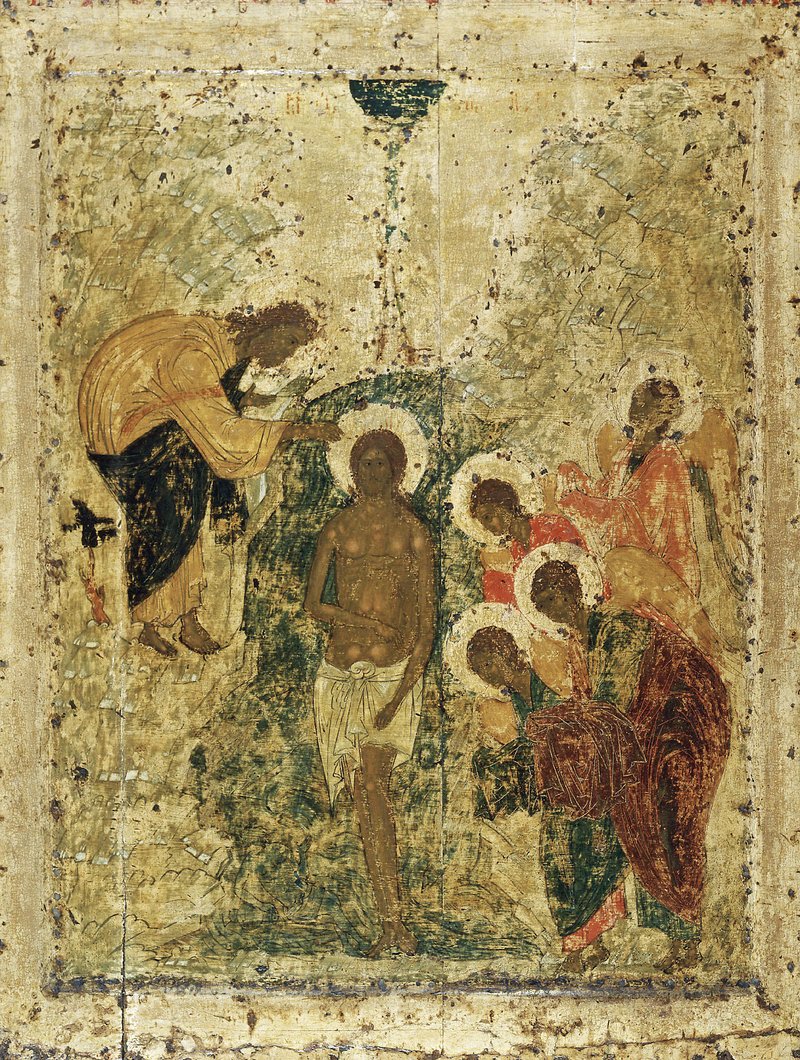
John 1:6 Meaning Explained: There Came a Man, Sent from God
What does John 1:6 mean? A Catholic exegesis of the Greek—the ἦν/ἐγένετο contrast, the perfect participle ἀπεσταλμένος, and John the Baptist as witness.
John 1:5 Meaning Explained: The Light Shines in the Darkness
What does John 1:5 mean? A study of the Greek—the present tense of φαίνει, the double meaning of κατέλαβεν, and the already/not yet of eschatology.
John 1:3–4 Meaning Explained: The Creator Who Became the Light
What do John 1:3–4 mean in the Gospel of John? A close reading in the original Greek — the punctuation of ὃ γέγονεν, Incarnation as life in the Word, and Chalcedonian Christology.
Stay Informed
Get new writing on faith, law, and service delivered to your inbox.
No spam. Unsubscribe anytime.