Is Molinism Compatible with Thomism?
On This Page
When I first encountered the debate between Molinism and Thomism in graduate seminary, I found myself genuinely perplexed. Here were two sophisticated theological traditions, both passionately defended by intelligent Catholic thinkers, both affirmed as orthodox by the Church, yet seemingly locked in irreconcilable disagreement about the most fundamental questions: How does God know the future? Does divine foreknowledge undermine human freedom? What does it mean for God to cause good actions without causing sin?
After years of wrestling with these questions—and having previously held an open theist view that rejected classical theism altogether—I’ve come to see the Molinist-Thomist debate not as a scandal to be resolved, but as a window into the proper limits of human theological understanding. The Church’s refusal to condemn either position, established in the early seventeenth century, was not a failure of ecclesiastical authority but a recognition of genuine mystery at the intersection of divine omniscience and human liberty.
This essay explores whether Molinism and Thomism are truly incompatible. My conclusion: they represent two different approaches to the same mystery rather than two propositions that can both be true in classical logic. Yet this does not make either one false—and the Church’s judgment reflects a mature acknowledgment of the limits of analogical reasoning when applied to the infinite.
The De Auxiliis Controversy: A Battle Over Divine Help
To understand the modern Molinist-Thomist debate, we must first understand what provoked it: a question that sounds arcane but cuts to the heart of soteriology. How does God move the human will toward good without destroying its freedom?
The controversy erupted in Spain at the end of the sixteenth century, when the Dominican friar Domingo Báñez published his commentary on Thomas Aquinas’s Summa Theologiae. Báñez defended and systematized Aquinas’s teaching on praemotio physica—“physical premotion,” the idea that God must actively move the human will at the very moment of its choice in order to ensure that choice’s efficacy. Without this divine motion, Báñez insisted, human acts would be too weak, too contingent, to cooperate with divine providence.
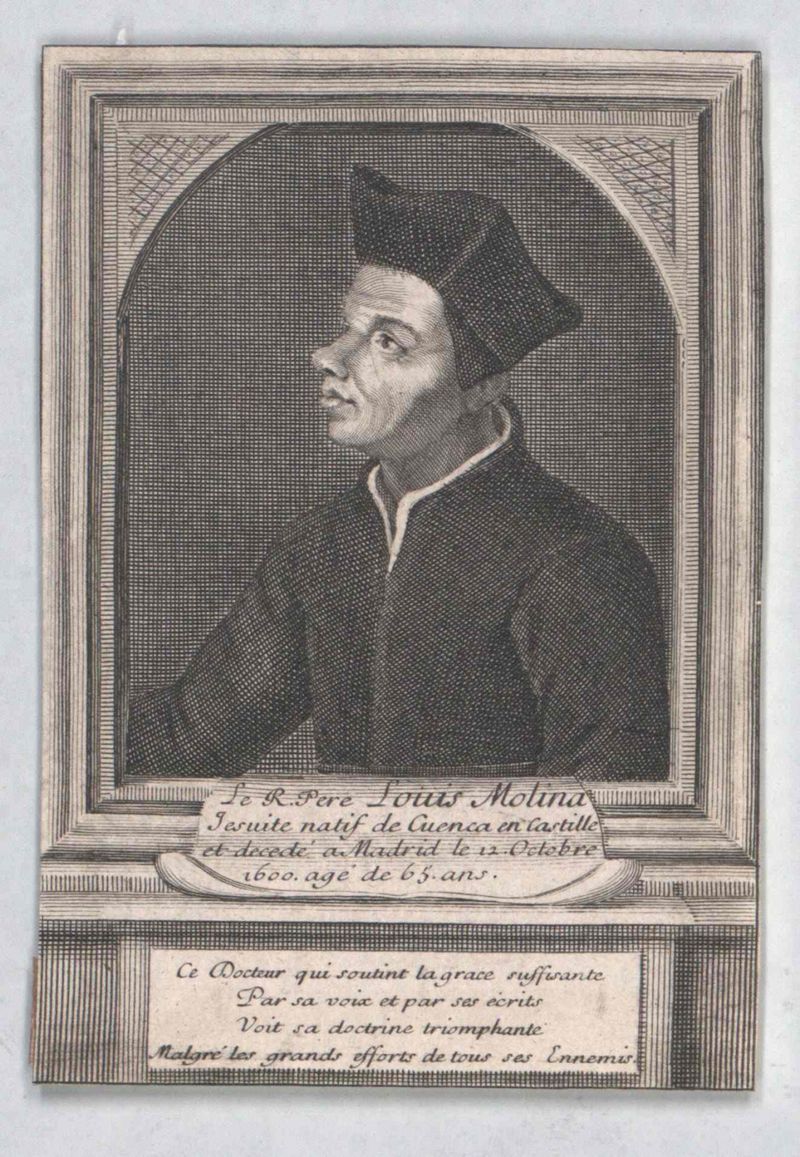
Enter Luis de Molina, a Spanish Jesuit, whose 1588 work Concordia Liberi Arbitrii cum Gratiae Donis (commonly known as the Concordia) proposed a radically different solution. Rather than saying God moves the will directly through physical premotion, Molina argued that God governs human choices through an extraordinary knowledge of counterfactuals—knowledge of what any person would freely choose in any possible circumstance. God’s knowledge of these conditionals, which Molina called scientia media (“middle knowledge”), allows divine providence to work through human freedom rather than despite it.
The De Auxiliis controversy that followed was not merely academic. It pitted Dominicans against Jesuits, threatened the peace of the Spanish Church, and eventually required papal intervention. From 1597 to 1607, both orders presented their cases to a papal commission, with theologians on both sides accusing their opponents of Pelagian tendencies (Molinists argued that Thomistic premotion bordered on theological determinism; Thomists countered that Molinist middle knowledge made God dependent on facts outside his causality).
When Pope Paul V finally rendered judgment in 1607, he did something remarkable: he condemned neither position. Both were declared orthodox. Both orders were permitted to teach their doctrines. But mutual public censure was prohibited.
The Thomistic Vision: God as Primary Cause
To grasp Thomism, one must begin with Thomas Aquinas’s principle of causality: everything that moves is moved by another, and ultimately everything must be moved by a first unmoved mover. Applied to the human will, this means that human acts, like all creatures acts, require a divine cause to actualize them.
For Aquinas—and even more systematically for his commentators like Báñez—God is the primary cause of all creaturely actuality. Human freedom is real, but it operates within the causal order established by divine omnipotence, not outside it. When I choose freely to do good, two things are simultaneously true: (1) I am the true cause of my choice, exercising genuine agency, and (2) God is the cause of my choice, moving my will toward the good.
This is not contradictory, Thomists argue, because causality operates on different levels. God is the primary cause; I am the secondary cause. A pen that writes a letter does not compete with the hand that moves it. Likewise, human will does not compete with divine power when both operate at their proper levels.[1]
The mechanism by which God accomplishes this is praemotio physica. Before and simultaneously with my act of will, God moves my will toward its proper object—the good. This divine motion is not a constraint that violates freedom because the motion itself is adapted to the nature of the will; it moves the will according to what the will is—a faculty capable of choosing good. The motion respects the will’s nature even as it determines its act.
More fundamentally, Aquinas roots God’s knowledge in His essence and His eternal mode of being. God knows Himself through Himself (Summa Theologiae I, Q.14, a.2), knows all things through His own essence (a.5), and His being is His act of understanding. In the crucial article on future contingents (I, Q.14, a.13), Aquinas explains that God knows contingent futures because “His glance is carried from eternity over all things as they are in their presentiality.” Knowledge here flows from God’s mode of existence (eternity), not from His will per se. Aquinas also teaches that God’s knowledge is the cause of things insofar as His will is joined to it—what he calls the scientia approbationis (I, Q.14, a.8): scientia dei est causa rerum.[2] But the causal direction runs from God’s knowledge-plus-will toward creatures, not from God’s will toward God’s knowledge.
The Bañezian development within Thomism gives the will a more prominent role, arguing that God knows future contingents specifically through His predetermining decrees (praemotio physica), since God as Pure Act cannot passively receive knowledge from external causes. This positions the will’s decretive act as epistemically prior to creatures’ actions. But even in the Bañezian scheme, divine simplicity means intellect and will are really identical in God—there is only a virtual distinction between them. To say knowledge “flows from” will imports a sequential relationship that divine simplicity forbids.
The Molinist Alternative: Knowledge Without Causation
Molina was not attacking Aquinas; he believed himself to be defending Aquinas. But he perceived a problem in how later Thomists explained the relationship between divine foreknowledge and human freedom. If God’s knowledge of my future choices is the cause of those choices, and if I cannot change what God eternally knows, then how can I be truly free? Is my choice not already determined by divine knowledge?
To escape this apparent determinism, Molina proposed a revolutionary doctrine: God’s knowledge must be understood in terms of three distinct “moments” (not temporal moments, but logical distinctions).[3]
Scientia visionis (“knowledge of vision”): God’s knowledge of all actual future events, including the free choices of human beings.
Scientia simplicis intelligentiae (“knowledge of simple understanding”): God’s knowledge of all essences and all possibilities—everything that could be, whether it will be or not.
Scientia media (“middle knowledge”): God’s knowledge of conditionals of freedom—knowledge of what any free creature would choose in any possible circumstance, whether or not that circumstance will actually obtain.
It is through middle knowledge that divine providence works. God knows that if he creates the world in circumstance C, Mary will freely choose X. And if he were to create the world in circumstance D, Mary would freely choose Y. By choosing which world to create—which set of circumstances to actualize—God governs the world entirely through human freedom. He knows what humans will freely do because he knows (through middle knowledge) what they would freely do, and he has chosen the circumstances in which those free acts will occur.
Notice what Molina has done: he has severed the link between God’s knowledge and God’s causation. God does not cause my choice in order to know it; rather, God’s knowledge of what I would freely choose (obtained through middle knowledge) grounds his decision to create circumstances in which I will make that choice. Divine foreknowledge is no longer the cause of my freedom; it is compatible with my freedom because it is knowledge of what I will freely choose, not knowledge of what I will be caused to do.
For many modern Catholic thinkers, this represents a conceptual advance. It seems to preserve both divine omniscience and human libertarian freedom. But it comes at a cost that Thomists were quick to identify.
The Fundamental Disagreement: The Grounding Objection
The most formidable challenge to the Molinist system is called “the grounding objection.” While Thomists have long pressed this point, the objection in its modern form was developed primarily by analytic philosophers like Robert Adams and William Hasker.
The objection runs like this: What makes a counterfactual conditional true? If God knows through middle knowledge that “If Pete is placed in circumstance C, Pete will freely choose X,” there must be something that makes this counterfactual true. It cannot be God’s knowledge, because that would make knowledge the ground of truth rather than truth the ground of knowledge. But what else could it be?
Molina himself famously left this question unanswered, and his successors have struggled with it ever since. Some later Molinists suggest that counterfactuals are grounded in the essences of free creatures—in what creatures are intrinsically inclined to do. But if counterfactuals of freedom are grounded in the nature of the creature, they are not freely determined by the creature at the moment of choice; they are determined by what the creature essentially is. And if the creature’s nature determines the truth of the counterfactual, have we not simply reintroduced determinism by another route?
Thomas Flint and other contemporary Molinists have offered sophisticated responses: middle knowledge is not grounded in anything other than God’s perfect understanding of reality. God simply knows what any free creature would choose, not because anything makes the counterfactual true prior to God’s knowledge, but because God’s knowledge is comprehensive and infallible. This move—embracing the apparent circularity rather than trying to escape it—may be the most honest response available to the Molinist position.[4]
But Thomists see in this move a concession that middle knowledge is ultimately unintelligible—that we do not truly understand how God could know counterfactuals of freedom without those counterfactuals being grounded in something other than God’s omniscience. And if middle knowledge is unintelligible in this way, why is it superior to Thomistic physical premotion? Both positions, the Thomist says, point toward mystery. The question is which mystery is more rationally defensible.
Secondary Disagreements: The Nature of Divine Causation
Beneath the grounding objection lie deeper disagreements about how causation itself should be understood when applied to God and creatures.
Thomists insist on a principle that Molinists resist: God must be the cause of every creaturely act insofar as that act has being. For Thomists, this is not a limitation on human freedom but a recognition of dependence. Just as the lines on a page depend on the pen that writes them, human choices depend on God who sustains them in being. This dependence is not incompatible with freedom because the dependence is vertical (creature on creator) while freedom is horizontal (pertaining to the creature’s power of choosing among alternatives).
Molinists worry that if God must cause every act of the human will, then God must also cause how the will acts—and this seems to entail that God causes not only good choices but sinful choices. The Thomist response is subtle: God causes the actuality of the choice (its being-ness) but not its deficiency. Sin is always a turning-away-from-God, and this deficiency cannot have God as its cause. God causes the act insofar as it is real; God does not cause the sin insofar as sin is a privation of the good that should be intended.
Is this distinction coherent? Molinists are skeptical. How can God cause the actuality of a sinful choice without causing that choice to be sinful? Thomists respond that this is precisely the mystery of sin—it is not a positive being but a defect, and God is the cause of all positive being but not of defects.
The difference here is not merely terminological. It reflects a deeper disagreement about whether God’s causation should be understood dynamically (as an active moving of creatures, as Thomists maintain) or logically (as God’s decision to actualize certain possible worlds, as Molinists suggest).
Where Agreement Remains
Yet despite these profound disagreements, Molinists and Thomists agree on essentials:
Both affirm exhaustive divine foreknowledge. God knows all future free choices with absolute certainty. Neither position makes God ignorant or dependent on time or contingency.
Both affirm genuine human freedom, though they disagree about its nature. Molinists unambiguously affirm libertarian freedom—the ability to have done otherwise in identical circumstances—which is the whole point of middle knowledge. Traditional Bañezian Thomism, with its doctrine of physical premotion, is more commonly classified by scholars as a form of compatibilism, though some neo-Thomists argue that Aquinas himself held a position closer to libertarianism. This disagreement about the nature of freedom was, in fact, a central issue in the De Auxiliis controversy itself.
Both recognize mystery. Neither pretends to have fully resolved the metaphysical puzzle of how omniscience and freedom can coexist. Both acknowledge that human concepts reach their limit when applied to God.
Both affirm that grace is efficacious. Both positions defend the Catholic teaching that God’s grace truly works in the human soul, that it is not merely offered passively to be accepted or rejected, but that it genuinely moves the will toward good.
Both affirm that humans can truly sin. Both reject Calvinist predestinarian theology. Both maintain that God genuinely permits humans to choose evil and that humans bear real responsibility for their sins.
This convergence on essentials is crucial. The disagreement is about how to explain these things, not about what is true at the doctrinal level.
Pope Paul V’s Judgment: Wisdom in Silence
When Pope Paul V ended the De Auxiliis controversy in 1607, he did not produce a synthesis that all could embrace. Instead, he made a deceptively simple pronouncement: both positions could be taught; both were consonant with Catholic orthodoxy; neither order could publicly censure the other.
This judgment has sometimes been read as the Church throwing up its hands in defeat. But I believe it represents something more profound: a recognition that certain mysteries lie beyond the reach of human systematization.
The Pope was saying, in effect: You are both trying to explain something that transcends human reason. Your frameworks differ, but your fundamental commitments are sound. Rather than exhaust the Church’s intellectual resources in trying to force agreement, let both schools continue to develop their thought, knowing that truth lies not in choosing between you but in holding together what you each emphasize.
This was not relativism. Both positions were not declared equally true; both were declared not-condemned. The Church left open the possibility that if human reason could adequately solve the problem, one position might prove superior to the other. But until such a resolution appears, both Catholics are free to embrace either tradition.
Modern Synthesis: Can They Be Reconciled?
Over the past century, some Catholic theologians have engaged the Thomism-Molinism question in ways that illuminate the debate, even if none has produced a definitive synthesis. Reginald Garrigou-Lagrange, the great twentieth-century Thomist, offered perhaps the most forceful modern defense of physical premotion against Molinist alternatives. Far from attempting to reconcile the two systems, Garrigou-Lagrange argued that scientia media was fundamentally incoherent and that Molinism veered dangerously close to semipelagianism. His Reality: A Synthesis of Thomistic Thought (1950) presents Thomism as a unified philosophical and theological system that has no need of Molinist supplementation—the title refers to a synthesis of Thomism, not a synthesis between Thomism and Molinism.[5]
Bernard Lonergan, a Jesuit theologian of tremendous depth, attempted something different in his early work Grace and Freedom (based on his 1940 doctoral dissertation). Rather than validating both rival interpretations, Lonergan argued that both Thomists and Molinists had missed what Aquinas actually taught. He sought to recover Aquinas’s own position on operative grace and freedom—a position he believed had been obscured by centuries of Bañezian and Molinist systematization alike.[6]
These engagements are valuable, but they illustrate rather than resolve the impasse. It may be that genuine synthesis is not possible—not because one position is false, but because the two positions embody different intuitions about which aspects of the problem are most fundamental. Thomists begin with the principle that God is the cause of all being; Molinists begin with the conviction that creatures possess genuine libertarian freedom that cannot be reduced to divine determination.
Starting from different premises, they reach different conclusions. Both premises seem true, but their systematic elaborations diverge. This does not mean one position is false; it may mean that the human intellect cannot, from first principles, construct a single comprehensive system that honors both insights equally.
Why the Church’s Refusal to Decide is Itself Significant
Looking back on the De Auxiliis controversy and its resolution, I have come to appreciate that the Church’s refusal to condemn either position is not a deficiency in magisterial authority. It is, rather, an acknowledgment of something important: not every theological question that seems urgent has a definitive answer available to reason.
The Reformation was fought partly over precisely this issue—how God’s absolute will and human freedom relate. Protestants tended toward predestinarianism; Catholics insisted on human freedom. But how to explain their compatibility became a question that divided Catholic theologians themselves. Rather than impose an answer, the Church recognized that both Thomism and Molinism represent legitimate attempts to hold together truths that reason can perceive but perhaps not fully reconcile.
This is not fideism. The Church did not say “reason cannot address this, so stop trying.” Rather, it said “reason can illuminate this problem from different angles, but neither angle fully resolves it.” This distinction matters.
It also matters ecumenically. My wrestling with these questions as a former open theist has taught me that Catholics—whether Thomist or Molinist—are closer to each other (and to classical Protestantism) than to theological traditions that reject exhaustive divine foreknowledge altogether. Both positions presuppose a God who knows the future, who is omnipotent, and who governs all things. The debate between them is internal to classical theism, not a debate about whether classical theism is true.
Conclusion: Two Aspects of One Mystery
So are Molinism and Thomism compatible? The answer depends on what we mean by compatible.
As systematic philosophical theology, they are not compatible in the strict sense. Both cannot be completely true in classical logic. If God’s knowledge of my future choice is the cause of my choice (as Thomism suggests), then God’s knowledge does indeed seem to determine my choice. And if God’s knowledge is not the cause of my choice (as Molinism suggests), then it is unclear what makes God’s knowledge infallible about my genuinely free choice.
But as spiritual and doctrinal commitments, they are perfectly compatible. A Catholic may be a Thomist or a Molinist while maintaining identical beliefs about God’s omniscience, human responsibility, the efficacy of grace, and the reality of sin. The difference concerns how these truths relate to each other—the metaphysical architecture that holds them together—not whether they are true at all.
This is why I hesitate to say that one position is simply right and the other wrong. Both represent insights into the nature of God and creatures that seem indispensable. God is the cause of all being; and creatures are genuinely free. These two truths, held together, point toward something that exceeds the grasp of human reason as we currently possess it.
Perhaps in the beatific vision, when we see God as he is, the apparent incompatibility will dissolve, and we will understand how God’s omnipotence and creatures’ freedom form a single harmonious reality. Until then, the Church’s judgment stands: let both schools flourish, let both contribute to the Church’s theological tradition, and let us approach this mystery with the humility that befits finite minds contemplating the infinite.
Further Reading
Primary Sources:
- Thomas Aquinas, Summa Theologiae I, Questions 14-23 on Divine Knowledge (New Advent)
- Luis de Molina, Concordia Liberi Arbitrii cum Gratiae Donis, Divina Praescientia, Praedestinatione et Reprobatione (1588)
- Domingo Báñez, Commentary on Summa Theologiae I, Questions 22-23
Secondary Scholarship:
- Thomas Flint, Divine Providence: The Molinist Account (Cornell University Press, 1998) — The definitive contemporary defense of Molinism
- Reginald Garrigou-Lagrange, Reality: A Synthesis of Thomistic Thought (B. Herder, 1950) — The preeminent twentieth-century defense of Thomistic physical premotion against Molinist alternatives
- Romanus Cessario, The Moral Virtues and Theological Ethics (University of Notre Dame Press, 2009) — Contains excellent chapters on Thomistic metaphysics
- Bernard Lonergan, Grace and Freedom (Darton, Longman and Todd / Herder and Herder, 1971) — A recovery of Aquinas’s own position on operative grace, arguing both Bañezians and Molinists missed his actual teaching
Online Resources:
- Stanford Encyclopedia of Philosophy on Divine Providence (discusses Molinism within the broader topic)
- Stanford Encyclopedia of Philosophy on Foreknowledge and Free Will (covers middle knowledge and its alternatives)
- Catholic Encyclopedia on Controversies on Grace
- Catholic Encyclopedia on the Congregatio de Auxiliis
Related Posts on This Site:
- Molinism Explained
- Is Open Theism Compatible with Catholicism?
- Divine Foreknowledge and Human Freedom
- Divine Simplicity and the Problem of Change
- Predestination: Catholic vs. Calvinist
Footnotes
[1] Thomas Aquinas, *Summa Theologiae* I, Q. 105, A. 5 ("Whether God works in every agent"). In this article, Aquinas argues that God acts in every agent as a first cause enabling the operation of secondary causes — not by overriding them but by granting them their very power to act. The analogy of the pen and hand is a classical one in medieval theology for illustrating the non-competitive relationship between primary and secondary causality.
[2] Aquinas, *Summa Theologiae* I, Q. 14, A. 8 ("Whether the knowledge of God is the cause of things"), citing Augustine's *De Trinitate* XV. The phrase *scientia dei est causa rerum* is the central thesis of this article and appears in its title. See also Aquinas's Commentary on the *Sentences*, Book 1, D. 35, Q. 1, A. 4 for related discussion.
[3] Molina's distinction of three "moments" in God's knowledge is not a temporal succession—God's knowledge is eternal and single—but a logical ordering that helps us understand the structure of divine knowledge. See *Concordia*, Disputation 52.
[4] Thomas Flint's work is crucial here. He argues that middle knowledge need not be grounded in anything other than God's perfect understanding. This "ungrounded knowledge" view has attracted both defenders and critics. See Flint, *Divine Providence: The Molinist Account* (Cornell University Press, 1998), especially the chapter on the grounding objection beginning at p. 121.
[5] Reginald Garrigou-Lagrange, *Reality: A Synthesis of Thomistic Thought* (B. Herder, 1950). Garrigou-Lagrange was among the twentieth century's most forceful opponents of Molinism, rejecting *scientia media* entirely and defending physical premotion against all Molinist alternatives. The book's title means a synthesis *of* Thomism as a unified system, not a synthesis between Thomism and Molinism.
[6] Bernard Lonergan, *Grace and Freedom* (Darton, Longman and Todd / Herder and Herder, 1971). Based on Lonergan's 1940 doctoral dissertation, this work argues that both Bañezian Thomists and Molinists missed Aquinas's actual position on operative grace and freedom. Rather than validating both rival interpretations, Lonergan sought to recover what Aquinas really thought. This work is demanding but rewarding for those willing to engage with Lonergan's methodology.
[7] Pope Paul V's 1607 decree concluding the De Auxiliis controversy prohibited both orders from censuring the other's position. This was reinforced by Clement XII's 1733 bull *Apostolicae Providentiae Officio*, and no subsequent magisterial declaration has resolved the question. For a detailed account of the controversy, see the Catholic Encyclopedia article on the Congregatio de Auxiliis.
[8] My own conversion from open theism to Catholicism involved embracing the classical theistic framework that both Thomists and Molinists share—namely, that God is omniscient, omnipotent, and immutable. The question of *how* to explain omniscience and freedom seemed less urgent once I accepted that both must be true.
Garrett Ham
Garrett Ham is an attorney, military veteran, and holds a Master of Divinity from Yale Divinity School. He writes from Northwest Arkansas on theology, law, and service.
More about Garrett →Related Posts
Molinism: Divine Sovereignty and Human Freedom
What is Molinism? Luis de Molina's middle knowledge (scientia media), the De Auxiliis controversy, and how Molinism compares to Thomism and Calvinism.
Open Theism: A Catholic Evaluation
What is open theism? A Catholic evaluation of the open model of God, its scriptural case, philosophical arguments, and why it falls outside defined Catholic dogma.
Divine Foreknowledge and Free Will: The Catholic Answer
Can God know the future and humans still be free? The Catholic intellectual tradition offers robust answers through Thomism and Molinism. Here’s how they work and why they matter.
Stay Informed
Get new writing on faith, law, and service delivered to your inbox.
No spam. Unsubscribe anytime.