In the Beginning Was the Word: John 1:1 Explained

On This Page
Ἐν ἀρχῇ ἦν ὁ λόγος, καὶ ὁ λόγος ἦν πρὸς τὸν θεόν, καὶ θεὸς ἦν ὁ λόγος.
“In the beginning was the Word, and the Word was with God, and the Word was God.” — John 1:1
There are few sentences in all of Scripture that reward patient attention more generously than this one. John’s prologue opens not with a genealogy or a birth narrative, but with a declaration about eternity, about what existed before creation itself. And the Greek in which that declaration is written is doing far more work than any standard translation can fully render. To read John 1:1 carefully is to find oneself at the threshold of the Church’s deepest theology—and at the battleground of some of Christianity’s most significant doctrinal disputes. Over the centuries, this verse became the focal point for five major heresies—Arianism, Modalism, Adoptionism, Ditheism, and Docetism—each of which misread the Prologue in ways that forced the Church to articulate its Christology with ever greater precision.
A Second Genesis
The first interpretive signal arrives before the theology even begins. John opens with the words Ἐν ἀρχῇ—“in the beginning”—and these are the exact two words, in the exact grammatical form, that open the Septuagint rendering of Genesis 1:1:
Ἐν ἀρχῇ ἐποίησεν ὁ θεὸς τὸν οὐρανὸν καὶ τὴν γῆν — “In the beginning, God created the heavens and the earth.”
This is no accident of vocabulary. The verbal precision is deliberate, and scholarship across confessional lines treats it as a conscious literary and theological signal: John is writing a new-creation prologue. (For more on the theological implications of Genesis’s opening, see my reflection on The Lost World of Genesis One.) The themes that follow—life, light, darkness, the creative power of the divine Word—reinforce the echo at every turn. Saint Augustine, reflecting on this passage in his Tractates on the Gospel of John, observes that John returns his reader to Genesis because the prologue reveals what creation’s opening chapter implies but does not name: that God did not create in solitude, and that the Word through whom God created was not merely divine speech in an abstract sense—it was a Person, the eternal Son, who was with God before creation and through whom everything was made (cf. John 1:3: “Through him all things were made”).1
Genesis establishes that God was in the beginning and that he created the heavens and the earth, but John fills out the scene. God was not alone. The Word was there—coeternal, co-present, oriented toward the Father in a relationship that preceded every created thing.
Πρὸς τὸν θεόν: More Than Proximity
What Does “With God” Mean in the Original Greek?
Here the Greek repays close attention. John says the Word was πρὸς τὸν θεόν—a phrase most translations render as “with God.” But the preposition πρὸς (pros), when paired with a noun in the accusative case—as “God” (θεόν) is here—carries a sense that exceeds simple spatial co-presence. The standard Greek-English lexicon of the New Testament (BDAG), in its primary entry for πρός with the accusative, describes it as a “marker of movement or orientation toward someone or something.” For John 1:1 specifically, BDAG classifies πρὸς τὸν θεόν under the idiom πρός τινα εἶναι—“to be with someone”—indicating close personal association rather than mere spatial proximity.2
John’s choice of πρὸς, rather than alternatives available to him in the Greek preposition system—such as μετά (meta) or παρά (para), which appear in similar “with” constructions elsewhere in the New Testament—reflects a specifically relational and directional intimacy. The Word does not merely occupy the same location as God; the Word is oriented toward God, in a communion that implies by its very nature both distinction of persons and active relationship between them. The evangelist will emphasize this relational “withness” so forcefully in <a href=”/john-1-2-meaning/”>John 1:2 that he repeats and deepens the same theological claim, making it the theological anchor against which heresies denying real personal distinction would be measured.
Saint John Chrysostom, in his homilies on John’s Gospel, observes that the repeated ἦν (“was”) throughout the verse—“in the beginning was the Word,” the Word “was with God,” “the Word was God”—is the imperfect tense of continuous, uninterrupted existence: the Word was not brought into being at any moment; the Word already was. Chrysostom contrasts this with the language of coming-into-being (ἐγένετο) used for John the Baptist (“There was a man sent from God,” John 1:6) and for created things (“All things were made through him,” John 1:3): the Word’s existence is of a wholly different order. And the relational orientation encoded in πρὸς τὸν θεόν establishes that this eternal existence is not solitary. It is communion.3
Herman C. Waetjen, in a detailed syntactic study of this phrase, argues that the Logos is primordially oriented toward God in a union it already enjoys—a relationship whose directional character (πρὸς) expresses not a movement toward something not yet attained, but the dynamic, relational quality of a communion that has always existed. The Logos, Waetjen observes, draws human beings through the Incarnation into the same union with the Creator that it has possessed from the beginning. Both elements matter: genuine relational distinction, and genuine intimacy. John is, from the first verse, preparing his reader for a theology that will not permit either confusion of persons or separation of essence.4
Καὶ θεὸς ἦν ὁ λόγος: The Grammar That Changed the World
The third clause is the theological summit of the verse: καὶ θεὸς ἦν ὁ λόγος — “and the Word was God.”
Was the Word God or “a God”?
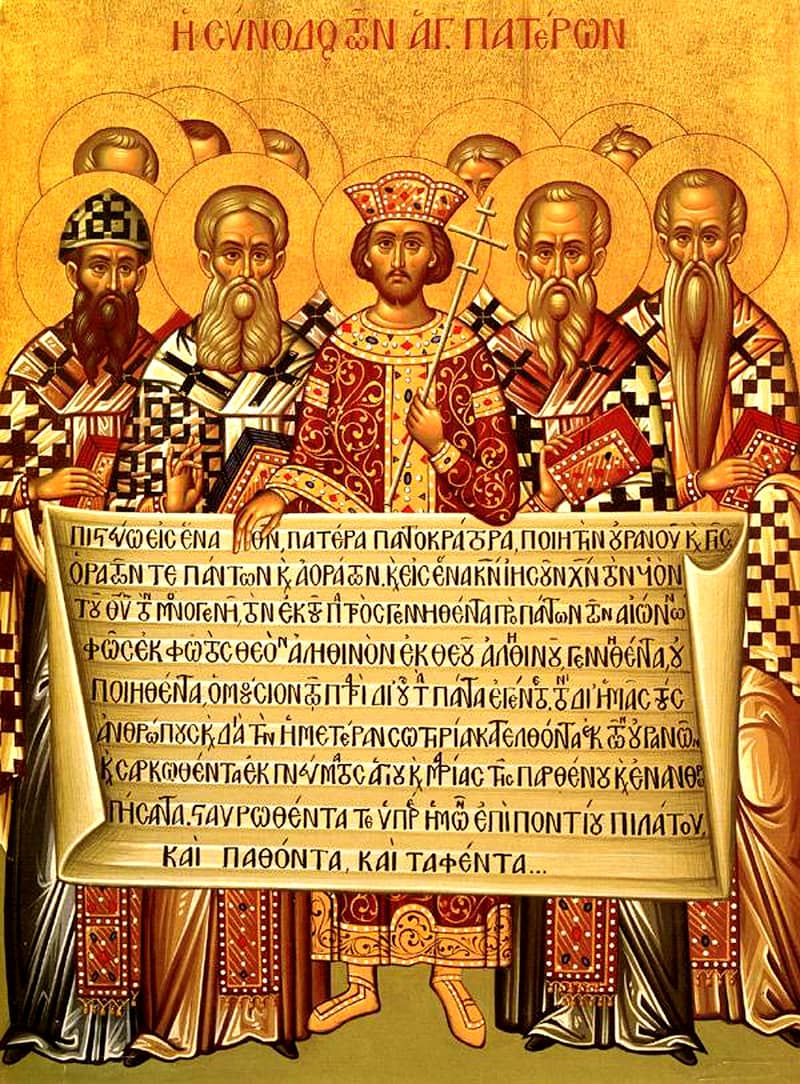
Observe the Greek carefully. The first occurrence of “God” in this verse (τὸν θεόν) carries a definite article—“the God.” The second occurrence (θεὸς in θεὸς ἦν ὁ λόγος) is anarthrous—it lacks the article. Certain groups, most visibly the Jehovah’s Witnesses, have seized on this distinction to argue that the clause should be rendered “the Word was a god,” presenting Christ as a subordinate divine being—in essence, a revival of the Arian heresy that the Council of Nicaea convened in 325 primarily to refute.5
What Is Colwell’s Rule?
The argument does not survive grammatical scrutiny. E. C. Colwell’s foundational study of the Greek article demonstrated that definite predicate nominatives appearing before the verb regularly lack the article—meaning the article’s absence in this syntactic position does not automatically justify an indefinite translation. The absence of the article permits but does not demand an indefinite reading; one cannot simply substitute “a god” and claim grammatical sanction.6
Moreover, the New World Translation’s own handling of the Greek exposes the inconsistency of its approach: θεός appears without the definite article in John 1:6, 1:12, 1:13, and 1:18, yet the NWT renders it as “God” in every one of those verses—reserving the indefinite “a god” exclusively for 1:1c, where the theological stakes are highest. As Daniel Wallace observes in Greek Grammar Beyond the Basics, the anarthrous θεός in John 1:1c is best understood as qualitative, emphasizing that the Word possesses the full nature of deity, making the indefinite “a god” the least probable translation option.7
More illuminating is Philip B. Harner’s analysis of what he termed qualitative predicate nominatives. When a noun appears before the verb in this construction—anarthrous and in the predicate position—it characteristically emphasizes the nature and essence of the subject rather than simply categorizing it. Applied to John 1:1c, the force of θεὸς ἦν ὁ λόγος is neither “the Word was the God” (which would risk collapsing the distinction so carefully preserved in 1:1b) nor “the Word was a god” (which introduces a polytheism the prologue nowhere sustains), but something that can be approximated as: the Word fully shares the nature of what God is. He is divine not by participation in a category—not as one member of a class called “gods,” the way one might say “Hercules was a god”—but by essence: he possesses the fullness of what it means to be God.8
Saint Athanasius, whose life’s work was the defense of Nicene orthodoxy against its Arian detractors, understood this with precision. In his Orations Against the Arians, he argues that what is at stake in the Johannine prologue—and in the broader witness of Scripture—is exactly the question of whether the Son belongs to the eternal divine identity or to the creaturely order, and that Scripture’s language permits no middle category. The Word either is God by nature, or the entire prologue contradicts itself.9
What Does Homoousios (Consubstantial) Mean?
Saint Thomas Aquinas, in his Commentary on the Gospel of John, identifies three distinct theological claims carried by John’s three phrases: the eternity of the Word’s existence, the distinction of persons, and the unity of divine nature. On the third clause, Aquinas concludes that the Word shares in the divine nature not by participation or category but essentially—which is why the Council of Nicaea employed the term ὁμοούσιος (homoousios)—consubstantialis in Latin: of one substance with the Father. The precise grammatical account of how θεὸς functions here as a qualitative predicate—telling the reader what the Word is by nature, rather than placing him in a class of beings—would be developed by modern scholarship through Colwell and Harner, whose work converges with Aquinas’s conclusion from a different direction. Not similar in nature, not approximately divine, but consubstantial.10
Ὁ Λόγος: A Term That Transcends Any Single Background
What Does “the Word” (Logos) Mean in John 1:1?
John’s designation ὁ λόγος—the Logos, the Word—is itself an act of theological appropriation of extraordinary range. In Stoic philosophy, λόγος named the rational principle pervading and ordering the cosmos.11 For Philo of Alexandria, the Jewish philosopher roughly contemporary with the events narrated in the Gospels and writing a generation before John’s Gospel was composed, the Logos functioned as a divine intermediary—the agent through whom the transcendent God relates to the created order.12 Within the Hebrew and Jewish wisdom tradition, readers would recognize the personified Wisdom of Proverbs 8, who was present with God before creation and through whom all things were made.
John’s Logos resonates across all of these registers. But Waetjen is correct to insist that John is not simply importing Stoic cosmology or Philonic metaphysics. John’s Logos is not an abstraction and not an intermediary in Philo’s sense—a being somehow suspended between the divine and the creaturely. John’s decisive intensification of every prior wisdom or logos tradition is the claim of full coeternity and consubstantiality: the Word preexisted not only as God’s first and greatest work, but as one who is not a work at all. He is not a creature. He is of the same substance as the Father. That is what neither Stoicism nor the Jewish wisdom tradition had asserted, and it is what makes John’s prologue so astonishing even by the standard of the theologically rich milieu in which it was composed.
A Translation That Attempts to Bear the Weight
Standard translations render the verse as: “In the beginning was the Word, and the Word was with God, and the Word was God.” This is faithful as far as it goes, and for most purposes it goes quite far. But given the semantic richness of πρὸς τὸν θεόν and the qualitative force of θεὸς ἦν ὁ λόγος, the following rendering attempts to carry more of the Greek’s theological freight into English:
“In the beginning was the Word, and the Word was in communion with God, and the Word was of the very same essence as God.”
“Communion” captures the relational orientation of πρὸς more fully than “with,” without overstating it as a technical ecclesial term. “Of the very same essence as God” renders the qualitative force that Harner identified in the anarthrous predicate construction and aligns with the Nicene term ὁμοούσιος—rendered in Latin as consubstantialis—that the Church has used ever since to give this verse its most precise theological expression.
How Different Translations Render John 1:1
| Translation | Tradition | John 1:1c Rendering |
|---|---|---|
| New American Bible, Revised Edition (NABRE) | Catholic | “and the Word was God” |
| New Jerusalem Bible (NJB) | Catholic | “and the Word was God” |
| Douay-Rheims Bible | Catholic | “and the Word was God” |
| Revised Standard Version, Catholic Edition (RSV-CE) | Catholic | “and the Word was God” |
| English Standard Version (ESV) | Protestant | “and the Word was God” |
| New American Standard Bible (NASB) | Protestant | “and the Word was God” |
| New International Version (NIV) | Protestant | “and the Word was God” |
| King James Version (KJV) | Protestant | “and the Word was God” |
| New Revised Standard Version (NRSV) | Ecumenical | “and the Word was God” |
| Eastern/Greek Orthodox New Testament | Orthodox | “and the Word was God” |
| New World Translation (NWT) | Jehovah’s Witnesses | “and the Word was a god” |
Every major Catholic, Protestant, Orthodox, and ecumenical translation renders θεὸς ἦν ὁ λόγος as “the Word was God.” The sole outlier is the New World Translation of the Jehovah’s Witnesses—a movement whose denial of Christ’s full divinity reprises the Arian heresy that the early Church condemned at Nicaea in 325. Their rendering, “and the Word was a god,” is addressed by the discussion of Colwell’s rule and Harner’s qualitative analysis above. This near-total unanimity across traditions spanning 400+ years of translation work, along with millennia of interpretive consistency, underscores the strength of the grammatical and theological case.
Why the First Verse Is the Whole Gospel
John does not open here arbitrarily. The Gospel of John is, in its entirety, a sustained argument about the identity of Jesus of Nazareth—an argument that reaches its culmination when Thomas, confronting the risen Christ, declares Ὁ κύριός μου καὶ ὁ θεός μου: “My Lord and my God” (20:28).13
The prologue is the key to the whole Gospel. Everything—the signs, the discourses, the Passion, the Resurrection—depends on the reader understanding from the very first sentence who it is they are reading about. He is the eternal Word through whom all things were made. He is not a lesser divine being, not the highest of creatures, not a personified attribute of God who falls short of full divinity. He is what the Council of Nicaea defined in 325 with the term ὁμοούσιος (homoousios)—of the same substance as the Father—a theological achievement whose implications the later Council of Chalcedon would develop further. It is what Athanasius spent his life defending against the Arian alternative, what Augustine illuminated in his reflection on the Trinity, and what Aquinas articulated with scholastic precision: God from God, Light from Light, true God from true God, begotten not made, consubstantial with the Father.14
Ἐν ἀρχῇ ἦν ὁ λόγος. In the beginning was the Word. Not became. Not was created. Was. The Word already was, in eternal communion with the Father, sharing fully in the divine nature, before the first syllable of creation was spoken.
The Stakes
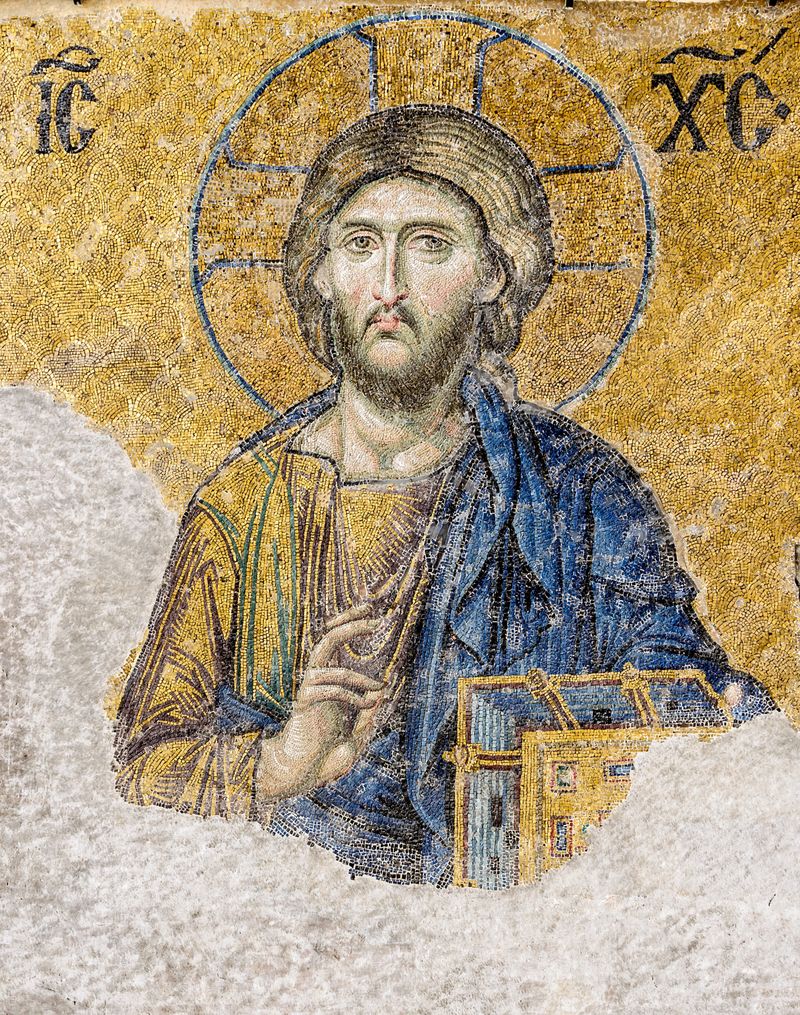
This is not an esoteric discussion, accessible only to those with Greek training and a taste for ancient controversies. It is the theological linchpin on which the entirety of the Christian faith depends, and the reason why the Church has insisted that precision here is not optional.
In Christ, God became a human being. He experienced what we experience, suffered what we suffer, and endured what we endure. Our God knows what it means to be hungry, grieved, betrayed, and broken because he has personally endured them all. He encountered the worst this world inflicts upon human beings, and he met death as we all must meet it—not as a spectator, but from within the human condition itself. The God who made all things took on the form of that which he made. He did not send a proxy. He did not call a mere man to great things, as he had in the past and still does today. He came himself.
This is precisely why the question of John 1:1 is not peripheral. Saint Athanasius, in his On the Incarnation, argues that only one who is truly God could accomplish what the Incarnation was meant to accomplish: the restoration of human nature to communion with the divine. A creature, however exalted, could redeem nothing beyond itself.15 And Saint Gregory of Nazianzus, defending the full humanity and full divinity of Christ against those who would diminish either, gave the principle its most enduring formulation: “what is not assumed is not healed.”16 If Christ did not take on the fullness of human nature, human nature remains unredeemed. And if Christ were not fully God, the one doing the assuming would lack the divine life necessary to heal what he assumed.
If Jesus were not God—if the Word of John’s prologue were a lesser divine being, a superior creature, anything short of ὁμοούσιος (homoousios) with the Father—then the Incarnation is not what the Church has always proclaimed it to be. God would remain, in some ultimate sense, at a distance. He might love us, as a sovereign loves his subjects, but he would not have entered the condition he came to transform. The acts of Christ’s life, death, and resurrection would lose the very thing that makes them the foundation of our hope rather than merely the most inspiring story ever told.
Ἐν ἀρχῇ ἦν ὁ λόγος. The first sentence of John’s Gospel is not throat-clearing before the real story begins. It is the story, the premise without which nothing that follows has the weight the Church has always claimed for it.
The next post in this series examines John 1:2 and why the apparent repetition is not redundant but structurally essential—a single verse that guards the mystery of distinction-within-unity against both Modalism and ditheism. After that, John 1:3–4 traces how the Creator became the light—the Word’s total creative agency, the ὃ γέγονεν punctuation problem, and the Chalcedonian grammar that holds the paradox together. For the full series, see the John Prologue verse-by-verse index.
Frequently Asked Questions
What does John 1:1 mean?
John 1:1 declares three foundational truths: the Word (Logos) existed before all creation (“In the beginning was the Word”), the Word existed in intimate communion with God the Father (“and the Word was with God”), and the Word fully shares the divine nature (“and the Word was God”). The verse establishes that Jesus Christ—identified as the Word in John 1:14—is eternal, relational, and fully divine.
What does “Logos” mean in John’s Gospel?
The Greek word Logos (λόγος) means “word,” “reason,” or “rational principle.” In Hellenistic philosophy, it referred to the divine reason that orders the cosmos. In the Jewish tradition, it echoes God’s creative speech in Genesis 1 (“And God said…”) and the personified Wisdom of Proverbs 8. John chose this term to bridge both worlds—presenting Jesus as the eternal divine reason through whom all things were made.
Why does the New World Translation say “a god” instead of “God”?
The New World Translation, used by Jehovah’s Witnesses, renders θεὸς ἦν ὁ λόγος as “the Word was a god” because the Greek word θεός lacks the definite article in this clause. However, Greek grammarians including E.C. Colwell and Philip Harner have demonstrated that an anarthrous predicate nominative preceding the verb—exactly the construction in John 1:1c—is typically qualitative, emphasizing the nature or essence of the subject rather than indicating indefiniteness. Every other major English translation—Catholic, Protestant, Orthodox, and ecumenical—renders the phrase “the Word was God.”
What is Colwell’s rule in Greek grammar?
Colwell’s rule, formulated by New Testament scholar E.C. Colwell in 1933, observes that definite predicate nouns that precede the verb in Greek typically lack the definite article. Applied to John 1:1, it means the absence of the article before θεός does not necessarily make the word indefinite (“a god”). Philip Harner’s subsequent research refined this further, showing that the pre-verbal anarthrous predicate is most often qualitative—emphasizing that the Word possesses the full quality or nature of God.
What does “consubstantial” (homoousios) mean?
Homoousios (ὁμοούσιος) is a Greek term meaning “of the same substance” or “consubstantial.” The Council of Nicaea adopted it in 325 AD to define the relationship between the Father and the Son: the Son is not a created being or a lesser deity, but shares the identical divine essence as the Father—“God from God, Light from Light, true God from true God.” The term was chosen precisely to exclude the semi-Arian alternative ὁμοιούσιος (homoiousios, “of similar substance”)—the famous “one iota of difference” that separates identical essence from mere resemblance. This term, enshrined in the Nicene Creed, is the dogmatic articulation of what John 1:1 expresses.
For Further Study
- St. John Chrysostom, Homilies on the Gospel of John, Homilies 2–3 (and cf. Homily 6 on John 1:6–8)
- St. Augustine, Tractates on the Gospel of John, Tractate 1
- St. Thomas Aquinas, Commentary on the Gospel of John, Lecture 1
- St. Athanasius, Orations Against the Arians, I.9–11
- St. Athanasius, On the Incarnation
- St. Gregory of Nazianzus, Epistle 101 to Cledonius the Priest, Against Apollinarius
- Philip B. Harner, “Qualitative Anarthrous Predicate Nouns: Mark 15:39 and John 1:1,” Journal of Biblical Literature 92 (1973): 75–87. JSTOR
- E. C. Colwell, “A Definite Rule for the Use of the Article in the Greek New Testament,” Journal of Biblical Literature 52 (1933): 12–21. JSTOR
- Herman C. Waetjen, “Logos πρὸς τὸν θεόν and the Objectification of Truth in the Prologue of the Fourth Gospel,” The Catholic Biblical Quarterly 63 (2001): 265–286. JSTOR
Study & Reflection Questions
These questions are designed for personal study, small group discussion, or Bible study preparation.
-
John opens his Gospel with the same two words that open Genesis—Ἐν ἀρχῇ (En archē, “In the beginning”). What does this deliberate echo signal about the kind of story John is about to tell? How does the Prologue function as a “second Genesis”?
-
The Greek word λόγος (logos) carried meaning in both Jewish and Hellenistic traditions. Why do you think John chose this specific word rather than, say, σοφία (sophia, “wisdom”) or υἱός (huios, “son”)? What does logos accomplish that other terms would not?
-
The preposition πρὸς (pros, “with/toward”) in “the Word was with God” implies not just spatial proximity but relational orientation. How does this distinction matter for understanding the nature of God? What does it reveal about the inner life of the Trinity?
-
How would you explain the difference between θεὸς ἦν ὁ λόγος (theos ēn ho logos, “the Word was God”) and the sectarian rendering “the Word was a god” to someone unfamiliar with Greek grammar? Why does the grammatical structure of John 1:1c (the anarthrous predicate nominative) matter so much?
-
Colwell’s rule and Harner’s qualitative analysis both address the same grammatical question from different angles. In your own words, what is the qualitative reading of θεὸς ἦν ὁ λόγος (theos ēn ho logos), and why does it preserve both the Word’s full deity and his personal distinction from the Father?
-
Athanasius argued that only one who is truly God could accomplish what the Incarnation was meant to accomplish. Why does the deity of the Word matter for soteriology — that is, for the doctrine of salvation? What would be lost if the Word were merely the greatest of all created beings?
Footnotes
1. St. Augustine, Tractates on the Gospel of John, Tractate 1, §§5, 10–11. New Advent
2. Walter Bauer, Frederick W. Danker, William F. Arndt, and F. Wilbur Gingrich, A Greek-English Lexicon of the New Testament and Other Early Christian Literature, 3rd ed. (Chicago: University of Chicago Press, 2000), s.v. “πρός,” §3a (general entry: “marker of movement or orientation toward someone or something”) and the idiom πρός τινα εἶναι (the specific sub-entry governing John 1:1: “to be with someone,” indicating close personal association). Available in print and via academic library databases.
3. St. John Chrysostom, Homilies on the Gospel of John, Homily 2, §9; Homily 3, §§2–4. The introductory observation on ἦν as eternal being appears in Homily 2, §9; the full grammatical and theological analysis comparing ἦν with the language of making is developed in Homily 3, §§2–4. The contrast between ἦν and ἐγένετο (used of John the Baptist in John 1:6) is addressed in Homily 6. Homily 2, New Advent · Homily 3, New Advent · Homily 6, New Advent
4. Herman C. Waetjen, “Logos πρὸς τὸν θεόν and the Objectification of Truth in the Prologue of the Fourth Gospel,” The Catholic Biblical Quarterly 63 (2001): 265–286. JSTOR (institutional access required for full text).
5. First Council of Nicaea (325 AD); Niceno-Constantinopolitan Creed (381 AD) as used in the Roman Rite. Nicaea was convened primarily to address the Arian controversy, though it also treated the Paschal dating question, the Meletian schism, and issued twenty disciplinary canons. EWTN, First Council of Nicaea (325) · USCCB, Order of Mass
6. E. C. Colwell, “A Definite Rule for the Use of the Article in the Greek New Testament,” Journal of Biblical Literature 52 (1933): 12–21. JSTOR (institutional access required for full text).
7. Daniel B. Wallace, Greek Grammar Beyond the Basics: An Exegetical Syntax of the New Testament (Grand Rapids: Zondervan, 1996), 266–269. Wallace classifies θεός in John 1:1c as qualitative and notes that the NWT renders anarthrous θεός as “God” in John 1:6, 12, 13, and 18 while singling out 1:1c for the indefinite “a god.” See also Bruce M. Metzger, “The Jehovah's Witnesses and Jesus Christ,” Theology Today 10 (1953): 65–85; Murray J. Harris, Jesus as God: The New Testament Use of Theos in Reference to Jesus (Grand Rapids: Baker, 1992), ch. 3.
8. Philip B. Harner, “Qualitative Anarthrous Predicate Nouns: Mark 15:39 and John 1:1,” Journal of Biblical Literature 92 (1973): 75–87. JSTOR (institutional access required for full text).
9. St. Athanasius, Orations Against the Arians (Contra Arianos), Discourse I, §§9–11. The binary argument—that the Son belongs either to the eternal divine identity or to the creaturely order, with no middle category—and the appeal to the Johannine prologue appear in these sections. New Advent
10. St. Thomas Aquinas, Commentary on the Gospel of John (Super Evangelium S. Ioannis Lectura), Ch. 1, Lecture 1, §§23, 37–38, 43–45, 53, 56. Trans. James A. Weisheipl, O.P. and Fabian R. Larcher, O.P. Aquinas’s tripartite mapping of the three clauses is in §23; his conclusion that the third clause establishes consubstantiality is in §56. The argument is grounded in philosophical and theological reasoning; the formal grammatical analysis of the anarthrous θεὸς as a qualitative predicate was developed by modern scholarship through Colwell (1933) and Harner (1973). Isidore.co
11. Diogenes Laertius, Lives of the Eminent Philosophers, VII.134–140. Diogenes preserves the most complete extant summary of Stoic physics, including the doctrine of the λόγος (logos) as the active, rational principle (τὸ ποιοῦν) pervading and governing the cosmos. See also A. A. Long and D. N. Sedley, The Hellenistic Philosophers, vol. 1 (Cambridge: Cambridge University Press, 1987), §§46, 55.
12. Philo of Alexandria (c. 20 BC–c. 50 AD). Philo’s Logos theology is developed principally in De Opificio Mundi and Legum Allegoriae. Philo died approximately a generation before the Gospel of John was composed (c. 90–100 AD); he was contemporary with the events narrated in the Gospels, not with their literary composition. The standard text is F. H. Colson and G. H. Whitaker, eds., Philo, Loeb Classical Library, 12 vols. (Cambridge: Harvard University Press, 1929–1962). CCEL, On the Creation (De Opificio Mundi)
13. It is worth noting that Thomas's confession uses the definite article with θεός—ὁ θεός μου, "the God of me"—and this fact is devastating to the argument from the article that groups like the Jehovah's Witnesses press in John 1:1. Their logic runs: because θεός lacks the article in 1:1c, it must mean "a god." But in 20:28, Thomas uses the articular ὁ θεός to address Jesus directly. If the presence or absence of the article with θεός is the decisive indicator of full deity, then Thomas is calling Jesus "the God"—fully identified with the one God—which is precisely what their theology denies. The argument from the article either proves too much in 20:28 or too little in 1:1; it cannot be applied consistently without collapsing under its own weight. John's Gospel is also rich in its portrayal of other figures who illuminate Christ's identity—as I explored in The Mother of Jesus as a Named Source in John.
14. See footnote 5. The creedal phrase “God from God, Light from Light, true God from true God, begotten not made, consubstantial with the Father” is from the current liturgical text of the Niceno-Constantinopolitan Creed as promulgated in the 2011 ICEL translation.
15. St. Athanasius, On the Incarnation (De Incarnatione Verbi Dei), §§7, 10, 20. The argument that only the eternal Word of God—not any creature, however exalted—could accomplish redemption is developed across these sections. New Advent · CCEL
16. St. Gregory of Nazianzus, Epistle 101 to Cledonius the Priest, Against Apollinarius (c. 382–383 AD). Greek: τὸ γὰρ ἀπρόσληπτον ἀθεράπευτον — “for what is not assumed is not healed.” Written against Apollinarius, who denied that Christ possessed a human rational mind; Gregory argues that any element of human nature left unassumed by the Word would remain unredeemed. New Advent

Garrett Ham
Garrett Ham is an attorney, military veteran, and holds a Master of Divinity from Yale Divinity School. He writes from Northwest Arkansas on theology, law, and service.
More about Garrett →Related Posts
John 1:6 Meaning Explained: There Came a Man, Sent from God
What does John 1:6 mean? A Catholic exegesis of the Greek—the ἦν/ἐγένετο contrast, the perfect participle ἀπεσταλμένος, and John the Baptist as witness.
John 1:2 Meaning Explained: This One Was in the Beginning with God
What does John 1:2 mean? A close reading in the original Greek — why the repetition guards against Modalism and polytheism, and what it reveals about God.
John 1:3–4 Meaning Explained: The Creator Who Became the Light
What do John 1:3–4 mean in the Gospel of John? A close reading in the original Greek — the punctuation of ὃ γέγονεν, Incarnation as life in the Word, and Chalcedonian Christology.
Stay Informed
Get new writing on faith, law, and service delivered to your inbox.
No spam. Unsubscribe anytime.