Divine Condescension and Divine Love
On This Page
This post is part of a series providing commentary on the Catechism of the Catholic Church.
Chapter Two: God Comes to Meet Man
The Catechism of the Catholic Church opens its treatment of divine revelation with a striking claim—one that quietly contains the whole logic of salvation history:
50 By natural reason man can know God with certainty, on the basis of his works. But there is another order of knowledge, which man cannot possibly arrive at by his own powers: the order of divine Revelation. Through an utterly free decision, God has revealed himself and given himself to man. This he does by revealing the mystery, his plan of loving goodness, formed from all eternity in Christ, for the benefit of all men. God has fully revealed this plan by sending us his beloved Son, our Lord Jesus Christ, and the Holy Spirit.
This paragraph establishes a fundamental distinction that shapes everything that follows. It is the distinction between what we can know about God on our own and what we can only know because God has chosen to tell us. And embedded in that distinction is a breathtaking claim about the character of God himself: that the infinite Creator of all things freely chose to cross the gulf between himself and his creatures—not because he had to, but because he wanted to.
The theological tradition has a name for this: divine condescension. It is sometimes also called divine accommodation—God’s willingness to lower himself, to adapt his self-communication to the limited capacities of the people he addresses. The concept runs like a golden thread through Scripture, through the Church Fathers, and through the Magisterium’s own reflection on how revelation works.
Revelation as Divine Condescension
Here, the Catholic Church moves from the idea of general to specific revelation. Man is fully capable of coming to know of God’s existence based solely upon his own God-given faculties: the use of reason, the inclination of the conscience, and the observation of the world around him.
Yet that is the limit of man’s inherent capabilities to know God. Reason alone cannot peer into the divine realm to obtain an understanding of the divine plan, nor can it grasp God’s plan of salvation. To know this, God must specifically reveal it.
And this he has done from the earliest times. Most notably, God revealed himself through Israel and her prophets, which finally culminated in his incarnation as an Israelite prophet himself. By becoming man, God came to us in a form that we can grasp, allowing us to grasp his love for us and his plan of redemptive grace—known to us through the witnesses to Christ’s earthly life, including the mother who bore him and stood at the foot of his cross. This is the ultimate form of divine condescension.
The Second Vatican Council made this principle explicit. In Dei Verbum, the Dogmatic Constitution on Divine Revelation, the Council Fathers taught that “the words of God, expressed in human language, have been made like human discourse, just as the Word of the eternal Father, when He took to Himself the flesh of human weakness, was in every way made like men” (Dei Verbum, §13). The analogy is striking: just as Christ took on human flesh, so God’s word takes on the “flesh” of human language, human culture, and human understanding. God does not shout at us from an infinite distance. He draws near. He speaks in terms we can comprehend.
The Patristic Foundation
St. John Chrysostom, the great fourth-century Doctor of the Church, made this principle central to his entire approach to Scripture. In his Homilies on Genesis, Chrysostom repeatedly invoked the Greek term synkatabasis—literally, “a coming down together with”—to describe how God adapts his self-revelation to the capacities of his audience. For Chrysostom, the fact that Scripture sometimes speaks of God in anthropomorphic terms (God “walking” in the garden, God “regretting” his decisions) is not a defect but a grace: it is God bending down to meet us at our level, the way a loving parent simplifies speech for a child (cf. Homilies on Genesis, 17.1). This is not deception. It is love expressed through restraint.
Divine Condescension as Divine Love
On reflection, this means that God is not merely satisfied with people’s being aware of his existence. He does not desire worship or adoration in a way that allows him to remain aloof and above the fray.
Instead, God wants to enter into relationships with us. And, as the infinite creator of all things, that requires him to condescend to us, to meet us where we are through means that we can understand. Every act of divine revelation, from the call of Abraham to the Incarnation itself, is an act of love—a decision by God to bridge the infinite distance between Creator and creature not by demanding that we rise to his level, but by stooping to ours.
This is what distinguishes the Christian understanding of God from the deism of the Enlightenment or the impersonal monad of certain philosophical traditions. The God of Abraham, Isaac, and Jacob is not a watchmaker who winds the universe and walks away. He is a God who pursues, who speaks, who enters covenants, who becomes flesh. And every one of those actions is an act of condescension—not in the pejorative sense of the word, but in the theological sense: God freely lowering himself for our sake.
The Divine Name as an Act of Condescension
The fullest exhibition of divine condescension was when God became man. But this divine condescension has precedent in God’s past dealings with man. One of the most fascinating—and, admittedly, most speculative—examples may be found in the very name by which God chose to reveal himself to Israel.
There is substantial archaeological evidence that El and YHWH were two distinct deities worshiped in the ancient Near East before and during the period of Israel’s emergence. Mark S. Smith’s landmark study The Early History of God: Yahweh and the Other Deities in Ancient Israel (2nd ed., 2002) documents the evidence for this extensively, drawing on inscriptions, cultic sites, and comparative Semitic religion. The so-called Kenite or Midianite hypothesis—discussed by Catholic scholars including Joseph Blenkinsopp and Roland de Vaux—proposes that the name YHWH may have been associated with a deity worshiped by the Midianites and Kenites before Moses’ encounter at the burning bush. Blenkinsopp, writing in the Journal for the Study of the Old Testament (2008), concluded that this hypothesis provides “the best explanation currently available of the relevant literary and archaeological data.”
Revelation Through Familiar Names
In Scripture, when God reveals himself to Moses as YHWH, he states that he had previously revealed himself as El Shaddai—“God Almighty” (Exod 6:3). The component El in this compound name connects to the broader Semitic divine name discussed above, and both El and YHWH are used for God throughout the Old Testament.
Read through the lens of divine condescension, this convergence suggests something remarkable: rather than revealing himself as an entirely unknown deity—a god with no existing frame of reference—God may have chosen to reveal himself through the names and cultic frameworks that his people already knew. He sovereignly chose existing names, not because those names belonged to real, independent deities (Catholic theology affirms that there is only one God, and that the “gods” of the nations are either non-existent or demonic; cf. CCC §§2112–2113; Deut 32:17; 1 Cor 10:19–21), but because those names were the religious vocabulary his people already possessed.
In other words, whatever the pre-Mosaic linguistic history of the name YHWH, God’s revelatory act at the burning bush invested it with genuine metaphysical content. God’s deepest self-identification is the אֶהְיֶה אֲשֶׁר אֶהְיֶה (ehyeh asher ehyeh) of Exodus 3:14, “I AM WHO I AM”—a name that reveals God as subsistent Being itself (CCC §213) and transcends all cultural containers. The tetragrammaton YHWH, transformed by this revelatory act, became a true bearer of divine self-disclosure.
Yet on the historical-critical reading, YHWH is also a name God chose from within the cultural world his people inhabited in order to accommodate his self-revelation to the people of Israel. He met them where they were. He spoke to them in a language—including a divine name—that they could receive. And then, over the long arc of salvation history, he gradually transformed their understanding of what that name meant, stripping away the archaic associations and filling the name with the truth of who he actually is.
A Reading Consistent with Catholic Teaching
This reading does not contradict any defined Catholic dogma. The Church teaches that God truly revealed himself to Moses (CCC §203–213) and that the divine name communicates something real about God’s nature. But the Church has not defined the precise historical mechanism by which the name YHWH came to be associated with the one true God. The Pontifical Biblical Commission, in The Interpretation of the Bible in the Church (1993), affirms that the historical-critical method—including the study of the ancient Near Eastern religious context in which Israel emerged—is a legitimate and necessary tool for biblical interpretation. And Dei Verbum §12 instructs interpreters to attend carefully to “the customary and characteristic styles of feeling, speaking, and narrating which prevailed at the time of the sacred writer.”
There are also suggestions that the earliest worship associated with the name YHWH did not point to a God with characteristics similar to the God we find in later Scripture. Archaeological evidence from sites such as Kuntillet Ajrud and Khirbet el-Qom includes inscriptions that pair YHWH with the goddess Asherah, suggesting that some early worshippers understood YHWH to have a consort—a notion entirely foreign to the mature monotheism of the Hebrew Bible (see William G. Dever, Did God Have a Wife? Archaeology and Folk Religion in Ancient Israel, 2005).
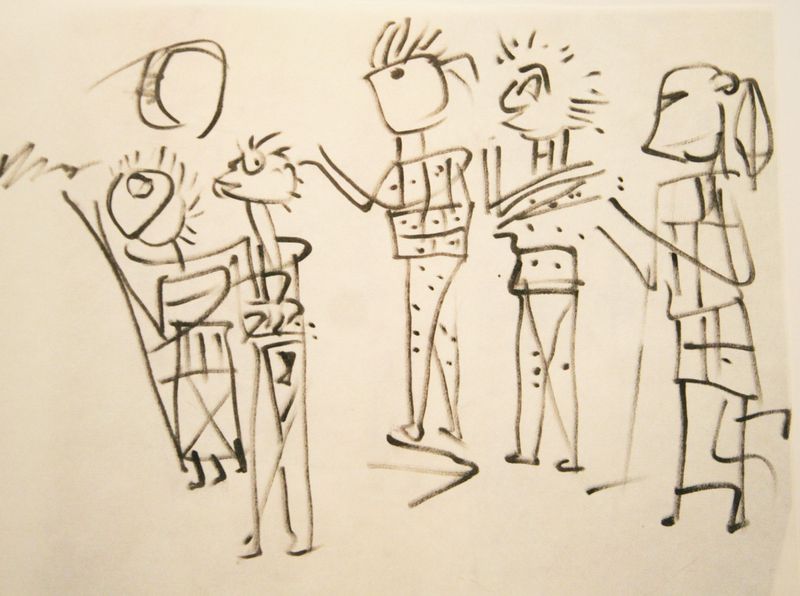
It therefore stands to reason that God may have sovereignly chosen a name and a cultic framework that came with significant baggage—baggage he would then spend centuries patiently correcting through his prophets.
A Slow, Patient Correction
Read in this light, much of Scripture appears devoted to removing the association between YHWH and the relics of the name’s earlier cultic context. Such efforts can be seen, perhaps, in the persistent prophetic condemnation of Asherah worship—not simply as generic idolatry, but as a specific correction of the false belief that YHWH had a divine consort.

They also may be seen in the condemnation of the “sins of Jeroboam.” Despite widespread impression to the contrary, it is almost certain that the Israelites did not worship the golden calves that Jeroboam set up in 1 Kings 12. Jeroboam was promoting YHWH worship, not the worship of idols. Like the cherubim on the Ark of the Covenant, the calves served merely as YHWH’s pedestals—a point well established in the scholarship on ancient Israelite cult practice (see John Day, Yahweh and the Gods and Goddesses of Canaan, 2002). It seems feasible, therefore, that when God chose the name YHWH as the vehicle for his self-revelation, he entered a cultic world with associations and archaic understandings that he then had to strive to dispel—not all at once, but gradually, in keeping with his pattern of patient condescension.
The biblical narrative, read this way, reveals a God who does not simply dictate truth from on high but enters into a centuries-long conversation with his people, correcting their misunderstandings, deepening their knowledge, and drawing them—step by patient step—toward the fullness of truth that would only be fully revealed in Christ.
God Meets Us Where We Are
While this may seem like a strange take, understood in the light of divine condescension, it makes sense. Were God merely to reveal himself as a new god, a god the people did not previously know, it may have been difficult for him to reach people.
Receiving an entirely new revelation—one with no connection to existing religious understanding—would have been extraordinarily difficult for any people to absorb. Even our Lord, who performed great miracles and rose from the dead, did not start from scratch but instead built upon the previous divine revelation in Judaism. He came as a Jewish rabbi, teaching in synagogues, quoting the Torah, fulfilling the promises made to Abraham and David. The Incarnation itself follows the pattern: God does not bypass human culture but enters it from within.
By entering an existing cultural and religious framework, God could give his prophets an instant level of credibility that they would not otherwise have. He could simultaneously reveal himself in a manner that would still allow people to reject his revelation.
That is, if he revealed himself to the people wondrously and undeniably, their ability to reject him would be quite limited. So also did Christ come as a humble man, not as a great ruler. Had Jesus come in the form of a figure like Alexander the Great, resisting him would have been much more difficult. God’s condescension preserves human freedom—and freedom, as the Church’s councils and her living Tradition affirm, is essential to the dignity of the human person created in God’s image (cf. CCC §160; Dignitatis Humanae, §§2–3).
And there is beauty in all of this. We worship a God who meets us exactly where we are, who condescends to us in our ignorance and limitations, bringing the Gospel to different peoples in different times, accommodating to the idiosyncrasies of culture to make himself known. This demonstrates divine condescension. We worship a loving God who pursues us but does not mean to capture us against our will. Understanding this principle helps clarify how comparative theology can proceed without syncretism, recognizing both the rays of truth that the Spirit brings about in human hearts and in the history of peoples (cf. Redemptoris Missio, §28; Nostra Aetate, §2) and the cultural particularity through which religious insight is always expressed.
Implications for Hermeneutics
There may be considerable hermeneutical benefit to this understanding of divine condescension. If we take the Old Testament as divinely inspired recordings of a people’s attempt to grapple with and understand their encounters with the divine—writings that are truly inspired by God but that also bear the marks of the human authors’ limited understanding at each stage of salvation history—then certain difficult passages take on a new light.
It is important to be precise here. The Catholic Church affirms the inerrancy of Scripture, but it does so in a carefully nuanced way. Dei Verbum §11 teaches that the books of Scripture “firmly, faithfully, and without error teach that truth which God wanted put into sacred writings for the sake of salvation.” This is not a claim that every historical detail or cultural assumption in the Bible is without error in the modern empirical sense. It is a claim that Scripture reliably communicates salvific truth.
Dei Verbum §12 further instructs that interpreters must attend to literary forms, historical contexts, and the conventions of the sacred writers’ time and culture. The Pontifical Biblical Commission’s 2014 document The Inspiration and Truth of Sacred Scripture goes further still, explicitly addressing the problem of morally troubling Old Testament passages—including violence attributed to divine command—and proposing that some Old Testament ethical perspectives have been “outdated by a better understanding of the procedures of justice” that emerges in the fullness of revelation in Christ. (Note: The PBC is a scholarly advisory body, not a magisterial organ; its documents inform Catholic biblical scholarship but do not carry the binding authority of conciliar or papal teaching.)
With these principles in hand, perhaps we can view some of the most unsavory aspects of the Old Testament that conflict with the full revelation of God in Jesus Christ—such as the genocidal killings of whole peoples described in Joshua—as mile markers on the path toward a greater understanding of the divine, a path that, by the necessity of human ignorance and aversion to change, was a long one.
Those who wrote Joshua, for example, may not yet have made it far enough in the process of progressive revelation to fully appreciate the divine character, just as those earliest adherents of the El or YHWH cult would have taken time to understand the nature of the God who had chosen these names as vehicles for his self-revelation. Yet God continued to work with them. He continued to inspire their writings—not because those writings perfectly captured his nature at every point, but because they faithfully recorded the stages of a journey toward the fullness of truth. God, in his condescension, did not demand that his people leap from primitive religious understanding to the Sermon on the Mount in a single generation. He walked with them, patiently, through every stage.
This is fully consistent with the Catholic understanding of biblical inspiration. As Dei Verbum §13 teaches, God’s words “have been made like human discourse”—and human discourse, by its nature, reflects the limitations and the growth of the people who speak it. To read the Old Testament through the lens of divine condescension is not to deny its inspiration but to take its inspiration seriously: God truly speaks through these texts, but he speaks through human beings who are themselves on a journey, and the full meaning of what God is saying only becomes clear in the light of Christ (cf. Dei Verbum, §16).
We serve a loving, merciful, and condescending God who meets us where we are, and I cannot imagine a more extraordinary demonstration of the divine love than this. God is love (1 John 4:8). It would, therefore, follow that his manner of revelation would exhibit the infinite patience that perfect love inspires.
Frequently Asked Questions
Q: What does divine condescension mean in Catholic theology?
Divine condescension (Latin: condescensio; Greek: synkatabasis) is the theological principle that God freely lowers himself to communicate with humanity in ways we can understand. Rather than remaining infinitely distant, God adapts his self-revelation to human language, culture, and capacity. The Second Vatican Council affirmed this in Dei Verbum §13, teaching that God’s words “have been made like human discourse, just as the Word of the eternal Father, when He took to Himself the flesh of human weakness, was in every way made like men.”
Q: Is divine condescension the same as the Incarnation?
The Incarnation is the ultimate expression of divine condescension, but condescension is a broader principle. God condescended throughout salvation history—in revealing himself to Abraham, in giving the Law through Moses, in speaking through the prophets—before the supreme act of condescension in which the Word became flesh (John 1:14). St. John Chrysostom taught that even Scripture itself is an act of condescension, because God accommodates infinite truth to finite human language.
Q: Does divine condescension conflict with biblical inerrancy?
No. The Catholic Church teaches that Scripture is inerrant regarding “that truth which God wanted put into sacred writings for the sake of salvation” (Dei Verbum §11). Recognizing divine condescension actually deepens our understanding of inerrancy: God truly speaks through human authors, but those authors bring their own cultural context and limited understanding to the text. The full meaning of Scripture only becomes clear in the light of Christ (Dei Verbum §16), which is itself a fruit of God’s patient, condescending pedagogy.
Q: What is synkatabasis?
Synkatabasis is the Greek term meaning “a coming down together with,” used extensively by St. John Chrysostom to describe God’s accommodation of his self-revelation to human capacity. In his Homilies on Genesis, Chrysostom invoked this concept to explain why Scripture sometimes uses anthropomorphic language about God—describing God as “walking” in the garden or “regretting” decisions. For Chrysostom, this is not a defect but a grace: God bending down to meet us at our level, like a loving parent simplifying speech for a child.

Garrett Ham
Garrett Ham is an attorney, military veteran, and holds a Master of Divinity from Yale Divinity School. He writes from Northwest Arkansas on theology, law, and service.
More about Garrett →Related Posts

The Catechism as an Exposition of Divine Love
God is love, and the Catechism must be read in its entirety as the outworking of that divine love in the world.

Meaning and Method in Comparative Theology
A review of Catherine Cornille's Meaning and Method in Comparative Theology — her framework for studying other religions faithfully without syncretism.
Divine Foreknowledge and Free Will: The Catholic Answer
Can God know the future and humans still be free? The Catholic intellectual tradition offers robust answers through Thomism and Molinism. Here’s how they work and why they matter.
Stay Informed
Get new writing on faith, law, and service delivered to your inbox.
No spam. Unsubscribe anytime.