Errors in Scripture and Biblical Authority
On This Page
In this article, I discuss whether contradictions and errors in Scripture affect the theological concept of inerrancy and whether we should redefine the term itself.
For centuries, the authority and nature of Scripture have occupied the minds of both the religious and secular alike. It divided the Catholic Church from Protestantism, it divides evangelical and mainline Protestants today, and it is even a matter of debate between Christians and unbelievers.
The Catholic answer—sometimes called limited inerrancy by interpreters of Vatican II—reads Scripture as inerrant in what it intends to teach for our salvation, while leaving room for the genuine humanity of the biblical authors and the cultural categories they wrote within. That position is the de facto default of most Catholic theologians and bishops today, but it is not uncontested even within Catholicism, and it requires a careful argument to defend. The rest of this post is that argument.
A Short History of the Inerrancy Debate
Hints of inerrancy as a formal doctrine appeared in earlier Protestant and Catholic thought, but the modern controversy is largely a nineteenth- and twentieth-century phenomenon. Its center of gravity sits in the conservative Protestant response to higher criticism, biblical-historical scholarship, and the emergence of Darwinian biology.
The Princeton theologians—Charles Hodge, A. A. Hodge, and B. B. Warfield—developed an influential American Protestant doctrine of “plenary verbal inspiration” extending inerrancy to every word of the autographs in every domain. The publication of The Fundamentals between 1910 and 1915, and later the 1978 Chicago Statement on Biblical Inerrancy, codified that position for evangelical Protestantism. The Chicago Statement extends inerrancy explicitly to “assertions in the fields of history and science” (Article XII).
There is a historical parallel worth noting here. The Protestant vocabulary of an “infallible” Bible was itself old—the Westminster Confession of 1646 already called Scripture “the infallible rule”—so the nineteenth century did not invent the term.1 What it produced was a hardened, all-domains version of the doctrine, and it did so in the very decades that Rome defined papal infallibility at the First Vatican Council (1870). The convergence has drawn scholarly comment: both doctrines have been read as attempts to anchor religious authority to something that could not fail—Rome to the teaching office of the papacy, conservative Protestantism to the text of Scripture itself—at a moment when higher criticism and the broader upheavals of modern life had thrown inherited certainties into doubt. The parallel is one of timing and instinct rather than influence; neither side borrowed the move from the other.2
The Catholic trajectory ran differently. Leo XIII’s encyclical Providentissimus Deus (1893) responded to higher criticism by affirming Scripture’s divine authorship and its freedom from error. Pius XII’s Divino Afflante Spiritu (1943) opened the Catholic exegetical tradition to genre criticism, ancient Near Eastern context, and historical-critical methods. Dei Verbum (1965), Vatican II’s Dogmatic Constitution on Divine Revelation, gave the most authoritative magisterial statement: Scripture teaches “without error that truth which God, for the sake of our salvation, wished to see confided to the Sacred Scriptures.” More recently, the Pontifical Biblical Commission’s 2014 document The Inspiration and Truth of Sacred Scripture worked through the implications of Dei Verbum in concrete cases, treating apparent historical and scientific tensions as compatible with biblical truth properly understood.
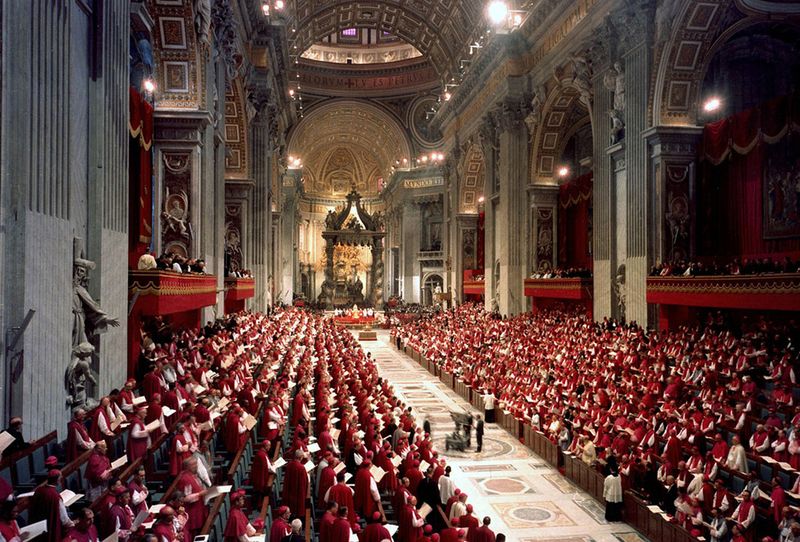
Once that history is in view, the recognition of potential errors in Scripture stops being an apologetic emergency. It becomes a question about what kind of book Scripture is and what kind of truth God intends to communicate through it. That is exactly the question the Princeton-flavored versions of inerrancy answer poorly and the Dei Verbum tradition answers well.
Are There Errors in Scripture?
If Scripture becomes the foundation upon which Christianity is built, then errors in Scripture create an issue of doubt, calling into question the reliability of the Bible to serve that purpose.
This is why advocates of inerrancy often find themselves under fire from secularists who use the latest scientific, archeological, and historical advances in human knowledge to point out factual inaccuracies in the biblical text.
For this reason, Christians must define precisely what we believe the nature of Scripture to be. For those who insist on defending inerrancy, the next task is to determine precisely what they mean by that term.
What the Church Teaches About Inerrancy
Before going further, it’s worth grounding this discussion in what the Catholic Church actually teaches. The Second Vatican Council’s Dogmatic Constitution on Divine Revelation, Dei Verbum, lays out the classic formulation, which the Catechism then restates. CCC § 107, quoting Dei Verbum § 11, provides the definitive statement:
Since therefore all that the inspired authors or sacred writers affirm should be regarded as affirmed by the Holy Spirit, we must acknowledge that the books of Scripture firmly, faithfully, and without error teach that truth which God, for the sake of our salvation, wished to see confided to the Sacred Scriptures.
CCC §§ 105–107 also affirm both divine authorship and genuine human authorship: “God is the author of Sacred Scripture” (§ 105), and yet “to compose the sacred books, God chose certain men who, all the while he employed them in this task, made full use of their own faculties and powers so that, though he acted in them and by them, it was as true authors that they consigned to writing whatever he wanted written, and no more” (§ 106). Inerrancy, in Catholic teaching, is the guarantee that the saving truth God means to communicate through Scripture is communicated truthfully. It is not a claim that every sentence of Scripture would survive scrutiny by a modern historiographer or scientist.
With that framing in place, the question of “errors” in Scripture becomes sharper and more manageable.
Inerrancy, in Catholic teaching, is the guarantee that the saving truth God means to communicate through Scripture is communicated truthfully—not that every sentence would survive scrutiny by a modern historiographer.
The Catholic Debate Over Dei Verbum 11
The text of Dei Verbum 11 is precise but it is not self-interpreting, and Catholic theologians disagree over how much weight the phrase “for the sake of our salvation” carries.
On one reading, the phrase is restrictive: Scripture is inerrant in matters pertaining to salvation, but does not necessarily extend that guarantee to every incidental historical or scientific detail. Cardinal Avery Dulles defended a version of this position, often summarized as “limited inerrancy,” and it has come to represent the de facto consensus of most Catholic theologians and biblical scholars in the post-conciliar era. Where Peter Is treats it as the dominant interpretive position, and the Pontifical Biblical Commission’s 2014 document broadly works within its frame.
On a second reading, the phrase is purposive rather than restrictive: it tells us why God inspired Scripture (to save us), not which parts of Scripture are inerrant. Scripture remains inerrant in everything it affirms, full stop. Scott Hahn has argued for this position, contending that Dei Verbum is “little more than a faithful restatement” of Providentissimus Deus and that the council fathers explicitly rejected drafts that would have limited inerrancy to “salvific truth.” Critics of the limited-inerrancy reading point out that the Council Fathers debated and rejected the phrase veritas salutaris (“salvific truth”) precisely because they did not want the scope of inerrancy to be restricted to soteriological content.
Both positions are within the bounds of legitimate Catholic theological diversity. The Magisterium has not formally adjudicated the question since the council, and Verbum Domini (Benedict XVI, 2010) reaffirms the broad framework of Dei Verbum without resolving the interpretive dispute. Catholics in good standing can and do hold either view.
The Magisterium has not formally adjudicated the scope question since the council. Catholics in good standing can and do hold either reading of Dei Verbum 11.
This post takes the limited-inerrancy reading. It does so for three reasons. First, the de facto consensus of post-conciliar Catholic biblical scholarship is on that side, and a Catholic engagement with Scripture that ignores that consensus is engaging with a different conversation than the one the Church is actually having. Second, the limited reading does the better job of honoring genre, cultural context, and the genuine humanity of the biblical authors—exactly the priorities Divino Afflante Spiritu and Dei Verbum set. Third, the limited reading produces a more pastorally honest answer to the secular critic who lays a list of biblical contradictions on the table. The full-inerrancy reading either has to defend each contradiction as merely apparent or has to multiply ad hoc harmonizations until the burden of proof becomes the apologist’s whole job. The limited reading concedes the that and shifts the conversation back to the what Scripture is actually teaching.
What follows assumes that frame.
Do Errors in Scripture Affect Inerrancy?
This may sound like a question that answers itself, but further reflection proves otherwise. I affirm the inerrancy of Scripture in the sense Dei Verbum describes. I nonetheless sometimes hesitate with the English word “inerrancy” because it has accrued additional meanings in popular Protestant usage that go beyond what the Church actually teaches.
The question begins with what we mean by error. That is, where Scripture affirms something that we would believe to be inaccurate were it contained within a twentieth-century history book, should we consider that an error? If a man didn’t live in the body of a fish for three days, or if King Solomon wasn’t the wealthiest ruler of his age, would that undermine the authority of Scripture?
If life came into existence through the evolutionary process, or if the Big Bang gave rise to the universe, does that make Scripture undependable?
For some, the answer to all these questions is yes. I, however, believe the answer to be no.
What is Error?
To sharpen the point: even if significant portions of Old Testament historical narrative turned out to include literary, theological, or culturally-shaped elements that don’t line up with a modern forensic standard of history, Scripture could still be inerrant in the sense Dei Verbum defines—because the saving truth it teaches would remain intact.3
On reflection, this claim is not so strange. Let’s consider, for example, a hypothetical retelling of the moon landing.
An Analogy

Let us say that, five hundred years from now, humanity has not progressed at all in space exploration. In fact, it has long abandoned the challenge.
Let us then say that someone, who wants to restart humanity’s passion for exploring the universe, attempts to persuade his fellow citizens to renew the pursuit by telling the story of man’s first step on the moon.
If he tells the story of how the United States put John Glenn on the moon in 1972, would we call his story erroneous? Obviously, there are some historical errors in the details in that story. We know that the United States’ Apollo program put Neil Armstrong on the moon on July 20, 1969. But does that make his story itself unreliable?
Maybe, but maybe not. The purpose of the story is not to give a detailed historical account of the first moon landing as a historian might. Instead, the purpose of the story in this context is to tell humanity that it once put a man on the moon, and it can do so again.
That is, the purpose of the story is to encourage others to take an action that the author considers to be right by pointing to something that actually did happen, even if the details are wrong. While these details may be important in some instances, if the purpose is simply to show that humanity is capable of reaching the moon, they matter very little.
The way many modern critics of the Bible treat Scripture, however, would be similar to critics of this hypothetical story arguing that (1) the date is wrong; (2) the man is wrong; (3) therefore, a man never landed on the moon.
The conclusion simply doesn’t follow.
Interpreting Scripture
We need to make allowances for the fact that the biblical authors had a particular agenda in mind, did not feel bound by modern ideas of “accuracy,” history, or science, and told their stories accordingly.
We should not anachronistically impose our modern ideas of scientific and historical facts and “errors” back onto the writers of Scripture, ideas they would have neither appreciated nor felt bound by. (For more on how this principle applies to the creation account specifically, see my comparison of Genesis 1 interpretations.)
Making those allowances will allow us to see what the biblical authors were trying to say. It is in what they were trying to say that we find the inerrancy flowing forth from divine inspiration. God used fallible people right where they were, with all their cultural presuppositions, to reveal Himself to humanity.
How Catholic Inerrancy Handles Hard Cases
Abstract principles only do so much work. The cases that matter are the ones critics of biblical authority lay on the table—passages where Scripture appears, on its face, to make a claim that does not survive modern historical or scientific scrutiny. Five short worked examples show how the Dei Verbum tradition handles these without flinching.
Joshua’s long day
In Joshua 10:13, the sun “stood still” while Israel completed its rout of the Amorite coalition. Read as forensic astronomy, the passage proposes that the rotation of the Earth halted for roughly a day—an event that would have catastrophic physical consequences and is unattested anywhere in the historical or astronomical record.
Read as ancient Near Eastern military hymn, however, the passage is doing something else. The Hebrew preserves a citation from the Book of Jashar, a poetic source the biblical text explicitly flags. Catholic interpreters have long read the passage phenomenologically—the sun “stood still” the way the sun “rises” and “sets” in modern English: a description from the perspective of an earthbound observer, not a metaphysical claim about celestial mechanics. That reading is not a modern concession to embarrassment. The principle of divine accommodation—God speaks to human authors in human categories—is patristic, articulated by Augustine and Aquinas, and reaffirmed implicitly by Divino Afflante Spiritu in 1943.
The Catholic point is not that Joshua’s long day “did not happen.” It is that Scripture is not making the kind of claim about it that modern readers reflexively assume. What the text affirms—God acted on Israel’s behalf in this battle—is what the text guarantees. The astronomical mechanism is not.
The “errors” critics flag are usually genre confusions: the modern reader assumes a forensic chronology the evangelist never claimed to provide.
The book of Esther
The book of Esther sets its palace intrigue in the Persian court of Ahasuerus, generally identified with Xerxes I (486–465 BC). Read as court chronicle, it raises a cluster of historical difficulties: Herodotus names Xerxes’s queen as Amestris, not Vashti or Esther, and a Jewish queen of Persia is otherwise unattested; the edict permitting the Jews to kill tens of thousands of their enemies has no independent record; and Mordecai, if taken to have been deported with Jeconiah in 597 BC (Esther 2:5–6), would be improbably old under Xerxes. Harmonizations exist for each point, but none commands consensus.
Read as what most scholars take it to be—a diaspora novella, a literarily shaped court tale written to explain and celebrate the feast of Purim—the difficulties change character. The Hebrew Esther famously never names God, working instead through irony, reversal, and hidden providence; the Greek additions preserved in the Catholic canon (the “Additions to Esther”) supply the explicit prayers and piety the Hebrew leaves implicit. That a canonical book reaches Catholics in this doubled form—Hebrew narrative plus Greek expansion—is itself a signal that its purpose is theological and liturgical rather than annalistic.
What Esther affirms—that God preserves His covenant people even in exile, even when His hand is unseen and His name unspoken—is not threatened by uncertainty over whether a historical queen bore that name. The saving truth is the providence; the court chronicle is the vehicle.
The book of Daniel
Daniel is the sharpest Old Testament case, and the most instructive, because the Catholic tradition has largely accepted the critical reading without alarm. The book presents itself as the work of a sixth-century exile in Babylon, but it carries well-known historical seams: it calls Belshazzar the son of Nebuchadnezzar and king of Babylon, though Belshazzar was the son of Nabonidus and never reigned as sole king; and it makes “Darius the Mede” the conqueror of Babylon, a figure unattested outside Daniel, when the city in fact fell to Cyrus the Persian. Its apocalyptic visions track the Hellenistic period with striking precision down to the persecution of Antiochus IV Epiphanes (167–164 BC), then falter on the manner of his death—the classic signature of prophecy written after the events it “foretells.”
The mainstream of Catholic scholarship reads Daniel accordingly, and does so on official footing: the introduction to the book in the New American Bible (the USCCB’s own translation) dates its composition to the Antiochene persecution of 167–164 BC and classifies it as apocalyptic—a genre that uses symbolic, retrospective vision to console a community under threat rather than to forecast the future. Here, too, the Catholic canon receives Daniel in expanded form, with Greek additions—Susanna, Bel and the Dragon, and the Prayer of Azariah—that the Hebrew and Aramaic text lacks.
None of this touches what Daniel affirms. Its saving truth is that God is sovereign over the rise and fall of empires, that the faithful who endure persecution will be vindicated, and that the dead will rise (Daniel 12:2, among the clearest resurrection texts in the Old Testament). A second-century date and an apocalyptic genre leave every one of those affirmations intact. Divino Afflante Spiritu’s insistence that the interpreter attend to the literary forms the ancient author actually used is not a threat to Daniel’s inspiration; it is the key to reading it.
The Quirinius census
Luke 2:1–2 describes a Roman census ordered while Quirinius was governor of Syria, prompting Joseph and Mary’s journey to Bethlehem. The historical problem is well-known: Jesus was born before the death of Herod the Great in 4 BC, and Quirinius’s documented governorship of Syria began in AD 6. Josephus describes the AD 6 census as the trigger for Judas the Galilean’s revolt. The dates appear to be off by roughly a decade.
Catholic exegetes have proposed several solutions, none decisive but all defensible. The Greek word prōtos in Luke 2:2 can carry the comparative sense “before” rather than the strict superlative “first,” yielding “this enrollment took place before Quirinius was governor of Syria.” Some scholars distinguish between an apographē (a registration of taxable property) and an apotimēsis (a tax assessment requiring payment), suggesting Luke describes the former while Josephus describes the latter. Others suggest Quirinius held an earlier military or administrative role in the region under Saturninus’s governorship that Luke’s Greek can plausibly describe.
The honest answer for the limited-inerrancy reading is that Luke is not writing a Roman administrative history, and the precise resolution of the Quirinius problem is a matter for historians and not a doctrine of the faith. What the passage affirms—that Christ was born in Bethlehem, in the lineage of David, in fulfillment of prophecy—is not threatened by chronological uncertainty about the census’s administrative details. The saving truth Luke intends is intact.
Gospel chronology divergences
The Synoptic Gospels (Matthew, Mark, Luke) place Jesus’s cleansing of the temple in the final week of His ministry, immediately before the passion. John places a temple cleansing at the beginning of Jesus’s public ministry, in chapter 2. Some readers conclude there were two cleansings; most modern scholars, including Catholic scholars like Raymond Brown, conclude there was one cleansing that John has placed thematically rather than chronologically—framing Jesus’s public ministry from the start as the inauguration of true worship.
The Synoptic-Johannine timeline diverges in similar ways elsewhere: the day of the Last Supper relative to Passover, the duration of the public ministry, the order of certain miracles. The classical Catholic answer—explicit in Pius XII’s Divino Afflante Spiritu and elaborated by the Pontifical Biblical Commission—is that the evangelists were not writing modern police reports. They were writing theological portraits with literary structure, and they expected their readers to read them that way. The “errors” critics flag are usually genre confusions: the modern reader assumes a forensic chronology the evangelist never claimed to provide.
Inerrancy, on this reading, is preserved exactly where Scripture intends to operate—in the saving truth communicated through the literary form. It is not at risk where modern readers wrongly project a literary form Scripture never adopted.
Are Errors in Scripture Errors?
I very much doubt that God cares much when we read the Scriptures that we get an “accurate” understanding of history or the movement of the heavens. He does not seek to show us anything about science, history, or other modern academic pursuits, but about Himself.
This is crucial to understand because human beings can only know God from where they are, not through a lens of omniscience that is impossible for them to achieve.
So, does it matter if David killed Goliath? No. What matters is that God uses imperfect people where they are. Does it matter if the earth revolves around the sun? No. What matters is that God performs His works and leaves His fingerprints where those who need to see Him can.
Community
Admittedly, this makes interpreting Scripture more difficult, but it opens us up to a search for wisdom, a dynamic journey through life, as we search after our invisible, mysterious God.
It does, however, wrestle the interpretation of Scripture away from the exclusive domain of the individual. This has traditionally been anathema to Protestants. If inerrancy as a concept is to be saved, however, biblical interpretation must take place within a community, guided by Tradition and the depository of the faith.
Until we let go of our need to discover the full richness of the message of Scripture in isolation from other believers, we will never see the interwoven dependency between the Bible and the body of Christ. Read in that light—within the Church, guided by Tradition and the Magisterium (Dei Verbum §§ 10, 12)—the apparent “errors” in Scripture are not errors at all in the sense that matters most, because Scripture communicates, without fail, the truth God wishes us to know for our salvation.
Conclusion
Catholic inerrancy is a narrower and more defensible claim than some popular versions of the doctrine suggest. It does not require Scripture to meet every modern standard of historical or scientific precision. It does require—and faithfully affirm—that the God who inspired Scripture guarantees the truthfulness of everything He intends to teach through it. Once we read Scripture that way, with attention to genre, cultural setting, and the ecclesial context of its interpretation, most of the “errors” skeptics flag turn out to be misreadings rather than defeaters of biblical authority.
Frequently Asked Questions
Does the Catholic Church teach biblical inerrancy?
Yes. CCC § 107, quoting Dei Verbum § 11, affirms that Scripture teaches “without error that truth which God, for the sake of our salvation, wished to see confided to the Sacred Scriptures.” CCC §§ 105–107 develop this teaching in detail.
Does Catholic inerrancy mean Scripture is scientifically or historically flawless by modern standards?
No. Catholic teaching focuses inerrancy on the saving truth God communicates through Scripture. It does not require, for instance, that the creation narratives of Genesis be read as modern cosmology, or that every Old Testament historical detail conform to contemporary historiographical standards.
Can a Catholic hold that some biblical narratives are not strictly historical?
Yes, provided the core truths of the faith—creation, the reality of sin, the incarnation, the bodily resurrection of Christ, and so on—are affirmed. Catholic biblical scholarship has long recognized the importance of literary genre in reading Scripture responsibly (cf. Dei Verbum § 12; CCC §§ 109–119).
How does the Church read Scripture authoritatively?
Through the unity of Scripture, Tradition, and the Magisterium (CCC §§ 85–87, 95). The Bible is the Church’s book, inspired by the Holy Spirit and interpreted within the living community of faith, not in isolation.
What is the difference between limited inerrancy and full inerrancy in Catholic theology?
Limited inerrancy reads Dei Verbum § 11 as restricting biblical inerrancy to the saving truth God intends to communicate, leaving room for incidental historical or scientific imprecision. Full inerrancy reads the same passage as teaching that Scripture is inerrant in everything it affirms, with the phrase “for the sake of our salvation” naming God’s purpose rather than restricting the scope of inerrancy. Cardinal Avery Dulles defended a version of the limited reading; Scott Hahn has argued for the full reading. The Magisterium has not formally adjudicated between the two since the council. Both are within the bounds of legitimate Catholic theological diversity, though the limited reading represents the de facto consensus of post-conciliar Catholic biblical scholarship.
Do contradictions in the Bible undermine its authority?
Not in the Catholic understanding of inerrancy. Apparent contradictions—divergent Gospel chronologies, dating tensions like the Quirinius census, phenomenological language like Joshua’s long day—are typically genre confusions: the modern reader projects a forensic-chronological standard onto texts written for theological, liturgical, or literary purposes. Scripture’s authority rests on the saving truth it communicates, not on every incidental detail surviving modern historical-critical scrutiny. The Pontifical Biblical Commission’s 2014 document The Inspiration and Truth of Sacred Scripture works through this in detail.
Footnotes
1. Westminster Confession of Faith (1646), 1.9 (“The infallible rule of interpretation of Scripture is the Scripture itself”) and 1.5 (the “infallible truth and divine authority” of Scripture). The Reformed vocabulary of biblical infallibility thus predates the First Vatican Council by more than two centuries.
2. A. A. Hodge and B. B. Warfield, “Inspiration,” Presbyterian Review 2 (1881): 225–260, gave the doctrine its hardened, all-domains form, locating inerrancy in the original autographs; for papal infallibility, see First Vatican Council, Pastor Aeternus (1870), ch. 4. The parallel between the two doctrines is developed in Mark E. Powell, Papal Infallibility: A Protestant Evaluation of an Ecumenical Issue (Eerdmans, 2009), esp. 1–19, who reads both as attempts to secure epistemic certainty in the modern age.
3. This is a hypothetical thought experiment, not a claim about which specific narratives are or are not historical. The Church affirms real historical events at the heart of salvation history, above all the incarnation, crucifixion, and bodily resurrection of Christ.

Garrett Ham
Garrett Ham is an attorney, military veteran, and holds a Master of Divinity from Yale Divinity School. He writes from Northwest Arkansas on theology, law, and service.
Related Posts

“Authority of Community in Christian Faith”
“How Scripture and community tradition work together in Christian faith. A Yale Divinity student's reflection on balancing Protestant and Anglican approaches to religious authority.”

What Does Bara Mean in Hebrew? The Biblical Word for 'Create' Explained
What does bara (בָּרָא) mean in Hebrew? The biblical verb for 'create' in Genesis 1:1 explained — its grammar, its 54 occurrences, why God is its only subject, and what it means for creation theology.
How to Talk to Protestants about Authority
Catholic-Protestant dialogue about religious authority: start from shared Scripture, then move to the Church Fathers and Catholic Tradition.
Stay Informed
Get new writing on faith, law, and service delivered to your inbox.
No spam. Unsubscribe anytime.