1 Samuel 2:25 Meaning: “The LORD Wanted Them Dead”
On This Page
אִם־יֶחֱטָ֨א אִ֤ישׁ לְאִישׁ֙ וּפִֽלְלֹ֣ו אֱלֹהִ֔ים וְאִ֤ם לַֽיהוָה֙ יֶֽחֱטָא־אִ֔ישׁ מִ֖י יִתְפַּלֶּל־לֹ֑ו וְלֹ֤א יִשְׁמְעוּ֙ לְקֹ֣ול אֲבִיהֶ֔ם כִּֽי־חָפֵ֥ץ יְהוָ֖ה לַהֲמִיתָֽם׃
“If a man sins against a man, then God may mediate for him. But if a man sins against Yahweh, who will intervene for him?” But they did not listen to the voice of their father, because Yahweh desired their death.—1 Samuel 2:25 (author’s translation)
1 Samuel 2:25 in Three Translations
ESV: “If someone sins against a man, God will mediate for him, but if someone sins against the Lord, who can intercede for him? But they would not listen to the voice of their father, for it was the will of the Lord to put them to death.”
NABRE: “If someone sins against another, anyone can intercede for the sinner with the Lord; but if anyone sins against the Lord, who can intercede for the sinner? But they disregarded their father’s warning, since the Lord wanted them dead.”
KJV: “If one man sin against another, the judge shall judge him: but if a man sin against the Lord, who shall intreat for him? Notwithstanding they hearkened not unto the voice of their father, because the Lord would slay them.”
LXX (1 Reigns 2:25): ὅτι βουλόμενος ἐβούλετο κύριος διαφθεῖραι αὐτούς—“because the Lord was determined to destroy them.”
The Verse That Will Not Let Catholic Readers Off the Hook
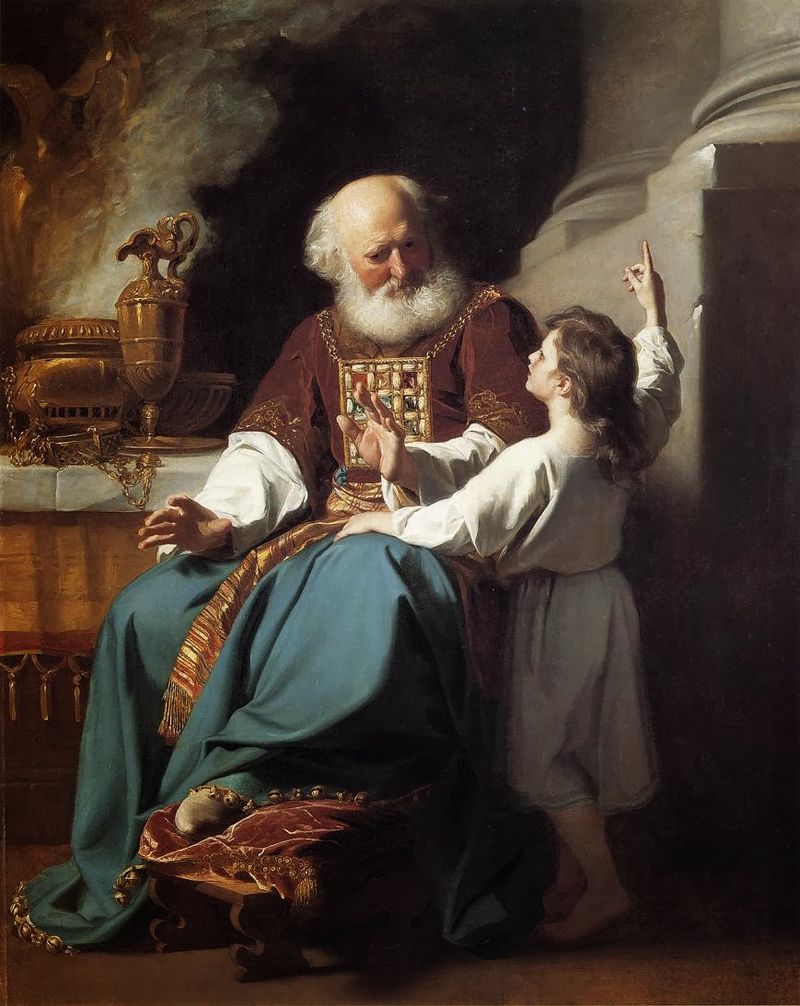
Few verses in the Old Testament land with quite the force of 1 Samuel 2:25. A father begs his two grown sons to stop profaning the sanctuary. They refuse. And the narrator, in a single devastating aside, tells the reader why: כִּי־חָפֵץ יְהוָה לַהֲמִיתָם—because YHWH desired to put them to death.
It is not a verse one preaches casually. It appears to attribute the very impenitence of Hophni and Phinehas to the sovereign will of God. It raises questions that the Catholic tradition has answered with more refinement than almost any other set of texts: What does it mean for God to “desire” the death of a sinner when Ezekiel insists he takes no pleasure in it? How does divine sovereignty relate to human freedom in cases of judicial hardening? And what happens when the priests who are supposed to mediate between God and his people become the ones against whom God’s judgment must fall?
This post works through the verse in the way I’ve found most fruitful: starting from the Hebrew and the ancient versions, moving through the literary architecture of 1 Samuel 1–3, examining the hardening tradition across the Hebrew Bible, and then tracing the interpretive history from Origen and Chrysostom through Augustine, Aquinas, Trent, and the De Auxiliis controversy. The goal is not to explain the verse away. The goal is to see why Catholic theology has been uniquely equipped to receive it.
I. The Hebrew Text and Its Witnesses
The Masoretic Text
The full verse in the Masoretic Text (BHS, Westminster Leningrad Codex) reads:
אִם־יֶחֱטָ֨א אִ֤ישׁ לְאִישׁ֙ וּפִֽלְלֹ֣ו אֱלֹהִ֔ים וְאִ֤ם לַֽיהוָה֙ יֶֽחֱטָא־אִ֔ישׁ מִ֖י יִתְפַּלֶּל־לֹ֑ו וְלֹ֤א יִשְׁמְעוּ֙ לְקֹ֣ול אֲבִיהֶ֔ם כִּֽי־חָפֵ֥ץ יְהוָ֖ה לַהֲמִיתָֽם׃
The structure is a two-clause protasis followed by a narrative apodosis. The first clause: if a man sins against a man, וּפִלְלוֹ אֱלֹהִים (ûpillĕlô ʾĕlōhîm, “God will mediate for him”). The second: if a man sins against YHWH, מִי יִתְפַּלֶּל־לוֹ (mî yitpallel-lô?, “who will intercede for him?”). Then the devastating close: כִּי־חָפֵץ יְהוָה לַהֲמִיתָם—they did not listen, because YHWH desired to put them to death.
David Tsumura, in his NICOT commentary on Samuel (Eerdmans, 2007), observes that the Masoretic text of Samuel is “in extremely poor condition” for both orthography and grammar—a judgment echoed by virtually every modern commentator.1 This is why the Septuagint and the Qumran manuscripts matter so much for 1 Samuel in particular: the ancient versions are not merely supplementary but often decisive witnesses for establishing the text.
The Septuagint Sharpens, Not Softens, the Divine Causality
The Septuagint (1 Reigns 2:25 in the Rahlfs edition) diverges from the MT at two important points.
First, in the protasis, the LXX reads καὶ προσεύξονται ὑπὲρ αὐτοῦ πρὸς κύριον—“and they shall pray for him to the Lord.” This presupposes a Hebrew Vorlage closer to וְהִתְפַּלְלוּ עָלָיו אֶל יהוה than to the MT’s וּפִלְלוֹ אֱלֹהִים (ûpillĕlô ʾĕlōhîm). The result is a cleaner parallelism than the MT preserves: human intercession is possible when the sin is interpersonal but impossible when the sin is directly against YHWH. P. Kyle McCarter’s Anchor Bible commentary (1980) and the NRSV translation committee both follow this reading.2
Second—and far more consequentially for theological interpretation—the LXX renders the final clause as ὅτι βουλόμενος ἐβούλετο κύριος διαφθεῖραι αὐτούς. This is a Hebraizing infinitive-absolute construction (“willing, he willed”) that intensifies rather than softens the claim. Two features deserve attention. The Greek verb is βούλομαι, which in Classical usage denotes deliberate, rational intention (the distinction from θέλω was noted by Ammonius and preserved in Thayer’s lexicon, though modern Koine linguistics recognizes significant semantic overlap between the two terms in Hellenistic Greek). What is indisputable is the intensive cognate construction itself: βουλόμενος ἐβούλετο amplifies the claim of divine volition regardless of how precisely one parses βούλομαι. And the infinitive is διαφθεῖραι—“to utterly destroy”—rather than simply “to kill.” The most fluid rendering is something like because the Lord was determined to utterly destroy them—though the literal structure (“willing, he willed”) is worth preserving mentally, because the redundancy is the point.
The Greek tradition, in other words, does not flinch from the Hebrew. It doubles down on it. And since the Fathers of the Church—Origen, Chrysostom, Augustine via the Vetus Latina, and most of the rest—worked primarily or exclusively from the LXX, their readings of this verse begin from a text that is more, not less, insistent on God’s active will.
Qumran, the Vulgate, and the Versional Landscape
The Qumran manuscript 4QSamᵃ (4Q51), dated ca. 50–25 BCE, preserves fragments of 1 Samuel 2:16–36. While its fragmentary state precludes certainty at every point, 4QSamᵃ is famous for frequently aligning with the LXX against the MT throughout 1–2 Samuel, suggesting that the two derive from a common Hebrew tradition older than the proto-Masoretic text. Cross, Parry, Saley, and Ulrich document this pattern extensively in DJD XVII (2005), and the NRSV critical apparatus at 1 Samuel 2:25 reads “Gk Compare Q Ms: MT another, God will mediate for him”—a cautious formulation that invites comparison between the Greek and the Qumran evidence without claiming full alignment. The relationship at this specific verse is triangular rather than a clean LXX-plus-Qumran front against the MT, and the English edition of the DSS Samuel renders the clause closer to “God will judge him,” nearer to the MT’s Piel sense than to the LXX’s prayer reading.3
Jerome’s Vulgate renders the protasis: si peccaverit vir in virum, placari ei potest Deus—“if a man sins against a man, God can be appeased for him.” This follows the MT’s sense but softens it toward appeasement rather than adjudication. The Nova Vulgata (1979) revised this to arbiter ei potest esse Deus—“God can be his arbiter”—aligning more closely with the judicial reading. For the final clause, the Vulgate reads quia voluit Dominus occidere eos (“because the Lord willed to kill them”), preserving the full force of divine volition without Greek intensification.
The Peshitta generally follows the MT in Samuel. Targum Jonathan, characteristically, applies anti-anthropomorphic paraphrase to theologically difficult passages. The Targumic tradition replaces direct divine agency with intermediary language (such as “a word from before the Lord”), softens hardening language by implying it is consequent upon prior human sin, and uses the concept of the Memra to distance God from direct negative action. Eveline van Staalduine-Sulman’s The Targum of Samuel (Brill, 2002) documents this interpretive strategy in detail.4
The Untranslatable Paronomasia of פלל
The first half of the verse exploits what the Cambridge Bible commentary calls an untranslatable paronomasia—a wordplay that collapses in every English version.
The first clause uses the Piel of the root פלל: ûpillĕlô (וּפִלְלוֹ), which means “he will judge, mediate, arbitrate.” The Piel of פלל is exceedingly rare in the Hebrew Bible—BDB lists only 1 Samuel 2:25, Psalm 106:30, Ezekiel 16:52, and Genesis 48:11 (with a distinct sense, “expect, imagine”). The best parallel is Psalm 106:30, where Phinehas—a different Phinehas, not Eli’s son—וַיְפַלֵּל (wayĕpallēl, “intervened, executed judgment”), staying the plague at Baal-Peor. The cognate noun פָּלִיל (pālîl, “judge, arbiter,” Exod 21:22; Deut 32:31) and the related noun פְּלִילָה (pĕlîlâ, “judgment,” Isa 28:7) confirm the judicial semantic field of the root family, even though those specific forms are nominal rather than verbal.
The second clause shifts stems: yitpallel (יִתְפַּלֶּל), the Hitpael form, which is the standard biblical Hebrew word for prayer and intercession (Gen 20:7; Num 11:2; Deut 9:20; 1 Sam 7:5). Different stems of the same root carry the full semantic range—from judicial arbitration to intercessory prayer—and Eli’s rhetorical question encompasses both: when the sin is against YHWH himself, neither adjudication nor intercession will avail.
This is the double register that every English translation obscures. The KJV tradition captures the judicial dimension (“the judge shall judge him”). The NRSV, following the LXX/4QSamᵃ, captures the intercessory dimension (“someone can intercede for the sinner with the Lord”). The ESV and NASB try to split the difference (“God will mediate… who can intercede?”). The NAB, New Jerusalem Bible (NJB), and NJPS each negotiate the tension differently. No single English rendering fully reproduces the semantic range, because no single English verb carries both “arbitrate a dispute” and “pray for.”
Does אֱלֹהִים Mean “God” or “Judges”?
Three viable readings exist for the word אֱלֹהִים (ʾĕlōhîm) in the first clause. Most modern translations take it as “God”—the divine being himself arbitrates when humans wrong each other. The KJV tradition reads “the judge(s),” following passages where ʾĕlōhîm designates human judges acting as God’s representatives (Exod 21:6; 22:8–9; Ps 82:1, 6). A third option, supported by the LXX and 4QSamᵃ, removes the ambiguity by reading “they shall pray to the Lord.”
The deliberate switch from אֱלֹהִים (ʾĕlōhîm) in the first clause to יהוה (YHWH) in the second is theologically suggestive. Source critics have occasionally attributed this to the interweaving of E and J materials, but a literary explanation is more compelling: אֱלֹהִים preserves the ambiguity between God and judges (both can arbitrate human disputes), while the specific divine name יהוה in the second clause makes the point unmistakable. When the offense is against Israel’s covenant God by name, no mediator suffices.
II. Eli’s Sons as the Dark Mirror of Samuel’s Calling
The Literary Architecture of 1 Samuel 1–3
The opening chapters of 1 Samuel are constructed as a deliberate literary contrast between the rise of Samuel and the fall of the house of Eli. The narrative interweaves the two trajectories with striking precision: Hannah’s barrenness and her answered prayer (1:1–28); Hannah’s psalm declaring YHWH’s sovereign reversal of fortunes (2:1–10); the catalog of Hophni and Phinehas’s sins (2:12–17); Samuel’s faithful ministry as a boy (2:18–21, 26); Eli’s failed rebuke and the divine hardening (2:22–25); the oracle of the man of God (2:27–36); and YHWH’s direct revelation to Samuel (3:1–18).
The reader is forced to see each scene against its counterpart. Samuel grows “in stature and in favor with the Lord and also with man” (2:26) while the Elides’ corruption deepens unto death. Walter Brueggemann puts it well in his Interpretation commentary: “every actor in the entire Samuel narrative—Hannah, Samuel, Saul, David, and the many lesser players—are all creatures of God’s sovereignty and agents of God’s intended future.”5
Hannah’s Song (2:1–10) is the theological hermeneutic for everything that follows. When Hannah declares that “the Lord kills and brings to life; he brings down to Sheol and raises up” (2:6) and that “the wicked shall be cut off in darkness” (2:9), she is not merely offering thanksgiving. She is stating the program of the book. 1 Samuel 2:25 is the first narrative enactment of that program.
The Sins of Hophni and Phinehas
The narrator’s indictment is comprehensive. Hophni and Phinehas are called בְּנֵי בְלִיַּעַל—“sons of Belial,” “worthless men” (2:12)—which is the most severe moral category in the Deuteronomistic vocabulary. Their specific offenses are threefold:
First, they forcibly seized sacrificial meat before the fat had been burned for YHWH, threatening violence against any worshiper who resisted (2:13–16). This was not petty corruption. By taking the Lord’s portion before it had been offered, they were literally robbing God of what was his—making their sin precisely the kind of direct offense against YHWH that Eli’s proverb addresses. The narrator’s judgment is emphatic: “the sin of the young men was very great before the Lord, for they treated the offering of the Lord with contempt” (2:17).
Second, they engaged in sexual relations with the women who served at the entrance to the tent of meeting (2:22). Whether these women were cultic functionaries or simply petitioners, the sons were exploiting them in the sacred space itself.
Third, and as a kind of summary charge, they had become the very opposite of what a priest was to be. The priest is to mediate between God and the people. Hophni and Phinehas were mediators in reverse: they offended God on the people’s behalf and exploited the people in God’s name.
2:25b as Narrative Prolepsis and the Oracle of the Man of God
The clause כִּי־חָפֵץ יְהוָה לַהֲמִיתָם (“because YHWH desired to put them to death”) functions as a narrative prolepsis—a flash-forward that discloses to the reader the inevitability of what will unfold. The sons will die at the battle of Aphek in chapter 4, but the narrator tells us here, already, that this is not accident and not bare human consequence. It is the judgment of God.
The oracle of the “man of God” in 2:27–36 then makes explicit what 2:25b has merely implied. The oracle recounts YHWH’s election of Aaron’s house from Egypt, accuses Eli of honoring his sons above YHWH (2:29), revokes the promise of a perpetual Aaronic priesthood (“Far be it from me,” 2:30), and prophesies the rise of a “faithful priest” (כֹּהֵן נֶאֱמָן, 2:35). The faithful priest is historically identified with Zadok; 1 Kings 2:27 explicitly notes that Solomon’s expulsion of Abiathar “fulfilled the word of the Lord concerning the house of Eli at Shiloh.”
This trajectory culminates in 1 Samuel 3:14, where YHWH tells the young Samuel directly: “the iniquity of Eli’s house shall not be atoned for by sacrifice or offering forever” (לֹא־יִתְכַּפֵּר עֲוֹן בֵּית־עֵלִי בְּזֶבַח וּבְמִנְחָה עַד־עוֹלָם). The Hebrew is explicit: the root is כפר (kpr), the standard verb for cultic atonement. And the statement confirms what the rhetorical question of 2:25a had already implied. The very mechanisms of reconciliation have been exhausted. The priests who administer the sacrificial system have corrupted it from within, and no sacrifice can atone for those who have profaned sacrifice itself.
III. The Redactional Seam: Where Source Critics Locate This Verse
The Documentary Archaeology of 1 Samuel 1–3
The source-critical history of 1 Samuel is complex and contested, and any exegetical study that takes the final form of the text seriously still benefits from knowing where the seams lie. Leonhard Rost’s foundational Die Überlieferung von der Thronnachfolge Davids (1926; ET 1982) identified the major building blocks of the Samuel tradition: an Ark Narrative (1 Sam 4:1b–7:1 + 2 Sam 6), a History of David’s Rise (1 Sam 16 – 2 Sam 5), and a Succession Narrative (2 Sam 9–20 + 1 Kgs 1–2). Martin Noth (1943) folded Rost’s analysis into his hypothesis of a single Deuteronomistic History, viewing the Deuteronomist as a redactor with access to older materials who made relatively modest editorial additions.6
For 1 Samuel 2:12–36, there is broad scholarly agreement that the passage contains both older traditional material and significant Deuteronomistic redaction. The question is how to distribute the material between them.
Under Frank Moore Cross’s dual-redaction model (Dtr1/Dtr2), developed in Canaanite Myth and Hebrew Epic (Harvard, 1973), a pre-exilic Josianic historian composed the original history celebrating the Davidic dynasty and Josiah’s reforms, while an exilic editor updated it. McCarter, applying Cross’s framework to 1 Samuel in the Anchor Bible, sees the oracle against Eli’s house in 2:27–36 as bearing characteristic Deuteronomistic language—the “Thus says the Lord” formula, the retrospective framing of priestly election from Egypt—and attributes it to the Deuteronomistic redactor. Verse 25b, with its theological aside about YHWH’s will, has the hallmarks of a Deuteronomistic theological gloss providing interpretive commentary on what might otherwise have been a straightforward narrative about obstinate sons.7
Under the Göttingen model (Smend, Dietrich, Veijola), three editorial layers are distinguished: DtrH (the historian), DtrP (prophetic concerns; Dietrich, Prophetie und Geschichte, 1972), and DtrN (nomistic/legal interests). Under this scheme, the man of God oracle in 2:27–36, with its prophetic speech form and judgment against a failed priestly house, would belong to DtrP. The hardening clause in 2:25b, functioning as theological explanation of the narrative’s movement, could belong to the basic DtrH layer.
Antony Campbell’s more recent form-critical approach (FOTL, 2003) acknowledges diachronic layers while insisting on interpretation of the text in its final canonical form—which is, for Catholic theology, the form that matters doctrinally.
The Form: A Legal Proverb Embedded in Narrative
The first part of 2:25 has the recognizable form of a legal proverb or Rechtssprichwort. The parallel structure (“if one sins against man // if one sins against YHWH”) follows a fortiori (qal waḥomer) logic and mirrors the casuistic law form found in the Covenant Code of Exodus 21–23. It reads as established legal-theological teaching that Eli is quoting, not an ad hoc argument he invents on the spot.
The distinction between offenses against humans (with available remediation) and offenses against the deity (where no higher court of appeal exists) has ancient Near Eastern parallels. Mesopotamian texts distinguish between obligations to other humans and obligations to the gods, with different expiation mechanisms for each. The essential logic—that there is no court higher than the divine court—operates across cultures.
The Collapse of the Tradition of Priestly Intercession
Against the rich biblical tradition of successful priestly and prophetic intercession, 1 Samuel 2:25 marks a theological limit. Moses interceded after the Golden Calf and YHWH relented (Exod 32:11–14). Aaron halted a plague with his censer, standing between the dead and the living (Num 16:46–48). Samuel himself would later intercede at Mizpah (1 Sam 7:5–9) and declare that to cease interceding for the people would be “a sin against the Lord” (1 Sam 12:23).
Here, by contrast, intercession is declared impossible. But notice why: not because the intercessor is inadequate, but because the sin has exceeded what any earthly mediator can address. Moses’ intercession succeeded because the people could still repent. Eli’s sons are given over to impenitence. The mediators have become the offenders. The sacrificial system has been profaned by its own custodians.
Intercession is declared impossible not because the intercessor is inadequate, but because the sin has exceeded what any earthly mediator can address.
Numbers 15:30–31 provides the legal framework: sins committed “with a high hand” (בְּיָד רָמָה) are subject to the death penalty without provision for sacrificial atonement. The sins of Hophni and Phinehas—stealing from YHWH’s sacrifices, sexual abuse at the tabernacle—are precisely such presumptuous, defiant sins. The system of atonement has no category for them other than death.
IV. The Theological Crux: חָפֵץ and the Hardening Tradition
The Semantic Range of חָפֵץ Creates a Genuine Biblical Tension
The verb חָפֵץ (ḥāpēṣ) denotes positive volition: to delight in, desire, take pleasure in, will. It is stronger than mere permission or reluctant acquiescence. The same verb appears in two of the most famous verses on divine mercy in all of Scripture:
“Do I take any pleasure (ḥāpēṣ) in the death of the wicked? declares the Lord GOD. Rather, am I not pleased when they turn from their ways and live?” (Ezek 18:23)
“As I live, declares the Lord GOD, I have no pleasure (ḥāpēṣ) in the death of the wicked, but that the wicked turn from his way and live.” (Ezek 33:11)
The tension is irreducible and lexically precise: the same Hebrew verb is used to assert that YHWH does desire the death of Eli’s sons and that YHWH does not desire the death of the wicked. The Cambridge Bible commentary calls this “a mystery which necessarily transcends our comprehension.” Albert Barnes is perhaps the most candid: “How this truth consists with man’s free will on the one hand; or, when the evil deeds and punishment of a sinner are some of the previous steps, with God’s infinite mercy and love on the other, is what cannot possibly be explained.”8
This is the point at which hand-waving is a disservice to the reader. The tension is really there. What distinguishes the Catholic interpretive tradition is not that it pretends otherwise, but that it refuses to resolve the tension by sacrificing one half of it.
Major Scholarly Positions: A Narrow But Genuine Spectrum
McCarter (Anchor Bible, 1980) treats the clause as the Deuteronomistic narrator’s theological explanation within a history that emphasizes divine sovereignty over Israel’s institutional life. The logic is internal to the Deuteronomistic History’s theology: YHWH’s sovereign purposes encompass even the rebellion of his own priests, and the narrator provides this aside to interpret the brothers’ judicial blindness as divinely ordained consequence.
Brueggemann (Interpretation, 1990) reads the verse under his overarching rubric of “the decisive role of Yahweh in Israel’s new beginning,” arguing that the entire Samuel narrative illustrates the theology of Hannah’s Song. He emphasizes holding “social realism” and the “Yahweh factor” together without resolving the tension prematurely.
Robert Alter, in his translation and commentary The Hebrew Bible (Norton, 2019), approaches the text as literary art and highlights the narrator’s rare theological intrusion. The aside functions as dramatic irony: the reader knows what the characters cannot—their fate is already sealed.
Keil and Delitzsch, in their classic nineteenth-century commentary, explicitly identify this as a case of “the judgment of hardening”: “Eli’s sons did not listen to this admonition … because they were already given up to the judgment of hardening,” connecting the passage directly to Exodus 4:21 and the Pharaoh cycle.
Ralph Klein (WBC, 1983) locates the passage within the broader Deuteronomistic theology of retribution in which faithfulness brings blessing and disobedience brings curse (cf. Deut 28), treating the hardening as the divine enforcement of that covenantal principle.
John Goldingay, in his three-volume Old Testament Theology (IVP Academic, 2003–2009), deliberately refuses philosophical harmonization, insisting that the Old Testament presents both divine initiative and human agency as “simultaneously operative.” He treats these tensions as “features rather than problems” of the OT’s theological witness.
The Hardening Tradition Across the Deuteronomistic History
1 Samuel 2:25 is not an isolated verse. It belongs to a well-attested biblical pattern that stretches from Exodus to the later prophets. In the Pharaoh cycle (Exodus 4–14), three different Hebrew roots describe hardening: חזק (“strengthen / make firm”), כבד (“make heavy”), and קשה (“make hard / obstinate”). Critically, in the first five plagues Pharaoh hardens his own heart; only from the sixth plague does God become the explicit agent. This sequence was interpretively decisive for the rabbis, as we will see.
Brevard Childs, in his landmark Exodus commentary (OTL, 1974), devoted an entire excursus (“Excursus I: The Hardening of Pharaoh”) to demonstrating that the final canonical form deliberately interweaves divine and human agency, making it “impossible to resolve the tension through source-critical dissection alone.”9
The pattern recurs across the Deuteronomistic History:
- In Deuteronomy 2:30, YHWH “hardened [Sihon’s] spirit and made his heart obstinate.”
- In Joshua 11:20, “it was the Lord’s doing to harden [the Canaanite kings’] hearts that they should come against Israel in battle.”
- In 2 Samuel 17:14, “the Lord had purposed to defeat the good counsel of Ahithophel.”
- In Isaiah 6:9–10, God commissions Isaiah to make the people’s hearts dull, their ears heavy, and their eyes blind.
The consistent pattern across all these texts is sequential. Human agents first exercise their own will in disobedience. Then God judicially confirms them in their chosen path, withdrawing grace and the capacity for repentance. The Cambridge Bible articulates this principle with particular clarity:
It must be carefully noted that it is not till Pharaoh has turned a deaf ear to repeated warnings, not till the Canaanites have polluted themselves with intolerable abominations, that God hardens their hearts; not till Eli’s sons have ignored His existence and defied His laws does He determine to slay them. Obstinate impenitence may be judicially punished by the withdrawal of the grace which leads to repentance.
This is precisely the pattern the Catholic tradition will later formalize as the distinction between God’s antecedent and consequent will.
Rabbinic Tradition: Maimonides and the Midrash Tanchuma
The rabbinic tradition develops the sequential logic with striking precision. Maimonides, in the Mishneh Torah, Hilchot Teshuvah (Laws of Repentance) 6:3, treats the Pharaoh case and its analogues as instances in which teshuvah (repentance) is judicially withheld as a consequence of persistent, freely chosen wickedness. The structure of Maimonides’ argument is exact: “Since he began to sin on his own initiative … judgment obligated that he be prevented from repenting,” and, in the summary statement: “the Almighty did not decree that Pharaoh should harm the Israelites … They all sinned on their own initiative and they were obligated to have teshuvah held back from them.”10
Rashi, drawing on the Midrash Tanchuma (Va’era 3), applies the Pharaoh paradigm directly. In the first five plagues, Pharaoh hardened his own heart; only after repeated self-hardening did God intervene and confirm him in his obstinacy. By analogy, Hophni and Phinehas had been given repeated opportunities—Eli’s rebukes, the warning of the man of God—and had rejected them all. God’s sealing of their fate came after, not before, their self-chosen rebellion.
This is worth lingering on. The Jewish tradition, working from the Hebrew alone and without access to later Catholic doctrinal categories, independently arrives at the same sequential reading that Aquinas will formalize. That convergence is not accidental. It is the reading that the texts themselves invite when one traces the hardening pattern across the canon.
The Jewish tradition, working from the Hebrew alone, independently arrives at the same sequential reading that Aquinas will formalize. That convergence is not accidental.
V. Second Temple Interpreters Negotiate the Difficulty
Josephus Omits; the Targum Reframes
Josephus, in Antiquities V.336–362, retells the Eli narrative at roughly twice the biblical length. He emphasizes the moral depravity of Hophni and Phinehas—they were “guilty of injustice towards men, and of impiety towards God, and abstained from no sort of wickedness”—and stresses Eli’s own culpability as a father who failed to restrain them. But crucially, Josephus omits the ḥāpēṣ clause entirely.
His retelling presents the sons’ destruction as straightforward prophetic judgment on their wickedness, without any suggestion of divine hardening or willed impenitence. This is characteristic of Josephus’s broader apologetic strategy: presenting God’s governance in terms intelligible to Greco-Roman audiences, emphasizing moral causation and divine justice rather than divine determinism. A verse that attributes impenitence to God’s will would have struck his readers as impious; Josephus quietly drops it.
Targum Jonathan handles the clause through the Aramaic synagogue tradition’s standard anti-anthropomorphic paraphrase. The Targumic corpus consistently replaces direct divine agency with intermediary language, softens hardening language by implying it is consequent upon prior human sin, and interposes the concept of the Memra (Word) to distance God from direct negative action.
Qumran and the Priestly Crisis
While 4QSamᵃ’s fragmentary state limits what can be said about its specific reading of 2:25b, the Qumran community’s broader preoccupation with priestly corruption provides an important interpretive context. The pesharim and sectarian documents relentlessly excoriate the Jerusalem priesthood as illegitimate and defiled. The Elide narrative would have resonated powerfully with a community that viewed the contemporary Temple establishment as fundamentally corrupt. The motif of God rejecting a corrupted priestly line in favor of a faithful alternative mirrors the sectarian self-understanding with uncanny precision.
VI. The Fathers Divide Along Familiar East–West Lines
Origen and Chrysostom: Synergism and Consequent Will
Origen (ca. 185–254) represents the pre-Augustinian consensus. His consistent defense of human free will (autexousion) against Gnostic determinism in De Principiis placed him firmly in the tradition that interprets hardening texts as divine responses to prior human resistance, not their prior cause. Origen’s surviving homilies on 1 Samuel treat primarily the Witch of Endor narrative (1 Samuel 28), but his general hermeneutic is clear: when God “hardens” or “desires” death, this language describes divine response to freely chosen sin, not its initiating cause. The formal distinction between God’s antecedent will (to save all) and consequent will (permitting the punishment of the impenitent) would later be formalized by John of Damascus (De Fide Orthodoxa II.29, ca. 730) and adopted by Aquinas (ST I, q. 19, a. 6, ad 1, crediting “Damascene”), but the underlying instinct is already operative in Origen.
John Chrysostom (ca. 347–407) offers the most developed Eastern patristic framework for hardening texts, though no surviving homilies on 1 Samuel are attributed to him. His Homilies on Romans, especially Homilies 15–16 on Romans 8–9, elaborate a comprehensive synergistic theology that bears directly on how the Eastern tradition would read passages like 1 Samuel 2:25. God’s “election” refers to divine foreknowledge of who will respond properly to grace; God foresees those who have “faith, virtue, and nobility of free will” (προαιρέσεως) and “elects” accordingly. On hardening specifically, Chrysostom comments on the potter/clay analogy: “it is not to do away with free-will that he says this, but to show, up to what point we ought to obey God.”11
Applied to 1 Samuel 2:25, Chrysostom’s hermeneutic—extrapolated from his treatment of hardening in Romans 9—would read God’s “desire” as a consequent will: God responded to the sons’ freely chosen impenitence by withdrawing grace and executing judgment. Calvin himself, writing twelve centuries later, grudgingly acknowledged in Institutes II.2.4 that “the Greeks above the rest, and of them, in particular, Chrysostom, have exceeded due bounds in extolling the powers of the human will”—a backhanded compliment that confirms the Eastern patristic consensus against his own position.
Augustine: The Decisive Western Turn
Augustine (354–430) marks the decisive Western turn. In City of God XVII.5–6, he treats the Eli prophecy at length through a typological lens: the rejection of Eli’s priestly line prefigures the supersession of the Old Covenant priesthood by Christ, the “faithful Priest” of 1 Samuel 2:35. For Augustine, the death of Hophni and Phinehas “signified the death not of the men, but of the priesthood itself of the sons of Aaron.” The judgment on the Elides is not ultimately about two corrupt individuals; it is about the inadequacy of the entire Aaronic system that they represent.
In his mature anti-Pelagian works, and especially in De Correptione et Gratia (On Rebuke and Grace, 426), Augustine developed the doctrine that would most directly bear on 1 Samuel 2:25. Predestination operates without regard to prior merits: “There could be no merit in men’s choice of Christ, if it were not that God’s grace was prevenient in His choosing them.” But on reprobation, Augustine maintained a crucial asymmetry: predestination to glory is positive divine causation through grace, while reprobation involves the permission of sin and its subsequent just punishment—not the positive causation of sin itself.
Applied to the sons of Eli, the clause “for it was the Lord’s will to put them to death” illustrates God’s sovereign decree executed through the withdrawal of grace from those already corrupted. Their impenitence was the result of God’s prior judicial abandonment, not its cause in any active sense. Modern Reformed interpreters like J. Robert Vannoy (Tyndale Commentary, 2009) have explicitly adopted this reading. (For a fuller comparison of the Catholic and Calvinist doctrines of predestination, see my dedicated post on the subject.)
Bede, Ambrose, and the Medieval Reception
Bede the Venerable (ca. 673–735) composed one of only two complete running commentaries on Samuel from the patristic-medieval period. (The other is attributed to Gregory of Nazianzus.) Bede’s commentary, now available in Liverpool University Press’s “Translated Texts for Historians” series (2019, 572 pp.), follows Augustinian lines but with a pastoral and historical emphasis.
The Ancient Christian Commentary on Scripture (OT IV, ed. John R. Franke, IVP Academic, 2005) collects the relevant patristic treatments. Ambrose, in De Spiritu Sancto (Book III, chapter 19), uses 1 Samuel 2:25 to argue that sin against the Holy Spirit is unpardonable, comparing sin directly against God to sin that has no intercessor—a reading that draws the verse into conversation with the synoptic logion about the unforgivable sin (Matt 12:31–32).12
Thomas Aquinas: The Definitive Medieval Synthesis
Aquinas provides the most refined Catholic framework through several interlocking discussions in the Summa Theologiae. Three passages are especially important for 1 Samuel 2:25.
On reprobation (ST I, q. 23, a. 3, “Whether God reprobates some men?”), Aquinas answers affirmatively but with a crucial asymmetry:
Reprobation, however, is not the cause of what is in the present—namely, sin; but it is the cause of abandonment by God. It is the cause, however, of what is assigned in the future—namely, eternal punishment. But guilt proceeds from the free-will of the person who is reprobated and deserted by grace.
God’s reprobation, in other words, involves (a) the permission of sin and (b) the punishment for sin, but never the positive causation of sin itself. The asymmetry is structural, not rhetorical.
On hardening (ST I-II, q. 79, a. 3, “Whether God is a cause of spiritual blindness and hardness of heart?”), Aquinas makes a twofold distinction directly applicable to 1 Samuel 2:25. As to the movement of the human mind in cleaving to evil, “God is not the cause of spiritual blindness and hardness of heart, just as He is not the cause of sin.” But as to the withdrawal of grace, “God is the cause of spiritual blindness and hardness of heart.” He employs his famous analogy of the sun and the shuttered house:
Just as the sun enlightens all bodies, yet if it be encountered by an obstacle in a body, it leaves it in darkness—[and] the sun is in no way the cause of the house being darkened.
The light is offered; the darkness is self-imposed; what God “does” in judicial hardening is the withdrawal of the grace that would have overcome the self-imposed darkness. This is not a metaphor the sons of Eli enjoy: they were, on Aquinas’s reading, those who had repeatedly closed the shutters—through their sacrilege, their sexual sin, their refusal to listen to Eli’s rebukes and the man of God’s warning—until God finally stopped calling them to open them.
On the antecedent/consequent will distinction (elaborated in SCG III, 159–161), Aquinas inherits a distinction traceable to John Damascene. God’s antecedent will is for all to be saved (1 Tim 2:4); God’s consequent will, taking into account free human responses, permits some to persist in sin and be justly punished. (I explore the relationship between divine foreknowledge and free will at greater length elsewhere.) Applied to 1 Samuel 2:25: YHWH’s “desire” to put the sons to death expresses his consequent will—responding to, not producing, their freely chosen impenitence.
VII. The Catholic Synthesis: Neither Double Predestination nor Empty Metaphor
Magisterial Teaching Excludes Positive Reprobation to Sin
The Catholic tradition has not only interpreted 1 Samuel 2:25; it has drawn dogmatic lines around the range of permissible readings. Three magisterial texts are directly relevant.
The Catechism of the Catholic Church §311 states: “God is in no way, directly or indirectly, the cause of moral evil. He permits it, however, because he respects the freedom of his creatures and, mysteriously, knows how to derive good from it.”
CCC §1037 addresses predestination directly: “God predestines no one to go to hell”; damnation requires “a willful turning away from God (a mortal sin) and persistence in it until the end.”
CCC §600, speaking of Christ’s death, articulates the principle that God’s redemptive plan operates through—not by overriding—human freedom.
The Council of Trent, Session VI (Decree on Justification), Canon 6, anathematizes the position “that it is not in man’s power to make his ways evil, but that the works that are evil as well as those that are good God produces, not permissively only but also properly and per se.” This is the critical dividing line. Where Scripture speaks of God “hardening” hearts, Catholic doctrine requires this to be understood as God permitting evil or withdrawing grace—not as God positively causing evil. The Hebrew idiom that attributes to God’s direct will what is more precisely his permissive or consequent will is recognized as a narrative convention of the Deuteronomistic Historian, not as a dogmatic claim about divine causality that Catholic theology must take at semantic face value.13
Báñez and Molina: Both Accommodate the Text
The De Auxiliis controversy (1581–1607) between Dominicans and Jesuits generated two permissible Catholic frameworks for reading texts like 1 Samuel 2:25. Pope Paul V, in 1607, decreed that both positions were legitimate—a Catholic reader is therefore free to interpret the verse through either lens.
A Báñezian reading emphasizes God’s sovereign withdrawal of efficacious grace from Hophni and Phinehas. Under Domingo Báñez’s theory of physical premotion (praemotio physica), God moves the will directly by the application of grace, which infallibly produces its intended result. Sufficient grace was given to the sons, enabling them to repent. But efficacious grace, which would have infallibly moved them to repent, was withheld. This reading comes closest to the surface meaning of the Hebrew: YHWH’s ḥāpēṣ is a genuine prior divine determination, though what it causes is not sin itself but the absence of the grace that would have overcome sin.
A Molinist reading, following Luis de Molina’s doctrine of scientia media (middle knowledge), holds that God foreknew—through his knowledge of counterfactuals—that Hophni and Phinehas would freely reject grace in any feasible circumstance. “YHWH desired to put them to death” thus expresses God’s consequent will based on foreknown obstinacy, not an antecedent decree. R. J. Matava, in Divine Causality and Human Free Choice (Brill, 2016), has argued that both Báñez and Molina share “common presuppositions [that] led both parties into an insoluble dilemma,” and has proposed a resolution through Aquinas’s doctrine of creation (ST I, q. 45, a. 3).14 (For a broader comparison of these models of divine providence, see my post on the subject.)
A Catholic reader can legitimately take either path. What the tradition forbids is the claim that God is the per se cause of sin. Everything else is open theological territory.
The Impossibility of Intercession—And Christ’s Answer
The rhetorical question מִי יִתְפַּלֶּל־לוֹ—“who will intercede for him?”—is theologically generative precisely because it exposes the insufficiency of the Levitical priesthood. When the priests themselves are the offenders, when the mediators have become the transgressors, the entire sacrificial system collapses from within. This is not merely a narrative point. It is a theological argument that the Letter to the Hebrews develops systematically.
Hebrews 7:23–25 answers Eli’s question directly. The Levitical priests “were prevented by death from continuing in office,” and they were themselves sinners needing sacrifice (Heb 7:27). Christ, by contrast, “holds his priesthood permanently, because he continues forever. Consequently, he is able to save to the uttermost those who draw near to God through him, since he always lives to make intercession for them.”
Read against 1 Samuel 2:25, the logic is exact. Eli’s question presupposes that no human mediator can intercede when the offense is against YHWH and the mediator himself is corrupt. Hebrews answers: there is one mediator, after the order of Melchizedek, whose priesthood is not inherited, not corruptible, not terminated by death. The impossibility announced in 1 Samuel 2:25 is precisely the impossibility that Christ overcomes.
1 Timothy 2:5—“there is one mediator between God and men, the man Christ Jesus”—gives the Christological answer to the anthropological impasse. The “faithful priest” promised in 1 Samuel 2:35, fulfilled partially in Samuel and in Zadok, finds its ultimate fulfillment in Christ.15
A Typological Reading for Catholic Preaching
Hophni and Phinehas function as anti-types of the faithful priest. They are what the priest must never be. Their corruption of the sacrificial system—taking God’s portion, treating the offering of the Lord with contempt (2:17), committing sexual sin at the sanctuary—invites typological comparison with the warnings about unworthy Eucharistic reception in 1 Corinthians 11:27–30:
Whoever eats the bread or drinks the cup of the Lord in an unworthy manner will be guilty concerning the body and blood of the Lord ... That is why many of you are weak and ill, and some have died.
The parallel is structurally precise. Abuse of the sacred meal brings divine judgment. The ḥāpēṣ of 1 Samuel 2:25 operates in the same theological register as Paul’s assertion that some in Corinth had died as a consequence of eucharistic profanation. Both texts insist that God takes the integrity of his own worship with a seriousness that the easy pieties of contemporary religion tend to underestimate.
For a Catholic preacher, the honest presentation of this text does not soften it. The verse asserts something genuinely difficult: that God’s sovereign purposes encompass even the hardening of sinners in their sin. Catholic theology does not deny this. It contextualizes it. The full sequence must be preached: prior human sin, the exhaustion of warnings and opportunities, then divine judicial abandonment—while affirming that God “predestines no one to go to hell” (CCC §1037) and that the tension between these truths, while genuine, is located in the mystery of God’s providence and not in a contradiction.
Catholic theology does not deny the difficulty. It contextualizes it. The full sequence must be preached: prior human sin, the exhaustion of warnings, then divine judicial abandonment.
VIII. The Driving Questions—Resolved and Honestly Unresolved
Is 1 Samuel 2:25b compatible with Catholic teaching on human freedom? Yes—but only through the interpretive framework that Catholic theology has painstakingly developed. The verse does not teach double predestination. It teaches divine judicial abandonment following persistent, freely chosen sin: what Aquinas called the withdrawal of grace from “those in whom [God] finds an obstacle” (ST I-II, q. 79, a. 3). The asymmetry is preserved: sin originates in human freedom; the confirmation in sin results from divine justice.
Does the hardening motif constitute double predestination? No. The consistent biblical pattern—documented across Exodus, Deuteronomy, Joshua, and Samuel—shows human self-hardening preceding divine judicial hardening. Catholic theology, following Trent’s Canon 6, maintains that God’s role is permissive and punitive, never the per se cause of sin. The Midrash Tanchuma and Maimonides articulate the same sequence from the Jewish side.
What does the impossibility of intercession reveal about the Levitical priesthood? It exposes a structural limitation: when the mediators become the transgressors, no mechanism within the system can repair the breach. Hebrews 7:23–25 uses exactly this logic to argue for the superiority of Christ’s priesthood—eternal, sinless, and therefore capable of intercession “to the uttermost.”
How should a Catholic preacher present this text honestly? Without softening it. Present the full sequence. Preserve the tension. And then point to the answer the Old Testament could only pose as a question: μι יִתְפַּלֶּל־לוֹ? The answer is Christ.
Conclusion: The Verse That Demands the Gospel
1 Samuel 2:25 is not a proof-text for Calvinist double predestination. But it is not a merely literary device that can be hermeneutically neutralized, either. It is a genuine theological crux that the Catholic tradition has engaged with more resources than any other: Aquinas’s antecedent/consequent will distinction, Trent’s precise condemnation of divine causation of sin, the De Auxiliis controversy’s open permission of both Báñezian and Molinist readings, and the magisterial insistence that God predestines no one to hell.
The verse stands at the intersection of the Old Testament’s most challenging themes: divine sovereignty, the limits of priestly mediation, the mechanics of judicial hardening, and the insufficiency of the sacrificial system when its custodians have become its corruptors. It is a hard verse. It is supposed to be.
What makes 1 Samuel 2:25 finally a Christian text, however, is its unanswered question. מִי יִתְפַּלֶּל־לוֹ—“who will intercede for him?”—echoes across the canon until it receives its answer in Hebrews 7:25: one who “always lives to make intercession.” The “faithful priest” of 1 Samuel 2:35 is not merely Zadok. He is the one whose priesthood is “after the order of Melchizedek”—not inherited, not corruptible, not terminated by death. The collapse of the Elide priesthood is not the end of the story. It is the necessary precondition for the story that begins at Calvary.
Study and Reflection Questions
-
The same Hebrew verb ḥāpēṣ is used in 1 Samuel 2:25 (YHWH desired to put them to death) and in Ezekiel 18:23 / 33:11 (YHWH takes no pleasure in the death of the wicked). How do you hold these two texts together without collapsing either one?
-
The paronomasia of פלל spans judicial arbitration and intercessory prayer. How does recognizing both senses change the force of Eli’s rhetorical question? What does it mean that neither form of mediation is available?
-
The hardening pattern across Scripture is sequential: human self-hardening precedes divine judicial hardening. Why does the order matter for Catholic teaching on human freedom? What would change if the order were reversed?
-
Aquinas uses the analogy of the sun and the shuttered house to describe judicial hardening. The light is offered; the darkness is self-imposed. How does this analogy illuminate the case of Hophni and Phinehas? Where does the analogy have its limits?
-
The De Auxiliis controversy left Catholics free to interpret hardening texts through either a Báñezian or a Molinist framework. Which reading makes more sense to you of 1 Samuel 2:25, and why?
-
When the mediators of the sacrificial system become its transgressors, Eli’s question “who will intercede?” has no answer within the old covenant. How does Hebrews 7:23–25 answer that question? Why does the answer require a priesthood “after the order of Melchizedek” rather than another Levitical priest?
-
Paul warns in 1 Corinthians 11:27–30 that unworthy Eucharistic reception brings judgment. How does the typological parallel with Hophni and Phinehas shape how you think about Eucharistic preparation and the seriousness of sacrilege?
Frequently Asked Questions
What does 1 Samuel 2:25 mean?
1 Samuel 2:25 contains a father’s rebuke to his sons followed by a narrator’s aside. Eli tells his sons Hophni and Phinehas that if a man sins against another man there is a mediator, but if a man sins against the Lord there is no higher court of appeal. The narrator then reports that the sons did not listen to their father, “because YHWH desired to put them to death.” The clause is theologically provocative because it appears to attribute the sons’ impenitence to God’s sovereign will. Catholic tradition reads this as judicial hardening: divine withdrawal of grace after persistent, freely chosen sin, not positive divine causation of sin itself.
What does the Hebrew word ḥāpēṣ mean in 1 Samuel 2:25?
The verb חָפֵץ (ḥāpēṣ) denotes positive volition: to delight in, desire, take pleasure in, will. It is stronger than mere permission. Strikingly, the same verb is used in Ezekiel 18:23 and 33:11 to deny that God takes any pleasure in the death of the wicked. The tension is lexically precise and irreducible, and it is one of the reasons Catholic theology developed the distinction between God’s antecedent and consequent will.
Does 1 Samuel 2:25 teach double predestination?
No. Catholic doctrine, following the Council of Trent (Session VI, Canon 6), explicitly excludes the view that God is the per se cause of sin. The verse teaches that God withdrew efficacious grace from Hophni and Phinehas after their persistent sacrilege and impenitence, judicially confirming them in the rebellion they had already chosen. The biblical pattern is consistent across the hardening texts (Pharaoh, Sihon, the Canaanite kings, Ahithophel, Isaiah 6): human self-hardening precedes divine judicial hardening.
Why does the Septuagint read “willing, the Lord willed to destroy them”?
The LXX uses an intensive cognate construction (βουλόμενος ἐβούλετο, “willing, he willed”) that amplifies the Hebrew. The verb βούλομαι carried a connotation of deliberate, rational intention in Classical Greek (a distinction from θέλω noted by Ammonius and preserved in Thayer’s lexicon), though modern Koine linguistics recognizes significant semantic overlap between the two terms. What is beyond dispute is the intensifying force of the cognate construction itself, along with the LXX’s use of διαφθεῖραι (“to utterly destroy”) rather than simply “to kill.” Far from softening the Hebrew, the Greek tradition doubles down on the claim of divine volition—a fact worth remembering because the Church Fathers overwhelmingly worked from the LXX.
What does Aquinas say about hardening and 1 Samuel 2:25?
Aquinas addresses the question in Summa Theologiae I-II, q. 79, a. 3. He distinguishes two aspects of hardening. As to the positive movement of the human mind toward evil, God is not the cause. As to the withdrawal of grace, God is the cause. He uses the analogy of the sun and the shuttered house: the sun shines on all, but a person who closes the shutters is left in darkness, and the sun is not responsible for the darkness. Applied to the Elides: the grace of God was offered, the sons “closed the shutters” through their sacrilege, and God eventually withdrew the grace that would have pierced their self-imposed darkness.
How is the paronomasia of פלל “untranslatable”?
The verb root פלל carries two meanings in different Hebrew stems. The Piel ûpillĕlô in the first clause means “mediate, arbitrate, judge”—the judicial sense. The Hitpael yitpallel in the second clause means “intercede, pray”—the intercessory sense. Different stems of the same root carry the full range from legal adjudication to prayer. Eli’s proverb encompasses both senses: when the sin is against YHWH himself, neither arbitration nor prayer avails. No English translation can preserve both senses with a single verb, which is why the KJV, ESV, NABRE, NRSV, and NAB all render the verse differently.
Who is the “faithful priest” of 1 Samuel 2:35?
The “faithful priest” (כֹּהֵן נֶאֱמָן) is historically identified with Zadok. 1 Kings 2:27 explicitly notes that Solomon’s expulsion of Abiathar (a descendant of Eli) “fulfilled the word of the Lord concerning the house of Eli at Shiloh.” Christian typology, following Augustine’s reading in City of God XVII.5–6, sees the ultimate fulfillment in Christ, the eternal priest after the order of Melchizedek who “always lives to make intercession” (Heb 7:25). The collapse of the Elide priesthood prefigures the supersession of the Levitical system by Christ’s eternal priesthood.
Does the Catholic Church have an official interpretation of 1 Samuel 2:25?
The Church has not issued a verse-specific interpretation, but it has defined the doctrinal framework within which any interpretation must operate. CCC §311 excludes God as the cause of moral evil. CCC §1037 states that God predestines no one to hell. Trent’s Session VI, Canon 6, anathematizes the view that God positively causes evil works. Within these guardrails, both Báñezian and Molinist readings are permitted (per Pope Paul V’s 1607 decree ending the De Auxiliis controversy without condemning either side).
Why didn’t Josephus include this verse in his retelling?
Josephus omits the ḥāpēṣ clause in his account in Antiquities V.336–362. His broader apologetic strategy was to present Israel’s history in terms intelligible to a Greco-Roman audience, emphasizing moral causation and divine justice rather than divine determinism. A verse that appeared to attribute impenitence to God’s direct will would have offended pagan sensibilities about divine goodness, so Josephus quietly set it aside and presented the sons’ destruction as straightforward judgment on wickedness.
For Further Study: Commentaries and Sources
Commentaries on 1 Samuel
- P. Kyle McCarter, I Samuel, Anchor Bible 8 (New York: Doubleday, 1980)—the standard critical commentary; follows the LXX/4QSamᵃ readings and treats the hardening clause as a Deuteronomistic theological gloss.
- Ralph W. Klein, 1 Samuel, Word Biblical Commentary (Waco: Word, 1983)—strong on textual criticism and the Deuteronomistic theology of retribution.
- Walter Brueggemann, First and Second Samuel, Interpretation (Louisville: Westminster John Knox, 1990)—reads the Samuel narrative under the rubric of divine sovereignty; indispensable for preaching.
- Robert Alter, The Hebrew Bible, vol. 2: Prophets (New York: Norton, 2019)—attentive to narrative art and to the rare theological intrusions of the Deuteronomistic narrator.
- Hans W. Hertzberg, I & II Samuel, Old Testament Library (Philadelphia: Westminster, 1964)—a classic German-tradition commentary.
- David Tsumura, The First Book of Samuel, NICOT (Grand Rapids: Eerdmans, 2007)—especially strong on the poor state of the MT and the text-critical questions in Samuel.
- Antony F. Campbell, 1 Samuel, Forms of the Old Testament Literature (Grand Rapids: Eerdmans, 2003)—recent form-critical treatment attentive to the final canonical form.
Old Testament Theology
- John Goldingay, Old Testament Theology, 3 vols. (Downers Grove: IVP Academic, 2003–2009)—deliberately refuses philosophical harmonization; treats divine initiative and human agency as simultaneously operative.
- Gerhard von Rad, Old Testament Theology, 2 vols. (New York: Harper & Row, 1962–65)—the classic German-tradition OT theology.
- Brevard S. Childs, The Book of Exodus, Old Testament Library (Philadelphia: Westminster, 1974)—especially “Excursus I: The Hardening of Pharaoh,” the indispensable treatment of the hardening theme.
- Jon D. Levenson, Creation and the Persistence of Evil (Princeton: Princeton University Press, 1988)—on divine sovereignty and the problem of evil in the Hebrew Bible.
Source Criticism and the Deuteronomistic History
- Leonhard Rost, The Succession to the Throne of David (1926; ET Sheffield: Almond, 1982)—the foundational work on the Samuel sources.
- Martin Noth, The Deuteronomistic History (1943; ET Sheffield: JSOT Press, 1981)—the classic hypothesis of a unified Deuteronomistic History.
- Frank Moore Cross, Canaanite Myth and Hebrew Epic (Cambridge: Harvard University Press, 1973)—the dual-redaction (Dtr1/Dtr2) model.
- Walter Dietrich, Prophetie und Geschichte (Göttingen: Vandenhoeck & Ruprecht, 1972)—the Göttingen school’s three-layer model.
Patristic and Medieval
- St. Augustine, City of God XVII.5–6 (on the Eli prophecy and the typological supersession of the Aaronic priesthood); De Correptione et Gratia (the mature doctrine of grace and reprobation).
- St. Thomas Aquinas, Summa Theologiae I, q. 23, a. 3 (on reprobation); I-II, q. 79, a. 3 (on divine causality of hardening); Summa Contra Gentiles III, 159–161 (on antecedent and consequent will).
- Bede the Venerable, On First Samuel, trans. Scott DeGregorio and Rosalind Love, Translated Texts for Historians (Liverpool: Liverpool University Press, 2019)—one of only two complete patristic-medieval commentaries on Samuel.
- John R. Franke, ed., Joshua, Judges, Ruth, 1–2 Samuel, Ancient Christian Commentary on Scripture OT IV (Downers Grove: IVP Academic, 2005)—collects the relevant patristic treatments.
Catholic Doctrine
- Catechism of the Catholic Church, §§311–312 (on God and the problem of evil); §600 (on God’s plan and human freedom); §1037 (on predestination and hell).
- Council of Trent, Session VI (Decree on Justification), Canon 6—anathematizing the view that God positively causes evil.
- R. J. Matava, Divine Causality and Human Free Choice: Domingo Báñez, Physical Premotion, and the Controversy De Auxiliis Revisited (Leiden: Brill, 2016)—the most recent scholarly treatment of the Báñez/Molina debate, proposing a way forward through Aquinas’s doctrine of creation.
- The Navarre Bible: Joshua–Kings (University of Navarre Faculty; New York: Scepter, various editions)—Catholic commentary drawing on the CCC and patristic sources.
- The Ignatius Catholic Study Bible: 1 & 2 Samuel, ed. Scott Hahn and Curtis Mitch (San Francisco: Ignatius Press)—connects the text to Church teaching and typological fulfillment in Christ.
Text Criticism and Versions
- Eveline van Staalduine-Sulman, The Targum of Samuel, Studies in the Aramaic Interpretation of Scripture 1 (Leiden: Brill, 2002)—the standard treatment of Targum Jonathan on Samuel.
- Frank Moore Cross, Donald W. Parry, Richard J. Saley, and Eugene Ulrich, Qumran Cave 4.XII: 1–2 Samuel, Discoveries in the Judaean Desert XVII (Oxford: Clarendon, 2005)—the critical edition of 4QSamᵃ.
- Albert Pietersma and Benjamin G. Wright, eds., A New English Translation of the Septuagint (New York: Oxford University Press, 2007)—the standard English LXX.
Footnotes
1. David Toshio Tsumura, The First Book of Samuel, NICOT (Grand Rapids: Eerdmans, 2007), on the text-critical situation of Samuel. The poor state of the MT is one reason the LXX and 4QSamᵃ are given unusual weight in the modern critical tradition on Samuel in particular.
2. P. Kyle McCarter, Jr., I Samuel, Anchor Bible 8 (New York: Doubleday, 1980), on the reconstruction of the Hebrew Vorlage behind the LXX reading of the first clause of 2:25. The NRSV translation committee followed McCarter’s reconstruction, producing the rendering “If one person sins against another, someone can intercede for the sinner with the Lord.”
3. Frank Moore Cross, Donald W. Parry, Richard J. Saley, and Eugene Ulrich, Qumran Cave 4.XII: 1–2 Samuel, Discoveries in the Judaean Desert XVII (Oxford: Clarendon, 2005), on the alignment of 4QSamᵃ with the LXX against the MT throughout 1–2 Samuel. This is one of the major pieces of textual evidence supporting the view that the LXX of Samuel reflects an older Hebrew tradition than the proto-Masoretic text.
4. Eveline van Staalduine-Sulman, The Targum of Samuel, Studies in the Aramaic Interpretation of Scripture 1 (Leiden: Brill, 2002), on Targum Jonathan’s characteristic strategies for handling anthropomorphic and morally difficult passages, including the use of Memra language to distance God from direct causation of negative events.
5. Walter Brueggemann, First and Second Samuel, Interpretation (Louisville: Westminster John Knox, 1990), on the theological architecture of the Samuel narrative under the rubric of divine sovereignty.
6. Leonhard Rost, The Succession to the Throne of David (1926; ET Sheffield: Almond, 1982); Martin Noth, The Deuteronomistic History (1943; ET Sheffield: JSOT Press, 1981). The Rost–Noth hypothesis remains the foundation of source-critical work on Samuel, even for scholars who revise its specific conclusions.
7. Frank Moore Cross, Canaanite Myth and Hebrew Epic (Cambridge: Harvard University Press, 1973), for the dual-redaction model; McCarter, I Samuel, for the application of Cross’s framework specifically to 1 Samuel 2. Under the Göttingen alternative, see Walter Dietrich, Prophetie und Geschichte (Göttingen: Vandenhoeck & Ruprecht, 1972), for the DtrH/DtrP/DtrN layers.
8. Albert Barnes’s Notes on the Old Testament, on 1 Samuel 2:25. Barnes’s candid admission is representative of nineteenth-century Protestant interpretation, which was willing to name the difficulty without pretending to resolve it. The Cambridge Bible for Schools and Colleges on Samuel offers the comparable judgment that the verse points to “a mystery which necessarily transcends our comprehension.”
9. Brevard S. Childs, The Book of Exodus, Old Testament Library (Philadelphia: Westminster, 1974), “Excursus I: The Hardening of Pharaoh.” Childs’s treatment is the standard starting point for any canonical reading of the hardening motif and insists that the final form of the text deliberately interweaves divine and human agency in a way that cannot be resolved by source-critical dissection.
10. Moses Maimonides, Mishneh Torah, Hilchot Teshuvah (Laws of Repentance) 6:3, in the Moznaim edition translated and annotated by Eliyahu Touger (New York/Jerusalem: Moznaim, 1990); Hebrew text and English translation also available via Sefaria (sefaria.org/Mishneh_Torah%2C_Repentance.6.3). Maimonides’ treatment of Pharaoh as a paradigm for judicially withheld teshuvah is the locus classicus in medieval Jewish thought for the sequential reading of hardening texts. The Rashi/Tanchuma tradition on Pharaoh’s first five plagues as self-hardening, followed by divine confirmation, is drawn from Midrash Tanchuma, Va’era 3; see the Buber recension, translated in Samuel A. Berman, Midrash Tanhuma-Yelammedenu (Hoboken: KTAV, 1996).
11. John Chrysostom, Homilies on Romans 15–16, on Romans 8–9. Chrysostom’s reading of the potter/clay analogy is characteristic of his broader synergistic theology: hardening texts are read as God’s consequent response to freely chosen sin, never as their initiating cause. Calvin’s concession appears in John Calvin, Institutes of the Christian Religion, Book II, chapter 2, section 4 (II.2.4), in the context of his discussion of the bondage of the will after the Fall: “the Greeks above the rest, and of them, in particular, Chrysostom, have exceeded due bounds in extolling the powers of the human will.” Calvin intends this as criticism; the quotation nevertheless documents that the Eastern patristic tradition, read through even a hostile Reformation lens, clearly affirmed a robust doctrine of free will that reads hardening texts consequently rather than antecedently.
12. Ambrose of Milan, De Spiritu Sancto (On the Holy Spirit), Book III, chapter 19, §§149–151, in Nicene and Post-Nicene Fathers, Second Series, vol. 10, ed. Philip Schaff and Henry Wace (Buffalo: Christian Literature Publishing, 1896), 154–55. Ambrose cites 1 Samuel 2:25 (“if a man sin against the Lord, who shall entreat for him?”) in the course of his argument that blasphemy against the Holy Spirit is unpardonable because it leaves the sinner without an intercessor, connecting the Elide clause to the synoptic logion in Matt 12:31–32. The passage is collected in the Ancient Christian Commentary on Scripture, OT IV: 1–2 Samuel, 1–2 Kings, 1–2 Chronicles, ed. John R. Franke (Downers Grove: IVP Academic, 2005), ad loc.
13. Council of Trent, Session VI (January 13, 1547), Decree on Justification, Canon 6: “If anyone says that it is not in man’s power to make his ways evil, but that the works that are evil as well as those that are good God produces, not permissively only but also properly and per se, in such wise that the treason of Judas is no less proper to God than the vocation of St. Paul: let him be anathema.” This is the single most important magisterial statement for interpreting hardening texts, because it fixes the limit beyond which no Catholic reading may go.
14. R. J. Matava, Divine Causality and Human Free Choice: Domingo Báñez, Physical Premotion, and the Controversy De Auxiliis Revisited (Leiden: Brill, 2016). Matava argues that both Báñez and Molina share certain problematic metaphysical assumptions and proposes a resolution by returning to Aquinas’s doctrine of creation (ST I, q. 45, a. 3). For the historical context of the De Auxiliis controversy itself and Pope Paul V’s 1607 decree, see any standard treatment of post-Tridentine theology.
15. James M. Hamilton Jr., Typology—Understanding the Bible’s Promise-Shaped Patterns: How Old Testament Expectations Are Fulfilled in Christ (Grand Rapids: Zondervan Academic, 2022), 73–77, in Chapter 3 (“Priests”) of Part 1 (“Persons”). Hamilton traces the “faithful priest” trajectory from 1 Samuel 2:35 through Samuel and the Levitical line to Christ, emphasizing historical correspondence and escalation, with direct engagement with Karl Deenick, “Priest and King or Priest-King in 1 Samuel 2:35,” Westminster Theological Journal 73 (2011): 325–39, and connection to Hebrews (including Heb 3:1–5 and the Psalm 110/Melchizedek material underlying Heb 7). See also Hamilton’s companion essay “Typology in Hebrews,” Southern Baptist Journal of Theology 24.1 (2020). The typological reading is not unique to Hamilton; it is present in Augustine (City of God XVII.5–6), in the medieval glossa, and in Catholic commentary traditions including the Ignatius Study Bible and the Navarre Bible.

Garrett Ham
Garrett Ham is an attorney, military veteran, and holds a Master of Divinity from Yale Divinity School. He writes from Northwest Arkansas on theology, law, and service.
More about Garrett →Related Posts
Catholic vs. Calvinist Predestination: What Divides Us and What We Share
How do Catholic and Calvinist views of predestination differ? A comparison of Thomism, Molinism, and Reformed theology on election, grace, and free will.

Divine Foreknowledge and Free Will: The Catholic Answer
Can God know the future and humans still be free? The Catholic intellectual tradition offers robust answers through Thomism and Molinism. Here’s how they work and why they matter.
Divine Providence and Free Will: A Catholic Guide
A comprehensive Catholic guide to the theology of divine providence and free will. Covers Thomism, Molinism, open theism, process theology, divine simplicity, foreknowledge, and how the Catholic tradition reconciles God's sovereignty with human freedom.
Stay Informed
Get new writing on faith, law, and service delivered to your inbox.
No spam. Unsubscribe anytime.