Saint Anacletus: The Third Pope History Can Barely See

On This Page
The third in a series on the popes.
There is a peculiar intimacy in the ancient Roman Canon of the Mass. After the consecration, the priest prays the Communicantes—a declaration of communion with the saints—and in that prayer, nestled between the apostles and the early martyrs, three names appear in sequence: Lini, Cleti, Clementis. Linus. Cletus. Clement. Three successors of Peter, named at every Eucharist that uses the First Eucharistic Prayer, spoken before God as witnesses to what happens on that altar.
Linus left barely more of a mark. Clement is famous—his letter to the Corinthians survives and remains one of the most important early Christian documents in existence. But Cletus? He is the one in the middle, the nearly invisible one. Ask most Catholics about the third pope and you will get a blank stare. Ask most historians, and they will tell you something surprising: we are not even entirely sure what his name was.
This post is about Saint Anacletus—also known as Cletus, also known as Anencletus—the third Bishop of Rome, the pope the historical record can barely see. Writing about him requires an unusual kind of honesty. The tradition is ancient and venerable. The evidence is extraordinarily thin. And, as we will see, holding both of those facts together at the same time is not a problem for Catholic faith—it is actually a window into something important about how the Church understands its own history.
The Name That Multiplied: A Historical Puzzle
Before we can even discuss who this man was, we have to sort out what to call him—and that turns out to be a detective story in its own right.
Three Names, One Greek Root
Three different names appear for the third Bishop of Rome across the ancient sources. Anencletus (Ανεγκλητος) is the oldest and most original Greek form; it means “blameless” or “without reproach,” and it appears in the New Testament itself as a qualification for church leaders (1 Timothy 3:10, Titus 1:6–7). The great church historian Eusebius of Caesarea consistently uses this form. Cletus (Κλητος) means “one who has been called” and is the shortened form that appears in the Roman Canon. The scholar John Chapman called it “a shortened and more Christian form of Anencletus.”1 And Anacletus (Ανακλητος), meaning “one who has been called back,” is what Chapman regarded as a Latin scribal error—a corrupted Latinization that crept into the tradition through Jerome and others.2
So: three names, one man. The scholarly consensus on this is unanimous. Chapman wrote in 1908 that “at the present time no critic doubts that Cletus, Anacletus, Anencletus, are the same person.”3 Döllinger called them “without doubt, the same person.” Every modern authority—Duchesne, Lightfoot, Kelly, Davis—agrees. The names are variants, not different individuals.4
But here is where the story becomes genuinely interesting. For more than a thousand years, the Catholic Church’s official lists counted them as two separate popes.
How the Error Grew
The culprit is a mid-fourth-century document known as the Catalogus Liberianus, compiled around 354 AD as part of the Chronography of 354. This catalogue lists the papal succession as Peter → Linus → Clement → Cletus → Anacletus → Evaristus—treating Cletus and Anacletus as entirely different men with separate reigns.5 The sixth-century Liber Pontificalis then perpetuated the error (having drawn on the Catalogus as a source), providing both Cletus and Anacletus with their own separate biographical entries. A related text called the Catalogus Felicianus went even further, helpfully inventing different nationalities to distinguish the two: making Cletus a Roman and Anacletus a Greek.6
How did this happen? Chapman’s best guess is that the compiler of the Catalogus found a list assigning both “Cletus XII” and “Anacletus XII” (twelve-year reigns under two name-variants) and, not recognizing them as the same man, simply entered them separately. Lightfoot called it “a mere accident.”7 Whatever its cause, the error was compounded across centuries. As the Annuario Pontificio now states with refreshing candor: “For the first two centuries, the dates of the start and the end of the pontificate are uncertain.”8
The Witnesses Who Got It Right
The earlier independent witnesses—those writing before the Catalogus—all know only one figure. Irenaeus of Lyon, our earliest and most authoritative source (c. 180 AD), lists the succession as Peter → Linus → Anacletus → Clement.9 Eusebius of Caesarea (c. 325) uses “Anencletus” for the same man in the same position.10 Augustine and Optatus, writing against the Donatists in the fourth and fifth centuries, each list only one figure (though they place Clement before him—a different ordering question we will set aside). Tertullian is an outlier: around 200 AD he omits this figure entirely, claiming Clement was ordained directly by Peter. This may reflect a simplified African tradition of the succession, or it may simply be Tertullian being Tertullian.11
The Church corrected the error officially in 1960, when Pope John XXIII’s calendar reform (Rubricarum Instructum) removed the separate July 13 feast of “Saint Anacletus” as a duplication. A February 14, 1961 decree of the Congregation for Rites specified that April 26 would be the feast, celebrated “under its right name, ‘Saint Cletus.’” Today the Annuario Pontificio lists a single entry: “Cletus” (with “Anacletus” as alternate), pontificate c. AD 80–92.12
The name confusion is not just a footnote. It reveals something important about how early papal history was transmitted: imperfectly, through multiple competing lists, subject to copying errors and editorial misreadings, dependent on documents compiled centuries after the fact.
A Life Glimpsed Through Fragments

What do we actually know about the man himself?
The honest answer is: almost nothing that can be independently verified.
The Liber Pontificalis, compiled in the sixth century, is our main biographical source. It tells us that Cletus’s father was named Emelianus, that he was a Roman by birth, that he came from the neighborhood known as the Vicus Patricius—a residential district on the Esquiline Hill, corresponding roughly to today’s Via Urbana, running between the Cispian and Viminal hills. The name, “Patricians’ Street,” recalled an earlier era when patrician families lived there; by the first century it was a respectable middle-class district.13 The Liber Pontificalis also records that he ordained twenty-five priests for Rome and was buried near the body of Saint Peter in the Vatican.
The Catholic Encyclopedia, with typical understated candor, notes: “There is historical evidence for only the last of these statements”—and even that, as we will see, has been complicated by modern archaeology.14
The Liber Pontificalis’s biographical details for early popes are, in the assessment of its best modern translator Raymond Davis, “the curious mixture of fact and legend which had come by the Ostrogothic period to be accepted as history by the Church in Rome.”15 Each early pope receives the same formulaic categories: origin, length of reign, decrees, ordinations, burial place—filled in with details that are often speculative, sometimes invented, and occasionally borrowed from other entries. It is a sixth-century reconstruction of a first-century past that left very few direct records.
His Greek name creates a mild tension with the claimed Roman birth. The New Catholic Encyclopedia notes that Anencletus “was common for slaves and may point to his social status.”16 This should not surprise us. The early Roman Christian community was overwhelmingly Greek-speaking. The historian Henry Hart Milman memorably described the first-century Church of Rome as a “Greek religious colony”—its language was Greek, its scriptures were Greek, its organizational vocabulary was Greek.17 A man with a Greek name who was born in Rome is perfectly plausible; much of Rome’s working and freedman population bore Greek names. Some popular sources claim Anacletus was born in Athens; this claim derives from the Catalogus Felicianus’s attempt to differentiate its two fictional popes and should be set aside entirely.18
One tradition is ancient enough to be worth preserving, even if it cannot be verified: that Peter personally ordained Cletus. The Liber Pontificalis’s entry for Peter records that “he ordained two bishops, Linus and Cletus, who in person fulfilled all the service of the priest in the city of Rome for the inhabitants and for strangers; then the blessed Peter gave himself to prayer and preaching.”19 If Cletus was ordained as a presbyter during Peter’s lifetime—that is, before Peter’s martyrdom under Nero, c. AD 64–67—and later emerged as the community’s leading figure after Linus’s death, the chronology is at least plausible. It cannot, however, be independently confirmed from any source that predates the Liber Pontificalis.
The World He Inhabited: Rome Under the Flavians
Whatever the limits of what we know about the man, we can describe the world he lived in with considerably more confidence. Anacletus’s pontificate—placed by Eusebius as beginning around AD 80 and ending around AD 92—falls entirely within the Flavian dynasty, one of the most consequential periods for the emerging Christian movement.20
The Fall of the Temple and the Jewish Tax
The Flavian era opened in the shadow of catastrophe. Vespasian (r. 69–79) came to power after the convulsive Year of the Four Emperors, and his son Titus destroyed Jerusalem and the Temple in AD 70—an event of shattering consequence for both Judaism and the nascent church. The Temple menorah and sacred vessels were paraded through Rome in the triumph that the Arch of Titus still commemorates. The Temple tax Jews had paid to support the sanctuary was now redirected by Rome to the Temple of Jupiter Capitolinus, becoming the Fiscus Judaicus—the Jewish Tax. Christians, increasingly distinct from mainstream Judaism but not yet clearly defined as a separate religion in Roman administrative understanding, found themselves in an uncomfortable no-man’s land: too Jewish to avoid the tax, not Jewish enough to claim Judaism’s legal protections.21
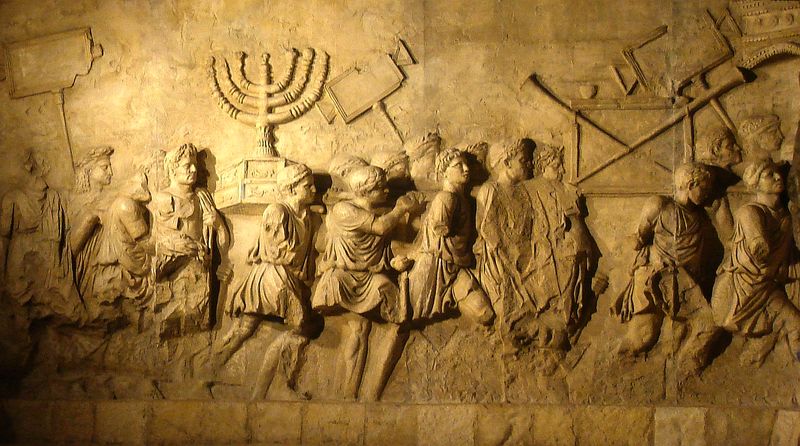
Titus (r. 79–81) had too short a reign to shape religious policy. In rapid succession his years were consumed by three disasters: the eruption of Vesuvius in August 79 (which buried Pompeii and Herculaneum under ash), a fire that devastated Rome the following year, and a severe plague. He died after barely two years in power.
Domitian: The “Second Nero” Reconsidered
Domitian (r. 81–96) has long been cast in Christian tradition as the great persecutor—the “second Nero,” the emperor under whom Anacletus supposedly perished as a martyr. Modern scholarship has significantly revised this picture. The classicist Brian W. Jones concluded that “no convincing evidence exists for a Domitianic persecution of the Christians,” and Leonard Thompson noted that “most modern commentators no longer accept a Domitianic persecution” as a historical fact.22 Even Tertullian, no friend of Roman emperors, stated that Domitian “ceased his cruelty and recalled the Christians he had exiled.”23 No surviving pagan writer of the period specifically accuses Domitian of persecuting Christians as Christians.
What Domitian did do was enforce the Fiscus Judaicus with particular aggressiveness. Suetonius personally witnessed an elderly man—ninety years old—stripped and examined by a magistrate to determine whether he was circumcised and thus liable for the Jewish Tax.24 This kind of pressure caught Christians in difficult situations. The execution in 95 AD of Flavius Clemens—Domitian’s own first cousin, a consul—and the exile of his wife Flavia Domitilla (Vespasian’s granddaughter) on charges of “atheism” and “Jewish ways” tantalizes historians. Whether this reflects Christianity, Judaism, philosophical eclecticism, or simple political intrigue remains genuinely contested.25
A Small Community in a Giant City

What we can say is that the Roman Christian community of Anacletus’s time was small—perhaps 1,000 to 3,000 people in a city of roughly one million—and scattered. They gathered in house churches (domus ecclesiae), private homes converted for worship: a dining room cleared of furniture, a ground-floor apartment opened to the neighborhood, a courtyard large enough to hold a few dozen people. The community included Jews, Greek-speaking freedmen, slaves, craftsmen, and a smaller number of wealthier patrons. It was diverse, mobile, and—at least for most of this period—below the threshold of systematic official attention.26
The best documentary window into this community at the end of Anacletus’s era is the letter we call 1 Clement (c. 95–96 AD), written from the Roman church to the church at Corinth. It is anonymous, authoritative in tone, and deeply concerned with proper order and governance. It prays for the emperor. It already speaks with something like Roman confidence about setting another community right. It is, in miniature, a hint of what the Church would become.27
Leading the Church Before the Office Had a Name

What did Anacletus actually do as the third Bishop of Rome? What did his role look like?
The Liber Pontificalis credits him with dividing Rome into twenty-five parishes and ordaining twenty-five priests. Both claims are almost certainly anachronistic. The tituli—the formal system of parish churches in Rome—developed centuries later. The Liber Pontificalis makes a nearly identical claim about Pope Evaristus (c. 99–107), raising the strong suspicion that these are duplicated or transferred traditions.28 Duchesne’s verdict on early papal chronology applies here with full force: the earliest fixed date in the Roman succession that can be stated with any historical confidence is the pontificate of Anicetus, who is known to have met Polycarp of Smyrna around AD 154. Everything before that is, as Duchesne wrote, far from the day when “the years, months, and days of the Pontifical Catalogue can be given with any guarantee of exactness.”29
Peter’s Auxiliaries: An Ancient Tradition
There is, however, a fascinating and theologically significant tradition preserved by Epiphanius of Salamis and Rufinus of Aquileia around the turn of the fifth century. Rufinus writes that “Linus and Cletus were indeed bishops in the city of Rome before Clement, but during the lifetime of Peter: that is, they undertook the care of the episcopate, and he fulfilled the office of apostleship.”30 In other words, Linus and Cletus were not quite Peter’s successors so much as his auxiliaries—handling the day-to-day liturgical and pastoral work while Peter devoted himself to preaching and apostolic ministry. Rufinus compares this to the arrangement at Caesarea, where Peter ordained Zacchaeus as bishop while remaining present himself.
This tradition is worth taking seriously precisely because it shows that even ancient writers were aware that the simple linear succession narrative did not tell the whole story.
The Monarchical Episcopate Question
Here we arrive at the honest elephant in the room. Most contemporary scholars—including many distinguished Catholic scholars—do not believe that the monarchical episcopate (a single bishop governing a local church) existed in Rome until the mid-second century. The earliest Roman church was governed more like a college of presbyter-bishops, from which a presiding figure gradually emerged whose name was remembered and who was eventually described, retroactively, as “bishop.”31
The evidence for this view is substantial. The letter of 1 Clement (c. 96 AD), written from the Roman community, is completely anonymous—no individual bishop is named as sender, and the terms “bishop” and “presbyter” are used interchangeably throughout, with multiple leaders speaking in the plural. Ignatius of Antioch (c. 107–110), in his famous letters to seven churches, urges obedience to a single bishop in each city and names the local bishop by name—everywhere, that is, except in his letter to Rome, where no bishop is mentioned at all. The Shepherd of Hermas, a Roman text from the early-to-mid second century, speaks of “presbyters who preside over the Church” in the plural.32
The Catholic scholars who have engaged these questions most rigorously speak with notable candor. Klaus Schatz, S.J., in his authoritative Papal Primacy: From Its Origins to the Present, writes that “the Roman church was governed by a group of presbyters from whom there very quickly emerged a presider or ‘first among equals’ whose name was remembered and who was subsequently described as ‘bishop’ after the mid-second century.”33 Francis Sullivan, S.J., in From Apostles to Bishops, frankly acknowledges that the monarchical episcopate is “the fruit of a post-New Testament development.”34 Raymond Brown, writing with an ecclesiastical imprimatur, noted that leaders like Linus, Cletus, and Clement “were probably prominent presbyter-bishops but not necessarily ‘monarchical’ bishops.”35
What does this mean for how we understand Anacletus? He was almost certainly not a pope in the medieval or modern sense—not a monarchical bishop exercising universal jurisdiction. He was, at most, the most prominent figure within a college of leaders: perhaps the one who presided at the Eucharist, the one through whom correspondence flowed, the one recognized as holding a special relationship to the apostolic tradition Peter had established in Rome. His community was small enough to fit in a few apartments. His authority was real but collegial, relational, embedded in a network of house churches.
This is not a crisis for Catholic faith. It is, rather, an instance of what Newman called the development of doctrine—the process by which seeds planted in the apostolic age flower, under the guidance of the Holy Spirit, into the full institutional form the Church eventually takes.36 Sullivan draws the analogy explicitly with the formation of the biblical canon: we do not doubt that Scripture is inspired because the canon was not finalized in a single moment but developed over centuries. Similarly, the Petrine office is no less real for having developed from collegial origins. The question, as Sullivan puts it, is not whether the episcopate developed but whether the result is divinely willed—and that is a theological question, not a historical one.37
Anacletus, then, should be understood not as a full-formed pope in the modern sense but as the recognized leader of the Roman Christian community who stood in a direct line from Peter—a line that would, across the following centuries, develop into the institution we call the papacy. He is not diminished by historical honesty. He is simply placed where he belongs: at the threshold of an unbroken tradition that was still finding its institutional form.
Did He Die for the Faith? The Honest Answer Is: We Don’t Know
Tradition holds that Anacletus was martyred under Domitian. This is the claim preserved in the Liber Pontificalis, which applies the formula “Martyrio coronatur”—“he was crowned with martyrdom”—to both its Cletus and Anacletus entries. The 1907 Catholic Encyclopedia gingerly states that he “died a martyr, perhaps about 91.”38
But the evidence against this claim is, frankly, more compelling than the evidence for it.
Irenaeus of Lyon, writing around 180 AD—less than a century after Anacletus would have died—lists the succession of Roman bishops from Peter through Eleutherius and singles out exactly one of them as a martyr: Telesphorus (who died c. 136–138), whom Irenaeus calls “a glorious martyr.” He says nothing—nothing—about any other bishop on the list having been martyred.39 If Anacletus had been martyred under Domitian, it is very difficult to explain why Irenaeus, writing within living memory of those who would have known the tradition, does not mention it. Eusebius, writing in the early fourth century, similarly records Anencletus’s succession without ever calling him a martyr.40 No first- or second-century source attests to his martyrdom. No details of his death survive: no manner, no circumstances, no narrative, no Roman legal record.
The theologian and canonist J.P. Kirsch put it plainly: “Between Nero and Domitian there is no mention of any persecution of the Roman Church; and Irenaeus from among the early Roman bishops designates only Telesphorus as a glorious martyr.”41 The Liber Pontificalis’s pattern of applying “Martyrio coronatur” to nearly all early popes looks less like historical reporting and more like hagiographic convention—the assumption that early popes must have been martyrs, because the age was one of persecution.
The most significant testimony comes from the Church itself. The 2004 Roman Martyrology—the current official liturgical catalog—lists him on April 26 as “Saint Cletus, pope, who, second after the Apostle Peter, ruled the Roman Church.” It does not call him a martyr. This represents a quiet but significant correction from earlier editions and reflects the Church’s own honest reckoning with the evidentiary gap.42
The Roman Martyrology’s careful silence on the point is itself a form of wisdom.
How should a Catholic approach this tradition? With respect and without false precision. The tradition that Anacletus died for the faith is ancient and should not be dismissed. The evidence for it is thin and should not be overstated. We can honor him as a shepherd who led the Church through a genuinely dangerous era—Domitian’s reign was a time of real uncertainty for Christians, even if systematic persecution is harder to document than tradition suggests—without asserting that we know he was martyred when we simply do not. The Roman Martyrology’s careful silence on the point is itself a form of wisdom.
Where He Endures: The Canon, the Calendar, and the Catacombs
Whatever history cannot tell us about the man, it can tell us where he has lived for two thousand years.
His Name in the Canon

The Communicantes prayer of the Roman Canon, established in the fifth century and shaped during the pontificate of Pope Damasus (366–384) or shortly after, lists the saints in whose communion the Church offers the Eucharist:
“…beatorum Apostolorum ac Martyrum tuorum, Petri et Pauli, Andreae, Iacobi, Ioannis, Thomae, Iacobi, Philippi, Bartholomaei, Matthaei, Simonis et Thaddaei: Lini, Cleti, Clementis, Xysti, Cornelii, Cypriani, Laurentii…”
Lini, Cleti, Clementis. The sequence follows the Irenaean ordering—the order now recognized as correct. His name appears there, sandwiched between the apostles and the great martyrs, at every Mass that uses the First Eucharistic Prayer. This is not a minor honor. Inclusion in the Canon represents the highest liturgical distinction in the Roman Rite. It is a form of memory more durable than any biography.43
His Feast: A Complicated History
Under the pre-1960 Tridentine calendar, there were actually two feast days connected to this one man: April 26 for “Saints Cletus and Marcellinus, Popes and Martyrs,” and July 13 for “Saint Anacletus, Pope and Martyr”—a direct consequence of the millennium-long confusion about the two names. Pope John XXIII’s 1960 reform removed July 13 as a duplication and retained April 26 under the corrected name “Saint Cletus.” The 1969 post-Vatican II reform under Paul VI went further, removing Cletus (and Marcellinus) from the General Roman Calendar entirely, citing “serious historical problems”—a decision that should be understood as administrative recalibration, not theological demotion. His veneration was never suppressed; he remains in the Roman Martyrology and, far more significantly, in the Roman Canon itself.44
His Tomb
The Liber Pontificalis records that Cletus was buried “iuxta corpus beati Petri, in Vaticanum”—near the body of blessed Peter, in the Vatican. A tomb ascribed to Anacletus does exist in the Vatican Necropolis, in the area known as Field P, near the so-called “Trophy of Gaius” that marks the traditional memorial of Saint Peter. But the archaeological evidence is uncertain. The Vatican excavations of 1940–1949, led by Engelbert Kirschbaum and colleagues, confirmed the use of the necropolis from the first century but did not positively identify individual tombs of the earliest popes. The New Catholic Encyclopedia states plainly that modern excavations show the claim about his burial near Peter cannot be confirmed—and suggests that the Liber Pontificalis may have confused Anacletus with Anicetus (a later pope whose names sound similar) as the builder of a burial monument for Peter.45
What does all of this amount to? The tomb is uncertain, the feast has been administratively reduced, but the Canon endures. Every time a priest at the altar prays the Communicantes, Cletus is named before God. That may be the most permanent form of historical memory we have.
Seeds and Flowers: Faith, History, and Development
There is a way of reading the history of Anacletus that would feel threatening to Catholic faith: we can barely establish his name, we cannot verify his biography, we doubt his martyrdom, and we question whether he held anything like the office we call the papacy. What is left?
But this is the wrong way to read it.
The right way begins with a distinction that careful Catholic thinkers have been making for generations. The historical question—what exactly did Anacletus do, how was the Roman church governed in the first century, what did the office of bishop look like before the monarchical episcopate developed—is separate from the theological question of whether the result of that development is divinely willed. As Francis Sullivan, S.J., puts it: the fact that the episcopate developed gradually “does not mean it was not divinely willed.” It means it was guided, shaped, and ordered by the Holy Spirit through history, not delivered in fully formed institutional perfection in the first decade after the Resurrection.46
Irenaeus constructed his famous succession list around 180 AD not primarily as a legal document establishing papal jurisdiction but as an argument against Gnosticism. The Gnostics claimed access to secret traditions passed down through hidden channels; Irenaeus replied that the Roman church’s tradition was public, traceable, named. His list was an anti-Gnostic weapon. When he named Anacletus, he meant the remembered leader of the Roman community, the human link in an unbroken chain. He did not mean to describe a pope in the sense of Innocent III or Leo X.47
But that chain is unbroken. Anacletus stands in it. Whether his authority was collegial or monarchical, limited or expansive, he was recognized—by the community in his own time and by the tradition that remembered him—as the one who held the apostolic deposit in Rome and passed it on. The seed of what would become the papacy was already present in what he represented: continuity with Peter, fidelity to the apostolic preaching, pastoral care for a community that would, within centuries, be shaping the life of the whole Church.
Schatz, Sullivan, Raymond Brown, and the other Catholic historians who have written most honestly about this period are not undermining the papacy. They are describing how a divine gift develops through history—imperfectly, gradually, under human conditions, with the Holy Spirit guiding the process. Newman understood this. The Church, in the modern era, understands it too.48
We honor Anacletus not because we can write his biography but because the Church has remembered his name for two thousand years and speaks it still. Not despite the historical fog but through it.
His name in the Canon—Lini, Cleti, Clementis—is itself a kind of creed: a declaration that the Church knows its own lineage, even when that lineage fades, at the beginning, into shadow. Even the almost-invisible ones belong to the line. Even the names we can barely see through nineteen centuries of distance.
Cletus. He has been called. And his name is still spoken.
Further Reading
For readers who want to explore further:
- J.N.D. Kelly, The Oxford Dictionary of Popes (Oxford University Press, 1986)—the single most reliable quick reference for early papal history
- Klaus Schatz, S.J., Papal Primacy: From Its Origins to the Present (Liturgical Press, 1996)—the best Catholic treatment of how the papacy developed
- Raymond Davis (trans.), The Book of Pontiffs (Liber Pontificalis) (Liverpool University Press, 3rd ed., 2010)—the foundational source for early papal biography, with honest critical introduction
- Francis A. Sullivan, S.J., From Apostles to Bishops (Newman Press, 2001)—the most rigorous Catholic engagement with the development of the episcopate
- T.J. Campbell, “Pope St. Anacletus,” J.P. Kirsch, “Pope St. Cletus,” and John Chapman, “Pope St. Clement I” (the most detailed discussion of the name question), all in the Catholic Encyclopedia (1907–08)—available free at NewAdvent.org
- Peter Lampe, From Paul to Valentinus: Christians at Rome in the First Two Centuries (Fortress Press, 2003)—the definitive scholarly portrait of early Roman Christianity
This post is part of an ongoing series on the popes. You can read about Saint Peter, the first pope, and Saint Linus, the second pope in the series.
Frequently Asked Questions
Is Cletus the same person as Anacletus?
Yes. The scholarly consensus is unanimous: Cletus, Anacletus, and Anencletus are three variant forms of one man’s name. The original Greek form was Anencletus (“blameless”); Cletus (“called”) is the shortened version that appears in the Roman Canon; Anacletus (“called back”) is a corrupted Latinization. For over a thousand years, Catholic lists mistakenly counted them as two separate popes. The error was officially corrected in 1960 by Pope John XXIII.
Was Anacletus really martyred?
The honest answer is that we do not know. Tradition holds he was martyred under Domitian, and the Liber Pontificalis applies the formula “Martyrio coronatur” to his entry. But the earliest and most authoritative sources—Irenaeus (c. 180 AD) and Eusebius (c. 325)—do not call him a martyr, and Irenaeus singles out only Telesphorus among the early Roman bishops as “a glorious martyr.” The 2004 Roman Martyrology lists Anacletus without the title of martyr, reflecting the Church’s own reckoning with the thin evidence.
What did Anacletus actually do as pope?
Very little can be verified. The Liber Pontificalis credits him with dividing Rome into twenty-five parishes and ordaining twenty-five priests, but these claims are almost certainly anachronistic projections from later centuries. Most scholars believe the monarchical episcopate did not exist in Rome until the mid-second century; Anacletus was likely the most prominent figure within a college of presbyter-bishops, presiding at the Eucharist and serving as the recognized custodian of the apostolic tradition Peter had established.
Why is Anacletus mentioned in the Roman Canon of the Mass?
The Communicantes prayer of the Roman Canon (Eucharistic Prayer I) lists saints in whose communion the Church offers the Eucharist. The sequence Lini, Cleti, Clementis follows the Irenaean ordering of the first three successors of Peter. Inclusion in the Canon represents the highest liturgical distinction in the Roman Rite—a form of memory more permanent than any biography or feast day.
When is the feast day of Saint Anacletus (Cletus)?
His feast is April 26. Before 1960, there were actually two feast days for this one man: April 26 for “Saints Cletus and Marcellinus” and July 13 for “Saint Anacletus”—a consequence of the millennium-long name confusion. Pope John XXIII removed the July 13 duplication in 1960. The 1969 post-Vatican II calendar reform removed Cletus from the General Roman Calendar, but his veneration was never suppressed; he remains in the Roman Martyrology and, most significantly, in the Roman Canon itself.
1. John Chapman, “Pope St. Clement I,” in The Catholic Encyclopedia, vol. 4 (New York: Robert Appleton Company, 1908). Available at NewAdvent.org. Chapman’s article on Clement contains the most detailed discussion of the Cletus/Anacletus name question. For the dedicated article on Anacletus, see T.J. Campbell, “Pope St. Anacletus,” in The Catholic Encyclopedia, vol. 1 (1907), available at NewAdvent.org.
2. Chapman, “Pope St. Clement I.” Chapman argues that “Anacletus” is a scribal corruption that arose when Latin copyists attempted to render the Greek “Anencletus” and inadvertently produced a different Greek word.
3. Chapman, “Pope St. Clement I.”
4. J.N.D. Kelly, The Oxford Dictionary of Popes (Oxford: Oxford University Press, 1986), 7; Raymond Davis (trans.), The Book of Pontiffs (Liber Pontificalis), 3rd ed. (Liverpool: Liverpool University Press, 2010), introduction; J.B. Lightfoot, The Apostolic Fathers, Part I, vol. 1 (London: Macmillan, 1890), 201–345.
5. The Catalogus Liberianus is preserved in the Chronography of 354. For the text and critical analysis, see Louis Duchesne, Liber Pontificalis, vol. 1 (Paris: Ernest Thorin, 1886), introduction.
6. Chapman, “Pope St. Clement I”; Campbell, “Pope St. Anacletus”; J.P. Kirsch, “Pope St. Cletus,” in The Catholic Encyclopedia, vol. 4 (New York: Robert Appleton Company, 1908). Available at NewAdvent.org.
7. Lightfoot, The Apostolic Fathers, Part I, vol. 1, 201–345; Chapman, “Pope St. Clement I.”
8. Annuario Pontificio (Vatican City: Libreria Editrice Vaticana, 2012), “I Sommi Pontefici Romani.”
9. Irenaeus of Lyon, Adversus Haereses III.3.3 (c. 180 AD). English translation in Alexander Roberts and James Donaldson (eds.), The Ante-Nicene Fathers, vol. 1 (Buffalo: Christian Literature Publishing, 1885), 416.
10. Eusebius of Caesarea, Historia Ecclesiastica III.13, III.15 (c. 313–325 AD).
11. Tertullian, De Praescriptione Haereticorum 32 (c. 200 AD); Jerome, De Viris Illustribus 15 (c. 392 AD).
12. Pope John XXIII, Rubricarum Instructum (July 25, 1960); Congregation for Rites, decree of February 14, 1961; Annuario Pontificio (2012).
13. Liber Pontificalis, “Cletus,” in Davis (trans.), The Book of Pontiffs, 3rd ed., 2–3. On the Vicus Patricius, see Samuel Ball Platner and Thomas Ashby, A Topographical Dictionary of Ancient Rome (London: Oxford University Press, 1929), “Vicus Patricius.”
14. Kirsch, “Pope St. Cletus.”
15. Davis, The Book of Pontiffs, introduction.
16. “Anacletus, Pope, St.,” in New Catholic Encyclopedia, 2nd ed. (Detroit: Gale, 2003), vol. 1.
17. Henry Hart Milman, The History of Christianity from the Birth of Christ to the Abolition of Paganism in the Roman Empire, vol. 2 (London: John Murray, 1840), 45–47. See also Peter Lampe, From Paul to Valentinus: Christians at Rome in the First Two Centuries, trans. Michael Steinhauser (Minneapolis: Fortress Press, 2003), 11–16, on the Greek-speaking character of the earliest Roman church.
18. Chapman, “Pope St. Clement I”; Campbell, “Pope St. Anacletus”; Kirsch, “Pope St. Cletus.”
19. Liber Pontificalis, “Peter,” in Davis (trans.), The Book of Pontiffs, 1.
20. Eusebius, Historia Ecclesiastica III.13, III.15.
21. On the Fiscus Judaicus and its implications for Christians, see Marius Heemstra, The Fiscus Judaicus and the Parting of the Ways (Tübingen: Mohr Siebeck, 2010).
22. Brian W. Jones, The Emperor Domitian (London: Routledge, 1992), 114–119; Leonard L. Thompson, The Book of Revelation: Apocalypse and Empire (New York: Oxford University Press, 1990), 15–17, 95–115.
23. Tertullian, Apologeticum 5.4.
24. Suetonius, Domitianus 12.2.
25. Cassius Dio, Roman History 67.14; Suetonius, Domitianus 15.1. On the question of whether Flavius Clemens and Flavia Domitilla were Christians, see Lampe, From Paul to Valentinus, 197–205.
26. Lampe, From Paul to Valentinus, 359–408, provides the most detailed reconstruction of the size, social composition, and topography of the early Roman Christian community.
27. 1 Clement (c. 95–96 AD). For a critical edition and translation, see Bart D. Ehrman (trans.), The Apostolic Fathers, vol. 1, Loeb Classical Library 24 (Cambridge, MA: Harvard University Press, 2003), 17–151.
28. Liber Pontificalis, “Evaristus,” in Davis (trans.), The Book of Pontiffs, 3–4.
29. Louis Duchesne, The Early History of the Christian Church from Its Foundation to the End of the Fifth Century, vol. 1, trans. Claude Jenkins (London: John Murray, 1909), 162–163.
30. Rufinus of Aquileia, preface to his translation of the pseudo-Clementine Recognitions (c. 402 AD). Cf. Epiphanius of Salamis, Panarion 27.6.
31. For a comprehensive treatment, see Lampe, From Paul to Valentinus, 397–408.
32. 1 Clement 42–44; Ignatius of Antioch, To the Romans (c. 107–110 AD); Shepherd of Hermas, Vision 2.4.3. For the argument from silence in Ignatius’s letter to Rome, see Raymond E. Brown and John P. Meier, Antioch and Rome: New Testament Cradles of Catholic Christianity (New York: Paulist Press, 1983), 163–164.
33. Klaus Schatz, S.J., Papal Primacy: From Its Origins to the Present, trans. John A. Otto and Linda M. Maloney (Collegeville, MN: Liturgical Press, 1996), 4–7.
34. Francis A. Sullivan, S.J., From Apostles to Bishops: The Development of the Episcopacy in the Early Church (New York: Newman Press, 2001), 15, 221–222.
35. Raymond E. Brown, “Episkopē and Episkopos: The New Testament Evidence,” Theological Studies 41 (1980): 322–338; Brown and Meier, Antioch and Rome, 163–164.
36. John Henry Newman, An Essay on the Development of Christian Doctrine (London: James Toovey, 1845).
37. Sullivan, From Apostles to Bishops, 15, 221–222.
38. T.J. Campbell, “Pope St. Anacletus,” in The Catholic Encyclopedia, vol. 1 (New York: Robert Appleton Company, 1907). Available at NewAdvent.org.
39. Irenaeus, Adversus Haereses III.3.3.
40. Eusebius, Historia Ecclesiastica III.13, III.15.
41. Kirsch, “Pope St. Cletus.”
42. Martyrologium Romanum, editio altera (Vatican City: Libreria Editrice Vaticana, 2004), April 26.
43. On the dating and development of the Communicantes, see Josef A. Jungmann, S.J., The Mass of the Roman Rite: Its Origins and Development, trans. Francis A. Brunner, C.SS.R., vol. 2 (New York: Benziger, 1955), 167–174.
44. Pope John XXIII, Rubricarum Instructum (1960); Pope Paul VI, Mysterii Paschalis (February 14, 1969).
45. New Catholic Encyclopedia, “Anacletus, Pope, St.”; Engelbert Kirschbaum, S.J., The Tombs of St. Peter and St. Paul (London: Sands, 1959); Margherita Guarducci, The Tomb of St. Peter, trans. Joseph McLellan (New York: Hawthorn Books, 1960).
46. Sullivan, From Apostles to Bishops, 15.
47. Irenaeus, Adversus Haereses III.3.1–3.
48. Schatz, Papal Primacy, 1–13; Sullivan, From Apostles to Bishops, 221–222; Brown and Meier, Antioch and Rome, 159–164; Newman, Essay on the Development of Christian Doctrine, passim.

Garrett Ham
Garrett Ham is an attorney, military veteran, and holds a Master of Divinity from Yale Divinity School. He writes from Northwest Arkansas on theology, law, and service.
More about Garrett →Related Posts

Simon Peter: The Fisherman Who Became the Rock
The life of Simon Peter—first among the apostles and first pope—traced through Scripture, the Church Fathers, and modern archaeology at Capernaum and Rome.

Saint Linus: The Name Behind the Second Link in the Chain
Nearly everything claimed about Pope Linus dissolves under scrutiny—yet he remains the earliest test case for apostolic succession. What does the evidence actually say?

Every Ex Cathedra Papal Statement: A Complete Guide
A comprehensive guide to infallible ex cathedra papal teaching. Explains Vatican I's conditions, examines the two universally agreed statements (Immaculate Conception and Bodily Assumption), and clarifies which other claims are disputed.
Stay Informed
Get new writing on faith, law, and service delivered to your inbox.
No spam. Unsubscribe anytime.