Orthodox Easter vs. Catholic Easter
On This Page
Every spring, Christians across the world celebrate the Resurrection of Christ—yet on different dates separated by weeks. The confusion isn’t accidental or careless; it flows from deep historical, theological, and computational differences between Eastern Orthodox and Catholic traditions. Understanding why Orthodox Pascha and Catholic Easter fall on different days reveals centuries of calendar disputes, the weight of liturgical tradition, and fundamentally different ways of experiencing the Church’s year.
Why the Dates Differ: The Julian-Gregorian Divide and the Paschal Computus
The primary reason Orthodox Pascha and Catholic Easter fall on different dates is embedded in calendar history. The Orthodox Church continues to use the Julian calendar for calculating the date of Pascha, while the Catholic Church adopted the Gregorian calendar reform in 1582.1 This thirteen-day gap (currently) means the two traditions are out of sync not only in astronomical time but also in how they compute Easter itself.
The Gregorian Reformation and Its Rejection
Pope Gregory XIII reformed the Julian calendar in 1582 to correct the gradual drift of the vernal (spring) equinox.2 The Julian calendar had gained roughly one day every 128 years because its leap year system was slightly too generous. By the 16th century, the calendar had drifted ten days ahead of the astronomical spring equinox, threatening to move Easter further away from the historical season of Passover.3
The Gregorian reform restored accuracy by adjusting the leap year rule: years divisible by 100 are not leap years unless also divisible by 400. This elegant correction has proven so accurate that the Gregorian calendar will only need a one-day adjustment in about 3,200 years.4
The Orthodox Church never formally adopted the Gregorian reform—a concern that adopting a calendar change mandated by Rome would suggest submission to papal authority.
However, the Orthodox Church never formally adopted this reform. Part of this was theological principle—a concern that adopting a calendar change mandated by Rome would suggest submission to papal authority.5 The Orthodox tradition preferred to maintain unbroken continuity with the early Church’s calendar practices. Today, the Julian calendar used for Paschal computations is thirteen days behind the Gregorian calendar.
The Paschal Computus and the First Council of Nicaea
Both traditions follow rules for calculating Easter that were established (at least in principle) at the First Council of Nicaea in 325 AD.6 That council decreed that Easter should be celebrated on the first Sunday following the first full moon after the vernal equinox, and that Easter must never coincide with or precede the Jewish Passover.7
The Council didn’t invent this rule arbitrarily. The Gospels describe Christ’s Resurrection occurring after Passover week, and the early Church was careful to distinguish Christian Pascha from Jewish Passover, both theologically and chronologically.8 The rule ensured that the Resurrection celebration would always fall in spring, maintain symbolic connection to the renewal of creation, and honor the Jewish festival’s historical precedence.
The Byzantine (Eastern) tradition developed a sophisticated computational method known as the Metonic cycle, which approximates the nineteen-year cycle by which lunar phases recur on the same calendar dates.9 Using this system with the Julian calendar, the Orthodox Church calculates the Paschal full moon and determines the date accordingly.
The Western (Catholic) tradition also uses a computational method, but with refinements introduced in the Gregorian reform and updated further in the 19th and 20th centuries.10 The Catholic calculation is more astronomically precise, using the ecclesiastical equinox (set at March 21) and precise astronomical calculations of the first full moon after that date.11
The Passover Rule
A widely cited Orthodox tradition holds that Pascha must not coincide with or precede the Jewish Passover.12 Some leading Orthodox scholars regard this “Passover Rule” as a historical misunderstanding of the Nicene decision, which mandated independent calculation rather than chronological dependence on the Jewish calendar. The 12th-century canonist John Zonaras observed that Pascha coincidentally always followed Passover under the existing computus and formalized this observation into a supposed rule. Regardless of its origins, the practical effect under the current Julian computus is that Orthodox Pascha consistently falls after Passover.
For the Catholic Church, this rule is no longer formally binding in modern practice. Catholic Easter can theoretically occur before Passover begins, though this is relatively rare.13 This represents a subtle but important doctrinal shift: the Catholic tradition prioritized astronomical and computational precision, while the Orthodox tradition maintained the historical and theological link to Passover.
When the Dates Converge and Diverge
Because of these different computational systems, Orthodox Pascha and Catholic Easter frequently fall on different dates. Occasionally they align, but the patterns are complex.
| Year | Catholic Easter | Orthodox Pascha | Difference |
|---|---|---|---|
| 2026 | April 5 | April 12 | 7 days |
| 2027 | March 28 | May 2 | 35 days |
| 2028 | April 16 | April 16 | 0 days |
| 2029 | April 1 | April 8 | 7 days |
| 2030 | April 21 | April 28 | 7 days |
| 2031 | April 13 | April 13 | 0 days |
| 2032 | March 28 | May 2 | 35 days |
Table: Comparison of Catholic Easter and Orthodox Pascha dates for coming years. Note that the maximum possible separation is 35 days, when the two systems’ calculations drift furthest apart.14
Historical Background: The Easter Date Controversy
The question of when to celebrate Easter has troubled the Church since its earliest centuries. Before a universal rule was established, different communities celebrated on different dates—some following the Jewish Passover calendar, others using fixed calendar dates.15
Quartodecimanism and the First Disputes
The earliest controversy centered on the Quartodecimans (“fourteenth day people”), who insisted on celebrating Easter on the 14th day of Nisan (the Jewish month), regardless of whether it fell on a Sunday.16 This practice honored the Passover connection but created a problem: the Resurrection should be celebrated on the Lord’s Day (Sunday), not just any day of the week.
The First Council of Nicaea in 325 AD, convened by Emperor Constantine, settled the matter with the rule that Easter would be calculated universally and always fall on a Sunday.17 This was a historic moment: Christianity was establishing a unified calendar practice that would apply across all provinces of the Church.
Alexandrian vs. Roman Computations
After Nicaea, disputes arose between different computational methods. The Alexandrian tradition, which had developed sophisticated mathematical calculations, produced tables of Easter dates well into the future.18 Saint Cyril of Alexandria, building on the work of his predecessor Theophilus and earlier Alexandrian computists, compiled the Metonic cycle approach into nineteen-year computations, and these “Paschal canons” became the standard in the Eastern Church.19
The Roman tradition initially used a simpler system called the Computus of Hippolytus, but eventually adopted a method based on the lunar cycles calculated by computists (Latin: computatores).20 During the Middle Ages, computists like the Venerable Bede refined Western calculations, though the systems remained distinct from Eastern methods.21
Because of computational differences and calendar drift, by the medieval period, Easter dates sometimes diverged between East and West even when communicating through diplomatic channels.22 The Great Schism of 1054 hardened these separate traditions into formally distinct churches, and any motivation to harmonize calculations largely evaporated.
The Gregorian Reform and Eastern Rejection
Pope Gregory XIII’s 1582 reform created an opportunity for reconciliation, but the Orthodox Church’s refusal to adopt the Gregorian calendar effectively closed that window.23 Some Eastern-rite Catholic communities, particularly the Ukrainian Greek Catholic Church and the Maronite Church, did adopt Gregorian calculations, but the primary Orthodox Church never did.24
Various ecumenical efforts in the 20th and 21st centuries have explored the possibility of a unified Easter date. A 1997 World Council of Churches consultation at Aleppo, Syria, considered and explicitly rejected fixing Easter on a definite calendar date, finding it would “obscure and weaken” the link between Passover and Christ’s passion. Instead, the consultation recommended maintaining the Nicene norms while calculating astronomical data using the most accurate scientific means, referenced to the meridian of Jerusalem.25 However, neither the Catholic Church nor the Orthodox Church has formally adopted this recommendation. The traditions remain committed to their inherited computational systems, seeing them as intrinsically connected to their liturgical theology.
Great Lent: The Foundation of Paschal Preparation
Before examining the feast of Pascha itself, we must understand the season that precedes it. Great Lent (also called Lenten season in Catholic terminology) is not merely a time of “giving something up” but rather a comprehensive reorientation of the Church’s life toward the Resurrection.26
The Orthodox tradition observes a seven-week Great Lent, totaling forty-nine days before Pascha itself. During this time, the faithful fast—traditionally abstaining from meat, dairy, eggs, fish, and oil—and intensify prayer, confession, and participation in the Liturgy.27 The fasting is not punitive but restorative; it aims to clear the passions and attachments so that the believer might be more fully present to the resurrection reality.
Alexander Schmemann, in his masterwork For the Life of the World, describes fasting not as a denial of creation but as a recovery of its proper use. In his opening chapters, Schmemann develops the idea that fasting cultivates a new attitude toward food and the world—an attitude free from greed and the conversion of food into an end in itself.28 The Orthodox tradition sees material deprivation as a gateway to spiritual presence.
The Sundays of Great Lent have their own names and theological emphases. The Sunday of Orthodoxy (the first Sunday) commemorates the victory of icons. The Sunday of Saint Gregory Palamas (the second Sunday) honors the 14th-century defender of hesychasm. Then come the Sunday of the Veneration of the Cross (the third), Saint John of the Ladder (the fourth), and Saint Mary of Egypt (the fifth)—each with their own liturgical texts, hymns, and spiritual significance.29 The final weekend before Holy Week comprises Lazarus Saturday (celebrating the raising of Lazarus) and Palm Sunday (commemorating Christ’s entry into Jerusalem), which together transition the Church from Lent to Holy Week.30
The Catholic tradition, reformed by Vatican II, observes a forty-day Lent (historically reckoned as forty weekdays, excluding Sundays).31 Modern Catholic practice emphasizes prayer, almsgiving, and penance rather than strict fasting. While less austere than the Orthodox fast, it remains a significant penitential season culminating in the Sacred Triduum (the three days of Holy Thursday, Good Friday, and Holy Saturday).
Holy Week in the Orthodox Tradition: A Detailed Journey
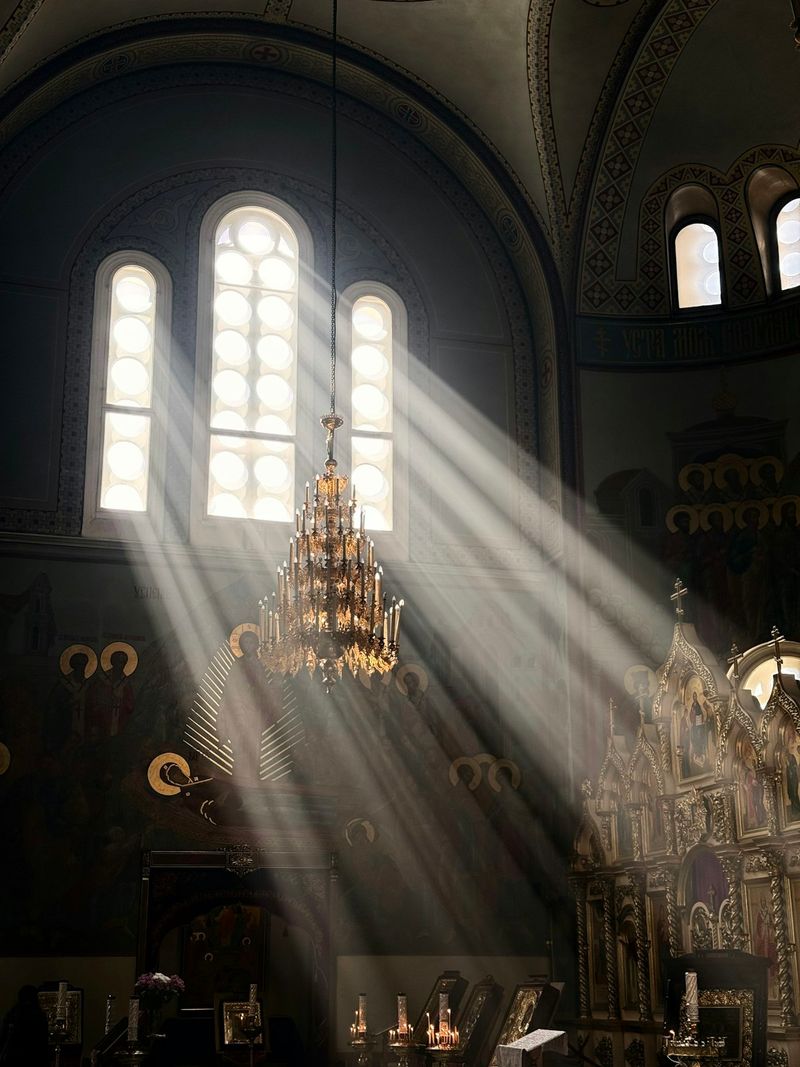
Holy Week—called Passion Week or the Week of Pascha in Orthodox tradition—unfolds with extraordinary liturgical richness. Each day has its own character and scriptural focus.
Lazarus Saturday and Palm Sunday
The Orthodox approach to Holy Week begins with two distinct celebrations on consecutive days. On Lazarus Saturday, the Church reads the Gospel of John 11:1–45—the raising of Lazarus, a resurrection miracle that foreshadows Christ’s own Resurrection. Lazarus has been dead four days; Jesus calls him forth with a thunderous voice: “Lazarus, come out!” The Church celebrates Lazarus’s triumph over death as a type and preview of what Christ will accomplish.32
The following day, Palm Sunday, the Church commemorates Christ’s triumphal Entry into Jerusalem. The faithful process with palm branches, and the liturgical texts emphasize both the joy of the crowd’s “Hosanna!” and the shadow of suffering to come. The contrast between the two days is deliberate: Lazarus is raised; Jesus marches toward death. Holy Week proper begins on Monday after Palm Sunday.
Tuesday, Wednesday, Thursday of Holy Week
Tuesday through Thursday of Holy Week continue the tension between resurrection proclamation and passion commemoration. The Church reads the Gospels of Matthew, Mark, and Luke in succession, dwelling on Christ’s teachings in His final days—the parables of the ten virgins and talents, the Last Judgment discourse, and the anointing at Bethany.33
The Orthodox liturgy begins to shift toward the Passion narrative. The veneration of the Cross takes on deeper meaning as the instrument of our salvation draws nearer. The Bridegroom (Nymphios) services—the anticipated Matins of Holy Monday, Tuesday, and Wednesday—are celebrated on Palm Sunday evening, Holy Monday evening, and Holy Tuesday evening. The troparion “Behold the Bridegroom comes at midnight” weaves together the motif of Christ as a bridegroom approaching his suffering and the Church’s longing for intimate union with Him.34
Holy Thursday (Maundy Thursday), the day of the Last Supper, holds tremendous significance. The Orthodox tradition commemorates Christ’s institution of the Eucharist and His washing of the disciples’ feet. The Church emphasizes both the gift of sacramental communion and the call to humble service.35 Many Orthodox parishes hold a communal foot-washing ceremony, and the liturgical tone is one of profound love mixed with sorrow, knowing what lies ahead.
The Twelve Gospels, the Royal Hours, and the Epitaphios
The Orthodox commemoration of the Passion unfolds across Thursday evening and all of Friday through a sequence of distinct services.
On Thursday evening, the Matins of Holy Friday (often called the Service of the Twelve Gospels) is served. Twelve Passion Gospel readings—drawn from Matthew, Mark, Luke, and John—are interspersed throughout the service, taking the faithful through the full narrative: the Passover meal, Gethsemane, the betrayal, the trials, the crucifixion, the burial. These are not brief excerpts but long, detailed accounts that take hours to chant in full.36
On Friday morning, the Royal Hours are served—the 1st, 3rd, 6th, and 9th Hours, each with special psalms, hymns, Old Testament readings, epistles, and Gospel Passion narratives. No full Eucharistic liturgy is celebrated; the Liturgy of the Presanctified (a service using pre-blessed bread and wine) is sometimes served, but the note of the day is extreme solemnity and lamentation.37
On Friday afternoon, the Vespers of Holy Friday includes the Apokathelosis (the “Taking Down from the Cross”), in which the body of Christ is symbolically removed from the cross and placed on the Epitaphios—an embroidered cloth icon of Christ’s burial.
The climax of Great Friday is the Epitaphios Threnos (Lamentations at the Tomb), served as the Matins of Holy Saturday on Friday evening. The Epitaphios is placed on a decorated bier (the “kouvouklion”), adorned with flowers, and carried in a solemn procession around the church. The faithful follow, holding candles and singing the Lamentations—three stanzas of hymns meditating on Christ’s burial and the mystery of God’s death in the flesh.38
Holy Saturday (Great Saturday) and the Resurrection Vigil
Holy Saturday is a day of anticipation. The Church enters the silence of Christ’s burial—the moment between death and resurrection that Christian theology calls the harrowing of Hades (Christ’s descent into hell to free the captive dead).39 Some services are held, but the note is one of watchfulness, not yet joy.
As evening approaches, the Paschal Vigil begins—the centerpiece of Orthodox Holy Week. The service commences with the Midnight Office (Mesonyktikon), during which the Canon of Holy Saturday is chanted over the Epitaphios, which is then carried silently into the altar.40
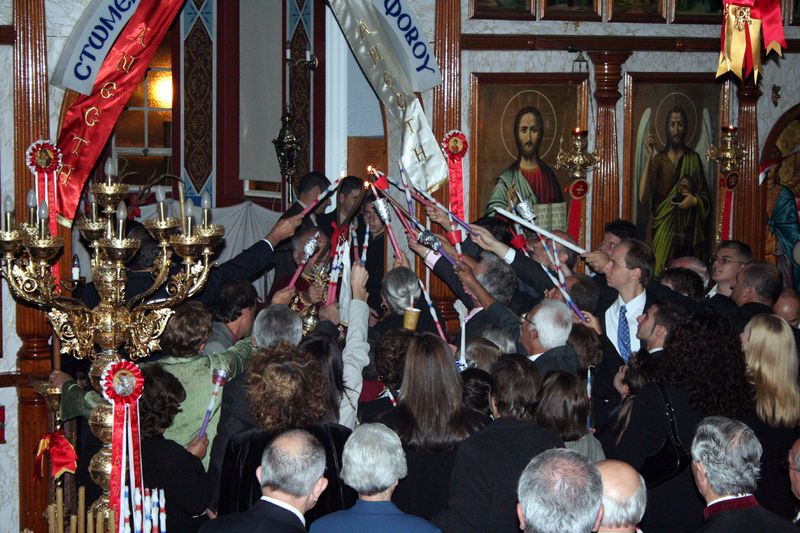
Near midnight, the clergy and faithful process out of the now-darkened church, circling the building while chanting the sticheron “Thy Resurrection, O Christ our Savior, the angels hymn in the heavens.” The procession halts before the closed church doors. In the stillness, the priest reads the Resurrection Gospel and intones the Paschal troparion for the first time: “Christ is risen from the dead, trampling down death by death, and upon those in the tombs bestowing life.” The doors are flung open (symbolizing the opening of the tomb), candles blaze to life, and the full Paschal Matins begins in an eruption of joy.41
The Paschal Vigil and the Midnight Resurrection: The Heart of Orthodox Pascha
The Orthodox Paschal Vigil and Resurrection liturgy constitute the climactic moment of the Church year. Unlike the Catholic Easter Vigil, which is celebrated in the evening, the Orthodox tradition typically extends the vigil through the night, culminating in the Resurrection Liturgy at midnight or near dawn.42
The Paschal Matins is extraordinarily long and liturgically complex. The service is built around the Paschal Canon (attributed to Saint John of Damascus), with its repeated refrains of “Christ is risen from the dead,” building in power and joy. The Exapostilarion—a hymn sung near the end of Matins after the canon—adds its own note of triumph:
“The night of darkness hath fled away, The dawn of light appeareth now. The royal doors have opened wide, And Christ, our Light, doth rise today!“43
After the Matins, the Paschal Divine Liturgy (the Eucharistic service) begins, often around midnight. The priest emerges wearing brilliant white vestments, and the altar is bedecked with flowers and light. The faithful receive Communion with a joy and solemnity unmatched at any other time of the year. Many Orthodox Christians prepare for this Communion through weeks of Lenten fasting and confession, approaching this Eucharist as the great sacrament of their year.44
The Paschal Homily of John Chrysostom
A central feature of the Paschal service is the reading (or chanting) of the Paschal Homily of Saint John Chrysostom.45 Written in the 4th century, this homily captures the Orthodox theology of the Resurrection with unmatched beauty. A few excerpts:
“If anyone is devout and a lover of God, let him enjoy this beautiful and radiant feast. If anyone is a grateful servant, let him enter, rejoicing into the joy of his Lord. If anyone is tired from fasting, let him now receive his reward…“46
The homily celebrates the universal victory of Christ: “Hell took a body and discovered God. It took earth and encountered Heaven… O Death, where is thy sting? O Hades, where is thy victory?”47 The tone is not mournful but triumphant. Death is defeated. Hell is emptied. Creation is restored.
The Paschal Greeting
Immediately following the homily, the priest greets the people with the traditional Paschal greeting:
Priest: “Christ is risen!” People: “He is risen indeed!”
This exchange, in the language of each nation, is the defining moment of Orthodox Easter. The greeting is repeated throughout Bright Week, and the faithful greet one another with these words for forty days, until the Feast of the Ascension. In some Orthodox traditions, the faithful also exchange Paschal eggs and Paschal breads (paskha—a traditional cheese or bread confection) while making this greeting.48
Paschal Customs and the Celebration of Bright Week
Orthodox Pascha is followed by Bright Week (or Feast Week), a prolonged festive period that contrasts sharply with Lent. If Lent is a descent into the desert, Bright Week is a return to abundance and joy.
Red Eggs and the Breaking of the Fast
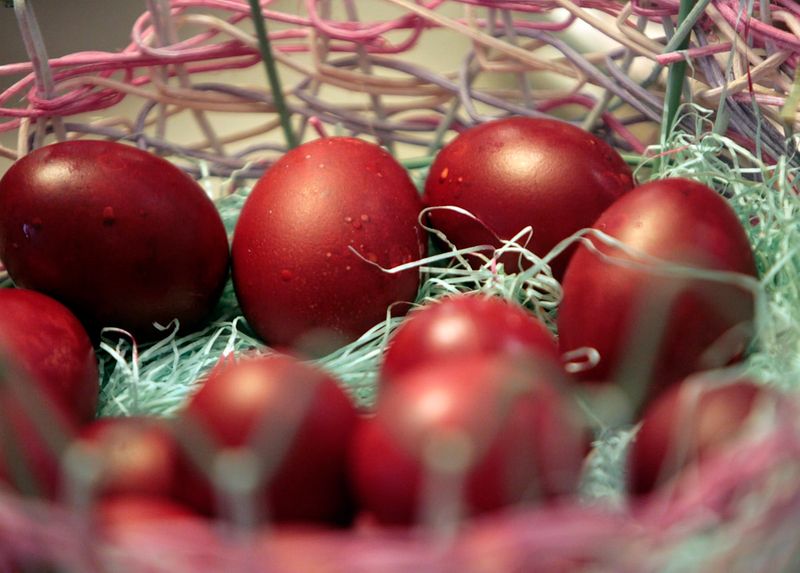
The tradition of red eggs has deep roots in Orthodox practice, though there is no single universally agreed-upon origin story. One tradition holds that eggs represent resurrection—the shell appears dead but contains new life. Another links the practice to Mary Magdalene, who is said (in Orthodox tradition) to have brought red eggs to the other apostles.49 The most common explanation is simply that eggs, prohibited during Lent, become available again at Pascha, and their dyeing red symbolizes the precious blood of Christ.50
These eggs are exchanged with the Paschal greeting, and families hold egg-tapping games (the first person whose egg cracks loses, and the winner continues challenging others) that symbolize the cracking open of the tomb and Christ’s emergence into resurrection life.51
Paschal Foods and the Festive Meal
The Orthodox fast ends at Pascha, and the traditional Paschal meal includes foods forbidden during Lent: lamb (especially roasted or in a soup called magiritsa), eggs, butter, cheese, milk, and bread.52 In different Orthodox cultures—Greek, Russian, Serbian, Ukrainian—the Paschal foods vary slightly, but all feature rich, celebratory meals with family and community.
The traditional Paschal paskha (the dessert) is a molded confection of sweetened curds or cream cheese, sometimes with candied fruit. Its shape—often a four-sided pyramid—is said to represent the “Tent of Meeting” or the altar of the temple.53
Bright Week Observance
Bright Week is a festival week in the Orthodox calendar. The Divine Liturgy is celebrated daily, and it includes special, resurrection-focused hymns. Many Orthodox churches hold processions, dinners, and celebrations throughout this week. The tone is celebratory and light—the word “bright” (svetlaya in Russian) captures the sense of illumination and joy.
The Church’s fast is lifted, but not all austerities cease immediately. Some Orthodox Christians continue to abstain from certain foods through Ascension (40 days after Pascha), mirroring a corporate fast that honors the period between Resurrection and Ascension.54
The Catholic Easter Vigil: Continuity and Contrast
The Catholic tradition also has a solemn Paschal vigil, substantially reformed by Pope Pius XII (ad experimentum in 1951, permanently in 1955–1956) with further modifications following Vatican II’s Sacrosanctum Concilium (1963). While sharing some common features with the Orthodox vigil, the Catholic Easter Vigil has distinct characteristics.55
The Catholic vigil begins with the Lucernarium (the service of light), where the Easter candle is lit from a fire (or, in practice, a lighter), and the faithful receive candles to carry during the opening procession.56 The service includes the Exsultet (Praeconium Paschale), a solemn Easter Proclamation traditionally sung by the deacon, celebrating Christ as the light and praising the wax of the candle that burns so the light might shine.57
The Catholic vigil traditionally includes a reading of the Prophetic Readings (Old Testament passages prefiguring Christ), followed by the Epistle Reading and Gospel. The full Eucharistic liturgy then follows.58 The Roman Missal requires the Vigil to take place “during the night” and provides for up to nine readings. The vigil is typically 2.5 to 3 hours or more, especially when baptisms and confirmations are celebrated. It is shorter than the Orthodox vigil, but more substantial than commonly assumed.
A key difference: the Catholic Church, since Vatican II, celebrates the vigil in the evening or early night (not at midnight), making it more accessible for families with children.59 The Orthodox tradition, especially in more traditional parishes, adheres to the midnight celebration, which carries profound theological significance: Christ rose at night, in darkness, and the vigil’s night-to-dawn progression mirrors that cosmic turning point.
Theological Emphasis: Resurrection Over Crucifixion
A fundamental theological difference between Orthodox and Catholic traditions emerges in their liturgical focus during Pascha. Both celebrate the Resurrection, but the theological weight differs.
The Orthodox tradition emphasizes Christus Victor—Christ the Victorious King who conquers death, hell, and Satan. Suffering is real, but it is always in service to a greater narrative of victory.
The Orthodox tradition emphasizes Christus Victor—Christ the Victorious King who conquers death, hell, and Satan.60 The Paschal hymnography dwells on the descent into Hades, the freeing of the imprisoned dead, and the triumph of the Cross. Suffering is real and commemorated, but it is always in service to a greater narrative of victory.
The Catholic tradition, influenced by medieval Western theology, employs multiple atonement models, prominently including the Satisfaction Theory (developed by Saint Anselm), wherein Christ’s obedience and suffering restore the honor owed to God. Unlike Calvinist penal substitutionary atonement (which emphasizes punishment), Anselm’s satisfaction presents an alternative to juridical punishment. The Catholic Catechism (CCC §599-618) affirms multiple models: sacrificial (§613), ransom (§601), solidarity (§602-603), satisfaction (§616), recapitulation (§517-518), and meritorious obedience (from Trent, §617). CCC §603 implicitly distances Catholic theology from strict penal substitution by affirming that Jesus “did not experience reprobation as if he himself had sinned” and was always united to the Father in redeeming love. While the Resurrection is celebrated, the focus on Christ’s redemptive suffering is pronounced. The Good Friday veneration of the cross is central to Catholic piety, and the cross often appears more prominently in Catholic sanctuary imagery than in Orthodox churches.61
These are not contradictory emphases but different prioritizations of the same mystery. The Orthodox do not deny that Christ’s suffering is redemptive; they simply don’t make it the primary lens. The Catholic Church does not deny Christ’s victory; it integrates that victory into a framework where Christ’s self-offering is primary.62
The Pentecostarion: Fifty Days of Resurrection
The Orthodox Church’s liturgical calendar doesn’t end at Pascha. Instead, the Pentecostarion (the liturgical book containing services for the fifty days from Pascha to Pentecost) extends the Paschal season.63
Each Sunday during this period has its own Gospel reading and theme. The first Sunday after Pascha is Thomas Sunday (also called Antipascha), commemorating Jesus’s appearance to Thomas and his confession, “My Lord and my God!”64 The Sunday of the Myrrh-Bearing Women (the second Sunday after Pascha) celebrates the women who visited the tomb. The Sunday of the Paralytic (third Sunday) tells the story of the man at the Pool of Bethesda, and the Sunday of the Samaritan Woman (fourth Sunday) presents the woman at the well.65
Each story illustrates dimensions of resurrection life and faith. The hymnography of the Pentecostarion maintains the resurrection theme, but with subtle shifts in emphasis as the Church moves toward Ascension (40 days after Pascha) and then Pentecost (50 days after Pascha).66
The Ascension, occurring 40 days after Pascha, commemorates Christ’s return to heaven. The Descent of the Holy Spirit at Pentecost (50 days after Pascha) completes the Easter cycle. Together, Pascha, Ascension, and Pentecost form the supreme feasts of the Orthodox Church year.67
The Catholic Church observes a shortened Easter season, concluding at Pentecost (50 days after Easter), but the intervening Sundays are less liturgically distinct. The modern Catholic calendar emphasizes Pentecost as the final “Easter Vigil” moment, when the Holy Spirit descends upon the Church.68
Efforts Toward a Unified Easter Date
Since the Great Schism, and especially since the mid-20th century, ecumenical dialogue has repeatedly addressed the question of a unified Easter date.
The 1997 World Council of Churches Consultation (Aleppo, Syria, March 5-10) brought together scholars from Catholic, Orthodox, Oriental Orthodox, and Protestant traditions. The Consultation explicitly rejected a fixed Easter date (e.g., the second Sunday in April), stating it “would obscure and weaken” the link between Passover and Christ’s passion. Instead, the Consultation produced one main recommendation: maintain the Nicene norms (Easter on the first Sunday after the first full moon following the vernal equinox, always following Passover) but calculate the astronomical data using the most accurate scientific means, referenced to the meridian of Jerusalem. This “Revised Paschal Computus” would allow both Eastern and Western churches to apply a common calculation while preserving the traditional theological principles governing Paschal computation.69
However, this recommendation has not been formally adopted by either the Catholic or Orthodox Churches. The Orthodox Church has hesitated, fearing that changing the Paschal computus could imply acceptance of Western calendar authority or deviation from unbroken tradition.70 The Catholic Church, secure in its Gregorian system, has shown less urgency for reform.71
A unified Easter date remains an unrealized ecumenical goal. As long as the Orthodox Church retains the Julian calendar for Paschal reckoning, and as long as both traditions see their computations as inseparable from their liturgical theology, separate dates will likely persist.72
Theological and Spiritual Lessons
The different Easter dates reveal something profound about Christian tradition and ecclesiology. The diversity itself is not a scandal but a reflection of how deeply liturgy and theology are interwoven in Christian life.
For Catholic Christians, Easter is the climactic feast of a penitential season. The emphasis on Christ’s suffering and redemption, on the satisfaction of divine justice, reflects a particular theological development in the Western Church. The Easter Vigil, celebrated in the evening with readily accessible hymnography and shorter duration, accommodates modern Catholic life.73
For Orthodox Christians, Pascha is the feast of feasts, approached through seven weeks of intensive fasting and prayer. The emphasis on Christ’s victory over death, on the cosmic restoration of all things, reflects early Christian thought preserved in the East. The midnight vigil, the extended hymnography, and the fifty-day celebration express a different rhythm of Church life—one less constrained by the secular calendar’s demands.74
Both traditions, through their different dates and emphases, call their adherents deeper into the mystery of the Resurrection. Both celebrate that Christ has risen, death is conquered, and humanity is restored to communion with God.
Conclusion: A Shared Mystery, Expressed Differently
The question “Why is Orthodox Easter on a different date?” has no simple answer. It involves history (the Great Schism and the Gregorian reform), mathematics (Metonic cycles and lunar calculations), theology (the significance of Passover and the nature of the Resurrection), and tradition (the reluctance of either church to surrender inherited practices).
The persistence of two different Easter dates should not be viewed as a failure of ecumenism but as a reminder of how deeply tradition shapes Christian identity.
The persistence of two different Easter dates should not be viewed as a failure of ecumenism but as a reminder of how deeply tradition shapes Christian identity. The Orthodox and Catholic churches each bring gifts to the universal Church: the Orthodox, their reverent preservation of patristic theology and their emphasis on theosis (deification) and the Resurrection’s cosmic scope; the Catholic Church, its systematic theology, its global reach, and its tireless efforts toward doctrinal clarity and unity.
To understand Orthodox Pascha is to enter a different rhythm of Church life, one rooted in the desert monasticism of Egypt and Syria, in the imperial Christianity of Constantinople, in the hesychasm of Mount Athos. To observe a Catholic Easter is to participate in the synthesis of faith and reason that characterizes Western Christendom, from Augustine through Thomas Aquinas to Vatican II.
For those interested in deepening their understanding, explore Eastern Orthodoxy Explained for a broader introduction to Orthodox faith and practice. Those curious about the historical roots of the separation should read about the Great Schism. For those contemplating the rigorous spiritual discipline of Orthodox preparation for Pascha, see Orthodox Fasting. The Orthodox vs. Catholic article provides a comprehensive comparison of other doctrinal and liturgical differences.
The mystery of the Resurrection transcends calendars and computations. Whether celebrated in April or May, in darkness or evening light, the Christ who rose is the same Lord, now and always. “Christ is risen! He is risen indeed!”
Frequently Asked Questions
What is the difference between Orthodox Easter and Catholic Easter?
Orthodox Easter (called Pascha) and Catholic Easter differ in three main ways: the date of celebration (Orthodox uses the Julian calendar, Catholic uses the Gregorian), the theological emphasis (Orthodox centers on Christ’s victory over death, Catholic integrates multiple atonement models), and the liturgical practice (the Orthodox Paschal Vigil extends through midnight with the Chrysostom homily, while the Catholic Easter Vigil is celebrated in the evening with the Exsultet).
Why is Orthodox Easter on a different date?
The primary reason is the calendar difference. The Orthodox Church uses the Julian calendar to calculate Pascha, while the Catholic Church uses the Gregorian calendar adopted in 1582. The Julian calendar is currently thirteen days behind the Gregorian. Additionally, the Orthodox maintain the ancient rule that Pascha must always follow Jewish Passover—a constraint the Catholic computus no longer enforces.
How often do Orthodox and Catholic Easter fall on the same date?
Orthodox Pascha and Catholic Easter coincide roughly every three to four years. When they do align, it is because the Julian and Gregorian computations happen to produce the same Sunday. The next shared date is April 16, 2028, followed by April 13, 2031.
What is the Paschal Homily of John Chrysostom?
The Paschal Homily attributed to Saint John Chrysostom (c. 349–407 AD) is read or chanted at every Orthodox Paschal service worldwide. It celebrates the universal victory of Christ over death and invites all people—the devout, the weary, and the late-arriving—to enter the joy of the Resurrection feast. Its most famous passage declares that Christ “took a body and discovered God” and asks, “Where, O Death, is thy sting?”
What are Orthodox Easter traditions?
Key Orthodox Easter traditions include the midnight Paschal Vigil with candlelit procession, the exchange of the greeting “Christ is risen! / He is risen indeed!,” the tradition of red eggs symbolizing the blood of Christ and the Resurrection, Paschal foods like lamb and paskha (a sweetened cheese confection), and the week-long celebration of Bright Week with daily Divine Liturgy.
Will Orthodox and Catholic Easter ever be on the same date permanently?
Not under the current systems. The 1997 World Council of Churches consultation at Aleppo proposed maintaining Nicene norms while using modern astronomical calculations referenced to the Jerusalem meridian, but neither church has adopted the recommendation. As long as the Orthodox retain the Julian calendar for Paschal reckoning, separate dates will persist in most years.
Footnotes
1. Timothy (Kallistos), *The Orthodox Church*, revised edition (London: Penguin Books, 1993), pp. 138–139. The Julian calendar remains in use for calculating the Orthodox Pascha (Easter), while the Gregorian calendar, introduced by Pope Gregory XIII in 1582, is now the internationally recognized civil calendar.
2. For the early Christian computus through Dionysius Exiguus, see Alden A. Mosshammer, The Easter Computus and the Origins of the Christian Era (Oxford: Oxford University Press, 2008). Mosshammer’s study covers the period through the sixth century. For the 1582 Gregorian reform specifically, see David Ewing Duncan, Calendar: Humanity’s Epic Struggle to Determine a True and Accurate Year (New York: Avon Books, 1998) and the Catholic Encyclopedia entry “Reform of the Calendar.”
3. The Julian calendar’s assumption of a 365.25-day year was too generous; the true tropical year is approximately 365.2422 days, creating a discrepancy of roughly 11 minutes and 14 seconds annually. See Duncan, Calendar, for a standard account of the drift and its consequences.
4. Estimates range from approximately 3,030 to 3,333 years depending on the tropical year value used; ~3,200 years is a reasonable midpoint. The Gregorian calendar is therefore suitable for both civil and ecclesiastical purposes far into the future.
5. Some Orthodox theologians were cautious about adopting a reform mandated by the Papacy, viewing it as a potential ecclesiological compromise. For the Orthodox perspective on calendar reform and liturgical tradition, see Alexander Schmemann, Introduction to Liturgical Theology, 3rd ed. (Crestwood, NY: St. Vladimir’s Seminary Press, 1986).
6. The First Council of Nicaea (325 AD) was the first ecumenical council of the Christian Church, convened by Emperor Constantine to address christological controversies and ecclesiastical order. While no specific numbered canon on Easter survives among Nicaea’s 20 canons, the Easter decision was communicated through synodal letters and became authoritative in establishing the principle of unified Paschal celebration.
7. The Council of Nicaea’s Easter decision was communicated through the synodal letter to the Church of Alexandria and Constantine’s circular letter to all churches (preserved in Eusebius, Life of Constantine III.17–20), not through any of the 20 numbered canons. See Norman P. Tanner, ed., Decrees of the Ecumenical Councils, Vol. 1 (Washington, DC: Georgetown University Press, 1990).
8. The distinction between Pascha and Passover was theologically significant: the Christian Resurrection feast commemorated Christ, not the historical Exodus, though the symbolic and prefigurative connections were acknowledged.
9. The Metonic cycle, named for the 5th-century BC Greek astronomer Meton, is a 19-year period after which lunar phases recur on approximately the same calendar dates. This cycle is fundamental to the Orthodox Paschal computus.
10. The Catholic computus, while also based on lunar cycles, incorporates the refined astronomical observations and calendar adjustments that accompanied the Gregorian reform. See Alden A. Mosshammer, The Easter Computus and the Origins of the Christian Era (Oxford: Oxford University Press, 2008), chapters 10–12, for a detailed treatment of the Western computational tradition.
11. The ecclesiastical equinox is conventionally fixed at March 21, regardless of the actual astronomical equinox. This ensures a stable computational system, even if not perfectly aligned with observed astronomical events.
12. The tradition that Pascha must follow Passover is sometimes called the “Passover Rule” or the “Zonaras Proviso” (after the 12th-century canonist John Zonaras). Leading Orthodox scholars, including Prof. John Fotopoulos of the Greek Orthodox Archdiocese of America, have argued that this “rule” is a later misreading of the Nicene decision, which mandated independent calculation from the Jewish calendar. Under the current Julian computus, Pascha consistently falls after Passover as a mathematical consequence of the calendar drift.
13. While Catholic Easter can technically occur before Passover in certain years, the rule forbidding this is not formally enforced in modern Catholic practice as it is in Orthodoxy. The Gregorian computus focuses on astronomical precision rather than coordination with the Jewish calendar.
14. Easter dates for 2026-2032 were calculated using standard ecclesiastical computus methods. The maximum separation of 35 days occurs when the lunar calculations of the two systems are most misaligned; the minimum is usually 0-7 days when they converge.
15. Before the Council of Nicaea, some Christian communities observed Easter according to the Jewish Passover calendar (Nisan 14-15), while others celebrated on a fixed Sunday date. This diversity caused concern about Christian unity.
16. The Quartodecimans followed the 14th day of Nisan regardless of the day of the week. Saint Polycarp of Smyrna discussed this practice with Pope Anicetus (~155 AD) in a meeting that ended amicably (Eusebius, Church History V.24). The genuine confrontation came decades later when Polycrates of Ephesus defended the practice against Pope Victor I (~190s AD), who threatened to excommunicate the Asian churches.
17. The Council of Nicaea’s Easter decision was decisive and universal: from that point forward, the entire Church was expected to observe Easter on a single, computationally determined Sunday. This marked a major shift toward liturgical uniformity.
18. Saint Cyril of Alexandria (c. 376–444 AD), building on the work of his predecessor Theophilus and earlier Alexandrian computists (principally Anatolius of Laodicea, ~260s AD), compiled a 95-year Paschal table covering 437–531 AD (five repetitions of the 19-year Metonic cycle). These tables became the foundation of Eastern Paschal computation.
19. The “Paschal canons” of the early Church, particularly those refined by Cyril of Alexandria, were received as authoritative and nearly infallible in the Eastern tradition. Their mathematical sophistication was remarkable for the 4th-5th centuries.
20. The Western computus evolved through the Middle Ages, with figures like Hippolytus, Anatolius, and later Ambrose and Augustine contributing refinements. The system was less uniform than the Eastern approach until the Gregorian reform clarified it.
21. The Venerable Bede (673-735 AD) was a master computist whose work on the reckoning of Easter and dates influenced Western practice for centuries. His *De temporum ratione* was the primary resource for medieval computists.
22. During the medieval period, various Byzantine and Western authorities calculated Easter differently, occasionally resulting in Eastern and Western churches celebrating on different dates, even when in direct communication via diplomatic channels.
23. The Orthodox Church’s hesitation regarding the Gregorian reform stemmed partly from doctrinal concerns about papal authority and partly from commitment to the Julian calendar as part of inherited tradition. This created a lasting divergence.
24. Some Eastern-rite Catholic Churches, particularly those in communion with Rome (the Ukrainian Greek Catholic Church, the Melkite Greek Catholic Church), adopted the Gregorian calendar and computus, allowing them to celebrate Easter with the Catholic Church.
25. “Towards a Common Date for Easter,” WCC/MECC Consultation, Aleppo, Syria, March 5–10, 1997. The consultation included representatives from Catholic, Orthodox, Oriental Orthodox, and Protestant churches. While it generated sophisticated proposals, neither the Catholic nor Orthodox Churches formally adopted its recommendations. The full text is available at oikoumene.org.
26. Great Lent in the Orthodox tradition is a forty-nine-day period (seven weeks) of intensive spiritual preparation. It is not merely penitential but transformative, aimed at renewing the believer’s relationship with God before Pascha.
27. The Orthodox fast excludes meat, dairy, eggs, olive oil, and fish. Monastic communities often fast more strictly, abstaining from all food on certain days. The fast is understood as a sign of repentance and a means of spiritual clarity.
28. Alexander Schmemann, *For the Life of the World: Sacraments and Orthodoxy* (Crestwood, NY: St. Vladimir’s Seminary Press, 1973), ch. 1 (pp. 11–18). Schmemann develops the theology of fasting as a recovery of the proper relationship to material creation throughout the book’s opening chapters. The quotation above is a paraphrase of Schmemann’s argument rather than a verbatim citation.
29. The five Sundays of Great Lent are: (1) Sunday of Orthodoxy, (2) Sunday of Saint Gregory Palamas (1296–1359), defender of hesychasm, (3) Sunday of the Veneration of the Cross, (4) Sunday of Saint John Climacus (whose *Ladder of Divine Ascent* addresses spiritual progress), and (5) Sunday of Saint Mary of Egypt (a model of repentance and theosis). Note: the Liturgy of Saint Basil the Great replaces the usual Liturgy of Saint John Chrysostom on all Sundays of Lent, but Basil does not have a named Sunday commemoration.
30. Lazarus Saturday is the day before Palm Sunday and the last Saturday of Great Lent. It commemorates the raising of Lazarus as a type of the Resurrection. Palm Sunday—the following day—celebrates Christ’s Entry into Jerusalem and serves as the gateway into Holy Week.
31. The Catholic Lenten period, by modern reckoning following Vatican II, begins on Ash Wednesday and extends for forty weekdays (excluding Sundays) until the Mass of the Lord’s Supper on Holy Thursday. Canon Law (Can. 1250-1253) still requires abstinence from meat on all Fridays of Lent (and universally on all Fridays year-round, though bishops’ conferences may permit substitution), plus obligatory fasting on Ash Wednesday and Good Friday. The *Paenitemini* (1966) reduced obligatory fast days compared to the 1917 Code, but the remaining obligations remain significant.
32. The Orthodox Church begins Holy Week on the Sunday of Lazarus, emphasizing the Resurrection motif of Lazarus as a prefigurement of Christ’s Resurrection. The Catholic Church begins with Palm Sunday, focusing on the Passion narrative.
33. During Holy Monday through Holy Wednesday, the Gospel readings progress through Matthew, Mark, and Luke respectively, encompassing Christ’s final teachings: parables of the Kingdom, the Judgment, and the Passion preparation.
34. The Bridegroom (Nymphios) services are the anticipated Matins of Holy Monday, Tuesday, and Wednesday, celebrated on Palm Sunday evening, Holy Monday evening, and Holy Tuesday evening respectively. The troparion “Behold the Bridegroom comes at midnight” portrays Christ as a bridegroom approaching His Passion, and the Church as His Bride, longing for union with Him.
35. Holy Thursday commemorates the institution of the Eucharist and the example of humble service through foot-washing. The Orthodox Church emphasizes both the sacramental gift and the ethical imperative to serve one another.
36. The Twelve Passion Gospels are read at the Matins of Holy Friday, which is served on Thursday evening (not on Friday itself). Drawing from Matthew, Mark, Luke, and John, the twelve readings are interspersed throughout the service and take several hours to chant, forming a comprehensive Gospel meditation on the Passion.
37. The Liturgy of the Presanctified is a service that uses pre-blessed bread and wine, allowing for a liturgical service on Great Friday without a full Eucharistic consecration. This preserves the solemnity of the day while maintaining the sacramental life of the Church.
38. The Epitaphios Threnos (Lamentations at the Tomb) is served as the Matins of Holy Saturday on Friday evening. The Epitaphios—an embroidered cloth icon of Christ’s burial—is placed on a decorated bier and carried in solemn procession around the church while the congregation chants three stanzas of Lamentations. This is the defining liturgical event of Great Friday evening in Orthodox practice.
39. The Harrowing of Hades refers to Christ’s descent into the place of the dead (Sheol/Hades in biblical terminology) to free the righteous dead who were imprisoned there before His Resurrection. This is commemorated in the Orthodox Creed (“He descended into Hades”).
40. The Paschal Vigil begins with the Midnight Office (Mesonyktikon), during which the Canon of Holy Saturday is chanted and the Epitaphios is carried into the altar. The Exapostilarion of Pascha is an ancient hymn of the Resurrection, traditionally attributed to the Studite monks of Constantinople, which appears later in the service near the end of Matins—not at the service’s opening.
41. “Come, let us all partake of the Light, and let us glorify the Risen Lord” is a traditional Paschal processional hymn. It calls the faithful to share in the spiritual illumination of the Resurrection and to worship Christ together.
42. The Orthodox Paschal Vigil typically extends late into the night and continues until the midnight (or dawn) Resurrection Liturgy. This nocturnal procession and service mirrors the disciples’ nocturnal experience of the Resurrection.
43. This verse is a traditional Paschal hymn expressing the transition from darkness (Hades, death) to light (Resurrection, life). The imagery of opening gates and Christ’s rising is central to Orthodox Paschal theology.
44. Preparation for the Paschal Communion through weeks of Great Lent fasting and sacramental confession is a deeply revered Orthodox practice. The Paschal Communion is understood as the culminating sacramental encounter of the Church year.
45. The Paschal Homily attributed to Saint John Chrysostom (c. 349–407 AD) is read or chanted at every Orthodox Paschal service and is one of the most beloved texts of the Eastern Christian tradition. While its authorship has been debated by scholars, the attribution to Chrysostom is traditional and universally honored in Orthodox liturgical practice.
46. The opening of the Paschal Homily invites all classes of people—the faithful, the weary, the fasting, the unwearied—to enter the joy of the feast. It reflects the universal scope of the Resurrection and the merciful invitation of Christ to all humanity.
47. This passage from the Paschal Homily quotes 1 Corinthians 15:55 (“O death, where is thy sting? O Hades, where is thy victory?”) and celebrates the complete victory of Christ over death. The theology is Christus Victor: Christ the Victor rather than Christ the Victim.
48. The Paschal greeting “Christ is risen! He is risen indeed!” is exchanged throughout Bright Week and for forty days until Ascension. The exchange of red eggs and traditional breads accompanies this greeting in many Orthodox cultures.
49. According to Orthodox tradition, Saint Mary Magdalene took Paschal eggs to the apostles and others as a sign of the Resurrection. While this tradition is not attested in Scripture, it is widely honored in Orthodox hagiography and piety.
50. The reddening of eggs symbolizes the precious blood of Christ shed for the world’s salvation. The shell’s hardness represents the stone of the tomb, while the living contents represent the Resurrection and renewal of life.
51. The custom of egg-tapping is both a folk practice and a spiritual exercise. As eggs break, the cracking symbolizes the rupture of the tomb and the emerging of Christ into life. It is a playful and joyful commemoration of the Resurrection.
52. The Paschal meal traditionally includes lamb (commemorating the Passover lamb and Christ as the Lamb of God), eggs, cheese, butter, and bread. The abundance and richness of the meal symbolize the restoration of creation and the joy of resurrection life.
53. The Paschal paskha is a molded dessert of sweetened curds, cream cheese, or cottage cheese, often shaped in a four-sided pyramid. The shape is said to represent the altar or the Tent of Meeting, sanctifying the Paschal meal.
54. Some Orthodox Christians continue certain fasts through the Ascension (40 days after Pascha), creating a link between Pascha and the Ascension. This extended period honors both the Resurrection and Christ’s glorification at His return to heaven.
55. The Catholic Easter Vigil was substantially reformed by Pope Pius XII (ad experimentum in 1951, permanently via the decree Maxima Redemptionis on November 16, 1955). This reform moved the Vigil from Saturday morning to Saturday night, restructured the service, and restored ancient elements such as the Service of Light and prophetic readings. Vatican II’s Sacrosanctum Concilium (1963) brought further modifications to the broader liturgy.
56. The Lucernarium, or service of light, is an ancient part of the Catholic Easter Vigil. The lighting of the Easter candle from a new fire symbolizes Christ as the Light of the World and the renewal of creation through His Resurrection.
57. The Exsultet (Praeconium Paschale) is the solemn Easter Proclamation traditionally sung by the deacon at the Catholic Easter Vigil. Since Vatican II it is regularly sung in the vernacular. Its poetic text celebrates the Easter candle, the season of spring, and the triumph of light over darkness, themes common to both [Catholic and Orthodox](/orthodox-catholic-protestant-comparison/) liturgies.
58. The Catholic Easter Vigil includes the reading of the Prophetic Readings (Old Testament passages prefiguring Christ), the Epistle Reading (typically Romans 6), and the Gospel (one of the four Resurrection accounts). This structure follows the pattern of the ancient Christian vigil.
59. The Catholic Easter Vigil, reformed by Vatican II, is celebrated in the evening or early night, typically beginning around 8:00-9:00 PM. This timing makes the vigil accessible to families with young children, though it differs from the traditional midnight celebration.
60. Christus Victor is the Greek patristic model of atonement, wherein Christ is portrayed as victorious over death, Satan, and the powers of evil. This theology is prevalent in the Paschal hymnography and is the dominant atonement theory of Orthodox theology.
61. The Satisfaction Theory, developed by Saint Anselm of Canterbury in the 11th century, teaches that Christ’s suffering on the cross satisfies the honor of God and justice required by sin. This theory became dominant in Western medieval theology. See also: The prominence of the cross in Catholic sanctuary art and piety reflects the emphasis on Christ’s redemptive suffering. Orthodox churches, by contrast, typically emphasize icons of the Risen Christ and the Resurrection in central positions.
62. Both Orthodox and Catholic theologies affirm the redemptive significance of Christ’s suffering and death and the victory of the Resurrection. The difference is one of emphasis and theological priority, not fundamental disagreement on the significance of these events.
63. The Pentecostarion is the liturgical book containing the variable portions of the services for the fifty-day period from Pascha to Pentecost. Each day and Sunday has its own appointed readings, hymns, and theological focus.
64. The Sunday of Thomas (the Sunday of the Myrrh-bearers is first, Thomas is second) commemorates Jesus’s appearance to Thomas after His Resurrection. Thomas’s declaration “My Lord and my God!” is a statement of full Christological faith and is commemorated in the gospel reading.
65. The subsequent Sundays of the Pentecostarion (the Paralytic, the Samaritan Woman, the Blind Man) each present Gospel accounts of healing and faith. These are interpreted as types of resurrection healing and new life in Christ.
66. The hymnography of the Pentecostarion maintains the Paschal resurrection theme while gradually shifting focus from Resurrection to the Ascension and then to the expectation of the Holy Spirit at Pentecost. Each Sunday deepens understanding of the mystery of Christ.
67. Pascha, Ascension, and Pentecost are the three supreme feasts of the Orthodox Church year. Together, they form the theological and liturgical climax of the year, celebrating Resurrection, Christ’s glorification, and the gift of the Holy Spirit.
68. The Catholic Church observes the Easter season (fifty days from Easter to Pentecost) with less elaborate liturgical variation than the Orthodox tradition. The final “Vigil” of Easter is Pentecost, which celebrates the descent of the Holy Spirit.
69. The 1997 Aleppo Consultation recommended maintaining Nicene norms (Easter follows Passover, calculated on the first Sunday after the first full moon following the vernal equinox) while using modern astronomical data calculated from Jerusalem’s meridian. This preserves theological principles while improving computational precision. See also: The Aleppo Statement explicitly rejected a fixed Easter date, stating it “would obscure and weaken” the paschal link to Passover. Instead, the recommendation was for calendar harmonization and unified astronomical calculations that preserve the traditional theological principles governing Paschal computation.
70. The Orthodox Church has resisted reform of the Paschal computus, fearing that changes could imply acceptance of Western authority or deviation from the unbroken apostolic tradition of the Eastern Church. The computus is seen as intrinsically connected to Orthodox ecclesiology.
71. The Catholic Church, while open to ecumenical dialogue on the Easter date, has shown less urgency for reform, particularly given the challenges of reaching consensus with the Orthodox Church. Practical convergence has proven difficult.
72. Until either the Orthodox Church adopts the Gregorian calendar for Paschal reckoning or both churches agree on a new unified system, separate Easter dates will continue. Ecumenical progress toward a unified date remains a long-term goal rather than an imminent prospect.
73. The Catholic evening vigil, shorter duration, and emphasis on Christ’s redemptive suffering reflect the pastoral needs and theological priorities of modern Catholic life. The vigil remains solemn and profound but is adapted to contemporary circumstances.
74. The Orthodox midnight vigil, extended hymnography, and fifty-day celebration reflect a different ecclesial rhythm, one rooted in monastic and patristic tradition. This rhythm prioritizes liturgical theology and the preservation of ancient Christian practice over adaptation to modern schedules.

Garrett Ham
Garrett Ham is an attorney, military veteran, and holds a Master of Divinity from Yale Divinity School. He writes from Northwest Arkansas on theology, law, and service.
More about Garrett →Related Posts
Eastern Orthodoxy Explained
What is Hellenistic Christianity? A complete guide to Eastern Orthodox theology, theosis, liturgy, sacraments, and the Church's ancient roots in Christian Hellenism.
Orthodox vs. Catholic
What are the real differences between Orthodox and Catholic theology? A point-by-point comparison of papal authority, the Filioque, original sin, and sacraments.
Orthodox Fasting
A comprehensive guide to fasting in the Eastern Orthodox Church — the four major fasting periods, weekly fasts, dietary rules, and the spiritual theology behind Orthodox asceticism.
Stay Informed
Get new writing on faith, law, and service delivered to your inbox.
No spam. Unsubscribe anytime.