Molinism: Divine Sovereignty and Human Freedom
On This Page
“The compatibility of divine grace with human freedom is a mystery; yet it is a mystery that demands, and repays, careful theological reflection.”
How does God govern every detail of the created order while leaving human beings genuinely free? This question has occupied Christian theology since the Apostolic age, but it reached a new level of precision in the late sixteenth century when a Spanish Jesuit named Luis de Molina proposed an answer so elegant—and so controversial—that it divided Catholic theology for decades and continues to shape the debate today. His answer was scientia media: middle knowledge.
Molinism is the Catholic theological framework developed by Luis de Molina (1535–1600) that uses the concept of middle knowledge (scientia media)—God’s knowledge of what every free creature would freely do in every possible circumstance—to reconcile divine sovereignty with genuine human freedom. The Catholic Church has permitted both Molinism and its Thomist rival as legitimate theological opinions since Pope Paul V’s 1607 ruling ending the De Auxiliis controversy.
Luis de Molina and the Post-Tridentine Context
The Man
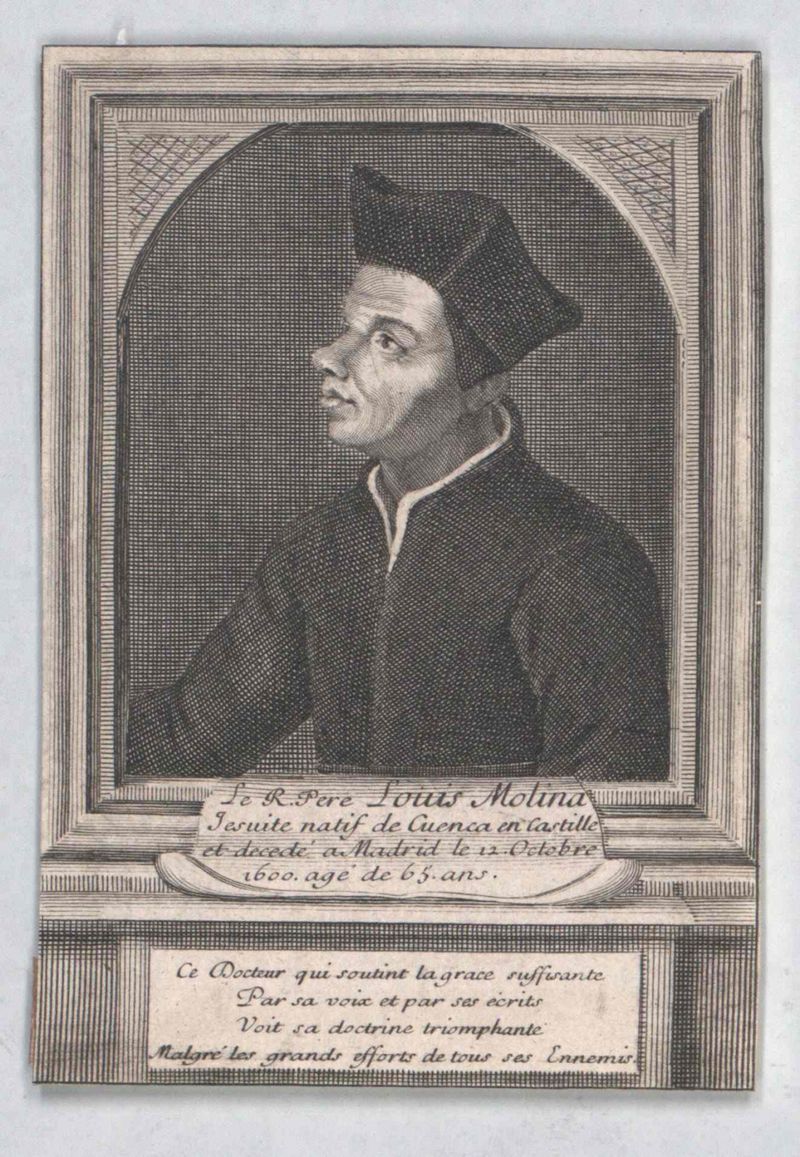
Luis de Molina (1535–1600) was born in Cuenca, Spain, entered the Society of Jesus at the age of eighteen, and spent much of his academic career at the University of Évora in Portugal. He was not a flashy controversialist but a meticulous systematic thinker whose primary concern was reconciling two truths that the Council of Trent (1545–1563) had forcefully reaffirmed: the absolute sovereignty of divine grace and the genuine freedom of the human will.
Trent reaffirmed what Catholic tradition had long held—and what the Protestant Reformers also recognized—that grace is absolutely necessary for salvation: no one can be justified without the prevenient inspiration of the Holy Spirit (Session 6, Canon 3). But against the Reformers, the council also defined that the human will genuinely cooperates with grace and is not merely passive in justification (Session 6, Canon 4). What the council deliberately left unspecified was how grace and freedom interact at the metaphysical level. That question it left to the theologians. Molina took up the invitation.
The Concordia
In 1588, Molina published his magnum opus: Concordia liberi arbitrii cum gratiae donis, divina praescientia, providentia, praedestinatione et reprobatione—in English, The Harmony of Free Will with the Gifts of Grace, Divine Foreknowledge, Providence, Predestination, and Reprobation. The title itself is a program: Molina believed that free will and divine sovereignty are not in tension but in harmony, and that the concept of middle knowledge provides the key to understanding how.
The Concordia provoked an immediate and furious response, particularly from Dominican theologians who saw Molina’s system as an unacceptable departure from the teaching of St. Thomas Aquinas. The controversy that followed—the De Auxiliis debate—would consume Catholic theology for nearly two decades and would be settled only by papal intervention. That intervention, remarkably, declined to settle the substantive theological question. The procedural outcomes were nevertheless significant: the commission established that neither position was heretical, that both schools were free to teach their views, and that mutual censure was prohibited. For an in-depth look at how Molinism addresses the specific biblical questions Paul raises in Romans 9–11, see my treatment of that passage’s predestination themes.
The Three Moments of Divine Knowledge
At the heart of Molinism lies a tripartite distinction in God’s knowledge. Molina did not claim that God’s knowledge occurs in temporal stages—God is eternal and knows all things in a single act—but he argued that we can distinguish three logical moments in God’s knowledge, each with a different object and a different relationship to the divine will.
1. Natural Knowledge (Scientia Naturalis)
The first logical moment is God’s knowledge of all necessary truths and all possibilities. This includes the laws of logic, the essences of all possible creatures, and every possible world that God could create. Natural knowledge is prevolitional—it precedes, in logical order, any act of God’s will. God does not choose what is possible; he simply knows it by knowing his own omnipotence.
For example, God knows that he could create a world containing a free creature named Peter, who could be placed in any number of different circumstances. This knowledge does not depend on any decision God has made; it flows from the divine nature itself.
2. Middle Knowledge (Scientia Media)
The second logical moment—and the distinctive contribution of Molinism—is God’s knowledge of all counterfactuals of creaturely freedom. (The technical term scientia media is often attributed to Molina’s Jesuit colleague Pedro da Fonseca, though scholarly attribution is disputed.) These are truths about what any possible free creature would freely do in any possible set of circumstances. Philosophers call these “subjunctive conditionals of freedom” or, following the contemporary philosopher Alvin Plantinga, “counterfactuals of creaturely freedom.”
Middle knowledge is so called because it stands logically between natural knowledge and free knowledge. Like natural knowledge, it is prevolitional—it does not depend on any decision of God’s will. God does not decide what Peter would freely do if placed in a given set of circumstances; he simply knows it. Yet unlike natural knowledge, it is contingent—the truths it contains could have been otherwise, because they depend on what free creatures would freely choose.
To illustrate: God knows, by middle knowledge, that if Peter were placed in a courtyard on a particular night and questioned about his association with Jesus, Peter would freely deny him three times. This is not a truth that God makes true by willing it, nor is it a merely possible truth (Peter might deny him); it is a truth about what Peter would do. It is a fact about Peter’s free will that God finds, as it were, already there in the logical order prior to his creative decree.
3. Free Knowledge (Scientia Libera)
The third logical moment is God’s knowledge of all actual truths—everything that will in fact happen in the world God has chosen to create. Free knowledge is postvolitional: it depends on God’s creative decree. God surveys, by middle knowledge, the full range of counterfactuals—what every possible creature would do in every possible circumstance—and then, by a free act of his will, chooses to actualize one particular world. His knowledge of what will happen in that world is his free knowledge.
The elegance of this framework lies in the middle moment. By inserting middle knowledge between natural knowledge and the creative decree, Molina provides a mechanism by which God exercises complete sovereign control over the course of history without determining the free choices of creatures. God does not cause Peter to deny him; rather, God knows that Peter would deny him in those circumstances and freely chooses to actualize a world in which those circumstances obtain. The denial is genuinely Peter’s; the providential plan is genuinely God’s. This same framework illuminates difficult biblical passages like 1 Samuel 2:25, where God hardens sinners’ hearts—God’s middle knowledge encompasses what the hardened sinners would freely choose, and God’s decree to harden them operates within this knowledge of their free responses.
How Molinism Reconciles Sovereignty and Freedom
The Molinist reconciliation of sovereignty and freedom can be summarized in three propositions:
-
God’s sovereignty is exhaustive. Nothing happens outside God’s providential plan. Every event, including every free human choice, is part of the world God deliberately chose to create from among all possible worlds.
-
Human freedom is genuine. When a creature makes a free choice, that choice is not determined by any prior cause—not even by God. The creature could have done otherwise in the same circumstances. The Molinist understanding of freedom is what philosophers call libertarian freedom: the ability to do otherwise, all prior conditions being equal.
-
Middle knowledge bridges the gap. God’s exhaustive sovereignty and human libertarian freedom are compatible because God’s providential governance operates through his knowledge of counterfactuals, not through causal determination. God achieves his purposes by selecting a world in which free creatures freely do what God’s plan requires.

God, in the Molinist account, is like a master chess player who knows exactly how his opponent will respond to every possible move—and who therefore achieves checkmate without ever moving his opponent’s pieces. This analogy, while imperfect, captures the essential Molinist insight: God’s control is mediated by knowledge, not by causal force.
The De Auxiliis Controversy
The Dominican Objection
The publication of the Concordia ignited a firestorm. Dominican theologians, led by Domingo Báñez (1528–1604), charged that Molinism effectively made God dependent on creatures for his knowledge—a charge that struck at the heart of divine aseity. If God’s middle knowledge is prevolitional and contingent, then there are truths about the world that God finds rather than makes. This seemed to the Dominicans to compromise divine sovereignty by making God a passive observer of creaturely decisions rather than the first cause of all that exists.
Báñez and his followers defended the Thomistic doctrine of physical premotion (praemotio physica): the view that God, as the first cause, must causally move the human will to act in every free choice. On this account, grace is not merely a sufficient offer that the will may accept or reject; it is an efficacious divine motion that infallibly produces its effect. The will remains free, the Thomists insisted, not because it could have done otherwise under the same divine motion but because it acts voluntarily and without coercion—what contemporary philosophers would call a compatibilist understanding of freedom, as opposed to the Molinist libertarian account.
Both labels carry caveats. “Compatibilist” is a modern philosophical approximation; many Thomists reject it as anachronistic, arguing that the Thomistic framework of primary and secondary causality transcends the modern compatibilism/incompatibilism distinction. “Libertarian” is likewise a modern label that Molina himself did not use; his understanding of freedom operates within a framework of divine concurrence richer than the bare principle of alternative possibilities in contemporary analytic philosophy.
The Molinists fired back that physical premotion was indistinguishable from the Calvinist doctrine of irresistible grace and that it destroyed genuine human freedom by making God the author of sin. If God causally premoves the will to every act, including sinful acts, then God is the ultimate cause of sin—a conclusion both sides agreed was unacceptable.
The Papal Congregations
The debate became so heated that Pope Clement VIII established a formal commission in 1597—the Congregatio de Auxiliis—to adjudicate the dispute. The broader commission met from 1598 to 1607, with some eighty-five formal conferences held in the presence of the popes between 1602 and 1607, hearing arguments from both sides with painstaking thoroughness. Clement VIII died in 1605 without reaching a verdict. His successor, Leo XI, reigned for only twenty-seven days. It fell to Paul V to bring the proceedings to a close.
On September 5, 1607, Paul V issued a decision that was, in effect, a refusal to decide. He declared that neither Molinism nor Bañezianism had been condemned by the Church. Both systems were permitted as legitimate theological opinions. Each side was forbidden to censure the other as heretical. The pope reserved to himself the right to settle the question definitively at a future date—a settlement that has never come.
The De Auxiliis controversy ended not with a verdict but with a truce—and four centuries later, the truce still holds. This papal non-decision is itself theologically significant. It tells us that the Church regards the precise metaphysical mechanism by which grace and freedom interact as a question on which faithful Catholics may legitimately disagree. The deposit of faith includes the truths that grace is necessary, that grace is efficacious, and that human freedom is genuine. It does not include a specification of exactly how these truths cohere at the deepest metaphysical level.
Molinism and Thomism Compared
The debate between Molinism and Thomism is not a dispute over whether God is sovereign or whether humans are free. Both sides affirm both truths. The dispute is over how these truths are reconciled.
| Molinism | Thomism/Bañezianism | |
|---|---|---|
| God’s knowledge of free acts | Through middle knowledge (prevolitional) | Through the divine decree (postvolitional) |
| How grace produces its effect | Through circumstances God selects, knowing the creature’s free response | Through physical premotion that infallibly moves the will |
| Nature of human freedom | Libertarian (ability to do otherwise) | Compatibilist in modern terms (voluntary action without coercion), though many Thomists reject this label |
| Sufficient vs. efficacious grace | Grace is sufficient; efficacy depends on the creature’s free consent | Distinction between sufficient grace (gives power) and efficacious grace (gives both power and act) |
| Risk of error | Molinists risk diminishing God’s causal sovereignty | Thomists risk making God the author of sin |
The strengths of each system mirror the weaknesses of the other. Molinism preserves a robust account of human freedom but faces the so-called “grounding objection”: what makes counterfactuals of creaturely freedom true, if not God’s will and not any existing state of affairs? Thomism preserves a robust account of divine sovereignty but must explain how physical premotion does not destroy freedom or make God responsible for sin. Neither system has answered its critics to universal satisfaction—which is perhaps why the Church has declined to choose between them.
For an overview of how both systems relate to the broader question of predestination, see my post on Catholic vs. Calvinist predestination.
Molinism and Protestant Theology
Molinism originated within Catholic theology and remains anchored by the Church’s magisterial framework. While some Protestants have adopted Molinist ideas, they do so outside the magisterial context in which the system was developed and its boundaries defined.
Molinism and Calvinism
Calvinism shares with Thomism an emphasis on the absolute sovereignty of God over all events, including human choices. The five points of Calvinism—total depravity, unconditional election, limited atonement, irresistible grace, and perseverance of the saints—form a tightly integrated system in which God’s sovereign decree is the ultimate explanation for everything that happens, including who is saved and who is damned.
Molinism differs from Calvinism in several critical respects. First, Molinism affirms libertarian freedom; Calvinism denies it. Second, Molinism holds that God genuinely desires the salvation of all persons (see God Desires All Men To Be Saved); Calvinism, at least in its strict form, restricts God’s saving will to the elect. Third, Molinism rejects double predestination—the view that God positively decrees the damnation of the reprobate—while many Calvinist theologians accept it, at least in a “passing over” (praeteritio) form. Fourth, Molinism holds that Christ died for all persons, not only for the elect, in keeping with the Catholic affirmation of universal redemption.
Despite these differences, Calvinists and Molinists share a conviction that God’s providential plan encompasses every detail of history. The disagreement is over the mechanism: Calvinists hold that God achieves his purposes through efficacious decrees that determine creaturely actions; Molinists hold that God achieves his purposes through his knowledge of what free creatures would do, selecting a world in which they freely carry out his plan.
Molinism and Arminianism
Arminianism, named after the Dutch Reformed theologian Jacob Arminius (1560–1609), arose almost contemporaneously with Molinism and shares some of its concerns. Arminius was likely aware of Molina’s work—recent scholarship increasingly recognizes some degree of influence, though its extent remains debated among historians—and his doctrine of prevenient grace (the idea that God gives all persons sufficient grace to respond freely to the Gospel) has strong affinities with the Molinist account.
However, Arminianism and Molinism diverge on a crucial point. Classical Arminianism holds that God’s foreknowledge of free choices is simple foreknowledge: God simply foresees what will happen in the actual world. Molinism, by contrast, holds that God’s knowledge extends to all possible worlds—to what every creature would do in every possible set of circumstances—and that this richer knowledge is what enables God’s providential governance. Simple foreknowledge, the Molinist argues, comes too late to be of providential use: if God knows what will happen only after the creative decree, he cannot use that knowledge to select which world to create.
Some contemporary Protestant philosophers, particularly the evangelical analytic philosopher William Lane Craig, have adopted Molinism precisely because they find simple foreknowledge insufficient to ground a robust doctrine of providence. Craig’s work has been instrumental in reviving interest in Molinism in the analytic philosophy of religion.
Heterodox Alternatives: Open Theism and Process Theology
It is worth briefly noting two positions that fall outside the bounds of Catholic orthodoxy, in order to clarify what Molinism is not.
Open theism, developed by evangelical theologians like Gregory Boyd and Clark Pinnock (and anticipated by the analytic philosopher Richard Swinburne, whose denial of exhaustive foreknowledge converges with the movement from distinct philosophical premises), holds that the future free actions of creatures are genuinely indeterminate and therefore not objects of knowledge even in principle. Open theists typically frame this as a reinterpretation of omniscience rather than a denial of it: God knows every truth there is to know, they argue, but because the future free actions of creatures are not yet fact, there is nothing there for God to know. The Catholic tradition, however, regards this reframing as incompatible with magisterial teaching. The First Vatican Council defined that God is “infinite in intellect” and that “all things are naked and open to His eyes, even those which by the free action of creatures are in the future” (Dei Filius, Chapter 1)—a teaching that affirms precisely the kind of comprehensive divine foreknowledge open theism redefines away.
Process theology, developed by Alfred North Whitehead and Charles Hartshorne, goes further still, reconceiving God not as the omnipotent creator but as a fellow participant in the ongoing creative process, who influences but does not control the world. Process theology denies both classical omnipotence and classical omniscience. It is incompatible with Catholic teaching at virtually every point and is mentioned here only to mark the outer boundary of the theological spectrum.
Molinism, by contrast, affirms everything that classical theism affirms: God is omniscient, omnipotent, eternal, and sovereign over all creation. Its innovation lies not in revising the divine attributes but in specifying how omniscience operates with respect to free creatures.
The Church’s Official Neutrality
The Catholic Church’s refusal to adjudicate the Molinist-Thomist debate is not a failure of magisterial nerve; it is a deliberate theological judgment. The Church has defined the boundaries of orthodoxy on grace and freedom with considerable precision:
- Grace is absolutely necessary for salvation. No one can merit the initium fidei—the beginning of faith—by natural powers alone (Council of Orange, Canon 5; Trent, Session 6, Canon 3). The Pelagian and Semi-Pelagian positions are condemned.
- Human freedom is genuine. The will cooperates with grace and is not merely passive (Trent, Session 6, Canon 4).
- God genuinely desires the salvation of all persons (1 Timothy 2:4; CCC §851).
- God predestines no one to hell (CCC §1037).
- God positively predestines the elect to grace and glory (praedestinatio ad gloriam; Romans 8:29–30; Ephesians 1:4–5; Trent, Session 6, Canon 17, which presupposes predestination to life while rejecting predestination to evil). The Thomist and Molinist schools disagree on whether this predestination is ante praevisa merita (before foreseen merits) or post praevisa merita (after foreseen merits), but both affirm the reality of divine election. (Most Molinists hold to post praevisa merita, though some notable early Molinists—including Suárez and Bellarmine—defended the ante position.)
Within these boundaries, the Church permits theological schools to propose different accounts of how grace and freedom interact. Molinism and Thomism are both legitimate options. The Augustinian school associated with the Augustinian friars, and the Scotist school associated with the Franciscans, offer still further variations. The Church’s pluralism on this question is not indifference but wisdom: she recognizes that the mystery of grace and freedom exceeds the capacity of any single philosophical system to capture exhaustively.
This official neutrality is sometimes invoked in the context of the broader discussion of the Counter-Reformation, since the De Auxiliis controversy was itself a product of the renewed theological energy that Trent unleashed.
Why This Debate Matters
It would be easy to dismiss the Molinist-Thomist debate as a piece of late-scholastic hair-splitting, a quarrel over abstractions that has no bearing on the life of faith. This would be a mistake.
The question at stake is nothing less than the character of God and the nature of human responsibility. If God causally determines every human choice, including the choice to sin, then in what meaningful sense is sin the creature’s fault? If God does not determine free choices, then in what meaningful sense is he sovereign? How we answer these questions shapes how we understand prayer, moral responsibility, the problem of evil, and the nature of salvation itself.
Molinism offers one answer: God is sovereign because he selects, from among all possible worlds, the one in which free creatures freely carry out his purposes. Thomism offers another: God is sovereign because he is the first cause of every act, including free acts, which he moves from within without destroying their freedom. Both answers have real consequences for how we pray, how we think about suffering, and how we preach the Gospel.
The debate also matters ecumenically. The Molinist framework has proven particularly fruitful in Catholic-Protestant dialogue, because it provides a way to affirm the Reformed emphasis on divine sovereignty while maintaining the Catholic insistence on genuine human freedom and universal salvific will. William Lane Craig, a Protestant philosopher who has done more than anyone in the contemporary era to popularize Molinism, has noted that Molinism occupies a “middle ground” not only logically but ecumenically—a point of contact between traditions that have often talked past each other.
Frequently Asked Questions
Is Molinism official Catholic teaching?
No. Molinism is a permitted theological opinion within the Catholic Church, not a defined doctrine. The Church has declined to choose between Molinism and Thomism, holding that both are legitimate attempts to explain how grace and freedom interact. A Catholic is free to be a Molinist, a Thomist, a Scotist, or an Augustinian on this question, provided that he or she affirms the defined dogmas: the necessity of grace, the reality of human freedom, God’s universal salvific will, and the rejection of double predestination.
What is the “grounding objection” to Molinism?
The grounding objection is the most serious philosophical challenge to Molinism. It asks: what makes counterfactuals of creaturely freedom true? If Peter would freely deny Christ in circumstance C, what grounds that truth? It cannot be grounded in God’s will (since middle knowledge is prevolitional) or in any actual state of affairs (since the circumstances are merely hypothetical). Critics charge that counterfactuals of creaturely freedom are “brute facts” with no metaphysical explanation—a conclusion that many philosophers find unsatisfying. Molinists have responded in various ways: some accept that these truths are primitive and ungrounded; others appeal to the essence or nature of the free creature; still others argue that the demand for a ground reflects an overly restrictive metaphysics.
How does Molinism relate to the problem of evil?
Molinism provides a distinctive response to the problem of evil. If God knows, by middle knowledge, what every free creature would do in every possible circumstance, then God can select a world that achieves his good purposes while respecting creaturely freedom—even though that world contains evil. Alvin Plantinga’s famous “free will defense” against the logical problem of evil draws heavily on Molinist concepts: Plantinga argues that it is possible that every possible world containing free creatures who always choose rightly is one that God cannot actualize, because actualizing it would require overriding the very freedom that makes moral goodness possible. This does not explain why God permits this particular evil, but it shows that the existence of evil is logically compatible with the existence of an omnipotent, omniscient, perfectly good God. For a broader exploration of how divine providence and human freedom shape our understanding of theodicy, see my post on whether everything happens for a reason.
What is scientia media?
Scientia media is the Latin term for “middle knowledge”—the distinctive Molinist claim that God knows what every possible free creature would freely do in every possible set of circumstances. It is called “middle” because it stands logically between God’s natural knowledge (of all necessary truths and possibilities) and God’s free knowledge (of what will actually happen in the world he has chosen to create). The term is often attributed to Molina’s Jesuit colleague Pedro da Fonseca, though scholarly attribution remains disputed.
Can a Protestant be a Molinist?
Yes—and many are. Molinism has enjoyed a remarkable revival among Protestant philosophers and theologians in recent decades, particularly through the work of William Lane Craig and other analytic philosophers of religion. Protestant Molinists typically combine middle knowledge with Protestant convictions about salvation, producing a system that affirms divine sovereignty and human freedom without the Calvinist doctrine of irresistible grace. The Southern Baptist Convention’s 2000 Baptist Faith and Message, while not explicitly Molinist, reflects a broadly Molinist sensibility in its affirmation that “election is consistent with the free agency of man.”
Further Reading
- God Desires All Men To Be Saved — How 1 Timothy 2:4 shapes Catholic soteriology and the doctrine of universal salvific will
- Catholic vs. Calvinist Predestination — A detailed comparison of Catholic and Reformed views of election, grace, and free will
- Pelagianism and Semi-Pelagianism — The heresies that define the boundaries of orthodox teaching on grace
- The Counter-Reformation — The renewal of Catholic theology and practice after the Council of Trent
- Thomas P. Flint, Divine Providence: The Molinist Account (Cornell University Press, 1998) — The standard contemporary philosophical defense of Molinism
- Alfred J. Freddoso, trans., On Divine Foreknowledge (Part IV of the Concordia) by Luis de Molina (Cornell University Press, 1988) — Indispensable English-language gateway to Molina’s primary text
Garrett Ham
Garrett Ham is an attorney, military veteran, and holds a Master of Divinity from Yale Divinity School. He writes from Northwest Arkansas on theology, law, and service.
More about Garrett →Related Posts
Open Theism vs. Molinism: A Catholic Comparison
How do open theism and Molinism differ on divine foreknowledge, human freedom, and providence? A Catholic comparison of two frameworks for understanding God’s knowledge of the future.
Is Molinism Compatible with Thomism?
Molinism and Thomism are the two great Catholic frameworks for reconciling divine sovereignty and human freedom. Are they truly incompatible, or can insights from both traditions be harmonized?
Divine Foreknowledge and Free Will: The Catholic Answer
Can God know the future and humans still be free? The Catholic intellectual tradition offers robust answers through Thomism and Molinism. Here’s how they work and why they matter.
Stay Informed
Get new writing on faith, law, and service delivered to your inbox.
No spam. Unsubscribe anytime.