John 1:6 Meaning Explained: There Came a Man, Sent from God
On This Page
Ἐγένετο ἄνθρωπος, ἀπεσταλμένος παρὰ θεοῦ, ὄνομα αὐτῷ Ἰωάννης.
“There came a man, having been sent from God, whose name was John.”—John 1:6 (author’s translation)
John 1:6 in Three Translations
NABRE: “A man named John was sent from God.”
KJV: “There was a man sent from God, whose name was John.”
ESV: “There was a man sent from God, whose name was John.”
Greek (NA28): Ἐγένετο ἄνθρωπος, ἀπεσταλμένος παρὰ θεοῦ, ὄνομα αὐτῷ Ἰωάννης.
A Shock in the Hymn
The Prologue of the Fourth Gospel (John 1:1–18) is arguably the most theologically compressed passage in the New Testament. For five verses the evangelist sings of realities that precede time itself: the Word who was in the beginning, who was with God, who was God, through whom all things came to be, in whom was life, and whose light shines in a darkness that cannot master it. Then, abruptly, in verse 6, the rhythm breaks. A human name enters the hymn.
Ἐγένετο ἄνθρωπος, ἀπεσταλμένος παρὰ θεοῦ, ὄνομα αὐτῷ Ἰωάννης—“There came a man, having been sent from God, whose name was John.”
The shock is deliberate. John the evangelist has been speaking the cosmic language of eternity, and now, without warning, he writes a sentence that could open any biographical note in the Hebrew Bible: “there came a man.” The contrast is not accidental; it is the engine of the passage’s theology. John 1:6 is a hinge on which the whole Prologue turns—from the timeless being of the Logos to the historical becoming of the witness; from cosmic creation to concrete mission; from the Word by whom all things were made to a named man through whom that Word would be introduced to Israel. Read carefully, the verse does not diminish the Baptist; it defines him. And in defining him, it reveals something about the one who sent him.
“There Came a Man”: The Grammar of a Contrast
Mapping γίνομαι in John 1:1–6
The central literary contrast in the Prologue is between two Greek verbs of existence: εἰμί (“to be”), used exclusively of the Word in verses 1–2, and γίνομαι (“to come to be, become, happen”), used of creation and of John in verses 3–6. A precise mapping of the forms in the critical text (Nestle-Aland 28 / SBLGNT) makes the pattern unmistakable:
Forms of γίνομαι in John 1:3–6
1:3a ἐγένετο aorist middle indicative “came into being”
1:3b ἐγένετο aorist middle indicative “came into being”
1:3c/4 γέγονεν perfect active indicative “has come into being”
1:6 Ἐγένετο aorist middle indicative “there came / came to be”
Four forms of γίνομαι crowd into six verses. Of these, three are aorists and one—γέγονεν at the disputed transition between verses 3 and 4—is a perfect. The distinction is not pedantic. The aorist ἐγένετο views creation as a completed historical event: things came into being at a point in time. The perfect γέγονεν, marked by its characteristic reduplication, emphasizes the enduring result of that act: what came into being continues in being. Raymond Brown, commenting on the shift, observes: “The aorist egeneto shifts to a perfect gegonen, and what came into being becomes what has come into being… the author had in mind a subtle difference in meaning.”1
ἦν and ἐγένετο: A Near-Universal Consensus
Set against this background of things that came to be, the imperfect ἦν of John 1:1–2 describes a mode of existence that simply is not “coming into being” at all. “In the beginning was (ἦν) the Word”—the verb names continuous past existence without origin. The contrast between ἦν and ἐγένετο is not a speculative reading by any one commentator; it is the near-universal consensus of Johannine scholarship. Brown states it plainly: “There can be no speculation about how the Word came to be, for the Word simply was.” Leon Morris writes: “It is fundamental to John that the Word is not to be included among created things.” B. F. Westcott notes of verse 6 that John’s “‘becoming’ is contrasted with the ‘being’ of the Word.” William Hendriksen captures the contrast in a single rhetorical line: “Christ was (ēn) from all eternity; John came (egeneto). Christ is the Word (ho logos); John is a mere man (anthrōpos). Christ is Himself God; John is commissioned by God.”2
The contrast serves a specifically theological purpose. By using ἐγένετο in verse 6—the same verb that verse 3 has just twice applied to “all things”—the evangelist places John the Baptist firmly within the category of the created. He “came into being” in the same linguistic register as the heavens and the earth. He is not the Light (v. 8); he is not the Word; he is not ἐν ἀρχῇ. He is a creature whose existence is itself a gift, granted through the very Logos whose coming he is sent to announce.
The Punctuation of John 1:3–4: Why It Matters Here
Any serious treatment of the γίνομαι chain in John 1:1–6 must reckon with the most debated punctuation question in the New Testament: where the sentence break falls around ὃ γέγονεν. NA28 and UBS5 attach ὃ γέγονεν to verse 4: “What has come into being—in him was life.” This reading is supported by the ante-Nicene fathers, including Irenaeus, Tertullian, and Origen. A second, traditional reading, adopted by the KJV and NIV and by commentators such as Schnackenburg, Barrett, Carson, and Morris, keeps ὃ γέγονεν with verse 3: “without him nothing came into being that has come into being.” Bruce Metzger’s Textual Commentary notes that the shift away from the earlier reading in the fourth century was provoked in part by Arian exploitation of the punctuation to argue that the Holy Spirit was a created being.3
For present purposes the question need not be settled: on either reading, the creative scope of the Logos is total, and on either reading, verse 6 enters as a deliberate counterpoint to the language of created “coming-to-be” that precedes it.
ἀπεσταλμένος παρὰ θεοῦ: Sent from God’s Side
The Perfect Passive Participle
The second participial clause of verse 6—ἀπεσταλμένος παρὰ θεοῦ—is theologically dense in a way that is easily lost in English. Ἀπεσταλμένος is a perfect passive participle of ἀποστέλλω, the verb from which the noun ἀπόστολος (“apostle, one sent”) is built. The perfect tense in Greek carries a force that English has no simple way to reproduce: it denotes a past action whose effects endure into the present. “John has been sent” is not merely an event of his life story; it is his permanent condition. His identity is his mission. There is no John the Baptist who is not, at any moment of the narrative, the one who has been and continues to be sent.
παρά with the Genitive: “From God’s Presence”
The preposition παρά with the genitive case means “from beside” or “from the presence of.” It carries a nuance of personal origin and intimate proximity that a simple “from” can obscure. To be sent παρὰ θεοῦ is to have come, as it were, from God’s very side—personally commissioned, not merely dispatched.
The theological weight of the construction becomes visible when one notices where else in the Fourth Gospel this same phrase appears. Jesus repeatedly speaks of himself as having come παρὰ τοῦ πατρός or παρὰ τοῦ θεοῦ—from the Father (John 6:46; 7:29; 16:27; 17:8). The linguistic parallel between John the Baptist and Jesus as ones “sent from God’s side” is a genuine and striking scholarly observation. As one recent Johannine study puts it, “nobody else in Johannine narrative is described as having been sent by God except Jesus.”4
The point is not that the Baptist is a second Christ. The point is rather that the evangelist’s vocabulary of divine mission links the Baptist to Jesus’s own experience of being sent. John the forerunner comes from God’s presence, as Jesus himself will claim to have come from the Father’s presence; his authority is derivative of that mission, not of his own charisma.
“All Things Came to Be Through Him”: John Among the πάντα
A legitimate theological inference flows from juxtaposing verse 3 with verse 6: “all things came into being through him; without him nothing came into being that came into being” (v. 3); “there came a man” (v. 6). The most natural logical corollary is that John the Baptist is included in the πάντα—the “all things”—that came into being through the Logos. Morris confirms that ἐγένετο in verse 3 “refers not only to what was made at creation, but all things that have come into being throughout history.” The Baptist is thus, in a sense, among the works of the Logos: a creature through whom the Word is about to reveal himself, yet himself fashioned through that same Word.
This inference is rhetorically powerful, but it should be framed with care. The evangelist’s primary point in verse 6 is not that John was made through Christ; it is that John was sent by God. The Christological implication is a legitimate secondary inference, not the verse’s main thrust.
Why the Baptist? The Polemical Horizon of John 1:6–8
A Strange Interruption
One of the most striking features of the Johannine Prologue is the way it pauses mid-hymn to say what the Baptist is not. The evangelist has just reached the soaring claim that the Logos is the life and light of all humanity (vv. 4–5)—and then, almost defensively, he writes: “He was not the Light, but came to bear witness to the Light” (v. 8). Why interrupt a Christological hymn to make a negative claim about another man? The question has only one serious answer: because some of the evangelist’s contemporaries were inclined to think otherwise.
The Evidence for a Baptist Rivalry
The historical evidence for a community of the Baptist’s disciples that posed a continuing theological challenge to early Christianity is substantial and multi-layered. The clearest testimony comes from the New Testament itself. Acts 18:24–19:7 records two encounters in Ephesus—the traditional location of the Johannine community—with followers of the Baptist. Apollos, “an eloquent man, competent in the Scriptures,” required correction from Priscilla and Aquila because he knew only “the baptism of John” (Acts 18:25). Immediately afterward, Paul encountered about twelve “disciples” in Ephesus who had “not even heard that there is a Holy Spirit” and who had received only John’s baptism; Paul re-baptized them in the name of the Lord Jesus (Acts 19:1–7). These passages confirm that Baptist sectarianism persisted well into the 50s and 60s of the first century.5
Later Christian literature extends the picture. The Pseudo-Clementine Recognitions (third–fourth century) portrays the Baptist as the head of a sect of “daily baptizers” and records that one of his disciples argued that “his teacher is greater than Jesus, Moses, and all men, and thus the Christ.” The Mandaean religion, a Gnostic community that survives in small numbers to the present day, venerates the Baptist as its greatest prophet. While the direct historical lineage between Mandaeism and first-century disciples of John is debated, the movement’s enduring high estimation of the Baptist corroborates the persistence of an independent Baptist tradition in Late Antiquity.
Raymond Brown’s Thesis
Raymond Brown was the leading twentieth-century proponent of the thesis that the Fourth Gospel addresses this rivalry directly. In The Community of the Beloved Disciple (1979), Brown identified followers of the Baptist as one of six groups addressed by the Johannine community, categorizing them among the “non-believers” whose claims the Gospel sets out to rebut. The Fourth Gospel’s repeated clarifications—John “was not the Light” (1:8); he denies being the Christ (1:20; 3:28); he must “decrease” while Jesus must “increase” (3:30); he “did no sign” (10:41)—look very much like the kind of sentence a teacher writes when students have drawn the wrong conclusion about an admirable figure.6
Once this polemical horizon is in view, the grammar of verse 6 does more work. To call the Baptist a man who came into being and was sent is, in that context, a precise and pastoral correction: he was not the Light; he was a creature; and his authority—real, divine, from God’s presence—is the authority of a messenger, not of a master.
The Witness Theme: John as μάρτυς
Verse 7 supplies the purpose of verse 6: “This one came for testimony (εἰς μαρτυρίαν), to bear witness concerning the Light, that all might believe through him.” The Synoptic tradition knows the Baptist as ὁ βαπτιστής—“the Baptizer.” The Fourth Gospel does not use that title at all. It knows him simply as the Witness. This transformation is not an accident of vocabulary; it is a theological decision.
The μαρτυρία theme structures the entire Gospel. Köstenberger identifies seven witnesses that the Fourth Gospel marshals in support of Jesus’s claims: the Baptist, Jesus himself, his works, the Father, Scripture, the Spirit, and the disciples. The Baptist stands at the head of this list. His witness has a distinctly forensic or juridical quality that is consistent with the Gospel’s broader “trial motif” (see John 5:31–47; 8:13–18): he is the first legal witness called to testify concerning the identity of the Accused.7
This forensic framing matters for the theological logic of verse 6. The Catechism of the Catholic Church, commenting specifically on John 1:6, places the Baptist’s mission within the Holy Spirit’s preparatory work: “In him, the Holy Spirit concludes his speaking through the prophets” (CCC §719). John is the final prophet of the Old Covenant and the first witness of the New. His testimony is not his own; it is the Spirit’s speech, taking its shape in a human voice.
The Fourth Gospel’s striking preference for μάρτυς over βαπτιστής is precisely the reason the Johannine community cannot be accused of minimizing the Baptist. On the contrary, it magnifies him—not as a rival light, but as the Light’s authoritative witness.
“Whose Name Was John”: Yōḥānān as Theological Coda
Verse 6 ends with a clause that reads in English like a footnote and in Hebrew like a thesis statement: ὄνομα αὐτῷ Ἰωάννης—“his name was John.” “John” is the Greek form of the Hebrew Yōḥānān (יוֹחָנָן), a theophoric name composed of a shortened form of the divine name YHWH and the verbal root ḥnn (“to be gracious”). It means, literally, “YHWH has been gracious,” or more simply, “God is gracious.”
Read against the culmination of the Prologue, this last clause is anything but incidental. In verse 14 the Logos will be described as “full of grace and truth” (πλήρης χάριτος καὶ ἀληθείας); in verse 16 the Church will confess that “from his fullness we have all received, grace upon grace” (χάριν ἀντὶ χάριτος); in verse 17 the Prologue reaches its climax: “the law was given through Moses; grace and truth came to be through Jesus Christ.” The name of the Baptist is a small, brilliant foreshadowing of the Prologue’s climax. Before grace upon grace is announced in the person of the Word made flesh, the evangelist introduces a man whose very name proclaims that God has already been gracious.
A Christian reader who approaches verse 6 in the echo of verse 17 is entitled to hear the name as a structural arc spanning the Prologue: John is, in his very name, the first announcement of the grace that is about to arrive in Jesus Christ. This is not allegory imposed on the text; it is the theological work that theophoric names are designed, in the Hebrew Bible, to do.
The Church Fathers on John 1:6
Why a Human Witness? Chrysostom
John Chrysostom, preaching on the Fourth Gospel in Antioch toward the end of the fourth century, raised precisely the question that the modern reader feels when the Prologue breaks for a human name. If the Word is God, why does he need a witness at all? Chrysostom’s answer is one of the finest pastoral theological sentences in the whole patristic corpus:
“I am God, and the really-Begotten Son of God… I need none to witness to Me; but because I care for the salvation of the many, I have descended to such humility as to commit the witness of Me to a man.”
For Chrysostom, the scandal of a divine Word requiring human witness is not a logical embarrassment but a revelation of divine condescension. God, who needs nothing, chooses to be testified to by a man, because salvation is offered to men. The witness is not for the Word’s sake; it is for ours.8
Augustine: Teacher of Humility and Giver of Exaltation
Augustine returns several times to the shock of John 1:6. In Tractate 2 on John, commenting on the contrast between the cosmic hymn and the human name, he writes: “God has man as a witness—but on account of man: so infirm are we.” The point is not that God requires a creaturely witness but that we require one; the Word accommodates himself to our weakness by sending a man ahead of himself.
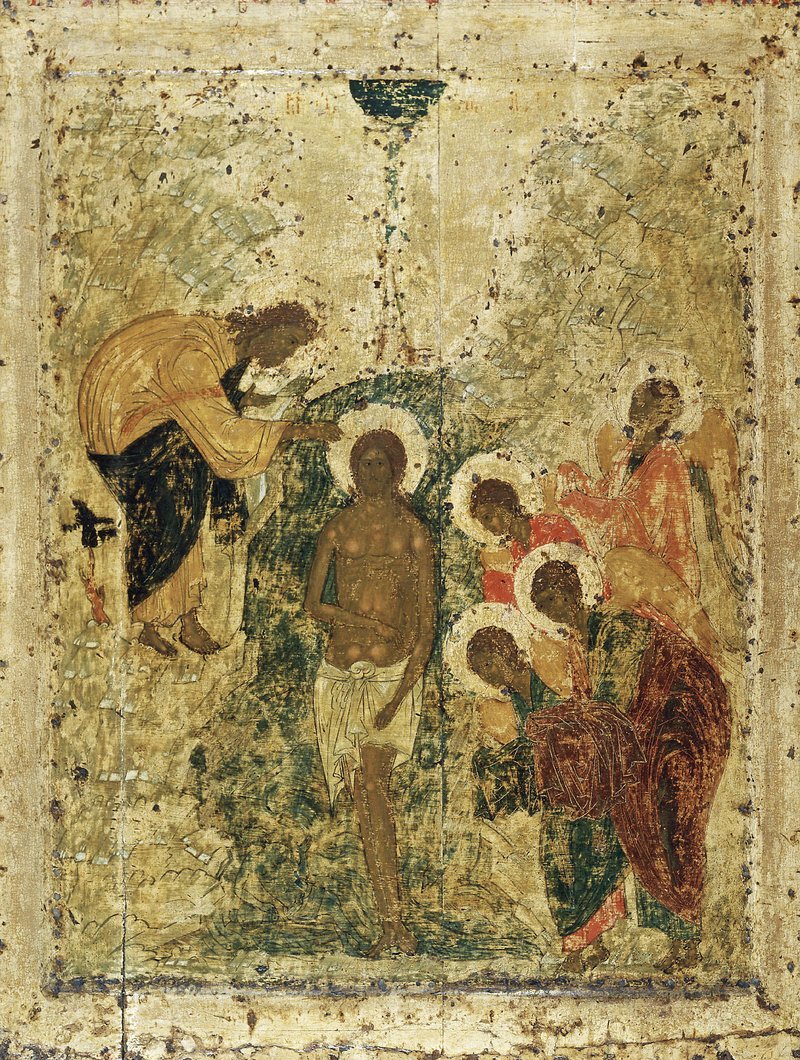
More striking still is a passage from his On Baptism, Against the Donatists, where he describes Christ himself as, at one and the same time, “the humblest among men and believed to be the most high God—at once the teacher of humility and the giver of exaltation.” The phrase is perhaps the most compact patristic expression of the theological paradox that governs the whole Prologue and reaches its narrative apex at the Baptist’s baptism of Jesus: the one who was sent to testify stands in the water while the Word whose existence precedes his own bends his head.9
Origen and Aquinas on “Sending”
Origen, in the second book of his Commentary on the Gospel of John, offers one of the earliest and most philosophically serious reflections on what it means for a prophet to be “sent from God.” His treatment places John 1:6 in the context of the broader biblical theology of apostolē and insists that the sender retains, in the sent one, a form of personal presence.
Thomas Aquinas, in his Super Evangelium S. Ioannis Lectura, treats the Baptist’s mission using his characteristic fourfold Aristotelian causality: efficient cause (God the Father, who sends), material cause (the human witness), formal cause (testimony to the Light), and final cause (that all might believe). Aquinas preserves the Trinitarian delicacy that a Catholic reading of verse 6 requires. The Father sends; the Son, through whom all things were made, is the mission’s ultimate term; the Spirit, in the Baptist, concludes the prophetic word. No Person acts in isolation; all act as the one indivisible God.10
The Humility That Shook the Cosmos: John’s Baptism of the Logos
No reflection on John 1:6 can stop at the verse itself. The one introduced here will reappear in 1:29–34 as the man who baptizes Jesus—the man whose own testimony is that the one coming after him is “before” him because he was before him (1:15, 30). The narrative generates a paradox: the Logos whose eternal ἦν stands behind the creation of John himself accepts baptism from John’s hands.
The Sanctification of the Waters
Ambrose of Milan offers the earliest sustained Latin treatment of the theological problem. His solution is that Christ is baptized not to be cleansed but to cleanse: “Our Lord was baptized because He wished, not to be cleansed, but to cleanse the waters, that, being purified by the flesh of Christ that knew no sin, they might have the virtue of baptism.” Chrysostom reaches the same conclusion in his Homilies on Matthew: Christ was baptized “that He might bequeath the sanctified waters to those who were to be baptized afterwards.” The waters do not purify Christ; Christ purifies the waters.
Cosmic Reversal: Gregory of Nazianzus
Gregory of Nazianzus provides perhaps the most cosmically vivid reading in the Greek tradition. In Oration 39, On the Holy Lights, preached on the feast of Epiphany, he writes:
“Jesus rises from the waters; the world rises with him. The heavens, like Paradise with its flaming sword, closed by Adam for himself and for his descendants, are rent open.”
The Jordan is not merely a location. It is the reversal of the curse of Genesis 3: the waters that once symbolized chaos and judgment become vehicles of grace, and the flaming sword that barred Eden is drawn back. This is cosmic reversal in the strongest sense, and it is triggered precisely by the Logos bending his head to the hand of the man introduced in verse 6.11
The Teacher of Humility
Augustine returns to the baptismal scene repeatedly. In Sermon 136, preaching on John 5, he says simply that Christ “wished to do what He had commanded all to do.” In On Baptism, as already noted, he describes Christ as “the humblest among men” and “believed to be the most high God”—“at once the teacher of humility and the giver of exaltation.” This formulation is the closest the patristic corpus comes to the narrative irony that the Logos who sent a man now submits to that man’s rite.
Doctrinal Precision: Creation, Trinity, and Mission
“Through Whom All Things Were Made”
The Catholic reader who wishes to speak of Christ’s agency in creation must do so with the precision of the Nicene Creed. The Catechism of the Catholic Church affirms that “God created everything by the eternal Word, his beloved Son,” citing John 1:1–3 and Colossians 1:16–17 (CCC §291). But CCC §316 is equally decisive: “Though the work of creation is attributed to the Father in particular, it is equally a truth of faith that the Father, Son and Holy Spirit together are the one, indivisible principle of creation.” The Council of Florence had already insisted: “The Father, the Son and the Holy Spirit are not three principles of creation but one principle.”
The Nicene Creed is theologically surgical. It calls the Father “maker (ποιητήν) of heaven and earth” and says of the Son only “through whom (δι’ οὗ) all things were made.” That preposition δι’ (“through”) is not a stylistic flourish; it preserves the Son’s role as mediating cause while maintaining the Father as source. Aquinas explains in Summa Theologiae I, q. 45, a. 6: “Of the Son it is said ‘Through Him all things were made,’ inasmuch as He has the same power, but from another; for this preposition ‘through’ usually denotes a mediate cause, or a principle from a principle.”12
The pastoral implication is that formulations like “Jesus is the creator” are true in a loose sense but theologically imprecise; the more careful formulation—and the one that tracks both the Creed and the Catechism—is that the Son is “the one through whom all things were made.” To say “John the Baptist exists because of the Word’s creative mediation” is to say something perfectly orthodox. To say “Jesus is the creator” is to risk a confusion that the Creed is carefully constructed to avoid.
Who Sends John? The Grammar of the Missions
A related precision concerns the question: “Who sends John?” CCC §523 identifies John as “the Lord’s immediate precursor or forerunner, sent to prepare his way,” but does not specify the Sender. CCC §§717–720 attribute his prophetic ministry to the Holy Spirit: “In him, the Holy Spirit concludes his speaking through the prophets.” And in Scripture the sending of prophets is consistently attributed to God the Father.
Catholic Trinitarian theology affirms that all external divine works (opera ad extra) are common to all three Persons. Nevertheless, specific missions are “appropriated” to specific Persons according to the distinctive personal property of each. Creation and sending are typically appropriated to the Father as the font of the Godhead; the Son has his proper missio in the Incarnation (CCC §§258, 422, 430); the Spirit is the one in whom the prophets speak.
The doctrinally precise formulation is this: the Word through whom all things were made—the same Word who would become incarnate as Jesus—was already at work in the divine act by which John was sent. The Father sends; the Son is the Word in whom the mission takes its eternal shape; the Spirit is its power. When the Logos, now incarnate as Jesus, descends into the Jordan, the paradox is sharpened but not fractured: the one toward whom John’s mission was ordered now honors the mission by receiving it. There is no rupture in the Trinity; there is only the ordered beauty of a single divine act unfolding in time.
Christ’s Baptism in the Catechism
The Catechism’s treatment of the baptism of Jesus is where a Catholic reading of John 1:6 finds its firmest ground. CCC §536 describes the baptism as “the acceptance and inauguration of his mission as God’s suffering Servant.” Christ “allows himself to be numbered among sinners” and submits “entirely to his Father’s will,” so that in his descent “the waters were sanctified… a prelude to the new creation.” CCC §1224 adds: “Jesus’ gesture is a manifestation of his self-emptying (kenosis).”13
The emphasis on voluntary condescension, identification with sinners, and the paradox of the sinless one receiving a baptism of repentance is precisely the theological territory that John 1:6 opens up. To see the Baptist in verse 6 as “sent from God’s side” is already to anticipate the moment in 1:29–34 when the Lamb of God walks into the water—voluntarily, obediently, and as the very one whose eternal “was” the evangelist has already proclaimed.
The Man Through Whom the Word Began to Speak
John 1:6 is the Fourth Gospel’s most concise theological formula. A single verse performs four distinct operations: it breaks the Prologue’s cosmic rhythm with a human name; it places John the Baptist firmly within the order of created things through the same verb (ἐγένετο) used of all creation in verse 3; it names his mission as divine commissioning (ἀπεσταλμένος παρὰ θεοῦ) in a phrase that elsewhere in this Gospel belongs to Jesus alone; and it discloses, in the theophoric meaning of “John,” that grace has already begun its descent. The man whose name means “God is gracious” stands on the threshold of a Gospel that will announce “grace upon grace” in the person of the Word made flesh.
For a Catholic reader, the verse is at once a piece of fine Greek literature and a hinge of doctrine. It is the first place where the Prologue allows history into the hymn. It is the place where the Gospel begins to defend itself against a rival Baptist claim by reframing the Baptist as witness, not light. It is the place where the Catechism’s careful language about sending, creation, and kenotic humility meets its exegetical ground. And it is the place where the paradox that will shape the rest of John 1 is first set in motion: the eternal ἦν of the Word stands behind, and beneath, the historical ἐγένετο of the man who is about to pour water on his head.
What the verse finally teaches is that the whole Christian life can fit inside the category of verse 6. Every Christian is, like John, a creature who came into being through the Word. Every Christian is sent. Every Christian is a witness to a Light that is not his own. And every Christian, facing the paradox of grace, must learn what Augustine learned: that the Lord is at once “the teacher of humility and the giver of exaltation.”
There came a man, sent from God, whose name was John. And there comes now, in every baptized reader, another such man or woman—named for grace, sent from God’s side, bearing witness to the Light that shines in the darkness and that the darkness has not overcome.
If you are following this series through John’s Prologue, the previous posts explore John 1:1 and the grammar of divine identity, John 1:2 and the structural safeguard against Modalism and polytheism, John 1:3–4 on the Creator who became the light, and John 1:5 on the light that shines in the darkness and the double meaning of κατέλαβεν. You may also find it helpful to read the reflections on the Council of Nicaea and the Council of Chalcedon, which trace the Christological grammar this series draws upon.
Study & Reflection Questions
These questions are designed for personal study, small group discussion, or Bible study preparation.
-
The verb ἐγένετο (“came into being”) is used both of all creation in verse 3 and of John the Baptist in verse 6. What does it mean to recognize that the one sent to announce the Word is himself a creature of the Word? How does this shape your understanding of Christian witness?
-
The perfect participle ἀπεσταλμένος (“having been sent”) implies that John’s mission is not an episode but his permanent identity. In what sense is every baptized Christian also permanently “sent”? How does your own sense of mission compare to this grammar?
-
Chrysostom says that God, who “needs none to witness to Me,” nevertheless chose to be testified to by a man. Why would an all-sufficient God choose to work through human witnesses? What does this say about how God regards human beings?
-
The name “John” (Yōḥānān) means “God is gracious.” Read the Prologue from verse 6 through verse 17 and notice how the theme of grace builds. How does the Baptist’s name function as a foreshadowing of “grace upon grace”?
-
The Fathers describe Christ’s baptism as a moment when the sinless one received a baptism of repentance—not to be cleansed, but to cleanse the waters. How does the paradox of the Creator submitting to a creature’s rite illuminate the meaning of humility in the Christian life?
-
Raymond Brown argues that the Fourth Gospel’s repeated insistence that the Baptist “was not the Light” reflects a real historical rivalry with Baptist disciples. What does it mean for Scripture to address a specific pastoral problem of its own time? Does this make it less “timeless,” or more?
-
The verse teaches that every Christian is, like John, a creature sent to bear witness to a Light not their own. Where in your own life are you tempted to make yourself the light rather than pointing to it?
What Does John 1:6 Mean?
John 1:6 introduces John the Baptist into the Prologue’s cosmic hymn with a verb (ἐγένετο, “there came”) that deliberately places him in the category of the created. The verse identifies his mission as a divine commission (ἀπεσταλμένος παρὰ θεοῦ, “sent from God’s side”) using a phrase that elsewhere in the Fourth Gospel belongs to Jesus alone, and closes with the theophoric name “John” (“God is gracious”)—a foreshadowing of the Prologue’s climactic announcement of “grace upon grace” in the Word made flesh. The verse functions as a hinge between the timeless being of the Logos and the historical becoming of his witness, and it addresses a real first-century rivalry with disciples of the Baptist by reframing him as the Light’s authoritative witness rather than a rival light.
Frequently Asked Questions
What does John 1:6 mean?
John 1:6 introduces the Baptist into the Prologue’s cosmic hymn by calling him a “man” who “came into being” (ἐγένετο)—the same verb used of all creation in verse 3—and who was “sent from God’s side” (ἀπεσταλμένος παρὰ θεοῦ). The verse places the Baptist firmly in the category of the created, defines his identity as his God-given mission, and, through his theophoric name (“God is gracious”), foreshadows the grace that the Prologue will announce in the person of the Word made flesh.
Why does John use ἐγένετο instead of ἦν for the Baptist?
The imperfect ἦν (“was”) is used exclusively of the eternal Word in verses 1–2, while ἐγένετο (“came into being”) is used of creation and of the Baptist. This contrast is the near-universal consensus of Johannine scholarship. The Word was from all eternity; John the Baptist came into being at a point in time. The grammar makes the theological point: the Baptist is a creature; the Word is not.
What does ἀπεσταλμένος παρὰ θεοῦ mean?
Ἀπεσταλμένος is a perfect passive participle of ἀποστέλλω (“to send”), the root of “apostle.” The perfect tense denotes a past action whose effects endure: John’s mission is his permanent condition, not a passing episode. The preposition παρά with the genitive means “from beside” or “from the presence of”—implying personal commissioning from God’s very side, not merely being dispatched.
Why does the Prologue interrupt its hymn to introduce John the Baptist?
The interruption addresses a historical reality: communities of the Baptist’s disciples persisted into the late first century and may have elevated him to a messianic status. Acts 18:24–19:7 records encounters in Ephesus with followers who knew only “the baptism of John.” Raymond Brown argues that the Fourth Gospel’s repeated clarifications—“he was not the Light” (1:8)—are pastoral corrections aimed at this rivalry.
What does the name “John” mean?
“John” is the Greek form of the Hebrew Yōḥānān, meaning “YHWH has been gracious” or “God is gracious.” It is a theophoric name—a name that carries the divine name within it. In the Prologue’s structure, this meaning foreshadows the climactic announcement of “grace upon grace” (v. 16) and “grace and truth came to be through Jesus Christ” (v. 17).
Why do the Church Fathers say Christ was baptized by John?
The patristic consensus is that Christ was baptized not to be cleansed but to cleanse. Ambrose says Christ wished “not to be cleansed, but to cleanse the waters.” Gregory of Nazianzus reads the baptism as a cosmic reversal of the curse of Genesis 3. Augustine describes Christ as “the teacher of humility and the giver of exaltation”—the sinless one who freely submitted to a rite of repentance to sanctify the waters for all who would follow.
What is the “trial motif” in John’s Gospel?
The Fourth Gospel frames Jesus’s public ministry as a cosmic trial in which witnesses are called to testify to his identity. The Baptist is the first witness called. This forensic or juridical framework, identified by scholars like Andrew Lincoln, runs through the Gospel (see John 5:31–47; 8:13–18) and explains why the Fourth Gospel calls the Baptist “the witness” rather than “the baptizer.”
For Further Study: Commentaries and Sources
- Raymond E. Brown, The Gospel According to John I–XII, Anchor Bible 29 (New York: Doubleday, 1966), pp. 6–37—the standard critical commentary on the Fourth Gospel; indispensable for any serious study of the Prologue.
- Raymond E. Brown, The Community of the Beloved Disciple (New York: Paulist, 1979)—the landmark study of the Johannine community and the groups it addressed, including followers of the Baptist.
- C. K. Barrett, The Gospel According to St John, 2nd ed. (London: SPCK, 1978)—concise, exegetically rigorous, and especially strong on the Greek text.
- Craig S. Keener, The Gospel of John: A Commentary, 2 vols. (Peabody: Hendrickson, 2003)—the most comprehensive recent commentary; encyclopedic on historical and cultural background.
- Andreas J. Köstenberger, John, Baker Exegetical Commentary on the New Testament (Grand Rapids: Baker Academic, 2004)—especially strong on the μαρτυρία theme and the seven witnesses of the Fourth Gospel.
- Leon Morris, The Gospel According to John, rev. ed., New International Commentary on the New Testament (Grand Rapids: Eerdmans, 1995)—a careful evangelical commentary with detailed attention to the ἦν/ἐγένετο contrast.
- Andrew T. Lincoln, Truth on Trial: The Lawsuit Motif in the Fourth Gospel (Peabody: Hendrickson, 2000)—the definitive treatment of the forensic/trial framework that gives the Baptist his role as witness.
- Francis Martin and William M. Wright IV, The Gospel of John, Catholic Commentary on Sacred Scripture (Grand Rapids: Baker Academic, 2015)—a major Catholic commentary attentive to the liturgical and doctrinal dimensions of the text.
- St. John Chrysostom, Homilies on the Gospel of John, Homily 6 (on John 1:6–8)
- St. Augustine, Tractates on the Gospel of John, Tractate 2
- St. Thomas Aquinas, Catena Aurea on John 1—Aquinas’s chain of patristic commentary, organizing the Church Fathers into a single continuous gloss.
- Catechism of the Catholic Church, §§456–478 (on the Incarnation), §§535–537 (on Christ’s baptism), §§717–720 (on the Baptist and the Holy Spirit)
Footnotes
1. Raymond E. Brown, The Gospel According to John I–XII, Anchor Bible 29 (New York: Doubleday, 1966), pp. 6–7. On the aspectual distinction between the aorist and perfect in John’s Prologue, see also Stanley E. Porter, Verbal Aspect in the Greek of the New Testament (New York: Peter Lang, 1989), and Daniel B. Wallace, Greek Grammar Beyond the Basics (Grand Rapids: Zondervan, 1996).
2. Brown, Gospel According to John, p. 8; Leon Morris, The Gospel According to John, rev. ed. (Grand Rapids: Eerdmans, 1995), on John 1:1; B. F. Westcott, The Gospel According to St. John (London: John Murray, 1908), on John 1:6; William Hendriksen, Exposition of the Gospel According to John (Grand Rapids: Baker, 1953), on John 1:6.
3. Bruce M. Metzger, A Textual Commentary on the Greek New Testament, 2nd ed. (Stuttgart: Deutsche Bibelgesellschaft, 1994), pp. 167–168. For a fuller discussion of the punctuation debate and its theological implications, see the treatment in the John 1:3–4 post in this series.
4. Hendrik J. M. Van Deventer, “John 1:6 Reconsidered: A Johannine Parallel Between John the Baptist and Jesus,” Pharos Journal of Theology 102 (2021): 1–12. The parallel has also been noted by Craig S. Keener, The Gospel of John: A Commentary (Peabody: Hendrickson, 2003), on John 1:6.
5. On the evidence for a continuing Baptist movement, see Joseph A. Fitzmyer, The Acts of the Apostles, Anchor Bible 31 (New York: Doubleday, 1998), on Acts 18:24–19:7; Martin Hengel, The Johannine Question (Philadelphia: Trinity Press International, 1989); and Edmondo Lupieri, The Mandaeans: The Last Gnostics (Grand Rapids: Eerdmans, 2002).
6. Raymond E. Brown, The Community of the Beloved Disciple (New York: Paulist, 1979), pp. 69–71. Brown further argued that the Johannine community itself included former disciples of the Baptist, perhaps including the Beloved Disciple himself, who is introduced in John 1:35–42 as a former follower of John.
7. Andreas J. Köstenberger, John, BECNT (Grand Rapids: Baker Academic, 2004), pp. 32–35. On the “trial motif” of the Fourth Gospel, see Andrew T. Lincoln, Truth on Trial: The Lawsuit Motif in the Fourth Gospel (Peabody: Hendrickson, 2000).
8. St. John Chrysostom, Homilies on the Gospel of John, Homily 6, on John 1:6–8. Text: New Advent.
9. Augustine, Tractates on the Gospel of John, Tractate 2. Text: New Advent. The “teacher of humility and giver of exaltation” formulation appears in On Baptism, Against the Donatists, Book V. Text: NPNF1 4.
10. Thomas Aquinas, Super Evangelium S. Ioannis Lectura, on John 1:6–8. English translation: James A. Weisheipl and Fabian R. Larcher (Washington, DC: Catholic University of America Press, 2010). For Aquinas’s Trinitarian theology of missions more broadly, see Gilles Emery, The Trinitarian Theology of Saint Thomas Aquinas (Oxford: Oxford University Press, 2007).
11. Gregory of Nazianzus, Oration 39, On the Holy Lights, §16. Translation: Nonna Verna Harrison, Festal Orations, Popular Patristics Series 36 (Crestwood, NY: St. Vladimir’s Seminary Press, 2008). On the sanctification of the waters, see Ambrose, Expositio Evangelii secundum Lucam (CCSL 14), and Chrysostom, Homilies on Matthew, Homily 12.
12. Thomas Aquinas, Summa Theologiae I, q. 45, a. 6. The Council of Florence’s decree for the Copts (1442) is found in Denzinger-Hünermann, Enchiridion Symbolorum, 43rd ed. (San Francisco: Ignatius, 2012), §1331. On Nicene Trinitarian theology more broadly, see Lewis Ayres, Nicaea and Its Legacy (Oxford: Oxford University Press, 2004).
13. Catechism of the Catholic Church, §§535–537, 1224. Vatican.va.

Garrett Ham
Garrett Ham is an attorney, military veteran, and holds a Master of Divinity from Yale Divinity School. He writes from Northwest Arkansas on theology, law, and service.
More about Garrett →Related Posts
John 1:5 Meaning Explained: The Light Shines in the Darkness
What does John 1:5 mean? A study of the Greek—the present tense of φαίνει, the double meaning of κατέλαβεν, and the already/not yet of eschatology.
John 1:3–4 Meaning Explained: The Creator Who Became the Light
What do John 1:3–4 mean in the Gospel of John? A close reading in the original Greek — the punctuation of ὃ γέγονεν, Incarnation as life in the Word, and Chalcedonian Christology.
John 1:2 Meaning Explained: This One Was in the Beginning with God
What does John 1:2 mean? A close reading in the original Greek — why the repetition guards against Modalism and polytheism, and what it reveals about God.
Stay Informed
Get new writing on faith, law, and service delivered to your inbox.
No spam. Unsubscribe anytime.