John 1:3–4 Meaning Explained: The Creator Who Became the Light
On This Page
πάντα δι’ αὐτοῦ ἐγένετο, καὶ χωρὶς αὐτοῦ ἐγένετο οὐδὲ ἕν. ὃ γέγονεν ἐν αὐτῷ ζωὴ ἦν, καὶ ἡ ζωὴ ἦν τὸ φῶς τῶν ἀνθρώπων·
“All things were made through him, and apart from him not one thing was made. What was made in him was life, and that life was the light of men.”—John 1:3–4 (author’s translation)
John 1:3–4 in Three Translations
NABRE: “All things came to be through him, and without him nothing came to be. What came to be through him was life, and this life was the light of the human race.” (with footnote acknowledging alternative punctuation)
KJV: “All things were made by him; and without him was not any thing made that was made. In him was life; and the life was the light of men.”
ESV: “All things were made through him, and without him was not any thing made that was made. In him was life, and the life was the light of men.”
Greek (NA28): πάντα δι’ αὐτοῦ ἐγένετο, καὶ χωρὶς αὐτοῦ ἐγένετο οὐδὲ ἕν. ὃ γέγονεν ἐν αὐτῷ ζωὴ ἦν, καὶ ἡ ζωὴ ἦν τὸ φῶς τῶν ἀνθρώπων.
What Does John 1:3 Mean?
Any serious commentary on the Gospel of John 1:3–4 must begin with the Prologue’s declaration of total creative agency. Having established that the Word was God and was with God before all things (John 1:1), and that this same Word—“this one,” οὗτος—was in the beginning with God (John 1:2), John now turns to what the Word did: πάντα δι’ αὐτοῦ ἐγένετο—“all things were made through him.”
The Greek repays careful attention. The verb ἐγένετο (from γίνομαι, “to come into being” or “to be made”) is in the aorist tense—here indicating a simple past action.1 The contrast with the imperfect ἦν (“was”) that has dominated verses 1 and 2 is deliberate. The Word was—continuously, eternally—but all things came into being at a point. The Word exists on one side of a line, and everything else exists on the other. John is drawing the Creator-creature distinction with absolute clarity.2
And then, as if to eliminate any possible exception, he restates it from the negative side: καὶ χωρὶς αὐτοῦ ἐγένετο οὐδὲ ἕν—“and apart from him not even one thing was made.” The double formulation is not redundancy. It is comprehensiveness. The positive statement (“all things through him”) is sealed by the negative (“not one thing apart from him”). There is no third category. There is the Creator, and there is everything else.
This carries an implication that John almost certainly intends: if nothing that was made was made apart from the Word, then the Word himself was not made. He does not belong to the category of things that came into being. He belongs to the category of the One through whom they came into being. The Nicene Creed would formalize this logic three centuries later—γεννηθέντα, οὐ ποιηθέντα, “begotten, not made”—but the logic is already here in the Prologue.3
The Preposition δι’ (Through)
A question arises in some translations: should we say “through him” or “by him”? The Greek preposition is διά with the genitive (δι’ αὐτοῦ), which most naturally indicates instrumentality or agency—“through.” Some readers worry that “through” makes the Word a mere instrument, as if the Father alone is the true Creator and the Word is only a tool. But this misreads the grammar and the theology.4
In Johannine and Pauline usage alike, διά with the genitive indicates the active agent through whom something is accomplished. Paul uses the same construction in 1 Corinthians 8:6: “one Lord, Jesus Christ, through whom (δι’ οὗ) all things exist.” The preposition does not diminish the Word’s creative role; it specifies the relational character of that role within the Trinity. The Father creates through the Word—not because the Word is a lesser agent, but because the act of creation is itself a Trinitarian act. As the Council of Nicaea confessed: “through him all things were made” is a confession of divinity, not a qualification of it.5
A Question of Where to Place the Period: The ὃ γέγονεν Problem
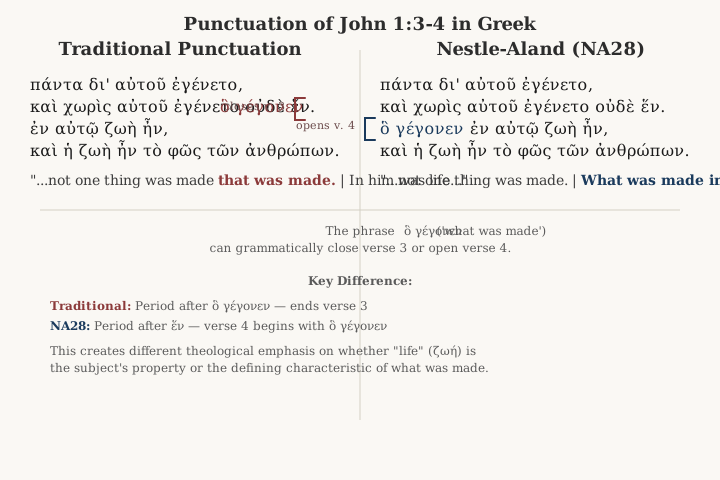
The proper translation and interpretation of John 1:3b–4a depends, in large part, on where to place a period. Since there were no punctuation marks in the original manuscripts—or even spaces between words, or lowercase letters—questions of punctuation are always questions of translation and interpretation.
Here, the crux is the phrase ὃ γέγονεν—“what was made” or “what came into being.” Where does it belong? Does it close verse 3, or open verse 4?
The Traditional Punctuation
If we follow the punctuation reflected in most English translations and in the Catholic Church’s official Latin Nova Vulgata, the period falls after ὃ γέγονεν, and verse 3 reads as a complete, self-contained declaration:
All things were made through him, and apart from him not one thing was made that was made. [Period.] In him was life, and that life was the light of men.
On this reading, ὃ γέγονεν is a relative clause that closes verse 3—“not one thing was made that was made.” It functions as a final emphatic repetition. Verse 4 then opens with a fresh thought: ἐν αὐτῷ ζωὴ ἦν—“in him was life.”
This is the reading adopted by the King James Version, the Douay-Rheims, the RSV, the ESV, the NASB, and virtually every major English translation. It is also the reading that became standard in the fourth century, when—as Bruce Metzger notes in his Textual Commentary on the Greek New Testament—orthodox writers preferred it in part because it removed a phrase that Arian and Macedonian heretics had exploited to argue that the Holy Spirit was a created being.6
The Nestle-Aland Punctuation
But another ancient reading—attested in some of the oldest manuscripts and cited by several Ante-Nicene Fathers—carries ὃ γέγονεν forward into verse 4, creating what scholars call “staircase parallelism”:
All things were made through him, and apart from him not one thing was made. [Period.] What was made in him was life, and that life was the light of men.
This is the punctuation adopted by the Nestle-Aland critical text (NA28) and the United Bible Societies’ Greek New Testament. It is also the reading reflected in the footnote of the New American Bible Revised Edition—the Bible used in American Catholic liturgy—which explicitly acknowledges that “the oldest manuscripts have no punctuation” and that some ancient witnesses take ὃ γέγονεν with what follows.7
The staircase pattern is unmistakable once you see it. The end of one clause becomes the beginning of the next, building like steps:8
- …and the Word was with God,
- and the Word was God.
- This one was in the beginning with God.
- All things were made through him,
- and apart from him not one thing was made.
- What was made in him was life,
- and that life was the light of men.
A majority of the editors of the Nestle-Aland text were persuaded by this rhythmic pattern, and by the consensus of ante-Nicene writers—orthodox and heterodox alike—who took ὃ γέγονεν with what follows. The Church has not dogmatically settled the question. Both readings remain live options within orthodox interpretation.

Translation Comparison
| Translation | Year | Punctuation | Rendering of ὃ γέγονεν |
|---|---|---|---|
| Douay-Rheims† | 1582 | Traditional | “…was made that was made. In him was life.” |
| KJV† | 1611 | Traditional | “…was not any thing made that was made. In him was life.” |
| RSV-CE | 1966 | Traditional | “…was not anything made that was made. In him was life.” |
| NAB (1970) | 1970 | Nestle-Aland | “…not a thing came to be. What came to be through him was life.” |
| NABRE | 2011 | Traditional (with NA footnote) | “…nothing came to be. [fn: Some ancient witnesses read with v. 4.]” |
| ESV | 2001 | Traditional | “…was not any thing made that was made. In him was life.” |
| NRSV | 1989 | Traditional (with NA footnote) | “…not one thing came into being. [fn: Or was not anything made. That which has been made was life in him.]” |
| NA28 (Greek) | 2012 | Nestle-Aland | ὃ γέγονεν taken with v. 4 |
† The Douay-Rheims text quoted here reflects the Challoner revision (1749–1752), which is the version in common use today; the 1582 original used more heavily Latinate phrasing. Similarly, the KJV text reflects the standard edition (effectively the 1769 revision by Benjamin Blayney), not the 1611 first printing, which differs in spelling and typography.
Why It Matters
The traditional reading presents two sequential thoughts: first, the cosmic creative agency of the Word, and then the life that dwells within him. The Nestle-Aland reading links them: out of all that was made through him, the particular thing made in him was life itself—a life that would become the light of humanity.
I find myself drawn to the Nestle-Aland construal, not merely for aesthetic reasons, but because it generates a richer theological unity between the two verses. And yet sitting with that reading carefully, it raises a question that takes us directly into the deepest waters of Christology.
What Was Made in Him: Life, Incarnation, and the Logic of John’s Prologue
If we follow the reading “what was made in him was life,” we must ask: what kind of life? And what does it mean to say something was “made in” the eternal Word?
We have already established that the Word stands on the Creator side of the Creator-creature divide—begotten, not made. And yet John says something was made in him. This is the paradox the evangelist is setting up, and I think it is intentional.
The life that was “made in him” cannot refer to the divine life—the life that belongs to God from eternity, the very life that the Word shares with the Father before all worlds. That life was never made; it always was. What, then, was made in him?
The Incarnation.
When John writes that the life made in the Word became the light of men, I believe he is pointing forward to what he will describe in verse 14: καὶ ὁ λόγος σὰρξ ἐγένετο—“and the Word became flesh.” The light that illumines every human being (verse 9) is not an abstract divine radiance but the concrete human life assumed by the Son of God in the womb of Mary. The life made in him is the human nature he took upon himself—the creaturely existence that began in time, that had a birth, a mother, a body, a death.
This is, of course, a startling thing to say. The eternal Creator took on something new. Something came into being in him that had not before existed.
Creator and Creature: The Chalcedonian Grammar
Here we must be precise, because the precision matters.
The one who became flesh—the Person, the eternal Son—did not change. He did not cease to be what he had always been. As the Council of Chalcedon confessed in 451, Christ is “perfect in divinity and perfect in humanity,” his two natures united “without confusion, without change, without division, without separation”—ἀσυγχύτως, ἀτρέπτως, ἀδιαιρέτως, ἀχωρίστως. Four Greek adverbs that have served as the grammar of orthodox Christology ever since.9
What began in time was not the divine Person, but the human nature: conceived by the Holy Spirit, born of the Virgin Mary. That created humanity—that genuine human life with its birth, its hunger, its grief, its death—was assumed by the eternal Son and made his own. The eternal became the subject of a temporal existence without ceasing to be eternal. The uncreated became the bearer of a created nature without ceasing to be uncreated. As the Catechism of the Catholic Church summarizes: “The unique and altogether singular event of the Incarnation of the Son of God does not mean that Jesus Christ is part God and part man, nor does it imply that he is the result of a confused mixture of the divine and the human. He became truly man while remaining truly God” (CCC §464).10
St. Athanasius, writing in De Incarnatione, describes the Word as forming his own body from the Virgin—since he who made that body was the Maker of all else—while insisting equally that the Word remained what he always was, unchanged in his divine nature. The Creator caused a human nature to exist and took it up into the unity of his divine Person. This is not self-annihilation. It is something stranger and more wonderful: the infinite containing the finite without ceasing to be infinite.11
The language of paradox is unavoidable here, and John himself seems to invite it. But paradox is not contradiction. The mystery of the Incarnation is not that God contradicts himself, but that the categories available to us—mutability and immutability, creator and creature, beginning and eternity—cannot, taken singly, contain what happened. The Son is genuinely eternal and genuinely had a birth. He is genuinely the Creator and genuinely became a creature. Both are true. Neither cancels the other. What holds them together is a reality that exceeds our comprehension but does not assault our reason. And the history of the Church’s attempts to articulate this paradox—from the five heresies that misread John 1 to the definitive settlement at Chalcedon—demonstrates that only the full Chalcedonian grammar can hold the Creator-creature distinction of John 1:3–4 together with the Incarnation of John 1:14.
Thomas Aquinas, in the Summa Theologiae, frames it with characteristic economy: the mystery of the Incarnation was not completed through God being changed, but through his having united himself to the creature in a new way. What is new is the created union, the created human nature assumed by the eternal Person. God himself remains what he always was—wholly, immutably God. And yet something genuinely new has occurred in history. Both are true.12
What Does John 1:4 Mean? The Life That Became the Light of Men
Return now to John’s verse. “What was made in him was life, and that life was the light of men.”
The Incarnation is the light of men. Not merely a metaphor for illumination. The life itself—the human life taken on by the eternal Son—is the light. John will say it directly later in the Gospel: “I am the light of the world” (8:12). And again: “I am the way, the truth, and the life” (14:6).
As St. John Chrysostom observed in his homilies on the Prologue, the life and light that the Word brings are not abstract attributes but personal realities—the very person of Christ entering the human condition to transform it from within.13 This means that the salvation John is announcing is not primarily a transaction conducted at a distance. It is not God solving humanity’s problem from outside the problem. It is God entering the problem from within—taking on our nature, living our life, suffering our death—in order to heal from within what could not be fixed from without. Gregory of Nazianzus, the fourth-century theologian, formulated the principle that has anchored Christian soteriology ever since: τὸ γὰρ ἀπρόσληπτον, ἀθεράπευτον—“that which he has not assumed, he has not healed” (Epistle 101). The assumption of human nature is not incidental to salvation; it is the beginning of salvation.14
Nor did the Son assume a sanitized or idealized humanity. He took on our nature as it is: mortal, suffering, subject to the full weight of what sin has done to the human condition—though without sinning himself. He entered the darkness fully, without becoming the darkness. He bore the death that our rebellion against God had introduced into the world, though he himself had no debt to death. And in rising from that death, he broke its power—not by avoiding it, but by passing through it and coming out the other side.
This is what John means by “the light of men.” Not mere illumination or enlightenment only, but liberation.
The Paradox as Invitation
So what are we to do with all of this?
John’s Prologue is designed to unsettle us in a productive way. He begins with language borrowed from the opening of Genesis—ἐν ἀρχῇ, “in the beginning”—and immediately establishes that the one through whom all things were made existed before “the beginning.” He layers paradox upon paradox: the Word is God, and the Word is with God. The Creator of all things became a creature. The eternal had a birth. The immutable assumed a mutable nature without mutating.
These are not puzzles to be solved and set aside. They are invitations to stand before something true and to let its truth press upon us. The philosophical categories that usually contain our thinking about God—his eternity, his immutability, his transcendence—are not abandoned by the Incarnation. They are, in some way, enacted by it. God demonstrates what it means to be truly immutable by remaining what he is even while taking on what he was not. He demonstrates what it means to be truly eternal by entering time without being undone by it.
And he did this for us. Not in the abstract, but in the particular: in a body, in a place, at a time. In Bethlehem. In Galilee. On a cross outside Jerusalem. In an empty tomb before dawn on the first day of the week.
The Creator entered his creation. The light came into the darkness. The life made in him became the light of men.
In the beginning was the Word. And the Word became flesh.
If you are following this series through John’s Prologue, the previous posts explore John 1:1 and the grammar of divine identity and John 1:2 and the structural safeguard against Modalism and polytheism. The next reflection explores John 1:5 and the light shining in the darkness. You may also find it helpful to read the reflections on Cyril of Alexandria’s theology of light and darkness and the Council of Chalcedon, which trace the Christological grammar that this post draws upon.
How Major Translations Render John 1:3–4
To fully understand what John 1:3–4 means, we need to account for the fact that the differences between English translations are more consequential here than in most verses, because they reflect a genuine textual-critical disagreement about where to place a period in the Greek. The table above (in the punctuation section) details the major renderings. The key takeaway: all major translations agree on the substance of verse 3—that all things were made through the Word—but they diverge on whether ὃ γέγονεν closes verse 3 or opens verse 4, and this divergence affects how we understand the relationship between creation and life in the Word.
Frequently Asked Questions
What does John 1:3 mean?
In the Gospel of John, John 1:3 declares that everything that exists was created through the Word (the Logos, whom John identifies with Jesus Christ). The verse uses both a positive and negative formulation—“all things were made through him, and apart from him not one thing was made”—to establish with absolute comprehensiveness that the Word is the agent of all creation. This places the Word on the Creator side of the Creator-creature divide: since nothing that was made was made apart from him, the Word himself cannot be a created being. He is, as the Nicene Creed confesses, “begotten, not made.”
What does John 1:4 mean?
John 1:4 identifies the Word as the source of life and light for humanity. On the Nestle-Aland reading of the Greek text, the verse reads: “What was made in him was life, and that life was the light of men.” This connects the creative work of the Word (verse 3) to the Incarnation—the moment when the eternal Son assumed a human nature and entered human history. The “life” made in the Word becomes the “light” of all people—a theme John develops throughout his Gospel, where Jesus declares himself “the light of the world” (John 8:12) and “the way, the truth, and the life” (John 14:6).
What is the ὃ γέγονεν (ho gegonen) punctuation problem?
The phrase ὃ γέγονεν (“what was made” or “what came into being”) sits at the juncture of verses 3 and 4, and since the original Greek manuscripts had no punctuation, its placement is a matter of interpretation. The traditional reading attaches it to verse 3: “not one thing was made that was made.” The Nestle-Aland reading carries it forward into verse 4: “What was made in him was life.” Both are ancient readings. The traditional punctuation became dominant in the fourth century partly to counter Arian misuse of the passage; the Nestle-Aland punctuation reflects the consensus of ante-Nicene Church Fathers and the “staircase parallelism” of the Prologue’s poetic structure.
What is Chalcedonian Christology?
The Council of Chalcedon (451 AD) defined that Jesus Christ is one Person with two natures—fully divine and fully human—united “without confusion, without change, without division, without separation” (ἀσυγχύτως, ἀτρέπτως, ἀδιαιρέτως, ἀχωρίστως). This definition holds together the paradox at the heart of John 1:3–4: the Creator who made all things became a creature, taking on a genuine human nature, without ceasing to be the eternal God. The Chalcedonian formula remains the grammar of orthodox Christology for Catholic, Eastern Orthodox, and most Protestant traditions.
What does “the light of men” mean in John 1:4?
“The light of men” (τὸ φῶς τῶν ἀνθρώπων) refers to the saving illumination that the Word brings to humanity through the Incarnation. It is not merely intellectual enlightenment or moral instruction. In context, the “light” is the human life of Christ himself—the life “made in” the eternal Word—which entered the darkness of the fallen world in order to redeem it from within. Gregory of Nazianzus captured the soteriological logic: “that which he has not assumed, he has not healed.” The Incarnation is itself the beginning of salvation.
For Further Study: Commentaries and Sources
- Raymond E. Brown, The Gospel According to John I–XII, Anchor Bible 29 (New York: Doubleday, 1966), pp. 6–37
- C. K. Barrett, The Gospel According to St John, 2nd ed. (Louisville: Westminster John Knox, 1978), pp. 155–162
- Bruce M. Metzger, A Textual Commentary on the Greek New Testament, 2nd ed. (Stuttgart: Deutsche Bibelgesellschaft, 1994), pp. 167–168
- St. Athanasius, De Incarnatione Verbi Dei (On the Incarnation)
- Thomas Aquinas, Summa Theologiae III, q. 1–6 (on the fittingness and mode of the Incarnation)
- Gregory of Nazianzus, Epistle 101 (To Cledonius)
- Daniel B. Wallace, Greek Grammar Beyond the Basics: An Exegetical Syntax of the New Testament (Grand Rapids: Zondervan, 1996), pp. 256–262, 368–369
- Gordon D. Fee, Pauline Christology: An Exegetical-Theological Study (Peabody, MA: Hendrickson, 2007), pp. 89–94
- Council of Chalcedon (451 AD), Definition of Faith
- Thomas Aquinas, Commentary on the Gospel of John, Chapters 1–5, trans. Fabian Larcher and James Weisheipl (Washington, DC: Catholic University of America Press, 2010)
- Craig S. Keener, The Gospel of John: A Commentary, 2 vols. (Peabody: Hendrickson, 2003), commentary on John 1:1–18
- St. John Chrysostom, Homilies on the Gospel of John, Homily 5 (on John 1:3–5)
- Catechism of the Catholic Church, §§456–478 (on the Incarnation and the hypostatic union)
Study & Reflection Questions
These questions are designed for personal study, small group discussion, or Bible study preparation.
-
John uses both a positive formulation—πάντα δι᾽ αὐτοῦ ἐγένετο (panta di’ autou egeneto, “all things were made through him”)—and a negative one—χωρὶς αὐτοῦ ἐγένετο οὐδὲ ἕν (chōris autou egeneto oude hen, “apart from him not one thing was made”)—in verse 3. Why does he state it both ways? What does the double formulation accomplish that a single statement would not?
-
The Greek preposition διά (dia, “through”) describes the Word’s role in creation. Some worry that “through” makes the Word merely an instrument rather than the true Creator. How does the Trinitarian understanding of the creative act resolve this concern? What does it mean for the Father to create through the Son?
-
Consider the two punctuation options for ὃ γέγονεν (ho gegonen, “what has come to be”). On the traditional reading, creation and life are two separate topics; on the Nestle-Aland reading, they are linked. Which reading do you find more theologically compelling, and why? Does your answer affect how you understand the relationship between creation and redemption?
-
If ὃ γέγονεν ἐν αὐτῷ ζωὴ ἦν (ho gegonen en autō zōē ēn, “what was made in him was life”), how does this anticipate the Incarnation described in John 1:14—ὁ λόγος σὰρξ ἐγένετο (ho logos sarx egeneto, “the Word became flesh”)? What does it mean for the Creator of all things to take on a created human nature?
-
The Chalcedonian Definition describes Christ’s two natures as united “without confusion, without change, without division, without separation.” Why are all four of those qualifiers necessary? What error does each one guard against?
-
John 1:4 says that ἡ ζωὴ ἦν τὸ φῶς τῶν ἀνθρώπων (hē zōē ēn to phōs tōn anthrōpōn, “the life was the light of men”). Gregory of Nazianzus taught that “what is not assumed is not healed.” How does the concreteness of the Incarnation—the Word assuming a real human body, mind, and will—relate to the “light” that illumines every person?
-
Reflect on the paradox at the heart of these two verses: the eternal, immutable Creator entered time and took on a mutable nature. How does this paradox function as an “invitation” rather than a problem to be solved?
Footnotes
1. The aorist tense in Greek does not always denote past time. Its core function is aspectual, not temporal: it presents an action as a complete whole, without reference to its internal duration or progress—what grammarians call “perfective” or “summary” aspect. In certain contexts, the aorist can express timeless or generally true statements (the “gnomic aorist”), or even present-time actions viewed as simple occurrences rather than ongoing processes. In John 1:3, the aorist ἐγένετο functions as a summary past action—creation viewed as a completed event—but the broader point is the aspectual contrast with the imperfect ἦν: the Word’s existence is presented as continuous and unbounded, while creation is presented as a bounded event. See Wallace, Greek Grammar Beyond the Basics, 554–565, on the range of aorist uses, including the gnomic and constative aorist.
2. On the aorist ἐγένετο versus the imperfect ἦν in the Johannine Prologue, see Daniel B. Wallace, Greek Grammar Beyond the Basics: An Exegetical Syntax of the New Testament (Grand Rapids: Zondervan, 1996), 256–262. The tense contrast is theologically loaded: the Word was (continuous existence), but creation came into being (punctiliar event).
3. The Nestle-Aland 28th edition (NA28) is the standard critical text of the Greek New Testament, published by the Institute for New Testament Textual Research in Münster, Germany. It represents the best reconstruction of the original text based on all available manuscript evidence. On the Nicene logic of “begotten, not made,” see Lewis Ayres, Nicaea and Its Legacy: An Approach to Fourth-Century Trinitarian Theology (Oxford: Oxford University Press, 2004), chs. 1–3.
4. The preposition διά with the genitive case indicates instrumentality or intermediate agency. See Wallace, Greek Grammar Beyond the Basics, 368–369. In Trinitarian theology, this does not imply subordination; it describes the relational mode of the creative act within the Godhead.
5. On Paul’s parallel usage in 1 Cor 8:6 and Col 1:16, see Gordon D. Fee, Pauline Christology: An Exegetical-Theological Study (Peabody, MA: Hendrickson, 2007), 89–94. Fee argues that the Pauline formula “through whom all things exist” reflects not instrumental subordination but the relational character of divine agency within the Godhead.
6. Bruce M. Metzger, A Textual Commentary on the Greek New Testament, 2nd ed. (Deutsche Bibelgesellschaft, 1994), 167–168. Metzger notes that “in the fourth century when Arians and Macedonian heretics began to appeal to the passage to prove that the Holy Spirit is to be regarded as one of the created things, orthodox writers preferred to take ὃ γέγονεν with the preceding sentence.” That is, by attaching ὃ γέγονεν to verse 3—“not one thing was made that was made”—the emphasis falls on the qualifying clause: the Word made all things that were made, which more explicitly precludes counting the Holy Spirit among created things, since the Spirit was not made. The shift in punctuation represented a change in emphasis rather than in doctrine; the earlier reading does not compel an Arian interpretation. The later punctuation simply sharpened the verse’s anti-Arian force by making the qualifying clause unmistakable—a pastoral response to a theological controversy contemporary with the change.
7. The NABRE footnote to John 1:3 reads: “The Greek of these verses is difficult and has been punctuated in different ways. The oldest manuscripts have no punctuation. Some ancient witnesses take ‘what came to be’ with what follows.”
8. The “staircase parallelism” (also called anadiplosis or chain-link interlock) is a rhetorical device in which the last element of one clause becomes the first element of the next. Metzger reports that “a majority of the Committee was impressed by the consensus of ante-Nicene writers (orthodox and heretical alike) who took ὃ γέγονεν with what follows.” See Brown, The Gospel According to John I–XII, 6.
9. The Chalcedonian Definition (451 AD) confesses Christ as “acknowledged in two natures, without confusion, without change, without division, without separation”—ἐν δύο φύσεσιν ἀσυγχύτως, ἀτρέπτως, ἀδιαιρέτως, ἀχωρίστως. The four adverbs function as a grammatical fence: the first two guard against Eutychianism—the heresy that Christ’s human nature was absorbed into or confused with the divine, producing a single mixed nature—by affirming that the natures are neither confused nor altered. The second two guard against Nestorianism—the heresy that Christ is two separate persons—by affirming that the natures are neither divided nor separated.
10. Catechism of the Catholic Church, §464. Vatican.va. See also §§467–469 on the hypostatic union and the Chalcedonian Definition. The Catechism cites Chalcedon’s four adverbs and affirms that Christ is “truly God and truly man” in one Person.
11. St. Athanasius, De Incarnatione Verbi Dei, §8. New Advent. Athanasius argues that the Word “was not enclosed in the body, nor was he in the body but not elsewhere,” but rather “while present in the body, he was also present in all things.” The Creator’s assumption of a created nature does not limit his divine nature.
12. Thomas Aquinas, Summa Theologiae III, q. 1, a. 1. Isidore.co. Aquinas writes: “The mystery of the Incarnation was not completed through God being changed in any way from the state in which He had been from eternity, but through His having united Himself to the creature in a new way, or rather through having united it to Himself.”
13. St. John Chrysostom, Homilies on the Gospel of John, Homily 5 (on John 1:3–5). New Advent. Chrysostom reads the “life” and “light” of verse 4 as the personal, saving presence of Christ—not merely an attribute of the divine nature, but the enacted gift of the Incarnate Word to humanity.
14. Gregory of Nazianzus, Epistle 101 (To Cledonius), §32. New Advent. τὸ γὰρ ἀπρόσληπτον, ἀθεράπευτον· ὃ δὲ ἥνωται τῷ θεῷ, τοῦτο καὶ σῴζεται—“For that which he has not assumed, he has not healed; but that which is united to his Godhead is also saved.” This axiom became foundational for the doctrine that Christ’s full humanity is soteriologically necessary.

Garrett Ham
Garrett Ham is an attorney, military veteran, and holds a Master of Divinity from Yale Divinity School. He writes from Northwest Arkansas on theology, law, and service.
More about Garrett →Related Posts
John 1:6 Meaning Explained: There Came a Man, Sent from God
What does John 1:6 mean? A Catholic exegesis of the Greek—the ἦν/ἐγένετο contrast, the perfect participle ἀπεσταλμένος, and John the Baptist as witness.
In the Beginning Was the Word: John 1:1 Explained
A deep dive into John 1:1 in the original Greek—the Logos, Colwell's rule, Nicene consubstantiality, and why this verse is the whole Gospel.
John 1:2 Meaning Explained: This One Was in the Beginning with God
What does John 1:2 mean? A close reading in the original Greek — why the repetition guards against Modalism and polytheism, and what it reveals about God.
Stay Informed
Get new writing on faith, law, and service delivered to your inbox.
No spam. Unsubscribe anytime.