John 1:2 Meaning Explained: This One Was in the Beginning with God
On This Page
οὗτος ἦν ἐν ἀρχῇ πρὸς τὸν θεόν.
“This one was in the beginning with God.” — John 1:2
John 1:2 in Three Translations
NABRE: “He was in the beginning with God.”
KJV: “The same was in the beginning with God.”
ESV: “He was in the beginning with God.”
Greek (NA28): οὗτος ἦν ἐν ἀρχῇ πρὸς τὸν θεόν.
If John 1:1 is the theological foundation of the Gospel—as I argued in my previous post—then John 1:2 is the load-bearing wall that keeps the foundation intact. It is one of the most structurally important sentences in the prologue, even though at first glance it appears to say nothing new. The Word was in the beginning with God. We already knew that. So why say it again?
The repetition is not filler. It is clarification of the highest order—the kind of clarification that, centuries later, would prove to be one of the textual anchors for distinguishing orthodox Trinitarian theology from its various heresies.
Οὗτος in John 1:2: “This One”
The first thing to notice is John’s choice of subject. He does not repeat ὁ λόγος (“the Word”), as he used in verse 1. Nor does he use αὐτός (“he”), the standard third-person pronoun. Instead, he reaches for the demonstrative: οὗτος—“this (one).” In Greek, demonstratives often function anaphorically, pointing emphatically back to the thing just described. The KJV captures this with “the same”: The same was in the beginning with God. The sense is: this very one I have just been telling you about—the one who was in the beginning, who was with God, who was God—this same one was in the beginning with God.1
The rhetorical effect is to close the loop and tighten the identification. John has just made three extraordinary claims in rapid succession: the Word’s preexistence, his relational orientation toward the Father, and his full participation in the divine nature. Now, with οὗτος, he draws a circle around all three and says—the subject of all these claims is one and the same. There is no slippage between the Word who was “with God” and the Word who “was God.” This one—no other—was both.
Why the Repetition Is Not Redundant
At the level of content, verse 2 restates what verse 1 already established: the Word was in the beginning πρὸς τὸν θεόν—in God’s presence, oriented toward the Father in the intimate, relational communion I explored in my reflection on John 1:1. Raymond Brown, in his Anchor Bible commentary, argues that the repetition is “far from otiose”—far from pointless. And the reason has everything to do with the danger of misreading what came immediately before.2
Consider what John has just written: the Word was with God, and the Word was God. Those two clauses, taken together without verse 2, create a potential instability. The first clause distinguishes the Word from God. The second identifies the Word as God. A reader could resolve that tension in at least two wrong directions.
The First Wrong Direction: Modalism
The first wrong direction is to collapse the distinction. If the Word was God, then perhaps the Word simply is the Father under another name—what later theology would call Modalism, the view that Father, Son, and Spirit are not distinct persons but merely different modes or manifestations of one divine person.
The Second Wrong Direction: Ditheism
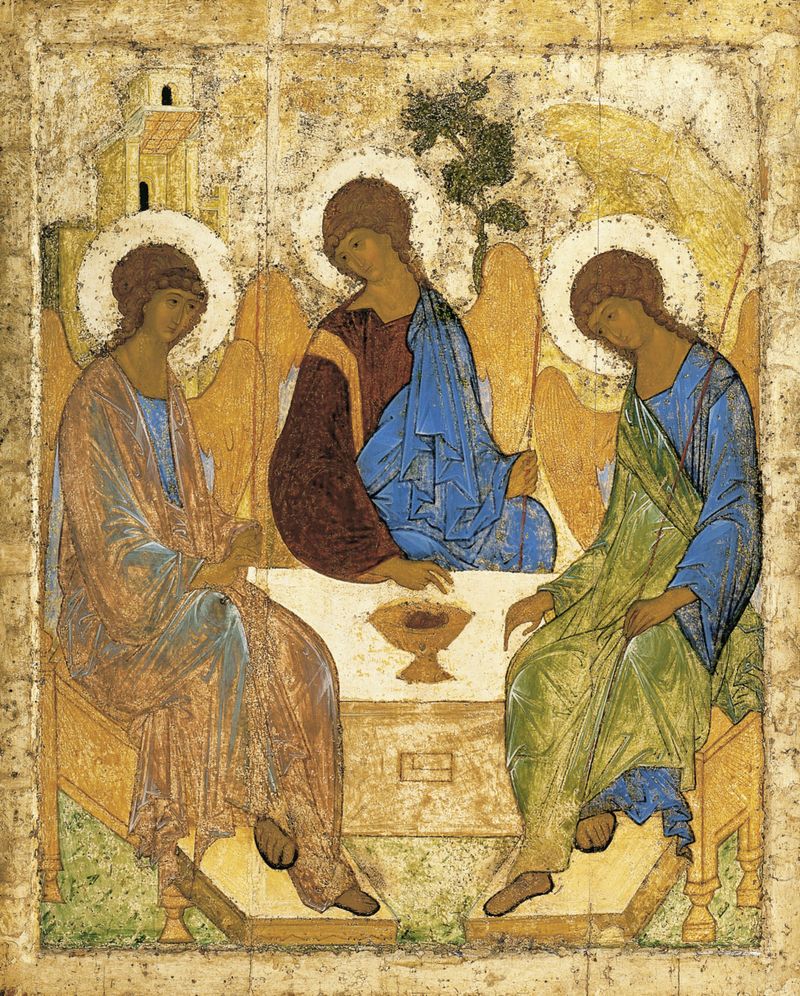
The second wrong direction runs the opposite way: if the Word is called θεός while being distinguished from τὸν θεόν (“the God,” typically the Father in Johannine usage), then perhaps we are dealing with two Gods—a form of ditheism that would be incompatible with the monotheism of Israel (cf. Deuteronomy 6:4, the Shema: “Hear, O Israel: The LORD our God, the LORD is one”). The Catholic tradition has always understood this “oneness” as a unity of divine nature rather than a numerical singleness of person—God is one in essence, not merely one in count (cf. CCC §228).
How John’s Grammar Resists Both Errors
John’s grammar in verse 1 already pushes against both errors. As I discussed in the John 1:1 post, the anarthrous θεός in the third clause (θεὸς ἦν ὁ λόγος) is qualitative: it affirms that the Word fully shares the divine nature without collapsing the Word into personal identification with the Father.3 And the relational force of πρὸς τὸν θεόν—an orientation toward God that implies both distinction and intimacy (as Brown notes, the preposition πρός with the accusative suggests “active relationship” and “communion”)—already resists a simple “the Word equals the Father” reading.
But verse 2 makes the resistance explicit. By restating the relational clause after the identity clause, John ensures his reader cannot resolve the tension by dissolving one side of it. Yes, the Word was God—in essence, in nature, fully divine. And yes, this same Word was in the beginning oriented toward God in personal distinction. Both realities hold simultaneously. The Prologue is written so as to hold together distinction and full deity in a way that later doctrinal language—“person,” “substance,” “relation”—would articulate with greater precision. John’s phrasing resists both a collapse of Father and Word into one person and a slide into ditheism. Later debates would make explicit what this text already holds together.4
Not Judaism, Not Polytheism—Something New
What John is doing here aligns with what contemporary scholars of earliest Christology have recognized as a genuinely new development within Jewish monotheism.
Larry Hurtado has argued that the earliest Christian communities maintained exclusive devotion to the one God of Israel while simultaneously including Jesus within their worship practice—a “dyadic devotional pattern” in which God and the Lord Jesus are co-recipients of the kind of devotion reserved for God alone. This is not polytheism; it is an expansion from within, not an importation from without.5 Richard Bauckham makes a related argument in different terms: Second Temple Jewish “monotheism” is best understood not as a numerical headcount of divine beings but in terms of God’s unique identity—his role as Creator of all things and sovereign Lord of all. Bauckham argues that the earliest Christian texts include Jesus within that unique divine identity rather than positing a second rival deity.6
John 1:2 fits squarely within these frameworks—and is, in a sense, their grammatical anchor. By restating that “this one was in the beginning with God” after the identity clause of verse 1, John does exactly what Hurtado and Bauckham describe the earliest Christians doing: including Jesus within the unique identity of Israel’s God while maintaining personal distinction. He is not importing a generic philosophical Logos and then abruptly equating it with God. He is placing the Word within the identity of Israel’s God—Creator, sovereign, the one from whom all things derive—while maintaining personal distinction. This is a move continuous with Jewish categories of Word and Wisdom yet radical in its christological identification. It is not the monotheism that preceded it, but neither is it a departure from monotheism. It is its deepest fulfillment.
From Prologue to Creed: What the Church Made Explicit
 affirming the Son as consubstantial with the Father](/images/blog/council-of-nicaea-800.jpg)
John’s prologue is not a fourth-century treatise. It does not use the vocabulary of Nicaea or Chalcedon. But it witnesses to realities—distinction, coeternity, full deity—that the Church later articulated with terms like “person” and “essence.” (For one example of how the Church corrected Christological errors that touched on these distinctions, see my post on Apollinarius and his heresy.) The Catechism of the Catholic Church teaches that the Trinity is “a mystery of faith in the strict sense,” inaccessible to reason alone, and that while God left traces of his Trinitarian being in creation and in the Old Testament, his “inmost Being as Holy Trinity” is a mystery known fully only through the Incarnation and the sending of the Holy Spirit.7
That framing matters for how we read John 1:2. The verse is not a Trinitarian formula. But it is one of the scriptural witnesses that made a Trinitarian formula necessary. The early Church did not impose the doctrine of the Trinity on Scripture from the outside. It recognized that Scripture—passages like this one—required a doctrinal vocabulary adequate to what the text was already saying. The Word was God. And the Word was with God. And both of those things were true at the same time, from the beginning, before anything was made.8
The Image of God as Communion
There is something in this verse that speaks beyond Christology into theological anthropology—into what it means to be human.
If God is not solitary—if, from before the foundation of the world, the divine life has been a life of relation, of persons oriented toward one another in communion—then the claim that humanity is made in the image of God takes on a communal dimension. We image God not only as individuals endowed with rationality and will, but also in the communion we form with one another. The Catechism makes this point explicitly: “The divine image is present in every man. It shines forth in the communion of persons, in the likeness of the union of the divine persons among themselves” (CCC 1702).9 John Paul II’s catechesis develops the same insight: human beings become the image and likeness of God not only through individual personhood but through the communion of persons that men and women form together.10
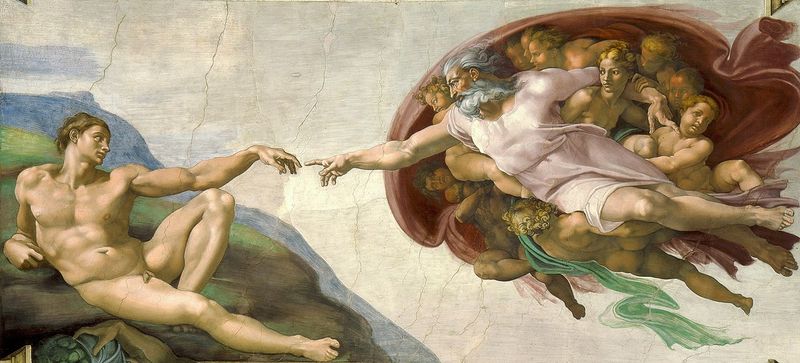
This is what John 1:2 opens up. The Word was not alone. God was not alone. And we, made in his image, are not meant to be alone either. The relational life within God—the life disclosed by πρὸς τὸν θεόν—is the archetype of which human communion is the icon.
Grasping at the Infinite
It is hard to wrap the mind around any of this. But perhaps that is exactly what we should expect.
We say that God is infinite. We say that each person of the Trinity is wholly God—not a third of God, not a fraction, not a component of some larger divine assembly. The Catechism is emphatic on this point: the three persons do not “share the one divinity among themselves” as if parceling it out; rather, “each of them is God whole and entire” (CCC 253). The persons are really distinct from one another, yet their distinction “does not divide the divine unity” because it resides solely in their relations to one another (CCC 254–255). The one divine essence subsists eternally as three really distinct persons.11
There is a temptation, when approaching the Trinity, to reach for quantitative metaphors—to think of God as a sum of parts, or to imagine the divine nature as a quantity that could be divided or distributed. But the tradition has consistently resisted this. Because God is not a material quantity, the fullness of divinity is not competitively possessed. The Son’s being fully God takes nothing from the Father. The Spirit’s being fully God takes nothing from either. This is not a mathematical puzzle to be solved but a mystery to be received—a mystery the Catechism explicitly identifies as inaccessible to reason alone and known only through divine revelation.12
And that, I think, is where the humility of verse 2 meets us. John has made an extraordinary set of claims, claims that the Church would spend centuries articulating with increasing precision. And yet the verse itself is simple, almost quiet in its syntax: This one was in the beginning with God. As if to say: I know what I just told you is staggering. Let me say it once more, plainly, so you know I mean it. The Word who was God was also, from eternity, in communion with God. Both things are true. Hold them together.
Would we be surprised to discover that there is a complexity to the character of an infinite Being that exceeds our capacity to hold it all in view at once? We are creatures who can appreciate the infinite only in theory and only the finite in practice. We grasp at something beyond our reach and can therefore only apprehend it in parts, in fits and starts, and in ways that seem at first to contradict one another. But this is not nonsense. It is the natural epistemic posture of finite minds before an infinite God—what the Christian tradition has always called mystery, not as an evasion of thought, but as an invitation to go deeper than thought alone can travel.13
Οὗτος ἦν ἐν ἀρχῇ πρὸς τὸν θεόν. This one was in the beginning with God. The verse does not explain the mystery. It guards it—ensuring that the reader holds together what must be held together, and does not resolve the tension by sacrificing one truth for the sake of another.
If you are following this series through John’s prologue, the previous post explores John 1:1 and the grammar of divine identity. The next reflection explores John 1:3–4, the Creator who became the light. You may also find it helpful to read the Catholic guide to the doctrine of the Trinity, which traces these scriptural seeds through to their full doctrinal flowering, or the reflection on theological anthropology and the imago Dei, which explores the communal implications of God’s relational life for what it means to be human.
How Major Translations Render John 1:2
The differences between English translations of John 1:2 are subtle but revealing. The key interpretive decisions involve how to translate the demonstrative pronoun οὗτος and how to render the preposition πρός.
| Translation | Year | Rendering | Notes |
|---|---|---|---|
| KJV | 1611 | “The same was in the beginning with God.” | “The same” captures the emphatic demonstrative force of οὗτος, pointing back to the Word just described. The wording is unchanged from the original 1611 printing; the 1769 standardization by Benjamin Blayney affected spelling and punctuation but not the words of this verse. |
| Douay-Rheims | 1582/1752 | “The same was in the beginning with God.” | The wording here reflects Bishop Challoner’s 1749–1752 revision, which modernized the original 1582 Rheims text and borrowed considerably from the KJV. All Douay-Rheims editions in print today are Challoner’s revision. |
| RSV-CE | 1965 | “He was in the beginning with God.” | Replaces the archaic “the same” with “he,” sacrificing some of the demonstrative emphasis for readability. |
| NABRE | 2011 | “He was in the beginning with God.” | The standard Catholic liturgical translation in the United States. Clean and accessible, but the emphatic “this one” nuance is lost. |
| ESV | 2001 | “He was in the beginning with God.” | Follows the RSV tradition. The pronoun “he” correctly identifies the Word as personal but flattens the anaphoric emphasis. |
| NRSV | 1989 | “He was in the beginning with God.” | Same rendering as ESV and RSV. The scholarly standard for academic citation in English. |
| NIV | 2011 | “He was with God in the beginning.” | Reorders the clauses, placing “with God” before “in the beginning.” This alters the emphasis but preserves the meaning. |
| NLT | 2015 | “He existed in the beginning with God.” | Adds “existed” to make the ontological claim more explicit—an interpretive choice rather than a strict translation. |
| Vulgate | c. 405 | Hoc erat in principio apud Deum. | Jerome’s Latin uses hoc (“this one”), preserving the demonstrative force of the Greek οὗτος. |
| Greek (NA28) | — | οὗτος ἦν ἐν ἀρχῇ πρὸς τὸν θεόν. | The critical Greek text. οὗτος = “this one”; ἦν = “was” (imperfect, continuous past); ἐν ἀρχῇ = “in the beginning”; πρὸς τὸν θεόν = “toward/with God.” |
The most significant translation choice is whether to render οὗτος as “the same” (KJV, Douay-Rheims) or simply “he” (most modern translations). The older rendering preserves the emphatic, pointing-back quality of the Greek demonstrative—this very one I have been describing. Modern translations opt for naturalness at the cost of that rhetorical force. Jerome’s Vulgate, notably, sides with the emphatic reading: hoc (“this one”), not ille (“he”).
Frequently Asked Questions
What does John 1:2 mean?
John 1:2 restates and reinforces the claims of John 1:1: the Word (Logos) who was identified as fully divine and personally distinct from the Father was in the beginning with God. The verse functions as a structural safeguard, ensuring the reader holds together the Word’s full deity and his relational distinction from the Father without collapsing either truth.
Why does John repeat himself in verse 2?
The repetition is not redundant but deliberate. After claiming both that the Word “was God” and that the Word “was with God,” John restates the relational clause to prevent two possible misreadings: Modalism (that the Word and the Father are the same person) and ditheism (that there are two separate Gods). Verse 2 holds both truths together.
What does οὗτος (“this one”) mean in John 1:2?
Οὗτος is a Greek demonstrative pronoun meaning “this.” If no noun follows it, the noun is implied in Greek, so that it means “this one.” John uses it instead of repeating “the Word” to emphatically point back to everything he said in verse 1. The KJV renders it “the same.” The effect is to tighten the identification: the single subject of all three claims in verse 1—preexistence, communion with God, full deity—is one and the same.
How does John 1:2 relate to the doctrine of the Trinity?
John 1:2 is not a Trinitarian formula in the technical sense, but it is one of the scriptural witnesses that made the doctrine of the Trinity necessary. By insisting on both the Word’s full deity and his personal distinction from the Father, the verse points toward the reality that the Church would later articulate with terms like “person,” “substance,” and ὁμοούσιος (homoousios, “consubstantial”).
What is the connection between John 1:2 and the image of God?
If the divine life is inherently relational—if God was never solitary but always existed as persons in communion—then the biblical claim that humans are made in God’s image has a communal dimension. The Catechism of the Catholic Church teaches that the divine image “shines forth in the communion of persons” (CCC 1702), and John Paul II developed this insight in his theology of the body.
For Further Study: Commentaries and Sources
- Raymond E. Brown, The Gospel According to John I–XII, Anchor Bible 29 (New York: Doubleday, 1966), commentary on John 1:1–18
- Larry W. Hurtado, Lord Jesus Christ: Devotion to Jesus in Earliest Christianity (Grand Rapids: Eerdmans, 2003)
- Richard Bauckham, Jesus and the God of Israel: God Crucified and Other Studies on the New Testament’s Christology of Divine Identity (Grand Rapids: Eerdmans, 2008)
- Lewis Ayres, Nicaea and Its Legacy: An Approach to Fourth-Century Trinitarian Theology (Oxford: Oxford University Press, 2004)
- Catechism of the Catholic Church, §§252–255 (Trinity), §§479–483 (Incarnation), §1702 (image of God as communion)
- St. Augustine, De Trinitate, especially Books V and X
- John Paul II, General Audience, November 14, 1979 (communion of persons and the imago Dei)
- Thomas Aquinas, Commentary on the Gospel of John, Chapters 1–5, trans. Fabian Larcher and James Weisheipl (Washington, DC: Catholic University of America Press, 2010)
- Gilles Emery, OP, The Trinity: An Introduction to Catholic Doctrine on the Triune God (Washington, DC: Catholic University of America Press, 2011)
- C.K. Barrett, The Gospel According to St. John, 2nd ed. (Louisville: Westminster John Knox, 1978)
- Joseph Ratzinger (Benedict XVI), Introduction to Christianity, 2nd ed. (San Francisco: Ignatius Press, 2004), especially the sections on the Trinitarian concept of God
- Khaled Anatolios, Retrieving Nicaea: The Development and Meaning of Trinitarian Doctrine (Grand Rapids: Baker Academic, 2011)
- Craig S. Keener, The Gospel of John: A Commentary, 2 vols. (Peabody: Hendrickson, 2003), commentary on John 1:1–18
Study & Reflection Questions
These questions are designed for personal study, small group discussion, or Bible study preparation.
-
Why does John use the demonstrative pronoun οὗτος (houtos, “this one”) rather than simply repeating ὁ λόγος (ho logos, “the Word”)? What rhetorical and theological work does the emphatic “this one” perform?
-
Verse 2 appears to repeat what verse 1 already said. Explain in your own words why the repetition is not redundant but structurally essential. What would be lost if John had moved directly from verse 1 to verse 3?
-
The post describes two “wrong directions” a reader might take after verse 1: Modalism (collapsing the distinction) and ditheism (two separate Gods). How does verse 2 prevent each of these misreadings?
-
Raymond Brown calls the repetition of verse 2 “far from otiose.” Can you think of other places in Scripture—or in great literature—where apparent repetition serves an essential clarifying function?
-
Larry Hurtado and Richard Bauckham argue that the earliest Christians included Jesus within the unique identity of Israel’s God. How does John 1:2 support this claim? Why is it significant that this “inclusion” happened so early in Christian history?
-
If the divine life is inherently relational—if the Father and the Word exist in eternal communion—what does this imply about human beings made in God’s image? How might the relational character of God reshape how you think about community, marriage, or friendship?
Footnotes
1. On the anaphoric force of οὗτος in Koine Greek and its function of emphatic back-reference, see Daniel B. Wallace, Greek Grammar Beyond the Basics: An Exegetical Syntax of the New Testament (Grand Rapids: Zondervan, 1996), 325–330. Brown notes that the KJV’s “the same” captures the emphatic demonstrative force well: Raymond E. Brown, The Gospel According to John I–XII, AB 29 (New York: Doubleday, 1966), 4.
2. Raymond E. Brown, The Gospel According to John I–XII, AB 29 (New York: Doubleday, 1966), 4, 24–25. Brown argues that verse 2 functions as “a résumé of vss. 1b and 1a,” drawing together the claims about the Word’s relationship to God and his preexistence before restating them as a unified affirmation.
3. Philip B. Harner, “Qualitative Anarthrous Predicate Nouns: Mark 15:39 and John 1:1,” Journal of Biblical Literature 92 (1973): 75–87. JSTOR. On the qualitative force of the anarthrous predicate in John 1:1c, see the fuller discussion in my post on John 1:1.
4. Lewis Ayres, Nicaea and Its Legacy: An Approach to Fourth-Century Trinitarian Theology (Oxford: Oxford University Press, 2004), especially chs. 1–3. Ayres traces how the Nicene debates articulated in doctrinal language what scriptural texts like John’s prologue had already held together implicitly—the simultaneous affirmation of unity of essence and distinction of persons.
5. Larry W. Hurtado, Lord Jesus Christ: Devotion to Jesus in Earliest Christianity (Grand Rapids: Eerdmans, 2003), 134–153. Hurtado develops the concept of a “binitarian” or “dyadic” devotional pattern in which Jesus is included alongside God as a co-recipient of corporate worship—a pattern he argues emerged remarkably early and without precedent in Jewish angelology or intermediary figures.
6. Richard Bauckham, Jesus and the God of Israel: God Crucified and Other Studies on the New Testament’s Christology of Divine Identity (Grand Rapids: Eerdmans, 2008), 1–59 (especially 6–11 on the “divine identity” framework as an alternative to the “intermediary figures” model). Bauckham’s central thesis is that Jewish monotheism is best understood in terms of God’s unique identity—as sole Creator of all things and sovereign ruler of all—and that the earliest Christology included Jesus within precisely this identity.
7. Catechism of the Catholic Church, 2nd ed. (Vatican City: Libreria Editrice Vaticana, 1997), §237. Vatican.va. The Catechism teaches that “The Trinity is a mystery of faith in the strict sense, one of the ‘mysteries that are hidden in God, which can never be known unless they are revealed by God’” (§237), and that while traces of Trinitarian being appear in creation and the Old Testament, God’s “inmost Being as Holy Trinity” is disclosed fully only in the missions of the Son and the Spirit.
8. See Ayres, Nicaea and Its Legacy, 31–40, on the relationship between Scripture and the development of Trinitarian doctrine. Ayres is careful to argue that Nicene theology is not a foreign imposition on the biblical text but an articulation of what the text demands—a point equally stressed by the Catechism’s insistence that the Church developed its Trinitarian terminology “with the help of certain notions of philosophical origin” but “did not submit the faith to human wisdom” (CCC §251).
9. Catechism of the Catholic Church, §1702. Vatican.va.
10. John Paul II, General Audience (November 14, 1979). Vatican.va. This catechesis, part of what would later be collected as John Paul II’s Theology of the Body, argues that the creation of humanity as male and female discloses the communal character of the imago Dei: human beings image God not only as rational individuals but in the communion of persons they form with one another.
11. Catechism of the Catholic Church, §§253–255. Vatican.va. The Catechism draws here on the Fourth Lateran Council (1215), the Second Council of Lyons (1274), and the Council of Florence (1442): “The divine persons do not share the one divinity among themselves but each of them is God whole and entire” (§253). See also St. Augustine, De Trinitate, V.9: “In God there is nothing said according to accident, because nothing happens to him accidentally; yet everything that is said is not said according to substance.”
12. Catechism of the Catholic Church, §237; cf. First Vatican Council, Dei Filius, ch. 4 (DS 3015–3016): “The divine mysteries so exceed the created intellect that, even when they have been communicated by revelation and received by faith, they remain nonetheless covered by the veil of faith itself and shrouded, as it were, in a certain obscurity.”
13. St. Augustine, Sermo 117.3.5: “If you understand it, it is not God.” (Si comprehendis, non est Deus.) Augustine’s point is not that theology is futile but that any concept of God that the finite mind can fully contain has, by that very fact, fallen short of the infinite God. Mystery, in the Christian tradition, is not the absence of intelligibility but its superabundance—a depth of meaning that rewards investigation without ever being exhausted by it. See also Thomas Aquinas, Summa Theologiae I, q. 32, a. 1, where Aquinas argues that the Trinity cannot be demonstrated by natural reason and is known only through divine revelation—a position reaffirmed by the First Vatican Council in Dei Filius. New Advent

Garrett Ham
Garrett Ham is an attorney, military veteran, and holds a Master of Divinity from Yale Divinity School. He writes from Northwest Arkansas on theology, law, and service.
More about Garrett →Related Posts
John 1:6 Meaning Explained: There Came a Man, Sent from God
What does John 1:6 mean? A Catholic exegesis of the Greek—the ἦν/ἐγένετο contrast, the perfect participle ἀπεσταλμένος, and John the Baptist as witness.

In the Beginning Was the Word: John 1:1 Explained
A deep dive into John 1:1 in the original Greek—the Logos, Colwell's rule, Nicene consubstantiality, and why this verse is the whole Gospel.
John 1:3–4 Meaning Explained: The Creator Who Became the Light
What do John 1:3–4 mean in the Gospel of John? A close reading in the original Greek — the punctuation of ὃ γέγονεν, Incarnation as life in the Word, and Chalcedonian Christology.
Stay Informed
Get new writing on faith, law, and service delivered to your inbox.
No spam. Unsubscribe anytime.