Jephthah’s Vow: A Catholic Reading of Judges 11:29–40
On This Page
“And it came to pass when he returned from the battle to Maspha, that his only daughter met him with timbrels and with dances: for he had no other children. And when he saw her, he rent his garments, and said: Alas! my daughter, thou hast deceived me, and thou thyself art deceived: for I have opened my mouth to the Lord, and I can do no other thing.” — Judges 11:34–35 (Douay-Rheims)
Few episodes in the Old Testament unsettle the Catholic reader the way Jephthah’s vow does. A Spirit-empowered judge of Israel marches off to war, makes a reckless promise to God, wins a stunning victory—and then his only daughter dances out of the doors of his house to meet him. What follows has divided interpreters for two millennia. Did Jephthah literally sacrifice his daughter as a burnt offering? Or did he consecrate her to lifelong virginity in the service of the sanctuary? And what is the Catholic faithful to make of a story in which God seems silent at exactly the moment we most expect Him to intervene?
This post works through the passage section by section: the Hebrew text and its ambiguities, the central interpretive debate, Jephthah as a tragic figure within the “downward spiral” of Judges, the Church Fathers and the Catholic moral tradition on rash vows, the daughter herself, and finally what the episode contributes to salvation history when read within the whole canon. The Catholic tradition speaks with remarkable unanimity here: the overwhelming majority of Catholic interpreters from Ambrose and Augustine through Aquinas and Cornelius a Lapide to the New American Bible and Roland de Vaux read the passage as describing an actual human sacrifice—and virtually all condemn the act as sinful. The aim of what follows is not to flatten the difficulty but to read the text with the mind of the Church.
1. The text and its ambiguities
The Hebrew of Judges 11:30–31 reads, in a fairly literal rendering:
וַיִּדַּר יִפְתָּח נֶדֶר לַיהוָה וַיֹּאמַר אִם־נָתוֹן תִּתֵּן אֶת־בְּנֵי עַמּוֹן בְּיָדִי׃ וְהָיָה הַיּוֹצֵא אֲשֶׁר יֵצֵא מִדַּלְתֵי בֵיתִי לִקְרָאתִי בְּשׁוּבִי בְשָׁלוֹם מִבְּנֵי עַמּוֹן וְהָיָה לַיהוָה וְהַעֲלִיתִהוּ עוֹלָה׃
“And Jephthah vowed a vow (neder, נֶדֶר) to YHWH (יהוה) and said, ‘If you will indeed give the sons of Ammon into my hand, then it shall be that the one coming out (hayyotse asher yetse, הַיּוֹצֵא אֲשֶׁר יֵצֵא), who comes out from the doors of my house to meet me when I return in peace from the sons of Ammon, shall belong to YHWH, and (waw, וְ) I will offer him up as a burnt offering (‘olah, עוֹלָה).’”
Five Hebrew details are exegetically decisive.
neder (נֶדֶר)—“vow.” A neder is a voluntary, conditional promise to God. The Torah Catholics confess as inerrant Scripture is unambiguous: once made, it must be kept (Deuteronomy 23:21–23; Numbers 30:2). Yet the same Torah explicitly provides relief for rash vows. Leviticus 5:4–6 stipulates a guilt offering for one who “swears rashly with his lips,” and Leviticus 27:1–8 establishes a monetary redemption schedule for persons vowed to the LORD: a woman aged 20–60 could be redeemed for thirty shekels of silver. This redemption clause is the linchpin of the rabbinic and patristic critique of Jephthah, and it will return below.
‘olah (עוֹלָה)—“burnt offering.” This word appears roughly 286 times in the Hebrew Bible and, in virtually every instance, denotes a literal animal sacrifice wholly consumed by fire on the altar (Leviticus 1). It is the same term used in Genesis 22:2 (the binding of Isaac) and 2 Kings 3:27 (Mesha’s sacrifice of his son). John Walton, in a widely-cited Zondervan “Koinonia” blog essay (whose substance parallels his treatment in the Zondervan Illustrated Bible Backgrounds Commentary, vol. 2, 2009, pp. 180–181), puts the point sharply: “to suggest that this word has a unique and different meaning here is special pleading.” This is the single weightiest textual datum against the “perpetual virginity” reading.
The conjunction waw (וְ). Jephthah says the one coming out “shall be the LORD’s and (waw) I will offer him up as a burnt offering.” The majority position reads this waw as conjunctive—the burnt offering specifies how the subject becomes the LORD’s. A minority position, beginning with the medieval Jewish commentator David Kimhi (Radak, 1160–1235), reads it disjunctively (“or”): if a person comes out, they will be dedicated; if an animal, sacrificed. Hebrew grammar permits both, but the conjunctive reading is contextually stronger; as one careful assessment puts it, the disjunctive reading is “grammatically possible but contextually strained.”
hayyotse asher yetse (הַיּוֹצֵא אֲשֶׁר יֵצֵא)—“whoever/whatever comes out.” The participle is grammatically masculine, which is consistent with either an indeterminate human or animal referent. Augustine’s reading of the Old Latin text noted that the Vetus Latina rendered the phrase quicumque—“whoever,” not “whatever”—already tilting the interpretation toward a human victim. Tim Keller’s modern observation—in his popular expository volume Judges for You (The Good Book Company, 2013), ch. 8—cuts through the abstraction: “If Jephthah had promised God an animal, then when his daughter came through the doors he would never have considered the promise to have had any binding force with regard to her.” The horror of the scene only makes sense if Jephthah understood himself to have promised a human being.
betulim (בְּתוּלִים)—“virginity.” The daughter asks two months “to bewail my virginity” (Judges 11:37). The root b-t-l appears twice in two verses (betulai, v. 37; betuleiha, v. 38), with verse 39’s “she knew no man” reinforcing the theme—an emphatic cluster that has rightly drawn attention. For sacrifice-view interpreters, weeping for virginity reflects the ancient Near Eastern conviction that the worst death for a woman was to die “young, unfulfilled, childless,” in Barry Webb’s phrase. For dedication-view interpreters, the emphasis on virginity is the sacrifice—she will live but never marry.
The verse the entire reading hinges on is Judges 11:39: “And he did to her as he had vowed, and she knew no man.” The first clause is the standard Hebrew fulfillment formula; the second, “and she knew no man,” can be read either as a separate fact about her remaining state or as an epexegetical clause explaining what “he did to her as he had vowed” actually meant. The grammar genuinely permits both. The narrative weight, however, falls on the dreadful concision of “he did to her as he had vowed.”
2. The central debate: did Jephthah kill his daughter?
Position A: Literal sacrifice
This is the majority position in the entire history of interpretation, and—as we will see at length below—it is the unanimous reading of every major Catholic interpreter from the Fathers through the modern New American Bible. It is the view of Josephus, John Chrysostom, Ambrose, Jerome, Augustine, and Thomas Aquinas. Among modern critical and evangelical scholars, it is the position of Daniel Block, Barry Webb, Robert Chisholm, K. Lawson Younger Jr., Robert Boling, Phyllis Trible, and Mieke Bal. Even Martin Luther conceded: “Some affirm that he did not sacrifice her, but the text is clear enough!”
The arguments are formidable. The lexical case for ‘olah as literal burnt offering is overwhelming. The conjunctive waw reading is grammatically and contextually more natural. Jephthah tears his clothes—a mourning gesture—and cries “you have brought me very low” (v. 35), grief proportionate only to impending death, not to lifelong celibacy. The contrast with Genesis 22 is devastating: God intervened for Abraham with an angel and a ram; for Jephthah, there is only silence. And the laconic “he did to her as he had vowed” follows the standard fulfillment pattern of Hebrew narrative.
Position B: Perpetual virginity and sanctuary service
The minority position traces to medieval Jewish commentary and finds its first major advocate in David Kimhi, who reads the waw disjunctively and argues that Jephthah’s daughter was placed in seclusion. Levi ben Gershon (Ralbag) followed him. This reading entered late-medieval Catholic exegesis primarily through Nicholas of Lyra (c. 1270–1349), whose Postilla Literalis engaged Jewish commentary extensively. In the Christian tradition more broadly, the dedication view has been defended by Jonathan Edwards (who argued she became a Nazirite), Gleason Archer, E. W. Bullinger, Adam Clarke, and most rigorously by David Marcus in his monograph Jephthah and His Vow (Texas Tech, 1986).
The arguments here are not negligible. The text does place an unusual emphasis on virginity across verses 37–39, with two occurrences of the b-t-l root reinforced by “she knew no man” in verse 39. The phrase “she knew no man” reads more naturally as a concluding statement about her state than as a euphemism for death. Exodus 38:8 and 1 Samuel 2:22 attest women who “served at the entrance of the Tent of Meeting.” And Hebrews 11:32 includes Jephthah in the New Testament’s “faith” roster, which seems difficult if he committed deliberate child murder.
The position’s weaknesses, however, are significant. As Rabbi Moshe Reiss observes in the Jewish Bible Quarterly (37.1, 2009), the idea of perpetual female consecrated virginity “had never previously appeared in Jewish texts and in fact lay outside the Jewish belief system and cultural milieu.” There was no pre-monarchic institutional mechanism for female consecrated virginity in Israel. Non-Levites could not serve at the tabernacle. And Deuteronomy 23:2, which barred those of irregular birth from “the assembly of the LORD,” may have made Jephthah’s daughter (the granddaughter of a prostitute through her father) ineligible for sanctuary service entirely.
Where the weight of evidence—and the Catholic tradition—lies
Honest reading must acknowledge that the lexical, grammatical, narratological, and canonical evidence converges on literal sacrifice. The Septuagint already tilts in this direction by translating letannot (לְתַנּוֹת, the verb of the daughters’ annual observance in v. 40) with the funerary Greek verb θρηνεῖν, “to lament.” Most strikingly, the Targum Jonathan—the authoritative Jewish Aramaic paraphrase—adds a remarkable gloss to verse 39: “It became a decree in Israel that no one may offer up his son or his daughter for a burnt offering, as Jephthah the Gileadite did, who did not ask Phinehas the priest. For if he had asked Phinehas the priest, he would have rescued her with a monetary consecration.” The Targumist read the text as literal sacrifice, condemned it, and explicitly invoked Leviticus 27’s redemption clause as the path Jephthah failed to take.
The 1910 Catholic Encyclopedia article on “Jephte” by James F. Driscoll states the Catholic consensus bluntly: “The obvious import of the narrative is that the daughter of Jephte was offered up as a human sacrifice, and in fact, such has been the unanimous interpretation of it in Jewish, as well as in early Christian, tradition.” The footnote of the New American Bible (NABRE) on Judges 11, the official Catholic translation in the United States, takes the same line: “The sacrifice of children was strictly forbidden by Mosaic law (Lv 18:21; 20:2–5), and when the biblical writers report its occurrence, they usually condemn it in strong terms (2 Kgs 16:3; 21:6; Jer 7:31; 19:5). In this case, however, the narrator simply records the old story, offering no comment on the acceptability of Jephthah’s extreme gesture.”
I read the passage with the tradition. Jephthah, in tragic ignorance of the Torah that the biblical narrative presents as already governing Israel, killed his daughter as a burnt offering.1 The dedication view is not mere special pleading; it is a serious minority tradition with a respectable medieval pedigree, and the text’s deliberate ambiguity is itself part of its power. But the Catholic interpretive tradition has, with near unanimity, read the passage the same way the Targumist did: as a real death, condemned by God’s silence, and turned by the women of Israel into a lasting memorial of what should never happen again.
3. Jephthah the man: outcast, diplomat, tragic figure
To read Judges 11:29–40 in isolation is to misread it. Jephthah is introduced with a paradoxical double identification in 11:1: he is “a mighty man of valor” (gibbor hayil, גִּבּוֹר חַיִל—the same phrase used for Gideon in 6:12) and “the son of a prostitute” (zonah, זוֹנָה). Driven from his father’s house by his legitimate half-brothers over the inheritance, he flees to the land of Tob, where he gathers “worthless fellows” (‘anashim reqim, אֲנָשִׁים רֵיקִים) and becomes a brigand chieftain. The irony of the elders’ recall is sharp: the man they expelled becomes the only one who can save them—a pattern that mirrors Israel’s own relationship to the God they had rejected (Judges 10:6–16) but to whom they cry in desperation.
Jephthah’s diplomatic exchange with the king of Ammon (11:12–28) demonstrates impressive historical knowledge of Israel’s wilderness traditions. But it contains a telling theological error. In verse 24, Jephthah argues: “Will you not possess what Chemosh your god gives you?” The problem is that Chemosh was the god of Moab (Numbers 21:29; 1 Kings 11:33), not Ammon; Ammon’s deity was Milcom or Molech (1 Kings 11:5, 7). Scholars have proposed that the two nations may have shared cult practices, or that the disputed territory was originally Moabite. But Daniel Block and other commentators view this slip as evidence of theological confusion: Jephthah knew Israel’s history better than Israel’s God. As Barry Webb sharply puts it, Jephthah “tried to conduct his relationship with God in the same way that he had conducted his relationships with men. He has debased religion into politics.”
This characterization frames the vow. Jephthah is not a moral monster. He is a marginal figure raised among pagans, called from exile to lead a people whose own religious knowledge had decayed (Judges 10:6 reports that Israel “served the Baals and the Ashtaroth, the gods of Syria, Sidon, Moab, Ammon, and the Philistines”). His vow reflects a transactional, bargaining theology characteristic of Canaanite and Ammonite religion—not the covenantal trust of Abraham.
Jephthah is what Block calls a symptom of “the Canaanization of the nation of Israel.” Kenneth Way of Biola, in his Judges and Ruth (Teach the Text Commentary, Baker 2016) and in a 2011 Biola Good Book Blog essay, observes that the major judges in Judges are arranged “from, relatively speaking, best to worst. Othniel is the moral apex and Samson is the moral nadir.” Jephthah occupies a critical transitional position—worse than Gideon, not yet as personally debased as Samson—and the treatment of women degenerates with him.
This is the heart of it: the narrator condemns Jephthah whether or not he says so explicitly. The Catholic doctrine of biblical inerrancy does not require that every action recorded in Scripture be endorsed by Scripture—only that what Scripture teaches for the sake of our salvation is taught without error. The absence of divine command, the absence of divine intervention, and the placement within Judges’ decline narrative constitute implicit judgment. The narrator’s silence is not approval but artistry—he forces the reader to render the verdict the text withholds.

4. The historical-critical reading
The Catholic interpretive tradition does not work in isolation. Since Divino Afflante Spiritu (1943) and Dei Verbum §12, the Church has explicitly authorized—and encouraged—the use of historical-critical method as a tool for reading Scripture, provided that its conclusions are integrated into theological reading within the living Tradition. The Pontifical Biblical Commission’s The Interpretation of the Bible in the Church (1993) calls historical-critical method “indispensable” for any serious reading of an ancient text. What follows is the best current account of how a working biblical scholar would approach Judges 11:29–40: the dating of the book, the likely prehistory of the narrative, its ancient Near Eastern context, its etiological function, and the redactor’s purpose in preserving it. The patristic and scholastic readings in the sections that follow will work with this historical reading, not around it.
The Deuteronomistic History and the framing of Judges
Since Martin Noth’s Überlieferungsgeschichtliche Studien (Halle, 1943), the dominant critical hypothesis has read Deuteronomy, Joshua, Judges, 1–2 Samuel, and 1–2 Kings as a single continuous composition—the Deuteronomistic History (Dtr or DtrH)—composed during or after the Babylonian exile (after 586 BCE) by an author or editorial school working within the theological framework of Deuteronomy. On this reading, Judges is not a simple archive of pre-monarchic hero-tales but a literary-theological construction that takes older traditions and fits them into a recurring cycle: Israel apostatizes, YHWH hands them over to a foreign oppressor, Israel cries out, YHWH raises up a deliverer, the land has peace, the deliverer dies, and the cycle resumes (Judges 2:11–19). The frame itself is the editor’s theological voice.
Noth’s exilic dating has been refined substantially over the last seventy-five years. Frank Moore Cross, in Canaanite Myth and Hebrew Epic (Harvard, 1973), argued for a double redaction: an original Josianic edition (Dtr¹), composed c. 620 BCE to support Josiah’s reform, and an exilic update (Dtr²) that added the loss of the land to the scheme. Thomas Römer, in The So-Called Deuteronomistic History (T&T Clark, 2005), traces three editorial layers stretching from the late monarchic period through the Persian era. Wolfgang Richter’s earlier source-critical work on Judges (Die Bearbeitungen des “Retterbuches” in der deuteronomischen Epoche, 1964) had already argued for an older “Savior Book” (Retterbuch) of hero-tales circulating before the Deuteronomist took them up. On any of these reconstructions, the Jephthah narrative in its present form is a late edited text reflecting on events or traditions from a considerably earlier period.
This matters for two reasons. First, the Deuteronomist is writing about the pre-monarchic period from the vantage of centuries later—with full knowledge of the Torah’s prohibition against child sacrifice (Leviticus 18:21; 20:2–5; Deuteronomy 12:31; 18:10) that a historical Jephthah may well have had no access to. The legal framework against which the final editor measures the story was itself not necessarily in force at the time of the hypothetical events. Second, the decision to preserve this dreadful story—rather than suppress it, as later hagiographic traditions often did—was a deliberate editorial choice. The Deuteronomist kept Jephthah because his story served the editor’s theological purpose.
The prehistory of the narrative
Most critical scholars detect multiple layers in Judges 10:6–12:7. The diplomatic exchange with the king of Ammon in 11:12–28 has long been recognized as secondary: its prose style differs from the surrounding narrative, it confuses Moabite Chemosh with Ammonite Milcom (a slip that is exegetically telling for a canonical reading but a source-critical datum for a historical reading), and the territorial argument it deploys parallels Deuteronomy 2 closely. Most source critics—following Richter and elaborated by Barnabas Lindars’s ICC commentary on Judges 1–5 (T&T Clark, 1995) and Trent Butler’s Judges in the Word Biblical Commentary (2009)—treat 11:12–28 as a Deuteronomistic insertion into an older narrative core.
The vow-and-daughter narrative in 11:29–40, by contrast, bears marks of considerable antiquity. It is tightly constructed; it preserves a folkloric structure characteristic of oral tradition (the unexpected first-to-come-out); and it ends with an etiological note about an annual ritual that the editor clearly did not invent and may not have fully understood. Robert Boling, in his Anchor Bible Judges (Doubleday, 1975), read the core story as pre-Deuteronomistic. J. Alberto Soggin, in his Old Testament Library Judges (Westminster, 1981), concurred. The consensus is that what we have is an old tradition—possibly quite old—absorbed and reframed by a later editor who condemned what the original story may have simply reported.
Marc Brettler, in The Book of Judges (Routledge, 2002), has argued that the editor’s restraint is itself the point: the narrator deliberately withholds explicit moral commentary precisely to force the reader to supply it. Susan Niditch, in her Old Testament Library Judges (Westminster John Knox, 2008), reads the narrative within the “ideology of war and death” that runs through the whole book, and has argued (following her earlier War in the Hebrew Bible, Oxford, 1993) that the vow is functionally similar to the ḥerem devotion of war-booty to YHWH (cf. Joshua 6–7; Deuteronomy 20:10–18)—an association that, on her reading, clarifies why a Spirit-empowered judge would make such a promise in the first place. On this reading, Jephthah is participating in an archaic strand of Yahwism in which the fiercest devotion to YHWH could include devoting living beings to destruction as an offering.
The ancient Near Eastern context of child sacrifice
A historical-critical reading has to engage the hard question of whether, and to what extent, child sacrifice was practiced in ancient Israel and its neighbors. The evidence is considerable, and its interpretation is contested.
Archaeologically, the Phoenician/Punic tophet at Carthage, excavated by Lawrence Stager and others in the 1970s–80s and published in Stager and Samuel Wolff, “Child Sacrifice at Carthage—Religious Rite or Population Control?” (Biblical Archaeology Review 10.1, 1984), preserves thousands of urns containing the cremated remains of infants, associated with stelae invoking Ba’al Hammon and Tanit. Similar tophet installations have been identified at Motya, Tharros, and Sulcis. Carthage was a Phoenician colony, and Phoenician religion shared significant DNA with Canaanite and even Israelite religion. The Greek and Roman literary witnesses (Kleitarchos, Diodorus Siculus 20.14, Plutarch, Tertullian) describe the rite as molk-sacrifice—the same consonantal root as biblical mōlek / Moloch.
Biblically, the polemic against child sacrifice runs through the prophets and the Deuteronomistic History with an intensity that only makes sense if the practice was a live temptation within Israel itself. Jeremiah 7:31 accuses Judah of building “the high places of Topheth in the valley of the son of Hinnom, to burn their sons and their daughters in the fire—which I did not command, nor did it come into my mind.” Jeremiah 19:5, 32:35, and Ezekiel 20:25–26 make similar charges. 2 Kings 16:3 reports that Ahaz “made his son pass through the fire”; 2 Kings 21:6 reports the same of Manasseh; Josiah’s reform in 2 Kings 23:10 explicitly defiles the Topheth in the valley of Ben-hinnom “that no one might burn his son or his daughter as an offering to Molech.” Most strikingly, 2 Kings 3:27 recounts that when the king of Moab was besieged by a coalition including Israel, he “took his firstborn son who was to reign in his place and offered him for a burnt offering (‘ōlâ—the same term Judges 11:31 uses) on the wall,” and the narrator reports that “there came great wrath against Israel” and the besieging coalition withdrew. A neighboring king’s child sacrifice is reported as efficacious in the narrator’s own framing. This is the ancient Near Eastern logic within which Jephthah operates.
Jon Levenson, in The Death and Resurrection of the Beloved Son: The Transformation of Child Sacrifice in Judaism and Christianity (Yale, 1993), argued that the ideology of child sacrifice was structurally embedded in Israelite religion at a deep level—the firstborn belonged to YHWH (Exodus 13:2; 22:29–30; 34:19–20)—and that the normative tradition came to substitute for literal sacrifice (the Passover lamb; the redemption of the firstborn in Exodus 13:13, 34:20, and Numbers 18:15–16) rather than abolishing the underlying logic. Francesca Stavrakopoulou’s King Manasseh and the Child Sacrifice: Biblical Distortions of Historical Realities (de Gruyter, 2004) pressed the point further, arguing that child sacrifice was a regular feature of pre-reform Judahite Yahwism which later Deuteronomistic editors systematically repudiated. Heath Dewrell’s Child Sacrifice in Ancient Israel (Eisenbrauns/Penn State, 2017) offers the most comprehensive recent treatment, distinguishing carefully between the archaeological evidence, the inscriptional evidence, and the biblical rhetoric.
Within this context, Jephthah’s vow is not an inexplicable individual aberration. It is a recognizable instance of an ancient Near Eastern pattern: in moments of crisis or desperate need, vow the most precious thing to the deity, up to and including a child. What makes the Jephthah narrative theologically distinctive is not that a judge made such a vow but that the narrative preserves the story while embedding it in a downward-spiral frame that reads the vow as catastrophic religious error.
Form criticism and the etiological function
Verse 40 is the hermeneutic key to the narrative’s final form:
“It became a custom in Israel that the daughters of Israel went year by year to lament (lĕtannôt, לְתַנּוֹת) the daughter of Jephthah the Gileadite four days in the year.”
In form-critical terms, this is an etiology—a narrative that explains the origin of a practice, custom, place-name, or ritual. The Jephthah story as we have it ends by anchoring itself to an annual four-day women’s lament, and the narrative functions within the final text to explain why the women of Israel mourn. Hermann Gunkel, Julius Wellhausen, and after them generations of form critics argued that such etiologies are often independent of the narratives they conclude—that is, the ritual existed first, and the story was composed (or adapted) to account for it. David Gunn’s Blackwell Judges commentary (2005) and David Marcus’s Jephthah and His Vow (Texas Tech, 1986) both treat the etiology as the organizing key to the narrative’s final shape.
Scholars have noted parallels to other ancient Near Eastern women’s mourning rituals, most famously the weeping for Tammuz that Ezekiel 8:14 reports inside the Jerusalem temple (“behold, there sat women weeping for Tammuz”) and the Greek-attested laments for Adonis. None of this means the Jephthah story is secretly about Tammuz. It means the ritual the story etiologizes is part of a broader ancient Near Eastern pattern of annual female-led lament for a divine or heroic death, and that the Israelite editor inherited this ritual and attached Jephthah’s daughter to it as its origin story. The meaning of the ritual in the final form of the text is something new: not a fertility-cult mourning of a dying god, but a counter-memory of a girl sacrificed by religious folly.
This is why the women of Israel hold the memory. The narrator nearly buries her (she has no name, no resisting speech, no divine vindication); the ritual preserves what the narrative marginalizes. Phyllis Trible captured the point unforgettably in Texts of Terror: Literary-Feminist Readings of Biblical Narratives (Fortress, 1984): the annual lament is the text’s own protest against what the story reports.
Redactor’s purpose: why the story was kept
Given all this, why did the Deuteronomist—writing centuries later, from within a reform theology that categorically condemned child sacrifice—preserve this story? Four reasons converge.
First, the etiological hook. The four-day women’s ritual was an established practice the editor had to explain, and the Jephthah tradition provided the explanation. To suppress the story would have orphaned the ritual.
Second, the theological pattern. Judges is structured as a downward spiral (Brettler 2002; Robert O’Connell, The Rhetoric of the Book of Judges, Brill, 1996; Gregory Wong, Compositional Strategy of the Book of Judges, Brill, 2006). Each major judge is morally worse than the last, and the book is driving toward its closing refrain: “In those days there was no king in Israel; everyone did what was right in his own eyes” (Judges 21:25). Jephthah fits the pattern exactly. His theological confusion, his transactional vow, and the horror of its fulfillment all work to make the case that Israel without a king—and specifically, without the centralizing, Jerusalem-focused Yahwism that the Deuteronomist favored—devolves into religious chaos. The redactor’s argument is partly political: only a king committed to Deuteronomic reform can prevent this kind of thing.
Third, the polemic against popular Yahwism. The Deuteronomist is writing against the survival of syncretistic, pre-reform religion in Israel and Judah. Jephthah’s vow is precisely the kind of thing the reform wanted to eliminate: a spontaneous, transactional, folkloric interaction with YHWH that treats the deity like a Canaanite god to be bargained with. Preserving the story while letting its horror speak for itself was a rhetorical strategy. The narrator’s silence is a form of condemnation that respects the reader’s intelligence—and that aligns with the Deuteronomistic historiographical technique of letting disastrous outcomes do the moral work that sermons would flatten.
Fourth, the women of Israel. The editor chose to preserve the daughter’s lament, to name the ritual, to let the text close on grief rather than triumph. Whatever else he was doing, he was ensuring that this girl would be remembered—not as a heroine whose sacrifice was acceptable but as a victim whose death required mourning. Mieke Bal, in Death and Dissymmetry: The Politics of Coherence in the Book of Judges (Chicago, 1988), has argued that this editorial choice is as close as the Deuteronomist comes to a direct moral verdict on the episode.
What historical-critical reading leaves open—and what it establishes
None of these critical observations force a reading of the passage. Historical-critical method is a tool for recovering what a text may have meant to its original authors, editors, and audiences; it does not supplant canonical and theological reading. Dei Verbum §12 is explicit that historical method serves theology rather than displaces it, and the Pontifical Biblical Commission’s 1993 document warns against both an “ahistorical fundamentalism” that ignores critical findings and a “reductionist” historical criticism that treats the text as nothing more than the product of its compositional history.
What the critical reading does establish is this:
- The Jephthah narrative is not a simple report of a historical event but an old tradition framed by a later editor for a specific theological purpose.
- The ancient Near Eastern context makes Jephthah’s vow intelligible rather than anomalous—it fits a recognizable pattern of crisis-vow religion that biblical Yahwism came to condemn.
- The etiological function explains why the story ends where it does and why it was preserved in the first place.
- The Deuteronomist’s silence is a literary act, not a theological endorsement. The placement of the story within the downward spiral of Judges, the refusal to give the daughter a name or a resisting speech, and the closing focus on annual mourning all function as narrative condemnation.
The patristic and scholastic tradition, working without the tools of modern historical criticism, arrived at substantially the same reading of the meaning of the text: that Jephthah sinned, that the text condemns him by its silence, and that the daughter must be remembered. What historical criticism adds is the mechanism by which the text came to mean what it means—and the humility of recognizing that the text we read was shaped by editors who were themselves making theological judgments about events they knew only from older traditions. The two readings are not in tension. They converge, from different directions, on the same truth.
5. The Church Fathers on Jephthah’s vow
The patristic witness on Jephthah is striking in its convergence. Every major Father who treats the passage assumes the literal sacrifice and explicitly condemns it. There is no patristic dedication-view tradition. What the Fathers debate is not whether Jephthah killed his daughter but how God’s allowance of the deed should be theologically understood.

St. Ambrose of Milan (c. 339–397)
Ambrose discusses Jephthah in De Officiis Ministrorum—his Christian rewriting of Cicero’s De Officiis, which substitutes Old Testament figures for Roman exemplars. The Jephthah passage appears in Book I, chapter 40 (§§196–198) (Migne PL 16; modern critical edition: Ivor J. Davidson, Ambrose: De Officiis, Oxford Early Christian Studies, Oxford University Press, 2001, 2 vols.). Ambrose’s central judgment is that Jephthah’s vow was rash and unconsidered rather than the fruit of mature deliberation. It serves as Ambrose’s primary biblical proof-text for the principle that it is sometimes contrary to duty to fulfill a promise or to keep an oath. Ambrose draws the moral with characteristic directness: a sworn word does not make an evil deed good. The category “rash vow” enters Catholic moral theology in large part through this passage.
Jerome, in Adversus Jovinianum I (PL 23:211–338), preserves Ambrose’s reading and adds the telling note that Ambrose “says there was no difference between Jephthah and his virgin daughter, who was sacrificed to the Lord (quae immolata est Domino): nay, of the two, he prefers the faith of the father to that of the daughter who met death with grief and tears.” Ambrose, in other words, believed she really died—and admired the daughter’s submission even as he condemned the father’s vow. He returns to the daughter in De Virginibus (PL 16) as part of his broader argument for the excellence of consecrated virginity.
St. Augustine of Hippo (354–430)
Augustine’s most detailed treatment is Quaestiones in Heptateuchum, Book VII (on Judges), Question 49 (c. 419–420; PL 34; critical edition: CCL 33). It is the longest patristic discussion of the passage and remains the foundation of all subsequent Catholic exegesis. (Augustine’s broader theological grammar—including his account of the Cross—is the indispensable backdrop for everything that follows; for an overview of Augustine’s atonement theology, see the longer treatment elsewhere on this site.) Augustine advances three interlinked arguments.
The linguistic argument. Augustine observes that the Old Latin text of Judges 11:31 reads quicumque (“whoever”) rather than quodcumque (“whatever”), suggesting Jephthah specifically anticipated a human victim. The grammar is decisive against the “what comes out” softening.
The argument from absurdity. With characteristic wit, Augustine notes that Jephthah surely did not expect a sheep—“for it is not the custom now, nor was it then, for sheep to run out to greet a returning master.” A dog would have been “a sacrifice at once illicit, contemptible, and unclean.” Jephthah therefore must have understood his vow as anticipating a human being from the start.
The pedagogical argument. This is Augustine’s central theological move. God intervened to stop Abraham from sacrificing Isaac because that sacrifice was divinely commanded. God did not intervene with Jephthah, and Augustine explains why:
“After sixty days, having given such a long delay to his daughter, the Lord did not forbid him from killing his only dearest, as he forbade Abraham, until, having accomplished what he had vowed, he smote himself with a most grievous affliction; but God would never be appeased by the immolation of a man (immolatione hominis). An example would be left of such a vow, that men might think they were vowing something great to God when they vowed human victims, and, what is more terrible, children.”
For Augustine, divine non-intervention was not approval. It was judgment—and a permanent warning written into Scripture so that no future Israelite would repeat the sin. The silence is the lesson.
St. Jerome (c. 347–420)
Jerome treats Jephthah in several places. In Adversus Jovinianum I, marshalling Old Testament examples for the superiority of virginity, he describes the daughter as one quae immolata est Domino—“who was sacrificed to the Lord.” His reading takes the death for granted. In his Commentary on Jeremiah 7 (on the Topheth passages where Israel sacrificed children to Moloch), Jerome—and the broader patristic stream he represents—draws the careful distinction that what is praiseworthy in such cases is not the sacrifice itself but the disposition of the one offering it. The act was wrong; the daughter’s submission and the father’s broken-hearted fidelity were not entirely worthless. This careful separation of sinful act from pious intention became the template for all later Catholic moral analysis of the passage.
The maxim most often attributed to Jerome—stultus in vovendo… impius in solvendo, “foolish in vowing… wicked in keeping”—is quoted by Aquinas as Jerome’s, but actually originates in Peter Comestor’s twelfth-century Historia Scholastica (in the Liber Judicum, PL 198, approximately cols. 1288–1292), where Comestor himself attributes the substance of the criticism to Josephus (Antiquities 5.263–266). The chain of transmission is therefore: Josephus (the idea) → Comestor (the Latin maxim, c. 1170) → Aquinas (who attributes it, mistakenly, to Jerome). Its substance, however, faithfully summarizes Jerome’s scattered comments on the passage and would become the single most-quoted Catholic verdict on Jephthah for the next eight centuries.
St. John Chrysostom (c. 347–407)
Chrysostom’s most extensive treatment appears in Homily 14 on the Statues (Ad populum Antiochenum homiliae; PG 49, cols. 143ff.; English: NPNF, First Series, Vol. 9), preached at Antioch during Lent 387. The whole homily is a sermon against rash oaths, and Jephthah is its central example. Chrysostom’s pastoral logic is sober and unflinching:
“I know, indeed, that many of the unbelievers impugn us of cruelty and inhumanity on account of this sacrifice.”
His defense is providential. Jephthah really sacrificed his daughter, and God really permitted it—not because the act was good, but because:
“If after that vow and promise He had forbidden the sacrifice, many also who were subsequent to Jephthah, in the expectation that God would not receive their vows, would have increased the number of such vows, and proceeding on their way would have fallen into child-murder. But now, by suffering this vow to be actually fulfilled, He put a stop to all such cases in future.”
The annual mourning of Israel’s daughters is, for Chrysostom, the proof that the act was not divinely approved: “That they might learn that it was not after the mind of God that this should be done, for in that case He would not have permitted the virgins to bewail and lament her.” Chrysostom calls the vow “a snare of child-murder” and attributes the temptation to the devil.
Chrysostom returns to the question in his Homily 27 on the Epistle to the Hebrews (PG 63; NPNF I.14), commenting on Hebrews 11:32. The objection is obvious: how can Paul list such men among the heroes of faith? Chrysostom’s answer is methodologically crucial:
“Some find fault with Paul, because he puts Barak, and Samson, and Jephthah in these places. What do you say? After having introduced the harlot [Rahab], shall he not introduce these? For do not tell me of the rest of their life, but only whether they did not believe and shine in Faith.”
Hebrews 11 commends one act of faith—going out to fight Israel’s enemies under the Spirit—not the entirety of these men’s lives. This distinction is the key to every Catholic harmonization of Hebrews 11:32 with the moral failure of Jephthah’s vow.
Origen of Alexandria (c. 185–c. 253)
Origen’s surviving Homilies on Judges (Migne PG 12; SC 389; English: Elizabeth Ann Dively Lauro, Origen: Homilies on Judges, Fathers of the Church 119, Catholic University of America Press, 2010) cover only Judges 2–7—the Jephthah narrative falls outside the extant homilies. No dedicated Origen treatment of Judges 11 survives. Catena fragments and secondary citations suggest Origen read the daughter’s death within his characteristic spiritual-allegorical framework, with sacrificial-redemptive overtones, but no extended primary text is available. (The standard scholarly synthesis is John L. Thompson, Writing the Wrongs: Women of the Old Testament among Biblical Commentators from Philo through the Reformation, Oxford University Press, 2001.)
6. St. Thomas Aquinas: the definitive Catholic moral analysis
The most authoritative Catholic theological treatment of Jephthah’s vow is St. Thomas Aquinas, Summa Theologiae II-II, q. 88, a. 2 (“Whether a vow should always be about a better good?”). The question structure is itself revealing: Aquinas treats Jephthah not in passing but as the central test case for the entire theology of vows.
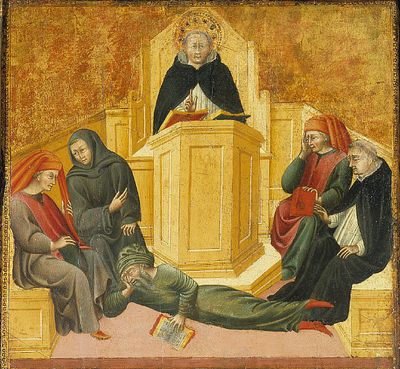
The objection (II-II, q. 88, a. 2, obj. 2) poses the difficulty as sharply as anyone has:
Jephthah is listed among the saints in Hebrews 11:32, yet “he killed his innocent daughter on account of his vow (Judges 11). Since, then, the slaying of an innocent person is not a better good, but is in itself unlawful, it seems that a vow may be made not only about a better good, but also about something unlawful.”
Aquinas’s reply establishes the threefold classification of vow-matter that has shaped Catholic moral theology ever since:
- Things good whatever their result—acts of virtue. These may absolutely be vowed.
- Things evil whatever their result—sins in themselves. These “can nowise be the matter of a vow.”
- Things good in themselves but which may yield an evil result. These may be vowed, but the vow must not be kept if evil results follow.
Aquinas places Jephthah squarely in the third category:
“It was thus with the vow of Jephte, who as related in Judges 11:30–31, ‘made a vow to the Lord, saying: If Thou wilt deliver the children of Ammon into my hands, whosoever shall first come forth out of the doors of my house, and shall meet me when I return in peace… the same will I offer a holocaust to the Lord.’ For this could have an evil result if, as indeed happened, he were to be met by some animal which it would be unlawful to sacrifice, such as an ass or a human being.”
Aquinas then deploys the maxim he attributes to Jerome (and which actually descends from Peter Comestor):
In vovendo fuit stultus, quia discretionem non habuit, et in reddendo impius. “In vowing he was foolish, through lack of discretion; in keeping his vow he was wicked.”
The vow itself sinned by indiscretion—the matter was indeterminate and could resolve into something unlawful. The fulfillment sinned by impiety—having seen the evil that would result, Jephthah should have recognized the vow as void and refused to act on it.
Aquinas then addresses why Jephthah nevertheless appears in Hebrews 11. He offers three reasons (II-II, q. 88, a. 2, ad 2), the third of which contains a striking typological hint:
- The Spirit of the Lord came upon him (Judges 11:29)—“his faith and devotion, which moved him to make that vow, were from the Holy Ghost.”
- The military victory he obtained was real—God did deliver Ammon into his hand.
- It is probable that he repented of his sinful deed, “which nevertheless foreshadowed something good” (quod tamen praefigurabat aliquod bonum). The closing clause is brief but pregnant: Aquinas allows that the act, however sinful in itself, prefigured something—and Catholic typological exegesis would draw out the Christological resonance at length (see Section 9 below).
A secondary Thomistic text appears in Super Epistolam ad Hebraeos lectura, cap. 11, lectio 5, Aquinas’s lecture commentary on Hebrews 11:32–35, which treats Jephthah among the judges as exemplars of some faith rather than of moral perfection—the same methodological move Chrysostom makes in his Homily 27 on Hebrews. The Catena Aurea covers only the four Gospels and contains no direct Jephthah commentary. The Quaestiones Disputatae De Malo and De Virtutibus do not treat the case specifically.
The Aquinian framework—votum de re illicita non obligat, “a vow about an unlawful matter does not bind”—is the bedrock principle of Catholic moral theology on rash vows, and it received its definitive articulation in this single article of the Summa.
7. Vows, conscience, and the Catechism
Catholic moral theology since Aquinas has consistently applied his framework. The principle is straightforward: a promise made to God must serve the good. A promise that would bind one to evil is void from the beginning, and to fulfill such a vow compounds the sin rather than mitigates it.
The Catechism of the Catholic Church
The CCC—which the Church presents as an exposition of divine love and not merely a rulebook—does not name Jephthah, but the relevant paragraphs apply directly to his case:
- CCC 2102 defines a vow as “a deliberate and free promise made to God concerning a possible and better good which must be fulfilled by reason of the virtue of religion” (citing CIC, can. 1191 §1). The decisive phrase is “a possible and better good”—a vow concerning an evil act fails this definition and is null ab initio.
- CCC 2101: “Fidelity to promises made to God is a sign of the respect owed to the divine majesty and of love for a faithful God.”
- CCC 2103: “The Church can, in certain cases and for proportionate reasons, dispense from vows and promises.”
- CCC 2150–2155 on oaths apply the same principle to perjury and to oaths made to do evil.
- CCC 2258: “Human life is sacred because from its beginning it involves the creative action of God… God alone is the Lord of life from its beginning until its end: no one can under any circumstance claim for himself the right directly to destroy an innocent human being.”
- CCC 2261: “The deliberate murder of an innocent person is gravely contrary to the dignity of the human being, to the golden rule, and to the holiness of the Creator. The law forbidding it is universally valid: it obliges each and everyone, always and everywhere.”
- CCC 2268: “Infanticide, fratricide, parricide and the murder of a spouse are especially grave crimes by reason of the natural bonds which they break.”
Read together, these paragraphs make Jephthah’s case textbook. He vowed something that, in the event, ceased to be “a possible and better good” and became the deliberate killing of an innocent—his own child, the most grievous of all bonds the Catechism names. The vow was therefore null. He should not have kept it. He should have done what the Targumist said Phinehas would have helped him do: redeem her under Leviticus 27.
The moral theology manuals
The principle votum de re illicita non obligat is found in every standard Catholic moral theology manual. St. Alphonsus Liguori (1696–1787, Doctor of the Church and Doctor Moralis), in Theologia Moralis, follows the Thomistic framework in treating vows under the Decalogue and applies the principle that a vow whose fulfillment requires sin is null. Dominic Prümmer, O.P., in Manuale Theologiae Moralis; Henry Davis, S.J., in his standard four-volume Moral and Pastoral Theology (1935); and in our own day Germain Grisez in The Way of the Lord Jesus—all teach the same. Grisez’s “new natural law” account is especially clear: the absolute prohibition against intentionally killing the innocent is one of the basic human goods that may never be violated, and Jephthah’s case is the paradigm of how misguided piety cannot override exceptionless moral norms.
The conclusion is unanimous across the Catholic tradition: Jephthah sinned twice. He sinned in vovendo by making a rash, indeterminate vow without the discretion the virtue of religion requires. And he sinned in solvendo by carrying out a vow whose fulfillment had become an act of murder.
The Leviticus 27 escape Jephthah did not take
The Targumic critique sharpens to a fine point in Catholic moral theology. Under Leviticus 27:1–8, a female aged 20–60 vowed to the LORD could be redeemed with thirty shekels of silver—a sum well within reach of a victorious judge. Jephthah’s geographic and theological isolation in Transjordan, far from priestly instruction, plausibly explains his ignorance. But Catholic moral theology preserves the distinction between ignorantia invincibilis (which excuses) and ignorantia vincibilis (which does not). Jephthah’s ignorance was vincible. He could have inquired. The rabbinic tradition faults both Jephthah and the High Priest Phinehas for refusing to approach each other out of pride: the Babylonian Talmud (Ta’anit 4a) calls Jephthah’s vow shelo kehogen—“improper”—and the fullest version of the mutual-blame tradition appears in Genesis Rabbah 60:3, which preserves the proverb “between the midwife and the woman in labor, the son of the unfortunate woman was lost.” That is precisely the pastoral judgment the Catholic tradition makes as well.
Magisterial silence and the verdict of tradition
A systematic search of Vatican.va, the Acta Apostolicae Sedis, and the catechetical addresses of recent popes reveals no direct papal treatment of Jephthah by name. He does not appear in Benedict XVI’s well-known biblical-figure series, nor in John Paul II’s catechetical cycles, nor in Francis’s homilies. The Pontifical Biblical Commission documents (The Interpretation of the Bible in the Church, 1993; The Jewish People and their Sacred Scriptures in the Christian Bible, 2001) do not reference him. The Roman Catechism of 1566 does not cite him in its treatment of vows.
This magisterial silence is itself significant. The Church has never formally adjudicated the exegetical question (literal sacrifice vs. dedication), nor has it dogmatically pronounced on the moral status of Jephthah’s act. The matter is left to the theological tradition—and there, as documented above, the consensus is overwhelming: he killed her, and he sinned in doing so.
8. The daughter
The text never gives her a name. This silence has been read in two opposing ways.
For feminist scholars like Phyllis Trible (Texts of Terror, 1984), the anonymity is paradigmatic of women’s silencing in patriarchal narrative. The daughter is “powerless property,” in Mieke Bal’s phrase; Bal herself proposes calling her “Bath.” J. Cheryl Exum, in the same vein, has advocated naming her “Bat-Jiftah”—“daughter of Jephthah”—to underline how she is defined entirely by her relationship to her father.
But Catholic readers may also notice a different effect of the anonymity. By refusing to name her, the text universalizes her. She becomes every daughter sacrificed to the rashness, ambition, or theological confusion of those who should have protected her. And the community remembers what the narrator nearly erases. Verse 40 reports that “the daughters of Israel went year by year to lament (or commemorate) the daughter of Jephthah the Gileadite four days in the year.” This communal, exclusively female mourning rite—preserved as a hoq (חֹק), a statute, alongside Passover and David’s war-spoils law—is a kind of subversive counter-narrative. The women of Israel hold the memory the main story tries to bury.
The earliest extensive expansion of the story, the first-century Pseudo-Philo (Liber Antiquitatum Biblicarum), names the daughter Seila and gives her a voice. In Pseudo-Philo’s retelling, God is depicted as angry at the vow: “If a dog should meet Jephthah first, will the dog be offered to me?” Seila ascends Mount Stelac and delivers a sophisticated lament, explicitly invoking the binding of Isaac: “Have you forgotten what happened in the days of our fathers when the father placed the son as a burnt offering?” God declares Seila “wiser than her father” and promises her death “will be precious before me always.” (Standard critical edition: Howard Jacobson, A Commentary on Pseudo-Philo’s Liber Antiquitatum Biblicarum, Brill, 1996.)
The name Seila would re-enter the Catholic imagination through Peter Abelard, and from there—through art, music, and devotion—into the long Catholic afterlife of the passage.

9. The Catholic afterlife: Carissimi, Abelard, and the typology of sacrifice
Jephthah’s daughter has no feast day. She does not appear in either the pre- or post-Vatican II Roman Martyrology. She has no liturgical commemoration in the Latin Rite. And yet the Catholic tradition has remembered her with surprising tenderness—in oratorio, in monastic lament, in stained glass and tapestry, and in the typological imagination of the Middle Ages.
Giacomo Carissimi’s Jephte (c. 1648–1649)
The most significant Catholic artistic treatment of the passage is the Latin oratorio Jephte by Giacomo Carissimi (1605–1674), maestro di cappella at the Jesuit German College and the Church of Sant’Apollinare in Rome. Jephte is widely considered the finest Latin oratorio of its era and a founding masterwork of the entire oratorio genre—and it remains, almost four centuries on, the single greatest musical setting of any episode from Judges.
The libretto is adapted directly from the Vulgate text of Judges 11:28–40. Three principal dramatic roles carry the action—a Historicus (narrator), Jephthah, and his daughter—though the Historicus is not a single voice but shifts across alto, bass, and soprano solos and smaller ensembles, with the whole work scored for six voice parts (SSSATB) plus chorus. Kircher, strikingly, calls the piece a dialogum rather than an “oratorio”—the genre term itself was not fully standardized until the 1660s. The work is generally thought to have been performed at the Oratorio del Santissimo Crocifisso in Rome, since oratorios were the only dramatic musical performances permitted during Lent (liturgical music—masses, vespers, motets—continued normally). Athanasius Kircher cited it in his Musurgia universalis (published 1650, though the book’s content was finalized by 1649, as the dedicatory portrait is dated Antwerp 1649) for its unparalleled ability to “move the minds of listeners to whatever affection [the composer] wishes,” providing an ante quem for Jephte.
The oratorio tradition itself grew from St. Philip Neri’s devotional gatherings at the Congregation of the Oratory in the 1550s (Neri was ordained in 1551; the Congregation received papal recognition in 1575), making Jephte a thoroughly Catholic artistic flowering.
The piece runs roughly twenty to twenty-five minutes. After the daughter’s extended, almost unbearable lament, the work closes with the famous chorus “Plorate filii Israel, plorate omnes virgines, et filiam Jephte unigenitam in carmine doloris lamentamini”—“Weep, O children of Israel, weep all ye virgins, and in songs of sorrow lament the only-begotten daughter of Jephthah.” It is one of the most affecting choral passages in the entire Baroque repertoire, and its theological force is unmistakable: the Catholic Church, in the heart of seventeenth-century Rome, gathered in Lent to weep with the daughters of Israel for a girl whose name even Scripture had not preserved.
Peter Abelard’s Planctus virginum Israel super filia Iephte Galaaditis (c. 1130s)
Five centuries before Carissimi, Peter Abelard (d. 1142) had composed six Latin verse Planctus (Laments) drawn from Old Testament voices—most likely written for Héloïse and the nuns of the Paraclete. The third lament, Planctus virginum Israel super filia Iephte Galaaditis (“Lament of the Virgins of Israel over the Daughter of Jephthah of Gilead”), opens “Ad festas choreas celibes”—“To the festive dances, you unmarried maidens.” It is voiced by the maidens of Israel themselves, mourning the daughter of Jephthah.
Abelard, like Pseudo-Philo, calls her Seila. In his letters to Héloïse, he portrays Seila as a model for monastic women who devote their whole lives to God, drawing an explicit line between the daughter’s consecrated virginity (or sacrificial death) and the religious life. The best modern edition, with the first complete English translation, is Juanita Feros Ruys, The Repentant Abelard: Family, Gender, and Ethics in Peter Abelard’s Carmen ad Astralabium and Planctus (Palgrave Macmillan, 2014). The melody is preserved in medieval notation, though its exact reconstruction remains debated.
What is striking is that the founder of scholastic dialectic chose Seila—not Mary, not a martyr, not a desert mother—as a model for the consecrated women in his pastoral care. (Abelard’s instinct here is of a piece with his broader theological move toward interiority and example, which I discuss in the post on Abelard’s subjective atonement theory.) The Catholic tradition has, at its best, refused to look away from her.
The Liturgy of the Hours
In the post-Vatican II Liturgy of the Hours, the Book of Judges is read semi-continuously during Ordinary Time, typically in the late summer or early autumn weeks. The Jephthah narrative falls within this cycle. The Office of Readings pairs each Scripture passage with a second reading from patristic or spiritual writers; the patristic readings drawn for the Judges weeks belong to the same tradition documented in Sections 4 and 5 above. The faithful who pray the Office encounter Jephthah every couple of years.
The typological tradition: from Augustine to the Speculum
Catholic typological exegesis has read Jephthah’s daughter both as a type of Christ and (more rarely) as a type of Mary.
The Christological reading is hinted at by Aquinas (“praefigurabat aliquod bonum”) and developed at length in the medieval period. The most elaborate ancient version is by Jacob of Sarug (c. 451–521), the great Syriac theologian, in a metrical homily that argues Jephthah’s daughter was necessary as a type of Christ because the sacrifice of mere animals insufficiently pointed forward to Calvary. Jacob casts Jephthah as a type of God the Father and the daughter as a type of Christ, calling her “the offering speaking to the priest” and “the sacrifice speaking in reply to the priest, to show him that without sorrow he should offer it.” Jacob belongs to the Syriac rather than the Latin tradition, but his reading was known to and cited by later Catholic sources.
The structural parallels with Calvary are real: a beloved only child, willing acceptance of death, the journey to a sacred place, an obedient submission to a father’s word. The disanalogies are equally real and must not be elided: Jephthah was not God the Father, his vow was not the divine plan of salvation, and his daughter—unlike Christ—was a victim of human folly rather than the freely-offered Lamb. The Christological typology must be held lightly, as Aquinas held it: as a hint that even the most catastrophic human failure can be drawn into the broader logic of redemption, not as a justification of the failure itself.
The Marian reading appears in scattered medieval sources, drawing parallels between the daughter’s perpetual virginity (“she knew no man”) and Mary’s, between her willing obedience to her father’s word and Mary’s fiat at the Annunciation, and between the offering of the virgin daughter and Mary’s purification at the Temple (Candlemas, February 2). This typology is minor compared to the great Marian types—the New Eve, the Ark of the Covenant, the Daughter Zion—and it does not enter formal Marian dogmatic theology. But it shaped medieval iconography. The Speculum Humanae Salvationis (c. 1309–1324), the bestselling typological manual of the late Middle Ages, surviving in over 350 manuscripts plus blockbook and incunabulum editions, juxtaposed the Presentation of Mary at the Temple with Jephthah’s daughter—though the relationship there is more a contrast than a straightforward prefiguration, setting Mary’s willing virginal service over against the daughter’s forced sacrifice. The related Biblia Pauperum transmitted the same tradition. Together these two works shaped medieval programs in stained glass, sculpture, tapestry, and manuscript illumination across Western Europe.
The medieval Latin commentators
Three medieval Catholic commentary traditions deserve mention:
- The Glossa Ordinaria on Judges 11 (PL 113), the standard medieval biblical commentary compiled in the twelfth century in the school of Anselm of Laon, transmitted the literal-sacrifice reading and the patristic moral analysis to every medieval theology student.
- Rabanus Maurus (c. 780–856), the Praeceptor Germaniae, wrote extensive commentaries on the Heptateuch drawing on Jerome, Augustine, Gregory the Great, Isidore, Origen, Ambrose, and Bede. His Judges commentary follows the patristic framework directly.
- Nicholas of Lyra (c. 1270–1349), the Franciscan whose Postilla Literalis engaged Jewish exegesis (especially Rashi) more than any other medieval Christian, encountered the Radak/Kimhi tradition arguing for the daughter’s survival and dedication to perpetual virginity. Nicholas’s engagement with Jewish sources represents the late-medieval point at which the dedication reading first began to enter Catholic exegesis from the Jewish tradition—though it did not displace the patristic consensus.
Cornelius a Lapide
The great Jesuit exegete Cornelius a Lapide (1567–1637), in his Commentaria in Scripturam Sacram on Judges 11, synthesizes the entire prior Catholic tradition. His commentary works through “not only the literal, but also the allegorical, tropological, and anagogical senses” with extensive quotations from the Fathers, the Glossa Ordinaria, Nicholas of Lyra, and the Scholastics. It is the most comprehensive single Catholic treatment of the passage before the modern period and remains valuable for its sheer breadth of patristic and medieval citation. The Latin text is available in the standard collected editions (Antwerp 1681; Lyon 1839–1842; Paris 1859–1863).
Modern Catholic biblical scholarship
The modern Catholic biblical commentaries continue the tradition. The Jerome Biblical Commentary (1968), the New Jerome Biblical Commentary (1990, with the Judges article by M. O’Connor), and the Jerome Biblical Commentary for the Twenty-First Century (2022, ed. Collins, Hens-Piazza, Reid, and Senior, with foreword by Pope Francis) all read the passage through the historical-critical lens authorized by Divino Afflante Spiritu (1943), treat the narrative as describing actual human sacrifice, and place it within the Deuteronomistic History’s portrait of moral decline.
Roland de Vaux, O.P., longtime director of the École Biblique in Jerusalem, treats Jephthah’s sacrifice in his magisterial Ancient Israel: Its Life and Institutions (English translation, McGraw-Hill, 1961), in the section on human sacrifice in Israel, placing it within the broader ancient Near Eastern context while emphasizing that the prophetic and legal traditions consistently condemned such practices. The Navarre Bible: Joshua–Kings (Scepter Publishers) and the Ignatius Catholic Study Bible: Old Testament offer pastorally oriented treatments in the same tradition. The most relevant article in the Catholic Biblical Quarterly is Mary Ann Beavis, “The Resurrection of Jephthah’s Daughter: Judges 11:34–40 and Mark 5:21–24, 35–43,” CBQ 72.1 (January 2010), pp. 46–62, an intertextual study comparing Jephthah’s daughter with Jairus’s daughter—and reading Christ’s raising of a young girl as a kind of canonical answer to the silence of God in Judges 11.
10. The Aqedah, the silence of God, and the Cross
Genesis 22—the binding of Isaac—and Judges 11 are deliberately set in dialogue. Both stories involve a father, an only child, a journey to the place of sacrifice, a dialogue between father and child, and a climactic moment on a mountain. The rare Hebrew adjective for “only” appears in both: the masculine yahid (יָחִיד) of Isaac in Genesis 22:2, 12, 16, and the feminine yehidah (יְחִידָה) of Jephthah’s daughter in Judges 11:34—one of only a handful of occurrences of the form in the Hebrew Bible. Modern commentators have long read Judges 11:30–39 as a deliberate structural inversion of Genesis 22. The inversion is devastating:

- Abraham was commanded by God; Jephthah initiated his own vow.
- Abraham trusted God without bargaining; Jephthah tried to buy divine favor.
- God provided a ram for Abraham; God was silent with Jephthah.
- The Aqedah affirms divine provision; Jephthah’s story illustrates the consequences of religious ignorance and pride.
The Genesis 22 parallel is not an embarrassment to the literal-sacrifice reading; it is the engine of it. The text wants us to feel the absence of the angel.
And yet, read within the whole canon, the silence is not the last word. The book of Judges itself ends with the refrain: “In those days there was no king in Israel: every one did what seemed right to himself” (Judges 21:25, Douay-Rheims). The downward spiral of Judges is a cry for a true king. For Catholic readers, that cry finds its answer not in David—David is in the same Hebrews 11 list, and David also wrecked a household over a vow he should never have made—but in Christ, the King who does not demand the sacrifice of his children but becomes the sacrifice for them.
Catholic typology has long read Isaac as a figure of Christ: a beloved son who carries the wood of his own offering up the mountain. (For another example of how Catholic readers have traced this typological grammar across Scripture, see my treatment of Cana and Calvary in John’s Gospel.) Jephthah’s daughter is, in a sad and indirect way, also a figure of what humanity does in the absence of the Cross—what we are reduced to when we try to manage God by transactional vows. She is the casualty of a religious world that has not yet learned that God desires “mercy and not sacrifice” (Hosea 6:6; Matthew 9:13). And the medieval Catholic instinct that paired her with Mary at the Presentation is not finally wrong: the Mother who said fiat and saw her own Son sacrificed is the answer to the daughter who said fac mihi quod promisisti and was sacrificed by hers. The daughters of Israel weep four days for one nameless girl, and the Church places at the center of history a Mother who weeps for her Son so that no daughter need ever be sacrificed again.
This is what Aquinas glimpsed when he wrote, of Jephthah’s terrible deed, that it nevertheless praefigurabat aliquod bonum—it foreshadowed something good. Not because the deed was good, but because every Old Testament story of a child laid on an altar finds its true meaning only in the One who climbed the altar willingly and was not delivered. Where Jephthah’s daughter died because her father’s vow was sinful, Christ died because His Father’s will was love. Where the daughters of Israel wept four days, the Church weeps three—and on the third day, the silence breaks.
11. Reading the passage today
What does the Catholic believer take home from this passage?
First, the danger of treating God as a bargaining partner. Jephthah’s vow is the model of what not to do in prayer. The Catechism’s treatment of prayer (CCC 2559–2565) repeatedly insists that authentic prayer is a relationship of trusting communion, not a contractual exchange. We do not buy God’s favor with promises. Ecclesiastes warned against this exact temptation: “Be not rash with thy mouth, neither let thy heart be hasty to utter any thing before God … It is much better not to vow, than after a vow not to perform the things promised” (Ecclesiastes 5:1, 4, Douay-Rheims).
Second, the principle that conscience must be formed by the law of God. Jephthah’s tragedy is, at root, a tragedy of theological ignorance. The Torah he should have known would have saved his daughter. Catholics inherit a tradition that prizes the formation of conscience precisely because it knows that sincere intentions are not enough. The well-meaning pagan can still kill his own child.
Third, the truth that not all vows are good vows. The Church has always honored holy vows—religious profession, marriage, baptismal promises—and equally always taught that vows to do evil are void. Votum de re illicita non obligat. If Jephthah had known the second principle as well as he knew the first, his daughter would have lived.
Fourth, the dignity of the silenced. The daughters of Israel kept her memory for four days every year. The Church has, in her own quieter way, kept it too—in Abelard’s lament, in Carissimi’s Plorate filii Israel, in the long Catholic exegetical tradition that has refused to rationalize her death. To read the passage well is to mourn with the women of Israel, not to argue past them.
And finally, the Cross. Every Old Testament story of a child laid on an altar finds its true meaning only in the One who climbed the altar willingly and was not delivered. Where Jephthah’s daughter died because her father’s vow was sinful, Christ died because His Father’s will was love. The silence of God in Judges 11 is broken in Matthew 27—and answered, three days later, by an empty tomb.
A note on sources
This post draws primarily on the Hebrew text of Judges 11 (with the Vulgate and Douay-Rheims for Catholic readers), the Septuagint and Targum Jonathan as ancient witnesses, and the following Catholic primary sources:
Patristic. Ambrose, De Officiis Ministrorum I (PL 16; ed. Davidson, OECS 2001); Augustine, Quaestiones in Heptateuchum VII.49 (PL 34; CCL 33); Jerome, Adversus Jovinianum I (PL 23) and Commentary on Jeremiah 7 (PL 24); Chrysostom, Homilies on the Statues 14 (PG 49) and Homilies on Hebrews 27 (PG 63); Origen, Homilies on Judges (PG 12; SC 389; FOC 119, 2010—though Judges 11 is not extant).
Scholastic and medieval. Thomas Aquinas, Summa Theologiae II-II, q. 88, a. 2 (especially the corpus and ad 2); Super Epistolam ad Hebraeos lectura cap. 11; the Glossa Ordinaria on Judges 11 (PL 113); Peter Comestor, Historia Scholastica; Rabanus Maurus, commentaries on the Heptateuch; Nicholas of Lyra, Postilla Literalis on Judges; Peter Abelard, Planctus virginum Israel super filia Iephte Galaaditis (ed. Ruys, Palgrave 2014); the Speculum Humanae Salvationis and Biblia Pauperum; Jacob of Sarug’s metrical homily on Jephthah’s daughter (Syriac, but received in the broader Catholic tradition).
Early modern and modern Catholic. Cornelius a Lapide, Commentaria in Scripturam Sacram on Judges (Antwerp 1681; Lyon 1839–1842); the Catechism of the Catholic Church §§ 2101–2103, 2150–2155, 2258–2269, 2559–2565; St. Alphonsus Liguori, Theologia Moralis; Henry Davis, S.J., Moral and Pastoral Theology (1935); Germain Grisez, The Way of the Lord Jesus; James F. Driscoll, “Jephte,” Catholic Encyclopedia (1910); Roland de Vaux, O.P., Ancient Israel: Its Life and Institutions (1961); The Jerome Biblical Commentary (1968), New Jerome Biblical Commentary (1990), and Jerome Biblical Commentary for the Twenty-First Century (2022); the New American Bible (NABRE) study notes on Judges 11; the Navarre Bible: Joshua–Kings; Mary Ann Beavis, “The Resurrection of Jephthah’s Daughter,” CBQ 72.1 (2010): 46–62.
Music and devotion. Giacomo Carissimi, Jephte (oratorio, c. 1648–1649); Athanasius Kircher, Musurgia universalis (1650); Peter Abelard’s Planctus.
For the broader scholarly background I have relied on Daniel Block’s Judges, Ruth (NAC, 1999); Barry Webb’s The Book of Judges (NICOT, 2012); Robert Chisholm’s A Commentary on Judges and Ruth (Kregel, 2013) and his article “The Ethical Challenge of Jephthah’s Fulfilled Vow,” Bibliotheca Sacra 167 (2010): 404–422; K. Lawson Younger Jr.’s Judges/Ruth (NIVAC); Robert Boling’s Judges (Anchor Bible); David Marcus’s Jephthah and His Vow (Texas Tech, 1986); Howard Jacobson’s critical edition of Pseudo-Philo (Brill, 1996); Phyllis Trible’s Texts of Terror (Fortress, 1984); Mieke Bal’s Death and Dissymmetry (Chicago, 1988); and John L. Thompson’s Writing the Wrongs: Women of the Old Testament among Biblical Commentators from Philo through the Reformation (Oxford, 2001).
Frequently Asked Questions
Did Jephthah really sacrifice his daughter?
The overwhelming majority of Catholic interpreters—Ambrose, Augustine, Jerome, Chrysostom, Aquinas, Cornelius a Lapide, the 1910 Catholic Encyclopedia, and the footnotes of the New American Bible—read Judges 11:39 (“and he did to her as he had vowed”) as describing a literal burnt offering. A minority tradition stemming from the medieval Jewish commentator David Kimhi (Radak) and entering Catholic exegesis through Nicholas of Lyra argues that she was instead dedicated to perpetual virginity. The lexical, grammatical, and canonical evidence favors the literal-sacrifice reading, which is the position this post takes.
Did God approve of Jephthah’s vow?
No. Augustine’s classic answer is that God deliberately did not intervene—as He had for Abraham in Genesis 22—precisely so that Scripture would carry a permanent warning against rash vows and human sacrifice. The silence of God in Judges 11 is judgment, not approval. Chrysostom makes the same point: the annual four-day mourning of Israel’s daughters is itself evidence that the act was not after the mind of God.
Why is Jephthah listed in Hebrews 11:32 if he killed his daughter?
Chrysostom and Aquinas give the same answer. Hebrews 11 commends one specific act of faith—going out under the Spirit of the LORD to fight Israel’s enemies (Judges 11:29)—not the entirety of a man’s life. The same principle explains why Samson, Barak, and even David appear there despite moral failures. As Chrysostom puts it: “do not tell me of the rest of their life, but only whether they did not believe and shine in Faith.”
What does the Catechism say about rash vows?
The Catechism does not name Jephthah, but CCC 2102 defines a vow as “a deliberate and free promise made to God concerning a possible and better good.” A promise to do evil fails this definition and is null from the beginning. CCC 2258 and 2261 teach that the deliberate killing of an innocent person is absolutely forbidden, and CCC 2268 singles out the murder of one’s own child as especially grave. The Thomistic principle votum de re illicita non obligat—“a vow about an unlawful matter does not bind”—is the bedrock of Catholic moral theology on this point.
Could Jephthah have legally broken the vow?
Yes. Leviticus 27:1–8 established a redemption schedule for persons vowed to the LORD: a woman aged 20–60 could be redeemed for thirty shekels of silver. Targum Jonathan faults Jephthah for not consulting the High Priest Phinehas, who would have invoked this clause. The Talmud (Ta’anit 4a) faults both men for pride: “between them both, the maiden was lost.” Catholic moral theology treats Jephthah’s ignorance as vincible—he could have inquired—and therefore not fully excusing.
Who was Jephthah’s daughter?
Scripture does not give her a name. The first-century Jewish text Liber Antiquitatum Biblicarum (Pseudo-Philo) calls her Seila and gives her a voice and a sophisticated lament. Peter Abelard used the same name in his twelfth-century Planctus virginum Israel super filia Iephte Galaaditis, and from there the name entered the Catholic devotional and artistic imagination. Giacomo Carissimi’s oratorio Jephte (c. 1648–1649) gave her the most famous musical lament in the Baroque repertoire.
1. A brief methodological note: critical scholarship debates when the Pentateuch reached its final form, and the historical Jephthah, if we could recover him, may well have known nothing of a codified Torah. Throughout this post I read Judges canonically—within the narrative world the text itself assumes, in which the Torah is already in force and Jephthah is judged by its standard. This is the hermeneutic of the Catholic interpretive tradition, and it is the one on which the patristic and scholastic verdicts rest.
If this post helped you, consider sharing it with someone else who has wrestled with this passage. And if you disagree with where I have landed, the comments are open—but please honor the daughters of Israel by being kind.

Garrett Ham
Garrett Ham is an attorney, military veteran, and holds a Master of Divinity from Yale Divinity School. He writes from Northwest Arkansas on theology, law, and service.
More about Garrett →Related Posts
The First Council of Nicaea: What It Decided and Why It Matters
What happened at the First Council of Nicaea in 325 AD? A Catholic examination of the Arian crisis, the meaning of homoousios, and why the Nicene Creed still defines Christian orthodoxy.

Week 7 at Yale: Struggle with Scriptural Inerrancy
What does scriptural inerrancy really mean? A Yale Divinity student explores how to define biblical errors, reconcile contradictions, and understand Scripture as a reliable guide for faith.
Stay Informed
Get new writing on faith, law, and service delivered to your inbox.
No spam. Unsubscribe anytime.