Jansenism: The Augustinian Heresy That Divided the Church
On This Page
Few movements in the history of the Catholic Church have been as earnest, as austere, or as ultimately mistaken as Jansenism. Born from a sincere desire to recover the theology of Augustine against what its founders saw as a lax and complacent age, Jansenism pressed the great Doctor of Grace’s teaching past the boundary the Church had drawn—and in doing so reproduced, under Catholic colors, much of what Calvin had taught a century earlier. For more than a hundred years it shaped French religious life, produced some of the most brilliant minds of the age, and forced the Church to define, again and again, exactly how grace and human freedom fit together.
To understand Jansenism is to understand a recurring temptation in Christian thought: the impulse to magnify the sovereignty of grace so completely that human freedom, the universal will of God to save, and the genuine sufficiency of grace offered to all quietly disappear.
Jansenism was a movement in seventeenth- and eighteenth-century Catholicism, named for Cornelius Jansen, the Dutch-born bishop of Ypres, which held that grace cannot be resisted, that the fallen will is not truly free, and that Christ died only for the elect. Rome condemned it repeatedly—most decisively in 1653 and 1713, and its Italian afterlife in 1794.
Who Was Cornelius Jansen?
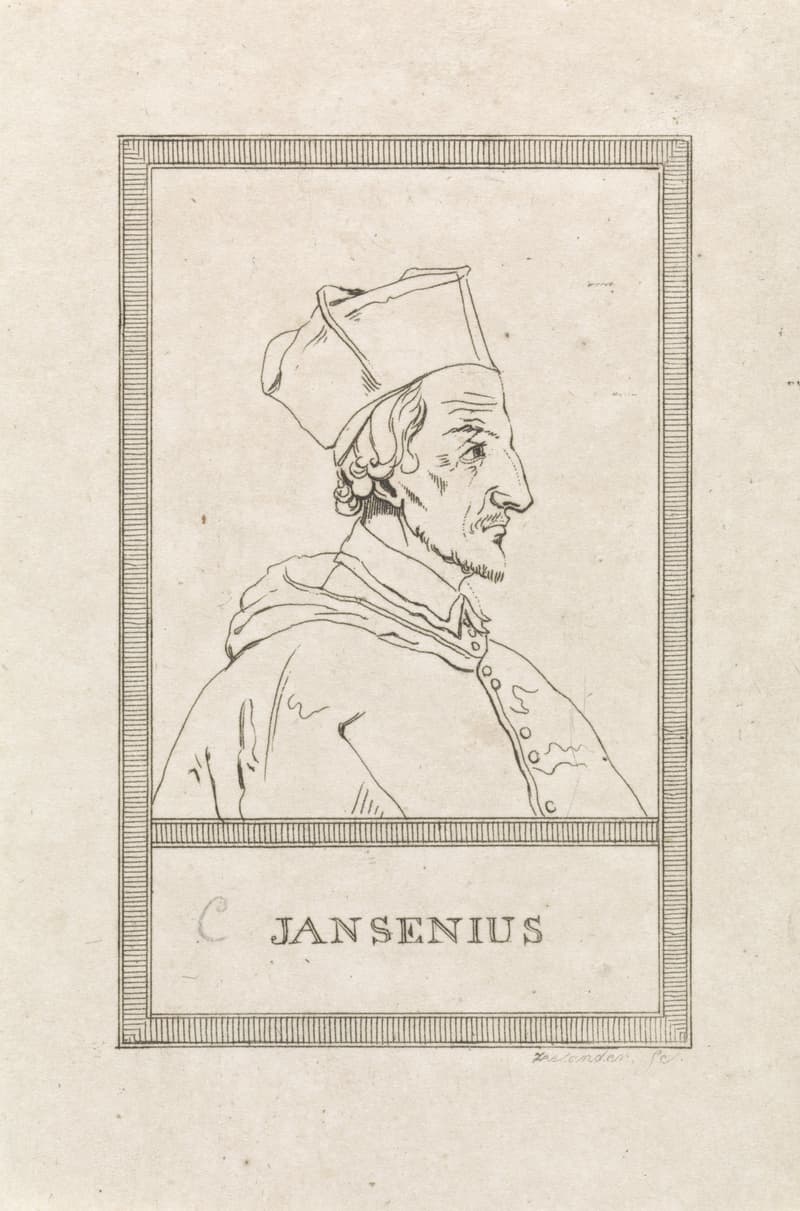
Cornelius Jansen—Latinized as Jansenius—was born in 1585 in the Low Countries and educated at the University of Louvain, then the great northern center of Augustinian theology.1 At Louvain he absorbed a tradition that had been shaped by the controversy over Michael Baius (Michel de Bay), a Louvain theologian who had pressed Augustine’s darkest themes into strict doctrine: an original integrity owed to human nature rather than freely given, and a fallen will able of itself to do nothing but sin. Pope Pius V condemned a list of propositions drawn from Baius’s work in 1567, in a bull that pointedly declined to name him. That condemnation hung over everything that followed: the question of how far one could press Augustine without falling into error was already, in Jansen’s world, a live and dangerous one.
From Louvain to Ypres
It was at Louvain that Jansen formed the friendship that would define his life, with a French student named Jean du Vergier de Hauranne, later the Abbé de Saint-Cyran. Together the two men conceived a project of theological renewal: a return to the authentic Augustine, purified of what they regarded as the evasions of the Jesuit theologians of grace. Jansen would supply the scholarship; Saint-Cyran would carry the cause into France.
Jansen rose to become Bishop of Ypres in Flanders. He died there of the plague in 1638, his great work still unpublished.
The Augustinus
The book on which Jansen had labored for some twenty years appeared posthumously in 1640 under the title Augustinus. It was a massive synthesis of Augustine’s anti-Pelagian writings, organized to demonstrate that the Catholic theology of grace had drifted from its patristic source and toward a covert Pelagianism—the very error Augustine had spent his life refuting. (On that original controversy, see my essay on Pelagianism and Semi-Pelagianism.)
The intention was conservative: to defend grace against human presumption. But in pressing Augustine’s language of efficacious, sovereign grace to its limit, Jansen produced a system in which grace not only enables the will but overwhelms it—and in which the freedom Augustine had always preserved quietly vanished.
The book also broke a truce. Rome had spent a decade on precisely this question in the Congregation de Auxiliis (1597–1607), which heard the Dominicans and the Jesuits argue efficacious grace through eighty-five conferences and settled nothing; Paul V finally let each school keep its own doctrine, forbade either to charge the other with heresy, and in 1611 barred the publication of any book on efficacious grace until the Holy See should rule. It never did, and the prohibition stood for most of the century.
Rome’s response was therefore swift. The Holy Office prohibited the book in 1641, and the following year Urban VIII’s bull In eminenti renewed the condemnation—both because the Augustinus defied that standing ban and because it revived errors of Baius that Pius V and Gregory XIII had already censured.2 Its reception foreshadowed what was to come: some claimed the bull had been forged or interpolated, and the Augustinus circulated regardless, on the plea that authority had yet to condemn any well-defined thesis.
The Heart of Jansenist Theology
Jansenism is often summarized, accurately enough, as “Catholic Calvinism.” The label is imperfect—the Jansenists insisted, sincerely, that they were faithful Augustinian Catholics—but it captures the substance of the problem.
Grace That Cannot Be Resisted
Catholic theology distinguishes two kinds of help. Sufficient grace genuinely enables a good act while leaving the will free to cooperate with it or refuse it; efficacious grace infallibly accomplishes the act God intends by it. At the core of Jansenism lay the doctrine of efficacious grace conceived as irresistible in the strong sense—not merely certain of its effect, but incapable of being refused. When God gives grace, Jansen taught, the will cannot finally refuse it. The fallen will is not poised between competing attractions but is simply moved by whichever delight is stronger—the delectatio victrix, or “victorious delight,” a phrase the Jansenists took over from Augustine and made the hinge of their system. On this account the human being does not so much choose as register the verdict of the dominant pleasure.
This is the decisive break with Catholic teaching. The Church holds that efficacious grace is real, but that even the grace which infallibly achieves its end does so without coercion, moving the will in a manner that respects and perfects its freedom. Grace and freedom, in Catholic doctrine, are not rivals competing for the same space (CCC 2022; 1742).3
On this account the human being does not so much choose as register the verdict of the dominant pleasure.
Where Jansen Parted from Augustine
Étienne Gilson drew the line between Augustine and Jansen with unusual precision, and the distinction is worth stating exactly, because the word irresistible does two different jobs in this argument. It can mean that grace unfailingly accomplishes what God intends by it, or it can mean that grace overrides the will. Augustine holds the first and denies the second. Augustinian grace, Gilson wrote, “can be irresistible without being constraining”: it attains its end, but does so either by suiting itself to the free choice of those it has decided to save, or by transforming the will from within so that the will comes to delight freely in what it would otherwise refuse.4
Jansen’s initial error, on Gilson’s reading, was not that he made grace efficacious—Augustine had done that—but that he treated delight as a weight in the will distinct from the will itself. For Augustine, grace changes what a man loves, so that he wants the good freely and as his own; for Jansen, delight arrives as a force acting on the will from outside, and the strongest one wins. Once delight becomes a cause acting upon the will rather than the will’s own movement, grace begins to look like determinism, and freedom is gone.
Gilson called this a deviation from authentic Augustinianism, and Henri de Lubac pressed the same point about the vocabulary: the phrase gratia victrix that Jansen claimed to have found not rarely in Augustine is not there, while delectatio victrix, which is Augustine’s own, was for him a metaphor rather than a theory.
A Pessimistic View of Human Nature
Jansenism followed Baius—the condemned Louvain rigorist—in taking a still darker view of fallen nature. After Adam, the human person was understood to be so dominated by concupiscence that, apart from efficacious grace, every act tended toward sin. There was no “sufficient grace” that enabled the good while leaving the outcome to free cooperation; grace either conquered or was absent.
From this followed the most startling of the Jansenist theses: that Christ did not die for all men, but only for the elect. The universal salvific will of God—the truth that “God desires all men to be saved and to come to the knowledge of the truth” (1 Tim 2:4 RSV-CE)—was, on the Jansenist reading, an illusion. (I treat that doctrine at length in God Desires All Men To Be Saved.)
Moral Rigorism
The theology bred a temperament. Jansenism became famous—and, for a time, admired—for its severity: a horror of sin, a suspicion of pleasure, and a reverence for the sacraments so exacting that it kept people away from them. Antoine Arnauld’s De la fréquente communion (1643) argued that the Eucharist should be approached only rarely and after long penance, a counsel that spread a chill over French Catholic piety for generations.5 The irony is sharp: a movement that began by exalting grace ended by making the means of grace seem almost unapproachable.
Port-Royal and the Spread of Jansenism
Jansenism would have remained a Flemish academic dispute had it not found, in France, a community to embody it. That community was the convent of Port-Royal, reformed into austere discipline by its formidable abbess, Mère Angélique Arnauld, and guided spiritually by Saint-Cyran.
The irony is sharp: a movement that began by exalting grace ended by making the means of grace seem almost unapproachable.
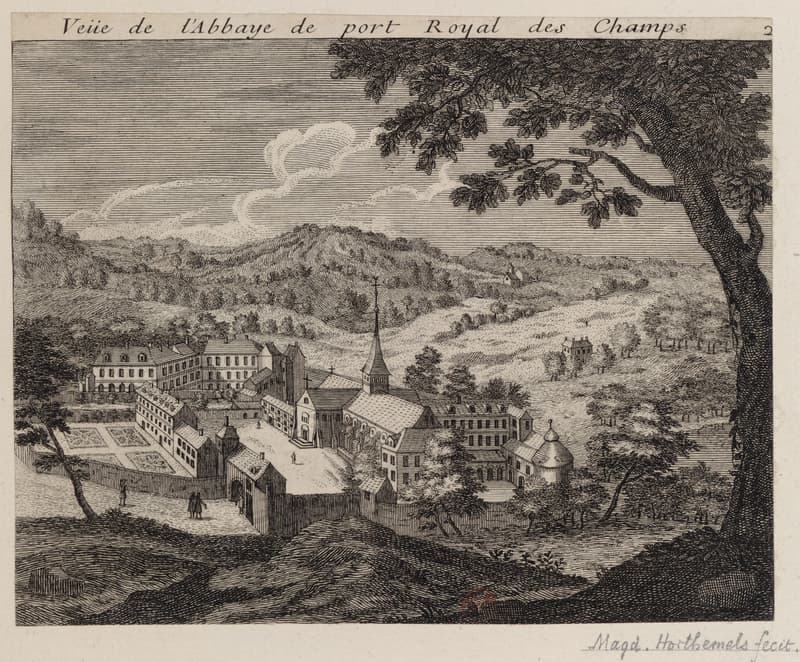
Around Port-Royal gathered the remarkable Arnauld family—above all Antoine Arnauld, “le Grand Arnauld,” theologian and tireless controversialist—together with scholars such as Pierre Nicole and the solitaires, laymen and secular priests who lived without vows or rule in prayer, study, and manual labor. Into this circle came the most famous mind associated with the movement: Blaise Pascal, mathematician, physicist, and author of the Pensées, whose sister was a nun at Port-Royal.
Port-Royal gave Jansenism prestige, brilliance, and a kind of moral glamour. It also gave it enemies, chiefly the Jesuits, whose more optimistic theology of grace and more accommodating moral counsel the Jansenists despised.
The Five Propositions and Their Condemnation
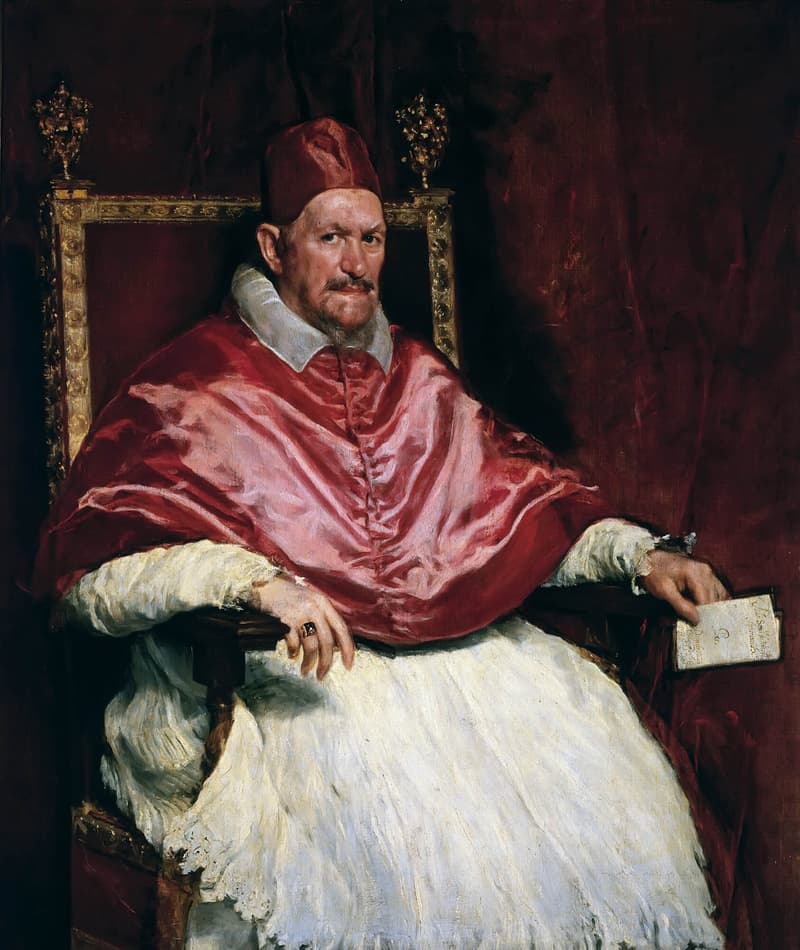
In 1653, after a letter signed individually by some eighty-five French bishops asked Rome to decide the matter, Pope Innocent X issued the bull Cum Occasione, condemning five propositions said to be drawn from Jansen’s Augustinus.6
The Five Propositions
The condemned propositions were these:
- Some of God’s commandments are impossible for the just who wish and strive to keep them, given the powers they actually have; and the grace that would make them possible is also lacking.
- In the state of fallen nature, no one ever resists interior grace.
- To merit or demerit in the state of fallen nature, freedom from interior necessity is not required; freedom from external coercion suffices.
- The Semi-Pelagians admitted the necessity of interior prevenient grace for every act, even the beginning of faith; their heresy lay in holding that this grace could be either obeyed or resisted by the human will.
- It is Semi-Pelagian to say that Christ died or shed his blood for all men without exception.
The fourth is the subtlest of the five. Prevenient grace—the grace that goes before and enables any first movement toward God—is genuinely required, as the Semi-Pelagians said; their error lay elsewhere. Jansen’s proposition located their error in the claim that such grace can be resisted—which implies that it cannot be, and that is the point in dispute.
The censures were graded rather than uniform: this was not a blanket anathema but a set of distinct verdicts, the heaviest falling on the first proposition and the fifth condemned only in a specified sense—that Christ died for the predestined alone.7 The pattern is unmistakable: each proposition denies, in some way, either the genuine freedom of the will under grace or the universal scope of God’s saving will.
The Question of Fact and Law
Here the controversy took its strangest turn. The Jansenists did not defend the five propositions; they conceded that, as condemned, the propositions were erroneous. They argued instead that the propositions were not actually to be found in Jansen’s Augustinus—that Rome had condemned a position no one held. This was the famous distinction between the question of droit (law: are the propositions heretical?) and the question of fait (fact: are they in the book?). The Church, they admitted, could settle the former; but on the latter, they claimed, the faithful owed only a respectful silence, not interior assent.
Rome rejected the evasion. A formulary was drawn up requiring clergy and religious to affirm that the propositions were both heretical and genuinely Jansen’s, and the refusal of Port-Royal’s nuns to sign it without reservation precipitated decades of conflict, suppression, and—eventually—the physical destruction of Port-Royal des Champs. (The Paris house survived to the Revolution, but the resisting community was not there: it had been concentrated at des Champs since the 1660s.)
They argued instead that the propositions were not actually to be found in Jansen’s Augustinus—that Rome had condemned a position no one held.
Pascal’s Provincial Letters
The most enduring monument of the controversy is a work of polemic. Between 1656 and 1657, Pascal published a series of anonymous open letters—the Lettres provinciales—defending Arnauld and savaging the moral theology of the Jesuits. Their casuistry reasoned case by case rather than from rules alone. Their probabilism held that where theologians disagreed, a penitent might follow a solidly probable opinion even if the stricter one were more probable still—a principle meant to keep scrupulous consciences free, and one Pascal portrayed as a machine for excusing sin.8
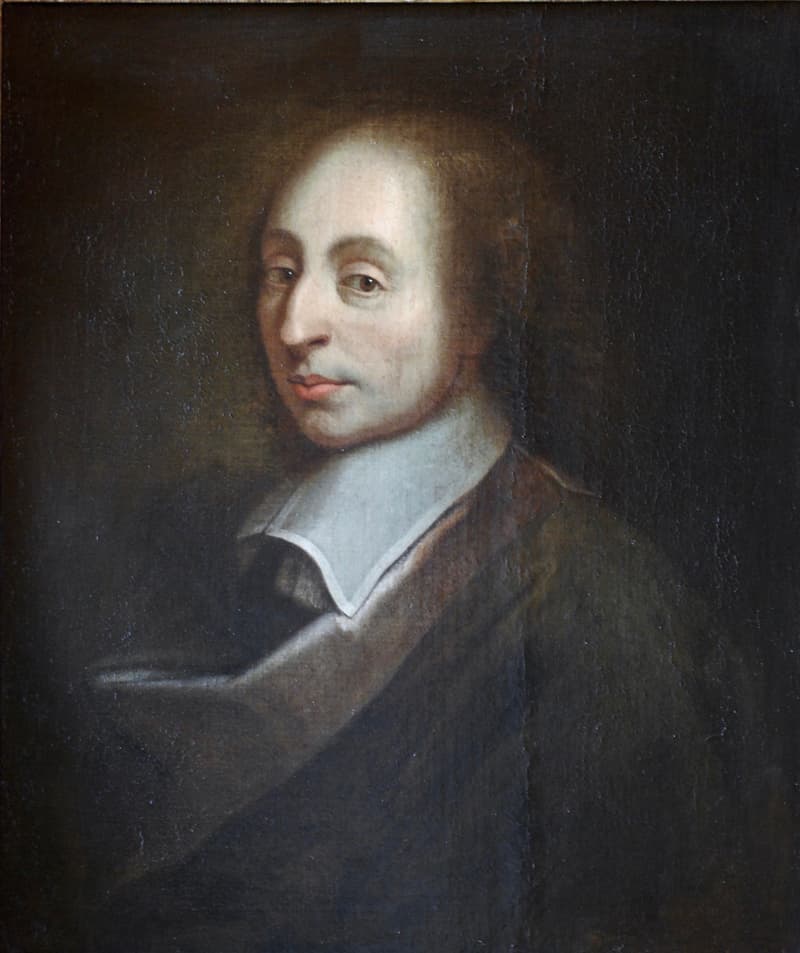
As literature the Provincial Letters are a masterpiece, witty and devastating, and they fixed in the European imagination a caricature of Jesuit laxism that has never fully faded. As theology they are a one-sided weapon. But they reveal the genuine moral seriousness at the heart of Jansenism—and the reason the movement could command the loyalty of a mind as great as Pascal’s.
Unigenitus and the Long Decline
The condemnation of 1653 did not end the movement; it drove it underground and into endless dispute. In the early 18th century the controversy revived around Pasquier Quesnel, an Oratorian whose annotated New Testament, the Réflexions morales, restated Jansenist themes for a popular audience. In 1713 Pope Clement XI condemned 101 propositions from Quesnel’s book in the bull Unigenitus—the most sweeping of all the anti-Jansenist documents.9
Unigenitus split the French Church. Those who accepted the bull were called Acceptants; those who appealed against it to a future general council were called Appellants. The dispute entangled bishops, the Sorbonne, the Parlement of Paris, and the crown, and it dragged on for decades. Deprived of legitimacy at Rome, a remnant of Jansenism survived in the small schismatic Church of Utrecht, while in France it gradually decomposed into political resistance and, in its strangest phase, the ecstatic phenomena of the convulsionnaires at the cemetery of Saint-Médard.
By the end of the 18th century Jansenism as a coherent theological force was spent. What survived longest was not its doctrine of grace but its temperament: a rigorist suspicion of the body, of joy, and of frequent communion that lingered in Catholic practice well into the 20th century.
Jansenism Beyond France: The Synod of Pistoia
That account is French, and Jansenism’s center of gravity always was. But the movement began in the Low Countries, and its last serious institutional venture took place in Italy—in the very decades the French cause was dying. What it looked like there is worth seeing, because it shows what the movement had become.
Peter Leopold, Grand Duke of Tuscany and brother of the Emperor Joseph II, sent his bishops fifty-seven “points of view” on doctrine, discipline, and worship, directing that diocesan synods be convened to enact them. Of eighteen Tuscan bishops only three complied, and only one was a genuine partisan: Scipione de’ Ricci, Bishop of Pistoia and Prato. The synod he convened sat at Pistoia from 18 to 28 September 1786. It adopted the four Gallican Articles of 1682, proposed a vernacular liturgy and a single altar in each church, would have reduced the religious orders to one rule and one habit, and granted the civil power authority over impediments to marriage.
Its program collapsed almost immediately. When Ricci summoned his clergy the following April to endorse the synod, twenty-seven came and twenty refused to sign; the Tuscan bishops, assembled at Florence, rejected the program outright after nineteen sessions. In 1794 Pius VI condemned eighty-five of its propositions in the bull Auctorem fidei. Ricci submitted, and in 1805 asked Pius VII in person for reconciliation.10
Pistoia is worth attention for what it reveals about the endpoint. By 1786 the quarrel was no longer principally about efficacious grace at all; it was about authority—who governs the Church, and on whose warrant. The theology that had once been the whole point had become a banner over a jurisdictional fight, and a state-sponsored one at that. The Italian heirs of the Appellants were defending not a doctrine of grace but a claim about jurisdiction, and they lost that too.
How Jansenism Differs from Catholic Teaching
It is worth stating plainly what the Church affirms against each Jansenist error, because the contrast clarifies Catholic doctrine itself.
What the Church Affirms Against Each Error
The first three Jansenist errors meet the answers already given above: grace heals freedom rather than abolishing it (“God’s free initiative demands man’s free response,” CCC 2002), efficacious grace works in harmony with the will rather than overpowering it, and God “desires all men to be saved” (1 Tim 2:4; CCC 1058). The fourth had been answered a century before the Augustinus appeared. Against the claim that God’s commands can be impossible to the justified, Trent taught that God does not command the impossible but, in commanding, counsels us to do what we can, to ask for the grace to do what we cannot, and helps us so that we can.11
Jansenism and Calvinism: The Same System in Catholic Dress
The deepest irony of Jansenism is that it shares so much with the Calvinism it claimed to oppose. But the resemblance has to be stated precisely, because the crude version of the charge misses its mark.
The Reformed confessions do not teach that grace overpowers the will. The Canons of Dort say that regenerating grace “does not treat men as senseless stocks and blocks, nor takes away their will and its properties, neither does violence thereto,” but “spiritually quickens, heals, corrects, and at the same time sweetly and powerfully bends it” (III/IV.16). Nor do they deny all sufficiency in Christ’s death, which Dort calls “of infinite worth and value, abundantly sufficient to expiate the sins of the whole world” (II.3). Whatever divides Trent from Dort, it is not that one tradition made grace gentle and the other made it violent.
The divergence lies somewhere more precise, and Trent had already marked it. Among the canons of the same session that taught God does not command the impossible, one falls under anathema on anyone who says that the will “cannot refuse its consent, if it would” (Session VI, canon 4). Catholic teaching does not merely permit that interior grace may be refused; it requires it. There must be grace really given, really interior, and really sufficient—and nevertheless refused.
That is exactly what the second condemned proposition denies: in the state of fallen nature, no one ever resists interior grace. Jansen’s system had no room for a grace truly offered and truly rejected—grace either conquered or was absent. The Reformed system, for all its care about the manner of grace, has no room for it either; its sufficiency rests in the worth of the atonement and in the outward call, not in an interior grace a man receives and refuses.
Reformed readers will answer that this leaves out too much. Dort holds that everyone called by the gospel is “unfeignedly called,” and that God “confers upon them various gifts” even where the call is refused (III/IV.8–9); the Westminster Confession grants that the non-elect “may have some common operations of the Spirit” and still “never truly come unto Christ” (10.4). The objection is fair, and it does not reach Trent’s canon. Those operations are, on the confessions’ own account, something other than the grace that justifies, and no Reformed confession will say that the grace which would have saved a man was given to him interiorly and refused. (For that comparison at length, see Catholic vs. Calvinist Predestination.)
This is also why the Catholic schools can quarrel as fiercely as they do and remain inside the boundary Jansenism crossed. Thomists and Molinists divide over how efficacious grace attains its effect; neither surrenders sufficient grace genuinely offered to all. (On that internal debate, see my essay on Molinism.)
Why Jansenism Still Matters
Jansenism is not merely a historical curiosity. It stands as a permanent case study in how a true premise can be driven to a false conclusion. Augustine was right that grace is necessary, sovereign, and unmerited; Jansen took that truth and, by removing every counterweight, turned it into a doctrine of despair. The line between authentic Augustinianism and Jansenist error is precisely the line this whole controversy was fought to draw—and it is the same line that runs through Augustine’s own doctrine of the massa damnata, the condemned mass of fallen humanity, which the Church received without ever concluding, as Jansen did, that God fails to will the salvation of all.12
Augustine was right that grace is necessary, sovereign, and unmerited; Jansen took that truth and, by removing every counterweight, turned it into a doctrine of despair.
The movement’s afterlife is a caution of another kind. Long after its theology was condemned, its spirit persisted in a Catholicism that was anxious, scrupulous, and reluctant at the altar rail. It took the explicit intervention of Pope Pius X in the early 20th century—encouraging frequent, even daily, Communion and admitting children to the Eucharist at the age of reason—to undo much of the pastoral damage Jansenist rigorism had done.13 The doctrine had been answered in the 17th century; the disposition took three hundred years to heal.
Frequently Asked Questions
What was Jansenism?
Jansenism was a movement in 17th- and 18th-century Catholicism, named for Cornelius Jansen, the Dutch-born bishop of Ypres, that sought to recover Augustine’s theology of grace but pressed it into error. It taught that grace is irresistible, that the fallen will is not truly free, and that Christ died only for the elect. Centered in France at the convent of Port-Royal, it was repeatedly condemned by Rome and gradually died out, though its rigorist spirit lingered for centuries.
What is the difference between sufficient and efficacious grace?
Sufficient grace genuinely enables a good act while leaving the will free to cooperate or refuse; efficacious grace infallibly accomplishes what God intends by it. Catholic teaching holds both, and holds that sufficient grace is offered to everyone and sometimes genuinely refused. Jansenism collapsed the distinction: grace either conquered the will or was absent, so a grace really given and really rejected had nowhere to exist. That collapse is what the second condemned proposition denies, and it is where Jansenism left Catholic teaching—and where it most resembles Calvinism (see Catholic vs. Calvinist Predestination).
Why was Jansenism condemned?
Because it denied truths the Church regards as essential: that grace, even when efficacious, respects human freedom; that God genuinely wills the salvation of all; and that Christ died for all, not only for the elect. Pope Innocent X condemned five Jansenist propositions in 1653, and Pope Clement XI condemned 101 more in the bull Unigenitus in 1713.
What were the Five Propositions?
They were five statements, said to be drawn from Jansen’s Augustinus and condemned in 1653. In essence: that some of God’s commands are impossible even to the justified, and the grace to keep them is lacking; that in fallen nature no one ever resists interior grace; that freedom from coercion, without freedom from necessity, suffices for merit; that the Semi-Pelagian error lay in holding that prevenient grace could be resisted; and that it is Semi-Pelagian to say Christ died for all without exception. The censures were graded rather than uniform: the first was condemned as rash, impious, blasphemous, and heretical; the second and third as heretical; the fourth as false and heretical; and the fifth as false, rash, and scandalous—and heretical taken in the sense that Christ died for the predestined alone.
If God’s grace always achieves its effect, how can the will still be free?
The Church denies the premise that grace and freedom compete for the same space. Efficacious grace does not defeat the will from outside; it moves the will from within, so that what a person does under grace is genuinely his own act—grace that, in Étienne Gilson’s formulation, “can be irresistible without being constraining.” How this works Rome has never settled: the Dominicans and Jesuits argued it to a standstill in the Congregation de Auxiliis, and both explanations remain open to Catholics.
What did the Jesuits actually teach that the Jansenists hated?
Chiefly probabilism: where competent theologians genuinely disagreed about whether something was permitted, a penitent could in good conscience follow a solidly probable opinion even if the stricter view had more support. Paired with casuistry—reasoning case by case rather than from rules alone—it was meant to keep anxious consciences from being bound where the Church had not bound them. To the Jansenists it looked like a system for finding permission to sin, and Pascal’s Provincial Letters made that charge unforgettable.
Footnotes
1. Biographical details follow the standard accounts: Cornelius Jansen (1585–1638), educated at Louvain, Bishop of Ypres from 1636, died of plague in 1638. See Jacques Forget, “Jansenius and Jansenism,” in The Catholic Encyclopedia, vol. 8 (Robert Appleton, 1910), and “Cornelius Otto Jansen” in the Encyclopædia Britannica. Among modern studies, see William Doyle, Jansenism: Catholic Resistance to Authority from the Reformation to the French Revolution (Macmillan, 2000), and Alexander Sedgwick, Jansenism in Seventeenth-Century France: Voices from the Wilderness (University Press of Virginia, 1977).
2. Urban VIII, In eminenti (1642), renewing the Holy Office’s decree of 1641 that had prohibited the Augustinus. See Forget, “Jansenius and Jansenism.”
3. Catechism of the Catholic Church 2022 (“The divine initiative in the work of grace precedes, prepares, and elicits the free response of man”) and 1742 (grace does not diminish but rather strengthens and frees the human will). On delectatio victrix (“victorious delight”), the dominant attraction by which, on Jansen’s account, the will is infallibly determined: the phrase is Augustine’s own—uictricem delectationem, De peccatorum meritis et remissione 2.19.32 (CSEL 60:103)—not a Jansenist coinage. What Jansen claimed to have found non raro in Augustine, and did not, was gratia victrix. See n. 4 below.
4. Étienne Gilson, The Christian Philosophy of Saint Augustine, trans. L. E. M. Lynch (Random House, 1960), 155–56, 162, and 321 n. 81; French original Introduction à l’étude de saint Augustin, 2nd ed. (Vrin, 1943), 202, 210–11. Henri de Lubac, Augustinianism and Modern Theology, trans. Lancelot Sheppard (Herder and Herder, 1969), 77, 79–80. A caution on terms: Gilson holds that Augustinian grace is infallibly efficacious while denying that it coerces, whereas Eugène Portalié, using irresistible to mean coercive, denies that Augustine’s grace is irresistible at all (“Teaching of St. Augustine of Hippo,” in The Catholic Encyclopedia, vol. 2 [Robert Appleton, 1907], newadvent.org). They agree in substance and differ in the use of the word.
5. Antoine Arnauld, De la fréquente communion (Paris, 1643). The work counseled rigorous penitential preparation before receiving the Eucharist and was long blamed for the decline in frequent Communion among French Catholics—a charge the magisterium itself echoed in Sacra Tridentina Synodus (1905). Historians of practice now treat it as one factor among several: infrequent reception long predated the book, and the eucharistic fast, the inherited linkage of confession to communion, and a post-Tridentine rigorism neither Jansenist nor Jesuit in origin were at least as consequential.
6. Innocent X, Cum Occasione (May 31, 1653), Denzinger–Hünermann 2001–2007 (= old Denzinger 1092–1096 for the five propositions themselves). The propositions were drawn up in 1649 by Nicolas Cornet, syndic of the Sorbonne’s faculty of theology, who put forward seven and pointedly declined to name any author; whether they are quotations from the Augustinus or Cornet’s own formulations is precisely the question the controversy would turn on. After the Parlement of Paris blocked the faculty’s censure, the matter passed to the Assembly of the Clergy of France in 1650, and a letter organized by Isaac Habert, bishop of Vabres, and signed individually by some eighty-five bishops reached Rome in March 1651. About a dozen bishops, among them Henri Arnauld of Angers, petitioned that the case be tried in France instead.
7. On the precise qualifications, which the bull grades proposition by proposition (Denzinger–Hünermann 2006): the first is declared temerariam, impiam, blasphemam, anathemate damnatam et haereticam; the second and third haereticam; the fourth falsam et haereticam; the fifth falsam, temerariam, scandalosam, and—taken in the sense that Christ died pro salute dumtaxat praedestinatorum, for the salvation of the predestined alone—also impiam, blasphemam, contumeliosam, divinae pietati derogantem et haereticam. Note that the bull says “predestined,” not “elect.” The English wording given here is a standard English rendering of the propositions as condemned, not a quotation from the Augustinus itself—a distinction at the very heart of the controversy (see “The Question of Fact and Law,” above).
8. Blaise Pascal, Lettres provinciales (1656–1657), published pseudonymously, under the name Louis de Montalte. The letters attack the casuistry and probabilism associated with Jesuit moral theology; their portrait of Jesuit laxism is brilliant polemic rather than balanced history. On Pascal’s religion and the spirit of the movement, see Leszek Kolakowski, God Owes Us Nothing: A Brief Remark on Pascal’s Religion and on the Spirit of Jansenism (University of Chicago Press, 1995).
9. Clement XI, Unigenitus Dei Filius (September 8, 1713), condemning 101 propositions drawn from Pasquier Quesnel’s annotated New Testament. The work first appeared in 1671–72 as Abrégé de la morale de l’Évangile and in complete form as Le Nouveau Testament en françois, avec des réflexions morales sur chaque verset (1692; revised 1693–94); it is conventionally cited as the Réflexions morales, a short title it never actually bore. The bull divided the French clergy into Acceptants and Appellants, the latter appealing to a future general council.
10. Synod of Pistoia, 18–28 September 1786; Pius VI, Auctorem fidei (August 28, 1794), condemning eighty-five propositions drawn from its acts, Denzinger–Hünermann 2600–2700 (the propositions themselves at 2601–2700 = old Denzinger 1501–1599). For the convocation, membership, and swift collapse of the synod, see John Bertram Peterson, “Synod of Pistoia”, in The Catholic Encyclopedia, vol. 12 (Robert Appleton, 1911), and Michael O’Riordan, “Auctorem Fidei”, in The Catholic Encyclopedia, vol. 2 (Robert Appleton, 1907). These two articles differ on the year Peter Leopold acceded in Tuscany, so no accession date is asserted above. The standard modern study is Shaun Blanchard, The Synod of Pistoia and Vatican II: Jansenism and the Struggle for Catholic Reform, Oxford Studies in Historical Theology (Oxford University Press, 2020), which reads Pistoia as a reforming movement whose concerns partly anticipate Vatican II—a reading contested by those who take the bull’s censures at face value. On late Jansenism as a politics of resistance rather than a theology of grace, the framing is Doyle’s (n. 1 above).
11. Council of Trent, Decree on Justification (Session VI, January 13, 1547), chapter 11, De observatione mandatorum, deque illius necessitate et possibilitate (Denzinger–Hünermann 1536; old Denzinger 804); see also Session VI, canon 18 (DH 1568). Trent teaches that God “does not command impossibilities, but by commanding admonishes you both to do what you can and to ask for what you cannot—and he helps you so that you may be able.” The saying is Augustine’s (De natura et gratia 43.50), but Trent quotes it without naming him, attributing it only to the Fathers; and the closing clause—et adiuvat ut possis—is Trent’s own addition, Augustine’s sentence ending at quod non possis. That added clause is what answers the second limb of the first condemned proposition, which holds that the grace making obedience possible is also wanting.
12. Jansen drew on the same Augustinian language of the massa damnata and efficacious grace that the Catholic tradition received, but unlike that tradition he denied the universal salvific will and the genuine sufficiency of grace offered to all. The distinction between Augustine’s asymmetric doctrine of reprobation and Jansen’s (and Calvin’s) positive double predestination is the crux. Critics have long pressed the objection that this is a distinction without a difference; the Catholic answer is that permitting the self-ruin of a free creature and positively willing it are not the same act, and the Church has bound itself to the difference: “God predestines no one to go to hell” (CCC 1037), and Trent anathematized the claim that anyone is “by the divine power, predestined unto evil” (Session VI, canon 17, DH 1567).
13. Sacra Tridentina Synodus, decree of the Sacred Congregation of the Council (December 20, 1905), approved by Pius X, encouraging frequent and even daily Communion; and Quam Singulari, decree of the Congregation of the Discipline of the Sacraments (August 8, 1910), admitting children to First Communion at the age of reason. Neither document leaves the target to inference: the first speaks of “the widespread plague of Jansenism” and of “the poison of Jansenism” that “had infected the minds even of good men”; the second of excessive precautions proceeding “from the errors of the Jansenists who contended that the Most Holy Eucharist is a reward rather than a remedy for human frailty.” Quam Singulari names other causes as well.

Garrett Ham
Garrett Ham is an attorney, military veteran, and holds a Master of Divinity from Yale Divinity School. He writes from Northwest Arkansas on theology, law, and service.
Related Posts

Massa Damnata: Augustine’s Doctrine of the Condemned Mass
What is Augustine’s massa damnata? The condemned mass—its roots in Romans 5 and 9, the Thomist–Molinist debate, and the Catholic theology of grace.
Pelagianism and Semi-Pelagianism: Why the Church Condemned Both
Understand Pelagianism vs. semi-Pelagianism: why both heresies were condemned, their impact on theology, and what they teach about grace and salvation.
Catholic vs. Calvinist Predestination: What Divides Us and What We Share
How do Catholic and Calvinist views of predestination differ? A comparison of Thomism, Molinism, and Reformed theology on election, grace, and free will.
Stay Informed
Get new writing on faith, law, and service delivered to your inbox.
No spam. Unsubscribe anytime.