Is Marian Devotion Idolatry? A Catholic Response to Protestant Objections
On This Page
For many Protestants, Marian devotion is the place where Catholicism feels most foreign — and most concerning. The rosary, the statues, the litanies, the title “Mother of God,” the dogmas of the Immaculate Conception and the Assumption: at each step, an evangelical or Reformed Christian raised on sola Scriptura and the sufficiency of Christ may feel a deep instinct that something is off.
The instinct is not contemptible. It is, in fact, a form of jealous devotion to Christ, and any Catholic apologetic worth taking seriously should begin by acknowledging that.
This essay is written for the Protestant reader who is willing to hear the case stated carefully. It is also written for the Catholic reader who wants a more rigorous account of why the Church honors Mary and what that honor does and does not mean. It is not an attempt to “win” anyone or to dismiss centuries of serious theological objection. It is an attempt to put the strongest Catholic case alongside the strongest Protestant objections and let the reader weigh them.
I will argue four things:
First, that the Catholic distinction between worship (latria) and veneration (dulia, hyperdulia) is not a semantic dodge but a coherent and ancient distinction with biblical roots and Protestant analogues.
Second, that Marian honor is fundamentally Christological — that is, the Catholic Church honors Mary because of who her Son is, not in spite of him.
Third, that the practice of asking Mary to pray for us is structurally identical to a practice every Protestant accepts — asking another Christian to pray for you — and that the only thing standing between the two is a contested premise about whether the saints in glory remain part of the Body of Christ.
Fourth, that the historical case for early Marian piety is much stronger than is commonly assumed, and that the Reformers themselves held views of Mary that would shock most contemporary evangelicals.
I will not argue that you should immediately start praying the rosary. I will argue that you should not consider Catholics who do so to be idolaters, and that the practice deserves a more careful hearing than it usually gets.
A note on method: I have tried to follow the principle of steel-manning throughout. Where Protestants object, I quote their best confessional documents — the Augsburg Confession, the Smalcald Articles, the Westminster Confession, Calvin’s Institutes — rather than picking on weak internet apologists. Where Catholics teach, I cite magisterial documents — Vatican II’s Lumen Gentium, the Catechism of the Catholic Church, the papal definitions, and the November 2025 doctrinal note from the Dicastery for the Doctrine of the Faith, Mater Populi Fidelis — rather than popular devotional excess. I have also marked doctrinal claims by their authority level — Defined Dogma, Authoritative Teaching, Theological Opinion, Disciplined Formulation — because conflating these levels is one of the chief sources of confusion in this debate.
Starting from where we agree
Before any disagreement can be productive, the participants need to map the common ground. On Marian devotion, the common ground between thoughtful Catholics and thoughtful Protestants is wider than is often supposed.
We agree that Christ alone saves. No serious Catholic theologian, and certainly no magisterial document, teaches that Mary is a co-savior in the strict sense. The November 2025 doctrinal note from the Dicastery for the Doctrine of the Faith, Mater Populi Fidelis, explicitly judges the title “Co-redemptrix” to be “always inappropriate” precisely because it risks obscuring the unique mediation of Christ. This is not damage control after Protestant criticism. It is the Church’s own internal correction, articulated in 2025 with magisterial weight, against language that could mislead.
The Catechism of the Catholic Church §970 states plainly that Mary’s maternal role “in no way obscures or diminishes” Christ’s unique mediation but “rests on his mediation, depends entirely on it, and draws all its power from it.” If a Protestant reader takes nothing else from this essay, take this: Catholic teaching is not that Mary saves alongside Christ. Catholic teaching is that whatever role Mary has, she has because Christ saved her first and saves through her cooperation, not in competition with him. [Authoritative Teaching]
We agree that Scripture is authoritative. Catholics differ from Protestants on whether Scripture is the sole infallible authority, but no Catholic can hold a doctrine that contradicts Scripture. The Catholic case for Marian devotion is not “Scripture says nothing, so we made it up.” It is “Scripture says these things, and Christian reflection on them across twenty centuries has discerned this.” Whether you find that reflection legitimate is a different question — one we will get to. But the starting point is the same Bible.
We agree that idolatry is forbidden. “You shall have no other gods before me” is not negotiable for either Catholic or Protestant. The whole question is whether honoring Mary in the way Catholics do constitutes “another god.” Catholics say it does not, and they say so for reasons that the Protestant should at least try on for size before rejecting.
We agree that Mary herself was a real, historical, Jewish woman who said yes to God and bore Jesus of Nazareth. No Christian can say less than this. Many Protestants will say more — that Mary was holy, that her fiat was a model of faith, that her Magnificat is one of the most beautiful prayers in Scripture. Good. The disagreement is not whether Mary matters. It is how she matters and what follows from that.
We agree that Mary is “blessed among women” and that “all generations” should call her blessed. This is the explicit testimony of Luke 1:42 and 1:48, in the mouths of Elizabeth and Mary herself. If a Protestant tradition has somehow ended up in a place where calling Mary “blessed” feels uncomfortable, that tradition has drifted from its own scriptural foundation. The question is what calling her blessed actually means in practice — and on this, reasonable Christians can disagree.
This is where we start. Now to the harder part.
The worship/veneration distinction is not a dodge
The most common Protestant objection to Marian devotion is also the most fundamental: it looks like worship. Catholics light candles before her image, kneel in front of her statues, sing hymns to her, address her in prayer, ask her for help, and call her “Queen of Heaven.” If that isn’t worship, what is?
This is a serious question, and it deserves a serious answer. The answer requires us to distinguish more carefully than English usually allows.
The vocabulary the Church inherited
Greek-speaking Christianity had — and Catholic theology preserves — a precise threefold distinction.
Latria (λατρεία) is the honor owed to God alone. It is adoration in the strict sense, the reverence appropriate to the Creator and to no creature. To give latria to anything other than God is, by definition, idolatry.
Dulia (δουλεία) is the honor owed to creatures who deserve respect — saints, angels, parents, civil authorities. The English word “veneration” is a rough equivalent. Showing dulia to a creature is not idolatry; it is the recognition that this creature reflects something of God’s goodness.
Hyperdulia (ὑπερδουλεία) is a special degree of dulia given to Mary alone, in recognition of her unique role as the Mother of the Incarnate Word. It is a higher honor than is given to other saints, but it remains infinitely lower than the worship owed to God. The prefix “hyper-” should not be misread as elevating Mary toward God; it elevates her among creatures while keeping her firmly on the creature side of the Creator–creature distinction.
A Protestant reader is entitled to ask whether this distinction is biblical or whether it is a piece of medieval scholasticism dressed up in Greek.
It is biblical. The Greek New Testament uses latreuō (the verb form of latria) consistently and almost exclusively for the worship of God. Romans 1:25 condemns those who “worshiped and served (elatreusan) the creature rather than the Creator” — the verb latreuō there marks precisely the kind of worship that should never be given to a creature. By contrast, the New Testament uses douleuō and related terms for ordinary service, including service rendered to other people (Galatians 5:13: “through love serve one another”). The vocabulary distinction tracks a conceptual one: there is a kind of honor owed only to God, and a kind of honor that creatures may legitimately receive.
Aquinas draws the distinction explicitly in Summa Theologiae II–II, q. 103, a. 3, grounding it in the difference between the honor owed to God’s infinite excellence and the honor owed to created excellence that participates in God’s (with article 4 then treating the species of dulia, including hyperdulia for Mary). Vatican II reaffirms it in Lumen Gentium §66, noting that Marian devotion “differs essentially from the cult of adoration which is offered equally to the Incarnate Word and to the Father and the Holy Spirit.” [Authoritative Teaching]
The Protestant analogue you already accept
Here is where the Protestant reader should pause and notice something. The Catholic latria/dulia distinction has a structural parallel that every Protestant already accepts: the distinction between worship and honor.
When a Protestant stands for the national anthem, removes his hat, places his hand on his heart, and sings about his country, he is not worshiping America. When a Protestant child obeys the command to “honor your father and mother” — including by bowing in some cultures, kneeling for a parental blessing in others, kissing a parent’s hand in still others — that child is not worshiping his parents. When a Protestant attends a funeral and stands respectfully as a casket is carried by, perhaps placing flowers on the grave, perhaps speaking aloud to the deceased (“I miss you, Dad”), he is not worshiping the dead.
The bodily gestures of honor — kneeling, bowing, lighting candles, reverent silence, even speaking aloud — are not by themselves worship. What makes an act worship is the intention behind it and the theological context that interprets it. A Catholic kneeling before a statue of Mary is not addressing the statue. He is using a physical posture of reverence to focus his mind on a person — exactly as a Protestant who closes his eyes and bows his head during a meal is not addressing his hands but using a physical posture to focus on God.
The Protestant who says “but the appearance of worship is dangerous” has a fair point about pastoral risk, and we will return to it. But the same Protestant should be aware that the appearance-of-worship objection, applied consistently, would forbid most of what Christians have always done with their bodies in prayer. Bowing, kneeling, prostrating, raising hands, lighting lamps, processing with banners, singing hymns — all of these gestures appear in the Old Testament directed both to God (legitimately) and to created people (also legitimately, when the recipient is properly honored rather than worshiped).
David bows seven times to Esau (Genesis 33:3) without idolatry. The sons of the prophets bow themselves to the ground before Elisha (2 Kings 2:15) without idolatry. Joseph’s brothers fulfill his dream by bowing before him (Genesis 42:6, 43:26) without idolatry. The biblical line between worship and honor is not drawn at the gesture but at the heart and the theology.
The clean Catholic answer
Catholic doctrine has been clear for centuries: to worship Mary as God, or to give her the honor owed to God alone, would be idolatry, and the Church condemns it. Lumen Gentium §67 exhorts theologians and preachers to “abstain zealously both from all gross exaggerations as well as from petty narrow-mindedness,” and warns specifically against any Marian devotion that would mislead “separated brethren” about Catholic doctrine. The 2025 Mater Populi Fidelis note demonstrates that this is not a dead letter: when a Marian title risks confusion with the unique mediation of Christ, the Church will publicly discourage its use, even when the title has long-standing devotional traction. [Disciplined Formulation]
If you encounter a Catholic who treats Mary as a goddess, or as an alternative to Christ, or as someone whose favor must be sought because Jesus is too distant or too angry — that Catholic is not practicing what the Church teaches. He is practicing a folk distortion of it. The proper Catholic response to such distortion is correction, not embrace, and the magisterium has been doing exactly that correction publicly and repeatedly.
Theotokos: why “Mother of God” matters
If the worship/veneration distinction clears Catholic Marian devotion of the charge of idolatry, it does not yet explain why Catholics give Mary special honor in the first place. A Protestant might grant that hyperdulia is conceptually distinct from latria and still ask: why give it to her? Why not just say she was a faithful disciple, mention her in the Christmas story, and move on?
The Catholic answer is that Mary’s significance is not primarily about Mary. It is about who her Son is. And the title that locks this in — the title that, when you understand it, makes the rest of Marian devotion intelligible — is Theotokos: God-bearer, Mother of God.
What Theotokos means and does not mean
Let me state plainly what Theotokos does and does not mean.
It does not mean that Mary is the source of Christ’s divine nature. Mary did not give Jesus his divinity; the Father did, eternally. Mary did not pre-exist Christ; Christ pre-existed her. Mary is not “the Mother of God” in the sense that she is older than God or that God depends on her for his being.
It does mean this: the one person born of Mary is God. Not two persons sharing a body — one human person from Mary, one divine person from heaven — but one person, the eternal Son, who has taken to himself a complete human nature in the womb of Mary. Because that one person is God, and because Mary is the mother of that person, Mary is rightly called the Mother of God in the same sense in which any mother is the mother of her child: a mother bears a person, not a nature.
This is not a piece of speculative Mariology. It is the heart of the Council of Ephesus (431) and the foundation of Chalcedon (451). The fight over Theotokos in the fifth century was not really about Mary at all; it was about Christ. Nestorius, the Patriarch of Constantinople, objected to the title Theotokos because he was uncomfortable with the idea that God could be “born” of a woman. He preferred Christotokos, “Christ-bearer,” to keep the divinity safely separated from the messy realities of human birth. Cyril of Alexandria saw immediately what was at stake: if Mary is not the mother of God, then the one she bore is not God-and-man in a single person. He is two persons, two centers of action, two “sons” — and the Incarnation is dissolved into a partnership between God and a man rather than a true union in one person.
The Council of Ephesus condemned Nestorius and affirmed Theotokos not to elevate Mary but to protect Christ. Chalcedon’s creed in 451 includes the title in its central confession: Christ is “born of the Father before all ages as to his divinity, and in these last days, for us and for our salvation, born of Mary the Virgin, the Mother of God, as to his humanity.” [Defined Dogma]
Why this matters for Protestants
Here is the awkward question every Protestant should ask himself: do I believe what Ephesus and Chalcedon defined?
If you believe that Jesus Christ is one person, fully God and fully man, then you are committed — whether you have noticed it or not — to Theotokos. The title is not optional Catholic devotion. It is the test of Christological orthodoxy. To refuse it is to take the side of Nestorius, and Nestorius was condemned not because the early Church was insufficiently Protestant but because his theology dismantled the Incarnation.
This is why Martin Luther, John Calvin, and the early Reformed and Lutheran traditions all retained Theotokos as a Christological title. Luther in particular was emphatic. In his 1521 Commentary on the Magnificat, written after he had already been excommunicated and had broken decisively with Rome on indulgences and justification, Luther refers to Mary as “the Mother of God” repeatedly and treats this title as a basic Christian truth, not a Catholic accretion. The title appears in the Lutheran confessional documents and in the Anglican formularies. It is, in the precise sense, a Protestant doctrine — a doctrine the magisterial Reformers retained because they understood it was not optional.
So when a contemporary Protestant flinches at “Mother of God,” he should ask whether his flinching represents fidelity to the Reformers and to Chalcedon, or a more recent drift that the Reformers themselves would have rejected.
From Theotokos to honor
Once you grant Theotokos, the basic logic of Marian honor becomes hard to escape. If Mary is the Mother of God in this strict and proper sense, then she occupies a place in the economy of salvation that no other creature occupies. She is the only human being whose flesh became the flesh of God. She is the only human being whose womb was the dwelling place of the Incarnate Word. She is the only human being to whom the angel said “Hail” and who was told her child would be “great” and “called the Son of the Most High.”
To honor her as the mother of the Lord is not to detract from the Lord. It is to recognize what the Lord himself recognized when he chose her, prepared her by grace, took flesh from her, and submitted himself to her authority for thirty years. The honor we give Mary is the honor that the very economy of the Incarnation gives her. We are simply ratifying, in our worship, what God himself did in choosing this woman to be the mother of his Son.
This is why Elizabeth, “filled with the Holy Spirit” (Luke 1:41), greets Mary with the words “Blessed are you among women, and blessed is the fruit of your womb. And why is granted to me, that the mother of my Lord should come to me?” (Luke 1:42–43). Elizabeth — under the explicit prompting of the Spirit, in inspired Scripture — calls Mary “the mother of my Lord.” She does not say “the mother of the man Jesus.” She says “the mother of my Lord,” using Kyrios, the standard Septuagint translation of the divine name. Elizabeth’s greeting is the first Marian devotion in the New Testament, and it is offered “in a loud voice” with the assistance of the Holy Spirit.
If a Protestant can call Mary “the mother of my Lord” with Elizabeth, he has, in principle, said everything Theotokos means. The Catholic is asking him to say it consistently.
Asking Mary for prayer: the communion of saints
The Christological argument establishes why Mary is honored. It does not yet establish why Catholics talk to her. This is the second major Protestant objection: even if Mary is honorable, why pray to her? Doesn’t that confuse the categories?
Here is where I want to ask the Protestant reader to follow a specific line of argument carefully, because I think it does most of the work.
A practice every Protestant accepts
Imagine a Protestant Christian — call her Sarah — who is going through a difficult season. Her marriage is strained, her job is uncertain, and her faith feels dry. She mentions this to her small group. What do they do? They pray for her. They might lay hands on her. They might say, “Sarah, I’m going to be praying for you this week.” Sarah might call her mother, who is a strong believer, and ask, “Mom, can you pray for me?” The mother says yes and intercedes for her daughter daily.
Nothing in this scene strikes a Protestant as theologically problematic. The practice of asking other Christians to pray for you is woven into the New Testament (Romans 15:30; 2 Corinthians 1:11; Ephesians 6:18–19; 1 Thessalonians 5:25; James 5:16), woven into Protestant worship, and woven into Protestant pastoral care. Asking another Christian to intercede for you is not idolatry. It does not detract from Christ’s unique mediation. It does not imply that you cannot go directly to God yourself. It is, in fact, a fulfillment of the New Testament’s vision of the Church as a body whose members bear one another’s burdens.
Now, why is this not idolatry? The answer is precise: because the Christian you are asking to pray for you is also a creature who prays to God. Sarah’s mother, when she intercedes for Sarah, is not the source of grace. She is asking the source of grace — God — to act on Sarah’s behalf. The mother is, in the precise theological sense, a mediator — but a participated mediator, one who derives her capacity to intercede entirely from her union with Christ, who is the unique and sole Mediator in the absolute sense (1 Timothy 2:5).
Every Protestant accepts this distinction implicitly. You distinguish between Christ’s unique mediation — he alone reconciles God and man through his sacrifice — and the participated intercession of believers, who pray for one another and whose prayers God hears because they are members of Christ’s body. If you did not accept this distinction, you would have to refuse to pray for anyone else, since any such prayer would be “competing” with Christ’s mediation.
Catholic teaching makes exactly this distinction explicit. The Catechism §970, citing Lumen Gentium, says of Mary: “Her function as mother of men in no way obscures or diminishes this unique mediation of Christ, but rather shows its power. All Mary’s saving influence on men originates, not from some inner necessity, but from the divine pleasure. It flows forth from the superabundance of the merits of Christ, rests on his mediation, depends entirely on it, and draws all its power from it.” Mary’s intercession is participated mediation in the same category as Sarah’s mother’s prayer — only intensified by Mary’s unique role and her position in the resurrection life. [Authoritative Teaching]
The contested premise
So if Catholic prayers to Mary are structurally identical to Protestant prayer requests among living Christians, what is the actual disagreement?
It is not about whether participated intercession is legitimate. The actual disagreement is about whether Mary, who has died and entered the resurrection life, can hear and intercede in the way a living Christian friend can.
This is the contested premise. And here, the Protestant should notice that the question is no longer about idolatry or about competing with Christ. The question is about the state of the dead in Christ and whether the communion of saints transcends physical death.
The Catholic answer rests on three premises that the Protestant has every reason to consider seriously.
First, the dead in Christ are alive. “God is not the God of the dead, but of the living, for to him all are alive” (Luke 20:38). The believer who has died has not gone out of existence; she is “with Christ, which is far better” (Philippians 1:23). She is “absent from the body and present with the Lord” (2 Corinthians 5:8). Whatever the resurrection life involves, it is not unconsciousness or non-existence. The saints in glory are more alive than they ever were on earth.
Second, the saints in glory are aware of what happens on earth, at least in some measure. Hebrews 12:1, often quoted in evangelical sermons about perseverance, speaks of being “surrounded by so great a cloud of witnesses.” The Greek word martyrōn (witnesses) is not a passive metaphor; in the legal-courtroom sense the writer is invoking, witnesses see and testify.
Revelation 5:8 describes the twenty-four elders in heaven holding “golden bowls full of incense, which are the prayers of the saints” — a remarkable image of heavenly creatures actively involved in presenting the prayers of earthly believers. Revelation 6:9–10 shows the souls of the martyrs under the altar crying out to God about the affairs of those still on earth. Whatever exactly is going on in these passages, the universe they describe is one in which the boundary between the Church on earth and the Church in heaven is permeable to communication and concern.
Third, the body of Christ is not severed by death. This is the Pauline vision of the Church: one body, many members, all united in Christ. Death does not amputate believers from this body; it transfers them from the militant phase of membership to the triumphant phase. If we are members of one another (Romans 12:5), and if death cannot separate us from the love of Christ (Romans 8:38–39), then death cannot separate believers from the body of Christ to which they belong by virtue of his love.
If you grant these three premises, the Catholic conclusion is not exotic. It is straightforward. If the saints in glory are alive, aware, and still members of the body of Christ, then asking them to pray for you is structurally identical to asking a Christian friend on earth to pray for you. The only difference is that the friend in question now sees God face to face and intercedes from the throne room rather than from the next pew.
What the Protestant must actually argue
Notice what the Protestant must argue if he wants to reject this conclusion. He cannot simply argue “1 Timothy 2:5 — only one mediator” because that argument, applied consistently, would forbid asking any Christian to pray for you. He must argue something narrower and more specific: that the saints in glory, unlike Christians on earth, cannot hear our requests for their prayers, or should not be asked, even though they remain part of the body of Christ.
This is a defensible position. Calvin held it. The Augsburg Confession holds it. But the Protestant should be honest about the shape of the argument. It is not “the Catholic position is idolatry.” It is “we have a different view of the eschatological state of the saints and of what kinds of communication are possible between the Church militant and the Church triumphant.” That is a real disagreement, and a Catholic owes the Protestant a serious answer to it. But it is a different disagreement from the one Protestants usually think they are having. It is a disagreement about ecclesiology and eschatology, not about idolatry.
And on that disagreement, the Catholic case has the burden of plausibility on its side. The early Christians clearly believed they were in communion with the martyrs and asked for their prayers — and here the epigraphic evidence is remarkable. The porticoed dining hall (triclia) of the Memoria Apostolorum at the Catacombs of San Sebastiano on the Via Appia in Rome preserves more than 600 graffiti scratched into its walls by ordinary Christian pilgrims. Among them is the text “Paule et Petre petite pro Victore” — “Paul and Peter, intercede for Victor” (ICUR n.s. V, no. 12989). Other graffiti from the same site read “Paul and Peter, intercede and pray for Eros,” and “Peter and Paul, intercede for [us] that we may be able to come to you.”
The stratigraphic dating of these graffiti places them securely between approximately 250 and 325 AD. The triclia was built over mid-third-century structures; the Constantinian basilica was built directly over the triclia, sealing the graffiti beneath it; and — most telling — across this body of texts there is a complete absence of the chi-rho Christogram that becomes ubiquitous in Christian epigraphy after Constantine’s conversion in 312.
The visitors were mostly semi-literate laypeople writing in colloquial Latin. As Carlo Carletti has argued, this is not top-down episcopal Marian and saint cultus imposed on a passive laity; it is a “spontanea e quasi confidenziale consuetudine” — a spontaneous and almost familiar custom — of asking the apostles to intercede, flourishing among ordinary Roman Christians within decades of the last great persecution. The practice did not begin in the medieval imagination. It began among Christians whose memory of the apostolic age was still living, and they scratched their petitions into the walls of a pilgrimage site with their own hands.
What Luther, Calvin, and Wesley actually believed about Mary
One of the most striking features of contemporary Protestant unease about Marian devotion is how little it resembles what the magisterial Reformers actually believed. Many evangelicals, especially in the American context, have inherited a low Mariology that owes more to nineteenth-century revivalism and twentieth-century anti-Catholic apologetics than to Luther, Calvin, or even Zwingli.
The historical record is awkward for the strict-line Protestant position. Let me lay out some of it.
Martin Luther
Luther’s Marian theology is high and warm throughout his career, even as he criticizes specific Catholic devotional practices. The primary document is his 1521 Commentary on the Magnificat (Das Magnificat verdeutscht und ausgelegt, WA 7:544–604), written after his break with Rome and while he was in hiding at the Wartburg. Commenting on Luke 1:49, Luther writes:
“[S]he became the Mother of God, in which work so many and such great good things are bestowed on her as pass man’s understanding.… Hence men have crowded all her glory into a single word, calling her the Mother of God. No one can say anything greater of her or to her, though he had as many tongues as the earth possesses flowers and blades of grass: the sky, stars; and the sea, grains of sand. It needs to be pondered in the heart what it means to be the Mother of God.” (LW 21:326; WA 7:572–573)
Luther closes the commentary with a prayer “through the intercession and for the sake of His dear Mother Mary” (LW 21:355). He is careful throughout to insist that Mary’s greatness lies entirely in God’s gracious regard for her lowliness, not in any merit of her own: “For, in proportion as we ascribe merit and worthiness to her, we lower the grace of God and diminish the truth of the Magnificat” (LW 21:321–322). But the title “Mother of God” is not negotiable for Luther. It is the highest thing that can be said of any creature, and he says it repeatedly and emphatically.
Luther also affirmed Mary’s perpetual virginity consistently from 1523 until his death in 1546. In That Jesus Christ Was Born a Jew (1523), he rejects the Helvidian position — that Mary bore other children after Jesus — as “babble” (Gewäsch) (LW 45:212–213). In On the Councils and the Church (1539), he defends Mary’s title “Mother of God” as a Christological confession grounded in the communicatio idiomatum: “She is the true mother of God and bearer of God.… Mary suckled God, rocked God to sleep, prepared broth and soup for God, etc. For God and man are one person, one Christ, one Son, one Jesus” (LW 41:99–100).
In his 1537–39 Sermons on the Gospel of John, he treats perpetual virginity as self-evident: “Christ, our Savior, was the real and natural fruit of Mary’s virginal womb.… This was without the cooperation of a man, and she remained a virgin after that” (LW 22:23). And in a sermon preached on February 2, 1546 — roughly sixteen days before his death — Luther said of Mary: “A virgin before the conception and birth, she remained a virgin also at the birth and after it.” Editor Jaroslav Pelikan summarizes the evidence plainly: Luther “does not even consider the possibility that Mary might have had other children.… This is consistent with his lifelong acceptance of the idea of the perpetual virginity of Mary.”
Luther’s position on Mary’s sinlessness is more complicated, and honesty requires Catholic writers to present it carefully rather than claim him as a witness to the 1854 dogma. In his early career, Luther affirmed something very close to the Immaculate Conception. In his 1522 Personal Prayer Book, he wrote: “She is full of grace, proclaimed to be entirely without sin — something exceedingly great. For God’s grace fills her with everything good and makes her devoid of all evil” (WA 10/II:375ff; LW 43:39).
A 1527 Sermon on the Day of the Conception of the Mother of God contains the most explicit statement: “It is a sweet and pious belief that the infusion of Mary’s soul was effected without original sin; so that in the very infusion of her soul she was also purified from original sin and adorned with God’s gifts” (WA 17/2:288). But this passage was deleted from the 1528 and all subsequent editions published during Luther’s lifetime, and the editors of the modern Luther’s Works note that the original wording may be the responsibility of the sermon’s editor, Stephan Roth, rather than Luther himself.
By Christmas 1532, in his House Postil, Luther writes that “Mary the Mother was surely born of sinful parents, and in sin, as we were” — though, in fairness to the full passage, he immediately continues: “but the Holy Spirit covered her, sanctified and purified her so that this child was born of flesh and blood, but not with sinful flesh and blood.” In later disputations he relocates the purification to the moment of Christ’s conception rather than Mary’s own. Eric Gritsch, in the Lutheran–Catholic dialogue volume The One Mediator, the Saints, and Mary, summarizes Luther’s mature position as holding that Mary “had been conceived in sin but her soul was purified by infusion after conception” through a special intervention of the Holy Spirit.
The honest summary is this: Luther’s Mariology is far higher than that of most contemporary evangelicals, and at certain points in his career he held a view very close to the 1854 dogma — but his position shifted, and Catholic apologists should not flatly claim him for the Immaculate Conception without qualification.
What Luther consistently rejected was the invocation of saints, including Mary, as a religious practice. The Smalcald Articles (1537), which Luther himself drafted, condemn the invocation of saints as an “abuse” that “conflicts with the chief article” and “destroys the knowledge of Christ” (Part II, Article II, §25). So Luther’s position is a coherent middle: a very high Mariology combined with a refusal to pray to Mary. He honored her as the Mother of God, defended her perpetual virginity until his death, and wrote with extraordinary devotion in the Magnificat commentary — but he did not invoke her. This is, I think, the natural starting point for any Protestant who wants to take Mary seriously without going the full Catholic distance. And it is much higher than where most American evangelicals currently stand.
John Calvin
Calvin is often presented as the great Protestant deflater of Marian devotion, and he certainly did argue forcefully against the invocation of saints in Institutes III.20. But Calvin’s actual statements about Mary are more nuanced than this reputation suggests.
Calvin defended Mary’s perpetual virginity against challengers. In his Commentary on a Harmony of the Evangelists on Matthew 1:25, Calvin writes that “no just and well-grounded inference can be drawn from these words of the Evangelist, as to what took place after the birth of Christ” and concludes: “Certainly, no man will ever raise a question on this subject, except from curiosity; and no man will obstinately keep up the argument, except from an extreme fondness for disputation” (CO 45:64–65; CTS, trans. William Pringle, vol. I, 107).
On Matthew 13:55, where Jesus’ “brothers” are mentioned, Calvin flatly writes that “Helvidius has shown himself to be ignorant” in using the text against perpetual virginity. In a 1562 sermon on Matthew 1, he is blunter still: “There have been certain strange folk who have wished to suggest from this passage that the Virgin Mary had other children.… What folly this is!” (CO 46:259–272). David F. Wright, Timothy George, and other Calvin scholars agree that Calvin “undoubtedly favored” perpetual virginity and, in Wright’s careful phrase, “may be said to have believed it himself without claiming that Scripture taught it.”
Calvin’s relationship to the title Theotokos is more complicated than it is often presented — and honest Catholic writers should not overclaim here. In a 1552 letter to the French Reformed congregation in London, Calvin expressed pastoral caution: “I cannot conceal that the title being commonly attributed to the Virgin in sermons is disapproved.… To call the Virgin Mary the mother of God can only serve to confirm the ignorant in their superstitions” (CO 14:367–372). Yet in the same letter, he also rebukes those who “reprove the way of speaking” with “ignorance” and “rashness.”
Calvin never uses “Theotokos” as a title for Mary in his own writings, and in this he stands apart from Luther, Zwingli, and Bullinger. But — as the Reformed theologian Timothy George (founding dean of Beeson Divinity School) has put it — Calvin “balked at the title Mother of God but not at the doctrinal truth it was intended to convey.” Calvin’s discussion of the communicatio idiomatum in Institutes II.14 establishes exactly the Christology that Theotokos was meant to protect. His commentary on Luke 1:43 affirms that the one “begotten a mortal man in the womb of Mary is, at the same time, the eternal God.” The substance is Chalcedonian. Calvin’s hesitation is about pastoral use of the title in a context where he worried it would be misunderstood.
What Calvin unambiguously rejected was the invocation of Mary as a religious practice and any suggestion that Marian devotion could become a substitute for the direct relationship with Christ. His argument against invoking the saints, in Institutes III.20, is the most rigorous Protestant statement of the position, and it deserves to be answered on its own terms — which I have tried to do in the section on the communion of saints above.
Zwingli, Bullinger, and Wesley
The pattern continues across the Reformation. Huldrych Zwingli — the most radical of the major Reformers in most other respects — preached a sermon in September 1522 titled Eine Predigt von der ewig reinen Magd Maria (“A Sermon on the Ever-Pure Virgin Mary, the Mother of Jesus Christ”), in which he declared: “I firmly believe that Mary, according to the words of the gospel, as a pure Virgin brought forth for us the Son of God and in childbirth and after childbirth forever remained a pure, intact Virgin” (Z I:424, in the Corpus Reformatorum critical edition of Zwingli’s Sämtliche Werke). Zwingli affirmed the same view at the Berne Disputation of January 1528 and elsewhere throughout his career. He repeatedly uses terms like immaculata, illibata, and purissima for Mary (documented by Gottfried Locher in Zwingli’s Thought: New Perspectives, Brill, 1981, 88).
Heinrich Bullinger, Zwingli’s successor at Zurich and one of the most influential Reformed theologians of the sixteenth century, wrote the Second Helvetic Confession (1566), which confesses Christ as born “ex Maria semper virgine” — “of the blessed ever-virgin Mary” — as a settled article of Reformed faith (ch. XI, §4). In a 1558 sermon, Bullinger said: “If Mary really is the Mother of the Lord, as the blessed Elizabeth, filled with the Holy Spirit, so explicitly named her, then it is altogether just that she should be named by the Fathers of the Church ‘theotokos,’ that is to say Mother of God.”
More remarkable still is a passage from Bullinger’s 1539 treatise De origine erroris: “This is the cause wherefore we believe that the Virgin Mary, Mother of God, the pure and immaculate bedchamber and temple of the Holy Spirit, that is, her most holy body, was carried up into heaven by the angels.” Bullinger — the author of one of the foundational documents of Reformed Christianity — held something like a doctrine of the Assumption, more than four centuries before Pius XII defined it as Catholic dogma. (He later grew more cautious about the Assumption on the grounds of Scripture’s silence, so the citation should not be overdrawn into later Bullinger. But the 1539 statement is what he wrote.)
John Wesley, in his 1749 Letter to a Roman Catholic — a document intended precisely to explain what Methodists could affirm with Catholics — professed belief that Christ was “conceived by the singular operation of the Holy Ghost, and born of the blessed Virgin Mary, who, as well after as before she brought Him forth, continued a pure and unspotted virgin” (Works of the Rev. John Wesley, ed. Thomas Jackson, vol. 10, 80–86). This is the founder of Methodism — a movement whose contemporary heirs would, in most cases, be scandalized by the claim.
These are not Catholic apologists. These are the founding fathers of Reformed and Methodist Christianity, the men whose theological work undergirds every Protestant confession from Heidelberg to Westminster. And they all held a view of Mary that contemporary low-Mariological evangelicalism would find embarrassing.
What this history establishes
The contemporary evangelical position — Mary was a faithful Jewish girl, full stop, and any further honor risks idolatry — is not the historic Protestant position. The historic Protestant position, articulated by the Reformers themselves, is that Mary is the Mother of God in the strict Christological sense, that she remained ever-virgin, that she was uniquely graced, and that she should be honored as the most blessed of all creatures — but that she should not be invoked in prayer or treated as a mediatrix in the manner of late medieval popular devotion.
This is a coherent and defensible position, and it is much closer to Catholic Marian theology than to the modern evangelical default. A Protestant who wants to be in continuity with his own tradition has work to do. He cannot simply dismiss Marian devotion as Romish accretion, because his own founding theologians retained almost everything in it except the practice of invocation.
If the conversation between Protestants and Catholics on Marian devotion were conducted on the actual terrain that Luther, Calvin, and Wesley occupied, it would be a much narrower disagreement than the one currently in the air. The narrow disagreement is real, and it matters. But it is a disagreement between brothers within a shared tradition who agree on Theotokos, on perpetual virginity, on Mary’s singular grace, and on her unique role in the economy of salvation, while differing on whether to ask for her prayers.
And the conversation is, in fact, starting to happen within contemporary Protestantism — not because Protestants are becoming secretly Catholic, but because serious Protestant biblical scholars and theologians have noticed the gap between their own tradition and where popular evangelicalism currently sits.
Beverly Roberts Gaventa, a Presbyterian New Testament scholar (formerly at Princeton Theological Seminary, now Distinguished Professor of New Testament at Baylor University), published Mary: Glimpses of the Mother of Jesus in 1995 and co-edited Blessed One: Protestant Perspectives on Mary in 2002 — the first Protestant essay collection dedicated to Mary’s relevance for Protestant faith. Jaroslav Pelikan, perhaps the most distinguished church historian of the twentieth century, published Mary Through the Centuries with Yale University Press in 1996 while still a Lutheran. Tim Perry, an evangelical Anglican, published Mary for Evangelicals with IVP Academic in 2006, arguing that evangelical theology requires a fuller Mariology because Christology and ecclesiology cannot be properly articulated without it. Scot McKnight’s The Real Mary: Why Evangelical Christians Can Embrace the Mother of Jesus appeared in 2007.
Carl Braaten and Robert Jenson, two of the leading Lutheran theologians of the late twentieth century, edited Mary, Mother of God (Eerdmans, 2004), in which Jenson argued that “there seems to be no reason why I cannot ask also a departed believer to pray for me” — a remarkable move for a confessional Lutheran. The Reformed theologian Timothy George, founding dean of Beeson Divinity School (now Distinguished Professor of Divinity there), has written movingly about “The Blessed Evangelical Mary.” These are not marginal voices. They represent a serious stream of contemporary Protestant scholarship pushing back against low-Mariological drift and calling Protestants back to their own tradition. The conversation this essay is part of is a conversation that is already live within Protestantism. I am not asking Protestant readers to do something their own best scholars have not already been doing.
The biblical architecture of Marian honor
Up to this point, the case has been mostly conceptual: how Catholic categories work, how Christology grounds Marian honor, how the communion of saints frames intercessory prayer. The Protestant reader is entitled to demand: where is the Bible in all this?
The biblical case for Marian honor does not rest on any single proof-text. It rests on a canonical pattern — a set of converging biblical witnesses that, taken together, form the architecture for the Church’s Marian teaching. I will sketch the most important threads.
Genesis 3:15 — the protoevangelium
After the Fall, God speaks to the serpent: “I will put enmity between you and the woman, and between your seed and her seed; he shall bruise your head, and you shall bruise his heel” (Genesis 3:15).
This is the first messianic promise in Scripture, and it is striking for two reasons. First, the Messiah is identified through the seed of the woman, an unusual phrase given that biblical genealogy normally proceeds through male descent. Second, the woman is set in opposition to the serpent in a way that links her fate to her seed’s victory.
Christian readers from the second century onward have read the woman of Genesis 3:15 as anticipating Mary, just as the seed has been read as anticipating Christ. This is not arbitrary allegorization. It is the same canonical-typological reading that Protestants apply when they read Adam-Christ typology in Romans 5 or the Passover lamb as anticipating the crucifixion. The argument is not that Moses, in writing Genesis 3:15, had Mary explicitly in mind. The argument is that within the unity of the canon, the woman whose seed crushes the serpent’s head is Mary, and the seed is Christ. This reading has roots in Justin Martyr and Irenaeus and runs through the entire tradition.
Luke 1 — annunciation, visitation, Magnificat
Luke 1 is the densest Marian chapter in the New Testament, and almost every word matters.
When Gabriel greets Mary, he uses an extraordinary word: kecharitōmenē (Luke 1:28). This is the perfect passive participle of charitoō, which means “to grace” or “to bestow grace upon.” The perfect tense in Greek indicates a completed action with continuing effects. The form is best translated as “you who have been graced” — graced in the past, with effects continuing into the present. Kecharitōmenē is unique in the New Testament; it is not a generic greeting. The angel does not merely call Mary “highly favored.” He addresses her by what amounts to a title, identifying her as one whose state is one of completed and continuing graced-ness.
Catholic tradition has read this as pointing to Mary’s unique condition before God — a fullness of grace that prepared her for her unique vocation as the Mother of the Incarnate Word. Whether this exegetical move is sufficient to ground the dogma of the Immaculate Conception is debated, even among Catholic scholars. But the lexical and grammatical force of kecharitōmenē is real, and any responsible reading of Luke 1:28 must reckon with it.
A few verses later, Mary visits Elizabeth, who is filled with the Holy Spirit and proclaims: “Blessed are you among women, and blessed is the fruit of your womb. And why is granted to me, that the mother of my Lord should come to me?” (Luke 1:42–43). Elizabeth uses the verb anaphōneō — “to call out with a loud voice” — which appears in the Septuagint in liturgical contexts associated with the Ark of the Covenant and the Temple. The verbal echo is not accidental.
This connects to a striking parallel that several Catholic and a few Protestant scholars have noticed. Compare the visitation narrative of Luke 1:39–56 with the account of the Ark of the Covenant being brought up to Jerusalem in 2 Samuel 6:
- Mary “arose and went” to the hill country of Judah (Luke 1:39); David “arose and went” to bring up the Ark from the same hill country (2 Samuel 6:2).
- John the Baptist “leaped” in Elizabeth’s womb (Luke 1:41); David “leaped and danced” before the Ark (2 Samuel 6:14).
- Elizabeth cries out, “How is it that the mother of my Lord should come to me?” (Luke 1:43); David asks, “How can the Ark of the Lord come to me?” (2 Samuel 6:9).
- The Ark remained in the house of Obed-edom for three months (2 Samuel 6:11); Mary remained with Elizabeth for “about three months” (Luke 1:56).
These verbal and structural parallels are too thick to be coincidence. Luke is presenting Mary as the new Ark — the vessel that bears the divine presence into the midst of God’s people. The Ark of the Old Covenant carried the tablets of the Law, the manna, and Aaron’s rod. The Ark of the New Covenant carries the Law-giver, the Bread of Life, and the true High Priest — in her womb.
This Ark typology does not, by itself, prove the Immaculate Conception or the Assumption. But it does establish that Luke himself presents Mary as a figure of unique theological weight, marked out by Old Testament resonance for a singular role in the economy of salvation. And it provides a biblical anchor for the Catholic instinct that Mary’s flesh, which was the dwelling place of God, was prepared by God for that purpose.
Then comes the Magnificat (Luke 1:46–55), Mary’s own prophecy: “From now on all generations will call me blessed.” This is a remarkable claim from a young woman who, by every worldly measure, was unknown and powerless. It is also a prediction that has been historically fulfilled in only one tradition — the catholic tradition (East and West) that has called her blessed in liturgy, prayer, and devotion across twenty centuries. A Protestant who is uncomfortable calling Mary blessed should ask whether his discomfort represents a fulfillment or a falsification of Mary’s own inspired prophecy.
John 2 and John 19 — Cana and the Cross
The Gospel of John mentions Mary in only two scenes, and they form a literary inclusio that the careful reader cannot miss.
At Cana (John 2:1–11), Mary is the one who notices that the wine has run out and intercedes with Jesus: “They have no wine.” Jesus’ response — “Woman, what concern is that to you and to me? My hour has not yet come” — has been read by some as a rebuke. But Mary’s reaction is not that of a rebuked person. She turns to the servants and says, “Do whatever he tells you.” She acts in the confidence that Jesus will respond to her, and he does. He performs his first sign at her instigation, even as he says his hour has not yet come.
The Catholic tradition has seen in this episode a model of Marian intercession: Mary notices a need, brings it to Jesus, and he acts on her request even when, on his own timeline, the moment had not yet come. The Protestant who wants to dismiss this reading must explain why John records the episode at all and why he records Jesus’ apparent reluctance followed by his actual response. Something is going on at Cana that is more than a story about wine.
At the Cross (John 19:25–27), Mary appears again, addressed by Jesus once more as “Woman” — the same address as at Cana, deliberately echoed. Jesus says to her, “Woman, behold your son,” and to the beloved disciple, “Behold your mother.” From that hour, the disciple took her into his own home.
A minimalist Protestant reading takes this as Jesus making practical provision for his widowed mother. This is true as far as it goes. But the literary placement is striking. Jesus is dying. He has just said “It is finished” — or is about to. Of all the things he could say from the cross, John records this. And he records it using the address “Woman” that intentionally connects this scene to Cana, and through Cana to Genesis 3:15 (the woman whose seed crushes the serpent), and through Genesis 3:15 to the entire canonical pattern of “the woman.”
Catholic interpretation has long seen in this scene Mary’s adoption as mother to all the disciples — symbolized in John, who is the disciple whom Jesus loved and the figure with whom every reader of the Fourth Gospel is invited to identify. It is not that Mary literally became John’s biological mother. It is that, in this hour, with these words, Jesus extends Mary’s motherhood from the natural order to the order of grace. She becomes mother to those who are united to him. (For a longer treatment of this scene, see my essay on why Jesus gave Mary to John at the cross and the companion piece on why Jesus called his mother “Woman”.)
You do not have to accept this reading. But you should at least notice that John, the most theologically intentional of the evangelists, gives Mary the first miracle, the deliberate “Woman” inclusio, and the dying word from the cross. That is not the literary treatment of an incidental character.
Revelation 12 — the woman clothed with the sun
The strongest contested text. Revelation 12 describes a woman “clothed with the sun, with the moon under her feet, and on her head a crown of twelve stars,” who gives birth to “a male child, one who is to rule all the nations with a rod of iron” — clearly the Messiah — and is then pursued by the dragon into the wilderness.
The mainstream Protestant reading identifies the woman with Israel and/or the Church: the covenant community from which the Messiah came forth. This reading has real exegetical support. The twelve stars suggest the twelve tribes; the wilderness flight evokes Israel’s exodus and the Church’s persecuted pilgrimage; the “rest of her offspring” who keep God’s commandments and bear witness to Jesus (Revelation 12:17) plainly refers to Christians at large, not to Mary’s biological children.
But the Catholic reading has not insisted that the woman is only Mary. Catholic interpretation has been “both/and”: the woman is Mary, and the woman is the Church, and through Mary the woman is also Israel. This both/and is not exegetical sleight of hand. It is the same kind of layered typology that Protestants accept when they read the Suffering Servant as both Israel and Christ, or when they read the Davidic king as both David and Messiah. Apocalyptic literature operates in compressed, polyvalent imagery; refusing to allow a Marian dimension to Revelation 12 because it also has an ecclesial dimension imposes a flatter hermeneutic on the text than Protestants apply elsewhere.
The Marian dimension of Revelation 12 has patristic roots that are tentative in the earliest period and grow more confident over time. Hippolytus reads the woman primarily ecclesiologically; Epiphanius cautiously allows a Marian connection; later Fathers integrate the readings. This is the normal pattern of doctrinal development: an initial dominant reading that gives way, over centuries of contemplation, to a richer reading that includes the original without canceling it.
Synthesis
No single one of these passages, taken in isolation, “proves” Catholic Marian doctrine. That is not how the canonical case works. The case is cumulative: Genesis 3:15’s woman, Luke’s kecharitōmenē and Ark typology and Magnificat prophecy, John’s “Woman” inclusio at Cana and Calvary, Revelation 12’s apocalyptic vision — these form a pattern. The pattern is not invented by Catholics. It is read out of Scripture by Christians who have been doing it from the second century, and it has the same structure as other typological readings that Protestants accept without difficulty.
If the same Protestant who confidently reads Romans 5 as making Adam-Christ typology load-bearing for the doctrine of original sin will not allow Eve-Mary typology to do any theological work, he is not being more careful with the text. He is being arbitrary. Either typological reading is a legitimate hermeneutic for the New Testament Church, in which case the Catholic case deserves a hearing, or it is not, in which case Protestants should give up Adam-Christ typology too — and a great deal of Reformed soteriology with it.
Was Marian devotion a late invention?
A common Protestant intuition is that Marian devotion is a medieval accretion. The image is of a pristine apostolic Church that focused on Christ and the Gospel, followed by a slow drift into Marian and saint cultus during the centuries when Christianity became established and absorbed pagan elements. On this view, the dogmas of 1854 and 1950 are the late, baroque endpoints of a long deviation.
This story is wrong on the dating. Marian devotion is older than the New Testament canon was finalized. Let me show you the evidence.
Second-century roots: Justin and Irenaeus
In the mid-second century — within living memory of the apostles’ immediate disciples — Justin Martyr writes his Dialogue with Trypho (c. 155–160 AD). In chapter 100, Justin draws an explicit parallel between Eve and Mary. Eve, he says, conceived the word of the serpent and brought forth disobedience and death; Mary received the word of the angel with faith and joy and brought forth the one through whom God destroys the serpent’s work. This is the first articulation of “Mary as the New Eve,” and it is offered as a familiar theological motif, not a novel speculation.
A few decades later, Irenaeus of Lyons — a disciple of Polycarp, who was in turn a disciple of John the Apostle — develops the New Eve theme more fully in Against Heresies III.22.4 (c. 180 AD). Irenaeus writes that “the knot of Eve’s disobedience was loosed by the obedience of Mary; for what the virgin Eve had bound by unbelief, the Virgin Mary set loose by faith.” The theology is striking: Mary is not a passive vessel; her fiat actively undoes Eve’s disobedience. And this is being said by a man who could trace his theological pedigree to John in two steps.
This matters. By the late second century — long before any Marian dogma, long before Constantine, long before there was a “Catholic Church” in any institutional sense distinguishable from “Christianity” — the New Eve typology is in circulation as a normal piece of Christian theological reflection. It is not a fourth-century or medieval invention. It is older than the canonical gospel of John was received as canonical by some communities.
The Sub tuum praesidium prayer
One of the most famous pieces of early Marian evidence is the Sub tuum praesidium — “Beneath thy compassion.” The text, preserved in the Greek liturgical tradition, reads:
Beneath your compassion we take refuge, O Mother of God [Theotokos]. Do not despise our petitions in time of trouble, but rescue us from danger, O only pure, only blessed one.
The prayer survives on a fragmentary Greek papyrus held by the John Rylands Library in Manchester, catalogued as P.Ryl. III 470. It is significant for two reasons: it addresses Mary directly in the second person and asks for her intercession, and it uses the title Theotokos in a devotional rather than polemical context.
I want to be honest here about something that Catholic apologetics literature has not always been honest about: the dating of this papyrus is genuinely contested, and the trend in specialist papyrological scholarship has moved toward a later date than the traditional third-century claim.
The original 1938 publication was by C. H. Roberts in the Catalogue of the Greek and Latin Papyri in the John Rylands Library. Roberts reported that his colleague, the paleographer Edgar Lobel, was “unwilling to place 470 later than the third century.” But Roberts himself — and this is often left out of Catholic retellings — found this dating theologically uncomfortable, calling it “almost incredible that a prayer addressed directly to the Virgin in these terms could be written in the third century,” and proposed instead a date in the second half of the fourth century. Even the two original editors disagreed from the beginning.
Since the mid-1990s, the Austrian papyrologist Hans Förster has mounted a rigorous paleographic challenge to the early dating. In detailed letter-by-letter analysis published in Biblos (1995) and the Journal of Coptic Studies (2005), Förster argues that the handwriting of P.Ryl. III 470 parallels manuscripts of the sixth and seventh centuries, and that the papyrus’s brown ink is unattested before the fourth century. His own conclusion places the manuscript in the sixth-to-seventh century range; the still-later upper bound (eighth or even ninth century) reflects the assessment in the Trismegistos database rather than Förster’s own argument.
Several subsequent specialists — Theodore de Bruyn, Arne Effenberger, Ágnes Mihálykó, and P. Towarek — have endorsed the later dating. The Trismegistos database, the leading digital catalog of ancient papyri, now lists the date range as AD 700–899. Stephen Shoemaker, in his 2016 Mary in Early Christian Faith and Devotion (Yale University Press), continues to defend a date “around the turn of the fourth century,” but as de Bruyn has noted, Shoemaker does not substantially engage Förster’s paleographic arguments. No radiocarbon dating has been performed.
So what should a careful reader conclude? Two things.
First, Catholic writers should stop claiming P.Ryl. III 470 as securely third-century. The specialist consensus has moved, and responsible apologetics moves with it.
Second, and just as importantly, the case for early Marian devotion does not collapse on the later dating, because the prayer itself is almost certainly older than the surviving manuscript. A Vienna parchment copy independently dated to the sixth or seventh century preserves the same text. The prayer appears in the Georgian Iadgari (Chantbook) of Jerusalem, documenting its liturgical use as early as the fifth century.
And the composition of liturgical prayers normally lags the practice they codify; a prayer does not get copied onto an amulet or included in a chantbook until it has already been prayed somewhere for long enough to become settled liturgy. How far back the actual composition of Sub tuum praesidium goes is genuinely uncertain. But even on the latest plausible dating of P.Ryl. III 470, we have firm evidence that Christians were praying a direct petition to Mary as Theotokos by the fifth or sixth century at the latest — which still predates the Reformation by a thousand years.
The honest conclusion is that Sub tuum praesidium is powerful evidence for ancient Marian devotion, but it is not the earliest-by-a-mile proof that apologetics literature sometimes presents. The load-bearing historical evidence for early Marian devotion rests on multiple pieces converging — Justin, Irenaeus, the catacomb graffiti at San Sebastiano, the fourth-century fathers — and Sub tuum praesidium contributes to that cumulative picture without having to bear the whole weight by itself.
The patristic chorus
The historical witness extends across the patristic period and across geographic regions.
Gregory of Nazianzus, around 382–383, writes in Letter 101: “If anyone does not believe that Holy Mary is the Mother of God [Theotokos], he is severed from the Godhead.” Gregory uses the title as a test of orthodoxy, not as devotional flourish.
Augustine of Hippo, around 415, in On Nature and Grace (De natura et gratia) 36.42, writing against Pelagius, makes a striking exception to his otherwise rigorous insistence on universal human sinfulness. Pelagius had listed biblical figures — including Mary — who supposedly lived without sin by natural capacity. Augustine responds (in Roland Teske’s modern translation from the New City Press edition):
“With the exception of the holy Virgin Mary, in whose case, out of respect for the Lord, I do not wish there to be any further question as far as sin is concerned, since how can we know what great abundance of grace was conferred on her to conquer sin in every way, seeing that she merited to conceive and bear him who certainly had no sin at all?”
The key Latin phrase — nullam prorsus…haberi volo quaestionem — means “I wish absolutely no question to be raised.” Augustine — the architect of original sin theology — deliberately excepts Mary from his general claims about universal sinfulness, grounds the exception in Christological honor (propter honorem Domini), and refuses to discuss the question further. This is not a passing remark; it is a deliberate exclusion of Mary from the massa damnata, articulated by the Church’s most rigorous theologian of original sin.
What exactly Augustine meant by this passage is genuinely disputed. Protestant readers have argued that he was refusing to raise the question rather than positively affirming sinlessness, and that he was addressing actual personal sin (peccata) rather than original sin. They can point to Augustine’s Opus Imperfectum contra Julianum 4.122, where he writes that Mary, like all humans, is subject to the condition of birth from which the grace of rebirth delivers her.
Catholic readers — including Thomas Aquinas in Summa Theologiae III, q. 27, a. 4, which directly quotes De natura et gratia 36.42 in its sed contra — have read Augustine as at least affirming Mary’s freedom from all actual personal sin and attributing that freedom to a unique abundance of grace. The Catholic patrologist Luigi Gambero, in Mary and the Fathers of the Church, concludes that Augustine clearly affirmed Mary’s sinlessness but that extending his statement to original sin specifically is a move Augustine himself did not explicitly make. The scholar Stuart Squires has shown that Augustine’s position on sinlessness shifted across multiple treatises between 411 and 418, and that De natura et gratia represents a relatively open phase.
The honest summary is that Augustine plants a seed rather than defining a dogma. He explicitly refuses to assert that Mary sinned, grounds her exception in Christological honor, and attributes it to a unique grace — and he does so while treating original sin with unprecedented rigor in every other case. This is not the 1854 dogma of the Immaculate Conception. But it is enough to make the Protestant claim that “Mary’s freedom from sin is a late Catholic invention” historically untenable.
The medieval debate that produced the dogma — between Bernard of Clairvaux, who opposed the Immaculate Conception, the Dominican school (including Aquinas), which was cautious, and the Franciscan school of Duns Scotus, which championed it with the formula potuit, decuit, ergo fecit (“God could do it, it was fitting, therefore he did it”) — was a medieval development of a patristic seed that goes back to the most important theologian of Latin Christianity.
John of Damascus, around 730, in his three Homilies on the Dormition, articulates a fully developed theology of Mary’s bodily assumption into heaven. He treats the doctrine as the inheritance of the eastern Church, not as his own innovation. The 1950 dogma of the Assumption is, on his account, simply the formal definition of what Christians had been celebrating liturgically for centuries.
The Council of Ephesus (431)
If the second-century evidence is contested in detail, the fifth-century evidence is overwhelming. The Council of Ephesus in 431 met to address the Christological controversy raised by Nestorius, and its centerpiece was the affirmation of Theotokos. The conciliar acts include letters from Cyril of Alexandria that take it for granted that Theotokos is the established faith of the Church — so established that to deny it is heresy. Nestorius did not face a Church that was inventing a new title for Mary; he faced a Church that was defending an inherited title against his attempt to remove it.
When the council ratified Theotokos, the people of Ephesus reportedly lit torches and processed through the streets in celebration. This is not a top-down imposition of doctrine on a reluctant laity. It is the laity’s recognition of what they already believed, defended publicly against an episcopal attempt to qualify it. The popular and the official converge: Mary, Mother of God, was already at the center of fifth-century Christian devotion when the bishops gathered to make it official.
What this evidence does and does not establish
The historical evidence does not establish that every detail of contemporary Catholic Marian piety is apostolic. It does not establish that the rosary in its modern form, or the Brown Scapular, or the apparitions at Lourdes, or the 1950 dogma of the Assumption in its precise articulation, was already present in the second century. These are developments — and the question of legitimate development is a real question that John Henry Newman addressed in his Essay on the Development of Christian Doctrine and that has been debated ever since.
But the historical evidence does establish three things that Protestants commonly deny or underestimate.
First, that Marian honor is rooted in second-century reflection on the Incarnation, not in medieval syncretism with paganism.
Second, that the title Theotokos and the practice of asking Mary for intercession are attested well before the Council of Ephesus, and the council formalized rather than invented them.
Third, that key features of later Marian doctrine — Mary’s freedom from sin, her perpetual virginity, her bodily glorification — have patristic anticipations that grow steadily in confidence through the patristic period and into the medieval.
The Protestant who wants to argue that Marian devotion is “late” needs to push his “early Christianity” earlier than the second century. Good luck.
Honest concessions
A persuasive case is not one that wins by ignoring its weaknesses. Let me be direct about what the Catholic should concede in this conversation.
Devotional excess is real. There are Catholic devotional practices, especially in popular piety, that have crossed lines or come dangerously close to crossing them. The 2025 Mater Populi Fidelis note explicitly addresses this with respect to “Co-redemptrix” language. There have been periods in Catholic history — late medieval, baroque, nineteenth-century — when Marian rhetoric escalated in ways that the magisterium has subsequently had to discipline. The Protestant who looks at a particular shrine, a particular hymn, a particular litany and says “this looks like idolatry” may sometimes be right that this particular thing has gone wrong, even if Marian devotion as such is legitimate. The proper Catholic response to this is not denial but confession and correction.
The dogmas of 1854 and 1950 are late as formal definitions. The Immaculate Conception was defined in 1854 and the Assumption in 1950. These are dogmatic definitions, binding on Catholic faith. They emerged through a long process of theological reflection and pastoral judgment, and a Protestant is entitled to ask why, if these doctrines were always part of the apostolic deposit, the Church waited so long to define them.
The Catholic answer involves Newman’s account of doctrinal development: doctrines can be implicit in the apostolic deposit and become explicit only under the pressure of controversy or pastoral need. The Trinity itself was defined this way — “consubstantial with the Father” is not a New Testament phrase, and Nicaea (325) is itself a development of what the Church had always believed but had not yet been forced to articulate with this precision. Protestants accept Nicaea and Chalcedon; in doing so, they accept the principle of legitimate doctrinal development. The question is whether Catholic Marian definitions are extensions of the same principle or distortions of it. That question deserves more than a one-paragraph answer, and the Catholic should concede frankly that explaining the legitimacy of the dogmas requires a robust account of doctrinal development. It is not a knockdown argument either way.
Some Marian language has been pastorally counterproductive. When a hymn praises Mary in language that, taken in isolation, would be appropriate only for God; when a litany piles up titles that obscure rather than illuminate; when popular piety treats Mary as more accessible than Jesus, who is somehow assumed to be distant or angry — these are not the high points of Catholic spirituality. They are pastoral failures. The Protestant who sees them and recoils is exercising legitimate Christian discernment, even if the Catholic theology of Mary as such is not the problem.
The Catholic Church’s own response to these failures, especially in the post-conciliar period, has been to recenter Marian devotion on Christ. Lumen Gentium placed its Marian chapter at the end of its document on the Church, not as an isolated treatise but as the culmination of ecclesiology. Mater Populi Fidelis in 2025 disciplined a title that had built up confusing connotations.
The communion of saints is a contested premise. The Catholic case for asking Mary’s prayers depends on the premise that the saints in glory remain in communion with the Church on earth and can hear and intercede. This is, I think, a defensible and biblically grounded premise. But it is not airtight, and a Protestant who holds a different ecclesiology and eschatology can resist it without being foolish or dishonest. The disagreement on this point is real, and Catholics should not pretend it is trivial.
These concessions do not undo the Catholic case. But they should change its tone. The Catholic apologist who acknowledges the legitimate concerns of his Protestant interlocutor is doing better apologetics than the one who pretends those concerns are baseless.
The strongest Protestant objections, fairly answered
It is worth working through the major Protestant objections one more time, in their strongest form, with the framework now built up.
”Scripture nowhere commands or models prayer to Mary.”
This is the strongest single objection. The Catholic response is twofold.
First, the absence of an explicit command or model in Scripture does not, for Catholics, settle the question, because Catholics do not hold sola Scriptura in the strict regulative sense. The Catholic position is that Scripture and Tradition together are the rule of faith, and that practices consistent with the apostolic deposit are legitimate even if not commanded explicitly in the New Testament. A Protestant who rejects this premise will not find the Catholic answer satisfying — but the disagreement at this point is about authority, not about Mary.
Second, even within Scripture, the structural pattern of intercessory prayer among members of the body of Christ is robust, and the Catholic argues that asking Mary’s prayers is a particular instance of that pattern. The New Testament does not contain an explicit command to ask Christians in your local church to pray for you (the closest thing is James 5:16, which presumes the practice rather than commanding it). Yet every Protestant accepts the practice as biblical because it follows from the broader vision of the Church as a body whose members bear one another’s burdens. The Catholic argues that the same structural pattern, extended to the saints in glory, gives us asking for Mary’s prayers.
”1 Timothy 2:5 — there is one mediator between God and men.”
The key move is to distinguish unique mediation (Christ alone reconciles God and man) from participated intercession (Christians praying for one another). 1 Timothy 2:5 establishes the first; it does not exclude the second, since Paul himself, in the very same letter, asks Timothy to pray for him and elsewhere asks his churches to pray for all sorts of people. If 1 Timothy 2:5 forbids participated intercession in any form, it forbids you from asking your pastor to pray for you. Since no Protestant draws that conclusion, the verse must be doing something narrower than it is sometimes made to do. What it forbids is treating any creature as a substitute mediator — as another channel of saving grace, parallel to or in competition with Christ. Catholic teaching, in Catechism §970 and Lumen Gentium §60, explicitly affirms this and explicitly denies that Mary’s intercession competes with Christ’s unique mediation.
”Mary was just a faithful Jewish woman; the Gospels themselves de-center her.”
The proof texts are usually Mark 3:31–35 (“Who are my mother and my brothers?… whoever does the will of God is my brother and sister and mother”) and Luke 11:27–28 (“Blessed rather are those who hear the word of God and keep it”). The Protestant reading is that Jesus consistently relativizes biological kinship in favor of discipleship.
The Catholic reading agrees with everything in this except the conclusion. Yes, Jesus relativizes biological kinship. Yes, the new criterion of belonging to his family is doing the will of God. And — and — Mary is the supreme instance of doing the will of God. She is the one who said “Let it be to me according to your word” (Luke 1:38). She is the one who, more than anyone else in the New Testament, heard the word of God and kept it. When Jesus says “blessed rather are those who hear the word of God and keep it,” he is not lowering his mother below the crowd; he is identifying the criterion by which his mother is most blessed of all. Luke himself signals this by including, just a chapter earlier, Mary’s fiat, which is the paradigmatic instance of hearing and keeping God’s word.
So the “de-centering” passages, read in their full canonical context, do not undermine Marian honor. They specify what Marian honor is for: Mary is honored because she did, more perfectly than any other disciple, what Jesus identifies as the basis for true blessedness. Honoring Mary is not idolizing biological kinship; it is recognizing the supreme model of obedient discipleship.
”Marian devotion looks like baptized goddess worship.”
Stephen Benko, in The Virgin Goddess, makes a serious scholarly case that Marian piety in the early Church absorbed elements from ancient Mediterranean goddess cults — Isis, Diana, the Magna Mater. The visual iconography of Mary and child does have parallels with earlier images of Isis and Horus.
The Catholic response is to distinguish iconographic borrowing from theological identity. Early Christian art borrowed many of its conventions from the surrounding visual vocabulary — that is what art always does. The image of the Good Shepherd derives from Hellenistic shepherd-philosopher iconography; no one thinks the doctrine of Christ as Good Shepherd is therefore a baptized version of Hermes Criophoros. The same applies to Marian iconography.
Doctrinally, Marian theology is driven by Christology, not by goddess theology. The fight at Ephesus was about whether the one born of Mary is God; the title Theotokos exists to defend the unity of Christ’s person, not to elevate Mary into a divine pantheon. There is no Catholic doctrine that Mary is a goddess, that she has divine attributes, that she is independently to be worshiped, or that she occupies a place in any kind of divine council. The doctrinal substance is irreducibly creaturely.
”Even if you have a coherent theology, the practice in the pews is different.”
This is, in many ways, the most honest Protestant objection. It acknowledges that Catholic theology may be defensible while raising concerns about Catholic practice.
The Catholic answer here has to be empirical and pastoral, not just theoretical. Yes, popular Catholic devotion can drift. Yes, the gap between official teaching and grandmother’s prayers can be real. But two things should be added.
First, the same gap exists in every Christian tradition. There are Protestants whose practice diverges from their tradition’s theology. The question is not whether the gap exists but whether the theology itself is sound and whether the tradition has internal mechanisms to correct distortions. On both points, Catholic Marian theology and Catholic ecclesial governance pass the test.
Second, the actual practice of Marian devotion in most Catholic contexts is closer to the theology than Protestants often assume. The rosary, properly prayed, is a meditation on the mysteries of Christ’s life — joyful, sorrowful, glorious, luminous — using Mary as a contemplative companion. The Hail Mary is composed of two biblical greetings (Gabriel’s and Elizabeth’s) plus a request for prayer. The Marian feasts of the liturgical year are organized around the events of Christ’s life and Mary’s role in them. A Protestant judging Marian devotion by its worst practitioners is not seeing the thing he is judging.
A word to the Protestant reader who has made it this far
If you have read this carefully, you have done me — and the topic — a real courtesy. Let me end by saying as honestly as I can what I am and am not asking of you.
I am not asking you to start praying the rosary tomorrow. I am not asking you to accept the Immaculate Conception or the Assumption as binding on your conscience. I am not asking you to convert.
I am asking you to reconsider three things.
First, reconsider whether “Marian devotion is idolatry” is a theologically careful judgment or a reflex. The Catholic distinction between worship and veneration is real, ancient, biblically grounded, and structurally parallel to distinctions you already accept in your own life. Honoring Mary is not the same as worshiping her, and the Church teaches this with magisterial clarity. If you continue to disagree with the practice, disagree on the right grounds — not because it is idolatry (it is not), but because you hold a different view of the communion of saints, of doctrinal authority, or of legitimate development.
Second, reconsider whether your low Mariology is in continuity with your own Reformation tradition. Luther, Calvin, Zwingli, Bullinger, and Wesley all held Marian views that would shock most contemporary evangelicals. They retained Theotokos. They retained perpetual virginity. They retained Mary’s singular grace. They rejected only the practice of invocation and the more elaborate dogmatic developments. If you find that you cannot say what Luther said about Mary — that she is “the Mother of God,” the “highest woman,” the “noblest gem in Christianity after Christ” — then it is your theology, not the Catholic’s, that has drifted from the magisterial Reformation. The proper Protestant response to this is not to defend the drift but to consider returning to your own roots.
Third, reconsider whether the early Christian witness is the witness you want to be in continuity with. If Christianity is true, then the Christians of the second and third and fourth centuries — the Christians who lived under persecution, who copied the Scriptures by hand, who fought the Christological heresies, who left us the creeds — are not strangers to be dismissed. They are family.
And those Christians honored Mary. They called her Theotokos. They asked for her prayers. They wrote prayers like Sub tuum praesidium. They saw her as the New Eve. They guarded her perpetual virginity. They did this in the same churches that gave us the canon of Scripture and the doctrine of the Trinity. If you trust them on the canon and the Trinity, you have to give serious weight to their witness on Mary as well. They cannot be reliable on the things you accept and unreliable only on the things you find uncomfortable.
What the Catholic Church asks of the Protestant is not surrender but seriousness. It asks that the conversation about Mary be conducted with the actual sources, the actual distinctions, the actual history, and the actual theology — rather than with the cartoon version that is most convenient to refute. And when the conversation is conducted on those terms, the gap between thoughtful Catholics and thoughtful Protestants on Marian devotion turns out to be much smaller than it looks.
You may end the conversation still not invoking Mary. That is your right and your conscience. But I hope you will end it with a different posture toward the Catholic who does — not as an idolater to be corrected, but as a brother in Christ whose Marian devotion, properly understood, is a particular and ancient way of saying amen to the Incarnation. The honor he gives to Mary is, finally, honor given to Christ — because the only reason to honor Mary at all is that her Son is the Lord.
And on the Lord, we agree.
Frequently asked questions
Do Catholics worship Mary?
No. Catholic teaching explicitly forbids worshiping Mary. Catholics distinguish latria (worship, owed to God alone) from dulia (veneration, given to saints) and hyperdulia (a higher degree of veneration given to Mary because of her unique role as the Mother of the Incarnate Word). To give latria to any creature, including Mary, would be idolatry, and the Church condemns it. Lumen Gentium §66 explicitly states that Marian devotion “differs essentially from the cult of adoration which is offered equally to the Incarnate Word and to the Father and the Holy Spirit.”
What does Theotokos mean, and why does it matter?
Theotokos is Greek for “God-bearer” or “Mother of God.” It was defined at the Council of Ephesus in 431 as a test of Christological orthodoxy, not as Marian elevation. The point is that the one born of Mary is one divine Person — the eternal Son — who has taken a complete human nature. Because Mary is the mother of that person, and because that person is God, Mary is rightly called the Mother of God. To refuse the title is, in effect, to take the side of Nestorius and dissolve the unity of Christ into two persons. Luther, Zwingli, Bullinger, and the Anglican formularies all retained Theotokos for this reason.
Why do Catholics pray to Mary if 1 Timothy 2:5 says there is one mediator?
Catholics distinguish Christ’s unique mediation — he alone reconciles God and man through his sacrifice — from the participated intercession of Christians who pray for one another. 1 Timothy 2:5 forbids the first kind of mediation to any creature; it does not forbid participated intercession, which the New Testament repeatedly commends (Romans 15:30; Ephesians 6:18–19; 1 Thessalonians 5:25; James 5:16). Asking Mary to pray for you is structurally identical to asking a Christian friend to pray for you — only she is now in the resurrection life, seeing God face to face, still a member of the Body of Christ that death cannot dissolve.
Was Marian devotion a medieval Catholic invention?
No. The honoring of Mary as the New Eve is attested in Justin Martyr (c. 155) and Irenaeus of Lyons (c. 180), a disciple of Polycarp, who was in turn a disciple of John the Apostle. The practice of asking the martyrs to intercede is documented in the San Sebastiano catacomb graffiti (c. 250–325 AD). The title Theotokos was defended, not invented, at the Council of Ephesus in 431. Augustine (c. 415) excepts Mary from his otherwise rigorous doctrine of universal sinfulness. The “medieval accretion” theory of Marian devotion cannot be sustained against the patristic evidence.
What did Martin Luther believe about Mary?
Far more than most contemporary evangelicals would be comfortable with. Luther retained the title Theotokos throughout his career and treated it as the highest thing that could be said of any creature. He defended Mary’s perpetual virginity from 1523 until his death in 1546. His 1521 Commentary on the Magnificat is one of the most reverent Marian texts in the Reformation. He affirmed Mary’s singular grace, and for part of his career held a view very close to the Immaculate Conception. What Luther consistently rejected was the invocation of saints — not the high Mariology that went with it.
Is the Immaculate Conception biblical?
The 1854 dogma is not explicit in Scripture. Catholics argue it is implicit: in Gabriel’s unique greeting kecharitōmenē (“you who have been graced,” Luke 1:28), a perfect passive participle suggesting a completed state of grace; in the Eve–Mary typology that Justin and Irenaeus develop in the second century; and in Augustine’s refusal to include Mary in his otherwise rigorous doctrine of universal sinfulness. The Catholic case rests on the principle of legitimate doctrinal development — the same principle Protestants accept when they affirm Nicaea’s homoousios, a word that is not in the New Testament either.
A note on doctrinal status
Throughout this essay I have used four labels to mark the authority level of doctrinal claims. Conflating these levels is one of the chief sources of confusion in Catholic–Protestant conversation about Mary, and a Protestant reader is owed a clear statement of what the Catholic Church requires of her own faithful.
Defined Dogma (de fide) is doctrine that has been formally defined by the Church’s extraordinary magisterium — an ecumenical council or an ex cathedra papal definition — and is binding on Catholic faith. To deny a defined dogma is to place oneself outside the Catholic communion. With respect to Mary, the defined dogmas are: her divine motherhood (Theotokos, defined at Ephesus, 431), her perpetual virginity (defined at the Lateran Council of 649 and reaffirmed at Constantinople II), her Immaculate Conception (defined by Pius IX in Ineffabilis Deus, 1854), and her bodily Assumption (defined by Pius XII in Munificentissimus Deus, 1950).
Authoritative Teaching is doctrine taught by the ordinary magisterium of the Church — through papal encyclicals, conciliar documents, the Catechism, and the consistent teaching of the bishops in communion with Rome — that is binding on Catholic faithful but not formally defined as dogma in the strict sense. The teaching of Lumen Gentium on Marian devotion as ordered to Christ, the Catechism’s articulation of Mary’s participated mediation, and the Church’s teaching on the legitimacy of asking Mary’s prayers all fall in this category.
Theological Opinion is the position held by theologians — sometimes widely, sometimes with substantial dissent — but not authoritatively settled by the magisterium. Catholics may hold or not hold theological opinions and remain in good standing. The precise scope of virginitas in partu (whether Mary’s perpetual virginity entails physiologically painless childbirth, as distinct from the dogma of her continuing virginity), the question of Mary’s role as mediatrix in any specific extended sense beyond participated intercession, and the precise mechanism of her Assumption (whether she died and was raised or was assumed without dying) are all matters of theological opinion.
Disciplined Formulation describes Marian language that the magisterium has actively discouraged — not because it is necessarily heretical, but because it is pastorally confusing or risks obscuring more important truths. The 2025 DDF note Mater Populi Fidelis places the title “Co-redemptrix” in this category, judging it “always inappropriate” because it can be misread as compromising Christ’s unique mediation.
The Protestant who understands these distinctions is in a much better position to engage Catholic Marian teaching responsibly. Many Protestant objections that seem to land against Catholicism actually land only against folk devotion or against theological opinions that are not binding even on Catholics.
Sources and suggested further reading
Magisterial documents. Vatican II, Lumen Gentium, especially chapter VIII (1964). Catechism of the Catholic Church, §§484–511, 963–975. Pius IX, Ineffabilis Deus (1854). Pius XII, Munificentissimus Deus (1950). Dicastery for the Doctrine of the Faith, Mater Populi Fidelis (November 2025).
Patristic and conciliar sources. Justin Martyr, Dialogue with Trypho, especially ch. 100. Irenaeus of Lyons, Against Heresies III.22.4. Augustine of Hippo, De natura et gratia 36.42 (CSEL 60, ed. Urba and Zycha; Eng. trans. Roland J. Teske in Answer to the Pelagians I, Works of Saint Augustine I/23, New City Press, 1997). Gregory of Nazianzus, Letter 101. John of Damascus, Homilies on the Dormition. Acts of the Council of Ephesus (431); the Chalcedonian Definition (451).
Reformation sources (critical editions). Martin Luther, Commentary on the Magnificat (WA 7:544–604; LW 21:295–358). Luther, That Jesus Christ Was Born a Jew (WA 11:314–336; LW 45:195–229). Luther, On the Councils and the Church (WA 50:509–653; LW 41:99–100). Luther, Sermons on the Gospel of John (LW 22:23, 214–215). Luther, Smalcald Articles (1537). John Calvin, Institutes of the Christian Religion III.20 (Battles edition). Calvin, Commentary on a Harmony of the Evangelists on Matthew 1:25 (CO 45:64–65; CTS trans. William Pringle). Calvin, Letter to the French congregation in London, Sept. 27, 1552 (CO 14:367–372). Huldrych Zwingli, Eine Predigt von der ewig reinen Magd Maria (Sept. 1522), in Huldreich Zwinglis Sämtliche Werke, vol. 1 (Corpus Reformatorum vol. 88, ed. Emil Egli), Z I:424. Heinrich Bullinger, Second Helvetic Confession (1566), ch. XI §4; De origine erroris (1539). Augsburg Confession Art. XXI (1530). Westminster Confession of Faith (1647). John Wesley, Letter to a Roman Catholic (1749), in Works of the Rev. John Wesley, ed. Thomas Jackson, vol. 10, 80–86.
Catholic scholarship and history. Jaroslav Pelikan, Mary Through the Centuries: Her Place in the History of Culture (Yale University Press, 1996). John Henry Newman, An Essay on the Development of Christian Doctrine. Hugo Rahner, Our Lady and the Church. Luigi Gambero, Mary and the Fathers of the Church (Ignatius Press, 1999). Stephen J. Shoemaker, Mary in Early Christian Faith and Devotion (Yale University Press, 2016). Brant Pitre, Jesus and the Jewish Roots of Mary (Image, 2018). Hilda Graef, Mary: A History of Doctrine and Devotion (Sheed & Ward, 1965; repr. Ave Maria Press, 2009).
Protestant scholarship engaging Mary sympathetically. The last three decades have produced a substantial Protestant literature on Mary that ought to be on the reading list of any thoughtful Protestant wrestling with these questions. Beverly Roberts Gaventa (Presbyterian, Princeton Theological Seminary), Mary: Glimpses of the Mother of Jesus (University of South Carolina Press, 1995), and (with Cynthia Rigby) Blessed One: Protestant Perspectives on Mary (Westminster John Knox, 2002) — the first Protestant essay collection dedicated to Mary. John Macquarrie (Anglican, formerly Lady Margaret Professor of Divinity, Oxford), Mary for All Christians (Collins, 1991; 2nd ed. T&T Clark, 2001). Donald Macleod (Free Church of Scotland), The Person of Christ (IVP, 1998), ch. 1, treating Mary within a robust Reformed Christology. Tim S. Perry (evangelical Anglican), Mary for Evangelicals: Toward an Understanding of the Mother of Our Lord (IVP Academic, 2006) — the first full-scale evangelical Mariology, winner of the 2007 Word Guild Award for Best Biblical Studies Book. Scot McKnight (evangelical), The Real Mary: Why Evangelical Christians Can Embrace the Mother of Jesus (Paraclete Press, 2007). Carl E. Braaten and Robert W. Jenson, eds. (both Lutheran), Mary, Mother of God (Eerdmans, 2004), which includes Jenson’s argument that “there seems to be no reason why I cannot ask also a departed believer to pray for me” and Timothy George’s essay “The Blessed Evangelical Mary.” Max Thurian (Reformed, Taizé Community), Mary: Mother of All Christians (Herder & Herder, 1963).
On the Reformers’ Mariology specifically. Walter Tappolet and Albert Ebneter, eds., Das Marienlob der Reformatoren (Katzmann, 1962) — the exhaustive primary-source collection. Hans Düfel, Luthers Stellung zur Marienverehrung (Vandenhoeck & Ruprecht, 1968). Beth Kreitzer, Reforming Mary: Changing Images of the Virgin Mary in Lutheran Sermons of the Sixteenth Century (Oxford University Press, 2004). Eric W. Gritsch, “The Views of Luther and Lutheranism on the Veneration of Mary,” in The One Mediator, the Saints, and Mary: Lutherans and Catholics in Dialogue VIII (Augsburg Fortress, 1992). Thomas O’Meara, Mary in Protestant and Catholic Theology (Sheed & Ward, 1966). William J. Cole, “Was Luther a Devotee of Mary?” Marian Studies 21 (1970): 94–202.
On early Christian epigraphy and the cult of the saints. Antonio Ferrua, Inscriptiones Christianae Urbis Romae, new series vol. V (for the San Sebastiano triclia graffiti, nos. 12907–13096). Carlo Carletti, Epigrafia dei cristiani in Occidente dal III al VII secolo (Edipuglia, 2008). A. M. Nieddu, La Basilica Apostolorum sulla via Appia (Pontificio Istituto di Archeologia Cristiana, 2009). David Eastman, Paul the Martyr (SBL Press, 2011). Éric Rebillard, The Care of the Dead in Late Antiquity (Cornell University Press, 2009). Peter Brown, The Cult of the Saints (University of Chicago Press, 1981).
On the Sub tuum praesidium dating controversy. Hans Förster, “Die älteste marianische Antiphon — eine Fehldatierung?” Biblos: Österreichische Zeitschrift für Buch- und Bibliothekswesen 44 (1995): 183–192. Förster, “Zur ältesten Überlieferung der marianischen Antiphon Sub tuum praesidium,” Journal of Coptic Studies 7 (2005): 99–109. Theodore de Bruyn, “The Use of the Sub Tuum Praesidium in Early Christian Apotropaic Amulets,” in L. M. Peltomaa, A. Külzer, and P. Allen, eds., Presbeia Theotokou: The Intercessory Role of Mary Across Times and Places in Byzantium (Vienna: Austrian Academy of Sciences, 2015), 115–129. Ágnes T. Mihálykó, The Christian Liturgical Papyri: An Introduction (Mohr Siebeck, 2019). Roberta Mazza, “Dating Early Christian Papyri: Old and New Methods — Introduction,” JSNT 42/1 (2019): 46–57.
Historical and comparative scholarship. Stephen Benko, The Virgin Goddess: Studies in the Pagan and Christian Roots of Mariology (Brill, 2004) — essential to engage fairly. Nicola Denzey Lewis, The Bone Gatherers: The Lost Worlds of Early Christian Women (Beacon Press, 2007). Chris Maunder, ed., Origins of the Cult of the Virgin Mary (Bloomsbury, 2008).
Ecumenical dialogue. Anglican–Roman Catholic International Commission, Mary: Grace and Hope in Christ (the “Seattle Statement,” 2005). Note that ARCIC documents are agreed statements, not magisterial documents binding on either communion.
Garrett Ham
Garrett Ham is an attorney, military veteran, and holds a Master of Divinity from Yale Divinity School. He writes from Northwest Arkansas on theology, law, and service.
More about Garrett →Related Posts
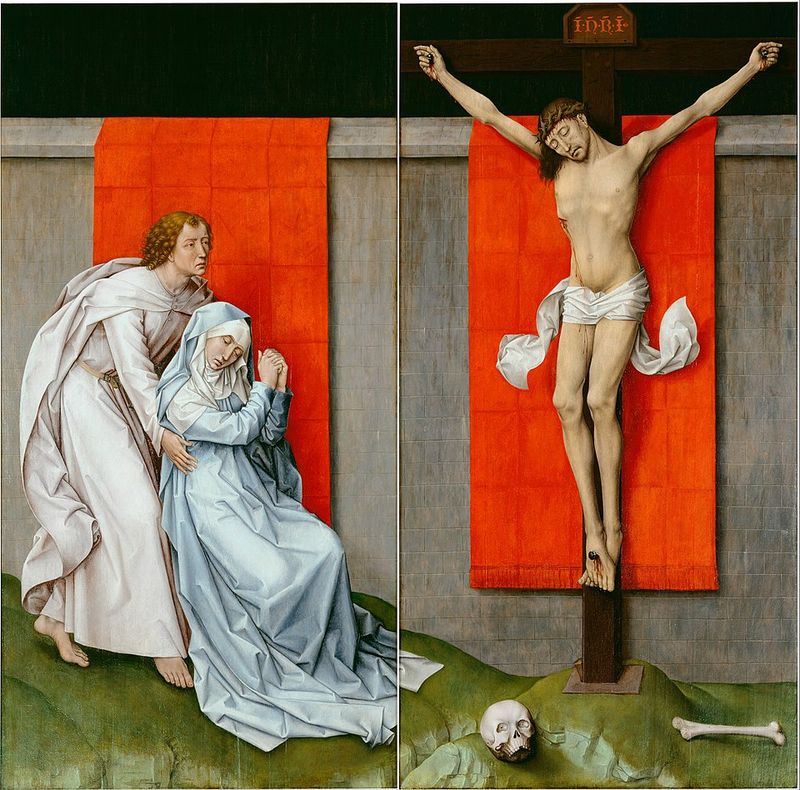
Why Did Jesus Give Mary to John at the Cross?
Jesus bypassed his own brothers to commend his mother to the Beloved Disciple. This wasn't just filial care — it was a theological act that reshaped how we read John's Gospel.
Why Did Jesus Call His Mother 'Woman'?
Jesus addresses Mary as 'woman' at Cana and from the cross — a choice that puzzles modern readers. Here's what the Greek actually means and why it matters for understanding John's Gospel.
The Mother of Jesus as a Named Source in John
An analysis of John 19:26-27 arguing that Mary, the mother of Jesus, served as a named source for the Gospel of John. Based on a paper from Yale Divinity School.
Stay Informed
Get new writing on faith, law, and service delivered to your inbox.
No spam. Unsubscribe anytime.