The Epistle to the Hebrews — Authorship, Canon, and the New Testament's Greatest Sermon

On This Page
Part of the series: The New Testament Canon — How 27 Books Survived the Ancient Gauntlet
The anonymous masterpiece
Hebrews is a paradox. It contains the most polished Greek in the New Testament—prose so elegant that Harold Attridge called it “the most sophisticated, and perhaps the most enigmatic, text of first-century Christianity.”1 Its theology is indispensable: without Hebrews, Christianity loses its most developed understanding of Christ as high priest, the once-for-all sacrifice, and the relationship between the old and new covenants. The letter has shaped Catholic sacramental theology, liturgical practice, and the theology of the priesthood more than almost any other single biblical text.
And yet nobody knows who wrote it.
Hebrews is the only New Testament epistle that is entirely anonymous. It has no greeting, no sender identification, no claim to apostolic authority. When the early church tried to assign it an author—Paul, Barnabas, Luke, Apollos, Clement of Rome—every attribution created as many problems as it solved. Origen of Alexandria, the greatest biblical scholar of the patristic era, weighed the evidence in the third century and delivered a verdict that has proven permanent: “Who wrote the epistle, in truth God knows.”2
Who wrote the epistle, in truth God knows.
That anonymity created the New Testament’s most fascinating canonical problem. The Western church held apostolicity as the indispensable criterion for canonicity—a book had to be connected to an apostle. Hebrews could not satisfy this requirement. The result was a three-century standoff between East and West, resolved only when the Latin-speaking church adopted an attribution it probably never fully believed, under pressure from Eastern consensus, anti-Arian theological need, and conciliar authority. The story of how Hebrews entered the canon reveals more about the mechanics of canon-formation than any other book in the New Testament.
Who wrote Hebrews?
The Eastern tradition: Paul through a translator
The attribution of Hebrews to Paul originated in Alexandria and nowhere else. The earliest recorded defense came from Pantaenus (c. 180), founder of the Alexandrian catechetical school, who explained Paul’s uncharacteristic failure to identify himself as a gesture of modesty—Paul was apostle to the Gentiles, not to the Hebrews, and so withheld his name out of deference.3
Clement of Alexandria (c. 150–215) developed this into a full theory. As Eusebius preserved it, Clement argued that Paul wrote Hebrews in Hebrew and that Luke translated it into Greek—which would explain both the absence of Paul’s name and the polished Greek style that looked nothing like Paul’s other letters.4 It was an ingenious solution. It preserved Pauline authorship while accounting for every objection.
Origen (c. 185–253), Clement’s intellectual successor, gave the most famous and nuanced verdict. His assessment, from his lost Homilies on Hebrews preserved by Eusebius, deserves careful attention:
If I were to state my own opinion, I should say that the thoughts are the apostle’s, but that the style and composition belong to one who called to mind the apostle’s teachings and, as it were, made short notes of what his master said.5
Origen distinguished the content—Pauline in theology—from the composition—someone else’s Greek. He reported that some attributed the letter to Clement of Rome, others to Luke. And then the famous conclusion: “But who wrote the epistle, in truth God knows.”6
Importantly, Origen did not reject the letter. He accepted its authority precisely because its theology was apostolic, even though its authorship remained uncertain. This distinction—between apostolic content and apostolic authorship—anticipated the modern Catholic position by eighteen centuries.
The Western tradition: three centuries of doubt
The Latin-speaking West had no tradition of Pauline authorship and resisted the attribution for roughly two hundred years. The evidence for this resistance is extensive and consistent.
The Muratorian Fragment (c. 170–200), the earliest known canon list and likely of Roman origin, enumerates thirteen Pauline epistles but omits Hebrews entirely.7 The Fragment also warns against two forged Pauline letters—to the Laodiceans and to the Alexandrians—suggesting the compiler was attentive to what belonged in Paul’s corpus and what did not. The omission of Hebrews was deliberate.
Tertullian (c. 160–220), the great North African theologian, provides the earliest explicit alternative attribution. In De Pudicitia 20 (c. 210–220), he attributes Hebrews to Barnabas—not as personal speculation, but as a received tradition: “There is extant withal an Epistle to the Hebrews under the name of Barnabas—a man sufficiently accredited by God, as being one whom Paul has stationed next to himself.”8 Jerome later confirmed that “several among the Latins” held the same view, and the Barnabas attribution persisted in Spain and France until the late fourth century.9
Hippolytus of Rome (c. 170–235) listed only thirteen Pauline epistles, excluding Hebrews. Cyprian of Carthage (c. 200–258) neither cited nor recognized it. Irenaeus of Lyons (c. 130–202) apparently knew the letter—Eusebius reports quotations in a lost work—but did not receive it as Pauline.10 Even Jerome, who ultimately accepted Hebrews, acknowledged the lingering resistance in his own day: “The Latin usage does not receive the Epistle to the Hebrews among the canonical books.”11
The Western silence was not merely an oversight. It was a sustained, principled refusal to accept a letter that could not be traced to an apostle.
The candidates
The authorship question has generated a remarkable array of proposals over two millennia. Each one illuminates something about the letter, and none is conclusive.
Paul remains the traditional Eastern attribution, defended in the modern era by David Alan Black.12 The placement of Hebrews after Romans in P46 (c. 200), the earliest Pauline manuscript collection, demonstrates that at least in Egyptian circles Hebrews was considered fully Pauline at a very early date.
Barnabas, Tertullian’s candidate, has a natural attraction. Acts 4:36 identifies Barnabas as a Levite—which would explain the author’s deep familiarity with the Levitical priesthood and sacrificial system.
Luke was Clement of Alexandria’s candidate as translator. David Allen has revived the proposal in modern scholarship, arguing for stylistic and theological affinities between Hebrews and Luke-Acts.13
Apollos is perhaps the most attractive hypothesis. Luther suggested it in the sixteenth century, and it has been revived by Ceslas Spicq, George Guthrie, and others.14 Acts 18:24 describes Apollos as “an eloquent man, competent in the Scriptures,” a native of Alexandria—fitting the polished Greek, the Alexandrian intellectual coloring, the scriptural mastery, and the connection to Paul’s circle (the author knows Timothy, 13:23). The major objection: would the Alexandrian church have forgotten that one of its own produced such a masterpiece?
Priscilla was proposed by Adolf von Harnack in 1900, arguing the author’s name was suppressed because she was a woman.15 The theory is creative but faces a significant grammatical obstacle: the masculine participle diegoumenon in 11:32, modifying the first-person pronoun, strongly suggests a male author. Attridge and William Lane both consider this decisive.16
Why the modern consensus rejects Paul
The modern critical consensus—shared by Protestant and Catholic scholars alike—is that Paul did not write Hebrews. The arguments are cumulative and, taken together, overwhelming.
The Greek style is the most polished in the entire New Testament. Paul’s prose is spontaneous, argumentative, and frequently ungrammatical. Hebrews is carefully composed, with elaborate periodic sentences, deliberate alliteration, and sophisticated rhetorical devices. Even Origen noticed the difference.17
The vocabulary diverges sharply from Paul’s acknowledged letters. Hebrews contains approximately 169 words found nowhere else in the New Testament. Paul’s characteristic phrases—“in Christ,” “Christ Jesus,” which Paul uses roughly ninety times—never appear in Hebrews.18 The theological framework differs fundamentally: Paul operates within a justification/law matrix; Hebrews operates within a covenant/tabernacle/priesthood matrix.
Most critically, Hebrews 2:3 describes the gospel as “confirmed to us by those who heard him”—the self-description of a second-generation Christian who received the faith at second hand. Paul emphatically and repeatedly claimed precisely the opposite: “I did not receive it from any man, nor was I taught it; rather, I received it by revelation from Jesus Christ” (Gal 1:12).
The letter also lacks Paul’s invariable self-identification. Paul names himself in the opening of every letter attributed to him. Hebrews is entirely anonymous—not pseudonymous (falsely attributed), but genuinely anonymous.
The Catholic Church’s evolving position
The Council of Trent (Session IV, 1546) listed “fourteen epistles of Paul the Apostle” including “to the Hebrews.” But as Catholic scholars have noted, the Council affirmed canonicity, not authorship per se—it declared the letter sacred and canonical without categorically stating Paul wrote it.19
The Pontifical Biblical Commission issued a decree in 1914 maintaining that Pauline authorship could not be overthrown. But this decree was effectively superseded by Pius XII’s Divino Afflante Spiritu (1943), which encouraged modern critical methods, and definitively by Pope Paul VI’s Sedula Cura (1971), which reorganized the PBC so that its earlier decisions no longer carry magisterial authority. Cardinal Ratzinger described the early PBC decrees as “anti-modernistic decisions” whose specific authorship claims are not binding.20
The New American Bible introduction, published with nihil obstat and imprimatur, states plainly: “The modern consensus is that the letter was not written by Paul.”21 Raymond Brown, twice appointed to the Pontifical Biblical Commission, treated Hebrews separately from the Pauline letters in his Introduction to the New Testament.22 The Catholic Church today does not require belief in Pauline authorship. It affirms Hebrews’ canonicity and divine inspiration while treating authorship as an open historical-critical question.
Origen’s verdict endures: who wrote the epistle, in truth God knows.
When and where was Hebrews written?
Dating: a range of 60 to 95 AD
Hebrews must have been written before 1 Clement (c. 96), which extensively quotes and alludes to it—providing a firm latest possible date.23 The reference to Timothy as a contemporary (13:23) places the letter within the apostolic generation. Most scholars favor a date somewhere between the early 60s and the mid-80s.
The most debated evidence is the author’s present-tense language about the sacrificial system (8:4–5; 9:6–9; 10:1–3). Does this mean sacrifices were still being offered—placing the letter before the destruction of the Jerusalem temple in 70 AD?
Those who argue yes—including William Lane, F.F. Bruce, D.A. Carson, Douglas Moo, and J.A.T. Robinson—contend that if the temple had already been destroyed, the author’s argument about the old covenant’s obsolescence would have been enormously strengthened.24 The silence, in this view, is deafening. Why not mention the most dramatic possible proof that the old system had been superseded?
Those who argue no—including Attridge, W.G. Kümmel, and Herbert Braun—make a powerful counter-observation: the author never mentions the Herodian temple. Every reference is to the wilderness tabernacle, drawn from Exodus and Leviticus.25 The argument proceeds from Scripture, not from contemporary observation. And post-70 authors—including Josephus, 1 Clement, the Epistle of Barnabas, and the Mishnah—routinely use present-tense verbs for temple rituals even after the temple’s destruction. As Kümmel put it: “In its timeless scholarly movement of ideas only the OT sanctuary plays a role, not the Herodian temple.”26
The pre-70 date remains the majority position but is far from unanimous.
Destination: probably Rome
Hebrews 13:24—“those from Italy send you greetings”—is grammatically ambiguous. The phrase hoi apo tēs Italias can mean either “those in Italy” (written from Italy) or “those from Italy” (Italian expatriates sending greetings home). Most scholars favor the second reading, making Rome the likely destination.27 Supporting evidence includes 1 Clement’s early use of Hebrews (demonstrating its presence in Rome by the 90s), the persecution described in 10:32–34 (fitting known Roman persecutions), and the use of hēgoumenoi (“leaders”) for pastors—terminology found also in 1 Clement and the Shepherd of Hermas, both Roman works.28
A sermon disguised as a letter
Hebrews is not a typical letter. It lacks an epistolary opening entirely—no sender, no addressee, no greeting—but has a letter-like conclusion (13:22–25). The author calls his work a “word of exhortation” (logos tēs paraklēseōs, 13:22)—the identical phrase used in Acts 13:15 for a synagogue homily.29 The scholarly consensus, articulated by James Swetnam and others, treats Hebrews as fundamentally a sermon sent as a letter—a homily with epistolary elements added for written transmission. Ernst Grässer called it “a sermon sent from one place to another.” Lane observed it is “the only example of a completely preserved homily” from this period.30
The literary structure was revolutionized by Albert Vanhoye, whose 1963 study identified five devices the author used to mark section boundaries: announcement of subject, transitional hook-words, change of genre, characteristic terms, and inclusio.31 The most distinctive structural feature—universally recognized—is the systematic alternation between theological exposition and pastoral exhortation. The author builds a Christological argument, then pauses to apply it pastorally, then resumes the argument at a higher level. George Guthrie mapped this interweaving pattern in detail through discourse analysis.32
And the Greek is extraordinary. The prologue (1:1–4) is a single, elaborately constructed periodic sentence reminiscent of classical prose. The opening—Polymerōs kai polytripōs palai ho theos lalēsas tois patrasin en tois prophētais—features deliberate pi-alliteration. The vocabulary is exceptionally refined: approximately 169 words appear nowhere else in the New Testament.33 Barnabas Lindars wrote simply: “The unknown author’s command of the art of rhetoric is universally recognized.”34
The theology: Christ as the great high priest
The central argument
The heart of Hebrews runs from 4:14 through 10:18, building a progressive demonstration of Christ’s superiority over every prior institution. The Son is superior to the angels (chs. 1–2), demonstrated through a chain of seven Old Testament quotations. He is superior to Moses (ch. 3): Moses was faithful as a servant in God’s house; Christ is faithful as Son over God’s house. He is superior to Aaron and the Levitical priesthood (chs. 4–7): his Melchizedekian priesthood is eternal, established by divine oath. And he is superior to the entire sacrificial system (chs. 8–10): a single offering versus endlessly repeated sacrifices, the true heavenly sanctuary versus the earthly copy.
The author employs a sophisticated type-antitype framework. The earthly tabernacle is a “copy and shadow” of heavenly realities (8:5, citing Exod 25:40). The Levitical sacrifices are “a shadow of the good things to come” (10:1). The old covenant is declared “obsolete” (8:13). Christ enters “not a sanctuary made with hands … but into heaven itself” (9:24).
The Christology of the prologue
The prologue (1:1–4) is one of the most exalted Christological passages in the New Testament. In just four verses, the Son is identified as God’s final revelation, appointed heir of all things, agent of creation, “radiance of God’s glory” (apaugasma tēs doxēs), “exact representation of his nature” (charaktēr tēs hypostasēōs), sustainer of all things, purifier of sins, and enthroned at the right hand of the Majesty on high.
One of Hebrews’ most remarkable features is its equal insistence on full divinity and genuine humanity.
One of Hebrews’ most remarkable features is its equal insistence on full divinity and genuine humanity. The one addressed as “O God” whose “throne is forever” (1:8) is also the one who “in the days of his flesh offered up prayers and supplications, with loud cries and tears” and who “learned obedience through what he suffered” (5:7–8). He was “tempted in every respect as we are, yet without sin” (4:15). This is not a distant, impassible deity but a high priest who can “sympathize with our weaknesses” precisely because he has shared them.

The Melchizedek argument
Chapter 7 weaves Genesis 14:17–20 and Psalm 110:4 into a sustained argument for Christ’s priestly superiority. The author proceeds through etymology (“king of righteousness,” “king of peace”), Abraham’s inferiority (paying tithes to Melchizedek), Levi’s implicit subordination (paying tithes through Abraham “in his loins”), the imperfection of the Levitical system (why prophesy “another priest” if perfection had been achieved?), and permanence (“he holds his priesthood permanently because he continues forever,” 7:24).
The description of Melchizedek as “without father, without mother, without genealogy, without beginning of days or end of life” (7:3) employs argumentum e silentio—a recognized first-century Jewish exegetical technique in which what Scripture does not say is theologically significant. Genesis provides no genealogy for Melchizedek, extraordinary in a book built entirely around genealogies. The silence makes him a fitting type of Christ’s eternal priesthood. The 11QMelchizedek fragment from Qumran—dating to the late second or early first century BC—presents Melchizedek as a heavenly, semi-divine figure, confirming that speculative elaboration was widespread in Second Temple Judaism, though the specific Christological application is distinctive to Hebrews.35
The warning passages: can believers fall away?
The five warning passages (2:1–4; 3:7–4:13; 5:11–6:12; 10:26–31; 12:14–29) are among the most debated texts in the New Testament. Hebrews 6:4–6 describes those “once enlightened,” who “tasted the heavenly gift,” “shared in the Holy Spirit,” and “tasted the goodness of the word of God”—yet “fell away,” with restoration to repentance declared “impossible.”
Catholic and Arminian interpreters read these as describing genuine believers who can commit apostasy. The Council of Trent (Session VI, 1547) affirmed that justified persons can lose grace through mortal sin, and these passages have long served as among the strongest biblical texts against the doctrine of eternal security.36 Scot McKnight’s formal analysis of the warning passages concluded the sin described throughout is specifically apostasy—not generic spiritual lethargy.37
Reformed interpreters have proposed several alternatives: the passages describe a hypothetical impossibility for true believers (Griffith Thomas, Charles Ryrie), or non-regenerate professors who had genuine but non-saving experiences (John Owen, John Gill), or the specific unforgivable sin of blasphemy against the Holy Spirit (Calvin).38 There is no scholarly consensus. What scholars broadly agree on is that the author intended real, serious warnings directed at a specific community facing real danger.
Hebrews and Philo of Alexandria
The parallels between Hebrews and Philo of Alexandria are real and striking. Both employ a framework in which the earthly tabernacle is a “copy and shadow” of heavenly realities, both citing Exodus 25:40. Both interpret Melchizedek etymologically as “king of righteousness” and “king of peace.” Both use logos theology—though Hebrews’ Son is a concrete historical person, while Philo’s Logos is a metaphysical principle. Both are rooted in Septuagint text traditions.39
Ceslas Spicq dedicated over fifty pages of his magisterial commentary to “Le Philonisme de l’Épître aux Hébreux” and concluded the author was “a Philonian converted to Christianity”—a direct disciple of Philo.40 This thesis dominated for a generation until Ronald Williamson’s exhaustive 602-page study systematically challenged it, concluding that the parallels reflect common Alexandrian Jewish education and shared Septuagint usage rather than direct literary dependence.41
The current scholarly consensus follows Williamson: Hebrews and Philo share a common intellectual milieu—the world of Alexandrian Judaism shaped by Middle Platonic categories—but the author of Hebrews was not Philo’s student.42
The crucial difference is theological. Philo operates with a cosmological dualism derived from Platonic thought: the material world as a permanent shadow of the eternal world of Forms. This dualism is ontologically static—it describes the way things are. Hebrews operates with an eschatological dualism: the contrast between “this age” and “the age to come” (2:5; 6:1–5), between old covenant and new covenant. Even when Hebrews affirms the heavenly as superior to the earthly, the superiority is temporal, not merely spatial. And there is no equivalent in Philo to the once-for-all historical sacrifice of Christ. Philo’s Logos is not an incarnate being who suffers and dies. Hebrews maintains a distinctly Christian “already/not yet” tension that Philo’s cosmological Platonism cannot accommodate.43

Two churches, two centuries, two verdicts
Eastern reception: early and assured
The East accepted Hebrews consistently from the earliest evidence. Pantaenus (c. 180) affirmed Pauline authorship. Clement of Alexandria and Origen followed with characteristic nuance. P46 (c. 200)—the oldest extant Pauline manuscript collection—places Hebrews immediately after Romans, before 1 Corinthians.44 This placement is enormously significant: it treats Hebrews as an integral, undisputed Pauline letter at the highest position in the corpus (the ordering principle is descending length). By the early third century, at least in Egyptian circles, Hebrews was fully canonical. Cyril of Jerusalem (348) and Athanasius (367) both listed fourteen Pauline epistles including Hebrews without hesitation.45
Western reception: long resistance, then capitulation
The West’s resistance was driven by several interconnected factors: anonymous authorship with no Western tradition connecting it to Paul, stylistic differences from Paul’s acknowledged letters, strict apostolicity criteria—and, critically, the Novatianist controversy.
Philastrius of Brescia (fourth century) explicitly confirms this connection: “It is also not read by some … on account of the Novatians, because of what it says about repentance.”46 Novatian (fl. 249–251), who opposed any readmission of Christians who had lapsed during persecution, used Hebrews 6:4–6 as his scriptural warrant for denying post-baptismal repentance. The Montanists made similar use of the text. This rigorist appropriation of Hebrews directly contributed to Western wariness—if accepting the letter meant accepting Novatianist rigorism, many Western pastors wanted nothing to do with it.
The very community that first treated Hebrews as authoritative later became the community most resistant to accepting it into the canon.
The irony is striking. First Clement (c. 96), written from Rome, is the earliest and most extensive post-apostolic witness to Hebrews. B.F. Westcott remarked that Hebrews seems to have been “wholly transfused” into Clement’s mind.47 The very community that first treated Hebrews as authoritative later became the community most resistant to accepting it into the canon—because the question of apostolic authorship had become paramount.
How the West changed its mind
The turning point came through converging forces in the mid-to-late fourth century. The Arian controversy made Hebrews’ high Christology—especially 1:3, the Son as “radiance of God’s glory and exact imprint of his nature”—invaluable for the orthodox defense of Christ’s divinity. Athanasius responded to Arian misreadings of Hebrews extensively in his Orations Against the Arians, and F.F. Bruce suggested that during his exile in Rome (340–346), Athanasius “persuaded the Roman Christians to fall into line with their eastern brethren.”48
Jerome normalized Hebrews’ canonical status by including it in his Vulgate translation—though he placed it last among Paul’s letters, reflecting lingering awareness of Western doubts, and he honestly acknowledged the authorship debate. Augustine’s enormous authority in North Africa was decisive for the African councils, though interestingly his own position on authorship evolved over the course of his career—in his earliest writings he cited Hebrews as Paul’s; in mid-career he wavered; in old age he referred to it as anonymous.49
The canonical journey: from disputed to indispensable
The canonical history of Hebrews is the paradigmatic case of a book that met every criterion for canonicity except the one the Western church considered non-negotiable: demonstrable apostolic authorship. Its theology was superb—no one questioned that. Its use was widespread in the East from the earliest period. It was read liturgically (P46 contains reading marks suggesting liturgical use). But without the apostolic connection, the West would not accept it.
A chronology of acceptance
The timeline tells the story:
c. 96: 1 Clement, written from Rome, extensively uses Hebrews—the earliest post-apostolic witness to the letter.
c. 170–200: The Muratorian Fragment omits Hebrews from the Western canon list.
c. 180: Pantaenus affirms Pauline authorship in Alexandria.
c. 200: P46 places Hebrews after Romans in the Pauline corpus.
c. 210: Clement of Alexandria develops the Paul-in-Hebrew-Luke-translated theory.
c. 220: Tertullian attributes Hebrews to Barnabas.
c. 240: Origen delivers the famous “God knows” verdict.
c. 325: Eusebius counts fourteen Pauline epistles but honestly reports Roman resistance.
367: Athanasius’s 39th Festal Letter—the first extant list matching the modern 27-book canon—includes Hebrews among Paul’s epistles.
382: The Council of Rome lists fourteen Pauline epistles.
393: The Synod of Hippo lists “Epistles of Paul, thirteen; of the same to the Hebrews, one”—a peculiar phrasing that preserves a frozen moment of compromise, acknowledging Hebrews as Pauline while subtly distinguishing it from the undisputed thirteen.50
397: The Council of Carthage reaffirms Hippo’s canon.
419: A subsequent Council of Carthage simplifies the formula to “Fourteen Epistles of Paul.”
1522: Luther moves Hebrews to the back of his New Testament, alongside James, Jude, and Revelation—the books he considered of lesser authority.
1546: The Council of Trent definitively lists Hebrews among fourteen Pauline epistles.
Eusebius: honest reporting
Eusebius’s treatment in Ecclesiastical History 3.25 reflects the letter’s genuinely ambiguous status. His system distinguished homologoumena (universally acknowledged), antilegomena (disputed), and notha (spurious). He counted “the fourteen letters of Paul” among the homologoumena but immediately added: “Yet it is not right to ignore that some dispute the Epistle to the Hebrews, saying that it was rejected by the church of Rome as not being by Paul.”51 Eusebius personally accepted Hebrews while honestly reporting Western objections—placing it in a liminal zone between acknowledged and disputed.
The manuscripts tell the story
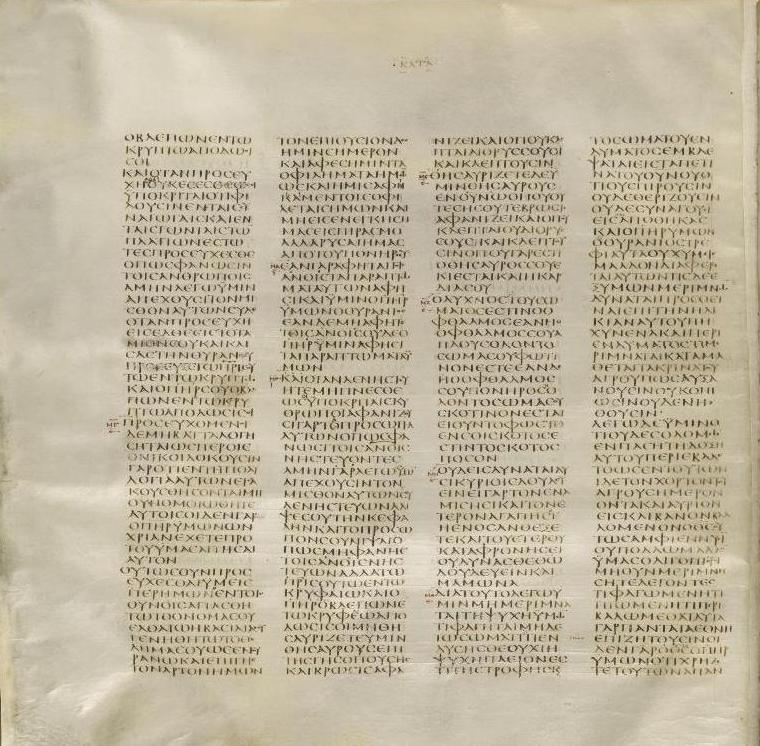
The physical placement of Hebrews across manuscripts traces its gradually declining association with Paul’s undisputed letters. In P46 (c. 200), it appears second, immediately after Romans—fully integrated. In Codex Sinaiticus and Codex Alexandrinus (fourth–fifth century), it occupies a transitional position after 2 Thessalonians and before 1 Timothy—between Paul’s letters to churches and his letters to individuals. In Jerome’s Vulgate and all subsequent Western tradition, it appears last, after Philemon. The Codex Claromontanus (sixth century) physically preserves the transition: three blank pages were originally left after Philemon, with Hebrews added subsequently.52
Luther’s disruption, Calvin’s solution
Luther placed Hebrews at the back of his New Testament alongside James, Jude, and Revelation—separated from the other twenty-three books and unnumbered in his table of contents. His preface stated: “Up to this point we have had to do with the true and certain chief books of the New Testament. The four which follow have from ancient times had a different reputation.”53 His specific objections included Hebrews 6:4–6 (seeming to deny repentance), Hebrews 2:3 (the second-generation self-description excluding Paul), and what he considered theological tensions with other Pauline teachings. His suggestion that Apollos wrote the letter remains one of scholarship’s most enduring authorship proposals.
Calvin equally denied Pauline authorship but took a markedly different position on canonicity: “I class it without hesitation among the apostolic writings”—using “apostolic” to mean doctrinal authority rather than direct authorship.54 Calvin’s separation of authorship from canonicity was a critical methodological advance that anticipated the modern Catholic position by four centuries.
The Council of Trent responded definitively. Session IV (April 8, 1546) listed “fourteen Epistles of Paul the Apostle” and declared: “If anyone does not accept as sacred and canonical the aforesaid books in their entirety and with all their parts … let him be anathema.”55 This was the first dogmatic definition of the biblical canon with the force of an ecumenical council.
What Hebrews reveals about how the canon formed
Hebrews is the paradigmatic illustration of how canonical criteria actually functioned—and of their limits. Apostolicity was the criterion the Western church held most firmly, and the one Hebrews could not satisfy. Orthodoxy (its theology was superb), catholicity (wide Eastern use from the earliest period), and liturgical use (P46’s reading marks) all supported acceptance. But without the apostolic connection, the West would not accept it.
Canon-formation was neither purely mechanical nor arbitrary. It was a complex negotiation between theological conviction, historical evidence, ecclesiastical authority, and pastoral need.
The solution—adopting the Alexandrian Pauline attribution—was a pragmatic compromise, one the church later acknowledged was probably incorrect. Hebrews thus demonstrates that canon-formation was neither purely mechanical (applying criteria rigidly) nor arbitrary. It was a complex negotiation between theological conviction, historical evidence, ecclesiastical authority, and pastoral need. The church did not create the canon arbitrarily, but neither did it simply discover it lying on the ground. It recognized the voice of God in these texts through a process that was messy, protracted, and—in the case of Hebrews—took over three hundred years.
Hebrews in Catholic theology and worship
The priesthood of Christ and the ministerial priesthood
Catholic theology draws on Hebrews’ high-priestly Christology to articulate a threefold priestly structure: Christ’s unique high priesthood, the ministerial (ordained) priesthood, and the common priesthood of all the baptized. The Catechism teaches: “The redemptive sacrifice of Christ is unique, accomplished once for all; yet it is made present in the Eucharistic sacrifice of the Church. The same is true of the one priesthood of Christ; it is made present through the ministerial priesthood without diminishing the uniqueness of Christ’s priesthood” (CCC §1545).56 Albert Cardinal Vanhoye provided the definitive Catholic exegesis of this connection in Old Testament Priests and the New Priest, tracing how Melchizedek’s offering of bread and wine (Gen 14:18) links Christ’s priesthood to the Eucharistic offering.57
The sacrifice of the Mass and the ephapax
The reconciliation of Hebrews’ ephapax (“once for all”) language (7:27; 9:12; 10:10) with the daily offering of the Mass is one of Catholic theology’s central tasks. The Council of Trent addressed it directly: “The victim is one and the same: the same now offers through the ministry of priests, who then offered himself on the Cross; only the manner of offering is different.”58 The Mass is not a repetition but a re-presentation of the one sacrifice. Thomas Aquinas taught that the Eucharist is an “image” of Christ’s Passion—a representative sacrifice, not a new one.59 Sacrosanctum Concilium (Vatican II, 1963) stated: “Our Savior instituted the eucharistic sacrifice of his Body and Blood … in order to perpetuate the sacrifice of the Cross throughout the centuries” (§47).60 The Catechism synthesizes: “The sacrifice of Christ and the sacrifice of the Eucharist are one single sacrifice” (CCC §1367).61
Catholic theologians highlight Hebrews 7:24–25, stating Christ “holds his priesthood permanently” and “always lives to make intercession,” as grounding the Mass in Christ’s continuing heavenly intercession—the Mass participates in an ongoing heavenly liturgical action, not a concluded historical event.
The communion of saints
Hebrews 12:1 (“since we are surrounded by so great a cloud of witnesses”) and 12:22–23 (believers having “come to Mount Zion … to innumerable angels in festal gathering, and to the assembly of the firstborn … and to the spirits of the righteous made perfect”) are foundational for the Catholic theology of the communion of saints. The Catechism cites Hebrews 12:1 and teaches: “The witnesses who have preceded us into the kingdom … share in the living tradition of prayer by the example of their lives … and their prayer today” (CCC §2683).62
Warning passages and soteriology
The warning passages support the Catholic teaching that salvation can be lost through mortal sin (CCC §1861). Catholic theologians read Hebrews 6:4–6 as describing genuine believers—the “enlightened” as baptismal language, “tasted the heavenly gift” as Eucharistic language—who can fall away through deliberate apostasy.63
Hebrews in the Roman Lectionary
Hebrews receives sustained liturgical attention in the Roman Lectionary, especially during Year B of Ordinary Time, when seven consecutive Sundays (27th through 33rd) feature semi-continuous readings from Hebrews 2–10. It also appears prominently at Christmas Day (Mass during the Day: Heb 1:1–6), Good Friday (Heb 4:14–16; 5:7–9), and in Masses for Holy Orders, Religious Profession, and the Dead.64 The Catechism cites Hebrews approximately fifty or more times across its treatment of revelation (1:1–3), Christology (1:3), priesthood (5:1–10; 7:24–27), the word of God (4:12), faith (11:1), and the communion of saints (12:1).65
Frequently asked questions
Who wrote the Book of Hebrews?
Nobody knows. The letter is entirely anonymous—the only New Testament epistle with no authorship claim whatsoever. The Eastern church attributed it to Paul from the late second century; the Western church resisted that attribution for roughly three hundred years. Other candidates proposed over the centuries include Barnabas (Tertullian’s suggestion), Luke, Clement of Rome, Apollos (Luther’s proposal and the favorite of many modern scholars), and Priscilla (Harnack’s theory). The modern scholarly consensus, including among Catholic scholars, is that Paul did not write it. Origen’s third-century verdict remains the most honest assessment: “Who wrote the epistle, in truth God knows.”
Why was Hebrews controversial in the early church?
The controversy was entirely about authorship, not theology. Nobody questioned its doctrinal content. The problem was that the Western church held apostolicity—a demonstrable connection to an apostle—as a non-negotiable criterion for canonicity, and Hebrews could not satisfy this requirement. The Eastern church solved the problem by attributing the letter to Paul; the West, having no such tradition, rejected that attribution for centuries. The Novatianist controversy also played a role—rigorist groups used Hebrews 6:4–6 to deny the possibility of repentance after baptism, which made some Western pastors wary of the entire letter.
Does the Catholic Church teach that Paul wrote Hebrews?
No. While the Council of Trent listed Hebrews among “fourteen epistles of Paul,” this affirmed its canonicity, not Pauline authorship. The Pontifical Biblical Commission’s 1914 decree favoring Pauline authorship was effectively superseded by later developments, including Divino Afflante Spiritu (1943) and the PBC’s reorganization (1971). The New American Bible introduction states the modern consensus rejects Pauline authorship. Catholic scholars are free to investigate the question using historical-critical methods, and virtually all conclude Paul did not write it.
What is the main message of Hebrews?
Hebrews argues that Jesus Christ is the great high priest after the order of Melchizedek, whose once-for-all sacrifice in the true heavenly sanctuary has rendered the Levitical priesthood and the old covenant obsolete. The practical application is urgent: because Christ’s sacrifice is superior to everything that came before, the recipients must not abandon their faith—not for Judaism, not for paganism, not for anything. Perseverance in faith, modeled on the “cloud of witnesses” in chapter 11, is the only appropriate response to what God has done in Christ.
Footnotes
-
Harold W. Attridge, The Epistle to the Hebrews, Hermeneia (Philadelphia: Fortress, 1989), 1. ↩
-
Eusebius, Ecclesiastical History 6.25.14. Translation from Philip Schaff and Henry Wace, eds., Nicene and Post-Nicene Fathers, Second Series, vol. 1 (New York: Christian Literature, 1890). ↩
-
Eusebius, Hist. Eccl. 6.14.4. ↩
-
Eusebius, Hist. Eccl. 6.14.2–3. ↩
-
Eusebius, Hist. Eccl. 6.25.11–12. ↩
-
Eusebius, Hist. Eccl. 6.25.14. ↩
-
On the Muratorian Fragment’s date and provenance, see Bruce M. Metzger, The Canon of the New Testament: Its Origin, Development, and Significance (Oxford: Clarendon, 1987), 191–201. Some scholars (Geoffrey Hahneman, Albert Sundberg) have argued for a fourth-century date, but the consensus favors a late second-century Roman origin. ↩
-
Tertullian, De Pudicitia 20.2. ↩
-
Jerome, De Viris Illustribus 5. ↩
-
Eusebius, Hist. Eccl. 5.26. The sixth-century writer Stephanus Gobarus, preserved by Photius, states that “Hippolytus and Irenaeus claim that the Letter to the Hebrews is not by Paul.” See F.F. Bruce, The Epistle to the Hebrews, NICNT, rev. ed. (Grand Rapids: Eerdmans, 1990), 14. ↩
-
Jerome, Commentary on Isaiah, preface. ↩
-
David Alan Black, The Authorship of Hebrews: The Case for Paul (Gonzalez, FL: Energion, 2013). ↩
-
David L. Allen, Lukan Authorship of Hebrews, NAC Studies in Bible & Theology 8 (Nashville: B&H, 2010). ↩
-
Ceslas Spicq, L’Épître aux Hébreux, 2 vols., Études bibliques (Paris: Gabalda, 1952–53), 1:209–19. George H. Guthrie, “The Case for Apollos as the Author of Hebrews,” Faith and Mission 18, no. 2 (2001): 41–56. ↩
-
Adolf von Harnack, “Probabilia über die Addresse und den Verfasser des Hebräerbriefes,” ZNW 1 (1900): 16–41. See also Ruth Hoppin, Priscilla’s Letter: Finding the Author of the Epistle to the Hebrews (Fort Bragg, CA: Lost Coast, 2000). ↩
-
Attridge, Hebrews, 4; William L. Lane, Hebrews, WBC 47, 2 vols. (Dallas: Word, 1991), 1:clii. ↩
-
Eusebius, Hist. Eccl. 6.25.11. ↩
-
Bruce M. Metzger, The New Testament: Its Background, Growth, and Content, 3rd ed. (Nashville: Abingdon, 2003), 240–41. ↩
-
Council of Trent, Session IV, De Canonicis Scripturis (April 8, 1546). The decree listed “fourteen epistles of Paul the Apostle” but, as Catholic Answers has noted, chose not to state categorically that Hebrews was written by Paul. ↩
-
Joseph Ratzinger, “Preface to the Document of the Pontifical Biblical Commission on The Interpretation of the Bible in the Church” (1993). See also Raymond E. Brown, S.S., “Rome and the Freedom of Catholic Biblical Studies,” in Critical Meaning of the Bible (New York: Paulist, 1981), 45–52. ↩
-
The New American Bible, Revised Edition, introduction to the Letter to the Hebrews (Washington, DC: USCCB, 2011). ↩
-
Raymond E. Brown, S.S., An Introduction to the New Testament, ABRL (New York: Doubleday, 1997), 683–704. ↩
-
The parallels between 1 Clement and Hebrews are extensive. See 1 Clem. 36:1–5 (closely following Heb 1:3–4, 5, 7, 13); references to Jesus as “high priest of our offerings”; and allusions to Heb 11:5, 17, 31, 37 and 12:1 and 13:17. B.F. Westcott remarked that Hebrews seems to have been “wholly transfused” into Clement’s mind; see Westcott, The Epistle to the Hebrews, 3rd ed. (London: Macmillan, 1903), xl. ↩
-
Lane, Hebrews, 1:lxiii–lxvi; Bruce, Hebrews, 20–22; D.A. Carson and Douglas J. Moo, An Introduction to the New Testament, 2nd ed. (Grand Rapids: Zondervan, 2005), 604–7. ↩
-
Attridge, Hebrews, 8–9; W.G. Kümmel, Introduction to the New Testament, rev. ed., trans. Howard Clark Kee (Nashville: Abingdon, 1975), 399–401; Herbert Braun, An die Hebräer, HNT 14 (Tübingen: Mohr Siebeck, 1984), 1–4. ↩
-
Kümmel, Introduction, 399. ↩
-
Adolf Jülicher, An Introduction to the New Testament, trans. Janet Penrose Ward (London: Smith, Elder, 1904), 162. ↩
-
Lane, Hebrews, 1:lvi–lx; Attridge, Hebrews, 9–10; Craig R. Koester, Hebrews, AB 36 (New York: Doubleday, 2001), 49–51. ↩
-
Lawrence Wills, “The Form of the Sermon in Hellenistic Judaism and Early Christianity,” HTR 77 (1984): 277–99. ↩
-
Lane, Hebrews, 1:lxxi. ↩
-
Albert Vanhoye, La structure littéraire de l’Épître aux Hébreux (Paris: Desclée de Brouwer, 1963; 2nd ed., Pontifical Biblical Institute, 1976). ↩
-
George H. Guthrie, The Structure of Hebrews: A Text-Linguistic Analysis, NovTSup 73 (Leiden: Brill, 1994). ↩
-
Ben Witherington III, Letters and Homilies for Jewish Christians: A Socio-Rhetorical Commentary on Hebrews, James and Jude (Downers Grove, IL: IVP Academic, 2007), 20–22. ↩
-
Barnabas Lindars, “The Rhetorical Structure of Hebrews,” NTS 35 (1989): 382. ↩
-
On 11QMelchizedek, see Eric F. Mason, “You Are a Priest Forever”: Second Temple Jewish Messianism and the Priestly Christology of the Epistle to the Hebrews, STDJ 74 (Leiden: Brill, 2008), 148–75. ↩
-
Council of Trent, Session VI, Decree on Justification, ch. 15 and canon 23 (1547). ↩
-
Scot McKnight, “The Warning Passages in Hebrews: A Formal Analysis and Theological Conclusions,” TrinJ 13, no. 1 (1992): 21–59. ↩
-
Calvin, Institutes of the Christian Religion 3.3.21–24. ↩
-
On the shared textual tradition, see Gert J. Steyn, A Quest for the Assumed LXX Vorlage of the Explicit Quotations in Hebrews, FRLANT 235 (Göttingen: Vandenhoeck & Ruprecht, 2011). ↩
-
Spicq, L’Épître aux Hébreux, 1:39–91. ↩
-
Ronald Williamson, Philo and the Epistle to the Hebrews, ALGHJ 4 (Leiden: Brill, 1970). ↩
-
Kenneth Schenck, “Philo and the Epistle to the Hebrews: Ronald Williamson’s Study After Thirty Years,” Studia Philonica Annual 14 (2002): 112–35. ↩
-
James W. Thompson, The Beginnings of Christian Philosophy: The Epistle to the Hebrews, CBQMS 13 (Washington, DC: Catholic Biblical Association of America, 1982), 10–14; L.D. Hurst, The Epistle to the Hebrews: Its Background of Thought, SNTSMS 65 (Cambridge: Cambridge University Press, 1990). ↩
-
On P46’s significance and the placement of Hebrews, see Metzger, Canon, 261–63. ↩
-
Athanasius, Thirty-Ninth Festal Letter (367 AD); Cyril of Jerusalem, Catechetical Lectures 4.36. ↩
-
Philastrius of Brescia, Diversarum Hereseon Liber 88–89. ↩
-
Westcott, Hebrews, xl. ↩
-
Bruce, Hebrews, 15–16. ↩
-
On Augustine’s evolving position, see Metzger, Canon, 233–35. ↩
-
The canon list of the Synod of Hippo is preserved in the Breviarium Hipponense (canon 36). The Council of Carthage (397) ratified the same list in its canon 24. ↩
-
Eusebius, Hist. Eccl. 3.3.5. ↩
-
On the Codex Claromontanus, see Metzger, Canon, 302–3. Eldon Jay Epp, “Issues in the Interrelation of New Testament Textual Criticism and Canon,” in The Canon Debate, ed. Lee Martin McDonald and James A. Sanders (Peabody, MA: Hendrickson, 2002), 485–515. ↩
-
Martin Luther, “Preface to the Epistle to the Hebrews” (1522), in Luther’s Works, vol. 35: Word and Sacrament I, ed. E. Theodore Bachmann (Philadelphia: Muhlenberg, 1960), 394. ↩
-
John Calvin, The Epistle of Paul the Apostle to the Hebrews and the First and Second Epistles of St. Peter, trans. William B. Johnston, Calvin’s Commentaries (Grand Rapids: Eerdmans, 1963), 1. ↩
-
Council of Trent, Session IV, De Canonicis Scripturis. ↩
-
Catechism of the Catholic Church, 2nd ed. (Vatican City: Libreria Editrice Vaticana, 1997), §1545. ↩
-
Albert Vanhoye, Old Testament Priests and the New Priest: According to the New Testament, trans. J. Bernard Orchard (Petersham, MA: St. Bede’s, 1986; reprinted Leominster: Gracewing, 2009). ↩
-
Council of Trent, Session XXII, ch. 2 (1562). ↩
-
Thomas Aquinas, Summa Theologiae III, q. 83, a. 1. ↩
-
Second Vatican Council, Sacrosanctum Concilium (December 4, 1963), §47. ↩
-
CCC §1367. ↩
-
CCC §2683. ↩
-
CCC §§1855, 1861. ↩
-
On the lectionary, see the Ordo Lectionum Missae (1969; 2nd ed., 1981), especially the Sunday readings for Year B, Ordinary Time, Weeks 27–33. ↩
-
CCC §§65, 102 (Heb 1:1–3); §§241, 320 (Heb 1:3); §§1539, 1544, 1545 (Heb 5:1–10; 7:24–27); §§108, 127 (Heb 4:12); §146 (Heb 11:1); §161 (Heb 11:6); §2683 (Heb 12:1). ↩

Garrett Ham
Garrett Ham is an attorney, military veteran, and holds a Master of Divinity from Yale Divinity School. He writes from Northwest Arkansas on theology, law, and service.
More about Garrett →Related Posts

The Gospel of Matthew — The Church's Gospel and Its Journey to Canon
No book shaped early Christianity more than Matthew. Explore its authorship debates, composition, theology, and canonical status.
2 Peter — The Most Contested Letter in the Canon
No New Testament book faced more persistent doubt than 2 Peter. Explore its authorship debate, patristic reception, theological significance, and the centuries-long road to canonical acceptance.

What Is Gnosticism? A Catholic Guide to the Ancient Heresy
What is Gnosticism? A Catholic guide to proto-Gnostic currents, the 2nd-century systems, the Nag Hammadi texts, and the Church Fathers' response through canon, creed, and doctrine.
Stay Informed
Get new writing on faith, law, and service delivered to your inbox.
No spam. Unsubscribe anytime.