Did Constantine Create Christianity? Separating History from Myth
On This Page
The Myth and Why It Persists
For a Catholic Christian interested in defending the faith, few claims sting quite like this one: “Constantine created Christianity.” Or its close cousin: “Constantine chose which books go in the Bible to suppress the truth.”
These claims have found their way into popular culture through The Da Vinci Code and countless internet articles, and they circulate because they offer a seductive narrative. They suggest that Christianity as we know it isn’t genuinely ancient—it’s a fourth-century political invention. If true, this would undermine the entire tradition. But the historical record tells a very different story.
The persistence of this myth reveals something important about our historical moment. We live in an age suspicious of institutional authority, and Constantine—a Roman emperor who converted to Christianity—makes a convenient scapegoat. By blaming him for “creating” Christianity, critics believe they’ve exposed the faith as a human construct rather than divine revelation.
But historians who actually study Constantine and the early councils know the truth is far more nuanced. What Constantine did was remarkable enough without inventing false claims: he legalized a persecuted religion and convened a council to settle a theological dispute. The bishops debated doctrine. The canon developed gradually over centuries. And the Trinity—the divinity of Christ—was affirmed by Christian theologians a century before Constantine was even born.
This post separates the historical facts from the mythology.
What Constantine Actually Did
Constantine (circa 272–337 AD) was a Roman emperor who became sympathetic to Christianity, likely influenced by his mother Helena. His conversion is generally dated to 312 AD, following his vision before the Battle of the Milvian Bridge, after which he spent the next 25 years issuing pro-Christian legislation and building churches across the empire. He was not baptized until his deathbed in 337—but this was common fourth-century practice, since baptism was understood to cleanse sins once, leading many believers (including major church fathers like Ambrose and Basil of Caesarea) to delay the sacrament. Historians debate the theological depth and sincerity of his faith, but his actions had profound consequences for the Church.
What Constantine actually accomplished:
- Legalized Christianity through the Edict of Milan (313 AD), ending systematic persecution
- Funded church construction, building basilicas in Rome, Jerusalem, and Constantinople
- Convened the First Council of Nicaea (325 AD) to address the Arian controversy
- Gave bishops certain legal privileges and exemptions from taxation
What Constantine did NOT do:
— Invent the Trinity — Select the biblical canon — Suppress “alternative” gospels through council decree — Create Christianity as a religion — Personally decide theological doctrine
This distinction matters because Constantine’s actual role was already significant. He provided the political stability that allowed the Church to flourish openly, to build institutions, and to hold councils. That was enough to change history without inventing false tales.
The Edict of Milan (313 AD)
To understand Constantine’s significance, we must begin with the Edict of Milan. In 313 AD, Constantine and his co-emperor Licinius issued a proclamation that fundamentally changed Christianity’s legal status in the Roman Empire.
The edict did not declare Christianity the “official” religion of Rome—that came later under Theodosius in 380 AD. Rather, it granted tolerance to Christianity and returned confiscated church property. Constantine authorized religious freedom more broadly, benefiting not only Christians but also pagans and other religious groups.
Before 313 AD, Christians faced periodic, sometimes brutal, persecution. The edict did not end all hostility toward Christians, but it removed the legal sanction for their persecution. Suddenly, Christianity could be practiced openly. Churches could be built in public. Bishops could gather without fear of execution.
This shift was enormous. Within decades, Christian institutions flourished. But the edict itself did not “create” Christianity—it simply allowed what already existed to grow openly.
“Constantine did not invent Christian theology; he inherited it, embraced it, and provided the political stability for it to flourish.”
Constantine and the Council of Nicaea
The Council of Nicaea (325 AD) is where Constantine’s role in church history becomes most contentious. This is the council that anti-Christian polemicists claim “created” Christian doctrine wholesale.
What actually happened:
By 325 AD, the Arian controversy had become a serious problem within the Church. Arius, a priest in Alexandria, was teaching that Jesus Christ was God’s first and greatest creation—possessing a derived and lesser form of divinity by grace rather than by nature, and therefore fundamentally subordinate to the Father. This directly contradicted centuries of Christian teaching that Christ was God, fully equal with the Father.
The bishops of the Church could not tolerate this teaching. But bishops could not gather in a unified council without political protection. Constantine, recognizing that this theological dispute threatened the unity of his empire, called for a council at Nicaea (modern-day Iznik, Turkey).
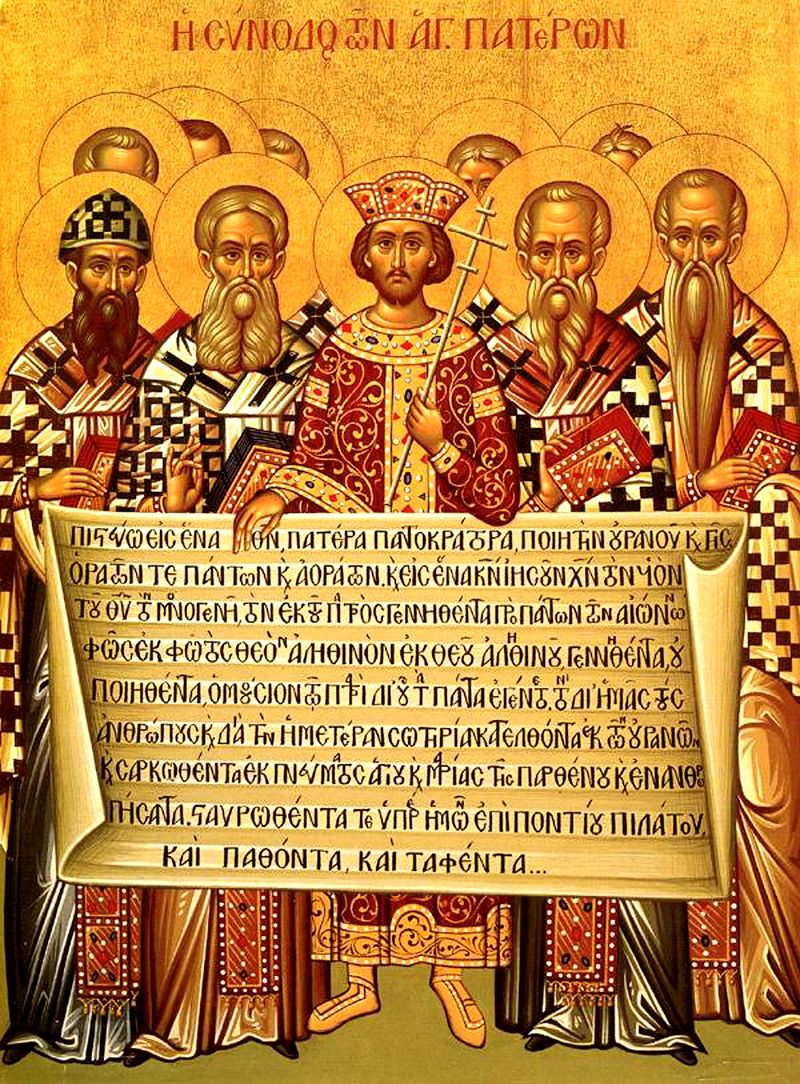
Constantine attended the council but did not vote on doctrine. He sat in a place of honor but deferred to the bishops on theological matters. Approximately 300 bishops gathered—most from the Eastern Roman Empire, with some representation from the West. They debated the nature of Christ for weeks.
The council produced the Nicene Creed, which affirmed that Christ is “of one substance” (homoousios) with the Father—fully divine, not created. This was an explicit rejection of Arianism. Constantine signed off on the creed and exiled Arius and his followers, using his imperial authority to enforce the council’s decision. (He later recalled Arius from exile around 328 AD under pressure from Arian sympathizers—a complication that shows Constantine’s role was more politically pragmatic than theologically principled.)
But here is the crucial point: Constantine did not write the creed. He did not decide the theology. The bishops did.
The bishops debated based on centuries of Christian tradition, Scripture, and the writings of church fathers. They were not inventing doctrine from nothing; they were giving precise theological definition to convictions the Church had held from the beginning—though the precision of the Nicene formulation, including the key term homoousios, was genuinely new. For a deeper dive into what Nicaea actually decided, see our full exploration at /council-of-nicaea/.
“The bishops debated for weeks, drawing on Scripture and centuries of Christian tradition. Constantine did not vote on doctrine—he simply made sure the decision stuck through imperial authority.”
Did Constantine Choose the Books of the Bible?
This is perhaps the most damaging false claim, and it requires a detailed response.
Short answer: No. Constantine had nothing to do with the formation of the biblical canon.
Longer answer:
The biblical canon—the official list of which books belong in Scripture—developed gradually over the first four centuries of Christianity. This process happened at multiple councils and through the consensus of bishops and theologians, not through any single decision by Constantine.
The Council of Nicaea Did Not Decide the Canon
This is critical: The Council of Nicaea in 325 AD did not discuss which books belong in the Bible. It addressed the Arian controversy. Church records show no debate about the canon at Nicaea.
The canonical gospels (Matthew, Mark, Luke, John) were already widely accepted by the fourth century. Most of Paul’s epistles had been collected and recognized as authoritative for centuries. The canon was not a problem that Constantine solved.
When Was the Canon Actually Decided?
The process was gradual:
Second Century: Early church fathers like Irenaeus and Clement of Alexandria discuss which texts are authoritative. There is broad agreement on the four gospels and Paul’s letters, though some texts on the margins (like Hebrews, Revelation, and 3 John) are debated.
Third Century: Origen (circa 185–254 AD) continues this work, categorizing books as accepted, disputed, or spurious. The core of the New Testament is firmly established, even as debate continues over a handful of texts.
Fourth Century: Athanasius of Alexandria, in his Easter letter of 367 AD, lists exactly the 27 New Testament books we have today. But Athanasius was not “creating” the canon—he was confirming what the Church had already largely accepted.
Councils of Hippo (393 AD) and Carthage (397 AD): These regional North African synods ratified a New Testament canon matching the 27 books we have today (alongside the Old Testament deuterocanonical books). They were not ecumenical councils, but they reflected the broad consensus of the Church. And Constantine had died in 337 AD—these councils happened decades after him, confirming decisions that had already been made by bishops and theologians over centuries.
What About “Suppressed Gospels”?
A related myth suggests Constantine destroyed “alternative” gospels that revealed “the truth” about Jesus. Books like the Gospel of Thomas, the Gospel of Mary, and the Gospel of Judas supposedly contained secret teachings that Constantine wanted hidden.
This narrative is fiction for several reasons:
-
These texts were known before Constantine. Early church fathers like Irenaeus (circa 180 AD) and Origen (circa 250 AD) were already aware of these texts and were rejecting them as non-apostolic forgeries. This happened 140+ years before Constantine.
-
They weren’t suppressed into obscurity. We possess copies of these texts today because they survived in church libraries and archives. If Constantine had truly wanted them destroyed, copies would be even rarer. In fact, many copies exist because monasteries preserved them for historical study.
-
They weren’t rejected because they contradicted church doctrine. They were rejected because the early Church recognized them as inauthentic—not written by the apostles they claimed as authors. The Gnostic gospels reflect theological views that developed in the second and third centuries, long after the apostles died. The Church fathers knew this.
To understand the actual history of the New Testament canon, the work of Bruce Metzger and his students on textual criticism reveals that by the time of Constantine, the canon was already established in practice. Constantine did not create it, select it, or substantially alter it.
“The canon developed gradually through the consensus of bishops and theologians over centuries. Constantine played no role in choosing which books were in the Bible. That process was already complete, and the decisions were made before Constantine even converted to Christianity.”
Did Constantine Invent the Trinity?
The Trinity—the doctrine that God is three persons in one substance, and that Christ is fully God—long predates Constantine.
Christian Teaching on the Trinity Before Constantine
The earliest New Testament texts explicitly affirm the divinity of Christ. In John’s Gospel (written circa 90–110 AD), Jesus is called the “Word” (logos) and identified with God. The prologue of John 1:1 states, “In the beginning was the Word, and the Word was with God, and the Word was God.”
Paul’s letters (written 50–65 AD) refer to Christ’s divine nature and equality with God. In Philippians 2:6, Paul describes Christ as existing “in the form of God” (en morphē theou)—a phrase that most scholars understand as affirming Christ’s essential divine nature, not merely an outward appearance.
Church Fathers on the Trinity Before Constantine
By the second century, church fathers were already developing Trinitarian theology—affirming the divinity of Christ and the threefold nature of God, even if their formulations did not yet match the precision of later councils:
Justin Martyr (circa 100–165 AD) developed a sophisticated logos theology, arguing that Christ was divine and pre-existent—though his formulation was subordinationist, placing the Son in “second place” relative to the Father, rather than affirming the co-equal divinity later defined at Nicaea.
Irenaeus (circa 130–202 AD) developed a proto-Trinitarian theology in Against Heresies, confessing Father, Son, and Spirit and famously calling the Son and Spirit the “two hands of God.” His theology was genuinely Trinitarian in its impulse, though it did not yet employ the precise technical language (homoousios, three co-equal hypostases in one ousia) that the councils of Nicaea and Constantinople would later define.
Tertullian (circa 155–220 AD) coined the Latin term trinitas (“Trinity”) and wrote extensively on the relationship between the three persons of God. (The Greek equivalent trias had already been used by Theophilus of Antioch around 180 AD.) Tertullian’s formulation was groundbreaking, though scholars note it still contained elements of subordinationism that later theology would refine.
Origen (circa 185–254 AD) affirmed the eternal generation of the Son (“there was never a time when he was not”)—a formulation that later anti-Arian theology drew upon heavily. However, Origen’s theology was complex and not entirely consistent with later Nicene definitions: he also described the Son as a “secondary God” (deuteros theos) and arranged the persons of the Trinity hierarchically. His legacy is genuinely mixed, contributing both to the development of orthodox Trinitarian thought and to the subordinationist tendencies the councils would later reject.
All of these theologians lived before Constantine. They developed Trinitarian theology over the first three centuries of Christianity without Constantine’s involvement. It is worth noting that this development was genuine—not merely the repetition of a fixed formula. As St. John Henry Newman argued in his Essay on the Development of Christian Doctrine, the highest truths of the faith, “though communicated to the world once for all by inspired teachers, could not be comprehended all at once.” Vatican II’s Dei Verbum affirmed this principle: “There is a growth in the understanding of the realities and the words which have been handed down.” The pre-Nicene fathers held real Trinitarian convictions that were substantively developed—not merely restated—at Nicaea and beyond. Catholic theology distinguishes between the deposit of faith (fixed) and its theological articulation (genuinely developing over time).
What the Council of Nicaea Actually Did
The Council of Nicaea did not invent the Trinity. It addressed a specific heresy: Arianism. Arius denied the full divinity and eternality of the Son. The council explicitly rejected this by affirming that Christ is “of one substance” with the Father.
The creed that emerged from Nicaea was a more explicit articulation of what the Church had always believed, formulated in response to a specific theological challenge.
For a comprehensive explanation of the Trinity and Catholic teaching, see /trinity-catholic-explanation/.
The Da Vinci Code Problem
Much of the modern “Constantine created Christianity” myth originates from Dan Brown’s The Da Vinci Code (2003). In the novel, a character claims that Constantine “invented” the divinity of Christ at Nicaea and suppressed “true” Christianity, which knew Jesus as merely human.
This is fiction presented as fact. Brown explicitly presented his novel as containing hidden historical truths, which blurred the line between entertainment and scholarship in readers’ minds.
The problem is compounded because The Da Vinci Code appeals to a deep suspicion of institutional authority that is common in contemporary culture. It tells readers that the Church has hidden the truth from them for centuries. This narrative is emotionally powerful, even if historically inaccurate.
But serious historians—including non-Christian scholars—have thoroughly debunked Brown’s claims. Darrell L. Bock, Timothy Paul Jones, and other scholars have published detailed refutations showing that Brown’s narrative has virtually no historical foundation.
What History Actually Shows
Here is what the historical evidence actually demonstrates:
1. Christianity Existed for 300 Years Before Constantine
The earliest Christians lived in the first century AD, when Christ walked the earth. Paul wrote his letters in the 50s–60s AD. The Gospels were composed in the late first century. By the second and third centuries, Christian theology was remarkably sophisticated and consistent. Constantine was born circa 272 AD—approximately 240 years after Christ’s crucifixion.
2. Christian Doctrine Was Articulated by Church Fathers, Not Constantine
The great church fathers—Justin Martyr, Irenaeus, Origen, Augustine, and others—developed Christian theology through careful study of Scripture and philosophical reasoning. Constantine was not a theologian. He was a patron and enforcer of decisions made by bishops.
3. The Councils Were Deliberative Bodies, Not Constantine’s Puppets
Nicaea was contentious. Bishops debated vigorously. Some initially sided with Arius. The majority eventually affirmed the Nicene Creed, but the decision was not Constantine’s decree handed down from on high. It was the consensus (albeit a controversial one) of the bishops gathered in council.
4. The Canon Developed Gradually Over Centuries
The biblical canon was not decided at one council by Constantine or anyone else. It developed through the consensus of the Church over 300+ years, through the judgment of bishops and theologians who recognized which writings were apostolic and authoritative. By the time councils formally ratified the canon in the late fourth century, Constantine was already dead.
5. Constantine Made Christianity Possible, Not Invented It
Constantine’s great achievement was to provide the political stability that allowed Christianity to flourish openly. He legalized the faith, funded its institutions, and used his authority to enforce church discipline. This was extraordinary and consequential. But it was not the same as inventing Christianity.
FAQ: Did Constantine Really Create Christianity?
Q: Did Constantine convert Christianity from a persecuted faith to a state religion?
A: Constantine legalized Christianity and provided it imperial patronage, but he did not declare it the official state religion. That came later under Emperor Theodosius I in 380 AD with the Edict of Thessalonica. Constantine’s Edict of Milan (313 AD) granted tolerance but not privileged status. Christianity was one of several religions tolerated in the empire.
Q: Didn’t Constantine decide which gospels were authentic?
A: No. Constantine had nothing to do with the selection of the four canonical gospels. These gospels (Matthew, Mark, Luke, John) had been recognized as authoritative by the Church for 200+ years before Constantine. Early church fathers like Irenaeus (circa 180 AD) already identified these four as the authentic gospels. Constantine simply inherited this consensus.
Q: What about the Council of Nicaea? Didn’t Constantine control that?
A: Constantine convened the council and attended, but the bishops debated theology and voted on doctrine. Constantine did not write the Nicene Creed, did not vote on it, and did not decide which interpretation of Christ’s nature was correct. He enforced the council’s decision through his imperial authority after the bishops decided it. That’s a significant distinction.
Q: Is there any evidence that Constantine tried to suppress the “real” Christianity?
A: No credible historical evidence supports this. Constantine’s actions were toward enforcing orthodoxy (right belief) as determined by church councils, not toward suppressing alternative gospels. The Gnostic texts that modern critics claim were “suppressed” were already rejected by the Church before Constantine, for reasons of authenticity and theological coherence with apostolic teaching.
Q: If Constantine didn’t create Christianity, why do so many people believe he did?
A: This myth persists because (1) it appeals to modern skepticism of institutional authority, (2) popular fiction like The Da Vinci Code have given it cultural currency, and (3) Constantine is a convenient scapegoat for people who want to delegitimize Christianity. It is psychologically appealing to believe that a major world religion was “invented” by a political figure rather than grounded in actual historical revelation. But the appeal of a narrative is not the same as its truth.
Conclusion: Constantine the Patron, Not the Creator
Constantine did not invent Christianity. He did not create the Trinity. He did not select the biblical canon. He did not suppress “alternative” Christianity.
What Constantine did do was provide the legal and political framework for Christianity to flourish openly. He legalized the faith, funded its institutions, convened councils that clarified and defended its doctrine, and used his imperial authority to enforce church discipline. This was historically significant. It changed everything. But it was not the same as creating Christianity.
For Catholics and serious Christians, the historical record is actually our friend. It shows that Christian theology is remarkably consistent across the first four centuries. The Trinity is affirmed in Scripture and in the writings of church fathers from the second century onward. The four gospels were recognized as authentic long before Constantine was born. The faith Constantine legalized was already ancient, already sophisticated, already established in doctrine and practice.
The myth of “Constantine creating Christianity” requires us to ignore the testimony of early Christian documents, the writings of pre-Constantine theologians, and the actual deliberations of church councils. It requires us to believe that a religion with nearly 300 years of documented history suddenly became “real” when a Roman emperor decided to support it.
Real history is more interesting and more faithful. Constantine was the patron of Christianity, not its creator. And that story is remarkable enough.
- Timothy D. Barnes, Constantine and Eusebius (Cambridge, MA: Harvard University Press, 1981)—the definitive scholarly biography of Constantine.
- Eusebius of Caesarea, Vita Constantini (Life of Constantine)—a primary historical account written by a bishop who knew Constantine personally and attended the Council of Nicaea.
- J.N.D. Kelly, Early Christian Doctrines (New York: Harper & Row, 1978)—the standard reference on the development of Christian theology before Constantine.
- R.P.C. Hanson, The Search for the Christian Doctrine of God: The Arian Controversy, 318-381 (Edinburgh: T&T Clark, 1988)—exhaustive treatment of Arian controversy and Nicaea.
- Bruce M. Metzger, The Canon of the New Testament: Its Origin, Development, and Significance (Oxford: Oxford University Press, 1987)—the authoritative work on how the biblical canon developed.
- Irenaeus, Against Heresies, Book III—written circa 180 AD, defending the four canonical gospels against Gnostic alternative gospels.
- Tertullian, Against Praxeas—written circa 210 AD, the earliest systematic defense of Trinitarian doctrine in Latin Christian theology.
- Athanasius of Alexandria, Easter Letter 39 (367 AD)—the first church document to list exactly the 27 books of the New Testament we have today.
- Timothy Paul Jones, Conspiracies and the Cross: How to Intelligently Counter the Ten Most Popular Theories That Attack the Gospel of Jesus (Lake Mary, FL: Frontline/Charisma Media, 2008)—detailed refutation of popular conspiracy theories about early Christianity, including the Da Vinci Code narrative.
- The Council of Hippo (393 AD) and the Council of Carthage (397 AD)—regional North African synods, not ecumenical councils—ratified a canon including the 27 New Testament books and the Old Testament deuterocanonical books. Constantine died in 337 AD and had no involvement in these councils.

Garrett Ham
Garrett Ham is an attorney, military veteran, and holds a Master of Divinity from Yale Divinity School. He writes from Northwest Arkansas on theology, law, and service.
More about Garrett →Related Posts
The First Council of Nicaea: What It Decided and Why It Matters
What happened at the First Council of Nicaea in 325 AD? A Catholic examination of the Arian crisis, the meaning of homoousios, and why the Nicene Creed still defines Christian orthodoxy.
A Guide to Church History: Councils, Schisms, and the Development of Christian Doctrine
A comprehensive guide to church history covering the ecumenical councils, the Great Schism, the Reformation, and the development of Christian doctrine — from a Yale Divinity graduate.
Is Jesus God? The Biblical and Catholic Case for the Deity of Christ
Is Jesus God? A biblical and theological examination of the deity of Christ, from New Testament texts through the Councils, addressing common objections and theological implications.
Stay Informed
Get new writing on faith, law, and service delivered to your inbox.
No spam. Unsubscribe anytime.