The Counter-Reformation: Catholic Reform in the Wake of Luther
On This Page
On October 31, 1517, an Augustinian friar named Martin Luther posted ninety-five theses on the door of the Castle Church in Wittenberg. Whatever Luther’s original intentions—and historians continue to debate whether the gesture was a call to academic disputation or an act of public protest—the consequences were seismic. Within a generation, the Western Church was fractured along lines that have never fully mended. The unity that had held Latin Christendom together for a millennium was shattered, and the Catholic Church was forced to confront an uncomfortable truth: the Reformers had real grievances, and many of them were justified.1
The Catholic response to the Reformation—traditionally called the Counter-Reformation, though some historians prefer the term “Catholic Reformation” to emphasize that reform impulses predated Luther—was not a single event but a complex, decades-long process of doctrinal clarification, institutional reform, and spiritual renewal. It produced some of the greatest saints, theologians, and cultural achievements in the Church’s history. It also, in its less admirable moments, produced the Roman Inquisition and the Index of Forbidden Books. An honest account must reckon with both.
The Abuses That Provoked the Reformation
The Catholic Church in the late fifteenth and early sixteenth centuries was, by any honest assessment, in a state of serious institutional decay. The problems were not primarily doctrinal—the Church’s teaching on the great questions of faith had not changed—but practical, moral, and pastoral. The gap between what the Church professed and how her leaders behaved had grown into a chasm.
Indulgences
The most immediate trigger of Luther’s protest was the sale of indulgences. The theology of indulgences—the remission of temporal punishment due to sin, drawn from the treasury of merit accumulated by Christ and the saints—is a legitimate part of Catholic teaching. But by the early sixteenth century, the practice had degenerated into something that bore little resemblance to its theological foundations. Johann Tetzel, a Dominican friar commissioned to sell indulgences to fund the construction of St. Peter’s Basilica in Rome, reportedly used the slogan, “As soon as the coin in the coffer rings, the soul from purgatory springs.” Whether or not Tetzel actually uttered those exact words, the sentiment captured a real problem: indulgences were being marketed as a commodity, and the faithful were being led to believe that salvation could be purchased with money.2
Luther was not the first to object. Theologians within the Church had raised concerns for decades. But Luther’s protest caught fire in a way that earlier criticisms had not, partly because of the printing press and partly because the institutional Church’s response was defensive rather than self-critical.
Clerical Corruption and Simony
The problem extended far beyond indulgences. Simony—the buying and selling of ecclesiastical offices—was widespread. Bishoprics were treated as political prizes, awarded to the younger sons of noble families regardless of their spiritual qualifications. Pluralism, the practice of holding multiple benefices simultaneously, meant that many bishops never visited the dioceses they nominally governed. Absenteeism was endemic. Priests were often poorly educated, barely able to read the Latin of the Mass they celebrated, and unable to preach or catechize their flocks. Concubinage among the clergy was an open secret in many regions.3
The papacy itself was part of the problem. The Renaissance popes—Alexander VI (Rodrigo Borgia), Julius II, Leo X—were often more interested in political power, military campaigns, and artistic patronage than in the spiritual governance of the Church. Alexander VI fathered multiple children and engaged in the kind of nepotism that would have scandalized even the more tolerant standards of secular politics. Leo X, the pope who excommunicated Luther, reportedly said upon his election, “Since God has given us the papacy, let us enjoy it.” The remark may be apocryphal, but it captures a real ethos.4
Poor Catechesis
Perhaps the deepest failure was catechetical. As I have written elsewhere in discussing the preservation of faith through catechesis, the Church’s primary obligation to her members is to transmit the faith clearly, accurately, and accessibly. In the decades before the Reformation, this obligation was being neglected on a massive scale. The laity were often ignorant of basic Christian teaching. Popular piety, while sometimes genuine and moving, was frequently entangled with superstition. The faithful were told what to do—attend Mass, receive the sacraments, venerate relics, purchase indulgences—but rarely told why, and even more rarely given the theological foundations that would allow them to distinguish authentic Catholic teaching from its corrupted imitations.
When Luther, Calvin, and the other Reformers offered an alternative—a faith grounded directly in Scripture, preached in the vernacular, stripped of what they saw as the accumulated debris of medieval Catholicism—millions found it compelling. The Reformers were wrong about much, but they were not wrong that the Church needed reform. The Counter-Reformation was, at its best, the Church’s belated recognition of that fact.
The Council of Trent (1545–1563)
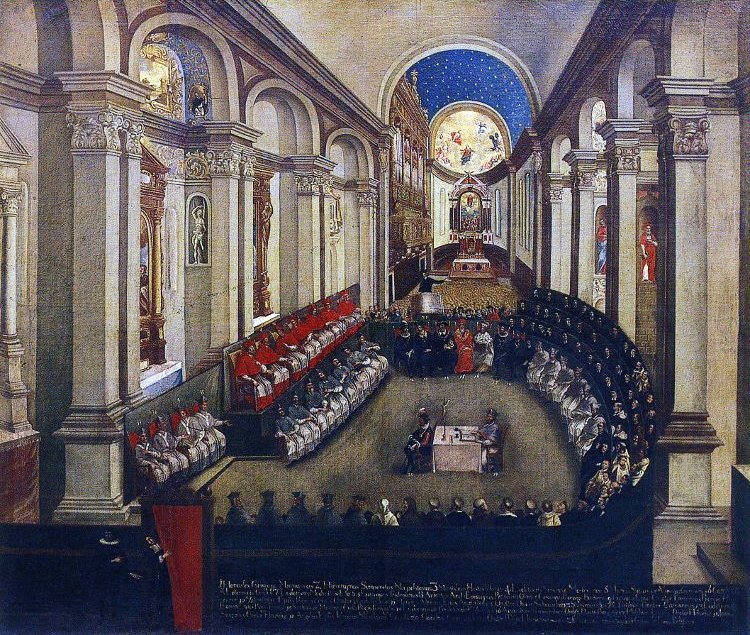
The Council of Trent was the centerpiece of the Counter-Reformation and one of the most consequential ecumenical councils in the Church’s history. Convened by Pope Paul III in 1545, it met in three major periods of sessions—1545–1547, 1551–1552, and 1562–1563—interrupted by wars, plagues, and political complications. By the time it concluded under Pope Pius IV in 1563, it had produced a body of doctrinal definitions and disciplinary reforms that would shape Catholicism for the next four centuries.5
Scripture and Tradition
One of the council’s earliest and most important decrees addressed the question of religious authority. The Protestant Reformers had advanced the principle of sola Scriptura—the claim that Scripture alone is the supreme authority in matters of faith and morals. Trent responded with a carefully nuanced affirmation that divine revelation is transmitted through both Sacred Scripture and Sacred Tradition, and that both are to be received “with equal affection of piety and reverence” (pari pietatis affectu ac reverentia). The council also affirmed the Vulgate as the authoritative Latin text of Scripture for use in public lectures, disputations, and preaching, while acknowledging the value of the original languages.6
This was not, as Protestant polemicists sometimes claim, an elevation of human tradition to the level of Scripture. It was a reaffirmation of the principle the Church had always held: that Scripture does not interpret itself, that the apostolic faith was transmitted both in writing and by oral teaching, and that the living Magisterium of the Church—guided by the Holy Spirit—is the authentic interpreter of both. As the Second Vatican Council would later reaffirm, Scripture, Tradition, and the Magisterium “are so linked and joined together that one cannot stand without the others” (Dei Verbum §10).
Justification
The Decree on Justification, promulgated at Session VI in January 1547, is arguably the most theologically significant document produced by Trent. It addressed the central issue of the Reformation: How is a sinner made right with God?
Luther had insisted on justification by faith alone (sola fide)—that the sinner is declared righteous through faith in Christ, without any contribution from human works. Trent rejected a specific construal of the sola fide formula—the interpretation that faith requires “nothing else” to cooperate in justification—but affirmed, with great care, the absolute primacy and necessity of grace. (Canon 9’s qualifying clause ita ut intelligat, “so as to understand,” specifies which reading is condemned, and some Catholic theologians argue the canon leaves room for a properly defined faith-alone formula understood as fides caritate formata—faith formed by charity.) The decree teaches that justification is “not only the remission of sins, but also the sanctification and renewal of the inner man” (Session VI, Chapter 7)—not merely a forensic declaration of righteousness but a genuine interior transformation wrought by the Holy Spirit.7
Trent’s teaching on justification is often caricatured—by both Protestants and poorly catechized Catholics—as a doctrine of works-righteousness. It is nothing of the kind. The council explicitly teaches that “none of those things which precede justification, whether faith or works, merit the grace itself of justification” (Session VI, Chapter 8). Grace is prior, grace is necessary, grace is a free gift. What the council insists upon, against the Reformers, is that this grace, once received, genuinely transforms the recipient, enabling a real cooperation with God that bears fruit in good works—and that this cooperation, itself enabled by grace, is not opposed to faith but is the natural expression of a living faith. As I discussed in my post on God’s universal desire for salvation, the Catholic synthesis holds that salvation is entirely God’s gift and that the human response to that gift is itself made possible by grace. For a detailed examination of how this teaching contrasts with Reformed theology, see Calvinism vs. Catholicism.
“If anyone says that the sinner is justified by faith alone, meaning that nothing else is required to cooperate in order to obtain the grace of justification, and that it is not in any way necessary that he be prepared and disposed by the action of his own will: let him be anathema.”
— Council of Trent, Session VI, Canon 9
The council also rejected the errors of Pelagianism and semi-Pelagianism, reaffirming what the Second Council of Orange had taught in 529: that even the initial movement toward faith is a work of grace, not a product of unaided human effort. Trent’s teaching on justification, rightly understood, stands in the same balanced tradition that stretches from Orange through Aquinas and into the modern Catechism.
The Sacraments
Trent produced extensive decrees on the sacraments, affirming their number as seven (against the Protestant reduction to two or three), defining the nature of the Eucharist as a true sacrifice and affirming the real presence of Christ under the appearances of bread and wine (transubstantiation), defending the sacramentality of marriage and holy orders, and clarifying the theology of baptism, confirmation, penance, and anointing of the sick. These decrees were not innovations but precise articulations of what the Church had always believed and practiced, now stated with a clarity that the pre-Reformation Church had often lacked.8
Seminary Formation and Clerical Reform
Perhaps the most practically consequential decree of Trent was the requirement that every diocese establish a seminary for the training of priests. Before Trent, there was no standardized system of priestly formation. Many priests were ordained with minimal education and little understanding of the theology they were supposed to teach. Trent changed this decisively, mandating a curriculum that included Scripture, dogmatic theology, moral theology, liturgy, and pastoral practice. The seminary system that Trent established became the backbone of Catholic clerical formation for the next four centuries and remains, in modified form, the standard today.9
The council also addressed the abuses of absenteeism, pluralism, and simony directly, requiring bishops to reside in their dioceses, limiting the accumulation of benefices, and imposing stricter standards of conduct on the clergy. Enforcement was uneven—some regions implemented the reforms vigorously, others resisted for decades—but the direction was clear, and over time the reforms took hold.
Key Figures of the Counter-Reformation
The Counter-Reformation was not merely a matter of conciliar decrees and institutional reform. It was driven by saints—men and women of extraordinary holiness, intellectual rigor, and pastoral energy who embodied the renewal the Church so desperately needed.
Ignatius of Loyola (1491–1556)
A Basque soldier whose leg was shattered by a cannonball at the Battle of Pamplona in 1521, Ignatius experienced a profound conversion during his convalescence, reading the lives of the saints and the life of Christ. He went on to develop the Spiritual Exercises—a structured program of prayer, meditation, and discernment that remains one of the most influential works of Christian spirituality ever written—and to found the Society of Jesus (the Jesuits) in 1540. The Jesuits became the intellectual and missionary vanguard of the Counter-Reformation, establishing schools and universities across Europe and carrying the faith to the Americas, Asia, and Africa.10
Teresa of Ávila (1515–1582)
A Carmelite nun and mystic, Teresa reformed her own order by founding the Discalced Carmelites, returning to the original austerity of the Carmelite Rule. Her writings on prayer—particularly The Interior Castle and The Way of Perfection—are masterworks of mystical theology. She was also a formidable administrator and a woman of sharp wit and practical intelligence. She was declared a Doctor of the Church in 1970, the first woman to receive that title.11
Charles Borromeo (1538–1584)
Archbishop of Milan and a nephew of Pope Pius IV, Charles Borromeo could easily have been another example of the nepotism that plagued the Renaissance Church. Instead, he became its antithesis. He implemented the reforms of Trent in his diocese with tireless energy, establishing seminaries, conducting regular pastoral visitations, reforming religious houses, and personally ministering to the sick during the plague of 1576. He became the model of what a post-Tridentine bishop should be.12
Francis de Sales (1567–1622)
Bishop of Geneva—the very city that had become John Calvin’s stronghold—Francis de Sales approached the task of re-evangelization not with polemics but with gentleness. His Introduction to the Devout Life (1609) democratized the spiritual life, arguing that holiness was not reserved for monks and nuns but was accessible to laypeople in every state of life. His patient, charitable approach to Protestants won many back to the Catholic faith and established a model of evangelization through kindness rather than coercion. He was declared a Doctor of the Church in 1877.13
Robert Bellarmine (1542–1621)
A Jesuit theologian and cardinal, Bellarmine was the foremost Catholic controversialist of his age. His Disputationes de Controversiis offered a comprehensive, systematic defense of Catholic teaching against the Reformers—a work of such intellectual caliber that Protestant universities felt compelled to establish chairs specifically to refute it. Unlike some of his contemporaries, Bellarmine engaged Protestant arguments with rigor and fairness, earning the respect even of those who opposed him. He was declared a Doctor of the Church in 1931.14
New Religious Orders
The Counter-Reformation produced a remarkable flowering of religious life. New orders and reformed congregations emerged to meet the needs of a Church in crisis, each with a distinctive charism that addressed specific failures of the pre-Reformation era.
The Society of Jesus (Jesuits)
Founded by Ignatius of Loyola and approved by Pope Paul III in 1540, the Jesuits were organized along quasi-military lines, with a strong emphasis on obedience, intellectual excellence, and missionary zeal. They took a special fourth vow of obedience to the pope regarding missions, making them uniquely available for deployment wherever the Church needed them. By the end of the sixteenth century, the Jesuits were running hundreds of schools and colleges across Europe and had established missions in India, Japan, China, Brazil, and the Philippines. Their educational system—the Ratio Studiorum of 1599—became the gold standard of Catholic education and influenced the development of secondary and university education across the Western world.15
The Capuchins
A reform branch of the Franciscan order, the Capuchins sought to return to the radical poverty and simplicity of St. Francis of Assisi. Approved in 1528, they became the preeminent popular preachers of the Counter-Reformation, ministering to the poor and working-class communities that the institutional Church had often neglected. Their effectiveness as preachers and confessors played a significant role in halting the spread of Protestantism in rural areas of Italy, France, and the German-speaking lands.
The Discalced Carmelites
Founded by Teresa of Ávila and her collaborator John of the Cross, the Discalced (“barefoot”) Carmelites represented a return to the contemplative austerity of the original Carmelite Rule. Their emphasis on interior prayer, mystical union with God, and radical detachment from worldly concerns provided a spiritual counterweight to the activism of the Jesuits. The writings of Teresa and John of the Cross remain among the greatest treasures of Christian mystical literature.
The Oratorians
Founded by Philip Neri in Rome in 1575, the Congregation of the Oratory offered a distinctive model of priestly life: secular priests living in community without formal vows, devoted to prayer, preaching, and the works of mercy. Neri’s approach was marked by joy, humor, and personal warmth—qualities that made him one of the most beloved figures in sixteenth-century Rome. The Oratorians contributed to the renewal of Catholic culture through their patronage of music (the musical form called the “oratorio” takes its name from their prayer halls) and their emphasis on accessible, engaging preaching.
Catholic Art, Education, and Mission
The Baroque
The Counter-Reformation transformed Catholic art. The austere, whitewashed interiors of Protestant churches stood in stark contrast to the exuberant, emotionally powerful art of the Catholic Baroque. Painters like Caravaggio, sculptors like Bernini, and architects like Borromini created works designed to overwhelm the senses, to draw the viewer into an encounter with the sacred that was visceral as well as intellectual. The great Baroque churches of Rome—the Gesù, Sant’Andrea al Quirinale, Sant’Ignazio—were theological arguments in stone and paint, proclaiming the glory of God and the reality of the sacraments with a confidence that directly answered the Reformers’ critique.
The Council of Trent itself issued a decree on sacred images (Session XXV, 1563) that affirmed the legitimate use of images in worship while cautioning against superstition and excess. This decree gave theological sanction to the artistic explosion that followed, while also providing a framework for correcting its abuses.
Education
The Jesuits and other Counter-Reformation orders established a network of schools and universities that fundamentally reshaped European education. By 1600, the Jesuits alone operated more than two hundred colleges across Europe. Their curriculum emphasized the liberal arts, philosophy, theology, and the natural sciences, producing graduates who were as well educated as any in Europe. This educational enterprise had effects far beyond the Church: René Descartes, Voltaire, and many other seminal figures of early modern thought were educated in Jesuit schools, even when their later work departed from Catholic teaching.
Missionary Activity
The Counter-Reformation coincided with the European age of exploration, and the Church seized the opportunity for global evangelization. Jesuit missionaries like Francis Xavier in India and Japan, Matteo Ricci in China, and the reductions (mission communities) in South America represented some of the most ambitious missionary enterprises in the Church’s history. These missions were not without serious moral complications—they were entangled with European colonialism, and the line between evangelization and cultural imperialism was often blurred or nonexistent. But they also produced remarkable experiments in inculturation, genuine conversions, and communities of faith that endure to this day.16
An Honest Assessment
What the Counter-Reformation Achieved
The achievements of the Counter-Reformation were substantial. The Council of Trent produced doctrinal definitions of lasting clarity and depth. The seminary system transformed the quality of the Catholic priesthood. The new religious orders revitalized spiritual life, education, and missionary activity. The Baroque gave the Church a cultural language of extraordinary power and beauty. The worst abuses of the pre-Reformation era—the most blatant forms of simony, pluralism, absenteeism, and indulgence-selling—were curtailed, if not entirely eliminated. The hemorrhaging of souls to Protestantism was largely stopped, and in some regions reversed.
More fundamentally, the Counter-Reformation forced the Church to articulate her own teaching with a precision she had previously lacked. The Decree on Justification, whatever one thinks of its conclusions, is a masterwork of theological reasoning. The Catechism of the Council of Trent (the Roman Catechism, published in 1566) provided a comprehensive and accessible summary of Catholic teaching that served the Church for centuries. The reforms in clerical formation ensured that future generations of priests would be better educated and more spiritually formed than their predecessors.
Where the Counter-Reformation Fell Short
Intellectual honesty requires acknowledging what the Counter-Reformation did not achieve—and where it went wrong.
First, the reform came too late. By the time Trent opened in 1545, nearly three decades after Luther’s ninety-five theses, the Reformation was an accomplished fact. Millions of Christians had left the Catholic Church and were not coming back. Had the Church addressed her own failures more promptly—had the papacy listened to the voices calling for reform in the fifteenth century, from the conciliarists to Erasmus—the fracture of Western Christendom might have been avoided, or at least minimized.
Second, the Counter-Reformation hardened confessional boundaries in ways that produced centuries of mutual suspicion, hostility, and violence. The wars of religion that devastated Europe in the sixteenth and seventeenth centuries—the French Wars of Religion, the Thirty Years’ War, the conflicts in the Low Countries—were fueled in part by the intransigence of both sides. The Counter-Reformation Church sometimes treated dialogue as betrayal and compromise as weakness, missing opportunities for reconciliation that might have borne fruit.
Third, the Roman Inquisition and the Index of Forbidden Books represent dimensions of the Counter-Reformation that cannot be defended. The permission-based system that grew up around the Tridentine Index functioned, in Spain and Italy, as a near-total prohibition on lay vernacular Bible reading for roughly two centuries. The suppression of intellectual inquiry, the censorship of legitimate scholarship, and the persecution of individuals whose views were unorthodox—or merely inconvenient—are stains on the Church’s record. The case of Galileo, though often oversimplified, remains emblematic of a broader problem: the Counter-Reformation Church was sometimes more interested in controlling thought than in pursuing truth.
Fourth, the emphasis on uniformity and discipline, while necessary in many respects, came at a cost. The post-Tridentine Church was more orderly but also more rigid. Liturgical creativity was curtailed. Theological speculation was viewed with suspicion. The rich diversity of medieval Catholic life—its regional liturgical traditions, its varied forms of piety, its tolerance of a certain creative disorder—gave way to a more centralized, standardized, and in some ways impoverished Catholicism. It would take the Second Vatican Council, four centuries later, to begin recovering what had been lost.
The Lasting Legacy
The Counter-Reformation’s legacy for the modern Catholic Church is profound and ambivalent. On one hand, the doctrinal clarity of Trent, the spiritual riches of the Counter-Reformation saints, the educational and missionary enterprises of the Jesuits and other orders, and the cultural achievement of the Baroque all remain living realities in the Church today. The seminary system, the structure of Catholic education, the Church’s global missionary presence—all of these trace their modern form to the Counter-Reformation.
On the other hand, many of the tensions that defined the Counter-Reformation era remain unresolved. The relationship between Scripture and Tradition, the nature of justification, the role of the laity, the balance between unity and diversity, the proper limits of ecclesiastical authority—these are all questions that Vatican II revisited, and that the Church continues to wrestle with today.
Perhaps the most important lesson of the Counter-Reformation is the simplest: the Church is always in need of reform. Ecclesia semper reformanda—the Church is always to be reformed—is a principle that Catholics sometimes associate with Protestantism but that has deep roots in the Catholic tradition itself. The Counter-Reformation demonstrated that the Church is capable of profound self-renewal—but also that this renewal often comes only after crisis has forced the Church’s hand. The saints of the Counter-Reformation did not wait for institutional permission to begin reforming. They acted, often in the face of indifference or opposition from the very institutions they were trying to save. That willingness to act, rooted in love for the Church and fidelity to the Gospel, remains the model for Catholic reform in every age.
Frequently Asked Questions
What was the Counter-Reformation?
The Counter-Reformation was the Catholic Church’s response to the Protestant Reformation, spanning roughly from the 1530s to the late seventeenth century. It encompassed doctrinal clarification (principally through the Council of Trent, 1545–1563), institutional reform (seminary formation, elimination of simony and absenteeism), the founding of new religious orders (most notably the Jesuits), and a renewal of Catholic spirituality, art, education, and missionary activity. Some historians prefer the term “Catholic Reformation” to emphasize that reform impulses within the Church predated Luther’s protest.
What did the Council of Trent decide?
The Council of Trent produced definitive teachings on many of the contested issues of the Reformation. On justification, it affirmed that salvation is entirely a gift of grace while insisting that grace genuinely transforms the recipient and enables cooperation with God. On authority, it affirmed that divine revelation is transmitted through both Scripture and Tradition, rejecting the Protestant principle of sola Scriptura. On the sacraments, it reaffirmed their number as seven and defined the Eucharist as a true sacrifice involving the real presence of Christ. On discipline, it mandated the establishment of seminaries, required bishops to reside in their dioceses, and addressed the abuses of simony and pluralism.
Did the Catholic Church acknowledge that the Reformers had legitimate grievances?
Not in so many words at the time—the Counter-Reformation Church was generally more concerned with refuting Protestant errors than with acknowledging Protestant insights. However, the reforms Trent enacted were themselves a tacit admission that the Reformers had identified real problems. In more recent times, the Church has been more explicit. Pope Adrian VI, as early as 1523, acknowledged through his legate at the Diet of Nuremberg that “abominations” and “abuses in ecclesiastical matters” had contributed to the crisis. Pope John Paul II, in preparation for the Jubilee Year 2000, asked forgiveness for the sins committed by members of the Church over the centuries—a gesture of remarkable honesty from the institution that the Reformers had accused of being incapable of self-criticism.
How does the Counter-Reformation relate to Vatican II?
The Second Vatican Council (1962–1965) can be understood, in part, as a continuation and correction of the Counter-Reformation. Vatican II preserved Trent’s doctrinal achievements while opening windows that Trent had closed: liturgical reform and the use of the vernacular, a renewed emphasis on Scripture in Catholic life, the recognition of the laity’s role in the Church, a more positive engagement with Protestantism through the ecumenical movement, and a more nuanced understanding of religious freedom. Where Trent was defensive—necessarily so, given the circumstances—Vatican II was dialogical, seeking to engage the modern world without compromising the substance of the faith.
Further Reading
- God Desires All Men To Be Saved — How the Catholic Church understands justification, grace, and God’s universal salvific will
- Pelagianism and Semi-Pelagianism — The heresies that denied the necessity of grace, and why Trent’s teaching on justification reaffirms the Council of Orange
- Sola Scriptura and Catholicism — The Catholic case for Scripture and Tradition as co-sources of divine revelation
- Catechesis and the Preservation of Faith — Why the Church’s failure to catechize was among the deepest causes of the Reformation
- The First Council of Nicaea — How the early Church used ecumenical councils to define doctrine and respond to crisis
1. The debate over Luther’s intentions in posting the ninety-five theses—whether it was an invitation to academic debate or an act of public protest—has been shaped significantly by Erwin Iserloh, The Theses Were Not Posted: Luther Between Reform and Reformation (Boston: Beacon Press, 1968), who argued that Luther did not actually nail the theses to the church door but sent them by letter to Archbishop Albrecht of Mainz. Most historians now accept that the posting likely did occur, but Iserloh’s work usefully complicates the popular narrative. See also Martin Brecht, Martin Luther: His Road to Reformation, 1483–1521 (Minneapolis: Fortress Press, 1985), 195–210.
2. On the theology and abuse of indulgences in the late medieval period, see R.N. Swanson, Indulgences in Late Medieval England: Passports to Paradise? (Cambridge: Cambridge University Press, 2007); and Bernhard Lohse, Martin Luther’s Theology: Its Historical and Systematic Development (Minneapolis: Fortress Press, 1999), 53–62. The “coin in the coffer” jingle attributed to Tetzel is widely attested in sixteenth-century sources but may be apocryphal or at least a popularized simplification of his actual preaching.
3. On clerical corruption, simony, and absenteeism in the pre-Reformation Church, see Euan Cameron, The European Reformation, 2nd ed. (Oxford: Oxford University Press, 2012), 39–66; and Diarmaid MacCulloch, The Reformation: A History (New York: Viking, 2004), 29–36.
4. The remark attributed to Leo X is reported by the sixteenth-century papal biographer Paolo Giovio but cannot be independently verified. On the Renaissance papacy more broadly, see Barbara McClung Hallman, Italian Cardinals, Reform, and the Church as Property (Berkeley: University of California Press, 1985); and Eamon Duffy, Saints and Sinners: A History of the Popes, 4th ed. (New Haven: Yale University Press, 2014), 193–220.
5. The standard scholarly edition of the Tridentine decrees is in Heinrich Denzinger, Enchiridion Symbolorum, ed. Peter Hünermann, 43rd ed. (San Francisco: Ignatius Press, 2012). For a comprehensive history of the council, see John W. O’Malley, Trent: What Happened at the Council (Cambridge, MA: Harvard University Press, 2013)—the best single-volume account available.
6. The decree on Scripture and Tradition is from Session IV (April 8, 1546). See Denzinger, Enchiridion, nos. 1501–1508. The phrase pari pietatis affectu ac reverentia is at no. 1501. On the theological debate surrounding this decree, see O’Malley, Trent, 89–101.
7. The Decree on Justification is from Session VI (January 13, 1547). See Denzinger, Enchiridion, nos. 1520–1583. On the drafting history and theological significance of this decree, see O’Malley, Trent, 106–123; and Anthony N.S. Lane, Justification by Faith in Catholic-Protestant Dialogue (London: T&T Clark, 2002). The 1999 Joint Declaration on the Doctrine of Justification, signed by the Pontifical Council for Promoting Christian Unity and the Lutheran World Federation (with the World Methodist Council associating itself in 2006, and Anglicans and the World Communion of Reformed Churches following in 2016 and 2017, respectively), acknowledged a “consensus on basic truths of the doctrine of justification”—a significant ecumenical achievement that built on careful re-readings of both Luther’s and Trent’s positions.
8. The sacramental decrees span multiple sessions: the general decree on the sacraments (Session VII, 1547), the Eucharist (Session XIII, 1551), penance and anointing (Session XIV, 1551), holy orders (Session XXIII, 1563) and marriage (Session XXIV, 1563). See Denzinger, Enchiridion, nos. 1600–1816; O’Malley, Trent, 130–159, 226–246.
9. The decree on seminaries is from Session XXIII (July 15, 1563), Canon 18 (Cum adolescentium aetas). See O’Malley, Trent, 232–237. On the implementation of the seminary decree and its long-term effects, see James O’Toole, The Faithful: A History of Catholics in America (Cambridge, MA: Harvard University Press, 2008), 21–24.
10. On Ignatius and the founding of the Jesuits, see John W. O’Malley, The First Jesuits (Cambridge, MA: Harvard University Press, 1993). The Spiritual Exercises have been published in numerous editions; the critical text is in the Monumenta Historica Societatis Iesu series.
11. On Teresa of Ávila, see Rowan Williams, Teresa of Avila (London: Continuum, 2004); and Gillian T.W. Ahlgren, Teresa of Avila and the Politics of Sanctity (Ithaca, NY: Cornell University Press, 1996).
12. On Charles Borromeo and the implementation of Tridentine reforms in Milan, see John M. Headley and John B. Tomaro, eds., San Carlo Borromeo: Catholic Reform and Ecclesiastical Politics in the Second Half of the Sixteenth Century (Washington, DC: Folger Shakespeare Library, 1988).
13. On Francis de Sales, see Wendy M. Wright, Heart Speaks to Heart: The Salesian Tradition (Maryknoll, NY: Orbis Books, 2004). His Introduction to the Devout Life remains in print and widely read; a solid modern edition is published by Vintage Books (2002).
14. On Bellarmine and the intellectual culture of Counter-Reformation controversy, see Stefania Tutino, Empire of Souls: Robert Bellarmine and the Christian Commonwealth (Oxford: Oxford University Press, 2010).
15. On the Ratio Studiorum and Jesuit education, see John W. O’Malley et al., eds., The Jesuits: Cultures, Sciences, and the Arts, 1540–1773 (Toronto: University of Toronto Press, 1999); and Cristiano Casalini, Rise, Character, and Development of the Ratio Studiorum (Leiden: Brill, 2019).
16. On Jesuit missions and the complexities of Counter-Reformation evangelization, see Luke Clossey, Salvation and Globalization in the Early Jesuit Missions (Cambridge: Cambridge University Press, 2008); and R. Po-chia Hsia, The World of Catholic Renewal, 1540–1770, 2nd ed. (Cambridge: Cambridge University Press, 2005), 186–212.
Garrett Ham
Garrett Ham is an attorney, military veteran, and holds a Master of Divinity from Yale Divinity School. He writes from Northwest Arkansas on theology, law, and service.
More about Garrett →Related Posts
God Desires All Men To Be Saved
What does 1 Timothy 2:4 mean for Catholic theology? A reflection on Catechism §74, predestination, free will, and God's universal desire for salvation.
Pelagianism and Semi-Pelagianism: Why the Church Condemned Both
Understand Pelagianism vs. semi-Pelagianism: why both heresies were condemned, their impact on theology, and what they teach about grace and salvation.
Sola Scriptura and the Journey Toward Catholicism
In this post, I write about sola scriptura and what started my journey toward the Catholic Church.
Stay Informed
Get new writing on faith, law, and service delivered to your inbox.
No spam. Unsubscribe anytime.