Classical Theism vs. Process Theology: A Catholic Comparison
On This Page
In the landscape of Christian theology, few comparisons are more instructive—or more revealing of fundamental metaphysical commitments—than the contrast between classical theism and process theology. Both traditions claim to take God seriously. Both attempt to reconcile God’s power with human freedom, his transcendence with his involvement in the world. Yet they arrive at starkly different conclusions about the very nature of who God is.
For nearly two thousand years, the Catholic Church and the broader Christian tradition have drawn on classical theism—the vision of God inherited from Aristotle and the Church Fathers, refined by the medieval Doctors, and reaffirmed by the ecumenical councils. Classical theism teaches that God is pure act, utterly simple, immutable, impassible, omnipotent, and the source of all creation ex nihilo. He is radically transcendent, yet intimately involved in his creation through divine providence.
Process theology, by contrast, emerged in the twentieth century as a radical alternative. Drawing on the metaphysics of Alfred North Whitehead, it reimagines God as a being in process—growing, changing, and genuinely affected by the world. Where classical theism emphasizes God’s transcendence and immutability, process theology emphasizes divine responsiveness and persuasive influence. The two positions could hardly be more different.
But why should Catholics care? Because understanding the differences between classical theism and process theology clarifies what we believe about God and why it matters for how we understand divine love, human freedom, and the meaning of suffering.
God’s Nature: Simplicity vs. Dipolarity
The most fundamental difference between classical theism and process theology concerns the internal structure of God’s being.
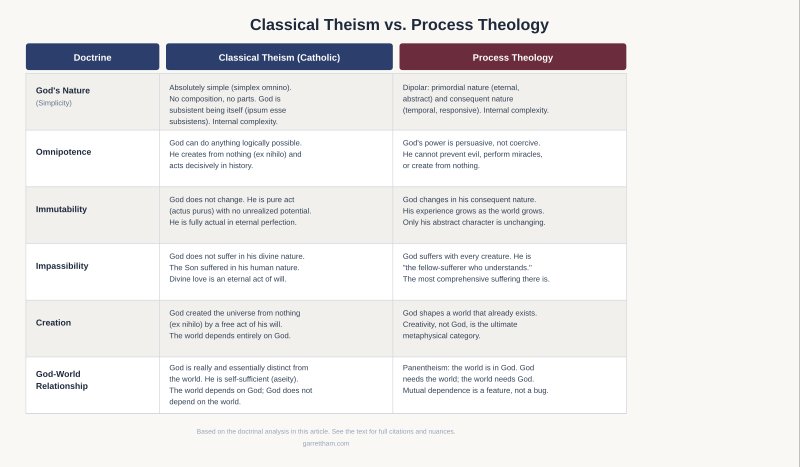
Classical Theism teaches divine simplicity: God has no parts, no composition, no internal structure whatsoever. God does not have goodness, wisdom, or power; he is goodness, wisdom, and power. There is no distinction in God between essence and existence, between potency and act, or between any of the categories that apply to creatures. This doctrine, affirmed explicitly at the Fourth Lateran Council (1215) and the First Vatican Council (1870), represents the deepest layer of Catholic metaphysics. As St. Thomas Aquinas argues, a God with parts would be less than fully perfect, since the parts would depend on some higher principle to unite them.
Process Theology, by contrast, teaches that God is dipolar. God has two distinct natures: a primordial nature (eternal, abstract, containing all possibilities) and a consequent nature (temporal, concrete, constituted by God’s experience of the world). This dipolar structure is not a deficiency that process theology grudgingly accepts; it is central to the process vision of a God who is genuinely responsive to creation. But it directly contradicts divine simplicity. A God with distinct natures is a God with internal composition—and that, the Catholic tradition insists, cannot be the God we worship.
Omnipotence: Coercive vs. Persuasive
How should we understand divine power?
Classical Theism holds that God is omnipotent: he can do anything that is logically possible. This omnipotence is understood as coercive power—unilateral capacity to bring about any state of affairs. God can create ex nihilo, perform miracles, and act decisively in history. He can move the will of creatures without overriding their freedom, through the theological framework of divine concurrence and God’s scientia visionis (his knowledge of what will freely come to pass). For classical theism, omnipotence is not a limitation on God’s love; it is the very condition that makes God’s love redemptive.
Process Theology redefines omnipotence as maximal persuasive power. God lures every actual occasion toward the best possible outcome available to it through an “initial aim,” but God cannot unilaterally determine any outcome. God lacks the power to coerce, to override creaturely freedom, or to prevent natural disasters. This has obvious implications for the problem of evil: if God cannot prevent suffering, then God is not responsible for it. But it also means that God is not, in the classical sense, almighty. For process theologians, this is not a defect in God but a necessary consequence of respecting the freedom and reality of creatures.
Immutability: Pure Act vs. Becoming
Is God subject to change?
Classical Theism teaches that God is immutable: he does not change. God is pure act (actus purus)—he has no unrealized potential, no capacity for growth or development. This is the highest perfection. To change would be to move from potency to act, to acquire something not previously possessed, and thus to be capable of improvement. But a God capable of improvement would be a less-than-perfect God. Moreover, immutability follows necessarily from divine simplicity: if God is utterly simple, he cannot acquire new properties, develop new knowledge, or undergo emotional change. God’s knowledge of all things is eternal and unchanging; his love for creatures is an eternal act of will, not a temporal reaction.
Process Theology teaches that God is in a state of perpetual becoming. In his primordial nature, God is eternal and abstract, but in his consequent nature, God acquires new experiences moment by moment. As creatures make decisions and create new actualities, God responds to these developments, feeling their joys and sorrows, incorporating their achievements into his own experience. God literally grows: his consequent nature becomes richer and more complex as history unfolds. For process theologians, this makes God more genuinely alive, more responsive, and more engaged with creation than the immobile deity of classical theism.
Impassibility: Divine Nature vs. Fellow-Sufferer
Can God suffer?
Classical Theism affirms divine impassibility: God does not suffer. The divine nature as such is incapable of suffering because suffering involves an external cause acting upon the sufferer, and God depends on nothing external to himself. This does not mean God is indifferent to suffering. God loves creatures and desires their good. But God’s love operates within an eternal, unchanging divine nature. The suffering of the Passion belongs to Christ’s human nature, not to the divine nature. This distinction—between the impassibility of the divine nature and the reality of Christ’s suffering in his human nature—is preserved through the doctrine of the communicatio idiomatum, which allows us to say truly that God suffered and died, while maintaining that the divine nature itself remains impassible.
Process Theology explicitly rejects impassibility. Process theologians argue that a God who does not suffer is a God who does not truly love, and that the biblical witness to a responsive, emotionally engaged God should not be dismissed as anthropomorphic metaphor. In process theology, God is “the fellow-sufferer who understands,” to use Whitehead’s famous phrase. God’s consequent nature is constituted by his participation in the suffering of every creature. This makes God’s love genuine and immediate in a way that classical theism, process theologians argue, cannot adequately express.
Creation: Ex Nihilo vs. Eternal Process
How did the world come to be?
Classical Theism teaches creation ex nihilo—creation from nothing. There was no pre-existing matter, chaos, or principle alongside God. God alone is uncreated; everything else is utterly dependent on God for its existence. This doctrine, defined at the Fourth Lateran Council, is non-negotiable for Catholic faith. It expresses the radical transcendence of God and the complete contingency of creatures. Creation is a free act of God’s will, not a necessary emanation or an inevitable overflow of the divine nature.
Process Theology denies creation ex nihilo. In Whitehead’s metaphysics, creativity is the ultimate category, and God works within this ultimate metaphysical structure rather than transcending it. God does not create the world from nothing; he orders and shapes a world that is, in some sense, always already there. God acts as a persuasive force upon actual occasions that arise from the ultimate principle of creativity. This means the world is co-eternal with God and metaphysically necessary to God’s existence. The Catholic tradition sees this as fundamentally incompatible with the revealed doctrine of creation.
God-World Relationship: Transcendence vs. Panentheism
How should we understand the relationship between God and the world?
Classical Theism emphasizes radical transcendence. God is distinct from creation, not dependent on it, and not limited by it. God’s relationship to the world is real on the creature’s side but a “relation of reason” on God’s side, in Aquinas’ terminology. This does not mean God is indifferent; rather, it means God relates to the world through the eternal and unchanging act of his will. The world is utterly contingent; it could not have existed. God transcends space, time, and all creaturely limitations.
Process Theology teaches panentheism: the world is in God, constituting his consequent nature. God is not simply distinct from the world but includes it within himself. Moreover, God needs the world: without creatures to experience, God’s concrete, consequent nature would be empty. The relationship is one of mutual dependence. God provides the lure toward beauty and complexity; the world provides the content of God’s experience. This mutual dependence, for process theologians, expresses God’s relational nature more adequately than classical transcendence.
A Catholic Assessment
Each of these differences points to a fundamental theological choice about what kind of God we believe in and what it means to worship.
The Catholic Church cannot accept the metaphysical framework of process theology because it contradicts defined dogma. The Fourth Lateran Council and the First Vatican Council are not casual sources of doctrine; they represent the solemn, binding teaching of ecumenical councils on matters explicitly revealed. The claims that God creates from nothing, that God is absolutely simple, that God is immutable, and that God depends on nothing outside himself are not negotiable points that can be traded away in light of philosophical fashion.
Yet the Church also recognizes that process theology raises legitimate pastoral and theological concerns. Catholics should take seriously the problem of evil, the question of how God relates to human suffering, and the insistence that God genuinely loves the world and responds to human prayer. The Catholic intellectual tradition has rich resources for addressing these concerns—resources grounded in the Cross of Christ, the theology of the Trinity, and the doctrine of divine providence understood through frameworks like Molinism.
The deepest Catholic conviction is this: God’s transcendence is not opposed to his love but is, rather, the very ground of it. Because God is simple, immutable, and all-knowing, his love is not a reaction but an eternal act of the divine will—and that makes it more stable, not less. Because God is pure act, he lacks nothing and depends on nothing, which means his love is wholly gratuitous, a gift with no price tag. And because God entered history in the Incarnation, suffered on the Cross, and rose in power, we know that the transcendent God is not distant but has bridged the infinite distance through grace.
Frequently Asked Questions
Which view does the Catholic Church hold?
The Catholic Church unequivocally affirms classical theism. The dogmatic definitions of the Fourth Lateran Council (1215) and the First Vatican Council (1870), along with the consistent teaching of the Catechism of the Catholic Church, are clear: God is the creator of all things from nothing, is absolutely simple, is immutable, is omnipotent, and is really and essentially distinct from the world. These are not matters of theological opinion but of defined doctrine.
Can we learn anything from process theology?
Yes. Process theology helpfully raises questions about divine responsiveness, the reality of human freedom, and God’s solidarity with suffering. These questions have prompted Catholic theologians to articulate more clearly how classical theism, properly understood, addresses these concerns. The Catholic doctrines of the Incarnation, the Trinity, God’s universal salvific will, and divine providence all testify to a God who is intimately involved with creation. Process theology is wrong about the metaphysics, but it is asking important pastoral questions.
How do process theology and open theism differ?
Process theology and open theism both reject exhaustive divine foreknowledge and both emphasize divine responsiveness. However, open theism typically retains creation ex nihilo and divine omnipotence (understood as God’s voluntary self-limitation of his power), while remaining within a more traditional Christian metaphysical framework. Process theology goes further, denying creation ex nihilo outright and redefining omnipotence as persuasive rather than coercive. Process theology is more radical in its metaphysical commitments.
Does classical theism make God seem cold or distant?
This is a common misunderstanding. Classical theism holds that God is immutable and simple, but it also teaches that God is absolute love (1 John 4:8). God’s unchanging love is more reliable than a love that could grow or diminish. The Incarnation—God becoming human, suffering, and dying on the Cross—is the supreme expression of divine love precisely because it is the eternal God who freely enters into human suffering. Classical theism makes room for this mystery; process theology does not.
Further Reading
- Process Theology: A Catholic Evaluation — A comprehensive examination of Whitehead’s system and why the Church cannot accept it
- Divine Simplicity — Why God has no parts, and what that means for theology
- Open Theism vs. Process Theology — A side-by-side comparison of two challenges to classical theism
- The Trinity: A Catholic Explanation — How the doctrine of the Trinity preserves both divine transcendence and divine involvement
- Molinism — A Catholic framework for reconciling divine sovereignty and human freedom
- Divine Providence: Models Compared — How Catholic theology understands God’s governance of the world
1 Fourth Lateran Council (1215), De Fide Catholica, cap. 1 (DS 800): “Deus...omnipotenti virtute ab initio temporis creavit de nihilo utramque creaturam, spiritualem et corporalem.”
2 First Vatican Council, Dei Filius, chap. 1 (DS 3001): “Deus...omnipotens, aeternus, immensus, incomprehensibilis, infinitus in intellectu et voluntate et in omni perfectione...omnino simplex, immutabilis...substantia spiritualis.”
3 Thomas Aquinas, Summa Theologiae I, q. 3, aa. 1–8. Aquinas’ treatment of divine simplicity remains the standard exposition in the Catholic tradition.
4 Alfred North Whitehead, Process and Reality: An Essay in Cosmology, corrected edition, ed. David Ray Griffin and Donald W. Sherburne (New York: Free Press, 1978), 337–351.
5 Charles Hartshorne, The Divine Relativity: A Social Conception of God (New Haven: Yale University Press, 1948), which remains the foundational work for process theology’s doctrine of God.
6 Catechism of the Catholic Church §213: “God is infinite, almighty, perfect (cf. John 11:26). ‘Infinite in every way, God’s knowledge and power are boundless.’” The CCC’s discussion of God’s transcendence and uniqueness (sections 200–231) provides the contemporary authoritative statement of Catholic theism.

Garrett Ham
Garrett Ham is an attorney, military veteran, and holds a Master of Divinity from Yale Divinity School. He writes from Northwest Arkansas on theology, law, and service.
More about Garrett →Related Posts
Process Theology: A Catholic Evaluation
What is process theology? An examination of Whitehead's dipolar theism, panentheism, and the rejection of classical divine attributes—and why the Catholic Church cannot accept it.
What Is Process Theology?
What is process theology? A clear introduction to Whitehead's process philosophy, dipolar theism, panentheism, and how process theology differs from classical Christian theism.
Divine Simplicity: God's Absolute Oneness
An exploration of divine simplicity—the doctrine that God is utterly simple, without composition or division. How this classical Catholic teaching shapes our understanding of God's nature and attributes.
Stay Informed
Get new writing on faith, law, and service delivered to your inbox.
No spam. Unsubscribe anytime.