Canon 28 of Chalcedon: The Canon That Divided Rome and Constantinople
On This Page
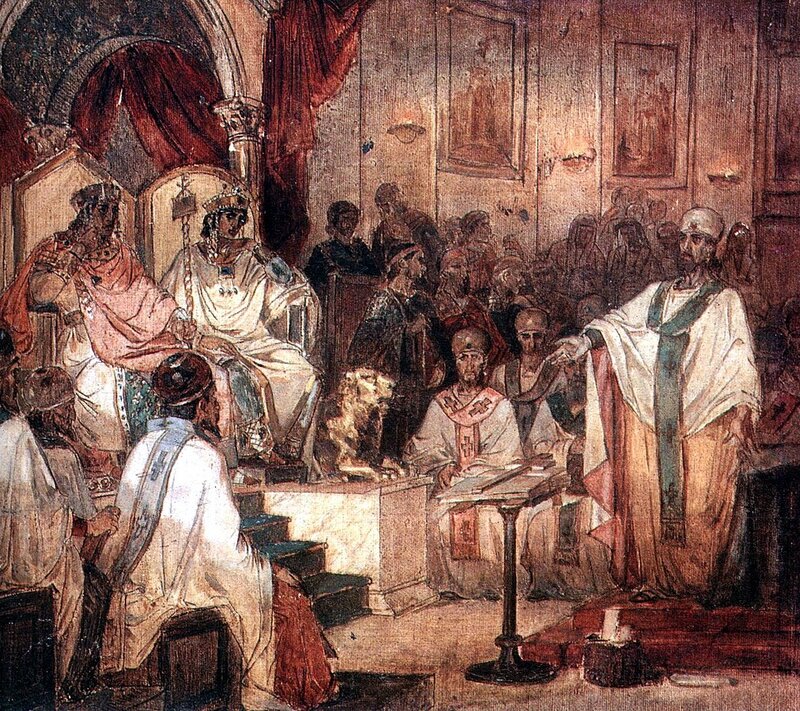
In the summer of 451, bishops gathered in the seaside city of Chalcedon—just across the Bosphorus from Constantinople—to settle some of Christianity’s most vexing theological questions. They produced what many consider the most important doctrinal definition of the early Church: Christ is one person in two natures, truly God and truly man. But overshadowed by this triumph was a canon that would prove far more destabilizing: Canon 28, which gave the Bishop of Constantinople extraordinary ecclesiastical rank.
Most Christian historians—Catholic and Orthodox alike—recognize Canon 28 as a watershed moment. Where you stood on this canon would eventually shape whether you answered to Rome or Constantinople. To understand the Great Schism, you must understand Canon 28.
What Canon 28 Actually Said
Canon 28 is remarkably brief. Here is its substance: Constantinople’s bishop should receive “the same privileges” as Rome’s bishop and should have “pre-eminence” over the Eastern provinces—second only to Rome itself. The canon explicitly justified this on a novel principle: Constantinople was “new Rome,” the capital of the empire, and therefore its chief bishop deserved honors commensurate with the city’s political status.
This sounds almost bureaucratic today. But in the fifth century, it was radical. It fundamentally altered how the Church understood ecclesiastical authority.
The traditional understanding—rooted in apostolic tradition and accepted since the first centuries—was that honor followed apostolic foundation. Rome was premier because Peter and Paul founded it. Alexandria held the next rank because Mark established it. Antioch followed because Peter served as its first bishop and Paul played a foundational role there alongside Barnabas (Acts 11:19–26). Constantinople, by contrast, had no apostolic founder. No disciple walked its streets. Its claim to greatness was purely political: Constantine had moved the imperial capital there in 330.
Canon 28 was not without precedent. Seventy years earlier, Canon 3 of the First Council of Constantinople (381) had already declared that “the Bishop of Constantinople shall have the prerogative of honor after the Bishop of Rome, because Constantinople is New Rome.” Pope Damasus I rejected it at the time. But where Canon 3 granted only honorary precedence, Canon 28 went further—extending that precedence into concrete jurisdictional authority over the dioceses of Pontus, Asia, and Thrace. It was the culmination of a trajectory that had been building for decades.
Still, the implications were sweeping. Canon 28 said, in effect, that the See of Peter could lose its unique prerogatives if political circumstances changed. If another city became the capital, perhaps its bishop would eventually eclipse Rome. The seeds of ecclesiastical relativism were sown.
The Emperor’s Hand Behind Canon 28
To understand why the bishops accepted Canon 28, we must recognize the political pressure they faced. Pope Leo I had originally requested a council under Theodosius II, who refused. After Theodosius died, Empress Pulcheria—who may have made convening the council a condition of her marriage to Marcian—helped bring it about. Emperor Marcian issued the formal edict on May 17, 451. Ironically, Leo later opposed holding the council, preferring that bishops individually sign his Tome. But Marcian made no secret of his expectations. He wanted Constantinople to govern the Eastern Church—fully and directly—without constant appeals to Rome.
This was pragmatic imperial governance. Rome lay in the ruins of the Western Empire, increasingly isolated and impoverished. Constantinople was wealthy, secure, and the actual center of imperial administration. From Marcian’s perspective, the Eastern Church needed a chief pastor who answered to Constantinople’s metropolitan, not a distant pope in Italy.
The bishops felt the weight of this power. When they voted on Canon 28, most Eastern bishops supported it. It served their interests too. A powerful patriarch of Constantinople would give them someone to negotiate with locally, someone who could represent their concerns to the emperor without long delays for papal approval.
But the Western bishops present—and more importantly, Pope Leo I, presiding through legates—objected strenuously. Leo’s response reveals the Catholic understanding of papal primacy in its clearest fifth-century form.
Pope Leo’s Principled Objection
Pope Leo did not object to giving Constantinople honor and respect. In his letters about Chalcedon, he praises the council’s orthodoxy and even acknowledges the city’s importance. What he rejected absolutely was the principle behind Canon 28.
Leo’s argument was ecclesiological, not political. He wrote that ecclesiastical rank must follow apostolic foundation and inheritance of the faith, not the changing map of political empires. To accept Canon 28 would be to say that authority in the Church flows from Caesar’s decisions, not from Christ’s promises to Peter. It would reduce papal primacy to merely one privilege among many, revocable if circumstances shifted.
In Leo’s view—and the Catholic view that inherited from him—the papacy is not one office among several that happen to be located in the capital. It is a unique charism, a universal jurisdiction rooted in Christ’s words to Peter and inseparable from Rome. You cannot transfer it. You cannot diminish it by elevating others.
The pope therefore refused to accept Canon 28. Rome’s legates protested vigorously at the session where it was passed—the council’s own letter to Leo acknowledged that “Your legates have made a violent stand against it”—but they were overruled. Leo then explicitly repudiated the canon in subsequent correspondence, ratifying the council’s doctrinal decrees on March 21, 453, while continuing to reject Canon 28. In his letter to Empress Pulcheria, he used the strongest possible language: “we declare void, and by the authority of blessed Peter annul it.” This was not political stubbornness. It was a defense of what Leo understood as the structure of the Church Christ founded.
Rome’s Long Refusal—and a Parallel That Wasn’t Acceptance
What followed was a curious impasse. The Eastern bishops had declared Canon 28 ecumenical law. Rome had rejected it. Yet in practice, the East simply moved forward as if Rome had agreed.
For centuries, this did not create immediate schism. The relationship between Rome and Constantinople remained fractious but functional. However, the underlying issue never died. Every major dispute between East and West had Canon 28 lurking in the background.
Rome’s position remained essentially unchanged for nearly eight centuries. At the Fourth Lateran Council in 1215, under Pope Innocent III, Canon 5 established a ranking of patriarchal sees—Rome, Constantinople, Alexandria, Antioch, Jerusalem—that superficially resembled Canon 28’s outcome. But Canon 5 never mentioned Canon 28. It framed its action as “renewing the ancient privileges of the patriarchal sees” and grounded Rome’s authority not in political status but in divine disposition: Rome “through the Lord’s disposition has a primacy of ordinary power.” Canon 5 also required all patriarchs to receive the pallium from Rome and swear an oath of fidelity and obedience—requirements antithetical to Canon 28’s framework of equal privileges. And the essential context is this: by 1215, Constantinople had been under Latin military occupation since the Fourth Crusade of 1204, and the “Patriarch of Constantinople” at Lateran IV was a Latin appointee controlled by Rome. Ranking a see Rome had recently conquered was radically different from accepting the historical claims of the Greek Orthodox Patriarchate.
The underlying divide persisted. Constantinople and its successors understood the Eastern patriarch’s role in a way incompatible with Rome’s claims. Rome understood its own primacy as non-negotiable precisely because it was apostolic, not political.
Canon 28 and the Road to Schism
Historians sometimes treat the Great Schism of 1054 as a sudden rupture. But any study of the primary sources reveals decades of escalating tension, with Canon 28 as a constant irritant.
When the Patriarch of Constantinople began using the title “ecumenical patriarch”—a designation that developed gradually over more than a century, conferred by emperors and confirmed by synod—Rome saw it as implicitly claiming universal jurisdiction. Pope Gregory I (590–604) fiercely opposed it, calling it “diabolical arrogance.” Byzantine sources, however, told the papal librarian Anastasius that the title meant merely “imperial patriarch,” not “universal.” Whatever its intended meaning, the title’s trajectory followed the logic established by Canon 28. If Constantinople’s bishop had equal privileges to Rome and pre-eminence in the East, why shouldn’t he claim a broader role?
Similarly, when Rome demanded that Eastern bishops accept papal authority, and Constantinople resisted on the grounds that the Eastern Church had always been governed collegially under imperial oversight, both sides were drawing from different understandings of ecclesiastical order. Canon 28 had crystallized that difference.
The final schism emerged not from a single dispute but from a fundamental disagreement about how the Church should be structured—a disagreement encoded at Chalcedon itself.
Canon 28 and Modern Dialogue
Today, in ecumenical conversations between Catholics and Orthodox, Canon 28 remains an obstacle. The Orthodox see their hierarchical but collegial structure as legitimate—indeed, as more authentically apostolic than Rome’s centralization. Catholics continue to maintain, with the Second Vatican Council, that Christ “placed Blessed Peter over the other apostles, and instituted in him a permanent and visible source and foundation of unity of faith and communion.”1
Neither side denies the historical reality of Canon 28 or its significance. But they interpret it differently. For the Orthodox, it shows that the early Church never understood Rome’s claims to universal jurisdiction. For Catholics, it demonstrates precisely why such clarity became necessary—left unresolved, it led to schism.
Understanding Canon 28, then, is not mere antiquarianism. It illuminates why East and West developed such different ecclesiologies, and why bridging that gap remains one of the deepest challenges in Christian unity. Until Catholics and Orthodox can agree on what Church governance should look like—whether the Church is fundamentally structured around Rome, or around a college of patriarchs under Rome’s honor—the canon’s shadow will continue to fall across every dialogue.
- Second Vatican Council, Lumen Gentium (Dogmatic Constitution on the Church), 18.

Garrett Ham
Garrett Ham is an attorney, military veteran, and holds a Master of Divinity from Yale Divinity School. He writes from Northwest Arkansas on theology, law, and service.
More about Garrett →Related Posts
The Council of Chalcedon (451): How Political Rivalry Reshaped Christendom
The Council of Chalcedon (451 AD) resolved a Christological crisis but reshaped the political map of Christendom. How it destroyed Alexandria, elevated the papacy, and set the stage for the Great Schism.

Should Eastern Orthodoxy Exist in the West?
In this post, I consider whether Eastern Orthodoxy, according to its own teachings, should exist in the West at all.
The First Vatican Council (1869-1870)—What It Taught and Why It Matters
Vatican I defined papal infallibility and primacy while defending faith against rationalism. Explore its two major constitutions, the context that prompted it, and its enduring significance for Catholic theology.
Stay Informed
Get new writing on faith, law, and service delivered to your inbox.
No spam. Unsubscribe anytime.