The National Firearms Act of 1934
On This Page
A basic overview of the National Firearms Act of 1934 — what items it regulates, what process it imposes, and how the 1986 Hughes Amendment and the 2025 One Big Beautiful Bill Act have reshaped the regime.
With recurring debates over federal firearms policy, many people are surprised to learn that current law allows the possession of fully automatic machine guns by private citizens in the United States. The new-machine-gun ban did not take effect until 1986 and applied only prospectively, meaning that private citizens may still purchase, own, and operate machine guns registered prior to that date.
The National Firearms Act (NFA)
In 1934, Congress passed the NFA at a time when prohibition was coming to an end and gang activity was running rampant in the United States. This was the tail end of the era of Al Capone, bootleggers, and the Thompson submachine gun.
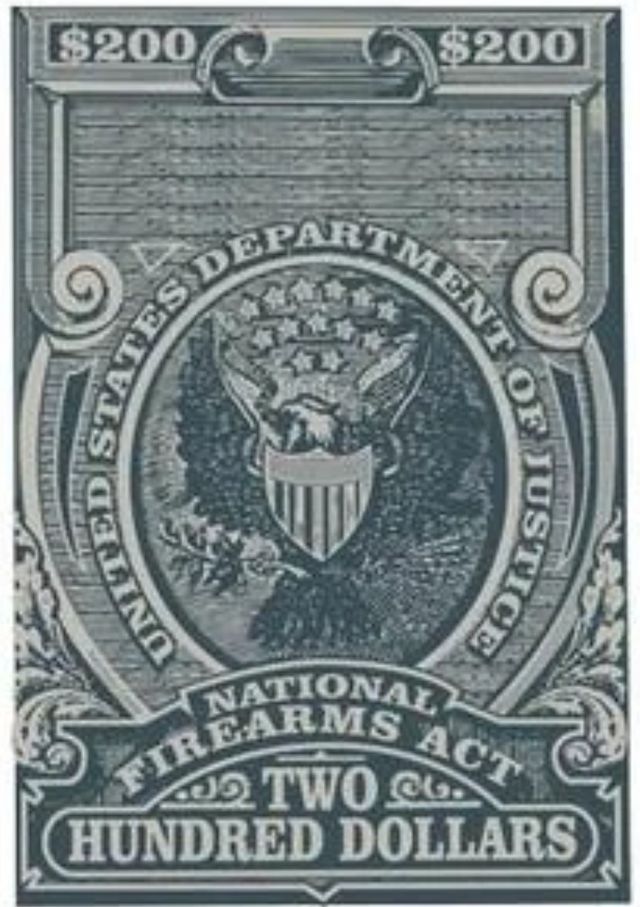
The NFA imposes an excise tax on the manufacture and transfer of certain weapons—including machine guns, short-barreled weapons (including sawed-off shotguns and rifles but not handguns), and suppressors—and requires the registration of these items with the ATF. A private citizen may purchase such weapons, but in order to do so, he or she must, among other things, submit an application to the ATF, obtain the signature of the local Chief Law Enforcement Officer (CLEO)—who may be the county sheriff or local police chief—pass a background check requiring the submission of the person’s photograph and fingerprints, and historically pay a $200 excise tax.
The 2026 Tax Stamp Reduction
The One Big Beautiful Bill Act, signed July 4, 2025, made a significant change to the NFA fee structure: effective January 1, 2026, the $200 federal NFA tax is reduced to $0 for suppressors, short-barreled rifles (SBRs), short-barreled shotguns (SBSs), and “any other weapons” (AOWs). The $200 tax continues to apply to machine guns and destructive devices, which were excluded from the reduction.
Importantly, the underlying registration requirements remain unchanged. ATF Form 4 (or Form 1 for owner-manufactured items) still must be filed, fingerprints and a passport-style photo are still required, and the background check still applies. The change is to the tax, not to the registration regime. Approval timelines for ATF processing remain a function of agency workload rather than the fee.
Practical Considerations
In acquiring a Title II weapon, controversy may erupt where the CLEO will not sign the necessary documentation. In most states, the CLEO is not required to provide his or her signature, and without that signature an individual cannot acquire a Title II weapon. As another post explains in detail, gun trusts have become a popular way to circumvent this requirement. Transfers of NFA items to impersonal legal entities, such as corporations or trusts, require neither CLEO signature nor the submission of fingerprint cards or photographs.
The NFA registration or transfer process generally takes between three and six months, sometimes longer. Once the transfer occurs, the firearm cannot be transported or handled by anyone other than the gun’s owner. Any transfer of the firearm will require a new application, though there may be exceptions where the gun passes via inheritance.
Even in such situations, however, a permanent transfer must always be approved by the ATF. Gun trusts have increased in popularity for this reason as well: they allow for the transfer of NFA weapons merely by changing the trust’s trustees. Since the same trust continues to own the NFA weapon, there is no real transfer of ownership that would invoke this provision of the Act.
Costs and Potential Sanctions
The Hughes Amendment to the Firearm Owners Protection Act of 1986 effectively banned private ownership of new machine guns. Since private citizens may now only own machine guns manufactured and registered prior to May 19, 1986, the costs of these weapons have increased dramatically and are significantly more expensive than comparable weapons manufactured today. The Hughes Amendment affects only machine guns, however, and so other modern Title II items—suppressors, SBRs, and SBSs—are still legal to acquire and transfer pursuant to the National Firearms Act.
The NFA carries significant penalties for noncompliance. Violations are punishable by up to 10 years in prison and a fine of up to $10,000. (Willful attempts to evade the excise tax under 26 U.S.C. § 7201 may incur fines of up to $100,000 for individuals and $500,000 for corporations.) In addition, a violator may have his or her weapons confiscated while losing the ability to own firearms of any kind in the future.
Some states as part of their gun control efforts have completely banned ownership of Title II weapons, and so private citizens in those states may not possess them, even though allowable by federal law. In most states, however—including Arkansas—private individuals may own such weapons as long as they comply with federal law.
Disclaimer: This post is for informational purposes only and is not legal advice. NFA compliance, especially the manufacture and transfer of regulated weapons, is highly fact-specific; consult a qualified federal-firearms attorney in your jurisdiction about your situation.

Garrett Ham
Garrett Ham is an attorney, military veteran, and holds a Master of Divinity from Yale Divinity School. He writes from Northwest Arkansas on theology, law, and service.
More about Garrett →Related Posts
NFA Gun Registration Requirements
How Haynes v. United States (1968) struck down NFA registration on Fifth Amendment self-incrimination grounds, and how Congress's 1968 amendments brought the registration regime back into constitutional compliance.

Gun Trusts
A gun trust is a legal entity that owns NFA-regulated firearms — bypassing CLEO consent, individual fingerprinting, and photographs while simplifying transfers across multiple trustees.

Uniform Transfer to Minors Act
The Uniform Transfer to Minors Act lets you transfer property to a child through a custodian — here's how it works and the gift, estate, and income tax implications.
Stay Informed
Get new writing on faith, law, and service delivered to your inbox.
No spam. Unsubscribe anytime.