The Arian Heresy Explained: What Arius Taught and Why the Church Condemned It
On This Page
Introduction
If you ask most Christians today what heresy the early Church feared most, they might mention Gnosticism or Docetism. But they would be wrong. The heresy that nearly conquered Christendom, that divided empires, that sparked councils and councils and still echoes in modern Christian movements, was Arianism—the teaching that Jesus Christ was not truly divine, but rather the greatest and first of created beings.
For nearly a century after its condemnation at the First Council of Nicaea in 325 AD, Arianism remained the dominant form of Christianity in much of the Roman Empire. Emperors wavered. Bishops switched sides. Athanasius, the great defender of Christ’s divinity, was exiled five times. The future looked uncertain. How could the Church have gotten things so wrong for so long? And how could intelligent, scripture-reading Christians have believed something so contrary to the faith once delivered to the saints?
The answer lies in understanding what Arius actually taught, why his teaching seemed plausible to so many, and what was ultimately at stake when the Church declared him anathema. This is not merely ancient history. Arianism’s logic lives on in Jehovah’s Witnesses, in certain strains of Unitarianism, and even in casual misunderstandings of the Trinity that creep into contemporary preaching. To understand Arianism is to understand the foundations of Trinitarian orthodoxy and why the divinity of Christ matters for everything the Church believes and teaches.
Who Was Arius? Life, Context, and the Alexandrian Milieu
Arius (c. 250–336 AD) was a Christian presbyter in Alexandria, Egypt, one of the great intellectual centers of the ancient world. We know frustratingly little about his early life with certainty. He appears to have been formed in the tradition of Lucian of Antioch—Arius himself referred to the bishop Eusebius of Nicomedia as a “fellow-Lucianist”—though he was also shaped by the broader intellectual milieu of Alexandria. By the early fourth century, he held a significant position in the Church of Alexandria, presiding over the important church of Baucalis.
Alexandria was a crucible of Christian thought. It was home to Clement of Alexandria and Origen, two of the greatest Christian theologians of the pre-Nicene era. Origen, in particular, had developed a theology in which the Son was eternally generated by the Father, yet somehow less than the Father—subordinate in some respects, though still divine. Origen’s influence permeated Alexandrian theology, creating a conceptual framework within which Arius would develop his thought.
The Egypt of Arius’s day was theologically contentious. The great debates of the third and fourth centuries centered on fundamental questions: Was God truly one? How could Christ be divine without compromising monotheism? Could the Son really be “God” in the full sense that the Father was God? These were not idle questions for parlor debate; they touched the heart of Christian faith and the reality of salvation itself.
Around 318 AD, Arius entered into a bitter dispute with his bishop, Alexander of Alexandria. Alexander had taken a strongly pro-Nicene position before Nicaea existed—he was convinced that the Son must be eternal, uncreated, and fully divine. Arius disagreed, and the controversy escalated rapidly. By 320–321 AD, Alexander convened a synod of roughly one hundred Egyptian and Libyan bishops that formally condemned Arius’s teaching. Rather than submit, Arius took his case to the broader Church, writing letters and composing poems to spread his theology. This move proved catastrophic, but not before Arianism had infected much of the Christian world.
What Arius Actually Taught: The Theological System
To understand Arianism properly, we must move beyond caricature and slogans to the actual theology. Arius was not denying that Christ was divine in some sense, nor was he claiming Christ was merely human. Rather, Arius articulated a carefully reasoned Christological system designed to preserve monotheism and biblical authority as he understood them. That this system failed to do justice to the fullness of Christian revelation became the Church’s judgment; but we must understand his logic before assessing his error.
The Eternal Generation Problem
The centerpiece of Arian theology was a doctrine of creation rather than generation. The Christian tradition had long spoken of the Son as “begotten, not made,” employing the language of generation to describe the eternal relationship between Father and Son. But what did “eternal generation” really mean? How could something be both eternal and generated?
Arius seized on this tension. If the Son was generated, he reasoned, then there must have been a time when He did not exist. Generation implies a beginning. Eternity, properly understood, belongs only to the one who has no source, no origin—the Father alone. To ascribe eternality to the Son alongside the Father seemed to Arius to undermine divine uniqueness.
Hence his famous formulation: “There was when he was not.”1 This phrase, repeated and condemned by councils and councils, captures the essence of Arian subordinationism. The Son had a beginning. Before that beginning, the Son did not exist. The Father, by contrast, is without origin, unbegotten, alone truly eternal.
The Son as First Creature
But if the Son was not eternal, what was He? Arius’s answer: the Son was the first and greatest of creatures, made by the Father’s will before all ages, but nonetheless a creature—ktisma in Greek, a thing made.
This is crucial. Arianism does not teach that Christ is merely human, or on par with angels, or anything of that sort. The Son occupies a unique place in creation. He is the instrument through which all other things were made. He is incomparable in His perfection and power. But He is not God in the sense that the Father is God. He is not of the same substance as the Father. He is not uncreated.
Arius presented the Son as the supreme mediator between the transcendent Father and creation. The Father, utterly simple and beyond reach, cannot directly interact with the material world. The Son serves as the bridge, the God-like being through whom the cosmos exists and through whom divine will is executed. This sounds almost noble in its logic: it explains how a transcendent God can have anything to do with creation without compromising His utter transcendence.
But it comes at a cost, one that would not become fully apparent until the doctrine of soteriology came into focus.
The Son’s Limited Knowledge
An often-overlooked element of Arianism concerns the limits of the Son’s knowledge. Arius taught that the Son did not know the Father completely. This follows logically from his system: if the Son is a creature, even the first creature, then his knowledge, though vast, is limited. Only the Father knows Himself fully. Even the Son is veiled from the deepest mysteries of the Father’s nature.
This might seem like a minor theological point, but it represents a fundamental dislocation of the Trinity. In orthodox theology, the Son knows the Father because He is the express image of His substance, because He is God of God. In Arianism, the Son knows the Father as a creature knows its maker—genuinely, but incompletely.
The Denial of True Divinity
When we put these pieces together—the creation of the Son, the absence of eternity, the ignorance of the Father’s deepest nature—we see that Arius was denying what the Church had come to affirm: that Christ is truly God. Not God-like. Not divine in an honorary sense. Not a very special creature. But God, in the full and proper sense.
Yet Arius himself would have bristled at this formulation. He believed he was preserving biblical monotheism and biblical Christology. He believed he was defending the unique transcendence of the Father. He believed he was being rational and faithful to Scripture. His error was not one of obvious heterodoxy but of subtle, sophisticated misunderstanding.
The Scriptural Arguments: What Arius Thought Scripture Taught
Arius was not operating in a theological vacuum, nor was he simply imposing rational philosophy on Scripture. He believed his teaching was grounded in the text of Scripture itself. Let us examine the key biblical passages he marshaled in defense of his system.
Proverbs 8:22 and the Creature Language
One of Arius’s favorite texts was Proverbs 8:22, where Wisdom (understood as referring to Christ in Christian tradition) says: “The Lord created me at the beginning of His way, the first of His acts of old.” Here, Arius argued, Scripture itself speaks of the Son as created. The word “created” is unambiguous. How could one explain it away?
The orthodox response, refined especially by Athanasius, held that Proverbs 8 must be read in light of the Fourth Gospel and the fuller revelation of Christ as Logos. The “creation” language refers to the Son’s role in the economy of salvation, not to His metaphysical status. The Son is “created” for us and our salvation, not in His eternal being. This distinction between ontology and economy would become crucial in Trinitarian theology.
John 14:28 and Subordinationism
Another text Arius heavily emphasized was John 14:28: “The Father is greater than I.” If the Father is greater than the Son, Arius reasoned, how can they be of one substance? How can they be equal? Surely greater and lesser imply different natures and levels of divinity.
Again, the orthodox had to account for this troubling text. The answer involved distinguishing between Christ’s divine nature and His state of humiliation. As man, Christ is indeed less than the Father. As God, Christ is equal to the Father. The statement reflects Christ’s incarnate condition, not His eternal nature. This required careful theological work, but it did justice to the full counsel of Scripture.
Colossians 1:15 and the “Image” Language
Colossians 1:15 describes Christ as “the image of the invisible God, the firstborn of all creation.” The language of “image” and “firstborn” seemed to Arius to clearly indicate subordination. An image is not the same as the original. A firstborn implies sequence, not equality.
The orthodox needed to clarify that “image” in biblical theology does not mean “copy” in the platonic sense. The Son is the perfect image of the Father’s substance, the radiance of His glory. Similarly, “firstborn” does not necessarily imply temporal sequence; it can denote supremacy and priority of rank. The Son is firstborn because He is supreme over creation, not because He is the first creature.
The Problem of Biblical Subordination
One of Arianism’s great strengths was that it took seriously the subordinationist language that does appear in Scripture. Passages abound in which the Son defers to the Father, obeys the Father, speaks of the Father as His God. Arianism offered a straightforward interpretation: the Son is literally subordinate because He is metaphysically different from and less than the Father.
The orthodox theologians had to develop a more nuanced account, one that recognized true subordination in the economy of salvation while affirming metaphysical equality in the ontological Trinity. This was no easy task, and it explains in part why Arianism made such headway. It seemed simpler, more rational, more obviously biblical—even if it lost something essential in the process.
Why It Mattered: The Soteriological Stakes
The great Church Father Gregory of Nazianzus articulated a principle that cuts to the heart of why the Church could not tolerate Arianism: “What is not assumed is not healed.”2 Gregory’s original target was Apollinarianism—the denial that Christ possessed a complete human mind—but the underlying soteriological logic extends naturally to the Arian controversy. Just as Christ must be fully human to heal all of human nature, so He must be fully divine to accomplish the work of deification. It was Athanasius who pressed this anti-Arian argument most forcefully in his De Incarnatione, but the principle Gregory crystallized remains the most memorable formulation of the stakes.
The Problem of Salvation
If Christ is a creature, even the greatest creature, He cannot save. Salvation is not something a creature can accomplish. Salvation requires a work that only God can do: the reconciliation of infinite divine justice with infinite mercy, the transformation of human nature itself, the overcoming of sin and death. Only God can do God’s work.
Consider what salvation actually entails. It involves the remission of sins against an infinite God—something that requires infinite satisfaction or infinite mercy. It involves the sanctification of human nature, its elevation to union with the divine. It involves the conquest of death and the devil. These are divine works. They cannot be accomplished by a creature, no matter how exalted.
Athanasius hammered this point repeatedly. In his De Incarnatione, he argues that God became man so that man might become god—or more precisely, so that man might share in divine life. But if the one who became man is himself a creature, then we have merely creature-to-creature contact, not the life-giving communion with divinity that salvation requires.
Deification in the Eastern Tradition
The Eastern Christian understanding of salvation as theosis (deification, divinization) made this problem especially acute. To be saved is to be transformed into the divine image, to share in God’s incorruptibility and immortality, to participate in divine life itself. This is not a mere legal declaration of forgiveness; it is a real transformation of the human person.
But such a transformation is possible only if we are united to what is truly divine. If the Son is merely the greatest creature, we are united only to a creature, and we remain creatures. We cannot transcend our creatureliness through contact with what is merely creaturely. We need union with the divine itself. We need the incarnate God, not the incarnate highest creature.
The Logical Consequence
This soteriological objection to Arianism can be stated simply but powerfully: Arianism ultimately denies the possibility of salvation as the Christian tradition understood it. If this consequence follows from Arianism’s premises, and if salvation is indeed possible and necessary, then Arianism must be false. The Church could not accept a teaching that undermined the very foundation of Christian hope.
The Response: Alexander, Athanasius, and the Road to Nicaea
The opposition to Arius did not begin with Nicaea. It began with Alexander of Alexandria, Arius’s own bishop, and with the broader ecclesiastical response to Arian teaching as it spread through the Church.
Alexander’s Condemnation
When the controversy could no longer be contained, Alexander convened a synod in Alexandria around 320–321 AD and condemned Arius. Alexander was not the most sophisticated theologian—his thought was sometimes more intuitive than precisely articulated—but he grasped what Arius was denying: the true divinity of the Word. Alexander insisted that the Word was eternally with the Father, uncreated, of one substance with the Father.
Arius refused to submit. Instead, he appealed beyond his bishop to the broader Church, writing letters to sympathetic bishops, composing the Thalia (a poem setting forth his theology), and building a constituency among clergy and intellectuals who found his rationalism appealing.
The Young Athanasius
Athanasius of Alexandria (c. 296–373 AD) emerged as Arianism’s great antagonist. When Alexander died around 328 AD, Athanasius succeeded him as bishop. Athanasius was young, learned, brilliant, and absolutely implacable in his opposition to Arianism. “Athanasius against the world,” the saying goes, capturing his lonely struggle to maintain orthodoxy as emperors wavered and bishops equivocated.
Athanasius understood what Arius denied: that the Son is not a creature, not subordinate in nature, not made in time, but eternally begotten of the Father and thus truly God. In his Contra Arianos and De Incarnatione, Athanasius deployed philosophical rigor, scriptural interpretation, and soteriological argument to demolish the Arian system.
But Athanasius would pay a terrible price for his faithfulness. He was exiled five times under four different emperors, persecuted and condemned by councils dominated by Arian sympathizers. Yet he never wavered—famously refusing Constantine’s direct order to readmit Arius to communion, a defiance that epitomized his unwavering commitment to the truth.
The First Council of Nicaea (325 AD)
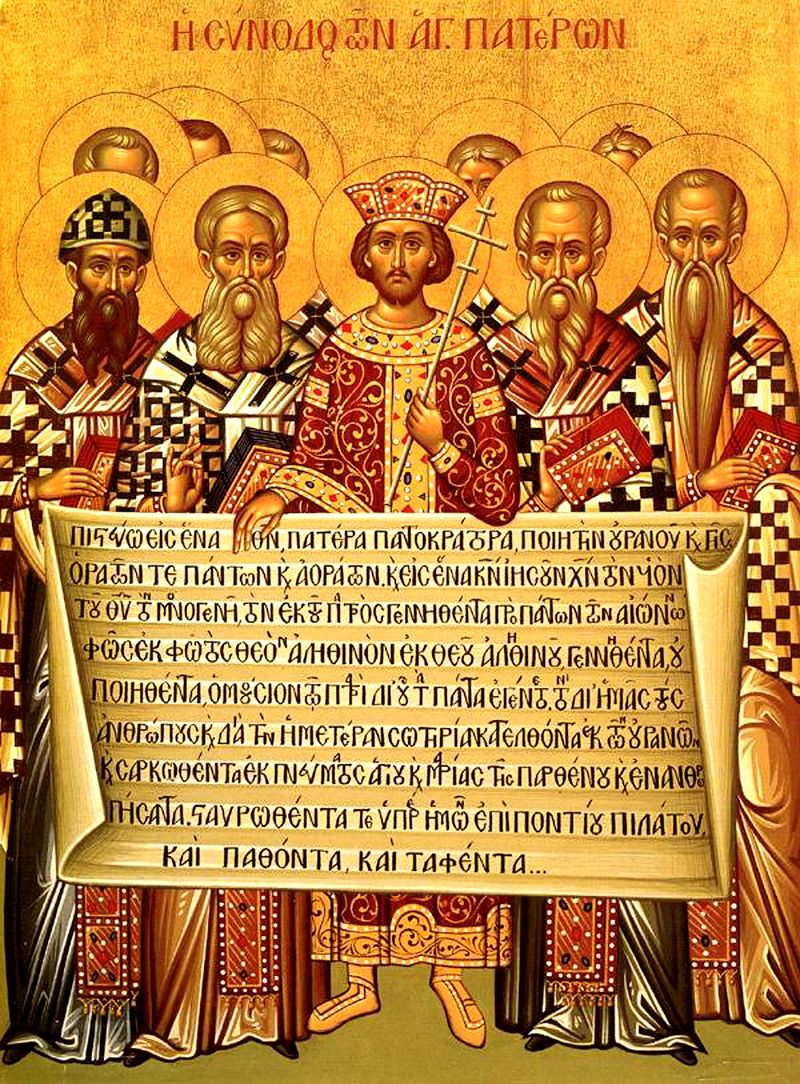
Emperor Constantine, concerned about the divisions threatening Church unity and imperial stability, convened the First Ecumenical Council at Nicaea in 325 AD. Over three hundred bishops gathered to settle the Arian controversy once and for all. (For a fuller account of the council, see our comprehensive guide to the First Council of Nicaea.)
The council condemned Arianism categorically. The Son, it declared, was “of one substance” with the Father—homoousios in Greek. This single word, later immortalized in the Nicene Creed, became the battleground for another half-century of controversy.
Why homoousios? The term itself was not biblical, which troubled some bishops. But it expressed what Scripture truly taught: that the Son shares the very substance, the very being, the very nature of the Father. He is not a creature. He is not subordinate in nature. He is God of God, Light of Light, true God of true God. There is no time when He was not.
The council issued its condemnation:
“As for those who say ‘once he was not’ or ‘before his generation he was not’ or ‘he came to be out of nothing’, or who assert that ‘the Son of God is of a different hypostasis or substance’, or ‘created’, or ‘changeable’, or ‘alterable’—the holy, catholic, and apostolic church anathematizes them.”3
Semi-Arianism and the Aftermath: The Long Fourth Century
One might have thought Nicaea would settle the matter. Arius was condemned. The Creed was adopted. The heresy was defeated. But the reality proved far messier.
A middle party of bishops, known as the Semi-Arians, emerged in the decades after Nicaea. They accepted that the Son was divine, but they balked at homoousios (of one substance), preferring instead homoiousios (of like substance). This seemingly minor terminological difference masked a profound disagreement.
The Semi-Arians wanted to assert the Son’s divinity while preserving a sense of gradation or distinction between Father and Son. They rejected Arius’s stark “there was when he was not,” but they also rejected the full consubstantiality that homoousios entailed. The Son, they suggested, was divine but derived, exalted but less than the Father.
This position proved remarkably durable. For much of the latter fourth century, Arianism in its cruder form (advocating for a created Son) and Semi-Arianism competed with Nicene orthodoxy for dominance in the Eastern Church. The great Cappadocian Fathers—Basil of Caesarea, Gregory of Nyssa, and Gregory of Nazianzus—had to fight not only against vulgar Arianism but against the more sophisticated Semi-Arian compromise.
The Council of Constantinople (381 AD) largely settled the matter in the East, reaffirming and clarifying the Nicene position. But it took the better part of a century, two more great councils, the writings of the Cappadocians, the exile and triumphant return of Athanasius, and the conversion of key imperial figures for Nicene orthodoxy to prevail definitively.
Modern Echoes of Arianism: Heresy in New Dress
While the Arian heresy in its classical fourth-century form is defunct, Arianism did not disappear. It was not so much refuted out of existence as it was superseded by institutional Christianity and the weight of ecclesiastical authority. In the modern world, Arianism has found new expressions in religious movements that emphasize biblical literalism and rationalism.
Jehovah’s Witnesses
The most obvious modern continuation of Arianism is found in the Jehovah’s Witnesses. While the Witnesses do not explicitly claim descent from Arius, their theology is fundamentally Arian: Jesus is the first and greatest creation of God the Father, the instrument through whom all other things were created, but not God in the full sense.
The Witnesses speak of Jesus as the “Son of God” and accord Him a dignity above all other creatures, but they explicitly reject the doctrine of the Trinity and insist on the subordination of the Son to the Father. In their theology, God’s unity is preserved by making the Son ultimately a creature, albeit a glorified one.
Unitarianism and Related Movements
Certain strains of Unitarianism, particularly historical Unitarianism in its rationalist phase, adopted positions functionally equivalent to Arianism. Unitarians denied the Trinity and rejected the full divinity of Christ, though they often preferred different philosophical frameworks and terminology.
Modern Unitarianism is diverse, and some contemporary Unitarians would be uncomfortable with an Arian label. But the logic is similar: an insistence on the absolute unity and transcendence of God (understood as the Father alone), a denial of the Trinity, and a subordinationist Christology that makes Jesus an exalted creature rather than God incarnate.
Informal Arianism in Popular Christianity
Perhaps more troubling to the pastorally-minded theologian is the informal Arianism that persists in popular Christian preaching and devotion. How often do we hear sermons that treat the Father as the “real” God while treating the Son as subordinate, powerful but not quite equal? How often does Christian devotion focus exclusively on God the Father while treating Christ as His agent rather than as God Himself?
This is not formal heresy; most preachers would affirm the Trinity if asked directly. But it reflects a conceptual Arianism, an inability to hold together the full divinity of the Son with the unique transcendence of the Father. It is Arianism lite, or Arianism at the level of unexamined assumption rather than explicit doctrine.
Why It Still Matters: The Permanent Significance of Nicene Orthodoxy
Why should contemporary Christians care about a fourth-century heresy that was supposedly defeated fifteen hundred years ago? The answer is that Arianism touches the very heart of Christian faith, and the principles at stake in its condemnation remain relevant.
The Absolute Uniqueness of God
First, the struggle against Arianism established that the absolute uniqueness and transcendence of God could not be preserved by subordinating the Son. Some might have thought: “Let’s make the Father absolutely unique by making everything else, including the Son, a creature.” But the Church recognized that this strategy ultimately failed. It did not preserve God’s uniqueness; it merely created a hierarchy within creation, a kind of demiurgical system.
True Christian monotheism, the Church came to understand, is not monotheism of degree but of kind. There is one God, and anything that partakes in God’s being and nature is God. The Son is not a second God beside the Father; He is God with the Father, of the same substance and nature.
The Doctrine of the Trinity
Nicene orthodoxy against Arianism established the basic framework for Trinitarian theology: that God is one in substance but three in person, that the Son and Spirit are fully divine, not creatures, and that the Christian God is irreducibly mysterious—not susceptible to simple rational categories.
This may seem like abstract metaphysics, but it reflects a hard-won Christian insight: the God revealed in Christ cannot be confined to the rationalist boxes we construct for Him. He is at once utterly transcendent and intimately involved in creation and redemption. He is at once absolutely one and irreducibly three. This mystery is not a confusion to be resolved by subordinating the Son, but a truth to be affirmed and worshiped.
The Ground of Salvation
Perhaps most importantly, the Nicene condemnation of Arianism established that salvation depends on the full divinity of Christ. If we cannot be saved by a creature, no matter how exalted, then Christ must be truly God. And if Christ is truly God become man, then the salvation He effects is genuinely divine salvation, not merely a creature-to-creature transaction.
This has implications for how we understand redemption. It means that in Christ, God Himself enters into human experience, suffers with and for us, and transforms human nature from within. It means that salvation is not merely the cancellation of a debt or the transfer of merit, but the restoration of human nature to communion with the divine. It is, in the Eastern tradition, deification. And this is possible only because Christ is truly God.
FAQ: Common Questions About Arianism and Its Condemnation
Q1: Was Arius’s theology completely irrational? Could intelligent people really have believed it?
A: Arianism was not irrational in its own terms. Arius was working with Platonic philosophical categories that were common in his milieu, and he deployed those categories consistently. The problem was not irrationality but what we might call a false rationalism—an insistence that God must conform to our rational categories. This led Arius to deny the possibility of genuine eternal generation (because generation seemed to imply a beginning) and to insist that the Son must be a creature (because true creation was a more intelligible concept than the paradoxical union of Creator and creature).
The orthodox response was not less rational but more thoroughly rational: it recognized that certain truths about God transcend the limitations of discursive reason and must be affirmed even when they seem paradoxical. The Trinity is rational in the sense that it is not self-contradictory, but it is not rationally obvious in the way that a simple subordinationism might seem to be.
Q2: Didn’t the Council of Nicaea impose the term “homoousios” against the wishes of many bishops? Isn’t that problematic?
A: The theological history here is complex. While it is true that homoousios was not a term that all bishops preferred, and while some conservative bishops initially resisted it, there is no evidence that the council imposed it against the considered judgment of the assembly. Rather, as bishops debated the issues, the case for homoousios became compelling: it was the only term that adequately excluded Arianism while preserving the real distinctions of the Trinity.
Some bishops initially preferred vaguer formulations, but the pressure of Arian arguments forced theological precision. One of the lessons of Nicaea is that doctrinal precision in creeds is not a lapse into scholasticism but a necessary defense against heresy. To say the Son is “very divine” or “godlike” is not to say He is truly God. Homoousios does.
Q3: Don’t biblical subordinationist passages (like John 14:28) support Arianism?
A: This is an important question, and we must be careful not to dismiss it. Scripture does contain passages that speak of the Father as “greater” than the Son, and of the Son as “sent” by the Father, “obeying” the Father, and so forth. These are not subordinationist in the Arian sense only if read in light of the incarnation and the Son’s voluntary humiliation.
As God, the Son is equal to the Father. But the Son freely took on human nature, a finite and limited nature, and in that nature submitted to the Father. When Jesus says “the Father is greater than I,” He speaks as the incarnate Son, as the God-man. The statement is true of Him as man, true of Him in His state of exaltation and obedience, but not true of His divine nature considered in itself.
This requires careful reading of Scripture in context, distinguishing what Christ says of Himself as incarnate from what the broader New Testament teaches of His divine status. But it is not a matter of denying biblical subordinationist language; it is a matter of interpreting it rightly.
Q4: What exactly does “consubstantial” mean? How is it different from “of like substance”?
A: Homoousios (of one substance) means that the Son and Father share the same divine substance, nature, or being. They are not merely similar in their properties or powers; they are of the same fundamental reality. The Son is not a different kind of being from the Father, but of the same kind. This is why the Nicene Creed affirms that the Son is “God from God, Light from Light, true God from true God.”
Homoiousios (of like substance), by contrast, suggests similarity without identity. The Son’s substance is like the Father’s substance but not identical to it. This seemingly minor difference is actually crucial: it leaves room for the kind of subordinationism that the orthodox rejected. If the Son’s substance is merely “like” the Father’s, then there is a real distinction and a real hierarchy. The Son is less than the Father.
The orthodox were right to see that only homoousios adequately safeguarded the Son’s full divinity while preserving monotheism and the real distinctions of the Trinity.
Q5: How does understanding Arianism help us understand the Trinity better?
A: The struggle against Arianism clarified what the Trinity is and is not. It is not a compromise between monotheism and belief in the divinity of Father, Son, and Spirit. It is not a hierarchy of divine beings with the Father at the apex. It is not a way of making the Son less than fully God in order to preserve God’s uniqueness.
Rather, the Trinity is the affirmation that the one God eternally exists in three persons, each fully divine, each truly God, yet each distinct. The Father begets the Son; the Spirit proceeds from Father and Son (in the Western formula). These are real, not merely apparent, distinctions. Yet the three are one God, one substance, one nature. The doctrine maintains the paradox: genuine distinction without division, unity without confusion.
Arianism represents a refusal of this paradox. It tries to resolve the apparent tension by subordinating the Son, making Him fundamentally different from the Father. But this solution comes at the cost of denying His full divinity. The orthodox solution is harder to grasp but truer to Scripture and to the lived experience of Christian salvation. The Trinity is precisely the affirmation that we need not choose between the absolute uniqueness of God and the full divinity of the Son.
Conclusion: The Permanence of Nicene Faith
The First Council of Nicaea met in 325 AD to condemn a heresy that seemed to threaten the very heart of Christian faith. Arius taught that the Son was a creature, not God, and that this subordination was necessary to preserve monotheism and rationality. The council disagreed. It affirmed that the Son is fully divine, consubstantial with the Father, and that the true God is irreducibly Trinitarian.
Fifteen hundred years later, we inhabit a world very different from the fourth century. Our philosophical categories have changed; our scientific worldview is vastly expanded; our understanding of history and culture has deepened. Yet the fundamental question remains: Who is Jesus Christ, and what does His divinity mean for human salvation?
Arianism, in its classical or modernized forms, continues to attract minds by its simplicity and its apparent rationality. Make the Son a creature, it suggests, and everything falls into place. Monotheism is preserved. Rationality is satisfied. Scripture is taken literally.
But the Church has always recognized that this apparent simplicity masks a genuine impoverishment of faith. If Christ is merely a creature, He cannot save us. If the Son is not truly God, then we have not encountered God in Christ, and the deepest promises of the Gospel are hollow. The Church’s faith in the true divinity of Christ is not a lapse into irrationality but a recognition that the God revealed in Christ transcends our rational categories while perfecting them.
The Nicene Creed remains the standard of orthodoxy. The faith it expresses—that Jesus Christ is “God from God, Light from Light, true God from true God”—remains the heart of Christian belief. To understand why Arianism was condemned is to understand why we confess Christ as Lord and God, and why this confession is not a confusion but the deepest truth about reality and our salvation.
See Also
- The First Council of Nicaea: History, Theology, and Enduring Significance
- The Trinity Explained: A Catholic Guide to the Nature of God
- Divine Simplicity: Why God Is Not Composed of Parts
- Is Jesus God? What Scripture and Tradition Teach
- The Heresies Against Which John’s Gospel Was Written
- Modalism: The Heresy That God Wears Different Masks
- Arius’s exact phrase ἦν ποτε ὅτε οὐκ ἦν (“there was when he was not”) appears in the Thalia and in the condemnations issued against him at Nicaea. See Rowan Williams, Arius: Heresy and Tradition, rev. ed. (London: SCM Press, 2001), 62–81.
- Gregory of Nazianzus, Epistle 101 (Letter to Cledonius): “For that which He has not assumed He has not healed.” In Greek: “Τὸ γὰρ ἀπρόσληπτον καὶ ἀθεράπευτον” (Sources Chrétiennes 208, p. 50). Gregory’s original argument targeted Apollinarianism, but the soteriological principle extends to the Arian controversy by analogical application; see the discussion in the main text above.
- The condemnatory clause of the Council of Nicaea from the Vita Constantini of Eusebius of Caesarea, as cited in Henry Bettenson and Chris Maunder (eds.), Documents of the Christian Church, 3rd ed. (Oxford: Oxford University Press, 1999), 48.

Garrett Ham
Garrett Ham is an attorney, military veteran, and holds a Master of Divinity from Yale Divinity School. He writes from Northwest Arkansas on theology, law, and service.
More about Garrett →Related Posts
The First Council of Nicaea: What It Decided and Why It Matters
What happened at the First Council of Nicaea in 325 AD? A Catholic examination of the Arian crisis, the meaning of homoousios, and why the Nicene Creed still defines Christian orthodoxy.
The Holy Trinity Explained: A Catholic Guide to the Central Mystery of Faith
What is the Holy Trinity? A Catholic explanation of one God in three persons — the scriptural foundations, Nicene doctrine, and why it matters for the Christian life.
Modalism: The Trinitarian Heresy That Collapsed the Persons of God
What is Modalism? A Catholic examination of the heresy that denied the real distinction of Father, Son, and Spirit — its origins, key proponents, and why the Church condemned it.
Stay Informed
Get new writing on faith, law, and service delivered to your inbox.
No spam. Unsubscribe anytime.