Apollinarius of Laodicea and His Christological Heresy
On This Page
τὸ γὰρ ἀπρόσληπτον ἀθεράπευτον
“For what is not assumed is not healed.” — St. Gregory of Nazianzus, Epistle 101
The history of Christian doctrine is, in large part, a history of the Church learning to say precisely what it means about the person of Jesus Christ. Each major heresy forced the Church to articulate with greater exactness what Scripture and apostolic tradition had always confessed but had not yet needed to define against distortion. Arianism provoked the Church to declare at the Council of Nicaea that the Son is consubstantial with the Father. But no sooner had that battle been largely won than a new challenge emerged—this time from an unexpected quarter—that would force the Church to clarify not the divinity of Christ but the completeness of his humanity.
The Man and His Reputation
Apollinarius of Laodicea (c. 310–390 AD) was no marginal figure. He was the bishop of Laodicea in Syria, a man of considerable learning who had collaborated with his father in producing literary paraphrases of Scripture in classical Greek forms after the Emperor Julian banned Christians from teaching pagan literature.1 More importantly, Apollinarius was a stalwart defender of Nicene orthodoxy during the decades when Arianism enjoyed imperial favor and orthodox bishops faced exile. He was an ally of Athanasius of Alexandria and a correspondent of Basil of Caesarea—two of the most formidable theological minds of the fourth century.2
This is what makes Apollinarius’s heresy so instructive. It did not arise from hostility to orthodox Christianity but from an overzealous attempt to protect it. His error was not a rejection of Christ’s divinity but a truncation of Christ’s humanity, undertaken precisely because he believed a full human nature in Christ would compromise the unity of his person and the integrity of his divinity.
The Christological Problem Apollinarius Set Out to Solve
To understand Apollinarius, one must first understand what he feared. The dominant Christological anxiety of the mid-fourth century—particularly in the Alexandrian theological tradition—was how to affirm that Christ was both fully God and fully man without dividing him into two persons. If Christ possessed a complete divine nature and a complete human nature, including a human rational mind with its own will and deliberative capacity, how could these two natures constitute a single, unified subject? Would there not be, in effect, two agents operating within Christ—two centers of consciousness, two wills, two decision-makers?3
Apollinarius saw in this problem a genuine theological danger. If Christ had a human mind capable of independent deliberation, that mind could, in principle, have sinned. And if Christ could have sinned, the certainty of salvation would rest on a contingency rather than on the divine nature itself. The Incarnation, for Apollinarius, had to be understood in a way that made Christ’s sinlessness not merely a moral achievement but a metaphysical certainty.4
The Apollinarian Solution: The Logos as Mind
Apollinarius adopted a tripartite anthropology drawn from Platonic philosophy, dividing the human person into body (σῶμα / sōma), animal soul (ψυχή / psychē), and rational mind or spirit (νοῦς / nous).5 His theological move was as elegant as it was devastating: Christ, he argued, possessed a human body and a human animal soul, but the divine Logos itself took the place of the human rational mind.6 The nous—the seat of reason, deliberation, and will—was not human in Christ but divine.
This schema preserved, in Apollinarius’s view, both the unity of Christ’s person and his impeccability. There could be no internal conflict between a human will and a divine will, because there was no human will. The Logos governed Christ’s entire existence from within, using the body and animal soul as instruments but never competing with a second rational agent. Christ was, on this account, a kind of divine mind clothed in human flesh—not a man in the fullest sense, but something more like God wearing a body.7
The appeal of this position is not difficult to see. It offered a clean, philosophically tidy resolution to the problem of Christ’s personal unity, and it did so while maintaining an uncompromising commitment to Nicene orthodoxy regarding the Logos’s full divinity. It is no accident that a committed anti-Arian like Apollinarius arrived at this solution: having fought to secure the confession that the Logos is fully God, he was unwilling to allow anything in Christ’s constitution that might subordinate or dilute the divine presence.
Why the Church Said No
The Soteriological Catastrophe
The fundamental problem with Apollinarianism is not philosophical but soteriological—it concerns the very purpose and efficacy of the Incarnation. The Church’s response, articulated most powerfully by Gregory of Nazianzus, rested on a principle that would become axiomatic for all subsequent Christology: the Son of God became what we are in order to heal what we are. If any part of human nature was left unassumed by the Word, that part remains unredeemed.
Gregory states the principle with devastating clarity in his Epistle 101 to Cledonius the Priest, Against Apollinarius (c. 382–383 AD):
“If anyone has put his trust in him as a man without a human mind, he is himself mindless and not worthy of salvation. For what is not assumed is not healed; but what is united to his Godhead is also saved.”8
The logic is relentless. The rational mind—the nous—is precisely the faculty by which human beings deliberate, choose, sin, and turn away from God. It is the seat of the human condition in its most acute form. If the Logos did not assume a human rational mind, then the very dimension of human existence most in need of healing was left outside the scope of the Incarnation. Christ would have redeemed human flesh and human animal vitality, but the distinctively human capacity for thought, choice, and moral agency would remain untouched by the salvific union with God.
As I discussed in my examination of John 1:1, the stakes of Christological precision are not academic but existential. If Christ is not fully God, as Arius claimed, then no creature can bridge the infinite distance between God and creation. And if Christ is not fully human, as Apollinarius effectively maintained, then the Incarnation does not reach the depths of the human condition it was meant to transform. The Church needed both affirmations—full divinity and full humanity—to maintain the coherence of its soteriology. This is why Gregory’s principle—what is not assumed is not healed—became axiomatic for understanding both the full deity that John 1:2 affirms and the complete humanity that Chalcedon would later defend.
The Christological Inadequacy
Gregory pressed the argument further. Apollinarius’s Christ was not truly a mediator between God and humanity but a tertium quid9—a third thing, neither fully God nor fully man, but a hybrid that belonged entirely to neither category. Gregory writes:
“Do not let them say, then, that he is composed of Godhead and body only, robbing him of the mind. For it is not reasonable that while his flesh is mingled with Godhead and constitutes such a lofty mystery, the mind—the noblest part of man—should be excluded and only the earthly tabernacle should have the honor.”10
The point is incisive. If one grants that God could unite himself to human flesh—an astonishing enough claim—then the refusal to allow the same union with the human mind is arbitrary. It demeans precisely the faculty that most distinguishes human beings from the rest of the created order, implying that what is noblest in humanity is the one thing God could not or would not redeem.
Gregory also identified the moral implications. A Christ without a human mind is a Christ who never genuinely faced temptation as we face it—not merely in the body, but in the deliberative struggle of the will. The Epistle to the Hebrews declares that Christ “has been tempted in every way, just as we are—yet he did not sin” (Heb 4:15). If Christ lacked a human rational faculty, this claim is evacuated of its force. He would have been incapable of sin not by the triumph of a human will united to God but by the simple absence of the faculty through which sin becomes possible. The encouragement to struggling believers—that their High Priest understands their weakness from the inside—would be a pious fiction.11
Gregory of Nazianzus and Epistle 101
Gregory of Nazianzus (c. 329–390 AD), one of the three Cappadocian Fathers alongside Basil of Caesarea and Gregory of Nyssa, was uniquely positioned to address the Apollinarian crisis. He had served briefly as Archbishop of Constantinople and had presided over subsequent sessions of the First Council of Constantinople in 381, following the death of Meletius of Antioch, before resigning due to ecclesiastical politics. His theological authority, however, was undiminished, and the Church would later honor him with the title “the Theologian”—a distinction shared only with the Apostle John himself.12
Epistle 101, addressed to Cledonius, a priest in Gregory’s former diocese who had been contending with Apollinarian influence, is among the most consequential letters in the history of Christian theology. In it, Gregory does not merely refute Apollinarius on a single point but articulates a comprehensive Christological framework that would shape the Church’s teaching for centuries to come.
Gregory insists on a series of affirmations: Christ is one person, not two. He possesses both a complete divine nature and a complete human nature. The union of these natures does not result in confusion, mixture, or diminishment of either. The human nature is genuinely and fully human—body, soul, and rational mind—while the divine nature remains fully divine. The two natures are united in the single person of the Logos without ceasing to be what they are.13
These formulations would find their mature dogmatic expression seventy years later at the Council of Chalcedon in 451, whose Definition of Faith declared that Christ is “acknowledged in two natures, without confusion, without change, without division, without separation.” The Chalcedonian Definition is, in significant part, a codification of what Gregory and the other Cappadocians had already argued against Apollinarius. Gregory’s axiom—“what is not assumed is not healed”—stands behind the Definition’s insistence that both natures are complete, and that the humanity of Christ is not truncated or instrumentalized but genuinely assumed by the divine Word.
The Condemnation at Constantinople I (381 AD)
The First Council of Constantinople, convened by Emperor Theodosius I in 381, is best known for its reaffirmation and expansion of the Nicene Creed—producing the Niceno-Constantinopolitan Creed that Christians still recite today. But among its canons, the Council also formally condemned Apollinarianism alongside other heresies, including the remnants of Arianism and the pneumatomachian denial of the Holy Spirit’s divinity.14
The condemnation was not a surprise. Apollinarius’s teachings had already been rejected by synods in Rome under Pope Damasus I in 377 and 381, and the theological consensus against him had been building for years.1516 What Constantinople accomplished was to give ecumenical authority to that consensus, making the rejection of Apollinarianism a matter of universal Church teaching rather than merely regional or synodal opinion.
The Council’s Canon I anathematized “every heresy,” and the broader theological context of the Council’s work—particularly its creedal affirmation that the Son “became incarnate from the Holy Spirit and the Virgin Mary and became man” (ἐνανθρωπήσαντα)—implicitly but decisively excludes the Apollinarian position. To “become man” is to assume a complete human nature. There is no room in this confession for a humanity stripped of its rational core.17
The Lasting Significance
Apollinarianism did not vanish overnight. Apollinarius’s followers continued to circulate his writings, sometimes under the names of orthodox authors—a strategy that caused considerable confusion in subsequent centuries and may have inadvertently influenced later Christological debates, including the monophysite controversies that culminated at Chalcedon.1819
But the theological legacy of the Apollinarian controversy is overwhelmingly positive, not because the heresy was beneficial, but because the Church’s response to it clarified truths that might otherwise have remained imprecise. Three contributions stand out.
First, Gregory’s soteriological axiom became a permanent feature of Christian theology. “What is not assumed is not healed” is not merely a polemical weapon against one fourth-century heresy; it is a principle that governs the Church’s understanding of the Incarnation as such. It was implicitly operative at Chalcedon, where the Council formally received Gregory’s Epistles 101 and 102 as doctrinal authorities (alongside other canonical patristic letters).20 It was invoked at the Third Council of Constantinople (681 AD) against monothelitism, and it remains operative in Catholic, Orthodox, and many Protestant Christologies today.21
Second, the controversy forced the Church to develop a more precise vocabulary for describing the relationship between Christ’s natures and his person. The Apollinarian error—replacing one component of human nature with the divine Logos—showed that it was not enough to affirm both divinity and humanity in Christ. The Church had to specify that both natures are complete and that the union occurs at the level of the person (hypostasis), not by the substitution of one nature’s components for another’s. This hypostatic union—one person in two complete natures—became the bedrock of Chalcedonian orthodoxy.
Third, Apollinarianism serves as a permanent warning against a temptation that recurs in every age: the temptation to protect Christ’s divinity by diminishing his humanity. The instinct is understandable. A Christ who possesses a genuine human mind—who deliberates, questions, experiences ignorance and fear, and faces temptation from within the human condition—is more theologically challenging than a Christ whose human nature is merely a shell for divine operations. But the Church, following Gregory, has consistently insisted that the more challenging confession is the true one. The salvation of the whole human person requires a Savior who is wholly human.
Frequently Asked Questions
Who was Apollinarius of Laodicea?
Apollinarius of Laodicea (c. 310–390 AD) was a bishop and theologian in Syria who was a strong defender of Nicene orthodoxy against Arianism. Despite his orthodox credentials, he developed a heretical Christology that denied Christ possessed a human rational mind, arguing instead that the divine Logos replaced the human nous (mind) in Christ. His teachings were condemned at the First Council of Constantinople in 381 AD.
What did Apollinarius teach about Christ?
Apollinarius taught that Christ had a human body and a human animal soul but not a human rational mind. He argued that the divine Logos itself took the place of the human nous—the faculty of reason, will, and deliberation. This preserved the unity of Christ’s person, in his view, but at the cost of denying that Christ was fully human.
What does “what is not assumed is not healed” mean?
This axiom, formulated by St. Gregory of Nazianzus in his Epistle 101, means that any aspect of human nature that the Son of God did not take on in the Incarnation remains unredeemed. Since Apollinarius denied that Christ had a human rational mind, Gregory argued that the most distinctively human faculty—the capacity for thought, choice, and moral agency—would be left outside the scope of salvation.
When was Apollinarianism condemned?
Apollinarianism was condemned by multiple synods in Rome under Pope Damasus I in 377 and 381, and it received its definitive ecumenical condemnation at the First Council of Constantinople in 381 AD. The Council anathematized Apollinarianism alongside other heresies and affirmed in the Niceno-Constantinopolitan Creed that the Son “became man”—implying a complete human nature.
How does Apollinarianism relate to the Council of Chalcedon?
The Council of Chalcedon (451 AD) built on the anti-Apollinarian theology of Gregory and the Cappadocian Fathers. Chalcedon’s Definition of Faith—that Christ exists “in two natures, without confusion, without change, without division, without separation”—presupposes that both natures are complete. Gregory’s principle that what is not assumed is not healed stands behind Chalcedon’s insistence on the fullness of Christ’s humanity.
For Further Study
- St. Gregory of Nazianzus, Epistle 101 to Cledonius the Priest, Against Apollinarius
- St. Gregory of Nazianzus, Epistle 102 to Cledonius the Priest, Against Apollinarius
- St. Athanasius, On the Incarnation
- Hans Lietzmann, Apollinaris von Laodicea und seine Schule (the standard collection of Apollinarius’s fragments)
- J.N.D. Kelly, Early Christian Doctrines, 5th rev. ed. (New York: Harper & Row, 1978), ch. 11
- Aloys Grillmeier, Christ in Christian Tradition, vol. 1, 2nd rev. ed. (Atlanta: John Knox Press, 1975), pp. 329–343
- Brian E. Daley, Gregory of Nazianzus, The Early Church Fathers (London: Routledge, 2006)
Footnotes
1. Sozomen, Ecclesiastical History, V.18. Apollinarius the Elder and Apollinarius the Younger (the bishop and theologian) collaborated on these literary works after Emperor Julian's school edict of 362. See also J.N.D. Kelly, Early Christian Doctrines, 5th rev. ed. (New York: Harper & Row, 1978), 289.
2. Basil of Caesarea, Epistle 263.4 (to the Westerners, distancing himself from Apollinarius publicly). For the direct Basil-Apollinarius correspondence, see Epistles 361–364. For Basil's account of his embarrassment at the early association, see Epistle 224.2. See also Aloys Grillmeier, Christ in Christian Tradition, vol. 1, 2nd rev. ed. (Atlanta: John Knox Press, 1975), 329–330.
3. This anxiety would recur in different forms throughout the Christological controversies. The Nestorian crisis at the Council of Ephesus (431) and the monophysite controversy leading to the Council of Chalcedon (451) were, in different ways, attempts to navigate the same tension between unity and duality in Christ.
4. Apollinarius, fragments preserved in Hans Lietzmann, Apollinaris von Laodicea und seine Schule (Tübingen: J.C.B. Mohr, 1904). For a synthetic reconstruction of Apollinarius's reasoning, see Grillmeier, 331–336; Kelly, 289–295.
5. This tripartite division (body/soul/mind) was not unique to Apollinarius; it had antecedents in Plato and was employed by Origen and other earlier Christian thinkers. More precisely, the framework derives from the eclectic anthropological tradition of Middle Platonism and Neoplatonism, which also echoes the Pauline triad of spirit, soul, and body in 1 Thessalonians 5:23. Apollinarius's distinctive move was to use it as a Christological tool, substituting the Logos for the human nous. See Kelly, 290–291; Grillmeier, 332–334.
6. Apollinarius's two principal surviving Christological texts are the Kata meros pistis (Detailed Confession of Faith, c. 362), which circulated under the name of Gregory Thaumaturgus, and the Apodeixis (Demonstration of the Divine Incarnation, c. 376), his most mature systematic statement. The Apodeixis survives primarily through Gregory of Nyssa's point-by-point refutation in the Antirrheticus adversus Apollinarem. See Lietzmann (1904) for the fragment collection.
7. Gregory of Nazianzus characterizes this as making Christ “a man without a human mind” (ἄνθρωπον ἄνουν)—human in appearance but not in the fullness of human nature. Epistle 101. New Advent
8. St. Gregory of Nazianzus, Epistle 101 to Cledonius the Priest, Against Apollinarius (c. 382–383 AD). Greek: τὸ γὰρ ἀπρόσληπτον ἀθεράπευτον — “for what is not assumed is not healed.” New Advent. This passage is also discussed in my analysis of John 1:1, where Gregory's axiom is cited in the context of why both the full divinity and full humanity of the Word are soteriologically necessary.
9. The term tertium quid (Latin for the Greek τρίτον τί, “a third something”) is a modern scholarly characterization, not Gregory's own language. Gregory's actual argument in Epistle 101 is that the Apollinarian Christ belongs fully to neither category—not that a third category is created. See Grillmeier, 336–338.
10. St. Gregory of Nazianzus, Epistle 101. Translation adapted from the Nicene and Post-Nicene Fathers, Series II, vol. 7, ed. Philip Schaff and Henry Wace, trans. Charles Gordon Browne and James Edward Swallow. The renderings have been lightly modernized; for the unmodified NPNF text and the Greek original, see Sources Chrétiennes 208 (ed. Gallay). New Advent
11. Gregory develops this argument in both Epistle 101 and Epistle 102. The point was later reinforced at the Third Council of Constantinople (681), which condemned monothelitism—the teaching that Christ had only one will—on substantially the same soteriological grounds: a human will that is not assumed is not healed. See Epistle 102, New Advent.
12. Gregory's title “the Theologian” (ὁ Θεολόγος) was formally recognized at the Council of Chalcedon in 451. Recent scholarship traces the formal application of the title to Theodoret of Cyrrhus writing after Chalcedon, though the usage is generally treated as ratified by the council's reception of Gregory's corpus as authoritative. The only other figures to receive this title in the Eastern tradition are St. John the Evangelist and St. Symeon the New Theologian (949–1022). See Brian E. Daley, Gregory of Nazianzus, The Early Church Fathers (London: Routledge, 2006), 1–5.
13. St. Gregory of Nazianzus, Epistle 101. Gregory's insistence on the completeness of both natures without confusion or separation anticipates the four Chalcedonian adverbs (ἀσυγχύτως, ἀτρέπτως, ἀδιαιρέτως, ἀχωρίστως) by seventy years. New Advent
14. First Council of Constantinople (381 AD), Canon I. The canon anathematizes “every heresy,” with specific mention of Eunomians (Anomoeans), Arians (Eudoxians), Semi-Arians (Pneumatomachians), Sabellians, Marcellians, Photinians, and Apollinarians—the Eunomians and Eudoxians appearing first and most prominently in the original text. New Advent
15. Pope Damasus I condemned Apollinarianism at synods in Rome in 377 and 381. The Tomus Damasi is most commonly dated by scholars to c. 377–378; its attribution to the 382 synod is a minority position. The Tomus Damasi affirmed that Christ assumed a complete human nature, including a rational soul. See Kelly, 296; Grillmeier, 343.
16. The most consequential ecclesiastical consequence of Apollinarianism was the schism at Antioch precipitated by Vitalis, a former presbyter of Meletius who embraced Apollinarius's Christology and was consecrated by him as bishop of a rival Apollinarian congregation (c. 376). Epiphanius of Salamis encountered Vitalis personally and documented his equivocal responses to interrogation about Christ's human nous in Panarion 77 (Against the Dimoeritae, called Apollinarians by some)—the earliest heresiological treatment of the movement by a contemporary witness.
17. The Niceno-Constantinopolitan Creed's language—σαρκωθέντα ἐκ Πνεύματος Ἁγίου καὶ Μαρίας τῆς Παρθένου καὶ ἐνανθρωπήσαντα (“was incarnate from the Holy Spirit and the Virgin Mary and became man”)—uses ἐνανθρωπήσαντα specifically to indicate the assumption of complete manhood, not merely the taking of flesh. See Kelly, 297–298.
18. Several works of Apollinarius circulated under the names of orthodox Fathers, including Athanasius, Pope Julius I, and Gregory Thaumaturgus. The Kata meros pistis (Detailed Confession of Faith, c. 362), one of Apollinarius's principal Christological texts, circulated under the name of Gregory Thaumaturgus. These pseudepigraphical attributions caused significant confusion in the fifth-century Christological debates, as monophysite theologians sometimes cited “Athanasian” texts that were in fact Apollinarian. See Grillmeier, 343; Charles E. Raven, Apollinarianism: An Essay on the Christology of the Early Church (Cambridge: Cambridge University Press, 1923), 227–245.
19. Scholars also distinguish between an earlier phase of Apollinarius's Christology (pre-360s), in which the Logos may have replaced the entire human soul (a dichotomist position), and his mature trichotomist refinement, in which a human psychē was retained alongside the Logos-as-nous. This development explains why the heresy went undetected for some years: the earlier formulations were sufficiently ambiguous to appear orthodox. See Raven (1923), 183–210; Kelly, 290–292.
20. The Council of Chalcedon, Session II (ACO II.1.2), endorsed Gregory's canonical epistles as authoritative. The specific axiom's formal citation is most clearly documented at the Third Council of Constantinople (681).
21. The axiom was explicitly invoked at the Third Council of Constantinople (681 AD) in its condemnation of monothelitism and remains a standard reference point in Catholic dogmatic theology. See Catechism of the Catholic Church, Part I, Section 2, Article 3 (on the Incarnation; the specific axiom is invoked in the broader soteriological discussion of Christ's assumption of human nature); Karl Rahner, “Current Problems in Christology,” in Theological Investigations, vol. 1 (Baltimore: Helicon, 1961), 149–200.
Garrett Ham
Garrett Ham is an attorney, military veteran, and holds a Master of Divinity from Yale Divinity School. He writes from Northwest Arkansas on theology, law, and service.
More about Garrett →Related Posts
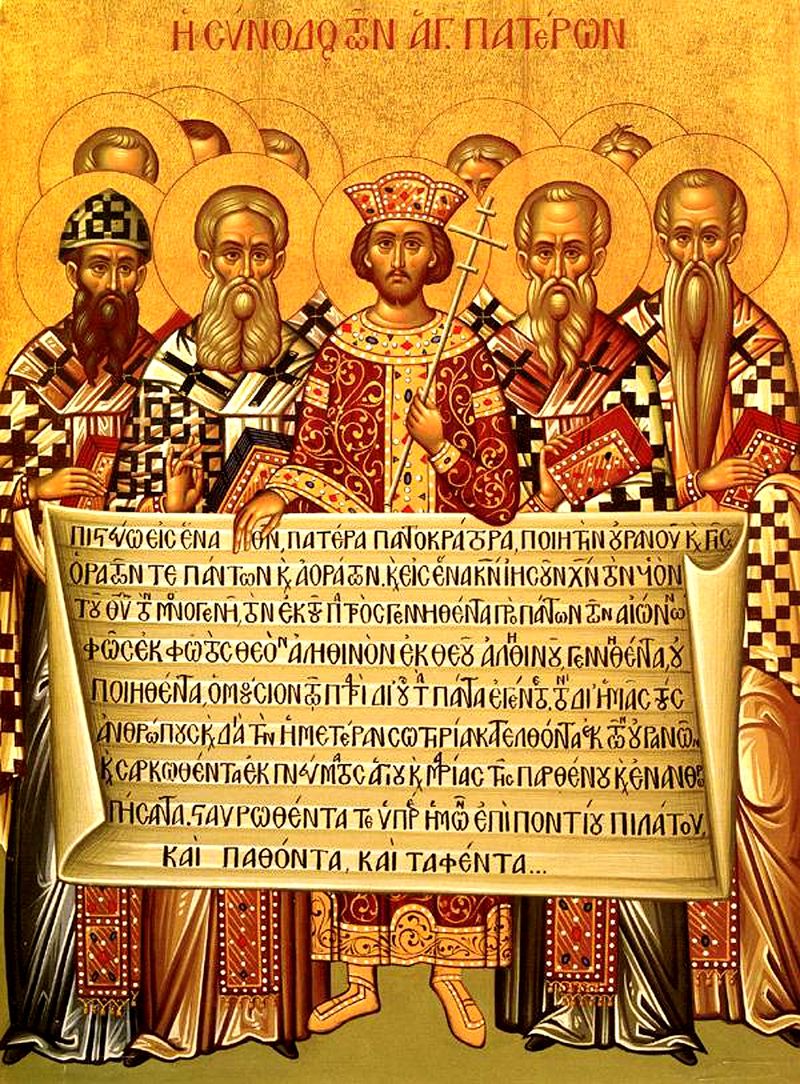
The First Council of Nicaea: What It Decided and Why It Matters
What happened at the First Council of Nicaea in 325 AD? A Catholic examination of the Arian crisis, the meaning of homoousios, and why the Nicene Creed still defines Christian orthodoxy.
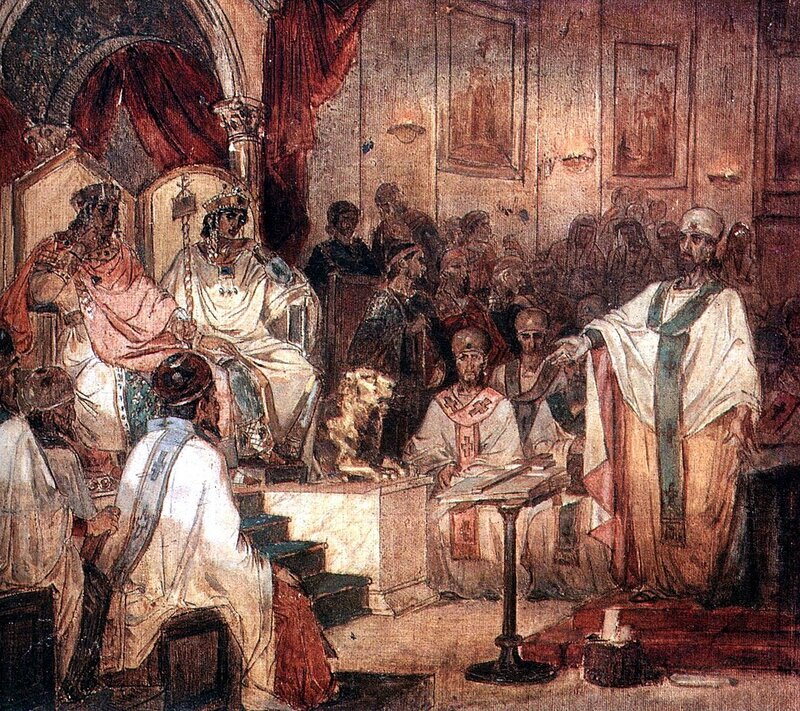
The Council of Chalcedon (451): How Political Rivalry Reshaped Christendom
The Council of Chalcedon (451 AD) resolved a Christological crisis but reshaped the political map of Christendom. How it destroyed Alexandria, elevated the papacy, and set the stage for the Great Schism.
The Meletian Schism: The Egyptian Church Crisis That Shaped Nicaea
The Meletian Schism divided the Egyptian church over lapsed Christians during the Diocletian persecution. Learn how it shaped the Council of Nicaea's Canon 6 and intersected with Arianism.
Stay Informed
Get new writing on faith, law, and service delivered to your inbox.
No spam. Unsubscribe anytime.