Why Did Jesus Give Mary to John at the Cross?
On This Page
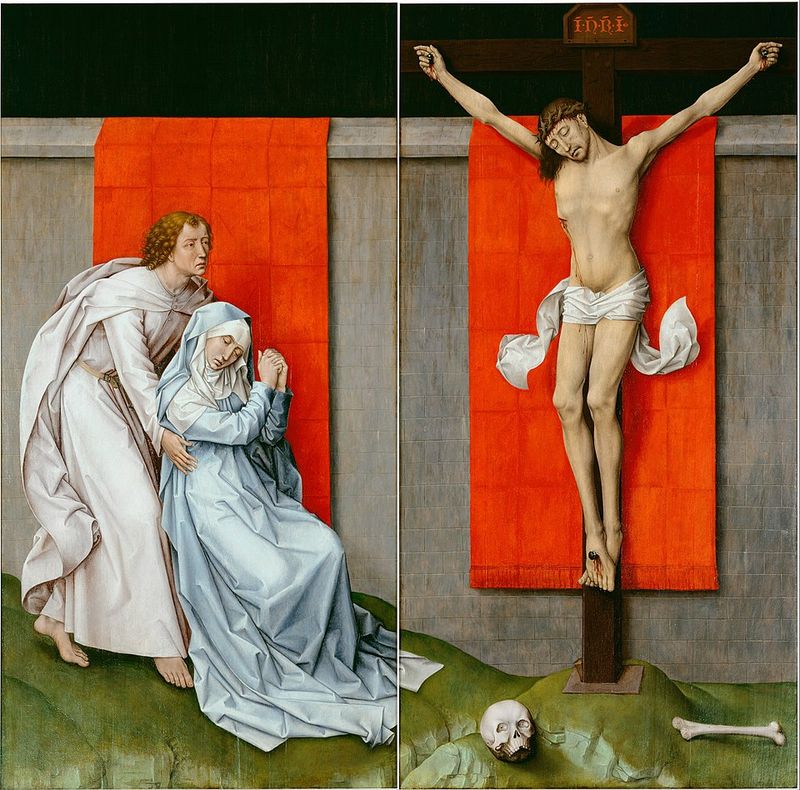
In the final moments before his death, as soldiers divided his garments and the weight of crucifixion crushed the breath from his lungs, Jesus paused to address his mother. “Woman, behold your son,” he said, looking toward the disciple whom he loved. Then, to that disciple: “Behold your mother” (John 19:26-27).
At first glance, this looks like a dying son making practical arrangements. His mother would need someone to care for her after he was gone. The Beloved Disciple was standing right there. It was a tender, filial gesture — nothing more.
But that reading, while not wrong, barely scratches the surface. If all Jesus wanted was to ensure his mother had a roof over her head, the passage would be unremarkable — a footnote in the passion narrative that readers would scarcely notice if it were missing. Instead, the Evangelist places it at the theological center of the crucifixion scene, sandwiched between the division of Jesus’ garments (fulfilling Psalm 22:18) and his declaration that “it is finished.” That placement is not accidental. Something far more significant is happening here than estate planning from the cross.
For a comprehensive analysis of Mary’s role across the entire Fourth Gospel, see my article on the mother of Jesus in John.
The Surface Answer: His Brothers Were Not Believers
The most common explanation for why Jesus gave Mary to John rather than to his own brothers is straightforward: his brothers did not believe in him. The Gospel makes this explicit. “For not even his brothers were believing in him” (John 7:5).
This is the answer you will find on sites like GotQuestions.org, and it is accurate as far as it goes. Jesus’ brothers were not present at the cross. They had not followed him. They did not yet understand who he was. It would have made little sense for Jesus to entrust his mother to men who rejected his mission and his identity.
There is also a practical dimension. In the ancient Mediterranean world, a widow’s security depended on the men in her household. If Jesus’ brothers were hostile to his movement — or at minimum unsympathetic — placing Mary in their care could have meant isolating her from the community of believers that had formed around Jesus during his ministry.
So the surface answer holds up. But it explains the negative (why not the brothers) without adequately addressing the positive (why this disciple, and why in this way). The Evangelist is doing something more deliberate, more theologically loaded, than simply identifying the next available caretaker.
Kingdom Relations over Blood Relations
Throughout the Gospels, Jesus consistently redefines the boundaries of family. In the Synoptics, when told that his mother and brothers are waiting outside, he gestures to his disciples and declares, “Here are my mother and my brothers” (Matt 12:49; cf. Mark 3:34). The kingdom of God creates new kinship structures that supersede biological ones.
John’s Gospel makes this point with particular force at the cross. The crucifixion is not merely an execution in John; it is the “hour” of Jesus’ glorification, the moment toward which the entire narrative has been building (cf. John 2:4; 7:30; 12:23; 13:1; 17:1). And it is precisely at this hour — not before, not after — that Jesus establishes a new family.
The contrast with his brothers is intentional. In John 7, Jesus tells his brothers that “the world cannot hate you” (7:7), a sharp distinction from his prayer for his disciples, whom the world hates because “they do not belong to the world” (17:14). His brothers belong to the existing order. The Beloved Disciple belongs to the new one. By commending his mother to the disciple rather than to his brothers, Jesus enacts the very kingdom ethic he has been teaching: spiritual kinship, born of faithfulness and love, takes precedence over blood.1
This is consistent with the subversive character of John’s crucifixion narrative. Just as the cross itself inverts expectations — what should be shame becomes glory, what should be defeat becomes victory — so the commendation inverts the expected family order. The brothers who should care for the mother are bypassed. A non-relative steps into the role of son. The old household gives way to the new one.
For more on what it means to belong to this new body of Christ, the community that Jesus forms through his death and resurrection, see my earlier discussion of the corporate nature of Christian faith.
The Adoption Language
The formula Jesus uses is striking. “Behold your son” and “Behold your mother” are not casual observations. They are performative declarations — words that accomplish what they describe. Scholars have long recognized the adoption language at work here.2
Beasley-Murray draws a parallel to Tobit 7:11, where the father says to Tobias upon his betrothal to Sarah, “From now on you are her brother, and she is your sister.” The declaration creates the relationship. In the same way, Jesus’ words do not merely acknowledge an existing bond between the Beloved Disciple and his mother; they forge a new one.3
The bidirectional nature of the declaration matters. Jesus does not simply tell the Beloved Disciple to take care of his mother and leave it at that. He addresses both parties, charging each with obligations toward the other. The mother gains a son. The son gains a mother. This is not a one-way transaction of care but the creation of a mutual, familial bond.
The Greek vocabulary reinforces this reading. The word for “woman” (gynai) can also mean “wife” (e.g., Matt 5:31; 14:3). The word for “he took” (elaben) appears elsewhere in the specific context of taking a wife (Mark 12:19-21; Luke 20:28-31).4 This is not to suggest a romantic dimension, but rather that the language the Evangelist employs carries connotations of formal household incorporation. The Beloved Disciple does not merely offer Mary a spare room. He takes her into his household as his own mother.
For more on why Jesus addresses his mother as “woman” — a term that has puzzled readers for centuries — and what it reveals about their relationship in John’s Gospel, see my dedicated analysis of that question.
Eis ta idia: A Prologue Connection
One of the most overlooked details in John 19:27 is the phrase that describes what the Beloved Disciple does after receiving Jesus’ command. The Greek reads: kai ap’ ekeines tes horas elaben ho mathetes auten eis ta idia — “and from that hour the disciple took her into his own.”
Most English translations render eis ta idia as “into his home” (ESV, NIV) or “to his own home” (KJV, NRSV). That translation is defensible, but it domesticates a phrase that carries far greater theological weight in John’s Gospel.
The same expression appears in the Prologue. “He came to his own (eis ta idia), and his own people did not receive him” (John 1:11). This is one of the most tragic lines in all of Scripture — the Word who made the world enters it, and the world refuses him. The phrase appears again in John 16:32, where Jesus tells his disciples that the hour is coming when they will be “scattered, each to his own (eis ta idia),” abandoning him.
The verbal echo is unmistakable. At the beginning of the Gospel, Jesus comes eis ta idia and is rejected. As the passion approaches, his disciples scatter eis ta idia, each retreating to their own concerns. But here, at the cross, the Beloved Disciple takes the mother of Jesus eis ta idia — and this time, the reception is not rejection but welcome.5
The Prologue’s tragedy is reversed. The one who was not received “into his own” now has his mother received “into his own” by the disciple who stayed. The theological architecture of John’s Gospel comes full circle at the foot of the cross. For an exploration of the Prologue’s claims about the Word and its relationship to all that follows, see my analysis of “In the beginning was the Word” (John 1:1).
Raymond Brown notes that the phrase eis ta idia “entails more than just taking her into his house to give her shelter.”6 It means incorporating her into everything that belongs to the disciple — his life, his community, his mission. The Beloved Disciple does not simply provide for Mary. He receives her as the defining relationship of his household.
The Source Behind the Source
This brings us to what I believe is the most significant — and most frequently overlooked — dimension of the commendation. The Beloved Disciple is widely understood to be the authority behind the Fourth Gospel. Whether he physically wrote it or served as its authoritative source, the Gospel claims his testimony as its foundation: “This is the disciple who is bearing witness about these things, and who wrote these things, and we know that his testimony is true” (John 21:24).7
But from where does the Beloved Disciple derive his authority? Partly from his proximity to Jesus, of course — he is the one who reclined on Jesus’ breast at the Last Supper (13:23), who stood at the foot of the cross, who outran Peter to the empty tomb (20:4). But Jesus had many disciples. He had twelve apostles. Several of them witnessed many of the same events.
What I propose distinguished the Beloved Disciple was this: he had the mother.
By commending Mary to the Beloved Disciple’s household, Jesus gave him access to the one person who could testify to the full scope of Jesus’ life — from birth to death and everything in between. The mother of Jesus knew things no disciple could know. She was present at the beginning, and she was present at the end. She had raised him, watched him grow, and understood him with an intimacy that no amount of discipleship could replicate.8
As I argue in my full analysis of this passage, the Evangelist’s purpose in recording the commendation is not merely to document a touching moment. It is to cite the mother of Jesus as a named source for the Gospel’s composition. The phrase “from that hour” (ap’ ekeines tes horas) indicates that the mother was in the Beloved Disciple’s household from the moment of Jesus’ glorification onward — which means she was there when the Gospel traditions were being preserved, shaped, and eventually written down.
This is where the passage becomes genuinely subversive, if this reading is correct. On this analysis, a woman was the source of authority for the Beloved Disciple.9 In a world where women’s testimony was legally suspect and their names were often suppressed in public discourse (cf. Thucydides II.45.2), the Evangelist grounds the authority of his Gospel in the witness of Jesus’ mother. I argue that the Beloved Disciple’s credibility does not rest solely on his own eyewitness experience. The claim advanced here — that it rests in part on his unique access to Mary — is not a standard position in Johannine scholarship but is the central thesis of this analysis and of my longer study of the mother of Jesus as a named source.
John does not include a birth narrative. He does not need one. The mother is the birth narrative.10 Her presence in the Beloved Disciple’s household serves as a standing testimony to Jesus’ full humanity — a point of particular importance given the Evangelist’s likely concern with Docetism, the heresy that Jesus only appeared to be human.11
Conclusion
The question “Why did Jesus give Mary to John?” deserves more than a one-sentence answer. Yes, Jesus’ brothers were not believers. Yes, the Beloved Disciple was a faithful follower who was present at the cross. These facts explain the logistics. They do not explain the theology.
What Jesus accomplished in John 19:26-27 was the creation of a new household — the household in which the Gospel of John would be composed. He placed his mother, the most authoritative witness to his life, into the care of the disciple whose testimony would become the foundation of the Fourth Gospel. He did this at the hour of his glorification, using the formal language of adoption, with a phrase that echoes and reverses the Prologue’s central tragedy.
This was not an afterthought squeezed between more important events. It was a deliberate, theological act — one that reshaped the Beloved Disciple’s authority, honored the mother’s irreplaceable witness, and established the community from which one of the most profound texts in human history would emerge.
Frequently Asked Questions
Why didn’t Jesus give Mary to his brothers?
Jesus’ brothers did not believe in him during his ministry (John 7:5) and were not present at the crucifixion. More fundamentally, Jesus was establishing that kingdom relations supersede blood relations. The cross was the hour of his glorification, and the new family he created there — the Beloved Disciple and his mother bound together by his word — represented the new order of the kingdom rather than the old order of biological kinship.
What does “into his own” mean in John 19:27?
The Greek phrase eis ta idia is usually translated “into his home,” but it carries deeper significance. The same phrase appears in John 1:11 (“He came to his own, and his own did not receive him”) and John 16:32 (the disciples scattering “each to his own”). At the cross, the Beloved Disciple’s reception of the mother reverses the Prologue’s rejection. The phrase means more than physical shelter; it signifies full incorporation into the disciple’s household, life, and mission.
Is the Beloved Disciple the same as the Apostle John?
Ancient sources — including Irenaeus, Clement of Alexandria, and Tertullian — identify the Beloved Disciple as the Apostle John. Modern scholarship has questioned this identification, though the debate remains unsettled. For the purposes of the Gospel’s own claims, what matters is that the Beloved Disciple is presented as the authoritative eyewitness behind the text (John 21:24), regardless of whether he is identical with the son of Zebedee.12
Was Mary a source for the Gospel of John?
The textual evidence strongly suggests so. By taking the mother of Jesus into his household “from that hour” (John 19:27), the Beloved Disciple gained access to the one person who could attest to the full arc of Jesus’ life — from birth to death. The Gospel’s emphasis on this arrangement, placed at the theological center of the crucifixion narrative, functions as a citation of the mother as a source whose witness undergirds the Gospel’s claims of authority and reliability.
Footnotes
-
On kingdom relations superseding blood relations in the Fourth Gospel, see Craig S. Keener, The Gospel of John: A Commentary, 2 vols. (Peabody, MA: Hendrickson, 2003), 2:1144-45; see also Ritva H. Williams, “The Mother of Jesus at Cana: A Social-Science Interpretation of John 2:1-12,” The Catholic Biblical Quarterly 59, no. 4 (October 1997): 691. ↩
-
George R. Beasley-Murray, John: Revised Edition, ed. Peter H. Davids, Word Biblical Commentary (Nashville: Thomas Nelson, 1999), 349. ↩
-
Beasley-Murray, 349. Brown argues the phrasing is instead an example of the Evangelist’s revelatory formula, but the adoption reading better accounts for the bidirectional nature of the exchange. See Raymond E. Brown, The Gospel According to John, ed. William Foxwell Albright and David Noel Freedman, 2 vols., The Anchor Bible (New York: Doubleday, 1966), 2:923. ↩
-
BDAG, s.v. “γυνή,” “λαμβάνω.” ↩
-
On the verbal connections between John 1:11, 16:32, and 19:27, see Brown, John, 2:923; C. Marvin Pate, The Writings of John: A Survey of the Gospel, Epistles, and Apocalypse (Grand Rapids, MI: Zondervan, 2011), 204. ↩
-
Brown, John, 2:906; see also Leon Morris, The Gospel According to John, ed. Gordon D. Fee, The New International Commentary on the New Testament (Grand Rapids, MI: Eerdmans, 1995), 718. ↩
-
On the Beloved Disciple as the authority behind the Fourth Gospel, see Brown, John, 1:LXXXVII-LXXXVIII; Keener, 1:83; Beasley-Murray, lxxi-lxxii. ↩
-
Joseph A. Grassi, “The Role of Jesus’ Mother in John’s Gospel: A Reappraisal,” The Catholic Biblical Quarterly 48, no. 1 (January 1986): 74; Lilly Nortje-Meyer, “The Mother of Jesus as Analytical Category in John’s Gospel,” Neotestamentica 43, no. 1 (2009): 139. ↩
-
Beasley-Murray, lxxi: “Jesus committed his mother to the Beloved Disciple, so the followers of Jesus should resort to him for knowledge of him.” ↩
-
Nortje-Meyer, 131. ↩
-
On the Evangelist’s concern with Docetism, see Udo Schnelle, Antidocetic Christology in the Gospel of John: An Investigation of the Place of the Fourth Gospel in the Johannine School, trans. Linda M. Maloney (Minneapolis: Fortress Press, 1992), 16-18; Beasley-Murray, 356; D. A. Carson, The Gospel According to John, ed. D. A. Carson, The Pillar New Testament Commentary (Leicester, England: Apollos, 1991), 623. ↩
-
Brown, John, 1:LXXV; Keener, 1:91-100; Pate, 19-23. ↩

Garrett Ham
Garrett Ham is an attorney, military veteran, and holds a Master of Divinity from Yale Divinity School. He writes from Northwest Arkansas on theology, law, and service.
More about Garrett →Related Posts
The Mother of Jesus as a Named Source in John
An analysis of John 19:26-27 arguing that Mary, the mother of Jesus, served as a named source for the Gospel of John. Based on a paper from Yale Divinity School.
Why Did Jesus Call His Mother 'Woman'?
Jesus addresses Mary as 'woman' at Cana and from the cross — a choice that puzzles modern readers. Here's what the Greek actually means and why it matters for understanding John's Gospel.
The Parallels Between Cana and Calvary in John's Gospel
The wedding at Cana and the crucifixion share extraordinary parallels — drink, thirst, the hour, and the mother of Jesus. These connections are the key to understanding John's Gospel.
Stay Informed
Get new writing on faith, law, and service delivered to your inbox.
No spam. Unsubscribe anytime.